
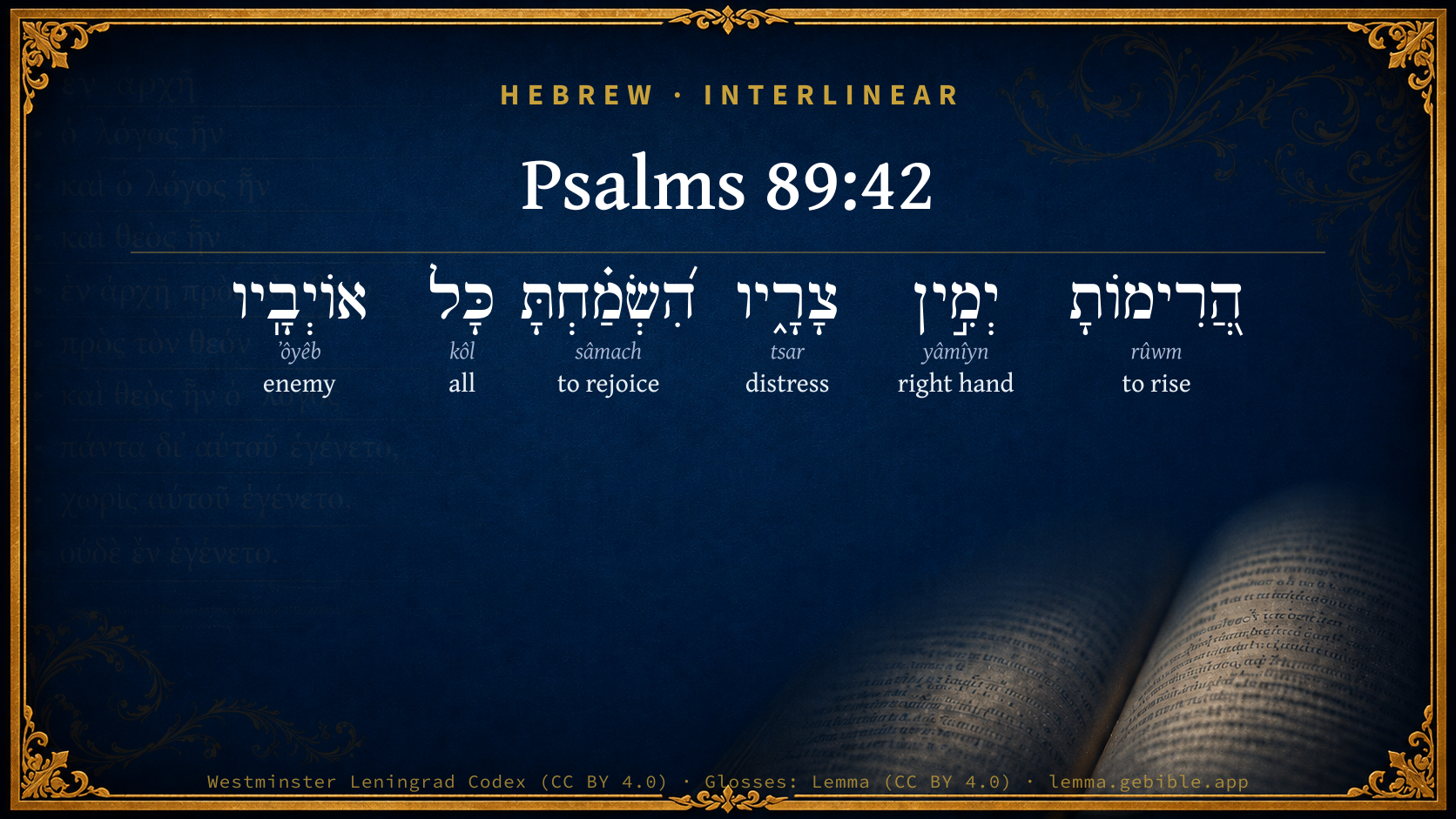
Psalms 89:42

Hebrew (Westminster Leningrad Codex) Psalms 89:42 appears in the Hebrew Old Testament. The text above is from the Westminster Leningrad Codex. Each word links to its Strong’s number, a concise gloss, and parsing drawn from the Open Scriptures Hebrew Bible morphology. Click any word for its full Brown-Driver-Briggs (BDB) entry.
Download image
Cite this verse

Psalms 89:42 (World English Bible). Public Domain. Lemma interlinear Bible study tool, https://lemma.gebible.app/v/psalms/89/42.

Show BibTeX & RIS
BibTeX
RIS
English Translation
You have exalted the right hand of his adversaries. You have made all of his enemies rejoice.
World English Bible · Public Domain
Download a study sheet

One document with this verse’s original text, its word-by-word gloss line, the meaning frame, cross-references with their text, attributed commentary, and full source and license credits — printable, and it pastes into notes with its structure intact.

This verse Autodidact and up

Study sheet (.html) Plain text (.txt)

A passage Seminary Student

Up to 50 verses in one chapter. A passage sheet keeps up to 6 commentary sources and 12 cross-references per verse, in the order this page ranks them, and says so on the sheet whenever that leaves anything out. Ask for a single verse and you get the Autodidact verse sheet above.

Everything on this page stays free to read, with no account — the sheet is a download of what is already on screen, not access to it.

Want to remove ads? Support Godless Engineer
Compare translations 3

The same verse in 3 English versions, stacked beneath the original-language interlinear above. Click any original word for its lexicon entry.

Each is an independent rendering of the whole verse — the interlinear is not word-aligned to these translations.

Highlighted words mark where these versions differ — a whole-verse word diff, not a word-by-word alignment.

  • World English Bible Public Domain
    You have exalted the right hand of his adversaries. You have made all of his enemies rejoice.
  • King James Version Public Domain
    Thou hast set up the right hand of his adversaries; thou hast made all his enemies to rejoice.
  • unfoldingWord Literal Text CC BY-SA 4.0
    You have raised up the right hand of his adversaries; you have made all of his enemies rejoice.

unfoldingWord Literal Text — © unfoldingWord, licensed CC BY-SA 4.0. Word-aligned USFM3 via Door43 (git.door43.org/unfoldingWord/en_ult).

Versions to compare (up to 4)

3 of 4 selected

Show all 18 translations

Every available English version of this verse, each an independent rendering of the whole verse.

  • World English Bible Public Domain
    You have exalted the right hand of his adversaries. You have made all of his enemies rejoice.
  • Berean Standard Bible Public Domain
    You have exalted the right hand of his foes; You have made all his enemies rejoice.
  • Majority Standard Bible Public Domain
    You have exalted the right hand of his foes; You have made all his enemies rejoice.
  • King James Version Public Domain
    Thou hast set up the right hand of his adversaries; thou hast made all his enemies to rejoice.
  • American Standard Version (1901) Public Domain
    Thou hast exalted the right hand of his adversaries; Thou hast made all his enemies to rejoice.
  • Revised Version (1885) Public Domain
    Thou hast exalted the right hand of his adversaries; thou hast made all his enemies to rejoice.
  • Geneva Bible (1599) Public Domain
    Thou hast set vp the right hand of his enemies, and made all his aduersaries to reioyce.
  • Douay-Rheims (1899) Public Domain
    All that pass by the way have robbed him: he is become a reproach to his neighbours.
  • Young's Literal Translation Public Domain
    Thou hast exalted the right hand of his adversaries, Thou hast caused all his enemies to rejoice.
  • Literal Standard Version CC BY-SA 4.0
    You have exalted the right hand of his adversaries, || You have caused all his enemies to rejoice.
  • Unlocked Literal Bible CC BY-SA 4.0
    You have raised the right hand of his enemies; you have made all his enemies rejoice.
  • unfoldingWord Literal Text CC BY-SA 4.0
    You have raised up the right hand of his adversaries; you have made all of his enemies rejoice.
  • Darby Bible Public Domain
    Thou hast exalted the right hand of his oppressors; thou hast made all his enemies to rejoice:
  • World Messianic Bible Public Domain
    You have exalted the right hand of his adversaries. You have made all of his enemies rejoice.
  • Webster's Bible Public Domain
    \\89:41\\All that pass by the way plunder him: he is a reproach to his neighbors.
  • Free Bible Version CC BY-SA 4.0
    You have made his enemies strong; you have made them celebrate their victory.
  • Bible in Basic English Public Domain
    You have given power to the right hand of his haters; you have made glad all those who are against him.
  • JPS Tanakh (1917) Public Domain
    (89-43) Thou hast exalted the right hand of his adversaries; Thou hast made all his enemies to rejoice.

Literal Standard Version (2020), Covenant Press — licensed CC BY-SA 4.0. Text via the HelloAO Bible API (eBible.org). Unlocked Literal Bible (unfoldingWord) — licensed CC BY-SA 4.0. Text via the HelloAO Bible API (eBible.org). unfoldingWord Literal Text — © unfoldingWord, licensed CC BY-SA 4.0. Word-aligned USFM3 via Door43 (git.door43.org/unfoldingWord/en_ult). Free Bible Version, Dr. Jonathan Gallagher — licensed CC BY-SA 4.0. Text via the HelloAO Bible API (eBible.org).

Word by word

More ways to search: Search by grammar → Find every occurrence → Compare this word →

Practice this passage: Drill this verse → Learn its vocabulary →

About this verse

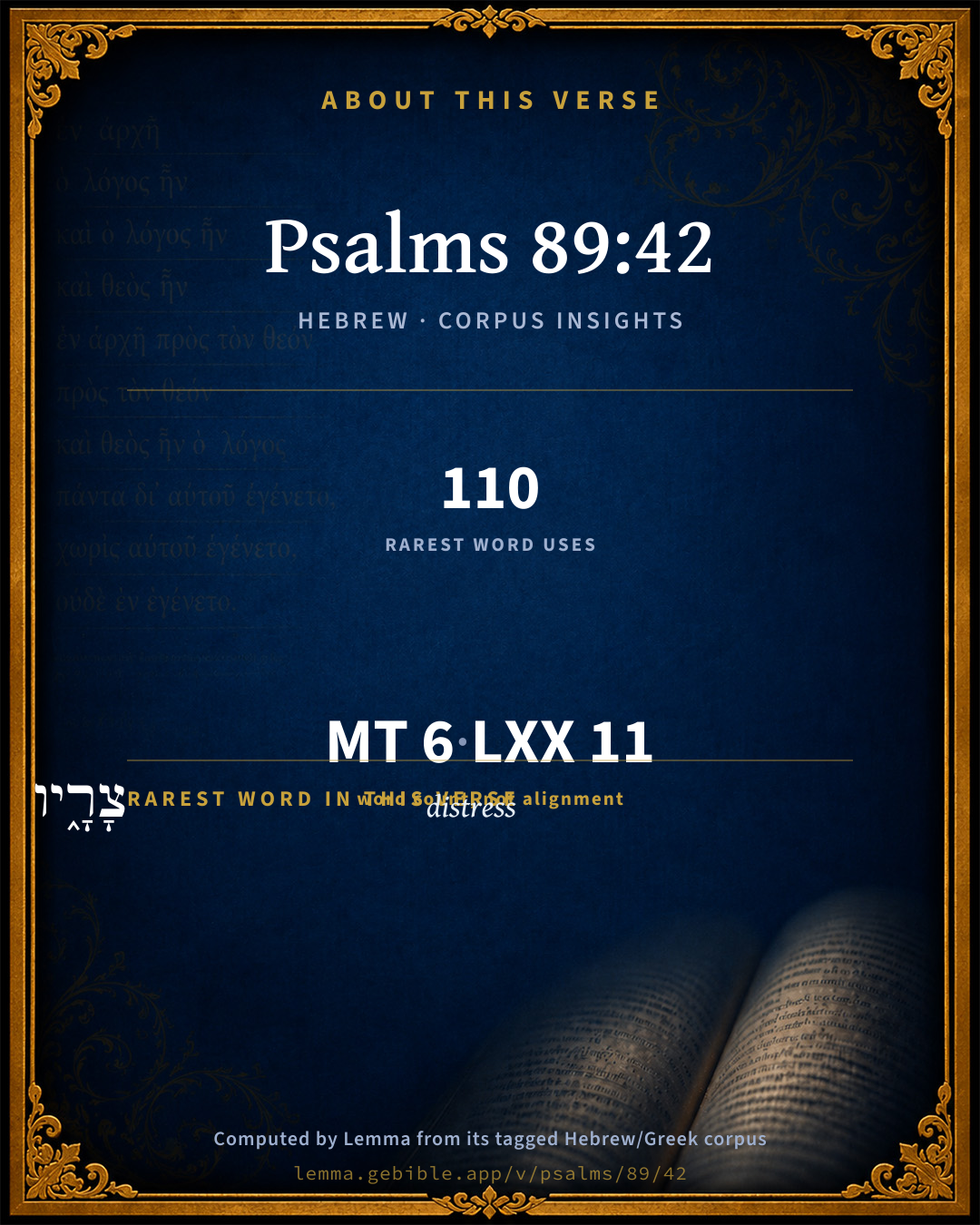
These counts appear in no published source. They are computed here, from the morphology-tagged text and Lemma’s own curated glosses. What Lemma adds →

6
words
6
distinct lemmas
Wisdom
section

Grammatical profile

  • 3 verbs
  • 3 nouns

Verb forms

  • הֲ֭רִימוֹתָ Hiphil · Perfect
  • הִ֝שְׂמַ֗חְתָּ Hiphil · Perfect
  • אוֹיְבָֽיו Qal · Participle Active

Hebrew & Septuagint length

In English translation the verse runs 17 words from the Hebrew and 17 from the Septuagint (LXX English) — the same length.

A rough comparison of the two English renderings, which tokenize alike — not a word-level alignment.

Word counts can differ between the Hebrew and the Greek without any difference in meaning — e.g. the Hebrew direct-object marker אֵת has no separate Greek word, and Greek often adds the article ὁ.

In the original languages it is 6 Hebrew tokens and 11 Greek tokens — but the two are counted differently (Hebrew bundles its prefixes and suffixes into one token; the Greek is in lemma form), so that isn’t a like-for-like length.

Cross-references

9

Topical passages linked to Psalms 89:42 in the Treasury of Scripture Knowledge — connected by theme and wording, ordered by reader-vote popularity; previews shown in the World English Bible.

  • Psalms 80:6 You make us a source of contention to our neighbors. Our enemies laugh among themselves.
  • Revelation 11:10 Those who dwell on the earth rejoice over them, and they will be glad. They will give gifts to one another, because these two prophets tormented those who dwell on the earth.
  • Leviticus 26:17 I will set my face against you, and you will be struck before your enemies. Those who hate you will rule over you; and you will flee when no one pursues you.
  • Leviticus 26:25 I will bring a sword upon you, that will execute the vengeance of the covenant; and you will be gathered together within your cities: and I will send the pestilence among you; and you will be delivered into the hand of the enemy.
  • Deuteronomy 28:25 Yahweh will cause you to be struck before your enemies; you shall go out one way against them, and shall flee seven ways before them: and you shall be tossed back and forth among all the kingdoms of the earth.
  • Deuteronomy 28:43 The foreigner who is in the midst of you shall mount up above you higher and higher; and you shall come down lower and lower.
  • Psalms 13:2 How long shall I take counsel in my soul, Having sorrow in my heart every day? How long shall my enemy triumph over me?
  • Lamentations 2:17 Yahweh has done that which he purposed; he has fulfilled his word that he commanded in the days of old; He has thrown down, and has not pitied: He has caused the enemy to rejoice over you; he has exalted the horn of your adversaries.
  • John 16:20 Most assuredly I tell you, that you will weep and lament, but the world will rejoice. You will be sorrowful, but your sorrow will be turned into joy.

Cross-references courtesy of OpenBible.info (CC BY 4.0).

Hebrew and Greek witnesses Masoretic Hebrew ↔ Greek Septuagint

The same verse in the two great witnesses to the Old Testament, shown verse-for-verse.

You’re reading Greek Psalm 88 (Hebrew Psalm 89). The Septuagint counts the superscription, so verse numbers can differ from the Hebrew — chapter-level alignment, not verse-by-verse. Numbering follows Rahlfs.

These are two independent witnesses, not word-aligned to each other, and the Septuagint is shown in lemma (dictionary) form.

Hebrew Psalms 89:42 Masoretic · Westminster Leningrad Codex

הֲ֭רִימוֹתָ יְמִ֣ין צָרָ֑יו הִ֝שְׂמַ֗חְתָּ כָּל אוֹיְבָֽיו

You have exalted the right hand of his adversaries. You have made all of his enemies rejoice.

World English Bible · Public Domain

Greek LXX Greek Psalm 88:42 Septuagint · lemma form

διαἁρπάζω αὐτός πᾶς ὁ διαὁδεύω ὁδός γίγνομαι ὄνειδος ὁ γείτων αὐτός

You have exalted the right hand of his enemies; you have made all his enemies to rejoice.

LXX2012 (modern English Septuagint) · Public Domain

Hebrew: Westminster Leningrad Codex (CC BY 4.0). Greek: Septuagint (public domain); English from LXX2012 (modern English Septuagint) (Public Domain). How the Septuagint differs from the Hebrew →

Commentary

Notes on Psalms 89:42 from classic Christian and Jewish commentators (each source and its license shown beneath its notes). The classic Christian expositions comment on the surrounding passage and are grouped to its opening verse, so a note may address several verses; the Jewish commentaries on the Tanakh (Rashi and others) are per-verse, so they appear only where the commentator wrote on this verse.

Lemma curates 59 commentaries, every one of them public domain or Creative Commons licensed, each selected and text-cleaned for this edition rather than reprinted as found. About our sources →

Trapp's Complete Commentary

John Trapp

Psa 89:42 Thou hast set up the right hand of his adversaries; thou hast made all his enemies to rejoice.

Ver. 42. Thou hast set up] Thou seemest to be on their side.

Thou hast made all his enemies] To revel in his ruins.

John Trapp, A Commentary or Exposition upon All the Books of the Old and New Testament (1647–1656) — public domain. Text from a community e-Sword module.

J. A. Alexander on Psalms

Joseph Addison Alexander

43. (Psa 89:42) Thou hast lifted the right hand of his foes, hast caused to triumph all his enemies. As the hand, and especially the right hand, is the symbol of exerted strength, and a high hand that of triumphant superiority, especially in war, so to raise the right hand in the first clause of the verse before us, really means nothing more than the literal expression (caused to triumph) in the other. This seemed to be in direct contradiction to the promise in Psa 89:22-23, as well as to the prayer in Psa 25:2.

Joseph Addison Alexander, The Psalms Translated and Explained (1850) — public domain. Text from a community e-Sword module.

Tyndale Open Study Notes

Tyndale Open Resources

89:42 Although the Lord promised to strengthen David, he secretly strengthened David’s enemies.

Tyndale Open Study Notes — © Tyndale Open Resources, licensed CC BY-SA 4.0. Text via the HelloAO Bible API.

Adam Clarke's Commentary

Verse 42. Thou hast set up the right hand of his adversaries] Thou hast given them that strength which thou didst formerly give to thy own people; therefore these are depressed, those exalted.

Adam Clarke's Commentary on the Bible (1810–1826) — public domain. Text from a community e-Sword/MySword module.

John Calvin's Commentaries

42 Thou hast exalted the right hand of his oppressors. Here he states that God took part with the enemies of the king; for he was well aware that these enemies could not have prevailed but by the will of God, who inspires some with courage, and renders others faint-hearted. In short, in proportion to the number of the calamities which had befallen the chosen people, was the number of the evidences of their having been forsaken by God; for, so long as he continued his favor, the whole world, by all their machinations, were unable to impair the stability of that kingdom. Had it been said that the enemies of the king obtained the victory, the statement would have been quite true; but it would not have been a mode of expression so obviously fitted to exalt the Divine power; as it might have been thought that men setting themselves in opposition to God had, by their own power, forced their way, and effected their purpose, even against those who enjoyed his protection. Accordingly, the prophet reflects with himself, that unless the Divine anger had been incensed, that kingdom which God had erected could not have been reduced to a condition so extremely wretched.

John Calvin's Commentaries (1540-1563) — public domain. Text from the Calvin Translation Society English edition (1840s-50s) via the Christian Classics Ethereal Library (ccel.org). Calvin's coverage is partial (roughly two-thirds of the Bible); uncommented books and verses are honest gaps, never fabricated. The 19th-century editor's footnotes and remarks are omitted so the notes are faithfully Calvin's own voice.

The Cambridge Bible for Schools and Colleges

gen. ed. J. J. S. Perowne

42. Thou hast set up] R.V. thou hast exalted. Contrast Psa_89:19; Psa_89:24.

to rejoice] The malignant delight of enemies is constantly deprecated as an aggravation of the bitterness of misfortune. Cp. Psa_25:2; Psa_30:1; Psa_35:19; Psa_35:24 ff.; Psa_38:16; and the close parallel in Lam_2:17.

The Cambridge Bible for Schools and Colleges (gen. ed. J. J. S. Perowne; Cambridge University Press, 1878–1918) — public domain. Text from a community e-Sword module.

John Gill's Exposition

Thou hast also turned the edge of his sword,.... Or the "sharpness" (a) of it blunted it, so that it could do no execution: the disciples of Christ were not allowed the use of the temporal sword to defend their master; and his house, his kingdom, not being of this world, Mat 26:51, other weapons were put into their hands; the sword of the Spirit, which is the word of God; and the edge of this was blunted, with respect to the Jews, being of little or no efficacy among them; it was turned off by them, and put away from them; but then it was turned towards the Gentiles, and was powerful and effectual among them; Christ girt it on his thigh, and rode forth in his glory and majesty, conquering, and to conquer, and by it subdued many, who fell under him, and gave up themselves unto him; see Eph 6:17, and ere long, with the twoedged sword, which proceeds out of his mouth, will he smite the antichristian nations; and the remnant of those that escape at the battle of Armageddon shall be slain with it, Rev 19:15,

and hast not made him to stand in the battle; but to fall in it, being delivered up into the hands of wicked men, of justice, and death; and yet, by dying, he put away sin, finished it, made an end of it, and destroyed it; he conquered Satan, and led him captive; overcame the world, the spite and malice of it, and its prince; and abolished death itself.

(a) "acumen", Junius & Tremellius, Piscator.

John Gill's Exposition of the Whole Bible (1746–1763) — public domain (CC PDM 1.0). Text via the HelloAO Bible API.

Albert Barnes' Notes on the Bible

Thou hast set up the right hand of his adversaries - Hast given them the victory. Thou hast suffered them to accomplish their purposes.

Thou hast made all his enemies to rejoice - They joy or rejoice in the success of their plans; in their triumphs over thy servant and over his people.

Albert Barnes' Notes on the Bible (1834–1885) — public domain. Text from a community e-Sword/MySword module.

Matthew Poole's English Annotations

Thou hast given them courage, and power, and success.

Matthew Poole's English Annotations on the Holy Bible (1683–1685) — public domain. Text from a community e-Sword/MySword module.

The Treasury of David

Charles H. Spurgeon

Ver. 42. Thou hast set up the right hand of thy adversaries. Thou hast done it, thou, who hast sworn to give him help and victory, thou hast, instead thereof, sided with his enemies, and lent them thy strength, so that they have gained the supremacy.

Thou hast made all his enemies to rejoice. They are boasting over him, and are glorying in his defeat, and this is done by thyself. O God, how is this? Where is the covenant? Hast thou forgotten thine own pledges and promises?

Psalms 89:43*

Charles H. Spurgeon's The Treasury of David (1869–1885) — public domain. Psalms only. Text from a community e-Sword/MySword module.

Whedon's Commentary on the Bible

Daniel D. Whedon

42. Set up the right hand—To do any thing with an uplifted hand was to do it proudly, defiantly, (Exo_14:8; Num_33:3,) sometimes also rebelliously. 1Ki_11:26. Contrast with Psa_89:21-22

Daniel D. Whedon (gen. ed.), Commentary on the Old and New Testaments (1874–1909) — public domain. Text from a community e-Sword module.

The Pulpit Commentary

Thou hast set up the right hand of his adversaries; i.e. " thou hast increased their power and strength, exalted them, and depressed him. Thou hast made all his enemies to rejoice. (comp. Psa_35:15, "In mine adversity they rejoiced;" and see also Mic_7:8 Oba_1:10-12) Every depression of Israel caused the neighbouring nations, who alike feared them and detested them, to rejoice.

The Pulpit Commentary (1880–1919), ed. H.D.M. Spence-Jones & Joseph S. Exell — public domain. Text from a community e-Sword module.

Lesson kit

Teaching starters — assembled from the data on this page, not authored interpretation. Every prompt links to the verse data it draws on. Edit before teaching.

Psalms, in the Wisdom, opens this verse with 6 words (6 distinct Hebrew lemmas). Its most distinctive word is tsar (“distress”). A historical commentator’s framing appears above. Read the whole chapter for the surrounding context.

Discussion questions

  1. What does “distress” (tsar) contribute to the verse as a whole?
  2. How does Psalms 80:6, which shares this passage’s theme, read alongside this verse?
  3. These translations render this verse differently. What is at stake in choosing one wording over another?
  4. «הֲ֭רִימוֹתָ» is a Hiphil Perfect verb. How does that grammatical form shape the action described?
  5. Compare how Trapp's Complete Commentary and J. A. Alexander on Psalms read this verse. Where do they agree or differ?

Things to notice

Reading settings

Reading text

Shown beneath each verse's original-language words.

Old Testament
Old Testament edition

Read the OT as the Masoretic Hebrew (MT) or the Greek Septuagint (LXX).

English shown for the Greek Septuagint (in the Hebrew ↔ Greek comparison).

Comparing translations? Open the Compare panel on any verse page to stack up to four side by side.