
Isaiah 10:15

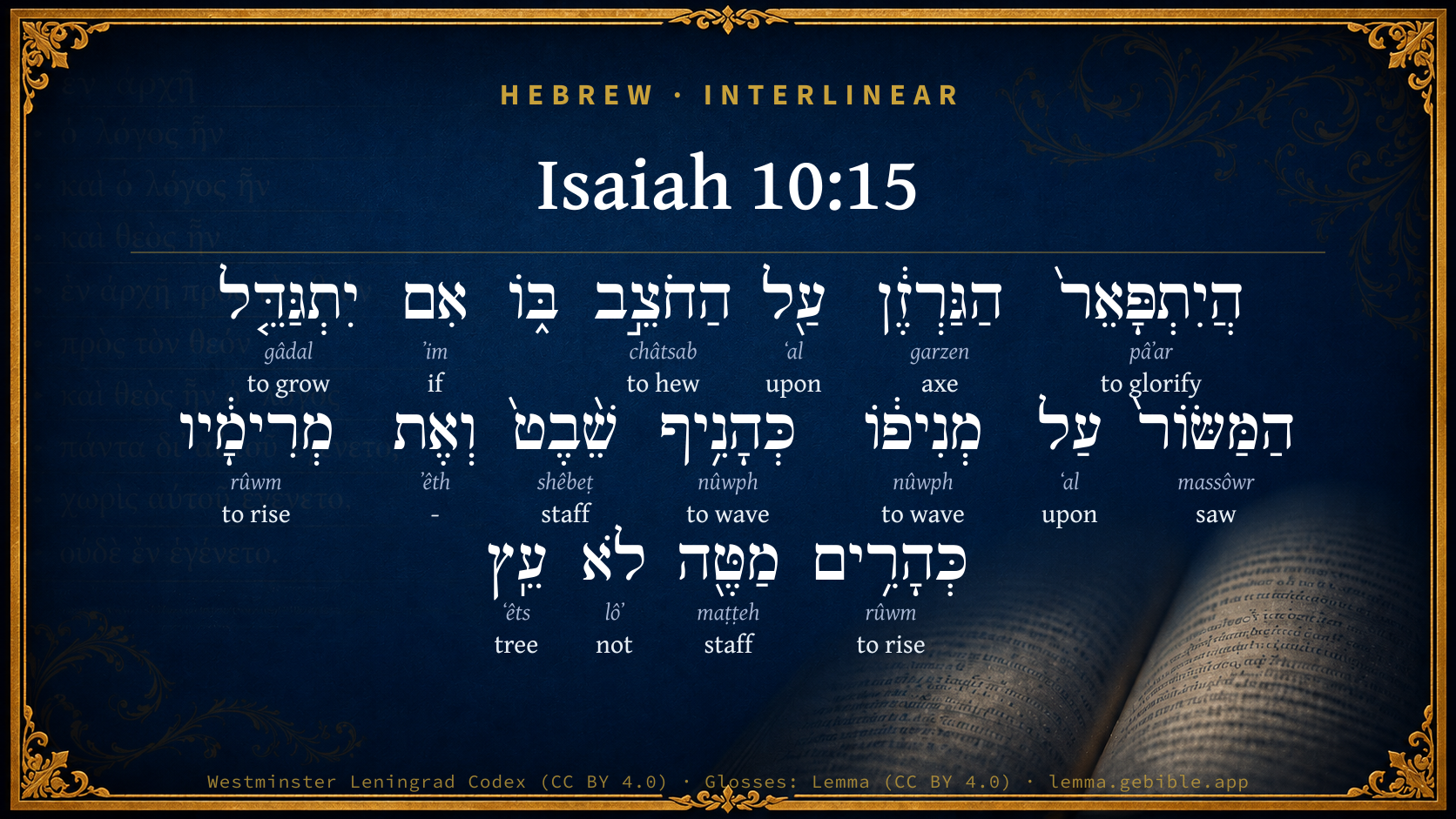
Hebrew (Westminster Leningrad Codex) Isaiah 10:15 appears in the Hebrew Old Testament. The text above is from the Westminster Leningrad Codex. Each word links to its Strong’s number, a concise gloss, and parsing drawn from the Open Scriptures Hebrew Bible morphology. Click any word for its full Brown-Driver-Briggs (BDB) entry.
Download image
Cite this verse

Isaiah 10:15 (World English Bible). Public Domain. Lemma interlinear Bible study tool, https://lemma.gebible.app/v/isaiah/10/15.

Show BibTeX & RIS
BibTeX
RIS
English Translation
Shall the axe boast itself against him who hews therewith? Shall the saw magnify itself against him who wields it? as if a rod should wield those who lift it up, [or] as if a staff should lift up [him who is] not wood.
World English Bible · Public Domain
Highlights
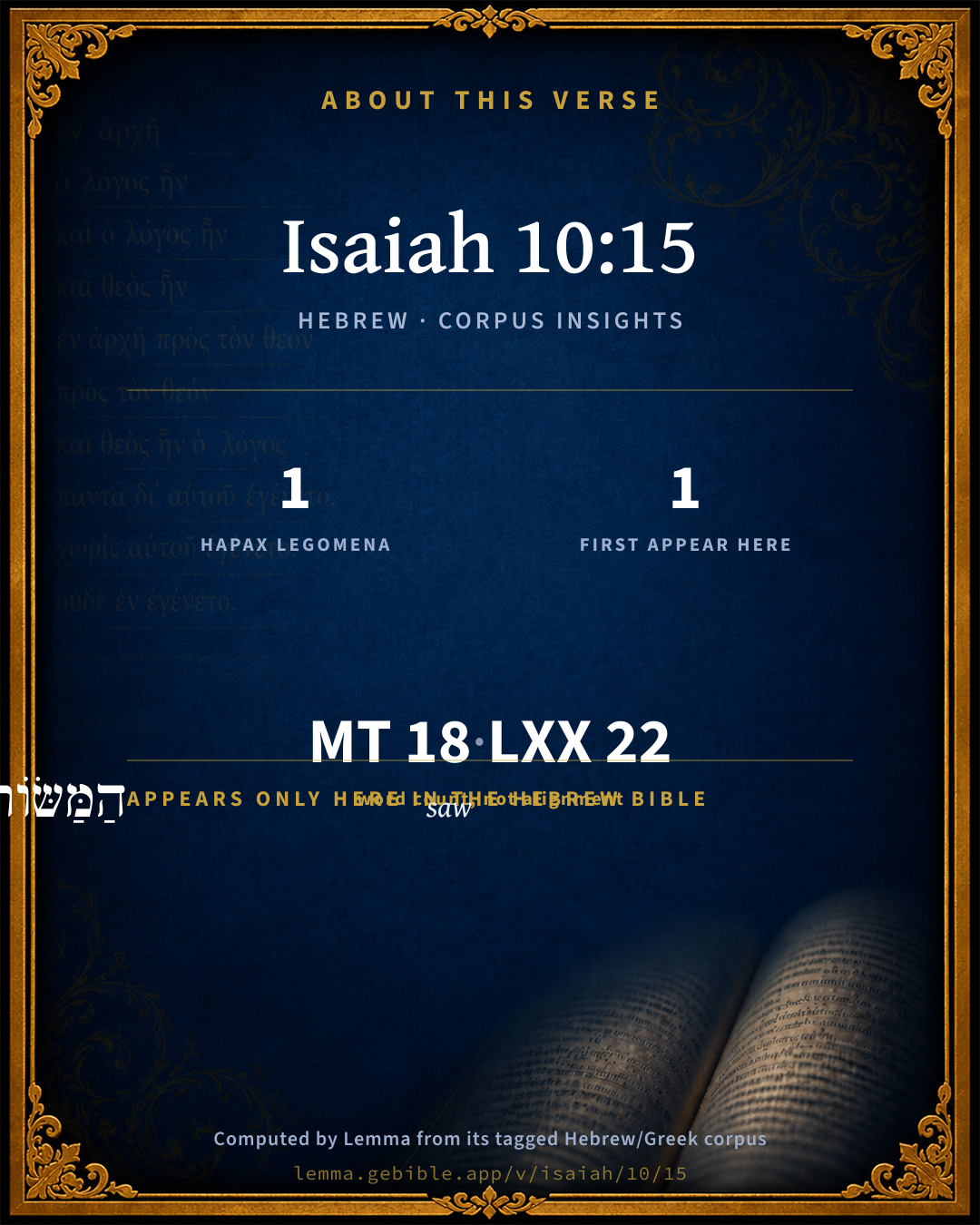
  • 1 hapax legomenon — only here in the Hebrew Bible
  • 1 first appearance in the Hebrew Bible
Full analysis ↓
Download a study sheet

One document with this verse’s original text, its word-by-word gloss line, the meaning frame, cross-references with their text, attributed commentary, and full source and license credits — printable, and it pastes into notes with its structure intact.

This verse Autodidact and up

Study sheet (.html) Plain text (.txt)

A passage Seminary Student

Up to 50 verses in one chapter. A passage sheet keeps up to 6 commentary sources and 12 cross-references per verse, in the order this page ranks them, and says so on the sheet whenever that leaves anything out. Ask for a single verse and you get the Autodidact verse sheet above.

Everything on this page stays free to read, with no account — the sheet is a download of what is already on screen, not access to it.

Want to remove ads? Support Godless Engineer
Compare translations 3

The same verse in 3 English versions, stacked beneath the original-language interlinear above. Click any original word for its lexicon entry.

Each is an independent rendering of the whole verse — the interlinear is not word-aligned to these translations.

Highlighted words mark where these versions differ — a whole-verse word diff, not a word-by-word alignment.

  • World English Bible Public Domain
    Shall the axe boast itself against him who hews therewith? Shall the saw magnify itself against him who wields it? as if a rod should wield those who lift it up, [or] as if a staff should lift up [him who is] not wood.
  • King James Version Public Domain
    Shall the axe boast itself against him that heweth therewith? or shall the saw magnify itself against him that shaketh it? as if the rod should shake itself against them that lift it up, or as if the staff should lift up itself, as if it were no wood.
  • unfoldingWord Literal Text CC BY-SA 4.0
    Does the axe exalt itself against the one hewing with it? Or does the saw magnify itself against the one moving it? As if a rod wielded its lifter! As if a club lifted not wood!

unfoldingWord Literal Text — © unfoldingWord, licensed CC BY-SA 4.0. Word-aligned USFM3 via Door43 (git.door43.org/unfoldingWord/en_ult).

Versions to compare (up to 4)

3 of 4 selected

Show all 18 translations

Every available English version of this verse, each an independent rendering of the whole verse.

  • World English Bible Public Domain
    Shall the axe boast itself against him who hews therewith? Shall the saw magnify itself against him who wields it? as if a rod should wield those who lift it up, [or] as if a staff should lift up [him who is] not wood.
  • Berean Standard Bible Public Domain
    Does an axe raise itself above the one who swings it? Does a saw boast over him who saws with it? It would be like a rod waving the one who lifts it, or a staff lifting him who is not wood!
  • Majority Standard Bible Public Domain
    Does an axe raise itself above the one who swings it? Does a saw boast over him who saws with it? It would be like a rod waving the one who lifts it, or a staff lifting him who is not wood!
  • King James Version Public Domain
    Shall the axe boast itself against him that heweth therewith? or shall the saw magnify itself against him that shaketh it? as if the rod should shake itself against them that lift it up, or as if the staff should lift up itself, as if it were no wood.
  • American Standard Version (1901) Public Domain
    Shall the axe boast itself against him that heweth therewith? shall the saw magnify itself against him that wieldeth it? as if a rod should wield them that lift it up, `or' as if a staff should lift up `him that is' not wood.
  • Revised Version (1885) Public Domain
    Shall the axe boast itself against him that heweth therewith? shall the saw magnify itself against him that shaketh it? as if a rod should shake them that lift it up, or as if a staff should lift up him that is not wood.
  • Geneva Bible (1599) Public Domain
    Shall the axe boast it selfe against him that heweth therewith? or shall the sawe exalt it selfe against him that moueth it? as if the rod shoulde lift vp it selfe against him that taketh it vp, or the staffe should exalt it selfe, as it were no wood.
  • Douay-Rheims (1899) Public Domain
    Shall the axe boast itself against him that cutteth with it? or shall the saw exalt itself against him by whom it is drawn? as if a rod should lift itself up against him that lifteth it up, and a staff exalt itself, which is but wood.
  • Young's Literal Translation Public Domain
    -- Doth the axe glorify itself Against him who is hewing with it? Doth the saw magnify itself Against him who is shaking it? As a rod waving those lifting it up! As a staff lifting up that which is not wood!
  • Literal Standard Version CC BY-SA 4.0
    Does the axe glorify itself || Against him who is hewing with it? Does the saw magnify itself || Against him who is shaking it? As a rod waving those lifting it up! As a staff lifting up that which is not wood!
  • Unlocked Literal Bible CC BY-SA 4.0
    Will the ax boast about itself against the one who wields it? Will the saw praise itself more than the one who cuts with it? It is as if a rod could lift up those who raise it, or as if a wooden club could lift up a person.
  • unfoldingWord Literal Text CC BY-SA 4.0
    Does the axe exalt itself against the one hewing with it? Or does the saw magnify itself against the one moving it? As if a rod wielded its lifter! As if a club lifted not wood!
  • Darby Bible Public Domain
    -- Shall the axe boast itself against him that heweth therewith? shall the saw magnify itself against him that wieldeth it? As if the rod should wield them that lift it up; as if the staff should lift up [him who is] not wood!
  • World Messianic Bible Public Domain
    Should an ax brag against him who chops with it? Should a saw exalt itself above him who saws with it? As if a rod should lift those who lift it up, or as if a staff should lift up someone who is not wood.
  • Webster's Bible Public Domain
    Shall the ax boast itself against him that heweth with it? or shall the saw magnify itself against him that moveth it? as if the rod should shake itself against them that lift it, or as if the staff should lift itself, as if it were no wood.
  • Free Bible Version CC BY-SA 4.0
    Does an ax say it's more important than the person swinging it? Does a saw boast that it's greater than the person sawing with it? It would be as if a rod waved the person holding it, or a walking stick lifted up a person—who certainly wasn't wood!
  • Bible in Basic English Public Domain
    Will the axe say high-sounding words against him who is using it, or the blade be full of pride against him who is cutting with it? As if a rod had the power of shaking him who is using it, or as if a stick might take up him who is not wood.
  • JPS Tanakh (1917) Public Domain
    Should the axe boast itself against him that heweth therewith? Should the saw magnify itself against him that moveth it? as if a rod should move them that lift it up, or as if a staff should lift up him that is not wood.

Literal Standard Version (2020), Covenant Press — licensed CC BY-SA 4.0. Text via the HelloAO Bible API (eBible.org). Unlocked Literal Bible (unfoldingWord) — licensed CC BY-SA 4.0. Text via the HelloAO Bible API (eBible.org). unfoldingWord Literal Text — © unfoldingWord, licensed CC BY-SA 4.0. Word-aligned USFM3 via Door43 (git.door43.org/unfoldingWord/en_ult). Free Bible Version, Dr. Jonathan Gallagher — licensed CC BY-SA 4.0. Text via the HelloAO Bible API (eBible.org).

Word by word

More ways to search: Search by grammar → Find every occurrence → Compare this word →

Practice this passage: Drill this verse → Learn its vocabulary →

הַמַּשּׂוֹר֙
massôwr
H4883
“the · saw”
Particle, Definite Article + Noun, Common, Masculine, Singular, Absolute
Part of Speech
Particle + Noun
Type
Common
Gender
Masculine
Number
Singular
State
Absolute
Full BDB Definition

Origin: from an unused root meaning to rasp

TWOT: 1423a

saw
  1. הֲיִתְפָּאֵר֙ pâʼar H6286 “to glorify” Particle, Interrogative + Verb, Hithpael, Imperfect, 3rd Person, Masculine, Singular
  2. הַגַּרְזֶ֔ן garzen H1631 “the · axe” Particle, Definite Article + Noun, Common, Masculine, Singular, Absolute
  3. עַ֖ל ʻal H5921 “upon” Preposition
  4. הַחֹצֵ֣ב châtsab H2672 “the · hewing” Particle, Definite Article + Verb, Qal, Participle Active, Masculine, Singular, Absolute
  5. אִם ʼim H518 “if” Conjunction
  6. יִתְגַּדֵּ֤ל gâdal H1431 “to grow” Verb, Hithpael, Imperfect, 3rd Person, Masculine, Singular
  7. עַל ʻal H5921 “upon” Preposition
  8. מְנִיפ֔וֹ nûwph H5130 “waving · him” Verb, Hiphil, Participle Active, Masculine, Singular, Construct + Suffix, Personal, 3rd Person, Masculine, Singular
  9. כְּהָנִ֥יף nûwph H5130 “like/as · to wave” Preposition + Verb, Hiphil, Infinitive Construct
  10. שֵׁ֨בֶט֙ shêbeṭ H7626 “staff” Noun, Common, Masculine, Singular, Absolute
  11. וְאֶת ʼêth H853 “and · -” Conjunction + Particle, Direct Object
  12. מְרִימָ֔יו rûwm H7311 “rising · him” Verb, Hiphil, Participle Active, Masculine, Plural, Construct + Suffix, Personal, 3rd Person, Masculine, Singular
  13. כְּהָרִ֥ים rûwm H7311 “like/as · to rise” Preposition + Verb, Hiphil, Infinitive Construct
  14. מַטֶּ֖ה maṭṭeh H4294 “staff” Noun, Common, Masculine, Singular, Absolute
  15. לֹא lôʼ H3808 “not” Particle, Negative
  16. עֵֽץ ʻêts H6086 “tree” Noun, Common, Masculine, Singular, Absolute

About this verse

These counts appear in no published source. They are computed here, from the morphology-tagged text and Lemma’s own curated glosses. What Lemma adds →

18
words
14
distinct lemmas
Prophets
section

Notable vocabulary

1 hapax legomenon — a word that appears only here in the entire Hebrew Bible:

  • הַמַּשּׂוֹר֙ saw H4883

First appearance in Scripture

This word makes its first canonical appearance in the Hebrew Bible here:

  • הַמַּשּׂוֹר֙ saw H4883

Shared distinctive vocabulary

הַגַּרְזֶ֔ן axe H1631 occurs in 4 verses of the Hebrew Bible. Also found in:

Grammatical profile

  • 7 verbs
  • 5 nouns
  • 3 prepositions
  • 1 conjunction
  • 2 particles

Verb forms

  • הֲיִתְפָּאֵר֙ Hithpael · Imperfect
  • הַחֹצֵ֣ב Qal · Participle Active
  • יִתְגַּדֵּ֤ל Hithpael · Imperfect
  • מְנִיפ֔וֹ Hiphil · Participle Active
  • כְּהָנִ֥יף Hiphil · Infinitive Construct
  • מְרִימָ֔יו Hiphil · Participle Active
  • כְּהָרִ֥ים Hiphil · Infinitive Construct

Repetition

Words recur within this verse — often emphatic in Hebrew:

  • עַ֖ל upon H5921 ×2
  • מְנִיפ֔וֹ to wave H5130 ×2
  • מְרִימָ֔יו to rise H7311 ×2

Hebrew & Septuagint length

In English translation the verse runs 44 words from the Hebrew and 38 from the Septuagint (LXX English) — closely comparable.

A rough comparison of the two English renderings, which tokenize alike — not a word-level alignment.

Word counts can differ between the Hebrew and the Greek without any difference in meaning — e.g. the Hebrew direct-object marker אֵת has no separate Greek word, and Greek often adds the article ὁ.

In the original languages it is 18 Hebrew tokens and 22 Greek tokens — but the two are counted differently (Hebrew bundles its prefixes and suffixes into one token; the Greek is in lemma form), so that isn’t a like-for-like length.

Cross-references

7

Topical passages linked to Isaiah 10:15 in the Treasury of Scripture Knowledge — connected by theme and wording, ordered by reader-vote popularity; previews shown in the World English Bible.

  • Romans 9:20–21 But indeed, O man, who are you to reply against God? Will the thing formed ask him who formed it, "Why did you make me like this?"
  • Isaiah 45:9 Woe to him who strives with his Maker--a potsherd among the potsherds of the earth! Shall the clay ask him who fashions it, "What are you making?" or your work, "He has no hands?"
  • Isaiah 10:5 Ho Assyrian, the rod of my anger, the staff in whose hand is my indignation!
  • Isaiah 29:16 You turn things upside down! Shall the potter be esteemed as clay; that the thing made should say of him who made it, He didn't make me; or the thing formed say of him who formed it, He has no understanding?
  • Jeremiah 51:20–23 You are my battle-axe and weapons of war: and with you will I break in pieces the nations; and with you will I destroy kingdoms;
  • Ezekiel 28:9 Will you yet say before him who kills you, I am God? but you are man, and not God, in the hand of him who wounds you.
  • Psalms 17:13–14 Arise, Yahweh, Confront him, cast him down. Deliver my soul from the wicked by your sword;

Cross-references courtesy of OpenBible.info (CC BY 4.0).

Hebrew and Greek witnesses Masoretic Hebrew ↔ Greek Septuagint

The same verse in the two great witnesses to the Old Testament, shown verse-for-verse.

These are two independent witnesses, not word-aligned to each other, and the Septuagint is shown in lemma (dictionary) form.

Hebrew Isaiah 10:15 Masoretic · Westminster Leningrad Codex

הֲיִתְפָּאֵר֙ הַגַּרְזֶ֔ן עַ֖ל הַחֹצֵ֣ב בּ֑וֹ אִם יִתְגַּדֵּ֤ל הַמַּשּׂוֹר֙ עַל מְנִיפ֔וֹ כְּהָנִ֥יף שֵׁ֨בֶט֙ וְאֶת מְרִימָ֔יו כְּהָרִ֥ים מַטֶּ֖ה לֹא עֵֽץ

Shall the axe boast itself against him who hews therewith? Shall the saw magnify itself against him who wields it? as if a rod should wield those who lift it up, [or] as if a staff should lift up [him who is] not wood.

World English Bible · Public Domain

Greek LXX Isaiah 10:15 Septuagint · lemma form

μή δοξάζω ἀξίνη ἄνευ ὁ κόπτω ἐν αὐτός ἤ ὑψόω πρίων ἄνευ ὁ ἕλκω αὐτός ὡσαύτως ἐάν τις αἴρω ῥάβδος ἤ ξύλον

Shall the axe glorify itself without him that hews with it? or shall the saw lift up itself without him that uses it, as if one should lift a rod or staff? but it shall not be so;

LXX2012 (modern English Septuagint) · Public Domain

Hebrew: Westminster Leningrad Codex (CC BY 4.0). Greek: Septuagint (public domain); English from LXX2012 (modern English Septuagint) (Public Domain). How the Septuagint differs from the Hebrew →

Targum (Aramaic paraphrase)

1

The Targum is the ancient Jewish Aramaic paraphrase of the Hebrew Scriptures — an interpretive translation, not the Hebrew text itself. Onkelos (literal) and Pseudo-Jonathan (expansive) render the Torah, and Jonathan the Prophets. Coverage is partial: where no permissively-licensed English translation exists for a verse, only the Aramaic is shown. This is verse-level text, not a word-by-word alignment to the Hebrew.

  1. Targum Jonathan Prophets (Joshua–Malachi)
    הֲאֶפְשַׁר דְיִשְׁתַּבַּח חוֹלִילָא עַל דְחָלִיל בֵּיהּ לְמֵימָר הָא אֲנָא חֲלִילַת אִם יִתְרַבְרַב מַסְרָא עַל דְנָגִיר בָהּ לְמֵימָר הֲלָא אֲנָא נַגָרִית כַּאֲרָמָא חוּטְרָא לְמִמְחֵי לָא חוּטְרָא מָחֵי אֱלָהֵן מַן דְמָחֵי בֵיהּ:

    What, is it possible that the axe should boast itself against him that heweth therewith, saying, Behold, I have cut! Or shall the saw magnify itself against him that draweth it, saying, Do I not draw? When a rod is lifted up to smite, it is not the rod that smites, but he that smites with it.

    Targum Jonathan — Aramaic: “Mikraot Gedolot” (public domain). English: “Sefaria Community Translation” (CC0 1.0 (public-domain dedication)); “London "Chaldee Paraphrase," 1871” (public domain). Text via Sefaria.

Commentary

Notes on Isaiah 10:15 from classic Christian and Jewish commentators (each source and its license shown beneath its notes). The classic Christian expositions comment on the surrounding passage and are grouped to its opening verse, so a note may address several verses; the Jewish commentaries on the Tanakh (Rashi and others) are per-verse, so they appear only where the commentator wrote on this verse.

Lemma curates 59 commentaries, every one of them public domain or Creative Commons licensed, each selected and text-cleaned for this edition rather than reprinted as found. About our sources →

Trapp's Complete Commentary

John Trapp

Isa 10:15 Shall the axe boast itself against him that heweth therewith? [or] shall the saw magnify itself against him that shaketh it? as if the rod should shake [itself] against them that lift it up, [or] as if the staff should lift up [itself, as if it were] no wood.

Ver. 15. Shall the axe boast itself.] Is not God the architect and chief agent - the Assyrian only the instrument in his hand? What a madness, then, is it for him thus to vaunt and vapour? is the man in his right mind, think ye? How much better that victorious emperor, Charles V, who, instead of Caesar’s Veni, vidi, vici, I came, i saw, I conquered, wrote Veni, vidi, sed Christus vicit! I came, I saw, but Christ conquers, Christ is the only conqueror.

As if the staff should lift up itself.] Or, When the rod is lift up, is it not wood, lignum inanime, sorry wood?

John Trapp, A Commentary or Exposition upon All the Books of the Old and New Testament (1647–1656) — public domain. Text from a community e-Sword module.

The Biblical Illustrator

Joseph S. Exell

Isa_10:15

Shall the axe boast itself against him that heweth therewith?

--

The Divine supremacy

All the various orders of creatures, natural and supernatural, animate and inanimate, are under the control of the Divine Being, who uses them for the accomplishment of His own purposes. The Assyrians were not conscious of being the Lords servants; it was, therefore, no virtue in them to be employed in His service. Mark the speech of the king of Assyria, it is vain and fulsome enough. Here observe--

I. THE SOVEREIGNTY OF GOD.

1. This is a doctrine of Scripture.

2. The term sovereignty is suitable here, since it is significant of the supremacy of the Divine Being. Where shall we go for manifestations of the Divine sovereignty?

(1) To creation.

(2) The moral government of the world furnishes the most striking illustration of the Divine sovereignty.

II. THE SUBJECTION OF MEN.

1. Man is not a merely passive instrument, but an active being, dependent upon and under the control of his Maker.

2. Man is a voluntary agent, has in possession a power which we call will, and an awful power it is either for good or evil. It imports responsibility.

3. Still, whatever may be said about the will of man, or the will of a nation, considered as a power, it must be allowed that man and his circumstances, that nations with all their complicated affairs, are under the control of the Divine Being.

4. The Divine Being is still at the head of the nations of the earth, directing and controlling all their affairs, for the accomplishment of His own ends; just as a man directs and controls the mountain stream, for the working of his mill, or the watering of his lands.

III. THE SIN OF SLIGHTING THE DIVINE BEING.

1. It is obvious that man has no choice as to whether or no he will have to do with his Maker. Mans choice is as to whether or no he will pursue a line of conduct befitting the relation in which he stands to God; whether he will obey or disobey, honour or slight God.

2. It is in the very nature of a creature to be dependent; man is a creature, and therefore dependent upon God for everything essential to his temporal welfare; and certainly not less so for everything essential to his spiritual welfare.

3. It is therefore irrational, and indeed grossly sinful, for those who excel others in station, in fortune, in respect to anything that may be justly deemed an advantage, to ascribe the difference altogether, or even mainly to their own skill and efforts; as though there were no God, or as though

He were unable, or unwilling, to interfere with human affairs (1Co_4:7).

4. God is jealous of His honour. He cannot give His glory to another.

5. The case of Nebuchadnezzar, as recorded in Dan_4:1-37, furnishes a remarkable illustration of the supremacy of the Divine Being, and of the sin of alighting it. We infer--

(1) That it is the will of God that there should be various distinctions among men with regard to circumstances; that some should be above others.

(2) It is the imperative duty of man, whatever his rank or position in society, to acknowledge the Divine Being uniformly and constantly.

(3) The Divine supremacy ought to be cheerfully acknowledged in every, household.

(4) Let the nations of the earth acknowledge the Divine authority.

(5) The Church especially is bound to honour God. (W. Winterburn.)

The worker and his tools

These words describe one of the common temptations of strong men in every sphere of action. Pointing to power in the sphere of human industry, we say, Shall the earn boast itself against him that heweth therewith?

I. THE REAL CONNECTION OF HUMAN INDUSTRY WITH GOD. Useful and fine art belongs to the original idea of man as a working being. Man is conformed to the design of his nature when muscle and nerve, mind and heart, are taxed in the productions of human industry.

1. This is made evident by the constitution of man. Sinfulness does not belong to the Divine ides of man. Hence mans inward nature does not approve of sin. But industry produces no such stress and confusion in the soul.

2. This is further seen in the kind of world which God has made our present home. Some things He has hidden, and others so constituted that we must search, discover, adapt, apply, and manufacture, before we can get from the earth (although full of Gods riches) what we really need. The toil and sorrow which are now connected with labour do not pertain to the original ordinance of labour. But even this discipline is merciful. In prison labour the criminal is sometimes required to turn a wheel connected with a loaded crank. The power is applied to no useful purpose, but is merely intended to weary the prisoner, and thus to punish him. And one bitter element in this correction is this, the prisoner knows that his labour produces nothing. Now, God has superadded toil to work, but with toil He has connected increase.

3. The mode in which Scripture speaks of the arts sustains the doctrine we now propound. Not one word is written in the Bible against the highest development of human industry. On the contrary, much is to be found in the Scriptures of the nature of sanction. When the desire to possess the products of industry becomes lust, and when the possession involves pride, then the creations of art assume a position and sustain a relation which is of the world, and not of the Father. But this shows that the evil is in the excess, and not in the thing itself. The New Testament confirms our remarks. Jesus Christ was the reputed son of an artisan, and, though He chose a condition of poverty, He did not clothe Himself in sackcloth nor refuse to partake of the luxuries of the rich. Not a word did He say against human industry, although He reprobated and denounced every vice and feller of His times, and at the time of His death He was wearing an entire woven coat, for which Roman soldiers cast lots. The apostles trod in the steps of the Saviour. Paul does not require Lydia, a seller of purple, to change her occupation. Let us learn to separate human handiwork from human sin. Art is safe when God is recognised in it.

II. THE DISCONNECTION OF INDUSTRIAL PURSUITS FROM GOD IN THE MINDS OF MEN GENERALLY. Men have either excluded God entirely from art, or they have worked as if on Divine sufferance. And because God has not been in their thoughts, they have felt that God was not in their craft, and they have taken to themselves all the glory. While idolaters have had a God for every art and for all important branches of human enterprise, Christians have too often thought that they must call art the world, and while they use and enjoy its varied products, verbally abuse them. We do not so read human nature. We do not so read Divine providence. We do not so read our Bible. And we are warned against this spirit by the words before us. Man is made a producer; and when he produces by his labour he fulfils one part of his mission. Now in this shall God be forgotten! God! whose earth this is? God! whose are the precious and the useful metals, and to whom belong the trees of the forest and the cattle upon the hills? Shall God be forgotten? God! we are His workmen; we use His tools; we employ His materials, and we labour in His factory. God forgotten? How unseemly and ungrateful is this!

1. The evil complained of in the text may exist either in a negative or a positive state. Say that God is not in the thoughts. There is no rejection of God, but God is not present. The man thinks of himself--he does not think of God.

2. The sources of this evil are religious ignorance and alienation from God.

3. The forms in which this evil is developed are such as these--Gods law is not applied to human labour. Work is not performed in a devotional spirit. Gods honour is not sought thereby. And you have one of two things--a man in appearance everywhere irreligious, or a man in appearancereligious everywhere but in his business. And then what have you? A whited sepulchre, a man-lie, or a rebel, open and avowed, against God the Creator. Trace this to its results. Banish religion from human industry, and you remove the chief salutary restraint! Then man will hold his brother in slavery; then men will cheat and lie and overreach and keep back the hire of the labourer.

4. The doctrine of what is commonly termed Justification by faith, has a most intimate connection with this subject. The substance of that doctrine is, that when a sinner truly repents and believes in Jesus Christ, God, instead of putting him upon a probation, immediately receives him to childlike communion. This shows that a Christian may at once have communion with God on every subject that concerns him.

5. Pride, covetousness, oppression, and cruelty are the four transgressions, chiefly named as Gods reason for the overthrow of Nineveh and Babylon, Egypt and Tyre. Without true religion the progress of art fosters these evils.

6. The duties especially incumbent upon the Christians of this land, in connection with their daily labour, are, the unfailing recognition of Divine providence, humility, justice, and kindness. There are no colours so brilliant, no forms so graceful, no combinations so complete, no products so perfect and abundant as those which exist apart from human skill and toil. Man, in comparison with the Great Worker, has done nothing.

7. You will not have failed to mark Gods calling the mightiest by this name, axe and saw; also Gods intimating the uselessness of all boasting, as if it were no wood; and Gods threatening to teach the axe and saw their real position; and you will take this lesson--if we do not make God of infinitely more consequence than man, He will make us feel how much lower than man His curse can sink us; and then, when like

Nebuchadnezzar, we feel less and lower than man, we may, in this severe school, learn to praise, and extol, and honour the King of heaven, all whose works are truth, and all whose ways are judgment, and who is able to abase those that walk in pride. (S. Martin.)

Proud boastings not overlooked by God

God keeps an account of all mens proud and haughty words, with which they set heaven and earth at defiance. They that speak great and swelling words of vanity shall hear of them again. (Matthew Henry.)

Absurd brag

Oh what a dust do I maker said the fly upon the cart wheel, in the fable. What destruction do I make among the trees! saith the axe. (Matthew Henry.)

God to be honoured

Bengel, when a tutor, addressing a letter to an old pupil, said, Either refrain, dear Reuss, from writing to me, or do not apply to me such superlative expressions. I should quietly, like a fond father, place it all to the account of your love, were I not afraid that my allowing it will bring upon me a heavy responsibility. For the same reason I wish it were not said here at daily prayers our most reverend tutors. I believe that if Herod had been displeased with the acclamation, It is the voice of a god and not of man, he would not have been struck dead in such a horrible manner. Gods honour is an awfully tender thing, and may be injured before we are aware.

Napoleon Bonapartes presumption

When Bonaparte was about to invade Russia, a person who had endeavoured to dissuade him from his purpose, finding he could not prevail, quoted to him the proverb, Man proposes, but God disposes; to which he indignantly replied, I dispose as well as propose. A Christian lady, on hearing the impious boast, remarked, I set that down as the turning point of Bonapartes fortunes. God will not suffer a creature with impunity thus to usurp His prerogative. It happened to Bonaparte just as the lady predicted. His invasion of Russia was the commencement of his fall. (J. Whitecross.)

The Biblical Illustrator, edited by Joseph S. Exell (c. 1880s–1900s) — public domain. Text from a community e-Sword module.

Joseph Benson's Commentary

Isa 10:15. Shall the axe boast itself, &c. — How absurd is it for thee, who art but an instrument in God’s hand, to blaspheme thy Lord and Master, who has as great power over thee as a man hath over the axe wherewith he heweth? As if the rod, &c. — See the margin; or, as if the staff, &c. — Should forget that it was wood, and should pretend, or attempt, to lift up itself — Either without, or against the man that moveth it. As if it were no wood — Literally translated, it is, As if the staff should lift up no wood; that is, should lift up man, who is very different from wood: as if the staff should lift the man instead of the man lifting the staff. In this way does the prophet refute the vain boasts of the Assyrian, and teach him, that, “in all his counsels, motions, and works, he was but the minister of the Divine Providence; incapable of doing any thing without the divine will and permission; and therefore his boasting was to be considered in no other light than as if the axe, or saw, or rod, should magnify themselves against him who handled them, and should ascribe to themselves that effect which was only caused by the mover.”

Joseph Benson's Commentary on the Old and New Testaments (1811–1818) — public domain. Text from a community e-Sword module.

Tyndale Open Study Notes

Tyndale Open Resources

10:15 ax . . . saw . . . rod . . . wooden cane: Such instruments are only as good as the person who uses them. Assyria considered itself independent of the hand of God, but their conquests were made possible only by his permission and to serve his purposes (10:5).

Tyndale Open Study Notes — © Tyndale Open Resources, licensed CC BY-SA 4.0. Text via the HelloAO Bible API.

Geneva Bible (1599)

Geneva Bible translators

Here we see that no creature is able to do anything, but as God appointeth him, and that they are all but his instruments to do his work, though the intentions be divers, as verse 6.

Geneva Bible (1599) marginal notes — public domain. Text via Bolls.life.

Jamieson, Fausset & Brown

Robert Jamieson, A. R. Fausset & David Brown

Shall the instrument boast against Him who uses it? Through free in a sense, and carrying out his own plans, the Assyrian was unconsciously carrying out God's purposes.

shaketh it--moves it back and forward.

staff . . . lift . . . itself . . . no wood--rather, "as if the staff (man, the instrument of God's judgments on his fellow man) should set aside (Him who is) not wood" (not a mere instrument, as man). On "no wood" compare Deu 32:21, "that which is not God;" Isa 31:8 shows that God is meant here by "not wood" [MAURER].

Jamieson, Fausset & Brown — Commentary Critical and Explanatory on the Whole Bible (1871) — public domain (CC PDM 1.0). Text via the HelloAO Bible API.

Adam Clarke's Commentary

Verse 15. No wood - "Its master."] I have here given the meaning, without attempting to keep to the expression of the original, לא עץ lo ets, "the no-wood;" that which is not wood like itself, but of a quite different and superior nature. The Hebrews have a peculiar way of joining the negative particle לא lo to a noun, to signify in a strong manner a total negation of the thing expressed by the noun.

"How hast thou given help (ללא כח lelo choach) to the no-strength?

And saved the arm (לא עז lo oz) of the no-power?

How hast, thou given counsel (ללא חכמה lelo chochmah) to the no-wisdom?"

Job 26:2-3.

That is, to the man totally deprived of strength, power, and wisdom.

"Ye that rejoice (ללא דבר lelo dabar) in nothing."

Am 6:13.

That is, in your fancied strength, which is none at all, a mere nonentity.

"For I am God, (ולא איש velo ish,) and no-man;

The Holy One in the midst of thee, yet do not frequent cities."

Ho 11:9.

"And the Assyrian shall fall by a sword (לא איש lo ish) of no-man;

And a sword of (לא אדם lo adam) no-mortal, shall devour him."

Isa 31:8.

"Wherefore do ye weigh out your silver (בלוא לחם belo lechem)

for the no-bread."

Isa 55:2.

So here לא עץ lo ets means him who is far from being an inert piece of wood, but is an animated and active being; not an instrument, but an agent.

Adam Clarke's Commentary on the Bible (1810–1826) — public domain. Text from a community e-Sword/MySword module.

Ellicott's Commentary for English Readers

(15) Shall the ax boast itself . . .?—The words spoken by the prophet as the mouthpiece of Jehovah remind us of the way in which Christian writers of the fifth century spoke of Attila as “the scourge of God.” There was comfort in that thought for the nations that were scourged. The man’s lust for power might be limitless, but there was the limit of the compassion and longsuffering of God.

As if the rod should shake itself against them that lift it up.—Better, As if the rod should shake them. The plural is used either as generalising the comparison, or more probably as suggesting the thought that Elohim (God) is the true wielder of the rod. (Comp. Isa_10:5.)

As if the staff should lift up itself, as if it were no wood.—The multiplied italics show that the translators found the clause difficult. Better and more simply, As if the staff should lift that which is not wood, i.e., the living arm that holds it. Was it for the king of Assyria to assume that he could alter and determine the purposes of Jehovah? Did the man wield the rod, or the rod the man?

A Bible Commentary for English Readers, edited by Charles John Ellicott (1878–1897) — public domain. Text from a community e-Sword module.

The Cambridge Bible for Schools and Colleges

gen. ed. J. J. S. Perowne

15. To a believer in the divine government of the world the self-exaltation of Assyria is as ludicrous as if a tool were to vaunt itself against the man who uses it. The two last clauses are exclamations.

against them that lift it up] A plural of majesty, indicating that Jehovah is meant. Some Hebrew MSS., however, have the singular.

should lift up itself, as if it were no wood] Lit. should lift up not-wood. (See R.V.) “Not-wood” is a compound noun like “not-man” in ch. Isa_31:8; “one who is not wood” i.e. a man.

The Cambridge Bible for Schools and Colleges (gen. ed. J. J. S. Perowne; Cambridge University Press, 1878–1918) — public domain. Text from a community e-Sword module.

John Gill's Exposition

Therefore shall the Lord, the Lord of hosts,.... Because of the pride, and arrogance, and vain boasting of the Assyrian monarch, which was resented by the Lord, he is threatened with what follows; and in order to humble him, and to show that God is above him, these titles are used; "the Lord", the Lord of the whole earth, and the King of kings, and Lord of lords; "the Lord of hosts", of armies above and below, of more and greater armies than what the king of Assyria was lord of; and therefore he might be assured that what is hereafter threatened would be fulfilled, namely,

send among his fat ones leanness; the Targum is, among his princes, who abounded in riches and honour; or his army, and the chiefs in it, the mighty and strong; and by "leanness" is meant destruction and death, which came upon his army, and the great men of it, immediately from the hand of God; see Psa 106:15 compared with Num 11:33,

and under his glory he shall kindle a burning, like the burning of a fire; that is, under his army, which was great and glorious, very numerous, and well accoutred with clothes and arms, and made a very splendid and glittering show, and of which the Assyrian monarch gloried; this army the Jews say was destroyed by fire, and that the bodies of the men were burnt, and their clothes untouched; but Jarchi interprets this glory of their garments, which give a man glory, and says these were burnt; the Targum calls them their vessels of glory; perhaps meaning their glittering arms, which were burnt along with them.

John Gill's Exposition of the Whole Bible (1746–1763) — public domain (CC PDM 1.0). Text via the HelloAO Bible API.

Albert Barnes' Notes on the Bible

Shall the axe ... - In this verse God reproves the pride and arrogance of the Assyrian monarch. He does it by reminding him that he was the mere instrument in his hand, to accomplish his purposes; and that it was just as absurd for him to boast of what he had done, as it would be for the axe to boast when it had been welded with effect. In the axe there is no wisdom, no skill, no power; and though it may lay the forest low, yet it is not by any skill or power which it possesses. So with the Assyrian monarch. Though nations had trembled at his power, yet be was in the hand of God, and had been directed by an unseen arm in accomplishing the designs of the Ruler of the universe. Though himself free, yet he was under the direction of God, and had been so directed as to accomplish his designs.

The saw magnify itself - That is boast or exalt itself against or over him that uses it.

That shaketh it - Or moves it backward and forward, for the purpose of sawing.

As if the rod - A rod is an instrument of chastisement or punishment; and such God regarded the king of Assyria.

Should shake” itself ... - The Hebrew, in this place, is as in the margin: ‘A rod should shake them that lift it up.’ But the sense is evidently retained in our translation, as this accords with all the other members of the verse, where the leading idea is, the absurdity that a mere instrument should exalt itself against him who makes use of it. In this manner the preposition על ‛al “over,” or “against,” is evidently understood. So the Vulgate and the Syriac.

The staff - This word here is synonymous with rod, and denotes an instrument of chastisement.

As if it were no wood - That is, as if it were a moral agent, itself the actor or deviser of what it is made to do. It would be impossible to express more strongly the idea intended here, that the Assyrian was a mere instrument in the hand of God to accomplish “his” purposes, and to be employed at his will. The statement of this truth is designed to humble him: and if there be “any” truth that will humble sinners, it is, that they are in the hands of God; that he will accomplish his purposes by them; that when they are laying plans against him, he will overrule them for his own glory; and that they will be arrested, restrained, or directed, just as he pleases. Man, in his schemes of pride and vanity, therefore, should not boast. He is under the God of nations; and it is one part of his administration, to control and govern all the intellect in the universe. In all these passages, however, there is not the slightest intimation that the Assyrian was not “free.” There is no fate; no compulsion. He regarded himself as a free moral agent; he did what he pleased; he never supposed that he was urged on by any power that violated his own liberty. If he did what he pleased, he was free. And so it is with all sinners. They do as they please. They form and execute such plans as they choose; and God overrules their designs to accomplish his own purposes. The Targum of Jonathan has given the sense of this passage; ‘Shall the axe boast against him who uses it, saying, I have cut (wood); or the saw boast against him who moves it, saying, I have sawed? When the rod is raised to smite, it is not the rod that smites, but he who smites with it.’

Albert Barnes' Notes on the Bible (1834–1885) — public domain. Text from a community e-Sword/MySword module.

Haydock's Catholic Bible Commentary

Axe. The Assyrian has no right to boast. What can man do without God’s assistance? (Calmet) --- Gratiæ tuæ deputo et quæcumque non feci mala. (St. Augustine, Confessions ii. 7.) --- Sennacherib persecuted the Jews of his own free will, though he was God’s instrument. (Worthington)

George Leo Haydock (1774–1849), Haydock's Catholic Family Bible and Commentary, 1859 edition — public domain. Excludes Psalms (Douay-Rheims chapter numbering differs from Protestant) and Deuterocanonical books (Catholic canon only).

Matthew Poole's English Annotations

Shall the axe boast itself against him that heweth therewith? How absurd and unreasonable a thing is it for thee, who art but an instrument in God’s hand, and canst do nothing without his leave and help, to blaspheme thy Lord and Master, who hath as great a power over thee, to manage thee as he pleaseth, as a man hath over the axe wherewith he heweth!

As if the rod should shake itself against them that lift it up; or, as it is rendered in the margin, and by other interpreters, as if a rod should shake (i.e. shall pretend to shake, or should boast that it would or could shake; which may easily be understood out of the foregoing words) them

that lift it up. As if the staff should lift up itself, as if it were no wood; as if a staff should forget that it was wood, and should pretend or attempt to lift up itself either without or against the man that moveth it; which is absurd in the very supposition of it, and were much more unreasonable in the practice. Nor are thy boasts less ridiculous.

Matthew Poole's English Annotations on the Holy Bible (1683–1685) — public domain. Text from a community e-Sword/MySword module.

Whedon's Commentary on the Bible

Daniel D. Whedon

15. The representation next given is that of a most foolish sin. The Assyrian’s bragging is like that of an implement, such as an axe, saw, or stick, against him who uses it.

Him that shaketh it — “It,” is the saw.

The verb is Hithpach, and denotes, “moving to and fro.”

No wood — One word, not-wood, which is man. God stands to the man as the not-wood, or man, stands to the wood. The boasting Assyrian forgets that he, a small cause, a small power, is placed in a small sphere of free action by Him who is the Cause of all causes, the Power of all powers. Assyria shall certainly fall some day by the sword of Not-man, that is, of one who is very different from man. Deu_32:21; Jer_5:7.

Daniel D. Whedon (gen. ed.), Commentary on the Old and New Testaments (1874–1909) — public domain. Text from a community e-Sword module.

The Pulpit Commentary

Shall the axe boast itself? Here the prophet takes the word, and rebukes Assyria for her folly in forgetting, or not perceiving, that she is a mere instrument, like an axe, a saw, a rod, or a stuff. The saw... him that shaketh it; rather, him that moveth it to and fro. The action of sawing is alluded to. As if the rod should shake itself against them that lift it up; rather, as if a rod were to move them to and fro that lift it up. For Assyria to assert herself as if she were independent of God is like a rod attempting to sway the hand that holds it. It is a complete inversion of the natural order of things. Or as if the staff should lift up itself, as if it were no wood . Translate, or as if d staff should lift up that which is not wood; i.e. "as if a staff should take action and lift up its holder, who is not wood, but flesh and blood.

Ver. 15. Man, the instrument of God.

This passage is most humbling to that pride of man which leads him to say, "I am my own; I can do as I please with my own powers and life." That pride it breaks down by saying," Not so; you are not your own; you are God"s; he made you; he gives you all; he uses you for his own high purposes." The proudest, wealthiest, mightiest man on earth may seem to be something. In reality, what is he? An axe, a saw, a staff in the hands of God, to work out his will. How foolish for the axe to boast against the workman, or the staff to resist the living man who uses it! The truth which we propose to illustrate is, that man can never be other than the instrument of God, used by him for the accomplishment of his Divine purposes. We can find nothing else that God has created which is without a purpose and end for its being. Winds and waters, metals and rocks, flowers and trees, sunshine and showers, summer and winter, day and night, disease and death, all are God"s tools. Not one insect hums in the summer evening but has received its commission from the Lord of heaven and earth. Not a flower opens its tinted bosom in the hedgerow but is obeying the voice of God. Not a bird fans the air with its waving wing but hastens to do the Lord"s bidding. The world is full of tools in the hands of God. As we ascend in the scale of creation we only find that higher beings have higher work to do; they are more subtle tools, set to do more skilful work, but they never cease to be tools. Man may be the crown of creation, but he is only a creature, and set to do God"s most delicate and particular work. So far as we can understand the history of our world, we can see that great nations have been raised up to do certain things for God, and they have done them, either with their wills or against them. Egypt was raised up to educate the childhood of God"s chosen people. Assyria was raised up, as we see in this chapter, to be the rod of God wherewith he might punish his people for their sin. Babylon was commissioned to guard the years of Jewish captivity. Greece was exalted to show the world that "the beautiful" is not, of necessity," the good." Rome proved to the world that restraint of law" can never take the place of the" liberty of righteousness." The Gothic nations were commissioned to overthrow a debased and worn-out civilization. France shows how the passion for "glory" can lead men astray. America illustrates the principles of self-government. England tells what can be achieved under the inspiration of duty. Every prominent man, who stands conspicuously out from his fellows, is a tool of God. Of Pharaoh it is said, "For this cause have I raised thee up, to make known my power in thee." Of Cyrus, who was appointed to arrange the return from captivity, it is said, "I girded thee, though thou hast not known me." Every man"s individuality is precisely arranged for God"s purpose in him. It becomes a most oppressive thought that each one of us is not only a tool, but a tool of a specific kind, and shape, and weight, and force, and keenness, adapted and attempered for that precise work which God wants to do by us. What, then, shall we do with this fact, that man is the instrument of God? In what relation shall we stand to it?

I WE MAY DENY THE FACT, AND MAKE THIS SUPPORT OUR REBELLION. Perhaps no one ever did, soberly and thoughtfully, say, "There is no God." Men say it in the bragging of their pride, as excuse for their wrong-doing; and by the self-pleasing of their lives; but Scripture reveals their secret when it says, "They do not like to retain God in their thoughts." The difficulty is moral, not intellectual. Even a bad man would hardly dare to say, Even if there be a God, he has no rights in me; I am my own; I rule myself; I shall take care of myself forever." And yet many a man"s life does, in effect, say, "I am no axe, no saw, no staff, of God"s; I will not be." "The axe boasteth itself against him that heweth therewith, and the saw magnifies itself against him that shaketh it." Scripture refers to such men. Nebuchadnezzar; Jonah; Assyria; Herod at Tyre. And what must always follow when the "potsherd strives against its Maker?

II WE MAY ACCEPT THE FACT, BUT PERVERT IT, AND SO MAKE OURSELVES INDIFFERENT TO MORAL DISTINCTIONS. A man may say, "Yes, I am a tool of God"s; my life is all planned out for me; it is all fore-ordained where I shall be, what I shall do; therefore there can be no real difference between right and wrong; whatever I do I cannot help doing, I was intended to do; I am only the axe or the saw; the virtue lies only in him who uses me, and whose power I cannot resist." We are all exposed to the temptation of treating this sublime fact of God"s relation to us in this most mournful and mistaken way. Losing the distinction between right and wrong out of our lives, we are in peril of losing God altogether as a moral Being, and transforming him into the "cloud-compelling Jove" of whom the pagans dreamed. Cannot we see that when God speaks of men as his axe or his saw, it is as using a symbol, which answers only in part? Man is not according to the nature of the axe or the saw; but his intelligence, his powers, his will, come into a relation of dependence on God and service to him, just as the saw does to man. God"s higher will takes into account man"s will, and would even work out its gracious plans through that human will.

III WE MAY RECEIVE THIS FACT, AND MAKE IT NOURISH A DAILY OBEDIENCE. Was the life of the Apostle Paul a free, noble, blessed life? He was but a tool in the hands of God. "Go thy way; thou art a chosen vessel unto me, to bear my Name before the Gentiles." He did not resist; he did not let the fact that he was God"s tool lead him to indifference. He cheerfully accepted God"s will for him; he fitted his will to God"s will, and said, "Yes, the very best thing for me is just the thing that God requires of me, that I should go and preach to the Gentiles." Is there moral glory in the life of the Lord Jesus Christ on the earth? It comes out of the fact that even he, in his earthly manifestation, was a tool in the hands of God, and liked to be a tool. He fitted his mind into the mind of God so as to say, Lo, I come to do thy will, O God;" "My meat and my drink is to do the will of my Father who is in heaven." The truth before us, in this our text, staggers and crushes us if we attempt to resist it. It is one rich indeed in comfort and help if we will accept it, fit our will and pleasure into God"s will and pleasure for us, and say, Gods plan for me is my plan for myself. God"s place, God"s work, God"s difficulties, God"s sorrows, God"s helps for me, are the very things that I would have chosen for myself, if I had wisdom enough to choose." The truth of the text will be a stumbling-block to us until we truly know God. Then it becomes to us a glory and a boasting. Why should the infant of a day be set to steer the vessel when the Lord of winds and seas is on board? Why should a stranger lead himself through the trackless forests of life when the all-seeing, all-knowing Father-God offers the guiding hand? What can be better for us than to be axe, saw, staff, in the hands of him who is good, wise, loving, strong, our Almighty Father? R.T.

The Pulpit Commentary (1880–1919), ed. H.D.M. Spence-Jones & Joseph S. Exell — public domain. Text from a community e-Sword module.

John Wesley's Explanatory Notes

The ax - How absurd is it, for thee, who art but an instrument in God's hand, to blaspheme thy Lord and master, who has as great power over thee, as a man hath over the ax wherewith he heweth?

John Wesley, Explanatory Notes Upon the Whole Bible (1754–1765) — public domain. Text via the GEBible commentary corpus.

Keil & Delitzsch

C. F. Keil & F. Delitzsch

This self-exaltation was a foolish sin. "Dare the axe boast itself against him that heweth therewith, or the saw magnify itself against him that useth it? As if a staff were to swing those that lift it up, as if a stick should lift up not-wood!" "Not-wood" is to be taken as one word, as in Isa 31:8. A stick is wood, and nothing more; in itself it is an absolutely motionless thing. A man is "not-wood," an incomparably higher, living being. As there must be "not-wood" to lay hold of wood, so, wherever a man performs extraordinary deeds, there is always a superhuman cause behind, viz., God Himself, who bears the same relation to the man as the man to the wood. The boasting of the Assyrian was like the bragging of an instrument, such as an axe, a saw, or a stick, against the person using it. The verb hēnı̄ph is applied both to saw and stick, indicating the oscillating movements of a measured and more or less obvious character. The plural, "those that lift it up," points to the fact that by Him who lifts up the stock, Jehovah, the cause of all causes, and power of all powers, is intended.

Keil & Delitzsch — Biblical Commentary on the Old Testament (1861–1891) — public domain (CC PDM 1.0). Text via the HelloAO Bible API. (Old Testament only.)

J. A. Alexander on Isaiah

Joseph Addison Alexander

Yet in all this the Assyrian was but an instrument in God’s hands, and his proud self-confidence is therefore as absurd as if an axe or a saw or a rod or a staff should exalt itself above the person wielding it. “Shall the axe glorify itself above the (person) hewing with it? Or shall the saw magnify itself above the (person) handling it? (This is indeed) like a rod’s wielding those who wield it, like a staff’s lifting (that which is) no wood (but man).” The idea is not merely that of boastful opposition but of preposterous inversion of the true relation between agent and instrument, between mind and matter. The last clause of this verse has not only been very variously explained by modern writers, but given great difficulty to the old translators, as appears from the inconsistent and unmeaning versions of it.

Joseph Addison Alexander, The Prophecies of Isaiah (1846–1847; New York: Scribner, 1870–1878) — public domain. Text from a community e-Sword module.

unfoldingWord translationNotes

Door43 World Missions Community

Will the ax boast about itself against the one who wields it? Will the saw praise itself more than the one who cuts with it?

The speaker uses these questions to mock the king of Assyria. AT: "An ax cannot boast that it is better than the one who holds it. And a saw does not get more glory than the one who cuts with it." (See: Rhetorical Question)

the saw

a sharp tool used for cutting wood

It is as if a rod could lift up those who raise it, or as if a wooden club could lift up a person

These phrases mean basically the same thing and are used to strengthen the meaning of the two questions before it. This can be translated as a new sentence. AT: "And neither can a rod or staff lift the person who picks it up" (See: Parallelism)

Therefore the Lord Yahweh of hosts will send emaciation among his elite warriors

It is unclear whether Yahweh or Isaiah is speaking. This can be reworded so that the abstract noun "emaciation" is expressed as the verb "make weak." AT: "Therefore I, Lord Yahweh of hosts, will make the king's strongest soldiers weak" (See: Abstract Nouns)

under his glory there will be kindled a burning like fire

Yahweh compares his punishment to a fire. This emphasizes that his punishment will completely destroy all the splendor and greatness of the kingdom of Assyria. AT: "I will destroy his greatness as if I were starting a fire to burn everything he is proud of" (See: Simile)

translationWords

ax

boast

rod

lord

Yahweh of hosts

glory

fire

unfoldingWord translationNotes — © Distant Shores Media and the Door43 World Missions Community, licensed CC BY-SA 4.0. Source: git.door43.org/Door43/en_tn.

Rashi

Rabbi Shlomo Yitzchaki (Rashi)

Shall the axe boast The Holy One, blessed be He, says: You should not have boasted about this, since you are merely like My axe, and I am hewing with you; I visit retribution upon My enemies. You are the saw, and I am He Who wields it. Now is it customary for the saw to boast over the one who wields it? מַשּׂוֹר is dolodojjre in O.F., a small axe.

It is as though the rod wields those who raise it It is as though the rod was raising [itself and] the hand of him who was raising it. Is it not so that the rod does not wield itself but the man?

When the staff is raised, it is not the wood It is not the wood that raises it, but it is the man who raises it.

Rashi on the Tanakh — English translations: “The Judaica Press complete Tanach with Rashi, translated by A. J. Rosenberg” (CC BY 4.0); “Pentateuch with Rashi's commentary by M. Rosenbaum and A.M. Silbermann, 1929-1934” (public domain); “The Metsudah Tanach series, Lakewood, N.J” (CC BY 4.0); and “The Book of Joshua, Metsudah Publications, 1997” (CC BY 4.0). Text via Sefaria.

Ibn Ezra

Rabbi Abraham ibn Ezra

הגרזן. An instrument to cut with. Comp. נגרזתי, I have been cut. (Ps. 31:23.) Shall the axe, etc. That is to say, It is God that has given the power to the Assyrians. משוד. Only one parallel is found to this word; וישר, And he cut (1 Chr. 20:3); it is derived from a verb ע״ע (שרר, to cut), after the form of מֽעוֹז, strength.

Another figure is contained in the succeeding.וחנופת מרימיו כהנפת שבט ═ כהניף שבט ואת מרימיו It is like the shaking of the rod; and this is principally the action of them that lift it up. כהרים מטה. As the lifting up of the staff, which is done by the people, not by the wood.

Ibn Ezra on the Tanakh — English translations: “Sefaria Community Translation” (CC0 1.0 (public-domain dedication)); “Yalkut, Sifsei Chachomim Chumash, Metsudah Publications, 2009” (CC BY 4.0); and “Commentary of Ibn Ezra on Isaiah - trans. by M. Friedlander, 1873” (public domain). Text via Sefaria.

Lesson kit

Teaching starters — assembled from the data on this page, not authored interpretation. Every prompt links to the verse data it draws on. Edit before teaching.

Isaiah, in the Prophets, opens this verse with 18 words (14 distinct Hebrew lemmas). Its most distinctive word is massôwr (“saw”). A historical commentator’s framing appears above. Read the whole chapter for the surrounding context.

Discussion questions

  1. The word massôwr carries the sense “saw.” How does it shape the verse?
  2. This verse holds 1 word here found nowhere else in the Hebrew Bible. What might the rare word draw attention to?
  3. The word “saw” first appears here in Scripture. What is being introduced at this debut?
  4. Deuteronomy 19:5 shares the word «axe» with this verse. How do the two illuminate each other?
  5. “upon” occurs 2× in this one verse. What is the effect of the repetition?
  6. The translations on this page render this verse differently — a whole-verse word diff, not a word-by-word alignment. What might account for the different wordings?
  7. The verb «הֲיִתְפָּאֵר֙» is Hithpael Imperfect. How does its form color the action?
  8. Reading how Trapp's Complete Commentary and The Biblical Illustrator read this verse, where do the two commentators agree and where do they part?

Things to notice

  • 1 word in this verse appears nowhere else in the Hebrew Bible.
  • 1 word makes its first canonical appearance in Scripture here.
  • This verse counts 18 Hebrew ↔ 22 Greek words.
  • These translations choose different wording for 24 words in this verse.
  • “upon” occurs 2× in this single verse.

Reading settings

Reading text

Shown beneath each verse's original-language words.

Old Testament
Old Testament edition

Read the OT as the Masoretic Hebrew (MT) or the Greek Septuagint (LXX).

English shown for the Greek Septuagint (in the Hebrew ↔ Greek comparison).

Comparing translations? Open the Compare panel on any verse page to stack up to four side by side.