

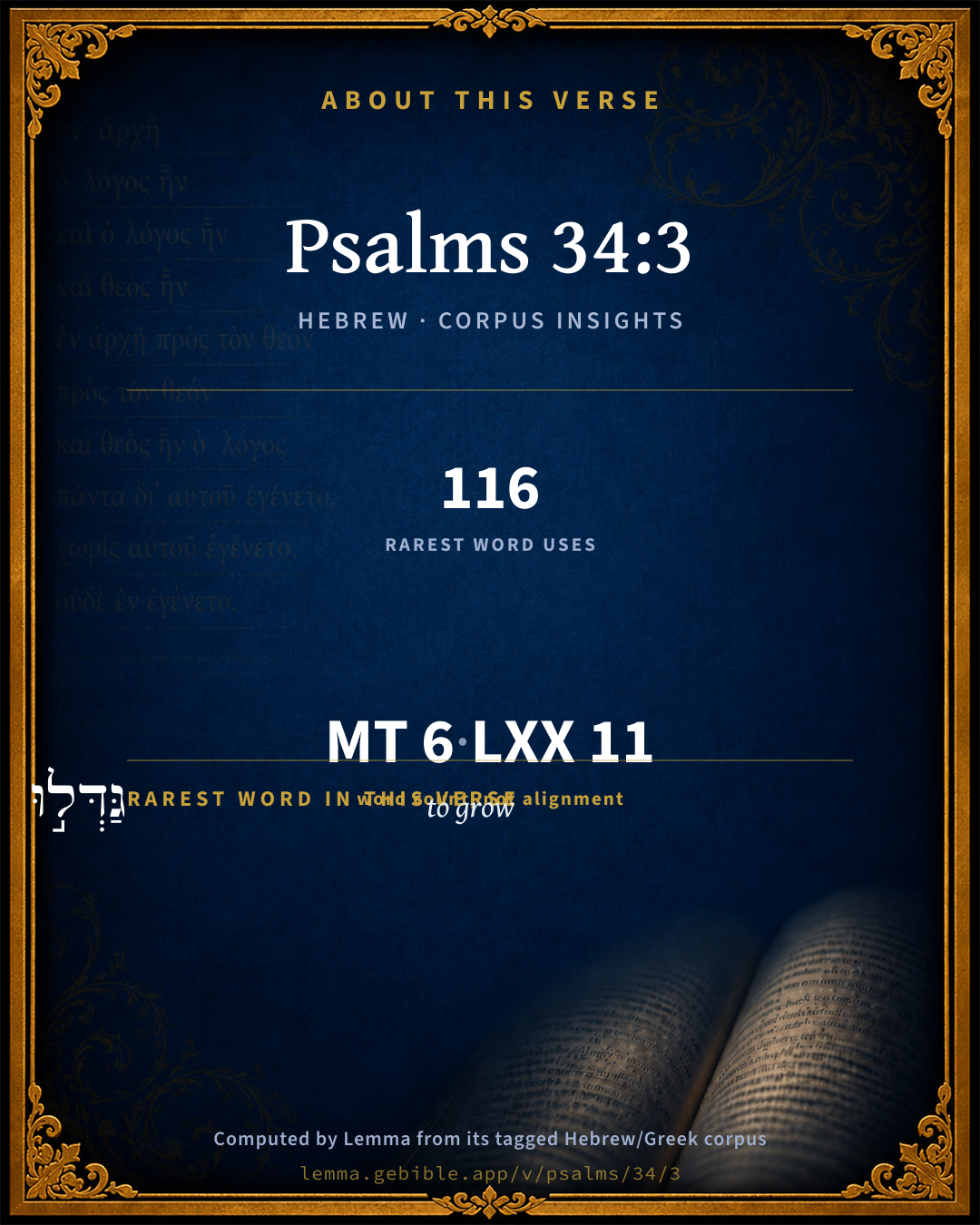
Psalms 34:3

Hebrew (Westminster Leningrad Codex) Psalms 34:3 appears in the Hebrew Old Testament. The text above is from the Westminster Leningrad Codex. Each word links to its Strong’s number, a concise gloss, and parsing drawn from the Open Scriptures Hebrew Bible morphology. Click any word for its full Brown-Driver-Briggs (BDB) entry.
Download image
Cite this verse

Psalms 34:3 (World English Bible). Public Domain. Lemma interlinear Bible study tool, https://lemma.gebible.app/v/psalms/34/3.

Show BibTeX & RIS
BibTeX
RIS
English Translation
Oh magnify Yahweh with me. Let us exalt his name together.
World English Bible · Public Domain
Download a study sheet

One document with this verse’s original text, its word-by-word gloss line, the meaning frame, cross-references with their text, attributed commentary, and full source and license credits — printable, and it pastes into notes with its structure intact.

This verse Autodidact and up

Study sheet (.html) Plain text (.txt)

A passage Seminary Student

Up to 50 verses in one chapter. A passage sheet keeps up to 6 commentary sources and 12 cross-references per verse, in the order this page ranks them, and says so on the sheet whenever that leaves anything out. Ask for a single verse and you get the Autodidact verse sheet above.

Everything on this page stays free to read, with no account — the sheet is a download of what is already on screen, not access to it.

Want to remove ads? Support Godless Engineer
Compare translations 3

The same verse in 3 English versions, stacked beneath the original-language interlinear above. Click any original word for its lexicon entry.

Each is an independent rendering of the whole verse — the interlinear is not word-aligned to these translations.

Highlighted words mark where these versions differ — a whole-verse word diff, not a word-by-word alignment.

  • World English Bible Public Domain
    Oh magnify Yahweh with me. Let us exalt his name together.
  • King James Version Public Domain
    O magnify the LORD with me, and let us exalt his name together.
  • unfoldingWord Literal Text CC BY-SA 4.0
    Magnify Yahweh with me, and let us exalt his name together.

unfoldingWord Literal Text — © unfoldingWord, licensed CC BY-SA 4.0. Word-aligned USFM3 via Door43 (git.door43.org/unfoldingWord/en_ult).

Versions to compare (up to 4)

3 of 4 selected

Show all 18 translations

Every available English version of this verse, each an independent rendering of the whole verse.

  • World English Bible Public Domain
    Oh magnify Yahweh with me. Let us exalt his name together.
  • Berean Standard Bible Public Domain
    Magnify the LORD with me; let us exalt His name together.
  • Majority Standard Bible Public Domain
    Magnify the LORD with me; let us exalt His name together.
  • King James Version Public Domain
    O magnify the LORD with me, and let us exalt his name together.
  • American Standard Version (1901) Public Domain
    Oh magnify Jehovah with me, And let us exalt his name together.
  • Revised Version (1885) Public Domain
    O magnify the LORD with me, and let us exalt his name together.
  • Geneva Bible (1599) Public Domain
    Praise ye the Lord with me, and let vs magnifie his Name together.
  • Douay-Rheims (1899) Public Domain
    In the Lord shall my soul be praised: let the meek hear and rejoice.
  • Young's Literal Translation Public Domain
    Ascribe ye greatness to Jehovah with me, And we exalt His name together.
  • Literal Standard Version CC BY-SA 4.0
    Ascribe greatness to YHWH with me, || And we exalt His Name together.
  • Unlocked Literal Bible CC BY-SA 4.0
    Praise Yahweh with me, let us lift up his name together.
  • unfoldingWord Literal Text CC BY-SA 4.0
    Magnify Yahweh with me, and let us exalt his name together.
  • Darby Bible Public Domain
    Magnify Jehovah with me, and let us exalt his name together.
  • World Messianic Bible Public Domain
    Oh magnify the LORD with me. Let’s exalt his name together.
  • Webster's Bible Public Domain
    \\34:2\\My soul shall make her boast in the LORD: the humble shall hear of it and be glad.
  • Free Bible Version CC BY-SA 4.0
    Glorify God with me; together let's honor his reputation.
  • Bible in Basic English Public Domain
    O give praise to the Lord with me; let us be witnesses together of his great name.
  • JPS Tanakh (1917) Public Domain
    (34-4) O magnify the LORD with me, and let us exalt His name together.

Literal Standard Version (2020), Covenant Press — licensed CC BY-SA 4.0. Text via the HelloAO Bible API (eBible.org). Unlocked Literal Bible (unfoldingWord) — licensed CC BY-SA 4.0. Text via the HelloAO Bible API (eBible.org). unfoldingWord Literal Text — © unfoldingWord, licensed CC BY-SA 4.0. Word-aligned USFM3 via Door43 (git.door43.org/unfoldingWord/en_ult). Free Bible Version, Dr. Jonathan Gallagher — licensed CC BY-SA 4.0. Text via the HelloAO Bible API (eBible.org).

Word by word

More ways to search: Search by grammar → Find every occurrence → Compare this word →

Practice this passage: Drill this verse → Learn its vocabulary →

גַּדְּל֣וּ
gâdal
H1431
“grow”
Verb, Piel, Imperative, 2nd Person, Masculine, Plural
Part of Speech
Verb
Stem
Piel
Form
Imperative
Person
2nd Person
Gender
Masculine
Number
Plural
Full BDB Definition

Origin: a primitive root

TWOT: 315

to grow, become great or important, promote, make powerful, praise, magnify, do great things - (Qal) - to grow up - to become great - to be magnified - (Piel) - to cause to grow - to make great, powerful - to magnify - (Pual) to be brought up - (Hiphil) - to make great - to magnify - to do great things - (Hithpael) to magnify oneself
  1. לַיהוָ֣ה Yᵉhôvâh H3068 “to/for · LORD” Preposition + Noun, Proper
  2. אִתִּ֑י ʼêth H854 “with · me” Preposition + Suffix, Personal, 1st Person, Common, Singular
  3. וּנְרוֹמְמָ֖ה rûwm H7311 “and · to rise” Conjunction + Verb, Polel, Cohortative, 1st Person, Common, Plural
  4. שְׁמ֣וֹ shêm H8034 “name · his” Noun, Common, Masculine, Singular, Construct + Suffix, Personal, 3rd Person, Masculine, Singular
  5. יַחְדָּֽו yachad H3162 “together” Adverb

About this verse

These counts appear in no published source. They are computed here, from the morphology-tagged text and Lemma’s own curated glosses. What Lemma adds →

6
words
6
distinct lemmas
Wisdom
section

Grammatical profile

  • 2 verbs
  • 2 nouns
  • 1 preposition
  • 1 adverb

Verb forms

  • גַּדְּל֣וּ Piel · Imperative
  • וּנְרוֹמְמָ֖ה Polel · Cohortative

Hebrew & Septuagint length

In English translation the verse runs 11 words from the Hebrew and 13 from the Septuagint (LXX English) — closely comparable.

A rough comparison of the two English renderings, which tokenize alike — not a word-level alignment.

Word counts can differ between the Hebrew and the Greek without any difference in meaning — e.g. the Hebrew direct-object marker אֵת has no separate Greek word, and Greek often adds the article ὁ.

In the original languages it is 6 Hebrew tokens and 11 Greek tokens — but the two are counted differently (Hebrew bundles its prefixes and suffixes into one token; the Greek is in lemma form), so that isn’t a like-for-like length.

Cross-references

14

Topical passages linked to Psalms 34:3 in the Treasury of Scripture Knowledge — connected by theme and wording, ordered by reader-vote popularity; previews shown in the World English Bible.

  • Psalms 69:30 I will praise the name of God with a song, And will magnify him with thanksgiving.
  • Luke 1:46 Mary said, "My soul magnifies the Lord.
  • Psalms 148:1–14 Praise Yah! Praise Yahweh from the heavens! Praise him in the heights!
  • Revelation 19:5–6 A voice came forth from the throne, saying, "Give praise to our God, all you his servants, you who fear him, the small and the great!"
  • Psalms 40:16 Let all those who seek you rejoice and be glad in you. Let such as love your salvation say continually, "Let Yahweh be exalted!"
  • Psalms 66:8 Praise our God, you peoples! Make the sound of his praise heard,
  • Psalms 35:27 Let them shout for joy and be glad, who favor my righteous cause. Yes, let them say continually, "Yahweh be magnified, Who has pleasure in the prosperity of his servant!"
  • Psalms 103:20–22 Praise Yahweh, you angels of his, Who are mighty in strength, who fulfill his word, Obeying the voice of his word.
  • Psalms 33:1–2 Rejoice in Yahweh, you righteous! Praise is fitting for the upright.
  • Revelation 14:7 He said with a loud voice, "Fear the Lord, and give him glory; for the hour of his judgment has come. Worship him who made the heaven, the earth, the sea, and the springs of waters!"
  • 1 Chronicles 29:20 David said to all the assembly, Now bless Yahweh your God. All the assembly blessed Yahweh, the God of their fathers, and bowed down their heads, and worshiped Yahweh, and the king.
  • 2 Chronicles 29:30 Moreover Hezekiah the king and the princes commanded the Levites to sing praises to Yahweh with the words of David, and of Asaph the seer. They sang praises with gladness, and they bowed their heads and worshiped.
  • Acts 19:17 This became known to all, both Jews and Greeks, who lived at Ephesus. Fear fell on them all, and the name of the Lord Jesus was magnified.
  • Philippians 1:20 according to my earnest expectation and hope, that I will in no way be disappointed, but with all boldness, as always, now also Christ will be magnified in my body, whether by life, or by death.

Cross-references courtesy of OpenBible.info (CC BY 4.0).

Hebrew and Greek witnesses Masoretic Hebrew ↔ Greek Septuagint

The same verse in the two great witnesses to the Old Testament, shown verse-for-verse.

You’re reading Greek Psalm 33 (Hebrew Psalm 34). The Septuagint counts the superscription, so verse numbers can differ from the Hebrew — chapter-level alignment, not verse-by-verse. Numbering follows Rahlfs.

These are two independent witnesses, not word-aligned to each other, and the Septuagint is shown in lemma (dictionary) form.

Hebrew Psalms 34:3 Masoretic · Westminster Leningrad Codex

גַּדְּל֣וּ לַיהוָ֣ה אִתִּ֑י וּנְרוֹמְמָ֖ה שְׁמ֣וֹ יַחְדָּֽו

Oh magnify Yahweh with me. Let us exalt his name together.

World English Bible · Public Domain

Greek LXX Greek Psalm 33:3 Septuagint · lemma form

ἐν ὁ κύριος ἐπιαἰνέω ὁ ψυχή ἐγώ ἀκούω πραΰς καί εὐφραίνω

Magnify you⌃ the Lord with me, and let us exalt his name together.

LXX2012 (modern English Septuagint) · Public Domain

Hebrew: Westminster Leningrad Codex (CC BY 4.0). Greek: Septuagint (public domain); English from LXX2012 (modern English Septuagint) (Public Domain). How the Septuagint differs from the Hebrew →

Commentary

Notes on Psalms 34:3 from classic Christian and Jewish commentators (each source and its license shown beneath its notes). The classic Christian expositions comment on the surrounding passage and are grouped to its opening verse, so a note may address several verses; the Jewish commentaries on the Tanakh (Rashi and others) are per-verse, so they appear only where the commentator wrote on this verse.

Lemma curates 59 commentaries, every one of them public domain or Creative Commons licensed, each selected and text-cleaned for this edition rather than reprinted as found. About our sources →

Trapp's Complete Commentary

John Trapp

Psa 34:3 O magnify the LORD with me, and let us exalt his name together.

Ver. 3. O magnify the Lord with me] As not sufficient to do so great a work himself, he calleth in the help of others. We read of a monster rather than a man, who lying on his death bed, not only himself swore as fast and as furiously as he could, but desperately desired the bystanders to help him with oaths, and to swear for him. I knew the man, saith mine author (Bolton, Assize Serm.). And should not we much more call upon others to join their forces with ours in magnifying the Lord? Birds, when they come to a full heap of corn, will chirp and call in for their fellows. Charity is no churl; goodness is diffusive.

And let us exalt his name together] And so begin heaven beforehand. Aben Ezra glosseth thus, Quasi diceret, Nos omnes simul ad laudandum Deum sumus imbecilles, We are all too weak for this work, though we should all do our utmost at it.

John Trapp, A Commentary or Exposition upon All the Books of the Old and New Testament (1647–1656) — public domain. Text from a community e-Sword module.

The Biblical Illustrator

Joseph S. Exell

Psa_34:3-7

O magnify the Lord with me, and let us exalt His name together.

A testimony meeting

Gods praises sound best in concert. The praise that lifts its voice in solitude is beautiful, but it is far more beautiful when heard in communion with the praise of ones fellows. Each instrument in the orchestra is enriched by the co-operation of the others. Each member in a chorus has his discernment sharpened, and his zeal intensified by the remaining members. So in the orchestra of praise. My own thanksgiving is quickened and enriched when I join it to the praises of others. The text appears to suggest that a number of thankful souls gathered together, and, each contributing his own testimony of the exceeding graciousness of God, they joined in an outburst of united and jubilant praise. Here is one of the testimonies: I sought the Lord, etc. And here is the gladsome confession of quite a numerous company. They looked unto Him and were lightened, etc. And here, again, is the witness of an inspired and grateful soul: This poor man cried, and the Lord heard him, etc.

1. He was burdened with fears. What did he make his resource? I sought the Lord. The seeking was a real business. Into the inquisition he put his whole soul. And what was the issue of the search? He heard me. The term implies heeding and responding. Mans seeking was responded to by a sympathetic movement on the part of God. And delivered me, etc. That is a full-coloured word, abounding in strength and vitality. It suggests the act of rescuing something out of a beasts mouth. It is from spiritual havoc of this kind that our Lord delivers us. The rescue is not partial. The relief is by no means incomplete. The freedom is absolute. He delivered me from all my fears. God sweeps the field, slays the enemies, and even buries their bones.

2. Let us listen to the second of these grateful testimonies. They looked unto Him and were lightened, and their faces were not ashamed. The gracious answer of God brought a benediction of light. They were lightened. Then before they must have been darkened. They were cheerless and depressed. They were losing heart. Thy looked unto Him. They gazed intently upon God. No snatch look, no hurried glances, no passing nod of recognition. A fixed and eager gaze. And what was the outcome of their gaze? They were lightened. They were brightened up, lit up, made cheerful. Now are ye light in the Lord. Depression gave way to buoyancy. Melancholy yielded to cheerfulness.

3. Let us now turn to the third of these witnesses, and hear his thankful confession. This poor man cried, etc. What had been this mans peculiar burden? Troubles. He had been in a tight corner, a tight place. In his straits he cried unto the Lord. It was a short, sharp, urgent prayer. Fervour is a heavenly ingredient in prayer; an arrow drawn with full strength hath a speedier issue; therefore the prayers of saints are expressed by crying in Scripture. Again we have the confession made by an earlier witness. The Lord heard him, paid heed to him, and began the ministry of gracious response. He saved him out of all his troubles. He opened a way out of the tight place. He led him out of straits into freedom. He gave him a sense of space. Thou hast brought my feet into a large place. (J. H. Jowett, M. A.)

A thanksgiving sermon

I. what it is to magnify the Lord, and exalt his name. Let us not mistake in arrogating to ourselves that which is quite out of our reach, as if we, diminutive bits of Gods creation, could enrich the exchequer of heaven. No, tis not at all in Himself, but only in our own minds, and others esteem, that we are capable of greatening and advancing the most glorious and ever-blessed God. When we conceive in ourselves any worthy sentiments, becoming the Divine majesty and goodness; are filled with an admiring sense of His transcendent excellencies, and a grateful sense of His loving-kindness and endeavour, all we can, to propagate the same magnificent and fair idea to others: this is the utmost whereof we are capable, to glorify God in such aggrandizing representations, as show Him somewhat like Himself. And thus we do magnify the God infinitely good, when we stand in admiration of such benignity, that we should have any comfort with our lives, when we have done so much to spoil all with our sins! Yea, that not a minute should pass but brings us a new favour from above; and gives us more assurance still that He desires our felicity, and cannot design our ruin. Thinking thus well of God, we do magnify the Lord, and exalt His name.

II. the properties of this eucharistical sacrifice, and how we are to offer it.

1. It must be with the soul, from the altar of a sensible heart. To glory in Him is one way of giving glory to Him.

2. Though it must not be only a lip-service, we must not refrain our lips either. When our bodies are His temple, and our tongues the living bells articulately to sound His praise; how can we better employ the speaking faculty, than in celebrating His goodness that gave it? What we are transported with, we can hardly forbear to speak of, if we are full of it, tis apt to float on our tongues: and if the mercies of God affect our hearts, tis fit we should express the same, both to discharge a due debt ourselves, and also to kindle the like flame in others.

3. We must bless the Lord at all times (Psa_34:1); not only by fits, as it pleases us, or when extorted from us upon some occasions extraordinary, but with such a heart whose pulse may be His praise. Our holy living is the most effectual thanksgiving. When we justify the Divine laws by our obedience, and thus stand up to attest their high reasonableness and goodness, instead of repining at them as hard sayings and heavy burdens; showing that really we do admire and applaud them for the blessed products of an infinite wisdom and love, to contrive and effect our everlasting happiness: then do we give them the best commendation, to make all enamoured with those sacred institutions, which they not only hear set off in hollow encomiums, but see produce such happy effects (Joh_15:8; Php_1:11).

III. the reason we have thus to magnify the Lord, and exalt his name.

1. It is the very end of our being. Man, as the priest of this inferior creation, is to offer up a general sacrifice in the name and behalf of all the rest; who in their several ways give a tacit consent, and (as it were) say Amen to the oblation: and when dumb and negligent to praise the Lord, we not only wrong ourselves, but rob multitudes that would do it, had they but our faculties and abilities to reason and express it. We not only stand for cyphers, but carry as an exorbitant rout, breaking our ranks and disordering the world, if we celebrate not His praise who has so set us up.

2. We have not only capacity, but all manner of obligations to it; even common justice hinds us to render to all their dues. Well may we extol Him, when He has done so for us (Psa_30:1). How many great luminaries else soever there be, all disappear at the rising sun; and all other benefactors must be even nullified to omnify the Supreme.

3. As we are obliged, so by the goodness of it encouraged to it (Psa_147:1). It is pleasant, and praise is comely. It gives the pious soul a sweet satisfaction, like the pleasure which an honest man takes in paying his debts. The most delicious viands are not more grateful to a healthy body, than the praises of God are to a well-affected soul. This raises us even into heaven a forehand, to anticipate the anthems of the celestial choir. And how great is that honour, to be taken up in the work of angels! How much for our own praise to praise Him, that has given us both matter and hearts for it! (B. Jenks.)

The Biblical Illustrator, edited by Joseph S. Exell (c. 1880s–1900s) — public domain. Text from a community e-Sword module.

Joseph Benson's Commentary

Psa 34:3. O magnify the Lord with me — Join your praises with mine, O ye humble ones. And let us exalt his name together — If not in one place, yet in affection and work: let our souls meet, and let our praises meet in the ears of the all-hearing God. Or the word יחדו, jachdav, may be rendered, alike; that is, with equal zeal and fervency; let none be willing to be outstripped by another. To magnify, or exalt, and the like expressions, “do not mean that we can add any thing to the glory of the name or nature of God; but that we should show forth, and publicly celebrate his majesty and greatness, when we experience the interpositions of his providence in our deliverance from any threatening evil. We should then, with the psalmist, ascribe our safety, not to our own contrivance, subtlety, or power, but to the care of God, who watches over us.”

Joseph Benson's Commentary on the Old and New Testaments (1811–1818) — public domain. Text from a community e-Sword module.

Whedon's Commentary on the Bible

Daniel D. Whedon

3. Magnify… exalt his name—Not absolutely, but relatively in the eyes of men, by showing forth his wonderful mercies. We magnify God by ascribing greatness to him. Deu_32:3. Psa_34:1-2, are a declaration of what the psalmist will do; Psa_34:3, a call upon all to join him.

Daniel D. Whedon (gen. ed.), Commentary on the Old and New Testaments (1874–1909) — public domain. Text from a community e-Sword module.

J. A. Alexander on Psalms

Joseph Addison Alexander

4. (Psa 34:3). Magnify (praise) to Jehovah with me, and let us exalt his name together. In Psa 69:31 (30), the verb to magnify is construed directly with its object, but in this case with a dative, to Jehovah, which may either be regarded as a poetical equivalent to the accusative, or connected with the noun praise understood, or with name, supplied from the other clause.

Joseph Addison Alexander, The Psalms Translated and Explained (1850) — public domain. Text from a community e-Sword module.

Jamieson, Fausset & Brown

Robert Jamieson, A. R. Fausset & David Brown

magnify the Lord--ascribe greatness to Him, an act of praise.

together--"alike" (Psa 33:15), or, equally, without exception.

Jamieson, Fausset & Brown — Commentary Critical and Explanatory on the Whole Bible (1871) — public domain (CC PDM 1.0). Text via the HelloAO Bible API.

Adam Clarke's Commentary

Verse 3. Magnify the Lord with me] גדלו ליהוה gaddelu lavhovah, "make greatness to Jehovah;" show his greatness; and let "us exalt his name," let us show how high and glorious it is.

Adam Clarke's Commentary on the Bible (1810–1826) — public domain. Text from a community e-Sword/MySword module.

John Calvin's Commentaries

3. Magnify Jehovah with me. The Psalmist shows still another fruit which would be the result of his giving thanks to God, namely, that he shall induce others by his example to the same exercise of devotion; nay more, he calls upon all the godly to unite with him in this exercise, inviting and exhorting them heartily and with one consent to extol the Lord. Let us therefore learn, from the many instances in which God may have given helps to any of his people, to abound in hope; and when each recites the personal benefits which he has received, let all be animated unitedly and in a public manner to give praise to God. We give thanks publicly to God, not only that men may be witnesses of our gratitude, but also that they may follow our example.

John Calvin's Commentaries (1540-1563) — public domain. Text from the Calvin Translation Society English edition (1840s-50s) via the Christian Classics Ethereal Library (ccel.org). Calvin's coverage is partial (roughly two-thirds of the Bible); uncommented books and verses are honest gaps, never fabricated. The 19th-century editor's footnotes and remarks are omitted so the notes are faithfully Calvin's own voice.

The Cambridge Bible for Schools and Colleges

gen. ed. J. J. S. Perowne

3. magnify] Man makes God great by acknowledging and celebrating His greatness (Deu_32:3), and exalts His Name by confessing that He is supreme above all. See note on Psa_30:1.

3, 4. Addressing the humble, he invites them to join in thanksgiving for his deliverance.

The Cambridge Bible for Schools and Colleges (gen. ed. J. J. S. Perowne; Cambridge University Press, 1878–1918) — public domain. Text from a community e-Sword module.

John Gill's Exposition

O magnify the Lord with me,.... The psalmist invites the humble ones, who he knew would rejoice at the goodness of God to him, to join with him in ascribing greatness to the Lord, which is meant by magnifying him; for he cannot be made great by men, only declared how great he is, and that can only be done in an imperfect manner;

and let us exalt his name together: by proclaiming him to be the most High; by making mention of his glorious perfections and works, that he be exalted; and by praising him in the highest strains; or by having the high praises of him in their mouths; and there is more pleasure as well as more glory brought to God by doing this in a social way, or by a number of saints joining together in such service.

John Gill's Exposition of the Whole Bible (1746–1763) — public domain (CC PDM 1.0). Text via the HelloAO Bible API.

Albert Barnes' Notes on the Bible

O magnify the Lord with me - This seems to be addressed primarily to the “humble,” those referred to in the previous verse. As they could appreciate what he would say, as they could understand the nature of his feelings in view of his deliverance, he calls upon them especially to exult with him in the goodness of God. As he and they had common calamities and trials, so might they have common joys; as they were united in danger and sorrow, so it was proper that they should be united in joy and in praise. The word “magnify’ means literally “to make great,” and then, to make great in the view of the mind, or to regard and treat as great. The idea is, that he wished all, in circumstances similar to those in which he had been placed, to have a just sense of the greatness of God, and of his claims to love and praise. Compare Psa 35:27; Psa 40:17; Psa 69:30; Psa 70:4; Luk 1:46.

And let us exalt his name together - Let us unite in “lifting up” his name; that is, in raising it above all other things in our own estimation, and in the view of our fellow-men; in so making it known that it shall rise above every other object, that all may see and adore.

Albert Barnes' Notes on the Bible (1834–1885) — public domain. Text from a community e-Sword/MySword module.

Matthew Poole's English Annotations

Join your praises with mine, O all ye humble ones.

Together; not in place, for David was now banished from the place of God’s public worship, but in affection and work: let our souls meet, and let our praises meet in the ears of the all-hearing God. Or, alike, i.e. with equal zeal and fervency; let none be willing to be outstripped by another.

Matthew Poole's English Annotations on the Holy Bible (1683–1685) — public domain. Text from a community e-Sword/MySword module.

The Treasury of David

Charles H. Spurgeon

Ver. 3. O magnify the Lord with me. Is this request addressed to the humble? If so it is most fitting. Who can make God great but those who feel themselves to be little? He bids them help him to make the Lord's fame greater among the sons of men. Jehovah is infinite, and therefore cannot really be made greater, but his name grows in manifested glory as he is made known to his creatures, and thus he is said to be magnified. It is well when the soul feels its own inability adequately to glorify the Lord, and therefore stirs up others to the gracious work; this is good both for the man himself and for his companions. No praise can excel that which lays us prostrate under a sense of our own nothingness, while divine grace like some topless Alp rises before our eyes and sinks us lower and lower in holy awe. Let us exalt his name together. Social, congregated worship is the outgrowth of one of the natural instincts of the new life. In heaven it is enjoyed to the full, and earth is like heaven where it abounds.

Ver. 3. Venema remarks that after the affair with Achish, we are told in 1Sa 22:1, "His brethren, and all his father's house went down to the cave Adullam unto him, "and these, together with those who were in debt, and discontented with Saul's government, formed a band of four hundred men. To these his friends and comrades, he relates the story of his escape, and bids them with united hearts and voices extol the Lord. C. H. S.

Ver. 3. Invitation to united praise.

Ver. 3. Magnifying --or making great the work of God, a noble exercise.

Psalms 34:4*

Charles H. Spurgeon's The Treasury of David (1869–1885) — public domain. Psalms only. Text from a community e-Sword/MySword module.

The Pulpit Commentary

O magnify the Lord with me, and let us exalt his Name together. Not content with praising God in his own person, the psalmist calls on Israel generally to praise the Lord with him. He then proceeds to assign reasons why God should be praised (vers. 4-10).

The Pulpit Commentary (1880–1919), ed. H.D.M. Spence-Jones & Joseph S. Exell — public domain. Text from a community e-Sword module.

John Wesley's Explanatory Notes

Together - Not in place, for David was now banished from the place of God's publick worship, but in affection: let our souls meet, and let our praises meet in the ears of the all-hearing God.

John Wesley, Explanatory Notes Upon the Whole Bible (1754–1765) — public domain. Text via the GEBible commentary corpus.

Rashi

Rabbi Shlomo Yitzchaki (Rashi)

My soul boasts of the Lord I boast, and praise myself that I have a patron like this to save me and protect me.

I will boast. Se porvantera in French.

may the humble hear the wonders that He did for me. Through my praise, they will understand it and rejoice.

Rashi on the Tanakh — English translations: “The Judaica Press complete Tanach with Rashi, translated by A. J. Rosenberg” (CC BY 4.0); “Pentateuch with Rashi's commentary by M. Rosenbaum and A.M. Silbermann, 1929-1934” (public domain); “The Metsudah Tanach series, Lakewood, N.J” (CC BY 4.0); and “The Book of Joshua, Metsudah Publications, 1997” (CC BY 4.0). Text via Sefaria.

Lesson kit

Teaching starters — assembled from the data on this page, not authored interpretation. Every prompt links to the verse data it draws on. Edit before teaching.

Psalms, in the Wisdom, opens this verse with 6 words (6 distinct Hebrew lemmas). Its most distinctive word is gâdal (“to grow”). A historical commentator’s framing appears above. Read the whole chapter for the surrounding context.

Discussion questions

  1. How does “to grow” (gâdal) shape what this verse is saying?
  2. Psalms 69:30 shares this passage’s theme. How do the two illuminate each other?
  3. These translations render this verse differently. What is at stake in choosing one wording over another?
  4. The verb «גַּדְּל֣וּ» is Piel Imperative. How does its form color the action?
  5. Reading how Trapp's Complete Commentary and The Biblical Illustrator read this verse, where do the two commentators agree and where do they part?

Things to notice

Reading settings

Reading text

Shown beneath each verse's original-language words.

Old Testament
Old Testament edition

Read the OT as the Masoretic Hebrew (MT) or the Greek Septuagint (LXX).

English shown for the Greek Septuagint (in the Hebrew ↔ Greek comparison).

Comparing translations? Open the Compare panel on any verse page to stack up to four side by side.