
Exodus 29:27

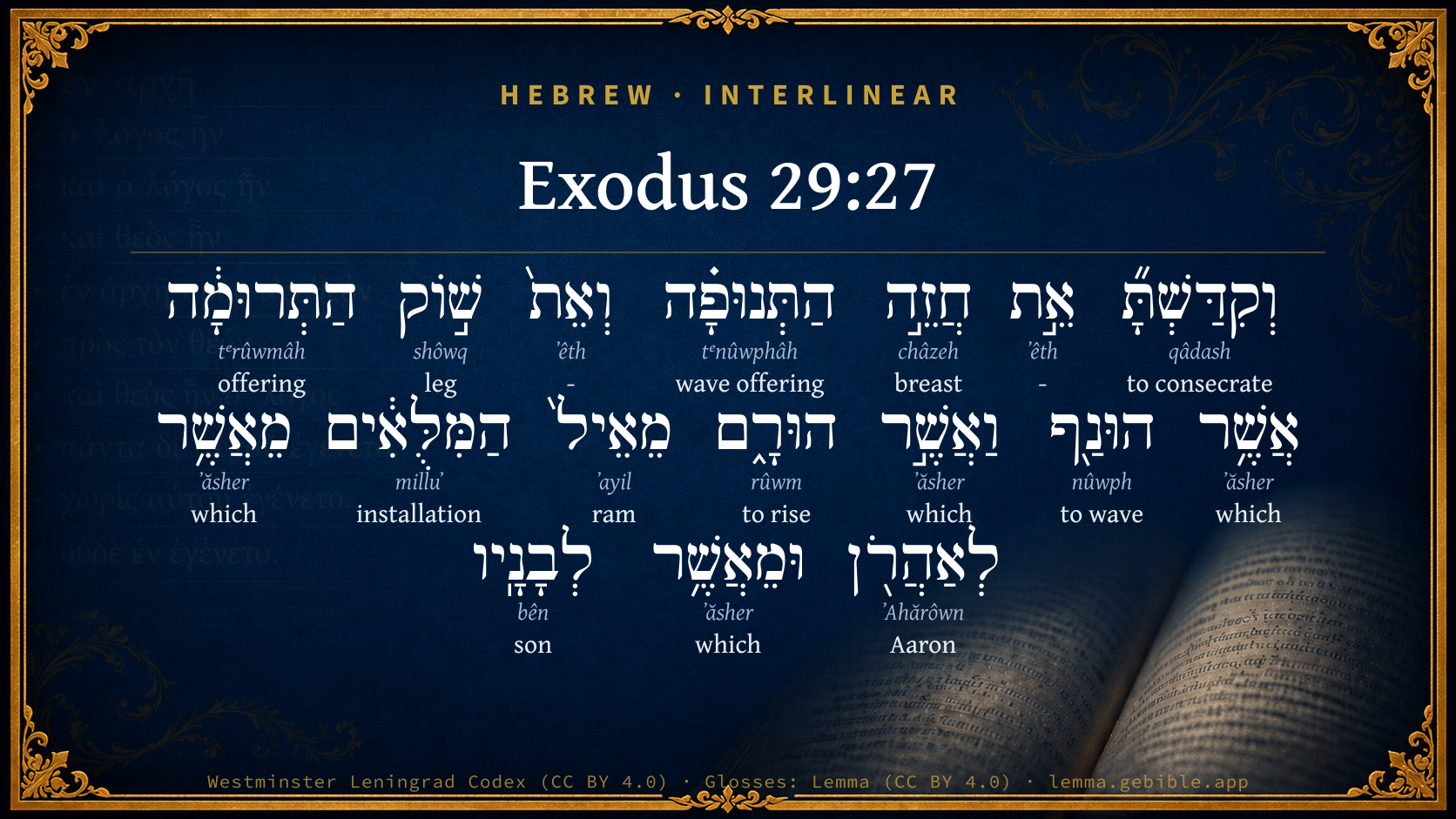
Hebrew (Westminster Leningrad Codex) Exodus 29:27 appears in the Hebrew Old Testament. The text above is from the Westminster Leningrad Codex. Each word links to its Strong’s number, a concise gloss, and parsing drawn from the Open Scriptures Hebrew Bible morphology. Click any word for its full Brown-Driver-Briggs (BDB) entry.
Download image
Cite this verse

Exodus 29:27 (World English Bible). Public Domain. Lemma interlinear Bible study tool, https://lemma.gebible.app/v/exodus/29/27.

Show BibTeX & RIS
BibTeX
RIS
English Translation
You shall sanctify the breast of the wave-offering, and the thigh of the heave-offering, which is waved, and which is heaved up, of the ram of consecration, even of that which is for Aaron, and of that which is for his sons:
World English Bible · Public Domain
Download a study sheet

One document with this verse’s original text, its word-by-word gloss line, the meaning frame, cross-references with their text, attributed commentary, and full source and license credits — printable, and it pastes into notes with its structure intact.

This verse Autodidact and up

Study sheet (.html) Plain text (.txt)

A passage Seminary Student

Up to 50 verses in one chapter. A passage sheet keeps up to 6 commentary sources and 12 cross-references per verse, in the order this page ranks them, and says so on the sheet whenever that leaves anything out. Ask for a single verse and you get the Autodidact verse sheet above.

Everything on this page stays free to read, with no account — the sheet is a download of what is already on screen, not access to it.

Want to remove ads? Support Godless Engineer
Compare translations 3

The same verse in 3 English versions, stacked beneath the original-language interlinear above. Click any original word for its lexicon entry.

Each is an independent rendering of the whole verse — the interlinear is not word-aligned to these translations.

Highlighted words mark where these versions differ — a whole-verse word diff, not a word-by-word alignment.

  • World English Bible Public Domain
    You shall sanctify the breast of the wave-offering, and the thigh of the heave-offering, which is waved, and which is heaved up, of the ram of consecration, even of that which is for Aaron, and of that which is for his sons:
  • King James Version Public Domain
    And thou shalt sanctify the breast of the wave offering, and the shoulder of the heave offering, which is waved, and which is heaved up, of the ram of the consecration, even of that which is for Aaron, and of that which is for his sons:
  • unfoldingWord Literal Text CC BY-SA 4.0
    And from the ram of consecration which is for Aaron and which is for his sons, you shall set apart the breast of the raised offering that was raised and the thigh of the contribution that was contributed.

unfoldingWord Literal Text — © unfoldingWord, licensed CC BY-SA 4.0. Word-aligned USFM3 via Door43 (git.door43.org/unfoldingWord/en_ult).

Versions to compare (up to 4)

3 of 4 selected

Show all 18 translations

Every available English version of this verse, each an independent rendering of the whole verse.

  • World English Bible Public Domain
    You shall sanctify the breast of the wave-offering, and the thigh of the heave-offering, which is waved, and which is heaved up, of the ram of consecration, even of that which is for Aaron, and of that which is for his sons:
  • Berean Standard Bible Public Domain
    Consecrate for Aaron and his sons the breast of the wave offering that is waved and the thigh of the heave offering that is lifted up from the ram of ordination.
  • Majority Standard Bible Public Domain
    Consecrate for Aaron and his sons the breast of the wave offering that is waved and the thigh of the heave offering that is lifted up from the ram of ordination.
  • King James Version Public Domain
    And thou shalt sanctify the breast of the wave offering, and the shoulder of the heave offering, which is waved, and which is heaved up, of the ram of the consecration, even of that which is for Aaron, and of that which is for his sons:
  • American Standard Version (1901) Public Domain
    And thou shalt sanctify the breast of the wave-offering, and the thigh of the heave-offering, which is waved, and which is heaved up, of the ram of consecration, even of that which is for Aaron, and of that which is for his sons:
  • Revised Version (1885) Public Domain
    And thou shalt sanctify the breast of the wave offering, and the thigh of the heave offering, which is waved, and which is heaved up, of the ram of consecration, even of that which is for Aaron, and of that which is for his sons:
  • Geneva Bible (1599) Public Domain
    And thou shalt sanctifie the brest of the shaken offering, and the shoulder of the heaue offering, which was shaken to and from, and which was heaued vp of the ramme of the consecration, which was for Aaron, and which was for his sonnes.
  • Douay-Rheims (1899) Public Domain
    And thou shalt sanctify both the consecrated breast, and the shoulder that thou didst separate of the ram,
  • Young's Literal Translation Public Domain
    and thou hast sanctified the breast of the wave-offering, and the leg of the heave-offering, which hath been waved, and which hath been lifted up from the ram of the consecration, of that which `is' for Aaron, and of that which `is' for his sons;
  • Literal Standard Version CC BY-SA 4.0
    and you have sanctified the breast of the wave-offering, and the leg of the raised-offering, which has been waved, and which has been lifted up from the ram of the consecration, of that which [is] for Aaron, and of that which [is] for his sons;
  • Unlocked Literal Bible CC BY-SA 4.0
    You must set apart to me the breast of the wave offering that is waved, and the thigh that is the contribution for the priests—both the breast that was waved and the thigh that was contributed for Aaron and his sons.
  • unfoldingWord Literal Text CC BY-SA 4.0
    And from the ram of consecration which is for Aaron and which is for his sons, you shall set apart the breast of the raised offering that was raised and the thigh of the contribution that was contributed.
  • Darby Bible Public Domain
    And thou shalt hallow the breast of the wave-offering, and the shoulder of the heave-offering, that hath been waved and heaved up, of the ram of the consecration, of that which is for Aaron, and of [that] which is for his sons.
  • World Messianic Bible Public Domain
    You shall sanctify the breast of the wave offering and the thigh of the wave offering, which is waved, and which is raised up, of the ram of consecration, even of that which is for Aaron, and of that which is for his sons.
  • Webster's Bible Public Domain
    And thou shalt sanctify the breast of the wave-offering, and the shoulder of the heave-offering, which is waved, and which is heaved up of the ram of the consecration, even of that which is for Aaron, and of that which is for his sons:
  • Free Bible Version CC BY-SA 4.0
    Set apart for Aaron and his sons the breast of the wave offering and the thigh of the offering that is lifted up, both taken from the ram of ordination.
  • Bible in Basic English Public Domain
    So you are to make holy the breast of the sheep which is waved and the leg which is lifted up on high, that is, of the sheep which is offered for Aaron and his sons;
  • JPS Tanakh (1917) Public Domain
    And thou shalt sanctify the breast of the wave-offering, and the thigh of the heave-offering, which is waved, and which is heaved up, of the ram of consecration, even of that which is Aaron's, and of that which is his sons'.

Literal Standard Version (2020), Covenant Press — licensed CC BY-SA 4.0. Text via the HelloAO Bible API (eBible.org). Unlocked Literal Bible (unfoldingWord) — licensed CC BY-SA 4.0. Text via the HelloAO Bible API (eBible.org). unfoldingWord Literal Text — © unfoldingWord, licensed CC BY-SA 4.0. Word-aligned USFM3 via Door43 (git.door43.org/unfoldingWord/en_ult). Free Bible Version, Dr. Jonathan Gallagher — licensed CC BY-SA 4.0. Text via the HelloAO Bible API (eBible.org).

Word by word

More ways to search: Search by grammar → Find every occurrence → Compare this word →

Practice this passage: Drill this verse → Learn its vocabulary →

חֲזֵ֣ה
châzeh
H2373
“breast of”
Noun, Common, Masculine, Singular, Construct
Part of Speech
Noun
Type
Common
Gender
Masculine
Number
Singular
State
Construct
Full BDB Definition

Origin: from H2372

TWOT: 634a

breast (of animals), breast of an animal sacrifice
  1. וְקִדַּשְׁתָּ֞ qâdash H6942 “and · to consecrate” Conjunction + Verb, Piel, Sequential Perfect, 2nd Person, Masculine, Singular
  2. אֵ֣ת ʼêth H853 “-” Particle, Direct Object
  3. הַתְּנוּפָ֗ה tᵉnûwphâh H8573 “the · wave offering” Particle, Definite Article + Noun, Common, Feminine, Singular, Absolute
  4. וְאֵת֙ ʼêth H853 “and · -” Conjunction + Particle, Direct Object
  5. שׁ֣וֹק shôwq H7785 “leg of” Noun, Common, Feminine, Singular, Construct
  6. הַתְּרוּמָ֔ה tᵉrûwmâh H8641 “the · offering” Particle, Definite Article + Noun, Common, Feminine, Singular, Absolute
  7. אֲשֶׁ֥ר ʼăsher H834 “which” Particle, Relative
  8. הוּנַ֖ף nûwph H5130 “to wave” Verb, Hophal, Perfect, 3rd Person, Masculine, Singular
  9. וַאֲשֶׁ֣ר ʼăsher H834 “and · which” Conjunction + Particle, Relative
  10. הוּרָ֑ם rûwm H7311 “to rise” Verb, Hophal, Perfect, 3rd Person, Masculine, Singular
  11. מֵאֵיל֙ ʼayil H352 “from · ram of” Preposition + Noun, Common, Masculine, Singular, Construct
  12. הַמִּלֻּאִ֔ים milluʼ H4394 “the · installations” Particle, Definite Article + Noun, Common, Masculine, Plural, Absolute
  13. מֵאֲשֶׁ֥ר ʼăsher H834 “from · which” Preposition + Particle, Relative
  14. לְאַהֲרֹ֖ן ʼAhărôwn H175 “to/for · Aaron” Preposition + Noun, Proper
  15. וּמֵאֲשֶׁ֥ר ʼăsher H834 “and · from · which” Conjunction + Preposition + Particle, Relative
  16. לְבָנָֽיו bên H1121 “to/for · sons · his” Preposition + Noun, Common, Masculine, Plural, Construct + Suffix, Personal, 3rd Person, Masculine, Singular

About this verse

These counts appear in no published source. They are computed here, from the morphology-tagged text and Lemma’s own curated glosses. What Lemma adds →

17
words
13
distinct lemmas
Pentateuch
section

Notable vocabulary

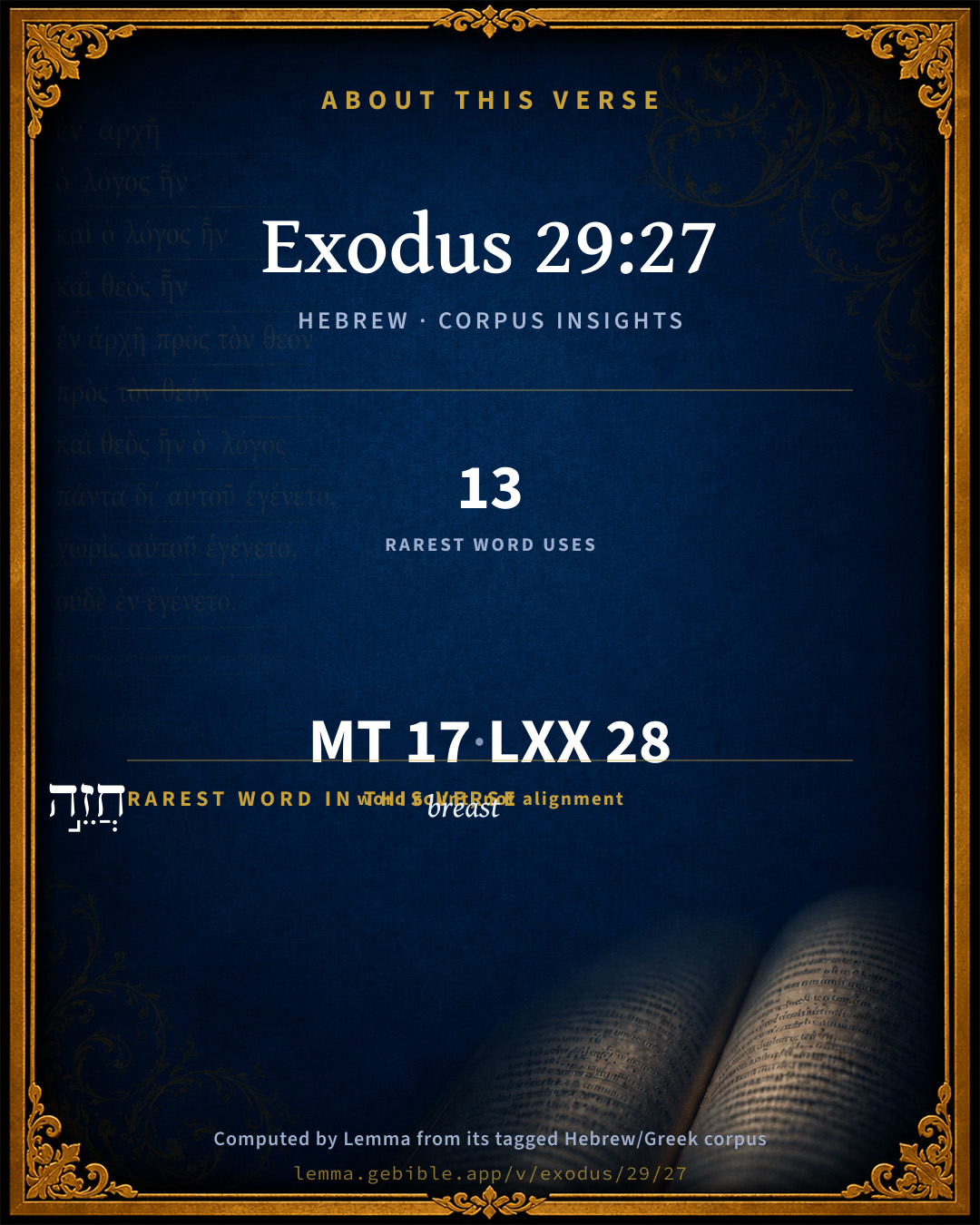
The rarest word here is חֲזֵ֣ה breast H2373 — appearing just 13 times in the whole Hebrew Bible.

Shared distinctive vocabulary

חֲזֵ֣ה breast H2373 occurs in 12 verses of the Hebrew Bible. Also found in:

Grammatical profile

  • 3 verbs
  • 8 nouns
  • 6 particles

Verb forms

  • וְקִדַּשְׁתָּ֞ Piel · Sequential Perfect
  • הוּנַ֖ף Hophal · Perfect
  • הוּרָ֑ם Hophal · Perfect

Repetition

A word recurs within this verse — often emphatic in Hebrew:

  • אֲשֶׁ֥ר which H834 ×4

Hebrew & Septuagint length

In English translation the verse runs 42 words from the Hebrew and 37 from the Septuagint (LXX English) — closely comparable.

A rough comparison of the two English renderings, which tokenize alike — not a word-level alignment.

Word counts can differ between the Hebrew and the Greek without any difference in meaning — e.g. the Hebrew direct-object marker אֵת has no separate Greek word, and Greek often adds the article ὁ.

In the original languages it is 17 Hebrew tokens and 28 Greek tokens — but the two are counted differently (Hebrew bundles its prefixes and suffixes into one token; the Greek is in lemma form), so that isn’t a like-for-like length.

Cross-references

10

Topical passages linked to Exodus 29:27 in the Treasury of Scripture Knowledge — connected by theme and wording, ordered by reader-vote popularity; previews shown in the World English Bible.

  • Leviticus 10:15 The heaved thigh and the waved breast they shall bring with the offerings made by fire of the fat, to wave it for a wave offering before Yahweh: and it shall be yours, and your sons' with you, as a portion forever; as Yahweh has commanded."
  • Numbers 18:11 This is your: the heave-offering of their gift, even all the wave-offerings of the children of Israel; I have given them to you, and to your sons and to your daughters with you, as a portion forever; everyone who is clean in your house shall eat of it.
  • Deuteronomy 18:3 This shall be the priests' due from the people, from those who offer a sacrifice, whether it be ox or sheep, that they shall give to the priest the shoulder, and the two cheeks, and the maw.
  • Leviticus 7:31–34 The priest shall burn the fat on the altar, but the breast shall be Aaron's and his sons'.
  • Leviticus 7:37 This is the law of the burnt offering, of the meal offering, and of the sin offering, and of the trespass offering, and of the consecration, and of the sacrifice of peace offerings;
  • Leviticus 8:28–31 Moses took them from their hands, and burned them on the altar on the burnt offering. They were a consecration for a sweet savor. It was an offering made by fire to Yahweh.
  • Leviticus 9:21 and the breasts and the right thigh Aaron waved for a wave offering before Yahweh, as Moses commanded.
  • Numbers 6:20 and the priest shall wave them for a wave offering before Yahweh. This is holy for the priest, together with the breast that is waved and the thigh that is offered. After that the Nazirite may drink wine.
  • Numbers 18:18–19 The flesh of them shall be your, as the wave-breast and as the right thigh, it shall be yours.
  • Hebrews 7:28 For the law appoints men as high priests who have weakness, but the word of the oath which came after the law appoints a Son forever who has been perfected.

Cross-references courtesy of OpenBible.info (CC BY 4.0).

Hebrew and Greek witnesses Masoretic Hebrew ↔ Greek Septuagint

The same verse in the two great witnesses to the Old Testament, shown verse-for-verse.

These are two independent witnesses, not word-aligned to each other, and the Septuagint is shown in lemma (dictionary) form.

Hebrew Exodus 29:27 Masoretic · Westminster Leningrad Codex

וְקִדַּשְׁתָּ֞ אֵ֣ת חֲזֵ֣ה הַתְּנוּפָ֗ה וְאֵת֙ שׁ֣וֹק הַתְּרוּמָ֔ה אֲשֶׁ֥ר הוּנַ֖ף וַאֲשֶׁ֣ר הוּרָ֑ם מֵאֵיל֙ הַמִּלֻּאִ֔ים מֵאֲשֶׁ֥ר לְאַהֲרֹ֖ן וּמֵאֲשֶׁ֥ר לְבָנָֽיו

You shall sanctify the breast of the wave-offering, and the thigh of the heave-offering, which is waved, and which is heaved up, of the ram of consecration, even of that which is for Aaron, and of that which is for his sons:

World English Bible · Public Domain

Greek LXX Exodus 29:27 Septuagint · lemma form

καί ἁγιάζω ὁ στηθύνιον ἀφόρισμα καί ὁ βραχίων ὁ ἀφαίρεμα ὅς ἀποὁρίζω καί ὅς ἀποαἱρέω ἀπό ὁ κριός ὁ τελείωσις ἀπό ὁ ααρων καί ἀπό ὁ υἱός αὐτός

And you shall sanctify the separated breast and the shoulder of removal which has been separated, and which has been removed from the ram of consecration, of the portion of Aaron and of that of his sons.

LXX2012 (modern English Septuagint) · Public Domain

Hebrew: Westminster Leningrad Codex (CC BY 4.0). Greek: Septuagint (public domain); English from LXX2012 (modern English Septuagint) (Public Domain). How the Septuagint differs from the Hebrew →

Targum (Aramaic paraphrase)

2

The Targum is the ancient Jewish Aramaic paraphrase of the Hebrew Scriptures — an interpretive translation, not the Hebrew text itself. Onkelos (literal) and Pseudo-Jonathan (expansive) render the Torah, and Jonathan the Prophets. Coverage is partial: where no permissively-licensed English translation exists for a verse, only the Aramaic is shown. This is verse-level text, not a word-by-word alignment to the Hebrew.

  1. Targum Onkelos Torah (Genesis–Deuteronomy)
    וּתְקַדֵשׁ יָת חֶדְיָא דַאֲרָמוּתָא וְיָת שׁוֹקָא דְאַפְרָשׁוּתָא דִי אִתָּרַם וְדִי אִתַּפְרָשׁ מִדְכַר קֻרְבָּנַיָא מִדִי לְאַהֲרֹן וּמִדִי לִבְנוֹהִי:

    (no public-domain English translation for this verse)

    Targum Onkelos — Aramaic: “Onkelos Genesis” (public domain); “Onkelos Exodus” (public domain); “Onkelos Leviticus” (public domain); “Onkelos Numbers” (public domain); “Onkelos Deuteronomy” (public domain). English: “Sefaria Community Translation” (CC0 1.0 (public-domain dedication)); “J.W. Etheridge. The Targums of Onkelos and Jonathan Ben Uzziel on the Pentateuch. London: Longmans, Green, 1862” (public domain). Text via Sefaria.

  2. Targum Pseudo-Jonathan Torah (Genesis–Deuteronomy)
    וּתְקַדֵּשׁ יַת חַדְיָא דְאַרָמוּתָא וְיַת שׁוֹקָא דְאַפְרָשׁוּתָא דְאִיתְרַם וּדְאִיתְפָּרֵשׁ מִדְכַר קוּרְבָּנַיָא מִידֵי לְאַהֲרן וּמִידֵי לִבְנוֹהִי

    And thou shalt consecrate the breast of the elevation and the shoulder of the separation, which have been uplifted and separated from the ram of the oblation from the hand of Aharon and from the hand of his sons.

    Targum Pseudo-Jonathan — Aramaic: “Targum Jonathan on Genesis” (public domain); “Targum Jonathan on Exodus” (public domain); “Targum Jonathan on Leviticus” (public domain); “Targum Jonathan on Numbers” (public domain); “Targum Jonathan on Deuteronomy” (public domain). English: “The Targum of Jonathan ben Uzziel, trans. J. W. Etheridge, London, 1862” (public domain). Text via Sefaria.

Commentary

Notes on Exodus 29:27 from classic Christian and Jewish commentators (each source and its license shown beneath its notes). The classic Christian expositions comment on the surrounding passage and are grouped to its opening verse, so a note may address several verses; the Jewish commentaries on the Tanakh (Rashi and others) are per-verse, so they appear only where the commentator wrote on this verse.

Lemma curates 59 commentaries, every one of them public domain or Creative Commons licensed, each selected and text-cleaned for this edition rather than reprinted as found. About our sources →

Trapp's Complete Commentary

John Trapp

Exo 29:27 And thou shalt sanctify the breast of the wave offering, and the shoulder of the heave offering, which is waved, and which is heaved up, of the ram of the consecration, [even] of [that] which [is] for Aaron, and of [that] which is for his sons:

Ver. 27. The breast of the wave offering, and the shoulder.] To teach the priests to serve the Lord with all their heart, and with all their strength.

John Trapp, A Commentary or Exposition upon All the Books of the Old and New Testament (1647–1656) — public domain. Text from a community e-Sword module.

Geneva Bible (1599)

Geneva Bible translators

So called because it was not only shaken to and fro, but also lifted up.

Geneva Bible (1599) marginal notes — public domain. Text via Bolls.life.

Adam Clarke's Commentary

Verse 27. The breast of the wave-offering, and the shoulder of the heave-offering] As the wave-offering was agitated to and fro, and the heave-offering up and down, some have conceived that this twofold action represented the figure of the cross, on which the great Peace-offering between God and man was offered in the personal sacrifice of our blessed Redeemer. Had we authority for this conjecture, it would certainly cast much light on the meaning and intention of these offerings; and when the intelligent reader is informed that one of the most judicious critics in the whole republic of letters is the author of this conjecture, viz., Houbigant, he will treat it with respect. I shall here produce his own words on this verse:

Hic distinguuntur, תנופה et תרומה, ut ejusdem oblationis caeremoniae duae. In significatur, moveri oblatam victimam huc et illuc, ad dextram et ad sinistram. In תרומה sursum tolli, et sublatam rursus deprimi; nam pluribus vicibus id fiebat. Rem sic interpretantur Judaei; et Christianos docent, quanquam id non agentes, sic adumbrari eam crucem, in quam generis humani victima illa pacifica sublata est, quam veteres victimae omnes praenunciabant.

"The heave-offering and wave-offering, as two ceremonies in the same oblation, are here distinguished. The wave-offering implies that the victim was moved hither and thither, to the right hand and to the left; the heave-offering was lifted up and down, and this was done several times. In this way the Jews explain these things, and teach the Christians, that by these acts the cross was adumbrated, upon which that Peace-offering of the human race was lifted up which was prefigured by all the ancient victims."

The breast and the shoulder, thus waved and heaved, were by this consecration appointed to be the priests' portion for ever; and this, as Mr. Ainsworth piously remarks, "taught the priests how, with all their heart and all their strength, they should give themselves unto the service of the Lord in his Church." Moses, as priest, received on this occasion the breast and the shoulder, which became afterwards the portion of the priests; see Ex 29:28, and Le 7:34. It is worthy of remark, that although Moses himself had no consecration to the sacerdotal office, yet he acts here as high priest, consecrates a high priest, and receives the breast and the shoulder, which were the priests' portion! But Moses was an extraordinary messenger, and derived his authority, without the medium of rites or ceremonies, immediately from God himself. It does not appear that Christ either baptized the twelve apostles, or ordained them by imposition of hands; yet, from his own infinite sufficiency, he gave them authority both to baptize, and to lay on hands, in appointing others to the work of the sacred ministry. Ex 29:29

Adam Clarke's Commentary on the Bible (1810–1826) — public domain. Text from a community e-Sword/MySword module.

Ellicott's Commentary for English Readers

THE LAW OF THE WAVE AND HEAVE OFFERINGS, AND OF THE CONSECRATION GARMENTS.

(27, 28) The wave offering.—For the future, in every case of offerings made at a consecration, both the breast and the right shoulder (Lev_7:32) were to be given to the officiating priest, who was to “wave” the one and “heave” the other before the Lord. “Heaving” was a single movement, an uplifting of the thing heaved; “waving” was a repeated movement, a swaying of the thing waved backwards and forwards horizontally. Both were modes of presenting the thing to God.

(29) The holy garments of Aaron shall be his sons’ after him.—That Eleazar was consecrated in his father’s holy garments we learn from Num_20:28; but nothing is recorded as to the investiture of later high priests. Still, it is reasonable to suppose that the injunctions here given were carried out so long as the garments worn by Aaron held together.

To be anointed therein.—The anointing of each successive high priest is here commanded by implication. Jewish tradition affirms the practice to have been in conformity.

A Bible Commentary for English Readers, edited by Charles John Ellicott (1878–1897) — public domain. Text from a community e-Sword module.

The Cambridge Bible for Schools and Colleges

gen. ed. J. J. S. Perowne

27. the breast of the wave offering] or, the wave breast, as this part of the peace-offering was technically called (Lev_7:34; Lev_10:14 al.).

the thigh of the heave offering elsewhere (Lev_7:34 al.) the heave thigh: better (see on Exo_25:2), the thigh of the contribution, i.e. the thigh which was contributed by the worshipper to the priest. As was explained on Exo_25:2, no rite of elevation is implied in the expression.

heaved up] contributed; lit. lifted up, or separated, from a large mass for a sacred purpose. Cf. Exo Exo_35:24; and see DB. iii. 588a (5 a).

from the ram of installation, (even) from that which is for Aaron, and from that which, &c.] ‘that which’ (twice) is in apposition wit ‘the ram of installation.’

27–28. Both the breast and the thigh of the ram of installation to in perpetuity the perquisite of Aaron and his sons. The verses (which do not agree with vv. 22, 24; for the thigh which was there burnt on the altar is here to be the perquisite of the priests) are probably a later insertion, correcting v. 26, and harmonizing (though imperfectly) vv. 22, 25 with the practice that was usual in the case of a peace-offering, viz. for the priests to receive both the breast and the right thigh (Lev_7:32-34).

27–30. Two parenthetical regulations: neither in Leviticus 8.

The Cambridge Bible for Schools and Colleges (gen. ed. J. J. S. Perowne; Cambridge University Press, 1878–1918) — public domain. Text from a community e-Sword module.

John Gill's Exposition

And thou shall sanctify the breast of the wave offering,.... Set it apart for the use of the priest in all succeeding ages:

and the shoulder of the heave offering: as the breast was waved from one hand to another, or cast from the hand of one to the hand of another; the shoulder was heaved up, or cast up and caught again: this also was to be sanctified or set apart for the priest's use, Lev 7:32,

which is waved, and which is heaved up of the ram of the consecration: the breast was waved and the shoulder heaved:

even of that which is for Aaron, and of that which is for his sons; as these two parts before mentioned in peace offerings were.

John Gill's Exposition of the Whole Bible (1746–1763) — public domain (CC PDM 1.0). Text via the HelloAO Bible API.

Matthew Poole's English Annotations

Heaved up: this was done by throwing the parts upward, and catching them again.

Even of that which is for Aaron, and of that which is for his sons: the words may be rendered thus, of which breast and shoulder of the ram shall be Aaron’s portion, and of which shall be the portion of his sons; so there is only an ellipsis of the verb substantive, which is most common, and the Hebrew prefix lamed designs a thing belonging to the person to whom that is prefixed, as it is in other like cases, as Gen 40:8; Deu 1:17; Psa 47:9.

Matthew Poole's English Annotations on the Holy Bible (1683–1685) — public domain. Text from a community e-Sword/MySword module.

The Pulpit Commentary

Vers. 27, 28. A short digression is here made, from this particular offering, to all future offerings for consecration. For the future both the breast and the right shoulder are to belong to the priests. The shoulder, moreover, is to be "heaved," and only the breast "waved; ... heaving" being a single lifting up of the offering towards heaven, while" waving" was a repeated movement in a horizontal direction. Wave and heave offerings are always connected with the portions of the priests, or with things dedicated to God"s service. (see Exo_25:2 Exo_35:22, 24 38:24, Lev_7:30-34; Num_18:11, Num_18:19, Num_18:24, etc.)

The Pulpit Commentary (1880–1919), ed. H.D.M. Spence-Jones & Joseph S. Exell — public domain. Text from a community e-Sword module.

Rashi

Rabbi Shlomo Yitzchaki (Rashi)

וקדשת את חזה התנופה ואת שוק התרומה וגו׳ AND THOU SHALT SANCTIFY THE BREAST OF THE WAVE OFFERING AND THE SHOULDER OF THE HEAVE OFFERING etc. — Declare these portions of the animal to have a sacred character for future generations in that the heaving of them and the waving of them shall be practised in respect of the breast and the shoulder of all peace-offerings, but the similarity between the שלמים and the מלואים shall not extend to burning the shoulder as was done in the case of the מלואים but (v. 28) “it shall be for Aaron and his sons” to be eaten.

הונף WHICH IS WAVED — an expression for moving to and fro in a horizontal direction; venteler in old French

הורם WHICH WAS HEAVED — an expression for moving up and down.

Rashi on the Tanakh — English translations: “The Judaica Press complete Tanach with Rashi, translated by A. J. Rosenberg” (CC BY 4.0); “Pentateuch with Rashi's commentary by M. Rosenbaum and A.M. Silbermann, 1929-1934” (public domain); “The Metsudah Tanach series, Lakewood, N.J” (CC BY 4.0); and “The Book of Joshua, Metsudah Publications, 1997” (CC BY 4.0). Text via Sefaria.

Lesson kit

Teaching starters — assembled from the data on this page, not authored interpretation. Every prompt links to the verse data it draws on. Edit before teaching.

Exodus, in the Pentateuch, opens this verse with 17 words (13 distinct Hebrew lemmas). Its most distinctive word is châzeh (“breast”). A historical commentator’s framing appears above. Read the whole chapter for the surrounding context.

Discussion questions

  1. How does “breast” (châzeh) shape what this verse is saying?
  2. Exodus 29:26 shares the word «breast» with this verse. How do the two illuminate each other?
  3. “which” occurs 4× in this one verse. What is the effect of the repetition?
  4. These translations render this verse differently; the difference is in the English rendering, not the original. What questions does that raise?
  5. The verb «וְקִדַּשְׁתָּ֞» is Piel Sequential Perfect. How does its form color the action?
  6. Reading how Trapp's Complete Commentary and Geneva Bible (1599) read this verse, where do the two commentators agree and where do they part?

Things to notice

Reading settings

Reading text

Shown beneath each verse's original-language words.

Old Testament
Old Testament edition

Read the OT as the Masoretic Hebrew (MT) or the Greek Septuagint (LXX).

English shown for the Greek Septuagint (in the Hebrew ↔ Greek comparison).

Comparing translations? Open the Compare panel on any verse page to stack up to four side by side.