
Exodus 35:24

Hebrew (Westminster Leningrad Codex) Exodus 35:24 appears in the Hebrew Old Testament. The text above is from the Westminster Leningrad Codex. Each word links to its Strong’s number, a concise gloss, and parsing drawn from the Open Scriptures Hebrew Bible morphology. Click any word for its full Brown-Driver-Briggs (BDB) entry.
Download image
Cite this verse

Exodus 35:24 (World English Bible). Public Domain. Lemma interlinear Bible study tool, https://lemma.gebible.app/v/exodus/35/24.

Show BibTeX & RIS
BibTeX
RIS
English Translation
Everyone who did offer an offering of silver and brass brought Yahweh's offering; and everyone, with whom was found acacia wood for any work of the service, brought it.
World English Bible · Public Domain
Download a study sheet

One document with this verse’s original text, its word-by-word gloss line, the meaning frame, cross-references with their text, attributed commentary, and full source and license credits — printable, and it pastes into notes with its structure intact.

This verse Autodidact and up

Study sheet (.html) Plain text (.txt)

A passage Seminary Student

Up to 50 verses in one chapter. A passage sheet keeps up to 6 commentary sources and 12 cross-references per verse, in the order this page ranks them, and says so on the sheet whenever that leaves anything out. Ask for a single verse and you get the Autodidact verse sheet above.

Everything on this page stays free to read, with no account — the sheet is a download of what is already on screen, not access to it.

Want to remove ads? Support Godless Engineer
Compare translations 3

The same verse in 3 English versions, stacked beneath the original-language interlinear above. Click any original word for its lexicon entry.

Each is an independent rendering of the whole verse — the interlinear is not word-aligned to these translations.

Highlighted words mark where these versions differ — a whole-verse word diff, not a word-by-word alignment.

  • World English Bible Public Domain
    Everyone who did offer an offering of silver and brass brought Yahweh's offering; and everyone, with whom was found acacia wood for any work of the service, brought it.
  • King James Version Public Domain
    Every one that did offer an offering of silver and brass brought the LORD's offering: and every man, with whom was found shittim wood for any work of the service, brought it.
  • unfoldingWord Literal Text CC BY-SA 4.0
    All of the presenters a contribution of silver and of bronze brought the contribution of Yahweh, and all with whom wood of acacias was found for all the work of the service brought.

unfoldingWord Literal Text — © unfoldingWord, licensed CC BY-SA 4.0. Word-aligned USFM3 via Door43 (git.door43.org/unfoldingWord/en_ult).

Versions to compare (up to 4)

3 of 4 selected

Show all 18 translations

Every available English version of this verse, each an independent rendering of the whole verse.

  • World English Bible Public Domain
    Everyone who did offer an offering of silver and brass brought Yahweh's offering; and everyone, with whom was found acacia wood for any work of the service, brought it.
  • Berean Standard Bible Public Domain
    And all who could present an offering of silver or bronze brought it as a contribution to the LORD. Also, everyone who had acacia wood for any part of the service brought it.
  • Majority Standard Bible Public Domain
    And all who could present an offering of silver or bronze brought it as a contribution to the LORD. Also, everyone who had acacia wood for any part of the service brought it.
  • King James Version Public Domain
    Every one that did offer an offering of silver and brass brought the LORD's offering: and every man, with whom was found shittim wood for any work of the service, brought it.
  • American Standard Version (1901) Public Domain
    Every one that did offer an offering of silver and brass brought Jehovah's offering; and every man, with whom was found acacia wood for any work of the service, brought it.
  • Revised Version (1885) Public Domain
    Every one that did offer an offering of silver and brass brought the LORD’S offering: and every man, with whom was found acacia wood for any work of the service, brought it.
  • Geneva Bible (1599) Public Domain
    All that offered an oblation of siluer and of brasse, brought the offring vnto the Lord: and euery one, that had Shittim wood for any maner worke of the ministration, brought it.
  • Douay-Rheims (1899) Public Domain
    Metal of silver and brass, they offered it to the Lord, and setim wood for divers uses.
  • Young's Literal Translation Public Domain
    every one lifting up a heave-offering of silver and brass have brought in the heave-offering of Jehovah; and every one with whom hath been found shittim wood for any work of the service brought `it' in.
  • Literal Standard Version CC BY-SA 4.0
    everyone lifting up a raised-offering of silver and bronze has brought in the raised-offering of YHWH; and everyone with whom has been found shittim wood for any work of the service brought [it] in.
  • Unlocked Literal Bible CC BY-SA 4.0
    Everyone making an offering of silver or bronze brought it as an offering to Yahweh, and everyone who had acacia wood for any use in the work brought it.
  • unfoldingWord Literal Text CC BY-SA 4.0
    All of the presenters a contribution of silver and of bronze brought the contribution of Yahweh, and all with whom wood of acacias was found for all the work of the service brought.
  • Darby Bible Public Domain
    All they that offered a heave-offering of silver and copper brought Jehovah's heave-offering. And every one with whom was found acacia-wood for all manner of work of the service, brought [it].
  • World Messianic Bible Public Domain
    Everyone who offered an offering of silver and bronze brought the LORD’s offering; and everyone with whom was found acacia wood for any work of the service, brought it.
  • Webster's Bible Public Domain
    Every one that offered an offering of silver and brass brought the LORD'S offering: and every man with whom was found shittim wood for any work of the service, brought it.
  • Free Bible Version CC BY-SA 4.0
    Those who could present an offering of silver or bronze brought it as a gift to the Lord. Everyone who had acacia wood for any part of the work donated it.
  • Bible in Basic English Public Domain
    Everyone who had silver and brass gave an offering of them to the Lord; and everyone who had hard wood, such as was needed for the work, gave it.
  • JPS Tanakh (1917) Public Domain
    Every one that did set apart an offering of silver and brass brought the LORD'S offering; and every man, with whom was found acacia-wood for any work of the service, brought it.

Literal Standard Version (2020), Covenant Press — licensed CC BY-SA 4.0. Text via the HelloAO Bible API (eBible.org). Unlocked Literal Bible (unfoldingWord) — licensed CC BY-SA 4.0. Text via the HelloAO Bible API (eBible.org). unfoldingWord Literal Text — © unfoldingWord, licensed CC BY-SA 4.0. Word-aligned USFM3 via Door43 (git.door43.org/unfoldingWord/en_ult). Free Bible Version, Dr. Jonathan Gallagher — licensed CC BY-SA 4.0. Text via the HelloAO Bible API (eBible.org).

Word by word

More ways to search: Search by grammar → Find every occurrence → Compare this word →

Practice this passage: Drill this verse → Learn its vocabulary →

שִׁטִּ֛ים
shiṭṭâh
H7848
“acacia trees”
Noun, Common, Feminine, Plural, Absolute
Part of Speech
Noun
Type
Common
Gender
Feminine
Number
Plural
State
Absolute
Full BDB Definition

Origin: meaning the sticks of wood [from the same as H7850 ]

TWOT: 2371

acacia tree, acacia wood
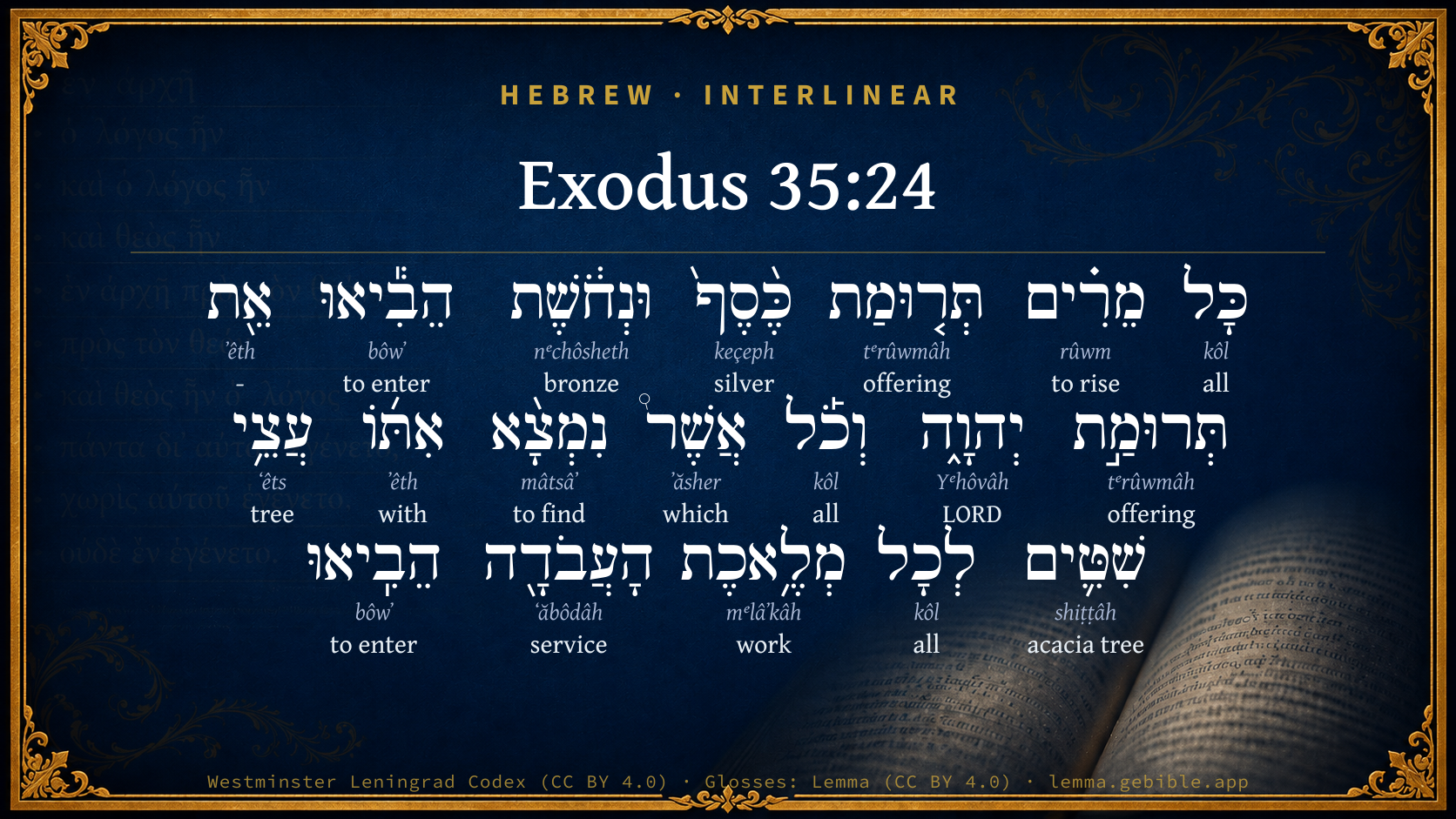
  1. כָּל kôl H3605 “all of” Noun, Common, Masculine, Singular, Construct
  2. מֵרִ֗ים rûwm H7311 “rising” Verb, Hiphil, Participle Active, Masculine, Singular, Absolute
  3. תְּר֤וּמַת tᵉrûwmâh H8641 “offering of” Noun, Common, Feminine, Singular, Construct
  4. כֶּ֨סֶף֙ keçeph H3701 “silver” Noun, Common, Masculine, Singular, Absolute
  5. וּנְחֹ֔שֶׁת nᵉchôsheth H5178 “and · bronze” Conjunction + Noun, Common, Feminine, Singular, Absolute
  6. הֵבִ֕יאוּ bôwʼ H935 “to enter” Verb, Hiphil, Perfect, 3rd Person, Common, Plural
  7. אֵ֖ת ʼêth H853 “-” Particle, Direct Object
  8. תְּרוּמַ֣ת tᵉrûwmâh H8641 “offering of” Noun, Common, Feminine, Singular, Construct
  9. יְהוָ֑ה Yᵉhôvâh H3068 “LORD” Noun, Proper
  10. וְכֹ֡ל kôl H3605 “and · all” Conjunction + Noun, Common, Masculine, Singular, Absolute
  11. אֲשֶׁר֩ ʼăsher H834 “which” Particle, Relative
  12. נִמְצָ֨א mâtsâʼ H4672 “to find” Verb, Niphal, Perfect, 3rd Person, Masculine, Singular
  13. אִתּ֜וֹ ʼêth H854 “with · him” Preposition + Suffix, Personal, 3rd Person, Masculine, Singular
  14. עֲצֵ֥י ʻêts H6086 “trees of” Noun, Common, Masculine, Plural, Construct
  15. לְכָל kôl H3605 “to/for · all of” Preposition + Noun, Common, Masculine, Singular, Construct
  16. מְלֶ֥אכֶת mᵉlâʼkâh H4399 “work of” Noun, Common, Feminine, Singular, Construct
  17. הָעֲבֹדָ֖ה ʻăbôdâh H5656 “the · service” Particle, Definite Article + Noun, Common, Feminine, Singular, Absolute
  18. הֵבִֽיאוּ bôwʼ H935 “to enter” Verb, Hiphil, Perfect, 3rd Person, Common, Plural

About this verse

These counts appear in no published source. They are computed here, from the morphology-tagged text and Lemma’s own curated glosses. What Lemma adds →

19
words
15
distinct lemmas
Pentateuch
section

Shared distinctive vocabulary

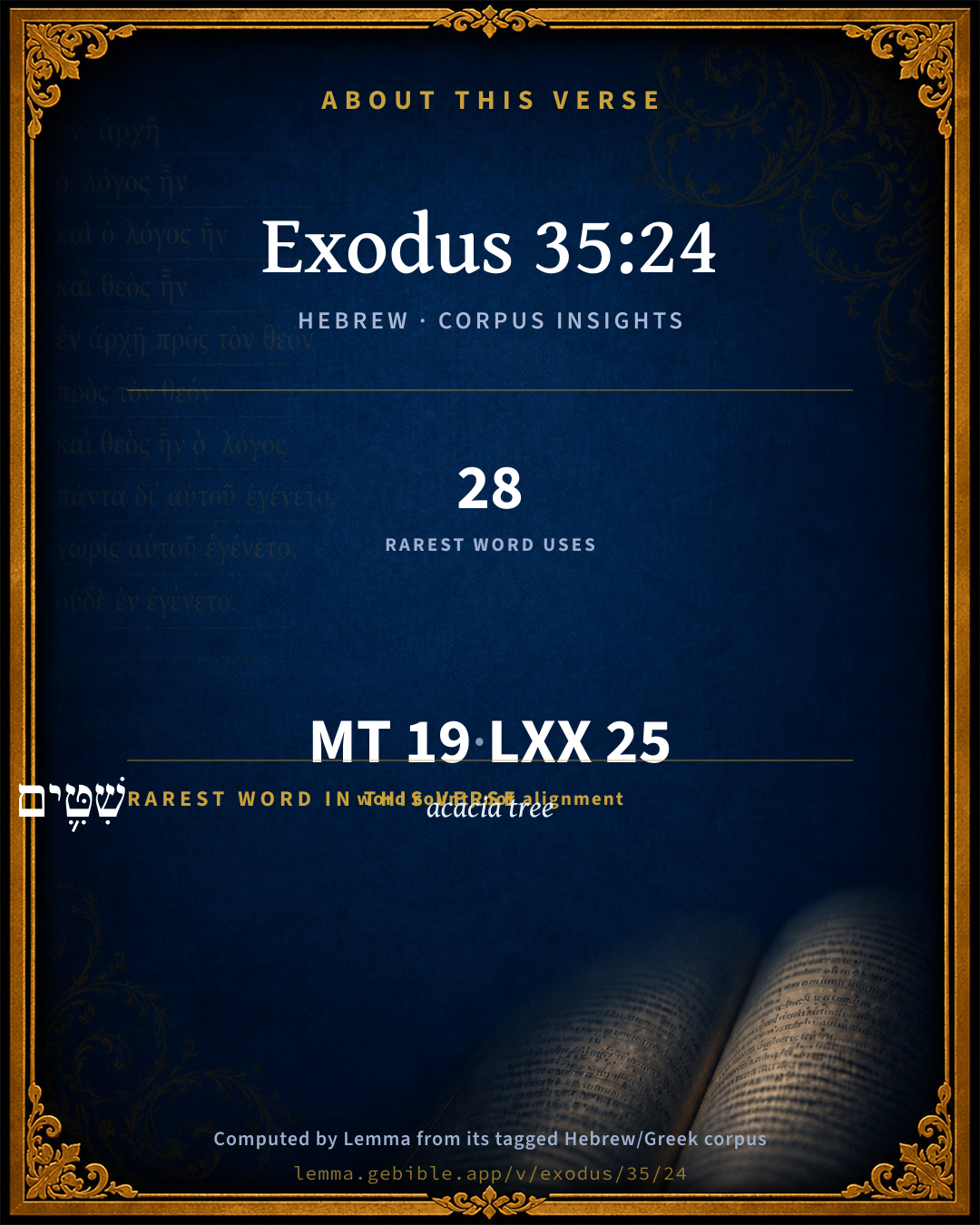
שִׁטִּ֛ים acacia tree H7848 occurs in 28 verses of the Hebrew Bible. Also found in:

Grammatical profile

  • 4 verbs
  • 12 nouns
  • 1 preposition
  • 2 particles

Verb forms

  • מֵרִ֗ים Hiphil · Participle Active
  • הֵבִ֕יאוּ Hiphil · Perfect
  • נִמְצָ֨א Niphal · Perfect
  • הֵבִֽיאוּ Hiphil · Perfect

Repetition

Words recur within this verse — often emphatic in Hebrew:

  • כָּל all H3605 ×3
  • תְּר֤וּמַת offering H8641 ×2
  • הֵבִ֕יאוּ to enter H935 ×2

Hebrew & Septuagint length

In English translation the verse runs 29 words from the Hebrew and 35 from the Septuagint (LXX English) — closely comparable.

A rough comparison of the two English renderings, which tokenize alike — not a word-level alignment.

Word counts can differ between the Hebrew and the Greek without any difference in meaning — e.g. the Hebrew direct-object marker אֵת has no separate Greek word, and Greek often adds the article ὁ.

In the original languages it is 19 Hebrew tokens and 25 Greek tokens — but the two are counted differently (Hebrew bundles its prefixes and suffixes into one token; the Greek is in lemma form), so that isn’t a like-for-like length.

Cross-references

1

Topical passages linked to Exodus 35:24 in the Treasury of Scripture Knowledge — connected by theme and wording, ordered by reader-vote popularity; previews shown in the World English Bible.

  • 2 Corinthians 8:12 For if the readiness is there, it is acceptable according to what you have, not according to what you don't have.

Cross-references courtesy of OpenBible.info (CC BY 4.0).

Hebrew and Greek witnesses Masoretic Hebrew ↔ Greek Septuagint

The same verse in the two great witnesses to the Old Testament, shown verse-for-verse.

These are two independent witnesses, not word-aligned to each other, and the Septuagint is shown in lemma (dictionary) form.

Hebrew Exodus 35:24 Masoretic · Westminster Leningrad Codex

כָּל מֵרִ֗ים תְּר֤וּמַת כֶּ֨סֶף֙ וּנְחֹ֔שֶׁת הֵבִ֕יאוּ אֵ֖ת תְּרוּמַ֣ת יְהוָ֑ה וְכֹ֡ל אֲשֶׁר֩ נִמְצָ֨א אִתּ֜וֹ עֲצֵ֥י שִׁטִּ֛ים לְכָל מְלֶ֥אכֶת הָעֲבֹדָ֖ה הֵבִֽיאוּ

Everyone who did offer an offering of silver and brass brought Yahweh's offering; and everyone, with whom was found acacia wood for any work of the service, brought it.

World English Bible · Public Domain

Greek LXX Exodus 35:24 Septuagint · lemma form

καί πᾶς ὁ ἀποαἱρέω ἀφαίρεμα ἀργύριον καί χαλκός φέρω ὁ ἀφαίρεμα κύριος καί παρά ὅς εὑρίσκω ξύλον ἄσηπτος εἰς πᾶς ὁ ἔργον ὁ κατασκευή φέρω

And every one that offered an offering brought silver and brass, the offerings to the Lord; and they with whom was found incorruptible wood; and they brought offerings for all the works of the preparation.

LXX2012 (modern English Septuagint) · Public Domain

Hebrew: Westminster Leningrad Codex (CC BY 4.0). Greek: Septuagint (public domain); English from LXX2012 (modern English Septuagint) (Public Domain). How the Septuagint differs from the Hebrew →

Targum (Aramaic paraphrase)

2

The Targum is the ancient Jewish Aramaic paraphrase of the Hebrew Scriptures — an interpretive translation, not the Hebrew text itself. Onkelos (literal) and Pseudo-Jonathan (expansive) render the Torah, and Jonathan the Prophets. Coverage is partial: where no permissively-licensed English translation exists for a verse, only the Aramaic is shown. This is verse-level text, not a word-by-word alignment to the Hebrew.

  1. Targum Onkelos Torah (Genesis–Deuteronomy)
    כָּל דַאֲרֵים אֲרָמוּת כְּסַף וּנְחַשׁ אַיְתִיאוּ יָת אַפְרָשׁוּתָא קֳדָם יְיָ וְכֹל דִי אִשְׁתְּכַח עִמֵהּ אָעֵי שִׁטִין לְכָל עִבִידַת פֻּלְחָנָא אַיְתִיאוּ:

    (no public-domain English translation for this verse)

    Targum Onkelos — Aramaic: “Onkelos Genesis” (public domain); “Onkelos Exodus” (public domain); “Onkelos Leviticus” (public domain); “Onkelos Numbers” (public domain); “Onkelos Deuteronomy” (public domain). English: “Sefaria Community Translation” (CC0 1.0 (public-domain dedication)); “J.W. Etheridge. The Targums of Onkelos and Jonathan Ben Uzziel on the Pentateuch. London: Longmans, Green, 1862” (public domain). Text via Sefaria.

  2. Targum Pseudo-Jonathan Torah (Genesis–Deuteronomy)
    כָּל דְּאָרִים אֲרָמוּת כַּסְפָּא וּנְחָשָׁא הַיְתִיוּ יַת אַפְרָשׁוּתָא קֳדָם יְיָ וְכָל מַאן דְּהִשְׁתַּכַּח עִמֵּיהּ קִיסִין דְּשִׁיטָא לְכָל עִיבִידַת פּוּלְחָנָא הַיְתִיוּ

    ___ and all with whom were found woods of sitta for all the work of the service brought.

    Targum Pseudo-Jonathan — Aramaic: “Targum Jonathan on Genesis” (public domain); “Targum Jonathan on Exodus” (public domain); “Targum Jonathan on Leviticus” (public domain); “Targum Jonathan on Numbers” (public domain); “Targum Jonathan on Deuteronomy” (public domain). English: “The Targum of Jonathan ben Uzziel, trans. J. W. Etheridge, London, 1862” (public domain). Text via Sefaria.

Commentary

Notes on Exodus 35:24 from classic Christian and Jewish commentators (each source and its license shown beneath its notes). The classic Christian expositions comment on the surrounding passage and are grouped to its opening verse, so a note may address several verses; the Jewish commentaries on the Tanakh (Rashi and others) are per-verse, so they appear only where the commentator wrote on this verse.

Lemma curates 59 commentaries, every one of them public domain or Creative Commons licensed, each selected and text-cleaned for this edition rather than reprinted as found. About our sources →

Geneva Bible (1599)

Geneva Bible translators

Hebrew, with whom was found.

Geneva Bible (1599) marginal notes — public domain. Text via Bolls.life.

Ellicott's Commentary for English Readers

(24) An offering of silver.—Silver had been enumerated among the offerings which would be accepted (Exo_25:3; Exo_35:5), and it was therefore brought; but it is difficult to say what was done with it. All the silver actually employed in the sanctuary came from the half-shekels paid when the people were numbered. (See Exo_38:25-28.) Perhaps the silver free-will offerings were returned to the donors.

A Bible Commentary for English Readers, edited by Charles John Ellicott (1878–1897) — public domain. Text from a community e-Sword module.

The Cambridge Bible for Schools and Colleges

gen. ed. J. J. S. Perowne

24. offering] not as v. 22, but, as v. 5, contribution (see on Exo_25:2). The verb ‘offer’ is cognate: lit. lift or take up (see ibid.).

the service] the business of constructing the sanctuary; so Exo_36:1; Exo_36:3.

The Cambridge Bible for Schools and Colleges (gen. ed. J. J. S. Perowne; Cambridge University Press, 1878–1918) — public domain. Text from a community e-Sword module.

John Gill's Exposition

And all the women that were wise hearted,.... That were ingenious, and had a good hand at spinning particularly, these were of the common and lower sort; the more honourable and richer sort of women are before mentioned, as bringing jewels or ornaments of gold of different sorts: but these were such who

did spin with their hands; in which way they got their living: some were more dexterous at it than others:

and brought that which they had spun, both of blue, and of purple, and of scarlet, and of fine linen; that is, yarn of these several colours, and flaxen thread, of which fine linen was made, all ready for the weaver, whether in woollen or linen.

John Gill's Exposition of the Whole Bible (1746–1763) — public domain (CC PDM 1.0). Text via the HelloAO Bible API.

The Pulpit Commentary

Every one that did offer an offering of silver. It would seem that silver was offered by some in the way of a free-will offering, in addition to the compulsory half-shekel. (Exo_30:12-16) Curiously, however, the amount obtained in this way is not given in Exo_38:24-29.

The Pulpit Commentary (1880–1919), ed. H.D.M. Spence-Jones & Joseph S. Exell — public domain. Text from a community e-Sword module.

Scofield Reference Notes

C. I. Scofield

shittim

i.e. acacia.

The Scofield Reference Bible (1917 edition), notes by C. I. Scofield — public domain. Text from a community e-Sword module.

Lesson kit

Teaching starters — assembled from the data on this page, not authored interpretation. Every prompt links to the verse data it draws on. Edit before teaching.

Exodus, in the Pentateuch, opens this verse with 19 words (15 distinct Hebrew lemmas). Its most distinctive word is shiṭṭâh (“acacia tree”). A historical commentator’s framing appears above. Read the whole chapter for the surrounding context.

Discussion questions

  1. How does “acacia tree” (shiṭṭâh) shape what this verse is saying?
  2. Exodus 25:5 shares the word «acacia tree» with this verse. How do the two illuminate each other?
  3. “all” occurs 3× in this one verse. What is the effect of the repetition?
  4. These translations render this verse differently. What is at stake in choosing one wording over another?
  5. The verb «מֵרִ֗ים» is Hiphil Participle Active. How does its form color the action?
  6. Reading how Geneva Bible (1599) and Ellicott's Commentary for English Readers read this verse, where do the two commentators agree and where do they part?

Things to notice

Reading settings

Reading text

Shown beneath each verse's original-language words.

Old Testament
Old Testament edition

Read the OT as the Masoretic Hebrew (MT) or the Greek Septuagint (LXX).

English shown for the Greek Septuagint (in the Hebrew ↔ Greek comparison).

Comparing translations? Open the Compare panel on any verse page to stack up to four side by side.