
1 Kings 11:26

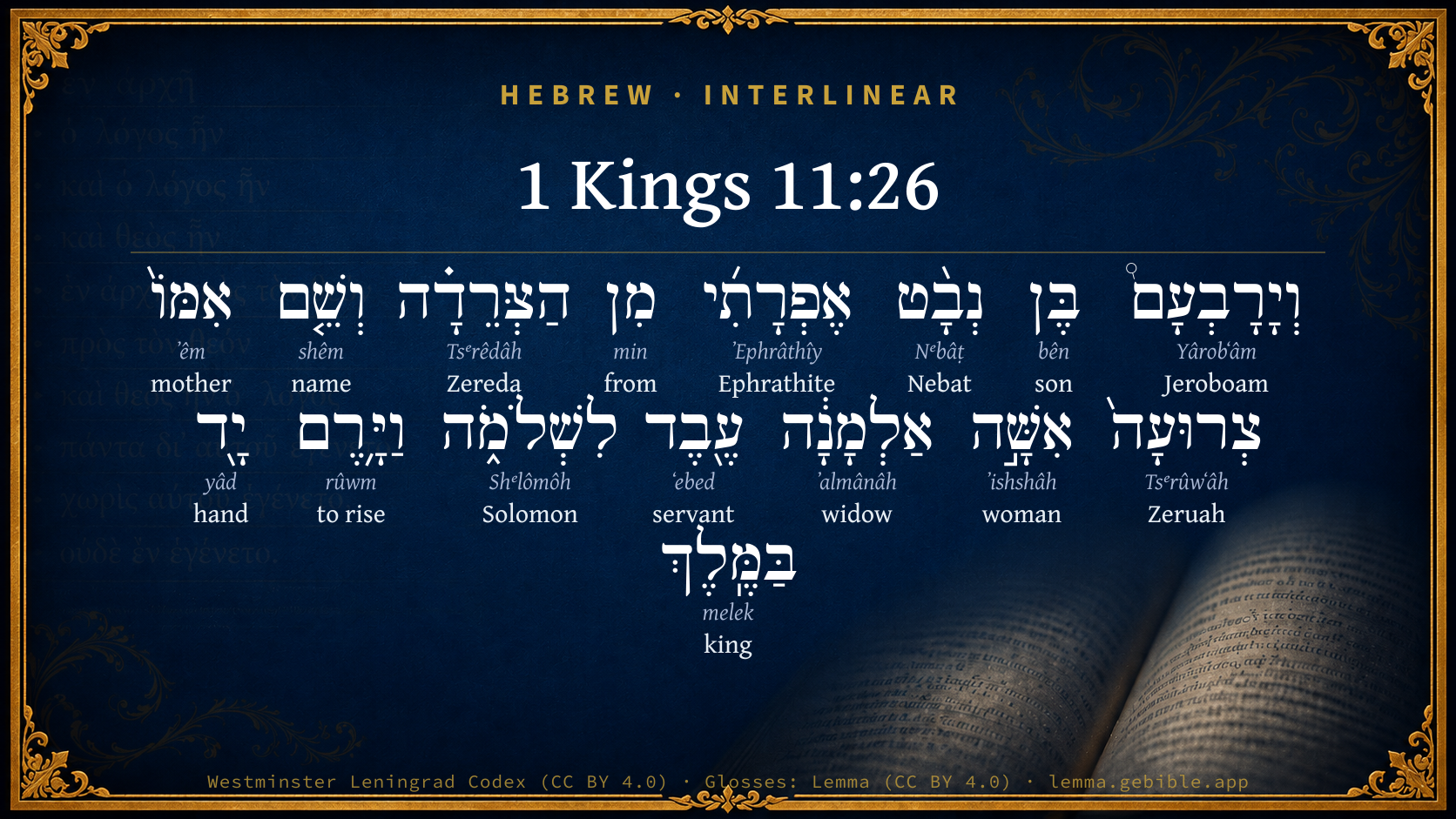
Hebrew (Westminster Leningrad Codex) 1 Kings 11:26 appears in the Hebrew Old Testament. The text above is from the Westminster Leningrad Codex. Each word links to its Strong’s number, a concise gloss, and parsing drawn from the Open Scriptures Hebrew Bible morphology. Click any word for its full Brown-Driver-Briggs (BDB) entry.
Download image
Cite this verse

1 Kings 11:26 (World English Bible). Public Domain. Lemma interlinear Bible study tool, https://lemma.gebible.app/v/1-kings/11/26.

Show BibTeX & RIS
BibTeX
RIS
English Translation
Jeroboam the son of Nebat, an Ephraimite of Zeredah, a servant of Solomon, whose mother's name was Zeruah, a widow, he also lifted up his hand against the king.
World English Bible · Public Domain
Highlights Full analysis ↓
Download a study sheet

One document with this verse’s original text, its word-by-word gloss line, the meaning frame, cross-references with their text, attributed commentary, and full source and license credits — printable, and it pastes into notes with its structure intact.

This verse Autodidact and up

Study sheet (.html) Plain text (.txt)

A passage Seminary Student

Up to 50 verses in one chapter. A passage sheet keeps up to 6 commentary sources and 12 cross-references per verse, in the order this page ranks them, and says so on the sheet whenever that leaves anything out. Ask for a single verse and you get the Autodidact verse sheet above.

Everything on this page stays free to read, with no account — the sheet is a download of what is already on screen, not access to it.

Want to remove ads? Support Godless Engineer
Compare translations 3

The same verse in 3 English versions, stacked beneath the original-language interlinear above. Click any original word for its lexicon entry.

Each is an independent rendering of the whole verse — the interlinear is not word-aligned to these translations.

Highlighted words mark where these versions differ — a whole-verse word diff, not a word-by-word alignment.

  • World English Bible Public Domain
    Jeroboam the son of Nebat, an Ephraimite of Zeredah, a servant of Solomon, whose mother's name was Zeruah, a widow, he also lifted up his hand against the king.
  • King James Version Public Domain
    And Jeroboam the son of Nebat, an Ephrathite of Zereda, Solomon's servant, whose mother's name was Zeruah, a widow woman, even he lifted up his hand against the king.
  • unfoldingWord Literal Text CC BY-SA 4.0
    And Jeroboam, the son of Nebat, an Ephrathite from Zeredah, and the name of his mother Zeruah, a woman, a widow, a servant of Solomon, and he raised a hand against the king.

unfoldingWord Literal Text — © unfoldingWord, licensed CC BY-SA 4.0. Word-aligned USFM3 via Door43 (git.door43.org/unfoldingWord/en_ult).

Versions to compare (up to 4)

3 of 4 selected

Show all 18 translations

Every available English version of this verse, each an independent rendering of the whole verse.

  • World English Bible Public Domain
    Jeroboam the son of Nebat, an Ephraimite of Zeredah, a servant of Solomon, whose mother's name was Zeruah, a widow, he also lifted up his hand against the king.
  • Berean Standard Bible Public Domain
    Now Jeroboam son of Nebat was an Ephraimite from Zeredah whose mother was a widow named Zeruah. Jeroboam was a servant of Solomon, but he rebelled against the king,
  • Majority Standard Bible Public Domain
    Now Jeroboam son of Nebat was an Ephraimite from Zeredah whose mother was a widow named Zeruah. Jeroboam was a servant of Solomon, but he rebelled against the king,
  • King James Version Public Domain
    And Jeroboam the son of Nebat, an Ephrathite of Zereda, Solomon's servant, whose mother's name was Zeruah, a widow woman, even he lifted up his hand against the king.
  • American Standard Version (1901) Public Domain
    And Jeroboam the son of Nebat, an Ephraimite of Zeredah, a servant of Solomon, whose mother's name was Zeruah, a widow, he also lifted up his hand against the king.
  • Revised Version (1885) Public Domain
    And Jeroboam the son of Nebat, an Ephraimite of Zeredah, a servant of Solomon, whose mother’s name was Zeruah, a widow woman, he also lifted up his hand against the king.
  • Geneva Bible (1599) Public Domain
    And Ieroboam the sonne of Nebat an Ephrathite of Zereda Salomons seruant (whose mother was called Zeruah a widowe) lift vp his hand against the King.
  • Douay-Rheims (1899) Public Domain
    Jeroboam also the son of Nabat an Ephrathite of Sareda, a servant of Solomon, whose mother was named Sarua, a widow woman, lifted up his hand against the king.
  • Young's Literal Translation Public Domain
    And Jeroboam son of Nebat, an Ephrathite of Zereda -- the name of whose mother `is' Zeruah, a widow woman -- servant to Solomon, he also lifteth up a hand against the king;
  • Literal Standard Version CC BY-SA 4.0
    And Jeroboam son of Nebat, an Ephraimite of Zereda—the name of whose mother [is] Zeruah, a widow woman—servant to Solomon, he also lifts up a hand against the king;
  • Unlocked Literal Bible CC BY-SA 4.0
    Then Jeroboam son of Nebat, an Ephraimite of Zeredah, an official of Solomon, whose mother's name was Zeruah, a widow, also lifted up his hand against the king.
  • unfoldingWord Literal Text CC BY-SA 4.0
    And Jeroboam, the son of Nebat, an Ephrathite from Zeredah, and the name of his mother Zeruah, a woman, a widow, a servant of Solomon, and he raised a hand against the king.
  • Darby Bible Public Domain
    And Jeroboam the son of Nebat, an Ephrathite of Zeredah, Solomon's servant (whose mother's name was Zeruah, a widow woman), even he lifted up his hand against the king.
  • World Messianic Bible Public Domain
    Jeroboam the son of Nebat, an Ephraimite of Zeredah, a servant of Solomon, whose mother’s name was Zeruah, a widow, also lifted up his hand against the king.
  • Webster's Bible Public Domain
    And Jeroboam the son of Nebat, an Ephrathite of Zereda, Solomon's servant, whose mother's name was Zeruah, a widow woman, even he raised his hand against the king.
  • Free Bible Version CC BY-SA 4.0
    In addition, Jeroboam, son of Nebat, rebelled against the king. One of Solomon's officials, he was an Ephraimite from Zeredah. His mother was a widow called Zeruah.
  • Bible in Basic English Public Domain
    And there was Jeroboam, the son of Nebat, an Ephraimite from Zeredah, a servant of Solomon, whose mother was Zeruah, a widow; and his hand was lifted up against the king.
  • JPS Tanakh (1917) Public Domain
    And Jeroboam the son of Nebat, an Ephraimite of Zeredah, a servant of Solomon, whose mother's name was Zeruah, a widow, he also lifted up his hand against the king.

Literal Standard Version (2020), Covenant Press — licensed CC BY-SA 4.0. Text via the HelloAO Bible API (eBible.org). Unlocked Literal Bible (unfoldingWord) — licensed CC BY-SA 4.0. Text via the HelloAO Bible API (eBible.org). unfoldingWord Literal Text — © unfoldingWord, licensed CC BY-SA 4.0. Word-aligned USFM3 via Door43 (git.door43.org/unfoldingWord/en_ult). Free Bible Version, Dr. Jonathan Gallagher — licensed CC BY-SA 4.0. Text via the HelloAO Bible API (eBible.org).

Word by word

More ways to search: Search by grammar → Find every occurrence → Compare this word →

Practice this passage: Drill this verse → Learn its vocabulary →

צְרוּעָה֙
Tsᵉrûwʻâh
H6871
“Zeruah”
Noun, Proper
Part of Speech
Noun
Type
Proper
Full BDB Definition

Origin: pass part of H6879

TWOT: None

Zeruah = "full breasted" - wife of Nebat and mother of king Jeroboam I of the northern kingdom of Israel
  1. וְיָרָבְעָם֩ Yârobʻâm H3379 “and · Jeroboam” Conjunction + Noun, Proper
  2. בֶּן bên H1121 “son of” Noun, Common, Masculine, Singular, Construct
  3. נְבָ֨ט Nᵉbâṭ H5028 “Nebat” Noun, Proper
  4. אֶפְרָתִ֜י ʼEphrâthîy H673 “Ephrathite” Noun, Gentilic, Masculine, Singular, Absolute
  5. מִן min H4480 “from” Preposition
  6. הַצְּרֵדָ֗ה Tsᵉrêdâh H6868 “the · Zereda” Particle, Definite Article + Noun, Proper
  7. וְשֵׁ֤ם shêm H8034 “and · name of” Conjunction + Noun, Common, Masculine, Singular, Construct
  8. אִמּוֹ֙ ʼêm H517 “mother · his” Noun, Common, Feminine, Singular, Construct + Suffix, Personal, 3rd Person, Masculine, Singular
  9. אִשָּׁ֣ה ʼishshâh H802 “woman” Noun, Common, Feminine, Singular, Absolute
  10. אַלְמָנָ֔ה ʼalmânâh H490 “widow” Noun, Common, Feminine, Singular, Absolute
  11. עֶ֖בֶד ʻebed H5650 “servant” Noun, Common, Masculine, Singular, Absolute
  12. לִשְׁלֹמֹ֑ה Shᵉlômôh H8010 “to/for · Solomon” Preposition + Noun, Proper
  13. וַיָּ֥רֶם rûwm H7311 “and · to rise” Conjunction + Verb, Hiphil, Sequential Imperfect, 3rd Person, Masculine, Singular
  14. יָ֖ד yâd H3027 “hand” Noun, Common, Both, Singular, Absolute
  15. בַּמֶּֽלֶךְ melek H4428 “in/at the · king” Preposition, Determined + Noun, Common, Masculine, Singular, Absolute

About this verse

These counts appear in no published source. They are computed here, from the morphology-tagged text and Lemma’s own curated glosses. What Lemma adds →

16
words
16
distinct lemmas
Historical
section

Notable vocabulary

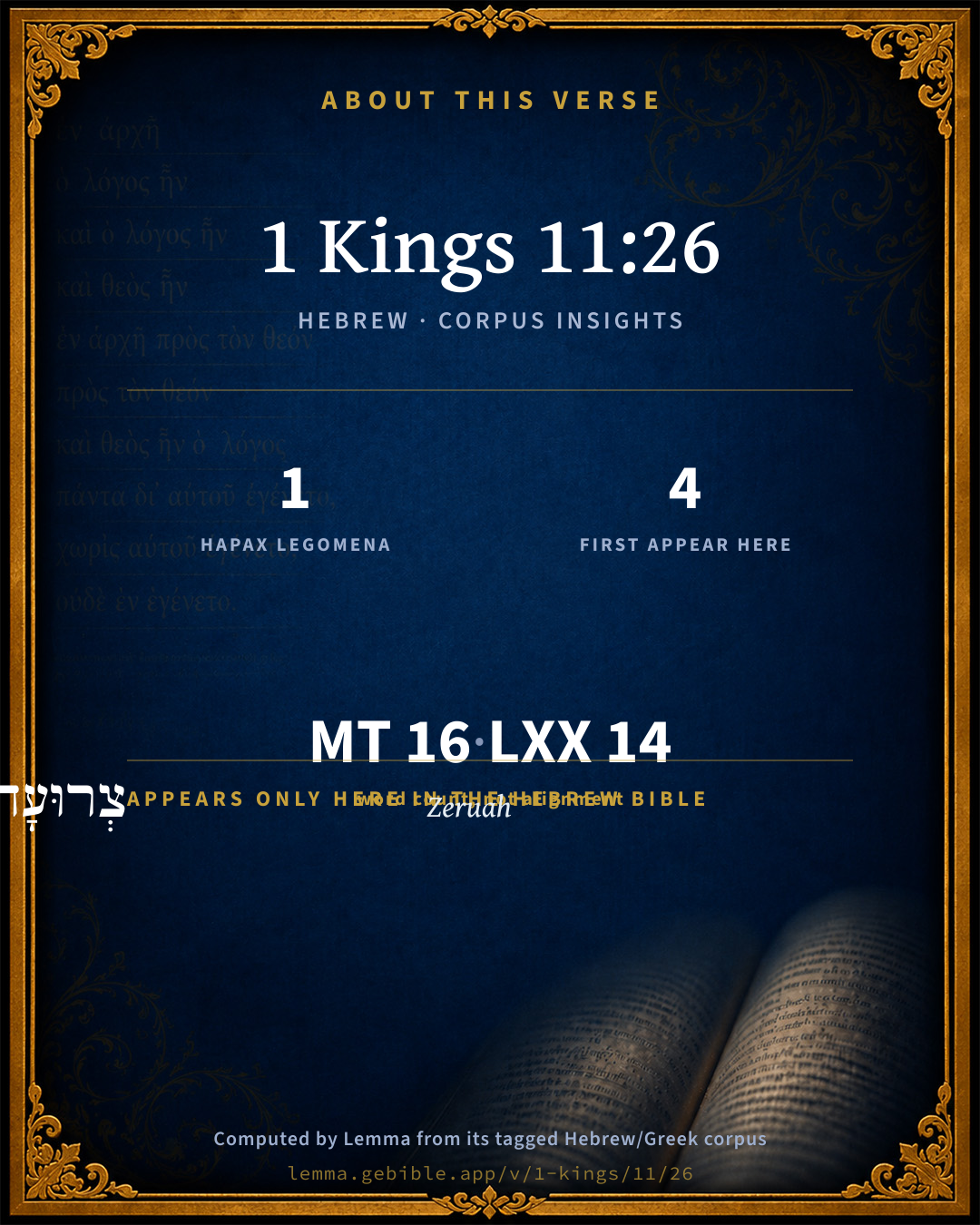
1 hapax legomenon — a word that appears only here in the entire Hebrew Bible:

  • צְרוּעָה֙ Zeruah H6871

First appearance in Scripture

These words make their first canonical appearance in the Hebrew Bible here:

  • וְיָרָבְעָם֩ Jeroboam H3379
  • נְבָ֨ט Nebat H5028
  • הַצְּרֵדָ֗ה Zereda H6868
  • צְרוּעָה֙ Zeruah H6871

Shared distinctive vocabulary

הַצְּרֵדָ֗ה Zereda H6868 occurs in 2 verses of the Hebrew Bible. Also found in:

Grammatical profile

  • 1 verb
  • 14 nouns
  • 1 preposition

Verb forms

  • וַיָּ֥רֶם Hiphil · Sequential Imperfect

Hebrew & Septuagint length

In English translation the verse runs 29 words from the Hebrew and 19 from the Septuagint (LXX English) — the Septuagint runs noticeably shorter here. See the side-by-side →

A rough comparison of the two English renderings, which tokenize alike — not a word-level alignment.

Word counts can differ between the Hebrew and the Greek without any difference in meaning — e.g. the Hebrew direct-object marker אֵת has no separate Greek word, and Greek often adds the article ὁ.

In the original languages it is 16 Hebrew tokens and 14 Greek tokens — but the two are counted differently (Hebrew bundles its prefixes and suffixes into one token; the Greek is in lemma form), so that isn’t a like-for-like length.

Cross-references

17

Topical passages linked to 1 Kings 11:26 in the Treasury of Scripture Knowledge — connected by theme and wording, ordered by reader-vote popularity; previews shown in the World English Bible.

  • 1 Kings 12:2 It happened, when Jeroboam the son of Nebat heard of it (for he was yet in Egypt, where he had fled from the presence of king Solomon, and Jeroboam lived in Egypt,
  • 2 Chronicles 13:6 Yet Jeroboam the son of Nebat, the servant of Solomon the son of David, rose up, and rebelled against his lord.
  • Ruth 1:2 The name of the man was Elimelech, and the name of his wife Naomi, and the name of his two sons Mahlon and Chilion, Ephrathites of Bethlehem Judah. They came into the country of Moab, and continued there.
  • 1 Samuel 1:1 Now there was a certain man of Ramathaim Zophim, of the hill-country of Ephraim, and his name was Elkanah, the son of Jeroham, the son of Elihu, the son of Tohu, the son of Zuph, an Ephraimite:
  • 2 Samuel 20:21 The matter is not so: but a man of the hill-country of Ephraim, Sheba the son of Bichri by name, has lifted up his hand against the king, even against David; deliver him only, and I will depart from the city. The woman said to Joab, Behold, his head shall be thrown to you over the wall.
  • 1 Kings 11:11 Therefore Yahweh said to Solomon, Because this is done of you, and you have not kept my covenant and my statutes, which I have commanded you, I will surely tear the kingdom from you, and will give it to your servant.
  • 1 Kings 11:28 The man Jeroboam was a mighty man of valor; and Solomon saw the young man that he was industrious, and he gave him charge over all the labor of the house of Joseph.
  • Genesis 35:16 They traveled from Bethel. There was still some distance to come to Ephrath, and Rachel travailed. She had hard labor.
  • 1 Samuel 17:12 Now David was the son of that Ephrathite of Bethlehem Judah, whose name was Jesse; and he had eight sons: and the man was an old man in the days of Saul, stricken [in years] among men.
  • 1 Kings 9:22 But of the children of Israel did Solomon make no bondservants; but they were the men of war, and his servants, and his princes, and his captains, and rulers of his chariots and of his horsemen.
  • 1 Kings 12:20–24 It happened, when all Israel heard that Jeroboam was returned, that they sent and called him to the congregation, and made him king over all Israel: there was none who followed the house of David, but the tribe of Judah only.
  • 1 Kings 13:1–10 Behold, there came a man of God out of Judah by the word of Yahweh to Beth El: and Jeroboam was standing by the altar to burn incense.
  • 1 Kings 14:16 He will give Israel up because of the sins of Jeroboam, which he has sinned, and with which he has made Israel to sin.
  • 1 Kings 15:30 for the sins of Jeroboam which he sinned, and with which he made Israel to sin, because of his provocation with which he provoked Yahweh, the God of Israel, to anger.
  • 1 Kings 16:3 behold, I will utterly sweep away Baasha and his house; and I will make your house like the house of Jeroboam the son of Nebat.
  • 1 Kings 21:22 and I will make your house like the house of Jeroboam the son of Nebat, and like the house of Baasha the son of Ahijah for the provocation with which you have provoked me to anger, and have made Israel to sin.

Cross-references courtesy of OpenBible.info (CC BY 4.0).

Hebrew and Greek witnesses Masoretic Hebrew ↔ Greek Septuagint

The same verse in the two great witnesses to the Old Testament, shown verse-for-verse.

Here the Septuagint runs noticeably shorter than the Hebrew — LXX2012 (modern English Septuagint) 19 words vs World English Bible 29. A rough length comparison of the two English translations, not a word-level alignment — read both below.

These are two independent witnesses, not word-aligned to each other, and the Septuagint is shown in lemma (dictionary) form.

Hebrew 1 Kings 11:26 Masoretic · Westminster Leningrad Codex

וְיָרָבְעָם֩ בֶּן נְבָ֨ט אֶפְרָתִ֜י מִן הַצְּרֵדָ֗ה וְשֵׁ֤ם אִמּוֹ֙ צְרוּעָה֙ אִשָּׁ֣ה אַלְמָנָ֔ה עֶ֖בֶד לִשְׁלֹמֹ֑ה וַיָּ֥רֶם יָ֖ד בַּמֶּֽלֶךְ

Jeroboam the son of Nebat, an Ephraimite of Zeredah, a servant of Solomon, whose mother's name was Zeruah, a widow, he also lifted up his hand against the king.

World English Bible · Public Domain

Greek LXX 1 Kings 11:26 Septuagint · lemma form

καί ιεροβοαμ υἱός ναβατ ὁ εφραθι ἐκ ὁ σαριρα υἱός γυνή χήρα δοῦλος σαλωμών

And Jeroboam the son of Nabat, the Ephrathite of Sarira, the son of a widow, was servant of Solomon.

LXX2012 (modern English Septuagint) · Public Domain

On this verse, MacLaren's Expositions of Holy Scripture discusses the Septuagint’s reading. Read the note in Commentary ↓

Hebrew: Westminster Leningrad Codex (CC BY 4.0). Greek: Septuagint (public domain); English from LXX2012 (modern English Septuagint) (Public Domain). How the Septuagint differs from the Hebrew →

Targum (Aramaic paraphrase)

1

The Targum is the ancient Jewish Aramaic paraphrase of the Hebrew Scriptures — an interpretive translation, not the Hebrew text itself. Onkelos (literal) and Pseudo-Jonathan (expansive) render the Torah, and Jonathan the Prophets. Coverage is partial: where no permissively-licensed English translation exists for a verse, only the Aramaic is shown. This is verse-level text, not a word-by-word alignment to the Hebrew.

  1. Targum Jonathan Prophets (Joshua–Malachi)
    וְיָרָבְעָם בַּר נְבָט אֶפְרָתִי מִן צְרֵדָה וְשׁוּם אִמֵיהּ צְרוּעָה אִתְּתָא אַרְמַלְתָּא עַבְדָא לִשְׁלֹמֹה וַאֲרֵים יְדָא בְּמַלְכָּא:

    (no public-domain English translation for this verse)

    Targum Jonathan — Aramaic: “Mikraot Gedolot” (public domain). English: “Sefaria Community Translation” (CC0 1.0 (public-domain dedication)); “London "Chaldee Paraphrase," 1871” (public domain). Text via Sefaria.

Commentary

Notes on 1 Kings 11:26 from classic Christian and Jewish commentators (each source and its license shown beneath its notes). The classic Christian expositions comment on the surrounding passage and are grouped to its opening verse, so a note may address several verses; the Jewish commentaries on the Tanakh (Rashi and others) are per-verse, so they appear only where the commentator wrote on this verse.

Lemma curates 59 commentaries, every one of them public domain or Creative Commons licensed, each selected and text-cleaned for this edition rather than reprinted as found. About our sources →

Matthew Henry's Commentary

We have here the first mention of that infamous name Jeroboam the son of Nebat, that made Israel to sin; he is here brought upon the stage as an adversary to Solomon, whom God had expressly told (Kg1 11:11) that he would give the greatest part of his kingdom to his servant, and Jeroboam was the man. We have here an account,

I. Of his extraction, Kg1 11:26. He was of the tribe of Ephraim, he next in honour to Judah. His mother was a widow, to whom Providence had made up the loss of a husband in a son that was active and ingenious, and (we may suppose) a great support and comfort to her.

II. Of his elevation. It was Solomon's wisdom, when he had work to do, to employ proper persons in it. He observed Jeroboam to be a very industrious young man, one that minded his business, took a pleasure in it, and did it with all his might, and therefore he gradually advanced him, till at length he made him receiver-general for the two tribes of Ephraim and Manasseh, or perhaps put him into an office equivalent to that of lord-lieutenant of those two counties, for he was ruler of the burden, or tribute, that is, either of the taxes or of the militia of the house of Joseph. Note, Industry is the way to preferment. Seest thou a man diligent in his business, that will take care and pains, and go through with it? he shall stand before kings, and not always be on the level with mean men. Observe a difference between David, and both his predecessor and his successor: when Saul saw a valiant man he took him to himself (Sa1 14:52); when Solomon saw an industrious man he preferred him; but David's eyes were upon the faithful in the land, that they might dwell with him: if he saw a godly man, he preferred him, for he was a man after God's own heart, whose countenance beholds the upright.

III. Of his designation to the government of the ten tribes after the death of Solomon. Some think he was himself plotting against Solomon, and contriving to rise to the throne, that he was turbulent and aspiring. The Jews say that when he was employed by Solomon in building Millo he took opportunities of reflecting upon Solomon as oppressive to his people, and suggesting that which would alienate them from his government. It is not indeed probable that he should say much to that purport, for Solomon would have got notice of it, and it would have hindered his preferment; but it is plainly intimated that he had it in his thoughts, for the prophet tells him (Kg1 11:37), Thou shalt reign according to all that thy soul desireth. But this was the cause, or rather this was the story, of the lifting up of his hand against the king: Solomon made him ruler over the tribes of Joseph, and, as he was going to take possession of his government, he was told by a prophet in God's name that he should be king, which emboldened him to aim high, and in some instances to oppose the king and give him vexation. 1. The prophet by whom this message was sent was Ahijah of Shiloh; we shall read of him again, Kg1 14:2. It seems, Shiloh was not so perfectly forsaken and forgotten of God but that, in remembrance of the former days, it was blessed with a prophet. He delivered his message to Jeroboam in the way, his servants being probably ordered to retire, as in a like case (Sa1 9:27), when Samuel delivered his message to Saul. God's word was not the less sacred and sure for being delivered to him thus obscurely, under a hedge it may be. 2. The sign by which it was represented to him was the rending of a garment into twelve pieces, and giving him ten, Kg1 11:30, Kg1 11:31. It is not certain whether the garment was Jeroboam's, as is commonly taken for granted, or Ahijah's, which is more probable: He (that is, the prophet) had clad himself with a new garment, on purpose that he might with it give him a sign. The rending of the kingdom from Saul was signified by the rending of Samuel's mantle, not Saul's, Sa1 15:27, Sa1 15:28. And it was more significant to give Jeroboam ten pieces of that which was not his own before than of that which was. The prophets, both true and false, used such signs, even in the New Testament, as Agabus, Act 21:10, Act 21:11. 3. The message itself, which is very particular, (1.) He assures him that he shall be king over ten of the twelve tribes of Israel, Kg1 11:31. The meanness of his extraction and employment shall be no hindrance to his advancement, when the God of Israel says (by whom kings reign), I will give ten tribes unto thee. (2.) He tells him the reason; not for his good character or deserts, but for the chastising of Solomon's apostasy: "Because he, and his family, and many of his people with him, have forsaken me, and worshipped other gods," Kg1 11:33. It was because they had done ill, not because he was likely to do much better. Thus Israel must know that it is not for their righteousness that they are made masters of Canaan, but for the wickedness of the Canaanites, Deu 9:4. Jeroboam did not deserve so good a post, but Israel deserved so bad a prince. In telling him that the reason why he rent the kingdom from the house of Solomon was because they had forsaken God, he warns him to take heed of sinning away his preferment in like manner. (3.) He limits his expectations to the ten tribes only, and to them in reversion after the death of Solomon, lest he should aim at the whole and give immediate disturbance to Solomon's government. He is here told, [1.] That two tribes (called here one tribe, because little Benjamin was in a manner lost in the thousands of Judah) should remain sure to the house of David, and he must never make any attempt upon them: He shall have one tribe (Kg1 11:32), and again (Kg1 11:36), That David may have a lamp, that is, a shining name and memory (Psa 132:17), and his family, as a royal family, may not be extinct. He must not think that David was rejected, as Saul was. No, God would not take his loving-kindness from him, as he did from Saul. The house of David must be supported and kept in reputation, for all this, because out of it the Messiah must arise. Destroy it not, for that blessing is in it. [2.] That Solomon must keep possession during his life, Kg1 11:34, Kg1 11:35. Jeroboam therefore must not offer to dethrone him, but wait with patience till his day shall come to fall. Solomon shall be prince, all the days of his life, not for his own sake (he had forfeited his crown to the justice of God), but for David my servant's sake, because he kept my commandments. Children that do not tread in their parents' steps yet often fare the better in this world for their good parents' piety. (4.) He gives him to understand that he will be upon his good behaviour. The grant of the crown must run quamdiu se bene gesserit - during good behaviour. "If thou wilt do what is right in my sight, I will build thee a sure house, and not otherwise" (Kg1 11:38), intimating that, if he forsook God, even his advancement to the throne would in time lay his family in the dust; whereas the seed of David, though afflicted, should not be afflicted for ever (Kg1 11:39), but should flourish again, as it did in many of the illustrious kings of Judah, who reigned in glory when Jeroboam's family was extirpated.

IV. Jeroboam's flight into Egypt, Kg1 11:40. In some way or other Solomon came to know of all this, probably from Jeroboam's own talk of it; he could not conceal it as Saul did, nor keep his own counsel; if he had, he might have staid in his country, and been preparing there for his future advancement; but letting it be known, 1. Solomon foolishly sought to kill his successor. Had not he taught others that, whatever devices are in men's hearts, the counsel of the Lord shall stand? And yet does he himself think to defeat that counsel? 2. Jeroboam prudently withdrew into Egypt. Though God's promise would have secured him any where, yet he would use means for his own preservation, and was content to live in exile and obscurity for a while, being sure of a kingdom at last. And shall not we be so, who have a better kingdom in reserve?

Matthew Henry's Commentary on the Whole Bible (1708–1710) — public domain (CC PDM 1.0). Text via the HelloAO Bible API.

Trapp's Complete Commentary

John Trapp

1Ki 11:26 And Jeroboam the son of Nebat, an Ephrathite of Zereda, Solomon’s servant, whose mother’s name [was] Zeruah, a widow woman, even he lifted up [his] hand against the king.

Ver. 26. And Jeroboam the son of Nebat.] Not of Shimei, whom Solomon slew, as some Rabbis fabled.

An Ephrathite,] i.e., Of the tribe of Ephraim, that arrogant and turbulent tribe, co-rival ever with Judah for the government.

Solomon’s servant.] But unthankful and disloyal, such as was Ahithophei to David, Brutus to Caesar, Phocas to Mauritius, Frederick III’s courtiers and creatures to him, Biron to Henry IV of France. That king had made him, of a common soldier a captain, of a captain a knight, of a knight duke of Biron, marshal of France, governor of Burgundy, &c.; yet all this and more could not keep him from conspiring the death of his king, queen, and prince, that the kingdom might be transferred to others, and the Huguenots rooted out. {a} It appeareth that Jeroboam was not only employed by Solomon, but preferred to be ruler over the whole house of Joseph, where he first talked his pleasure against his master, and then acted against him, in his posterity especially. {1Ki 12:12-24}

{a} Epit. Hist. Gallic., 274.

John Trapp, A Commentary or Exposition upon All the Books of the Old and New Testament (1647–1656) — public domain. Text from a community e-Sword module.

Joseph Benson's Commentary

1Ki 11:26-28. Even he lifted up his hand against the king — Probably made some secret attempts to raise a dissatisfaction against Solomon; for we do not read of any open attempt. And this was the cause, &c. — This was the occasion of Jeroboam’s advancement, as it follows in the next verse. Solomon built Millo, &c. — Solomon, being engaged in many buildings, made choice of such as he judged were fit persons to oversee his works; among whom Jeroboam was one. A mighty man of valour — Of great courage and strength of body. Solomon seeing — that he was industrious — Very diligent in the business wherein he had employed him, of overlooking his works. He made him ruler, &c. — Set him over those of the tribe of Benjamin who were employed in carrying stones, &c., for Solomon’s buildings; or over the taxes and tributes which were to be collected of the house of Joseph, that is, of Ephraim and Manasseh, or of Ephraim only, termed here, as often elsewhere, the house of Joseph.

Joseph Benson's Commentary on the Old and New Testaments (1811–1818) — public domain. Text from a community e-Sword module.

MacLaren's Expositions of Holy Scripture

Alexander MacLaren

1 Kings

THE NEW GARMENT RENT

1Ki 11:26 - 1Ki 11:43.

Solomon falls into the background in the last part of the story of his reign, and his enemies are more prominent than himself. So long as he walked with God, he was of importance for the historian; but as soon as he forsook God, and was consequently forsaken of His wisdom, he becomes as insignificant as an empty vessel which has once held sweet perfume, or a piece of carbon through which the electric current has ceased to flow. The sunbeam has left that peak, and shines on other summits. Never was there a sadder eclipse.

We are here told first how the instrument for shattering Solomon’s kingdom was shaped by himself. It is the old story of a young man of mark, attracting the eyes of the king, being promoted to offices of trust, which at once stir ambition, and give prominence and influence which seem to afford a possibility of gratifying it. The passion for building, so common in Eastern kings, and the cause of so much misery to their subjects, had grown on Solomon; and as his later days were harassed by war, and he had lost the safe defence of God’s arm, Jerusalem had to be enclosed by a wall. His father had been able to leave a ‘breach’ because the Lord was a wall round him and his city; and if Solomon had kept in his paths, he would have had no need to add to the fortifications. The preservation of ancestral piety is for nations and individuals a surer protection than the improvement of ancestral outward defences. Jeroboam made himself conspicuous by his energy {for that rather than ‘valour’ must be the meaning of the word}, and so got promotion. It was natural, but at the same time dangerous, to put him in command of the forced labour of his own tribe, as the narrative shows us was done; for ‘the house of Joseph’ is the tribe of Ephraim, to which, according to the correct translation of 1Ki 11:26, he belonged. In such an office he would be thrown among his kinsmen, and would at once gain influence and learn to sympathise with their discontent, or, at any rate, to know where the sore places were, if he ever wanted to inflame them. One can easily fancy the grumblings of the Ephraimites dragged up to Jerusalem to the hated labour, which Samuel had predicted {1Sa 8:16}, and how facile it would be for the officer in charge to fan discontent or to win friends by judicious indulgence. How long this went on we do not know, but the fire had smouldered for some time under the unconscious king’s very eyes, when it was fanned into a flame by Ahijah’s breath.

That is the second stage in the story,-the spark on the tinder. We have heard nothing of prophets during Solomon’s reign; but now this man from Shiloh, the ancient seat of the Tabernacle, meets the ambitious young officer in some solitary spot, with the message which answered to his secret thoughts and made his heart beat fast. The symbolic action preceding the spoken word, as usual, supplied the text, of which the word was the explanation and expansion. How pathetic is the newness of the garment! Unworn, strong, and fresh, it yet is rent in pieces. So the kingdom is so recent, with such possibilities of duration, and yet it must be shattered! Thus quickly has the experiment broken down! It is little more than a century since Saul’s anointing, little more than seventy years since the choice of David, and already the fabric, which had such fair promise of perpetuity, is ready to vanish away. If we may say so, that ‘new garment’ represents the divine disappointment and sorrow over the swift corruption of the kingdom. It was probably merely some loose square of cloth which Ahijah tore, with violence proportioned to its newness, into twelve pieces, ten of which he thrust into the astonished Jeroboam’s hands. The commentary followed.

Ahijah’s prophecy is substantially the same as the previous threatenings to Solomon, which had done no good. Their incipient fulfilment in the wars with Edom and Syria had been equally futile; and therefore God, who never strikes without warning, and never warns without striking if men do not heed, now drops the message into ears that were only too ready to hear. The seed fell on prepared soil, and Jeroboam’s half-formed plans would be consolidated and fixed. The scene is like that in which the witches foretell to Macbeth his dignity. Slumbering ambitions are stirred, and a half-inclined will is finally determined by the glimpse into the future. How easily men are persuaded that God speaks, and how willing they are to obey, when their inclinations jump with Heaven’s commandments! The prophet’s message makes the separation of the kingdoms a direct divine act, and yet it was the breaking up of a divine institution. God’s dealings have to be shaped according to facts, and He changes His methods, and lets the feebleness of His creatures and their sins mould His august procedure. The divine Potter, like mere human artisans, has His spoiled pieces of work, and, with infinite resource and patience as infinite, re-shapes the clay into other forms. The separation of the kingdoms was a divine act, and yet it is treated often in the later books as a crime and rebellion. God works out His purposes through men’s deeds, and their motives determine whether their acts are sins or obedience. A man may be a rebel while he is doing the will of God, if what he does be done at the bidding of his own selfishness. The separation of the kingdoms was God’s doing, but it was brought about by the free action of men obeying most secular impulses of political discontent, and led by a cunning, self-seeking schemer.

Note that the prophecy is in three parts. First, 1Ki 11:31 - 1Ki 11:33 announce the punishment, with the reservation of a dwindled dominion to the Davidic house, for the sake of their great ancestor and of God’s choice of Jerusalem, and solemnly charge on the people the idolatry which the king had introduced. The second part {1Ki 11:34 - 1Ki 11:36} postpones the execution of the sentence till after Solomon’s death, and assigns the same two reasons for this further forbearance. The third part {1Ki 11:37 - 1Ki 11:39} promises Jeroboam the kingdom, and lays down the conditions on which the favours promised to David and his house may be his. The whole closes with the assurance that the affliction of the seed of David is not to be for ever.

The punishment was heavy; for the disruption of the kingdom meant the wreck of all the prosperity of Solomon’s earlier days, the hopeless weakness of the divided tribes as against the formidable powers that pressed in on them from north and south, frequent intestine wars, bitter hatred instead of amity. Yet there was another side to it; for the very failure of the human kings made the Messianic hope the more bright, like a light glowing in the deepening darkness, and tumult and oppression might teach those whom prosperity and peace had only corrupted. The great lesson for us is the ruin which follows on departure from God. We do not see national sins followed with equal plainness or swiftness by national judgments; but the history of Israel is meant to show on a large scale what is always true, in the long run, both for nations and for individuals, that ‘it is an evil thing and a bitter’ to depart from the living God.

Mark, too, that the judgment is wrought out by perfectly natural causes. The separation follows old lines of cleavage. The strength of David’s kingdom lay in the south; and Ephraim was too powerful a tribe and too proud of its ancient glories, to acquiesce cheerfully in the pre-eminence of Judah. The oppression of forced labour and heavy taxation was put forward as the reason for the revolt, and, no doubt, was the reason for the readiness with which the ten tribes rallied to Jeroboam’s flag. There are two ways of writing history. You can either leave God out, or trace all to Him. The former way calls itself ‘scientific’ and ‘positive.’ The latter is the Bible way. Perhaps, if modern history were written on the same principles as the Books of Kings, the divine hand would be as plainly visible,-only it requires an inspired historian to do it. The way of bringing about the judgment for departing from God has changed, but the judgment remains the same to-day as when Ahijah rent his garment.

Between 1Ki 11:39 - 1Ki 11:40 we must suppose an attempt at armed rebellion by Jeroboam. That is implied by the expression that he ‘lifted his hand against the king’ {1Ki 11:26 - 1Ki 11:27}. That attempt must have been put down by Solomon. And that it should have been made shows how little Jeroboam was influenced by religious motives. The prophet’s words had set him all afire with ambitious hopes, and he paid no heed to the distinct assurance that Solomon was to be ‘prince all the days of his life.’ He stretched out a rash, self-willed hand to snatch the promised crown, and broke God’s commandment even while he pretended to be keeping it. How different David’s conduct in like circumstances! He took no steps to bring about the fulfilment of Samuel’s promise at his anointing, but patiently waited for God to do as He had said, in His own time, and meantime continued his lowly work. God’s time is the best time; and he who greedily grasps at a premature fulfilment of promised good will have to pay for it by defeat and exile from the modest good that he had.

Jeroboam’s flight to Egypt brings that ill-omened name on the page for the first time since the Exodus. It has given occasion to an extraordinary addition to the Septuagint, professing to tell his adventures there,-how he was high in Shishak’s favour, and married a princess. That is apparently pure legend; but his residence there was important, as the beginning of Egypt’s interference in Israel’s affairs. It is an old trick of aggressive nations to side with a pretender to the throne of a country which they covet, and benevolently to strengthen him that he may weaken it. No doubt it was as Jeroboam’s ally that Shishak invaded Judah in the fifth year of Rehoboam, and plundered the Temple and the palace. It was a bad beginning for a king of Israel to be a pensioner of Egypt.

The narrative closes with the sad, reticent formula which ends each reign, and in Solomon’s case hides so much that is tragic and dark. This was all that could be said about the end of a career that had begun so nobly. If more had been said, the record would have been sadder; and so the pitying narrative casts the veil of the stereotyped summary over the miserable story. There are many instances in history of lives of genius and enthusiasm, of high promise and partial accomplishment, marred and flung away, but none which present the great tragedy of wasted gifts, and blossoms never fruited, in a sharper, more striking form than the life of the wise king of Israel, who ‘in his latter days’ was ‘a fool.’ The goodliest vessel may be shipwrecked in sight of port. Solomon was not an old man, as we count age, when he died; for he reigned forty years, and was somewhere about twenty when he became king. But it was ‘when he was old’ that he fell, and that through passion which should have been well under control long before. The sun went down in a thick bank of clouds, which rose from undrained marshes in his soul, and stretched high up in the western horizon. His career, in its glory and its shame, preaches the great lesson which the Book of Ecclesiastes puts into his mouth as ‘the conclusion of the whole matter’: ‘Fear God, and keep His commandments; for this is the whole duty of man.’

Alexander MacLaren, Expositions of Holy Scripture (1904–1910) — public domain. Text from a community e-Sword module.

Tyndale Open Study Notes

Tyndale Open Resources

11:26-40 Information about Solomon’s third adversary, Jeroboam son of Nebat, provides background for the division of the kingdom of Israel (chs 12–14).

Tyndale Open Study Notes — © Tyndale Open Resources, licensed CC BY-SA 4.0. Text via the HelloAO Bible API.

Jamieson, Fausset & Brown

Robert Jamieson, A. R. Fausset & David Brown

Jeroboam--This was an internal enemy of a still more formidable character. He was a young man of talent and energy, who, having been appointed by Solomon superintendent of the engineering works projected around Jerusalem, had risen into public notice, and on being informed by a very significant act of the prophet Ahijah of the royal destiny which, by divine appointment, awaited him, his mind took a new turn.

Jamieson, Fausset & Brown — Commentary Critical and Explanatory on the Whole Bible (1871) — public domain (CC PDM 1.0). Text via the HelloAO Bible API.

Adam Clarke's Commentary

Verse 26. Jeroboam the son of Nebat] From the context we learn that Jeroboam while a young man was employed by Solomon to superintend the improvements and buildings at Millo, and had so distinguished himself there by his industry and good conduct as to attract general notice, and to induce Solomon to set him over all the labourers employed in that work, belonging to the tribes of Ephraim and Manasseh, called here the house of Joseph. At first it appears that Solomon employed none of the Israelites in any drudgery; but it is likely that, as he grew profane, he grew tyrannical and oppressive: and at the works of Millo he changed his conduct; and there, in all probability, were the seeds of disaffection sown. And Jeroboam, being a clever and enterprising man, knew well how to avail himself of the general discontent.

Adam Clarke's Commentary on the Bible (1810–1826) — public domain. Text from a community e-Sword/MySword module.

Ellicott's Commentary for English Readers

(26) Jeroboam the son of Nebat.—The life and character of Jeroboam are given in considerable detail in the history; and it is also remarkable that in some of the MSS. of the LXX. we find inserted after 1Ki_12:24 an independent account of his early history (see Note at the end of the chapter), generally of inferior authority, and having several suspicious features, but perhaps preserving some genuine details. As the great rebel against the House of David, the leader of the revolution which divided Israel and destroyed its greatness, the introducer of the idolatry of the temples of Dan and Bethel, and the corrupter of the worship of Jehovah in deference to an astute worldly policy, he stands out in a vividness of portraiture unapproached, till we come to the history of Ahab at the close of the book.

An Ephrathite of Zereda.—The word “Ephrathite,” which mostly means an inhabitant of Ephrata or Bethlehem, is here (as in 1Sa_1:1) simply another form of the name Ephraimite. Zereda is mostly supposed to be Zarthan (see 7:46 and 2Ch_4:17), a town of Ephraim in the Jordan valley. The Vatican MS. of the LXX., by a slight change in the Hebrew, reads Sarira, which is probably a rendering of Zererah or Zererath (Jdg_7:22), and, in the additional record noticed above, makes it a strong fortified place in Mount Ephraim.

The son of a widow woman.—This phrase, added to the phrase “Solomon’s servant,” is evidently designed to mark the utterly dependent condition from which Solomon’s favour raised the future rebel.

A Bible Commentary for English Readers, edited by Charles John Ellicott (1878–1897) — public domain. Text from a community e-Sword module.

The Cambridge Bible for Schools and Colleges

gen. ed. J. J. S. Perowne

26–40. Rise of Jeroboam’s hostility to Solomon. Ahijah’s prophetic action and message (Not in Chronicles)

26. Jeroboam the son of Nebat] This is the first mention of him who afterwards is so frequently spoken of as the man ‘who made Israel to sin.’ We know nothing more of his parentage than is told us in this verse. His after life comes before us frequently in the succeeding chapters.

an Ephrathite] Better with R.V. an Ephraimite. The word Ephrathite would mean one born at Ephratah, i.e. Bethlehem. This cannot be true of Jeroboam, from the words of the verse before us. A similar change is needed in the A.V. of 1Sa_1:1 where Elkanah, though described as ‘a man of the hill country of Ephraim’ is yet subsequently called an ‘Ephrathite.’

of Zereda] The Hebrew spelling requires Zeredah (as R.V.). This place must have been near or in the hill country of Ephraim. It has been thought by some to be the same as Zeredathah, which is given in 2Ch_4:17 instead of Zarthan of 1Ki_7:46, the place near which the castings of brass were made for Solomon s Temple. The LXX. (Vat.) gives Σαριρὰ as the name, and in a long addition which that version contains after 1Ki_11:24 of the next chapter Σαριρὰ occurs several times over. It is also given by the LXX. of 1Ki_14:17 instead of Tirzah, where Jeroboam had his royal residence. That the Greek translators identified this place with some town of great importance will be seen from the note on 1Ki_12:24 below, but whether their identification can be trusted is somewhat doubtful.

Solomon’s servant] i.e. One who had been employed by Solomon. The works were not necessarily unimportant, on which such servants were employed. But it makes the term a little more significant if (with R.V.) we render a servant of Solomon.

he lift up his hand against] A phrase indicative of rebellion and very expressive here. For Jeroboam was one of Solomon’s own people, whose hand might be expected to be with him, and not against him. Josephus marks the difference between this adversary and those previously named, when he calls Jeroboam τῶν ὁμοφύλων τίς.

The Cambridge Bible for Schools and Colleges (gen. ed. J. J. S. Perowne; Cambridge University Press, 1878–1918) — public domain. Text from a community e-Sword module.

John Gill's Exposition

And this was the cause that he lifted up his hand against the king,.... The occasion of it, his being advanced to some posts under Solomon, which elated him, and what passed between him and the prophet Ahijah, after related:

Solomon built Millo, and repaired the breaches of the city of David his father: in the oversight of which, it is supposed by the Jews, he employed this man, who reproached him for doing these works; building an house in Millo for Pharaoh's daughter, and stopping up the passage to the city of David, and the people's access thither upon occasion.

John Gill's Exposition of the Whole Bible (1746–1763) — public domain (CC PDM 1.0). Text via the HelloAO Bible API.

Albert Barnes' Notes on the Bible

Zereda - See Jdg 7:22.

Lifted up his hand against the king - i. e., “he rebelled.” Compare marginal reference.

Albert Barnes' Notes on the Bible (1834–1885) — public domain. Text from a community e-Sword/MySword module.

Haydock's Catholic Bible Commentary

King, attempting to draw the people into rebellion, as he perceived that they were discontent with the buildings at Mello. He had a command over them; and though he was, for the present, obliged to save himself by flight, he had sown the seeds of rebellion by his discourses, in such a manner, that the imprudent answer of Roboam (Calmet) easily brought them to maturity. (Haydock)

George Leo Haydock (1774–1849), Haydock's Catholic Family Bible and Commentary, 1859 edition — public domain. Excludes Psalms (Douay-Rheims chapter numbering differs from Protestant) and Deuterocanonical books (Catholic canon only).

Matthew Poole's English Annotations

i.e. Rebelled against the king; not now and immediately in the person of Solomon himself, but in his son and successor, Rehoboam.

Matthew Poole's English Annotations on the Holy Bible (1683–1685) — public domain. Text from a community e-Sword/MySword module.

Whedon's Commentary on the Bible

Daniel D. Whedon

26. Jeroboam the son of Nebat — Here we are first introduced to that distinguished person who figures so prominently in the following history as the first king in the kingdom of Israel.

Zereda — In Septuagint written Sarida, and Sarira; Vulgate, Sareda. It was somewhere in the tribe of Ephraim, but its exact locality has not been found. In the long addition to the Hebrew text which the Septuagint gives after 1Ki_12:24, and which adds somewhat to the history of Jeroboam, Sarira is represented as the place in Mount Ephraim to which Jeroboam returned from Egypt; there he assembled the whole tribe (σκηπτρον) of Ephraim, and there he built a fortress. May it not be the same as Tirzah? See 1Ki_14:17.

Lifted up his hand — A form of expression indicating sedition within the kingdom, a rebellion; rather than hostility from without, like the troubles occasioned by Rezon and Hadad.

Daniel D. Whedon (gen. ed.), Commentary on the Old and New Testaments (1874–1909) — public domain. Text from a community e-Sword module.

The Pulpit Commentary

And Jeroboam Viewed in the light of their history, the names Jeroboam and Rehoboam are both instructive. The first means, "Whose people are many;" the second, "Enlarger of the people." The latter might almost have been bestowed in irony, the former by way of parody the son of Nebat The case of Jeroboam is now related at much greater length, not so much because of the importance of the rebellion at the time, as because of its bearing on the later history of Israel. It led to the disruption of the kingdom and the schism in the Church. It was the first great symptom of the decadence of the power of Solomon; of his decline in piety we have had many indications. We see in it an indication that the Hebrew commonwealth has passed its zenith, an Ephrathite i.e. , Ephraimite; cf. Jud_1:12:5; 1Sa_1:1. Ephraim was the ancient rival of Judah, and by reason of its numbers, position, etc., might well aspire to the headship of the tribes (Gen_49:26 Gen_48:19; Deu_33:17; Jos_17:17) of Zereda Mentioned here only, unless it is identical with Zeredathah (2Ch_4:17) or Zarthan (Jos_3:16; 1Ki_4:12) in the Jordan valley. That this place was apparently situate in the tribe of Manasseh, is no argument against the identification (Bahr), for an Ephrathite might surely be born out of Ephraim. It is, however, observable that Zereda has the definite article (similarly hJ Sareira in the LXX, but this place is located in Mount Ephraim), which Zarthan, etc., have not. Hence it is probably the same as the Zererath of Jud_1:7:22. In fact, some MSS. read hdrex there instead of hrrex and r and d are not only etymologically interchangeable, but are also extremely liable to be confused (see above on ver. 14), Solomon"s servant i.e., officer; cf. ver. 28, whose mother"s name was Zeruah i.e., leprous. His mother"s name is recorded, probably because his father, having died early, was comparatively unknown. But it is not impossible that the similarity either with Zeruiah (cf. 1Ki_1:7) or Zererah had something to do with its preservation. The people would not readily forget that Solomon"s other great adversary was the son of Zeruiah. And we have many proofs how much the Jews affected the jingle of similar words, even he lifted up his Heb. a hand i.e. , rebelled. Synonymous expression 2Sa_18:28 2Sa_20:21. Observe, we have no history or account of this rebellion except in the LXX, but merely of the circumstances which led to it against the king.

Vers. 26-28.

Jeroboam.

The words before us are interesting as the earliest notice of a character who made a considerable figure in Hebrew history. They bring before us

I THE OBSCURITY OF HIS ORIGIN.

1. He was an Ephrathite of Zereda.

(1) The tribe of Ephraim was not obscure; on the contrary, it was next in importance to Judah. But that importance was collective arose from the multitude of its people. An individual Ephrathite would rather be lost in the multitude.

(2) As to Zereda, so little was this place among the thousands of Ephraim that it is mentioned only here, and would have been forgotten but for Jeroboam. Note: Places derive notoriety from men. Men are greater than places.

2. He was the son of Nebat and Zeruah.

(1) Of these persons we should not have heard bat for the part their son played in history. How much of our reputation is adventitious! Unenviable is the notoriety gained through relationship with the devil. How truly glorious is that man who rejoices in the imputed righteousness of Christ!

(2) Yet Nebat and Zeruah founded the reputation of Jeroboam. They had the moulding of the child which became the father of the man. This is the true reason for the association of their names with his.

(3) In this view there is something judicial in this association of the names of parents and child. Their influence, though obscure, was sure, and now finds expression. What an expression will there be of obscure influences when the momentous resultants come out in the disclosures of the great judgment!

3. He was the son of a widow.

(1) Why is this noted, but to suggest that through the death of Nebat the responsibilities of the home at Zereda early devolved upon Jeroboam? Thus, those executive powers which brought him under the notice of Solomon had early scope. How little we know of the purposes of Providence in the bereavements and afflictions of famine.

(2) Private afflictions are suffered for public uses. In suffering, let us not murmur but listen to the voice of God, and pray that the dispensation may be sanctified.

II HIS ADVANCEMENT TO POWER.

1. He became a mighty man of valour.

(1) This fact is recorded, but not the stages by which he became so known. Many a struggle occurred which had no other record than in this resultant. The value of circumstances is expressed in resultants. Let us attempt to weave all the circumstances of our lives into a character of goodness that will endure forever.

(2) Jeroboam had an energetic spirit and probably a robust physique. These he inherited. Neither for genius nor good constitutions are we indebted to ourselves. We owe much to our ancestors.

(3) But he cultivated his natural parts. Many are richly endowed by nature, but waste their endowments as an idle spendthrift wastes an inheritance. Our very faculties may become obliterated by disuse. (Mat_25:28)

2. His abilities were discerned by Solomon.

(1) This is noted to have occurred in connection with the building of Mille, and the closing of, or to close, the breaches in the city of David (ver. 27). Possibly Jeroboam distinguished himself against Jebusites, or some other malcontents, or in closing those breaches in the face of the enemy.

(2) Possibly the industry that attracted the notice of Solomon may have been simply in superintendence of improvements in the buildings at Millo and the fortifications. Providence finds opportunities for those who are ready to enter the opening door. (Pro_22:29)

3. He was promoted to the charge over the house of Joseph.

(1) From an individual once lost in the multitude of this great house, he is now conspicuous before the multitude. His being an Ephrathite is now of importance to him. Let us never quarrel with circumstances, for we never know what may prove of service.

(2) Being found diligent in a minor charge he is promoted to a major responsibility. So does God deal with His people. (Mat_13:12 Mat_25:29) What is worth doing is worth doing well.

4. Now he lifts his hang against his patron.

(1) Prosperity brings out the character. He is moved by ambition. Much would have more. He aspires to a throne. His success had encouraged this desire before he met Ahijah (see ver. 37).

(2) He rebels against the author of his prosperity. Ambition smothers gratitude. How human! Is not this the case with all rebels against God?

(3) How plainly we can see baseness when manifested by man toward his fellow; but how slow we are to see this when ingratitude is toward God!

The obscurity of our origin is no bar to our advancement in the religious service of God. "Not many noble are called. M.

Vers. 26-43.

The call to Jeroboam.

I THE UNWEARIED EFFORTS OF GOD TO WIN MEN FOR RIGHTEOUSNESS. This is the beginning of the story of Jeroboam the son of Nebat, who made Israel to sin.

1. He is met by mercy. The widow"s son is made king of Israel.

2. By counsel and promise (ver. 38). The seed is east upon the stony ground and among the thorns, as well as upon the good soil. Learn

1. That, like the great husbandman, we should sow the seed of the kingdom everywhere; though men may not hear, God is served and glorified in that offered mercy.

2. It is no proof that all is well with us, that we have been the recipients ofGod"s goodness, or that His Word has touched and searched our heart: is there any fruit?

II THE SPIRIT REQUIRED IN ORDER TO REAP LASTING BENEFIT FROM OTHERS" DISASTERS.

1. Sympathy with them in their suffering. The judgment which is to fall upon Solomon and Israel is laid upon Jeroboam"s heart. He went out clothed with a new garment, he returned with a handful of fragments, the symbol of the new kingdom and the effect of God"s judgment. We cannot rightly enter into blessing springing from another"s loss if we pass in with a light heart.

2. Recognition of them as still objects of Divine mercy (vers. 34, 36). The house of David was not to be utterly cast out. The love that smiles on us is still round them.

3. Recognition that the gift we receive is from the hand of the same Master. Blessing and judgment hang for him upon the same issues (vers. 33, 38). Only in lowliness and brotherliness can we rightly receive the gifts God sends us.

III THE IMPOSSIBILITY OF THWARTING THE DIVINE PURPOSE (ver. 40).

1. Solomon"s attempt to remove the danger by slaying Jeroboam is defeated. His life is guarded till his work is done.

2. It only serves the Divine purpose. Jeroboam"s enmity is secured. He is sent down to Egypt and strengthened by alliance with a power unfriendly to Israel. Fighting against God, we only bind our cords the more firmly, we kick against the pricks. To humble ourselves under the mighty hand of God will bring us into the light of mercy: to contend with Him is destruction. U.

The Pulpit Commentary (1880–1919), ed. H.D.M. Spence-Jones & Joseph S. Exell — public domain. Text from a community e-Sword module.

unfoldingWord translationNotes

Door43 World Missions Community

Jeroboam ... Nebat

These are the names of men. (See: How to Translate Names)

Zeredah ... Millo

These are the names of locations. (See: How to Translate Names)

Zeruah

This is the name of a woman. (See: How to Translate Names)

lifted up his hand against the king

The word "hand" refers to authority, power and control. The phrase "lifted up against" refers to having opposed someone by using authority, power and control. This is a metonym used as a common idiom. AT: "rebelled against the king" (See: Metonymy and Idiom)

Solomon had built up the place located at Millo

Translate "Millo" as in 1 Kings 9:15.

translationWords

Jeroboam

Ephraim

Solomon

name

hand

David

ancestor

unfoldingWord translationNotes — © Distant Shores Media and the Door43 World Missions Community, licensed CC BY-SA 4.0. Source: git.door43.org/Door43/en_tn.

Rashi

Rabbi Shlomo Yitzchaki (Rashi)

And he raised his hand against the king. He rebuked him in public.

Rashi on the Tanakh — English translations: “The Judaica Press complete Tanach with Rashi, translated by A. J. Rosenberg” (CC BY 4.0); “Pentateuch with Rashi's commentary by M. Rosenbaum and A.M. Silbermann, 1929-1934” (public domain); “The Metsudah Tanach series, Lakewood, N.J” (CC BY 4.0); and “The Book of Joshua, Metsudah Publications, 1997” (CC BY 4.0). Text via Sefaria.

Lesson kit

Teaching starters — assembled from the data on this page, not authored interpretation. Every prompt links to the verse data it draws on. Edit before teaching.

1 Kings, in the Historical, opens this verse with 16 words (16 distinct Hebrew lemmas). Its most distinctive word is Tsᵉrûwʻâh (“Zeruah”). The Greek Septuagint runs shorter here. A historical commentator’s framing appears above. Read the whole chapter for the surrounding context.

Discussion questions

  1. The word Tsᵉrûwʻâh carries the sense “Zeruah.” How does it shape the verse?
  2. 1 word here appears nowhere else in the Hebrew Bible. Why might the author reach for such rare wording?
  3. 4 words make their first appearance in Scripture here. What does this debut establish?
  4. How does 2 Chronicles 4:17, which shares the word «Zereda», read alongside this verse?
  5. The Septuagint runs shorter here than the Hebrew. What might account for the difference?
  6. These translations render this verse differently; the difference is in the English rendering, not the original. What questions does that raise?
  7. «וַיָּ֥רֶם» is a Hiphil Sequential Imperfect verb. How does that grammatical form shape the action described?
  8. Compare how Matthew Henry's Commentary and Trapp's Complete Commentary read this verse. Where do they agree or differ?

Things to notice

Reading settings

Reading text

Shown beneath each verse's original-language words.

Old Testament
Old Testament edition

Read the OT as the Masoretic Hebrew (MT) or the Greek Septuagint (LXX).

English shown for the Greek Septuagint (in the Hebrew ↔ Greek comparison).

Comparing translations? Open the Compare panel on any verse page to stack up to four side by side.