
Ezekiel 31:4

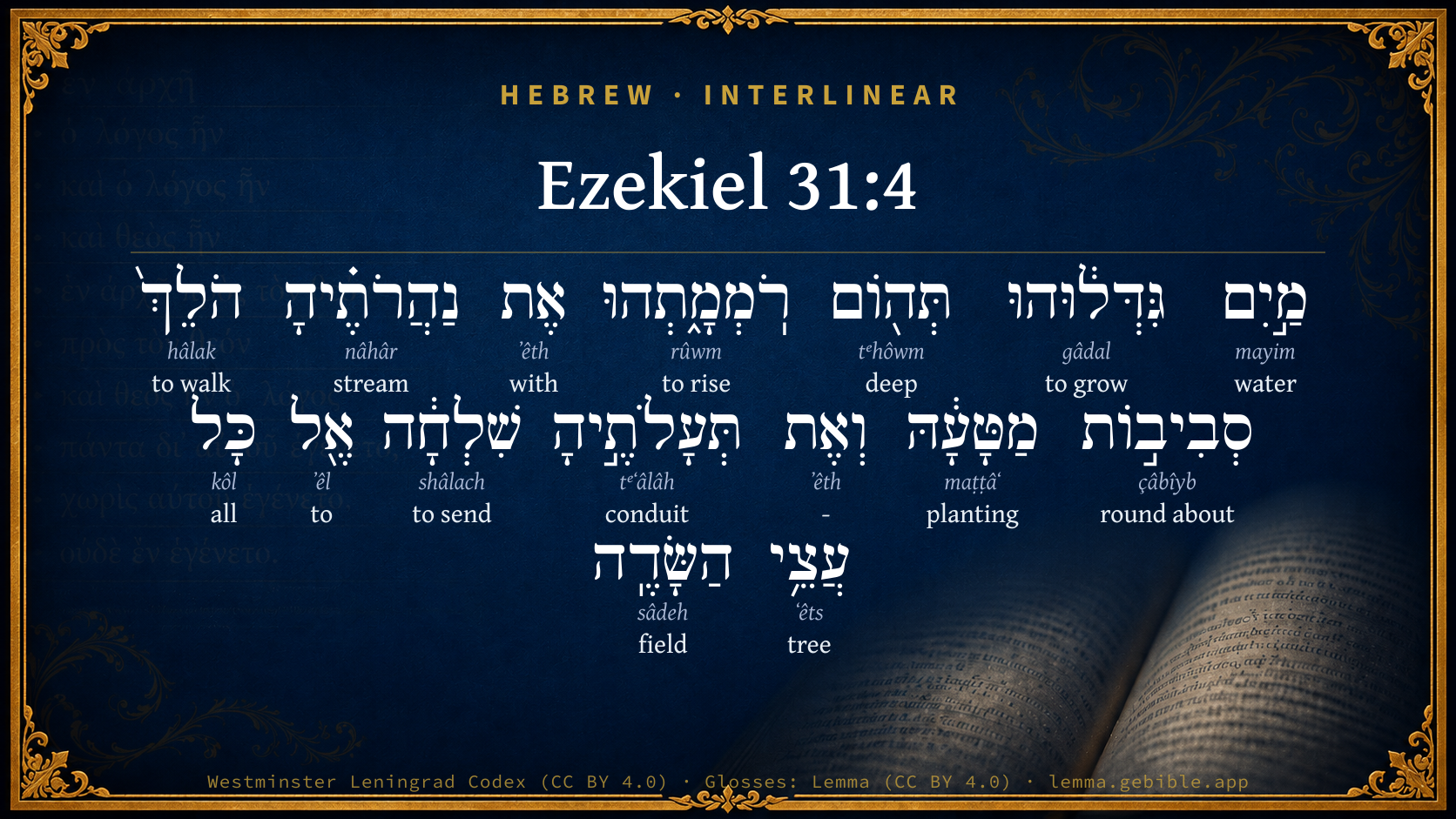
Hebrew (Westminster Leningrad Codex) Ezekiel 31:4 appears in the Hebrew Old Testament. The text above is from the Westminster Leningrad Codex. Each word links to its Strong’s number, a concise gloss, and parsing drawn from the Open Scriptures Hebrew Bible morphology. Click any word for its full Brown-Driver-Briggs (BDB) entry.
Download image
Cite this verse

Ezekiel 31:4 (World English Bible). Public Domain. Lemma interlinear Bible study tool, https://lemma.gebible.app/v/ezekiel/31/4.

Show BibTeX & RIS
BibTeX
RIS
English Translation
The waters nourished it, the deep made it to grow: the rivers of it ran round about its plantation; and it sent out its channels to all the trees of the field.
World English Bible · Public Domain
Download a study sheet

One document with this verse’s original text, its word-by-word gloss line, the meaning frame, cross-references with their text, attributed commentary, and full source and license credits — printable, and it pastes into notes with its structure intact.

This verse Autodidact and up

Study sheet (.html) Plain text (.txt)

A passage Seminary Student

Up to 50 verses in one chapter. A passage sheet keeps up to 6 commentary sources and 12 cross-references per verse, in the order this page ranks them, and says so on the sheet whenever that leaves anything out. Ask for a single verse and you get the Autodidact verse sheet above.

Everything on this page stays free to read, with no account — the sheet is a download of what is already on screen, not access to it.

Want to remove ads? Support Godless Engineer
Compare translations 3

The same verse in 3 English versions, stacked beneath the original-language interlinear above. Click any original word for its lexicon entry.

Each is an independent rendering of the whole verse — the interlinear is not word-aligned to these translations.

Highlighted words mark where these versions differ — a whole-verse word diff, not a word-by-word alignment.

  • World English Bible Public Domain
    The waters nourished it, the deep made it to grow: the rivers of it ran round about its plantation; and it sent out its channels to all the trees of the field.
  • King James Version Public Domain
    The waters made him great, the deep set him up on high with her rivers running round about his plants, and sent her little rivers unto all the trees of the field.
  • unfoldingWord Literal Text CC BY-SA 4.0
    Many waters made it tall; the deep waters made it huge. Rivers flowed all around its area, for their channels stretched out to all the trees in the field.

unfoldingWord Literal Text — © unfoldingWord, licensed CC BY-SA 4.0. Word-aligned USFM3 via Door43 (git.door43.org/unfoldingWord/en_ult).

Versions to compare (up to 4)

3 of 4 selected

Show all 18 translations

Every available English version of this verse, each an independent rendering of the whole verse.

  • World English Bible Public Domain
    The waters nourished it, the deep made it to grow: the rivers of it ran round about its plantation; and it sent out its channels to all the trees of the field.
  • Berean Standard Bible Public Domain
    The waters made it grow; the deep springs made it tall, directing their streams all around its base and sending their channels to all the trees of the field.
  • Majority Standard Bible Public Domain
    The waters made it grow; the deep springs made it tall, directing their streams all around its base and sending their channels to all the trees of the field.
  • King James Version Public Domain
    The waters made him great, the deep set him up on high with her rivers running round about his plants, and sent her little rivers unto all the trees of the field.
  • American Standard Version (1901) Public Domain
    The waters nourished it, the deep made it to grow: the rivers thereof ran round about its plantation; and it sent out its channels unto all the trees of the field.
  • Revised Version (1885) Public Domain
    The waters nourished him, the deep made him to grow: her rivers ran round about her plantation; and she sent out her channels unto all the trees of the field.
  • Geneva Bible (1599) Public Domain
    The waters nourished him, and the deepe exalted him on hie with her riuers running round about his plants, and sent out her litle riuers vnto all the trees of the fielde.
  • Douay-Rheims (1899) Public Domain
    The waters nourished him, the deep set him up on high, the streams thereof ran round about his roots, and it sent forth its rivulets to all the trees of the country.
  • Young's Literal Translation Public Domain
    Waters have made it great, The deep hath exalted him with its flowings, Going round about its planting, And its conduits it hath sent forth unto all trees of the field.
  • Literal Standard Version CC BY-SA 4.0
    Waters have made it great, || The deep has exalted him with its flowings, || Going around its planting, || And it has sent forth its conduits to all trees of the field.
  • Unlocked Literal Bible CC BY-SA 4.0
    Many waters made it tall; the deep waters made it huge. Rivers flowed all around its area, for their channels stretched out to all the trees in the field.
  • unfoldingWord Literal Text CC BY-SA 4.0
    Many waters made it tall; the deep waters made it huge. Rivers flowed all around its area, for their channels stretched out to all the trees in the field.
  • Darby Bible Public Domain
    The waters made him great, the deep set him up on high; its streams ran round about his plantation, and it sent out its rivulets unto all the trees of the field.
  • World Messianic Bible Public Domain
    The waters nourished it. The deep made it to grow. Its rivers ran all around its plantation. It sent out its channels to all the trees of the field.
  • Webster's Bible Public Domain
    The waters made him great, the deep set him up on high with her rivers running round his plants, and sent out her little rivers to all the trees of the field.
  • Free Bible Version CC BY-SA 4.0
    Deep springs of water made it grow tall and sent streams all around it to water all the other trees.
  • Bible in Basic English Public Domain
    It got strength from the waters and the deep made it tall: its streams went round about its planted land and it sent out its waterways to all the trees of the field.
  • JPS Tanakh (1917) Public Domain
    The waters nourished it, the deep made it to grow; her rivers ran round about her plantation, and she sent out her conduits unto all the trees of the field.

Literal Standard Version (2020), Covenant Press — licensed CC BY-SA 4.0. Text via the HelloAO Bible API (eBible.org). Unlocked Literal Bible (unfoldingWord) — licensed CC BY-SA 4.0. Text via the HelloAO Bible API (eBible.org). unfoldingWord Literal Text — © unfoldingWord, licensed CC BY-SA 4.0. Word-aligned USFM3 via Door43 (git.door43.org/unfoldingWord/en_ult). Free Bible Version, Dr. Jonathan Gallagher — licensed CC BY-SA 4.0. Text via the HelloAO Bible API (eBible.org).

Word by word

More ways to search: Search by grammar → Find every occurrence → Compare this word →

Practice this passage: Drill this verse → Learn its vocabulary →

מַטָּעָ֔הּ
maṭṭâʻ
H4302
“planting · her”
Noun, Common, Masculine, Singular, Construct + Suffix, Personal, 3rd Person, Feminine, Singular
Part of Speech
Noun
Type
Common
Gender
Masculine
Number
Singular
State
Construct
Full BDB Definition

Origin: from H5193

TWOT: 1354c

place or act of planting, planting, plantation - planting place - act of planting - plantation
  1. מַ֣יִם mayim H4325 “water(s)” Noun, Common, Masculine, Plural, Absolute
  2. גִּדְּל֔וּהוּ gâdal H1431 “to grow · him” Verb, Piel, Perfect, 3rd Person, Common, Plural + Suffix, Personal, 3rd Person, Masculine, Singular
  3. תְּה֖וֹם tᵉhôwm H8415 “deep” Noun, Common, Both, Singular, Absolute
  4. רֹֽמְמָ֑תְהוּ rûwm H7311 “to rise · him” Verb, Polel, Perfect, 3rd Person, Feminine, Singular + Suffix, Personal, 3rd Person, Masculine, Singular
  5. אֶת ʼêth H854 “with” Preposition
  6. נַהֲרֹתֶ֗יהָ nâhâr H5104 “streams · her” Noun, Common, Masculine, Plural, Construct + Suffix, Personal, 3rd Person, Feminine, Singular
  7. הֹלֵךְ֙ hâlak H1980 “walking” Verb, Qal, Participle Active, Masculine, Singular, Absolute
  8. סְבִיב֣וֹת çâbîyb H5439 “surroundings of” Noun, Common, Both, Plural, Construct
  9. וְאֶת ʼêth H853 “and · -” Conjunction + Particle, Direct Object
  10. תְּעָלֹתֶ֣יהָ tᵉʻâlâh H8585 “conduits · her” Noun, Common, Feminine, Plural, Construct + Suffix, Personal, 3rd Person, Feminine, Singular
  11. שִׁלְחָ֔ה shâlach H7971 “to send” Verb, Piel, Perfect, 3rd Person, Feminine, Singular
  12. אֶ֖ל ʼêl H413 “to” Preposition
  13. כָּל kôl H3605 “all of” Noun, Common, Masculine, Singular, Construct
  14. עֲצֵ֥י ʻêts H6086 “trees of” Noun, Common, Masculine, Plural, Construct
  15. הַשָּׂדֶֽה sâdeh H7704 “the · field” Particle, Definite Article + Noun, Common, Masculine, Singular, Absolute

About this verse

These counts appear in no published source. They are computed here, from the morphology-tagged text and Lemma’s own curated glosses. What Lemma adds →

16
words
16
distinct lemmas
Prophets
section

Notable vocabulary

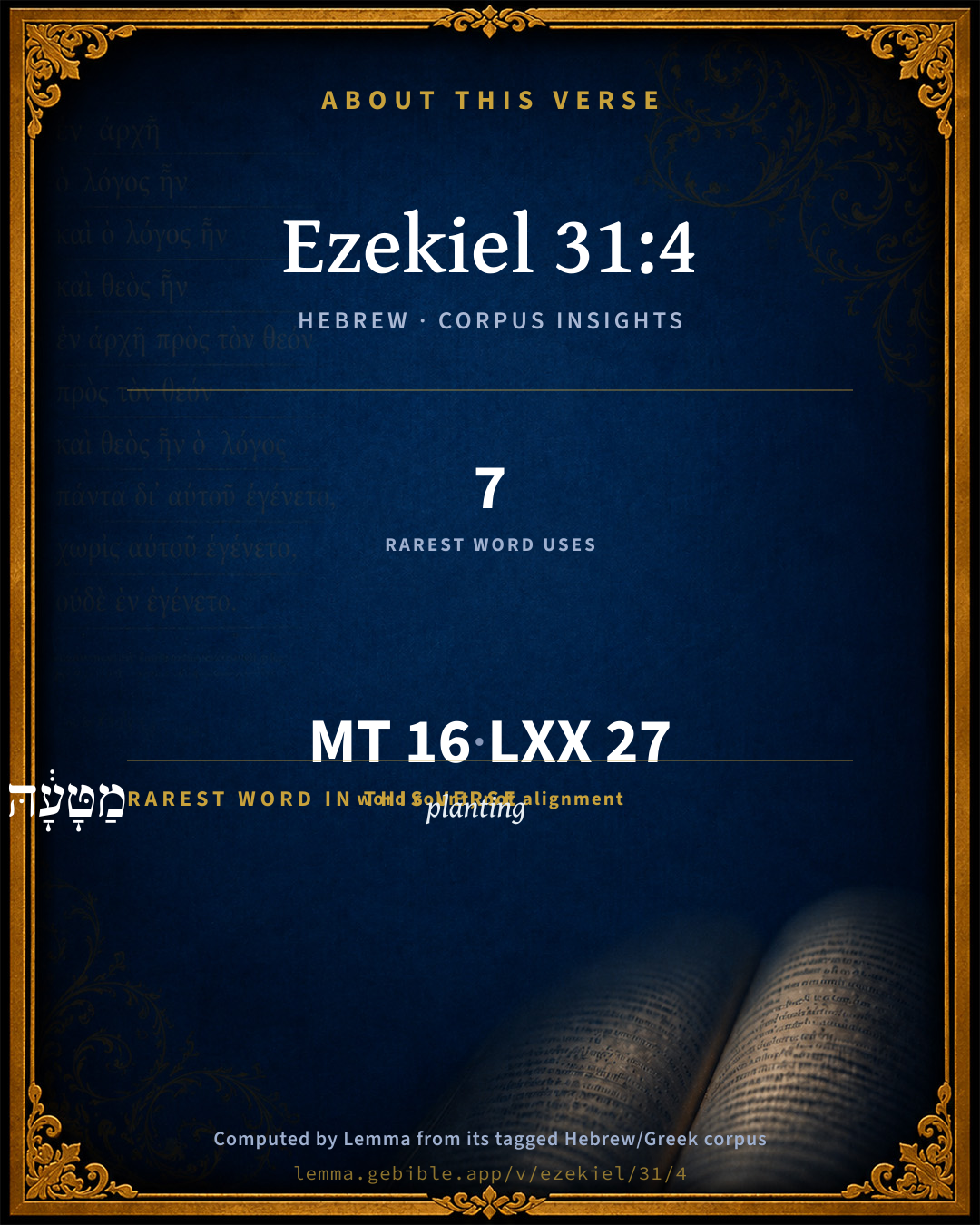
The rarest word here is מַטָּעָ֔הּ planting H4302 — appearing just 7 times in the whole Hebrew Bible.

Shared distinctive vocabulary

מַטָּעָ֔הּ planting H4302 occurs in 6 verses of the Hebrew Bible. Also found in:

Grammatical profile

  • 4 verbs
  • 9 nouns
  • 2 prepositions
  • 1 particle

Verb forms

  • גִּדְּל֔וּהוּ Piel · Perfect
  • רֹֽמְמָ֑תְהוּ Polel · Perfect
  • הֹלֵךְ֙ Qal · Participle Active
  • שִׁלְחָ֔ה Piel · Perfect

Hebrew & Septuagint length

In English translation the verse runs 32 words from the Hebrew and 31 from the Septuagint (LXX English) — closely comparable.

A rough comparison of the two English renderings, which tokenize alike — not a word-level alignment.

Word counts can differ between the Hebrew and the Greek without any difference in meaning — e.g. the Hebrew direct-object marker אֵת has no separate Greek word, and Greek often adds the article ὁ.

In the original languages it is 16 Hebrew tokens and 27 Greek tokens — but the two are counted differently (Hebrew bundles its prefixes and suffixes into one token; the Greek is in lemma form), so that isn’t a like-for-like length.

Cross-references

6

Topical passages linked to Ezekiel 31:4 in the Treasury of Scripture Knowledge — connected by theme and wording, ordered by reader-vote popularity; previews shown in the World English Bible.

  • Proverbs 14:28 In the multitude of people is the king's glory, But in the lack of people is the destruction of the prince.
  • Ezekiel 17:5 He took also of the seed of the land, and planted it in a fruitful soil; he placed it beside many waters; he set it as a willow tree.
  • Ezekiel 17:8 It was planted in a good soil by many waters, that it might bring forth branches, and that it might bear fruit, that it might be a goodly vine.
  • Revelation 17:1 One of the seven angels who had the seven bowls came and spoke with me, saying, "Come here. I will show you the judgment of the great prostitute who sits on many waters,
  • Revelation 17:15 He said to me, "The waters which you saw, where the prostitute sits, are peoples, multitudes, nations, and languages.
  • Jeremiah 51:36 Therefore thus says Yahweh: Behold, I will plead your cause, and take vengeance for you; and I will dry up her sea, and make her fountain dry.

Cross-references courtesy of OpenBible.info (CC BY 4.0).

Hebrew and Greek witnesses Masoretic Hebrew ↔ Greek Septuagint

The same verse in the two great witnesses to the Old Testament, shown verse-for-verse.

These are two independent witnesses, not word-aligned to each other, and the Septuagint is shown in lemma (dictionary) form.

Hebrew Ezekiel 31:4 Masoretic · Westminster Leningrad Codex

מַ֣יִם גִּדְּל֔וּהוּ תְּה֖וֹם רֹֽמְמָ֑תְהוּ אֶת נַהֲרֹתֶ֗יהָ הֹלֵךְ֙ סְבִיב֣וֹת מַטָּעָ֔הּ וְאֶת תְּעָלֹתֶ֣יהָ שִׁלְחָ֔ה אֶ֖ל כָּל עֲצֵ֥י הַשָּׂדֶֽה

The waters nourished it, the deep made it to grow: the rivers of it ran round about its plantation; and it sent out its channels to all the trees of the field.

World English Bible · Public Domain

Greek LXX Ezekiel 31:4 Septuagint · lemma form

ὕδωρ ἐκτρέφω αὐτός ὁ ἄβυσσος ὑψόω αὐτός ὁ ποταμός αὐτός ἄγω κύκλος ὁ φυτόν αὐτός καί ὁ σύστεμα αὐτός ἐκ ἀποστέλλω εἰς πᾶς ὁ ξύλον ὁ πεδίον

The water nourished him, the depth made him grow tall; she led her rivers round about his plants, and she sent forth her streams to all the trees of the field.

LXX2012 (modern English Septuagint) · Public Domain

On this verse, The Cambridge Bible for Schools and Colleges discusses the Septuagint’s reading. Read the note in Commentary ↓

Hebrew: Westminster Leningrad Codex (CC BY 4.0). Greek: Septuagint (public domain); English from LXX2012 (modern English Septuagint) (Public Domain). How the Septuagint differs from the Hebrew →

Targum (Aramaic paraphrase)

1

The Targum is the ancient Jewish Aramaic paraphrase of the Hebrew Scriptures — an interpretive translation, not the Hebrew text itself. Onkelos (literal) and Pseudo-Jonathan (expansive) render the Torah, and Jonathan the Prophets. Coverage is partial: where no permissively-licensed English translation exists for a verse, only the Aramaic is shown. This is verse-level text, not a word-by-word alignment to the Hebrew.

  1. Targum Jonathan Prophets (Joshua–Malachi)
    בְּעַמְמַיָא סַגִי בְּסוּמְכְוָתָא תַּקִיף יַת מַלְכַיָא שַׁעְבֵּיד לִתְחוֹת מַלְכוּתֵיהּ וְיַת שִׁלְטוֹנוֹהִי מָנֵי עַל כָּל מְדִינַת אַרְעָא:

    (no public-domain English translation for this verse)

    Targum Jonathan — Aramaic: “Mikraot Gedolot” (public domain). English: “Sefaria Community Translation” (CC0 1.0 (public-domain dedication)); “London "Chaldee Paraphrase," 1871” (public domain). Text via Sefaria.

Commentary

Notes on Ezekiel 31:4 from classic Christian and Jewish commentators (each source and its license shown beneath its notes). The classic Christian expositions comment on the surrounding passage and are grouped to its opening verse, so a note may address several verses; the Jewish commentaries on the Tanakh (Rashi and others) are per-verse, so they appear only where the commentator wrote on this verse.

Lemma curates 59 commentaries, every one of them public domain or Creative Commons licensed, each selected and text-cleaned for this edition rather than reprinted as found. About our sources →

Trapp's Complete Commentary

John Trapp

Eze 31:4 The waters made him great, the deep set him up on high with her rivers running round about his plants, and sent out her little rivers unto all the trees of the field.

Ver. 4. The waters made him great.] He had a confluence of all prosperities. Watered he was, non aquis sed abyssis; est autem abyssus, inexhausta felicitas et rerum affluentia. He overabounded with all outward happiness. In wealth, victories, and triumphs, he gave place to no man.

John Trapp, A Commentary or Exposition upon All the Books of the Old and New Testament (1647–1656) — public domain. Text from a community e-Sword module.

Geneva Bible (1599)

Geneva Bible translators

Or, country.

Many other nations were under their dominion.

Geneva Bible (1599) marginal notes — public domain. Text via Bolls.life.

Jamieson, Fausset & Brown

Robert Jamieson, A. R. Fausset & David Brown

waters . . . little rivers--the Tigris with its branches and "rivulets," or "conduits" for irrigation, the source of Assyria's fertility. "The deep" is the ever flowing water, never dry. Metaphorically, for Assyria's resources, as the "conduits" are her colonies.

Jamieson, Fausset & Brown — Commentary Critical and Explanatory on the Whole Bible (1871) — public domain (CC PDM 1.0). Text via the HelloAO Bible API.

Adam Clarke's Commentary

Verse 4. The waters made him great] Alluding to the fertility of Egypt by the overflowing of the Nile. But waters often mean peoples. By means of the different nations under the Egyptians, that government became very opulent. These nations are represented as fowls and beasts, taking shelter under the protection of this great political Egyptian tree, Eze 31:6.

Adam Clarke's Commentary on the Bible (1810–1826) — public domain. Text from a community e-Sword/MySword module.

Ellicott's Commentary for English Readers

(4) His plants.—Should rather be, his plantation.

Sent out her little rivers.—The thought is that the various surrounding and subordinate nations were nourished from the great stream of prosperity which swelled the power and wealth of Assyria.

A Bible Commentary for English Readers, edited by Charles John Ellicott (1878–1897) — public domain. Text from a community e-Sword module.

The Cambridge Bible for Schools and Colleges

gen. ed. J. J. S. Perowne

4. set him up on high] i.e. made him grow lofty. There is probably, however, the figure of a parent nourishing his offspring. The words “made great” and “set on high” are rendered “nourished and brought up” children, Isa_1:2; cf. Isa_23:4. The waters rear the tree as their child. The waters are those of Egypt.

with her rivers running] The construction is anomalous, and with expresses accompaniment, not instrumentality. It is easiest to read (with LXX.): she (the deep) made her rivers to run round … and sent out. Or possibly: as for her rivers, they ran, &c.

his plants] Rather: her plantation, “her” referring to the “deep,” which nourished the plantation, though this is not quite natural.

her little rivers] Marg. conduits, the small canals for irrigation. The plenteous waters nourished the great tree and the other trees alike.

The Cambridge Bible for Schools and Colleges (gen. ed. J. J. S. Perowne; Cambridge University Press, 1878–1918) — public domain. Text from a community e-Sword module.

John Gill's Exposition

The waters made him great,.... The waters of the river Tigris, near to which stood the city of Nineveh, the metropolis of the Assyrian monarchy; the traffic brought by which river made it rich and great, and the whole empire, and the king of it:

the deep set him up on high, with her rivers running round about his plants; the vast trade by sea, the profits and commodities of which were conveyed through various rivers, which ran about the provinces of the empire, which were as plants in a field; and by which they were enriched, and the whole empire, and the king of it, were raised to a prodigious pitch of wealth and power:

and sent out little rivers to all the trees of the field; so that the common people, comparable to the trees of the field for their number and usefulness, all received profit and advantage hereby: or else by waters and the deep may be meant the multitude of people, as in Rev 17:15, which increased his kingdom, filled his provinces, supplied his colonies, and enlarged his power and riches. The Targum is,

"by the people he was multiplied; by his auxiliaries he became strong; he subjected kings under his government; and his governors he appointed over all the provinces of the earth.''

John Gill's Exposition of the Whole Bible (1746–1763) — public domain (CC PDM 1.0). Text via the HelloAO Bible API.

Haydock's Catholic Bible Commentary

Roots. Various nations paid tribute to the Assyrians, (St. Jerome; Calmet) while he sent his troops, like rivulets, to keep all in subjection. (Theodoret)

George Leo Haydock (1774–1849), Haydock's Catholic Family Bible and Commentary, 1859 edition — public domain. Excludes Psalms (Douay-Rheims chapter numbering differs from Protestant) and Deuterocanonical books (Catholic canon only).

Matthew Poole's English Annotations

As cedars grow great by the watercourses, so did this kingdom by multitudes of people and convenience of trade; or by the plenty of the country, if no trade, for it was first planted in the fruitful fields among the sweet rivers, Euphrates, Tigris, Lycus, Diava, and others. The deep set him up on high; the sea sent out her waters, which gave being to the rivers that watered him and improved him; whereas, Egypt, thy rivers rise out of a lake, which, though great, is not to be compared with the deep. His plants; the provinces of this mighty kingdom, that are like plants about a great tree. Little rivers; beneficence, justice, protection, encouragements, that subjects need, and good princes disperse among them; so the deep filled this king, and he sent out his streams to all his subjects in his kingdom.

Matthew Poole's English Annotations on the Holy Bible (1683–1685) — public domain. Text from a community e-Sword/MySword module.

Whedon's Commentary on the Bible

Daniel D. Whedon

4. R.V., “The waters nourished him, the deep made him to grow: her rivers ran round about her plantation; and she sent out her channels,” etc. This could be said more naturally of Egypt than of any other country. (See note Eze_31:3.) The Nile and its canal created Egypt and made it great.

Daniel D. Whedon (gen. ed.), Commentary on the Old and New Testaments (1874–1909) — public domain. Text from a community e-Sword module.

The Pulpit Commentary

The waters made him great. The scenery is hardly that of Lebanon, but finds its counterpart in that of the Nile, perhaps also of the Tigris, with the waters of the river diverted into streams and channels by a careful system of irrigation. The cedar grew close to the river itself; the other trees of the field were watered only by the smaller channels, and so were inferior to it in the fullness of their growth. (For the general imagery, Eze_17:5; Psa_1:3; Jer_17:8; Num_24:6)

The Pulpit Commentary (1880–1919), ed. H.D.M. Spence-Jones & Joseph S. Exell — public domain. Text from a community e-Sword module.

John Wesley's Explanatory Notes

The waters - Cedars grow great by the water-courses. The deep - The sea sent out her waters, which gave being to the rivers, that watered him. His plants - The provinces of this mighty kingdom, that were like plants about a great tree. All the trees - To all his subjects.

John Wesley, Explanatory Notes Upon the Whole Bible (1754–1765) — public domain. Text via the GEBible commentary corpus.

Rashi

Rabbi Shlomo Yitzchaki (Rashi)

its canals [Heb. תְּעָלתֶיהָ,] fosses in French, ditches, canals.

to all the trees of the field to water them. The symbol is as the Targum of Jonathan interprets it: Behold the Assyrians were like the cedars of Lebanon, etc., as above.

Water nurtured it; the deep made it grow tall [Jonathan paraphrases:] Among nations he is great; because of his supporters he is powerful; he subjugates kings under his kingdom, and he appoints rulers over every state of the earth. The Midrash Aggadah (Pesikta Rabbathi 34:11, Meir Ayin 33) [states]: “and among the interwoven branches was its lofty top.” Whence did he merit greatness? Because 1) he withdrew from the counsel of the generation of separation, as it is said (Gen. 10: 11): “Out of that land Asshur went forth. “When all those who came upon the world formed one league to enter counsel to rebel against Him, then his lofty top was visible by itself, and [he] did not link himself with them. “Water nurtured him; the [waters of the] deep raised him up” and because 2) he hearkened to the voice of Jonah the son of Amittai, who descended into the [waters of the] deep, and the people of Nineveh repented of the violence that was in their hands.

Rashi on the Tanakh — English translations: “The Judaica Press complete Tanach with Rashi, translated by A. J. Rosenberg” (CC BY 4.0); “Pentateuch with Rashi's commentary by M. Rosenbaum and A.M. Silbermann, 1929-1934” (public domain); “The Metsudah Tanach series, Lakewood, N.J” (CC BY 4.0); and “The Book of Joshua, Metsudah Publications, 1997” (CC BY 4.0). Text via Sefaria.

Lesson kit

Teaching starters — assembled from the data on this page, not authored interpretation. Every prompt links to the verse data it draws on. Edit before teaching.

Ezekiel, in the Prophets, opens this verse with 16 words (16 distinct Hebrew lemmas). Its most distinctive word is maṭṭâʻ (“planting”). A historical commentator’s framing appears above. Read the whole chapter for the surrounding context.

Discussion questions

  1. The word maṭṭâʻ carries the sense “planting.” How does it shape the verse?
  2. How does Isaiah 60:21, which shares the word «planting», read alongside this verse?
  3. The translations on this page render this verse differently — a whole-verse word diff, not a word-by-word alignment. What might account for the different wordings?
  4. «גִּדְּל֔וּהוּ» is a Piel Perfect verb. How does that grammatical form shape the action described?
  5. Compare how Trapp's Complete Commentary and Geneva Bible (1599) read this verse. Where do they agree or differ?

Things to notice

Reading settings

Reading text

Shown beneath each verse's original-language words.

Old Testament
Old Testament edition

Read the OT as the Masoretic Hebrew (MT) or the Greek Septuagint (LXX).

English shown for the Greek Septuagint (in the Hebrew ↔ Greek comparison).

Comparing translations? Open the Compare panel on any verse page to stack up to four side by side.