Ezekiel 10:17

Hebrew (Westminster Leningrad Codex) Ezekiel 10:17 appears in the Hebrew Old Testament. The text above is from the Westminster Leningrad Codex. Each word links to its Strong’s number, a concise gloss, and parsing drawn from the Open Scriptures Hebrew Bible morphology. Click any word for its full Brown-Driver-Briggs (BDB) entry.
Download image
Cite this verse

Ezekiel 10:17 (World English Bible). Public Domain. Lemma interlinear Bible study tool, https://lemma.gebible.app/v/ezekiel/10/17.

Show BibTeX & RIS
BibTeX
RIS
English Translation
When they stood, these stood; and when they mounted up, these mounted up with them: for the spirit of the living creature was in them.
World English Bible · Public Domain
Download a study sheet

One document with this verse’s original text, its word-by-word gloss line, the meaning frame, cross-references with their text, attributed commentary, and full source and license credits — printable, and it pastes into notes with its structure intact.

This verse Autodidact and up

Study sheet (.html) Plain text (.txt)

A passage Seminary Student

Up to 50 verses in one chapter. A passage sheet keeps up to 6 commentary sources and 12 cross-references per verse, in the order this page ranks them, and says so on the sheet whenever that leaves anything out. Ask for a single verse and you get the Autodidact verse sheet above.

Everything on this page stays free to read, with no account — the sheet is a download of what is already on screen, not access to it.

Want to remove ads? Support Godless Engineer
Compare translations 3

The same verse in 3 English versions, stacked beneath the original-language interlinear above. Click any original word for its lexicon entry.

Each is an independent rendering of the whole verse — the interlinear is not word-aligned to these translations.

Highlighted words mark where these versions differ — a whole-verse word diff, not a word-by-word alignment.

  • World English Bible Public Domain
    When they stood, these stood; and when they mounted up, these mounted up with them: for the spirit of the living creature was in them.
  • King James Version Public Domain
    When they stood, these stood; and when they were lifted up, these lifted up themselves also: for the spirit of the living creature was in them.
  • unfoldingWord Literal Text CC BY-SA 4.0
    When the cherubim stood still, the wheels stood still, and when they rose up, the wheels rose up with them, for the spirit of the living creature was in the wheels.

unfoldingWord Literal Text — © unfoldingWord, licensed CC BY-SA 4.0. Word-aligned USFM3 via Door43 (git.door43.org/unfoldingWord/en_ult).

Versions to compare (up to 4)

3 of 4 selected

Show all 18 translations

Every available English version of this verse, each an independent rendering of the whole verse.

  • World English Bible Public Domain
    When they stood, these stood; and when they mounted up, these mounted up with them: for the spirit of the living creature was in them.
  • Berean Standard Bible Public Domain
    When the cherubim stood still, the wheels also stood still, and when they ascended, the wheels ascended with them, for the spirit of the living creatures was in the wheels.
  • Majority Standard Bible Public Domain
    When the cherubim stood still, the wheels also stood still, and when they ascended, the wheels ascended with them, for the spirit of the living creatures was in the wheels.
  • King James Version Public Domain
    When they stood, these stood; and when they were lifted up, these lifted up themselves also: for the spirit of the living creature was in them.
  • American Standard Version (1901) Public Domain
    When they stood, these stood; and when they mounted up, these mounted up with them: for the spirit of the living creature was in them.
  • Revised Version (1885) Public Domain
    When they stood, these stood; and when they mounted up, these mounted up with them: for the spirit of the living creature was in them.
  • Geneva Bible (1599) Public Domain
    When the Cherubims stoode, they stood: and when they were lifted vp, they lifted the selues vp also: for the spirit of the beast was in them.
  • Douay-Rheims (1899) Public Domain
    When they stood, these stood: and when they were lifted up, these were lifted up: for the spirit of life was in them.
  • Young's Literal Translation Public Domain
    In their standing they stand, and in their exaltation they are exalted with them: for the living spirit `is' in them.
  • Literal Standard Version CC BY-SA 4.0
    In their standing they stand, and in their exaltation they are exalted with them: for [the] spirit of the living creature [is] in them.
  • Unlocked Literal Bible CC BY-SA 4.0
    When the cherubim stood still, the wheels stood still, and when they rose up, the wheels rose up with them, for the spirit of the living creature was in the wheels.
  • unfoldingWord Literal Text CC BY-SA 4.0
    When the cherubim stood still, the wheels stood still, and when they rose up, the wheels rose up with them, for the spirit of the living creature was in the wheels.
  • Darby Bible Public Domain
    When they stood, these stood; and when they mounted up, these mounted up with them: for the spirit of the living creature was in them.
  • World Messianic Bible Public Domain
    When they stood, these stood. When they mounted up, these mounted up with them; for the spirit of the living creature was in them.
  • Webster's Bible Public Domain
    When they stood, these stood; and when they were lifted up, these lifted up themselves also: for the spirit of the living creature was in them.
  • Free Bible Version CC BY-SA 4.0
    When the cherubim stopped, the wheels stopped too. When they took off, the wheels did too, because the spirit of the living creatures was in them.
  • Bible in Basic English Public Domain
    When they were at rest in their place, these were at rest; when they were lifted up, these went up with them: for the spirit of life was in them.
  • JPS Tanakh (1917) Public Domain
    When they stood, these stood, and when they mounted up, these mounted up with them; for the spirit of the living creature was in them.

Literal Standard Version (2020), Covenant Press — licensed CC BY-SA 4.0. Text via the HelloAO Bible API (eBible.org). Unlocked Literal Bible (unfoldingWord) — licensed CC BY-SA 4.0. Text via the HelloAO Bible API (eBible.org). unfoldingWord Literal Text — © unfoldingWord, licensed CC BY-SA 4.0. Word-aligned USFM3 via Door43 (git.door43.org/unfoldingWord/en_ult). Free Bible Version, Dr. Jonathan Gallagher — licensed CC BY-SA 4.0. Text via the HelloAO Bible API (eBible.org).

Word by word

More ways to search: Search by grammar → Find every occurrence → Compare this word →

Practice this passage: Drill this verse → Learn its vocabulary →

יֵר֣וֹמּוּ
râmam
H7426
“to be exalted”
Verb, Niphal, Imperfect, 3rd Person, Masculine, Plural
Part of Speech
Verb
Stem
Niphal
Form
Imperfect
Person
3rd Person
Gender
Masculine
Number
Plural
Full BDB Definition

Origin: a primitive root

TWOT: 2174

to be exalted, be lifted up - (Qal) to be exalted - (Niphal) to lift oneself
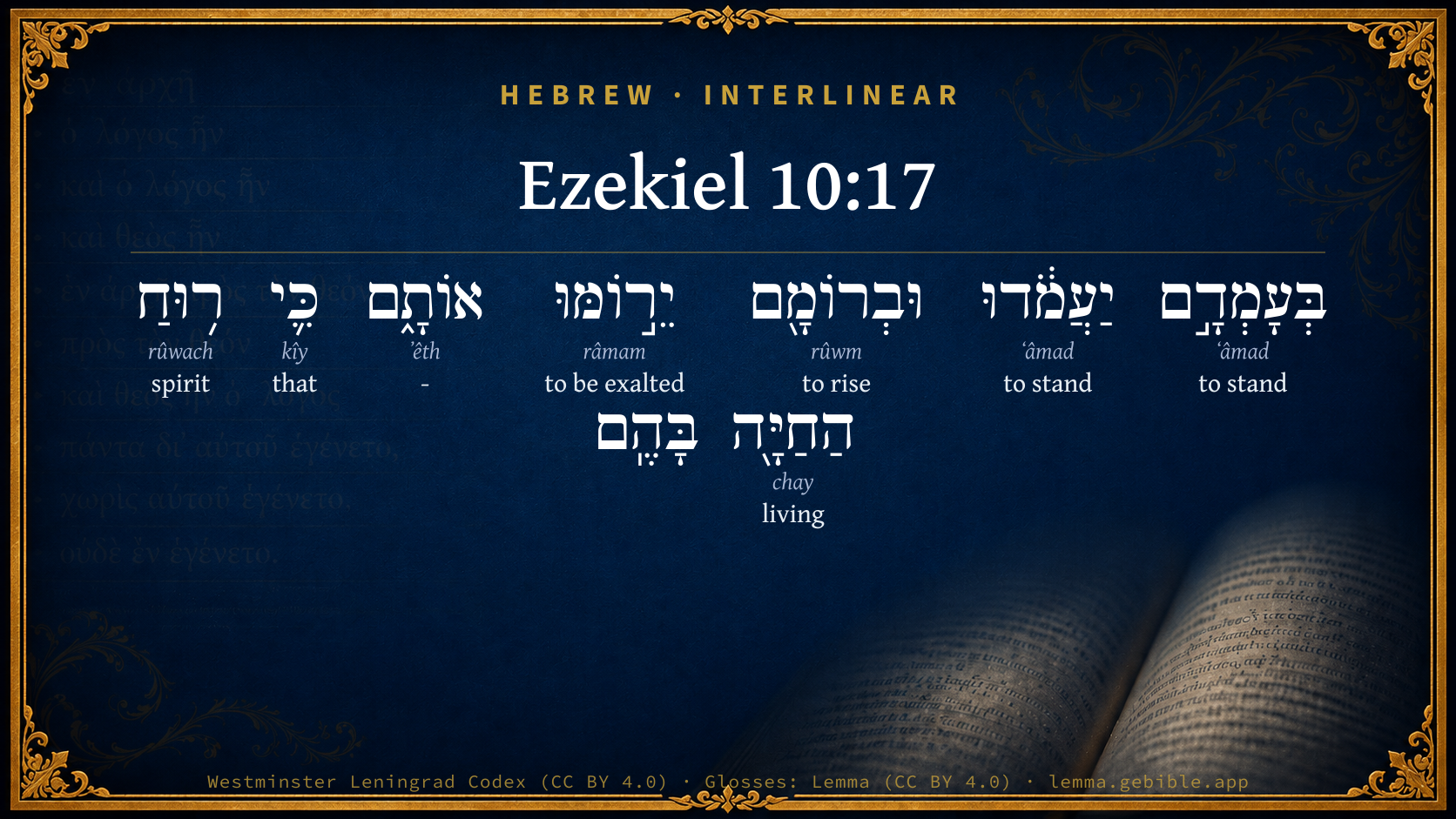
  1. בְּעָמְדָ֣ם ʻâmad H5975 “in/at · to stand · them” Preposition + Verb, Qal, Infinitive Construct + Suffix, Personal, 3rd Person, Masculine, Plural
  2. יַעֲמֹ֔דוּ ʻâmad H5975 “to stand” Verb, Qal, Imperfect, 3rd Person, Masculine, Plural
  3. וּבְרוֹמָ֖ם rûwm H7311 “and · in/at · to rise · them” Conjunction + Preposition + Verb, Qal, Infinitive Construct + Suffix, Personal, 3rd Person, Masculine, Plural
  4. אוֹתָ֑ם ʼêth H853 “- · them” Particle, Direct Object + Suffix, Personal, 3rd Person, Masculine, Plural
  5. כִּ֛י kîy H3588 “that” Conjunction
  6. ר֥וּחַ rûwach H7307 “spirit of” Noun, Common, Both, Singular, Construct
  7. הַחַיָּ֖ה chay H2416 “the · living” Particle, Definite Article + Noun, Common, Feminine, Singular, Absolute

About this verse

These counts appear in no published source. They are computed here, from the morphology-tagged text and Lemma’s own curated glosses. What Lemma adds →

9
words
7
distinct lemmas
Prophets
section

Notable vocabulary

The rarest word here is יֵר֣וֹמּוּ to be exalted H7426 — appearing just 6 times in the whole Hebrew Bible.

Shared distinctive vocabulary

יֵר֣וֹמּוּ to be exalted H7426 occurs in 6 verses of the Hebrew Bible. Also found in:

Grammatical profile

  • 4 verbs
  • 2 nouns
  • 1 preposition
  • 1 conjunction
  • 1 particle

Verb forms

  • בְּעָמְדָ֣ם Qal · Infinitive Construct
  • יַעֲמֹ֔דוּ Qal · Imperfect
  • וּבְרוֹמָ֖ם Qal · Infinitive Construct
  • יֵר֣וֹמּוּ Niphal · Imperfect

Repetition

A word recurs within this verse — often emphatic in Hebrew:

  • בְּעָמְדָ֣ם to stand H5975 ×2

Hebrew & Septuagint length

In English translation the verse runs 25 words from the Hebrew and 25 from the Septuagint (LXX English) — the same length.

A rough comparison of the two English renderings, which tokenize alike — not a word-level alignment.

Word counts can differ between the Hebrew and the Greek without any difference in meaning — e.g. the Hebrew direct-object marker אֵת has no separate Greek word, and Greek often adds the article ὁ.

Cross-references

5

Topical passages linked to Ezekiel 10:17 in the Treasury of Scripture Knowledge — connected by theme and wording, ordered by reader-vote popularity; previews shown in the World English Bible.

  • Ezekiel 1:20–21 Wherever the spirit was to go, they went; there was the spirit to go: and the wheels were lifted up beside them; for the spirit of the living creature was in the wheels.
  • Romans 8:2 For the law of the Spirit of life in Christ Jesus made me free from the law of sin and of death.
  • Genesis 2:7 Yahweh God formed man from the dust of the ground, and breathed into his nostrils the breath of life; and man became a living soul.
  • Ezekiel 1:12 They went everyone straight forward: where the spirit was to go, they went; they didn't turn when they went.
  • Revelation 11:11 After the three and a half days, the breath of life from God entered into them, and they stood on their feet. Great fear fell on those who saw them.

Cross-references courtesy of OpenBible.info (CC BY 4.0).

Hebrew and Greek witnesses Masoretic Hebrew ↔ Greek Septuagint

The same verse in the two great witnesses to the Old Testament, shown verse-for-verse.

These are two independent witnesses, not word-aligned to each other, and the Septuagint is shown in lemma (dictionary) form.

Hebrew Ezekiel 10:17 Masoretic · Westminster Leningrad Codex

בְּעָמְדָ֣ם יַעֲמֹ֔דוּ וּבְרוֹמָ֖ם יֵר֣וֹמּוּ אוֹתָ֑ם כִּ֛י ר֥וּחַ הַחַיָּ֖ה בָּהֶֽם

When they stood, these stood; and when they mounted up, these mounted up with them: for the spirit of the living creature was in them.

World English Bible · Public Domain

Greek LXX Ezekiel 10:17 Septuagint · lemma form

ἐν ὁ ἵστημι αὐτός ἵστημι καί ἐν ὁ μετεωρίζω αὐτός μετεωρίζω μετά αὐτός διότι πνεῦμα ζωή ἐν αὐτός εἰμί

When they stood, the wheels stood; and when they mounted up, the wheels mounted up with them: because the spirit of life was in them.

LXX2012 (modern English Septuagint) · Public Domain

Hebrew: Westminster Leningrad Codex (CC BY 4.0). Greek: Septuagint (public domain); English from LXX2012 (modern English Septuagint) (Public Domain). How the Septuagint differs from the Hebrew →

Targum (Aramaic paraphrase)

1

The Targum is the ancient Jewish Aramaic paraphrase of the Hebrew Scriptures — an interpretive translation, not the Hebrew text itself. Onkelos (literal) and Pseudo-Jonathan (expansive) render the Torah, and Jonathan the Prophets. Coverage is partial: where no permissively-licensed English translation exists for a verse, only the Aramaic is shown. This is verse-level text, not a word-by-word alignment to the Hebrew.

  1. Targum Jonathan Prophets (Joshua–Malachi)
    בִּמְקָמְהוֹן קַיְמִין וּבְאִתְרָמוּתְהוֹן מִתְרְמִין עִמְהוֹן אֲרֵי בְרוּחַ בִּרְיָתָא בְּהוֹן:

    (no public-domain English translation for this verse)

    Targum Jonathan — Aramaic: “Mikraot Gedolot” (public domain). English: “Sefaria Community Translation” (CC0 1.0 (public-domain dedication)); “London "Chaldee Paraphrase," 1871” (public domain). Text via Sefaria.

Commentary

Notes on Ezekiel 10:17 from classic Christian and Jewish commentators (each source and its license shown beneath its notes). The classic Christian expositions comment on the surrounding passage and are grouped to its opening verse, so a note may address several verses; the Jewish commentaries on the Tanakh (Rashi and others) are per-verse, so they appear only where the commentator wrote on this verse.

Lemma curates 59 commentaries, every one of them public domain or Creative Commons licensed, each selected and text-cleaned for this edition rather than reprinted as found. About our sources →

Trapp's Complete Commentary

John Trapp

Eze 10:17 When they stood, [these] stood; and when they were lifted up, [these] lifted up themselves [also]: for the spirit of the living creature [was] in them.

Ver. 17. When they stood.] See Eze 1:21.

The spirit of the living creatures.] Or, Of life. God governeth all events; he moveth the angels, they the wheels. No clock hath so certain motions as the vicissitudes of all things are overruled by God.

John Trapp, A Commentary or Exposition upon All the Books of the Old and New Testament (1647–1656) — public domain. Text from a community e-Sword module.

The Biblical Illustrator

Joseph S. Exell

Eze_10:17

When they stood, these stood; and when they were lifted up, these lifted up themselves also.

Feet and wings

Flying creatures have wings for the air and feet for the ground. This touch of nature is put on Gods cherubim. The prophet intends no special religious lesson here, but the fact he cites may be used to convey such.

I. The subject of Christian experience, what it is and how to be maintained. We have faculties of locomotion, feeding, sense, perception, etc., by which we act our parts on foot, as it were. We have attributes of faith perception, love appropriation, spiritual imagination, in which we become aerial creatures, resting suspensively in things above the world. This uplifting produces the transcendent mystery of experience in Christian conversion. We rise by trust in God--admitting the full revelation of His truth and friendship. Can the soul thus lifted stay in that serene element? It has gravitations which pull it all the while downward, and settle it on its feet, as the flying creatures fold their wings when they settle. Let us trace some of the instances and ways in which it ceases to live by faith. When a man of enterprise thinks of independence, how easily, how insensibly he ceases to hang on Providence as he did. His prayers lose their fervour. God is far less dear and less consciously present; and how long will he have the consciousness of His presence at all? The moment any disciple touches ground with but the tip of his foot, and begins to rest on earthly props, a mortal weakness takes him, and he goes down. Only a calm and loving return to his trust will recover him, and God is faithful enough to be trusted at all times. Let there be this rest by faith, and he will carry himself more steadily in studies, toils, or engagements. Sometimes obscurations may occur, but he has only to believe the more strongly and wait till they be cleared.

II. Many persons miss ever going above a service on foot, by not conceiving at all the more ethereal range of experience into which true faith would lift them. Sometimes they become reformers or philanthropists. They mean business in their religion, caring little for the fervours that are not fervours of work, The combining and roiling up of great masses of opinion are the means by which they expect to carry their projects. Censure and storm and fiery denunciation are close at hand. They, many times, do not conceive that they are disciples because of their repentances, or their prayers, or sensing of God by their faith, or any other grace that separates them from the world. They have much to say of love, but they visibly hate more strongly than they love. They never go above to descend upon the reform by inspirations there kindled; they keep on their feet, and war with the evils on the same level with them. Sometimes they attempt self-culture in the name of religion. They could mend defects, chasten faults, put themselves in the charities they have learned from Christ, perhaps, to admire; but the work is a far more hopeless one than they imagine, if there is no uplifting help from gracious inspirations. Oh, if they would go up to Christ, or to God in a true faith culture, faults would fall off, as blasted flowers from a tree, by the life principle therein. Sometimes they suppose they are religious because of a certain patronage they give to the Church and the Word. Not being in the gift of spiritual discernment, their tastes will be the better; and as there are always a great many reasons why a thing should not be done to any single reason why it should, they assume to be specially qualified critics. They contribute these critical powers, while others, less gifted, may contribute their prayers! Such negatives do not belong to the range of the Spirit, but to the nether world of fashion or opinion or custom. The critics have feet, but no wings. If they could give themselves over in trust to the Saviour, instead of giving their opinions and tastes, their contributions would be of worthier significance. (H. Bushnell, D. D.)

The Biblical Illustrator, edited by Joseph S. Exell (c. 1880s–1900s) — public domain. Text from a community e-Sword module.

Geneva Bible (1599)

Geneva Bible translators

There was one consent between the Cherubims and the wheels.

Geneva Bible (1599) marginal notes — public domain. Text via Bolls.life.

Jamieson, Fausset & Brown

Robert Jamieson, A. R. Fausset & David Brown

(Eze 1:12, Eze 1:20-21).

stood--God never stands still (Joh 5:17), therefore neither do the angels; but to human perceptions He seems to do so.

Jamieson, Fausset & Brown — Commentary Critical and Explanatory on the Whole Bible (1871) — public domain (CC PDM 1.0). Text via the HelloAO Bible API.

John Calvin's Commentaries

As he just said that the wheels were obedient to the movement of the living creatures, so he now says that they ceased with them. But in this place it seems as if some incongruity might arise: for it is not correct to say that angels ever rest. We know that their quickness and promptness in executing God’s commands is celebrated. (Psalm 103:20, 21.) Then since angels are the powers of God, it follows that they never cease from their office of working. For God never can rest; he sustains the world by his energy, he governs everything however minute, so that not even a sparrow falls to the ground without his decree. (Matthew 10:29.) And there is that known and celebrated sentence of Christ, My Father and I work hitherto. (John 5:17.) Since, therefore, God never rests from his works, how then can that resting be explained of which the Prophet says, when the angels stood, the wheels also stood? I reply: it must be taken in a human sense; for although God works continually by means of angels, yet he seems sometimes to rest between. For he does not govern his works in any equable manner, as for instance, the heavens are sometimes calm, and at others agitated, so that a great variety appears in God’s works, from which we may imagine that he is sometimes in vehement motion, and at others at perfect repose. This, therefore, is the cessation of which the Prophet now speaks when he says, the living creatures stood, and at the same time the wheels with them Experience also confirms this; for God sometimes seems to mingle heaven and earth, and rouses us by unaccustomed work, while at others the course of his works seems to flow like a placid river. So that it is not absurd to say that the wheels stood with the living creatures, and proceeded and were elevated with them He adds, the spirit of the living creature was in the wheels, I explained this point, in the first chapter, but here it may be shortly explained, that the spirit is here taken for secret vigor or instinct. The wheels are not properly animated, because we said that the events of things are represented to us by this word, and whatever seems to happen in the world; but their incomprehensible vigor and agitation proceeds from God’s command, so that all creatures are animated by angelic motion: not that there is a conversion of the angel into an ox or a man, but because God exerts and diffuses his energy in a secret manner, so that no creature is content with his own peculiar vigor, but is animated by angels themselves. Now it follows —

John Calvin's Commentaries (1540-1563) — public domain. Text from the Calvin Translation Society English edition (1840s-50s) via the Christian Classics Ethereal Library (ccel.org). Calvin's coverage is partial (roughly two-thirds of the Bible); uncommented books and verses are honest gaps, never fabricated. The 19th-century editor's footnotes and remarks are omitted so the notes are faithfully Calvin's own voice.

The Cambridge Bible for Schools and Colleges

gen. ed. J. J. S. Perowne

17. lift up themselves] Were lifted up with them.

The Cambridge Bible for Schools and Colleges (gen. ed. J. J. S. Perowne; Cambridge University Press, 1878–1918) — public domain. Text from a community e-Sword module.

John Gill's Exposition

When they stood, these stood,.... When the one were inactive, lifeless, and without motion, making no progress in knowledge, experience, and practice, the other were so likewise; See Gill on Eze 1:21;

and when they were lifted up, these lifted up themselves also; like people, like priest, whether in things commendable or not, Hos 4:9;

for the spirit of the living creature was in them; the same spirit that was in the cherubim was in the wheels; and the same Spirit of God, who is a "spirit of life" (c), as the words may be rendered, is in the churches, as in the ministers; generally speaking, if the one are lively, the other are also, and both move as they are acted by the Spirit; and also their motion from place to place, which is spoken of in Eze 10:18, is directed by the Spirit; see Act 16:6.

(c) , Sept. "spiritus vitae", V. L. Starckius.

John Gill's Exposition of the Whole Bible (1746–1763) — public domain (CC PDM 1.0). Text via the HelloAO Bible API.

Haydock's Catholic Bible Commentary

Life. They were not mere machines; (Haydock) or they were pushed forward by an impetuous wind.

George Leo Haydock (1774–1849), Haydock's Catholic Family Bible and Commentary, 1859 edition — public domain. Excludes Psalms (Douay-Rheims chapter numbering differs from Protestant) and Deuterocanonical books (Catholic canon only).

Matthew Poole's English Annotations

These two verses are explained, Eze 1:20, which see. A perfect harmony between second causes in their dependence on and subjection to the one infinite, wise, good, holy, and just God.

Matthew Poole's English Annotations on the Holy Bible (1683–1685) — public domain. Text from a community e-Sword/MySword module.

Whedon's Commentary on the Bible

Daniel D. Whedon

17. Lifted up themselves, etc. — Literally, were lifted up with them; for the spirit of life was in them.

Daniel D. Whedon (gen. ed.), Commentary on the Old and New Testaments (1874–1909) — public domain. Text from a community e-Sword module.

John Wesley's Explanatory Notes

For - There is a perfect harmony between second causes in their dependence on, and subjection to, the one infinite, wise, good, holy, and just God. The spirit of God directs all the creatures, upper and lower, so that they shall serve the divine purpose. Events are not determined by the wheel of fortune, which is blind, but by the wheels of providence, which are full of eyes.

John Wesley, Explanatory Notes Upon the Whole Bible (1754–1765) — public domain. Text via the GEBible commentary corpus.

Lesson kit

Teaching starters — assembled from the data on this page, not authored interpretation. Every prompt links to the verse data it draws on. Edit before teaching.

Ezekiel, in the Prophets, opens this verse with 9 words (7 distinct Hebrew lemmas). Its most distinctive word is râmam (“to be exalted”). A historical commentator’s framing appears above. Read the whole chapter for the surrounding context.

Discussion questions

  1. What does “to be exalted” (râmam) contribute to the verse as a whole?
  2. Numbers 16:45 shares the word «to be exalted» with this verse. How do the two illuminate each other?
  3. “to stand” occurs 2× in this one verse. What is the effect of the repetition?
  4. These translations render this verse differently; the difference is in the English rendering, not the original. What questions does that raise?
  5. The verb «בְּעָמְדָ֣ם» is Qal Infinitive Construct. How does its form color the action?
  6. Reading how Trapp's Complete Commentary and The Biblical Illustrator read this verse, where do the two commentators agree and where do they part?

Things to notice

  • These translations choose different wording for 8 words in this verse.
  • “to stand” occurs 2× in this single verse.
  • 7 distinct Hebrew lemmas span 9 words in this verse.

Reading settings

Reading text

Shown beneath each verse's original-language words.

Old Testament
Old Testament edition

Read the OT as the Masoretic Hebrew (MT) or the Greek Septuagint (LXX).

English shown for the Greek Septuagint (in the Hebrew ↔ Greek comparison).

Comparing translations? Open the Compare panel on any verse page to stack up to four side by side.