Isaiah 10:33

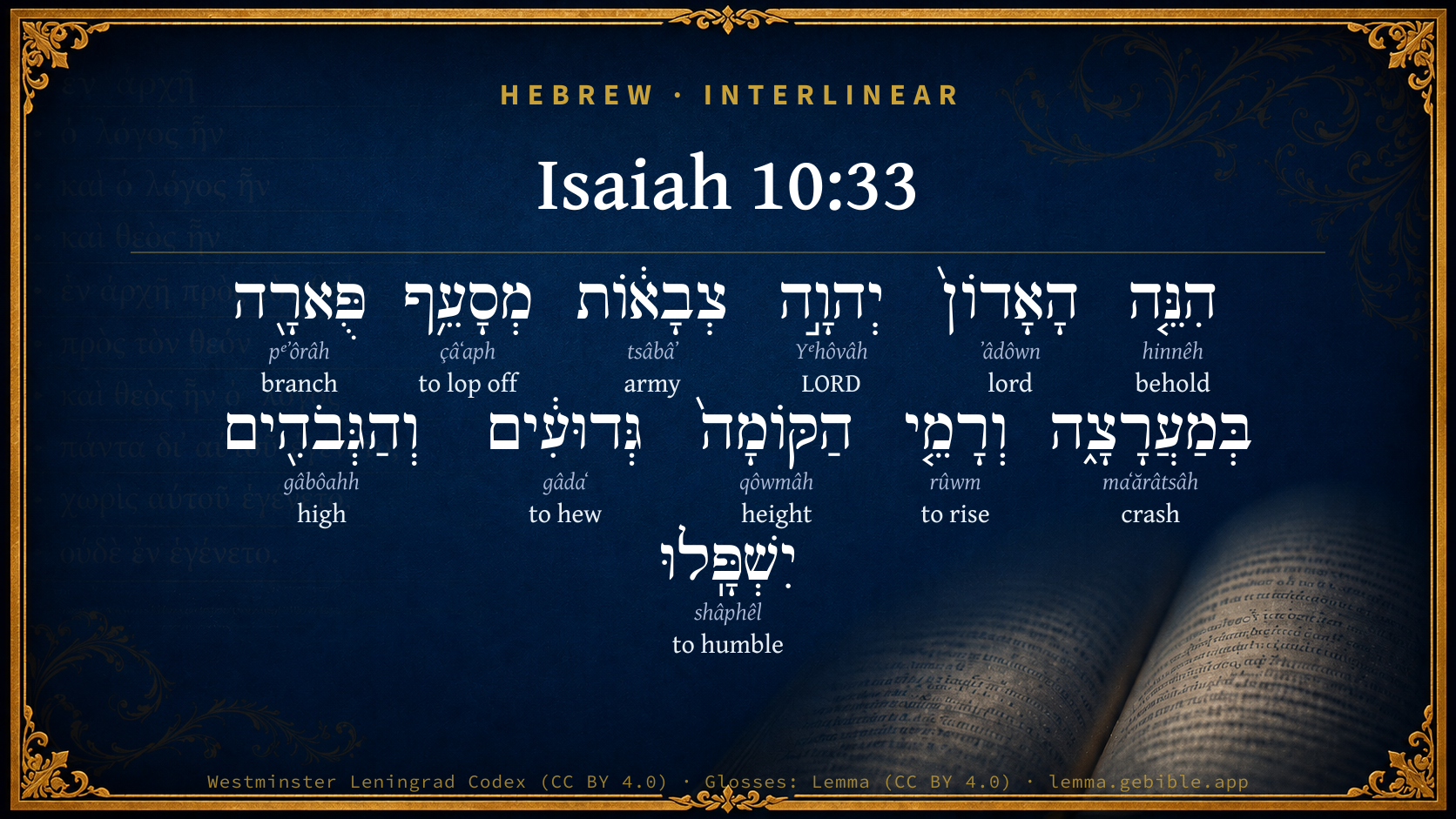
Hebrew (Westminster Leningrad Codex) Isaiah 10:33 appears in the Hebrew Old Testament. The text above is from the Westminster Leningrad Codex. Each word links to its Strong’s number, a concise gloss, and parsing drawn from the Open Scriptures Hebrew Bible morphology. Click any word for its full Brown-Driver-Briggs (BDB) entry.
Download image
Cite this verse

Isaiah 10:33 (World English Bible). Public Domain. Lemma interlinear Bible study tool, https://lemma.gebible.app/v/isaiah/10/33.

Show BibTeX & RIS
BibTeX
RIS
English Translation
Behold, the Lord, Yahweh of Hosts, will lop the boughs with terror: and the high of stature shall be hewn down, and the lofty shall be brought low.
World English Bible · Public Domain
Highlights
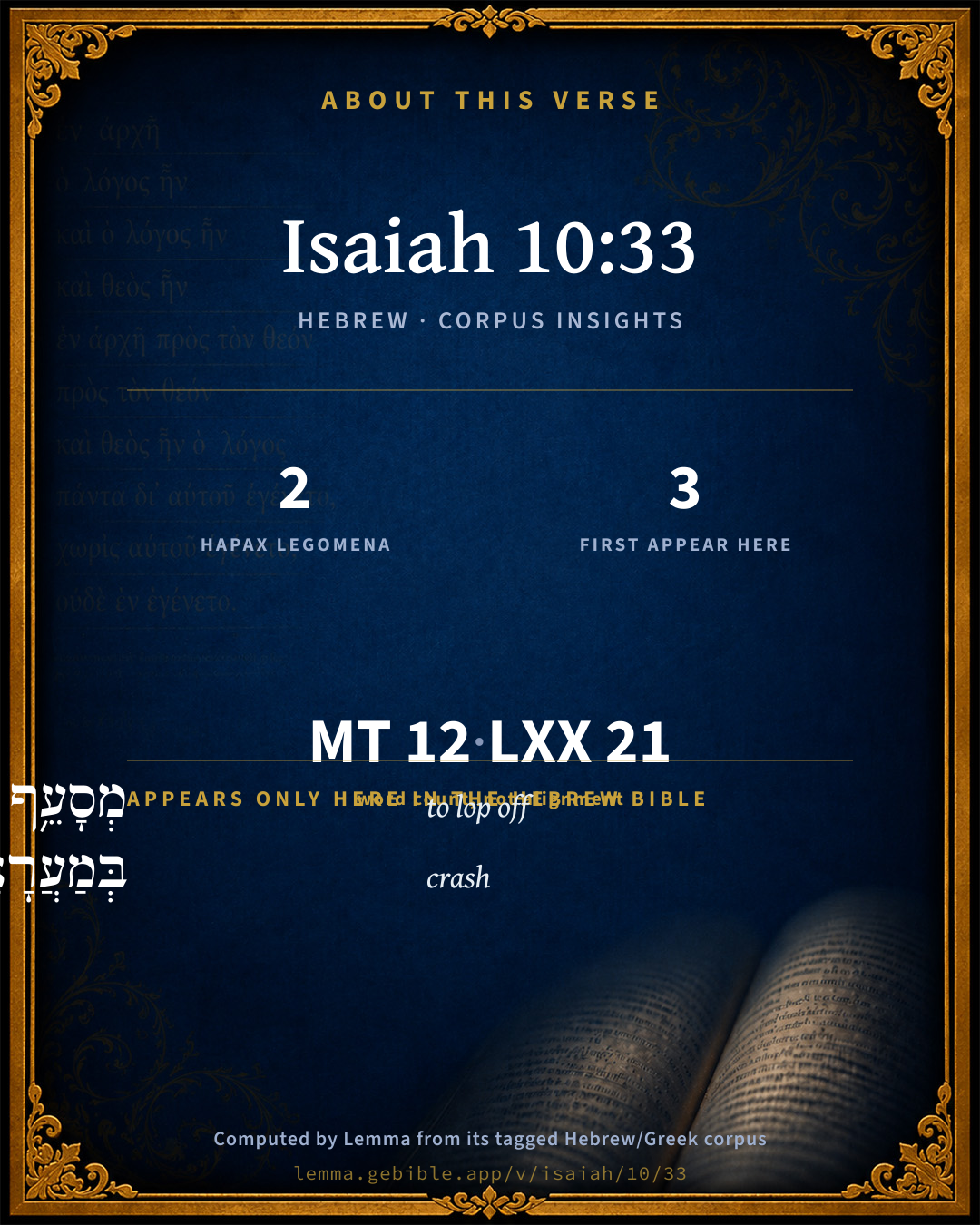
  • 2 hapax legomena — only here in the Hebrew Bible
  • 3 first appearances in the Hebrew Bible
Full analysis ↓
Download a study sheet

One document with this verse’s original text, its word-by-word gloss line, the meaning frame, cross-references with their text, attributed commentary, and full source and license credits — printable, and it pastes into notes with its structure intact.

This verse Autodidact and up

Study sheet (.html) Plain text (.txt)

A passage Seminary Student

Up to 50 verses in one chapter. A passage sheet keeps up to 6 commentary sources and 12 cross-references per verse, in the order this page ranks them, and says so on the sheet whenever that leaves anything out. Ask for a single verse and you get the Autodidact verse sheet above.

Everything on this page stays free to read, with no account — the sheet is a download of what is already on screen, not access to it.

Want to remove ads? Support Godless Engineer
Compare translations 3

The same verse in 3 English versions, stacked beneath the original-language interlinear above. Click any original word for its lexicon entry.

Each is an independent rendering of the whole verse — the interlinear is not word-aligned to these translations.

Highlighted words mark where these versions differ — a whole-verse word diff, not a word-by-word alignment.

  • World English Bible Public Domain
    Behold, the Lord, Yahweh of Hosts, will lop the boughs with terror: and the high of stature shall be hewn down, and the lofty shall be brought low.
  • King James Version Public Domain
    Behold, the Lord, the LORD of hosts, shall lop the bough with terror: and the high ones of stature shall be hewn down, and the haughty shall be humbled.
  • unfoldingWord Literal Text CC BY-SA 4.0
    Behold, the Lord, Yahweh of Armies, is lopping off the bough with terror, and the ones being high of stature are being felled, and the lofty will become low.

unfoldingWord Literal Text — © unfoldingWord, licensed CC BY-SA 4.0. Word-aligned USFM3 via Door43 (git.door43.org/unfoldingWord/en_ult).

Versions to compare (up to 4)

3 of 4 selected

Show all 18 translations

Every available English version of this verse, each an independent rendering of the whole verse.

  • World English Bible Public Domain
    Behold, the Lord, Yahweh of Hosts, will lop the boughs with terror: and the high of stature shall be hewn down, and the lofty shall be brought low.
  • Berean Standard Bible Public Domain
    Behold, the Lord GOD of Hosts will lop off the branches with terrifying power. The tall trees will be cut down, the lofty ones will be felled.
  • Majority Standard Bible Public Domain
    Behold, the Lord GOD of Hosts will lop off the branches with terrifying power. The tall trees will be cut down, the lofty ones will be felled.
  • King James Version Public Domain
    Behold, the Lord, the LORD of hosts, shall lop the bough with terror: and the high ones of stature shall be hewn down, and the haughty shall be humbled.
  • American Standard Version (1901) Public Domain
    Behold, the Lord, Jehovah of hosts, will lop the boughs with terror: and the high of stature shall be hewn down, and the lofty shall be brought low.
  • Revised Version (1885) Public Domain
    Behold, the Lord, the LORD of hosts, shall lop the boughs with terror: and the high ones of stature shall be hewn down, and the lofty shall be brought low.
  • Geneva Bible (1599) Public Domain
    Beholde, the Lord God of hostes shall cut off the bough with feare, and they of high stature shalbe cut off, and the hie shalbe humbled.
  • Douay-Rheims (1899) Public Domain
    Behold the sovereign Lord of hosts shall break the earthen vessel with terror, and the tall of stature shall be cut down, and the lofty shall be humbled.
  • Young's Literal Translation Public Domain
    Lo, the Lord, Jehovah of Hosts, Is lopping a branch with violence, And the high of stature are cut down, And the lofty are become low,
  • Literal Standard Version CC BY-SA 4.0
    Behold, the Lord, YHWH of Hosts, || Is lopping a branch with violence, || And the high of stature are cut down, || And the lofty have become low,
  • Unlocked Literal Bible CC BY-SA 4.0
    Behold, the Lord Yahweh of hosts will lop off the boughs with a terrifying crash; the tallest trees will be cut down, and the lofty will be brought low.
  • unfoldingWord Literal Text CC BY-SA 4.0
    Behold, the Lord, Yahweh of Armies, is lopping off the bough with terror, and the ones being high of stature are being felled, and the lofty will become low.
  • Darby Bible Public Domain
    Behold the Lord, Jehovah of hosts, shall lop the boughs with violence; and the high ones of stature shall be hewn down, and the haughty shall be brought low;
  • World Messianic Bible Public Domain
    Behold, the Lord, GOD of Hosts, will lop the boughs with terror. The tall will be cut down, and the lofty will be brought low.
  • Webster's Bible Public Domain
    Behold, the Lord, the LORD of hosts will lop the bough with terror: and the high ones of stature shall be hewn down, and the haughty shall be humbled.
  • Free Bible Version CC BY-SA 4.0
    Look how the Lord Almighty is going to chop off the branches with great force. The tall trees will be cut down, the proud trees will be brought crashing down.
  • Bible in Basic English Public Domain
    See, the Lord, the Lord of armies, is cutting off his branches with a great noise, and his strong ones are falling and his high ones are coming down.
  • JPS Tanakh (1917) Public Domain
    Behold, the Lord, the LORD of hosts, shall lop the boughs with terror; and the high ones of stature shall be hewn down, and the lofty shall be laid low.

Literal Standard Version (2020), Covenant Press — licensed CC BY-SA 4.0. Text via the HelloAO Bible API (eBible.org). Unlocked Literal Bible (unfoldingWord) — licensed CC BY-SA 4.0. Text via the HelloAO Bible API (eBible.org). unfoldingWord Literal Text — © unfoldingWord, licensed CC BY-SA 4.0. Word-aligned USFM3 via Door43 (git.door43.org/unfoldingWord/en_ult). Free Bible Version, Dr. Jonathan Gallagher — licensed CC BY-SA 4.0. Text via the HelloAO Bible API (eBible.org).

Word by word

More ways to search: Search by grammar → Find every occurrence → Compare this word →

Practice this passage: Drill this verse → Learn its vocabulary →

מְסָעֵ֥ף
çâʻaph
H5586
“lopping off”
Verb, Piel, Participle Active, Masculine, Singular, Absolute
Part of Speech
Verb
Stem
Piel
Form
Participle Active
Gender
Masculine
Number
Singular
State
Absolute
Full BDB Definition

Origin: a primitive root

TWOT: 1527c

(Piel) to cut off, lop off boughs
  1. הִנֵּ֤ה hinnêh H2009 “behold” Particle, Demonstrative
  2. הָאָדוֹן֙ ʼâdôwn H113 “the · lord” Particle, Definite Article + Noun, Common, Masculine, Singular, Absolute
  3. יְהוָ֣ה Yᵉhôvâh H3068 “LORD” Noun, Proper
  4. צְבָא֔וֹת tsâbâʼ H6635 “armies” Noun, Common, Both, Plural, Absolute
  5. פֻּארָ֖ה pᵉʼôrâh H6288 “branch” Noun, Common, Feminine, Singular, Absolute
  6. בְּמַעֲרָצָ֑ה maʻărâtsâh H4637 “in/at · crash” Preposition + Noun, Common, Feminine, Singular, Absolute
  7. וְרָמֵ֤י rûwm H7311 “and · rising” Conjunction + Verb, Qal, Participle Active, Masculine, Plural, Construct
  8. הַקּוֹמָה֙ qôwmâh H6967 “the · height” Particle, Definite Article + Noun, Common, Feminine, Singular, Absolute
  9. גְּדוּעִ֔ים gâdaʻ H1438 “hewn” Verb, Qal, Participle Passive, Masculine, Plural, Absolute
  10. וְהַגְּבֹהִ֖ים gâbôahh H1364 “and · the · high” Conjunction + Particle, Definite Article + Adjective, Adjective, Masculine, Plural, Absolute
  11. יִשְׁפָּֽלוּ shâphêl H8213 “to humble” Verb, Qal, Imperfect, 3rd Person, Masculine, Plural

About this verse

These counts appear in no published source. They are computed here, from the morphology-tagged text and Lemma’s own curated glosses. What Lemma adds →

12
words
12
distinct lemmas
Prophets
section

Notable vocabulary

2 hapax legomena — words that appear only here in the entire Hebrew Bible:

  • מְסָעֵ֥ף to lop off H5586
  • בְּמַעֲרָצָ֑ה crash H4637

First appearance in Scripture

These words make their first canonical appearance in the Hebrew Bible here:

  • מְסָעֵ֥ף to lop off H5586
  • פֻּארָ֖ה branch H6288
  • בְּמַעֲרָצָ֑ה crash H4637

Shared distinctive vocabulary

פֻּארָ֖ה branch H6288 occurs in 7 verses of the Hebrew Bible. Also found in:

Grammatical profile

  • 4 verbs
  • 6 nouns
  • 1 adjective
  • 1 particle

Verb forms

  • מְסָעֵ֥ף Piel · Participle Active
  • וְרָמֵ֤י Qal · Participle Active
  • גְּדוּעִ֔ים Qal · Participle Passive
  • יִשְׁפָּֽלוּ Qal · Imperfect

Hebrew & Septuagint length

In English translation the verse runs 28 words from the Hebrew and 28 from the Septuagint (LXX English) — the same length.

A rough comparison of the two English renderings, which tokenize alike — not a word-level alignment.

Word counts can differ between the Hebrew and the Greek without any difference in meaning — e.g. the Hebrew direct-object marker אֵת has no separate Greek word, and Greek often adds the article ὁ.

In the original languages it is 12 Hebrew tokens and 21 Greek tokens — but the two are counted differently (Hebrew bundles its prefixes and suffixes into one token; the Greek is in lemma form), so that isn’t a like-for-like length.

Cross-references

10

Topical passages linked to Isaiah 10:33 in the Treasury of Scripture Knowledge — connected by theme and wording, ordered by reader-vote popularity; previews shown in the World English Bible.

  • Amos 2:9 Yet I destroyed the Amorite before them, Whose height was like the height of the cedars, And he was strong as the oaks; Yet I destroyed his fruit from above, and his roots from beneath.
  • Isaiah 37:38 It happened, as he was worshipping in the house of Nisroch his god, that Adrammelech and Sharezer his sons struck him with the sword; and they escaped into the land of Ararat. Esar Haddon his son reigned in his place.
  • Daniel 4:37 Now I, Nebuchadnezzar, praise and extol and honor the King of heaven; for all his works are truth, and his ways justice; and those who walk in pride he is able to abase.
  • 2 Kings 19:21–37 This is the word that Yahweh has spoken concerning him: The virgin daughter of Zion has despised you and ridiculed you; the daughter of Jerusalem has shaken her head at you.
  • 2 Chronicles 32:21 Yahweh sent an angel, who cut off all the mighty men of valor, and the leaders and captains, in the camp of the king of Assyria. So he returned with shame of face to his own land. When he was come into the house of his god, those who came forth from his own bowels killed him there with the sword.
  • Job 40:11–12 Pour forth the fury of your anger. Look on everyone who is proud, and bring him low.
  • Isaiah 2:11–17 The lofty looks of man will be brought low, The haughtiness of men will be bowed down, And Yahweh alone will be exalted in that day.
  • Isaiah 10:16–19 Therefore will the Lord, Yahweh of Hosts, send among his fat ones leanness; and under his glory there shall be kindled a burning like the burning of fire.
  • Isaiah 37:24–36 By your servants have you defied the Lord, and have said, With the multitude of my chariots am I come up to the height of the mountains, to the innermost parts of Lebanon; and I will cut down the tall cedars of it, and the choice fir trees of it; and I will enter into its farthest height, the forest of its fruitful field;
  • Luke 14:11 For everyone who exalts himself will be humbled, and whoever humbles himself will be exalted."

Cross-references courtesy of OpenBible.info (CC BY 4.0).

Hebrew and Greek witnesses Masoretic Hebrew ↔ Greek Septuagint

The same verse in the two great witnesses to the Old Testament, shown verse-for-verse.

These are two independent witnesses, not word-aligned to each other, and the Septuagint is shown in lemma (dictionary) form.

Hebrew Isaiah 10:33 Masoretic · Westminster Leningrad Codex

הִנֵּ֤ה הָאָדוֹן֙ יְהוָ֣ה צְבָא֔וֹת מְסָעֵ֥ף פֻּארָ֖ה בְּמַעֲרָצָ֑ה וְרָמֵ֤י הַקּוֹמָה֙ גְּדוּעִ֔ים וְהַגְּבֹהִ֖ים יִשְׁפָּֽלוּ

Behold, the Lord, Yahweh of Hosts, will lop the boughs with terror: and the high of stature shall be hewn down, and the lofty shall be brought low.

World English Bible · Public Domain

Greek LXX Isaiah 10:33 Septuagint · lemma form

ἰδού γάρ ὁ δεσπότης κύριος σαβαωθ συνταράσσω ὁ ἔνδοξος μετά ἰσχύς καί ὁ ὑψηλός ὁ ὕβρις συντρίβω καί ὁ ὑψηλός ταπεινόω

Behold, the Lord, the Lord of hosts, will mightily confound the glorious ones; and the haughty in pride shall be crushed, and the lofty shall be brought low:

LXX2012 (modern English Septuagint) · Public Domain

On this verse, Haydock's Catholic Bible Commentary discusses the Septuagint’s reading. Read the note in Commentary ↓

Hebrew: Westminster Leningrad Codex (CC BY 4.0). Greek: Septuagint (public domain); English from LXX2012 (modern English Septuagint) (Public Domain). How the Septuagint differs from the Hebrew →

Targum (Aramaic paraphrase)

1

The Targum is the ancient Jewish Aramaic paraphrase of the Hebrew Scriptures — an interpretive translation, not the Hebrew text itself. Onkelos (literal) and Pseudo-Jonathan (expansive) render the Torah, and Jonathan the Prophets. Coverage is partial: where no permissively-licensed English translation exists for a verse, only the Aramaic is shown. This is verse-level text, not a word-by-word alignment to the Hebrew.

  1. Targum Jonathan Prophets (Joshua–Malachi)
    הָא רִבּוֹן עַלְמָא יְיָ צְבָאוֹת רָמֵי קְטוֹל בְּמַשִׁרְיָתֵיהּ כִּבְעוֹט דְמִתְבָּעֵיט בְּמַעֲצַרְתָּא וְרָמֵי קוֹמָא יִתְקַטְפוּן וְתַקִיפַיָא יִמְאֲכוּן:

    Behold, the Lord of the world, the Lord of hosts, shall cast forth slaughter into his camp, as grapes that are trod in a wine-press: and the high ones of stature shall be hewn down, and the mighty shall be humbled.

    Targum Jonathan — Aramaic: “Mikraot Gedolot” (public domain). English: “Sefaria Community Translation” (CC0 1.0 (public-domain dedication)); “London "Chaldee Paraphrase," 1871” (public domain). Text via Sefaria.

Commentary

Notes on Isaiah 10:33 from classic Christian and Jewish commentators (each source and its license shown beneath its notes). The classic Christian expositions comment on the surrounding passage and are grouped to its opening verse, so a note may address several verses; the Jewish commentaries on the Tanakh (Rashi and others) are per-verse, so they appear only where the commentator wrote on this verse.

Lemma curates 59 commentaries, every one of them public domain or Creative Commons licensed, each selected and text-cleaned for this edition rather than reprinted as found. About our sources →

The Cambridge Bible for Schools and Colleges

gen. ed. J. J. S. Perowne

33, 34. Just when the Assyrian is in sight of his goal, Jehovah smites him down. The description naturally passes into figurative and somewhat vague language. The image is that of a stately forest laid low by the axe-man.

Isa_10:33. The Lord Jehovah of Hosts, as in Isa_10:16.

The “high ones of stature,” and the “lofty ones” (R.V.) are the great trees; the epithets keep within the limits of the figure. For be humbled read lie low.

Isa_10:34. the thickets of the forest (R.V.) cf. ch. Isa_9:18. The verb in the first clause is probably passive: “shall be cut down.” Lebanon] Better, the Lebanon. Lebanon means “the white (mountain)”—either from its snows or its chalk cliffs—and in Hebr. prose always retains the art.; here, however, the reference is to its forests, which supply a figure for the Assyrian army.

a mighty one] or “a majestic One”—Jehovah Himself.

The Cambridge Bible for Schools and Colleges (gen. ed. J. J. S. Perowne; Cambridge University Press, 1878–1918) — public domain. Text from a community e-Sword module.

John Gill's Exposition

And he shall cut down the thickets of the forest with iron,.... The multitude of the common soldiers, the whole body of the army, by means of one of his angels, that excel in strength, for which he is compared to "iron"; and which is explained in the next clause:

and Lebanon shall fall by a mighty one; the Assyrian army is compared to the forest of Lebanon, for the multitude of trees in it, and the tallness of its cedars, it abounding not only with common soldiers, but with great men; so it is compared to a forest, and to Carmel, or a fruitful field, in Isa 10:18 and the Assyrian monarch is said to be a cedar in Lebanon, Eze 31:3 which fell by the hands of one of the mighty angels, Kg2 19:35 some, because of this last clause, think that this and the preceding verse Isa 10:33 are to be understood of the calamities that should come upon the Jews, at the time of the Babylonish captivity; for though Sennacherib should stop at Nob; and proceed no further, however should not be able to take Jerusalem, yet hereafter a successor of his should; and, according to this sense, by the "bough" lopped may be meant Jeconiah, or Zedekiah king of Judah; by the "high ones of stature", and the "haughty" ones, his children, the princes of the blood, and the nobles of the land; and by the "thickets of the forest", the common people, who were either killed or carried captive; and by Lebanon, the temple, Zac 11:1 and by the "mighty one", Nebuchadnezzar that burnt it. And some of the ancient Jews interpret this last clause of the destruction of the temple by Vespasian; they observe upon this passage in one place (m), there is no mighty one but a king, as in Jer 30:21 and there is no Lebanon but the house of the sanctuary, according to Deu 3:25 wherefore when a certain Jew saluted Vespasian as a king, and he replied that he was no king, the Jew made answer, if thou art not a king, thou shall be one; for this house (meaning the temple) shall not be destroyed but by the hands of a king, as it is said, "and Lebanon shall fall by a mighty one" (n).

(m) T. Bab. Gittin, fol. 56. 2. (n) Midrash Echa Rabbati, fol 46. 4.

Next: Isaiah Chapter 11

John Gill's Exposition of the Whole Bible (1746–1763) — public domain (CC PDM 1.0). Text via the HelloAO Bible API.

Trapp's Complete Commentary

John Trapp

Isa 10:33 Behold, the Lord, the LORD of hosts, shall lop the bough with terror: and the high ones of stature [shall be] hewn down, and the haughty shall be humbled.

Ver. 33. Behold, the Lord shall lop the bough,] i.e., Those of greatest state and stature in the Assyrian army.

And the haughty shall be humbled.] See Isa 2:11; Isa 2:17.

John Trapp, A Commentary or Exposition upon All the Books of the Old and New Testament (1647–1656) — public domain. Text from a community e-Sword module.

Joseph Benson's Commentary

Isa 10:33-34. The Lord of hosts shall lop the bough — The top bough, Sennacherib; with terror — Hebrew, במערצהbemagnaratza, with a dreadful crash, as Bishop Lowth renders it, expressed by the very sound of the Hebrew word; by a most terrible and unexpected blow; and the high ones, &c. — The lofty boughs, Hebrew, ורמי הקומהexcelsi statura, the high of stature: that is, his valiant soldiers, or the great commanders of his army, compared to the tall trees of a forest; shall be hewn down — By a sudden and irresistible stroke; and the haughty — The proud, self- confident boasters, elati animo, the high-minded, as חגבהיםsignifies; shall be humbled — Shall be laid motionless in the dust, namely, by the invisible power of the destroying angel. And he shall cut down the thickets, &c., with iron — Or, as with iron, as the trees of the forest are cut down with instruments of iron; and Lebanon — Or, his Lebanon, the Assyrian army, which being before compared to a forest, and being called his Carmel in the Hebrew text, (Isa 10:18,) may very fitly, upon the same ground, be called his Lebanon here. Shall fall by a mighty one — By a mighty angel, Isa 37:36.

Joseph Benson's Commentary on the Old and New Testaments (1811–1818) — public domain. Text from a community e-Sword module.

Geneva Bible (1599)

Geneva Bible translators

Fear and destruction shall come upon Judah for the princes and the people shall be all led away captives.

Geneva Bible (1599) marginal notes — public domain. Text via Bolls.life.

Jamieson, Fausset & Brown

Robert Jamieson, A. R. Fausset & David Brown

bough--literally, the "beauty" of the tree; "the beautiful branch."

high ones of stature--"the upright stem," as distinguished from the previous "boughs" [HORSLEY].

Jamieson, Fausset & Brown — Commentary Critical and Explanatory on the Whole Bible (1871) — public domain (CC PDM 1.0). Text via the HelloAO Bible API.

Adam Clarke's Commentary

Verse 33. Shall lop the bough with terror] פארה purah; but פורה purah, wine-press, is the reading of twenty-six of Kennicott's and twenty-three of De Rossi's MSS., four ancient editions, with Symmachus, Theodotion, and the Chaldee.

Adam Clarke's Commentary on the Bible (1810–1826) — public domain. Text from a community e-Sword/MySword module.

Ellicott's Commentary for English Readers

(33) Behold, . . . the Lord of hosts . . .—The sudden change of tone indicates another pressure of the “strong hand” of Jehovah (Isa_8:11), another burst of intensest inspiration. So far shalt thou go, the prophet says to Sargon, as he said afterwards to Sennacherib (Isa_37:28-32), and no farther. In the “boughs” that are to be lopped, and the “thickets of the forest” that are to be cut down, we have the same imagery as in Isa_10:17-19. The constant boasts of the Assyrian kings that they cut down the forests of the nations they conquered, gave a special fitness to this emblem of the work of the Divine Nemesis. High as the cedars of Lebanon might rise in their majesty, the “Mighty One” of Israel (better, Glorious One; comp. Isa_10:18, Isa_33:21; Psa_93:4) would lay them low.

A Bible Commentary for English Readers, edited by Charles John Ellicott (1878–1897) — public domain. Text from a community e-Sword module.

Albert Barnes' Notes on the Bible

Behold, the Lord ... - The prophet had described, in the previous verses, the march of the Assyrians toward Jerusalem, station by station. He had accompanied him in his description until he had arrived in full sight of the city, which was the object of all his preparation. He had described the consternation which was felt at his approach in all the smaller towns. Nothing had been able to stand before him; and now, flushed with success, and confident that Jerusalem would fall, he stands before the devoted city. But here, the prophet announces that his career was to close; and here his arms to be stayed. Here he was to meet with an overthrow, and Jerusalem would still be safe. This is the design of the prophecy, to comfort the inhabitants of Jerusalem with the assurance that they still would be safe.

Will lop the bough - The word “bough” here (פארה pû'râh) is from פאר pâ'ar to adorn, to beautify; and is given to a branch or bough of a tree on account of its beauty. It is, therefore, descriptive of that which is beautiful, honored, proud; and is applied to the Assyrian on account of his pride and magnificence. In Isa 10:18-19, the prophet had described the army of the Assyrian as a magnificent forest. Here he says that the glory of that army should be destroyed, as the vitality and beauty of the waving bough of a tree is quickly destroyed when it is lopped with an axe. There can scarcely be conceived a description, that would more beautifully represent the fading strength of the army of the Assyrian than this.

With terror - In such a way as to inspire terror.

The high ones of stature - The chief men and officers of the army.

Albert Barnes' Notes on the Bible (1834–1885) — public domain. Text from a community e-Sword/MySword module.

Haydock's Catholic Bible Commentary

Vessel. Like Gideon, when he attacked Madian, ver. 26., and Judges vii. 19. Septuagint, "the nobles." (Haydock) --- Hebrew, "their beauty." The empire of Assyria shall presently fall. (Calmet)

George Leo Haydock (1774–1849), Haydock's Catholic Family Bible and Commentary, 1859 edition — public domain. Excludes Psalms (Douay-Rheims chapter numbering differs from Protestant) and Deuterocanonical books (Catholic canon only).

Matthew Poole's English Annotations

The bough; the top bough, Sennacherib; or,

the boughs, his valiant soldiers or commanders of his army, which he compareth to a forest, Isa 10:18,34.

With terror; with a most terrible and amazing stroke by an angel.

Matthew Poole's English Annotations on the Holy Bible (1683–1685) — public domain. Text from a community e-Sword/MySword module.

The Pulpit Commentary

The Lord... shall lop the bough with terror. A check to the Assyrian arms is intended, but of what nature is not clear. The "lopping of the bough with terror" might indicate a panic, such as that which seized the Syrians and made Benhadad II raise the siege of Samaria. (2Ki_7:6, 2Ki_7:7) But the expressions used later on," hewn down," "cut down," "shall fall," rather imply a defeat.

The Pulpit Commentary (1880–1919), ed. H.D.M. Spence-Jones & Joseph S. Exell — public domain. Text from a community e-Sword module.

John Wesley's Explanatory Notes

The bough - The top-bough, Sennacherib, with a most terrible stroke.

John Wesley, Explanatory Notes Upon the Whole Bible (1754–1765) — public domain. Text via the GEBible commentary corpus.

J. A. Alexander on Isaiah

Joseph Addison Alexander

To the triumphant march and proud defiance now succeeds abruptly the tremendous downfall of the enemy himself, in describing which the Prophet resumes the figure dropped at v. 19, and represents the catastrophe as the sudden and violent prostration of a forest. “Behold, the Lord, Jehovah of hosts (is) lopping (or about to lop) the branch (of this great tree) with terror (or tremendous violence), and the (trees) high of stature (shall be) felled, and the lofty ones brought low.” Lofty of stature is not to be applied to men directly, as descriptive either of their pride or their appearance, but to trees, as representing the Assyrians in general or their chief men in particular.

Joseph Addison Alexander, The Prophecies of Isaiah (1846–1847; New York: Scribner, 1870–1878) — public domain. Text from a community e-Sword module.

unfoldingWord translationNotes

Door43 World Missions Community

Behold

This can be translated as "Look" or "Listen" or "Pay attention to what I am about to tell you."

Yahweh of hosts

See how you translated this in Isaiah 1:9.

will lop off the boughs ... and Lebanon in his majesty will fall

Isaiah speaks of the army of Assyria as if it were the tall trees in Lebanon. God will destroy the army like people cutting down the mighty trees of Lebanon. This emphasizes that though the army is strong, God has the power to destroy it. (See: Metaphor)

will lop off the boughs

"will cut off the big branches of the trees." In order to make it clear that this refers to the army of Assyria, it can be translated as a simile: He will destroy the army of Assyria like strong men cutting off the big branches of trees. (See: Metaphor)

with a terrifying crash

This can be reworded so that the abstract noun "crash" is expressed as the verb "make a noise." AT: "and the branches will crash down on the ground and make a terrifying noise" or "and the branches will fall to the ground with a very loud noise" (See: Abstract Nouns)

the tallest trees will be cut down

This can be stated in active form. AT: "he will cut down the tallest trees" (See: Active or Passive)

the tallest trees

This is a metaphor for "the strongest soldiers." (See: Metaphor)

the lofty will be brought low

This can be stated in active form. AT: "he will bring down the lofty people" (See: Active or Passive)

lofty

proud

the thickets of the forest

"the dense shrubs in the forest." This is possibly a metaphor for those people who are not well known. (See: Metaphor)

Lebanon in his majesty will fall

"the forests of Lebanon will no longer be so grand." This is possibly a metaphor for the Assyrian army. AT: "Yahweh will defeat the army of Assyria, as mighty as it is" (See: Metaphor)

translationWords

lord

Yahweh of hosts

ax

Lebanon

majesty

unfoldingWord translationNotes — © Distant Shores Media and the Door43 World Missions Community, licensed CC BY-SA 4.0. Source: git.door43.org/Door43/en_tn.

Rashi

Rabbi Shlomo Yitzchaki (Rashi)

Behold the Master on that night.

lops off the branches with a saw Shall lop off its branches, the root of the branches of his trees. ([Mss. read:] Uproots the branches of his trees.) ([Other mss. read:] Cuts off the branches of his trees.)

with a saw Heb. בְּמַעֲרָצָה, with a saw that cuts the boughs. This [word פֻּארָה] is not an expression denoting a winepress, for it is not spelled with a ‘vav,’ like (infra 63: 3) “A winepress (פּוּרָה) I trod,” and like (Haggai 2:16) “To draw off fifty measures from the winepress (פּוּרָה),” but with an ‘aleph,’ like (Ezekiel 31:5) “And its boughs became long (פֹּארֹתָיו).” מְסָעֵף is an expression of cutting off branches [esbranchier in O.F.], like (infra 27:10) “And he will destroy its branches (סְעִיפֶיהָ), and (infra 17:6) “On its branches (בִּסְעִיפֶיהָ) the fruitful one.”

with a saw Heb. בְּמַעֲרָצָה, with an implement of destruction, which breaks them.

and those of lofty height [This alludes to] the heroes.

are hewn down The expression of hewing is apropos only to trees and hard things.

Rashi on the Tanakh — English translations: “The Judaica Press complete Tanach with Rashi, translated by A. J. Rosenberg” (CC BY 4.0); “Pentateuch with Rashi's commentary by M. Rosenbaum and A.M. Silbermann, 1929-1934” (public domain); “The Metsudah Tanach series, Lakewood, N.J” (CC BY 4.0); and “The Book of Joshua, Metsudah Publications, 1997” (CC BY 4.0). Text via Sefaria.

Ibn Ezra

Rabbi Abraham ibn Ezra

מסעף Shall cut off the branches (סעיפים). Comp. לא תפאר Thou shalt not take off the crown (פאר, Deut. 24:20); ושרשך And he will take away thy root (Ps. 52:7).

פארה Bough. Comp. פארות Branches (Ez. 17:6).

במערצה With strength. Comp. עריץ strong.

And the high ones of stature shall be hewn down, etc. The nobles shall be cut off.

Ibn Ezra on the Tanakh — English translations: “Sefaria Community Translation” (CC0 1.0 (public-domain dedication)); “Yalkut, Sifsei Chachomim Chumash, Metsudah Publications, 2009” (CC BY 4.0); and “Commentary of Ibn Ezra on Isaiah - trans. by M. Friedlander, 1873” (public domain). Text via Sefaria.

Lesson kit

Teaching starters — assembled from the data on this page, not authored interpretation. Every prompt links to the verse data it draws on. Edit before teaching.

Isaiah, in the Prophets, opens this verse with 12 words (12 distinct Hebrew lemmas). Its most distinctive word is çâʻaph (“to lop off”). A historical commentator’s framing appears above. Read the whole chapter for the surrounding context.

Discussion questions

  1. How does “to lop off” (çâʻaph) shape what this verse is saying?
  2. This verse holds 2 words here found nowhere else in the Hebrew Bible. What might the rare words draw attention to?
  3. 3 words here appear for the first time in Scripture. What is being introduced at this debut?
  4. Ezekiel 17:6 shares the word «branch» with this verse. How do the two illuminate each other?
  5. The translations on this page render this verse differently — a whole-verse word diff, not a word-by-word alignment. What might account for the different wordings?
  6. The verb «מְסָעֵ֥ף» is Piel Participle Active. How does its form color the action?
  7. Reading how The Cambridge Bible for Schools and Colleges and John Gill's Exposition read this verse, where do the two commentators agree and where do they part?

Things to notice

Reading settings

Reading text

Shown beneath each verse's original-language words.

Old Testament
Old Testament edition

Read the OT as the Masoretic Hebrew (MT) or the Greek Septuagint (LXX).

English shown for the Greek Septuagint (in the Hebrew ↔ Greek comparison).

Comparing translations? Open the Compare panel on any verse page to stack up to four side by side.