
Proverbs 6:17

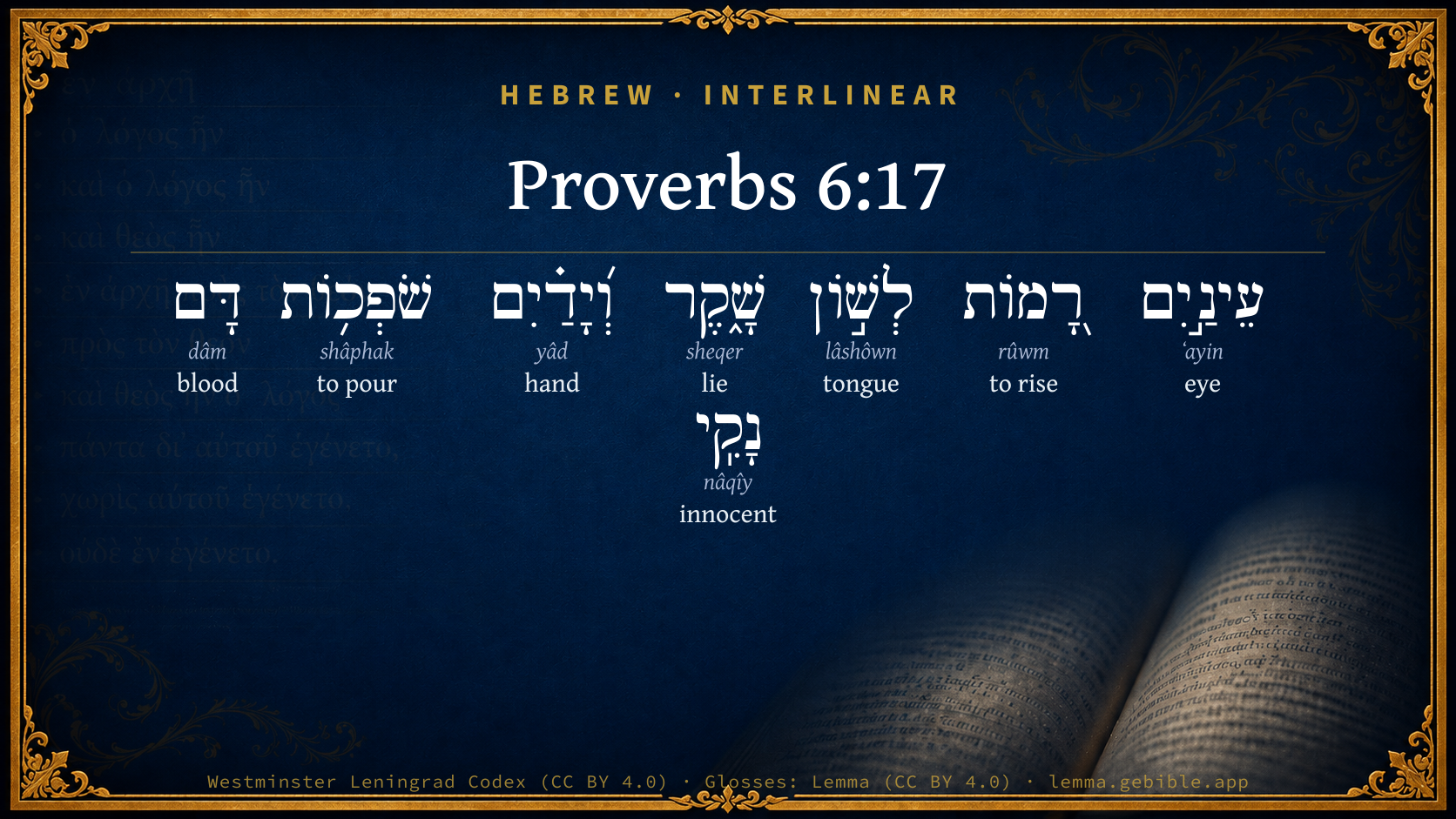
Hebrew (Westminster Leningrad Codex) Proverbs 6:17 appears in the Hebrew Old Testament. The text above is from the Westminster Leningrad Codex. Each word links to its Strong’s number, a concise gloss, and parsing drawn from the Open Scriptures Hebrew Bible morphology. Click any word for its full Brown-Driver-Briggs (BDB) entry.
Download image
Cite this verse

Proverbs 6:17 (World English Bible). Public Domain. Lemma interlinear Bible study tool, https://lemma.gebible.app/v/proverbs/6/17.

Show BibTeX & RIS
BibTeX
RIS
English Translation
Haughty eyes, a lying tongue, Hands that shed innocent blood;
World English Bible · Public Domain
Download a study sheet

One document with this verse’s original text, its word-by-word gloss line, the meaning frame, cross-references with their text, attributed commentary, and full source and license credits — printable, and it pastes into notes with its structure intact.

This verse Autodidact and up

Study sheet (.html) Plain text (.txt)

A passage Seminary Student

Up to 50 verses in one chapter. A passage sheet keeps up to 6 commentary sources and 12 cross-references per verse, in the order this page ranks them, and says so on the sheet whenever that leaves anything out. Ask for a single verse and you get the Autodidact verse sheet above.

Everything on this page stays free to read, with no account — the sheet is a download of what is already on screen, not access to it.

Want to remove ads? Support Godless Engineer
Compare translations 3

The same verse in 3 English versions, stacked beneath the original-language interlinear above. Click any original word for its lexicon entry.

Each is an independent rendering of the whole verse — the interlinear is not word-aligned to these translations.

Highlighted words mark where these versions differ — a whole-verse word diff, not a word-by-word alignment.

  • World English Bible Public Domain
    Haughty eyes, a lying tongue, Hands that shed innocent blood;
  • King James Version Public Domain
    A proud look, a lying tongue, and hands that shed innocent blood,
  • unfoldingWord Literal Text CC BY-SA 4.0
    uplifted eyes, a tongue of falsehood, and hands pouring out innocent blood,

unfoldingWord Literal Text — © unfoldingWord, licensed CC BY-SA 4.0. Word-aligned USFM3 via Door43 (git.door43.org/unfoldingWord/en_ult).

Versions to compare (up to 4)

3 of 4 selected

Show all 18 translations

Every available English version of this verse, each an independent rendering of the whole verse.

  • World English Bible Public Domain
    Haughty eyes, a lying tongue, Hands that shed innocent blood;
  • Berean Standard Bible Public Domain
    haughty eyes, a lying tongue, hands that shed innocent blood,
  • Majority Standard Bible Public Domain
    haughty eyes, a lying tongue, hands that shed innocent blood,
  • King James Version Public Domain
    A proud look, a lying tongue, and hands that shed innocent blood,
  • American Standard Version (1901) Public Domain
    Haughty eyes, a lying tongue, And hands that shed innocent blood;
  • Revised Version (1885) Public Domain
    Haughty eyes, a lying tongue, and hands that shed innocent blood;
  • Geneva Bible (1599) Public Domain
    The hautie eyes, a lying tongue, and the hands that shed innocent blood,
  • Douay-Rheims (1899) Public Domain
    Haughty eyes, a lying tongue, hands that shed innocent blood,
  • Young's Literal Translation Public Domain
    Eyes high -- tongues false -- And hands shedding innocent blood --
  • Literal Standard Version CC BY-SA 4.0
    High eyes, || False tongues, || And hands shedding innocent blood,
  • Unlocked Literal Bible CC BY-SA 4.0
    The eyes of a proud person, a tongue that lies, hands that shed the blood of innocent people,
  • unfoldingWord Literal Text CC BY-SA 4.0
    uplifted eyes, a tongue of falsehood, and hands pouring out innocent blood,
  • Darby Bible Public Domain
    haughty eyes, a lying tongue, and hands that shed innocent blood;
  • World Messianic Bible Public Domain
    arrogant eyes, a lying tongue, hands that shed innocent blood,
  • Webster's Bible Public Domain
    A proud look, a lying tongue, and hands that shed innocent blood.
  • Free Bible Version CC BY-SA 4.0
    arrogant eyes, a lying tongue, hands that murder the innocent,
  • Bible in Basic English Public Domain
    Eyes of pride, a false tongue, hands which take life without cause;
  • JPS Tanakh (1917) Public Domain
    Haughty eyes, a lying tongue, and hands that shed innocent blood;

Literal Standard Version (2020), Covenant Press — licensed CC BY-SA 4.0. Text via the HelloAO Bible API (eBible.org). Unlocked Literal Bible (unfoldingWord) — licensed CC BY-SA 4.0. Text via the HelloAO Bible API (eBible.org). unfoldingWord Literal Text — © unfoldingWord, licensed CC BY-SA 4.0. Word-aligned USFM3 via Door43 (git.door43.org/unfoldingWord/en_ult). Free Bible Version, Dr. Jonathan Gallagher — licensed CC BY-SA 4.0. Text via the HelloAO Bible API (eBible.org).

Word by word

More ways to search: Search by grammar → Find every occurrence → Compare this word →

Practice this passage: Drill this verse → Learn its vocabulary →

About this verse

These counts appear in no published source. They are computed here, from the morphology-tagged text and Lemma’s own curated glosses. What Lemma adds →

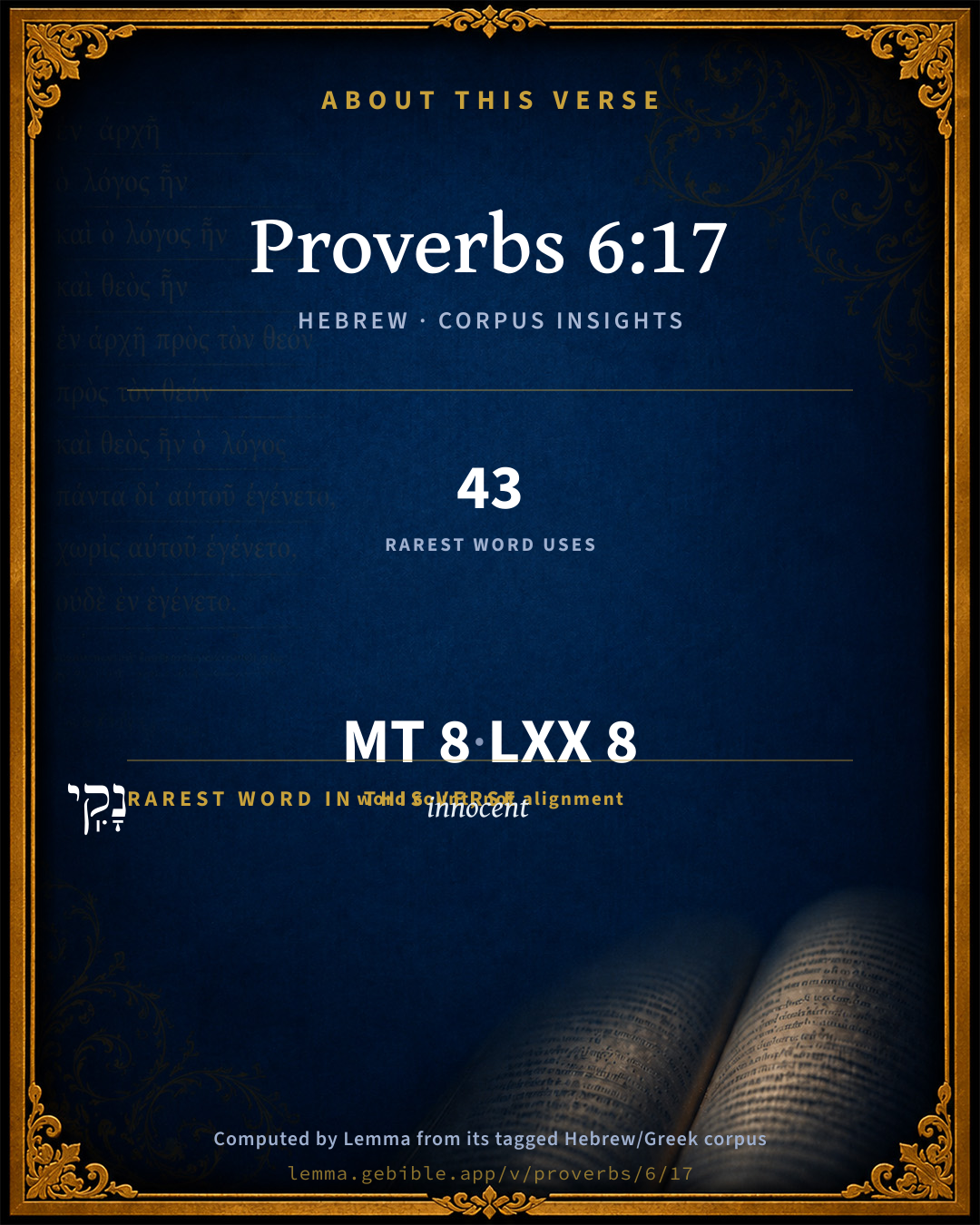
8
words
8
distinct lemmas
Wisdom
section

Shared distinctive vocabulary

נָקִֽי innocent H5355 occurs in 42 verses of the Hebrew Bible. Also found in:

Grammatical profile

  • 2 verbs
  • 5 nouns
  • 1 adjective

Verb forms

  • רָ֭מוֹת Qal · Participle Active
  • שֹׁפְכ֥וֹת Qal · Participle Active

Hebrew & Septuagint length

In English translation the verse runs 10 words from the Hebrew and 15 from the Septuagint (LXX English) — the Septuagint runs noticeably longer here. See the side-by-side →

A rough comparison of the two English renderings, which tokenize alike — not a word-level alignment.

Word counts can differ between the Hebrew and the Greek without any difference in meaning — e.g. the Hebrew direct-object marker אֵת has no separate Greek word, and Greek often adds the article ὁ.

In the original languages it is 8 Hebrew tokens and 8 Greek tokens — but the two are counted differently (Hebrew bundles its prefixes and suffixes into one token; the Greek is in lemma form), so that isn’t a like-for-like length.

Cross-references

27

Topical passages linked to Proverbs 6:17 in the Treasury of Scripture Knowledge — connected by theme and wording, ordered by reader-vote popularity; previews shown in the World English Bible.

  • Psalms 120:2–3 Deliver my soul, Yahweh, from lying lips, From a deceitful tongue.
  • Proverbs 12:22 Lying lips are an abomination to Yahweh, But those who do the truth are his delight.
  • Psalms 101:5 I will silence whoever secretly slanders his neighbor. I won't tolerate one who is haughty and conceited.
  • Isaiah 1:15 When you spread forth your hands, I will hide my eyes from you; Yes, when you make many prayers, I will not hear. Your hands are full of blood.
  • Psalms 5:6 You will destroy those who speak lies. Yahweh abhors the blood-thirsty and deceitful man.
  • Deuteronomy 27:25 Cursed be he who takes a bribe to kill an innocent person. All the people shall say, Amen.
  • Proverbs 21:4 A high look, and a proud heart, The lamp of the wicked, is sin.
  • Proverbs 26:28 A lying tongue hates those it hurts; And a flattering mouth works ruin.
  • Isaiah 3:9 The look of their faces testify against them. They parade their sin like Sodom. They don't hide it. Woe to their soul! For they have brought disaster upon themselves.
  • Hosea 4:1–2 Hear the word of Yahweh, you children of Israel; For Yahweh has a charge against the inhabitants of the land: "Indeed there is no truth, Nor goodness, Nor knowledge of God in the land.
  • Deuteronomy 19:10 that innocent blood not be shed in the midst of your land, which Yahweh your God gives you for an inheritance, and so blood be on you.
  • 2 Kings 24:4 and also for the innocent blood that he shed; for he filled Jerusalem with innocent blood: and Yahweh would not pardon.
  • Psalms 18:27 For you will save the afflicted people, But the haughty eyes you will bring down.
  • Psalms 31:18 Let the lying lips be mute, Which speak against the righteous insolently, with pride and contempt.
  • Proverbs 14:5 A truthful witness will not lie, But a false witness pours out lies.
  • Isaiah 3:16 Moreover Yahweh said, "Because the daughters of Zion are haughty, And walk with outstretched necks and flirting eyes, Walking to trip as they go, Jingling ornaments on their feet;
  • Isaiah 59:3–7 For your hands are defiled with blood, and your fingers with iniquity; your lips have spoken lies, your tongue mutters wickedness.
  • John 8:44 You are of your Father, the devil, and you want to do the desires of your father. He was a murderer from the beginning, and doesn't stand in the truth, because there is no truth in him. When he speaks a lie, he speaks on his own; for he is a liar, and the father of it.
  • Proverbs 1:11 If they say, "Come with us, Let's lay in wait for blood; Let's lurk secretly for the innocent without cause;
  • Proverbs 17:7 Arrogant speech isn't fitting for a fool, Much less do lying lips fit a prince.
  • Proverbs 30:13 There is a generation, oh how lofty are their eyes! Their eyelids are lifted up.
  • Isaiah 2:11 The lofty looks of man will be brought low, The haughtiness of men will be bowed down, And Yahweh alone will be exalted in that day.
  • Psalms 10:4 The wicked, in the pride of his face, Has no room in his thoughts for God.
  • Psalms 73:6–8 Therefore pride is like a chain around their neck. Violence covers them like a garment.
  • Psalms 131:1 Yahweh, my heart isn't haughty, nor my eyes lofty; Nor do I concern myself with great matters, Or things too wonderful for me.
  • 1 Peter 5:5 Likewise, you younger ones, be subject to the elder. Yes, all of you gird yourselves with humility, to subject yourselves to one another; for "God resists the proud, but gives grace to the humble."
  • Revelation 22:15 Outside are the dogs, the sorcerers, the sexually immoral, the murderers, the idolaters, and everyone who loves and practices falsehood.

Cross-references courtesy of OpenBible.info (CC BY 4.0).

Hebrew and Greek witnesses Masoretic Hebrew ↔ Greek Septuagint

The same verse in the two great witnesses to the Old Testament, shown verse-for-verse.

Here the Septuagint runs noticeably longer than the Hebrew — LXX2012 (modern English Septuagint) 15 words vs World English Bible 10. A rough length comparison of the two English translations, not a word-level alignment — read both below.

These are two independent witnesses, not word-aligned to each other, and the Septuagint is shown in lemma (dictionary) form.

Hebrew Proverbs 6:17 Masoretic · Westminster Leningrad Codex

עֵינַ֣יִם רָ֭מוֹת לְשׁ֣וֹן שָׁ֑קֶר וְ֝יָדַ֗יִם שֹׁפְכ֥וֹת דָּם נָקִֽי

Haughty eyes, a lying tongue, Hands that shed innocent blood;

World English Bible · Public Domain

Greek LXX Proverbs 6:17 Septuagint · lemma form

ὀφθαλμός ὕβριστος γλῶσσα ἄδικος χείρ ἐκχέω αἷμα δίκαιος

The eye of the haughty, a tongue unjust, hands shedding the blood of the just;

LXX2012 (modern English Septuagint) · Public Domain

On this verse, The Pulpit Commentary discusses the Septuagint’s reading. Read the note in Commentary ↓

Hebrew: Westminster Leningrad Codex (CC BY 4.0). Greek: Septuagint (public domain); English from LXX2012 (modern English Septuagint) (Public Domain). How the Septuagint differs from the Hebrew →

Commentary

Notes on Proverbs 6:17 from classic Christian and Jewish commentators (each source and its license shown beneath its notes). The classic Christian expositions comment on the surrounding passage and are grouped to its opening verse, so a note may address several verses; the Jewish commentaries on the Tanakh (Rashi and others) are per-verse, so they appear only where the commentator wrote on this verse.

Lemma curates 59 commentaries, every one of them public domain or Creative Commons licensed, each selected and text-cleaned for this edition rather than reprinted as found. About our sources →

Trapp's Complete Commentary

John Trapp

Pro 6:17 A proud look, a lying tongue, and hands that shed innocent blood,

Ver. 17. A proud look.] Heb., Haughty eyes. Men’s hearts usually and chiefly sit and show themselves in oculis, in loculis, in poculis, in their eyes, purses, and cups. The Latins speaking of an arrogant disdainful person say, that he doth supercilium attollere, look loftily. {a} Odi fastum istius Ecclesiae, said Basil; {b} I hate the proud stateliness of that Western Church: the Church of Rome he means, which even in those purer times began to look big, and despise all others in comparison of itself. {c} This he somewhere calls οφρυς δυτικη, the Western eyebrow, which occasioned at length that lamentable separation of the Eastern or Greek Church from communion with the Latin: the other four patriarchs dividing themselves from the Bishop of Rome, and at their parting, using these or the like words, - "Thy greatness we know, thy covetousness we cannot satisfy; thine intolerable insolence we can no longer endure, live to thyself," &c. {d} God himself "resists" a proud person in a special manner, {1Pe 5:5} and that "afar off"; {Psa 138:6} he cannot abide the sight of him, looks aloof at him. For whereas all other vices fly from God, saith Boethius, pride lets fly at him. {e} No wonder therefore though his soul abhor it, when it "buds especially," {Eze 7:10} and "testifies to a man’s face," {Hos 7:10} breaking forth as the masterpock of the soul in big swelling words, bubbles of vanity, {2Pe 2:18} proud gait, ridiculous gestures, garish attire, lofty and haughty looks, that hate of heaven and gate to hell. David could not endure it in any of his. {Psa 101:5} No more could Queen Elizabeth in the greatest favourite about her. Dissension once falling out between her and Essex about a fit man for government of Ireland, he forgetting himself, and neglecting his duty, uncivilly turneth his back, as it were in contempt, with a scornful look. She waxing impatient, gave him a cuff on the ear, bidding him begone with a vengeance, &c. {f} For avoiding of all discontent and distempers this way occasioned, it were to be wished that men would first get humble hearts, - the apostle makes humble mindedness the first virtue, {Eph 4:2} as here a proud look is made the first vice, the master root, - and then, that they would enter into a covenant, as Job did, with his own eyes at least; {Job 31:1} such a covenant as was once made at a meeting of the Borderers in the marches between England and Scotland: security was given and confirmed on both sides by oath, according to custom, and proclamation made, saith mine author, {g} that no man should harm other by word, deed, or look.

A lying tongue.] Heb., A tongue of lying - viz., that hath learnt the trade, and can do it artificially. "A friar, a liar," was the old proverb here, passing for current of that evil generation, those loud and lewd liars. "The proud have forged lies against me"; {Psa 119:69} - Assunt mendacium mendacio, so the Hebrew hath it; they sew one lie to another, "until their iniquity be found to be hateful." {Psa 36:2} "A righteous man" - how much more the righteous God! - "hateth lying; but a wicked man" - for his lying - "is loathsome" (Heb., stinketh), "and cometh to shame." {Pro 13:5} Pilate, for instance, - of whom Egesippus saith that he was Vir nequam et parvi faciens mendacium, a naughty man, and that made light of a lie. It may seem so by that scornful question of his What is truth? {Joh 18:38} Tacitus also is by Tertullian said to be mendaciorum loquacissimus. Where he speaks of Christians, he writes so many lines, so many lies. Liars pervert the end for which God created speech, which was, to give light to the notions of the mind. Hence φωνη, quasi φως του νου.

And hands that shed innocent blood.] This is fitly subjoined and set after a lying tongue, because bloodshed is oft occasioned by lying.

“ Nil est audacius illis

Deprensis: iram atque animos ex crimine sumunt. ”

- Juvenal.

Ruffians revenge the lie given them with a stab. Persecutors, as in the French massacre, give out that Christians are the worst of men, not fit to live for their notorious enormities, and therefore not to be pitied if taken from the earth. Those that kill a dog, saith the French proverb, make the world believe he was mad first. So they always belied the Church, and traduced her to the world, and then persecuted her; first "took away her veil," and then "wounded her,." {Son 5:7} The devil was first a slanderer and liar, and then a murderer. He cannot murder without he slander first. But "God will destroy them that speak lies; the Lord will abhor the bloody and deceitful man." {Psa 5:6}

{a} Profecto oculis animus inhabitat - Plin.

{b} Ep. ad Evagr.

{c} Quid verum sit neque sciunt, nequc sustinent discerere. - Ibid.

{d} Dr Field, Of the Church. Gerson. Carleton.

{e} Sola superbia se Deo opponit.

{f} Camden’s Elisab. 494.

{g} Ibid., 279.

John Trapp, A Commentary or Exposition upon All the Books of the Old and New Testament (1647–1656) — public domain. Text from a community e-Sword module.

Jamieson, Fausset & Brown

Robert Jamieson, A. R. Fausset & David Brown

proud look--literally, "eyes of loftiness" (Psa 131:1). Eyes, tongue, &c., for persons.

Jamieson, Fausset & Brown — Commentary Critical and Explanatory on the Whole Bible (1871) — public domain (CC PDM 1.0). Text via the HelloAO Bible API.

Ellicott's Commentary for English Readers

(17) A proud look.—Hateful to God, because rendering men unfit to receive grace. Till they acknowledge their weakness, they will not seek for His strength, and without it they can make no progress in holiness. (Comp. 1Pe_5:5, and Christ’s commendation of the “poor in spirit,” Mat_5:3.)

A Bible Commentary for English Readers, edited by Charles John Ellicott (1878–1897) — public domain. Text from a community e-Sword module.

The Cambridge Bible for Schools and Colleges

gen. ed. J. J. S. Perowne

17. A proud look] Rather, haughty eyes, A.V. margin, R.V. text. Thus the enumeration in the Heb. of the parts of the body: ‘eyes,’ ‘tongue,’ ‘hands,’ ‘heart,’ ‘feet’ is preserved.

The Cambridge Bible for Schools and Colleges (gen. ed. J. J. S. Perowne; Cambridge University Press, 1878–1918) — public domain. Text from a community e-Sword module.

John Gill's Exposition

An heart that deviseth wicked imaginations,.... Or, "thoughts of wickedness" (e); which are framed and formed in the heart: and this being the source and fountain of all wickedness, is placed in the midst of these hateful and abominable things; See Gill on Pro 6:14; evil thoughts and designs, both against God and men, are intended, which are forged and fabricated in the wicked heart of man; and may respect the depths of Satan in the antichristian beast of Rome, Rev 2:24;

feet that be swift in running to mischief; to commit all manner of sin with greediness, especially murder; see Pro 1:16.

(e) "cogitationes iniquitatis", Montanus; "cogitationes vanitatis", Cocceius.

John Gill's Exposition of the Whole Bible (1746–1763) — public domain (CC PDM 1.0). Text via the HelloAO Bible API.

Matthew Poole's English Annotations

A proud look; pride of heart, which commonly discovers itself by a man’s looks and gestures. See Psa 101:5; 131:1; Pro 30:13.

A lying tongue; he that accustometh himself to lying and deceit in his common conversation.

Matthew Poole's English Annotations on the Holy Bible (1683–1685) — public domain. Text from a community e-Sword/MySword module.

The Pulpit Commentary

The enumeration begins with pride. A proud look (Hebrew, eynayim ramoth); literally, haughty or lofty eyes, as in the margin; Vulgate, oculos sublimes; LXX, ofyalmo . It is not merely the look which is meant, but the temper of mind which the look expresses (Wardlaw). The lofty look is the indication of the swelling pride which fills the heart, the mentis elatae tumor, the supreme disdain, grande supercilium, for everything and everybody. Pride is put first, because it is at the bottom of all disobedience and rebellion against God"s laws. It is the very opposite of humility, which the apostle, in Eph_4:2, mentions as the basis, as it were, of all the virtues. All pride is intended, and the face of the Lord is against this pride. He "resisteth the proud;" he "knoweth them afar off;" he "hath respect unto the lowly;" he "will bring down high looks"; (Psa_18:27) he judgeth those that are high. (Job_21:22) It is against this spirit that Job prays Jehovah "to behold every one that is proud, and abase him," and "to look upon every one that is proud, and bring him low". (Job_40:11, Job_40:12) The next thing in the enumeration is a lying tongue. Lying is hateful to God, because he is the God of truth. In a concise form the expression, "a lying tongue," represents what has been already said in vers. 12 and 13 of "the wicked man" who "walks with a froward mouth," and whose conduct is made up of deceit. Lying is the wilful perversion of truth, not only by speech, but by any means whatever whereby a false impression is conveyed to the mind. The liar "sticks not at any lies, flatteries, or calumnies" (Patrick). Lying is elsewhere denounced as the subject which excites the Divine displeasure; (see Psa_5:6 Psa_120:3, 4 Hos_4:1-3 Rev_21:8, Rev_21:27) and in the early Christian Church, in the ease of Ananias and Sapphira, it was punished with death. On the subject of lying, see St. Augustine, "Enchiridion," 100: 18., wherein he says, "Mihi autem videtur peccatum quidem esse omne mendacium." Every lie is a sin. The third thing is hands that shed innocent blood, i.e. a murderous and cruel disposition, which, rather than have its plans frustrated, will imbue the hands with innocent blood, i.e. the blood of those who have done it no injury. The Divine command is, "Thou shall do no murder," and those who break it will find, even if they escape man, that the Lord is "the avenger of blood," and that he "maketh inquisition" for it. (cf. ch. 1 and 2, and Isa_59:7, which bear a close resemblance to this passage) That the shedding of innocent blood cues for vengeance, and pulls down God"s heavy judgments on the murderer, appears in the ease of Cain and Abel (Muffet).

The Pulpit Commentary (1880–1919), ed. H.D.M. Spence-Jones & Joseph S. Exell — public domain. Text from a community e-Sword module.

unfoldingWord translationNotes

Door43 World Missions Community

Connecting Statement:

This is the list of things that Yahweh hates that was introduced in Proverbs 6:16.

eyes ... tongue ... hands ... heart ... feet

All of these body parts refer to a whole person. You can translate each of these with "people." (See: Synecdoche)

shed the blood of

"kill" or "murder"

wicked schemes

"evil plans"

breathes out lies

This figure of speech uses "breathes" to refer to lying constantly. AT: "constantly lies" (See: Idiom)

discord

See how you translated this in Proverbs 6:14.

one who sows discord

This figure of speech is using "sows" to refer to causing or bringing about discord. AT: "a person who causes discord" (See: Metaphor)

translationWords

proud

blood

innocent

heart

evil

testimony

plant

unfoldingWord translationNotes — © Distant Shores Media and the Door43 World Missions Community, licensed CC BY-SA 4.0. Source: git.door43.org/Door43/en_tn.

Lesson kit

Teaching starters — assembled from the data on this page, not authored interpretation. Every prompt links to the verse data it draws on. Edit before teaching.

Proverbs, in the Wisdom, opens this verse with 8 words (8 distinct Hebrew lemmas). Its most distinctive word is nâqîy (“innocent”). The Greek Septuagint runs longer here. A historical commentator’s framing appears above. Read the whole chapter for the surrounding context.

Discussion questions

  1. What does “innocent” (nâqîy) contribute to the verse as a whole?
  2. How does Genesis 24:41, which shares the word «innocent», read alongside this verse?
  3. The Septuagint runs longer here than the Hebrew. What might account for the difference?
  4. These translations render this verse differently. What is at stake in choosing one wording over another?
  5. «רָ֭מוֹת» is a Qal Participle Active verb. How does that grammatical form shape the action described?
  6. Compare how Trapp's Complete Commentary and Jamieson, Fausset & Brown read this verse. Where do they agree or differ?

Things to notice

Reading settings

Reading text

Shown beneath each verse's original-language words.

Old Testament
Old Testament edition

Read the OT as the Masoretic Hebrew (MT) or the Greek Septuagint (LXX).

English shown for the Greek Septuagint (in the Hebrew ↔ Greek comparison).

Comparing translations? Open the Compare panel on any verse page to stack up to four side by side.