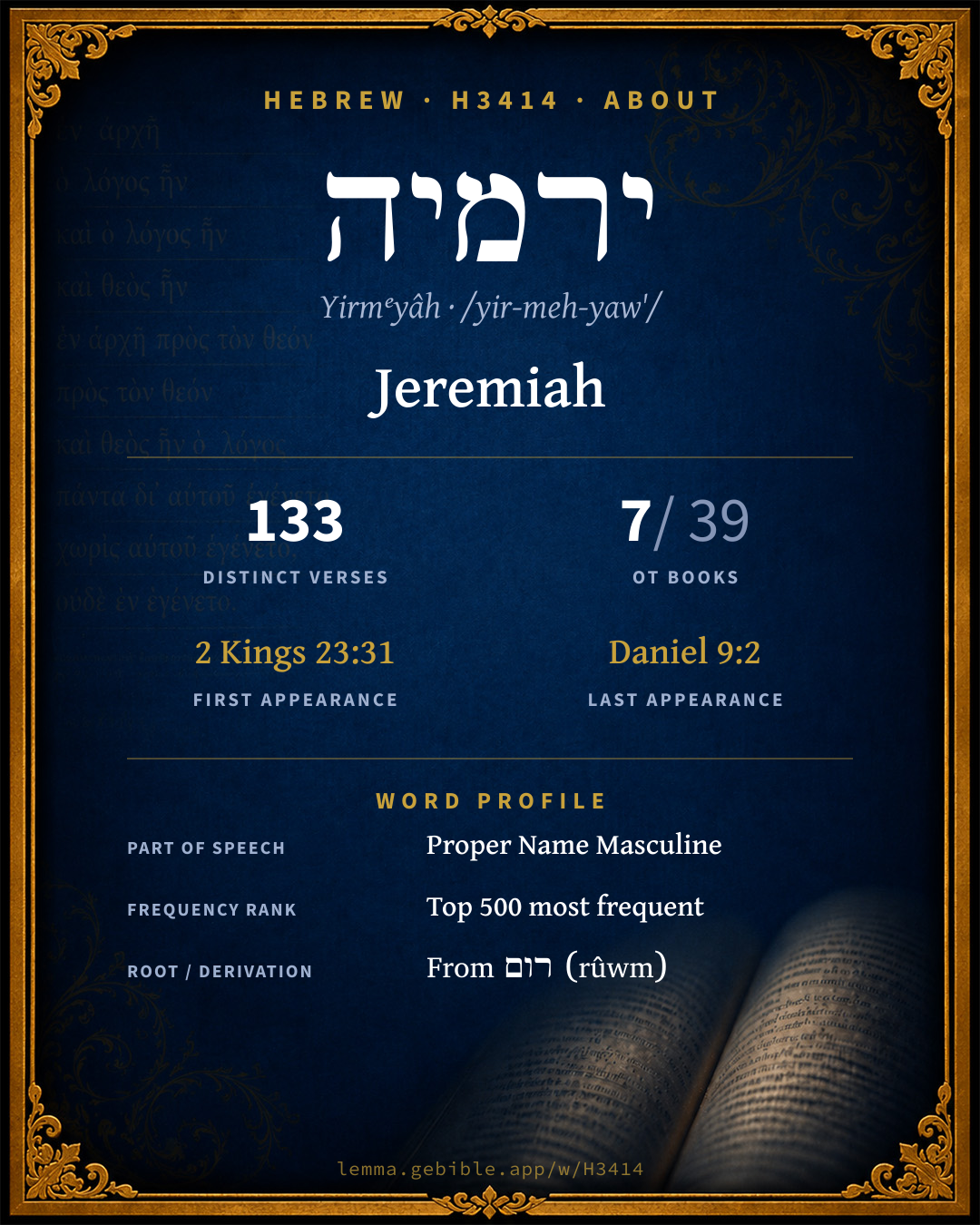
יִרְמְיָ֫הוּ
Jeremiah
BDB lists 10 entries for ‘Jeremiah’ fuller range ↓
Full lexicon entry — Brown-Driver-Briggs (BDB)
From Brown-Driver-Briggs (BDB)
Where this word appears
Grammar key — what these labels mean
Part of speech
- Noun
- A naming word — a person, place, thing, or idea.
Noun type
- Proper
- A name of a specific person, place, or people (e.g. Abraham, Zion, Israel).
Every verse where H3414 appears — 133 distinct verses across 7 books. Click any verse to open its interlinear word-by-word view. Verse text shown in the World English Bible for context — . Each verse’s Hebrew form is shown with its reference; the English is not keyword-highlighted, since the data carries no word-level English alignment. Use “Compare translations” on any verse to read it across multiple English versions. This concordance covers the Hebrew Bible; Septuagint (Greek Old Testament) occurrences are not indexed here.
2 Kings 2 verses
- 2 Kings 23:31 יִרְמְיָ֖הוּ n Proper Jehoahaz was twenty-three years old when he began to reign; and he reigned three months in Jerusalem: and his mother's name was Hamutal the daughter of Jeremiah of Libnah.
- 2 Kings 24:18 יִרְמְיָ֖הוּ n Proper Zedekiah was twenty-one years old when he began to reign; and he reigned eleven years in Jerusalem: and his mother's name was Hamutal the daughter of Jeremiah of Libnah.
1 Chronicles 4 verses
- 1 Chronicles 5:24 וְ/יִרְמְיָ֨ה conj + n Proper These were the heads of their fathers' houses: even Epher, and Ishi, and Eliel, and Azriel, and Jeremiah, and Hodaviah, and Jahdiel, mighty men of valor, famous men, heads of their fathers' houses.
- 1 Chronicles 12:4 וְ/יִרְמְיָ֤ה conj + n Proper and Ishmaiah the Gibeonite, a mighty man among the thirty, and over the thirty, and Jeremiah, and Jahaziel, and Johanan, and Jozabad the Gederathite,
- 1 Chronicles 12:10 יִרְמְיָ֖ה n Proper Mishmannah the fourth, Jeremiah the fifth,
- 1 Chronicles 12:13 יִרְמְיָ֨הוּ֙ n Proper Jeremiah the tenth, Machbannai the eleventh.
2 Chronicles 4 verses
- 2 Chronicles 35:25 יִרְמְיָהוּ֮ n Proper Jeremiah lamented for Josiah: and all the singing men and singing women spoke of Josiah in their lamentations to this day; and they made them an ordinance in Israel: and, behold, they are written in the lamentations.
- 2 Chronicles 36:12 יִרְמְיָ֥הוּ n Proper and he did that which was evil in the sight of Yahweh his God; he didn't humble himself before Jeremiah the prophet [speaking] from the mouth of Yahweh.
- 2 Chronicles 36:21 יִרְמְיָ֔הוּ n Proper to fulfill the word of Yahweh by the mouth of Jeremiah, until the land had enjoyed its Sabbaths: [for] as long as it lay desolate it kept Sabbath, to fulfill seventy years.
- 2 Chronicles 36:22 יִרְמְיָ֑הוּ n Proper Now in the first year of Cyrus king of Persia, that the word of Yahweh by the mouth of Jeremiah might be accomplished, Yahweh stirred up the spirit of Cyrus king of Persia, so that he made a proclamation throughout all his kingdom, and [put it] also in writing, saying,
Ezra 1 verse
Nehemiah 4 verses
- Nehemiah 10:2 יִרְמְיָֽה n Proper Seraiah, Azariah, Jeremiah,
- Nehemiah 12:1 יִרְמְיָ֖ה n Proper Now these are the priests and the Levites who went up with Zerubbabel the son of Shealtiel, and Jeshua: Seraiah, Jeremiah, Ezra,
- Nehemiah 12:12 לְ/יִרְמְיָ֖ה prep + n Proper In the days of Joiakim were priests, heads of fathers' [houses]: of Seraiah, Meraiah; of Jeremiah, Hananiah;
- Nehemiah 12:34 וְ/יִרְמְיָֽה conj + n Proper Judah, and Benjamin, and Shemaiah, and Jeremiah,
Jeremiah 117 verses
- Jeremiah 1:1 יִרְמְיָ֖הוּ n Proper The words of Jeremiah the son of Hilkiah, of the priests who were in Anathoth in the land of Benjamin:
- Jeremiah 1:11 יִרְמְיָ֑הוּ n Proper Moreover the word of Yahweh came to me, saying, Jeremiah, what see you? I said, I see a rod of an almond tree.
- Jeremiah 7:1 יִרְמְיָ֔הוּ n Proper The word that came to Jeremiah from Yahweh, saying,
- Jeremiah 11:1 יִרְמְיָ֔הוּ n Proper The word that came to Jeremiah from Yahweh, saying,
- Jeremiah 14:1 יִרְמְיָ֔הוּ n Proper The word of Yahweh that came to Jeremiah concerning the drought.
- Jeremiah 18:1 יִרְמְיָ֔הוּ n Proper The word which came to Jeremiah from Yahweh, saying,
- Jeremiah 18:18 יִרְמְיָהוּ֮ n Proper Then said they, Come, and let us devise devices against Jeremiah; for the law shall not perish from the priest, nor counsel from the wise, nor the word from the prophet. Come, and let us strike him with the tongue, and let us not give heed to any of his words.
- Jeremiah 19:14 יִרְמְיָ֨הוּ֙ n Proper Then came Jeremiah from Topheth, where Yahweh had sent him to prophesy; and he stood in the court of Yahweh's house, and said to all the people:
- Jeremiah 20:1 יִרְמְיָ֔הוּ n Proper Now Pashhur, the son of Immer the priest, who was chief officer in the house of Yahweh, heard Jeremiah prophesying these things.
- Jeremiah 20:2 יִרְמְיָ֣הוּ n Proper Then Pashhur struck Jeremiah the prophet, and put him in the stocks that were in the upper gate of Benjamin, which was in the house of Yahweh.
- Jeremiah 20:3 יִרְמְיָ֖הוּ יִרְמְיָ֗הוּ n Proper n Proper It happened on the next day, that Pashhur brought forth Jeremiah out of the stocks. Then said Jeremiah to him, Yahweh has not called your name Pashhur, but Magormissabib.
- Jeremiah 21:1 יִרְמְיָ֖הוּ n Proper The word which came to Jeremiah from Yahweh, when king Zedekiah sent to him Pashhur the son of Malchijah, and Zephaniah the son of Maaseiah, the priest, saying,
- Jeremiah 21:3 יִרְמְיָ֖הוּ n Proper Then said Jeremiah to them, Thus shall you tell Zedekiah:
- Jeremiah 24:3 יִרְמְיָ֔הוּ n Proper Then said Yahweh to me, What see you, Jeremiah? I said, Figs; the good figs, very good; and the bad, very bad, that can't be eaten, they are so bad.
- Jeremiah 25:1 יִרְמְיָ֨הוּ֙ n Proper The word that came to Jeremiah concerning all the people of Judah, in the fourth year of Jehoiakim the son of Josiah, king of Judah (the same was the first year of Nebuchadrezzar king of Babylon),
- Jeremiah 25:2 יִרְמְיָ֤הוּ n Proper which Jeremiah the prophet spoke to all the people of Judah, and to all the inhabitants of Jerusalem, saying:
- Jeremiah 25:13 יִרְמְיָ֖הוּ n Proper I will bring on that land all my words which I have pronounced against it, even all that is written in this book, which Jeremiah has prophesied against all the nations.
- Jeremiah 26:7 יִרְמְיָ֔הוּ n Proper The priests and the prophets and all the people heard Jeremiah speaking these words in the house of Yahweh.
- Jeremiah 26:8 יִרְמְיָ֗הוּ n Proper It happened, when Jeremiah had made an end of speaking all that Yahweh had commanded him to speak to all the people, that the priests and the prophets and all the people laid hold on him, saying, You shall surely die.
- Jeremiah 26:9 יִרְמְיָ֖הוּ n Proper Why have you prophesied in the name of Yahweh, saying, This house shall be like Shiloh, and this city shall be desolate, without inhabitant? All the people were gathered to Jeremiah in the house of Yahweh.
- Jeremiah 26:12 יִרְמְיָ֨הוּ֙ n Proper Then spoke Jeremiah to all the princes and to all the people, saying, Yahweh sent me to prophesy against this house and against this city all the words that you have heard.
- Jeremiah 26:20 יִרְמְיָֽהוּ n Proper There was also a man who prophesied in the name of Yahweh, Uriah the son of Shemaiah of Kiriath Jearim; and he prophesied against this city and against this land according to all the words of Jeremiah:
- Jeremiah 26:24 יִרְמְיָ֑הוּ n Proper But the hand of Ahikam the son of Shaphan was with Jeremiah, that they should not give him into the hand of the people to put him to death.
- Jeremiah 27:1 יִרְמְיָ֔ה n Proper In the beginning of the reign of Jehoiakim the son of Josiah, king of Judah, came this word to Jeremiah from Yahweh, saying,
- Jeremiah 28:5 יִרְמְיָ֣ה n Proper Then the prophet Jeremiah said to the prophet Hananiah in the presence of the priests, and in the presence of all the people who stood in the house of Yahweh,
- Jeremiah 28:6 יִרְמְיָ֣ה n Proper even the prophet Jeremiah said, Amen: Yahweh do so; Yahweh perform your words which you have prophesied, to bring again the vessels of Yahweh's house, and all them of the captivity, from Babylon to this place.
- Jeremiah 28:10 יִרְמְיָ֣ה n Proper Then Hananiah the prophet took the bar from off the prophet Jeremiah's neck, and broke it.
- Jeremiah 28:11 יִרְמְיָ֥ה n Proper Hananiah spoke in the presence of all the people, saying, Thus says Yahweh: Even so will I break the yoke of Nebuchadnezzar king of Babylon within two full years from off the neck of all the nations. The prophet Jeremiah went his way.
- Jeremiah 28:12 יִרְמְיָ֑ה יִרְמְיָ֥ה n Proper n Proper Then the word of Yahweh came to Jeremiah, after that Hananiah the prophet had broken the bar from off the neck of the prophet Jeremiah, saying,
- Jeremiah 28:15 יִרְמְיָ֧ה n Proper Then said the prophet Jeremiah to Hananiah the prophet, Hear now, Hananiah: Yahweh has not sent you; but you make this people to trust in a lie.
- Jeremiah 29:1 יִרְמְיָ֥ה n Proper Now these are the words of the letter that Jeremiah the prophet sent from Jerusalem to the residue of the elders of the captivity, and to the priests, and to the prophets, and to all the people, whom Nebuchadnezzar had carried away captive from Jerusalem to Babylon,
- Jeremiah 29:27 בְּ/יִרְמְיָ֖הוּ prep + n Proper Now therefore, why have you not rebuked Jeremiah of Anathoth, who makes himself a prophet to you,
- Jeremiah 29:29 יִרְמְיָ֥הוּ n Proper Zephaniah the priest read this letter in the ears of Jeremiah the prophet.
- Jeremiah 29:30 יִרְמְיָ֖הוּ n Proper Then came the word of Yahweh to Jeremiah, saying,
- Jeremiah 30:1 יִרְמְיָ֔הוּ n Proper The word that came to Jeremiah from Yahweh, saying,
- Jeremiah 32:1 יִרְמְיָ֨הוּ֙ n Proper The word that came to Jeremiah from Yahweh in the tenth year of Zedekiah king of Judah, which was the eighteenth year of Nebuchadrezzar.
- Jeremiah 32:2 וְ/יִרְמְיָ֣הוּ conj + n Proper Now at that time the king of Babylon's army was besieging Jerusalem; and Jeremiah the prophet was shut up in the court of the guard, which was in the king of Judah's house.
- Jeremiah 32:6 יִרְמְיָ֑הוּ n Proper Jeremiah said, The word of Yahweh came to me, saying,
- Jeremiah 32:26 יִרְמְיָ֖הוּ n Proper Then came the word of Yahweh to Jeremiah, saying,
- Jeremiah 33:1 יִרְמְיָ֖הוּ n Proper Moreover the word of Yahweh came to Jeremiah the second time, while he was yet shut up in the court of the guard, saying,
- Jeremiah 33:19 יִרְמְיָ֖הוּ n Proper The word of Yahweh came to Jeremiah, saying,
- Jeremiah 33:23 יִרְמְיָ֖הוּ n Proper The word of Yahweh came to Jeremiah, saying,
- Jeremiah 34:1 יִרְמְיָ֖הוּ n Proper The word which came to Jeremiah from Yahweh, when Nebuchadnezzar king of Babylon, and all his army, and all the kingdoms of the earth that were under his dominion, and all the peoples, were fighting against Jerusalem, and against all the cities of it, saying:
- Jeremiah 34:6 יִרְמְיָ֣הוּ n Proper Then Jeremiah the prophet spoke all these words to Zedekiah king of Judah in Jerusalem,
- Jeremiah 34:8 יִרְמְיָ֖הוּ n Proper The word that came to Jeremiah from Yahweh, after that the king Zedekiah had made a covenant with all the people who were at Jerusalem, to proclaim liberty to them;
- Jeremiah 34:12 יִרְמְיָ֔הוּ n Proper Therefore the word of Yahweh came to Jeremiah from Yahweh, saying,
- Jeremiah 35:1 יִרְמְיָ֖הוּ n Proper The word which came to Jeremiah from Yahweh in the days of Jehoiakim the son of Josiah, king of Judah, saying,
- Jeremiah 35:3 יִרְמְיָ֨הוּ֙ n Proper Then I took Jaazaniah the son of Jeremiah, the son of Habazziniah, and his brothers, and all his sons, and the whole house of the Rechabites;
- Jeremiah 35:12 יִרְמְיָ֖הוּ n Proper Then came the word of Yahweh to Jeremiah, saying,
- Jeremiah 35:18 יִרְמְיָ֗הוּ n Proper Jeremiah said to the house of the Rechabites, Thus says Yahweh of Hosts, the God of Israel: Because you have obeyed the commandment of Jonadab your father, and kept all his precepts, and done according to all that he commanded you;
- Jeremiah 36:1 יִרְמְיָ֔הוּ n Proper It happened in the fourth year of Jehoiakim the son of Josiah, king of Judah, that this word came to Jeremiah from Yahweh, saying,
- Jeremiah 36:4 יִרְמְיָ֔הוּ יִרְמְיָ֗הוּ n Proper n Proper Then Jeremiah called Baruch the son of Neriah; and Baruch wrote from the mouth of Jeremiah all the words of Yahweh, which he had spoken to him, on a scroll of a book.
- Jeremiah 36:5 יִרְמְיָ֔הוּ n Proper Jeremiah commanded Baruch, saying, I am shut up; I can't go into the house of Yahweh:
- Jeremiah 36:8 יִרְמְיָ֣הוּ n Proper Baruch the son of Neriah did according to all that Jeremiah the prophet commanded him, reading in the book the words of Yahweh in Yahweh's house.
- Jeremiah 36:10 יִרְמְיָ֖הוּ n Proper Then read Baruch in the book the words of Jeremiah in the house of Yahweh, in the chamber of Gemariah the son of Shaphan, the scribe, in the upper court, at the entry of the new gate of Yahweh's house, in the ears of all the people.
- Jeremiah 36:19 וְ/יִרְמְיָ֑הוּ conj + n Proper Then said the princes to Baruch, Go, hide you, you and Jeremiah; and let no man know where you are.
- Jeremiah 36:26 יִרְמְיָ֣הוּ n Proper The king commanded Jerahmeel the king's son, and Seraiah the son of Azriel, and Shelemiah the son of Abdeel, to take Baruch the scribe and Jeremiah the prophet; but Yahweh hid them.
- Jeremiah 36:27 יִרְמְיָ֑הוּ יִרְמְיָ֖הוּ n Proper n Proper Then the word of Yahweh came to Jeremiah, after that the king had burned the scroll, and the words which Baruch wrote at the mouth of Jeremiah, saying,
- Jeremiah 36:32 וְ/יִרְמְיָ֜הוּ יִרְמְיָ֔הוּ conj + n Proper n Proper Then took Jeremiah another scroll, and gave it to Baruch the scribe, the son of Neriah, who wrote therein from the mouth of Jeremiah all the words of the book which Jehoiakim king of Judah had burned in the fire; and there were added besides to them many like words.
- Jeremiah 37:2 יִרְמְיָ֥הוּ n Proper But neither he, nor his servants, nor the people of the land, did listen to the words of Yahweh, which he spoke by the prophet Jeremiah.
- Jeremiah 37:3 יִרְמְיָ֥הוּ n Proper Zedekiah the king sent Jehucal the son of Shelemiah, and Zephaniah the son of Maaseiah, the priest, to the prophet Jeremiah, saying, Pray now to Yahweh our God for us.
- Jeremiah 37:4 וְ/יִרְמְיָ֕הוּ conj + n Proper Now Jeremiah came in and went out among the people; for they had not put him into prison.
- Jeremiah 37:6 יִרְמְיָ֥הוּ n Proper Then came the word of Yahweh to the prophet Jeremiah, saying,
- Jeremiah 37:12 יִרְמְיָ֨הוּ֙ n Proper then Jeremiah went forth out of Jerusalem to go into the land of Benjamin, to receive his portion there, in the midst of the people.
- Jeremiah 37:13 יִרְמְיָ֤הוּ n Proper When he was in the gate of Benjamin, a captain of the guard was there, whose name was Irijah, the son of Shelemiah, the son of Hananiah; and he laid hold on Jeremiah the prophet, saying, You are falling away to the Chaldeans.
- Jeremiah 37:14 יִרְמְיָ֜הוּ בְּ/יִרְמְיָ֔הוּ n Proper prep + n Proper Then said Jeremiah, It is false; I am not falling away to the Chaldeans. But he didn't listen to him; so Irijah laid hold on Jeremiah, and brought him to the princes.
- Jeremiah 37:15 יִרְמְיָ֖הוּ n Proper The princes were angry with Jeremiah, and struck him, and put him in prison in the house of Jonathan the scribe; for they had made that the prison.
- Jeremiah 37:16 יִרְמְיָ֛הוּ יִרְמְיָ֖הוּ n Proper n Proper When Jeremiah was come into the dungeon-house, and into the cells, and Jeremiah had remained there many days;
- Jeremiah 37:17 יִרְמְיָ֨הוּ֙ n Proper Then Zedekiah the king sent, and fetched him: and the king asked him secretly in his house, and said, Is there any word from Yahweh? Jeremiah said, There is. He said also, You shall be delivered into the hand of the king of Babylon.
- Jeremiah 37:18 יִרְמְיָ֔הוּ n Proper Moreover Jeremiah said to king Zedekiah, Wherein have I sinned against you, or against your servants, or against this people, that you have put me in prison?
- Jeremiah 37:21 יִרְמְיָהוּ֮ יִרְמְיָ֔הוּ n Proper n Proper Then Zedekiah the king commanded, and they committed Jeremiah into the court of the guard; and they gave him daily a loaf of bread out of the bakers' street, until all the bread in the city was spent. Thus Jeremiah remained in the court of the guard.
- Jeremiah 38:1 יִרְמְיָ֛הוּ n Proper Shephatiah the son of Mattan, and Gedaliah the son of Pashhur, and Jucal the son of Shelemiah, and Pashhur the son of Malchijah, heard the words that Jeremiah spoke to all the people, saying,
- Jeremiah 38:6 יִרְמְיָ֗הוּ יִרְמְיָ֖הוּ יִרְמְיָ֖הוּ n Proper n Proper n Proper Then took they Jeremiah, and cast him into the dungeon of Malchijah the king's son, that was in the court of the guard: and they let down Jeremiah with cords. In the dungeon there was no water, but mire; and Jeremiah sank in the mire.
- Jeremiah 38:7 יִרְמְיָ֖הוּ n Proper Now when Ebedmelech the Ethiopian, a eunuch, who was in the king's house, heard that they had put Jeremiah in the dungeon (the king then sitting in the gate of Benjamin),
- Jeremiah 38:9 לְ/יִרְמְיָ֣הוּ prep + n Proper My lord the king, these men have done evil in all that they have done to Jeremiah the prophet, whom they have cast into the dungeon; and he is likely to die in the place where he is, because of the famine; for there is no more bread in the city.
- Jeremiah 38:10 יִרְמְיָ֧הוּ n Proper Then the king commanded Ebedmelech the Ethiopian, saying, Take from hence thirty men with you, and take up Jeremiah the prophet out of the dungeon, before he die.
- Jeremiah 38:11 יִרְמְיָ֛הוּ n Proper So Ebedmelech took the men with him, and went into the house of the king under the treasury, and took there rags and worn-out garments, and let them down by cords into the dungeon to Jeremiah.
- Jeremiah 38:12 יִרְמְיָ֗הוּ יִרְמְיָ֖הוּ n Proper n Proper Ebedmelech the Ethiopian said to Jeremiah, Put now these rags and worn-out garments under your armholes under the cords. Jeremiah did so.
- Jeremiah 38:13 יִרְמְיָ֨הוּ֙ יִרְמְיָ֔הוּ n Proper n Proper So they drew up Jeremiah with the cords, and took him up out of the dungeon: and Jeremiah remained in the court of the guard.
- Jeremiah 38:14 יִרְמְיָ֤הוּ יִרְמְיָ֗הוּ n Proper n Proper Then Zedekiah the king sent, and took Jeremiah the prophet to him into the third entry that is in the house of Yahweh: and the king said to Jeremiah, I will ask you a thing; hide nothing from me.
- Jeremiah 38:15 יִרְמְיָ֨הוּ֙ n Proper Then Jeremiah said to Zedekiah, If I declare it to you, will you not surely put me to death? and if I give you counsel, you will not listen to me.
- Jeremiah 38:16 יִרְמְיָ֖הוּ n Proper So Zedekiah the king swore secretly to Jeremiah, saying, As Yahweh lives, who made us this soul, I will not put you to death, neither will I give you into the hand of these men who seek your life.
- Jeremiah 38:17 יִרְמְיָ֣הוּ n Proper Then said Jeremiah to Zedekiah, Thus says Yahweh, the God of hosts, the God of Israel: If you will go forth to the king of Babylon's princes, then your soul shall live, and this city shall not be burned with fire; and you shall live, and your house.
- Jeremiah 38:19 יִרְמְיָ֑הוּ n Proper Zedekiah the king said to Jeremiah, I am afraid of the Jews who are fallen away to the Chaldeans, lest they deliver me into their hand, and they mock me.
- Jeremiah 38:20 יִרְמְיָ֖הוּ n Proper But Jeremiah said, They shall not deliver you. Obey, I beg you, the voice of Yahweh, in that which I speak to you: so it shall be well with you, and your soul shall live.
- Jeremiah 38:24 יִרְמְיָ֗הוּ n Proper Then said Zedekiah to Jeremiah, Let no man know of these words, and you shall not die.
- Jeremiah 38:27 יִרְמְיָ֨הוּ֙ n Proper Then came all the princes to Jeremiah, and asked him; and he told them according to all these words that the king had commanded. So they left off speaking with him; for the matter was not perceived.
- Jeremiah 38:28 יִרְמְיָ֨הוּ֙ n Proper So Jeremiah abode in the court of the guard until the day that Jerusalem was taken.
- Jeremiah 39:11 יִרְמְיָ֑הוּ n Proper Now Nebuchadrezzar king of Babylon gave charge concerning Jeremiah to Nebuzaradan the captain of the guard, saying,
- Jeremiah 39:14 יִרְמְיָ֜הוּ n Proper they sent, and took Jeremiah out of the court of the guard, and committed him to Gedaliah the son of Ahikam, the son of Shaphan, that he should carry him home: so he lived among the people.
- Jeremiah 39:15 יִרְמְיָ֖הוּ n Proper Now the word of Yahweh came to Jeremiah, while he was shut up in the court of the guard, saying,
- Jeremiah 40:1 יִרְמְיָ֨הוּ֙ n Proper The word which came to Jeremiah from Yahweh, after that Nebuzaradan the captain of the guard had let him go from Ramah, when he had taken him being bound in chains among all the captives of Jerusalem and Judah, who were carried away captive to Babylon.
- Jeremiah 40:2 לְ/יִרְמְיָ֑הוּ prep + n Proper The captain of the guard took Jeremiah, and said to him, Yahweh your God pronounced this evil on this place;
- Jeremiah 40:6 יִרְמְיָ֛הוּ n Proper Then went Jeremiah to Gedaliah the son of Ahikam to Mizpah, and lived with him among the people who were left in the land.
- Jeremiah 42:2 יִרְמְיָ֣הוּ n Proper and said to Jeremiah the prophet, Let, we pray you, our supplication be presented before you, and pray for us to Yahweh your God, even for all this remnant; for we are left but a few of many, as your eyes do see us:
- Jeremiah 42:4 יִרְמְיָ֤הוּ n Proper Then Jeremiah the prophet said to them, I have heard you; behold, I will pray to Yahweh your God according to your words; and it shall happen that whatever thing Yahweh shall answer you, I will declare it to you; I will keep nothing back from you.
- Jeremiah 42:5 יִרְמְיָ֔הוּ n Proper Then they said to Jeremiah, Yahweh be a true and faithful witness among us, if we don't do according to all the word with which Yahweh your God shall send you to us.
- Jeremiah 42:7 יִרְמְיָֽהוּ n Proper It happened after ten days, that the word of Yahweh came to Jeremiah.
- Jeremiah 43:1 יִרְמְיָ֜הוּ n Proper It happened that, when Jeremiah had made an end of speaking to all the people all the words of Yahweh their God, with which Yahweh their God had sent him to them, even all these words,
- Jeremiah 43:2 יִרְמְיָ֗הוּ n Proper then spoke Azariah the son of Hoshaiah, and Johanan the son of Kareah, and all the proud men, saying to Jeremiah, You speak falsely: Yahweh our God has not sent you to say, You shall not go into Egypt to sojourn there;
- Jeremiah 43:6 יִרְמְיָ֣הוּ n Proper the men, and the women, and the children, and the king's daughters, and every person who Nebuzaradan the captain of the guard had left with Gedaliah the son of Ahikam, the son of Shaphan; and Jeremiah the prophet, and Baruch the son of Neriah;
- Jeremiah 43:8 יִרְמְיָ֔הוּ n Proper Then came the word of Yahweh to Jeremiah in Tahpanhes, saying,
- Jeremiah 44:1 יִרְמְיָ֔הוּ n Proper The word that came to Jeremiah concerning all the Jews who lived in the land of Egypt, who lived at Migdol, and at Tahpanhes, and at Memphis, and in the country of Pathros, saying,
- Jeremiah 44:15 יִרְמְיָ֗הוּ n Proper Then all the men who knew that their wives burned incense to other gods, and all the women who stood by, a great assembly, even all the people who lived in the land of Egypt, in Pathros, answered Jeremiah, saying,
- Jeremiah 44:20 יִרְמְיָ֖הוּ n Proper Then Jeremiah said to all the people, to the men, and to the women, even to all the people who had given him who answer, saying,
- Jeremiah 44:24 יִרְמְיָ֨הוּ֙ n Proper Moreover Jeremiah said to all the people, and to all the women, Hear the word of Yahweh, all Judah who are in the land of Egypt:
- Jeremiah 45:1 יִרְמְיָ֣הוּ יִרְמְיָ֔הוּ n Proper n Proper The word that Jeremiah the prophet spoke to Baruch the son of Neriah, when he wrote these word in a book at the mouth of Jeremiah, in the fourth year of Jehoiakim the son of Josiah, king of Judah, saying,
- Jeremiah 46:1 יִרְמְיָ֥הוּ n Proper The word of Yahweh which came to Jeremiah the prophet concerning the nations.
- Jeremiah 46:13 יִרְמְיָ֖הוּ n Proper The word that Yahweh spoke to Jeremiah the prophet, how that Nebuchadrezzar king of Babylon should come and strike the land of Egypt.
- Jeremiah 47:1 יִרְמְיָ֥הוּ n Proper The word of Yahweh that came to Jeremiah the prophet concerning the Philistines, before that Pharaoh struck Gaza.
- Jeremiah 49:34 יִרְמְיָ֥הוּ n Proper The word of Yahweh that came to Jeremiah the prophet concerning Elam, in the beginning of the reign of Zedekiah king of Judah, saying,
- Jeremiah 50:1 יִרְמְיָ֥הוּ n Proper The word that Yahweh spoke concerning Babylon, concerning the land of the Chaldeans, by Jeremiah the prophet.
- Jeremiah 51:59 יִרְמְיָ֣הוּ n Proper The word which Jeremiah the prophet commanded Seraiah the son of Neriah, the son of Mahseiah, when he went with Zedekiah the king of Judah to Babylon in the fourth year of his reign. Now Seraiah was chief chamberlain.
- Jeremiah 51:60 יִרְמְיָ֗הוּ n Proper Jeremiah wrote in a book all the evil that should come on Babylon, even all these words that are written concerning Babylon.
- Jeremiah 51:61 יִרְמְיָ֖הוּ n Proper Jeremiah said to Seraiah, When you come to Babylon, then see that you read all these words,
- Jeremiah 51:64 יִרְמְיָֽהוּ n Proper and you shall say, Thus shall Babylon sink, and shall not rise again because of the evil that I will bring on her; and they shall be weary. Thus far are the words of Jeremiah.
- Jeremiah 52:1 יִרְמְיָ֖הוּ n Proper Zedekiah was twenty-one years old when he began to reign; and he reigned eleven years in Jerusalem: and his mother's name was Hamutal the daughter of Jeremiah of Libnah.
Daniel 1 verse
About this entry
At a glance — auto-summarized from this page’s data, not written by a person. Every figure links to its source below. This summary describes the numbers; it doesn’t interpret them.
ירמיה (Yirmᵉyâh) is a Hebrew name most often rendered “Jeremiah.” Jeremiah dominates its distribution — 117 of 133 verses. The Hebrew Bible uses it across 133 verses — common. Debuting at 2 Kings 23:31, it then recurs through the corpus. The sections below give every occurrence and version rendering.
Gloss history
Strong's 1890 vs modern scholarship
About this word
Strong's H3414 catalogs a Hebrew word from the Hebrew Old Testament.
These counts are not copied from any lexicon or concordance. They are computed here, from the morphology-tagged Hebrew Old Testament. What Lemma adds →
- 133
- distinct verses
- The word appears in 133 distinct verses.
- 7 / 39
- OT books
- The word appears in 7 of 39 Old Testament books.
- #305
- by frequency
- Top 500 most frequent Hebrew words (rank 305 of 8,640 Hebrew words by occurrence).
View all 133 occurrences in the concordance →
Most concentrated in
- Jeremiah 117 verses 88%
- 1 Chronicles 4 verses 3%
- 2 Chronicles 4 verses 3%
By section of the Old Testament
By traditional corpus
Conventional, traditional groupings — biblical authorship is debated, so this is a traditional corpus grouping, not an authorship claim. Each share is this word’s portion of its verses in that division of the Hebrew canon. Each figure is a share of the word’s 133 distinct verses.
- Prophets (Nevi'im) 119 verses · 89%
- Writings (Ketuvim) 14 verses · 11%
How translations render this word
Counts come from each version’s own published word-to-Strong’s tagging or interlinear alignment — an approximate guide to how each version renders this word, not a word-level alignment the data otherwise carries. Because each total is that version’s own tagged count, the per-version totals vary from one another and need not match the appearance or distinct-verse counts above. These counts may also differ from a printed concordance because Lemma counts each distinctly tagged rendering and does not collapse phrase taggings into a single head-word total. This is a fixed set of word-tagged versions (KJV, ASV, BSB, ULT) and does not change with the reading translation you choose elsewhere. Each version’s license is shown beside its name below (and on Sources).
BDB lists this Strong’s number as 2 distinct words (homographs). Each count above pools all of them and is not split by sense — see the Senses section below. A low-frequency rendering may belong to a different one of those words, not the primary meaning.
- King James Version†: Jeremiah 107×, Came to jeremiah 16×, Came unto jeremiah 10×
- American Standard Version†: Jeremiah 106×, Came to jeremiah 16×, Came unto jeremiah 10×
- Berean Standard Bible†: Jeremiah 132×, Through jeremiah 3×, Had jeremiah 2×
- unfoldingWord Literal Text†: Jeremiah 48×
King James Version Public Domain
Renders H3414 across 147† tagged occurrences — most commonly:
Plus 10 renderings that appear only once — usually multi-word phrases or single function words the recovered tagging swept in, not distinct renderings.
American Standard Version Public Domain
Renders H3414 across 146† tagged occurrences — most commonly:
Plus 12 renderings that appear only once — usually multi-word phrases or single function words the recovered tagging swept in, not distinct renderings. Not rendered by a distinct English word in 1 further occurrence.
Berean Standard Bible Public Domain
Renders H3414 across 141† tagged occurrences — most commonly:
Plus 2 renderings that appear only once — usually multi-word phrases or single function words the recovered tagging swept in, not distinct renderings. Not rendered by a distinct English word in 6 further occurrences.
unfoldingWord Literal Text CC BY-SA 4.0
Renders H3414 across 48† tagged occurrences — most commonly:
8 senses and sub-senses in the full BDB
What do BDB’s symbols mean?
BDB uses these scholarly abbreviations:
| Symbol | Meaning |
|---|---|
| 𝔊 | the Septuagint (the ancient Greek translation, LXX) |
| 𝔙 | the Vulgate (the Latin translation) |
| 𝔖 | the Syriac version (the Peshitta) |
| 𝔗 | the Targum (the Aramaic translation) |
| ψ | the Psalms |
| √ | root (the underlying root or stem) |
| ‖ | parallel passage (a synonymous or contrasted parallel) |
| † | the dagger: every passage where the word occurs is cited |
The 8 senses and sub-senses the full Brown-Driver-Briggs lexicon distinguishes for this word, in lexicon order (not ranked by frequency), with BDB’s own verbatim wording and sub-sense lettering. Shown in Hebrew script with BDB’s own scholarly abbreviations. The condensed entry is in the Lexicon Entry tab. See also the Forms in the corpus table below.
- 1. 136 proph., son of Ḥilḳiah, of priestly family in ʿAnathôth: יִרְמְיָ֫הוּ Je 1:1, 11; 29:27; 36:1, 4(×2) + 116 times Je, + 2 Ch 35:25; 36:12, 21, 22 (יר׳ הַנָּבִיא Je 21:2 + often); -יָה Je 27:1; 28:5, 6, 10, 11, 12, 15; 29:1 Ezr 1:1; Dn 9:2; Ἰερεμίας. e.g. Jeremiah 1:1
- 2. יִרְמְיָ֫הוּ, of Libnah, father of Josiah’s wife, 2 K 23:31; 24:18 = Je 52:1, Ἰερεμίας. e.g. 2 Kings 23:31
- 3. -יָ֫הוּ Gadite, David’s time 1 Ch 12:13, Ιερεμεια, 𝔊L Ιεραμαου. The foll. all -יָה, 𝔊 Ἰερεμία(ς), Ἰερμία(ς), etc.: e.g. 1 Chronicles 12:13
- 4. Manassite 1 Ch 5:24. e.g. 1 Chronicles 5:24
- 5. Benjamite 12:4. e.g. 1 Chronicles 12:4
- 6. Gadite 12:10. e.g. 1 Chronicles 12:10
- 7.
- a. priestly name: Ne 12:1, 2. e.g. Nehemiah 12:1
- b. Ne 10:3, perhaps = 12:34. e.g. Nehemiah 10:3
Senses from the full Brown-Driver-Briggs lexicon (Brown, Driver, Briggs; Oxford 1906 — public domain), digitized via Sefaria, supplemented by the OpenScriptures HebrewLexicon (CC BY 4.0). Full attribution on Sources.
Word origin
n.pr.m. (? י׳ looseneth, sc. the womb? cf. Assyrian ša kirimmaša rummû, whose womb is loosened DlHWB 623);—
— Brown-Driver-Briggs (Oxford 1906, public domain), digitized via Sefaria, supplemented by the OpenScriptures HebrewLexicon (CC BY 4.0). See Sources.
Derived from רום (rûwm) (H7311) — to rise.
Jastrow Dictionary
A second Hebrew/Aramaic lexicon for comparison, covering Aramaic and post-biblical (Talmudic, Targumic, Midrashic) usage that the biblical-Hebrew BDB does not. Matched by lemma rather than by Strong’s number, so a lemma may carry more than one Jastrow headword (shown separately below), and the entries cover usage well beyond the Bible.
יִרְמְיָה
- (b. h.) pr. n. m. Jeremiah,
- 1. J. the prophet. Pesik. Dibré, p. 114ᵇ י׳ ר̇ם̇ י̇ה̇ he is named J., because in his days the Lord (Shekhinah) moved from place to place; Yalk. Jer. 257 י׳ י̇ר̇ם̇ י̇ה̇. Ib. … י׳ שבימיו א̇ר̇י̇מ̇י̇ן̇ he is called J., because in his days the Temple became deserted; Koh. R. beg., v. אֱירֶימִיאָה. Meg. 14ᵇ. Snh. 95ᵃ; a. v. fr.—(ספר) ר׳ the Book of Jeremiah. B. Bath. 14ᵇ
- 2. name of several Amoraim, esp. R. J., pupil of R. Zera. Ib. 23ᵇ ועל דא אפקוה לר׳ י׳ וכ׳ for this (burlesque question) they ejected R. J. from college. Ib. 165ᵇ עיילוה לר׳ י׳ וכ׳ upon this (reply) they reinstated R. J.—Y. M. Kat. III, 81ᵈ bot.; a. fr.—V. Fr. M’bo p. 108ᵃ; 118ᵇ
A Dictionary of the Targumim, the Talmud Babli and Yerushalmi, and the Midrashic Literature (Marcus Jastrow; London, Luzac, 1903) — Public Domain. Digitized via Sefaria. Digitized via Sefaria. Full attribution on Sources.
Forms in the corpus
The 33 distinct written forms H3414 takes in the Hebrew Bible, most frequent first — each parse links to that state’s occurrences in the concordance. Hebrew forms include their vowel points and cantillation, so a single lemma takes many written forms.
| Form | Parsing | Example | Uses |
|---|---|---|---|
| יִרְמְיָ֖הוּ | Noun, Proper | 2 Kings 23:31 | 32 |
| יִרְמְיָ֔הוּ | Noun, Proper | 2 Chronicles 36:21 | 21 |
| יִרְמְיָ֨הוּ֙ | Noun, Proper | 1 Chronicles 12:13 | 14 |
| יִרְמְיָ֗הוּ | Noun, Proper | Jeremiah 20:3 | 11 |
| יִרְמְיָ֣הוּ | Noun, Proper | Jeremiah 20:2 | 9 |
| יִרְמְיָ֥הוּ | Noun, Proper | 2 Chronicles 36:12 | 9 |
| יִרְמְיָ֑הוּ | Noun, Proper | 2 Chronicles 36:22 | 7 |
| יִרְמְיָ֛הוּ | Noun, Proper | Jeremiah 37:16 | 4 |
| יִרְמְיָ֤הוּ | Noun, Proper | Jeremiah 25:2 | 4 |
| יִרְמְיָ֜הוּ | Noun, Proper | Jeremiah 37:14 | 3 |
| יִרְמְיָ֣ה | Noun, Proper | Jeremiah 28:5 | 3 |
| יִרְמְיָ֥ה | Noun, Proper | Jeremiah 28:11 | 3 |
| יִרְמְיָֽהוּ | Noun, Proper | Jeremiah 26:20 | 3 |
| יִרְמְיָהוּ֮ | Noun, Proper | 2 Chronicles 35:25 | 3 |
| יִרְמְיָ֑ה | Noun, Proper | Ezra 1:1 | 2 |
| יִרְמְיָ֖ה | Noun, Proper | 1 Chronicles 12:10 | 2 |
| בְּ/יִרְמְיָ֔הוּ | Noun, Proper | Jeremiah 37:14 | 1 |
| בְּ/יִרְמְיָ֖הוּ | Noun, Proper | Jeremiah 29:27 | 1 |
| וְ/יִרְמְיָ֑הוּ | Noun, Proper | Jeremiah 36:19 | 1 |
| וְ/יִרְמְיָ֕הוּ | Noun, Proper | Jeremiah 37:4 | 1 |
| וְ/יִרְמְיָ֜הוּ | Noun, Proper | Jeremiah 36:32 | 1 |
| וְ/יִרְמְיָ֣הוּ | Noun, Proper | Jeremiah 32:2 | 1 |
| וְ/יִרְמְיָ֤ה | Noun, Proper | 1 Chronicles 12:4 | 1 |
| וְ/יִרְמְיָ֨ה | Noun, Proper | 1 Chronicles 5:24 | 1 |
| וְ/יִרְמְיָֽה | Noun, Proper | Nehemiah 12:34 | 1 |
| יִרְמְיָ֔ה | Noun, Proper | Jeremiah 27:1 | 1 |
| יִרְמְיָ֧ה | Noun, Proper | Jeremiah 28:15 | 1 |
| יִרְמְיָ֧הוּ | Noun, Proper | Jeremiah 38:10 | 1 |
| יִרְמְיָֽה | Noun, Proper | Nehemiah 10:2 | 1 |
| יִרְמִיָ֣ה | Noun, Proper | Daniel 9:2 | 1 |
| לְ/יִרְמְיָ֑הוּ | Noun, Proper | Jeremiah 40:2 | 1 |
| לְ/יִרְמְיָ֖ה | Noun, Proper | Nehemiah 12:12 | 1 |
| לְ/יִרְמְיָ֣הוּ | Noun, Proper | Jeremiah 38:9 | 1 |
Same root — word family
Other BDB entries built from the same root as H3414, grouped by Strong’s listed origin. These share a root / origin per the lexicon — not necessarily a shared meaning. Each links to that word’s own entry.
Derives from
Shares the same root
- מרום mârôwm H4791 height
- רום rûwm H7312 haughtiness
- רום rûwm H7313 to rise
- רום rôwm H7315 on high
- רמה râmâh H7413 high place
- רמות râmûwth H7419 height
- תרומה tᵉrûwmâh H8641 offering
Proper names from this root
People and places named from this root — a name, not an additional meaning of the word.
- ירימות Yᵉrîymôwth H3406 Jerimoth
- ירמות Yarmûwth H3412 Jarmuth
- ירמי Yᵉrêmay H3413 Jeremai
- מרמות Mᵉrêmôwth H4822 Meremoth
- רומה Rûwmâh H7316 height
- רוממתי עזר Rôwmamtîy ʻEzer H7320 Romamti-ezer
- רם Râm H7410 Ram
- רמיה Ramyâh H7422 Ramiah
- Ιερεμιας Hieremías G2408 Jeremiah
Compare all same-root words → Showing 4 of 18 — not the complete family. 9 of the same-root words are proper names (people or places). They share a root, not necessarily a meaning.
Bible dictionary
Public-domain dictionary articles matched to this entry by name (Jeremiah). A biblical name can be shared by more than one person or place, so an article may treat several.
Easton's Bible Dictionary · M. G. Easton, 1897
Raised up or appointed by Jehovah. (1.) A Gadite who joined David in the wilderness (1 Chr. 12:10).
(2.) A Gadite warrior (1 Chr. 12:13).
(3.) A Benjamite slinger who joined David at Ziklag (1 Chr. 12:4).
(4.) One of the chiefs of the tribe of Manasseh on the east of Jordan (1 Chr. 5:24).
(5.) The father of Hamutal (2 Kings 23:31), the wife of Josiah.
(6.) One of the "greater prophets" of the Old Testament, son of Hilkiah (q.v.), a priest of Anathoth (Jer. 1:1; 32:6). He was called to the prophetical office when still young (1:6), in the thirteenth year of Josiah (B.C. 628). He left his native place, and went to reside in Jerusalem, where he greatly assisted Josiah in his work of reformation (2 Kings 23:1-25). The death of this pious king was bewailed by the prophet as a national calamity (2 Chr. 35:25).
During the three years of the reign of Jehoahaz we find no reference to Jeremiah, but in the beginning of the reign of Jehoiakim the enmity of the people against him broke out in bitter persecution, and he was placed apparently under restraint (Jer. 36:5). In the fourth year of Jehoiakim he was commanded to write the predictions given to him, and to read them to the people on the fast-day. This was done by Baruch his servant in his stead, and produced much public excitement. The roll was read to the king. In his recklessness he seized the roll, and cut it to pieces, and cast it into the fire, and ordered both Baruch and Jeremiah to be apprehended. Jeremiah procured another roll, and wrote in it the words of the roll the king had destroyed, and "many like words" besides (Jer. 36:32).
He remained in Jerusalem, uttering from time to time his words of warning, but without effect. He was there when Nebuchadnezzar besieged the city (Jer. 37:4, 5), B.C. 589. The rumour of the approach of the Egyptians to aid the Jews in this crisis induced the Chaldeans to withdraw and return to their own land. This, however, was only for a time. The prophet, in answer to his prayer, received a message from God announcing that the Chaldeans would come again and take the city, and burn it with fire (37:7, 8). The princes, in their anger at such a message by Jeremiah, cast him into prison (37:15-38:13). He was still in confinement when the city was taken (B.C. 588). The Chaldeans released him, and showed him great kindness, allowing him to choose the place of his residence. He accordingly went to Mizpah with Gedaliah, who had been made governor of Judea. Johanan succeeded Gedaliah, and refusing to listen to Jeremiah's counsels, went down into Egypt, taking Jeremiah and Baruch with him (Jer. 43:6). There probably the prophet spent the remainder of his life, in vain seeking still to turn the people to the Lord, from whom they had so long revolted (44). He lived till the reign of Evil-Merodach, son of Nebuchadnezzar, and must have been about ninety years of age at his death. We have no authentic record of his death. He may have died at Tahpanhes, or, according to a tradition, may have gone to Babylon with the army of Nebuchadnezzar; but of this there is nothing certain.
Smith's Bible Dictionary · William Smith, 1863
Seven other persons bearing the same name as the prophet are mentioned in the Old Testament:--
+ Jeremiah of Libnah, father of Hamutal wife of Josiah. (2 Kings 23:31) (B.C. before 632.) 2,3,4. Three warriors--two of the tribe of Gad-- in David's army. (1 Chronicles 12:4,10,13) (B.C. 1061-53.) + One of the "mighty men of valor" of the transjordanic half-tribe of Manasseh. (1 Chronicles 5:24) (B.C. 782.) + A priest of high rank, head of the second or third of the twenty-one courses which are apparently enumerated in (Nehemiah 10:2-8; 12:1,12) (B.C. 446-410). + The father of Jazaniah the Rechabite. (Jeremiah 35:3) (B.C. before 606.)
(whom Jehovah has appointed) was "the son of Hilkiah of the priests that were in Anathoth." (Jeremiah 1:1)
+ History.--He was called very young (B.C. 626) to the prophetic office, and prophesied forty-two years; but we have hardly any mention of him during the eighteen years between his call and Josiah's death, or during the short reign of Jehoahaz. During the reigns of Jehoiakim and Jehoiachin, B.C. 607-598, he opposed the Egyptian party, then dominant in Jerusalem, and maintained that they only way of safety lay in accepting the supremacy of the Chaldeans. He was accordingly accused of treachery, and men claiming to be prophets had the "word of Jehovah" to set against his. (Jeremiah 14:13; 23:7) As the danger from the Chaldeans became more threatening, the persecution against Jeremiah grew hotter. ch. 18. The people sought his life; then follows the scene in (Jeremiah 19:10-13) he was set, however, "as a fenced brazen wall," ch. (Jeremiah 15:20) and went on with his work, reproving king and nobles and people. The danger which Jeremiah had so long foretold at last came near. First Jehoiakim, and afterwards his successor Jehoiachin, were carried into exile, 2Kin 24; but Zedekiah, B.C. 597-586, who was appointed by Nebuchadnezzar, was more friendly to the prophet, though powerless to help him. The approach of an Egyptian army, and the consequent departure of the Chaldeans, made the position of Jeremiah full of danger, and he sought to effect his escape from the city; but he was seized and finally thrown into a prison-pit to die, but was rescued. On the return of the Chaldean army he showed his faith in God's promises, and sought to encourage the people by purchasing the field at Anathoth which his kinsman Hanameel wished to get rid of. (Jeremiah 32:6-9) At last the blow came. The city was taken, the temple burnt. The king and his princes shared the fate of Jehoiachin. The prophet gave utterance to his sorrow in the Lamentations. After the capture of Jerusalem, B.C. 586, by the Chaldeans, we find Jeremiah receiving better treatment; but after the death of Gedaliah, the people, disregarding his warnings, took refuge in Egypt, carrying the prophet with them. In captivity his words were sharper and stronger than ever. He did not shrink, even there, from speaking of the Chaldean king once more as "the servant of Jehovah." (Jeremiah 43:10) After this all is uncertain, but he probably died in Egypt. + Character.--Canon Cook says of Jeremiah, "His character is most interesting. We find him sensitive to a most painful degree, timid, shy, hopeless, desponding, constantly complaining and dissatisfied with the course of events, but never flinching from duty...Timid in resolve, he was unflinching in execution; as fearless when he had to face the whole world as he was dispirited and prone to murmuring when alone with God. Judged by his own estimate of himself, he was feeble, and his mission a failure; really, in the hour of action and when duty called him, he was in very truth 'a defenced city, and an iron pillar, and brazen walls against the whole land.' ch. (Jeremiah 1:18) he was a noble example of the triumph of the moral over the physical nature." (It is not strange that he was desponding when we consider his circumstances. He saw the nation going straight to irremediable ruin, and turning a deaf ear to all warnings. "A reign of terror had commenced (in the preceding reign), during which not only the prophets but all who were distinguished for religion and virtue were cruelly murdered." "The nation tried to extirpate the religion of Jehovah;" "Idolatry was openly established," "and such was the universal dishonesty that no man trusted another, and society was utterly disorganized." How could one who saw the nation about to reap the awful harvest they had been sowing, and yet had a vision of what they might have been and might yet be, help indulging in "Lamentations"?--ED.)
Hitchcock's Bible Names Dictionary · Roswell D. Hitchcock, 1869
exaltation of the Lord
Classic public-domain reference works; full attribution on Sources.
Septuagint verse parallels
This word appears in 113 verses that also exist in the Greek Old Testament (Septuagint), out of the 133 Hebrew verses it occurs in. You can read those verses in Greek by switching the Old Testament edition to the Septuagint.
Read these verses in the Septuagint
This is a verse-level parallel only — the same verses exist in both the Hebrew and Greek Old Testaments. No word-level Hebrew↔Greek correspondence is claimed: the data carries no such alignment, so no Greek word is shown as this Hebrew word’s translation. Coverage is not total — the Septuagint omits the deuterocanon and renumbers the Psalms, so some Hebrew verses have no direct Greek parallel.