Psalms 148:14

Hebrew (Westminster Leningrad Codex) Psalms 148:14 appears in the Hebrew Old Testament. The text above is from the Westminster Leningrad Codex. Each word links to its Strong’s number, a concise gloss, and parsing drawn from the Open Scriptures Hebrew Bible morphology. Click any word for its full Brown-Driver-Briggs (BDB) entry.
Download image
Cite this verse

Psalms 148:14 (World English Bible). Public Domain. Lemma interlinear Bible study tool, https://lemma.gebible.app/v/psalms/148/14.

Show BibTeX & RIS
BibTeX
RIS
English Translation
He has lifted up the horn of his people, The praise of all his saints; Even of the children of Israel, a people near to him. Praise Yah!
World English Bible · Public Domain
Download a study sheet

One document with this verse’s original text, its word-by-word gloss line, the meaning frame, cross-references with their text, attributed commentary, and full source and license credits — printable, and it pastes into notes with its structure intact.

This verse Autodidact and up

Study sheet (.html) Plain text (.txt)

A passage Seminary Student

Up to 50 verses in one chapter. A passage sheet keeps up to 6 commentary sources and 12 cross-references per verse, in the order this page ranks them, and says so on the sheet whenever that leaves anything out. Ask for a single verse and you get the Autodidact verse sheet above.

Everything on this page stays free to read, with no account — the sheet is a download of what is already on screen, not access to it.

Want to remove ads? Support Godless Engineer
Compare translations 3

The same verse in 3 English versions, stacked beneath the original-language interlinear above. Click any original word for its lexicon entry.

Each is an independent rendering of the whole verse — the interlinear is not word-aligned to these translations.

Highlighted words mark where these versions differ — a whole-verse word diff, not a word-by-word alignment.

  • World English Bible Public Domain
    He has lifted up the horn of his people, The praise of all his saints; Even of the children of Israel, a people near to him. Praise Yah!
  • King James Version Public Domain
    He also exalteth the horn of his people, the praise of all his saints; even of the children of Israel, a people near unto him. Praise ye the LORD.
  • unfoldingWord Literal Text CC BY-SA 4.0
    And he has raised up a horn for his people, praise for all of his faithful, for the sons of Israel, a people near to him. Hallelu Yah!

unfoldingWord Literal Text — © unfoldingWord, licensed CC BY-SA 4.0. Word-aligned USFM3 via Door43 (git.door43.org/unfoldingWord/en_ult).

Versions to compare (up to 4)

3 of 4 selected

Show all 17 translations

Every available English version of this verse, each an independent rendering of the whole verse.

  • World English Bible Public Domain
    He has lifted up the horn of his people, The praise of all his saints; Even of the children of Israel, a people near to him. Praise Yah!
  • Berean Standard Bible Public Domain
    He has raised up a horn for His people, the praise of all His saints, of Israel, a people near to Him. Hallelujah!
  • Majority Standard Bible Public Domain
    He has raised up a horn for His people, the praise of all His saints, of Israel, a people near to Him. Hallelujah!
  • King James Version Public Domain
    He also exalteth the horn of his people, the praise of all his saints; even of the children of Israel, a people near unto him. Praise ye the LORD.
  • American Standard Version (1901) Public Domain
    And he hath lifted up the horn of his people, The praise of all his saints; Even of the children of Israel, a people near unto him. Praise ye Jehovah.
  • Revised Version (1885) Public Domain
    And he hath lifted up the horn of his people, the praise of all his saints; even of the children of Israel, a people near unto him. Praise ye the LORD.
  • Geneva Bible (1599) Public Domain
    For he hath exalted the horne of his people, which is a prayse for all his Saintes, euen for the children of Israel, a people that is neere vnto him. Prayse ye the Lord.
  • Young's Literal Translation Public Domain
    And He exalteth the horn of His people, The praise of all His saints, Of the sons of Israel, a people near Him. Praise ye Jah!
  • Literal Standard Version CC BY-SA 4.0
    And He exalts the horn of His people, || The praise of all His saints, || Of the sons of Israel, || A people near Him. Praise YAH!
  • Unlocked Literal Bible CC BY-SA 4.0
    He has lifted up the horn of his people for praise from all his faithful ones, the Israelites, the people near to him. Praise Yahweh.
  • unfoldingWord Literal Text CC BY-SA 4.0
    And he has raised up a horn for his people, praise for all of his faithful, for the sons of Israel, a people near to him. Hallelu Yah!
  • Darby Bible Public Domain
    And he hath lifted up the horn of his people, the praise of all his saints, [even] of the children of Israel, a people near unto him. Hallelujah!
  • World Messianic Bible Public Domain
    He has lifted up the horn of his people, the praise of all his holy ones, even of the children of Israel, a people near to him. Praise the LORD!
  • Webster's Bible Public Domain
    He also exalteth the horn of his people, the praise of all his saints; even of the children of Israel, a people near to him. Praise ye the LORD.
  • Free Bible Version CC BY-SA 4.0
    He has given his people a source of strength, bringing praise to his faithful followers, the people of Israel who are dear to him. Praise the Lord!
  • Bible in Basic English Public Domain
    He has put on high the horn of his people, for the praise of all his saints; even the children of Israel, a people which is near to him. Let the Lord be praised.
  • JPS Tanakh (1917) Public Domain
    And He hath lifted up a horn for His people, a praise for all His saints, even for the children of Israel, a people near unto Him. Hallelujah.

Literal Standard Version (2020), Covenant Press — licensed CC BY-SA 4.0. Text via the HelloAO Bible API (eBible.org). Unlocked Literal Bible (unfoldingWord) — licensed CC BY-SA 4.0. Text via the HelloAO Bible API (eBible.org). unfoldingWord Literal Text — © unfoldingWord, licensed CC BY-SA 4.0. Word-aligned USFM3 via Door43 (git.door43.org/unfoldingWord/en_ult). Free Bible Version, Dr. Jonathan Gallagher — licensed CC BY-SA 4.0. Text via the HelloAO Bible API (eBible.org).

Word by word

More ways to search: Search by grammar → Find every occurrence → Compare this word →

Practice this passage: Drill this verse → Learn its vocabulary →

חֲסִידָ֗יו
châçîyd
H2623
“faithful one · his”
Adjective, Adjective, Masculine, Plural, Construct + Suffix, Personal, 3rd Person, Masculine, Singular
Part of Speech
Adjective
Type
Adjective
Gender
Masculine
Number
Plural
State
Construct
Full BDB Definition

Origin: from H2616

TWOT: 698b

faithful, kind, godly, holy one, saint, pious - kind - pious, godly - faithful ones (substantive)
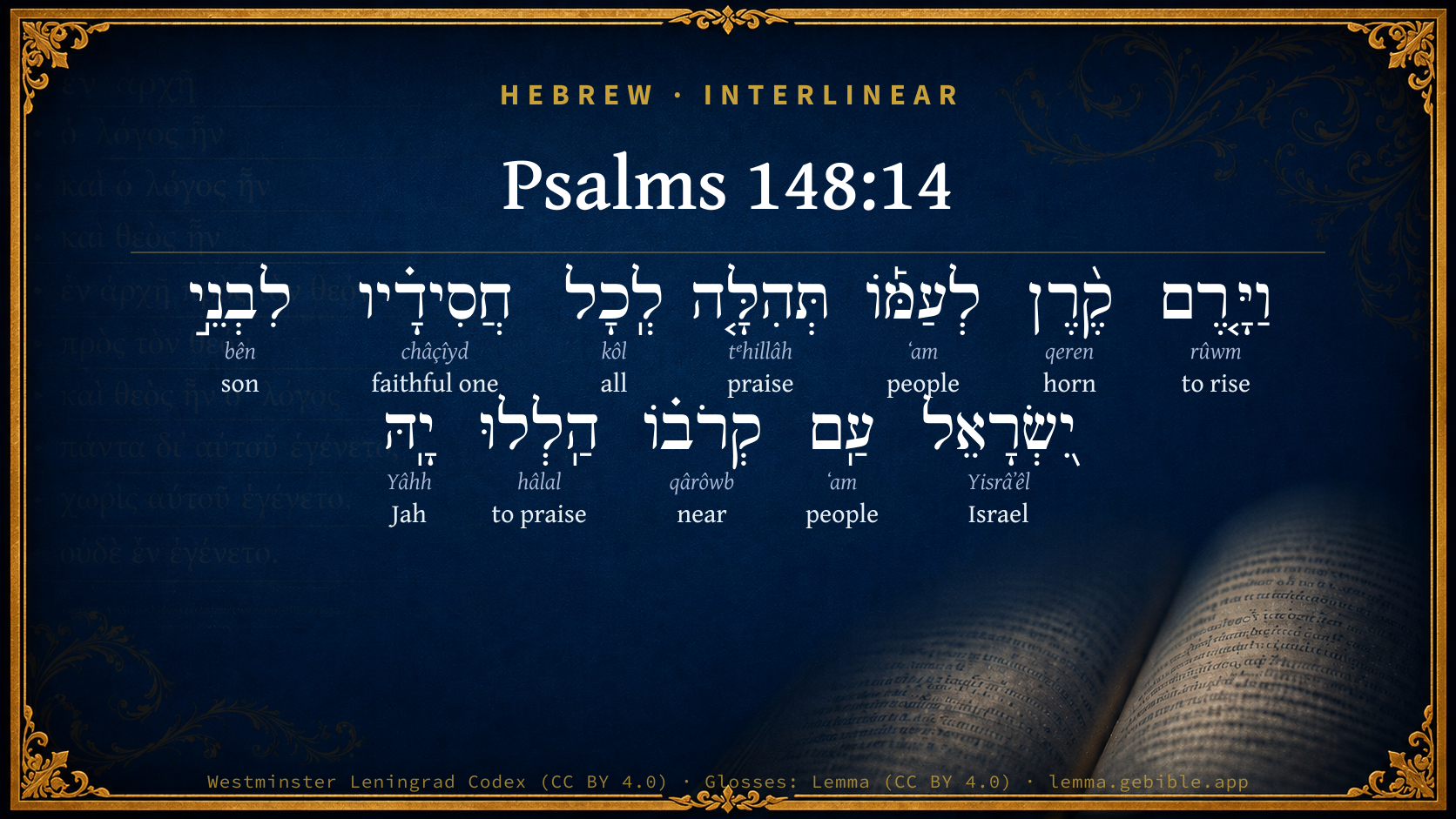
  1. וַיָּ֤רֶם rûwm H7311 “and · to rise” Conjunction + Verb, Hiphil, Sequential Imperfect, 3rd Person, Masculine, Singular
  2. קֶ֨רֶן qeren H7161 “horn” Noun, Common, Both, Singular, Absolute
  3. לְעַמּ֡וֹ ʻam H5971 “to/for · people · his” Preposition + Noun, Common, Masculine, Singular, Construct + Suffix, Personal, 3rd Person, Masculine, Singular
  4. תְּהִלָּ֤ה tᵉhillâh H8416 “praise” Noun, Common, Feminine, Singular, Absolute
  5. לְֽכָל kôl H3605 “to/for · all of” Preposition + Noun, Common, Masculine, Singular, Construct
  6. לִבְנֵ֣י bên H1121 “to/for · sons of” Preposition + Noun, Common, Masculine, Plural, Construct
  7. יִ֭שְׂרָאֵל Yisrâʼêl H3478 “Israel” Noun, Proper
  8. עַֽם ʻam H5971 “people of” Noun, Common, Masculine, Singular, Construct
  9. קְרֹב֗וֹ qârôwb H7138 “near · his” Adjective, Adjective, Masculine, Singular, Construct + Suffix, Personal, 3rd Person, Masculine, Singular
  10. הַֽלְלוּ hâlal H1984 “praise” Verb, Piel, Imperative, 2nd Person, Masculine, Plural
  11. יָֽהּ Yâhh H3050 “Jah” Noun, Proper

About this verse

These counts appear in no published source. They are computed here, from the morphology-tagged text and Lemma’s own curated glosses. What Lemma adds →

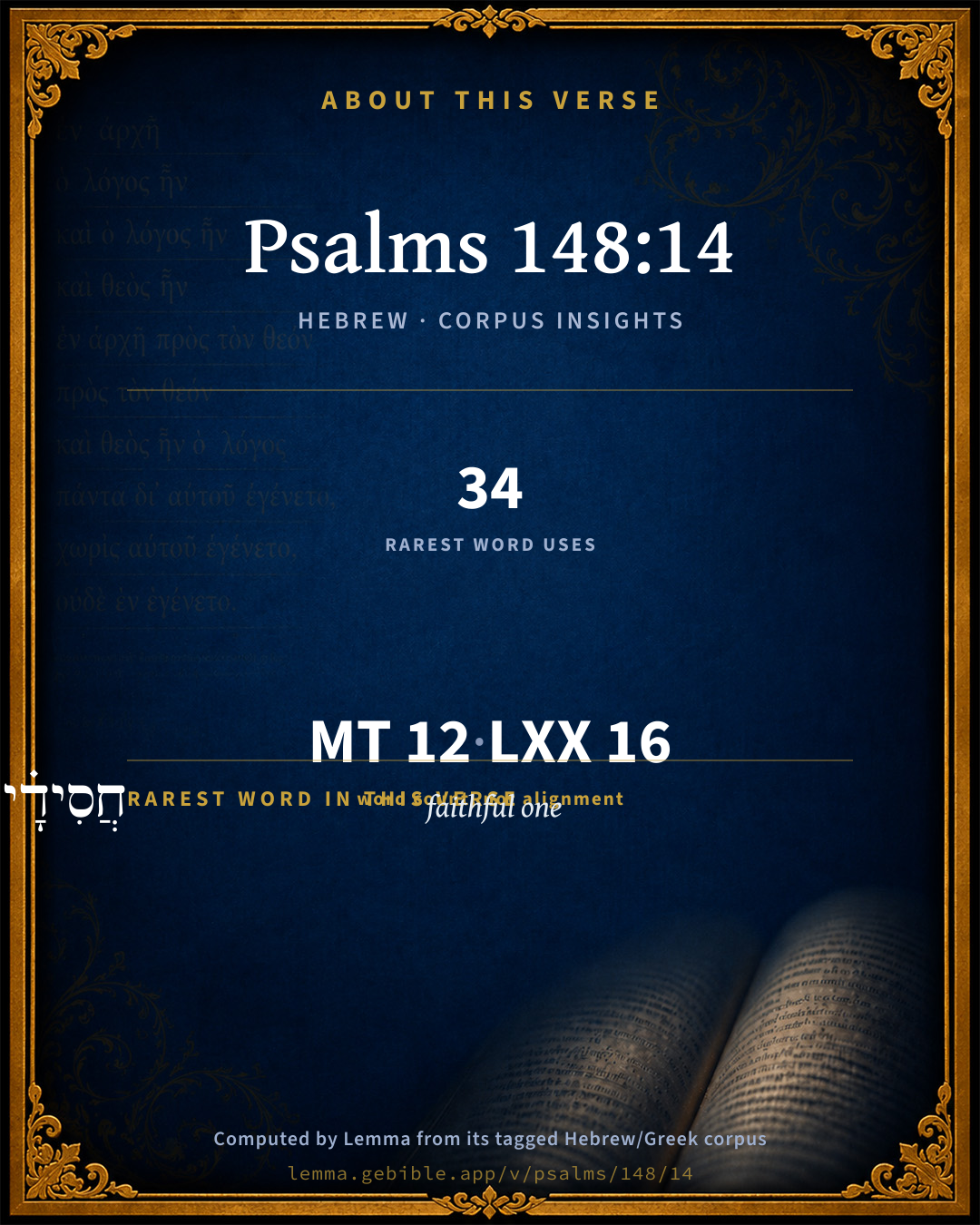
12
words
11
distinct lemmas
Wisdom
section

Shared distinctive vocabulary

חֲסִידָ֗יו faithful one H2623 occurs in 32 verses of the Hebrew Bible. Also found in:

Grammatical profile

  • 2 verbs
  • 8 nouns
  • 2 adjectives

Verb forms

  • וַיָּ֤רֶם Hiphil · Sequential Imperfect
  • הַֽלְלוּ Piel · Imperative

Repetition

A word recurs within this verse — often emphatic in Hebrew:

  • לְעַמּ֡וֹ people H5971 ×2

Hebrew & Septuagint length

In English translation the verse runs 28 words from the Hebrew and 30 from the Septuagint (LXX English) — closely comparable.

A rough comparison of the two English renderings, which tokenize alike — not a word-level alignment.

Word counts can differ between the Hebrew and the Greek without any difference in meaning — e.g. the Hebrew direct-object marker אֵת has no separate Greek word, and Greek often adds the article ὁ.

In the original languages it is 12 Hebrew tokens and 16 Greek tokens — but the two are counted differently (Hebrew bundles its prefixes and suffixes into one token; the Greek is in lemma form), so that isn’t a like-for-like length.

Cross-references

18

Topical passages linked to Psalms 148:14 in the Treasury of Scripture Knowledge — connected by theme and wording, ordered by reader-vote popularity; previews shown in the World English Bible.

  • Psalms 75:10 I will cut off all the horns of the wicked, But the horns of the righteous shall be lifted up.
  • Deuteronomy 4:7 For what great nation is there, that has a god so near to them, as Yahweh our God is whenever we call on him?
  • Ephesians 2:17 He came and preached peace to you who were far off and to those who were near.
  • 1 Samuel 2:1 Hannah prayed, and said: My heart exults in Yahweh; My horn is exalted in Yahweh; My mouth is enlarged over my enemies; Because I rejoice in your salvation.
  • Deuteronomy 10:21 He is your praise, and he is your God, who has done for you these great and awesome things, which your eyes have seen.
  • Psalms 112:9 He has dispersed, he has given to the poor. His righteousness endures forever. His horn will be exalted with honor.
  • 1 Peter 2:9 But you are a chosen race, a royal priesthood, a holy nation, a people for God's own possession, that you may show forth the excellencies of him who called you out of darkness into his marvelous light:
  • Revelation 5:8–14 Now when he had taken the book, the four living creatures and the twenty-four elders fell down before the Lamb, each one having a harp, and golden bowls full of incense, which are the prayers of the saints.
  • Psalms 92:10 But you have exalted my horn like that of the wild ox. I am anointed with fresh oil.
  • Psalms 145:10 All your works will give thanks to you, Yahweh. Your saints will extol you.
  • Psalms 149:9 To execute on them the written judgment. All his saints have this honor. Praise Yah!
  • Jeremiah 17:14 Heal me, O Yahweh, and I shall be healed; save me, and I shall be saved: for you are my praise.
  • Ephesians 2:13 But now in Christ Jesus you who once were far off are made near in the blood of Christ.
  • Ephesians 2:19 So then you are no longer strangers and foreigners, but you are fellow citizens with the saints, and of the household of God,
  • Psalms 89:17 For you are the glory of their strength. In your favor, our horn will be exalted.
  • Exodus 19:5–6 Now therefore, if you will indeed obey my voice, and keep my covenant, then you shall be my own possession from among all peoples; for all the earth is mine;
  • Luke 1:52 He has put down princes from their thrones. And has exalted the lowly.
  • Luke 2:32 A light for revelation to the Gentiles, And the glory of your people Israel."

Cross-references courtesy of OpenBible.info (CC BY 4.0).

Hebrew and Greek witnesses Masoretic Hebrew ↔ Greek Septuagint

The same verse in the two great witnesses to the Old Testament, shown verse-for-verse.

You’re reading Greek Psalm 148 (Hebrew Psalm 148). The Septuagint counts the superscription, so verse numbers can differ from the Hebrew — chapter-level alignment, not verse-by-verse. Numbering follows Rahlfs.

These are two independent witnesses, not word-aligned to each other, and the Septuagint is shown in lemma (dictionary) form.

Hebrew Psalms 148:14 Masoretic · Westminster Leningrad Codex

וַיָּ֤רֶם קֶ֨רֶן לְעַמּ֡וֹ תְּהִלָּ֤ה לְֽכָל חֲסִידָ֗יו לִבְנֵ֣י יִ֭שְׂרָאֵל עַֽם קְרֹב֗וֹ הַֽלְלוּ יָֽהּ

He has lifted up the horn of his people, The praise of all his saints; Even of the children of Israel, a people near to him. Praise Yah!

World English Bible · Public Domain

Greek LXX Greek Psalm 148:14 Septuagint · lemma form

καί ὑψόω κέρας λαός αὐτός ὕμνος πᾶς ὁ ὅσιος αὐτός ὁ υἱός ἰσραήλ λαός ἐγγίζω αὐτός

and he shall exalt the horn of his people, there is a hymn for all his saints, even of the children of Israel, a people who draw near to him.

LXX2012 (modern English Septuagint) · Public Domain

On this verse, The Cambridge Bible for Schools and Colleges discusses the Septuagint’s reading. Read the note in Commentary ↓

Hebrew: Westminster Leningrad Codex (CC BY 4.0). Greek: Septuagint (public domain); English from LXX2012 (modern English Septuagint) (Public Domain). How the Septuagint differs from the Hebrew →

Commentary

Notes on Psalms 148:14 from classic Christian and Jewish commentators (each source and its license shown beneath its notes). The classic Christian expositions comment on the surrounding passage and are grouped to its opening verse, so a note may address several verses; the Jewish commentaries on the Tanakh (Rashi and others) are per-verse, so they appear only where the commentator wrote on this verse.

Lemma curates 59 commentaries, every one of them public domain or Creative Commons licensed, each selected and text-cleaned for this edition rather than reprinted as found. About our sources →

Trapp's Complete Commentary

John Trapp

Psa 148:14 He also exalteth the horn of his people, the praise of all his saints; [even] of the children of Israel, a people near unto him. Praise ye the LORD.

Ver. 14. He also exalteth the horn] i.e. He graceth them singularly.

A people near unto him] And in that respect happy above all people on the earth, Deu 4:7; Deu 33:29, because in covenant with him and near allied to him, as the word here importeth.

John Trapp, A Commentary or Exposition upon All the Books of the Old and New Testament (1647–1656) — public domain. Text from a community e-Sword module.

The Biblical Illustrator

Joseph S. Exell

Psa_148:14

A people near unto Him.

Believers near to God

I. The position of the people near to God, or the relationship indicated by nearness.

1. A legal nearness. Made nigh by the blood of Christ.

2. A covenant relationship. A solemn mutual pledge, sealed at the Cross.

3. A filial relationship. Not more certainly will affection be felt in the heart of both parent and child among the families of men than in the Abba Father of the believing soul, and the tender pity of Gods gracious bosom.

4. A mystical union between Christ and the soul. All His becomes yours, and yours becomes His.

5. Partakers of the Divine nature.

II. The privileges of the people near to God. What shall we say to that protection which this nearness ensures to your soul, seeing that the place of your defence shall be the munitions of rocks, that your bread shall be given you, and your water shall be sure? Jehovah is like a wall of fire about His people. What shall we say of that provision made for you in this wilderness, where every possible want of the body and the soul meets its full and perpetual supply in the riches of Divine goodness, which are all pledged to you by the love and faithfulness of your covenant God? What shall we say of the promises exceeding great and precious, made to all collectively, and to one by one personally. What shall we say of providences, all arranged by wisdom which never errs, and love which never fails, and controlled by power that is never weary, so as most effectually to promote the salvation of your souls?

III. The transforming efficacy of this nearness to God. See how it will and must operate from principles necessarily at work.

1. There is the solemnity of your position. If Gods nearness be fairly and fully recognized, if He be seen as He is, and you seen as you are, in the light of His purity, will you, can you, dare you be contented to remain in the corruption of nature?

2. There is admiration of Gods character. Let His character be seen and felt as revealed in the way of pardoning sin by the Cross in infinite power and wisdom, holiness and truth, all displayed in sweet harmony and ineffable glory, while mercy casts her bright radiance over them all to assure the trembling sinner, and constrain him to draw nigh; then can you see all thee perfections engaged on the side of the sinner, engaged to sanctify and save his soul, and feel not a lofty admiration of the beauty of the Lord?

3. But admiration begets desire. If we feel admiration for any person, do we not wish to make him a friend? The moment that admiration of anything ceases, desire to have and enjoy it ceases too. But the beauty of the Lord is manifested to your faith just that you may feel the kindlings of desire to be His, and to be like Him in His loveliness.

4. But surely the soul that has such desires will frequently, solemnly, and closely commune with this infinitely lovely and blessed God. Such communion gives a consciousness of the reality of Divine things, and is fitted to stir you up and spur you on in the effort to become like your God. It thus necessarily leads to--

5. Imitation. This is the end of the process, imitation of God manifest in the flesh. His Word will make you wise. His truth will render you truthful. His justice will move you to rectitude. His sovereignty will make and keep you lowly. His purity will lead you to holiness of heart. His mercy and pity will make you tender, and loving, and gentle. (John Walker.)

Nearness to God

I. In what respects true believers are near to God.

1. The awful breach is healed, and they are reconciled. The separating wall of sin is broken down, and they have boldness and access with confidence to Him who would otherwise be a consuming fire.

2. The power of sin is subdued, and they are near as to union and likeness. Nearness, as to the former, is by the blood of Christ: the latter is by the influences of the Holy Spirit.

3. They are near as to communion and fellowship. Jacob had his Bethel, David his hill Mizar, and Paul, though sometimes pressed out of measure, had also his raptures in the third heavens (Isa_12:1).

4. They are near to Him in a way of endearment, being precious in His sight. They are near to His heart, and to His eye, and His ear is open to their complaints.

5. They are so near to Him that they will soon be with Him--at home, and at rest. Faith gives you an interest in the Divine favour, and death will bring you to the full enjoyment of it. Your warfare shall be accomplished, and the victory complete.

II. The reasons why this nearness is matter of exultation and joy.

1. This nearness is lasting: those who are thus brought near to God shall be for ever near.

2. Those who are near to God have God also near to them. He will guide, protect, and comfort His people amidst all their difficulties and dangers.

3. They have blessings and privileges which none else can enjoy. They may hear from Him, and He from them; may contemplate His glorious majesty, and commune with Him, as it were, face to face.

4. Being near to God, they are also near to heaven. Improvement--

(1) How vain are all our hopes of happiness without God (Psa_73:27).

(2) Let us be reconciled to those providences which tend to bring us near. The severest trials are often among the means which God employs to bring us to Himself.

(3) Let nearness to God be the object sought after in every holy duty, both public and private. We may as well be in Geshur as at Jerusalem, unless we see the Kings face.

(4) Not only let us desire to be brought near in a way of interest, but to keep near in a way of communion. This will soften afflictions, heighten our mercies, fortify us against the fear of death, and be our best preparative for heaven.

(5) If the Lords people be near and dear to Him, let them be so to us. (B. Beddome, M. A.)

The privilege of dwelling near to God

Communion with Christ is the happiest life. If you gained all the world, and did not lose your soul, but only lost the light of Christs countenance for a few days, you would make a poor bargain. There is heaven in every glance of His eye. There is infinite joy in every word of His mouth when He speaks comfortably to His servants. Go not away from Him. Be like Miltons angel, who lived in the sun. Abide in Christ, and let His words abide in you. Closer, closer, closer, this is the way to spiritual wealth. To follow afar off, and live at a distance from Christ, even if it does not make your soul to perish, yet it will wither up your joys, and make you feel an unhappy man, an unhappy woman. (C. H. Spurgeon.)

.

Psa_149:1-9

The Biblical Illustrator, edited by Joseph S. Exell (c. 1880s–1900s) — public domain. Text from a community e-Sword module.

J. A. Alexander on Psalms

Joseph Addison Alexander

14. (Psa 148:14) And he has raised np a horn for his people praise for all his saints —for the children of Israel—a people near to him. Hallelujah! While all the creatures before mentioned have abundant cause to praise God for his infinite perfection and his goodness to themselves, a peculiar obligation is incumbent on his people: first, for his distinguishing favour through all periods of their history; and then, for a special mercy recently experienced, namely, the restoration from captivity, now completed by the renewal of the temple and the reconstruction of the city walls. This restoration is described, by a favourite Davidic figure, as exalting or lifting up the horn of Israel. See above, on Psa 75:5-6; Psa 92:10. The previous condition of the chosen people might be well represented by the opposite figure used in Job 16:15. Raised up a horn for his people seems to be only another way of saying raised the horn of his people. The first form of expression may have been here used for the purpose of assimilating this clause to the next, where praise is still dependent on the verb at the beginning, and to raise up praise for his people is to give them fresh occasion of still higher praise than they had ever yet been called to utter. The ancient church is here described in a fourfold manner: first, simply as his people; then, as his saints or gracious ones, the objects of his mercy and the subjects of his grace; then, by their national title, as the sons (or descendants) of Israel; and lastly, as the people near him, i.e. nearer to him than all others, sustaining a more intimate relation to him. The same expression which is elsewhere applied to the priests (Lev 10:3, Eze 42:13) is here applied to Israel as "a kingdom of priests and a holy nation" (Exo 19:6).

Joseph Addison Alexander, The Psalms Translated and Explained (1850) — public domain. Text from a community e-Sword module.

Geneva Bible (1599)

Geneva Bible translators

That is, the dignity, power and glory of his Church.

By reason of his covenant made with Abraham.

Geneva Bible (1599) marginal notes — public domain. Text via Bolls.life.

Jamieson, Fausset & Brown

Robert Jamieson, A. R. Fausset & David Brown

exalteth the horn--established power (Psa 75:5-6).

praise of--or literally, "for"

his saints--that is, occasions for them to praise Him. They are further described as "His people," and "near unto Him," sustaining by covenanted care a peculiarly intimate relation.

Next: Psalms Chapter 149

Jamieson, Fausset & Brown — Commentary Critical and Explanatory on the Whole Bible (1871) — public domain (CC PDM 1.0). Text via the HelloAO Bible API.

Adam Clarke's Commentary

Verse 14. He also exalteth the horn] Raises to power and authority his people.

The praise] Jehovah is the subject of the praise of all his saints.

A people near unto him.] The only people who know him, and make their approaches unto him with the sacrifices and offerings which he has himself prescribed. Praise ye the Lord!

O what a hymn of praise is here! It is a universal chorus! All created nature have a share, and all perform their respective parts.

All intelligent beings are especially called to praise him who made them in his love, and sustains them by his beneficence. Man particularly, in all the stages of his being - infancy, youth, manhood, and old age: all human beings have their peculiar interest in the great Father of the spirits of all flesh.

He loves man, wheresoever found, of whatsoever colour, in whatever circumstances, and in all the stages of his pilgrimage from his cradle to his grave.

Let the lisp of the infant, the shout of the adult, and the sigh of the aged, ascend to the universal parent, as a gratitude-offering. He guards those who hang upon the breast; controls and directs the headstrong and giddy, and sustains old age in its infirmities; and sanctifies to it the sufferings that bring on the termination of life.

Reader, this is thy God! How great, how good, holy merciful, how compassionate! Breathe thy soul up to him; breathe it into him; and let it be preserved in his bosom till mortality be swallowed up of life, and all that is imperfect be done away.

Jesus is thy sacrificial offering; Jesus is thy Mediator. He has taken thy humanity, and placed it on the throne! He creates all things new; and faith in his blood will bring thee to his glory! Amen! hallelujah!

The beautiful morning hymn of Adam and Eve, (Paradise Lost, book v., line 153, c.,) -

"These are thy glorious works, Parent of good

Almighty, thine this universal frame," c.

has been universally admired. How many have spoken loud in its praises, who have never attempted to express their feelings in a stanza of the hundred and forty-eighth Psalm! But to the rapturous adorers of Milton's poetry what is the song of David, or this grand music of the spheres! Know this, O forgetful man, that Milton's morning hymn is a paraphrase of this Psalm, and is indebted to it for every excellency it possesses. It is little else that the psalmist speaking in English instead of Hebrew verse.

ANALYSIS OF THE HUNDRED AND FORTY-EIGHTH PSALM

The psalmist calls upon the whole creation to he instrumental in praising God. By which he shows, -

I. His ardent desire that God be praised. As if creatures, endowed with reason, were too few, therefore he calls on inanimate things to join and be heralds of his wondrous works.

II. His intention what he would and could have done.

III. That what could be done should be done.

IV. That all really do praise him in their kind and manner.

This Psalm is disposed into excellent distribution.

1. He calls upon celestial creatures in general; 2. In particular. 1. On angels: "Praise ye the Lord from the heavens," c. Ye of celestial order. 2. "Praise him in the heights," &c. The heavens above. 3. "Praise him, all his hosts," &c. Which in St. Luke are called the heavenly host.

2. "Praise ye him, sun, moon, and stars." Though not with the voice, yet by your beauty, motion, light, efficacy, &c.

He mentions the whole body of the heavenly orbs.

1. "Praise him, ye heavens of heavens," &c. The highest state of bliss.

2. "And ye waters," &c. All the orbs above the air, in Scripture called heavens and the waters that are above the firmament.

And in the two next verses he gives the reason.

1. "He commanded," &c. They are his creatures, therefore, -

2. "He hath established them," &c. They are incorruptible.

From the heavens he now descends to the earth, air, water, &c.: "Praise the Lord from the earth," &c. All ye elementary substances.

1. "Ye dragons." Whales, great fishes.

2. "All deeps." All kinds of waters.

3. "Fire and hail," &c. Meteors, &c.

4. "Mountains and hills," &c.

5. "Fruitful trees," &c. Trees fit to build with and fruit-trees.

6. "Beasts and all cattle." Both wild and tame.

7. "Creeping things," &c. Worms and serpents.

8. "And all flying fowls."

And, lastly, he cites all mankind to praise God.

1. "The highest kings," &c. They who command, and they who obey.

2. "Princes, and all judges," &c. All inferior magistrates.

3. "Both young men and maidens." Both sexes.

4. "Old men and children," - all ages: "Let them praise the name of the Lord."

And for this reason: -

1. "For his name is excellent alone." No name is so sublime and worthy.

2. "His glory is above the earth and heaven." All good comes from him.

The prophet concludes this Psalm with God's goodness to the Church, which furnishes him with another reason: -

1. He also "exalts the horn," &c. The power and glory of his people.

2. "He is the praise," &c. The Guide of Israel.

3. "Even of the children of Israel," &c. A people consecrated to God. All which is to be understood not merely of Israel according to the flesh, but God's spiritual Church. Now those who are true Israelites, and those especially, he excites to sing, -

"Hallelujah! Praise ye the Lord!"

Adam Clarke's Commentary on the Bible (1810–1826) — public domain. Text from a community e-Sword/MySword module.

John Calvin's Commentaries

14. And hath exalted the horn, etc. As we saw in the former Psalm, that the perfections of God are to be seen more conspicuously in the Church than in the constitution of the world at large, the Psalmist has added this sentence, as to the Church being protected by the divine hand, and armed with a power against all enemies which secures its safety in every danger. By the horn, as is well known, is meant strength or dignity. Accordingly the Psalmist means that God’s blessing is apparent in his Church and among his chosen people, inasmuch as it only flourishes and is powerful through his strength. There is a tacit comparison implied between the Church of God and other hostile powers, for it needs divine guardianship as being exposed on all sides to attack. Hence the Psalmist infers that praise is to all the merciful ones of God, for they have ground given them in the singular goodness of his condescension both for self-congratulation and praise. In calling the children of Israel a people near unto God, he reminds them of the gracious covenant which God made with Abraham. For how came the nearness, except in the way of God’s preferring an unknown despised stranger to all nations? Nor are we to seek the cause of the distinction elsewhere than in the mere love of God. Though all the world equally belongs to God, he graciously discovered himself to the children of Israel, and brought them near to him, strangers as they were from God, even as are the whole race of Adam. Hence the words of Moses —

“When the Most High divided to the nations their inheritance, and distributed the peoples, he stretched forth his line to Jacob.” (Deuteronomy 32:8.)

He is to be considered, therefore, as pointing out the cause why God hath extended such signal blessings to a single people, and a people poor and despised — his adoption of them to himself.

John Calvin's Commentaries (1540-1563) — public domain. Text from the Calvin Translation Society English edition (1840s-50s) via the Christian Classics Ethereal Library (ccel.org). Calvin's coverage is partial (roughly two-thirds of the Bible); uncommented books and verses are honest gaps, never fabricated. The 19th-century editor's footnotes and remarks are omitted so the notes are faithfully Calvin's own voice.

Ellicott's Commentary for English Readers

(14) He hath . . .—Render, and he hath raised a horn for his people. Praise is for all His saints, for the sons of Israel, a people near Him.

The raising of the horn evidently implies some victory, or assurance of victory, which, no doubt, gave the first impulse for this song of praise. (See Introduction). For the figure see Note, Psa_75:4-5.

The verse is a repetition of a frequent statement of the Psalms. While poetically all the universe, inanimate as well as animate, all men, heathen as well as Hebrews, can be called to sing “hallelujah,” it remains as it has ever been, the covenant privilege of Israel. This explanation disposes at once of the charge which has been brought against this verse of narrowing a grand universal anthem, and ending the psalm with an anti-climax.

A Bible Commentary for English Readers, edited by Charles John Ellicott (1878–1897) — public domain. Text from a community e-Sword module.

The Cambridge Bible for Schools and Colleges

gen. ed. J. J. S. Perowne

14. Israel’s special ground for praise.

And he nath lifted up a horn for his people] He has once more given to Israel dignity and power. For the metaphor cp. Psa_75:4; Psa_89:17; Psa_89:24; Psa_92:10, note.

The rendering of P.B.V., he shall exalt, is that of the LXX, ὑψώσει, and is adopted by some critics. But the tense expresses accomplished fact more naturally than confident anticipation.

the praise of all his saints] Lit. a praise for all his beloved; best taken in apposition to the preceding clause to mean that this national restoration is a theme of praise for all the members of the covenant people. The words may however be in apposition to the subject of the verb, and refer to Jehovah: He … who is the praise &c.: cp. Deu_10:21, “He is thy praise.” So the LXX, paraphrased in P.B.V., “all his saints shall praise him.”

a people near unto him] Jehovah was ‘near’ to Israel (Deu_4:7; Psa_145:18); and Israel, as “a kingdom of priests” (Exo_19:6), stood in a unique relation of nearness to Jehovah. Cp. Psa_65:4, note; Num_16:5; Jer_30:21. That relation, which seemed to have been interrupted by the Exile, has now been restored: Jehovah once more dwells in the midst of His people in the city of His choice.

This verse is quoted verbatim in the Hebrew text of Sir_51:12 (15). See p. 777.

The Cambridge Bible for Schools and Colleges (gen. ed. J. J. S. Perowne; Cambridge University Press, 1878–1918) — public domain. Text from a community e-Sword module.

John Gill's Exposition

He also exalteth the horn of his people,.... Which is done when he increases their strength, their spiritual strength especially; makes them strong in the Lord, in his grace, and in the power of his might; when their dominion and authority is enlarged, and victory given over all their enemies; particularly when the kingdom under the whole heaven shall be given to them, and when they shall reign with Christ on earth; for this phrase denotes the honourable as well as the safe state of the people of God; the horn being an emblem of power, authority, and dominion, on; the Targum renders it, the glory of his people; see Psa 75:10. Some interpret this of Christ the Horn of David, the Horn of salvation, and the author of it, Psa 132:17; who is King over his people, as a horn signifies; and is the strength, safety, and security of them; has gotten them the victory over all their enemies, and is now exalted in heaven at the right hand of God, and that "for his people" (g), as it may be rendered; he is both raised up and exalted for them;

the praise of all his saints; that is, the Lord is the object of the praise of all his saints, to whom he has showed favour and kindness, and on whom he has bestowed the blessings of his grace; it is matter of praise that they are saints, set apart by God the Father, sanctified by the blood of Christ, and by the Spirit of God; and that their horn is exalted, or they raised to dignity and honour; and that Christ is raised and lifted up as an horn for them, Co1 1:30, Luk 1:68;

even of the children of Israel; not literal but spiritual Israel, such who are Israelites indeed, whether Jews or Gentiles;

a people near unto him; in respect of union, being one with him, in the bond of everlasting love; in respect of relation, being near akin, he their father, they his children, not by creation only, but by adopting grace; and Christ their near kinsman, nay, their father, brother, head, and husband; in respect of access unto him, which they have through Christ, with boldness and confidence, being made nigh and brought near by the blood of Christ; in respect of communion and the enjoyment of his gracious presence; and in respect of inhabitation, God, Father, Son, and Spirit, dwelling in them, and making their abode with them: or, as it may be rendered, "the people of his near one" (h); that is, of Christ, who is near to God his Father, is one with him, was with him from everlasting, was as one brought up with him, yea, lay in his bosom, drew nigh to him as the surety of his people, and offered himself a sacrifice to him as their Priest, and now is set down at his right hand as their King; and where he also appears for them, is their advocate, and ever lives to intercede for them;

praise ye the Lord: even all creatures, especially his saints, his people, the children of Israel, the last spoken of.

(g) "cornu populo suo", Pagninus, Montanus, Tigurine version, Cocceius, Michaelis. (h) "populo propinqui sui", Cocceius, Schmidt.

Next: Psalms Chapter 149

John Gill's Exposition of the Whole Bible (1746–1763) — public domain (CC PDM 1.0). Text via the HelloAO Bible API.

Albert Barnes' Notes on the Bible

He also exalteth the horn of his people - He gives them power and prosperity. See the notes at Psa 89:17 : “And in thy favor our horn shall be exalted.” Compare Psa 92:10; Psa 112:9.

The praise of all his saints - That is, “he has raised up praise for all his saints;” or, has given them occasion for praise. He has so blessed them with special mercies as to make praise especially appropriate for them.

Even of the children of Israel, a people near unto him - whom he admits to his presence as his friends; whom he regards as his own. See the notes at Eph 2:13; compare the notes at Act 2:39.

Praise ye the Lord - Hallelu-jah. Let all unite in his praise.

Albert Barnes' Notes on the Bible (1834–1885) — public domain. Text from a community e-Sword/MySword module.

Matthew Poole's English Annotations

Exalteth the horn of his people, to wit, above the horns of all the people in the world, in respect of their spiritual and eternal privileges, as it here follows.

The horn in Scripture doth commonly note strength, victory, glory, and felicity, as Deu 33:17, and everywhere.

The praise; either,

1. He is the praise, as God is called, Deu 10:21, to wit, the God of their praise, as Psa 119:1, the chiefest object and matter of it: or,

2. Which is the praise; which work of God in exalting their horn is their glory, and maketh them praiseworthy, or obligeth and provoketh them in a singular manner to perform this great duty of praising God, which is so generally neglected by others. Near unto him, by special relation, and friendship, and covenant, and by familiar intercourses; God manifesting his face and favour to them, and they frequently and solemnly approaching into his presence, and worshipping him at his footstool.

Matthew Poole's English Annotations on the Holy Bible (1683–1685) — public domain. Text from a community e-Sword/MySword module.

The Treasury of David

Charles H. Spurgeon

Ver. 14. He also exalteth the horn of his people. He hath made them strong, famous, and victorious. His goodness to all his creatures does not prevent his having a special favour to his chosen nation: he is good to all, but he is God to his people. He lifts up the down trodden, but he in a peculiar manner lifts up his people. When they are brought low he raises up a horn for them by sending them a deliverer; when they are in conflict he gives them courage and strength, so that they lift up their horn amid the fray; and when all is peaceful around them, he fills their horn with plenty, and they lift it up with delight.

The praise of all his saints. He is their glory: to him they render praise; and he by his mercy to them evermore gives them further reasons for praise, and higher motives for adoration. He lifts up their horn, and they lift up his praise. He exalts them, and they exalt him. The Holy One is praised by holy ones. He is their God, and they are his saints; he makes them blessed, and they bless him in return.

Even of the children of Israel. The Lord knoweth them that are his. He knows the name of him with whom he made a covenant, and how he came by that name, and who his children are, and where they are. All nations are bidden in Ps 148:11 to praise the Lord; but here the call is specially addressed to his elect people, who know him beyond all others. Those who are children of privilege should be children of praise.

A people near unto him, near by kin, and near by care; near as to manifestation and near as to affection. This is a highly honourable description of the beloved race; and it is true even more emphatically of the spiritual Israel, the believing seed. This nearness should prompt us to perpetual adoration. The Lord's elect are the children of his love, the courtiers of his palace, the priests of his temple, and therefore they are bound beyond all others to be filled with reverence for him, and delight in him.

Praise ye the Lord, or, Hallelujah. This should be the Alpha and Omega of a good man's life. Let us praise God to the end, world without end. The field of praise which lies before us in this Psalm is bounded at beginning and end by landmarks in the form of Hallelujahs, and all that lieth between them is every word of it to the Lord's honour. Amen.

Ver. 14. His people, the praise of all his saints. But among all, one class in particular is called on to praise him, for they have an additional motive for so doing, namely, "his people", and "his saints." As man above all the creatures, so among men his elect or chosen, who are the objects of his special grace, and, above all, of his redeeming love. He also exalteth the horn of his people exalts them, one and all, from the death of sin to the life of righteousness, and consequent on this, from the dust of earth to the glory of heaven. "The praise of all his saints"; and, yet again, among them, of one people in particular"even of the children of Israel, a people near unto him." "Near to him" of old, and yet again to beyea, nearest of all the peoples of the earthwhen he recalls them from their dispersion, and again places his name and his throne among them. HALLELUJAHPRAISE YE THE LORD. William De Burgh.

Ver. 14. A people near unto him. Jesus took our nature, and became one with us; thus he is "near" unto us; he gives us his Holy Spirit, brings us into union with himself, and thus we are near to him. This is our highest honour, an unfailing source of happiness and peace. We are near to him in point of relation, being his children; near to him in point of affection, being loved with an everlasting love; we are near to him in point of union, being members of his body, of his flesh, and of his bones; we are near to him in point of fellowship, walking with him as a man walketh with his friend; we are near to him in point of attention, being the objects of his daily, hourly, tender care; we shall soon be near to him in point of locality, when our mansion is prepared, for we shall depart to be with Christ, which is far better. We are near to him when poor, and when deeply tried; and if ever nearer at one time than another, we shall be nearest to him in death. If we are near unto him, he will sympathize with us in all our sorrows, assist us in all our trials, protect us in all our dangers, hold intercourse with us in all our lonely hours, provide for us in all seasons of necessity, and honourably introduce us to glory. Let us realize this fact dailywe are near and dear to our God. James Smith.

Ver. 14. The Favoured People and their God.

1. What he does for them.

2. What he makes them: "Saints."

3. Who they are: "Children of Israel."

4. Where they are: "Near unto him."

5. What they do for him: "Praise ye the Lord."

Charles H. Spurgeon's The Treasury of David (1869–1885) — public domain. Psalms only. Text from a community e-Sword/MySword module.

Whedon's Commentary on the Bible

Daniel D. Whedon

14. He also exalteth the horn of his people… a people near unto him— The climax of Jehovah’s works, and of the praise due, is at length reached. Above created nature, above nations, above all human ranks of age or honour, near to the heart of God, stands the Church, the spiritual Israel, the fruit of his redeeming love. The allusion supposes Israel to have been recently exalted to honour from abasement. The language suits the restoration from captivity. The event astonished the nations, and became the theme of a “new song” of praise. Thus the moral government and redemption will for ever stand out the distinguishing glory of God.

Daniel D. Whedon (gen. ed.), Commentary on the Old and New Testaments (1874–1909) — public domain. Text from a community e-Sword module.

The Pulpit Commentary

He also exalteth the horn of his people. Great as God is, his greatness does not separate him from his human creatures. On the contrary, it makes the union between himself and them closer. His might enables him to confer benefits on his people to "exalt their horn;" i.e. to increase their glory and their strength, and set them up above their enemies. The praise of all his saints. The construction is doubtful. Some regard "praise" as in apposition with "horn," and understand that God, by exalting the "horn" (power) of his saints, exalts also their "praise" or "renown." Others imagine an ellipse, and translate, "Praise belongs to all his saints" (Kay); or, "Seemly is praise for all his saints" (Cheyne). Even of the children of Israel, a people near unto him. The "children of Israel" are nearer to God than others, since he has taken them to himself as his own peculiar people, and both "draws nigh" to them, (Psa_69:11) and draws them near to him. (Jer_30:21) Praise ye the Lord (comp. ver. 1).

Praise inspired by personal experience.

"And he hath lifted up the horn of his people, the praise of all his saints." The figure of the horn is a familiar one, and need not be again explained. What is noticeable here is that the supreme subject of praise for man is Gods personal dealing with him in the sphere of his moral and religious life. This we refer to as a man"s personal experience.

I PRAISE INSPIRED BY THE PERSONAL EXPERIENCE OF GOD"S PROVIDENCE. In this man"s praise is common with the praise of all creation and all creatures. All have their being from God; all are sustained in their places in God; all have their movements directed by God; all have their wants supplied by God; all are helped to fulfill their mission by God. "All thy works praise thee, in all places of thy dominion." And yet here man stands out in front of all creation, because he knows that he is, in his willfulness, a disturbing element in God"s providence., and so has an altogether fuller sense of the wonder-working of a providence which can remedy and restore, as well as sustain and provide. And besides this general view, each man should have such a particular impression of God"s workings and overrulings in his actual life-experience, as would be for him the constant inspiration of fresh praise and trust. And the experiences of the individual may be illustrated by the experience of Gods people Israel, whose horn he had so often lifted up.

II PRAISE INSPIRED BY THE PERSONAL EXPERIENCE OF GOD"S GRACE. Illustrate by John Newton, who, when reproved for his testimony and his joy in Christ, replied, "How can the old blasphemer be silent!" It is here that redeemed man passes out of the sphere of nature, and out of the sphere of ordinary humanity. God has "brought him out of the miry pit and horrible clay, and put a new song in his mouth." And to him all life is but a repetition of the restorings and deliverings which is ever calling forth fresh songs to him who "redeemeth our soul from destruction. R.T.

The Pulpit Commentary (1880–1919), ed. H.D.M. Spence-Jones & Joseph S. Exell — public domain. Text from a community e-Sword module.

John Wesley's Explanatory Notes

The horn - In scripture commonly denotes strength, victory, glory, and felicity.

John Wesley, Explanatory Notes Upon the Whole Bible (1754–1765) — public domain. Text via the GEBible commentary corpus.

Lesson kit

Teaching starters — assembled from the data on this page, not authored interpretation. Every prompt links to the verse data it draws on. Edit before teaching.

Psalms, in the Wisdom, opens this verse with 12 words (11 distinct Hebrew lemmas). Its most distinctive word is châçîyd (“faithful one”). A historical commentator’s framing appears above. Read the whole chapter for the surrounding context.

Discussion questions

  1. The word châçîyd carries the sense “faithful one.” How does it shape the verse?
  2. Deuteronomy 33:8 shares the word «faithful one» with this verse. How do the two illuminate each other?
  3. “people” occurs 2× in this one verse. What is the effect of the repetition?
  4. These translations render this verse differently; the difference is in the English rendering, not the original. What questions does that raise?
  5. The verb «וַיָּ֤רֶם» is Hiphil Sequential Imperfect. How does its form color the action?
  6. Reading how Trapp's Complete Commentary and The Biblical Illustrator read this verse, where do the two commentators agree and where do they part?

Things to notice

Reading settings

Reading text

Shown beneath each verse's original-language words.

Old Testament
Old Testament edition

Read the OT as the Masoretic Hebrew (MT) or the Greek Septuagint (LXX).

English shown for the Greek Septuagint (in the Hebrew ↔ Greek comparison).

Comparing translations? Open the Compare panel on any verse page to stack up to four side by side.