
Ezekiel 21:26

Hebrew (Westminster Leningrad Codex) Ezekiel 21:26 appears in the Hebrew Old Testament. The text above is from the Westminster Leningrad Codex. Each word links to its Strong’s number, a concise gloss, and parsing drawn from the Open Scriptures Hebrew Bible morphology. Click any word for its full Brown-Driver-Briggs (BDB) entry.
Download image
Cite this verse

Ezekiel 21:26 (World English Bible). Public Domain. Lemma interlinear Bible study tool, https://lemma.gebible.app/v/ezekiel/21/26.

Show BibTeX & RIS
BibTeX
RIS
English Translation
thus says the Lord Yahweh: Remove the turban, and take off the crown; this [shall be] no more the same; exalt that which is low, and abase that which is high.
World English Bible · Public Domain
Download a study sheet

One document with this verse’s original text, its word-by-word gloss line, the meaning frame, cross-references with their text, attributed commentary, and full source and license credits — printable, and it pastes into notes with its structure intact.

This verse Autodidact and up

Study sheet (.html) Plain text (.txt)

A passage Seminary Student

Up to 50 verses in one chapter. A passage sheet keeps up to 6 commentary sources and 12 cross-references per verse, in the order this page ranks them, and says so on the sheet whenever that leaves anything out. Ask for a single verse and you get the Autodidact verse sheet above.

Everything on this page stays free to read, with no account — the sheet is a download of what is already on screen, not access to it.

Want to remove ads? Support Godless Engineer
Compare translations 3

The same verse in 3 English versions, stacked beneath the original-language interlinear above. Click any original word for its lexicon entry.

Each is an independent rendering of the whole verse — the interlinear is not word-aligned to these translations.

Highlighted words mark where these versions differ — a whole-verse word diff, not a word-by-word alignment.

  • World English Bible Public Domain
    thus says the Lord Yahweh: Remove the turban, and take off the crown; this [shall be] no more the same; exalt that which is low, and abase that which is high.
  • King James Version Public Domain
    Thus saith the Lord GOD; Remove the diadem, and take off the crown: this shall not be the same: exalt him that is low, and abase him that is high.
  • unfoldingWord Literal Text CC BY-SA 4.0
    the Lord Yahweh says this to you: Remove the turban and take off the crown! Things will no longer be the same! Exalt the lowly and humble the exalted!

unfoldingWord Literal Text — © unfoldingWord, licensed CC BY-SA 4.0. Word-aligned USFM3 via Door43 (git.door43.org/unfoldingWord/en_ult).

Versions to compare (up to 4)

3 of 4 selected

Show all 18 translations

Every available English version of this verse, each an independent rendering of the whole verse.

  • World English Bible Public Domain
    thus says the Lord Yahweh: Remove the turban, and take off the crown; this [shall be] no more the same; exalt that which is low, and abase that which is high.
  • Berean Standard Bible Public Domain
    This is what the Lord GOD says: ‘Remove the turban, and take off the crown. Things will not remain as they are: Exalt the lowly and bring low the exalted.
  • Majority Standard Bible Public Domain
    This is what the Lord GOD says: ‘Remove the turban, and take off the crown. Things will not remain as they are: Exalt the lowly and bring low the exalted.
  • King James Version Public Domain
    Thus saith the Lord GOD; Remove the diadem, and take off the crown: this shall not be the same: exalt him that is low, and abase him that is high.
  • American Standard Version (1901) Public Domain
    thus saith the Lord Jehovah: Remove the mitre, and take off the crown; this `shall be' no more the same; exalt that which is low, and abase that which is high.
  • Revised Version (1885) Public Domain
    thus saith the Lord GOD: Remove the mitre, and take off the crown: this shall be no more the same: exalt that which is low, and abase that which is high.
  • Geneva Bible (1599) Public Domain
    Thus saith the Lord God, I will take away the diademe, and take off the crowne: this shalbe no more the same: I wil exalt the humble, and will abase him that is hie.
  • Douay-Rheims (1899) Public Domain
    Thus saith the Lord God: Remove the diadem, take off the crown: is it not this that hath exalted the low one, and brought down him that was high?
  • Young's Literal Translation Public Domain
    Thus said the Lord Jehovah: Turn aside the mitre, and bear away the crown, This -- not this -- the low make high, And the high make low.
  • Literal Standard Version CC BY-SA 4.0
    Thus said Lord YHWH: Turn aside the turban, and carry away the crown, || This—not this—make high the low, || And make low the high.
  • Unlocked Literal Bible CC BY-SA 4.0
    the Lord Yahweh says this to you: Remove the turban and take off the crown! Things will no longer be the same! Exalt the lowly and humble the exalted!
  • unfoldingWord Literal Text CC BY-SA 4.0
    the Lord Yahweh says this to you: Remove the turban and take off the crown! Things will no longer be the same! Exalt the lowly and humble the exalted!
  • Darby Bible Public Domain
    -- thus saith the Lord Jehovah: Remove the mitre and take off the crown; what is shall be no [more]. Exalt that which is low, and abase that which is high.
  • World Messianic Bible Public Domain
    the Lord GOD says: “Remove the turban, and take off the crown. This will not be as it was. Exalt that which is low, and humble that which is high.
  • Webster's Bible Public Domain
    Thus saith the Lord GOD; Remove the diadem, and take off the crown: this shall not be the same: exalt him that is low, and abase him that is high.
  • Free Bible Version CC BY-SA 4.0
    This is what the Lord God says: Take off your turban, and your crown. Things won't continue as they were. Give power to the common people and bring down the powerful!
  • Bible in Basic English Public Domain
    This is what the Lord has said: Take away the holy head-dress, take off the crown: this will not be again: let that which is low be lifted up, and that which is high be made low.
  • JPS Tanakh (1917) Public Domain
    (21-31) thus saith the Lord GOD: The mitre shall be removed, and the crown taken off; this shall be no more the same: that which is low shall be exalted, and that which is high abased.

Literal Standard Version (2020), Covenant Press — licensed CC BY-SA 4.0. Text via the HelloAO Bible API (eBible.org). Unlocked Literal Bible (unfoldingWord) — licensed CC BY-SA 4.0. Text via the HelloAO Bible API (eBible.org). unfoldingWord Literal Text — © unfoldingWord, licensed CC BY-SA 4.0. Word-aligned USFM3 via Door43 (git.door43.org/unfoldingWord/en_ult). Free Bible Version, Dr. Jonathan Gallagher — licensed CC BY-SA 4.0. Text via the HelloAO Bible API (eBible.org).

Word by word

More ways to search: Search by grammar → Find every occurrence → Compare this word →

Practice this passage: Drill this verse → Learn its vocabulary →

הַמִּצְנֶ֔פֶת
mitsnepheth
H4701
“the · turban”
Particle, Definite Article + Noun, Common, Feminine, Singular, Absolute
Part of Speech
Particle + Noun
Type
Common
Gender
Feminine
Number
Singular
State
Absolute
Full BDB Definition

Origin: from H6801

TWOT: 1940c

turban (of the high priest)
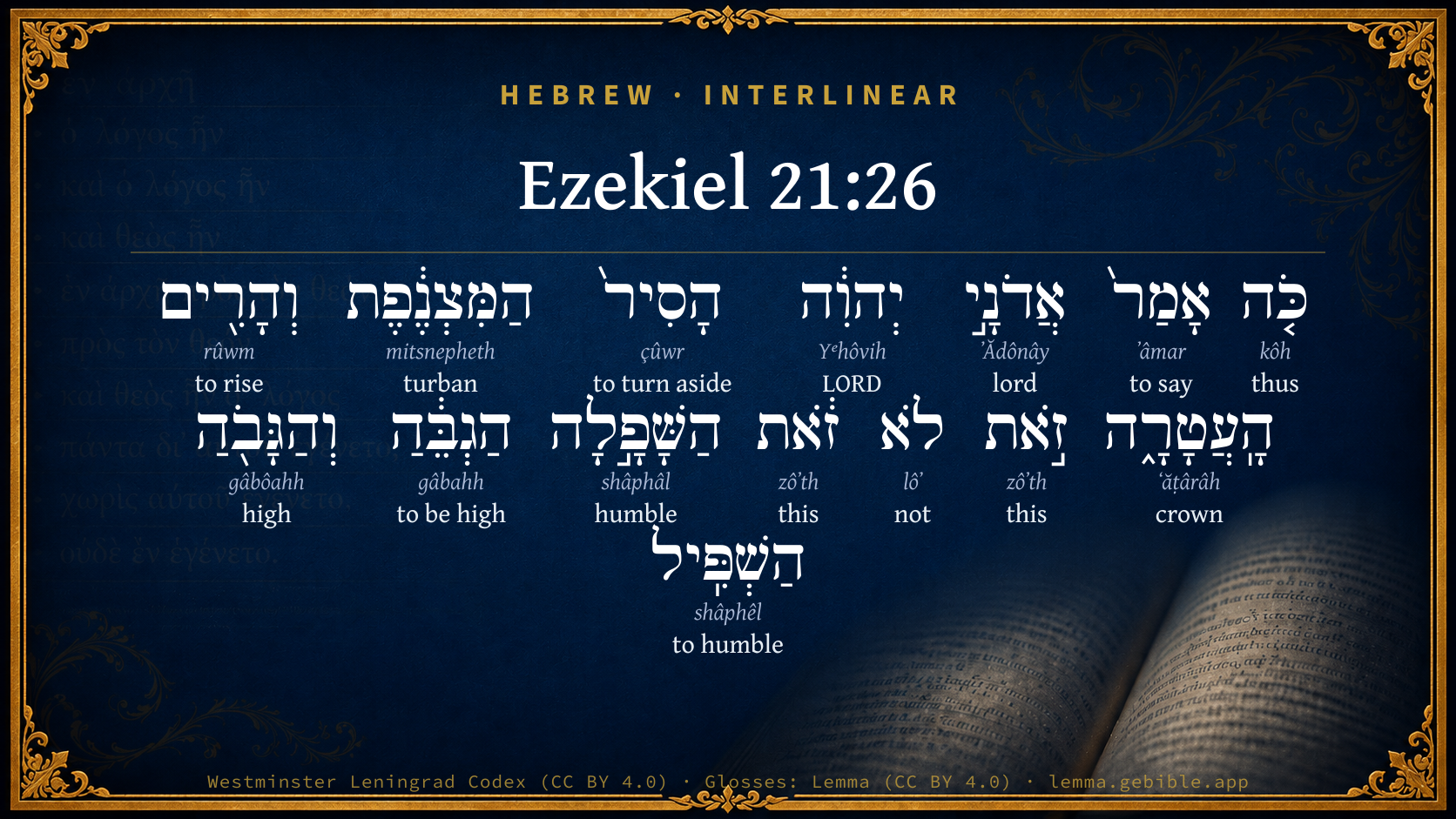
  1. כֹּ֤ה kôh H3541 “thus” Adverb
  2. אָמַר֙ ʼâmar H559 “to say” Verb, Qal, Perfect, 3rd Person, Masculine, Singular
  3. אֲדֹנָ֣י ʼĂdônây H136 “Lord · my” Noun, Common, Masculine, Plural, Construct + Suffix, Personal, 1st Person, Common, Singular
  4. יְהוִ֔ה Yᵉhôvih H3069 “LORD” Noun, Proper
  5. הָסִיר֙ çûwr H5493 “turn aside” Verb, Hiphil, Imperative, 2nd Person, Masculine, Singular
  6. וְהָרִ֖ים rûwm H7311 “and · rise” Conjunction + Verb, Hiphil, Imperative, 2nd Person, Masculine, Singular
  7. הָֽעֲטָרָ֑ה ʻăṭârâh H5850 “the · crown” Particle, Definite Article + Noun, Common, Feminine, Singular, Absolute
  8. זֹ֣את zôʼth H2063 “this” Pronoun, Demonstrative, Feminine, Singular
  9. לֹא lôʼ H3808 “not” Particle, Negative
  10. זֹ֔את zôʼth H2063 “this” Pronoun, Demonstrative, Feminine, Singular
  11. הַשָּׁפָ֣לָה shâphâl H8217 “the · humble” Particle, Definite Article + Adjective, Adjective, Feminine, Singular, Absolute
  12. הַגְבֵּ֔הַ gâbahh H1361 “to be high” Verb, Hiphil, Infinitive Absolute
  13. וְהַגָּבֹ֖הַ gâbôahh H1364 “and · the · high” Conjunction + Particle, Definite Article + Adjective, Adjective, Masculine, Singular, Absolute
  14. הַשְׁפִּֽיל shâphêl H8213 “to humble” Verb, Hiphil, Infinitive Construct

About this verse

These counts appear in no published source. They are computed here, from the morphology-tagged text and Lemma’s own curated glosses. What Lemma adds →

15
words
14
distinct lemmas
Prophets
section

Notable vocabulary

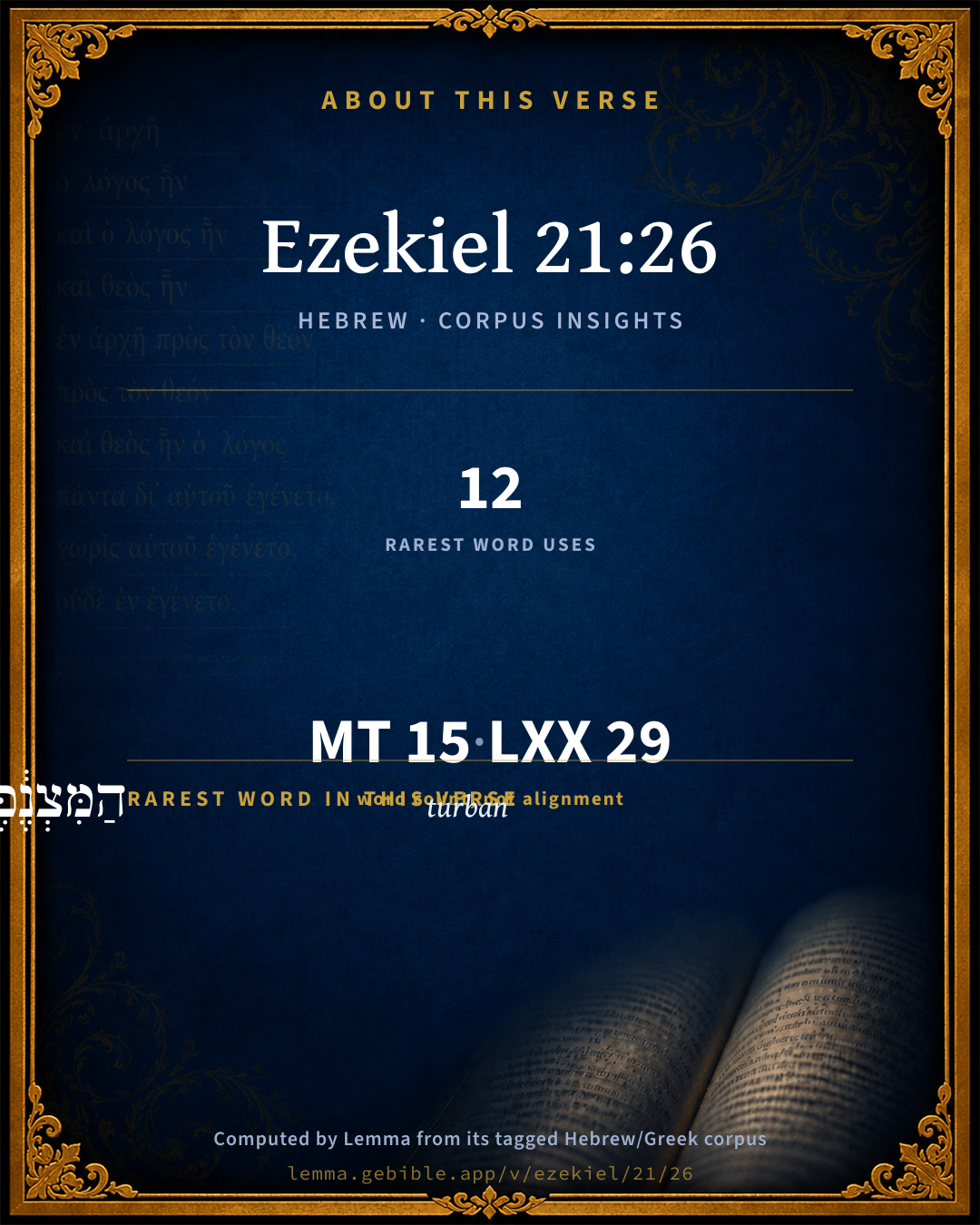
The rarest word here is הַמִּצְנֶ֔פֶת turban H4701 — appearing just 12 times in the whole Hebrew Bible.

Shared distinctive vocabulary

הַמִּצְנֶ֔פֶת turban H4701 occurs in 9 verses of the Hebrew Bible. Also found in:

Grammatical profile

  • 5 verbs
  • 4 nouns
  • 2 adjectives
  • 2 pronouns
  • 1 adverb
  • 1 particle

Verb forms

  • אָמַר֙ Qal · Perfect
  • הָסִיר֙ Hiphil · Imperative
  • וְהָרִ֖ים Hiphil · Imperative
  • הַגְבֵּ֔הַ Hiphil · Infinitive Absolute
  • הַשְׁפִּֽיל Hiphil · Infinitive Construct

Repetition

A word recurs within this verse — often emphatic in Hebrew:

  • זֹ֣את this H2063 ×2

Hebrew & Septuagint length

In English translation the verse runs 31 words from the Hebrew and 32 from the Septuagint (LXX English) — closely comparable.

A rough comparison of the two English renderings, which tokenize alike — not a word-level alignment.

Word counts can differ between the Hebrew and the Greek without any difference in meaning — e.g. the Hebrew direct-object marker אֵת has no separate Greek word, and Greek often adds the article ὁ.

In the original languages it is 15 Hebrew tokens and 29 Greek tokens — but the two are counted differently (Hebrew bundles its prefixes and suffixes into one token; the Greek is in lemma form), so that isn’t a like-for-like length.

Cross-references

14

Topical passages linked to Ezekiel 21:26 in the Treasury of Scripture Knowledge — connected by theme and wording, ordered by reader-vote popularity; previews shown in the World English Bible.

  • Ezekiel 17:24 All the trees of the field shall know that I, Yahweh, have brought down the high tree, have exalted the low tree, have dried up the green tree, and have made the dry tree to flourish; I, Yahweh, have spoken and have done it.
  • Psalms 75:7 But God is the judge. He puts down one, and lifts up another.
  • Jeremiah 13:18 Say you to the king and to the queen-mother, Humble yourselves, sit down; for your headdresses are come down, even the crown of your glory.
  • Jeremiah 52:31–34 It happened in the seven and thirtieth year of the captivity of Jehoiachin king of Judah, in the twelfth month, in the five and twentieth day of the month, that Evilmerodach king of Babylon, in the [first] year of his reign, lifted up the head of Jehoiachin king of Judah, and brought him forth out of prison;
  • Jeremiah 52:9–11 Then they took the king, and carried him up to the king of Babylon to Riblah in the land of Hamath; and he gave judgment on him.
  • Ezekiel 16:12 I put a ring on your nose, and ear-rings in your ears, and a beautiful crown on your head.
  • Luke 1:52 He has put down princes from their thrones. And has exalted the lowly.
  • 1 Samuel 2:7–8 Yahweh makes poor, and makes rich: He brings low, he also lifts up.
  • 2 Kings 25:6 Then they took the king, and carried him up to the king of Babylon to Riblah; and they gave judgment on him.
  • 2 Kings 25:27 It happened in the seven and thirtieth year of the captivity of Jehoiachin king of Judah, in the twelfth month, on the seven and twentieth day of the month, that Evilmerodach king of Babylon, in the year that he began to reign, did lift up the head of Jehoiachin king of Judah out of prison;
  • Psalms 113:7–8 He raises up the poor out of the dust. Lifts up the needy from the ash heap;
  • Jeremiah 39:6–7 Then the king of Babylon killed the sons of Zedekiah in Riblah before his eyes: also the king of Babylon killed all the nobles of Judah.
  • Lamentations 5:16 The crown is fallen from our head: Woe to us! for we have sinned.
  • Ezekiel 12:12–13 The prince who is among them shall bear on his shoulder in the dark, and shall go forth: they shall dig through the wall to carry out thereby: he shall cover his face, because he shall not see the land with his eyes.

Cross-references courtesy of OpenBible.info (CC BY 4.0).

Hebrew and Greek witnesses Masoretic Hebrew ↔ Greek Septuagint

The same verse in the two great witnesses to the Old Testament, shown verse-for-verse.

These are two independent witnesses, not word-aligned to each other, and the Septuagint is shown in lemma (dictionary) form.

Hebrew Ezekiel 21:26 Masoretic · Westminster Leningrad Codex

כֹּ֤ה אָמַר֙ אֲדֹנָ֣י יְהוִ֔ה הָסִיר֙ הַמִּצְנֶ֔פֶת וְהָרִ֖ים הָֽעֲטָרָ֑ה זֹ֣את לֹא זֹ֔את הַשָּׁפָ֣לָה הַגְבֵּ֔הַ וְהַגָּבֹ֖הַ הַשְׁפִּֽיל

thus says the Lord Yahweh: Remove the turban, and take off the crown; this [shall be] no more the same; exalt that which is low, and abase that which is high.

World English Bible · Public Domain

Greek LXX Ezekiel 21:26 Septuagint · lemma form

διότι ἵστημι βασιλεύς βαβυλών ἐπί ὁ ἀρχαῖος ὁδός ἐπί ἀρχή ὁ δύο ὁδός ὁ μαντεύομαι μαντεία ὁ ἀναβράζω ῥάβδος καί ἐπιἐρωτάω ἐν ὁ γλυπτός καί ἡπατοσκοπέω ἐκ δεξιός αὐτός

You have taken off the mitre and put on the crown, it shall not have such another after it: you have abased that which was high, and exalted that which was low.

LXX2012 (modern English Septuagint) · Public Domain

Hebrew: Westminster Leningrad Codex (CC BY 4.0). Greek: Septuagint (public domain); English from LXX2012 (modern English Septuagint) (Public Domain). How the Septuagint differs from the Hebrew →

Targum (Aramaic paraphrase)

1

The Targum is the ancient Jewish Aramaic paraphrase of the Hebrew Scriptures — an interpretive translation, not the Hebrew text itself. Onkelos (literal) and Pseudo-Jonathan (expansive) render the Torah, and Jonathan the Prophets. Coverage is partial: where no permissively-licensed English translation exists for a verse, only the Aramaic is shown. This is verse-level text, not a word-by-word alignment to the Hebrew.

  1. Targum Jonathan Prophets (Joshua–Malachi)
    אֲרֵי קָם מַלְכָּא דְבָבֶל עַל אֵם פְּרָשׁוּת אוֹרַח בְּרֵישׁ תַּרְתֵּין אוֹרַח לְמִקְסָם קָסֶם קְשַׁת בְּגִרְרַיָא שָׁאַל בְּצַלְמְנַיָא חֲזָא בְּכַבְדָא:

    (no public-domain English translation for this verse)

    Targum Jonathan — Aramaic: “Mikraot Gedolot” (public domain). English: “Sefaria Community Translation” (CC0 1.0 (public-domain dedication)); “London "Chaldee Paraphrase," 1871” (public domain). Text via Sefaria.

Commentary

Notes on Ezekiel 21:26 from classic Christian and Jewish commentators (each source and its license shown beneath its notes). The classic Christian expositions comment on the surrounding passage and are grouped to its opening verse, so a note may address several verses; the Jewish commentaries on the Tanakh (Rashi and others) are per-verse, so they appear only where the commentator wrote on this verse.

Lemma curates 59 commentaries, every one of them public domain or Creative Commons licensed, each selected and text-cleaned for this edition rather than reprinted as found. About our sources →

Trapp's Complete Commentary

John Trapp

Eze 21:26 Thus saith the Lord GOD; Remove the diadem, and take off the crown: this [shall] not [be] the same: exalt [him that is] low, and abase [him that is] high.

Ver. 26. Remove the diadem.] This was a fine linen cloth, wherewith the king’s head used to be bound about, {a} and then the crown was set on.

Take off the crown.] Our Richard II, when to be deposed, was brought forth crowned and in royal robes. Never, saith the chronicler, was prince so gorgeous with less glory and more grief.

This shall not be the same.] Haec non erit haec. This crown or kingdom shall not be as it hath been.

Exalt him that is low.] Jeconiah, or, as some will, Christ the King of the Church.

And abase him that is high.] {b} Zedekiah. Let him not henceforth be the master of a molehill, nor owner of his own liberty. In him let it appear that mortality is but the stage of mutability.

{a} Diadema, of διαδειν circumligare.

{b} Just the same that Cambyses threatened unto Egypt, τα μεν ανω κατω, τα δε κατω ανω. - Herod., lib. ii.

John Trapp, A Commentary or Exposition upon All the Books of the Old and New Testament (1647–1656) — public domain. Text from a community e-Sword module.

The Biblical Illustrator

Joseph S. Exell

Eze_21:26-27

Thus saith the Lord God; Remove the diadem, and take off the crown.

The Christian philosophy of revolution

The true philosophical history of man is that which reveals to us the causes and progress, first, of his depravity and deterioration; and secondly, of his return towards that state of holiness and happiness which he is destined, in the purpose of God, and through the agency of the Gospel, again to attain. The progression which the history of the race exhibits has been in cycles, and not in straight lines. In accordance with the principle announced by the prophet of Jehovah to the profane and wicked Prince of Israel, it has been a process of revolution and not of development. It involves the law of declension and decay, as much as that of quickening and growth. In the first place, the origin of the human race was not from a state of barbarism, but one of absolute perfection; and the first change which passed upon human nature was that by which it fell into degeneracy, by reason of temptation from without. Social happiness was blighted, and perished in the bud. The very first offspring of the social state, instead of love, sympathy, and mutual support, were, first, envy, then hatred, and lastly murder. Alienation and division thus became at once the universal law of society. In the first place, the earliest ages of the world after the fall, when the light of revealed truth was dimmest, and the reign of grace most feeble, were marked by a rapid degeneration, physical, intellectual, and moral, in the nature, the character, and the condition of man. In the second place, when the power of sin was checked by larger gifts of gracious influence, the power of Divine truth became diffusive, and entered upon its aggressive work in the achievement of mans regeneration; and has continued to the present hour, progressive; and, judging from the history of the past, and the characteristics of the present, as well as the prophetic delineation of the future, it will continue steadily progressive, till its final and perfect consummation. In the third place, the great agent by which this progress has been carried forward is that of revolution, or that of overturning, overturning, overturning, till He shall come whose right it is to wear the crown of universal dominion, amidst the redeemed race of man. In any comprehensive survey of the subject, the central epoch of human history is the advent of the Son of God. Everything anterior to that event pointed to the incarnation as embracing the fulness of its significancy, and everything subsequent derives its vitality and power from the same source. To the eye of the Christian, and in the light of the Bible, those vast and sublime overturnings which reared and overthrew successively the gigantic empires of Egypt, Assyria, Persia, and Macedon, to say nothing of countless smaller states, which concentrated the intellect, the genius, and the cultivation of the world in the States of Greece, and finally enthroned Rome as sole mistress of the earth, these all appear as mighty and indispensable agencies, commissioned of God to produce that mental culture, that feeling of strong, unsatisfied religious want, and that state of universal peace, which were essential to prepare the world for the advent of the Son of God. And now in like manner we believe the peculiar dispensation of the age, and specifically of the race to which we belong, is to leaven the philosophy, the literature, the morality, and the civil and political institutions of the world with the religion of the Bible, and then carry their elevating, purifying influence throughout the earth. This is the last of the great dispensations of the worlds progressive history. The true and final civilisation of the race, as statesmen and philosophers delight to call it, is just that which owes to Christianity both the life of its being and the law of its forms. It was designed for the whole family of man; and it will therefore embrace the whole. Changes are passing upon the internal policy and the outward face of nations, with a rapidity as much greater than those of the early ages of history as the modes of locomotion and the intercourse of the world have been improved by the agencies of steam and magnetic electricity. The progress of human events toward their ultimate goal, like some mighty mass acted upon by a constant mechanical force, is ever accelerating as it advances. This is preeminently true of the very point of time now passing. The plot thickens. Events crowd with ever-accumulating momentum toward the appointed end. The watchwords of the downtrodden classes of the Old World--Liberty, Equality, Fraternity--are not so far from the embodiment of the true and fundamental principles of that very civilisation which yet awaits the human race. But as to the sources whence these blessings are to come, they are, by the necessities of their previous condition, wholly in the dark. The liberty which they are blindly struggling after, in the turbulent and bloody track of radicalism, is to be realised in the enfranchisement of the Gospel, and grounded on that personal liberty wherewith Christ makes His people free. The equality to which their inward convictions assure them they are entitled is not an agrarian equality of social and material position, but an equality in human rights, founded on an equality of moral condition and desert in the sight of God; and the fraternity emblazoned on their motto is the genuine, but it may be the perverted, heart utterance of the conscious right to membership in that common brotherhood of humanity which springs out of the common Fatherhood of God. The whole and every item of this ideal longing of humanity in its most degraded and dangerous forms, and which has been moulded into the war cry of modern revolution, is destined to fulfilment; but in a form and from a source widely different from that to which the ignorant and vicious and dangerous paupers and outcasts of the world are looking for succour. They shall yet enjoy all, and more than all, their brightest hopes, but only as a fruit of the Gospel of Christ. (M. B. Hope, D. D.)

National revolutions

Our day is one of unusual excitement; mind is everywhere agitated; the foundations are out of place; the earth reels like a drunken man; sceptres are broken; dynasties tremble; the diadem is removed and the crown taken off; thrones are burnt in the open streets; kings flee for their lives to foreign shores; mens hearts are failing them for fear, and for looking after those things that are coming on the earth, for the powers of heaven are shaken.

I. National revolutions are symptomatic of moral disorder. They are the result of one or more causes of an evil, or a series of evils, which have been long accumulating and gathering force and strength, until the terrible crisis comes, when, like the central fires of the earth rushing to the volcano, an eruption takes place, and men are filled with astonishment and oppressed with awe. All the manifestations of injustice are evidences of the moral disorder to which I allude.

1. Religious persecution.

2. The withholding of political rights.

3. Positive oppression.

II. National revolutions are in harmony with individual experience and material phenomena. The individual is the type of the nation. The nation is but the individual on a broader scale. The body politic is congregated men. The mass is the man multiplied. We are firmly persuaded that the security of a nation is not in the form, but in the moral integrity of its government. Righteousness exalteth a nation. We deprecate injustice, whether it emanate from a throne or a presidential chair; and tyranny, whether it come from a man or a mob; and slavery, whether it exist under a despotism or a republic. Again, as in the individual, so in the nation; if there be the conservative power of health, it will struggle for the mastery. The accumulated moral disease must destroy vitality, or be thrown to the surface by revolution. We find another analogy in material laws. The inequality of the earths surface is conducive to the health of vegetables and animals. The roaring cataract stuns the beholder, but he inhales not there the poison of the stagnant pool. The sweeping wind makes the forest to groan, but it causes its roots to strike deeper in the earth, and the juices of vegetable life are increased. The thunders of heaven, with their herald-lightnings, appall and terrify us, but they are the physicians of the atmosphere, and drive pestilence from the land.

III. National revolutions are the voice of God speaking to the world.

1. They proclaim the vanity of all artificial greatness. The Lord is known by the judgment which He executeth. He leadeth princes away spoiled, and overthroweth the mighty. He poureth contempt upon princes, and causeth them to wander in the wilderness where there is no way.

2. By these revolutions God utters His protest against tyranny. God is the God of justice, the Friend of the needy, the Avenger of the oppressed; and those that walk in pride He is able to abase. His voice, if despised in His word, is lifted up in the storm, the tempest, the plague, and the revolution; and it is the protest against injustice and oppression.

3. Another lesson read to the their victories worthless; their wars, sin; their pride, rebellion; their honours, transient; their wealth, evanescent; their glory, a fading flower; and their destiny, extinction from under these heavens.

IV. These revolutions are forerunners of the Redeemers righteous reign. The Redeemer will come again--not to be betrayed, mocked, and crucified; but to be glorified in His saints, and admired in all them that believe; to be hailed as the Prince of peace--the liberator of every bondman--the joy of every loyal heart--the desire of all nations; to be crowned, amid the hosannahs of an exulting world, while the smiling heavens are vocal with the intermingling hallelujahs of angels and men. (W. Leask.)

The Biblical Illustrator, edited by Joseph S. Exell (c. 1880s–1900s) — public domain. Text from a community e-Sword module.

Geneva Bible (1599)

Geneva Bible translators

Some refer this to the Priest’s attire: for Jehozadak the Priest went into captivity with the king.

Geneva Bible (1599) marginal notes — public domain. Text via Bolls.life.

Jamieson, Fausset & Brown

Robert Jamieson, A. R. Fausset & David Brown

diadem--rather, "the miter" of the holy priest (Exo 28:4; Zac 3:5). His priestly emblem as representative of the priestly people. Both this and "the crown," the emblem of the kingdom, were to be removed, until they should be restored and united in the Mediator, Messiah (Psa 110:2, Psa 110:4; Zac 6:13), [FAIRBAIRN]. As, however, King Zedekiah alone, not the high priest also, is referred to in the context, English Version is supported by GESENIUS.

this shall not be the same--The diadem shall not be as it was [ROSENMULLER]. Nothing shall remain what it was [FAIRBAIRN].

exalt . . . low, . . . abase . . . high--not the general truth expressed (Pro 3:34; Luk 1:52; Jam 4:6; Pe1 5:5); but specially referring to Messiah and Zedekiah contrasted together. The "tender plant . . . out of the dry ground" (Isa 53:2) is to be "exalted" in the end (Eze 21:27); the now "high" representative on David's throne, Zedekiah, is to be "abased." The outward relations of things shall be made to change places in just retaliation on the people for having so perverted the moral relations of things [HENGSTENBERG].

Jamieson, Fausset & Brown — Commentary Critical and Explanatory on the Whole Bible (1871) — public domain (CC PDM 1.0). Text via the HelloAO Bible API.

Adam Clarke's Commentary

Verse 26. Exalt him that is low] Give Gedaliah the government of Judea.

Abase him that is high] Depose Zedekiah - remove his diadem, and take off his crown.

Adam Clarke's Commentary on the Bible (1810–1826) — public domain. Text from a community e-Sword/MySword module.

Ellicott's Commentary for English Readers

(26) Remove the diadem.—The word translated “diadem” is rendered in every other place in which it occurs (Exo_28:4; Exo_28:37 bis, Exo_28:39; Exo_29:6 bis, Exo_39:28; Exo_39:31; Lev_8:9 bis, Exo_16:4) the mitre of the high priest, and undoubtedly has the same sense here. Not only was the royal but also the high-priestly office to be overthrown in the approaching desolation. Neither of them were ever recovered in their full power after the captivity. The various verbs here, remove, take off, exalt, abase, are in the original in the infinitive, and although it is sometimes necessary to translate the infinitive as an imperative, it is better here to keep to its more common sense of indicating an action without reference to the agent which is most readily expressed in English by the passive: “The mitre shall be removed, and the crown taken off . . . the low exalted, and the high abased.”

This shall not be the same.—Literally, this not this, or, supplying the verb, as is often required, this shall not be this—i.e., as the following clauses express, there shall be an utter change and overturning of the whole existing state of things. For the abasement of the high and exaltation of the low, as an expression of the Divine interposition at the introduction of a new order of things, comp. 1Sa_2:6-8; Luk_1:51-53.

A Bible Commentary for English Readers, edited by Charles John Ellicott (1878–1897) — public domain. Text from a community e-Sword module.

The Cambridge Bible for Schools and Colleges

gen. ed. J. J. S. Perowne

26. The term “diadem” is used of the mitre of the high-priest, Exo_28:4. There can be no reference to the high-priest here, the passage refers exclusively to the royal house, which shall be discrowned.

this … the same] The somewhat enigmatical words mean probably: this is not that, i.e. the present royal house and régime is not that which shall be (the Messianic), as Eze_21:27 explains. Or, this shall not remain this, i.e. what it is, it shall be removed and give place to something higher to come, Eze_21:27.

exalt … that is high] let that be exalted which is low, and that which is high be abased. The words “overturn,” &c., Eze_21:27 explain the idea. The present order shall disappear, the high shall be abased and at last that which is humble shall be exalted, cf. Eze_17:24.

The Cambridge Bible for Schools and Colleges (gen. ed. J. J. S. Perowne; Cambridge University Press, 1878–1918) — public domain. Text from a community e-Sword module.

John Gill's Exposition

And thou, son of man, prophesy, and say,.... Here begins a new prophecy, or rather an enlargement on part of the former; two ways being marked out for the sword of the Chaldeans to come in; the one leading to Jerusalem, the other to Rabbath of the Ammonites; the prophecy being finished concerning the former, here an account is given of the latter; how the sword should move that way, and what execution it would do:

thus saith the Lord God concerning the Ammonites, and concerning their reproach; Nebuchadnezzar, agreeably to the above prophecy, having taken his route to Jerusalem, as his divination directed him, and destroyed that, returned to Babylon, without making any attempt upon the Ammonites; which so flushed them, that they insulted the Jews, and laughed at their destruction, as if their God whom they served could not save them; attributing their safety and prosperity to the idols they worshipped; see Eze 25:1,

even say thou, the sword, the sword is drawn for the slaughter; the same sword of the Chaldeans, which was drawn for the slaughter of the Jews, is now drawn for the slaughter of the Ammonites; and which is repeated for the certainty of it, and to inject terror; and this, as Josephus (u) says, was accomplished five years after the destruction of Jerusalem, in the twenty third year of Nebuchadnezzar:

it is furbished, to consume because of the glittering; being brightened and made sharp, it not only terrified with its glittering, but was more fit and prepared to cut and destroy; see Eze 21:9.

(u) Antiqu. Jud. l. 10. c. 9. sect. 7.

John Gill's Exposition of the Whole Bible (1746–1763) — public domain (CC PDM 1.0). Text via the HelloAO Bible API.

Haydock's Catholic Bible Commentary

Diadem, (cidarim.) Some think this was th ornament of the high priest, (St. Jerome; Chaldean) denoting that he should perish as well as the king. (Haydock) --- This. The royal crown of Juda had exalted Sedecias from a private state and condition to the sovereign power, as the loss of it brought down Jechonias, &c. (Challoner) --- It shall be given go Godolias. (Chaldean) Hebrew, "it is not (Haydock) or shall be no more" the same, or for the posterity of Sedecias. None of the tribe of Juda was truly king after him, till the Messias. (Sanctius; Tirinus, &c.) (Genesis xlix. 10.) (Calmet)

George Leo Haydock (1774–1849), Haydock's Catholic Family Bible and Commentary, 1859 edition — public domain. Excludes Psalms (Douay-Rheims chapter numbering differs from Protestant) and Deuterocanonical books (Catholic canon only).

Matthew Poole's English Annotations

Either God speaks to the prophet to declare the thing, or to Nebuchadnezzar to do the thing, to take away the diadem, the royal tire of the head, which the king did ordinarily and daily wear.

The crown; which was a royal ornament used on solemnities, and more than ordinary occasions; or it may be one thing in doubled expressions of the deposing of Zedekiah.

The same; the kingdom and crown shall never be what it hath been; as we say of one greatly altered, He is not himself, so here, This shall not be the same; it was great, glorious, and flourishing, but hereafter small, dependent, ignoble, and withering.

Exalt him; Jeconiah; it is probable the prophet foretells the advance of this captive king, which came to pass in the 37th year of Jeconiah’s captivity, in the first year of Merodach, 2Ki 25:27-29; Jer 52:31, who exalted his seat above all the captive kings in Babylon.

That is low; now in captivity in Babylon. Abase him; Zedekiah, That is high; not now on the throne of Judah, strengthened with the confederacy of Egypt, on which he relieth, and exalteth himself, and bears himself high against the prophet, the king of Babylon, and, which is most insolent, against the God of heaven.

Matthew Poole's English Annotations on the Holy Bible (1683–1685) — public domain. Text from a community e-Sword/MySword module.

Whedon's Commentary on the Bible

Daniel D. Whedon

26. Diadem — “Miter” (Exo_28:4).

This shall not be the same — Dr. Davidson remarks that these enigmatical words probably mean, “This is not that;” that is, the present royal house and regime is not that which shall be (the Messianic), as Eze_21:27 explains; or “this shall not remain this;” that is, what it is; it shall be removed and give place to something higher to come (Eze_21:27).

Exalt him that is low, and abase him that is high — Rather, the low shall be exalted and the high abased. (See Eze_21:27; Eze_17:24.)

Daniel D. Whedon (gen. ed.), Commentary on the Old and New Testaments (1874–1909) — public domain. Text from a community e-Sword module.

The Pulpit Commentary

Remove the diadem, etc. The noun is used throughout the Pentateuch (e.g. Exo_28:4 Exo_37:3-9; Lev_8:9 Lev_16:4) for the "turban" or "mitre" of the high priest, and Keil so takes it here, as pointing to the punishment of the priest as well as of the king. This shall not be the same; literally, this shall not be this; or, as the Revised Version paraphrases, this shall be no more the same; i.e. the mitre and the crown shall alike pass away taken from their unworthy wearers. There was to be, as in the following words, a great upturning of all things; the high brought low, the lowly exalted.

Vers. 26, 27. The Divine reversal.

The judgments of God are not in vain. The sword is not sheathed until the purposes of infinite righteousness are achieved. War leads to such an end, to such a place, as eternal wisdom approves. No good end would be answered by Divine interposition, did all things go on as before. A Divine reversal crowns the work.

I THE HISTORICAL FACT. The primary reference of the prophet is doubtless to the downfall of the usurping, rebellious, treacherous, plotting prince of Judah, i.e. Zedekiah. His true policy lay in subjection to Nebuchadnezzar; instead of adopting and holding fast by this policy, he was ever endeavouring to free himself from the yoke, in the vain hope of independence. It was foreseen and predicted by Ezekiel that this should lead to his destruction.

II THE MORAL, GOVERNMENTAL PRINCIPLE SUGGESTED BY THIS FACT. We learn that the Omnipotent Ruler is not indifferent to what happens among the nations, that he works in and through the ordinary laws of human action, and may sometimes work by extraordinary and exceptional means. Certain it is that his ways are not as men"s ways. The great are often overthrown, and the feeble exalted, by the operation of his wise and merciful providence. God confounds all human policy and defeats all human expectations, exalts the low, and at the same time abases the high. The mitre and the crown are taken from the forehead of the powerful, and are placed upon the lowliest, brows.

III THE TYPICAL AND SPIRITUAL APPLICATIONS OF THIS PRINCIPLE. There is a grandeur in this language which seems almost to compel its reference to greater events than those which happened in Jerusalem during the Eastern captivity. The kingdom of sin is mighty, and then have often felt how utterly vain it is to expect that kingdom to yield to any human attack. Ignorance and error, vice and crime, superstition and infidelity, have through millenniums of human history acquired over humanity a power which seems irresistible and invincible. But there is One "whose right it is" to reign, and he, the Son of God, has come in the flesh, and has come in the dispensation of the Holy Spirit. In his favour, and in order to secure his universal conquest, his everlasting dominion, the Most High is overturning, ever overturning. He is the High Priest, the rightful King, of the humanity whose nature he assumed, and fur whose salvation he died. The mitre and the crown are his of right, and to him they shall be given. Every usurper shall be defeated and disgraced; and Christ, whose right it is to reign, shall receive the kingdom, and his dominion shall have no end. T.

The Pulpit Commentary (1880–1919), ed. H.D.M. Spence-Jones & Joseph S. Exell — public domain. Text from a community e-Sword module.

John Wesley's Explanatory Notes

The diadem - The royal attire of the head, which the king daily wore. Shall not be the same - The kingdom shall never be what it hath been. Him that is low - Jeconiah. The advance of this captive king, came to pass in the thirty-seventh year of his captivity.

John Wesley, Explanatory Notes Upon the Whole Bible (1754–1765) — public domain. Text via the GEBible commentary corpus.

Rashi

Rabbi Shlomo Yitzchaki (Rashi)

the crossroads Heb. אֵם הַדֶרֶךְ, carrefour in French, crossroads.

he furbished the arrows Heb. קִלְקַל, he furbished the arrows with a glitter. He shot an arrow upward, and it turns by itself right or left, and to the place it turns—that is the lot.

he flashed with the arrows Menachem (p. 155), connected it with (above 1:7): “burnished (קָלָל) copper”; (Ecc. 10:10): “and he did not sharpen (קִלְקֵל) the edge.” It may also be explained as an expression of deterioration, as in (Jer. 4:24): “and all the hills deteriorated (הִתְקַלְקָלוּ).” Some translate קִלְקַל into French, as trait, he shot, and Jonathan as well renders קִלְקַל בֲּחִצִים as קְשֲּׁתבְּגִרְרֲיָא.

he inquired of the teraphim An image that talks through magic, and there is a set time, that if one makes it at that time, it possesses speech forever.

looked into the liver There are some experts who divine with liver.

Rashi on the Tanakh — English translations: “The Judaica Press complete Tanach with Rashi, translated by A. J. Rosenberg” (CC BY 4.0); “Pentateuch with Rashi's commentary by M. Rosenbaum and A.M. Silbermann, 1929-1934” (public domain); “The Metsudah Tanach series, Lakewood, N.J” (CC BY 4.0); and “The Book of Joshua, Metsudah Publications, 1997” (CC BY 4.0). Text via Sefaria.

Lesson kit

Teaching starters — assembled from the data on this page, not authored interpretation. Every prompt links to the verse data it draws on. Edit before teaching.

Ezekiel, in the Prophets, opens this verse with 15 words (14 distinct Hebrew lemmas). Its most distinctive word is mitsnepheth (“turban”). A historical commentator’s framing appears above. Read the whole chapter for the surrounding context.

Discussion questions

  1. How does “turban” (mitsnepheth) shape what this verse is saying?
  2. Exodus 28:4 shares the word «turban» with this verse. How do the two illuminate each other?
  3. “this” occurs 2× in this one verse. What is the effect of the repetition?
  4. The translations on this page render this verse differently — a whole-verse word diff, not a word-by-word alignment. What might account for the different wordings?
  5. The verb «אָמַר֙» is Qal Perfect. How does its form color the action?
  6. Reading how Trapp's Complete Commentary and The Biblical Illustrator read this verse, where do the two commentators agree and where do they part?

Things to notice

Reading settings

Reading text

Shown beneath each verse's original-language words.

Old Testament
Old Testament edition

Read the OT as the Masoretic Hebrew (MT) or the Greek Septuagint (LXX).

English shown for the Greek Septuagint (in the Hebrew ↔ Greek comparison).

Comparing translations? Open the Compare panel on any verse page to stack up to four side by side.