
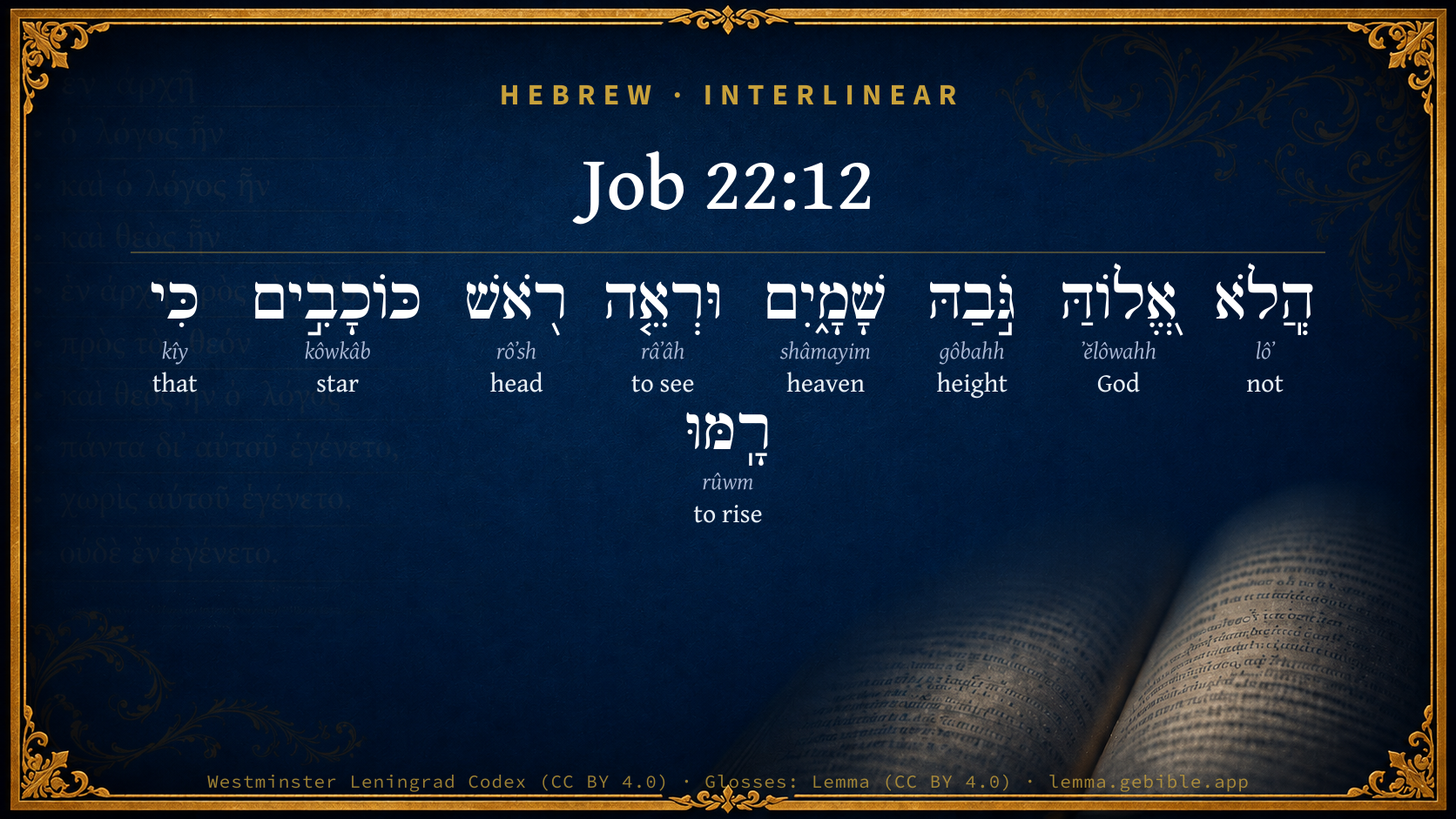
Job 22:12

Hebrew (Westminster Leningrad Codex) Job 22:12 appears in the Hebrew Old Testament. The text above is from the Westminster Leningrad Codex. Each word links to its Strong’s number, a concise gloss, and parsing drawn from the Open Scriptures Hebrew Bible morphology. Click any word for its full Brown-Driver-Briggs (BDB) entry.
Download image
Cite this verse

Job 22:12 (World English Bible). Public Domain. Lemma interlinear Bible study tool, https://lemma.gebible.app/v/job/22/12.

Show BibTeX & RIS
BibTeX
RIS
English Translation
"Isn't God in the heights of heaven? See the height of the stars, how high they are!
World English Bible · Public Domain
Download a study sheet

One document with this verse’s original text, its word-by-word gloss line, the meaning frame, cross-references with their text, attributed commentary, and full source and license credits — printable, and it pastes into notes with its structure intact.

This verse Autodidact and up

Study sheet (.html) Plain text (.txt)

A passage Seminary Student

Up to 50 verses in one chapter. A passage sheet keeps up to 6 commentary sources and 12 cross-references per verse, in the order this page ranks them, and says so on the sheet whenever that leaves anything out. Ask for a single verse and you get the Autodidact verse sheet above.

Everything on this page stays free to read, with no account — the sheet is a download of what is already on screen, not access to it.

Want to remove ads? Support Godless Engineer
Compare translations 3

The same verse in 3 English versions, stacked beneath the original-language interlinear above. Click any original word for its lexicon entry.

Each is an independent rendering of the whole verse — the interlinear is not word-aligned to these translations.

Highlighted words mark where these versions differ — a whole-verse word diff, not a word-by-word alignment.

  • World English Bible Public Domain
    "Isn't God in the heights of heaven? See the height of the stars, how high they are!
  • King James Version Public Domain
    Is not God in the height of heaven? and behold the height of the stars, how high they are!
  • unfoldingWord Literal Text CC BY-SA 4.0
    Is not God in the height of the heavens? And behold the head of the stars, that they are high!

unfoldingWord Literal Text — © unfoldingWord, licensed CC BY-SA 4.0. Word-aligned USFM3 via Door43 (git.door43.org/unfoldingWord/en_ult).

Versions to compare (up to 4)

3 of 4 selected

Show all 18 translations

Every available English version of this verse, each an independent rendering of the whole verse.

  • World English Bible Public Domain
    "Isn't God in the heights of heaven? See the height of the stars, how high they are!
  • Berean Standard Bible Public Domain
    Is not God as high as the heavens? Look at the highest stars, how lofty they are!
  • Majority Standard Bible Public Domain
    Is not God as high as the heavens? Look at the highest stars, how lofty they are!
  • King James Version Public Domain
    Is not God in the height of heaven? and behold the height of the stars, how high they are!
  • American Standard Version (1901) Public Domain
    Is not God in the height of heaven? And behold the height of the stars, how high they are!
  • Revised Version (1885) Public Domain
    Is not God in the height of heaven? and behold the height of the stars, how high they are!
  • Geneva Bible (1599) Public Domain
    Is not God on hie in the heauen? and behold the height of the starres how hie they are.
  • Douay-Rheims (1899) Public Domain
    Dost not thou think that God is higher than heaven, and is elevated above the height of the stars?
  • Young's Literal Translation Public Domain
    Is not God high `in' heaven? And see the summit of the stars, That they are high.
  • Literal Standard Version CC BY-SA 4.0
    Is God not high [in] the heavens? And see the summit of the stars, || That they are high.
  • Unlocked Literal Bible CC BY-SA 4.0
    Is not God in the heights of heaven? Look at the height of the stars, how high they are!
  • unfoldingWord Literal Text CC BY-SA 4.0
    Is not God in the height of the heavens? And behold the head of the stars, that they are high!
  • Darby Bible Public Domain
    Is not +God in the height of the heavens? And behold the summit of the stars: how exalted are they!
  • World Messianic Bible Public Domain
    “Isn’t God in the heights of heaven? See the height of the stars, how high they are!
  • Webster's Bible Public Domain
    Is not God in the hight of heaven? and behold the hight of the stars, how high they are!
  • Free Bible Version CC BY-SA 4.0
    Doesn't God live high in heaven and looks down on even the highest stars?
  • Bible in Basic English Public Domain
    Is not God as high as heaven? and see the stars, how high they are!
  • JPS Tanakh (1917) Public Domain
    Is not God in the height of heaven? And behold the topmost of the stars, how high they are!

Literal Standard Version (2020), Covenant Press — licensed CC BY-SA 4.0. Text via the HelloAO Bible API (eBible.org). Unlocked Literal Bible (unfoldingWord) — licensed CC BY-SA 4.0. Text via the HelloAO Bible API (eBible.org). unfoldingWord Literal Text — © unfoldingWord, licensed CC BY-SA 4.0. Word-aligned USFM3 via Door43 (git.door43.org/unfoldingWord/en_ult). Free Bible Version, Dr. Jonathan Gallagher — licensed CC BY-SA 4.0. Text via the HelloAO Bible API (eBible.org).

Word by word

More ways to search: Search by grammar → Find every occurrence → Compare this word →

Practice this passage: Drill this verse → Learn its vocabulary →

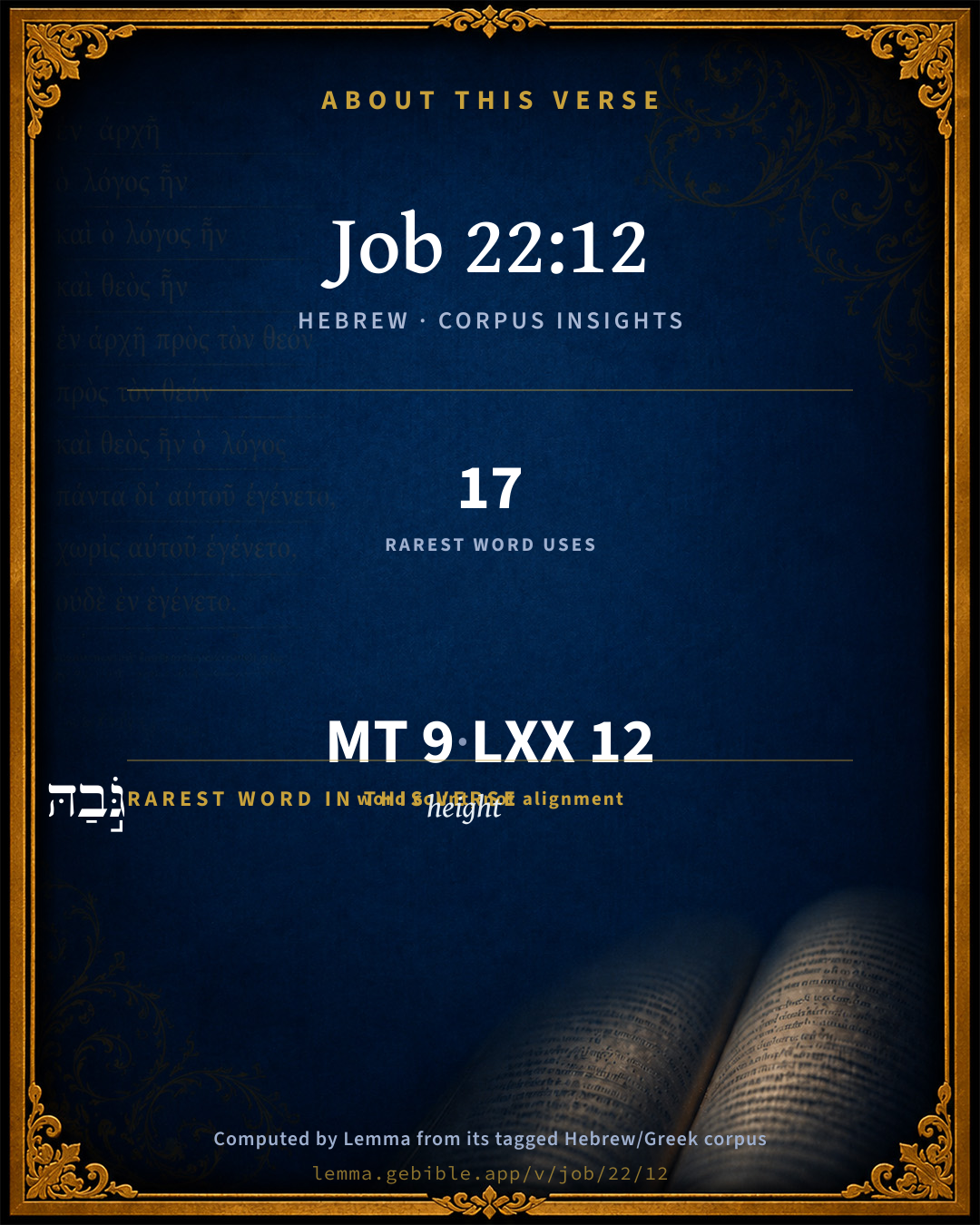
About this verse

These counts appear in no published source. They are computed here, from the morphology-tagged text and Lemma’s own curated glosses. What Lemma adds →

9
words
9
distinct lemmas
Wisdom
section

Notable vocabulary

The rarest word here is גֹּ֣בַהּ height H1363 — appearing just 17 times in the whole Hebrew Bible.

Shared distinctive vocabulary

גֹּ֣בַהּ height H1363 occurs in 16 verses of the Hebrew Bible. Also found in:

Grammatical profile

  • 2 verbs
  • 5 nouns
  • 1 conjunction
  • 1 particle

Verb forms

  • וּרְאֵ֤ה Qal · Imperative
  • רָֽמּוּ Qal · Perfect

Hebrew & Septuagint length

In English translation the verse runs 17 words from the Hebrew and 18 from the Septuagint (LXX English) — closely comparable.

A rough comparison of the two English renderings, which tokenize alike — not a word-level alignment.

Word counts can differ between the Hebrew and the Greek without any difference in meaning — e.g. the Hebrew direct-object marker אֵת has no separate Greek word, and Greek often adds the article ὁ.

In the original languages it is 9 Hebrew tokens and 12 Greek tokens — but the two are counted differently (Hebrew bundles its prefixes and suffixes into one token; the Greek is in lemma form), so that isn’t a like-for-like length.

Cross-references

7

Topical passages linked to Job 22:12 in the Treasury of Scripture Knowledge — connected by theme and wording, ordered by reader-vote popularity; previews shown in the World English Bible.

  • Job 11:8 They are high as heaven. What can you do? Deeper than Sheol: what can you know?
  • Psalms 8:3–4 When I consider your heavens, the work of your fingers, The moon and the stars, which you have ordained;
  • Ecclesiastes 5:2 Don't be rash with your mouth, and don't let your heart be hasty to utter anything before God; for God is in heaven, and you on earth. Therefore let your words be few.
  • Isaiah 66:1 Thus says Yahweh, heaven is my throne, and the earth is my footstool: what manner of house will you build to me? and what place shall be my rest?
  • Psalms 115:3 But our God is in the heavens. He does whatever he pleases.
  • Isaiah 57:15 For thus says the high and lofty One who inhabits eternity, whose name is Holy: I dwell in the high and holy place, with him also who is of a contrite and humble spirit, to revive the spirit of the humble, and to revive the heart of the contrite.
  • Psalms 115:16 The heavens are the heavens of Yahweh; But the earth has he given to the children of men.

Cross-references courtesy of OpenBible.info (CC BY 4.0).

Hebrew and Greek witnesses Masoretic Hebrew ↔ Greek Septuagint

The same verse in the two great witnesses to the Old Testament, shown verse-for-verse.

These are two independent witnesses, not word-aligned to each other, and the Septuagint is shown in lemma (dictionary) form.

Hebrew Job 22:12 Masoretic · Westminster Leningrad Codex

הֲֽלֹא אֱ֭לוֹהַּ גֹּ֣בַהּ שָׁמָ֑יִם וּרְאֵ֤ה רֹ֖אשׁ כּוֹכָבִ֣ים כִּי רָֽמּוּ

"Isn't God in the heights of heaven? See the height of the stars, how high they are!

World English Bible · Public Domain

Greek LXX Job 22:12 Septuagint · lemma form

μή οὐ ὁ ὁ ὑψηλός ναίω ἐπιὁράω ὁ δέ ὕβρις φέρω ταπεινόω

Does not he that dwells in the high places observe? and has he not brought down the proud?

LXX2012 (modern English Septuagint) · Public Domain

Hebrew: Westminster Leningrad Codex (CC BY 4.0). Greek: Septuagint (public domain); English from LXX2012 (modern English Septuagint) (Public Domain). How the Septuagint differs from the Hebrew →

Commentary

Notes on Job 22:12 from classic Christian and Jewish commentators (each source and its license shown beneath its notes). The classic Christian expositions comment on the surrounding passage and are grouped to its opening verse, so a note may address several verses; the Jewish commentaries on the Tanakh (Rashi and others) are per-verse, so they appear only where the commentator wrote on this verse.

Lemma curates 59 commentaries, every one of them public domain or Creative Commons licensed, each selected and text-cleaned for this edition rather than reprinted as found. About our sources →

The Cambridge Bible for Schools and Colleges

gen. ed. J. J. S. Perowne

12, 13. Eliphaz points to God’s place of abode in the lofty heavens (Job_22:12); and under this feeling of His infinite distance from the earth Job said, How doth God know? Men’s conduct was not observed by Him; the thick clouds obscured His vision.

And thou sayest] Rather, and thou saidst. On this mode of thought comp. Psa_94:7; Isa_29:15; Eze_8:12.

12–20. Eliphaz, having in Job_22:6-10 suggested what Job’s offences must have been, now suggests under what feeling in regard to God he must have committed them. He thought God so far removed from the world that He did not observe men’s conduct.

The Cambridge Bible for Schools and Colleges (gen. ed. J. J. S. Perowne; Cambridge University Press, 1878–1918) — public domain. Text from a community e-Sword module.

Trapp's Complete Commentary

John Trapp

Job 22:12 [Is] not God in the height of heaven? and behold the height of the stars, how high they are!

Ver. 12. Is not God in the height of heaven?] Some add out of the next verse these words, Sayest thou; making Job’s atheistic speeches (here mimetically fathered upon him by Eliphaz) an argument of his great wickedness; as if Job should say, and so discover himself ("for out of the abundance of the heart the mouth speaketh," Mat 12:34) to be of Protagoras’s opinion, who doubted Deity, De Diis, utrum sint non ausim affirmare ( Prot.); or of Diagoras’s, who flatly denied it; or, at least, of Aristotle’s, who pent up God in heaven, and taught that he took little or no care of things done on earth. But what saith the psalmist (and Job was of the same mind whatever the Jewish doctors affirm of him to the contrary)? "Our God is in the heavens; he hath done whatsoever he pleased" in heaven and in earth. "The Lord is high above all nations; and his glory above the heavens. Who is like unto the Lord our God, who dwelleth on high, who humbleth himself to behold the things that are in heaven and in the earth! He raiseth up the poor out of the dust," &c., Psa 115:3; Psa 113:4-7. "The eyes of the Lord run to and fro through the whole earth to show himself strong," &c., 2Ch 16:9. His wrath "is revealed from heaven against all ungodliness and unrighteousness of men," Rom 1:18. Job had frequently acknowledged and celebrated the power and providence of God, his judgments upon the wicked, his fatherly chastisements upon himself; deeply detesting all such thoughts and speeches as he is here wrongfully made the author of.

And behold the height of the stars] Heb. The head of the stars; those that are the very highest, and at the top of the visible heaven, the eighth heaven, beyond which some of the ancients acknowledged not any other. Aristotle saith, That beyond the aspect and movement in the heavens, there is neither body, nor time, nor place, nor vacuum. But the Scripture teacheth us that there is beyond the stars, how high set soever, a third heaven, a heaven of heavens, the throne of God, and habitation of the blessed; the starry sky is but as the brick wall encompassing this lofty palace, the glorious and glittering rough cast thereof.

How high they are!] Ut vix eo noster possit aspectus pertingere, so high that our eyes can hardly reach them (Mercer). It is a wonder that we can look up to so admirable a height, and that the very eye is not tired in the way. Now God is far, far above the stars, omnium supremus, altissimorum altissimus. "The high and lofty One, that inhabiteth eternity," Isa 57:15, dwelleth in light inaccessible, 1Ti 6:16, such as whereof no natural knowledge can be had, nor any help by human arts, geometry, optics, &c. How, then, can he see from such a distance what is here done on earth? saith the atheist; who thinks to hide himself from God, because he hath hidden God from himself. Propterea quod tantum Chaos sit inter nos et Deum (Vat.). Hear him else in the next verse. See also Eze 8:12; Eze 9:9.

John Trapp, A Commentary or Exposition upon All the Books of the Old and New Testament (1647–1656) — public domain. Text from a community e-Sword module.

The Biblical Illustrator

Joseph S. Exell

Job_22:12-13

Is not God in the height of heaven?

God brought near

Is there anything that can make God a present God? Bring Him from the height of heaven beyond the stars into conscious contact with the experience of daily life? There is. What? Philosophic reasoning. Correct reasoning on the subject must indeed convince man that if there be a God, He must be everywhere, and, therefore, ever at hand. But men may reach this conclusion, and yet practically regard their God as distant. Will natural science do it? True natural science must connect God with everything. Will scriptural theology do it? (Homilist.)

The Biblical Illustrator, edited by Joseph S. Exell (c. 1880s–1900s) — public domain. Text from a community e-Sword module.

Joseph Benson's Commentary

Job 22:12. Is not God in the height of heaven? — Surely, he is; and from that high tower he looketh down upon men, to behold, and govern, and recompense all their actions, whether good or bad. And, therefore, O Job, thou art grossly mistaken, in thinking that good men suffer as deeply as any others in this lower world, while the vilest of men flourish and are exalted; which would imply that all things are managed here by chance, or without any regard to justice and to just men, and not by the wise and holy providence of God. Behold the stars, how high they are — Yet God is far higher than they, and from thence can easily observe all men and things here below.

Joseph Benson's Commentary on the Old and New Testaments (1811–1818) — public domain. Text from a community e-Sword module.

Whedon's Commentary on the Bible

Daniel D. Whedon

Second double strophe — THE FATE OF THE ANTEDILUVIANS A WARNING TO Job , vv12-20.

a. The sceptical views of Job, which exalted God above all concern for and knowledge of the universe, have led Job into the commission of the sins alleged, and aggravated the punishment they called forth, Job_22:12-15.

12. In the height of heaven — The abrupt original appears by omitting in. Is not God high as the heavens? (Job_11:8,) — exalted so high that he cannot see. The language that Milton attributes to Eve after her terrible sin breathes the same godless spirit.

And I perhaps am secret: heaven is high;

High and remote to see from thence distinct

Each thing on earth.

— Paradise Lost, book 9.

It belongs to sinful nature to solace itself with the treacherous sense of secrecy. “They will gladly allow God his heavens, if he will only allow them their earthly life of pleasure.” — Starke.

Height of the stars — The highest stars.

Daniel D. Whedon (gen. ed.), Commentary on the Old and New Testaments (1874–1909) — public domain. Text from a community e-Sword module.

Tyndale Open Study Notes

Tyndale Open Resources

22:12-14 That’s why: Job had not claimed that God can’t see, but others have (Pss 10:11; 73:11; 94:7).

Tyndale Open Study Notes — © Tyndale Open Resources, licensed CC BY-SA 4.0. Text via the HelloAO Bible API.

Geneva Bible (1599)

Geneva Bible translators

He accuseth Job of impiety and contempt of God, as though he would say, If thou pass not for men, yet consider the height of God’s majesty.

That so much the more by that excellent work thou mayest fear God, and reverence him.

Geneva Bible (1599) marginal notes — public domain. Text via Bolls.life.

Jamieson, Fausset & Brown

Robert Jamieson, A. R. Fausset & David Brown

Eliphaz says this to prove that God can from His height behold all things; gratuitously inferring that Job denied it, because he denied that the wicked are punished here.

height--Hebrew, "head of the stars"; that is, "elevation" (Job 11:8).

Jamieson, Fausset & Brown — Commentary Critical and Explanatory on the Whole Bible (1871) — public domain (CC PDM 1.0). Text via the HelloAO Bible API.

Adam Clarke's Commentary

Verse 12. Is not God in the height of heaven?] It appears, from this and the following verses, that Eliphaz was attributing infidel and blasphemous speeches or sentiments to Job. As if he had said: "Thou allowest that there is a God, but thou sayest that he is infinitely exalted above the heavens and the stars, and that there is so much dense ether and thick cloud between his throne and the earth, that he can neither see it nor its inhabitants." These were sentiments which Job never held, and never uttered; but if a man be dressed in a bear's skin, he may be hunted and worried by his own dogs. Job's friends attribute falsities to him, and then dilate upon them, and draw inferences from them injurious to his character. Polemic writers, both in theology and politics, often act in this way.

Adam Clarke's Commentary on the Bible (1810–1826) — public domain. Text from a community e-Sword/MySword module.

John Gill's Exposition

And thou sayest, how doth God know?.... What is done on earth, the works of the children of men, their sinful actions, when he dwells at such a distance, and so remote from the earth, as the height of the stars, and highest heavens, be; not that Job said this expressly with his lips, but in his heart; Eliphaz imagined and supposed that such was the reasoning of his mind; it was an invidious consequence he had drawn from what Job had said concerning the afflictions of the godly, and the prosperity of the wicked; which he interpreted as a denial of the providence of God, as if he had no regard to human affairs, but things took place in a very disorderly and confused way, without any regard to right or wrong; and he concluded that Job was led into these sentiments by the consideration of the distance of God from the earth; that, dwelling in the highest heavens, he could not and did not see what was done here, and therefore men might commit all manner of sin with impunity; that their sins would never be taken notice of, or they be called to an account for them; which are the very language and sentiments of the most abandoned of men, see Psa 10:11;

can he judge through the dark clouds? if he cannot see and know what is done, he cannot judge of it, whether it is good or bad, and so can neither justify nor condemn an action. By "the dark cloud" is not meant the matter, or corporeal mass, with which man is covered, as a Jewish commentator (x) interprets it; rather the cloudy air, or atmosphere around us; or that thick darkness in which Jehovah dwells, clouds and darkness being around him, Psa 97:2; but all this hinders not his sight of things done here below; what is thick darkness to us is pure light to him, in which also he is said to dwell, and with which he covers himself as with a garment; and the darkness and the light are both alike to him, he can see and judge through the one as well as the other.

(x) Peritzol.

John Gill's Exposition of the Whole Bible (1746–1763) — public domain (CC PDM 1.0). Text via the HelloAO Bible API.

Albert Barnes' Notes on the Bible

Is not God in the height of heaven? - In the highest heaven. That is, Is not God exalted over all worlds? This seems to be intended to refer to the sentiments of Job, as if he had maintained that God was so exalted that he could not notice what was occurring on earth. It should, therefore, be read in connection with the following verse: “God is so exalted, that thou sayest, How can he know? Can he look down through the thick clouds which intervene between him and man?” Job had maintained no such opinion, but the process of thought in the mind of Eliphaz seems to have been this. Job had maintained that God did “not” punish the wicked in this life as they deserved, but that they lived and prospered. Eliphaz “inferred” that he could hold that opinion only because he supposed that God was so exalted that he could not attend to worldly affairs. He knew no other way in which the opinion could be held, and he proceeds to argue “as if” it were so.

Job had in the previous chapter appealed to plain “facts,” and had rested his whole argument on them. Eliphaz, instead of meeting the “facts” in the case, or showing that they did not exist as Job said they did, considered his discourse as a denial of Divine Providence, and as representing God to be so far above the earth that he could not notice what was occurring here. How common is this in theological controversy! One man, in defending his opinions, or in searching for the truth, appeals to “facts,” and endeavors to ascertain their nature and bearing. His adversary, instead of meeting them, or showing that they are not so, at once appeals to some admitted doctrine, to some established article of a creed, or to some tradition of the fathers, and says that the appeal to fact is but a denial of an important doctrine of revelation. It is easier to charge a man with denying the doctrine of Providence, or to call him by a harsh name, than it is to meet an argument drawn from fact and from the plain meaning of the Bible.

And behold the height of the stars - Margin, as in Hebrew “head” - ראשׁ rô'sh. God is more exalted than the highest of the stars. The stars are the highest objects in view, and the sense, therefore, is, that God is infinitely exalted.

Albert Barnes' Notes on the Bible (1834–1885) — public domain. Text from a community e-Sword/MySword module.

Haydock's Catholic Bible Commentary

Stars: and of course, that his Providence regardeth not human affairs. (Calmet) --- When an infidel observed, "I think the gods are too great to want my adoration," Socrates well replied, "The greater they appear to thee, the more oughtest thou to treat them with respect and honour." (Xenophon, Memor.)

George Leo Haydock (1774–1849), Haydock's Catholic Family Bible and Commentary, 1859 edition — public domain. Excludes Psalms (Douay-Rheims chapter numbering differs from Protestant) and Deuterocanonical books (Catholic canon only).

Matthew Poole's English Annotations

Is not God in the height of heaven? Surely he is; and from that high tower he looketh down upon men, Psa 14:2, to behold, and govern, and recompense all their actions, whether good or bad. And therefore, O Job, thou art grossly mistaken, in thinking that all things in this lower world are managed by chance, and without any regard to justice, or to just men, and not by the wise and holy providence of God; for this is the genuine consequence of thy great principle, that good men suffer as deeply as any others, whilst the vilest of men are exalted and flourish.

Behold the height of the stars, how high they are; yet God is far higher than they, and from thence can easily spy all men and things here below; as the highest places afford the best prospects.

Matthew Poole's English Annotations on the Holy Bible (1683–1685) — public domain. Text from a community e-Sword/MySword module.

The Pulpit Commentary

Is not God in the height of heaven? From taxing Job with definite open sins, Eliphaz proceeds to accuse him of impious thoughts and principles. He does not acknowledge, Eliphaz says, either the majesty or the omniscience of God. Here he has, at any rate, some tangible ground for his reproaches. Job"s words have been over-bold, over-venturesome. He has seemed to forget the distance between God and man, (Job_9:30-33 Job_10:2, 3 13:3, etc.) and to call in question either God"s omniscience or his regard for moral distinctions. (Job_9:22, 23 21:7-13, 23-26) Hence Eliphaz is enabled to take a high tone and ask, "Hast thou forgotten that God is in the height of heaven, far up above all us poor wretched mortals? Dost thou need to be reminded of this? He is above the stars, and yet behold the height of the stars, how high they are! Even they are infinitely above men, yet how far below him!". (comp. Job_35:5)

The Pulpit Commentary (1880–1919), ed. H.D.M. Spence-Jones & Joseph S. Exell — public domain. Text from a community e-Sword module.

John Wesley's Explanatory Notes

Heaven - And from that high tower looketh down upon men, to behold, and govern, and recompense all their actions, whether good or bad. How high - Yet God is far higher than they, and from thence can easily see all things.

John Wesley, Explanatory Notes Upon the Whole Bible (1754–1765) — public domain. Text via the GEBible commentary corpus.

Keil & Delitzsch

C. F. Keil & F. Delitzsch

12 Is not Eloah high as the heavens?

See but the head of the stars, how exalted!

13 So then thou thinkest: "What doth God know?

Can He judge through the thick cloud?

14 Clouds veil Him that He seeth not,

And in the vault of heaven He walketh at His pleasure."

Because Job has denied the distribution of worldly fortune, of outward prosperity and adversity, according to the law of the justice that recompenses like for like, Eliphaz charges him with that unbelief often mentioned in the Psalms (Psa 73:11; Psa 94:7; comp. Isa 29:15; Eze 8:12), which denies to the God in heaven, as Epicurus did to the gods who lead a blessed life in the spaces between the worlds, a knowledge of earthly things, and therefore the preliminary condition for a right comprehension of them. The mode of expression here is altogether peculiar. גּבהּ שׁמים is not acc. loci, as the like accusatives in combination with the verb שׁכן, Isa 57:15, may be taken: the substantival clause would lead one to expect בּגבהּ, or better בּגבהי (Job 11:8); it is rather (similar to Job 11:8) nomin. praedicati: Eloah is the height of the heavens = heaven-high, as high as the heavens, therefore certainly highly, and indeed very highly, exalted above this earth. In this sense it is continued with Waw explic.: and behold (= behold then) the head of the stars, that, or how (כּי as in Gen 49:15; Sa1 14:29, quod = quam) exalted they are. וּראה has Asla (Kadma) in correct texts, and רמו is written רמּוּ (râmmu) with a so-called Dag. affectuosum (Olsh. 83, b). It may be received as certain that ראשׁ, the head (vertex), beside ראה (not ספר), does not signify the sum (Aben-Ezra). But it is questionable whether the genitive that follows ראשׁ is gen. partitivus: the highest among the stars (Ew., Hirz., Schlottm.), or gen. epexegeticus: the head, i.e., (in relation to the rest of the universe) the height, which is formed by the stars, or even which they occupy (Ges. coelum stellatum); the partitive rendering is to be preferred, for the Semitic perception recognises, as the plural שׁמים implies, nearer and more distant celestial spheres. The expression "head of the stars" is therefore somewhat like fastigium coeli (the extreme height, i.e., the middle of the vault of heaven), or culmen aereum (of the aether separating the strata of air above); the summit of the stars rising up into the extremest spheres is intended (we should say: the fixed stars, or to use a still more modern expression, the milky way), as also the רמו naturally refers to ראשׁ כוכבים as one notion (summitas astrorum = summa astra).

The connection of what follows with Waw is not adversative (Hirz., Ew., and others: and yet thou speakest), it is rather consecutive (Hahn: and since thou speakest; better: and in consequence of this thou speakest; or: thus speakest thou, thinkest thou then). The undeniable truth that God is exalted, and indeed absolute in His exaltation, is misapplied by Job to the false conclusion: what does God know, or (since the perf. in interrogative sentences frequently corresponds to the Latin conjunctive, vid., on Psa 11:3) how should God know, or take knowledge, i.e., of anything that happens on earth? In Job 22:13 the potential takes the place of this modal perfect: can He rule judicially behind the dark clouds, i.e., over the world below from which He is shut out? בּעד (of like verbal origin with the Arab. b‛da, post, prop. distance, separation, succession, but of wider use) signifies here, as in Job 1:10; Job 9:7, behind, pone, with the secondary notion of being encompassed or covered by that which shuts off. Far from having an unlimited view of everything earthly from His absolute height, it is veiled from His by the clouds, so that He sees not what occurs here below, and unconcerned about it He walks the circle of the heavens (that which vaults the earth, the inhabitants of which seem to Him, according to Isa 40:22, as grasshoppers); התלּך is here, after the analogy of Kal, joined with the accus. of the way over which He walks at His pleasure: orbem coelum obambulat. By such unworthy views of the Deity, Job puts himself on a par with the godless race that was swept away by the flood in ancient days, without allowing himself to be warned by this example of punishment.

Keil & Delitzsch — Biblical Commentary on the Old Testament (1861–1891) — public domain (CC PDM 1.0). Text via the HelloAO Bible API. (Old Testament only.)

Kretzmann's Popular Commentary

Paul E. Kretzmann

Warning to Avoid Further Punishments

v. 12. Is not God in the height of heaven, the infinitely Exalted One, ruling the world and punishing evil? And behold the height of the stars, how high they are! God is immensely exalted over puny man with his feeble criticism of divine justice and every suspicion of God’s wisdom.

v. 13. And thou sayest, How doth God know? His wisdom cannot extend to the every-day affairs of men. Can He judge through the dark cloud? The idea is that God is wholly separated and shut off from the business of men, so that He does not concern Himself about them.

v. 14. Thick clouds are a covering to Him that He seeth not; and He walketh in the circuit of heaven, on its immense vault, so engrossed in His own exaltation that He overlooks and neglects the affairs of the insignificant world of men.

v. 15. Hast thou marked the old way which wicked men have trodden? Did Job intend to observe and follow the way of the wicked children of the world?

v. 16. Which were cut down out of time, being swept away by a calamity before they had reached the normal span of life, whose foundation was overflown with a flood, the place where they and their dwellings stood became fluid as quicksand, causing them to sink down;

v. 17. which said unto God, Depart from us! and what could the Almighty do for them? Both speeches are attributed to the ungodly, with whom Eliphaz here classes Job, in allusion to 21:14. 15.

v. 18. Yet He filled their houses with good things, it was God who had granted to these very scoffers the prosperity which they enjoyed; but the counsel of the wicked is far from me! Eliphaz here echoes the declaration of Job 21:16, but includes Job in the number of the wicked.

v. 19. The righteous see it and are glad, namely, over the destruction which would surely come upon the wicked; and the innocent laugh them to scorn, mocking at those whose insolence has such a shameful end.

v. 20. Whereas our substance is not cut down, but the remnant of them the fire consumeth. That is the sum of the mocking speeches which the righteous heap upon the ungodly: Verily, destroyed is our adversary, and what is left of their prosperity the fire has devoured! In this sneering manner Eliphaz attempted to apply the doctrine of divine retribution to the case of Job.

Paul E. Kretzmann, Popular Commentary of the Bible (1921–1924) — public domain. Text from a community e-Sword module.

unfoldingWord translationNotes

Door43 World Missions Community

Connecting Statement:

Eliphaz continues speaking to Job.

Is not God in the heights of heaven?

Eliphaz uses this question to say that God sees Job's sin and will judge him. AT: "God is in the heights of heaven and sees everything that happens on earth." (See: Rhetorical Question and Assumed Knowledge and Implicit Information)

Look at the height of the stars, how high they are!

Eliphaz implies that God is higher than the stars. This can be made explicit. AT: "Look at how high the stars are. God is even higher than the stars!" (See: Assumed Knowledge and Implicit Information)

What does God know? Can he judge through the thick darkness?

Eliphaz uses these questions to imply that Job has said these things against God. AT: "God does not know what happens on earth. He sits in dark clouds and cannot see to judge us." (See: Rhetorical Question)

he walks on the vault of heaven

Here "vault" refers to the barrier that ancient people believed separated the earth from heaven. AT: "he lives too far away in heaven to see what happens here" (See: Assumed Knowledge and Implicit Information)

translationWords

God

heaven

unfoldingWord translationNotes — © Distant Shores Media and the Door43 World Missions Community, licensed CC BY-SA 4.0. Source: git.door43.org/Door43/en_tn.

Rashi

Rabbi Shlomo Yitzchaki (Rashi)

Is not God in the height of heaven and will not lower Himself to see.

and behold the topmost of the stars, which are lofty Heb. וראה, like (above 10:15), “and seeing (וראה) my affliction” at the end of the fifth reply. That is to say, ‘And You gaze upon the topmost stars because they are lofty.’ Therefore, you said...

Rashi on the Tanakh — English translations: “The Judaica Press complete Tanach with Rashi, translated by A. J. Rosenberg” (CC BY 4.0); “Pentateuch with Rashi's commentary by M. Rosenbaum and A.M. Silbermann, 1929-1934” (public domain); “The Metsudah Tanach series, Lakewood, N.J” (CC BY 4.0); and “The Book of Joshua, Metsudah Publications, 1997” (CC BY 4.0). Text via Sefaria.

Lesson kit

Teaching starters — assembled from the data on this page, not authored interpretation. Every prompt links to the verse data it draws on. Edit before teaching.

Job, in the Wisdom, opens this verse with 9 words (9 distinct Hebrew lemmas). Its most distinctive word is gôbahh (“height”). A historical commentator’s framing appears above. Read the whole chapter for the surrounding context.

Discussion questions

  1. How does “height” (gôbahh) shape what this verse is saying?
  2. 1 Samuel 17:4 shares the word «height» with this verse. How do the two illuminate each other?
  3. These translations render this verse differently. What is at stake in choosing one wording over another?
  4. The verb «וּרְאֵ֤ה» is Qal Imperative. How does its form color the action?
  5. Reading how The Cambridge Bible for Schools and Colleges and Trapp's Complete Commentary read this verse, where do the two commentators agree and where do they part?

Things to notice

Reading settings

Reading text

Shown beneath each verse's original-language words.

Old Testament
Old Testament edition

Read the OT as the Masoretic Hebrew (MT) or the Greek Septuagint (LXX).

English shown for the Greek Septuagint (in the Hebrew ↔ Greek comparison).

Comparing translations? Open the Compare panel on any verse page to stack up to four side by side.