1 Kings 11:27

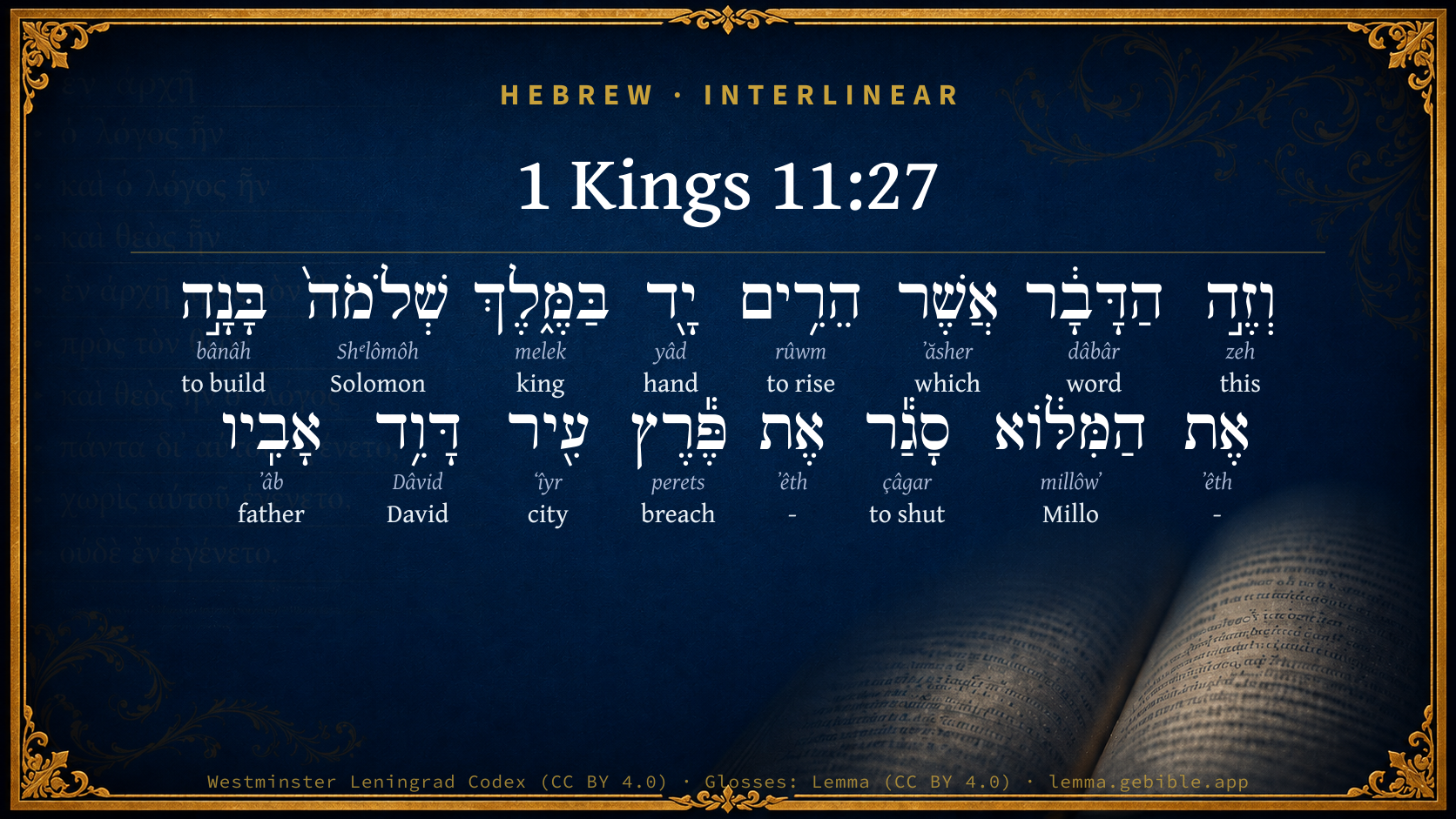
Hebrew (Westminster Leningrad Codex) 1 Kings 11:27 appears in the Hebrew Old Testament. The text above is from the Westminster Leningrad Codex. Each word links to its Strong’s number, a concise gloss, and parsing drawn from the Open Scriptures Hebrew Bible morphology. Click any word for its full Brown-Driver-Briggs (BDB) entry.
Download image
Cite this verse

1 Kings 11:27 (World English Bible). Public Domain. Lemma interlinear Bible study tool, https://lemma.gebible.app/v/1-kings/11/27.

Show BibTeX & RIS
BibTeX
RIS
English Translation
This was the reason why he lifted up his hand against the king: Solomon built Millo, and repaired the breach of the city of David his father.
World English Bible · Public Domain
Download a study sheet

One document with this verse’s original text, its word-by-word gloss line, the meaning frame, cross-references with their text, attributed commentary, and full source and license credits — printable, and it pastes into notes with its structure intact.

This verse Autodidact and up

Study sheet (.html) Plain text (.txt)

A passage Seminary Student

Up to 50 verses in one chapter. A passage sheet keeps up to 6 commentary sources and 12 cross-references per verse, in the order this page ranks them, and says so on the sheet whenever that leaves anything out. Ask for a single verse and you get the Autodidact verse sheet above.

Everything on this page stays free to read, with no account — the sheet is a download of what is already on screen, not access to it.

Want to remove ads? Support Godless Engineer
Compare translations 3

The same verse in 3 English versions, stacked beneath the original-language interlinear above. Click any original word for its lexicon entry.

Each is an independent rendering of the whole verse — the interlinear is not word-aligned to these translations.

Highlighted words mark where these versions differ — a whole-verse word diff, not a word-by-word alignment.

  • World English Bible Public Domain
    This was the reason why he lifted up his hand against the king: Solomon built Millo, and repaired the breach of the city of David his father.
  • King James Version Public Domain
    And this was the cause that he lifted up his hand against the king: Solomon built Millo, and repaired the breaches of the city of David his father.
  • unfoldingWord Literal Text CC BY-SA 4.0
    Now this the matter which he raised a hand against the king. Solomon had built the Millo; he had closed up the breach of the City of David his father.

unfoldingWord Literal Text — © unfoldingWord, licensed CC BY-SA 4.0. Word-aligned USFM3 via Door43 (git.door43.org/unfoldingWord/en_ult).

Versions to compare (up to 4)

3 of 4 selected

Show all 18 translations

Every available English version of this verse, each an independent rendering of the whole verse.

  • World English Bible Public Domain
    This was the reason why he lifted up his hand against the king: Solomon built Millo, and repaired the breach of the city of David his father.
  • Berean Standard Bible Public Domain
    and this is the account of his rebellion against the king. Solomon had built the supporting terraces and repaired the gap in the wall of the city of his father David.
  • Majority Standard Bible Public Domain
    and this is the account of his rebellion against the king. Solomon had built the supporting terraces and repaired the gap in the wall of the city of his father David.
  • King James Version Public Domain
    And this was the cause that he lifted up his hand against the king: Solomon built Millo, and repaired the breaches of the city of David his father.
  • American Standard Version (1901) Public Domain
    And this was the reason why he lifted up his hand against the king: Solomon built Millo, and repaired the breach of the city of David his father.
  • Revised Version (1885) Public Domain
    And this was the cause that he lifted up his hand against the king: Solomon built Millo, and repaired the breach of the city of David his father.
  • Geneva Bible (1599) Public Domain
    And this was the cause that he lift vp his hande against the King, When Salomon built Millo, he repared the broken places of the citie of Dauid his father.
  • Douay-Rheims (1899) Public Domain
    And this is the cause of his rebellion against him, for Solomon built Mello, and filled up the breach of the city of David his father.
  • Young's Literal Translation Public Domain
    and this `is' the thing `for' which he lifted up a hand against the king: Solomon built Millo -- he shut up the breach of the city of David his father,
  • Literal Standard Version CC BY-SA 4.0
    and this [is] the thing [for] which he lifted up a hand against the king: Solomon built Millo—he shut up the breach of the city of his father David,
  • Unlocked Literal Bible CC BY-SA 4.0
    He lifted up his hand against the king because Solomon had built up the place located at Millo and repaired the opening in the city wall of David his father.
  • unfoldingWord Literal Text CC BY-SA 4.0
    Now this the matter which he raised a hand against the king. Solomon had built the Millo; he had closed up the breach of the City of David his father.
  • Darby Bible Public Domain
    And this was the cause that he lifted up his hand against the king: Solomon was building Millo, and closing the breach of the city of David his father;
  • World Messianic Bible Public Domain
    This was the reason why he lifted up his hand against the king: Solomon built Millo, and repaired the breach of his father David’s city.
  • Webster's Bible Public Domain
    And this was the cause why he raised his hand against the king: Solomon built Millo, and repaired the breaches of the city of David his father.
  • Free Bible Version CC BY-SA 4.0
    This is why he rebelled against the king: Solomon had built the terraces and had closed the gap in the wall of the city of his father David.
  • Bible in Basic English Public Domain
    The way in which his hand came to be lifted up against the king was this: Solomon was building the Millo and making good the damaged parts of the town of his father David;
  • JPS Tanakh (1917) Public Domain
    And this was the cause that he lifted up his hand against the king: Solomon built Millo, and repaired the breach of the city of David his father.

Literal Standard Version (2020), Covenant Press — licensed CC BY-SA 4.0. Text via the HelloAO Bible API (eBible.org). Unlocked Literal Bible (unfoldingWord) — licensed CC BY-SA 4.0. Text via the HelloAO Bible API (eBible.org). unfoldingWord Literal Text — © unfoldingWord, licensed CC BY-SA 4.0. Word-aligned USFM3 via Door43 (git.door43.org/unfoldingWord/en_ult). Free Bible Version, Dr. Jonathan Gallagher — licensed CC BY-SA 4.0. Text via the HelloAO Bible API (eBible.org).

Word by word

More ways to search: Search by grammar → Find every occurrence → Compare this word →

Practice this passage: Drill this verse → Learn its vocabulary →

הַמִּלּ֔וֹא
millôwʼ
H4407
“the · Millo”
Particle, Definite Article + Noun, Proper
Part of Speech
Particle + Noun
Type
Proper
Full BDB Definition

Origin: from H4390

TWOT: None

Millo = "rampart" or " mound" - a place near Shechem; site unknown - a part of the fortifications of Jerusalem
  1. וְזֶ֣ה zeh H2088 “and · this” Conjunction + Pronoun, Demonstrative, Masculine, Singular
  2. הַדָּבָ֔ר dâbâr H1697 “the · word” Particle, Definite Article + Noun, Common, Masculine, Singular, Absolute
  3. אֲשֶׁר ʼăsher H834 “which” Particle, Relative
  4. הֵרִ֥ים rûwm H7311 “to rise” Verb, Hiphil, Perfect, 3rd Person, Masculine, Singular
  5. יָ֖ד yâd H3027 “hand” Noun, Common, Both, Singular, Absolute
  6. בַּמֶּ֑לֶךְ melek H4428 “in/at the · king” Preposition, Determined + Noun, Common, Masculine, Singular, Absolute
  7. שְׁלֹמֹה֙ Shᵉlômôh H8010 “Solomon” Noun, Proper
  8. בָּנָ֣ה bânâh H1129 “to build” Verb, Qal, Perfect, 3rd Person, Masculine, Singular
  9. אֶת ʼêth H853 “-” Particle, Direct Object
  10. סָגַ֕ר çâgar H5462 “to shut” Verb, Qal, Perfect, 3rd Person, Masculine, Singular
  11. אֶת ʼêth H853 “-” Particle, Direct Object
  12. פֶּ֕רֶץ perets H6556 “breach of” Noun, Common, Masculine, Singular, Construct
  13. עִ֖יר ʻîyr H5892 “city of” Noun, Common, Feminine, Singular, Construct
  14. דָּוִ֥ד Dâvid H1732 “David” Noun, Proper
  15. אָבִֽיו ʼâb H1 “father · his” Noun, Common, Masculine, Singular, Construct + Suffix, Personal, 3rd Person, Masculine, Singular

About this verse

These counts appear in no published source. They are computed here, from the morphology-tagged text and Lemma’s own curated glosses. What Lemma adds →

16
words
15
distinct lemmas
Historical
section

Notable vocabulary

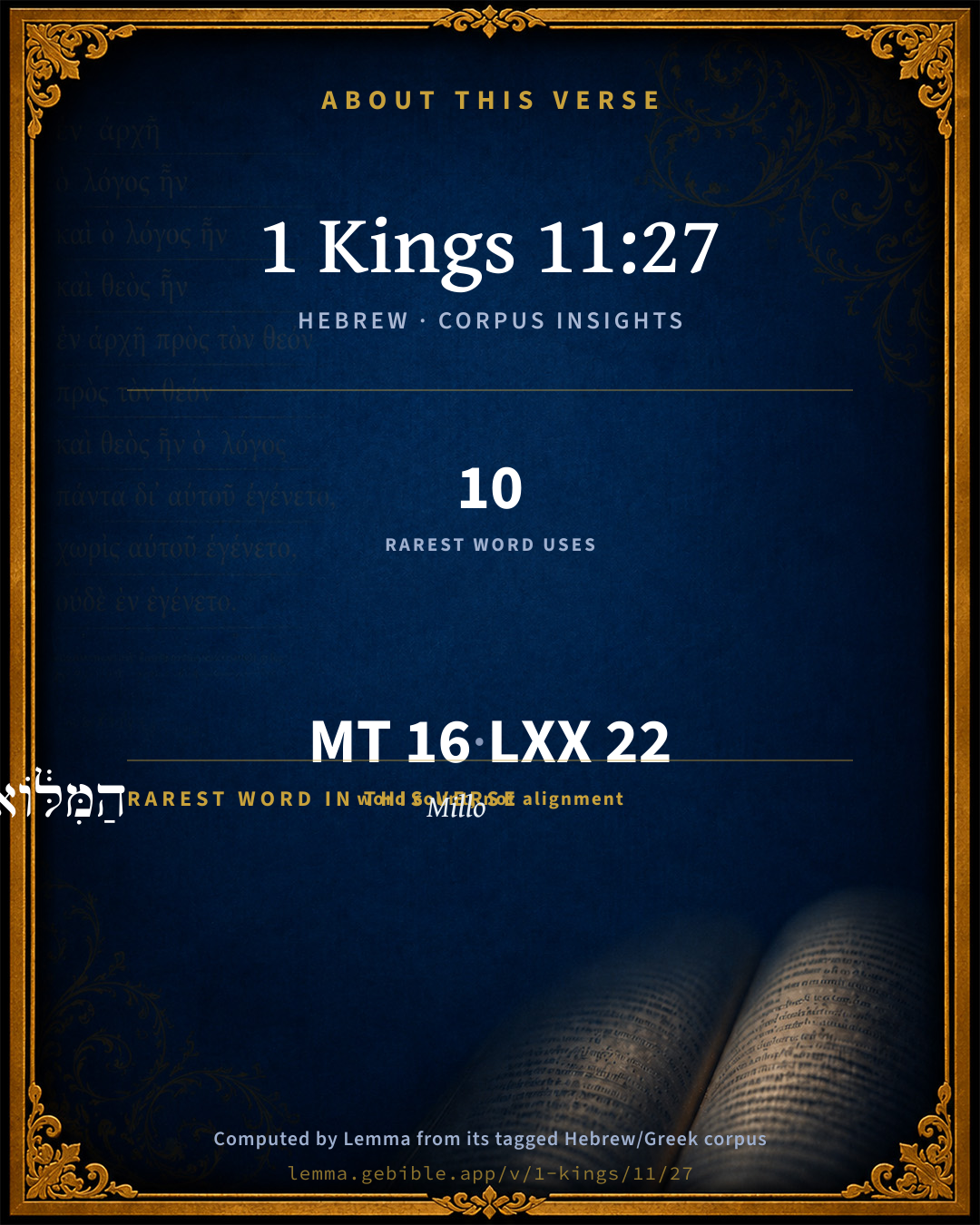
The rarest word here is הַמִּלּ֔וֹא Millo H4407 — appearing just 10 times in the whole Hebrew Bible.

Shared distinctive vocabulary

הַמִּלּ֔וֹא Millo H4407 occurs in 9 verses of the Hebrew Bible. Also found in:

Grammatical profile

  • 3 verbs
  • 9 nouns
  • 1 pronoun
  • 3 particles

Verb forms

  • הֵרִ֥ים Hiphil · Perfect
  • בָּנָ֣ה Qal · Perfect
  • סָגַ֕ר Qal · Perfect

Hebrew & Septuagint length

In English translation the verse runs 27 words from the Hebrew and 31 from the Septuagint (LXX English) — closely comparable.

A rough comparison of the two English renderings, which tokenize alike — not a word-level alignment.

Word counts can differ between the Hebrew and the Greek without any difference in meaning — e.g. the Hebrew direct-object marker אֵת has no separate Greek word, and Greek often adds the article ὁ.

In the original languages it is 16 Hebrew tokens and 22 Greek tokens — but the two are counted differently (Hebrew bundles its prefixes and suffixes into one token; the Greek is in lemma form), so that isn’t a like-for-like length.

Cross-references

11

Topical passages linked to 1 Kings 11:27 in the Treasury of Scripture Knowledge — connected by theme and wording, ordered by reader-vote popularity; previews shown in the World English Bible.

  • 1 Kings 9:24 But Pharaoh's daughter came up out of the city of David to her house which [Solomon] had built for her: then did he build Millo.
  • 1 Kings 9:15 This is the reason of the levy which king Solomon raised, to build the house of Yahweh, and his own house, and Millo, and the wall of Jerusalem, and Hazor, and Megiddo, and Gezer.
  • 2 Samuel 5:7 Nevertheless David took the stronghold of Zion; the same is the city of David.
  • 2 Samuel 20:21 The matter is not so: but a man of the hill-country of Ephraim, Sheba the son of Bichri by name, has lifted up his hand against the king, even against David; deliver him only, and I will depart from the city. The woman said to Joab, Behold, his head shall be thrown to you over the wall.
  • Nehemiah 4:7 But it happened that when Sanballat, Tobiah, the Arabians, the Ammonites, and the Ashdodites heard that the repairing of the walls of Jerusalem went forward, [and] that the breaches began to be stopped, then they were very angry;
  • Psalms 60:2 You have made the land tremble. You have torn it. Mend its fractures, For it quakes.
  • Proverbs 30:32 "If you have done foolishly in lifting up yourself, Or if you have thought evil, Put your hand over your mouth.
  • Isaiah 22:9 You saw the breaches of the city of David, that they were many; and you gathered together the waters of the lower pool;
  • Isaiah 26:11 Yahweh, your hand is lifted up, yet they don't see: but they shall see [your] zeal for the people, and be disappointed; yes, fire shall devour your adversaries.
  • Ezekiel 13:5 You have not gone up into the gaps, neither built up the wall for the house of Israel, to stand in the battle in the day of Yahweh.
  • Amos 9:11 In that day I will raise up the tent of David who is fallen, and close up its breaches, and I will raise up its ruins, and I will build it as in the days of old;

Cross-references courtesy of OpenBible.info (CC BY 4.0).

Hebrew and Greek witnesses Masoretic Hebrew ↔ Greek Septuagint

The same verse in the two great witnesses to the Old Testament, shown verse-for-verse.

These are two independent witnesses, not word-aligned to each other, and the Septuagint is shown in lemma (dictionary) form.

Hebrew 1 Kings 11:27 Masoretic · Westminster Leningrad Codex

וְזֶ֣ה הַדָּבָ֔ר אֲשֶׁר הֵרִ֥ים יָ֖ד בַּמֶּ֑לֶךְ שְׁלֹמֹה֙ בָּנָ֣ה אֶת הַמִּלּ֔וֹא סָגַ֕ר אֶת פֶּ֕רֶץ עִ֖יר דָּוִ֥ד אָבִֽיו

This was the reason why he lifted up his hand against the king: Solomon built Millo, and repaired the breach of the city of David his father.

World English Bible · Public Domain

Greek LXX 1 Kings 11:27 Septuagint · lemma form

καί οὗτος ὁ πρᾶγμα ὡς ἐπιαἴρω χείρ ἐπί βασιλεύς σαλωμών οἰκοδομέω ὁ ἄκρος συνκλείω ὁ φραγμός ὁ πόλις δαυίδ ὁ πατήρ αὐτός

And this was the occasion of his lifting up his hands against king Solomon: now king Solomon built the citadel, he completed the fortification of the city of David his father.

LXX2012 (modern English Septuagint) · Public Domain

Hebrew: Westminster Leningrad Codex (CC BY 4.0). Greek: Septuagint (public domain); English from LXX2012 (modern English Septuagint) (Public Domain). How the Septuagint differs from the Hebrew →

Targum (Aramaic paraphrase)

1

The Targum is the ancient Jewish Aramaic paraphrase of the Hebrew Scriptures — an interpretive translation, not the Hebrew text itself. Onkelos (literal) and Pseudo-Jonathan (expansive) render the Torah, and Jonathan the Prophets. Coverage is partial: where no permissively-licensed English translation exists for a verse, only the Aramaic is shown. This is verse-level text, not a word-by-word alignment to the Hebrew.

  1. Targum Jonathan Prophets (Joshua–Malachi)
    וְדֵין פִּתְגָמָא דַאֲרֵים יְדָא בְּמַלְכָּא שְׁלֹמֹה בְּנָא יַת מִלֵיתָא אֲחַד יַת תַּרְעֲתָא קַרְתָּא דְדָוִד אֲבוּהִי:

    (no public-domain English translation for this verse)

    Targum Jonathan — Aramaic: “Mikraot Gedolot” (public domain). English: “Sefaria Community Translation” (CC0 1.0 (public-domain dedication)); “London "Chaldee Paraphrase," 1871” (public domain). Text via Sefaria.

Commentary

Notes on 1 Kings 11:27 from classic Christian and Jewish commentators (each source and its license shown beneath its notes). The classic Christian expositions comment on the surrounding passage and are grouped to its opening verse, so a note may address several verses; the Jewish commentaries on the Tanakh (Rashi and others) are per-verse, so they appear only where the commentator wrote on this verse.

Lemma curates 59 commentaries, every one of them public domain or Creative Commons licensed, each selected and text-cleaned for this edition rather than reprinted as found. About our sources →

Trapp's Complete Commentary

John Trapp

1Ki 11:27 And this [was] the cause that he lifted up [his] hand against the king: Solomon built Millo, [and] repaired the breaches of the city of David his father.

Ver. 27. And this was the cause that he lifted up.] Vatablus readeth it thus, And this was the word whereby he lifted up his hand; that is, made way to his open rebellion afterwards. Solomon buildeth Millo, &c., and so putteth the people to an excessive charge and pains; and repaireth the breaches &c., which his father, though wise enough and able enough, never did.

John Trapp, A Commentary or Exposition upon All the Books of the Old and New Testament (1647–1656) — public domain. Text from a community e-Sword module.

Tyndale Open Study Notes

Tyndale Open Resources

11:27-28 Solomon noted the work ethic of Jeroboam during the repair of the city’s structures and put him in charge. Jeroboam’s status among the laborers may have made him aware of brewing discontent in northern sections of Solomon’s kingdom. Jeroboam showed leadership on this occasion, as well as during the empire’s division and reorganization of the northern tribes (12:12-19, 25-33). Unfortunately, he did not always use his abilities wisely and later proved unfaithful to the Lord (12:25–13:10; 14:14-16; 2 Kgs 17:21-23).

Tyndale Open Study Notes — © Tyndale Open Resources, licensed CC BY-SA 4.0. Text via the HelloAO Bible API.

Ellicott's Commentary for English Readers

(27) Solomon built Millo.—See 1Ki_9:15; 1Ki_9:24. This was apparently after he had built the Temple and the palace, some twenty years after his accession, when the delight in magnificence of building apparently grew upon him, and with it the burdens of the people.

A Bible Commentary for English Readers, edited by Charles John Ellicott (1878–1897) — public domain. Text from a community e-Sword module.

The Cambridge Bible for Schools and Colleges

gen. ed. J. J. S. Perowne

27. Millo] Read the Millo. See above on 1Ki_9:15.

and repaired the breaches of the city of David] The verb signifies ‘to close up’ and the noun is in the singular. Hence ‘to close up the breach’ has been thought to mean the building a wall across the valley between Zion and Moriah, and so making the ravine between these mountains inclosed within the walls. This valley was known at a later time as the Tyropœon. This makes the statement harmonize with 1Ki_9:15, where Solomon’s object is said to have been ‘to build the walls of Jerusalem.’

The Cambridge Bible for Schools and Colleges (gen. ed. J. J. S. Perowne; Cambridge University Press, 1878–1918) — public domain. Text from a community e-Sword module.

John Gill's Exposition

And the man Jeroboam was a mighty man of valour,.... A man of great strength of body, and fortitude of mind:

and Solomon seeing the young man that he was industrious; in what he was set about in the above buildings and repairs:

he made him ruler over all the charge of the house of Joseph; the tribes of Ephraim and Manasseh, to be a prince or a deputy governor of them; or rather to collect the king's tax from them, or the revenues of that part of the country, see Pro 22:29.

John Gill's Exposition of the Whole Bible (1746–1763) — public domain (CC PDM 1.0). Text via the HelloAO Bible API.

Albert Barnes' Notes on the Bible

Millo was probably fortified in Solomon’s twenty-fourth or twenty-fifth year.

Albert Barnes' Notes on the Bible (1834–1885) — public domain. Text from a community e-Sword/MySword module.

Whedon's Commentary on the Bible

Daniel D. Whedon

27. Breaches — Rents in the walls, made by time and storms. It was while Solomon was repairing the walls and fortifications of Jerusalem, as noticed in 1Ki_9:15, (where see note,) that Jeroboam showed his superior abilities, and was promoted by the king. 28.

A mighty man of valour — An able and efficient workman.

Charge of the house of Joseph — That is, of the levy of men from the Ephraimites who were descendants of Joseph, and sometimes thus called by their father’s name. The charge or burden of this tribe here means the labour they were required to perform in building Millo and repairing the walls of the city. This tribe was of course called on for its quota of men in the levy which Solomon raised, (1Ki_5:13; 1Ki_9:15,) and Jeroboam was at first among the labourers — perhaps an under officer; but at length, on account of his marked ability, was made overseer of all the workmen of his tribe.

Daniel D. Whedon (gen. ed.), Commentary on the Old and New Testaments (1874–1909) — public domain. Text from a community e-Sword module.

The Pulpit Commentary

And this was the cause or, this is the account; this is how it came about. Same words Jos_5:4, and 1Ki_9:15. We have here a long parenthesis, explaining the origin, etc., of Jeroboam"s disaffection that he lifted up his hand Heb. a hand against the king. Solomon built Millo, (see on 1Ki_9:15) and repaired the breaches These words convey the impression that Solomon renewed the decayed or destroyed parts of the wall. But

(1) rgs does not mean repair, except indirectly. It means he closed, shut. And

(2) rP sing, refers to one breach or opening. Moreover

(3) it was not so long since the wall was built. (2Sa_5:9) It could hardly, therefore, have decayed, and there had been no siege to cause a breach. We must understand the word, consequently, not of a part broken down, but of a portion unbuilt. We have elsewhere suggested that this was the breach in the line of circumvallation, caused by the Tyropsson valley, and that the Millo was the bank, or rampart which closed it. And to this view the words of the text lend some confirmation of the city of David his father. As Millo was built about the 25th year of Solomon"s reign (ch. 9:15), we are enabled to fix approximately the date of Jeroboam"s rebellion. It was apparently about ten or twelve years before Solomon"s death.

The Pulpit Commentary (1880–1919), ed. H.D.M. Spence-Jones & Joseph S. Exell — public domain. Text from a community e-Sword module.

Rashi

Rabbi Shlomo Yitzchaki (Rashi)

It was about this matter. Concerning which he rebuked him.

Shlomo had built up the Millo. And with this building, he closed up the breach of the City of Dovid which was behind the Millo. He said to him, “Your father made breaches in the wall for the festival pilgrims to enter, and you closed it up, to create a labor force for Pharaoh’s daughter, to station there her menservants and maidservants.”

Rashi on the Tanakh — English translations: “The Judaica Press complete Tanach with Rashi, translated by A. J. Rosenberg” (CC BY 4.0); “Pentateuch with Rashi's commentary by M. Rosenbaum and A.M. Silbermann, 1929-1934” (public domain); “The Metsudah Tanach series, Lakewood, N.J” (CC BY 4.0); and “The Book of Joshua, Metsudah Publications, 1997” (CC BY 4.0). Text via Sefaria.

Lesson kit

Teaching starters — assembled from the data on this page, not authored interpretation. Every prompt links to the verse data it draws on. Edit before teaching.

1 Kings, in the Historical, opens this verse with 16 words (15 distinct Hebrew lemmas). Its most distinctive word is millôwʼ (“Millo”). A historical commentator’s framing appears above. Read the whole chapter for the surrounding context.

Discussion questions

  1. What does “Millo” (millôwʼ) contribute to the verse as a whole?
  2. Judges 9:6 shares the word «Millo» with this verse. How do the two illuminate each other?
  3. These translations render this verse differently. What is at stake in choosing one wording over another?
  4. The verb «הֵרִ֥ים» is Hiphil Perfect. How does its form color the action?
  5. Reading how Trapp's Complete Commentary and Tyndale Open Study Notes read this verse, where do the two commentators agree and where do they part?

Things to notice

Reading settings

Reading text

Shown beneath each verse's original-language words.

Old Testament
Old Testament edition

Read the OT as the Masoretic Hebrew (MT) or the Greek Septuagint (LXX).

English shown for the Greek Septuagint (in the Hebrew ↔ Greek comparison).

Comparing translations? Open the Compare panel on any verse page to stack up to four side by side.