
1 Samuel 9:24

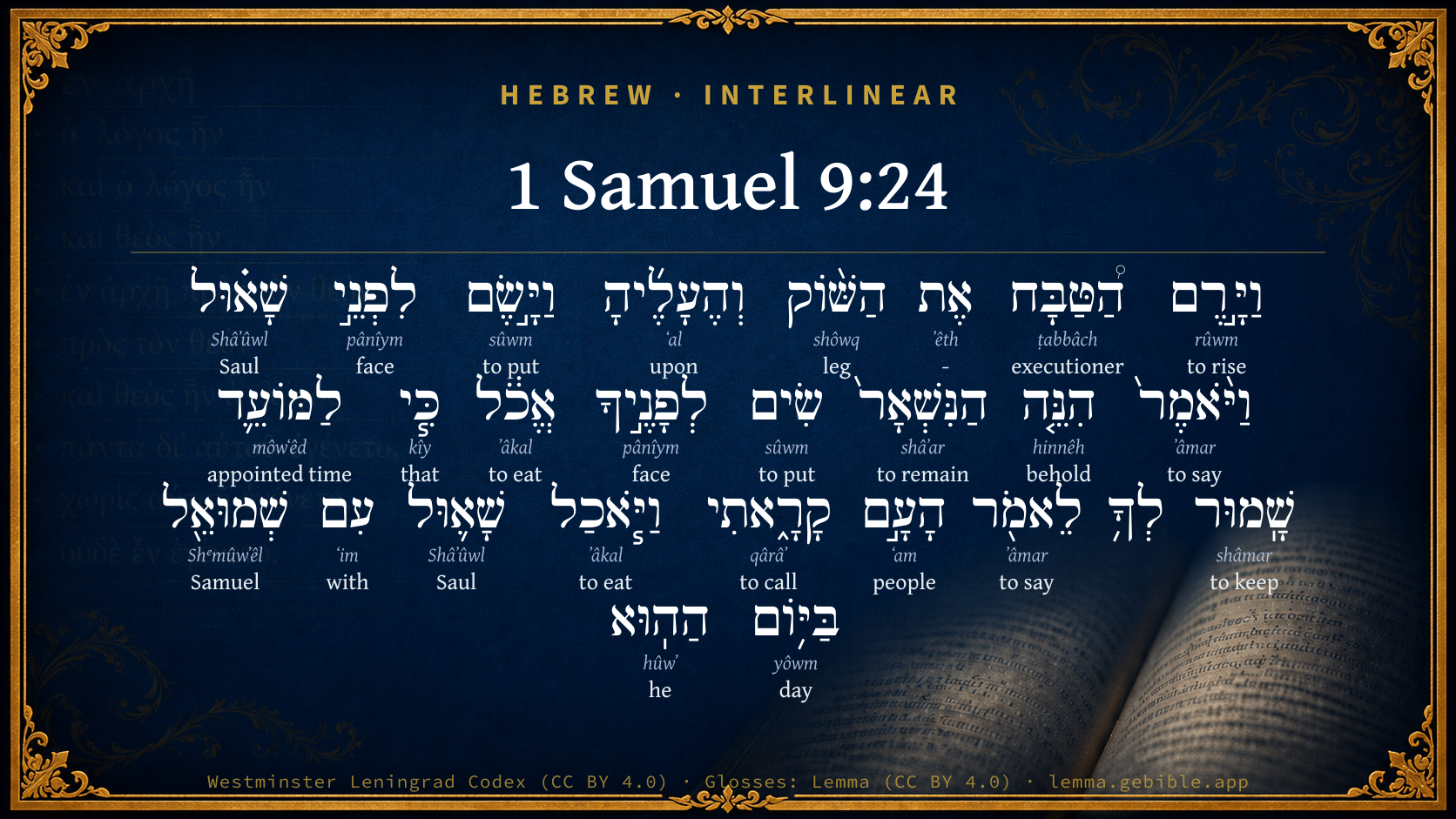
Hebrew (Westminster Leningrad Codex) 1 Samuel 9:24 appears in the Hebrew Old Testament. The text above is from the Westminster Leningrad Codex. Each word links to its Strong’s number, a concise gloss, and parsing drawn from the Open Scriptures Hebrew Bible morphology. Click any word for its full Brown-Driver-Briggs (BDB) entry.
Download image
Cite this verse

1 Samuel 9:24 (World English Bible). Public Domain. Lemma interlinear Bible study tool, https://lemma.gebible.app/v/1-samuel/9/24.

Show BibTeX & RIS
BibTeX
RIS
English Translation
The cook took up the thigh, and that which was on it, and set it before Saul. [Samuel] said, Behold, that which has been reserved! set it before you and eat; because to the appointed time has it been kept for you, for I said, I have invited the people. So Saul ate with Samuel that day.
World English Bible · Public Domain
Download a study sheet

One document with this verse’s original text, its word-by-word gloss line, the meaning frame, cross-references with their text, attributed commentary, and full source and license credits — printable, and it pastes into notes with its structure intact.

This verse Autodidact and up

Study sheet (.html) Plain text (.txt)

A passage Seminary Student

Up to 50 verses in one chapter. A passage sheet keeps up to 6 commentary sources and 12 cross-references per verse, in the order this page ranks them, and says so on the sheet whenever that leaves anything out. Ask for a single verse and you get the Autodidact verse sheet above.

Everything on this page stays free to read, with no account — the sheet is a download of what is already on screen, not access to it.

Want to remove ads? Support Godless Engineer
Compare translations 3

The same verse in 3 English versions, stacked beneath the original-language interlinear above. Click any original word for its lexicon entry.

Each is an independent rendering of the whole verse — the interlinear is not word-aligned to these translations.

Highlighted words mark where these versions differ — a whole-verse word diff, not a word-by-word alignment.

  • World English Bible Public Domain
    The cook took up the thigh, and that which was on it, and set it before Saul. [Samuel] said, Behold, that which has been reserved! set it before you and eat; because to the appointed time has it been kept for you, for I said, I have invited the people. So Saul ate with Samuel that day.
  • King James Version Public Domain
    And the cook took up the shoulder, and that which was upon it, and set it before Saul. And Samuel said, Behold that which is left! set it before thee, and eat: for unto this time hath it been kept for thee since I said, I have invited the people. So Saul did eat with Samuel that day.
  • unfoldingWord Literal Text CC BY-SA 4.0
    And the cook lifted the thigh and the on it, and he set to the face of Saul. And he said, “Behold, the reserved is set to your face. Eat, for kept for you for the appointed time, saying, ‘I have invited the people.’” So Saul ate with Samuel on that day.

unfoldingWord Literal Text — © unfoldingWord, licensed CC BY-SA 4.0. Word-aligned USFM3 via Door43 (git.door43.org/unfoldingWord/en_ult).

Versions to compare (up to 4)

3 of 4 selected

Show all 18 translations

Every available English version of this verse, each an independent rendering of the whole verse.

  • World English Bible Public Domain
    The cook took up the thigh, and that which was on it, and set it before Saul. [Samuel] said, Behold, that which has been reserved! set it before you and eat; because to the appointed time has it been kept for you, for I said, I have invited the people. So Saul ate with Samuel that day.
  • Berean Standard Bible Public Domain
    So the cook picked up the leg and what was attached to it and set it before Saul. Then Samuel said, “Here is what was kept back. It was set apart for you. Eat, for it has been kept for you for this occasion, from the time I said, ‘I have invited the people.’” So Saul dined with Samuel that day.
  • Majority Standard Bible Public Domain
    So the cook picked up the leg and what was attached to it and set it before Saul. Then Samuel said, “Here is what was kept back. It was set apart for you. Eat, for it has been kept for you for this occasion, from the time I said, ‘I have invited the people.’” So Saul dined with Samuel that day.
  • King James Version Public Domain
    And the cook took up the shoulder, and that which was upon it, and set it before Saul. And Samuel said, Behold that which is left! set it before thee, and eat: for unto this time hath it been kept for thee since I said, I have invited the people. So Saul did eat with Samuel that day.
  • American Standard Version (1901) Public Domain
    And the cook took up the thigh, and that which was upon it, and set it before Saul. And `Samuel' said, Behold, that which hath been reserved! set it before thee and eat; because unto the appointed time hath it been kept for thee, for I said, I have invited the people. So Saul did eat with Samuel that day.
  • Revised Version (1885) Public Domain
    And the cook took up the thigh, and that which was upon it, and set it before Saul. And Samuel said, Behold that which hath been reserved! set it before thee and eat; because unto the appointed time hath it been kept for thee, for I said, I have invited the people. So Saul did eat with Samuel that day.
  • Geneva Bible (1599) Public Domain
    And the cooke tooke vp the shoulder, and that which was vpon it, and set it before Saul. And Samuel said, Beholde, that which is left, set it before thee and eate: for hitherto hath it bene kept for thee, saying, Also I haue called the people. So Saul did eate with Samuel that day.
  • Douay-Rheims (1899) Public Domain
    And the cook took up the shoulder, and set it before Saul. And Samuel said: Behold what is left, set it before thee, and eat: because it was kept of purpose for thee, when I invited the people. And Saul ate with Samuel that day.
  • Young's Literal Translation Public Domain
    (and the cook lifteth up the leg, and that which `is' on it, and setteth before Saul), and he saith, `Lo, that which is left; set `it' before thee -- eat, for to this appointed season it is kept for thee, saying, The people I have called;' and Saul eateth with Samuel on that day.
  • Literal Standard Version CC BY-SA 4.0
    (And the cook lifts up the leg, and that which [is] on it, and sets [it] before Saul), and he says, “Behold, that which is left; [it] is set before your face—eat, for it is kept for you for this appointed time, [at my] saying, I have called the people”; and Saul eats with Samuel on that day.
  • Unlocked Literal Bible CC BY-SA 4.0
    So the cook took up the thigh and what was on it and set it before Saul. Then Samuel said, “See what has been kept is set before you. Eat it, because it has been kept for you until the appointed time, from the time when I said, 'I have invited the people.'” So Saul ate with Samuel that day.
  • unfoldingWord Literal Text CC BY-SA 4.0
    And the cook lifted the thigh and the on it, and he set to the face of Saul. And he said, “Behold, the reserved is set to your face. Eat, for kept for you for the appointed time, saying, ‘I have invited the people.’” So Saul ate with Samuel on that day.
  • Darby Bible Public Domain
    And the cook took up the shoulder, and what was on it, and set [it] before Saul. And he said, Behold that which has been reserved! set it before thee, eat; for against the set time has it been kept for thee, since I said, I will invite the people. So Saul ate with Samuel that day.
  • World Messianic Bible Public Domain
    The cook took up the thigh, and that which was on it, and set it before Saul. Samuel said, “Behold, that which has been reserved! Set it before yourself and eat; because it has been kept for you for the appointed time, for I said, ‘I have invited the people.’” So Saul ate with Samuel that day.
  • Webster's Bible Public Domain
    And the cook took up the shoulder, and that which was upon it, and set it before Saul. And Samuel said, Behold that which is left! set it before thee, and eat; for to this time hath it been kept for thee since I said, I have invited the people. So Saul ate with Samuel that day.
  • Free Bible Version CC BY-SA 4.0
    So the cook took the upper thigh of meat and what was with it and placed it before Saul. Then Samuel said, “See, this is what was kept to one side. It was reserved for you. Eat it, for it was kept for you for this particular time, right from when I said, ‘I have invited the people.’” So Saul ate with Samuel that day.
  • Bible in Basic English Public Domain
    And the cook took up the leg with the fat tail on it, and put it before Saul. And Samuel said, This is the part which has been kept for you: take it as your part of the feast; because it has been kept for you till the right time came and till the guests were present. So that day Saul took food with Samuel.
  • JPS Tanakh (1917) Public Domain
    And the cook took up the thigh, and that which was upon it, and set it before Saul. And Samuel said: 'Behold that which hath been reserved! set it before thee and eat; because unto the appointed time hath it been kept for thee, for I said: I have invited the people.' So Saul did eat with Samuel that day.

Literal Standard Version (2020), Covenant Press — licensed CC BY-SA 4.0. Text via the HelloAO Bible API (eBible.org). Unlocked Literal Bible (unfoldingWord) — licensed CC BY-SA 4.0. Text via the HelloAO Bible API (eBible.org). unfoldingWord Literal Text — © unfoldingWord, licensed CC BY-SA 4.0. Word-aligned USFM3 via Door43 (git.door43.org/unfoldingWord/en_ult). Free Bible Version, Dr. Jonathan Gallagher — licensed CC BY-SA 4.0. Text via the HelloAO Bible API (eBible.org).

Word by word

More ways to search: Search by grammar → Find every occurrence → Compare this word →

Practice this passage: Drill this verse → Learn its vocabulary →

הַשּׁ֨וֹק
shôwq
H7785
“the · leg”
Particle, Definite Article + Noun, Common, Feminine, Singular, Absolute
Part of Speech
Particle + Noun
Type
Common
Gender
Feminine
Number
Singular
State
Absolute
Full BDB Definition

Origin: from H7783

TWOT: 2350a

leg, thigh - of man; specifically the lower leg (calf) as opposed to the thigh - of sacrificial animal; specifically the thigh, upper leg, hind leg, as the portion eaten
  1. וַיָּ֣רֶם rûwm H7311 “and · to rise” Conjunction + Verb, Hiphil, Sequential Imperfect, 3rd Person, Masculine, Singular
  2. הַ֠טַּבָּח ṭabbâch H2876 “the · executioner” Particle, Definite Article + Noun, Common, Masculine, Singular, Absolute
  3. אֶת ʼêth H853 “-” Particle, Direct Object
  4. וְהֶעָלֶ֜יהָ ʻal H5921 “and · the · upon · her” Conjunction + Particle, Definite Article + Preposition + Suffix, Personal, 3rd Person, Feminine, Singular
  5. וַיָּ֣שֶׂם sûwm H7760 “and · to put” Conjunction + Verb, Qal, Sequential Imperfect, 3rd Person, Masculine, Singular
  6. לִפְנֵ֣י pânîym H6440 “to/for · face(s) of” Preposition + Noun, Common, Both, Plural, Construct
  7. שָׁא֗וּל Shâʼûwl H7586 “Saul” Noun, Proper
  8. וַיֹּ֨אמֶר֙ ʼâmar H559 “and · to say” Conjunction + Verb, Qal, Sequential Imperfect, 3rd Person, Masculine, Singular
  9. הִנֵּ֤ה hinnêh H2009 “behold” Particle, Demonstrative
  10. הַנִּשְׁאָר֙ shâʼar H7604 “the · remaining” Particle, Definite Article + Verb, Niphal, Participle Active, Masculine, Singular, Absolute
  11. שִׂים sûwm H7760 “put” Verb, Qal, Imperative, 2nd Person, Masculine, Singular
  12. לְפָנֶ֣יךָ pânîym H6440 “to/for · face(s) · your” Preposition + Noun, Common, Both, Plural, Construct + Suffix, Personal, 2nd Person, Masculine, Singular
  13. אֱכֹ֔ל ʼâkal H398 “eat” Verb, Qal, Imperative, 2nd Person, Masculine, Singular
  14. כִּ֧י kîy H3588 “that” Conjunction
  15. לַמּוֹעֵ֛ד môwʻêd H4150 “to/for the · appointed time” Preposition, Determined + Noun, Common, Masculine, Singular, Absolute
  16. שָֽׁמוּר shâmar H8104 “kept” Verb, Qal, Participle Passive, Masculine, Singular, Absolute
  17. לֵאמֹ֖ר ʼâmar H559 “to say” Preposition + Verb, Qal, Infinitive Construct
  18. הָעָ֣ם ʻam H5971 “the · people” Particle, Definite Article + Noun, Common, Masculine, Singular, Absolute
  19. קָרָ֑אתִי qârâʼ H7121 “to call” Verb, Qal, Perfect, 1st Person, Common, Singular
  20. וַיֹּ֧אכַל ʼâkal H398 “and · to eat” Conjunction + Verb, Qal, Sequential Imperfect, 3rd Person, Masculine, Singular
  21. שָׁא֛וּל Shâʼûwl H7586 “Saul” Noun, Proper
  22. עִם ʻim H5973 “with” Preposition
  23. שְׁמוּאֵ֖ל Shᵉmûwʼêl H8050 “Samuel” Noun, Proper
  24. בַּיּ֥וֹם yôwm H3117 “in/at the · day” Preposition, Determined + Noun, Common, Masculine, Singular, Absolute
  25. הַהֽוּא hûwʼ H1931 “the · he” Particle, Definite Article + Pronoun, Personal, 3rd Person, Masculine, Singular

About this verse

These counts appear in no published source. They are computed here, from the morphology-tagged text and Lemma’s own curated glosses. What Lemma adds →

27
words
21
distinct lemmas
Historical
section

Notable vocabulary

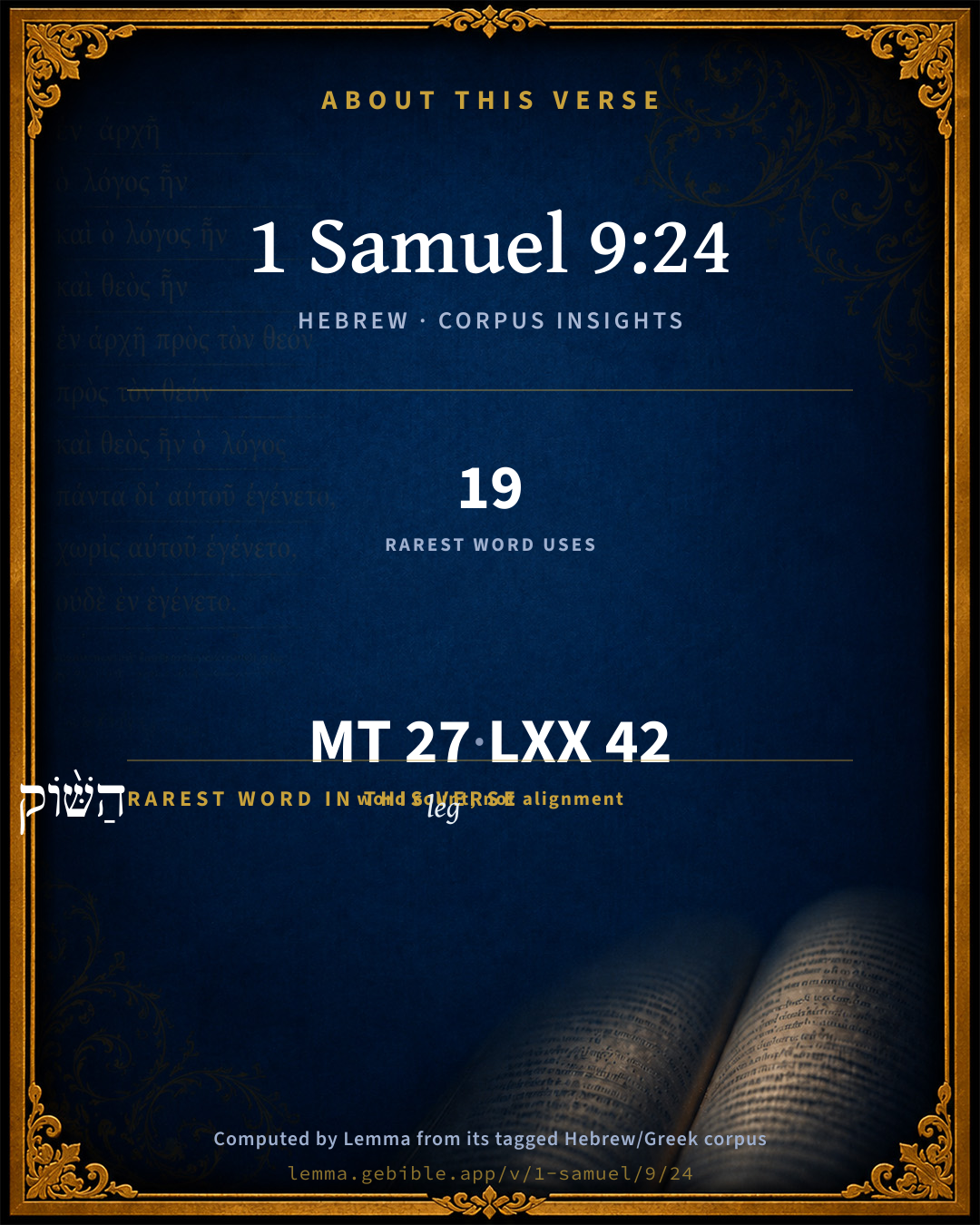
The rarest word here is הַשּׁ֨וֹק leg H7785 — appearing just 19 times in the whole Hebrew Bible.

Shared distinctive vocabulary

הַשּׁ֨וֹק leg H7785 occurs in 19 verses of the Hebrew Bible. Also found in:

Grammatical profile

  • 10 verbs
  • 10 nouns
  • 1 pronoun
  • 3 prepositions
  • 1 conjunction
  • 2 particles

Verb forms

  • וַיָּ֣רֶם Hiphil · Sequential Imperfect
  • וַיָּ֣שֶׂם Qal · Sequential Imperfect
  • וַיֹּ֨אמֶר֙ Qal · Sequential Imperfect
  • הַנִּשְׁאָר֙ Niphal · Participle Active
  • שִׂים Qal · Imperative
  • אֱכֹ֔ל Qal · Imperative
  • שָֽׁמוּר Qal · Participle Passive
  • לֵאמֹ֖ר Qal · Infinitive Construct
  • קָרָ֑אתִי Qal · Perfect
  • וַיֹּ֧אכַל Qal · Sequential Imperfect

Repetition

Words recur within this verse — often emphatic in Hebrew:

  • וַיָּ֣שֶׂם to put H7760 ×2
  • לִפְנֵ֣י face H6440 ×2
  • שָׁא֗וּל Saul H7586 ×2
  • וַיֹּ֨אמֶר֙ to say H559 ×2
  • אֱכֹ֔ל to eat H398 ×2

Hebrew & Septuagint length

In English translation the verse runs 57 words from the Hebrew and 52 from the Septuagint (LXX English) — closely comparable.

A rough comparison of the two English renderings, which tokenize alike — not a word-level alignment.

Word counts can differ between the Hebrew and the Greek without any difference in meaning — e.g. the Hebrew direct-object marker אֵת has no separate Greek word, and Greek often adds the article ὁ.

In the original languages it is 27 Hebrew tokens and 42 Greek tokens — but the two are counted differently (Hebrew bundles its prefixes and suffixes into one token; the Greek is in lemma form), so that isn’t a like-for-like length.

Cross-references

5

Topical passages linked to 1 Samuel 9:24 in the Treasury of Scripture Knowledge — connected by theme and wording, ordered by reader-vote popularity; previews shown in the World English Bible.

  • Leviticus 7:32–33 The right thigh you shall give to the priest for a heave offering out of the sacrifices of your peace offerings.
  • Ezekiel 24:4 gather the pieces of it into it, even every good piece, the thigh, and the shoulder; fill it with the choice bones.
  • Exodus 29:22 Also you shall take some of the ram's fat, the fat tail, the fat that covers the innards, the cover of the liver, the two kidneys, the fat that is on them, and the right thigh (for it is a ram of consecration),
  • Exodus 29:27 You shall sanctify the breast of the wave-offering, and the thigh of the heave-offering, which is waved, and which is heaved up, of the ram of consecration, even of that which is for Aaron, and of that which is for his sons:
  • Numbers 18:18 The flesh of them shall be your, as the wave-breast and as the right thigh, it shall be yours.

Cross-references courtesy of OpenBible.info (CC BY 4.0).

Hebrew and Greek witnesses Masoretic Hebrew ↔ Greek Septuagint

The same verse in the two great witnesses to the Old Testament, shown verse-for-verse.

These are two independent witnesses, not word-aligned to each other, and the Septuagint is shown in lemma (dictionary) form.

Hebrew 1 Samuel 9:24 Masoretic · Westminster Leningrad Codex

וַיָּ֣רֶם הַ֠טַּבָּח אֶת הַשּׁ֨וֹק וְהֶעָלֶ֜יהָ וַיָּ֣שֶׂם לִפְנֵ֣י שָׁא֗וּל וַיֹּ֨אמֶר֙ הִנֵּ֤ה הַנִּשְׁאָר֙ שִׂים לְפָנֶ֣יךָ אֱכֹ֔ל כִּ֧י לַמּוֹעֵ֛ד שָֽׁמוּר לְךָ֥ לֵאמֹ֖ר הָעָ֣ם קָרָ֑אתִי וַיֹּ֧אכַל שָׁא֛וּל עִם שְׁמוּאֵ֖ל בַּיּ֥וֹם הַהֽוּא

The cook took up the thigh, and that which was on it, and set it before Saul. [Samuel] said, Behold, that which has been reserved! set it before you and eat; because to the appointed time has it been kept for you, for I said, I have invited the people. So Saul ate with Samuel that day.

World English Bible · Public Domain

Greek LXX 1 Samuel 9:24 Septuagint · lemma form

καί ὑψόω ὁ μάγειρος ὁ κωλέα καί παρατίθημι αὐτός ἐνώπιον σαούλ καί εἶπον σαμουηλ ὁ σαούλ ἰδού ὑπόλειμμα παρατίθημι αὐτός ἐνώπιον σύ καί ἐσθίω ὅτι εἰς μαρτύριον τίθημι σύ παρά ὁ ἄλλος ἀποκνίζω καί ἐσθίω σαούλ μετά σαμουηλ ἐν ὁ ἡμέρα ἐκεῖνος

Now the cook had boiled the shoulder, and he set it before Saul; and Samuel said to Saul, Behold that which is left: set before you, and eat; for it is set you for a testimony in preference to the others; take of it: and Saul ate with Samuel on that day.

LXX2012 (modern English Septuagint) · Public Domain

On this verse, Ellicott's Commentary for English Readers discusses the Septuagint’s reading. Read the note in Commentary ↓

Hebrew: Westminster Leningrad Codex (CC BY 4.0). Greek: Septuagint (public domain); English from LXX2012 (modern English Septuagint) (Public Domain). How the Septuagint differs from the Hebrew →

Targum (Aramaic paraphrase)

1

The Targum is the ancient Jewish Aramaic paraphrase of the Hebrew Scriptures — an interpretive translation, not the Hebrew text itself. Onkelos (literal) and Pseudo-Jonathan (expansive) render the Torah, and Jonathan the Prophets. Coverage is partial: where no permissively-licensed English translation exists for a verse, only the Aramaic is shown. This is verse-level text, not a word-by-word alignment to the Hebrew.

  1. Targum Jonathan Prophets (Joshua–Malachi)
    וַאֲרִים טַבָּחָא יַת שָׁקָא וְיַרְכֵיהּ וְשַׁוֵי קֳדָם שָׁאוּל וַאֲמַר הָא דְאִשְׁתָּאַר שַׁוִי קֳדָמָךְ אֲכוֹל אֲרֵי לְזִימְנָא נְטִיר לָךְ לְמֵימַר עַמָא זַמֵנִית לְשֵׁירוּתָא וַאֲכַל שָׁאוּל עִם שְׁמוּאֵל בְּיוֹמָא הַהוּא:

    (no public-domain English translation for this verse)

    Targum Jonathan — Aramaic: “Mikraot Gedolot” (public domain). English: “Sefaria Community Translation” (CC0 1.0 (public-domain dedication)); “London "Chaldee Paraphrase," 1871” (public domain). Text via Sefaria.

Commentary

Notes on 1 Samuel 9:24 from classic Christian and Jewish commentators (each source and its license shown beneath its notes). The classic Christian expositions comment on the surrounding passage and are grouped to its opening verse, so a note may address several verses; the Jewish commentaries on the Tanakh (Rashi and others) are per-verse, so they appear only where the commentator wrote on this verse.

Lemma curates 59 commentaries, every one of them public domain or Creative Commons licensed, each selected and text-cleaned for this edition rather than reprinted as found. About our sources →

Trapp's Complete Commentary

John Trapp

1Sa 9:24 And the cook took up the shoulder, and [that] which [was] upon it, and set [it] before Saul. And [Samuel] said, Behold that which is left! set [it] before thee, [and] eat: for unto this time hath it been kept for thee since I said, I have invited the people. So Saul did eat with Samuel that day.

Ver. 24. And the cook took up the shoulder.] Which was counted ill those days a principal piece: whence the priest, for his part of the peace offering, had the right shoulder allotted him. {Lev 7:32-33}

And that which was upon it.] The sauce likely, or garnish.

Behold that which is left!] Or rather, Reserved, as in the margin.

John Trapp, A Commentary or Exposition upon All the Books of the Old and New Testament (1647–1656) — public domain. Text from a community e-Sword module.

Geneva Bible (1599)

Geneva Bible translators

That is, the shoulder with the breast, which the Priest had for his family in all peace offerings, Lev. 10:14.

That both by the assembling of the people, and by the meat prepared for thee, thou mightest understand that I knew of thy coming.

Geneva Bible (1599) marginal notes — public domain. Text via Bolls.life.

Jamieson, Fausset & Brown

Robert Jamieson, A. R. Fausset & David Brown

the cook took up the shoulder . . . and set it before Saul. And Samuel said, Behold that which is left; set it before thee, and eat--that is, reserved (see on Gen 18:7; Gen 43:34). This was, most probably, the right shoulder; which, as the perquisite of the sacrifice, belonged to Samuel, and which he had set aside for his expected guest. In the sculptures of the Egyptian shambles, also, the first joint taken off was always the right shoulder for the priest. The meaning of those distinguished attentions must have been understood by the other guests.

Jamieson, Fausset & Brown — Commentary Critical and Explanatory on the Whole Bible (1871) — public domain (CC PDM 1.0). Text via the HelloAO Bible API.

Adam Clarke's Commentary

Verse 24. The shoulder, and that which was upon it] Probably the shoulder was covered with a part of the caul, that it might be the better roasted. The Targum has it the shoulder and its thigh; not only the shoulder merely, but the fore-leg bone to the knee; perhaps the whole fore-quarter. Why was the shoulder set before Saul? Not because it was the best part, but because it was an emblem of the government to which he was now called. See Isa 9:6: And the government shall be upon his SHOULDER.

Adam Clarke's Commentary on the Bible (1810–1826) — public domain. Text from a community e-Sword/MySword module.

Ellicott's Commentary for English Readers

(24) And Samuel said.—There is an error here in the English translation which requires correction. Although the matter is not one of great moment, yet it is important and deeply interesting to notice the little details that the inspired historian has thought it right to preserve in connection with this whole transaction. There was, no doubt, a very early and authentic tradition of the circumstance of this anointing of the first king, which was, of course, often rehearsed in the sacred assemblies of Israel. “Samuel’s name is not given in the Hebrew, and though inserted by the LXX. and Vulg., it is so only by a manifest error. The Syriac and Chaldee, like the Hebrew, make the cook the speaker. The right translation is, And the cook lifted up the shoulder, with that which was upon it, and set it before Saul, and said, Behold that which hath been reserved is set (a participle, and not the imperative) before thee; eat, for it hath been kept for thee unto the appointed time, of which he (i.e., Samuel) spake, saying, I have invited the people. The word translated in the Authorised Version, “since I said,” is one which means saying, and nothing else; and as what goes before contains no verb to which saying can refer, it is plain that there is an ellipse. But if the cook be the speaker, the meaning is plain, as follows:—When, on the previous day, the revelation was made to Samuel that Israel’s future king would present himself on the morrow, the prophet at once made preparations to receive him with due solemnity, and for this purpose arranged a sacrifice, and invited thirty of the chief citizens of Ramah to assemble at the high place, and sit at the banquet with him. And then it was, when telling the cook of his invitation, that he gave orders that the portion of honour should be carefully reserved, to be set at the fitting time before the stranger. The chat of the cook is entirely after the manner of ancient times, and would show Saul how completely his coming had been foreseen and provided for.”—Dean Payne Smith, in Pulpit Comm.

A Bible Commentary for English Readers, edited by Charles John Ellicott (1878–1897) — public domain. Text from a community e-Sword module.

The Cambridge Bible for Schools and Colleges

gen. ed. J. J. S. Perowne

24. And the cook took up the shoulder] Rather, And the cook heaved the leg. The right leg was the priest’s portion (Lev_7:32), which Samuel had received. Its dedication to God was indicated by a solemn “heaving” or elevation “before the Lord,” to which allusion is here made. Cp. Num_18:26 ff. The reservation of the leg for Saul was a mark of honour. Josephus calls it “a royal portion.”

And [Samuel] said] The E. V. fellows the Sept. and Vulg. in supplying Samuel which is not in the Heb. But the words may possibly be the cook’s. See below.

Behold that which is left, &c.] Or, Behold that which was reserved is set before thee, eat.

for unto this time, &c.] The Heb. text cannot be thus translated and is most likely corrupt, but the sense intended appears to be “For against the set time hath it been kept for thee of which I said, I have invited the people:” or, if the words are the cook’s, “of which Samuel said.” In either case the point is that Saul’s arrival was expected and provision made for it beforehand.

The Sept. renders “Because for a testimony (this is a common mistranslation of the word meaning “set time”) hath it been reserved for thee apart from the rest; cut it up.” The Vulg. “Because it was kept on purpose for thee when I invited the people.”

The Cambridge Bible for Schools and Colleges (gen. ed. J. J. S. Perowne; Cambridge University Press, 1878–1918) — public domain. Text from a community e-Sword module.

John Gill's Exposition

And the cook took up the shoulder, and that which was upon it,.... Meaning either, as some think, some sauce that was poured on it, or garnish about it; or the thigh, as the Targum, and so Jarchi, Kimchi, and others; or rather the breast, as a more ancient Jew (o); since this joined to the shoulder before separated, and in sacrifices went along with it; though most think this was the left shoulder and breast, because the right shoulder and breast of the peace offerings were given to the priest, to be eaten by him and his sons, Lev 7:34 but in those unsettled times, with respect to sacrifices, many things were dispensed with; and Samuel, though a Levite, might officiate as a priest, and so the right shoulder and breast belonged to him as such; and this best accounts for his having the disposal of it; and upon this extraordinary occasion, Saul, though not the son of a priest, might be admitted to eat of it, it being the choicest part, and fit to be set before one designed to be king; and to show that he was to live in friendship with the priests of the Lord, and to take care of and protect the ministerial function:

and set it before Saul; by the direction of Samuel no doubt, as a token of honour and respect unto him; it being usual in other countries to commend the best dishes, or best pieces of flesh, to the more excellent and worthy persons at table (p); and this was, as Josephus (q) calls it, a royal portion: the arm or shoulder, especially the right arm, being a symbol of strength, may denote that strength which was necessary for him to bear the burden of government, to protect his people, and fight in defence of them; and the breast being the seat of wisdom and prudence, of affection and love, may signify how necessary such qualities were for kingly government, to know how to go in and out before the people, and be heartily concerned for their good: and Samuel said:

behold that which is left; not by the guests, and what they could not eat; for till Samuel came they did not begin to eat; and as for this part, it was but just brought in, and was never set before the guests, but it was left by Samuel in the hands of the cook, and reserved for the use of Saul:

set it before thee, and eat; it was already set before him, but he would have him keep it by him, and eat of it, and make his meal of it, it being the best dish at the table:

for unto this time hath it been kept for thee; by which he gave him to understand that he knew of his coming before hand, and therefore had made this provision for him; and which might serve to persuade him of the truth and certainty of what he had hinted to him:

since I said I have invited the people; not the thirty persons before mentioned, for it does not appear that they were invited by Samuel, but rather by those who brought the peace offerings, who had a right to invite any of their friends they thought fit; but by "the people" are meant Saul and his servant; for in the eastern languages two or three persons, and even one, are called a people; and this Samuel had said to his cook, when he bid him set by the shoulder, and what was on it, because he had invited some, for whom he had designed it:

so Saul did eat with Samuel that day: they dined together.

(o) R. Eliezer in T. Bab. Avodah Zara, fol. 25. 1. (p) Vid. Diodor. Sicul. l. 5. p. 306. (q) Ut supra. (Antiqu. l. 6. c. 4. sect. 1.)

John Gill's Exposition of the Whole Bible (1746–1763) — public domain (CC PDM 1.0). Text via the HelloAO Bible API.

Albert Barnes' Notes on the Bible

The shoulder and its appurtenances - would give the sense accurately. The right shoulder was the priest’s portion in the Levitical sacrifices. Probably it was Samuel’s own portion in this case, and he gave it to Saul as a mark of the highest honor.

Albert Barnes' Notes on the Bible (1834–1885) — public domain. Text from a community e-Sword/MySword module.

Haydock's Catholic Bible Commentary

Shoulder. It was the left, (Menochius) as the right shoulder belonged to the priest, and laymen were not allowed to taste of it after it had been offered in sacrifice, Leviticus vii. 32. Some suppose that Samuel had this right shoulder for his portion. But he was not a priest. (Calmet) --- This part was assigned to the most eminent man at table; and Josephus calls it "the royal portion." (Menochius) --- Hebrew, "the shoulder, and what was upon it, (or he held it up) and set it (the whole quarter) before Saul." Aquila, &c., translate "the thigh," left or reserved. Septuagint, "laid by." It was then the fashion to place large pieces of meat before those who were to be most honoured, Genesis xviii. 6. (Homer, &c.) --- People. Hebrew, "till now it has been ket for thee, I said, I have invited the people." He insinuates that he knew of his coming, though it seemed so accidental, even when he invited the company. Septuagint, "eat, for it is placed before thee, as a memorial, by the people, cut it in pieces." (Haydock) --- As the shoulder supports a burden, so the king was reminded to maintain the interests of the commonwealth. (Menochius)

George Leo Haydock (1774–1849), Haydock's Catholic Family Bible and Commentary, 1859 edition — public domain. Excludes Psalms (Douay-Rheims chapter numbering differs from Protestant) and Deuterocanonical books (Catholic canon only).

Matthew Poole's English Annotations

The shoulder, to wit, the left shoulder, for the right shoulder was the priest’s, Lev 7:32,33. This he gives him, either, first, As the best and noblest part of the remainders of the sacrifice; the best parts being usually given by the master of the feast to such guests as were most honourable, or best beloved, as Gen 43:34. Or, secondly, As a secret symbol or sign of that burden which was to be laid upon Saul, and of that strength which was necessary for the bearing of it; the shoulder being both the seat of burdens, and the subject of strength.

That which was upon it; something which the cook by Samuel’s order was to put upon it when it was drest, either for ornament, or in the nature of a sauce.

That which is left, to wit, left of the sacrifice; but so all or most of the rest of their provisions were left: or rather, reserved, or laid by, by my order, for thy eating, when the rest of the meat was sent up and disposed of as the cook pleased.

Unto this time; till thou shouldst come hither, and sit down here; whereby thou mayst know that thy coming hither was not unknown to me, and was designed by God for a higher purpose.

Since I said, to wit, to the cook, who was before mentioned, as the person to whose care this was committed.

I have invited the people, i.e. I have invited or designed some persons, for whom I reserve this part. For since the word people is not here taken properly, but for some particular persons of the people, which were not in all above thirty, 1Sa 9:22, why may not the same word be understood of two or three persons whom Samuel specially invited, to wit, Saul and his servant? So some learned men understand this word people of three men, 2Ki 18:36. And they further note, that in the Arabic, and Ethiopic, and Persian languages, (all which are near akin, both to themselves and to the Hebrew, and do ofttimes communicate their signification each to other,) the word that signifies people, is oft used for some few particular persons. Or if the word people be meant of the chief of the people, mentioned above, 1Sa 9:22, then Samuel was the principal author of this sacrifice and feast, and it was not a sacrifice of the people, as it is rendered, 1Sa 9:12, but a sacrifice and feast made by Samuel for the people, as it should be rendered there; and the sense is, When I first spake or sent to the cook, that I had invited the people, first to join with me in my sacrifice, and then to partake with me of the feast, I then bade him reserve this part for thy use.

Matthew Poole's English Annotations on the Holy Bible (1683–1685) — public domain. Text from a community e-Sword/MySword module.

Whedon's Commentary on the Bible

Daniel D. Whedon

24. The shoulder — Or leg, (שׁוק.) Whether of the fore or hind quarter, or from the right or left side, we are not told. The older interpreters supposed it not to have been the right shoulder, because that was given to the priests. Lev_7:32. But it is possible that on this occasion Samuel, as president of the sacrifice, was honoured by receiving the portion usually given to the priests, and had ordered it to be reserved for the distinguished stranger whom the Lord had told him he would send that day.

And that which was upon it — Interpreters have understood this variously, as the broth, (Maurer,) caul, (Clarke,) kidney, (Thenius,) thigh, (Targum.) Harmer understands that the shoulder was covered over with butter and milk — a great delicacy in the East. Luther translates הֶעליה what hung to it; and Keil explains it as such of the fat upon the flesh as was not intended for the altar. This last is, perhaps, the most simple explanation, but there is nothing in the passage or context to decide the precise meaning.

Daniel D. Whedon (gen. ed.), Commentary on the Old and New Testaments (1874–1909) — public domain. Text from a community e-Sword module.

The Pulpit Commentary

And Samuel said. Samuel"s name is not given in the Hebrew, and though inserted by the Septuagint and Vulgate, it is so only by a manifest error. The Syriac and Chaldee, like the Hebrew, make the cook the speaker. The right translation is, "And the cook lifted up the shoulder with that which was upon it, and set it before Saul, and said, "Behold, that which hath been reserved is set (a participle, and not the imperative) before thee; eat, for it hath been kept for thee unto the appointed time of which he (i.e. Samuel) spake, saying, I have invited the people. The word translated in the A.V since I said is one which means saying, and nothing else; and as what goes before contains no verb to which saying can refer, it is plain that there is an ellipse. But if the cook be the speaker, the meaning is plain, as follows: When on the previous day the revelation was made to Samuel that Israel"s future king would present himself on the morrow, the prophet at once made preparations to receive him with due solemnity, and for this purpose arranged a sacrifice, and invited thirty of the chief citizens of Ramah to assemble at the high place, and sit at the banquet with him. And then it was, when telling the cook of his invitation, that he gave orders that the portion of honour should be carefully reserved, to be set at the fittingtime before the stranger. The chat of the cook is entirely after the manner of ancient times, and would show Saul how completely his coming had been foreseen and provided for.

The Pulpit Commentary (1880–1919), ed. H.D.M. Spence-Jones & Joseph S. Exell — public domain. Text from a community e-Sword module.

John Wesley's Explanatory Notes

I said - When I first spake that I had invited the people to join with me in my sacrifice, and then to partake with me of the feast, I then bade the cook reserve this part for thy use.

John Wesley, Explanatory Notes Upon the Whole Bible (1754–1765) — public domain. Text via the GEBible commentary corpus.

Rashi

Rabbi Shlomo Yitzchaki (Rashi)

The thigh with what was attached to it. The thigh and the hip above it.

Here is what remains. From the portions of the invited guests, and has been set aside for you.

Put before you and eat. In the final chapter of [Maseches] Zevochim, it is established that [the waving of] the breast and thigh is [performed] in a large [i.e., public] high place, [but the waving of] the breast and thigh is not [performed] in a small [i.e., private] high place. It was therefore permissible for Shaul to eat [the thigh].

For it was kept… until the appointed time. Because for the appointed time of the banquet, this thigh had been reserved for you.

I told the [cook], I have invited the people. My statement to the cook was, 'I invited the people to the feast, and I know their number. Be careful with their portions.' And I ordered from him the number of portions accordingly, and this one was reserved for you.

Rashi on the Tanakh — English translations: “The Judaica Press complete Tanach with Rashi, translated by A. J. Rosenberg” (CC BY 4.0); “Pentateuch with Rashi's commentary by M. Rosenbaum and A.M. Silbermann, 1929-1934” (public domain); “The Metsudah Tanach series, Lakewood, N.J” (CC BY 4.0); and “The Book of Joshua, Metsudah Publications, 1997” (CC BY 4.0). Text via Sefaria.

Lesson kit

Teaching starters — assembled from the data on this page, not authored interpretation. Every prompt links to the verse data it draws on. Edit before teaching.

1 Samuel, in the Historical, opens this verse with 27 words (21 distinct Hebrew lemmas). Its most distinctive word is shôwq (“leg”). A historical commentator’s framing appears above. Read the whole chapter for the surrounding context.

Discussion questions

  1. What does “leg” (shôwq) contribute to the verse as a whole?
  2. How does Exodus 29:22, which shares the word «leg», read alongside this verse?
  3. What does the repetition of “to put” (2× in this one verse) do in this verse?
  4. These translations render this verse differently; the difference is in the English rendering, not the original. What questions does that raise?
  5. «וַיָּ֣רֶם» is a Hiphil Sequential Imperfect verb. How does that grammatical form shape the action described?
  6. Compare how Trapp's Complete Commentary and Geneva Bible (1599) read this verse. Where do they agree or differ?

Things to notice

Reading settings

Reading text

Shown beneath each verse's original-language words.

Old Testament
Old Testament edition

Read the OT as the Masoretic Hebrew (MT) or the Greek Septuagint (LXX).

English shown for the Greek Septuagint (in the Hebrew ↔ Greek comparison).

Comparing translations? Open the Compare panel on any verse page to stack up to four side by side.