
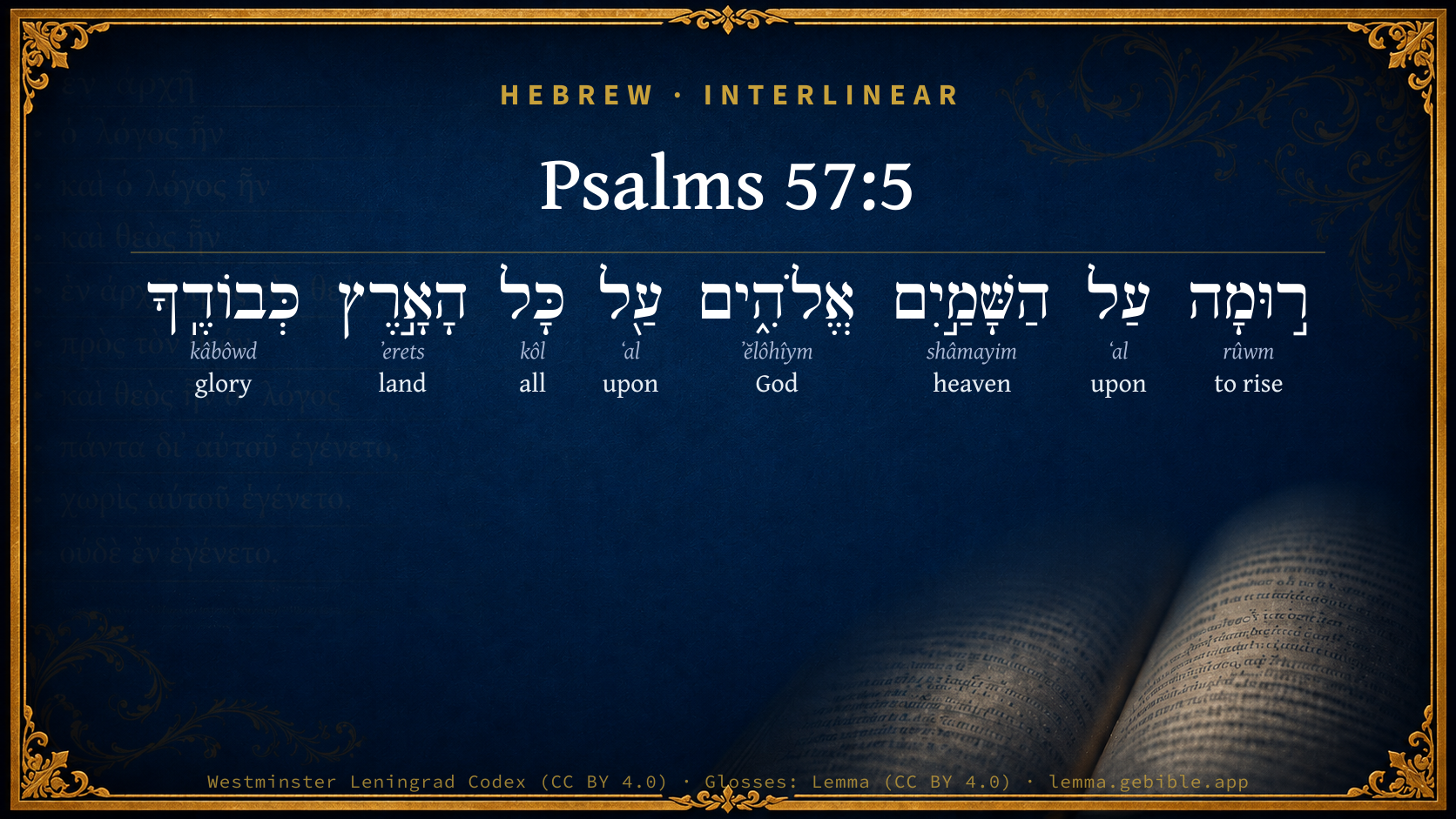
Psalms 57:5

Hebrew (Westminster Leningrad Codex) Psalms 57:5 appears in the Hebrew Old Testament. The text above is from the Westminster Leningrad Codex. Each word links to its Strong’s number, a concise gloss, and parsing drawn from the Open Scriptures Hebrew Bible morphology. Click any word for its full Brown-Driver-Briggs (BDB) entry.
Download image
Cite this verse

Psalms 57:5 (World English Bible). Public Domain. Lemma interlinear Bible study tool, https://lemma.gebible.app/v/psalms/57/5.

Show BibTeX & RIS
BibTeX
RIS
English Translation
Be exalted, God, above the heavens! Let your glory be above all the earth!
World English Bible · Public Domain
Download a study sheet

One document with this verse’s original text, its word-by-word gloss line, the meaning frame, cross-references with their text, attributed commentary, and full source and license credits — printable, and it pastes into notes with its structure intact.

This verse Autodidact and up

Study sheet (.html) Plain text (.txt)

A passage Seminary Student

Up to 50 verses in one chapter. A passage sheet keeps up to 6 commentary sources and 12 cross-references per verse, in the order this page ranks them, and says so on the sheet whenever that leaves anything out. Ask for a single verse and you get the Autodidact verse sheet above.

Everything on this page stays free to read, with no account — the sheet is a download of what is already on screen, not access to it.

Want to remove ads? Support Godless Engineer
Compare translations 3

The same verse in 3 English versions, stacked beneath the original-language interlinear above. Click any original word for its lexicon entry.

Each is an independent rendering of the whole verse — the interlinear is not word-aligned to these translations.

Highlighted words mark where these versions differ — a whole-verse word diff, not a word-by-word alignment.

  • World English Bible Public Domain
    Be exalted, God, above the heavens! Let your glory be above all the earth!
  • King James Version Public Domain
    Be thou exalted, O God, above the heavens; let thy glory be above all the earth.
  • unfoldingWord Literal Text CC BY-SA 4.0
    Be high above the heavens, God, your glory above all of the earth.

unfoldingWord Literal Text — © unfoldingWord, licensed CC BY-SA 4.0. Word-aligned USFM3 via Door43 (git.door43.org/unfoldingWord/en_ult).

Versions to compare (up to 4)

3 of 4 selected

Show all 18 translations

Every available English version of this verse, each an independent rendering of the whole verse.

  • World English Bible Public Domain
    Be exalted, God, above the heavens! Let your glory be above all the earth!
  • Berean Standard Bible Public Domain
    Be exalted, O God, above the heavens; may Your glory cover all the earth.
  • Majority Standard Bible Public Domain
    Be exalted, O God, above the heavens; may Your glory cover all the earth.
  • King James Version Public Domain
    Be thou exalted, O God, above the heavens; let thy glory be above all the earth.
  • American Standard Version (1901) Public Domain
    Be thou exalted, O God, above the heavens; `Let' thy glory `be' above all the earth.
  • Revised Version (1885) Public Domain
    Be thou exalted, O God, above the heavens; let thy glory be above all the earth.
  • Geneva Bible (1599) Public Domain
    Exalt thy selfe, O God, aboue the heauen, and let thy glory be vpon all the earth.
  • Douay-Rheims (1899) Public Domain
    and he hath delivered my soul from the midst of the young lions. I slept troubled. The sons of men, whose teeth are weapons and arrows, and their tongue a sharp sword.
  • Young's Literal Translation Public Domain
    Be Thou exalted above the heavens, O God, Above all the earth Thine honour.
  • Literal Standard Version CC BY-SA 4.0
    Be exalted above the heavens, O God, || Your glory above all the earth.
  • Unlocked Literal Bible CC BY-SA 4.0
    Be exalted, God, above the heavens; let your glory be above all the earth.
  • unfoldingWord Literal Text CC BY-SA 4.0
    Be high above the heavens, God, your glory above all of the earth.
  • Darby Bible Public Domain
    Be exalted above the heavens, O God; let thy glory be above all the earth!
  • World Messianic Bible Public Domain
    Be exalted, God, above the heavens! Let your glory be above all the earth!
  • Webster's Bible Public Domain
    \\57:4\\My soul is among lions: and I lie even among them that are set on fire, even the sons of men, whose teeth are spears and arrows, and their tongue a sharp sword.
  • Free Bible Version CC BY-SA 4.0
    God, your greatness is above the highest heavens; and your glory covers the whole earth!
  • Bible in Basic English Public Domain
    O God, be lifted up higher than the heavens; let your glory be over all the earth.
  • JPS Tanakh (1917) Public Domain
    (57-6) Be Thou exalted, O God, above the heavens; Thy glory be above all the earth.

Literal Standard Version (2020), Covenant Press — licensed CC BY-SA 4.0. Text via the HelloAO Bible API (eBible.org). Unlocked Literal Bible (unfoldingWord) — licensed CC BY-SA 4.0. Text via the HelloAO Bible API (eBible.org). unfoldingWord Literal Text — © unfoldingWord, licensed CC BY-SA 4.0. Word-aligned USFM3 via Door43 (git.door43.org/unfoldingWord/en_ult). Free Bible Version, Dr. Jonathan Gallagher — licensed CC BY-SA 4.0. Text via the HelloAO Bible API (eBible.org).

Word by word

More ways to search: Search by grammar → Find every occurrence → Compare this word →

Practice this passage: Drill this verse → Learn its vocabulary →

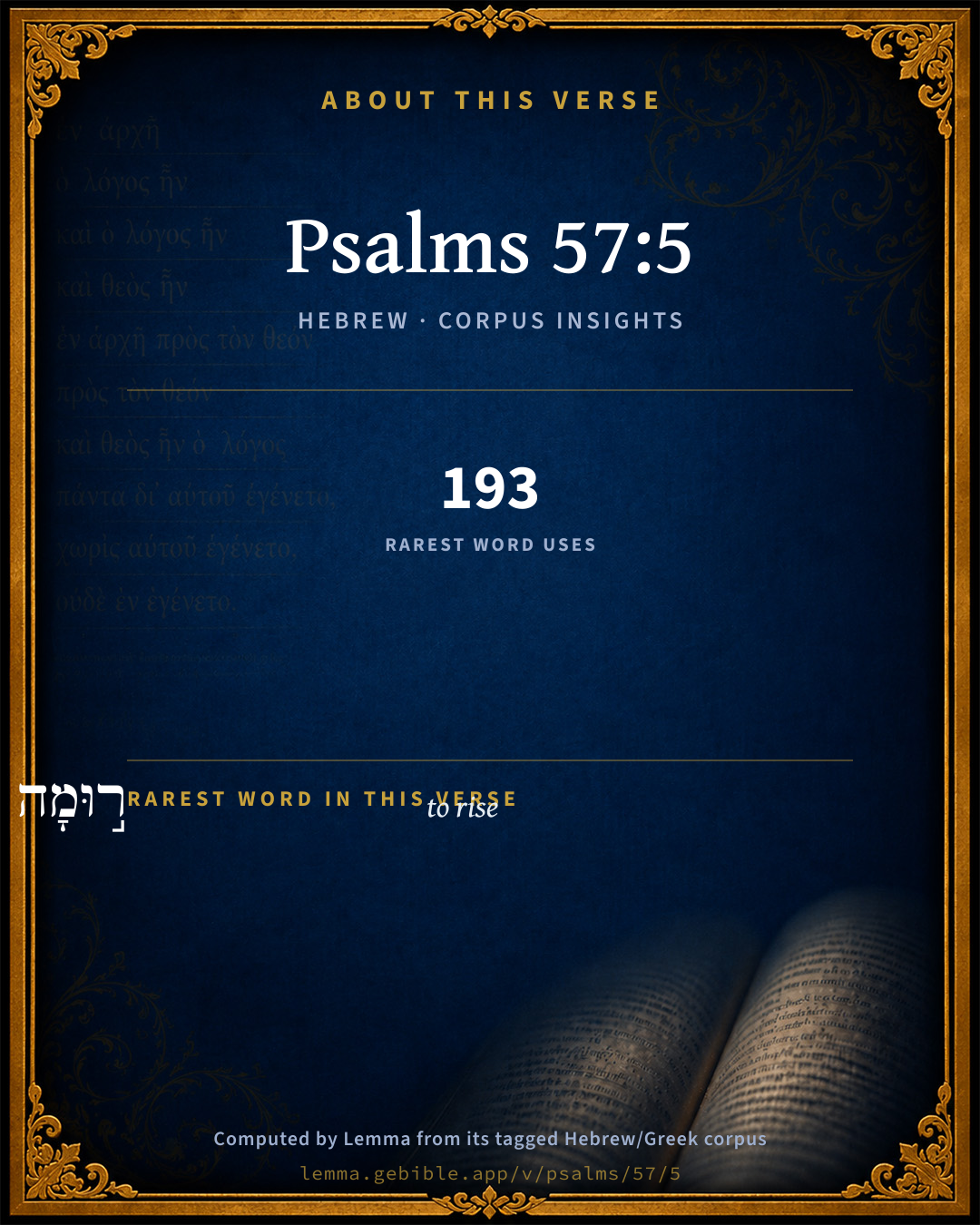
ר֣וּמָה
rûwm
H7311
“rise”
Verb, Qal, Imperative, 2nd Person, Masculine, Singular + Suffix, h
Part of Speech
Verb
Stem
Qal
Form
Imperative
Person
2nd Person
Gender
Masculine
Number
Singular
Full BDB Definition

Origin: a primitive root

TWOT: 2133

to rise, rise up, be high, be lofty, be exalted - (Qal) - to be high, be set on high - to be raised, be uplifted, be exalted - to be lifted, rise - (Polel) - to raise or rear (children), cause to grow up - to lift up, raise, exalt - to exalt, extol - (Polal) to be lifted up - (Hiphil) - to raise, lift, lift up, take up, set up, erect, exalt, set on high - to lift up (and take away), remove - to lift off and present, contribute, offer, contribute - (Hophal) to be taken off, be abolished - (Hithpolel) to exalt oneself, magnify oneself - (Qal) to be rotten, be wormy
  1. עַל ʻal H5921 “upon” Preposition
  2. הַשָּׁמַ֣יִם shâmayim H8064 “the · heaven(s)” Particle, Definite Article + Noun, Common, Masculine, Plural, Absolute
  3. אֱלֹהִ֑ים ʼĕlôhîym H430 “God(s)” Noun, Common, Masculine, Plural, Absolute
  4. עַ֖ל ʻal H5921 “upon” Preposition
  5. כָּל kôl H3605 “all of” Noun, Common, Masculine, Singular, Construct
  6. הָאָ֣רֶץ ʼerets H776 “the · land” Particle, Definite Article + Noun, Common, Both, Singular, Absolute
  7. כְּבוֹדֶֽךָ kâbôwd H3519 “glory · your” Noun, Common, Both, Singular, Construct + Suffix, Personal, 2nd Person, Masculine, Singular

About this verse

These counts appear in no published source. They are computed here, from the morphology-tagged text and Lemma’s own curated glosses. What Lemma adds →

8
words
7
distinct lemmas
Wisdom
section

Grammatical profile

  • 1 verb
  • 5 nouns
  • 2 prepositions

Verb forms

  • ר֣וּמָה Qal · Imperative

Repetition

A word recurs within this verse — often emphatic in Hebrew:

Hebrew & Septuagint length

In English translation the verse runs 14 words from the Hebrew and 15 from the Septuagint (LXX English) — closely comparable.

A rough comparison of the two English renderings, which tokenize alike — not a word-level alignment.

Word counts can differ between the Hebrew and the Greek without any difference in meaning — e.g. the Hebrew direct-object marker אֵת has no separate Greek word, and Greek often adds the article ὁ.

Cross-references

17

Topical passages linked to Psalms 57:5 in the Treasury of Scripture Knowledge — connected by theme and wording, ordered by reader-vote popularity; previews shown in the World English Bible.

  • Habakkuk 2:14 For the earth will be filled with the knowledge of the glory of Yahweh, as the waters cover the sea.
  • Isaiah 6:3 One called to another, and said, "Holy, holy, holy, is Yahweh of Hosts! The whole earth is full of his glory!"
  • Psalms 72:19 Blessed be his glorious name forever! Let the whole earth be filled with his glory! Amen and amen.
  • Numbers 14:21 but in very deed, as I live, and as all the earth shall be filled with the glory of Yahweh;
  • Psalms 57:11 Be exalted, God, above the heavens. Let your glory be over all the earth.
  • Psalms 108:4–5 For your loving kindness is great above the heavens. Your faithfulness reaches to the skies.
  • Psalms 113:4–6 Yahweh is high above all nations, His glory above the heavens.
  • Habakkuk 3:3 God came from Teman, The Holy One from Mount Paran. Selah. His glory covered the heavens, And his praise filled the earth.
  • Psalms 148:13 Let them praise the name of Yahweh, For his name alone is exalted. His glory is above the earth and the heavens.
  • Psalms 8:1 Yahweh, our Lord, how majestic is your name in all the earth, Who has set your glory above the heavens!
  • Matthew 6:9–10 Pray like this: 'Our Father in heaven, may your name be kept holy.
  • Isaiah 2:11 The lofty looks of man will be brought low, The haughtiness of men will be bowed down, And Yahweh alone will be exalted in that day.
  • Isaiah 37:20 Now therefore, Yahweh our God, save us from his hand, that all the kingdoms of the earth may know that you are Yahweh, even you only.
  • Psalms 21:13 Be exalted, Yahweh, in your strength, So we will sing and praise your power.
  • Isaiah 2:17 The loftiness of man shall be bowed down, And the haughtiness of men shall be brought low; And Yahweh alone shall be exalted in that day.
  • Isaiah 12:4 In that day you will say, "Give thanks to Yahweh! Call on his name. Declare his doings among the peoples. Proclaim that his name is exalted!
  • 1 Chronicles 29:1 David the king said to all the assembly, Solomon my son, whom alone God has chosen, is yet young and tender, and the work is great; for the palace is not for man, but for Yahweh God.

Cross-references courtesy of OpenBible.info (CC BY 4.0).

Hebrew and Greek witnesses Masoretic Hebrew ↔ Greek Septuagint

The same verse in the two great witnesses to the Old Testament, shown verse-for-verse.

You’re reading Greek Psalm 56 (Hebrew Psalm 57). The Septuagint counts the superscription, so verse numbers can differ from the Hebrew — chapter-level alignment, not verse-by-verse. Numbering follows Rahlfs.

These are two independent witnesses, not word-aligned to each other, and the Septuagint is shown in lemma (dictionary) form.

Hebrew Psalms 57:5 Masoretic · Westminster Leningrad Codex

ר֣וּמָה עַל הַשָּׁמַ֣יִם אֱלֹהִ֑ים עַ֖ל כָּל הָאָ֣רֶץ כְּבוֹדֶֽךָ

Be exalted, God, above the heavens! Let your glory be above all the earth!

World English Bible · Public Domain

Greek LXX Greek Psalm 56:5 Septuagint · lemma form

καί ῥύομαι ὁ ψυχή ἐγώ ἐκ μέσος σκύμνος κοιμάω ταράσσω υἱός ἄνθρωπος ὁ ὀδούς αὐτός ὅπλον καί βέλος καί ὁ γλῶσσα αὐτός μάχαιρα ὀξύς

Be you exalted, O God, above the heavens; and your glory above all the earth.

LXX2012 (modern English Septuagint) · Public Domain

Hebrew: Westminster Leningrad Codex (CC BY 4.0). Greek: Septuagint (public domain); English from LXX2012 (modern English Septuagint) (Public Domain). How the Septuagint differs from the Hebrew →

Commentary

Notes on Psalms 57:5 from classic Christian and Jewish commentators (each source and its license shown beneath its notes). The classic Christian expositions comment on the surrounding passage and are grouped to its opening verse, so a note may address several verses; the Jewish commentaries on the Tanakh (Rashi and others) are per-verse, so they appear only where the commentator wrote on this verse.

Lemma curates 59 commentaries, every one of them public domain or Creative Commons licensed, each selected and text-cleaned for this edition rather than reprinted as found. About our sources →

Trapp's Complete Commentary

John Trapp

Psa 57:5 Be thou exalted, O God, above the heavens; [let] thy glory [be] above all the earth.

Ver. 5. Be thou exalted, O God, above the heavens] That is, saith the Chaldee, above the angels.

And let thy glory be above all the earth] That is, above the inhabitants of the earth. There are, saith Kimchi, that think thou either wilt not, or else canst not, save; oh, let thy power appear for the conviction of all such who now lift up themselves, and seem at least to touch the heaven with one finger.

John Trapp, A Commentary or Exposition upon All the Books of the Old and New Testament (1647–1656) — public domain. Text from a community e-Sword module.

The Biblical Illustrator

Joseph S. Exell

Psa_57:5

Be Thou exalted, O God, above the heavens; let Thy glory be above all the earth.

The Lord alone exalted

I. As the absolute decree of heaven. For--

1. His own glory is the first principle with God.

2. The ordination of Christ to His official work put Him under responsibility to effect this.

3. The principle is essential to the nature and existence of God.

II. The law of thy covenant of grace. All the leading truths of the Bible contribute to the glory of God--election, regeneration. The union between Christ and His Church. Redemption.

III. The language of every believing heart. For it is his desire, purpose and endeavour that God may be exalted. (Joseph Irons.)

The Biblical Illustrator, edited by Joseph S. Exell (c. 1880s–1900s) — public domain. Text from a community e-Sword module.

Joseph Benson's Commentary

Psa 57:5. Be thou exalted above the heavens — That is, higher than the heavens, or to the highest degree possible. Glorify thy power and goodness, thy justice and faithfulness, by my deliverance; all which attributes are exposed to censure and reproach while thou sufferest the ungodly to oppress and triumph over the righteous, who put their trust in thee. Let thy glory be above all the earth — Above all men upon earth, some of whom do now audaciously lift up themselves against thee, and act as if they thought themselves above thee, and able to counteract thy designs. Or, through all the earth, as the Hebrew may be rendered. Spread the fame of thy glorious perfections through all nations. Display thy glory, not only among thy own people, but in such a manner that even the heathen may be forced to acknowledge and admire it.

Joseph Benson's Commentary on the Old and New Testaments (1811–1818) — public domain. Text from a community e-Sword module.

J. A. Alexander on Psalms

Joseph Addison Alexander

6. (Psa 57:5). Be high above the heavens, O God, above all the earth thy glory! Some, in the last clause, read on all the earth, and then explain on the heavens to mean nothing more than in heaven. The whole verse then is the expression of a wish that God may be exalted both in heaven and earth. But this is far less natural than the usual construction, which supposes a comparison, and makes the verse exalt God above all his works. Compare Psa 8:1.

Joseph Addison Alexander, The Psalms Translated and Explained (1850) — public domain. Text from a community e-Sword module.

Tyndale Open Study Notes

Tyndale Open Resources

57:5 This verse is repeated in 57:11 and 108:5. • God’s glory—his manifest presence that excludes all evil (8:1; 19:1-4; 24:7)—will fill the whole created order (Isa 6:3).

Tyndale Open Study Notes — © Tyndale Open Resources, licensed CC BY-SA 4.0. Text via the HelloAO Bible API.

Geneva Bible (1599)

Geneva Bible translators

Suffer me not to be destroyed to the contempt of thy Name.

Geneva Bible (1599) marginal notes — public domain. Text via Bolls.life.

Jamieson, Fausset & Brown

Robert Jamieson, A. R. Fausset & David Brown

This doxology illustrates his view of the connection of his deliverance with God's glory.

Jamieson, Fausset & Brown — Commentary Critical and Explanatory on the Whole Bible (1871) — public domain (CC PDM 1.0). Text via the HelloAO Bible API.

Adam Clarke's Commentary

Verse 5. Be thou exalted, O God, above the heavens] Let the glory of thy mercy and truth be seen in the heavens above, and in the earth beneath. Several of the fathers apply what is said above to the passion of our Lord, and what is said here to his resurrection.

Adam Clarke's Commentary on the Bible (1810–1826) — public domain. Text from a community e-Sword/MySword module.

John Calvin's Commentaries

To him we find David appealing in the words that follow, Exalt thyself, O God! above the heavens: let thy glory be above all the earth. To perceive the appropriateness of this prayer, it is necessary that we reflect upon the height of audacity and pride to which the wicked proceed, when unrestrained by the providence of God, and upon the formidable nature of that conspiracy which was directed against David by Saul, and the nation in general, all which demanded a signal manifestation of divine power on his behalf. Nor is it a small comfort to consider that God, in appearing for the help of his people, at the same time advances his own glory. Against it, as well as against them, is the opposition of the wicked directed, and he will never suffer his glory to be obscured, or his holy name to be polluted with their blasphemies. The Psalmist reverts to the language of complaint. He had spoken of the cruel persecution to which he was subjected, and now bewails the treachery and deceit which were practiced against him. His soul he describes as being bowed down, in allusion to the crouching of the body when one is under the influence of fear, or to birds when terrified by the fowler and his nets, which dare not move a feather, but lie flat upon the ground. Some read, He has bowed down my soul But the other is the most obvious rendering, and the verb כפף, caphaph, is one which is frequently taken with the neuter signification. Although the Hebrew word נפש, nephesh, rendered soul, is feminine, this is not the only place where we find it with a masculine adjunct.

John Calvin's Commentaries (1540-1563) — public domain. Text from the Calvin Translation Society English edition (1840s-50s) via the Christian Classics Ethereal Library (ccel.org). Calvin's coverage is partial (roughly two-thirds of the Bible); uncommented books and verses are honest gaps, never fabricated. The 19th-century editor's footnotes and remarks are omitted so the notes are faithfully Calvin's own voice.

The Cambridge Bible for Schools and Colleges

gen. ed. J. J. S. Perowne

5. The thought of man’s murderous hostility naturally leads up to the prayer that God will manifest Himself in majesty. From the confusions of earth the Psalmist looks up to God. Cp. Psa_11:4 ff.; Psa_36:5 ff.

Be thou exalted] Or, Exalt thyself. Cp. Psa_21:13; Psa_46:10. God is exalted in majesty (Isa_6:1): what is needed is that He should manifest His supreme authority (Isa_2:11 ff.) over these insolent rebels.

Though rhythmically divided, the two clauses are logically one: ‘exalt Thyself in Thy glory above heaven and earth.’

The Cambridge Bible for Schools and Colleges (gen. ed. J. J. S. Perowne; Cambridge University Press, 1878–1918) — public domain. Text from a community e-Sword module.

John Gill's Exposition

Be thou exalted, O God, above the heavens,.... That is, show thyself to be God, that sittest in the heavens, and art higher than they, by saving me, and disappointing mine enemies; that I, and those that are with me, may magnify the Lord and exalt his name together. The Targum is,

"be thou exalted above the angels of heaven, O God;''

let thy glory be above all the earth; that is, above all the inhabitants of the earth, as the Chaldee paraphrase: let the glory of God in my deliverance be seen by all that dwell upon the earth; for by how much the lower and more distressed his case and condition were, by so much the more would the glory of God be displayed in bringing him out of it. Nothing lies nearer the hearts of the people of God than his glory; this is more desirable than their own salvation: David breathes after the one, when he says nothing of the other, that being uppermost; though his meaning is, that the one might be brought about by the other.

John Gill's Exposition of the Whole Bible (1746–1763) — public domain (CC PDM 1.0). Text via the HelloAO Bible API.

Albert Barnes' Notes on the Bible

Be thou exalted, O God, above the heavens - Compare Psa 8:1. The language here is that of a man who in trouble lifts his thoughts to God; who feels that God reigns; who is assured in his own soul that all things are under his hand; and who is desirous that God should be magnified whatever may become of himself. His prime and leading wish is not for himself, for his own safety, for his own deliverance from danger; it is that “God” may be honored - that the name of God may be glorified - that God may be regarded as supreme over all things - that God may be exalted in the highest possible degree - an idea expressed in the prayer that he may be exalted “above the heavens.”

Let thy glory be above all the earth - The honor of thy name; thy praise. Let it be regarded, and be in fact, “above” all that pertains to this lower world; let everything on earth, or that pertains to earth, be subordinate to thee, or be surrendered for thee. This was the comfort which David found in trouble. And this “is” the only true source of consolation. The welfare of the universe depends on God; and that God should be true, and just, and good, and worthy of confidence and love - that he should reign, - that his law should be obeyed - that his plans should be accomplished, - is of more importance to the universe than anything that merely pertains to us; than the success of any of our own plans; than our health, our prosperity, or our life.

Albert Barnes' Notes on the Bible (1834–1885) — public domain. Text from a community e-Sword/MySword module.

Matthew Poole's English Annotations

Be thou exalted; glorify thy power, and goodness, and justice, and faithfulness by my deliverance, all which are exposed to censure and reproach, whilst thou sufferest ungodly wretches to oppress and triumph over the innocent and righteous, that put their trust in thee.

Above the heavens, i.e. higher than the heavens, or to the highest degree possible; or above all the false gods which are supposed to reside in heaven.

Above all the earth, i.e. above all men upon earth, some whereof do now audaciously lift up themselves against thee, and above thee. Or, through (as the Hebrew particle is commonly rendered, and it is no new thing to have the same word or particle diversely taken in the same verse, as hath been formerly showed) the whole earth; not only amongst thine own people, but so that the heathens shall be forced to acknowledge and admire thy glorious deeds.

Matthew Poole's English Annotations on the Holy Bible (1683–1685) — public domain. Text from a community e-Sword/MySword module.

The Treasury of David

Charles H. Spurgeon

Ver. 5. Be thou exalted, O God, above the heavens. This is the chorus of the Psalm. Before he has quite concluded his prayer the good man interjects a verse of praise; and glorious praise too, seeing it comes from the lion's den and from amid the coals of fire. Higher than the heavens is the Most High, and so high ought our praises to rise. Above even the power of cherubim and seraphim to express it, the glory of God is revealed and is to be acknowledged by us.

Let thy glory be above all the earth. As above, so below, let thy praises, O thou great Jehovah, be universally proclaimed. As the air surrounds all nature, so let thy praises gird the earth with a zone of song.

None.

Ver. 5.

I. The end which God has in view, both in heaven and

earth, in a sinful and in sinless worlds--his own

glory.

II. Our duty to acquiesce in that end: Be thou, etc.

--Not self, not men, not angels--Be thou

exalted, etc. In this we should acquiesce--

1. Actively, by seeking that end.

2. Passively, by submission to his will. G. R.

Psalms 57:6*

Charles H. Spurgeon's The Treasury of David (1869–1885) — public domain. Psalms only. Text from a community e-Sword/MySword module.

Whedon's Commentary on the Bible

Daniel D. Whedon

5. Be thou exalted, O God—The cause of David was the cause of God. The manifested glory of God as supreme, implied David’s deliverance, and either implied the defeat of his enemies. His prayer against his enemies was, therefore, at once a prayer for deliverance and for the honour of God. The dawn of David’s deliverance appears in this verse, and fully breaks forth in Psa_57:8

Daniel D. Whedon (gen. ed.), Commentary on the Old and New Testaments (1874–1909) — public domain. Text from a community e-Sword module.

The Pulpit Commentary

Be thou exalted, O God, above the heavens; or, exalt thyself, O God, above the heavens; i.e. show forth thy might in such a signal way that the heavens (i.e. the angels) may stand to gaze at it. Let thy glory be above all the earth. Let thy exaltation equally draw the attention of the whole earth.

The Pulpit Commentary (1880–1919), ed. H.D.M. Spence-Jones & Joseph S. Exell — public domain. Text from a community e-Sword module.

John Wesley's Explanatory Notes

Excited - Glorify thy power, and goodness, and justice, and faithfulness, by my deliverance. Above, &c. - To the highest degree possible.

John Wesley, Explanatory Notes Upon the Whole Bible (1754–1765) — public domain. Text via the GEBible commentary corpus.

Rashi

Rabbi Shlomo Yitzchaki (Rashi)

My soul is among lions Abner and Amassa, who were “lions” [leaders] the in Torah, and who do not protest against Saul.

I lie among men who are aflame En flanboyanz, or enflamoyonz, among those who are flaming. Among the Ziphim, who are aflame after slander.

Rashi on the Tanakh — English translations: “The Judaica Press complete Tanach with Rashi, translated by A. J. Rosenberg” (CC BY 4.0); “Pentateuch with Rashi's commentary by M. Rosenbaum and A.M. Silbermann, 1929-1934” (public domain); “The Metsudah Tanach series, Lakewood, N.J” (CC BY 4.0); and “The Book of Joshua, Metsudah Publications, 1997” (CC BY 4.0). Text via Sefaria.

Lesson kit

Teaching starters — assembled from the data on this page, not authored interpretation. Every prompt links to the verse data it draws on. Edit before teaching.

Psalms, in the Wisdom, opens this verse with 8 words (7 distinct Hebrew lemmas). Its most distinctive word is rûwm (“to rise”). A historical commentator’s framing appears above. Read the whole chapter for the surrounding context.

Discussion questions

  1. What does “to rise” (rûwm) contribute to the verse as a whole?
  2. How does Habakkuk 2:14, which shares this passage’s theme, read alongside this verse?
  3. What does the repetition of “upon” (2× in this one verse) do in this verse?
  4. These translations render this verse differently; the difference is in the English rendering, not the original. What questions does that raise?
  5. «ר֣וּמָה» is a Qal Imperative verb. How does that grammatical form shape the action described?
  6. Compare how Trapp's Complete Commentary and The Biblical Illustrator read this verse. Where do they agree or differ?

Things to notice

Reading settings

Reading text

Shown beneath each verse's original-language words.

Old Testament
Old Testament edition

Read the OT as the Masoretic Hebrew (MT) or the Greek Septuagint (LXX).

English shown for the Greek Septuagint (in the Hebrew ↔ Greek comparison).

Comparing translations? Open the Compare panel on any verse page to stack up to four side by side.