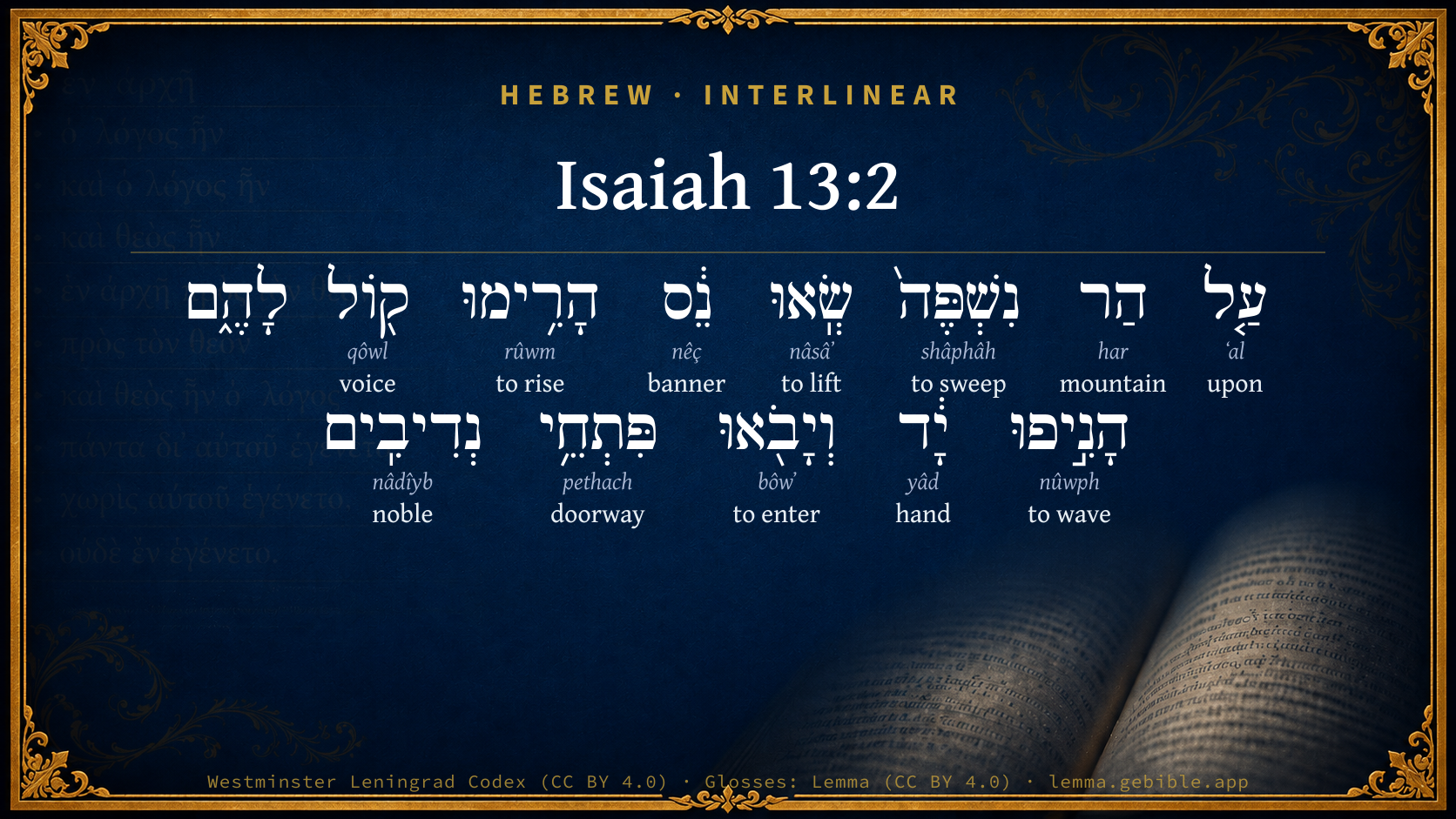
Isaiah 13:2

Hebrew (Westminster Leningrad Codex) Isaiah 13:2 appears in the Hebrew Old Testament. The text above is from the Westminster Leningrad Codex. Each word links to its Strong’s number, a concise gloss, and parsing drawn from the Open Scriptures Hebrew Bible morphology. Click any word for its full Brown-Driver-Briggs (BDB) entry.
Download image
Cite this verse

Isaiah 13:2 (World English Bible). Public Domain. Lemma interlinear Bible study tool, https://lemma.gebible.app/v/isaiah/13/2.

Show BibTeX & RIS
BibTeX
RIS
English Translation
Set up an ensign on the bare mountain, lift up the voice to them, wave the hand, that they may go into the gates of the nobles.
World English Bible · Public Domain
Download a study sheet

One document with this verse’s original text, its word-by-word gloss line, the meaning frame, cross-references with their text, attributed commentary, and full source and license credits — printable, and it pastes into notes with its structure intact.

This verse Autodidact and up

Study sheet (.html) Plain text (.txt)

A passage Seminary Student

Up to 50 verses in one chapter. A passage sheet keeps up to 6 commentary sources and 12 cross-references per verse, in the order this page ranks them, and says so on the sheet whenever that leaves anything out. Ask for a single verse and you get the Autodidact verse sheet above.

Everything on this page stays free to read, with no account — the sheet is a download of what is already on screen, not access to it.

Want to remove ads? Support Godless Engineer
Compare translations 3

The same verse in 3 English versions, stacked beneath the original-language interlinear above. Click any original word for its lexicon entry.

Each is an independent rendering of the whole verse — the interlinear is not word-aligned to these translations.

Highlighted words mark where these versions differ — a whole-verse word diff, not a word-by-word alignment.

  • World English Bible Public Domain
    Set up an ensign on the bare mountain, lift up the voice to them, wave the hand, that they may go into the gates of the nobles.
  • King James Version Public Domain
    Lift ye up a banner upon the high mountain, exalt the voice unto them, shake the hand, that they may go into the gates of the nobles.
  • unfoldingWord Literal Text CC BY-SA 4.0
    Lift up a banner on a bared mountain; raise a voice to them, wave a hand, that they may enter the gates of the nobles.

unfoldingWord Literal Text — © unfoldingWord, licensed CC BY-SA 4.0. Word-aligned USFM3 via Door43 (git.door43.org/unfoldingWord/en_ult).

Versions to compare (up to 4)

3 of 4 selected

Show all 18 translations

Every available English version of this verse, each an independent rendering of the whole verse.

  • World English Bible Public Domain
    Set up an ensign on the bare mountain, lift up the voice to them, wave the hand, that they may go into the gates of the nobles.
  • Berean Standard Bible Public Domain
    Raise a banner on a barren hilltop; call aloud to them. Wave your hand, that they may enter the gates of the nobles.
  • Majority Standard Bible Public Domain
    Raise a banner on a barren hilltop; call aloud to them. Wave your hand, that they may enter the gates of the nobles.
  • King James Version Public Domain
    Lift ye up a banner upon the high mountain, exalt the voice unto them, shake the hand, that they may go into the gates of the nobles.
  • American Standard Version (1901) Public Domain
    Set ye up an ensign upon the bare mountain, lift up the voice unto them, wave the hand, that they may go into the gates of the nobles.
  • Revised Version (1885) Public Domain
    Set ye up an ensign upon the bare mountain, lift up the voice unto them, wave the hand, that they may go into the gates of the nobles.
  • Geneva Bible (1599) Public Domain
    Lift vp a standard vpon the hie mountaine: lift vp the voyce vnto them: wagge the hand, that they may goe into the gates of the nobles.
  • Douay-Rheims (1899) Public Domain
    Upon the dark mountain lift ye up a banner, exalt the voice, lift up the hand, and let the rulers go into the gates.
  • Young's Literal Translation Public Domain
    `On a high mountain lift ye up an ensign, Raise the voice to them, wave the hand, And they go in to the openings of nobles.
  • Literal Standard Version CC BY-SA 4.0
    “Lift up an ensign on a high mountain, || Raise the voice to them, wave the hand, || And they go into the openings of nobles.
  • Unlocked Literal Bible CC BY-SA 4.0
    On the bare mountain set up a signal flag, cry aloud to them, wave your hand for them to go into the gates of the nobles.
  • unfoldingWord Literal Text CC BY-SA 4.0
    Lift up a banner on a bared mountain; raise a voice to them, wave a hand, that they may enter the gates of the nobles.
  • Darby Bible Public Domain
    Lift up a banner upon a bare mountain, raise the voice unto them, shake the hand, that they may enter the gates of the nobles.
  • World Messianic Bible Public Domain
    Set up a banner on the bare mountain! Lift up your voice to them! Wave your hand, that they may go into the gates of the nobles.
  • Webster's Bible Public Domain
    Lift ye up a banner upon the high mountain, exalt the voice to them, shake the hand, that they may go into the gates of the nobles.
  • Free Bible Version CC BY-SA 4.0
    Set up a banner on a bare hilltop; shout out to them; wave your hand to encourage them to enter the palaces of princes.
  • Bible in Basic English Public Domain
    Put up a flag on a clear mountain-top, make a loud outcry to them, give directions with the hand, so that they may go into the doors of the great ones.
  • JPS Tanakh (1917) Public Domain
    Set ye up an ensign upon the high mountain, lift up the voice unto them, wave the hand, that they may go into the gates of the nobles.

Literal Standard Version (2020), Covenant Press — licensed CC BY-SA 4.0. Text via the HelloAO Bible API (eBible.org). Unlocked Literal Bible (unfoldingWord) — licensed CC BY-SA 4.0. Text via the HelloAO Bible API (eBible.org). unfoldingWord Literal Text — © unfoldingWord, licensed CC BY-SA 4.0. Word-aligned USFM3 via Door43 (git.door43.org/unfoldingWord/en_ult). Free Bible Version, Dr. Jonathan Gallagher — licensed CC BY-SA 4.0. Text via the HelloAO Bible API (eBible.org).

Word by word

More ways to search: Search by grammar → Find every occurrence → Compare this word →

Practice this passage: Drill this verse → Learn its vocabulary →

נִשְׁפֶּה֙
shâphâh
H8192
“sweeping”
Verb, Niphal, Participle Active, Masculine, Singular, Absolute
Part of Speech
Verb
Stem
Niphal
Form
Participle Active
Gender
Masculine
Number
Singular
State
Absolute
Full BDB Definition

Origin: a primitive root

TWOT: 2440

to sweep bare, scrape - (Niphal) to be wind-swept, be bare, be scraped barren (by wind) - (Pual) to be bare, be laid bare
  1. עַ֤ל ʻal H5921 “upon” Preposition
  2. הַר har H2022 “mountain” Noun, Common, Masculine, Singular, Absolute
  3. שְֽׂאוּ nâsâʼ H5375 “lift” Verb, Qal, Imperative, 2nd Person, Masculine, Plural
  4. נֵ֔ס nêç H5251 “banner” Noun, Common, Masculine, Singular, Absolute
  5. הָרִ֥ימוּ rûwm H7311 “rise” Verb, Hiphil, Imperative, 2nd Person, Masculine, Plural
  6. ק֖וֹל qôwl H6963 “voice” Noun, Common, Masculine, Singular, Absolute
  7. הָנִ֣יפוּ nûwph H5130 “wave” Verb, Hiphil, Imperative, 2nd Person, Masculine, Plural
  8. יָ֔ד yâd H3027 “hand” Noun, Common, Both, Singular, Absolute
  9. וְיָבֹ֖אוּ bôwʼ H935 “and · to enter” Conjunction + Verb, Qal, Jussive, 3rd Person, Masculine, Plural
  10. פִּתְחֵ֥י pethach H6607 “doorways of” Noun, Common, Masculine, Plural, Construct
  11. נְדִיבִֽים nâdîyb H5081 “noble” Adjective, Adjective, Masculine, Plural, Absolute

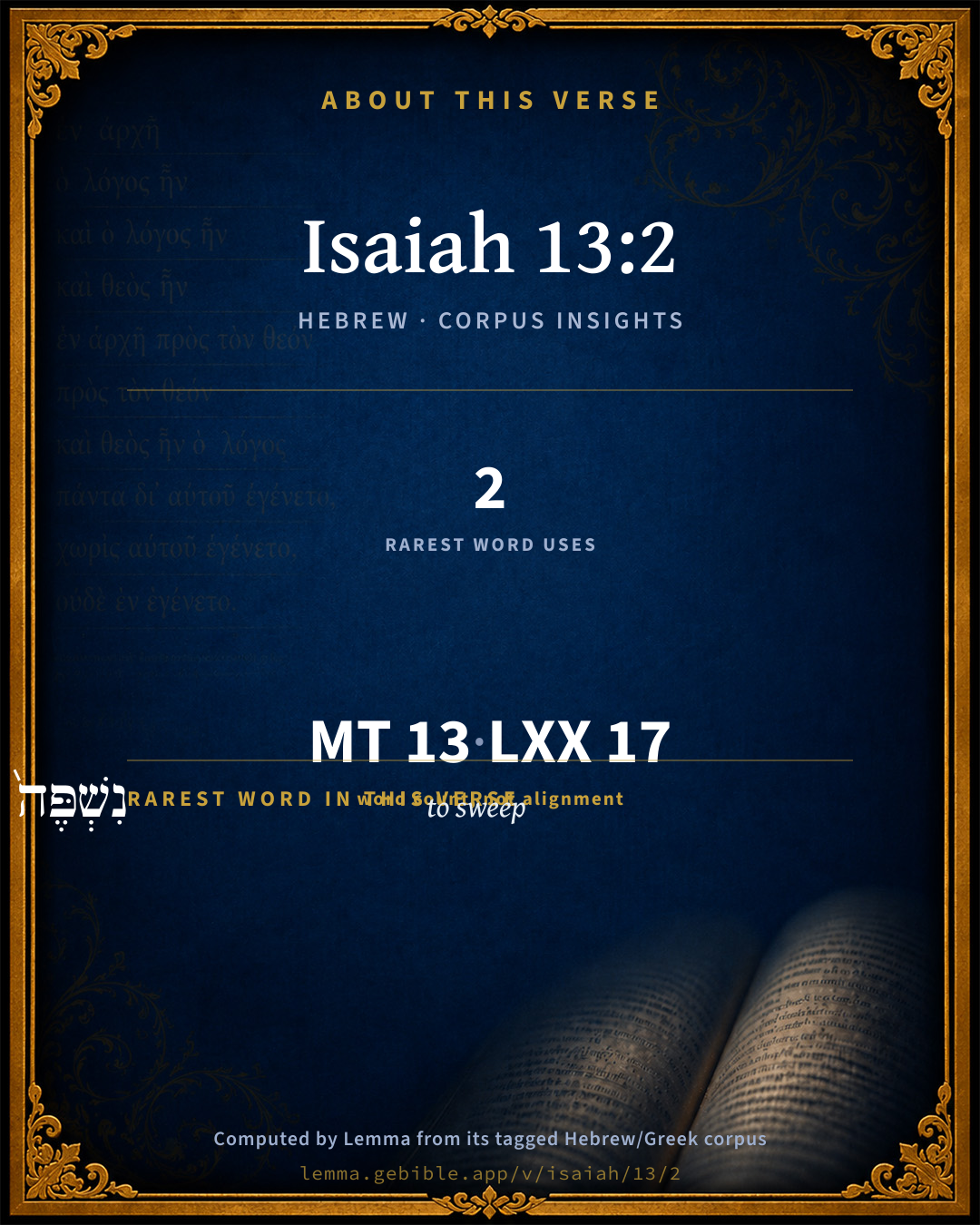
About this verse

These counts appear in no published source. They are computed here, from the morphology-tagged text and Lemma’s own curated glosses. What Lemma adds →

13
words
12
distinct lemmas
Prophets
section

Notable vocabulary

The rarest word here is נִשְׁפֶּה֙ to sweep H8192 — appearing just 2 times in the whole Hebrew Bible.

Shared distinctive vocabulary

נִשְׁפֶּה֙ to sweep H8192 occurs in 2 verses of the Hebrew Bible. Also found in:

Grammatical profile

  • 5 verbs
  • 5 nouns
  • 1 adjective
  • 2 prepositions

Verb forms

  • נִשְׁפֶּה֙ Niphal · Participle Active
  • שְֽׂאוּ Qal · Imperative
  • הָרִ֥ימוּ Hiphil · Imperative
  • הָנִ֣יפוּ Hiphil · Imperative
  • וְיָבֹ֖אוּ Qal · Jussive

Hebrew & Septuagint length

In English translation the verse runs 27 words from the Hebrew and 24 from the Septuagint (LXX English) — closely comparable.

A rough comparison of the two English renderings, which tokenize alike — not a word-level alignment.

Word counts can differ between the Hebrew and the Greek without any difference in meaning — e.g. the Hebrew direct-object marker אֵת has no separate Greek word, and Greek often adds the article ὁ.

In the original languages it is 13 Hebrew tokens and 17 Greek tokens — but the two are counted differently (Hebrew bundles its prefixes and suffixes into one token; the Greek is in lemma form), so that isn’t a like-for-like length.

Cross-references

10

Topical passages linked to Isaiah 13:2 in the Treasury of Scripture Knowledge — connected by theme and wording, ordered by reader-vote popularity; previews shown in the World English Bible.

  • Isaiah 5:26 He will lift up a banner to the nations from far, And he will whistle for them from the end of the earth. Behold, they will come speedily and swiftly.
  • Jeremiah 51:58 Thus says Yahweh of hosts: The broad walls of Babylon shall be utterly overthrown, and her high gates shall be burned with fire; and the peoples shall labor for vanity, and the nations for the fire; and they shall be weary.
  • Jeremiah 50:2 Declare you among the nations and publish, and set up a standard; publish, and don't conceal: say, Babylon is taken, Bel is disappointed, Merodach is dismayed; her images are disappointed, her idols are dismayed.
  • Isaiah 45:1–3 Thus says Yahweh to his anointed, to Cyrus, whose right hand I have held, to subdue nations before him, and I will loose the loins of kings; to open the doors before him, and the gates shall not be shut:
  • Jeremiah 51:25 Behold, I am against you, destroying mountain, says Yahweh, which destroy all the earth; and I will stretch out my hand on you, and roll you down from the rocks, and will make you a burnt mountain.
  • Isaiah 10:32 This very day shall he halt at Nob: he shakes his hand at the mountain of the daughter of Zion, the hill of Jerusalem.
  • Isaiah 18:3 All you inhabitants of the world, and you dwellers on the earth, when an ensign is lifted up on the mountains, look; and when the trumpet is blown, listen.
  • Isaiah 11:12 He will set up an ensign for the nations, and will assemble the outcasts of Israel, and gather together the dispersed of Judah from the four corners of the earth.
  • Isaiah 11:15 Yahweh will utterly destroy the tongue of the Egyptian sea; and with his scorching wind will he wave his hand over the River, and will strike it into seven streams, and cause men to march over in sandals.
  • Jeremiah 51:27–28 Set up a standard in the land, blow the trumpet among the nations, prepare the nations against her, call together against her the kingdoms of Ararat, Minni, and Ashkenaz: appoint a marshal against her; cause the horses to come up as the rough canker-worm.

Cross-references courtesy of OpenBible.info (CC BY 4.0).

Hebrew and Greek witnesses Masoretic Hebrew ↔ Greek Septuagint

The same verse in the two great witnesses to the Old Testament, shown verse-for-verse.

These are two independent witnesses, not word-aligned to each other, and the Septuagint is shown in lemma (dictionary) form.

Hebrew Isaiah 13:2 Masoretic · Westminster Leningrad Codex

עַ֤ל הַר נִשְׁפֶּה֙ שְֽׂאוּ נֵ֔ס הָרִ֥ימוּ ק֖וֹל לָהֶ֑ם הָנִ֣יפוּ יָ֔ד וְיָבֹ֖אוּ פִּתְחֵ֥י נְדִיבִֽים

Set up an ensign on the bare mountain, lift up the voice to them, wave the hand, that they may go into the gates of the nobles.

World English Bible · Public Domain

Greek LXX Isaiah 13:2 Septuagint · lemma form

ἐπί ὄρος πεδεινός αἴρω σημεῖον ὑψόω ὁ φωνή αὐτός μή φοβέω παρακαλέω ὁ χείρ ἀναοἴγω ὁ ἄρχων

Lift up a standard on the mountain of the plain, exalt the voice to them, beckon with the hand, open the gates, you⌃ rulers.

LXX2012 (modern English Septuagint) · Public Domain

Hebrew: Westminster Leningrad Codex (CC BY 4.0). Greek: Septuagint (public domain); English from LXX2012 (modern English Septuagint) (Public Domain). How the Septuagint differs from the Hebrew →

Targum (Aramaic paraphrase)

1

The Targum is the ancient Jewish Aramaic paraphrase of the Hebrew Scriptures — an interpretive translation, not the Hebrew text itself. Onkelos (literal) and Pseudo-Jonathan (expansive) render the Torah, and Jonathan the Prophets. Coverage is partial: where no permissively-licensed English translation exists for a verse, only the Aramaic is shown. This is verse-level text, not a word-by-word alignment to the Hebrew.

  1. Targum Jonathan Prophets (Joshua–Malachi)
    עַל כְּרַכָּא דְיַתְבָא שְׁלֵיוָא זְקוּפוּ אָתָא אֲרִימוּ קָלָא לְהוֹן אֲנִיפוּ יַד וְיֵיעֲלוּן בְּתַרְעָהָא מִתְנַדְבִין:

    Against the fortified city that dwells securely lift up the ensign, exalt the voice unto them, shake the hand, that they may go into the gates of the nobles.

    Targum Jonathan — Aramaic: “Mikraot Gedolot” (public domain). English: “Sefaria Community Translation” (CC0 1.0 (public-domain dedication)); “London "Chaldee Paraphrase," 1871” (public domain). Text via Sefaria.

Commentary

Notes on Isaiah 13:2 from classic Christian and Jewish commentators (each source and its license shown beneath its notes). The classic Christian expositions comment on the surrounding passage and are grouped to its opening verse, so a note may address several verses; the Jewish commentaries on the Tanakh (Rashi and others) are per-verse, so they appear only where the commentator wrote on this verse.

Lemma curates 59 commentaries, every one of them public domain or Creative Commons licensed, each selected and text-cleaned for this edition rather than reprinted as found. About our sources →

Trapp's Complete Commentary

John Trapp

Isa 13:2 Lift ye up a banner upon the high mountain, exalt the voice unto them, shake the hand, that they may go into the gates of the nobles.

Ver. 2. Lift up a banner.] Deus hic quasi classicum canit; God, as chief general, gives forth his orders to the Medes and Persians. He is a "man of war," {Exo 15:3} yea, the Lord victor of war, as the Chaldee there paraphraseth. See the like Jer 50:2.

Upon the high mountain.] Where it may best be seen. Media is a mountainous country. Or, contra montem caliglnosum, against the dark mountain - i.e., Babylon, which, though situated in a plain, yet was tumoured up with her wealth and power, and seemed unmoveable. Famous this city was for a hortus pensilis, an artificial garden (made by Nebuchadnezzar for the pleasure of his wife Nicotris), which, hanging over the city, darkeneth it, {a} like as that continual cloud doth the island of St Thomas, on the back side of Africa.

Exalt the voice unto them, shake the hand.] Propinquos voce, longinquos significatione ad arma convocate; { b} give the alarm to those that are near hand and further off.

That they may go into the gates of the nobles.] Or, Of the munificent or bounteous lords; for such all nobles are, or ought to be. Our English word lord, contracted of the Saxon word laford, cometh of luef, to sustain or succour others.

{a} Strabo, lib. xvi.; Curtius, lib. v.; Josephus, lib. x.

{b} Junius.

John Trapp, A Commentary or Exposition upon All the Books of the Old and New Testament (1647–1656) — public domain. Text from a community e-Sword module.

Joseph Benson's Commentary

Isa 13:2-3. Lift up a banner — To gather soldiers together for this expedition; upon the high mountain — Whence it may be discerned at a considerable distance. Exalt the voice unto them — To the Medes, named Isa 13:17. Shake the hand — Beckon to them with your hand, that they may come to this service. That they may go into the gates of the nobles — That they may go and take Babylon, and so may enter into the palaces of the king, and of his princes, and spoil them at their pleasure. I have commanded my sanctified ones — Or, my appointed ones, as Dr. Waterland renders מקדשׁי, namely, the Medes and Persians, who were solemnly designed and set apart by God for his service, in this sacred work of executing his just vengeance upon the Babylonians. I have called my mighty ones — Those whom I have made mighty for this work; even them that rejoice in my highness — Or, exult in my greatness, as Bishop Lowth renders it, that is, in the doing that work which will tend to the advancement of my glory, in destroying the Babylonian empire. Not that the Medes and Persians had any regard to God or to his glory, in undertaking and prosecuting this war: they certainly had only the gratifying their own ambition, and lust of power and empire, in view.

Joseph Benson's Commentary on the Old and New Testaments (1811–1818) — public domain. Text from a community e-Sword module.

Tyndale Open Study Notes

Tyndale Open Resources

13:2 A signal flag or banner that could be seen clearly from a great distance was often placed on a bare hilltop as a call to battle. • God stands against Babylon as the symbolic representative of all evil kingdoms.

Tyndale Open Study Notes — © Tyndale Open Resources, licensed CC BY-SA 4.0. Text via the HelloAO Bible API.

Geneva Bible (1599)

Geneva Bible translators

To wit, the Medes and Persians.

Geneva Bible (1599) marginal notes — public domain. Text via Bolls.life.

Jamieson, Fausset & Brown

Robert Jamieson, A. R. Fausset & David Brown

Lift . . . banner-- (Isa 5:26; Isa 11:10).

the high mountain--rather, "a bare (literally, "bald," that is, without trees) mountain"; from it the banner could be seen afar off, so as to rally together the peoples against Babylon.

unto them--unto the Medes (Isa 13:17), the assailants of Babylon. It is remarkable that Isaiah does not foretell here the Jews' captivity in Babylon, but presupposes that event, and throws himself beyond, predicting another event still more future, the overthrow of the city of Israel's oppressors. It was now one hundred seventy-four years before the event.

shake . . . hand--beckon with the hand--wave the hand to direct the nations to march against Babylon.

nobles--Babylonian. Rather, in a bad sense, tyrants; as in Isa 14:5, "rulers" in parallelism to "the wicked"; and Job 21:28 [MAURER].

Jamieson, Fausset & Brown — Commentary Critical and Explanatory on the Whole Bible (1871) — public domain (CC PDM 1.0). Text via the HelloAO Bible API.

Adam Clarke's Commentary

Verse 2. Exalt the voice] The word להם lahem, "to them," which is of no use, and rather weakens the sentence, is omitted by an ancient MS., and the Vulgate.

Adam Clarke's Commentary on the Bible (1810–1826) — public domain. Text from a community e-Sword/MySword module.

Ellicott's Commentary for English Readers

(2) Lift ye up a banner upon the high mountain . . .—Strictly speaking, a bare mountain. where there were no trees to hide the standard round which the forces that the prophet sees were to rally. The word and thought are the same as in Isa_5:26; but there the summons lies for the invaders of Israel, here for its avengers. The voice that summons is, as the next verse shows, that of Jehovah. The “shaking the hand” is, as in Isa_10:32, the act of the generals pointing with emphatic gesture to the city that is to be destroyed.

The gates of the nobles.—The word is used to heighten the contrast between the greatness of the city to be destroyed, with its gates that had witnessed for centuries the entrance of kings and princes, and the wild roughness of the barbarian destroyers.

A Bible Commentary for English Readers, edited by Charles John Ellicott (1878–1897) — public domain. Text from a community e-Sword module.

The Cambridge Bible for Schools and Colleges

gen. ed. J. J. S. Perowne

2. Lift ye up a banner] a signal, ch. Isa_5:26.

upon the high mountain] Render, upon a bare mountain; i.e. one denuded of trees, so that the signal might be clearly distinguished.

the gates of the nobles] The city gates through which the Babylonian magnates passed to and fro. The name Babel (Bab-ilu) signifies “Gate of God.”

2–4. Jehovah musters His hosts.

The Cambridge Bible for Schools and Colleges (gen. ed. J. J. S. Perowne; Cambridge University Press, 1878–1918) — public domain. Text from a community e-Sword module.

John Gill's Exposition

Lift ye up a banner upon the high mountain,.... Or "upon the mountain Nishphah"; some high mountain in Media or Persia, proper to set a standard on, or erect a banner for the gathering men together, to enlist themselves as soldiers, and so form an army to march into the land of Chaldea. Vitringa thinks there may be an allusion to the mountain Zagrius, which divides Media and Persia from Assyria, mentioned by Strabo (x). Or "upon a high mountain"; any high mountain fit for such a purpose; or "against the high mountain", as some (y) read it; meaning Babylon, called a mountain, Jer 51:25 not because of its situation, for it was in a plain; but because of its eminence above other cities and states. The Targum is,

"against the city that dwells securely, lift up a sign;''

a token of war, proclaim war against it, that lives at ease, and is in peace; and so the word is used in the Talmudic language, as Kimchi observes; and to this agrees Jarchi's note,

"to gather against the mountain that is quiet, and trusts in its tranquillity, lift up a banner to the nations.''

Exalt the voice unto them; the Medes, mentioned by name in Isa 13:17 such as were within call, or were gathered together by the lifting up of the banner; such were to be urged with great vehemency to enlist themselves, and engage in a war against Babylon:

shake the hand; beckon with it to them that are afar off, that cannot hear the voice:

that they may go into the gates of the nobles; that dwell in the city of Babylon, where they might expect to find rich plunder; though some understand this of the nobles or princes of the Medes and Persians, as Kimchi observes, that should enter through the gates of Babylon into the city; and by others it is interpreted of the soldiers coming to the doors of the leaders or generals of the army, to give in their names, and enlist themselves in their service; which well agrees with what goes before.

(x) Geograph. l. 11. p. 359. (y) "contra montem excelsum", Forerius, Sanctius.

John Gill's Exposition of the Whole Bible (1746–1763) — public domain (CC PDM 1.0). Text via the HelloAO Bible API.

Albert Barnes' Notes on the Bible

Lift ye up a banner - A military ensign or standard. The vision opens here; and the first thing which the prophet hears, is the solemn command of God addressed to the nations as subject to him, to rear the standard of war, and to gather around it the mighty armies which were to be employed in the destruction of the city. This command, ‘Lift ye up a banner,’ is addressed to the leaders of those armies to assemble them, and to prepare them for war.

Upon the high mountain - It was customary for military leaders to plant a standard on a tower, a fortress, a city, a high mountain, or any elevated spot, in order that it might be seen afar, and be the rallying point for the people to collect together (see the note at Isa 11:10). Here, the prophet does not refer to any particular “mountain,” but means simply, that a standard should be raised, around which the hosts should be assembled to march to Babylon. The Chaldee renders it, ‘Over the city dwelling in security, lift up the banner.’

Exalt the voice - Raise up the voice, commanding the people to assemble, and to prepare for the march against Babylon, Perhaps, however, the word ‘voice’ here (קול qôl) refers to the “clangor,” or sound, of a trumpet used for mustering armies. The word is often used to denote “any” noise, and is frequently applied to thunder, to the trumpet, etc.

Unto them - That is, to the Medes and Persians, who were to be employed in the destruction of Babylon.

Shake the hand - In the way of beckoning; as when one is at so great a distance that the voice cannot be heard, the hand is waved for a sign. This was a command to beckon to the nations to assemble for the destruction of Babylon.

That they may go into the gates of the nobles - The word rendered here ‘nobles’ (נדיבים nedı̂ybı̂ym) means, properly, “voluntary, free, liberal;” then those who are noble, or liberally-minded, from the connection between nobleness and liberality; then those who are noble or elevated in rank or office. In this sense it is used here; compare Job 12:21; Job 34:18; 1Sa 2:8; Psa 107:40; and Pro 8:16, where it is rendered ‘princes;’ Num 21:18, where it is rendered ‘nobles.’ Lowth renders it here ‘princes.’ Noyes renders it ‘tyrants ‘ - a sense which the word has in Job 21:28 (see the note at that place). There is no doubt that it refers to Babylon; and the prophet designs probably to speak of Babylon as a magnificent city - a city of princes, or nobles. The Chaldee renders it, ‘That they may enter its gates, which open to them of their own accord;’ retaining the original signification of “voluntariness” in the Hebrew word, and expressing the idea that the conquest would be easy. Our common translation has expressed the correct sense.

Albert Barnes' Notes on the Bible (1834–1885) — public domain. Text from a community e-Sword/MySword module.

Haydock's Catholic Bible Commentary

Mountain of Media, whence Darius came. It was usual to erect a signal, (chap. xxx. 17., and Jeremias vi. 1.) to call troops together. (Calmet)

George Leo Haydock (1774–1849), Haydock's Catholic Family Bible and Commentary, 1859 edition — public domain. Excludes Psalms (Douay-Rheims chapter numbering differs from Protestant) and Deuterocanonical books (Catholic canon only).

Matthew Poole's English Annotations

Lift ye up a banner, to gather soldiers together for this expedition.

Upon the high mountain; whence it may be discerned at a considerable distance. Withal he seems to intimate that their enemies should come from the mountainous country of Media.

Unto them; to the Medes, who are named below, Isa 13:17.

Shake the hand; beckon to them with your hand, that they may come to this service.

That they may go into the gates of the nobles; that they may go and fight against Babylon, and take it, and so enter into the palaces of the king, and of his princes, and spoil them at their pleasure; which the Medes and Persians did. The manner of expression implies how easily and expeditiously they did their work, that, like Caesar, they might say they only came, and saw, and overcame.

Matthew Poole's English Annotations on the Holy Bible (1683–1685) — public domain. Text from a community e-Sword/MySword module.

Whedon's Commentary on the Bible

Daniel D. Whedon

2. Lift ye up a banner — See Isa_5:26 and Isa_11:12, and the notes there.

Upon the high mountain — Literally, bald mountain, from which the reared standard could be seen from afar, and a rally thither could be made.

Unto them — The Medes. The Median power, with that of Persia, is to conquer Babylon. The point of time in the vision is, when Babylon is flushed with power and prosperity, and stained with crime. The Median mountainous country lay to the northeast, the Persian to the east. Cyrus, though not named, is the great instrument of God, who is now summoning.

Daniel D. Whedon (gen. ed.), Commentary on the Old and New Testaments (1874–1909) — public domain. Text from a community e-Sword module.

The Pulpit Commentary

Lift ye up a banner; rather, a standardan ensign," as in Isa_5:26:11:12. "Ensigns" were used both by the Assyrians and the Egyptians. "Banners," or flags, do not seem to have been employed in the ancient world. Upon the high mountain; rather, upon a bare mountain one that was clear of trees, so that the signal might be the better seen from it. God"s army having to be summoned against Babylon, the summons is made in three ways:

(1) by a signal or ensign lifted up on a high hill;

(2) by a loud call or shout; and

(3) by waving or beckoning with the hand.

The whole description is, of course, pure metaphor. That they may go into the gates of the nobles. Either that they may enter into the palaces of the grandees in Babylon, or that they may take the towns of the tributary princes.

Vers. 2-5. The kingdom of God.

These stirring, eloquent words of the prophet describing the gathering of the hosts at the summons of Jehovah speak to us of

I THE EXCEEDING BREADTH OF THE DIVINE CLAIM. All things, all nations, are Jehovah"s; all these hosts that are to be gathered together are "my sanctified ones;" they are "my mighty ones." They did not know him, but, notwithstanding, God claims them as belonging to himself. He does claim all nations and peoples as his own; not only those who own their allegiance, but those also who are ignorant of his Name, and are worshippers at other shrines.

II THE COMPREHENSIVENESS OF THE DIVINE PURPOSE. God has his purposes

(1) regarding the various nations of the earth. He had a certain work for his own people, Israel, to accomplish. But his "wise designs" covered a far wider area than any Holy Land; they embraced Syria, Assyria, Babylonia, Media, Persia, Egypt, Rome, Greece, etc. He arranged for them a part to play in his great redemptive scheme. But though this large aspect is a true one, and Isaiah, in prophetic vision, heard the "noise of a multitude... like as of a great people, a noise of the kingdoms of nations gathered together," coming "from a far country," yet is it equally true, and it is a truth of at least equal value, that God has his purposes

(2) respecting each humble individual life. The Christian minister has the right, without special vision, to declare to every man that God has a purpose to be fulfilled in his particular life, and that he is marshalling events and mustering "forces" in order that it may be carried out. It ought to raise our estimate of the sacredness and value of the life God has given us to live on the earth when we remember that "every man"s life is a plan of God," and that by it he desires and designs to accomplish some especial end.

III THE GREATNESS OF DIVINE POWER.

1. We understand that God has unlimited power over unresisting, inert matter.

2. We have a larger view of his omnipotence when we realize that he controls all sentient life, making every living creature to praise and serve him.

3. Our thought rises far higher as we consider how he is directing the activities of his obedient children, his voluntary servants, in all worlds.

4. We reach the largest and loftiest conception of Divine wisdom and power, in marvelous cooperation, when we dwell on his overruling energy. Jehovah so turns the selfish and ungodly projects of kings and armies to his own Divine account, that he can speak of Medes and Persians as "his sanctified ones," or as those set apart by him for this especial work; that he can represent them as rejoicing in his highness" when they were eagerly bent on their own purposes; that he can designate them "the weapons of his indignation.

(1) We little think how, under Divine interposition, we are contributing to one cause when we are absorbed in another.

(2) How immeasurably preferable is the service which is voluntary and conscious to that which is involuntary and unconscious! It is only the former which gives pleasure to the Supreme, and which will secure approval and reward for the human worker. C.

The Pulpit Commentary (1880–1919), ed. H.D.M. Spence-Jones & Joseph S. Exell — public domain. Text from a community e-Sword module.

John Wesley's Explanatory Notes

A banner - To gather soldiers together. Mountain - Whence it may be discerned at a considerable distance. Withal he seems to intimate, that their enemies should come from the mountainous country of Media. Them - To the Medes. Shake - Beckon to them with your hand, that they may come to this service, that they may go and fight against Babylon, and take it, and so enter in to the palaces of the king, and his princes.

John Wesley, Explanatory Notes Upon the Whole Bible (1754–1765) — public domain. Text via the GEBible commentary corpus.

Keil & Delitzsch

C. F. Keil & F. Delitzsch

The prophet hears a call to war. From whom it issues, and to whom or against whom it is directed, still remains a secret; but this only adds to the intensity."On woodless mountain lift ye up a banner, call to them with loud sounding voice, shake the hand, that they may enter into gates of princes!" The summons is urgent: hence a threefold signal, viz., the banner-staff planted on a mountain "made bald" (nishpeh, from which comes shephi, which only occurs in Isaiah and Jeremiah), the voice raised high, and the shaking of the hand, denoting a violent beckoning - all three being favourite signs with Isaiah. The destination of this army is to enter into a city of princes (nedı̄bı̄m, freemen, nobles, princes, Psa 107:40, cf., Psa 113:8), namely, to enter as conquerors; for it is not the princes who invite them, but Jehovah.

Keil & Delitzsch — Biblical Commentary on the Old Testament (1861–1891) — public domain (CC PDM 1.0). Text via the HelloAO Bible API. (Old Testament only.)

J. A. Alexander on Isaiah

Joseph Addison Alexander

The attack of the Medes and Persians upon Babylon is now foretold, not in the proper form of a prediction, nor even in that of a description, which is often substituted for it, but in that of an order from Jehovah to His ministers to summon the invaders, first by an elevated signal, and then as they draw nearer by gestures and the voice. “Upon a bare hill (i.e., one with a clear summit, not concealed by trees) set up a signal, raise the voice (shout or cry aloud) to them (the Medes and Persians), and let them enter the gates of the (Babylonian) nobles.” Some suppose the angels to be here addressed; others, the captive Jews; but it is best to understand the words indefinitely as addressed to those whose proper work it was to do the thing commanded. Jehovah being here represented as a military leader, the order is of course to be conceived as given to His heralds or other officers. They are not commanded to display a banner as a sign of victory, but to erect a signal for the purpose of collecting troops. The nobles are those of Babylon.

Joseph Addison Alexander, The Prophecies of Isaiah (1846–1847; New York: Scribner, 1870–1878) — public domain. Text from a community e-Sword module.

Rashi

Rabbi Shlomo Yitzchaki (Rashi)

On a tranquil mountain raise a banner to gather. On a tranquil, trusting, undisturbed mountain, raise a banner to the nations and raise your voice to those gathering, that they come upon it.

wave your hand Wave your hand to the distant ones who cannot hear, and let them see the waving of the hand and enter the gates of the nobles, of the princes of Babylon.

the gates Heb. פִּתְחֵי. As though it would say, בְּפִתְחֵי, into the gates. Comp. (Gen. 38:11) “Stay as a widow in your father’s house (בֵּית אָבִיךְ),” interpreted as בְּבֵית אָבִיךְ. Menachem ben Seruk (Machbereth Menachem p. 147) interpreted it as swords. Comp. (Psalms 55:22) “And they are drawn swords (פְּתִיחוֹת).”

Rashi on the Tanakh — English translations: “The Judaica Press complete Tanach with Rashi, translated by A. J. Rosenberg” (CC BY 4.0); “Pentateuch with Rashi's commentary by M. Rosenbaum and A.M. Silbermann, 1929-1934” (public domain); “The Metsudah Tanach series, Lakewood, N.J” (CC BY 4.0); and “The Book of Joshua, Metsudah Publications, 1997” (CC BY 4.0). Text via Sefaria.

Ibn Ezra

Rabbi Abraham ibn Ezra

נשפה High. According to some related to נֶשֶׁף (5:11) dimness; more correctly it may be compared with שְׁמׇיׅם heights (41:18), נ in that case being the characteristic of the Niphal; in both cases it means high; or the word must be considered as hap. leg.

For them. For those that come to attack Babylon.

That they may go into the gates of the nobles. They shall come and march at once into the country; they will undoubtedly conquer it.

Ibn Ezra on the Tanakh — English translations: “Sefaria Community Translation” (CC0 1.0 (public-domain dedication)); “Yalkut, Sifsei Chachomim Chumash, Metsudah Publications, 2009” (CC BY 4.0); and “Commentary of Ibn Ezra on Isaiah - trans. by M. Friedlander, 1873” (public domain). Text via Sefaria.

Lesson kit

Teaching starters — assembled from the data on this page, not authored interpretation. Every prompt links to the verse data it draws on. Edit before teaching.

Isaiah, in the Prophets, opens this verse with 13 words (12 distinct Hebrew lemmas). Its most distinctive word is shâphâh (“to sweep”). A historical commentator’s framing appears above. Read the whole chapter for the surrounding context.

Discussion questions

  1. What does “to sweep” (shâphâh) contribute to the verse as a whole?
  2. How does Job 33:21, which shares the word «to sweep», read alongside this verse?
  3. These translations render this verse differently; the difference is in the English rendering, not the original. What questions does that raise?
  4. «נִשְׁפֶּה֙» is a Niphal Participle Active verb. How does that grammatical form shape the action described?
  5. Compare how Trapp's Complete Commentary and Joseph Benson's Commentary read this verse. Where do they agree or differ?

Things to notice

Reading settings

Reading text

Shown beneath each verse's original-language words.

Old Testament
Old Testament edition

Read the OT as the Masoretic Hebrew (MT) or the Greek Septuagint (LXX).

English shown for the Greek Septuagint (in the Hebrew ↔ Greek comparison).

Comparing translations? Open the Compare panel on any verse page to stack up to four side by side.