
Ezekiel 6:13

Hebrew (Westminster Leningrad Codex) Ezekiel 6:13 appears in the Hebrew Old Testament. The text above is from the Westminster Leningrad Codex. Each word links to its Strong’s number, a concise gloss, and parsing drawn from the Open Scriptures Hebrew Bible morphology. Click any word for its full Brown-Driver-Briggs (BDB) entry.
Download image
Cite this verse

Ezekiel 6:13 (World English Bible). Public Domain. Lemma interlinear Bible study tool, https://lemma.gebible.app/v/ezekiel/6/13.

Show BibTeX & RIS
BibTeX
RIS
English Translation
You shall know that I am Yahweh, when their slain men shall be among their idols round about their altars, on every high hill, on all the tops of the mountains, and under every green tree, and under every thick oak, the places where they offered sweet savor to all their idols.
World English Bible · Public Domain
Download a study sheet

One document with this verse’s original text, its word-by-word gloss line, the meaning frame, cross-references with their text, attributed commentary, and full source and license credits — printable, and it pastes into notes with its structure intact.

This verse Autodidact and up

Study sheet (.html) Plain text (.txt)

A passage Seminary Student

Up to 50 verses in one chapter. A passage sheet keeps up to 6 commentary sources and 12 cross-references per verse, in the order this page ranks them, and says so on the sheet whenever that leaves anything out. Ask for a single verse and you get the Autodidact verse sheet above.

Everything on this page stays free to read, with no account — the sheet is a download of what is already on screen, not access to it.

Want to remove ads? Support Godless Engineer
Compare translations 3

The same verse in 3 English versions, stacked beneath the original-language interlinear above. Click any original word for its lexicon entry.

Each is an independent rendering of the whole verse — the interlinear is not word-aligned to these translations.

Highlighted words mark where these versions differ — a whole-verse word diff, not a word-by-word alignment.

  • World English Bible Public Domain
    You shall know that I am Yahweh, when their slain men shall be among their idols round about their altars, on every high hill, on all the tops of the mountains, and under every green tree, and under every thick oak, the places where they offered sweet savor to all their idols.
  • King James Version Public Domain
    Then shall ye know that I am the LORD, when their slain men shall be among their idols round about their altars, upon every high hill, in all the tops of the mountains, and under every green tree, and under every thick oak, the place where they did offer sweet savour to all their idols.
  • unfoldingWord Literal Text CC BY-SA 4.0
    Then you will know that I am Yahweh, when their dead lie among their idols, around their altars, on every high hill—on all the mountain peaks, and under every flourishing tree and thick oak—the places where they burned incense to all their idols.

unfoldingWord Literal Text — © unfoldingWord, licensed CC BY-SA 4.0. Word-aligned USFM3 via Door43 (git.door43.org/unfoldingWord/en_ult).

Versions to compare (up to 4)

3 of 4 selected

Show all 18 translations

Every available English version of this verse, each an independent rendering of the whole verse.

  • World English Bible Public Domain
    You shall know that I am Yahweh, when their slain men shall be among their idols round about their altars, on every high hill, on all the tops of the mountains, and under every green tree, and under every thick oak, the places where they offered sweet savor to all their idols.
  • Berean Standard Bible Public Domain
    Then you will know that I am the LORD, when their slain lie among their idols around their altars, on every high hill, on all the mountaintops, and under every green tree and leafy oak—the places where they offered fragrant incense to all their idols.
  • Majority Standard Bible Public Domain
    Then you will know that I am the LORD, when their slain lie among their idols around their altars, on every high hill, on all the mountaintops, and under every green tree and leafy oak—the places where they offered fragrant incense to all their idols.
  • King James Version Public Domain
    Then shall ye know that I am the LORD, when their slain men shall be among their idols round about their altars, upon every high hill, in all the tops of the mountains, and under every green tree, and under every thick oak, the place where they did offer sweet savour to all their idols.
  • American Standard Version (1901) Public Domain
    And ye shall know that I am Jehovah, when their slain men shall be among their idols round about their altars, upon every high hill, on all the tops of the mountains, and under every green tree, and under every thick oak, the places where they offered sweet savor to all their idols.
  • Revised Version (1885) Public Domain
    And ye shall know that I am the LORD, when their slain men shall be among their idols round about their altars, upon every high hill, in all the tops of the mountains, and under every green tree, and under every thick oak, the place where they did offer sweet savour to all their idols.
  • Geneva Bible (1599) Public Domain
    Then ye shall knowe, that I am ye Lord, when their slaine men shalbe among their idoles round about their altars, vpon euerie hie hill in al the toppes of the mountaines, and vnder euery greene tree, and vnder euerie thicke oke, which is the place where they did offer sweete sauour to all their idoles.
  • Douay-Rheims (1899) Public Domain
    And you shall know that I am the Lord, when your slain shall be amongst your idols, round about your altars, in every high hill, and on all the tops of mountains, and under every woody tree, and under every thick oak, the place where they burnt sweet smelling frankincense to all their idols.
  • Young's Literal Translation Public Domain
    And ye have known that I `am' Jehovah, In their wounded being in the midst of their idols, Round about their altars, On every high hill, on all tops of mountains, And under every green tree, and under every thick oak, The place where they gave sweet fragrance to all their idols.
  • Literal Standard Version CC BY-SA 4.0
    And you have known that I [am] YHWH, || In their wounded being in the midst of their idols, || Around their altars, || On every high hill, on all tops of mountains, || And under every green tree, and under every thick oak, || The place where they gave refreshing fragrance to all their idols.
  • Unlocked Literal Bible CC BY-SA 4.0
    Then you will know that I am Yahweh, when their dead lie among their idols, around their altars, on every high hill—on all the mountain peaks, and under every flourishing tree and thick oak—the places where they burned incense to all their idols.
  • unfoldingWord Literal Text CC BY-SA 4.0
    Then you will know that I am Yahweh, when their dead lie among their idols, around their altars, on every high hill—on all the mountain peaks, and under every flourishing tree and thick oak—the places where they burned incense to all their idols.
  • Darby Bible Public Domain
    And ye shall know that I [am] Jehovah, when their slain shall be among their idols, round about their altars, upon every high hill, on all the tops of the mountains, and under every green tree, and under every thick terebinth, the places where they offered sweet savour to all their idols.
  • World Messianic Bible Public Domain
    You will know that I am the LORD when their slain men are among their idols around their altars, on every high hill, on all the tops of the mountains, under every green tree, and under every thick oak—the places where they offered pleasant aroma to all their idols.
  • Webster's Bible Public Domain
    Then shall ye know that I am the LORD, when their slain men shall be among their idols round about their altars, upon every high hill, on all the tops of the mountains, and under every green tree, and under every thick oak, the place where they offered sweet savor to all their idols.
  • Free Bible Version CC BY-SA 4.0
    Then you will know that I am the Lord—when the idol worshipers lie dead among their idols and altars on the top of every hill and mountain, and under every green tree and large oak. These were the pagan shrines where they offered sweet-smelling incense to all their idols.
  • Bible in Basic English Public Domain
    And you will be certain that I am the Lord, when their dead men are stretched among their images round about their altars on every high hill, on all the tops of the mountains, and under every branching tree, and under every thick oak-tree, the places where they made sweet smells to all their images.
  • JPS Tanakh (1917) Public Domain
    And ye shall know that I am the LORD, when their slain men shall be among their idols round about their altars, upon every high hill, in all the tops of the mountains, and under every leafy tree, and under every thick terebinth, the place where they did offer sweet savour to all their idols.

Literal Standard Version (2020), Covenant Press — licensed CC BY-SA 4.0. Text via the HelloAO Bible API (eBible.org). Unlocked Literal Bible (unfoldingWord) — licensed CC BY-SA 4.0. Text via the HelloAO Bible API (eBible.org). unfoldingWord Literal Text — © unfoldingWord, licensed CC BY-SA 4.0. Word-aligned USFM3 via Door43 (git.door43.org/unfoldingWord/en_ult). Free Bible Version, Dr. Jonathan Gallagher — licensed CC BY-SA 4.0. Text via the HelloAO Bible API (eBible.org).

Word by word

More ways to search: Search by grammar → Find every occurrence → Compare this word →

Practice this passage: Drill this verse → Learn its vocabulary →

עֲבֻתָּ֔ה
ʻâbôth
H5687
“leafy”
Adjective, Adjective, Feminine, Singular, Absolute
Part of Speech
Adjective
Type
Adjective
Gender
Feminine
Number
Singular
State
Absolute
Full BDB Definition

Origin: from H5686

TWOT: 1558a

having interwoven foliage, leafy, dense with foliage
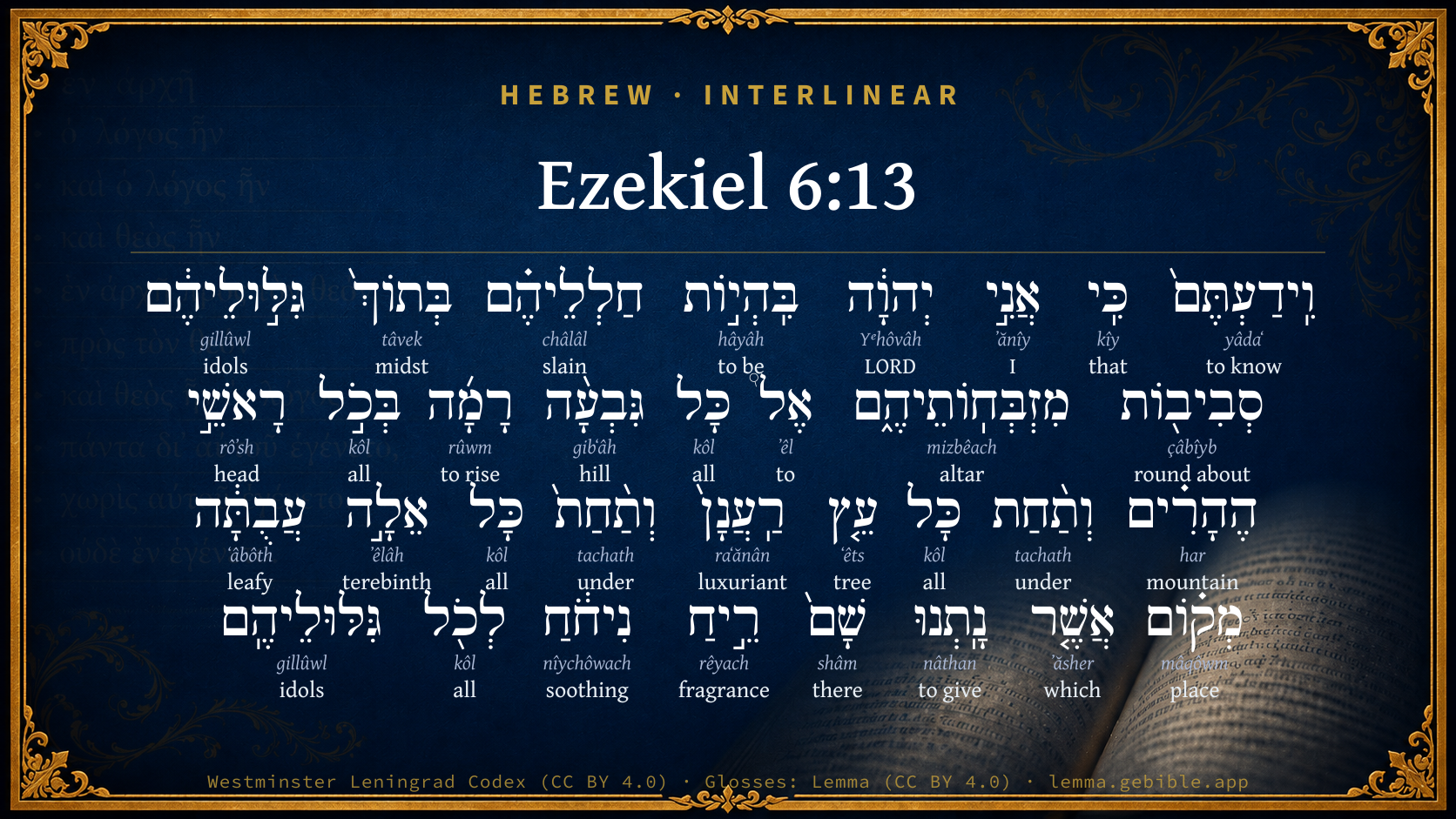
  1. וִֽידַעְתֶּם֙ yâdaʻ H3045 “and · to know” Conjunction + Verb, Qal, Sequential Perfect, 2nd Person, Masculine, Plural
  2. כִּֽי kîy H3588 “that” Conjunction
  3. אֲנִ֣י ʼănîy H589 “I” Pronoun, Personal, 1st Person, Common, Singular
  4. יְהוָ֔ה Yᵉhôvâh H3068 “LORD” Noun, Proper
  5. בִּֽהְי֣וֹת hâyâh H1961 “in/at · to be” Preposition + Verb, Qal, Infinitive Construct
  6. חַלְלֵיהֶ֗ם châlâl H2491 “slain · their” Adjective, Adjective, Masculine, Plural, Construct + Suffix, Personal, 3rd Person, Masculine, Plural
  7. בְּתוֹךְ֙ tâvek H8432 “in/at · midst of” Preposition + Noun, Common, Masculine, Singular, Construct
  8. גִּלּ֣וּלֵיהֶ֔ם gillûwl H1544 “idols · their” Noun, Common, Masculine, Plural, Construct + Suffix, Personal, 3rd Person, Masculine, Plural
  9. סְבִיב֖וֹת çâbîyb H5439 “surroundings of” Noun, Common, Both, Plural, Construct
  10. מִזְבְּחֽוֹתֵיהֶ֑ם mizbêach H4196 “altars · their” Noun, Common, Masculine, Plural, Construct + Suffix, Personal, 3rd Person, Masculine, Plural
  11. אֶל֩ ʼêl H413 “to” Preposition
  12. כָּל kôl H3605 “all of” Noun, Common, Masculine, Singular, Construct
  13. גִּבְעָ֨ה gibʻâh H1389 “hill” Noun, Common, Feminine, Singular, Absolute
  14. רָמָ֜ה rûwm H7311 “rising” Verb, Qal, Participle Active, Feminine, Singular, Absolute
  15. בְּכֹ֣ל kôl H3605 “in/at · all of” Preposition + Noun, Common, Masculine, Singular, Construct
  16. רָאשֵׁ֣י rôʼsh H7218 “heads of” Noun, Common, Masculine, Plural, Construct
  17. הֶהָרִ֗ים har H2022 “the · mountains” Particle, Definite Article + Noun, Common, Masculine, Plural, Absolute
  18. וְתַ֨חַת tachath H8478 “and · under” Conjunction + Preposition
  19. כָּל kôl H3605 “all of” Noun, Common, Masculine, Singular, Construct
  20. עֵ֤ץ ʻêts H6086 “tree” Noun, Common, Masculine, Singular, Absolute
  21. רַֽעֲנָן֙ raʻănân H7488 “luxuriant” Adjective, Adjective, Masculine, Singular, Absolute
  22. וְתַ֨חַת֙ tachath H8478 “and · under” Conjunction + Preposition
  23. כָּל kôl H3605 “all of” Noun, Common, Masculine, Singular, Construct
  24. אֵלָ֣ה ʼêlâh H424 “terebinth” Noun, Common, Feminine, Singular, Absolute
  25. מְק֗וֹם mâqôwm H4725 “place of” Noun, Common, Masculine, Singular, Construct
  26. אֲשֶׁ֤ר ʼăsher H834 “which” Particle, Relative
  27. נָֽתְנוּ nâthan H5414 “to give” Verb, Qal, Perfect, 3rd Person, Common, Plural
  28. שָׁם֙ shâm H8033 “there” Adverb
  29. רֵ֣יחַ rêyach H7381 “fragrance of” Noun, Common, Masculine, Singular, Construct
  30. נִיחֹ֔חַ nîychôwach H5207 “soothing” Noun, Common, Masculine, Singular, Absolute
  31. לְכֹ֖ל kôl H3605 “to/for · all of” Preposition + Noun, Common, Masculine, Singular, Construct
  32. גִּלּוּלֵיהֶֽם gillûwl H1544 “idols · their” Noun, Common, Masculine, Plural, Construct + Suffix, Personal, 3rd Person, Masculine, Plural

About this verse

These counts appear in no published source. They are computed here, from the morphology-tagged text and Lemma’s own curated glosses. What Lemma adds →

33
words
27
distinct lemmas
Prophets
section

Notable vocabulary

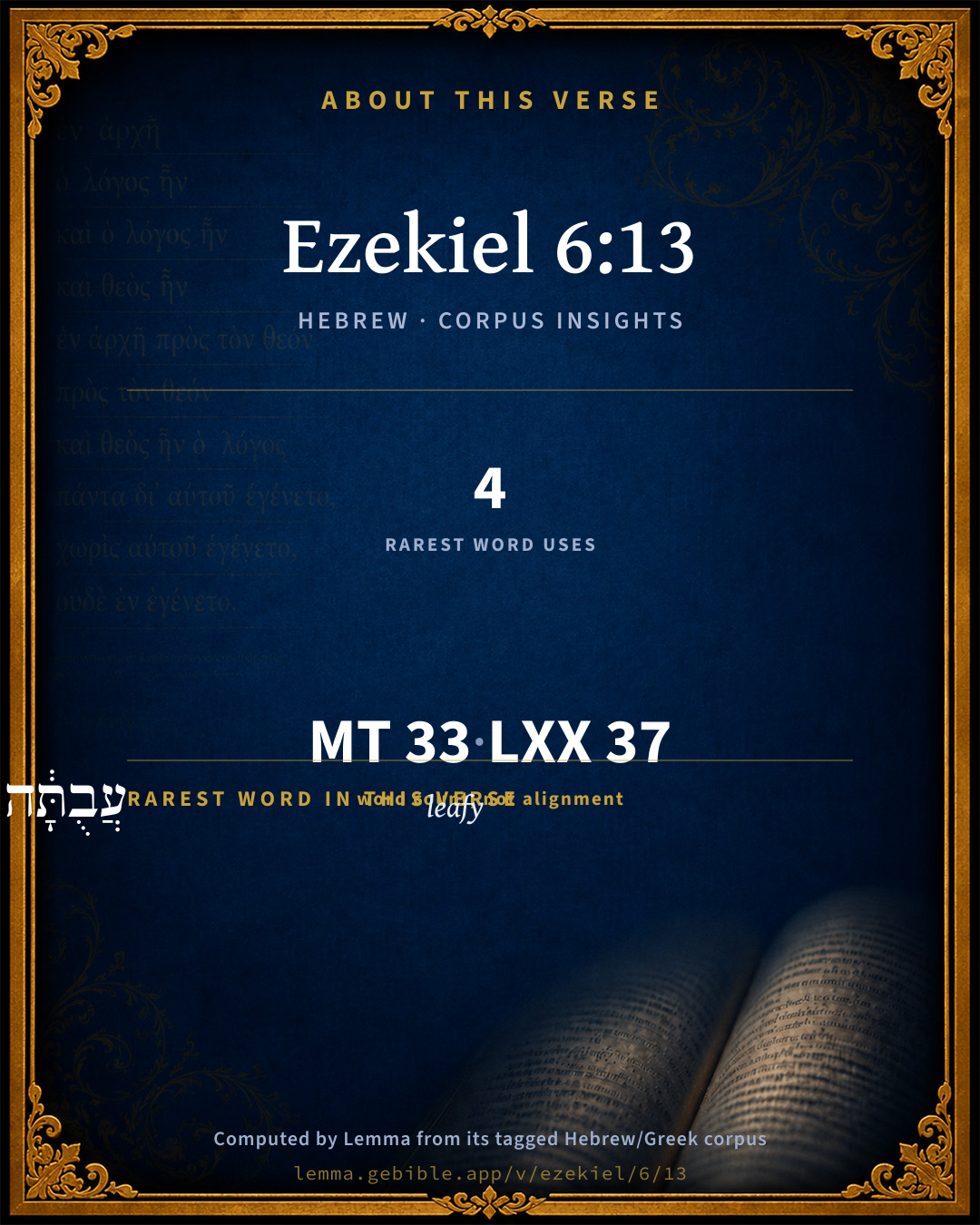
The rarest word here is עֲבֻתָּ֔ה leafy H5687 — appearing just 4 times in the whole Hebrew Bible.

Shared distinctive vocabulary

עֲבֻתָּ֔ה leafy H5687 occurs in 4 verses of the Hebrew Bible. Also found in:

Grammatical profile

  • 4 verbs
  • 19 nouns
  • 3 adjectives
  • 1 pronoun
  • 3 prepositions
  • 1 conjunction
  • 1 adverb
  • 1 particle

Verb forms

  • וִֽידַעְתֶּם֙ Qal · Sequential Perfect
  • בִּֽהְי֣וֹת Qal · Infinitive Construct
  • רָמָ֜ה Qal · Participle Active
  • נָֽתְנוּ Qal · Perfect

Repetition

Words recur within this verse — often emphatic in Hebrew:

  • כָּל all H3605 ×5
  • גִּלּ֣וּלֵיהֶ֔ם idols H1544 ×2
  • וְתַ֨חַת under H8478 ×2

Hebrew & Septuagint length

In English translation the verse runs 52 words from the Hebrew and 42 from the Septuagint (LXX English) — closely comparable.

A rough comparison of the two English renderings, which tokenize alike — not a word-level alignment.

Word counts can differ between the Hebrew and the Greek without any difference in meaning — e.g. the Hebrew direct-object marker אֵת has no separate Greek word, and Greek often adds the article ὁ.

In the original languages it is 33 Hebrew tokens and 37 Greek tokens — but the two are counted differently (Hebrew bundles its prefixes and suffixes into one token; the Greek is in lemma form), so that isn’t a like-for-like length.

Cross-references

13

Topical passages linked to Ezekiel 6:13 in the Treasury of Scripture Knowledge — connected by theme and wording, ordered by reader-vote popularity; previews shown in the World English Bible.

  • Ezekiel 20:28 For when I had brought them into the land, which I swore to give to them, then they saw every high hill, and every thick tree, and they offered there their sacrifices, and there they presented the provocation of their offering; there also they made their sweet savor, and they poured out there their drink-offerings.
  • Hosea 4:13 They sacrifice on the tops of the mountains, And burn incense on the hills, under oaks and poplars and terebinths, Because its shade is good. Therefore your daughters play the prostitute, And your brides commit adultery.
  • 1 Kings 14:23 For they also built them high places, and pillars, and Asherim, on every high hill, and under every green tree;
  • Jeremiah 2:20 For of old time I have broken your yoke, and burst your bonds; and you said, I will not serve; for on every high hill and under every green tree you did bow yourself, playing the prostitute.
  • 2 Kings 16:4 He sacrificed and burnt incense in the high places, and on the hills, and under every green tree.
  • Isaiah 1:29 For they shall be ashamed of the oaks which you have desired, And you shall be confounded for the gardens that you have chosen.
  • Isaiah 57:5–7 you who inflame yourselves among the oaks, under every green tree; who kill the children in the valleys, under the clefts of the rocks?
  • Ezekiel 6:4–7 Your altars shall become desolate, and your sun-images shall be broken; and I will cast down your slain men before your idols.
  • Isaiah 37:20 Now therefore, Yahweh our God, save us from his hand, that all the kingdoms of the earth may know that you are Yahweh, even you only.
  • Isaiah 37:36–38 The angel of Yahweh went forth, and struck in the camp of the Assyrians one hundred and eighty-five thousand; and when men arose early in the morning, behold, these were all dead bodies.
  • Isaiah 65:3–4 a people who provoke me to my face continually, sacrificing in gardens, and burning incense on bricks;
  • Isaiah 66:17 Those who sanctify themselves and purify themselves [to go] to the gardens, behind one in the midst, eating pig's flesh, and the abomination, and the mouse, they shall come to an end together, says Yahweh.
  • Jeremiah 3:6 Moreover Yahweh said to me in the days of Josiah the king, Have you seen that which backsliding Israel has done? she is gone up on every high mountain and under every green tree, and there has played the prostitute.

Cross-references courtesy of OpenBible.info (CC BY 4.0).

Hebrew and Greek witnesses Masoretic Hebrew ↔ Greek Septuagint

The same verse in the two great witnesses to the Old Testament, shown verse-for-verse.

These are two independent witnesses, not word-aligned to each other, and the Septuagint is shown in lemma (dictionary) form.

Hebrew Ezekiel 6:13 Masoretic · Westminster Leningrad Codex

וִֽידַעְתֶּם֙ כִּֽי אֲנִ֣י יְהוָ֔ה בִּֽהְי֣וֹת חַלְלֵיהֶ֗ם בְּתוֹךְ֙ גִּלּ֣וּלֵיהֶ֔ם סְבִיב֖וֹת מִזְבְּחֽוֹתֵיהֶ֑ם אֶל֩ כָּל גִּבְעָ֨ה רָמָ֜ה בְּכֹ֣ל רָאשֵׁ֣י הֶהָרִ֗ים וְתַ֨חַת כָּל עֵ֤ץ רַֽעֲנָן֙ וְתַ֨חַת֙ כָּל אֵלָ֣ה עֲבֻתָּ֔ה מְק֗וֹם אֲשֶׁ֤ר נָֽתְנוּ שָׁם֙ רֵ֣יחַ נִיחֹ֔חַ לְכֹ֖ל גִּלּוּלֵיהֶֽם

You shall know that I am Yahweh, when their slain men shall be among their idols round about their altars, on every high hill, on all the tops of the mountains, and under every green tree, and under every thick oak, the places where they offered sweet savor to all their idols.

World English Bible · Public Domain

Greek LXX Ezekiel 6:13 Septuagint · lemma form

καί γιγνώσκω διότι ἐγώ κύριος ἐν ὁ εἰμί ὁ τραυματίας σύ ἐν μέσος ὁ εἴδωλον σύ κύκλος ὁ θυσιαστήριον σύ ἐπί πᾶς βουνός ὑψηλός καί ὑποκάτω δένδρον συσκίος ὅς δίδωμι ἐκεῖ ὀσμή εὐωδία πᾶς ὁ εἴδωλον αὐτός

Then you⌃ shall know that I am the Lord, when your slain are in the midst of your idols round about your altars, on every high hill, and under every shady tree, where they offered a sweet savor to all their idols.

LXX2012 (modern English Septuagint) · Public Domain

On this verse, The Cambridge Bible for Schools and Colleges discusses the Septuagint’s reading. Read the note in Commentary ↓

Hebrew: Westminster Leningrad Codex (CC BY 4.0). Greek: Septuagint (public domain); English from LXX2012 (modern English Septuagint) (Public Domain). How the Septuagint differs from the Hebrew →

Targum (Aramaic paraphrase)

1

The Targum is the ancient Jewish Aramaic paraphrase of the Hebrew Scriptures — an interpretive translation, not the Hebrew text itself. Onkelos (literal) and Pseudo-Jonathan (expansive) render the Torah, and Jonathan the Prophets. Coverage is partial: where no permissively-licensed English translation exists for a verse, only the Aramaic is shown. This is verse-level text, not a word-by-word alignment to the Hebrew.

  1. Targum Jonathan Prophets (Joshua–Malachi)
    וְתִדְעוּן אֲרֵי אֲנָא יְיָ בְּמֶהֱוֵי קְטִילֵיהוֹן בְּגוֹ פִּגוּר טַעֲוַתְהוֹן סַחֲרָנוּת אִגוֹרֵיהוֹן עַל כָּל רָמָא מְנַטְלָא בְּכָל רֵישֵׁי טוּרַיָא תְּחוֹת כָּל אִילָן עַבּוּף וּתְחוֹת כָּל בּוּטְמָא מְעַפְיָא אֲתַר דִיהַבוּ תַמָן קוּרְבָּנִין לְפוּלְחַן לְכָל טַעֲוַתְהוֹן:

    (no public-domain English translation for this verse)

    Targum Jonathan — Aramaic: “Mikraot Gedolot” (public domain). English: “Sefaria Community Translation” (CC0 1.0 (public-domain dedication)); “London "Chaldee Paraphrase," 1871” (public domain). Text via Sefaria.

Commentary

Notes on Ezekiel 6:13 from classic Christian and Jewish commentators (each source and its license shown beneath its notes). The classic Christian expositions comment on the surrounding passage and are grouped to its opening verse, so a note may address several verses; the Jewish commentaries on the Tanakh (Rashi and others) are per-verse, so they appear only where the commentator wrote on this verse.

Lemma curates 59 commentaries, every one of them public domain or Creative Commons licensed, each selected and text-cleaned for this edition rather than reprinted as found. About our sources →

Trapp's Complete Commentary

John Trapp

Eze 6:13 Then shall ye know that I [am] the LORD, when their slain [men] shall be among their idols round about their altars, upon every high hill, in all the tops of the mountains, and under every green tree, and under every thick oak, the place where they did offer sweet savour to all their idols.

Ver. 13. Then shall ye know that I am the Lord.] Vexatio dabit intellectum; smart shall make wit. See Eze 6:10. Four times in this chapter are these words used: Verba toties inculcata, viva sunt, vera sunt, sana sunt, plana sunt. {a} The words are driven home often, they are alive, they are true, they are wholesome, they are plain.

Among their idols.] See on Eze 6:4.

Where they did offer sweet savour.] Idolatry is costly.

{a} Augustine.

John Trapp, A Commentary or Exposition upon All the Books of the Old and New Testament (1647–1656) — public domain. Text from a community e-Sword module.

Tyndale Open Study Notes

Tyndale Open Resources

6:13-14 Riblah was located on the northern border of Israel and is well known from other biblical books. At Riblah, Nebuchadnezzar set up his tribunal and executed the sons of Zedekiah and many other leading citizens of Judah (2 Kgs 25:6, 21).

Tyndale Open Study Notes — © Tyndale Open Resources, licensed CC BY-SA 4.0. Text via the HelloAO Bible API.

Geneva Bible (1599)

Geneva Bible translators

That is, all nations when you shall see my judgments.

Geneva Bible (1599) marginal notes — public domain. Text via Bolls.life.

John Calvin's Commentaries

Now he again announces that they shall know what they have long neglected. But here a different knowledge from the former seems to be marked; for he has lately said that they should so remember as to be ashamed, and acknowledge that the slaughters predicted by the Prophets had not been in vain: but here he mentions nothing of this kind, but only speaks of that experimental knowledge which is common to the ungodly. And, in truth, this doctrine seems to be extended promiscuously to all the commonalty. For although for the most part they did not profit by it, yet all perceived that God was a judge, because so clear and conspicuous was the proof of his vengeance, that they were compelled to feel, whether they would or not, that their punishment was just. We may perceive, then, that the Prophet intends the phrase — then ye shall know, etc., in a wide sense, because he addresses all the Israelites without exception, even those who should perish. For, we said, such was the character of that knowledge, that it only frightened them, and did not bend them to humility. And, truly, the words which follow show only the terrible vengeance of God, when they shall be slain, says he, that is, shall fall, near their idols But we have said that they would more clearly acknowledge the vengeance of God from this — that he rendered their false gods an object of ridicule. But, as I have said before, the Prophet uses an opprobrious name when speaking of idols. Since, therefore, they so fell near their idols, under the confidence and protection of which they thought that they would always be safe; and although the idols themselves were thus involved in the condemnation, this made God’s vengeance more manifest. And this is the reason, as I have before suggested, why the Prophet enters into these details. What follows is to the same purpose — by the circuit of all their altars This, then, was profanation of all altars, to be defiled by carcases being drawn over them, and then sprinkled with human blood. But he also points out the places where they worshipped false gods; for we have said that lofty places were chosen for them, but here he puts lofty hills, and then the tops of the mountains But as idol-worshippers heaped to themselves various and numerous games, when they were satiated with their high places, they had shady valleys, for their altars were under trees, where they offered incense. The Prophet therefore pronounces that there was no place which God did not condemn with infamy. When, therefore, he says that the incense had a pleasing smell, the opposite is doubtless intended, since this incense was foul before God: as when an immodest woman desires to please an adulterer, it moves the wrath of her husband, so here God silently complains that he was provoked by that foul incense with which the Israelites wished and desired to gratify their idols.

John Calvin's Commentaries (1540-1563) — public domain. Text from the Calvin Translation Society English edition (1840s-50s) via the Christian Classics Ethereal Library (ccel.org). Calvin's coverage is partial (roughly two-thirds of the Bible); uncommented books and verses are honest gaps, never fabricated. The 19th-century editor's footnotes and remarks are omitted so the notes are faithfully Calvin's own voice.

Ellicott's Commentary for English Readers

(13) Upon every high hill.—The various localities especially selected for idolatrous rites are enumerated one after another, to give more vividness and graphic character to the whole judgment. The words “sweet savour” are constantly applied to the commanded sacrifices to the Lord, and are here used ironically of the idol sacrifices.

A Bible Commentary for English Readers, edited by Charles John Ellicott (1878–1897) — public domain. Text from a community e-Sword module.

The Cambridge Bible for Schools and Colleges

gen. ed. J. J. S. Perowne

13. Comp. Eze_6:7 on the effect of these judgments on the minds of the people. On “idols,” cf. Eze_6:4. The cumulative phrases “in all the tops of the mountains,” and “under every thick oak” are wanting in LXX.; and so “he that remaineth” Eze_6:12. For oak rather terebinth.

sweet savour] Is said of the smoke or steam of the sacrificial fat burnt upon the altar, ch. Eze_16:19, Eze_20:28; Eze_20:41, and often in the ritual laws of the Pentateuch.

The Cambridge Bible for Schools and Colleges (gen. ed. J. J. S. Perowne; Cambridge University Press, 1878–1918) — public domain. Text from a community e-Sword module.

John Gill's Exposition

So will I stretch out mine hand upon them,.... Not unto them, in a way of mercy; but upon, or against them, in a way of judgment. The Targum paraphrases it,

"and I will lift up the stroke of my power upon them;''

his mighty hand of vengeance:

and make the land desolate; by destroying the inhabitants of it:

yea, more desolate than the wilderness towards Diblath, in all their habitations; so the Syriac version renders it, "and I will make this land more desolate than the land of Diblath"; but other versions, "I will make the land desolate from the wilderness of Diblath"; to which the Targum agrees; or, "from the wilderness to Diblath": Kimchi and Ben Melech think this is the same with Riblath; as Deuel is put for Reuel in Num 1:14; which was in the land of Hamath, and which, Jerom says, was in his times called Epiphania in Syria; here it was that Nebuchadnezzar brought Zedekiah, and slew his sons before him, Jer 39:5; this, though in Hamath in Syria, was on the borders of the land of Israel, Num 34:8; so that "hence from the desert of Diblath", as the Arabic version renders it, "even to Jerusalem", as may be supplied, takes in the whole land, and shows that it should be utterly desolate. There is a Bethdiblathaim mentioned in Jer 48:22; as in Moab; and there is also Almondiblathaim, which was one of the stations of the Israelites; and seems to be in Moab, or on its borders, Num 33:46; and appears, by the places named with it, to be the same as that in Jeremiah; and so was part of that terrible wilderness through which the Israelites passed; and to which the desolation of the land of Israel by the Chaldeans is compared; and which serves to confirm our version, which makes the desolation to be greater than that:

and they shall know that I am the Lord; the true God; the one and only Lord God; who never changes his purposes; fulfils his promises and threatenings; and there is no escaping his mighty hand.

Next: Ezekiel Chapter 7

John Gill's Exposition of the Whole Bible (1746–1763) — public domain (CC PDM 1.0). Text via the HelloAO Bible API.

Matthew Poole's English Annotations

Then shall ye know: see Eze 6:3-7,10.

Upon every high hill, & c.; each of which was accounted a fit place for such superstitions rites, and in all which some or other of you did commit idolatry, and, shame to speak it, burnt sweets, rich spices, which God had given them, to dunghill gods, stinking idols, which the devil had commended to them, Deu 32:17.

Matthew Poole's English Annotations on the Holy Bible (1683–1685) — public domain. Text from a community e-Sword/MySword module.

Whedon's Commentary on the Bible

Daniel D. Whedon

13. Oak — Rather, terebinth. This is an emphatic repetition of all the warnings uttered earlier in the chapter. If their iniquities shall continue — as they will — all these heavy punishments shall fall upon them.

Daniel D. Whedon (gen. ed.), Commentary on the Old and New Testaments (1874–1909) — public domain. Text from a community e-Sword module.

The Pulpit Commentary

The thought is the same as in ver. 6, but the localities are given in greater detail. The "hills" and "mountains" were naturally the scenes of the worship of the "high places," and these were commonly associated with groves of trees, as in Jer_2:20 Jer_3:6; Isa_57:5. in Hos_4:13, oaks (or terebinths) poplars, and elms are specifically named. (comp. Deu_12:2; 2Ki_16:4) Where they did offer sweet savour, etc. The phrase is eminently characteristic of Ezekiel as a priest, (Eze_16:19 Eze_20:28, Eze_20:41) and is specially prominent in the books which he must have studied. It meets us three times in Exodus, seventeen in Leviticus, seventeen in Numbers, and seldom elsewhere. The crowning sin, from the prophet"s point of view, was that the incense which was due to Jehovah had been lavished on the false gods of the nations.

The Pulpit Commentary (1880–1919), ed. H.D.M. Spence-Jones & Joseph S. Exell — public domain. Text from a community e-Sword module.

unfoldingWord translationNotes

Door43 World Missions Community

General Information:

These are Yahweh's words to the people of Israel.

around their altars, on every high hill

Another possible meaning is "around their altars, which are on every high hill."

hill—on all the mountain peaks, and under every flourishing tree and thick oak

Another possible meaning is "hill, on all the mountain peaks, under every flourishing tree, and under every thick oak."

flourishing

healthy and growing

oak

a large tree with strong wood that provided shade for worshipers

Diblah

the name of a city (See: How to Translate Names)

translationWords

oak

hand

desert

unfoldingWord translationNotes — © Distant Shores Media and the Door43 World Missions Community, licensed CC BY-SA 4.0. Source: git.door43.org/Door43/en_tn.

Rashi

Rabbi Shlomo Yitzchaki (Rashi)

terebinth Heb. אֵלָה, planzon in Old French, a branch.

branchy עֲבֻתָּה, an expression of (below 20: 28): “a branchy (עָבוֹת) tree,” i.e., whose branches are many.

Rashi on the Tanakh — English translations: “The Judaica Press complete Tanach with Rashi, translated by A. J. Rosenberg” (CC BY 4.0); “Pentateuch with Rashi's commentary by M. Rosenbaum and A.M. Silbermann, 1929-1934” (public domain); “The Metsudah Tanach series, Lakewood, N.J” (CC BY 4.0); and “The Book of Joshua, Metsudah Publications, 1997” (CC BY 4.0). Text via Sefaria.

Lesson kit

Teaching starters — assembled from the data on this page, not authored interpretation. Every prompt links to the verse data it draws on. Edit before teaching.

Ezekiel, in the Prophets, opens this verse with 33 words (27 distinct Hebrew lemmas). Its most distinctive word is ʻâbôth (“leafy”). A historical commentator’s framing appears above. Read the whole chapter for the surrounding context.

Discussion questions

  1. The word ʻâbôth carries the sense “leafy.” How does it shape the verse?
  2. How does Leviticus 23:40, which shares the word «leafy», read alongside this verse?
  3. What does the repetition of “all” (5× in this one verse) do in this verse?
  4. These translations render this verse differently; the difference is in the English rendering, not the original. What questions does that raise?
  5. «וִֽידַעְתֶּם֙» is a Qal Sequential Perfect verb. How does that grammatical form shape the action described?
  6. Compare how Trapp's Complete Commentary and Tyndale Open Study Notes read this verse. Where do they agree or differ?

Things to notice

Reading settings

Reading text

Shown beneath each verse's original-language words.

Old Testament
Old Testament edition

Read the OT as the Masoretic Hebrew (MT) or the Greek Septuagint (LXX).

English shown for the Greek Septuagint (in the Hebrew ↔ Greek comparison).

Comparing translations? Open the Compare panel on any verse page to stack up to four side by side.