
Psalms 18:46

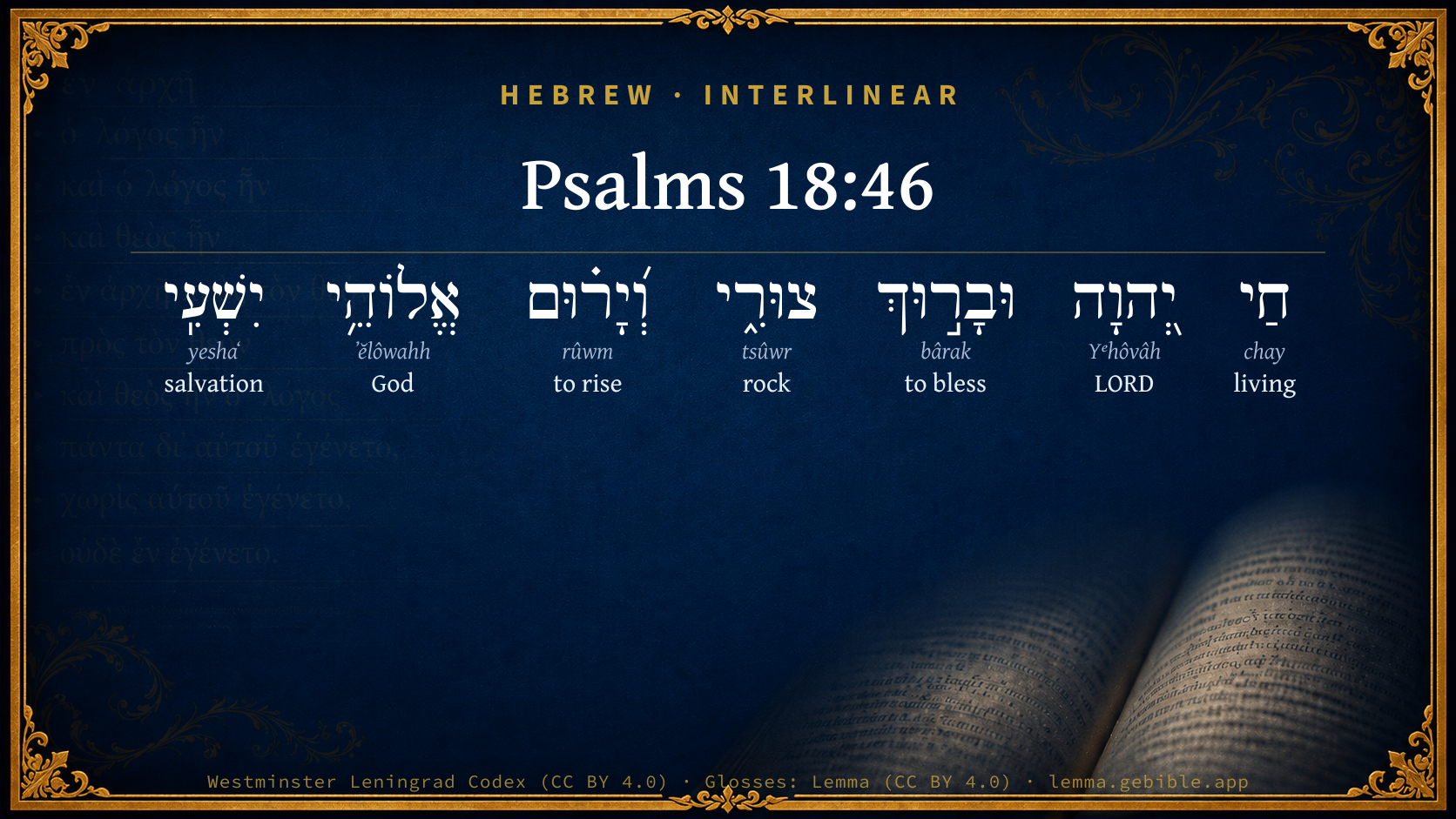
Hebrew (Westminster Leningrad Codex) Psalms 18:46 appears in the Hebrew Old Testament. The text above is from the Westminster Leningrad Codex. Each word links to its Strong’s number, a concise gloss, and parsing drawn from the Open Scriptures Hebrew Bible morphology. Click any word for its full Brown-Driver-Briggs (BDB) entry.
Download image
Cite this verse

Psalms 18:46 (World English Bible). Public Domain. Lemma interlinear Bible study tool, https://lemma.gebible.app/v/psalms/18/46.

Show BibTeX & RIS
BibTeX
RIS
English Translation
Yahweh lives; and blessed be my rock. Exalted be the God of my salvation,
World English Bible · Public Domain
Download a study sheet

One document with this verse’s original text, its word-by-word gloss line, the meaning frame, cross-references with their text, attributed commentary, and full source and license credits — printable, and it pastes into notes with its structure intact.

This verse Autodidact and up

Study sheet (.html) Plain text (.txt)

A passage Seminary Student

Up to 50 verses in one chapter. A passage sheet keeps up to 6 commentary sources and 12 cross-references per verse, in the order this page ranks them, and says so on the sheet whenever that leaves anything out. Ask for a single verse and you get the Autodidact verse sheet above.

Everything on this page stays free to read, with no account — the sheet is a download of what is already on screen, not access to it.

Want to remove ads? Support Godless Engineer
Compare translations 3

The same verse in 3 English versions, stacked beneath the original-language interlinear above. Click any original word for its lexicon entry.

Each is an independent rendering of the whole verse — the interlinear is not word-aligned to these translations.

Highlighted words mark where these versions differ — a whole-verse word diff, not a word-by-word alignment.

  • World English Bible Public Domain
    Yahweh lives; and blessed be my rock. Exalted be the God of my salvation,
  • King James Version Public Domain
    The LORD liveth; and blessed be my rock; and let the God of my salvation be exalted.
  • unfoldingWord Literal Text CC BY-SA 4.0
    Yahweh is alive! And blessed be my rock, and may the God of my salvation be exalted,

unfoldingWord Literal Text — © unfoldingWord, licensed CC BY-SA 4.0. Word-aligned USFM3 via Door43 (git.door43.org/unfoldingWord/en_ult).

Versions to compare (up to 4)

3 of 4 selected

Show all 18 translations

Every available English version of this verse, each an independent rendering of the whole verse.

  • World English Bible Public Domain
    Yahweh lives; and blessed be my rock. Exalted be the God of my salvation,
  • Berean Standard Bible Public Domain
    The LORD lives, and blessed be my Rock! And may the God of my salvation be exalted—
  • Majority Standard Bible Public Domain
    The LORD lives, and blessed be my Rock! And may the God of my salvation be exalted—
  • King James Version Public Domain
    The LORD liveth; and blessed be my rock; and let the God of my salvation be exalted.
  • American Standard Version (1901) Public Domain
    Jehovah liveth; and blessed be my rock; And exalted be the God of my salvation,
  • Revised Version (1885) Public Domain
    The LORD liveth; and blessed be my rock; and exalted be the God of my salvation:
  • Geneva Bible (1599) Public Domain
    Let the Lord liue, and blessed be my strength, and the God of my saluation be exalted.
  • Douay-Rheims (1899) Public Domain
    The children that are strangers have lied to me, strange children have faded away, and have halted from their paths.
  • Young's Literal Translation Public Domain
    Jehovah liveth -- and blessed `is' my rock, And exalted is the God of my salvation.
  • Literal Standard Version CC BY-SA 4.0
    YHWH lives—and blessed [is] my rock, || And exalted is the God of my salvation.
  • Unlocked Literal Bible CC BY-SA 4.0
    Yahweh lives; may my rock be praised. May the God of my salvation be exalted.
  • unfoldingWord Literal Text CC BY-SA 4.0
    Yahweh is alive! And blessed be my rock, and may the God of my salvation be exalted,
  • Darby Bible Public Domain
    Jehovah liveth; and blessed be my rock; and exalted be the God of my salvation,
  • World Messianic Bible Public Domain
    The LORD lives! Blessed be my rock. Exalted be the God of my salvation,
  • Webster's Bible Public Domain
    \\18:45\\The strangers shall fade away, and be afraid from their close places.
  • Free Bible Version CC BY-SA 4.0
    The Lord lives! Blessed be my rock! May the God who saves me be praised!
  • Bible in Basic English Public Domain
    The Lord is living; praise be to my Rock, and let the God of my salvation be honoured.
  • JPS Tanakh (1917) Public Domain
    (18-47) The LORD liveth, and blessed be my Rock; and exalted be the God of my salvation;

Literal Standard Version (2020), Covenant Press — licensed CC BY-SA 4.0. Text via the HelloAO Bible API (eBible.org). Unlocked Literal Bible (unfoldingWord) — licensed CC BY-SA 4.0. Text via the HelloAO Bible API (eBible.org). unfoldingWord Literal Text — © unfoldingWord, licensed CC BY-SA 4.0. Word-aligned USFM3 via Door43 (git.door43.org/unfoldingWord/en_ult). Free Bible Version, Dr. Jonathan Gallagher — licensed CC BY-SA 4.0. Text via the HelloAO Bible API (eBible.org).

Word by word

More ways to search: Search by grammar → Find every occurrence → Compare this word →

Practice this passage: Drill this verse → Learn its vocabulary →

About this verse

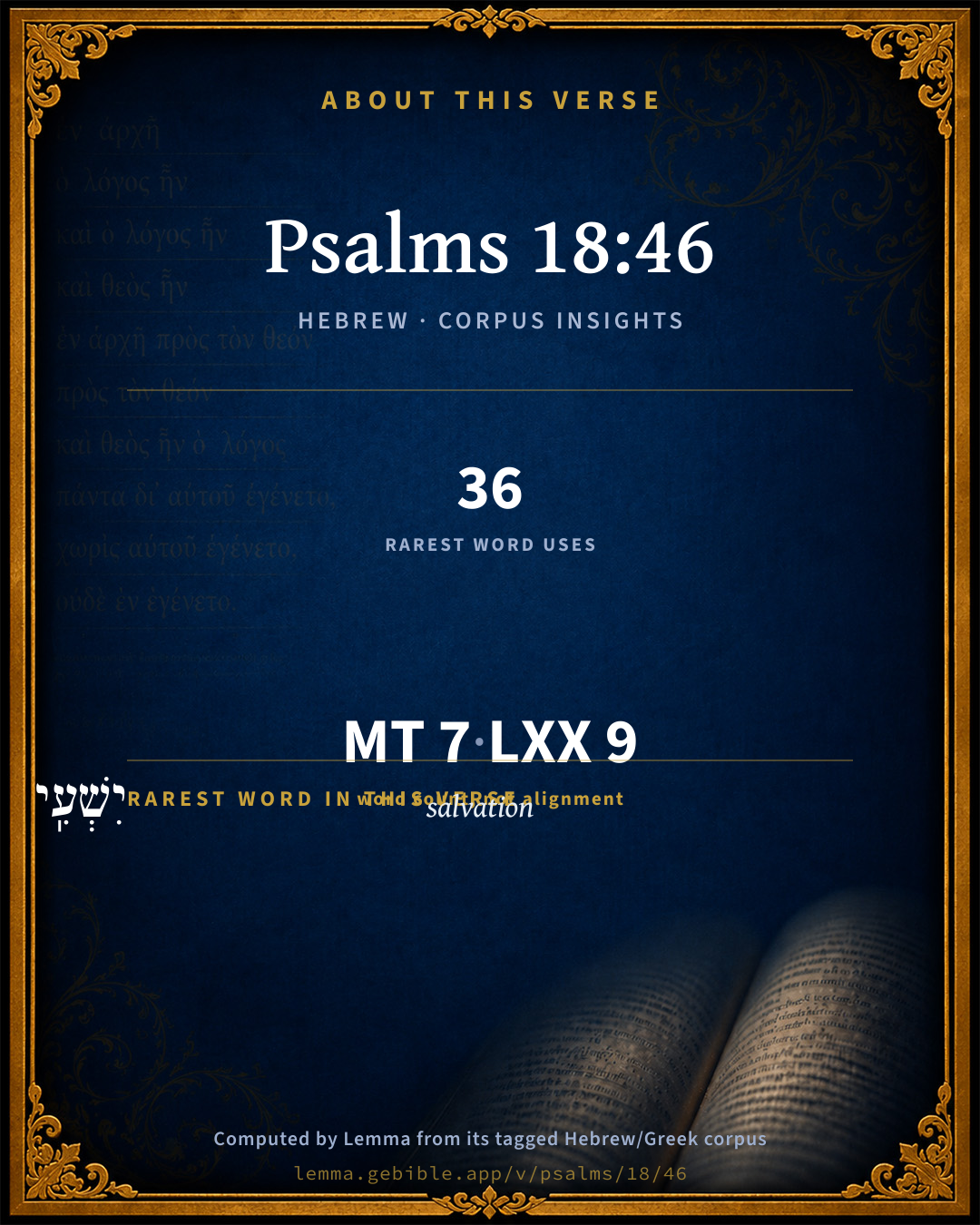
These counts appear in no published source. They are computed here, from the morphology-tagged text and Lemma’s own curated glosses. What Lemma adds →

7
words
7
distinct lemmas
Wisdom
section

Shared distinctive vocabulary

יִשְׁעִֽי salvation H3468 occurs in 35 verses of the Hebrew Bible. Also found in:

Grammatical profile

  • 2 verbs
  • 4 nouns
  • 1 adjective

Verb forms

  • וּבָר֣וּךְ Qal · Participle Passive
  • וְ֝יָר֗וּם Qal · Imperfect

Hebrew & Septuagint length

In English translation the verse runs 14 words from the Hebrew and 17 from the Septuagint (LXX English) — closely comparable.

A rough comparison of the two English renderings, which tokenize alike — not a word-level alignment.

Word counts can differ between the Hebrew and the Greek without any difference in meaning — e.g. the Hebrew direct-object marker אֵת has no separate Greek word, and Greek often adds the article ὁ.

In the original languages it is 7 Hebrew tokens and 9 Greek tokens — but the two are counted differently (Hebrew bundles its prefixes and suffixes into one token; the Greek is in lemma form), so that isn’t a like-for-like length.

Cross-references

16

Topical passages linked to Psalms 18:46 in the Treasury of Scripture Knowledge — connected by theme and wording, ordered by reader-vote popularity; previews shown in the World English Bible.

  • 2 Samuel 22:47 Yahweh lives; Blessed be my rock; Exalted be God, the rock of my salvation,
  • Psalms 18:2 Yahweh is my rock, my fortress, and my deliverer; My God, my rock, in whom I take refuge; My shield, and the horn of my salvation, my high tower.
  • Psalms 57:5 Be exalted, God, above the heavens! Let your glory be above all the earth!
  • Revelation 1:18 and the Living one. I was dead, and behold, I am alive forevermore. Amen. I have the keys of Death and of Hades.
  • Psalms 68:20 God is to us a God of deliverance. To Yahweh, the Lord, belongs escape from death.
  • Psalms 79:9 Help us, God of our salvation, for the glory of your name. Deliver us, and forgive our sins, for your name's sake.
  • Jeremiah 10:10 But Yahweh is the true God; he is the living God, and an everlasting King: at his wrath the earth trembles, and the nations are not able to abide his indignation.
  • Luke 1:47 My spirit has rejoiced in God my Savior,
  • John 14:19 Yet a little while, and the world will see me no more; but you will see me. Because I live, you will live also.
  • Psalms 57:11 Be exalted, God, above the heavens. Let your glory be over all the earth.
  • Psalms 99:9 Exalt Yahweh, our God. Worship at his holy hill, For Yahweh, our God, is holy!
  • Exodus 15:2 Yah is my strength and song, He has become my salvation: This is my God, and I will praise him; My father's God, and I will exalt him.
  • Psalms 25:5 Guide me in your truth, and teach me, For you are the God of my salvation, I wait for you all day long.
  • Psalms 42:9 I will ask God, my rock, "Why have you forgotten me? Why do I go mourning because of the oppression of the enemy?"
  • Psalms 51:14 Deliver me from bloodguiltiness, O God, the God of my salvation. My tongue shall sing aloud of your righteousness.
  • Isaiah 12:2 Behold, God is my salvation. I will trust, and will not be afraid; for Yah, Yahweh, is my strength and song; and he has become my salvation."

Cross-references courtesy of OpenBible.info (CC BY 4.0).

Hebrew and Greek witnesses Masoretic Hebrew ↔ Greek Septuagint

The same verse in the two great witnesses to the Old Testament, shown verse-for-verse.

You’re reading Greek Psalm 17 (Hebrew Psalm 18). The Septuagint counts the superscription, so verse numbers can differ from the Hebrew — chapter-level alignment, not verse-by-verse. Numbering follows Rahlfs.

These are two independent witnesses, not word-aligned to each other, and the Septuagint is shown in lemma (dictionary) form.

Hebrew Psalms 18:46 Masoretic · Westminster Leningrad Codex

חַי יְ֭הוָה וּבָר֣וּךְ צוּרִ֑י וְ֝יָר֗וּם אֱלוֹהֵ֥י יִשְׁעִֽי

Yahweh lives; and blessed be my rock. Exalted be the God of my salvation,

World English Bible · Public Domain

Greek LXX Greek Psalm 17:46 Septuagint · lemma form

υἱός ἀλλότριος παλαιόω καί χωλαίνω ἀπό ὁ τρίβος αὐτός

The Lord lives; and blessed be my God; and let the God of my salvation be exalted.

LXX2012 (modern English Septuagint) · Public Domain

Hebrew: Westminster Leningrad Codex (CC BY 4.0). Greek: Septuagint (public domain); English from LXX2012 (modern English Septuagint) (Public Domain). How the Septuagint differs from the Hebrew →

Commentary

Notes on Psalms 18:46 from classic Christian and Jewish commentators (each source and its license shown beneath its notes). The classic Christian expositions comment on the surrounding passage and are grouped to its opening verse, so a note may address several verses; the Jewish commentaries on the Tanakh (Rashi and others) are per-verse, so they appear only where the commentator wrote on this verse.

Lemma curates 59 commentaries, every one of them public domain or Creative Commons licensed, each selected and text-cleaned for this edition rather than reprinted as found. About our sources →

Trapp's Complete Commentary

John Trapp

Psa 18:46 The LORD liveth; and blessed [be] my rock; and let the God of my salvation be exalted.

Ver. 46. The Lord liveth] Or, Vivat Dominus, Let the Lord live. It is spoken, saith Calvin, after the manner of men, who use such kinds of acclamations to the kings whom they love and honour. The wicked could wish God extinct, that so they might never come to an account before him; but the saints cry out, Let the Lord live, let Christ reign, &c. Blessed be God that he is God, was a learned man’s motto. Luther’s was, Vivit, sc. Christus. Si non viveret, vellem me non unam horam vivere, de., Christ is alive, otherwise I would not wish to live an hour. Another good man saith, Christ liveth and reigneth, alioque totus totus desperassem, otherwise I should be utterly out of hope (Miconius).

Let the God of my salvation be exalted] Triumphali elogio ab omnibus celebretur, let him be set up in all hearts and houses.

John Trapp, A Commentary or Exposition upon All the Books of the Old and New Testament (1647–1656) — public domain. Text from a community e-Sword module.

The Biblical Illustrator

Joseph S. Exell

Psa_18:46

The Lord liveth; and blessed be my Rock; and let the God of my salvation be exalted.

The Rock of salvation

True religion has nothing in it cloudy, melancholy, depressing. It is in itself full of fire, love, light, warmth. Our sadness arises from our sin and sorrow, but in God there is that to fill us with joy. Now here we have--

I. A living Lord. It is a living Christ that sheds a glory around Calvary, and around the tomb in which His body was laid. What would be our grief if He were not living?

II. A solid rock. Christ will build His Church thereon. And it is a rock for refuge.

III. Its exaltation. He is exalted by tab Father; and in the Bible; and in the contrite believing heart; and in the life and purpose of all His people. Let us build on this Rock. (George Merrell.)

The Biblical Illustrator, edited by Joseph S. Exell (c. 1880s–1900s) — public domain. Text from a community e-Sword module.

Joseph Benson's Commentary

Psa 18:46. The Lord liveth — Jehovah, and he only, is the true and living God, and he hath manifested himself to be such for my comfort, and for the confusion of my enemies, when other gods are dead and impotent idols. Or, Let the Lord live, as חי יהוה, chai Jehovah, may be translated; and so it is a joyful and thankful acclamation, spoken after the manner in which earthly princes are addressed; and blessed be my rock — Let him have all blessing and praise, for he is worthy of it.

Joseph Benson's Commentary on the Old and New Testaments (1811–1818) — public domain. Text from a community e-Sword module.

J. A. Alexander on Psalms

Joseph Addison Alexander

47. (Psa 18:46). Jehovah lives, and blessed be my rock, and high shall be the God of my salvation. The first phrase, which is elsewhere always used as a formula of swearing (as the Lord liveth, i. e. as certainly as God exists), is by some interpreters confounded with a kindred phrase (long) live the king, and regarded as a kind of acclamation, similar to those which were uttered at the coronation of the Jewish kings (1Sa 10:24, 1Ki 1:25; 1Ki 1:39, 2Ki 11:12). But besides the difference of form in Hebrew, such a wish is inappropriate to any but a mortal. There may, however, be an intentional allusion to the custom in question, as well as to the practice of swearing by the life of Jehovah, both of which would naturally be suggested to a Hebrew reader. Jehovah is described as the living God, in contrast to dead idols, or imaginary deities, which, as Paul says (1Co 8:4), are nothing in the world. Blessed be my rock, the foundation of my hope, my refuge and protector; see above, on Psa 18:3 (2). The word translated blessed does not mean happy, but praised, and may here have the peculiar sense of worthy to be praised, like in Psa 18:4 (3) above. It may be rendered as an affirmation: My rock (is) worthy to be praised. Or it may be taken as a wish: Praised (be) my rock, to which there is the less objection, as the preceding proposition is, in fact though not in form, a doxology, i.e. a declaration of what God is in him- that self, and of that to which he is in consequence entitled. The third phrase, he shall be high, may be understood to mean, not only he shall still be glorious, but he shall be magnified as such, exalted by the praises of his creatures. The God of my salvation, or, my God of salvation, does not merely mean the God who saves me, but my God who is a Saviour, of whom this is one essential character. Compare Luk 1:47. This epithet is common in the Psalms, and occurs once or twice in the Prophets. Isa 17:10, Mic 7:7, Hab 3:18.

Joseph Addison Alexander, The Psalms Translated and Explained (1850) — public domain. Text from a community e-Sword module.

Tyndale Open Study Notes

Tyndale Open Resources

18:46-50 The psalmist again reflects on the Lord’s victories. God’s marvelous rescue and the king’s victory are cause for celebration.

Tyndale Open Study Notes — © Tyndale Open Resources, licensed CC BY-SA 4.0. Text via the HelloAO Bible API.

Jamieson, Fausset & Brown

Robert Jamieson, A. R. Fausset & David Brown

The Lord liveth--contrasts Him with idols (Co1 8:4).

Jamieson, Fausset & Brown — Commentary Critical and Explanatory on the Whole Bible (1871) — public domain (CC PDM 1.0). Text via the HelloAO Bible API.

Adam Clarke's Commentary

Verse 46. The Lord liveth] By him alone I have gained all my victories; and he continueth, and will be my Rock, the Source whence I may at all times derive help and salvation. May his name be blessed! May his kingdom be exalted!

Adam Clarke's Commentary on the Bible (1810–1826) — public domain. Text from a community e-Sword/MySword module.

John Calvin's Commentaries

46. Let Jehovah live. If it is thought proper to adopt this reading, which is in the optative mood expressing a wish that God might live, the manner of expression may seem somewhat strange; but it may be alleged in defense of it, that it is a metaphor borrowed from the custom of men, who not only use this manner of speaking when they wish well to any one, but likewise utter it with loud and applauding acclamation, when they intend to receive their princes with due honor. According to this view, it would be an expression in which praise is ascribed to God, and suitable for a triumphal song. “Ainsi ce seroit un mot tendant a lour Dieu et convenable a un cantique de triomphe.” — Fr.

John Calvin's Commentaries (1540-1563) — public domain. Text from the Calvin Translation Society English edition (1840s-50s) via the Christian Classics Ethereal Library (ccel.org). Calvin's coverage is partial (roughly two-thirds of the Bible); uncommented books and verses are honest gaps, never fabricated. The 19th-century editor's footnotes and remarks are omitted so the notes are faithfully Calvin's own voice.

Ellicott's Commentary for English Readers

(46-50) The psalm concludes with a burst of joyous praise, in which the previous figures are recalled in brief touches.

A Bible Commentary for English Readers, edited by Charles John Ellicott (1878–1897) — public domain. Text from a community e-Sword module.

The Cambridge Bible for Schools and Colleges

gen. ed. J. J. S. Perowne

46. The Lord liveth] Life is the essential attribute of Jehovah. He is the Living God in contrast to the dead idols of the heathen. The experience of David’s life is summed up in these words. It had been to him a certain proof that God is the living, active Ruler of the world. Cp. Jos_3:10.

and let &c.] R.V., and exalted be the God of my salvation. Cp. Psa_24:5. 2 Sam. reads, “the God of the rock of my salvation.”

46–50. Concluding thanksgiving and doxology.

The Cambridge Bible for Schools and Colleges (gen. ed. J. J. S. Perowne; Cambridge University Press, 1878–1918) — public domain. Text from a community e-Sword module.

John Gill's Exposition

It is God that avengeth me,.... Or "gives vengeance unto me", or "for me" (t): vengeance only belongs to God, and he repays it for and in behalf of his people. Private revenge is not to be exercised by any; public vengeance on delinquents may be exercised by the civil magistrate, to whom God gives power and authority to exercise it, Rom 13:4; as he did to David, as king of Israel; though the phrase rather seems to design the victories which he obtained over his enemies, which were punishments to them, vengeances inflicted on them; and owing to God; so the acceptable year of the Messiah's coming, and the time of his people redeemed by him, is called the day of vengeance of our God, both on his and their enemies, Isa 61:2;

and subdueth the people under me; the Edomites, Moabites, and others, as in Sa2 8:1, or the Gentiles under Christ; See Gill on Psa 18:39;

(t) "qui dat ultiones mihi", Pagninus, Gejerus; so Junius & Tremellius, Piscator, Musculus, Cocceius, Michaelis.

John Gill's Exposition of the Whole Bible (1746–1763) — public domain (CC PDM 1.0). Text via the HelloAO Bible API.

Albert Barnes' Notes on the Bible

The Lord liveth - Yahweh - the name used here - is often described as the living God in contradistinction to idols, who are represented as without life, Deu 5:26; Jos 3:10; 2Ki 19:4; Psa 42:2; Mat 16:16; 1Th 1:9. Compare Psa 115:5; Psa 135:16. It is probably in allusion to this idea that the phrase “The Lord liveth” is used here. It is a joyful exclamation in view of all that God had done; of all the deliverances which he had performed for the author of the psalm. In the remembrance of all this the psalmist says that God had shown himself to be the living, that is, the true God. These interpositions furnished abundant demonstration that Yahweh existed, and that he was worthy of adoration and praise as the true God. So, in view of mercy and salvation, the heart of the redeemed exultingly exclaims, “The Lord lives - there is a living God.”

And blessed be my Rock - God, who has shown himself to be a refuge and a protector. See the note at Psa 18:2.

And let the God of my salvation be exalted - The God who has saved me from my enemies. Let him be exalted, be praised, be honored, be adored. Let his name be exalted above all idol gods; above all the creatures that he has made. The wish is, that His name might be made prominent; that all creatures might praise and honor Him.

Albert Barnes' Notes on the Bible (1834–1885) — public domain. Text from a community e-Sword/MySword module.

Matthew Poole's English Annotations

He and he only is the true living God, and he hath manifested himself to be for my comfort, and for the confusion of mine enemies, when other gods are dead and impotent idols. Or, Let the Lord live. So it is a joyful and thankful acclamation, spoken after the manner of earthly princes.

Blessed be my rock; let him have all blessing and praise, for he is worthy of it.

Matthew Poole's English Annotations on the Holy Bible (1683–1685) — public domain. Text from a community e-Sword/MySword module.

The Pulpit Commentary

Vers. 46-50. This glorious and triumphant psalm concludes with a solemn ascription of praise, blessing, and thanksgiving to Almighty God partly recapitulation of what has preceded (vers. 47, 48), partly additional (vers. 46, 49, 50). Terms of praise are accumulated, and the whole is made to culminate in a Messianic burst, where David is swallowed up in his "Seed;" and the "Anointed King" presented to our view is rather the antitype than the type rather Christ Jesus than the son of Jesse. The Lord liveth. God was known to Israel as "the living God" from the time of Moses. (Deu_5:26) The epithet exalted him above all other so-called gods, who were not living. (comp. 2Ki_19:4 Isa_37:4, 17 Dan_6:26) But it had also a very precious, absolute meaning. God"s life was the source of man"s. It was through God (who had life in himself) breathing into man the breath of life that man became a living soul. (Gen_2:7) Hence "the living God" (Psa_42:2) is "the God of our life". (Psa_42:8) And blessed be my Rock (see vers. 1, 31). In blessing "his Rock," David blesses God for his qualities of firmness, steadfastness, and trustworthiness. And let the God of my salvation be exalted. "The God of my salvation" is a favourite phrase with David. (see Psa_25:5 Psa_27:9 Psa_38:22 Psa_51:14 Psa_88:1) Other writers use it rarely. When David prays that the God of his salvation (i.e. the God who continually saves him and preserves him) may be "exalted," he probably desires that he may be praised and honoured of all men.

The Pulpit Commentary (1880–1919), ed. H.D.M. Spence-Jones & Joseph S. Exell — public domain. Text from a community e-Sword module.

John Wesley's Explanatory Notes

The Lord - He and he only is the true living God.

John Wesley, Explanatory Notes Upon the Whole Bible (1754–1765) — public domain. Text via the GEBible commentary corpus.

Keil & Delitzsch

C. F. Keil & F. Delitzsch

(Heb.: 18:47-49) The hymn now draws towards the end with praise and thanksgiving for the multitude of God's mighty deeds, which have just been displayed. Like the (צוּרי) בּרוּך which is always doxological, חי ה (vivus Jahve) is meant as a predicate clause, but is read with the accent of an exclamation just as in the formula of an oath, which is the same expression; and in the present instance it has a doxological meaning. Accordingly וירוּם also signifies "exalted be," in which sense it is written וירם (וירם = וירם) in the other text. There are three doxological utterances drawn from the events which have just been celebrated in song. That which follows, from האל onwards, describes Jahve once more as the living, blessed (εὐλογητόν), and exalted One, which He has shown Himself to be. From ויּדבּר we see that הנּותן is to be resolved as an imperfect. The proofs of vengeance, נקמות, are called God's gift, insofar as He has rendered it possible to him to punish the attacks upon his own dignity and the dignity of his people, or to witness the punishment of such insults (e.g., in the case of Nabal); for divine vengeance is a securing by punishment (vindicatio) of the inviolability of the right. It is questionable whether הדבּיר (synonym רדד, Psa 144:2) here and in Psa 47:4 means "to bring to reason" as an intensive of דּבר, to drive (Ges.); the more natural meaning is "to turn the back" according to the Arabic adbara (Hitzig), cf. dabar, dabre, flight, retreat; debira to be wounded behind; medbûr, wounded in the back. The idea from which הדביר gains the meaning "to subdue" is that of flight, in which hostile nations, overtaken from behind, sank down under him (Psa 45:6); but the idea that is fully worked out in Psa 129:3, Isa 51:23, is by no means remote. With מפלטי the assertion takes the form of an address. מן רומם does not differ from Psa 9:14 : Thou liftest me up away from mine enemies, so that I hover above them and triumph over them. The climactic אף, of which poetry is fond, here unites two thoughts of a like import to give intensity of expression to the one idea. The participle is followed by futures: his manifold experience is concentrated in one general ideal expression.

Keil & Delitzsch — Biblical Commentary on the Old Testament (1861–1891) — public domain (CC PDM 1.0). Text via the HelloAO Bible API. (Old Testament only.)

unfoldingWord translationNotes

Door43 World Missions Community

may my rock be praised

This can be stated in active form. AT: "he is my rock and he should be praised" or "may people praise my rock" (See: Active or Passive)

my rock

Here the writer speaks of Yahweh's protection as if he were a rock that prevented his enemies from reaching him. See how you translated this in Psalms 18:2. (See: Metaphor)

May the God of my salvation be exalted

This can be stated in active form. AT: "May people exalt the God of my salvation" (See: Active or Passive)

the God of my salvation

The abstract nouns "salvation" can be stated as "saved" or "rescued." AT: "the God who rescued me" (See: Abstract Nouns)

the God who executes vengeance for me

To "execute vengeance" means to punish people for their evil actions. This can be restated to remove the abstract noun "vengeance." AT: "the God who punishes people for the evil things they have done to me" (See: Abstract Nouns)

translationWords

Yahweh

life

praise

God

save

exalt

avenge

subject

unfoldingWord translationNotes — © Distant Shores Media and the Door43 World Missions Community, licensed CC BY-SA 4.0. Source: git.door43.org/Door43/en_tn.

Rashi

Rabbi Shlomo Yitzchaki (Rashi)

shall wither Heb. יבלו. They shall become weary, as (in Exod. 18:18): “you shall surely wither (נבל תבל),” which the Targum renders: you shall surely weary. Menachem (Machbereth p. 45) explains it as (in Gen. 18:12): “after I have become old (בלתי),” and he explained נבל תבל in the same manner.

and they shall fear Heb. ויחרגו, an expression of fear; (in Deut. 32:25) “and terror from within,” the Targum renders: חרגת, fear of death.

their imprisonments Because of the tortures of the imprisonments in the dungeon where I imprison them and where they torture them. Menachem (p. 94) interprets it as an expression of loosening the girdle, and so he explains it: and they will be loosened of their girdles [meaning they will be frightened or weakened]. Dunash interprets ויחגרו ממסגרותיהם, and they will be lamed from their shackles, which are placed on their feet. The meaning of ויחגרו is: they will become lame, as the Aramaic for a lame person is חגר.

Rashi on the Tanakh — English translations: “The Judaica Press complete Tanach with Rashi, translated by A. J. Rosenberg” (CC BY 4.0); “Pentateuch with Rashi's commentary by M. Rosenbaum and A.M. Silbermann, 1929-1934” (public domain); “The Metsudah Tanach series, Lakewood, N.J” (CC BY 4.0); and “The Book of Joshua, Metsudah Publications, 1997” (CC BY 4.0). Text via Sefaria.

Lesson kit

Teaching starters — assembled from the data on this page, not authored interpretation. Every prompt links to the verse data it draws on. Edit before teaching.

Psalms, in the Wisdom, opens this verse with 7 words (7 distinct Hebrew lemmas). Its most distinctive word is yeshaʻ (“salvation”). A historical commentator’s framing appears above. Read the whole chapter for the surrounding context.

Discussion questions

  1. What does “salvation” (yeshaʻ) contribute to the verse as a whole?
  2. How does 2 Samuel 22:3, which shares the word «salvation», read alongside this verse?
  3. These translations render this verse differently; the difference is in the English rendering, not the original. What questions does that raise?
  4. «וּבָר֣וּךְ» is a Qal Participle Passive verb. How does that grammatical form shape the action described?
  5. Compare how Trapp's Complete Commentary and The Biblical Illustrator read this verse. Where do they agree or differ?

Things to notice

Reading settings

Reading text

Shown beneath each verse's original-language words.

Old Testament
Old Testament edition

Read the OT as the Masoretic Hebrew (MT) or the Greek Septuagint (LXX).

English shown for the Greek Septuagint (in the Hebrew ↔ Greek comparison).

Comparing translations? Open the Compare panel on any verse page to stack up to four side by side.