
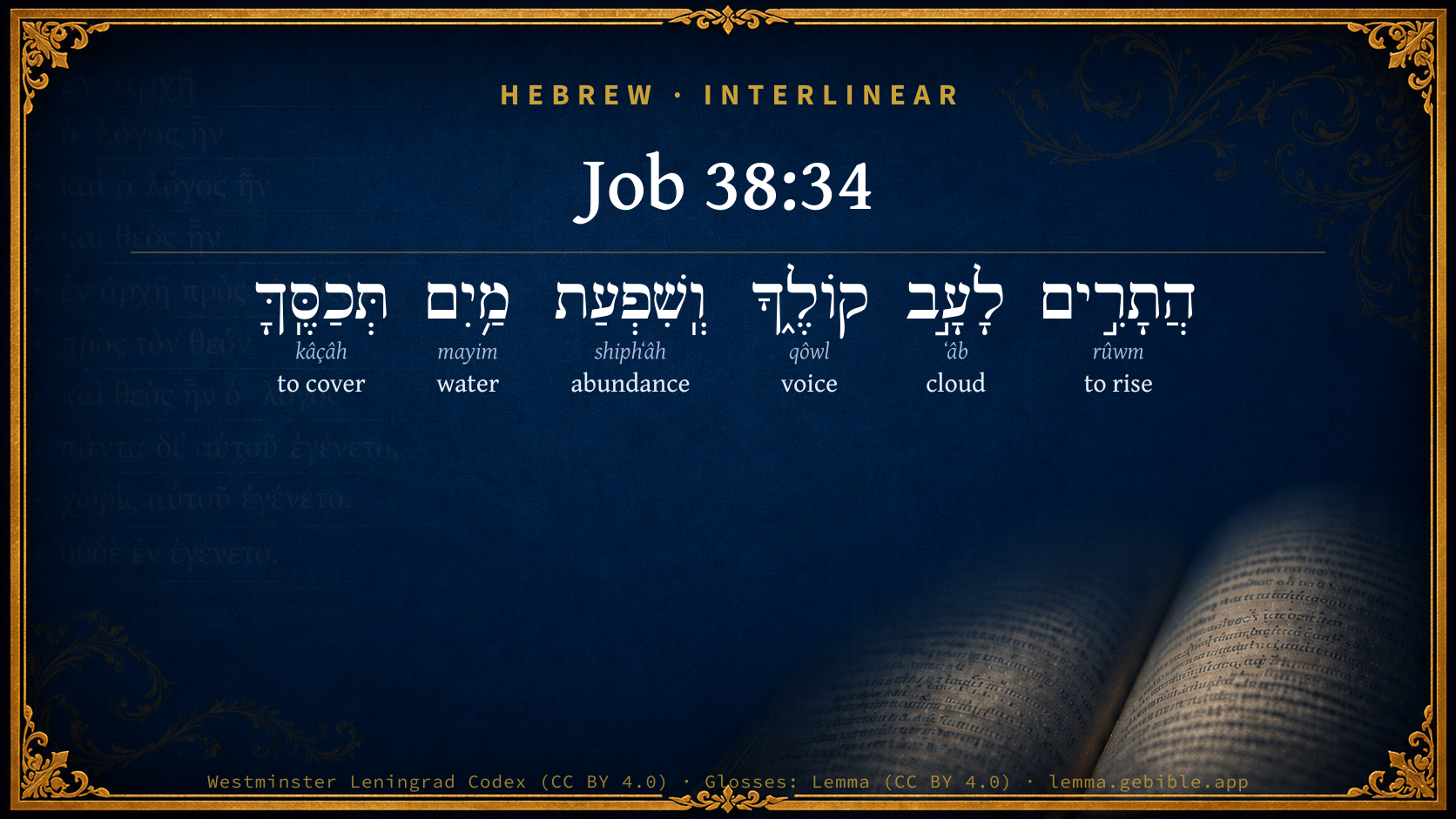
Job 38:34

Hebrew (Westminster Leningrad Codex) Job 38:34 appears in the Hebrew Old Testament. The text above is from the Westminster Leningrad Codex. Each word links to its Strong’s number, a concise gloss, and parsing drawn from the Open Scriptures Hebrew Bible morphology. Click any word for its full Brown-Driver-Briggs (BDB) entry.
Download image
Cite this verse

Job 38:34 (World English Bible). Public Domain. Lemma interlinear Bible study tool, https://lemma.gebible.app/v/job/38/34.

Show BibTeX & RIS
BibTeX
RIS
English Translation
"Can you lift up your voice to the clouds, That abundance of waters may cover you?
World English Bible · Public Domain
Download a study sheet

One document with this verse’s original text, its word-by-word gloss line, the meaning frame, cross-references with their text, attributed commentary, and full source and license credits — printable, and it pastes into notes with its structure intact.

This verse Autodidact and up

Study sheet (.html) Plain text (.txt)

A passage Seminary Student

Up to 50 verses in one chapter. A passage sheet keeps up to 6 commentary sources and 12 cross-references per verse, in the order this page ranks them, and says so on the sheet whenever that leaves anything out. Ask for a single verse and you get the Autodidact verse sheet above.

Everything on this page stays free to read, with no account — the sheet is a download of what is already on screen, not access to it.

Want to remove ads? Support Godless Engineer
Compare translations 3

The same verse in 3 English versions, stacked beneath the original-language interlinear above. Click any original word for its lexicon entry.

Each is an independent rendering of the whole verse — the interlinear is not word-aligned to these translations.

Highlighted words mark where these versions differ — a whole-verse word diff, not a word-by-word alignment.

  • World English Bible Public Domain
    "Can you lift up your voice to the clouds, That abundance of waters may cover you?
  • King James Version Public Domain
    Canst thou lift up thy voice to the clouds, that abundance of waters may cover thee?
  • unfoldingWord Literal Text CC BY-SA 4.0
    Will you raise your voice to the cloud and an abundance of waters will cover you?

unfoldingWord Literal Text — © unfoldingWord, licensed CC BY-SA 4.0. Word-aligned USFM3 via Door43 (git.door43.org/unfoldingWord/en_ult).

Versions to compare (up to 4)

3 of 4 selected

Show all 18 translations

Every available English version of this verse, each an independent rendering of the whole verse.

  • World English Bible Public Domain
    "Can you lift up your voice to the clouds, That abundance of waters may cover you?
  • Berean Standard Bible Public Domain
    Can you command the clouds so that a flood of water covers you?
  • Majority Standard Bible Public Domain
    Can you command the clouds so that a flood of water covers you?
  • King James Version Public Domain
    Canst thou lift up thy voice to the clouds, that abundance of waters may cover thee?
  • American Standard Version (1901) Public Domain
    Canst thou lift up thy voice to the clouds, That abundance of waters may cover thee?
  • Revised Version (1885) Public Domain
    Canst thou lift up thy voice to the clouds, that abundance of waters may cover thee?
  • Geneva Bible (1599) Public Domain
    Canst thou lift vp thy voice to the cloudes that the aboundance of water may couer thee?
  • Douay-Rheims (1899) Public Domain
    Canst thou lift up thy voice to the clouds, that an abundance of waters may cover thee?
  • Young's Literal Translation Public Domain
    Dost thou lift up to the cloud thy voice, And abundance of water doth cover thee?
  • Literal Standard Version CC BY-SA 4.0
    Do you lift up your voice to the cloud, || And abundance of water covers you?
  • Unlocked Literal Bible CC BY-SA 4.0
    Can you raise your voice up to the clouds, so that an abundance of rainwater may cover you?
  • unfoldingWord Literal Text CC BY-SA 4.0
    Will you raise your voice to the cloud and an abundance of waters will cover you?
  • Darby Bible Public Domain
    Dost thou lift up thy voice to the clouds, that floods of waters may cover thee?
  • World Messianic Bible Public Domain
    “Can you lift up your voice to the clouds, that abundance of waters may cover you?
  • Webster's Bible Public Domain
    Canst thou lift thy voice to the clouds, that abundance of waters may cover thee?
  • Free Bible Version CC BY-SA 4.0
    Can you shout to the clouds and command them to pour rain down on you?
  • Bible in Basic English Public Domain
    Is your voice sent up to the cloud, so that you may be covered by the weight of waters?
  • JPS Tanakh (1917) Public Domain
    Canst thou lift up thy voice to the clouds, that abundance of waters may cover thee?

Literal Standard Version (2020), Covenant Press — licensed CC BY-SA 4.0. Text via the HelloAO Bible API (eBible.org). Unlocked Literal Bible (unfoldingWord) — licensed CC BY-SA 4.0. Text via the HelloAO Bible API (eBible.org). unfoldingWord Literal Text — © unfoldingWord, licensed CC BY-SA 4.0. Word-aligned USFM3 via Door43 (git.door43.org/unfoldingWord/en_ult). Free Bible Version, Dr. Jonathan Gallagher — licensed CC BY-SA 4.0. Text via the HelloAO Bible API (eBible.org).

Word by word

More ways to search: Search by grammar → Find every occurrence → Compare this word →

Practice this passage: Drill this verse → Learn its vocabulary →

About this verse

These counts appear in no published source. They are computed here, from the morphology-tagged text and Lemma’s own curated glosses. What Lemma adds →

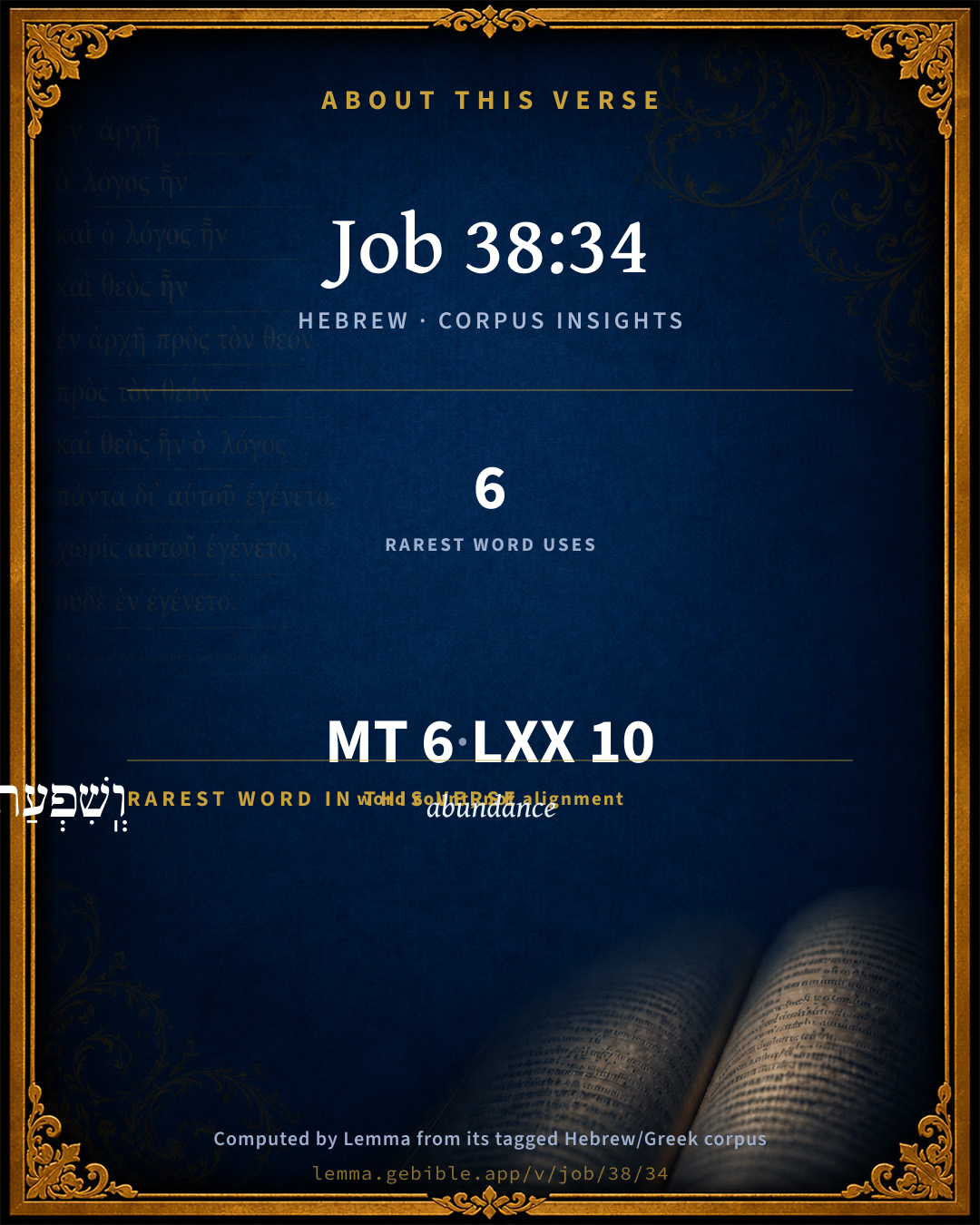
6
words
6
distinct lemmas
Wisdom
section

Notable vocabulary

The rarest word here is וְֽשִׁפְעַת abundance H8229 — appearing just 6 times in the whole Hebrew Bible.

Shared distinctive vocabulary

וְֽשִׁפְעַת abundance H8229 occurs in 5 verses of the Hebrew Bible. Also found in:

Grammatical profile

  • 2 verbs
  • 4 nouns

Verb forms

  • הֲתָרִ֣ים Hiphil · Imperfect
  • תְּכַסֶּֽךָּ Piel · Imperfect

Hebrew & Septuagint length

In English translation the verse runs 16 words from the Hebrew and 21 from the Septuagint (LXX English) — closely comparable.

A rough comparison of the two English renderings, which tokenize alike — not a word-level alignment.

Word counts can differ between the Hebrew and the Greek without any difference in meaning — e.g. the Hebrew direct-object marker אֵת has no separate Greek word, and Greek often adds the article ὁ.

In the original languages it is 6 Hebrew tokens and 10 Greek tokens — but the two are counted differently (Hebrew bundles its prefixes and suffixes into one token; the Greek is in lemma form), so that isn’t a like-for-like length.

Cross-references

6

Topical passages linked to Job 38:34 in the Treasury of Scripture Knowledge — connected by theme and wording, ordered by reader-vote popularity; previews shown in the World English Bible.

  • Job 22:11 Or darkness, so that you can not see, And floods of waters cover you.
  • 1 Samuel 12:18 So Samuel called to Yahweh; and Yahweh sent thunder and rain that day: and all the people greatly feared Yahweh and Samuel.
  • Job 36:27–28 For he draws up the drops of water, Which distill in rain from his vapor,
  • Amos 5:8 Seek him who made the Pleiades and Orion, And turns the shadow of death into the morning, And makes the day dark with night; Who calls for the waters of the sea, And pours them out on the surface of the earth, Yahweh is his name,
  • Zechariah 10:1 Ask of Yahweh rain in the spring time, Yahweh who makes storm clouds, And he gives rain showers to everyone for the plants in the field.
  • James 5:18 He prayed again, and the sky gave rain, and the earth brought forth its fruit.

Cross-references courtesy of OpenBible.info (CC BY 4.0).

Hebrew and Greek witnesses Masoretic Hebrew ↔ Greek Septuagint

The same verse in the two great witnesses to the Old Testament, shown verse-for-verse.

These are two independent witnesses, not word-aligned to each other, and the Septuagint is shown in lemma (dictionary) form.

Hebrew Job 38:34 Masoretic · Westminster Leningrad Codex

הֲתָרִ֣ים לָעָ֣ב קוֹלֶ֑ךָ וְֽשִׁפְעַת מַ֥יִם תְּכַסֶּֽךָּ

"Can you lift up your voice to the clouds, That abundance of waters may cover you?

World English Bible · Public Domain

Greek LXX Job 38:34 Septuagint · lemma form

καλέω δέ νέφος φωνή καί τρόμος ὕδωρ λάβρος ὑποἀκούω σύ

And will you call a cloud with your voice, and will it obey you with a violent shower of much rain?

LXX2012 (modern English Septuagint) · Public Domain

Hebrew: Westminster Leningrad Codex (CC BY 4.0). Greek: Septuagint (public domain); English from LXX2012 (modern English Septuagint) (Public Domain). How the Septuagint differs from the Hebrew →

Commentary

Notes on Job 38:34 from classic Christian and Jewish commentators (each source and its license shown beneath its notes). The classic Christian expositions comment on the surrounding passage and are grouped to its opening verse, so a note may address several verses; the Jewish commentaries on the Tanakh (Rashi and others) are per-verse, so they appear only where the commentator wrote on this verse.

Lemma curates 59 commentaries, every one of them public domain or Creative Commons licensed, each selected and text-cleaned for this edition rather than reprinted as found. About our sources →

Jamieson, Fausset & Brown

Robert Jamieson, A. R. Fausset & David Brown

job 38:34Jer 14:22; above Job 22:11, metaphorically.

Jamieson, Fausset & Brown — Commentary Critical and Explanatory on the Whole Bible (1871) — public domain (CC PDM 1.0). Text via the HelloAO Bible API.

John Gill's Exposition

Who can number the clouds in wisdom?.... Or has such wisdom as to be able to count them when the heavens are full of them; hence they are used to denote a great multitude, Isa 55:8; or "declare" them (t), set forth and explain the nature of them, their matter, motion, and use; none can do this perfectly or completely. Aben Ezra interprets it, who can make them as sapphire? in which he is followed by Mr. Broughton and others (u); the sapphire is a precious stone, very clear and lucid, of a sky colour. And then the sense is, who can make a clear and serene sky, when it is cloudy? None but the Lord; see Job 37:11;

or who can stay the bottles of heaven? or "barrels", as Mr. Broughton; the clouds in which the rain is bottled or barrelled up; and when it is the pleasure of God to pour them out, who can stay, stop, or restrain them? or who can "cause them to lie down" (w)? that is, on the earth; to descend or "distil" on it, as the same translator. Who can do this, when it is the will of God to withhold them? To stop or unstop, those bottles, to restrain rain, or pour it forth, is entirely at his dispose, and not man's; see Job 38:34.

(t) "enarrabit", V. L. "vel explicabit", Mercerus, Schmidt. (u) Junius & Tremellius, Piscator, Vid. Ravii Orthograph. Ebr. p. 22. (w) "cubare faciet", Drusius, Schmidt; "quiescere", Montanus; "descendere", Pagninus, so Aben Ezra; "effundit humi", Schultens.

John Gill's Exposition of the Whole Bible (1746–1763) — public domain (CC PDM 1.0). Text via the HelloAO Bible API.

Trapp's Complete Commentary

John Trapp

Job 38:34 Canst thou lift up thy voice to the clouds, that abundance of waters may cover thee?

Ver. 34. Canst thou lift up thy voice to the clouds?] Thy commanding voice, as Num 9:23. Some render it, Thy thunder. Will the clouds obey thee, and rain upon thee at thy pleasure? Something thou mayest get by thy prayers, as Elias did, Jas 5:17, and the thundering legion in the ecclesiastical history, but nothing by command or compulsion. The monarch of Mexico is a mad man to take an oath at his coronation, that it shall be what weather soever he pleaseth all the time of his reign (Lopez de Gomara).

John Trapp, A Commentary or Exposition upon All the Books of the Old and New Testament (1647–1656) — public domain. Text from a community e-Sword module.

Joseph Benson's Commentary

Job 38:34-35. Canst thou lift up thy voice to the clouds? — Either thundering in them, or calling to them with a loud voice, and commanding them to rain. That abundance of waters may cover thee? — That is, may cover thy land, when it needs and requires rain. Canst thou send lightnings that they may go? — At thy pleasure, and upon thy errand? and say, Here we are? — Ready to do thy will, as servants to obey their master. “Nothing can be more elevated and sublime than this verse. How strong the image! How simple the expression! We read of winged lightnings in the heathen poets; but where do they live, and act, and speak, and wait for orders with impatience as here?” See Peters and Dodd.

Joseph Benson's Commentary on the Old and New Testaments (1811–1818) — public domain. Text from a community e-Sword module.

Whedon's Commentary on the Bible

Daniel D. Whedon

γ. Maybe Job can legislate for the firmament by wielding the thunder, draw down and empty the cloud, or by a word give life to the lightnings, that they may fulfil his behests, Job_38:34-35.

34. Thy voice to the clouds — Not a rain-drop can the human voice call from the sky, and yet abundance of rain is essential to the weal of our race.

Daniel D. Whedon (gen. ed.), Commentary on the Old and New Testaments (1874–1909) — public domain. Text from a community e-Sword module.

Keil & Delitzsch

C. F. Keil & F. Delitzsch

34 Dost thou raise thy voice to the clouds

That an overflow of waters may cover thee?

35 Dost thou send forth lightnings, and they go,

And say to thee: Here we are?

36 Who hath put wisdom in the reins,

Or who hath given understanding to the cock?

37 Who numbereth the strata of the clouds with wisdom

And the bottles of heaven, who emptieth them,

38 When the dust flows together into a mass,

And the clods cleave together?

As Job 38:25 was worded like Job 28:26, so Job 38:34 is worded like Job 22:11; the ך of תכסך is dageshed in both passages, as Job 36:2, Job 36:18, Hab 2:17. What Jehovah here denies to the natural power of man is possible to the power which man has by faith, as the history of Elijah shows: this, however, does not come under consideration here. In proof of divine omnipotence and human feebleness, Elihu constantly recurs to the rain and the thunder-storm with the lightning, which is at the bidding of God. Most moderns since Schultens therefore endeavour, with great violence, to make טחות and שׂכרי mean meteors and celestial phenomena. Eichh. (Hirz., Hahn) compares the Arabic name for the clouds, tachâ (tachwa), Ew. Arab. ḍiḥḥ, sunshine, with the former; the latter, whose root is שׂכה (סכה), spectare, is meant to be something that is remarkable in the heavens: an atmospheric phenomenon, a meteor (Hirz.), or a phenomenon caused by light (Ew., Hahn), so that e.g., Umbr. translates: "Who hath put wisdom in the dark clouds, and given understanding to the meteor?" But the meaning which is thus extorted from the words in favour of the connection borders closely upon absurdity. Why, then, shall טחות, from טוּח, Arab. ṭı̂ych, oblinere, adipe obducere, not signify here, as in Psa 51:8, the reins (embedded in a cushion of fat), and in fact as the seat of the predictive faculty, like כּליות, Job 19:27, as the seat of the innermost longing for the future; and particularly since here, after the constellations and the influences of the stars have just been spoken of, the mention of the gift of divination is not devoid of connection; and, moreover, as a glance at the next strophe shows, the connection which has been hitherto firmly kept to is already in process of being resolved?

If טחות signifies the reins, it is natural to interpret שׂכוי also psychologically, and to translate the intellect (Targ. I, Syr., Arab.), or similarly (Saad., Gecat.), as Ges., Carey, Renan, Schlottm. But there is another rendering handed down which is worthy of attention, although not once mentioned by Rosenm., Hirz., Schlottm., or Hahn, according to which שׂכוי signifies a cock, gallum. We read in b. Rosch ha-Schana, 26a: "When I came to Techm-Kn-Nishraja, R. Simeon b. Lakish relates, the bride was there called נינפי and the cock שׂכוי, according to which Job 38:36 is to be interpreted: שׂכוי = תרנגול." The Midrash interprets in the same way, Jalkut, 905, beginning: "R. Levi says: In Arabic the cock is called סכוא." We compare with this, Wajikra rabba, c. 1: "סוכו is Arabic; in Arabia a prophet is called סכוא;" whence it is to be inferred that שׂכוי, as is assumed, describes the cock as a seer, as a prophet.

As to the formation of the word, it would certainly be without parallel (Ew., Olsh.) if the word had the tone on the penult., but Codd. and the best old editions have the Munach by the final syllable; Norzi, who has overlooked this, at least notes שׂכוי with the accent on the ult. as a various reading. It is a secondary noun, Ges. 86, 5, a so-called relative noun (De Sacy, Gramm. Arabe, 768): שׂכרי, speculator, from שׂכו (שׂכוּ, שׂכה), speculatio, as פּלאי, Jdg 13:18 (comp. Psa 139:6), miraculosus, from פּלא, a cognate form to the Chald. סכוי (סכואה), of similar meaning. In connection with this primary signification, speculator, it is intelligible how סכוי in Samaritan (vid., Lagarde on Proverbs, S. 62) can signify the eye; here, however, in a Hebrew poet, the cock, of which e.g., Gregory says: Speculator semper in altitudine stat, ut quidquid venturum sit longe prospiciat. That this signification speculator = gallus

(Note: No Arab. word offers itself here for comparison: tuchaj, a cock, has different consonants, and if Arab. škâ in the sense of Arab. šâk, fortem esse, were to be supposed, שׂכוי would be a synon. of גּבר, which is likewise a name of the cock.)

was generally accepted at least in the Talmudic age, the Beracha prescribed to him who hears the cock crow: "Blessed be He who giveth the cock (שׂכוי) knowledge to distinguish between day and night!" shows. In accordance with this, Targ. II translates: who has given understanding לתרנגול בּרא, gallo sylvestri (whereas Targ. I ללבּא, cordi, scil. hominis), to praise his Lord? and Jer.: (quis posuit in visceribus hominis sapientiam) et quis dedit gallo intelligentiam. This traditional rendering, condemned as talmudicum commentum (Ges.), we follow rather than the "phenomenon" of the moderns who guess at a meaning. What is questioned in Cicero, de divin. ii. 26: Quid in mentem venit Callistheni dicere, Deos gallis signum dedisse cantandi, quum id vel natura vel casus efficere potuisset, Jehovah here claims for Himself. The weather-prophet κατ ̓ ἐξοχήν among animals appropriately appears in this astrologico-meteorological connection by the side of the reins as, according to the Semitic view, a medium of augury (Psychol. S. 268f.). The Koran also makes the cock the watchman who wakes up the heavenly hosts to their duty; and Masius, in his Studies of Nature, has shown how high the cock is placed as being prophetically (for divination) gifted, Moreover, the worship of cocks in the idolatry of the Semites was a service rendered to the stars: the Sabians offered cocks, probably (vid., Chwolsohn, ii. 87) as the white cock of Jezides, regarded by them as a symbol of the sun (Deutsch. Morgenlnd. Zeitschr. 1862, S. 365f.).

In Job 38:37 Jerome translates: et concentum coelorum quis dormire faciet; נבלי, however, does not here signify harps, but bottles; and השׁכּיב is not: to lay to rest, but to lay down = to empty, pour out, which the Kal also, like the Arab. sakaba, directly signifies. בּצקת might be taken actively: when it pours, but according to Kg1 22:35 the intransitive rendering is also possible: when the dust pours forth, i.e., flows together, למוּצק, to what is poured out, i.e., not: to the fluid, but in contrast: to a molten mass, i.e., as cast metal (to be explained not according to Job 22:16, but according to Job 37:18), for the dry, sandy, dusty earth is made firm by the downfall of the rain (Arab. ruṣidat, firmata est terra imbre, comp. Arab. lbbd, pluviam emisit donec arena cohaereret). רגבים, glebae, as Job 21:33, from רגב, Arab. rjb, in the primary signification, which as it seems must be supposed: to bring together, from which the significations branch off, to thicken, become firm (muraggab, supported), and to be seized with terror.

Keil & Delitzsch — Biblical Commentary on the Old Testament (1861–1891) — public domain (CC PDM 1.0). Text via the HelloAO Bible API. (Old Testament only.)

Adam Clarke's Commentary

Verse 34. Canst thou lift up thy voice to the clouds] Canst thou produce lightning and thunder, that water may be formed, and poured down upon the earth?

Thunder is called קלות koloth, voices; for it is considered the voice of God: here then Job's voice, קולך kolecha, is opposed to the voice of JEHOVAH!

Adam Clarke's Commentary on the Bible (1810–1826) — public domain. Text from a community e-Sword/MySword module.

The Cambridge Bible for Schools and Colleges

gen. ed. J. J. S. Perowne

34, 35. For canst thou it is better, as before, to read, dost thou?

The Cambridge Bible for Schools and Colleges (gen. ed. J. J. S. Perowne; Cambridge University Press, 1878–1918) — public domain. Text from a community e-Sword module.

Albert Barnes' Notes on the Bible

Canst thou lift up thy voice to the clouds, that abundance of waters may cover thee? - That is, canst thou command the clouds so that they shall send down abundant rain? Bouillier supposes that there is an allusion here to the incantations which were pretended to be practiced by the Magi, by which they claimed the power of producing rain at pleasure; compare Jer 14:22, “Are there any among the vanities of the Gentiles (the idols that they worship) that can cause rain? Art not thou he, O Lord our God?” The idea is, that it is God only who can cause rain, and that the control of the clouds from which rain descends is wholly beyond the reach of man.

Albert Barnes' Notes on the Bible (1834–1885) — public domain. Text from a community e-Sword/MySword module.

Haydock's Catholic Bible Commentary

Voice, to mimic the thunder of God, (Calmet) or to order it to rain. (Haydock)

George Leo Haydock (1774–1849), Haydock's Catholic Family Bible and Commentary, 1859 edition — public domain. Excludes Psalms (Douay-Rheims chapter numbering differs from Protestant) and Deuterocanonical books (Catholic canon only).

Matthew Poole's English Annotations

Canst thou lift up thy voice to the clouds; either thundering in them, or calling to them with a loud voice, commanding them to rain?

May cover thee, i.e. thy land, when it needs and requires rain.

Matthew Poole's English Annotations on the Holy Bible (1683–1685) — public domain. Text from a community e-Sword/MySword module.

The Pulpit Commentary

Canst thou lift up thy voice to the clouds, that abundance of water may sever thee? Will the clouds take their orders from thee, listen to thee, obey thy voice? None but the "medicine-men" of savage tribes profess to have any such power. Elijah, indeed, "prayed, and the heaven gave rain"; (Jam_5:18) but this was a very different thing from "commanding the clouds of heaven." His prayer was addressed to God, and God gave the rain for which he made his petition.

The Pulpit Commentary (1880–1919), ed. H.D.M. Spence-Jones & Joseph S. Exell — public domain. Text from a community e-Sword module.

John Wesley's Explanatory Notes

Cover thee - Thy land when it needs rain.

John Wesley, Explanatory Notes Upon the Whole Bible (1754–1765) — public domain. Text via the GEBible commentary corpus.

unfoldingWord translationNotes

Door43 World Missions Community

Connecting Statement:

Yahweh continues to challenge Job.

General Information:

Yahweh uses two questions to emphasize to Job that he rules the rain clouds and lightning and Job does not. (See: Rhetorical Question)

Can you raise ... 'Here we are'?

These can be translated as statements. AT: "Tell me if you can raise your voice up to the clouds, so that an abundance of rainwater may cover you. Tell me if you can send out bolts of lightning that they may go out, that they say to you, 'Here we are!'" (See: Rhetorical Question)

an abundance of rainwater

The abstract noun "abundance" can be translated as the adjective "abundant." AT: "an abundant amount of rainwater" or "a flood of waters" (See: Abstract Nouns)

Here we are

This pictures the lightning bolts as servants saying they are ready to follow commands. (See: Personification)

translationWords

raise

voice

send

unfoldingWord translationNotes — © Distant Shores Media and the Door43 World Missions Community, licensed CC BY-SA 4.0. Source: git.door43.org/Door43/en_tn.

Rashi

Rabbi Shlomo Yitzchaki (Rashi)

Can you lift up your voice to the cloud to command it to tie up with the darkness of water so that an abundance of water cover you? That is the darkening of clouds, like (above 22:11), “or darkness so that you do not see.” [or] will an abundance of water from Heaven cover you by your commands.

Rashi on the Tanakh — English translations: “The Judaica Press complete Tanach with Rashi, translated by A. J. Rosenberg” (CC BY 4.0); “Pentateuch with Rashi's commentary by M. Rosenbaum and A.M. Silbermann, 1929-1934” (public domain); “The Metsudah Tanach series, Lakewood, N.J” (CC BY 4.0); and “The Book of Joshua, Metsudah Publications, 1997” (CC BY 4.0). Text via Sefaria.

Lesson kit

Teaching starters — assembled from the data on this page, not authored interpretation. Every prompt links to the verse data it draws on. Edit before teaching.

Job, in the Wisdom, opens this verse with 6 words (6 distinct Hebrew lemmas). Its most distinctive word is shiphʻâh (“abundance”). A historical commentator’s framing appears above. Read the whole chapter for the surrounding context.

Discussion questions

  1. How does “abundance” (shiphʻâh) shape what this verse is saying?
  2. How does 2 Kings 9:17, which shares the word «abundance», read alongside this verse?
  3. These translations render this verse differently; the difference is in the English rendering, not the original. What questions does that raise?
  4. «הֲתָרִ֣ים» is a Hiphil Imperfect verb. How does that grammatical form shape the action described?
  5. Compare how Jamieson, Fausset & Brown and John Gill's Exposition read this verse. Where do they agree or differ?

Things to notice

Reading settings

Reading text

Shown beneath each verse's original-language words.

Old Testament
Old Testament edition

Read the OT as the Masoretic Hebrew (MT) or the Greek Septuagint (LXX).

English shown for the Greek Septuagint (in the Hebrew ↔ Greek comparison).

Comparing translations? Open the Compare panel on any verse page to stack up to four side by side.