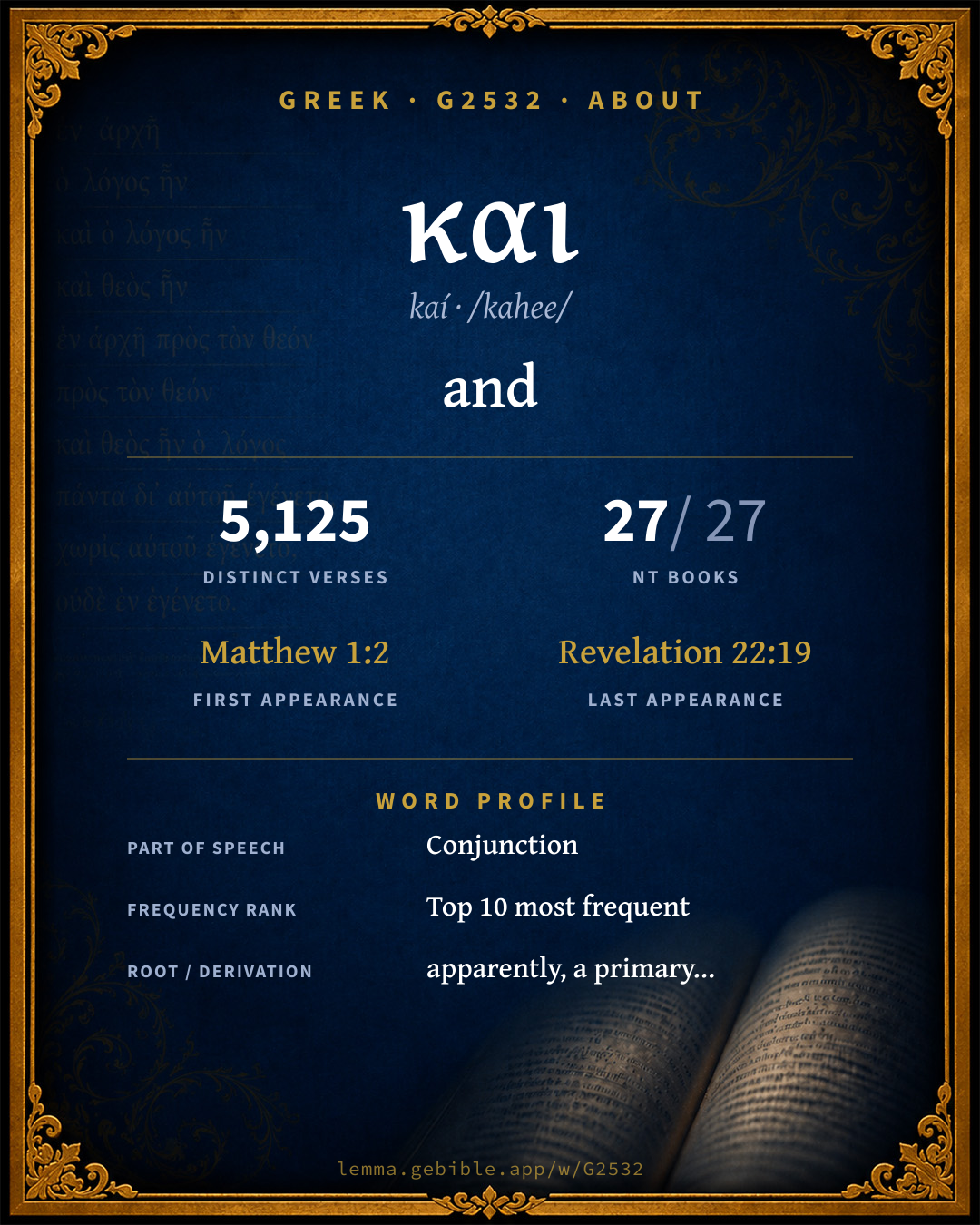
καί
and
Full lexicon entry — Thayer's Greek Lexicon
From Thayer's Greek Lexicon
Where this word appears
Grammar key — what these labels mean
Part of speech
- Conjunction
- A joining word linking words or clauses.
Page 7 of 26 — showing verses 1,201–1,400 of 5,125 distinct verses where G2532 appears, across 27 books. Click any verse to open its interlinear word-by-word view. Verse text shown in the World English Bible for context — . Each verse’s Greek form is shown with its reference; the English is not keyword-highlighted, since the data carries no word-level English alignment. Use “Compare translations” on any verse to read it across multiple English versions. This concordance covers the Greek New Testament; Septuagint (Greek Old Testament) occurrences of this word are not indexed here.
Mark 556 verses
- Mark 14:59 καὶ conj Even so, their testimony did not agree.
- Mark 14:60 καὶ conj The high priest stood up in the midst, and asked Jesus, "Have you no answer? What is it which these testify against you?"
- Mark 14:61 καὶ καὶ conj conj But he stayed quiet, and answered nothing. Again the high priest asked him, "Are you the Christ, the Son of the Blessed?"
- Mark 14:62 καὶ καὶ conj conj Jesus said, "I AM. You will see the Son of Man sitting at the right hand of Power, and coming with the clouds of the sky."
- Mark 14:65 Καὶ καὶ καὶ καὶ καὶ conj conj conj conj conj Some began to spit on him, and to cover his face, and to beat him with fists, and to tell him, "Prophesy!" The officers struck him with the palms of their hands.
- Mark 14:66 Καὶ conj As Peter was in the courtyard below, one of the maids of the high priest came,
- Mark 14:67 καὶ καὶ conj conj and seeing Peter warming himself, she looked at him, and said, "You were also with the Nazarene, Jesus!"
- Mark 14:68 καὶ καὶ conj conj But he denied it, saying, "I neither know, nor understand what you are saying." He went out on the porch, and the rooster crowed.
- Mark 14:69 καὶ conj The maid saw him, and began again to tell those who stood by, "This is one of them."
- Mark 14:70 καὶ καὶ conj conj But he again denied it. After a little while again those who stood by said to Peter, "You truly are one of them, for you are a Galilean, and your speech shows it."
- Mark 14:71 καὶ conj But he began to curse, and to swear, "I don't know this man of whom you speak!"
- Mark 14:72 καὶ καὶ καὶ conj conj conj The rooster crowed the second time. Peter remembered the word, how that Jesus said to him, "Before the rooster crows twice, you will deny me three times." When he thought about that, he wept.
- Mark 15:1 Καὶ καὶ καὶ καὶ conj conj conj conj Immediately in the morning the chief priests, with the elders and scribes, and the whole council, held a consultation, and bound Jesus, and carried him away, and delivered him up to Pilate.
- Mark 15:2 καὶ conj Pilate asked him, "Are you the King of the Jews?" He answered, "So you say."
- Mark 15:3 καὶ conj The chief priests accused him of many things.
- Mark 15:8 καὶ conj The multitude, crying aloud, began to ask him to do as he always did for them.
- Mark 15:15 καὶ conj Pilate, wishing to please the multitude, released Barabbas to them, and handed over Jesus, when he had flogged him, to be crucified.
- Mark 15:16 καὶ conj The soldiers led him away within the court, which is the Praetorium; and they called together the whole cohort.
- Mark 15:17 καὶ καὶ conj conj They clothed him with purple, and weaving a crown of thorns, they put it on him.
- Mark 15:18 καὶ conj They began to salute him, "Hail, King of the Jews!"
- Mark 15:19 καὶ καὶ καὶ conj conj conj They struck his head with a reed, and spat on him, and bowing their knees, did homage to him.
- Mark 15:20 καὶ καὶ Καὶ conj conj conj When they had mocked him, they took the purple off of him, and put his own garments on him. They led him out to crucify him.
- Mark 15:21 καὶ καὶ conj conj They compelled one passing by, coming from the country, Simon of Cyrene, the father of Alexander and Rufus, to go with them, that he might bear his cross.
- Mark 15:22 καὶ conj They brought him to the place called Golgotha, which is, being interpreted, "The place of a skull."
- Mark 15:23 καὶ conj They offered him wine mixed with myrrh to drink, but he didn't take it.
- Mark 15:24 καὶ καὶ conj conj Crucifying him, they parted his garments among them, casting lots on them, what each should take.
- Mark 15:25 καὶ conj It was the third hour, and they crucified him.
- Mark 15:26 καὶ conj The superscription of his accusation was written over him, "THE KING OF THE JEWS."
- Mark 15:27 Καὶ καὶ conj conj With him they crucified two robbers; one on his right hand, and one on his left.
- Mark 15:29 καὶ καὶ καὶ conj conj conj Those who passed by blasphemed him, wagging their heads, and saying, "Ha! You who destroy the temple, and build it in three days,
- Mark 15:31 καὶ conj Likewise, also the chief priests mocking among themselves with the scribes said, "He saved others. He can't save himself.
- Mark 15:32 καὶ καὶ conj conj Let the Christ, the King of Israel, now come down from the cross, that we may see and believe him." Those who were crucified with him insulted him.
- Mark 15:33 Καὶ conj When the sixth hour had come, there was darkness over the whole land until the ninth hour.
- Mark 15:34 καὶ conj At the ninth hour Jesus cried with a loud voice, saying, "Eloi, Eloi, lama sabachthani?" which is, being interpreted, "My God, my God, why have you forsaken me?"
- Mark 15:35 καί conj Some of those who stood by, when they heard it, said, "Behold, he is calling Elijah."
- Mark 15:36 καὶ conj One ran, and filling a sponge full of vinegar, put it on a reed, and gave it to him to drink, saying, "Let him be. Let's see whether Elijah comes to take him down."
- Mark 15:38 καὶ conj The veil of the temple was torn in two from the top to the bottom.
- Mark 15:40 καὶ καὶ καὶ καὶ καὶ conj conj conj conj conj There were also women watching from afar, among whom were both Mary Magdalene, and Mary the mother of James the less and of Joses, and Salome;
- Mark 15:41 καὶ καὶ conj conj who, when he was in Galilee, followed him, and served him; and many other women who came up with him to Jerusalem.
- Mark 15:42 Καὶ conj When evening had now come, because it was the Preparation Day, that is, the day before the Sabbath,
- Mark 15:43 καὶ καὶ conj conj Joseph of Arimathaea, a prominent council member who also himself was looking for the Kingdom of God, came. He boldly went in to Pilate, and asked for Jesus' body.
- Mark 15:44 καὶ conj Pilate marveled if he were already dead; and summoning the centurion, he asked him whether he had been dead long.
- Mark 15:45 καὶ conj When he found out from the centurion, he granted the body to Joseph.
- Mark 15:46 καὶ καὶ καὶ conj conj conj He bought a linen cloth, and taking him down, wound him in the linen cloth, and laid him in a tomb which had been cut out of a rock. He rolled a stone against the door of the tomb.
- Mark 15:47 καὶ conj Mary Magdalene and Mary, the mother of Joses, saw where he was laid.
- Mark 16:1 Καὶ καὶ καὶ conj conj conj When the Sabbath was past, Mary Magdalene, and Mary the mother of James, and Salome, bought spices, that they might come and anoint him.
- Mark 16:2 καὶ conj Very early on the first day of the week, they came to the tomb when the sun had risen.
- Mark 16:3 καὶ conj They were saying among themselves, "Who will roll away the stone from the door of the tomb for us?"
- Mark 16:4 καὶ conj for it was very big. Looking up, they saw that the stone was rolled back.
- Mark 16:5 καὶ καὶ conj conj Entering into the tomb, they saw a young man sitting on the right side, dressed in a white robe, and they were amazed.
- Mark 16:7 καὶ conj But go, tell his disciples and Peter, 'He goes before you into Galilee. There you will see him, as he said to you.'"
- Mark 16:8 καὶ καὶ καὶ conj conj conj They went out, and fled from the tomb, for trembling and astonishment had come on them. They said nothing to anyone; for they were afraid.
- Mark 16:10 καὶ conj She went and told those who had been with him, as they mourned and wept.
- Mark 16:11 καὶ conj When they heard that he was alive, and had been seen by her, they disbelieved.
- Mark 16:14 καὶ καὶ conj conj Afterward he was revealed to the eleven themselves as they sat at the table, and he rebuked them for their unbelief and hardness of heart, because they didn't believe those who had seen him after he had risen.
- Mark 16:15 καὶ conj He said to them, "Go into all the world, and preach the Gospel to the whole creation.
- Mark 16:16 καὶ conj He who believes and is baptized will be saved; but he who disbelieves will be condemned.
- Mark 16:18 καὶ conj they will take up serpents; and if they drink any deadly thing, it will in no way hurt them; they will lay hands on the sick, and they will recover."
- Mark 16:19 καὶ conj So then the Lord Jesus, after he had spoken to them, was received up into heaven, and sat down at the right hand of God.
- Mark 16:20 καὶ conj They went out, and preached everywhere, the Lord working with them, and confirming the word by the signs that followed. Amen.
Luke 829 verses
- Luke 1:2 καὶ conj even as those who from the beginning were eyewitnesses and ministers of the word delivered them to us,
- Luke 1:5 καὶ καὶ conj conj There was in the days of Herod, the king of Judea, a certain priest named Zacharias, of the priestly division of Abijah. He had a wife of the daughters of Aaron, and her name was Elizabeth.
- Luke 1:6 καὶ conj They were both righteous before God, walking blamelessly in all the commandments and ordinances of the Lord.
- Luke 1:7 καὶ καὶ conj conj But they had no child, because Elizabeth was barren, and they both were well advanced in years.
- Luke 1:10 καὶ conj The whole multitude of the people were praying outside at the hour of incense.
- Luke 1:12 καὶ καὶ conj conj Zacharias was troubled when he saw him, and fear fell upon him.
- Luke 1:13 καὶ καὶ conj conj But the angel said to him, "Don't be afraid, Zacharias, because your request has been heard, and your wife, Elizabeth, will bear you a son, and you shall call his name John.
- Luke 1:14 καὶ καὶ καὶ conj conj conj You will have joy and gladness; and many will rejoice at his birth.
- Luke 1:15 καὶ καὶ καὶ conj conj conj For he will be great in the sight of the Lord, and he will drink no wine nor strong drink. He will be filled with the Holy Spirit, even from his mother's womb.
- Luke 1:16 καὶ conj He will turn many of the children of Israel to the Lord, their God.
- Luke 1:17 καὶ καὶ καὶ conj conj conj He will go before him in the spirit and power of Elijah, 'to turn the hearts of the fathers to the children,' and the disobedient to the wisdom of the just; to make ready a people prepared for the Lord."
- Luke 1:18 καὶ καὶ conj conj Zacharias said to the angel, "How can I be sure of this? For I am an old man, and my wife is well advanced in years."
- Luke 1:19 καὶ καὶ καὶ conj conj conj The angel answered him, "I am Gabriel, who stands in the presence of God. I was sent to speak to you, and to bring you this good news.
- Luke 1:20 καὶ καὶ conj conj Behold, you will be silent and not able to speak, until the day that these things will happen, because you didn't believe my words, which will be fulfilled in their proper time."
- Luke 1:21 καὶ καὶ conj conj The people were waiting for Zacharias, and they marveled that he delayed in the temple.
- Luke 1:22 καὶ καὶ καὶ conj conj conj When he came out, he could not speak to them, and they perceived that he had seen a vision in the temple. He continued making signs to them, and remained mute.
- Luke 1:23 καὶ conj It happened, when the days of his service were fulfilled, he departed to his house.
- Luke 1:24 καὶ conj After these days Elizabeth, his wife, conceived, and she hid herself five months, saying,
- Luke 1:27 καὶ conj to a virgin pledged to be married to a man whose name was Joseph, of the house of David. The virgin's name was Mary.
- Luke 1:28 καὶ conj Having come in, the angel said to her, "Rejoice, you highly favored one! The Lord is with you. Blessed are you among women!"
- Luke 1:29 καὶ conj But when she saw him, she was greatly troubled at the saying, and considered what kind of salutation this might be.
- Luke 1:30 καὶ conj The angel said to her, "Don't be afraid, Mary, for you have found favor with God.
- Luke 1:31 καὶ καὶ καὶ conj conj conj Behold, you will conceive in your womb, and bring forth a son, and will call his name 'Jesus.'
- Luke 1:32 καὶ καὶ conj conj He will be great, and will be called the Son of the Most High. The Lord God will give him the throne of his father, David,
- Luke 1:33 καὶ καὶ conj conj and he will reign over the house of Jacob forever. There will be no end to his Kingdom."
- Luke 1:35 καὶ καὶ καὶ conj conj conj The angel answered her, "The Holy Spirit will come on you, and the power of the Most High will overshadow you. Therefore also the holy one who is born from you will be called the Son of God.
- Luke 1:36 καὶ καὶ καὶ conj conj conj Behold, Elizabeth, your relative, also has conceived a son in her old age; and this is the sixth month with her who was called barren.
- Luke 1:38 καὶ conj Mary said, "Behold, the handmaid of the Lord; be it to me according to your word." The angel departed from her.
- Luke 1:40 καὶ καὶ conj conj and entered into the house of Zacharias and greeted Elizabeth.
- Luke 1:41 καὶ καὶ conj conj It happened, when Elizabeth heard Mary's greeting, that the baby leaped in her womb, and Elizabeth was filled with the Holy Spirit.
- Luke 1:42 καὶ καὶ καὶ conj conj conj She called out with a loud voice, and said, "Blessed are you among women, and blessed is the fruit of your womb!
- Luke 1:43 καὶ conj Why am I so favored, that the mother of my Lord should come to me?
- Luke 1:45 καὶ conj Blessed is she who believed, for there will be a fulfillment of the things which have been spoken to her from the Lord!"
- Luke 1:46 Καὶ conj Mary said, "My soul magnifies the Lord.
- Luke 1:47 καὶ conj My spirit has rejoiced in God my Savior,
- Luke 1:49 καὶ conj For he who is mighty has done great things for me. Holy is his name.
- Luke 1:50 καὶ καὶ conj conj His mercy is for generations of generations on those who fear him.
- Luke 1:52 καὶ conj He has put down princes from their thrones. And has exalted the lowly.
- Luke 1:53 καὶ conj He has filled the hungry with good things. He has sent the rich away empty.
- Luke 1:55 καὶ conj As he spoke to our fathers, To Abraham and his seed forever."
- Luke 1:56 καὶ conj Mary stayed with her about three months, and then returned to her house.
- Luke 1:57 καὶ conj Now the time that Elizabeth should give birth was fulfilled, and she brought forth a son.
- Luke 1:58 καὶ καὶ καὶ conj conj conj Her neighbors and her relatives heard that the Lord had magnified his mercy towards her, and they rejoiced with her.
- Luke 1:59 καὶ καὶ conj conj It happened on the eighth day, that they came to circumcise the child; and they would have called him Zacharias, after the name of the father.
- Luke 1:60 καὶ conj His mother answered, "Not so; but he will be called John."
- Luke 1:61 καὶ conj They said to her, "There is no one among your relatives who is called by this name."
- Luke 1:63 καὶ καὶ conj conj He asked for a writing tablet, and wrote, "His name is John." They all marveled.
- Luke 1:64 καὶ καὶ conj conj His mouth was opened immediately, and his tongue freed, and he spoke, blessing God.
- Luke 1:65 καὶ καὶ conj conj Fear came on all who lived around them, and all these sayings were talked about throughout all the hill country of Judea.
- Luke 1:66 καὶ καὶ conj conj All who heard them laid them up in their heart, saying, "What then will this child be?" The hand of the Lord was with him.
- Luke 1:67 Καὶ καὶ conj conj His father, Zacharias, was filled with the Holy Spirit, and prophesied, saying,
- Luke 1:68 καὶ conj "Blessed be the Lord, the God of Israel, For he has visited and worked redemption for his people;
- Luke 1:69 καὶ conj And has raised up a horn of salvation for us in the house of his servant David
- Luke 1:71 καὶ conj Salvation from our enemies, and from the hand of all who hate us;
- Luke 1:72 καὶ conj To show mercy towards our fathers, To remember his holy covenant,
- Luke 1:75 καὶ conj In holiness and righteousness before him all the days of our life.
- Luke 1:76 καὶ conj And you, child, will be called a prophet of the Most High, For you will go before the face of the Lord to make ready his ways,
- Luke 1:79 καὶ conj To shine on those who sit in darkness and the shadow of death; To guide our feet into the way of peace."
- Luke 1:80 καὶ καὶ conj conj The child was growing, and becoming strong in spirit, and was in the desert until the day of his public appearance to Israel.
- Luke 2:3 καὶ conj All went to enroll themselves, everyone to his own city.
- Luke 2:4 καὶ καὶ conj conj Joseph also went up from Galilee, out of the city of Nazareth, into Judea, to the city of David, which is called Bethlehem, because he was of the house and family of David;
- Luke 2:7 καὶ καὶ καὶ conj conj conj She brought forth her firstborn son, and she wrapped him in bands of cloth, and laid him in a feeding trough, because there was no room for them in the inn.
- Luke 2:8 Καὶ καὶ conj conj There were shepherds in the same country staying in the field, and keeping watch by night over their flock.
- Luke 2:9 καὶ καὶ καὶ conj conj conj Behold, an angel of the Lord stood by them, and the glory of the Lord shone around them, and they were terrified.
- Luke 2:10 καὶ conj The angel said to them, "Don't be afraid, for behold, I bring you good news of great joy which will be to all the people.
- Luke 2:12 καὶ conj This is the sign to you: you will find a baby wrapped in strips of cloth, lying in a feeding trough."
- Luke 2:13 καὶ καὶ conj conj Suddenly, there was with the angel a multitude of the heavenly host praising God, and saying,
- Luke 2:14 καὶ conj "Glory to God in the highest, On earth peace, good will toward men."
- Luke 2:15 Καὶ καὶ conj conj It happened, when the angels went away from them into the sky, that the shepherds said one to another, "Let's go to Bethlehem, now, and see this thing that has happened, which the Lord has made known to us."
- Luke 2:16 καὶ καὶ καὶ καὶ conj conj conj conj They came with haste, and found both Mary and Joseph, and the baby was lying in the feeding trough.
- Luke 2:18 καὶ conj All who heard it wondered at the things which were spoken to them by the shepherds.
- Luke 2:20 καὶ καὶ καὶ conj conj conj The shepherds returned, glorifying and praising God for all the things that they had heard and seen, just as it was told them.
- Luke 2:21 Καὶ καὶ conj conj When eight days were fulfilled for the circumcision of the child, his name was called Jesus, which was given by the angel before he was conceived in the womb.
- Luke 2:22 Καὶ conj When the days of their purification according to the law of Moses were fulfilled, they brought him up to Jerusalem, to present him to the Lord
- Luke 2:24 καὶ conj and to offer a sacrifice according to that which is said in the law of the Lord, "A pair of turtledoves, or two young pigeons."
- Luke 2:25 Καὶ καὶ καὶ καὶ conj conj conj conj Behold, there was a man in Jerusalem whose name was Simeon. This man was righteous and devout, looking for the consolation of Israel, and the Holy Spirit was on him.
- Luke 2:26 καὶ conj It had been revealed to him by the Holy Spirit that he should not see death before he had seen the Lord's Christ.
- Luke 2:27 καὶ καὶ conj conj He came in the Spirit into the temple. When the parents brought in the child, Jesus, that they might do concerning him according to the custom of the law,
- Luke 2:28 καὶ καὶ καὶ conj conj conj then he received him into his arms, and blessed God, and said,
- Luke 2:32 καὶ conj A light for revelation to the Gentiles, And the glory of your people Israel."
- Luke 2:33 καὶ καὶ conj conj Joseph and his mother were marveling at the things which were spoken concerning him,
- Luke 2:34 καὶ καὶ καὶ καὶ conj conj conj conj and Simeon blessed them, and said to Mary, his mother, "Behold, this child is set for the falling and the rising of many in Israel, and for a sign which is spoken against.
- Luke 2:35 καὶ conj Yes, a sword will pierce through your own soul, that the thoughts of many hearts may be revealed."
- Luke 2:36 Καὶ conj There was one Anna, a prophetess, the daughter of Phanuel, of the tribe of Asher (she was of a great age, having lived with a husband seven years from her virginity,
- Luke 2:37 καὶ καὶ καὶ conj conj conj and she had been a widow for about eighty-four years), who didn't depart from the temple, worshipping with fastings and petitions night and day.
- Luke 2:38 καὶ καὶ conj conj Coming up at that very hour, she gave thanks to the Lord, and spoke of him to all those who were looking for redemption in Jerusalem.
- Luke 2:39 Καὶ conj When they had accomplished all things that were according to the law of the Lord, they returned into Galilee, to their own city, Nazareth.
- Luke 2:40 καὶ καὶ conj conj The child was growing, and was becoming strong in spirit, being filled with wisdom, and the grace of God was upon him.
- Luke 2:41 Καὶ conj His parents went every year to Jerusalem at the feast of the Passover.
- Luke 2:42 καὶ conj When he was twelve years old, they went up to Jerusalem according to the custom of the feast,
- Luke 2:43 καὶ καὶ conj conj and when they had fulfilled the days, as they were returning, the boy Jesus stayed behind in Jerusalem. Joseph and his mother didn't know it,
- Luke 2:44 καὶ καὶ conj conj but supposing him to be in the company, they went a day's journey, and they looked for him among their relatives and acquaintances.
- Luke 2:45 καὶ conj When they didn't find him, they returned to Jerusalem, looking for him.
- Luke 2:46 καὶ καὶ καὶ conj conj conj It happened after three days they found him in the temple, sitting in the midst of the teachers, both listening to them, and asking them questions.
- Luke 2:47 καὶ conj All who heard him were amazed at his understanding and his answers.
- Luke 2:48 καὶ καὶ conj conj When they saw him, they were astonished, and his mother said to him, "Son, why have you treated us this way? Behold, your father and I were anxiously looking for you."
- Luke 2:49 καὶ conj He said to them, "Why were you looking for me? Didn't you know that I must be in my Father's house?"
- Luke 2:50 καὶ conj They didn't understand the saying which he spoke to them.
- Luke 2:51 καὶ καὶ καὶ καὶ conj conj conj conj And he went down with them, and came to Nazareth. He was subject to them, and his mother kept all these sayings in her heart.
- Luke 2:52 καὶ καὶ καὶ καὶ conj conj conj conj And Jesus increased in wisdom and stature, and in favor with God and men.
- Luke 3:1 καὶ καὶ καὶ conj conj conj Now in the fifteenth year of the reign of Tiberius Caesar, Pontius Pilate being governor of Judea, and Herod being tetrarch of Galilee, and his brother Philip tetrarch of the region of Ituraea and Trachonitis, and Lysanias tetrarch of Abilene,
- Luke 3:2 καὶ conj in the high priesthood of Annas and Caiaphas, the word of God came to John, the son of Zacharias, in the wilderness.
- Luke 3:3 καὶ conj He came into all the region around the Jordan, preaching the baptism of repentance for remission of sins.
- Luke 3:5 καὶ καὶ καὶ καὶ conj conj conj conj Every valley will be filled. Every mountain and hill will be brought low. The crooked will become straight, And the rough ways smooth.
- Luke 3:6 καὶ conj All flesh will see God's salvation.'"
- Luke 3:8 καὶ conj Bring forth therefore fruits worthy of repentance, and don't begin to say among yourselves, 'We have Abraham for our father;' for I tell you that God is able to raise up children to Abraham from these stones!
- Luke 3:9 καὶ καὶ conj conj Even now the axe also lies at the root of the trees. Every tree therefore that doesn't bring forth good fruit is cut down, and thrown into the fire."
- Luke 3:10 Καὶ conj The multitudes asked him, "What then must we do?"
- Luke 3:11 καὶ conj He answered them, "He who has two coats, let him give to him who has none. He who has food, let him do likewise."
- Luke 3:12 καὶ καὶ conj conj Tax collectors also came to be baptized, and they said to him, "Teacher, what must we do?"
- Luke 3:14 καὶ καὶ καὶ καὶ conj conj conj conj Soldiers also asked him, saying, "What about us? What must we do?" He said to them, "Extort from no one by violence, neither accuse anyone wrongfully. Be content with your wages."
- Luke 3:15 καὶ conj As the people were in expectation, and all men reasoned in their hearts concerning John, whether perhaps he was the Christ,
- Luke 3:16 καὶ conj John answered them all, "I indeed baptize you with water, but he comes who is mightier than I, the latchet of whose sandals I am not worthy to loosen. He will baptize you in the Holy Spirit and fire,
- Luke 3:17 καὶ conj whose fan is in his hand, and he will thoroughly cleanse his threshing floor, and will gather the wheat into his barn; but he will burn up the chaff with unquenchable fire."
- Luke 3:18 καὶ conj Then with many other exhortations he preached good news to the people,
- Luke 3:19 καὶ conj but Herod the tetrarch, being reproved by him for Herodias, his brother's wife, and for all the evil things which Herod had done,
- Luke 3:20 καὶ conj added this also to them all, that he shut up John in prison.
- Luke 3:21 καὶ καὶ conj conj Now it happened, when all the people were baptized, Jesus also had been baptized, and was praying. The sky was opened,
- Luke 3:22 καὶ καὶ conj conj and the Holy Spirit descended in a bodily form as a dove on him; and a voice came out of the sky, saying "You are my beloved Son. In you I am well pleased."
- Luke 3:23 Καὶ conj Jesus himself, when he began to teach, was about thirty years old, being the son (as was supposed) of Joseph, the son of Heli,
- Luke 4:1 καὶ conj Jesus, full of the Holy Spirit, returned from the Jordan, and was led by the Spirit into the wilderness
- Luke 4:2 καὶ καὶ conj conj for forty days, being tempted by the devil. He ate nothing in those days. Afterward, when they were completed, he was hungry.
- Luke 4:4 καὶ conj Jesus answered him, saying, "It is written, 'Man shall not live by bread alone, but by every word of God.'"
- Luke 4:5 καὶ conj The devil, leading him up on a high mountain, showed him all the kingdoms of the world in a moment of time.
- Luke 4:6 καὶ καὶ καὶ conj conj conj The devil said to him, "I will give you all this authority, and their glory, for it has been delivered to me; and I give it to whomever I want.
- Luke 4:8 καὶ καὶ conj conj Jesus answered him, "Get behind me Satan! For it is written, 'You shall worship the Lord your God, and him only shall you serve.'"
- Luke 4:9 καὶ καὶ conj conj He led him to Jerusalem, and set him on the pinnacle of the temple, and said to him, "If you are the Son of God, cast yourself down from here,
- Luke 4:11 καὶ conj and, 'On their hands they will bear you up, Lest perhaps you dash your foot against a stone.'"
- Luke 4:12 καὶ conj Jesus answering, said to him, "It has been said, 'You shall not tempt the Lord your God.'"
- Luke 4:13 καὶ conj When the devil had completed every temptation, he departed from him until another time.
- Luke 4:14 Καὶ καὶ conj conj Jesus returned in the power of the Spirit into Galilee, and news about him spread through all the surrounding area.
- Luke 4:15 καὶ conj He taught in their synagogues, being glorified by all.
- Luke 4:16 Καὶ καὶ καὶ conj conj conj He came to Nazareth, where he had been brought up. He entered, as was his custom, into the synagogue on the Sabbath day, and stood up to read.
- Luke 4:17 καὶ καὶ conj conj The book of the prophet Isaiah was handed to him. He opened the book, and found the place where it was written,
- Luke 4:19 καὶ conj And to proclaim the acceptable year of the Lord."
- Luke 4:20 καὶ καὶ conj conj He closed the book, gave it back to the attendant, and sat down. The eyes of all in the synagogue were fastened on him.
- Luke 4:22 καὶ καὶ καὶ conj conj conj All testified about him, and wondered at the gracious words which proceeded out of his mouth, and they said, "Isn't this Joseph's son?"
- Luke 4:23 καὶ καὶ conj conj He said to them, "Doubtless you will tell me this parable, 'Physician, heal yourself! Whatever we have heard done at Capernaum, do also here in your hometown.'"
- Luke 4:25 καὶ conj But truly I tell you, there were many widows in Israel in the days of Elijah, when the sky was shut up three years and six months, when a great famine came over all the land.
- Luke 4:26 καὶ conj Elijah was sent to none of them, except to Zarephath, in the land of Sidon, to a woman who was a widow.
About this entry
At a glance — auto-summarized from this page’s data, not written by a person. Every figure links to its source below. This summary describes the numbers; it doesn’t interpret them.
At its core, και (kaí) means “and.” Scripture first uses it in Matthew 1:2. With 5,125 verses in 27 books, it is one of the most common word in the Greek New Testament. Sharing its root, it stands alongside καγω, καιγε and καιπερ. Each statement above links to its evidence; the full detail follows below.
Gloss history
Strong's 1890 vs modern scholarship

About this word
Strong's G2532 catalogs a Greek word from the Greek New Testament.
These counts are not copied from any lexicon or concordance. They are computed here, from the morphology-tagged Greek New Testament. What Lemma adds →
- 5,125
- distinct verses
- The word appears in 5,125 distinct verses.
- 27 / 27
- NT books
- The word appears in 27 of 27 New Testament books.
- #2
- by frequency
- Top 10 most frequent Greek words (rank 2 of 5,347 Greek words by occurrence).
View all 5,125 occurrences in the concordance →
By section of the New Testament
By traditional corpus
Conventional, traditional groupings — biblical authorship is debated, so this is a traditional corpus grouping, not an authorship claim. Some books belong to more than one corpus (Luke is in both the Gospels and the Lukan corpus, and so on), so these shares overlap and need not total 100%. Each figure is a share of the word’s 5,125 distinct verses.
- Gospels 2,619 verses · 51%
- Lukan (Luke–Acts) 1,489 verses · 29%
- Pauline corpus 1,026 verses · 20%
- Johannine 995 verses · 19%
- Revelation 370 verses · 7%
- General (Catholic) Epistles 277 verses · 5%
- Hebrews 173 verses · 3%
How translations render this word
Counts come from each version’s own published word-to-Strong’s tagging or interlinear alignment — an approximate guide to how each version renders this word, not a word-level alignment the data otherwise carries. Because each total is that version’s own tagged count, the per-version totals vary from one another and need not match the appearance or distinct-verse counts above. These counts may also differ from a printed concordance because Lemma counts each distinctly tagged rendering and does not collapse phrase taggings into a single head-word total. This is a fixed set of word-tagged versions (KJV, ASV, BSB, ULT) and does not change with the reading translation you choose elsewhere. Each version’s license is shown beside its name below (and on Sources).
- King James Version: And 8,097×, Also 500×, Even 101×
- American Standard Version: And 7,750×, Also 433×, Even 110×
- Berean Standard Bible: And 5,240×, Then 278×, Also 156×
- unfoldingWord Literal Text: And 7,949×, Also 596×, But 132×
King James Version Public Domain
Renders G2532 across 9,091 tagged occurrences — most commonly:
Plus other, less common renderings. Plus 72 renderings that appear only once — usually multi-word phrases or single function words the recovered tagging swept in, not distinct renderings. Not rendered by a distinct English word in 156 further occurrences.
American Standard Version Public Domain
Renders G2532 across 8,928 tagged occurrences — most commonly:
Plus other, less common renderings. Plus 227 renderings that appear only once — usually multi-word phrases or single function words the recovered tagging swept in, not distinct renderings. Not rendered by a distinct English word in 83 further occurrences.
Berean Standard Bible Public Domain
Renders G2532 across 6,415 tagged occurrences — most commonly:
Plus other, less common renderings. Plus 44 renderings that appear only once — usually multi-word phrases or single function words the recovered tagging swept in, not distinct renderings. Not rendered by a distinct English word in 2,467 further occurrences.
unfoldingWord Literal Text CC BY-SA 4.0
Renders G2532 across 9,016 tagged occurrences — most commonly:
Plus other, less common renderings. Plus 20 renderings that appear only once — usually multi-word phrases or single function words the recovered tagging swept in, not distinct renderings. Not rendered by a distinct English word in 3 further occurrences.
Senses in Thayer's
The 1 sense Thayer's distinguishes for this word, in lexicon order (not ranked by frequency or importance). The full entry — with sub-senses — is in the Lexicon Entry tab.
- and, also, even, indeed, but Frequency count based on 1894 Scrivener Greek New Testament.
Word origin
Origin: apparently, a primary particle, having a copulative and sometimes also a cumulative force
Apparently a primary particle having a copulative and sometimes also a cumulative force; and also even so then too etc.; often used in connection (or composition) with other particles or small words : - and also both but even for if indeed likewise moreover or so that then therefore when yea yet.
— Strong’s Exhaustive Concordance (1890), public domain.
Forms in the corpus
The 5 distinct written forms G2532 takes in the Greek New Testament, most frequent first — each parse links to that case’s occurrences in the concordance.
| Form | Parsing | Example | Uses |
|---|---|---|---|
| καὶ kaì | Conjunction | Matthew 1:2 | 8,661 |
| Καὶ Kaì | Conjunction | Matthew 4:21 | 274 |
| καί kaí | Conjunction | Matthew 15:4 | 29 |
| Καί Kaí | Conjunction | Luke 19:39 | 4 |
| και kai | Conjunction | John 7:53 | 1 |
Same root — word family
Other Thayer's entries built from the same root as G2532, grouped by Strong’s listed origin. These share a root / origin per the lexicon — not necessarily a shared meaning. Each links to that word’s own entry.
Derived from this word
- καγω kagṓ G2504 and I
- καιγε kaíge G2534 and indeed
- καιπερ kaíper G2539 although
- καιτοι kaítoi G2543 and yet
- κακει kakeî G2546 and there
- κακειθεν kakeîthen G2547 of place
- κακεινος kakeînos G2548 and he
- καν kán G2579 and if
Compare all same-root words → Showing 4 of 9 — not the complete family. They share a root, not necessarily a meaning.
Septuagint usage
The same Greek word και appears 47,643 times in the Greek Old Testament (Septuagint), across 18,587 verses in 38 books.
- 47,643
- LXX occurrences
- Tagged occurrences of this Greek word in the Septuagint.
- 18,587
- verses
- Distinct Septuagint verses containing this word.
- 38 / 39
- OT books
- The word appears in 38 of the 39 Old Testament books.
Sample Septuagint occurrences
- Genesis 1:1 καί
- Exodus 1:3 καί
- Leviticus 1:1 καί
- Numbers 1:1 καί
- Deuteronomy 1:1 καί
- Joshua 1:1 καί
- Judges 1:1 καί
- Ruth 1:1 καί
- 1 Samuel 1:1 καί
- 2 Samuel 1:1 καί
- 1 Kings 1:1 καί
- 2 Kings 1:1 καί
Septuagint occurrences (same lexeme)
Every verse where the same Strong’s number (G2532) appears in the Greek Septuagint — showing the first 50 of 18,587. Verse text shown in the World English Bible for context; the Greek form is the matched word — the English is not keyword-highlighted.
- Genesis 1:1 καί In the beginning God created the heavens and the earth.
- Genesis 1:2 καί Now the earth was formless and empty. Darkness was on the surface of the deep. God's Spirit was hovering over the surface of the waters.
- Genesis 1:3 καί God said, "Let there be light," and there was light.
- Genesis 1:4 καί God saw the light, and saw that it was good. God divided the light from the darkness.
- Genesis 1:5 καί God called the light Day, and the darkness he called Night. There was evening and there was morning, one day.
- Genesis 1:6 καί God said, "Let there be an expanse in the midst of the waters, and let it divide the waters from the waters."
- Genesis 1:7 καί God made the expanse, and divided the waters which were under the expanse from the waters which were above the expanse, and it was so.
- Genesis 1:8 καί God called the expanse sky. There was evening and there was morning, a second day.
- Genesis 1:9 καί God said, "Let the waters under the sky be gathered together to one place, and let the dry land appear," and it was so.
- Genesis 1:10 καί God called the dry land Earth, and the gathering together of the waters he called Seas. God saw that it was good.
- Genesis 1:11 καί God said, "Let the earth put forth grass, herbs yielding seed, and fruit trees bearing fruit after their kind, with its seed in it, on the earth," and it was so.
- Genesis 1:12 καί The earth brought forth grass, herbs yielding seed after their kind, and trees bearing fruit, with its seed in it, after their kind: and God saw that it was good.
- Genesis 1:13 καί There was evening and there was morning, a third day.
- Genesis 1:14 καί God said, "Let there be lights in the expanse of sky to divide the day from the night; and let them be for signs, and for seasons, and for days and years;
- Genesis 1:15 καί and let them be for lights in the expanse of sky to give light on the earth," and it was so.
- Genesis 1:16 καί God made the two great lights: the greater light to rule the day, and the lesser light to rule the night. He also made the stars.
- Genesis 1:17 καί God set them in the expanse of sky to give light to the earth,
- Genesis 1:18 καί and to rule over the day and over the night, and to divide the light from the darkness. God saw that it was good.
- Genesis 1:19 καί There was evening and there was morning, a fourth day.
- Genesis 1:20 καί God said, "Let the waters swarm with swarms of living creatures, and let birds fly above the earth in the open expanse of sky."
- Genesis 1:21 καί God created the large sea creatures, and every living creature that moves, with which the waters swarmed, after their kind, and every winged bird after its kind. God saw that it was good.
- Genesis 1:22 καί God blessed them, saying, "Be fruitful, and multiply, and fill the waters in the seas, and let birds multiply on the earth."
- Genesis 1:23 καί There was evening and there was morning, a fifth day.
- Genesis 1:24 καί God said, "Let the earth bring forth living creatures after their kind, cattle, creeping things, and animals of the earth after their kind," and it was so.
- Genesis 1:25 καί God made the animals of the earth after their kind, and the cattle after their kind, and everything that creeps on the ground after its kind. God saw that it was good.
- Genesis 1:26 καί God said, "Let us make man in our image, after our likeness: and let them have dominion over the fish of the sea, and over the birds of the sky, and over the cattle, and over all the earth, and over every creeping thing that creeps on the earth."
- Genesis 1:27 καί God created man in his own image. In God's image he created him; male and female he created them.
- Genesis 1:28 καί God blessed them. God said to them, "Be fruitful, multiply, fill the earth, and subdue it. Have dominion over the fish of the sea, over the birds of the sky, and over every living thing that moves on the earth."
- Genesis 1:29 καί God said, "Behold, I have given you every herb yielding seed, which is on the surface of all the earth, and every tree, which bears fruit yielding seed. It will be your food.
- Genesis 1:30 καί To every animal of the earth, and to every bird of the sky, and to everything that creeps on the earth, in which there is life, I have given every green herb for food." And it was so.
- Genesis 1:31 καί God saw everything that he had made, and, behold, it was very good. There was evening and there was morning, the sixth day.
- Genesis 2:1 καί The heavens and the earth were finished, and all the host of them.
- Genesis 2:2 καί On the seventh day God finished his work which he had made; and he rested on the seventh day from all his work which he had made.
- Genesis 2:3 καί God blessed the seventh day, and made it holy, because he rested in it from all his work which he had created and made.
- Genesis 2:4 καί This is the history of the generations of the heavens and of the earth when they were created, in the day that Yahweh God made earth and the heavens.
- Genesis 2:5 καί No plant of the field was yet in the earth, and no herb of the field had yet sprung up; for Yahweh God had not caused it to rain on the earth. There was not a man to till the ground,
- Genesis 2:6 καί but a mist went up from the earth, and watered the whole surface of the ground.
- Genesis 2:7 καί Yahweh God formed man from the dust of the ground, and breathed into his nostrils the breath of life; and man became a living soul.
- Genesis 2:8 καί Yahweh God planted a garden eastward, in Eden, and there he put the man whom he had formed.
- Genesis 2:9 καί Out of the ground Yahweh God made every tree to grow that is pleasant to the sight, and good for food; the tree of life also in the midst of the garden, and the tree of the knowledge of good and evil.
- Genesis 2:12 καί and the gold of that land is good. There is aromatic resin and the onyx stone.
- Genesis 2:13 καί The name of the second river is Gihon: the same river that flows through the whole land of Cush.
- Genesis 2:14 καί The name of the third river is Hiddekel: this is the one which flows in front of Assyria. The fourth river is the Euphrates.
- Genesis 2:15 καί Yahweh God took the man, and put him into the garden of Eden to dress it and to keep it.
- Genesis 2:16 καί Yahweh God commanded the man, saying, "Of every tree of the garden you may freely eat:
- Genesis 2:17 καί but of the tree of the knowledge of good and evil, you shall not eat of it: for in the day that you eat of it you will surely die."
- Genesis 2:18 καί Yahweh God said, "It is not good that the man should be alone; I will make him a helper suitable for him."
- Genesis 2:19 καί Out of the ground Yahweh God formed every animal of the field, and every bird of the sky, and brought them to the man to see what he would call them. Whatever the man called every living creature, that was its name.
- Genesis 2:20 καί The man gave names to all cattle, and to the birds of the sky, and to every animal of the field; but for man there was not found a helper suitable for him.
- Genesis 2:21 καί Yahweh God caused a deep sleep to fall on the man, and he slept; and he took one of his ribs, and closed up the flesh in its place.
These are occurrences of the same Greek lexeme (G2532) in the Septuagint — not a translation of any one Hebrew word. The store carries no word-level Hebrew↔Greek alignment, so no Hebrew original is asserted here. Counts come from the recovered LXX Strong's tagging — high-frequency vocabulary is well covered, while rare or late forms may be untagged — so they reflect tagged occurrences and may slightly undercount.