Luke 1:21

Greek (Tischendorf 8th ed.) Luke 1:21 appears in the Greek New Testament. The text above is from the Tischendorf 8th edition. Each word links to its Strong’s number and a concise gloss. Click any word for its full Thayer’s Greek Lexicon entry.
Download image
Cite this verse

Luke 1:21 (World English Bible). Public Domain. Lemma interlinear Bible study tool, https://lemma.gebible.app/v/luke/1/21.

Show BibTeX & RIS
BibTeX
RIS
English Translation
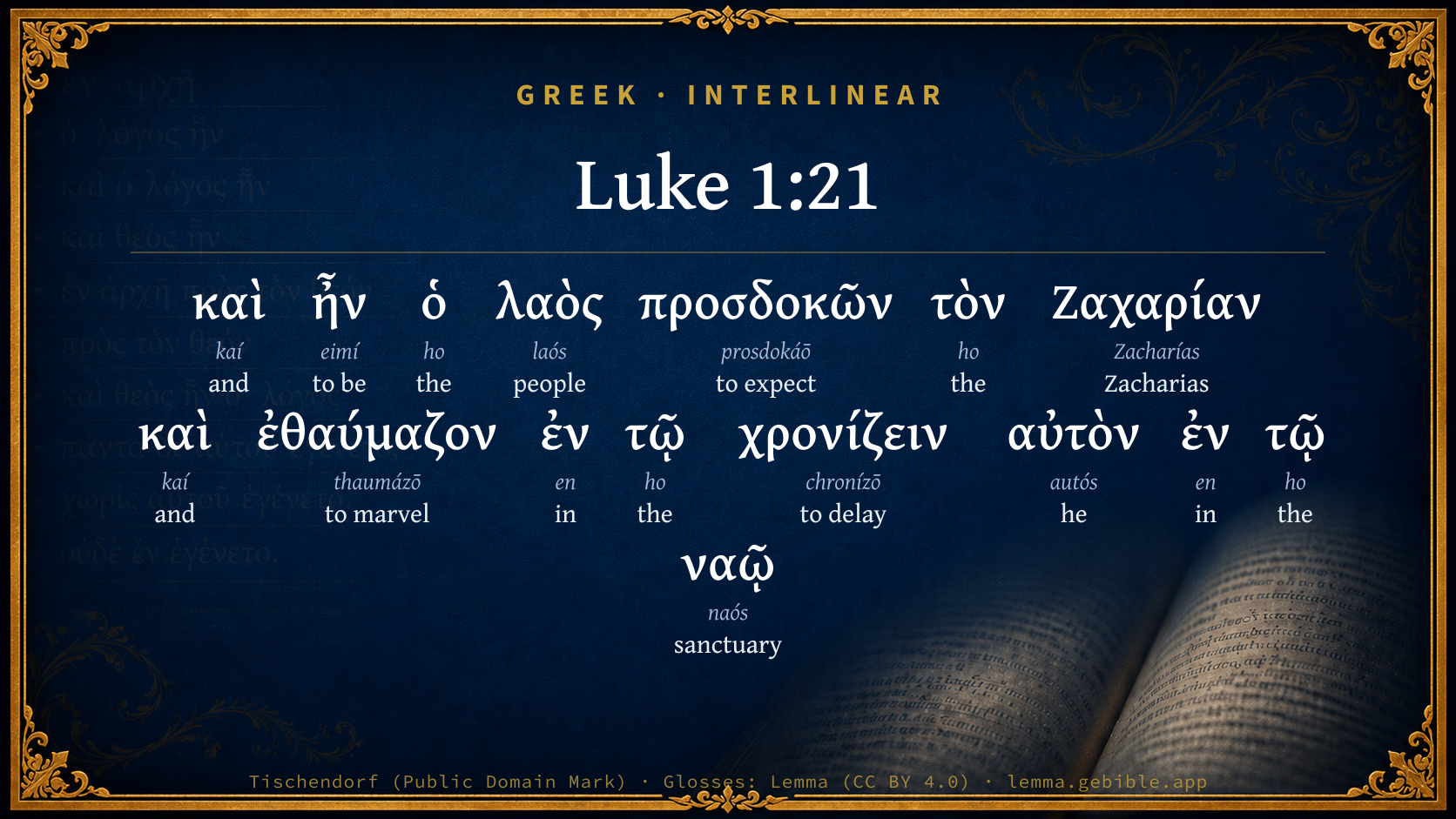
The people were waiting for Zacharias, and they marveled that he delayed in the temple.
World English Bible · Public Domain
Download a study sheet

One document with this verse’s original text, its word-by-word gloss line, the meaning frame, cross-references with their text, attributed commentary, and full source and license credits — printable, and it pastes into notes with its structure intact.

This verse Autodidact and up

Study sheet (.html) Plain text (.txt)

A passage Seminary Student

Up to 50 verses in one chapter. A passage sheet keeps up to 6 commentary sources and 12 cross-references per verse, in the order this page ranks them, and says so on the sheet whenever that leaves anything out. Ask for a single verse and you get the Autodidact verse sheet above.

Everything on this page stays free to read, with no account — the sheet is a download of what is already on screen, not access to it.

Want to remove ads? Support Godless Engineer
Compare translations 3

The same verse in 3 English versions, stacked beneath the original-language interlinear above. Click any original word for its lexicon entry.

Each is an independent rendering of the whole verse — the interlinear is not word-aligned to these translations.

Highlighted words mark where these versions differ — a whole-verse word diff, not a word-by-word alignment.

  • World English Bible Public Domain
    The people were waiting for Zacharias, and they marveled that he delayed in the temple.
  • King James Version Public Domain
    And the people waited for Zacharias, and marvelled that he tarried so long in the temple.
  • unfoldingWord Literal Text CC BY-SA 4.0
    And the people were waiting for Zechariah, and they were wondering at his delaying in the temple.

unfoldingWord Literal Text — © unfoldingWord, licensed CC BY-SA 4.0. Word-aligned USFM3 via Door43 (git.door43.org/unfoldingWord/en_ult).

Versions to compare (up to 4)

3 of 4 selected

Show all 19 translations

Every available English version of this verse, each an independent rendering of the whole verse.

  • World English Bible Public Domain
    The people were waiting for Zacharias, and they marveled that he delayed in the temple.
  • Berean Standard Bible Public Domain
    Meanwhile, the people were waiting for Zechariah and wondering why he took so long in the temple.
  • Majority Standard Bible Public Domain
    Meanwhile, the people were waiting for Zechariah and wondering why he took so long in the temple.
  • King James Version Public Domain
    And the people waited for Zacharias, and marvelled that he tarried so long in the temple.
  • American Standard Version (1901) Public Domain
    And the people were waiting for Zacharias, and they marvelled while he tarried in the temple.
  • Revised Version (1885) Public Domain
    And the people were waiting for Zacharias, and they marveled while he tarried in the temple.
  • Geneva Bible (1599) Public Domain
    Now the people waited for Zacharias, and marueiled that he taried so long in the Temple.
  • Douay-Rheims (1899) Public Domain
    And the people were waiting for Zachary; and they wondered that he tarried so long in the temple.
  • Young's Literal Translation Public Domain
    And the people were waiting for Zacharias, and wondering at his tarrying in the sanctuary,
  • Literal Standard Version CC BY-SA 4.0
    And the people were waiting for Zacharias, and wondering at his lingering in the temple,
  • Unlocked Literal Bible CC BY-SA 4.0
    Now the people were waiting for Zechariah. They were surprised that he was spending so much time in the temple.
  • unfoldingWord Literal Text CC BY-SA 4.0
    And the people were waiting for Zechariah, and they were wondering at his delaying in the temple.
  • Darby Bible Public Domain
    And the people were awaiting Zacharias, and they wondered at his delaying in the temple.
  • World Messianic Bible Public Domain
    The people were waiting for Zechariah, and they marveled that he delayed in the temple.
  • Webster's Bible Public Domain
    And the people waited for Zacharias, and marveled that he tarried so long in the temple.
  • Free Bible Version CC BY-SA 4.0
    Outside the people were waiting for Zechariah, wondering why he was taking so long in the Temple.
  • Bible in Basic English Public Domain
    And the people were waiting for Zacharias and were surprised because he was in the Temple for such a long time.
  • Text-Critical English NT CC BY 4.0
    Meanwhile, the people were waiting for Zechariah and wondering about his delay in the temple.
  • Tyndale New Testament (1534) Public Domain
    And the people wayted for zacharias and mervelled that he taryed in the temple.

Literal Standard Version (2020), Covenant Press — licensed CC BY-SA 4.0. Text via the HelloAO Bible API (eBible.org). Unlocked Literal Bible (unfoldingWord) — licensed CC BY-SA 4.0. Text via the HelloAO Bible API (eBible.org). unfoldingWord Literal Text — © unfoldingWord, licensed CC BY-SA 4.0. Word-aligned USFM3 via Door43 (git.door43.org/unfoldingWord/en_ult). Free Bible Version, Dr. Jonathan Gallagher — licensed CC BY-SA 4.0. Text via the HelloAO Bible API (eBible.org).

Word by word

More ways to search: Search by grammar → Find every occurrence → Compare this word →

Practice this passage: Drill this verse → Learn its vocabulary →

χρονίζειν
chronízō
G5549
“to delay”
Verb, Present, Active, Infinitive
Part of Speech
Verb
Tense
Present
Voice
Active
Mood
Infinitive
Full Thayer's Definition

Origin: from G5550

TDNT: None

1. to linger, delay, tarry
  1. καὶ kaí G2532 “and” Conjunction
  2. ἦν eimí G1510 “to be” Verb, Imperfect, Active, Indicative, 3rd person, Singular
  3. ὁ ho G3588 “the” Article, Nominative, Singular, Masculine
  4. λαὸς laós G2992 “people” Noun, Nominative, Singular, Masculine
  5. προσδοκῶν prosdokáō G4328 “to expect” Verb, Present, Active, Participle, Nominative, Singular, Masculine
  6. τὸν ho G3588 “the” Article, Accusative, Singular, Masculine
  7. Ζαχαρίαν Zacharías G2197 “Zacharias” Noun, Accusative, Singular, Masculine
  8. καὶ kaí G2532 “and” Conjunction
  9. ἐθαύμαζον thaumázō G2296 “to marvel” Verb, Imperfect, Active, Indicative, 3rd person, Plural
  10. ἐν en G1722 “in” Preposition
  11. τῷ ho G3588 “the” Article, Dative, Singular, Neuter
  12. αὐτὸν autós G846 “he” Personal pronoun, Accusative, Singular, Masculine
  13. ἐν en G1722 “in” Preposition
  14. τῷ ho G3588 “the” Article, Dative, Singular, Masculine
  15. ναῷ naós G3485 “sanctuary” Noun, Dative, Singular, Masculine

About this verse

These counts appear in no published source. They are computed here, from the morphology-tagged text and Lemma’s own curated glosses. What Lemma adds →

16
words
11
distinct lemmas
Gospels
section

Notable vocabulary

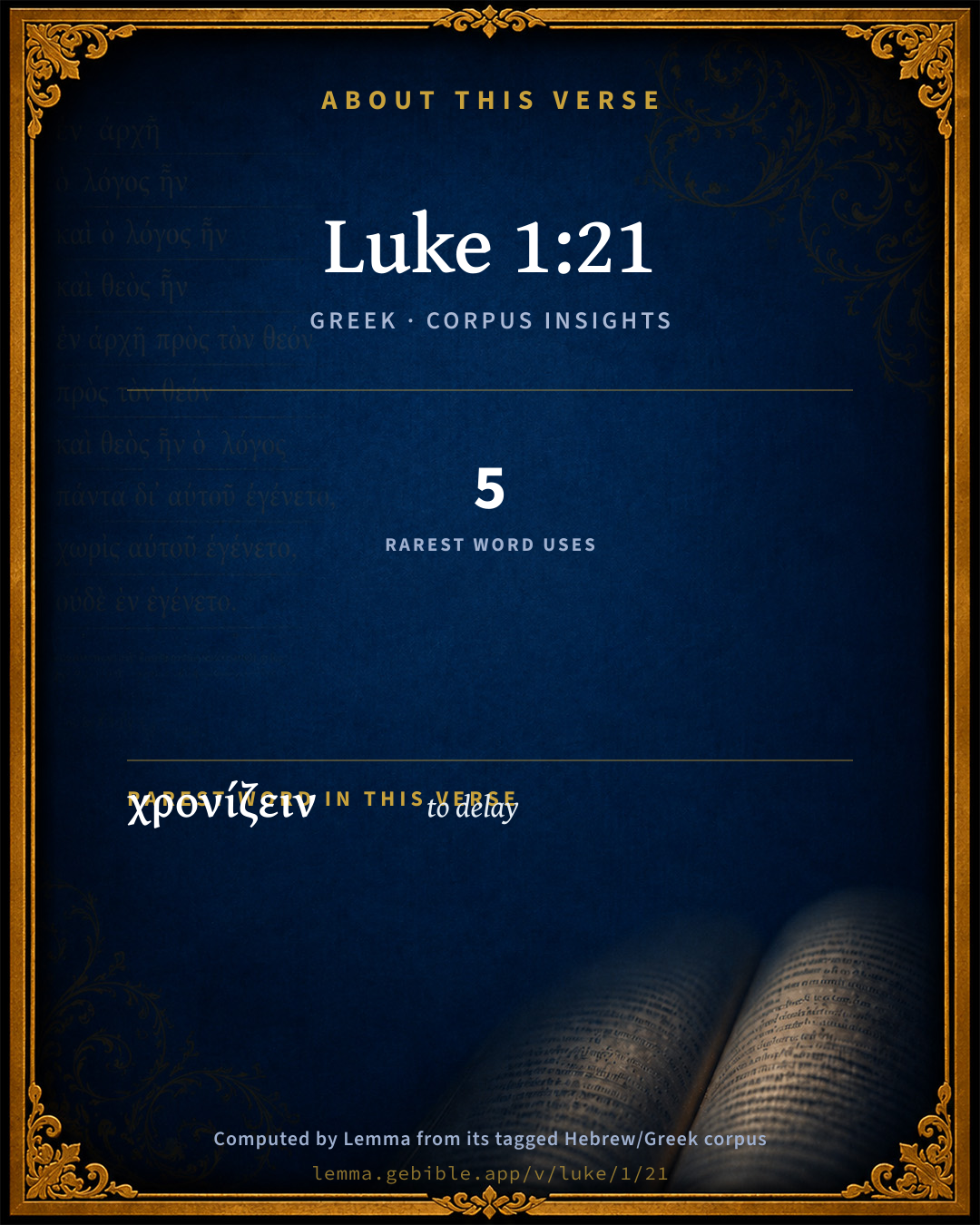
The rarest word here is χρονίζειν to delay G5549 — appearing just 5 times in the whole Greek New Testament.

Shared distinctive vocabulary

χρονίζειν to delay G5549 occurs in 5 verses of the Greek New Testament. Also found in:

Repetition

Words recur within this verse:

Cross-references

1

Topical passages linked to Luke 1:21 in the Treasury of Scripture Knowledge — connected by theme and wording, ordered by reader-vote popularity; previews shown in the World English Bible.

  • Numbers 6:23–27 "Speak to Aaron and to his sons, saying, 'This is how you shall bless the children of Israel.' You shall tell them,

Cross-references courtesy of OpenBible.info (CC BY 4.0).

Commentary

Notes on Luke 1:21 from classic Christian and Jewish commentators (each source and its license shown beneath its notes). The classic Christian expositions comment on the surrounding passage and are grouped to its opening verse, so a note may address several verses; the Jewish commentaries on the Tanakh (Rashi and others) are per-verse, so they appear only where the commentator wrote on this verse.

Lemma curates 59 commentaries, every one of them public domain or Creative Commons licensed, each selected and text-cleaned for this edition rather than reprinted as found. About our sources →

Joseph Benson's Commentary

Luk 1:21-22. And the people — Who had been praying in the court of the temple, while the incense was burning; waited for Zacharias — To come out and bless them; for so the priests used to do after burning the incense; and marvelled that he tarried so long, εν τω χρονιζειν αυτον, at his delaying, or, spending time in the temple; εν τω ναω, in the house, or sanctuary. See note on Luk 1:9. All that is here said to have taken place between the angel and Zacharias, might have passed in a few minutes; since, therefore, the people took notice of his continuing so much longer than was usual in the holy place, it is probable, that after the angel had left him, he employed some time in secret devotion, to which the mixture of holy affections that would naturally arise in his mind on so great and extraordinary an occasion would powerfully incline him; and while thus occupied, he might easily forget how fast the moments passed away. When he came out, he could not speak unto them — A circumstance which must have greatly astonished them; and they perceived that he had seen a vision — That is, a divine vision; in the temple — Or holy place. As the signs which he made, left them no room to doubt that some extraordinary and supernatural revelation had been made to him by God. For he beckoned unto them, and remained speechless — He continued deaf and dumb during the remainder of his stay at Jerusalem; a circumstance wisely ordered by Providence to awaken a greater and more general expectation, as to the event of so strange an occurrence; which, as a great multitude were now present in the court of the temple, (see Luk 1:10,) would of course be widely spread, not only through Jerusalem but all Judea.

Joseph Benson's Commentary on the Old and New Testaments (1811–1818) — public domain. Text from a community e-Sword module.

Meyer's Critical & Exegetical Commentary

Heinrich August Wilhelm Meyer

Luk_1:21. The priests, especially the chief priests, were accustomed, according to the Talmud, to spend only a short time in the sanctuary; otherwise it was apprehended that they had been slain by God, because they were unworthy or had done something wrong. See Hieros. Joma, f. 43, 2; Babyl. f. 53, 2; Deyling, Obss. III. ed. 2, p. 455 f. Still the unusually long delay of Zacharias, which could not but strike the people, is sufficient in itself as a reason of their wonder.

ἐν τῷ χρονίζειν αὐτόν] not over (ἐπί, Luk_4:22, al.), or on account of (Mar_6:6, διά), but on occasion of his failure to appear. So also Sir_11:21; Isa_61:6. Rightly, Gersdorf, Ewald, render: when he, etc.

Meyer — Critical and Exegetical Commentary on the New Testament — English translation by Peter Christie, edited by Frederick Crombie (T&T Clark, 1880) — public domain. Text from a community e-Sword module.

Expositor's Greek Testament

ed. W. Robertson Nicoll

Luk 1:21-22 . The people without . προσδοκῶν , waiting; they had to wait. The priest was an unusually long time within, something uncommon must have happened. The thought likely to occur was that God had slain the priest as unworthy. The Levitical religion a religion of distance from God and of fear. So viewed in the Epistle to the Hebrews. Illustrative quotations from Talmud in Wünsche, Beiträge , p. 413.

The Expositor's Greek Testament, edited by W. Robertson Nicoll (1897–1910) — public domain. Text from a community e-Sword module.

Jamieson, Fausset & Brown

Robert Jamieson, A. R. Fausset & David Brown

waited--to receive from him the usual benediction (Num 6:23-27).

tarried so long--It was not usual to tarry long, lest it should be thought vengeance had stricken the people's representative for something wrong [LIGHTFOOT].

Jamieson, Fausset & Brown — Commentary Critical and Explanatory on the Whole Bible (1871) — public domain (CC PDM 1.0). Text via the HelloAO Bible API.

Adam Clarke's Commentary

Verse 21. The people waited] The time spent in burning the incense was probably about half an hour, during which there was a profound silence, as the people stood without engaged in mental prayer. To this there is an allusion in Re 8:1-5. Zacharias had spent not only the time necessary for burning the incense, but also that which the discourse between him and the angel took up.

Adam Clarke's Commentary on the Bible (1810–1826) — public domain. Text from a community e-Sword/MySword module.

The Cambridge Bible for Schools and Colleges

gen. ed. J. J. S. Perowne

21. he tarried so long] Priests never tarried in the awful precincts of the shrine longer than was absolutely necessary for the fulfilment of their duties, from feelings of holy fear, Lev_16:13, “that he die not” (T. B. Yoma f. 52. 2.) See Excursus VII.

The Cambridge Bible for Schools and Colleges (gen. ed. J. J. S. Perowne; Cambridge University Press, 1878–1918) — public domain. Text from a community e-Sword module.

John Gill's Exposition

And the people waited for Zacharias,.... That were without, in the court of the Israelites, praying there, while he was offering incense: these were waiting for his coming out, in order to be blessed by him, according to Num 6:23 and be dismissed: and marvelled that he tarried so long in the temple; beyond the usual time of burning incense; which might be occasioned either by a longer discourse of the angel with him than what is here related; or being struck with amazement at the sight and hearing of the angel, he might continue long musing on this unexpected appearance and relation; or he might spend some time not only in meditation upon it, but in mental prayer, confession, and thanksgiving. The high priest, when he went in to burn incense on the day of atonement,

"made a short prayer in the outward house, (in the temple,) and he did not continue long in his prayer, , "that he might not affright" the Israelites'' (m),

thinking that he was dead; for many high priests that were unfit for, or made alteration in the service, died in the holy of holies (n),

"It is reported (o) of one high priest, that he continued long in his prayer, and his brethren, the priests, thought to have gone in after him; and they began to go in, and he came out; they say unto him, why didst thou continue long in thy prayer? he replied to them, is it hard in your eyes that I should pray for you, and for the house of the sanctuary, that it might not be destroyed? they answered him, be not used to do so; for we have learned, that a man should not continue long in prayer, that he may not affright Israel.

This high priest, they elsewhere say (p), was Simeon the just,

(m) Misna Yoma, c. 5. sect. 1. (n) Maimon. & Bartenora in ib. (o) T. Bab. Yoma, fol. 53. 2. (p) T. Hieros. Yoma, fol. 42. 3.

John Gill's Exposition of the Whole Bible (1746–1763) — public domain (CC PDM 1.0). Text via the HelloAO Bible API.

Trapp's Complete Commentary

John Trapp

21 And the people waited for Zacharias, and marvelled that he tarried so long in the temple.

Ver. 21. The people waited for Zacharias] They would not away without the blessing prescribed to the priests, Num 6:23-27. In the council of Agathon it was decreed that people should not presume to go out of the temples before the ministers had blessed the congregation. (Canon 32.)

John Trapp, A Commentary or Exposition upon All the Books of the Old and New Testament (1647–1656) — public domain. Text from a community e-Sword module.

Albert Barnes' Notes on the Bible

The people waited - That is, beyond the usual time.

Marvelled - Wondered. The priest, it is said, was not accustomed to remain in the temple more than half an hour commonly. Having remained on this occasion a longer time, the people became apprehensive of his safety, and wondered what had happened to him.

Albert Barnes' Notes on the Bible (1834–1885) — public domain. Text from a community e-Sword/MySword module.

Matthew Poole's English Annotations

While the priest was in the holy place, the people were in that part of the temple called the court of Israel, or the court of the people, praying: when he had done, he came out, and blessed them according to the law, Num 6:23-26, where is the form of blessing which he used; for this the people waited before they went home. Whether the angel’s discourse with Zacharias was longer, or his amazement at the vision made him stay longer than the priest was wont to stay, it is uncertain; but so he did, and when he came out he was not able to pronounce the blessing, nor to speak at all, only he beckons to them, by which the people judged that he had seen some vision. Yet dumbness being none of those bodily defects for which by the law they were to be removed from the priest’s office, nor having any great work in which he used his tongue during his ministration, which was more the work of the hands, he accomplished the days he was to minister, and then departed to his own house, for in the days of their ministration they had their lodgings in buildings appertaining to the temple.

Matthew Poole's English Annotations on the Holy Bible (1683–1685) — public domain. Text from a community e-Sword/MySword module.

The Pulpit Commentary

And the people waited for Zacharias, and marveled that he tarried so long in the temple. The Talmud tells us that even the high priest did not terry long in the holy of holies on the Day of Atonement. The same feeling of holy awe would induce the ministering priest of the day to perform his functions with no unnecessary delay, and to leave as soon as possible the holy place. The people praying in the court without were in the habit of waiting until the priest on duty came out of the sacred inner chamber, after which they were dismissed with the blessing. The unusual delay in the appearance of Zacharias puzzled and disturbed the worshippers.

The Pulpit Commentary (1880–1919), ed. H.D.M. Spence-Jones & Joseph S. Exell — public domain. Text from a community e-Sword module.

John Wesley's Explanatory Notes

The people were waiting - For him to come and dismiss them (as usual) with the blessing.

John Wesley, Explanatory Notes Upon the Whole Bible (1754–1765) — public domain. Text via the GEBible commentary corpus.

Kretzmann's Popular Commentary

Paul E. Kretzmann

The anxiety of the people:

v. 21 And the people waited for Zacharias, and marveled that he tarried so long in the Temple.

v. 22. And when he came out, he could not speak unto them; and they perceived that he had seen a vision in the Temple; for he beckoned unto them, and remained speechless.

v. 23. And it came to pass that, as soon as the days of his ministration were accomplished, he departed to his own house.

The offering of incense was the culmination of the morning service during which Zacharias was in the Holy Place all alone. The people were always apprehensive of some disaster that might befall the officiating priest, that God might slay him as unworthy and then visit His wrath upon the entire people; therefore they worried about him. The conversation with the angel had prolonged the priest’s stay far beyond the usual hour of closing, and their uneasy wonder about the delay was increasing. When he finally emerged from the Holy Place and stepped into the open space of the priests’ court, near the steps which led down to the other courts, he could not speak to the people, he could not pronounce the Aaronic blessing, which concluded the morning service. Zacharias had received proof positive that the credentials of Gabriel were beyond question; dumbness had at once fallen upon him. But by his gestures and signs the people sensed or perceived, understood that something unusual had occurred in the Temple, they inferred that he had seen a vision of some kind which had rendered him speechless. But though Zacharias had been deprived of the power of speech, he served the full course of his Temple ministry, he stayed for the full week, 2Ki 11:17. There were other services that did not demand the use of the voice, and many ministrations in the Temple were given over to such as had minor physical defects. But at the end of the week he returned to his house, to the city of the priests where he had his home. The words of one commentator referring to the work of the pastors in this connection may well be extended to include all Christians, inasmuch as they all should be engaged in the work of the Master. He writes: "There is something very instructive in the conduct of this priest; had he not loved the service he was engaged in, he might have made the loss of his speech a pretext for immediately quitting it. But as he was not thereby disabled from fulfilling the sacerdotal function, so he saw he was bound to continue till his ministry was ended, or till God had ’given him a positive dismissal. Preachers who give up their labor in the vineyard because of some trifling bodily disorder by which they are afflicted, or through some inconvenience in outward circumstances which the follower of a cross-bearing, crucified Lord should not mention, show either that they never had a proper concern for the honor of their Master or for the salvation of men, or else that they have lost the spirit of their Master and the spirit of their work. Again, Zacharias did not hasten to his house to tell his wife the good news that he had received from heaven, in which she was certainly very much interested: the angel had promised that all his words should be fulfilled in their season, and for this season he patiently waited in the path of duty. He had engaged in the work of the Lord, and must pay no attention to anything that was likely to mar or interrupt his religious service. Preachers who profess to be called of God to labor in the Word and doctrine and who abandon their work for filthy lucre’s sake are the most contemptible of mortals and traitors to their God."

Paul E. Kretzmann, Popular Commentary of the Bible (1921–1924) — public domain. Text from a community e-Sword module.

The People's New Testament

B. W. Johnson

21. The people waited for Zacharias. Those who were praying without waited until the incense offering priest came out and dismissed them with a benediction.

B. W. Johnson's The People's New Testament with Notes (1889–1891) — public domain. Electronic text from the Christian Classics Ethereal Library (CCEL) ThML edition.

unfoldingWord translationNotes

Door43 World Missions Community

Now

This marks a shift in the story from what happened inside the temple to what happened outside. AT: "While that was happening" or "While the angel and Zechariah were talking"

They realized that he had seen a vision while he was in the temple. He kept on making signs to them and remained silent

These things probably happened at the same time, and Zechariah's signs helped the people understand that he had had a vision. It might be helpful to your audience to change the order to show that. AT: "He kept on making signs to them and remained silent. So they realized that he had seen a vision while he was in the temple"

a vision

The earlier description indicated that Gabriel actually came to Zechariah in the temple. The people, not knowing that, assumed Zechariah saw a vision.

It came about

This phrase moves the story ahead to when Zechariah's service was ended.

he went to his house

Zechariah did not live in Jerusalem, where the temple was located. He traveled to his home town.

translationWords

temple

vision

servant

unfoldingWord translationNotes — © Distant Shores Media and the Door43 World Missions Community, licensed CC BY-SA 4.0. Source: git.door43.org/Door43/en_tn.

Cambridge Greek Testament for Schools and Colleges

21. ἐν τῷ χρονίζειν αὐτόν. While he was lingering they wondered at his delay. Priests never tarried in the awful precincts of the shrine longer than was absolutely necessary for the fulfilment of their duties from feelings of holy fear. Comp. Lev 16:13, “that he die not.” Yoma, f. 52. 2.) See Excursus VII.

Cambridge Greek Testament for Schools and Colleges (Cambridge University Press, 1896; 21 vols, various authors incl. Carr, Maclear, Plummer, Farrar, Lumby, Moule, M. R. James, Simcox) — public domain. Text from a community e-Sword module.

Alford’s Greek Testament

Henry Alford

21.] It was customary for the priest at the time of prayer not to remain long in the holy place, for fear the people who were without might imagine that any vengeance had been inflicted on him for some informality;—as he was considered the representative of the people. The words ἐθαύμαζον ἐν are best taken together, wondered at, as in ref. Sir. They may also be taken separately, taking ἐν as ‘during:’ and so Meyer: but this is not so probable.

Henry Alford, The Greek Testament (1849–1861) — public domain. Text from a community e-Sword module.

International Critical Commentary

21. ἦν ὁ λαὸς προσδοκῶν. As in ver. 20, the analytical tense marks the duration of the action. Zacharias was longer than was customary; and the Talmud states that the priests were accustomed to return soon to prevent anxiety. It was feared that in so sacred a place they might incur God’s displeasure, and be slain (Lev. 16:113). Hence ἐθαύμαζον ἐν τῷ ξρονίζειν, “They were wondering while he tarried.” Comp. ver. 8, and see on 3:21. The common rendering, “at his tarrying,” or “because he tarried,” quod tardaret, is improbable even if possible. This would have been otherwise expressed: ἐθαύμαζον ἐπί (2:33, 4:22, 9:43, etc.), which D reads here; or διά (Mar 6:6; Joh 7:21 ?); or ὅτι (11:38; Joh 3:7, Joh 4:27); or περί (2:18).

International Critical Commentary — older volumes (1896–1929), various authors — public domain. Text from a community e-Sword module.

Vincent's Word Studies in the New Testament

Marvin R. Vincent

Waited [ην προσδοκων] . The finite verb and participle, denoting protracted waiting. Hence, better as Rev., were waiting. Wyc., was abiding.

Marvelled. According to the Talmud, the priests, especially the chief priests, were accustomed to spend only a short time in the sanctuary, otherwise it was feared that they had been slain by God for unworthiness or transgression.

Marvin R. Vincent, Word Studies in the New Testament (1887–1900) — public domain. Text from a community e-Sword/MySword module.

Godet's Commentaries

Frédéric Louis Godet

Vers. 21 and 22. According to the Talmud, the high priest did not remain long in the Holy of Holies on the great day of atonement. Much more would this be true of the priest officiating daily in the Holy Place. The analytical form ᾖν προσδοκῶν depicts the lengthened expectation and uneasiness which began to take possession of the people. The text indicates that the event which had just taken place was made known in two ways: on the one hand, by the silence of Zacharias; on the other, by signs by which he himself (αὐτός) indicated its cause. The analytical form ἦν διανεύων denotes the frequent repetition of the same signs, and the imperfect διέμενεν, he remained dumb, depicts the increasing surprise produced by his continuing in this state.

Frédéric Louis Godet — Commentaries on Luke, John, Romans, and 1 Corinthians — English translation (T&T Clark, Edinburgh, 1870s–1890s) — public domain. Text from a community e-Sword module.

Lesson kit

Teaching starters — assembled from the data on this page, not authored interpretation. Every prompt links to the verse data it draws on. Edit before teaching.

Luke, in the Gospels, opens this verse with 16 words (11 distinct Greek lemmas). Its most distinctive word is chronízō (“to delay”). A historical commentator’s framing appears above. Read the whole chapter for the surrounding context.

Discussion questions

  1. The word chronízō carries the sense “to delay.” How does it shape the verse?
  2. How does Matthew 24:48, which shares the word «to delay», read alongside this verse?
  3. What does the repetition of “the” (4× in this one verse) do in this verse?
  4. These translations render this verse differently. What is at stake in choosing one wording over another?
  5. Compare how Joseph Benson's Commentary and Meyer's Critical & Exegetical Commentary read this verse. Where do they agree or differ?

Things to notice

Reading settings

Reading text

Shown beneath each verse's original-language words.

Old Testament
Old Testament edition

Read the OT as the Masoretic Hebrew (MT) or the Greek Septuagint (LXX).

English shown for the Greek Septuagint (in the Hebrew ↔ Greek comparison).

Comparing translations? Open the Compare panel on any verse page to stack up to four side by side.