
Luke 3:5

Greek (Tischendorf 8th ed.) Luke 3:5 appears in the Greek New Testament. The text above is from the Tischendorf 8th edition. Each word links to its Strong’s number and a concise gloss. Click any word for its full Thayer’s Greek Lexicon entry.
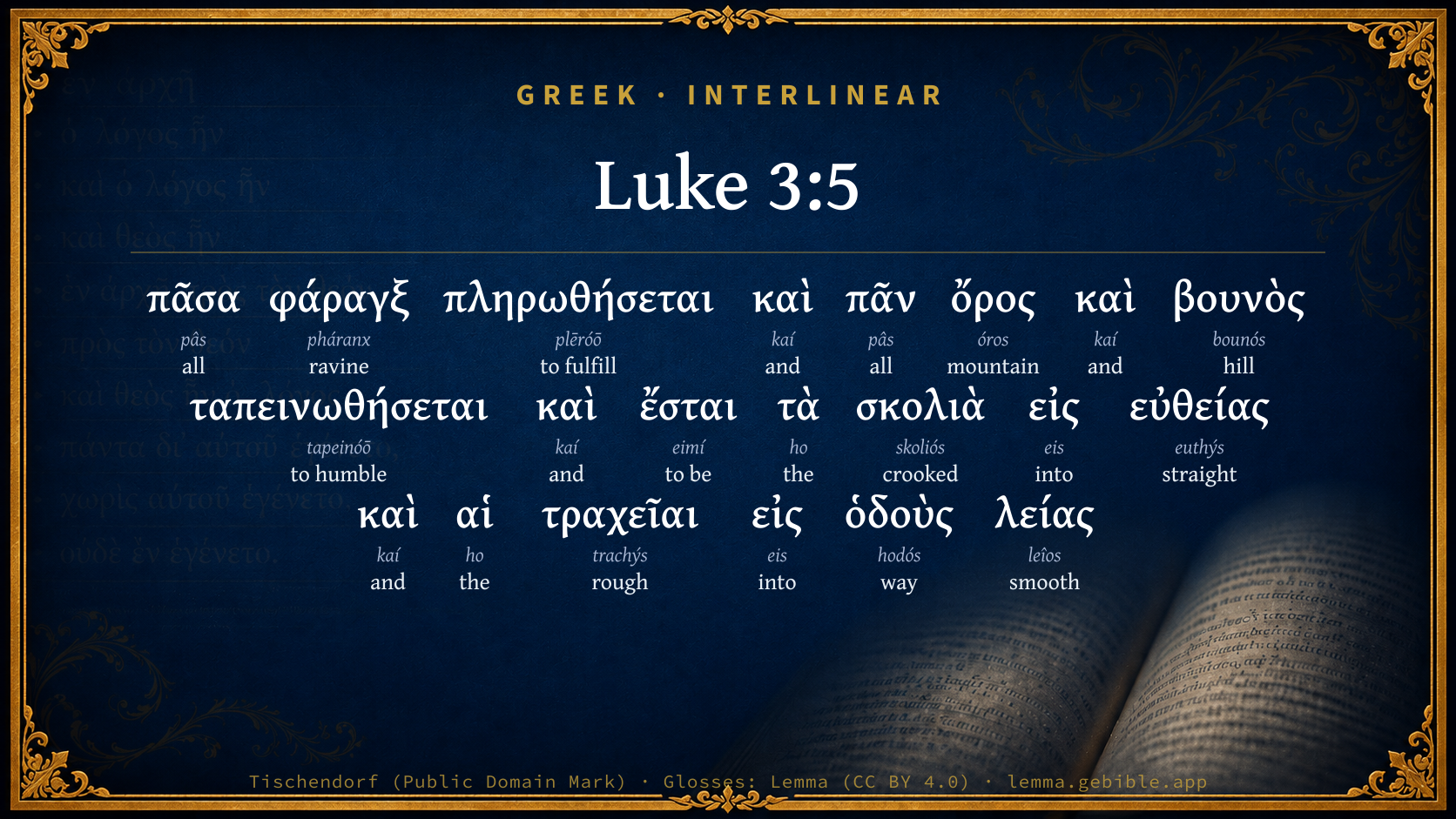
Download image
Cite this verse

Luke 3:5 (World English Bible). Public Domain. Lemma interlinear Bible study tool, https://lemma.gebible.app/v/luke/3/5.

Show BibTeX & RIS
BibTeX
RIS
English Translation
Every valley will be filled. Every mountain and hill will be brought low. The crooked will become straight, And the rough ways smooth.
World English Bible · Public Domain
Highlights
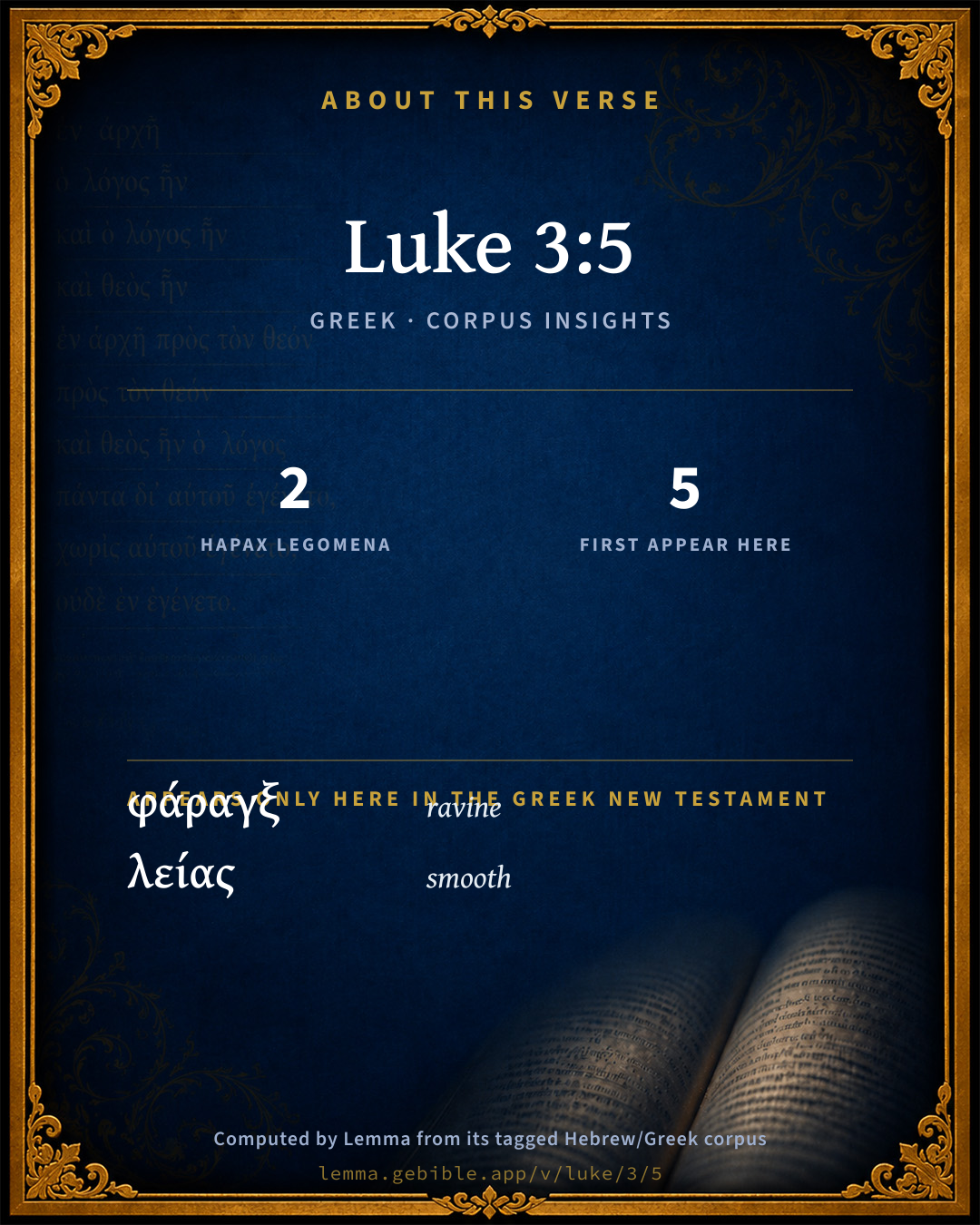
  • 2 hapax legomena — only here in the Greek New Testament
  • 5 first appearances in the Greek New Testament
Full analysis ↓
Download a study sheet

One document with this verse’s original text, its word-by-word gloss line, the meaning frame, cross-references with their text, attributed commentary, and full source and license credits — printable, and it pastes into notes with its structure intact.

This verse Autodidact and up

Study sheet (.html) Plain text (.txt)

A passage Seminary Student

Up to 50 verses in one chapter. A passage sheet keeps up to 6 commentary sources and 12 cross-references per verse, in the order this page ranks them, and says so on the sheet whenever that leaves anything out. Ask for a single verse and you get the Autodidact verse sheet above.

Everything on this page stays free to read, with no account — the sheet is a download of what is already on screen, not access to it.

Want to remove ads? Support Godless Engineer
Compare translations 3

The same verse in 3 English versions, stacked beneath the original-language interlinear above. Click any original word for its lexicon entry.

Each is an independent rendering of the whole verse — the interlinear is not word-aligned to these translations.

Highlighted words mark where these versions differ — a whole-verse word diff, not a word-by-word alignment.

  • World English Bible Public Domain
    Every valley will be filled. Every mountain and hill will be brought low. The crooked will become straight, And the rough ways smooth.
  • King James Version Public Domain
    Every valley shall be filled, and every mountain and hill shall be brought low; and the crooked shall be made straight, and the rough ways shall be made smooth;
  • unfoldingWord Literal Text CC BY-SA 4.0
    Every valley will be filled, and every mountain and hill will be made low, and the crooked roads will become straight, and the rough roads smooth,

unfoldingWord Literal Text — © unfoldingWord, licensed CC BY-SA 4.0. Word-aligned USFM3 via Door43 (git.door43.org/unfoldingWord/en_ult).

Versions to compare (up to 4)

3 of 4 selected

Show all 19 translations

Every available English version of this verse, each an independent rendering of the whole verse.

  • World English Bible Public Domain
    Every valley will be filled. Every mountain and hill will be brought low. The crooked will become straight, And the rough ways smooth.
  • Berean Standard Bible Public Domain
    Every valley shall be filled in, and every mountain and hill made low. The crooked ways shall be made straight, and the rough ways smooth.
  • Majority Standard Bible Public Domain
    Every valley shall be filled in, and every mountain and hill made low. The crooked ways shall be made straight, and the rough ways smooth.
  • King James Version Public Domain
    Every valley shall be filled, and every mountain and hill shall be brought low; and the crooked shall be made straight, and the rough ways shall be made smooth;
  • American Standard Version (1901) Public Domain
    Every valley shall be filled, And every mountain and hill shall be brought low; And the crooked shall become straight, And the rough ways smooth;
  • Revised Version (1885) Public Domain
    Every valley shall be filled, And every mountain and hill shall be brought low; And the crooked shall become straight, And the rough ways smooth;
  • Geneva Bible (1599) Public Domain
    Euery valley shalbe filled, and euery mountaine and hill shall be brought lowe, and crooked things shalbe made straight, and the rough wayes shalbe made smoothe.
  • Douay-Rheims (1899) Public Domain
    Every valley shall be filled; and every mountain and hill shall be brought low; and the crooked shall be made straight; and the rough ways plain;
  • Young's Literal Translation Public Domain
    every valley shall be filled, and every mountain and hill shall be made low, and the crooked shall become straightness, and the rough become smooth ways;
  • Literal Standard Version CC BY-SA 4.0
    Every valley will be filled, || And every mountain and hill will be made low, || And the crooked will become straightness, || And the rough become smooth ways;
  • Unlocked Literal Bible CC BY-SA 4.0
    Every valley will be filled, and every mountain and hill will be made low, and the crooked roads will be made straight, and the uneven places will be built into roads,
  • unfoldingWord Literal Text CC BY-SA 4.0
    Every valley will be filled, and every mountain and hill will be made low, and the crooked roads will become straight, and the rough roads smooth,
  • Darby Bible Public Domain
    Every gorge shall be filled up, and every mountain and hill shall be brought low, and the crooked [places] shall become a straight [path], and the rough places smooth ways,
  • World Messianic Bible Public Domain
    Every valley will be filled. Every mountain and hill will be brought low. The crooked will become straight, and the rough ways smooth.
  • Webster's Bible Public Domain
    Every valley shall be filled, and every mountain and hill shall be brought low; and the crooked shall be made straight, and the rough ways shall be made smooth;
  • Free Bible Version CC BY-SA 4.0
    Every valley will be filled, and every mountain and hill will be leveled. Crooked ways will be straightened, and rough roads will be smoothed.
  • Bible in Basic English Public Domain
    Every valley will be lifted up, and all the mountains and hills made low, and the twisted will be made straight, and the rough ways smooth;
  • Text-Critical English NT CC BY 4.0
    Every valley will be filled, and every mountain and hill will be brought low. The crooked roads will be made straight, and the rough ways will be made smooth.
  • Tyndale New Testament (1534) Public Domain
    Every valley shalbe fylled and every moutayne and hyll shalbe brought lowe. And crocked thinges shalbe made streight: and the rough wayes shalbe made smoth:

Literal Standard Version (2020), Covenant Press — licensed CC BY-SA 4.0. Text via the HelloAO Bible API (eBible.org). Unlocked Literal Bible (unfoldingWord) — licensed CC BY-SA 4.0. Text via the HelloAO Bible API (eBible.org). unfoldingWord Literal Text — © unfoldingWord, licensed CC BY-SA 4.0. Word-aligned USFM3 via Door43 (git.door43.org/unfoldingWord/en_ult). Free Bible Version, Dr. Jonathan Gallagher — licensed CC BY-SA 4.0. Text via the HelloAO Bible API (eBible.org).

Word by word

More ways to search: Search by grammar → Find every occurrence → Compare this word →

Practice this passage: Drill this verse → Learn its vocabulary →

φάραγξ
pháranx
G5327
“ravine”
Noun, Nominative, Singular, Feminine
Part of Speech
Noun
Case
Nominative
Number
Singular
Gender
Feminine
Full Thayer's Definition

Origin: properly, strengthened from the base of G4008 or rather of G4486

TDNT: None

1. a valley shut off by cliffs and precipices 2. a ravine
  1. πᾶσα pâs G3956 “all” Adjective, Nominative, Singular, Feminine
  2. πληρωθήσεται plēróō G4137 “to fulfill” Verb, Future, Passive, Indicative, 3rd person, Singular
  3. καὶ kaí G2532 “and” Conjunction
  4. πᾶν pâs G3956 “all” Adjective, Nominative, Singular, Neuter
  5. ὄρος óros G3735 “mountain” Noun, Nominative, Singular, Neuter
  6. καὶ kaí G2532 “and” Conjunction
  7. βουνὸς bounós G1015 “hill” Noun, Nominative, Singular, Masculine
  8. ταπεινωθήσεται tapeinóō G5013 “to humble” Verb, Future, Passive, Indicative, 3rd person, Singular
  9. καὶ kaí G2532 “and” Conjunction
  10. ἔσται eimí G1510 “to be” Verb, Future, Middle deponent, Indicative, 3rd person, Singular
  11. τὰ ho G3588 “the” Article, Nominative, Plural, Neuter
  12. σκολιὰ skoliós G4646 “crooked” Adjective, Nominative, Plural, Neuter
  13. εἰς eis G1519 “into” Preposition
  14. εὐθείας euthýs G2117 “straight” Adjective, Accusative, Plural, Feminine
  15. καὶ kaí G2532 “and” Conjunction
  16. αἱ ho G3588 “the” Article, Nominative, Plural, Feminine
  17. τραχεῖαι trachýs G5138 “rough” Adjective, Nominative, Plural, Feminine
  18. εἰς eis G1519 “into” Preposition
  19. ὁδοὺς hodós G3598 “way” Noun, Accusative, Plural, Feminine
  20. λείας leîos G3006 “smooth” Adjective, Accusative, Plural, Feminine

About this verse

These counts appear in no published source. They are computed here, from the morphology-tagged text and Lemma’s own curated glosses. What Lemma adds →

21
words
15
distinct lemmas
Gospels
section

Notable vocabulary

2 hapax legomena — words that appear only here in the entire Greek New Testament:

  • φάραγξ ravine G5327
  • λείας smooth G3006

First appearance in Scripture

These words make their first canonical appearance in the Greek New Testament here:

  • φάραγξ ravine G5327
  • βουνὸς hill G1015
  • σκολιὰ crooked G4646
  • τραχεῖαι rough G5138
  • λείας smooth G3006

Shared distinctive vocabulary

βουνὸς hill G1015 occurs in 2 verses of the Greek New Testament. Also found in:
Repetition

Words recur within this verse:

Cross-references

11

Topical passages linked to Luke 3:5 in the Treasury of Scripture Knowledge — connected by theme and wording, ordered by reader-vote popularity; previews shown in the World English Bible.

  • Isaiah 40:4 Every valley shall be exalted, and every mountain and hill shall be made low; and the uneven shall be made level, and the rough places a plain:
  • Isaiah 42:16 I will bring the blind by a way that they don't know; in paths that they don't know will I lead them; I will make darkness light before them, and crooked places straight. These things will I do, and I will not forsake them.
  • Isaiah 45:2 I will go before you, and make the rough places smooth; I will break in pieces the doors of brass, and cut in sunder the bars of iron;
  • Isaiah 49:11 I will make all my mountains a way, and my highways shall be exalted.
  • Ezekiel 17:24 All the trees of the field shall know that I, Yahweh, have brought down the high tree, have exalted the low tree, have dried up the green tree, and have made the dry tree to flourish; I, Yahweh, have spoken and have done it.
  • Hebrews 12:12–13 Therefore, lift up the hands that hang down and the feeble knees,
  • Luke 1:51–53 He has shown strength with his arm. He has scattered the proud in the imagination of their heart.
  • Isaiah 2:11–17 The lofty looks of man will be brought low, The haughtiness of men will be bowed down, And Yahweh alone will be exalted in that day.
  • Isaiah 35:6–8 Then shall the lame man leap as a hart, and the tongue of the mute shall sing; for in the wilderness shall waters break out, and streams in the desert.
  • Isaiah 61:1–3 The Spirit of the Lord Yahweh is on me; because Yahweh has anointed me to preach good news to the humble; he has sent me to bind up the broken-hearted, to proclaim liberty to the captives, and the opening [of the prison] to those who are bound;
  • James 1:9 But let the brother in humble circumstances glory in his high position;

Cross-references courtesy of OpenBible.info (CC BY 4.0).

Commentary

Notes on Luke 3:5 from classic Christian and Jewish commentators (each source and its license shown beneath its notes). The classic Christian expositions comment on the surrounding passage and are grouped to its opening verse, so a note may address several verses; the Jewish commentaries on the Tanakh (Rashi and others) are per-verse, so they appear only where the commentator wrote on this verse.

Lemma curates 59 commentaries, every one of them public domain or Creative Commons licensed, each selected and text-cleaned for this edition rather than reprinted as found. About our sources →

The Biblical Illustrator

Joseph S. Exell

Luk_3:5

Every valley shall be filled

The Kings highway

I.

VALLEYS MUST DE LEVELLED UP.

1. Inattention.

2. Apathy.

3. Despondency.

II. EMINENCES MUST BE LEVELLED DOWN.

1. The mountain of pride must be reduced.

(1) The pride that will not make full confession of sin.

(2) The pride that will not receive the kingdom of heaven as a little child.

(3) The pride of reason that will not accept salvation until its mysteries are comprehended.

(4) The pride of worldly professors.

2. The mountain of presumption must be depressed.

(1) Sinners are presumptuous when, without forsaking their sins, they attempt to believe for salvation.

(2) Professors arc presumptuous when they expect the work of

God to revive in the Church without exerting themselves to promote a revival.

(3) While we work as though everything depended upon working, we must trust as though everything depended upon trusting.

3. The hills of ingratitude must be brought low.

III. THE CROOKED PLACES MUST BE STRAIGHTENED.

1. Prejudice.

2. Jealousy.

3. Censoriousness.

4. Covetousness.

IV. THE ROUGH PLACES MUST BE SMOOTHED.

1. The ugly rock of Sabbath desecration must be removed.

2. That rut of drunkenness must be filled up.

3. Those sinks of immorality must be filled--lying, cheating, oppression, uncleanness.

4. The rough places of instability must be smoothed. (Prof. F. W. Macdonald, M. A.)

Preparing the way of the Lord

Before John, the wilderness preacher, the mountains of Pharisaic pride were levelled, the valleys of Sadducean unbelief were filled up, the tortuous vices of the courtly Judean were corrected, and the rude ignorance of the Galilean smoothed and reformed. (Canon Liddon.)

Road-makers

(To children.) In ancient times, especially in Eastern lands, when an emperor or king was travelling through his dominions, men were sent before them to prepare the way. Sometimes they had to make a new road through pathless wildernesses and rocky passes, hewing down trees, cutting a level way along steep or rugged hill-sides, clearing away rocks, and making embankments across valleys, and bridges over streams. Or sometimes the old road was overgrown with bushes and brambles, or washed away by floods, or covered with rubbish which the winter storms and swollen torrents had brought down from the mountains. In some Eastern lands, even at this day, travellers tell us how the roads are often so destroyed in the rainy season, that before a governor or high officer of state makes a journey, the highways must be mended and made ready for him to travel speedily and safely. So when the prophet Isaiah was speaking of the coming of the Lord Jesus, he foretold that some one would be sent by God to prepare the way, &c. Look at the Gospels and you will see that the messenger whom God sent to prepare the way for His beloved Son was John the Baptist. Now, how did John prepare the way? There were four things which he taught the people, in order to make ready their hearts for the Lord Jesus.

I. TO EXPECT HIM.

II. TO FEEL THEIR NEED OF HIM TO SAVE THEM FROM THEIR SINS.

III. TO REPENT OF ALL SIN.

IV. TO HEARKEN TO HIM, AND BELIEVE, LOVE, AND OBEY HIM WHEN HE CAME. NOW, if the Lord Jesus were coming to the place where you live, would you not be glad if you were invited to help to prepare the way for Him? Would you not think it a great honour and happiness to take one stone out of His way? Oh yes! Your heart would dance for joy, and perhaps your feet too. Who would not like to be a pioneer for Jesus, the King of kings? Well, but dont you know that He really wishes to come; not to pass along the streets, but to come into the homes and hearts of all the people, not to pay a visit, but to dwell there? Then what hinders His coming? Only that people arc not ready for Him. Do you know what God calls a heart that does not love and fear Him? He calls it a stony heart Eze_36:26). Well then, if you do not love and trust and try to obey the Lord Jesus as your own Saviour and King, dont you see that there is one stone to be taken out of His way? How? Just by coming to Him in prayer to make you truly His. (E. R. Conder, D. D.)

Valley and mountain

Every valley shall be filled; that the people might know what our Lord would do, to exalt the mercy of God to undone sinners, who, like valleys, lay very low under despondency of spirit; John bid them repent, which the law did not admit of. This word repent is a most sweet word, and tends to advance mercy and Gods free grace, and so to fill up those valleys, I mean despairing and desponding sinners. When God sends a messenger to rebels, and commands them to repent and believe, a sweet pardon be sure is comprehended therein; and this tends to fill up or exalt two valleys.

1. The lowly and desponding soul.

2. The mercy of God is exalted, which was one grand design of God in sending His Son to satisfy Divine justice; for mercy and Divine goodness could not be raised to run level with justice, until our Saviour had made a complete satisfaction for our sins.

I. But before I proceed, let it be considered (as I conceive) that the grand obstructions or obstacles which lie in the way of Gods being reconciled to sinners, and of sinners reconciliation unto Him, are comprehended by these metaphorical expressions.

1. The haughty Jews and Pharisees, who were swelled with pride; yea, like lifted up high mountains and hills; how did the Pharisee glory, God, I thank Thee I am not as other men, nor as this publican?

2. They were like mountains, in respect had to their legal privileges, being Gods covenant people, boasting They had Abraham to their father, and never were in bondage (Joh_8:33). John Baptist in his ministry strove to level these mountains, when he saw them coming to his baptism, O generation of vipers, who hath warned you to flee from the wrath to come?

3. The Jews and Pharisees might be compared to mountains and hills, in that they boasted they had the key of knowledge, and were the only teachers and masters of Israel, and that all besides themselves were ignorant and foolish persons. Do but read what holy Paul speaketh of them, to bring them down level with the ground.

II. Sin (as Mr. Caryl notes, speaking of this very text) may be also meant by these mountains.

III. By mountains here also may be meant, or refer unto those great oppositions our Lord Jesus met withal, in His working out our salvation.

1. From men.

2. From the devil. These stood in His way like mighty mountains, like as Sanballet stood as a mountain in the way of Zerubbabel (a type of Christ): And who art thou, great mountain? Before Zerubbabel, thou shalt become a plain (Zec_4:7).

IV. As valleys may refer to despairing sinners, so mountains and hills may refer to haughty and presumptuous sinners; I speak not here of self-righteous persons.

V. Valleys may refer to the low estate of mankind, or of Gods elect, as considered dead in the first Adam, or as under the law and curse thereof. (B. Keach.)

The crooked shall be made straight

1. Crooked may refer to mens crooked opinions; they speak not right of God; they do not judge according to the straight and equal glory of all the perfections of Gods holy nature; nor according to the straight rule of His holy law, but magnify the glory of His mercy, to the eclipsing the glory of His justice; and of this crooked opinion are the Socinians, and all that magnify the pardoning grace of God, without having respect to a plenary satisfaction, made to the justice and law of God by Jesus Christ.

2. Crooked things may refer to those false and crooked ways of worship which many walk in; ways which Christ never instituted or appointed: the Word of God is the only rule for worship, and administration of ordinances. Now all pretended ordinances and Divine worship, that doth not exactly agree with this rule, but vary in matter or manner from it, are crooked way.

3. Crooked may refer to the lives and conversations of men; the law of God (as it is in the hand of Jesus Christ) and the glorious gospel is the only rule of our lives; and all whose lives and conversations do not agree with that rule, are crooked ways.

4. Crooked may also refer unto mens crooked spirits; how cross and uneven are some mens hearts and spirits to the word and will of God. The carnal mind is enmity against God, it is not subject to the law of God, neither indeed can be (Rom_8:7). (B. Keach.)

The Biblical Illustrator, edited by Joseph S. Exell (c. 1880s–1900s) — public domain. Text from a community e-Sword module.

Bengel's Gnomon

Johann Albrecht Bengel

Luk 3:5. Φάραγξ, valley) Where there is a hollow and void, which is for removed from true righteousness, as in the case of the publicans and soldiers: Luk 3:12; Luk 3:14.—ὄρος, mountain) where there is a swelling [a tumid elevation] of human righteousness, or power, as in the case of Herod.—βουνὸς, σκολιὰ, τραχεῖαι, a hill, the crooked places, the rough ways) Those things which are distorted [which have lost their due proportions and so are perverted]: I. as to depth and height, II. lengthwise, III. broadwise, shall be restored to their right places and proportions, and shall be made level.—εἰς εὐθεῖαν, into a straight way) Ὁδὸν, way, has been left to be understood in the LXX. and so presently after, and the rough, viz. ways.

Bengel's Gnomon of the New Testament — English translation (T&T Clark, Edinburgh, 1860) — public domain. Text from a community e-Sword module.

Expositor's Greek Testament

ed. W. Robertson Nicoll

Luk 3:5 . φάραγξ , a ravine, here only in N. T. εἰς εὐθείας , the crooked places shall be (become) straight (ways, ὁδοὺς , understood) αἱ τραχεῖαι ( ὁδοὶ ), the rough ways shall become smooth.

The Expositor's Greek Testament, edited by W. Robertson Nicoll (1897–1910) — public domain. Text from a community e-Sword module.

Jamieson, Fausset & Brown

Robert Jamieson, A. R. Fausset & David Brown

Every valley, &c.--levelling and smoothing, obvious figures, the sense of which is in the first words of the proclamation, "Prepare ye the way of the Lord."

Jamieson, Fausset & Brown — Commentary Critical and Explanatory on the Whole Bible (1871) — public domain (CC PDM 1.0). Text via the HelloAO Bible API.

Adam Clarke's Commentary

Verse 5. Every valley shall be filled] All hinderances shall be taken out of the way: a quotation from the Greek version of Isa 40:4, containing an allusion to the preparations made in rough countries to facilitate the march of mighty kings and conquerors. See the instance produced on Mt 3:3.

Adam Clarke's Commentary on the Bible (1810–1826) — public domain. Text from a community e-Sword/MySword module.

Ellicott's Commentary for English Readers

(5) Every valley shall be filled.—The fuller citation by St. Luke, as compared with the other Gospels, is interesting, and suggests the thought that he was led to see in the manifold aspects of the Baptist’s ministry a fulfilment of this part of the prophecy. The “valley” was filled, when lowly and penitent souls received the assurance of pardon; “mountains and hills” were “brought low” when the pride of Pharisees and Sadducees was rebuked; the “crooked made straight” when Publicans learnt to be honest; the “rough places smooth” when soldiers were taught to do violence to no man. The imagery is, of course, taken from the work of pioneers levelling a road for the march of a great king.

(5) Here St. Matthew’s record stops, while St. Luke continues to trace the succession back to Adam—his list of names agreeing with those in Gen_11:10 and 1Ch_1:24-27 as far as Noah, and Genesis 5 and 1Ch_1:1-4 from Noah to Adam, with the exception of the insertion of a Cainan between Arphaxad and Salah in the former section.

Each of these points calls for separate consideration, the first being obviously the most important.

(5) (a) The fact that the genealogy goes back to Adam may have been originally in the document which St. Luke translated, without any special significance; but it at least falls in with the whole character of his Gospel as intended to set forth the universality of the gospel, to prepare the way for the truth of the brotherhood of mankind in Christ. It represented Christ as the second Adam, as St. Matthew’s genealogy represented Him as the heir of Abraham. (b) The insertion of Cainan between Salah and Arphaxad agrees with the text of all known copies of the Greek version of Genesis 11. This may imply an original Hebrew text older than that which we now possess; but, on the other hand, as all existing copies of the LXX. version were made for Christian use, it is possible that the name may have been inserted to bring the genealogy in Genesis 11 into agreement with that given by St. Luke. The name does not appear in this place in the Vulgate, Syriac, or Samaritan versions of the Pentateuch, and in one of the best MSS. of the New Testament (the Codex Bezœ) it is wanting here. Further than this we cannot go in dealing with a question which, after all, is infinitesimally small in itself, and has no direct bearing on any graver issues.

It may be noted, lastly, that genealogies, such as those given by St. Matthew and St. Luke, were common in almost every Jewish family. The books of Chronicles, Ezra, and Nehemiah, compiled after the return from Babylon, show that they existed then. Josephus transcribes his own pedigree, from the time of the Asmonæan, or Maccabean, priest-rulers, from public registers (Life, c. 1), and states (against Apion, i. 7) that not in Judæa only, but in Alexandria and Babylon, and other cities, wherever the Jews were settled, such registers were kept of the births and marriages of all belonging to the priesthood; that copies were sent to Jerusalem; that the registers went back for 2,000 years. The prevalence of the name Cohen (= priest) among modern Jews indicates the same care in the priestly line. The members of the house of David were hardly likely to be less careful in preserving records of their descent than those of the house of Aaron. Hillel the scribe, i.e., was known to be of the lineage of David, and must have had evidence of some kind to prove it. So, at a later time, the Princes of the Captivity who ruled over the Jews of Babylonia, claimed their allegiance as sons of David.

A Bible Commentary for English Readers, edited by Charles John Ellicott (1878–1897) — public domain. Text from a community e-Sword module.

The Cambridge Bible for Schools and Colleges

gen. ed. J. J. S. Perowne

5. Every valley, &c.] The metaphor is derived from pioneers who go before the march of a king. There is a remarkable parallel in Josephus (B. J. iii. 6, § 2), where he is describing the march of Vespasian, and says that among his vanguard were “such as were to make the road even and straight, and if it were anywhere rough and hard to be passed over, to plane it, and to cut down the woods that hindered their march (comp. prokoptein = ‘to advance’ in Luk_2:52), that the army might not be tired.” The Jews fabled that the Pillar of Cloud and Fire in the desert smoothed the mountains and filled the valleys before them. Tanchuma, f. 70, 3 on Num_20:22.

Every valley shall be filled, &c.] i. e. the humble and meek shall be exalted, and the mighty put down. Compare Isa_2:12-15, “The day of the Lord of hosts shall be upon every one that is proud and lofty, and upon every one that is lifted up, and he shall be brought low.… And upon all the high mountains, &c.” Zec_4:7, “Who art thou, O great mountain? Before Zerubbabel thou shalt become a plain.”

the crooked shall be made straight] The words in the original recall the names Jacob and Jeshurun; as though it were “then the Supplanter shall be turned into Prince with God” or “the beloved” (Isa_44:2; Isa_11:4). The general meaning of the prophecy is that no obstacles, whether they arose from depression, or power, or pride, or cunning perversity, or menacing difficulties, should be able to resist the labours of the Pioneers and Heralds of the Kingdom of God. The feeble instrumentality of Galilaeans should be strengthened; the power of the Romans and Herods should be shattered; the duplicity and plots of Pharisees and worldlings should be defeated; the apparently insuperable opposition of Judaism and Heathenism be swept away.

The Cambridge Bible for Schools and Colleges (gen. ed. J. J. S. Perowne; Cambridge University Press, 1878–1918) — public domain. Text from a community e-Sword module.

John Gill's Exposition

Every valley shall be filled,.... Luke cites more out of the same prophecy, as relating to the times of John the Baptist, and the Messiah, than the other Evangelists Matthew and Mark do: in the prophet it is, "every valley shall be exalted"; which is done, by filling it up; the metaphor is persisted in, of preparing and clearing the way, for the coming of the Messiah, done by the ministry of John; under which, such souls as were lowly and humble, and depressed with the sense of sin, should be raised and directed to believe in Christ, and be filled with divine consolation from him. These words are owned by the Jews (o) to belong to the world to come; that is, the times of the Messiah; though they understand them, of making way for the return of the Israelites from captivity, by the Messiah: just as they suppose such things were done by the miraculous cloud, for the children of Israel, as they passed through the wilderness; of which they say (p),

"that it went before them, smote the serpents and scorpions, and fiery serpents, and the rock; and if there was any low place, it raised it up; or high place, it made it low, and caused them to be plain; as it is said, Isa 40:3 "And every valley shall be exalted", &c.''

But what they say of this cloud literally, as preparing the way for the Israelites, is in a spiritual sense true, of the ministry of John; whereby many of the children of Israel, had the way prepared for them, for the reception of the Messiah; when as every humble soul had its expectation raised, and its faith encouraged, and its heart filled with spiritual joy; so such as were proud and haughty, were humbled:

and every mountain and hill shall be brought low; all such as are elated with their own abilities, and boast of their righteousness, trust in themselves, and look with disdain and contempt on others, their loftiness shall be bowed down, and their haughtiness made low; and the Messiah alone, in his person, grace, and righteousness, be exalted:

and the crooked shall be made straight: such as are of a crooked spirit, and walk in crooked ways, with the workers of iniquity, shall have new spirits given them, and be directed to right ways, and be led in the paths of righteousness and truth:

and the rough ways shall be made smooth; and men of rough tempers, comparable to lions and bears, shall become quiet and peaceable, smooth and easy; and moreover, whatever difficulties were in the minds of men concerning the Messiah, the end of his coming, and the nature of his kingdom; and whatever impediments were in the way of embracing him when come, should now be removed at least from many persons: R. David Kimchi, a very noted Jewish commentator (q), acknowledges that the whole of this passage is to be understood, , "by way of parable", in a mystical and figurative sense.

(o) T. Hieros. Erubin, fol. 25. 2. (p) Bemidbar Rabba, sect. 1. fol. 177. 1, 2. Vid. Targ. in Cant. ii. 6. & Jarchi in Cant. iii. 6. (q) In Isa. xl. 4.

John Gill's Exposition of the Whole Bible (1746–1763) — public domain (CC PDM 1.0). Text via the HelloAO Bible API.

Trapp's Complete Commentary

John Trapp

5 Every valley shall be filled, and every mountain and hill shall be brought low; and the crooked shall be made straight, and the rough ways shall be made smooth;

Ver. 5. Every valley shall be filled] Every hole, or hollow, φαραγξ (Barathrum). Fainting of heart unfits the way for Christ, as well as the swelling hills of pride. Plain things will join in every point one with another; not so, rough and hollow things: so plain spirits close with God’s truths; not so, those that are swollen, and uneven.

John Trapp, A Commentary or Exposition upon All the Books of the Old and New Testament (1647–1656) — public domain. Text from a community e-Sword module.

Haydock's Catholic Bible Commentary

Every valley, &c. If these words, in one sense, were a prediction of the deliverance of the Israelites from their captivity, (Isaias xl. 3.) and an admonition to level the roads for those that were to return, they also signified the redemption of mankind from the slavery of sin; and that all obstacles, which retard this benefit, should be removed, and also that the proud should be depressed, and the humble receive graces. (Witham)

George Leo Haydock (1774–1849), Haydock's Catholic Family Bible and Commentary, 1859 edition — public domain. Excludes Psalms (Douay-Rheims chapter numbering differs from Protestant) and Deuterocanonical books (Catholic canon only).

The Pulpit Commentary

Every valley shall be filled, and every mountain and hill shall be brought low; and the crooked shall be made straight, and the rough ways shall be made smooth. Godet and other commentators suggest, though they do not press, a particular application to each of the details of the picture. "For instance, the mountains that must be levelled may be referred to the pride of the Pharisees; the valleys to filled up, to the moral and religious indifference of such as the Sadducees; the crooked places to be made straight, to the frauds and lying excuses of the publicans; and lastly, the rough places, to the sinful habits found in all, even the best."

The Pulpit Commentary (1880–1919), ed. H.D.M. Spence-Jones & Joseph S. Exell — public domain. Text from a community e-Sword module.

John Wesley's Explanatory Notes

Every valley shall be filled, &c. - That is, every hindrance shall be removed.

John Wesley, Explanatory Notes Upon the Whole Bible (1754–1765) — public domain. Text via the GEBible commentary corpus.

unfoldingWord translationNotes

Door43 World Missions Community

Every valley will be filled ... every mountain and hill will be made low

When people prepare the road for an important person who is coming, they cut down the high places and fill in the low places so that the road will be level. This is part of the metaphor started in the previous verse. (See: Metaphor)

Every valley will be filled

This can be stated in active form. AT: "They will fill in every low place in the road" (See: Active or Passive)

every mountain and hill will be made low

This can be stated in active form. AT: "they will level every mountain and hill" or "they will remove every high place in the road" (See: Active or Passive)

see the salvation of God

This can be stated as an action. AT: "learn how God saves people from sin" (See: Abstract Nouns)

translationWords

save

God

unfoldingWord translationNotes — © Distant Shores Media and the Door43 World Missions Community, licensed CC BY-SA 4.0. Source: git.door43.org/Door43/en_tn.

Cambridge Greek Testament for Schools and Colleges

5. πᾶσα φάραγξ. Isa 40:4. The word occurs in Jdt 2:8 but not again in the N. T. The metaphor is derived from pioneers who go before the march of a king. There is a remarkable parallel in Josephus (B. J. III. 6, § 2), where he is describing the march of Vespasian, and says that among his vanguard were “such as were to make the road even and straight, and if it were anywhere rough and hard to be passed over, to plane it, and to cut down the woods that hindered their march (comp. προκόπτειν = ‘to advance’ in Luk 2:52), that the army might not be tired.” The Jews fabled that the Pillar of Cloud and Fire in the desert smoothed the mountains and filled the valleys before them. Tanchuma, f. 70, 3 on Num 20:22.

πᾶσα φάραγξ πληρωθήσεται. Isa 40:4-5. i.e. the humble and meek shall be exalted, and the mighty put down. Compare Isa 2:12-15, “The day of the Lord of hosts shall be upon every one that is proud and lofty, and upon every one that is lifted up, and he shall be brought low … And upon all the high mountains, &c.” Zec 4:7, “Who art thou, O great mountain? Before Zerubbabel thou shalt become a plain.”

βουνός. The word in the N. T. occurs only here and in Luk 23:30. It is a Cyrenaic word, first naturalised by Aeschylus who had learnt it in Sicily. It became common in Hellenistic Greek, see Valcknaer on Herod. IV. 158. Bähr on Herod. IV. 199.

ἔσται τὰ σκολιὰ εἰς εὐθείας. The words in the Hebrew recall the names Jacob and Jeshurun; as though it were “then the Supplanter shall be turned into Prince with God” or “the beloved” (Isa 44:2; Isa 11:4). The general meaning of the prophecy is that no obstacles, whether they arose from depression, or power, or pride, or cunning perversity, or menacing difficulties, should be able to resist the labours of the Pioneers and Heralds of the Kingdom of God. The feeble instrumentality of Galilaeans should be strengthened; the power of the Romans and Herods should be shattered; the duplicity and plots of Pharisees and worldlings should be defeated; the apparently insuperable opposition of Judaism and Heathenism be swept away.

Cambridge Greek Testament for Schools and Colleges (Cambridge University Press, 1896; 21 vols, various authors incl. Carr, Maclear, Plummer, Farrar, Lumby, Moule, M. R. James, Simcox) — public domain. Text from a community e-Sword module.

International Critical Commentary

5. φάραγξ. “A valley shut in by precipices, a ravine”; here only in N.T., but found in LXX (Judith 2:8) and in class. Grk. (Thuc. 2:67, 4). It is perhaps from the same root as φαράω=“plough” and foro=“bore.”

βουνός. Herodotus seems to imply that this is a Cyrenaic word (4:199, 2): but it is freq. in later writers and in LXX. Comp. 23:30, and for the sense Zec 4:7; Isa 40:4.

ἔσται τὰ σκολιὰ εἰς, κ.τ.λ. “The crooked places shall become straight ways, and the rough ways smooth ways”: i.e. roads shall be made where there were none before, and bad roads shall be made good roads. Comp. the account of Vespasian’s march into Galilee, especially the work of the pioneers (Jos. B. J. iii. 6, 2).

International Critical Commentary — older volumes (1896–1929), various authors — public domain. Text from a community e-Sword module.

Vincent's Word Studies in the New Testament

Marvin R. Vincent

Valley [φαραγξ] . Strictly, of a chasm or ravine in a mountain side. Shall be filled - brought low. In allusion to the practice of Eastern monarchs. On occasions of their progress, heralds were sent out to call on the people to clear and improve the old roads or to make new ones. "When Ibrahim Pacha proposed to visit certain places in Lebanon, the emirs and sheiks sent forth a general proclamation, somewhat in the style of Isaiah's exhortation, to all the inhabitants to assemble along the proposed route and prepare the way before him. The same was done in 1845, on a grand scale, when the Sultan visited Brusa. The stones were gathered out, the crooked places straightened, and rough ones made level and smooth. I had the benefit of these labors a few days after his majesty 's visit. The exhortation 'to gather out the stones ' (Isa 61:10) is peculiarly appropriate. These farmers do the exact reverse - gather up the stones from their fields and cast them into the highway; and it is this barbarous custom which, in many places, renders the paths uncomfortable and even dangerous" (Thomson, " Land and Book ").

Marvin R. Vincent, Word Studies in the New Testament (1887–1900) — public domain. Text from a community e-Sword/MySword module.

Lesson kit

Teaching starters — assembled from the data on this page, not authored interpretation. Every prompt links to the verse data it draws on. Edit before teaching.

Luke, in the Gospels, opens this verse with 21 words (15 distinct Greek lemmas). Its most distinctive word is pháranx (“ravine”). A historical commentator’s framing appears above. Read the whole chapter for the surrounding context.

Discussion questions

  1. How does “ravine” (pháranx) shape what this verse is saying?
  2. 2 words here appear nowhere else in the Greek New Testament. Why might the author reach for such rare wording?
  3. 5 words make their first appearance in Scripture here. What does this debut establish?
  4. How does Luke 23:30, which shares the word «hill», read alongside this verse?
  5. What does the repetition of “all” (2× in this one verse) do in this verse?
  6. The translations on this page render this verse differently — a whole-verse word diff, not a word-by-word alignment. What might account for the different wordings?
  7. Compare how The Biblical Illustrator and Bengel's Gnomon read this verse. Where do they agree or differ?

Things to notice

  • 2 words in this verse appear nowhere else in the Greek New Testament.
  • 5 words make their first canonical appearance in Scripture here.
  • These translations choose different wording for 7 words in this verse.
  • “all” occurs 2× in this single verse.
  • 15 distinct Greek lemmas span 21 words in this verse.

Reading settings

Reading text

Shown beneath each verse's original-language words.

Old Testament
Old Testament edition

Read the OT as the Masoretic Hebrew (MT) or the Greek Septuagint (LXX).

English shown for the Greek Septuagint (in the Hebrew ↔ Greek comparison).

Comparing translations? Open the Compare panel on any verse page to stack up to four side by side.