Luke 2:52

Greek (Tischendorf 8th ed.) Luke 2:52 appears in the Greek New Testament. The text above is from the Tischendorf 8th edition. Each word links to its Strong’s number and a concise gloss. Click any word for its full Thayer’s Greek Lexicon entry.
Download image
Cite this verse

Luke 2:52 (World English Bible). Public Domain. Lemma interlinear Bible study tool, https://lemma.gebible.app/v/luke/2/52.

Show BibTeX & RIS
BibTeX
RIS
English Translation
And Jesus increased in wisdom and stature, and in favor with God and men.
World English Bible · Public Domain
Highlights
  • 1 first appearance in the Greek New Testament
Full analysis ↓
Download a study sheet

One document with this verse’s original text, its word-by-word gloss line, the meaning frame, cross-references with their text, attributed commentary, and full source and license credits — printable, and it pastes into notes with its structure intact.

This verse Autodidact and up

Study sheet (.html) Plain text (.txt)

A passage Seminary Student

Up to 50 verses in one chapter. A passage sheet keeps up to 6 commentary sources and 12 cross-references per verse, in the order this page ranks them, and says so on the sheet whenever that leaves anything out. Ask for a single verse and you get the Autodidact verse sheet above.

Everything on this page stays free to read, with no account — the sheet is a download of what is already on screen, not access to it.

Want to remove ads? Support Godless Engineer
Compare translations 3

The same verse in 3 English versions, stacked beneath the original-language interlinear above. Click any original word for its lexicon entry.

Each is an independent rendering of the whole verse — the interlinear is not word-aligned to these translations.

Highlighted words mark where these versions differ — a whole-verse word diff, not a word-by-word alignment.

  • World English Bible Public Domain
    And Jesus increased in wisdom and stature, and in favor with God and men.
  • King James Version Public Domain
    And Jesus increased in wisdom and stature, and in favour with God and man.
  • unfoldingWord Literal Text CC BY-SA 4.0
    And Jesus was increasing in wisdom and stature, and in favor with God and men.

unfoldingWord Literal Text — © unfoldingWord, licensed CC BY-SA 4.0. Word-aligned USFM3 via Door43 (git.door43.org/unfoldingWord/en_ult).

Versions to compare (up to 4)

3 of 4 selected

Show all 19 translations

Every available English version of this verse, each an independent rendering of the whole verse.

  • World English Bible Public Domain
    And Jesus increased in wisdom and stature, and in favor with God and men.
  • Berean Standard Bible Public Domain
    And Jesus grew in wisdom and stature, and in favor with God and man.
  • Majority Standard Bible Public Domain
    And Jesus grew in wisdom and stature, and in favor with God and man.
  • King James Version Public Domain
    And Jesus increased in wisdom and stature, and in favour with God and man.
  • American Standard Version (1901) Public Domain
    And Jesus advanced in wisdom and stature, and in favor with God and men.
  • Revised Version (1885) Public Domain
    And Jesus advanced in wisdom and stature, and in favour with God and men.
  • Geneva Bible (1599) Public Domain
    And Iesus increased in wisedome, and stature, and in fauour with God and men.
  • Douay-Rheims (1899) Public Domain
    And Jesus advanced in wisdom, and age, and grace with God and men.
  • Young's Literal Translation Public Domain
    and Jesus was advancing in wisdom, and in stature, and in favour with God and men.
  • Literal Standard Version CC BY-SA 4.0
    and Jesus was advancing in wisdom, and in stature, and in favor with God and men.
  • Unlocked Literal Bible CC BY-SA 4.0
    But Jesus continued to grow in wisdom and stature, and increased in favor with God and people.
  • unfoldingWord Literal Text CC BY-SA 4.0
    And Jesus was increasing in wisdom and stature, and in favor with God and men.
  • Darby Bible Public Domain
    And Jesus advanced in wisdom and stature, and in favour with God and men.
  • World Messianic Bible Public Domain
    And Yeshua increased in wisdom and stature, and in favor with God and men.
  • Webster's Bible Public Domain
    And Jesus increased in wisdom and stature, and in favor with God and man.
  • Free Bible Version CC BY-SA 4.0
    Jesus grew steadily wiser and stronger, favored both by God and by the people.
  • Bible in Basic English Public Domain
    And Jesus was increasing in wisdom and in years, and in grace before God and men.
  • Text-Critical English NT CC BY 4.0
    And Jesus advanced in wisdom and in stature, and in favor with God and men.
  • Tyndale New Testament (1534) Public Domain
    And Iesus increased in wisdom and age and in favoure with god and man.

Literal Standard Version (2020), Covenant Press — licensed CC BY-SA 4.0. Text via the HelloAO Bible API (eBible.org). Unlocked Literal Bible (unfoldingWord) — licensed CC BY-SA 4.0. Text via the HelloAO Bible API (eBible.org). unfoldingWord Literal Text — © unfoldingWord, licensed CC BY-SA 4.0. Word-aligned USFM3 via Door43 (git.door43.org/unfoldingWord/en_ult). Free Bible Version, Dr. Jonathan Gallagher — licensed CC BY-SA 4.0. Text via the HelloAO Bible API (eBible.org).

Word by word

More ways to search: Search by grammar → Find every occurrence → Compare this word →

Practice this passage: Drill this verse → Learn its vocabulary →

προέκοπτεν
prokóptō
G4298
“to advance”
Verb, Imperfect, Active, Indicative, 3rd person, Singular
Part of Speech
Verb
Tense
Imperfect
Voice
Active
Mood
Indicative
Person
3rd person
Number
Singular
Full Thayer's Definition

Origin: from G4253 and G2875

TDNT: 17:43,9

1. to beat forward a. to lengthen out by hammering (as a smith forges metals) b. metaph. to promote, forward, further 2. to go forward, advance, proceed a. of time: the night is far spent b. metaph. to increase, make progress
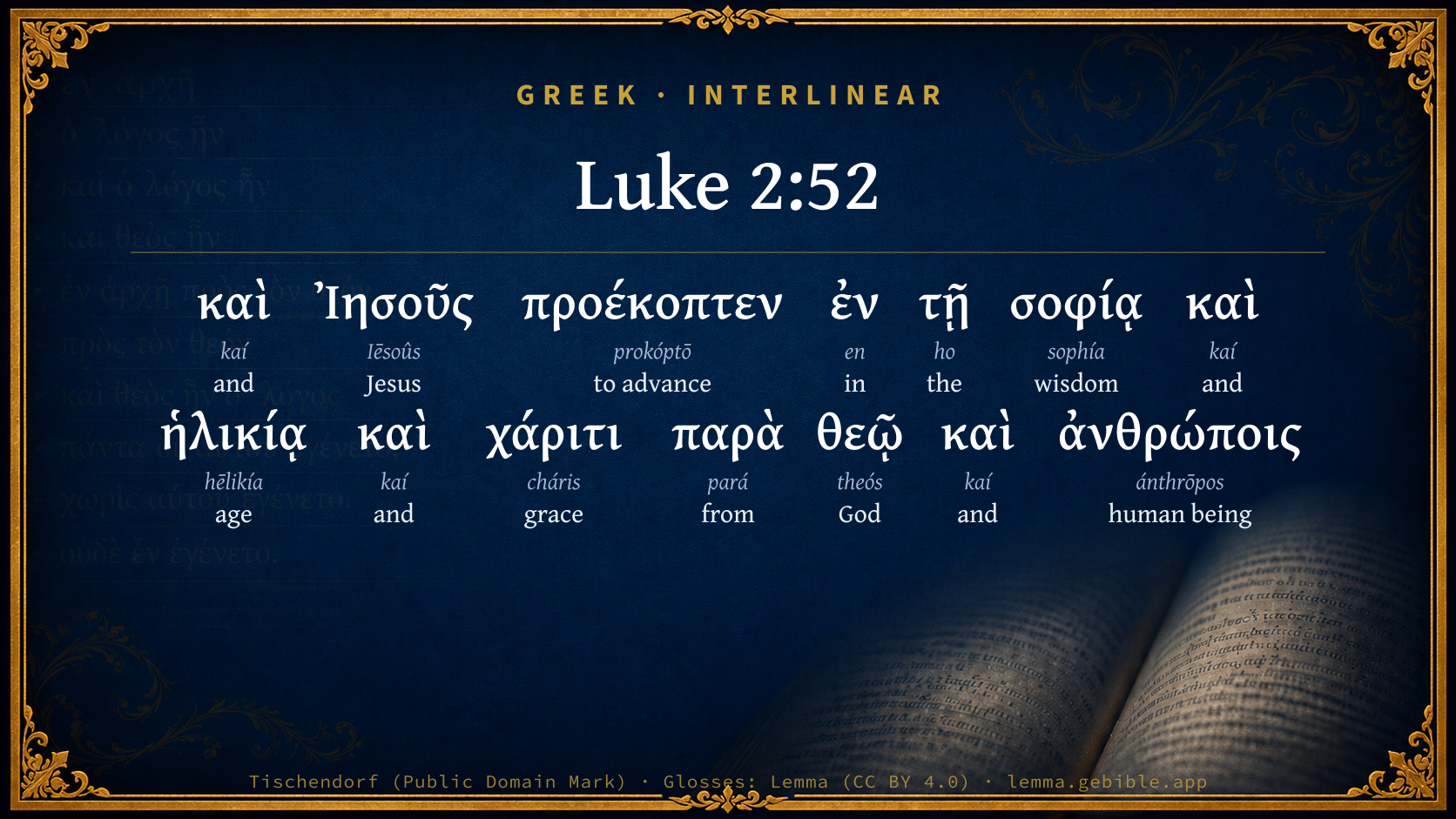
  1. καὶ kaí G2532 “and” Conjunction
  2. Ἰησοῦς Iēsoûs G2424 “Jesus” Noun, Nominative, Singular, Masculine
  3. ἐν en G1722 “in” Preposition
  4. τῇ ho G3588 “the” Article, Dative, Singular, Feminine
  5. σοφίᾳ sophía G4678 “wisdom” Noun, Dative, Singular, Feminine
  6. καὶ kaí G2532 “and” Conjunction
  7. ἡλικίᾳ hēlikía G2244 “age” Noun, Dative, Singular, Feminine
  8. καὶ kaí G2532 “and” Conjunction
  9. χάριτι cháris G5485 “grace” Noun, Dative, Singular, Feminine
  10. παρὰ pará G3844 “from” Preposition
  11. θεῷ theós G2316 “God” Noun, Dative, Singular, Masculine
  12. καὶ kaí G2532 “and” Conjunction
  13. ἀνθρώποις ánthrōpos G444 “human being” Noun, Dative, Plural, Masculine

About this verse

These counts appear in no published source. They are computed here, from the morphology-tagged text and Lemma’s own curated glosses. What Lemma adds →

14
words
11
distinct lemmas
Gospels
section

Notable vocabulary

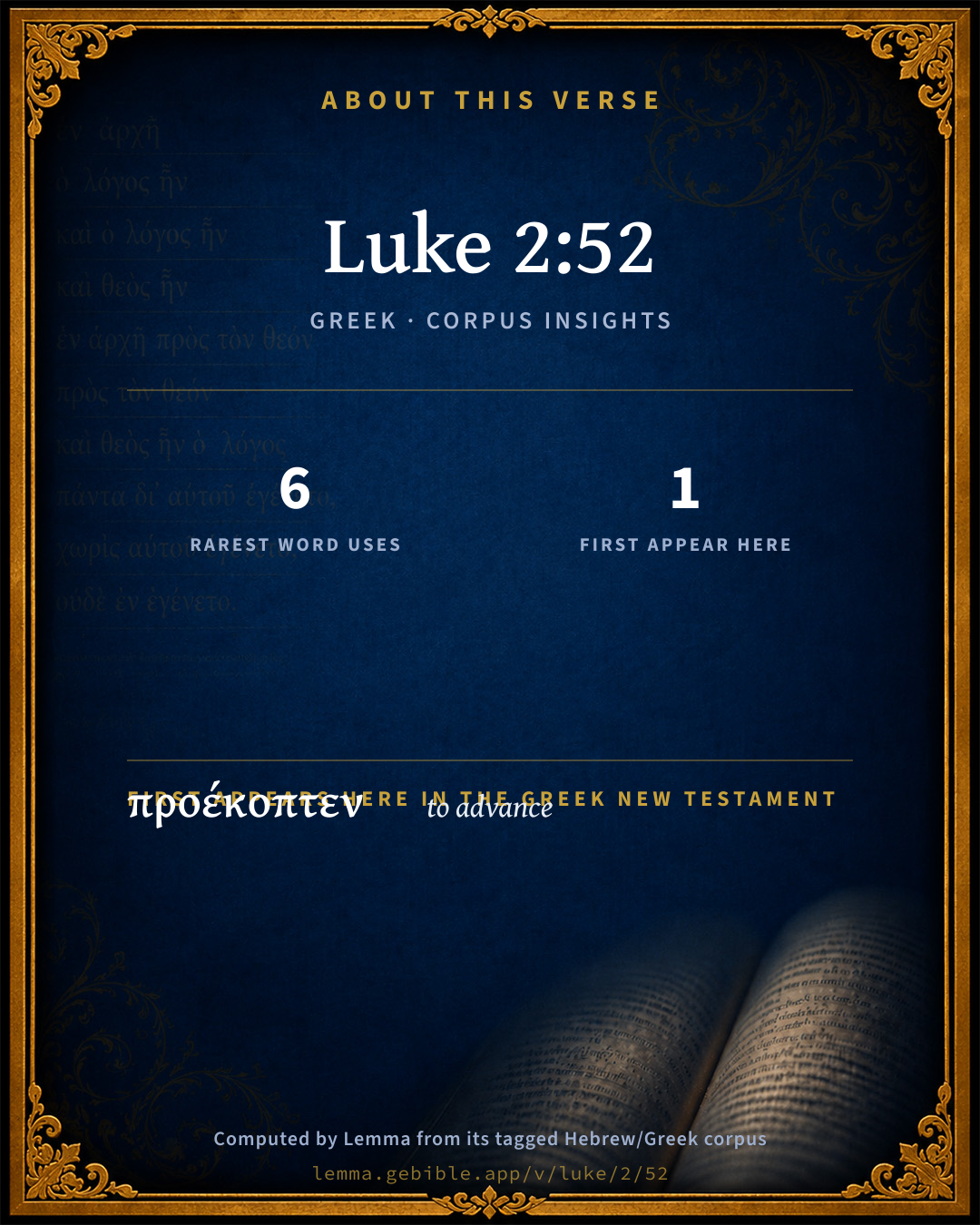
The rarest word here is προέκοπτεν to advance G4298 — appearing just 6 times in the whole Greek New Testament.

First appearance in Scripture

This word makes its first canonical appearance in the Greek New Testament here:

  • προέκοπτεν to advance G4298

Shared distinctive vocabulary

προέκοπτεν to advance G4298 occurs in 6 verses of the Greek New Testament. Also found in:

Repetition

A word recurs within this verse:

Cross-references

6

Topical passages linked to Luke 2:52 in the Treasury of Scripture Knowledge — connected by theme and wording, ordered by reader-vote popularity; previews shown in the World English Bible.

  • Luke 2:40 The child was growing, and was becoming strong in spirit, being filled with wisdom, and the grace of God was upon him.
  • Proverbs 3:3–4 Don't let kindness and truth forsake you. Bind them around your neck. Write them on the tablet of your heart.
  • 1 Samuel 2:26 The child Samuel grew on, and increased in favor both with Yahweh, and also with men.
  • Romans 14:18 For he who serves Christ in these things is acceptable to God and approved by men.
  • Luke 1:80 The child was growing, and becoming strong in spirit, and was in the desert until the day of his public appearance to Israel.
  • Acts 7:9–10 "The patriarchs, moved with jealousy against Joseph, sold him into Egypt. God was with him,

Cross-references courtesy of OpenBible.info (CC BY 4.0).

Commentary

Notes on Luke 2:52 from classic Christian and Jewish commentators (each source and its license shown beneath its notes). The classic Christian expositions comment on the surrounding passage and are grouped to its opening verse, so a note may address several verses; the Jewish commentaries on the Tanakh (Rashi and others) are per-verse, so they appear only where the commentator wrote on this verse.

Lemma curates 59 commentaries, every one of them public domain or Creative Commons licensed, each selected and text-cleaned for this edition rather than reprinted as found. About our sources →

The Biblical Illustrator

Joseph S. Exell

Luk_2:52

And Jesus increased in wisdom--

A pattern childhood and youth

1.

He grew, not in stature only, but in wisdom and favour with God and man. Christ, as Divine, must have had all knowledge and power from the first. But subjecting Himself to the laws of human development, He thereby consented to an unfolding which, in childhood should exhibit a perfect Child, in youth a perfect Youth, in manhood a perfect Man. It was the unfolding of a perfect bud into a perfect flower. At each advancing step He was only evincing larger measures of that wisdom and moral excellence which, in possibility and germ, were in Him from the first.

2. He was content with an obscure and humble home. In these days there is everywhere a great crowding into cities and populous towns. These are thought to have peculiar advantages for the training and education of children. But have not the solid men, for whose living in it the world has most reason to be grateful, oftenest come from hillsides and homes like that of Nazareth? It is in obscure places that youth escapes the wasting strifes of ambition, the unproductive chase after vanities; that he learns not only to scorn delights and love laborious days, but to think his own thoughts and to stand alone. The wise youth is content just where it has pleased God to place him. If the station is lowly and the lot obscure, he does not chafe and repine; he rather gives thanks.

3. He was a winning example of filial piety and obedience. For thirty years He was contentedly subject to parental guidance and authority. It is the discipline of a well-ordered home which makes good citizens. It is a blessing, above all others, to grow up in a house where the gospel rule prevails. There it is that foundations are laid for every moral virtue. There is the best safeguard of purity. It is there that one learns the sweetness of lowly ambitions and the surpassing wealth of pure affection.

4. It is time to speak of His self-subjection to the discipline of helpful industry. He was called the carpenters son. He was Himself the carpenter. Justin Martyr, who lived as near to Him as we do to George Washington, speaks of Him as a worker in wood, and says that He made ploughs and yokes and other implements relating to husbandry. After Josephs death, the care of His mother would devolve upon Him. It is therefore proper to think of Him as early sharing the lighter labours of His home. His little feet bear Him on many a helpful errand for His mother. Pitcher in hand, He runs for water to the well. To kindle the fire He gathers and brings the wood. Soon, with growing limbs, He begins to wield the hammer, the axe, and the saw in the shop; to invent and shape toys for Himself and useful things for the house. In the process of time, He settles into a more patient industry. In the little village on the hillside of Nazareth, He is the carpenter. And such a shop as that in which He wrought, must have been I Do you think He ever made reckless promises, and failed to keep them? Do you think He ever did poor work, and charged the price of good? That He ever concealed a flaw, or tried to get the better of another in trade--can you believe that?

5. He was not in undue haste to have done with the work of preparation and to enter upon His public ministry. In such backing lies the strength of all great workers. Have we not often seen men of ripened age, men of whom the world never so much as heard the name, suddenly burst upon the stage of action, assume an easy leadership, and carry off the best prizes of emolument and honour? They are equal to the places they attempt to fill. They endure. Such men have taken time for preparation. They have both knowledge and self-knowledge. They have that self-control which comes of quiet introvision. They have root; and a root grows: it is not made; only to an extent can it be forced.

6. The childhood and youth of Jesus were marked by delight in the truths and ordinances of religion. At twelve years old, when taken to Jerusalem, His feet swiftly bare Aim to the Temple. Let no parent, or teacher, or worker in the Lords vineyard look upon a child as too young to be interested in holy things. Little feet linger where earnest words are spoken about (God and duty to Him. Little minds are full of wonder concerning the very deep things of the world unseen. Little hearts would gladly know and choose the way of grateful and loving service. Childhoods years may be given to God. And oh, what glory and safety and blessedness it is to have begun thus early.

7. He made His most earthly work a service unto His Father. Back at Nazareth He was all the time doing His Fathers business, just as truly as when sitting among the doctors in the Temple. There is a time to pray, and there is also a time to read, and a time to work. Give to each its own time. And if, in each, your purpose is equally to do the will of God, and bring honour to Him, He is just as well pleased with the one as with the other. Go where God bids you go, abide where He would have you abide, and do each hour the work He appoints for that hour; do all in faith and love, and for His glory; for the rest you need have no fears. Thus the lowly can win as sweet a smile and as large a reward as those who fill the highest places. He is with us in lifes valleys as truly as on the mountain-tops. The little child can come as close to His heart as the great king. It is not a great name, or a giant intellect, or conspicuous service, which God wants. It is only a trusting and obedient heart. Who cannot, who would not, give that? (H. M. Grout.)

Progress in spiritual things

Religion is a generous and noble thing, in regard to its progress; it is perpetually carrying on that mind, in which it is once seated, towards perfection. Though the first appearance of it upon the souls of good men may be, but as the wings of the morning, spreading themselves upon the mountains, yet it is still rising higher and higher upon them, chasing away all the filthy mists and vapours of sin and wickedness before it, till it arrives to its meridian altitude. There is the strength and force of the Divinity in it; and though, when it first enters into the minds of men, it may seem to be sown in weakness, yet it will raise itself in power. As Christ was in His bodily appearance, He was still increasing in wisdom, and stature, and favour with God and man, until He was perfected in glory; so is He also in His spiritual appearance in the souls of men: and accordingly the New Testament does more than once distinguish of Christ, in His several ages and degrees of growth in the souls of all true Christians. Good men are always walking on from strength to strength, till at last they see God in Zion. Religion, though it hath its infancy, yet it hath no old age: while it is in its minority, it is always in motu; but, when it comes to its maturity, it will always be in quiete; it is then always the same, and its years fail not; but it shall endure for ever. (John Smith.)

Orderly development

An orderly development; none of your monstrous athletes; none of your mere intellectual book-worms; none of your emaciated, hysterical saints and ascetics; none of your hermits or fanatical antisocial visionaries. He grew in body, in mind, in soul, and heart; stature, wisdom, favour--human and Divine. Is not that parable of childhood writ clear! Is not the message to you and to your children? Follow the lines, not of your crushed, but of your restrained, controlled, and regenerate nature. Learn, like Him, by the things that you suffer, undergo, have to put up with. Learn, before you teach; obey, before you command; going in and out amongst men, toil hand and heart about the Fathers business, and with an ear ever attuned to the voices in the upper air, until we all come in the unity of the faith and the knowledge of the Son of God, to a perfect man, to the measure of the stature of the fulness of Christ. (H. R. Haweis, M. A.)

Christs growth in wisdom

The increase of Jesus in wisdom during this period was--

1. Real. Jesus had to learn from the words of others what as yet He knew not; and that was entirely unknown to Him as a child, which He had a glimpse of as a boy, conjectured as a youth, and first clearly perceived as a man.

2. Unchecked. In attributing to the Lord Jesus the relative imperfection of childhood, we must carefully avoid imputing to Him the failings of childhood. His life showed no trace of childish faults, to be hereafter conquered. The words of John (Mat_3:14) show, on the contrary, what impression was made by His moral purity when thirty years of age, and the voice from heaven (Mat_3:17) sets the seal of the Divine approval on the now completed development of the Son of Man, a seal which the Holy One of Israel would only have offered to absolute perfection.

3. It was effected by means--

(1) Careful home-training.

(2) The natural beauties of the neighbourhood of Nazareth.

(3) The Scriptures.

(4) The annual journeys to Jerusalem.

(5) Prayerful communion with His heavenly Father.

4. Normal, and so an example of what our development should be in fellowship with Him. (J. J. Van Oosterzee, D. D.)

The growth of Jesus in wisdom

Our Lords body grew in stature, so that, when He reached manhood, He had attained fair and comely proportions. And while the body grew, His human mind grew also; His human intelligence unfolded itself gradually into full blossom, in the same manner as the mind and intelligence of other children, only, doubtless, in a much greater degree. Perhaps you cannot understand how this could be. To grow in wisdom must imply that the person who grows is, at a more advanced age, wiser than when He was younger; knows something, understands something, which he did not know, and understand before. But how could this be in His ease? you may reasonably ask. Was He not God, you may say, even when He was quite a young child? And how can God be ignorant of anything, or fail to understand anything? Now it is true, doubtless--absolutely true--that our Lord, even while he was a child, was the everlasting God. But it is true also that He was God manifest in the flesh, God sinking Himself down to the low level of human nature. He became really and truly for our sakes an infant, a child, a youth, a man. He did not merely seem to be human, but He actually was human. Now in order that He might be really and truly a man, He consented, in His wonderful condescension, not to call into exercise those powers which He had as God. You can quite understand a person having strength, but not using it. A man might have the strength of a giant, who might choose to exert Himself very little, might never walk above a few yards, might not employ his hands in any harder work than turning over the leaves of a book or reeling off a skein of silk. And in like manner a man may have a perfectly strong and good eyesight, but he need not use it farther than he pleases. He may shut his eyes altogether, in which case he will see nothing. He may only half open them, in which ease he will see but dimly and confusedly; or he may go and live in a dungeon, where only a few straggling rays of light pierce the gloom; and then, however good his eyesight may be, he will for the first few seconds be able to see nothing; but when the eye has adjusted itself to the circumstances in which it is placed, he will begin to make out the forms of things around him, but will not see their colours, or have any power at all of examining them closely. This may help you to understand how our Lord, while He had in ]dis Divine nature all power and all knowledge, yet, when He made His appearance among us as man, was ignorant of certain things, and unable to do certain things. In coming into the world, He, by His own free will and consent, limited Himself to do the things which a man could do, and to know the things which a man could know. He came into our poor, narrow, dark nature, just as a free man might come out of the light of day into a narrow, dark, prison-dungeon, and there consent to be shut up. Such an one might have the power of walking miles, but in the dungeon he can only walk a few paces; he might have a very keen eyesight, but in the dungeon he cannot even see to read. Christ took a nature which, till He took it, was not His own, and accommodated Himself to the feebleness and ignorance of that nature--limited Himself, if I may use the expression, to the walls of it. (Dean Goulburn.)

Christs increase in the favour of God

We may compare our Lords period of growth, during which He was prepared for His work, to the gradual execution of some great piece of sculpture, a bust or a statue. Let us say that the marble chosen for the work is a piece without flaw, spotless white, without a single vein running through it. Thus our Lords human nature, unlike that which all of us inherit, was perfectly free from all tendency to evil; holy, harmless, undefiled at His very birth. But a white block of marble, though white when it is drawn from the quarry, can be made a more perfectly beautiful thing by being chiselled into an exquisite form. And a human nature, which was originally sinless, may be made a more perfectly beautiful thing by being disciplined through grace, and through the experience of suffering, into the perfect likeness of God. And you can quite understand how a sculptor, who is daily at work upon a statue, has an increasing satisfaction in it, as the work becomes more and more perfect, views it with greater pleasure and complacency to-day, when it has received so many flourishing touches, than he did some months ago, when it was a mere resemblance of the human form in outline. The work increases in favour with him daily; and when it is finished, he is then perfectly satisfied. Thus it was that Jesus, as a man, increased in favour with God. (Dean Goulburn.)

On the education of children

It is not, alas, according to this model, that the generality of Christians form their children. We behold them principally intent on procuring for them worldly accomplishments, while they totally neglect to make them acquainted with the great duties of Christianity.

1. The human mind cannot be too early impressed with religious principles. The prudent will, indeed, be careful not to make that a burden which should be a pleasure; they will be content to unfold the gospel principles by degrees, as the youthful mind is able to receive them.

2. Nature only requires a little gentle assistance to perfect all her productions. You have seen a tender plant springing upon a fertile soil, what though tall and straight, and promising to become the pride of the forest, since one unlucky stroke may have crushed its aspiring head, and forced it from its natural direction, from that moment it bended and grew downwards to the earth, instead of towering to the skies. Thus, the human mind while young and pliable, is in perpetual danger of growing luxuriant by too much indulgence, or losing all its strength by the unnatural restraint of too much severity, to be suppressed by misfortune, checked by disappointment, or chilled by penury. How liable is it to deviate from the straight line of rectitude and honour, by the fascination of example, and the influence of imitation; to folly, vice, and ruin. It is the pleasing but important task of parents and guardians, to direct and defend this young and delicate production; leading it from lower degrees of perfection to higher, from the nursery to the field of action, till it is adorned with the fairest honours, enriched with the most precious fruit, and ripe for transplanting to the paradise of God, where it shall bloom afresh under the immediate sunshine of heaven, and flourish for ever in immortal beauty and perfection.

3. The prejudices received in youth are sometimes so violent and inveterate, that even maturity of years, the admonition of friends, the principles of hope, fear, honour, and religion, are unable too often to restrain them. Nay, the best of all teachers, experience, frequently attempts, but in vain, to cure the maladies of a wrong education. It is nonsense to expect a harvest, where the seed time has been lost, and you must be disappointed, who wish to reap where you have not sown.

4. The least indulgence of the bad inclinations of children, sometimes produces the most fatal effects in society. Witness Davids indulgence of Amnon--it produced incest; of Absalom--it produced assassination and a civil war; of Adonijah--it produced a usurpation of the throne and crown. Observe, again, how God punished Eli, who neglected to correct duly the crimes of his children. Can you, O parents, hear these awful truths, and not shudder at the idea of indulging the least vicious propensity in your children? But let me turn from those gloomy images, to hold up to your view the picture of a parents care, rewarded in a wise and virtuous offspring. These will be your pride and glory in the day of your health and strength; but in the gloomy and melancholy season of sickness and old age, they will be the light of your eyes, and the cordial of your fainting spirits; and as once with tender care you watched their tender infancy, so shall they with pious duty support your failing strength, soften the pangs of a dying hour, close your eyes in peace, and eventually follow you to that world where love and bliss immortal reign. (B. Murphy.)

Gods favour to be sought

Jesus won the favour of man by seeking the favour of God. It is not so important that man should be pleased with us as that God should. But mans favour is more likely to be won through seeking Gods favour than in any other way. If we are always asking how those about us will look at us; if we give large weight in our thoughts to the opinion of our fellows; if we endeavour to so shape our course as to win popular approval, we are by no means sure to have what we strive for; we may fall far short of the coveted favour of man; and, moreover, may utterly lack Gods approval, whether man likes or dislikes us. But if we are always asking how God will look at our course; if we give large weight in our thoughts to His opinion and His commandments; if we seek to shape our course to win His approval, we are sure to get what we most long for; and we are surer of having also the favour of man than we could be through any other course. If God is our friend, He can secure to us mans approval. The best of human friends cannot win for us Gods favour. (H. C.Trumbull.)

The secret of the growth of Jesus

See the daisy. It opens its petals when the light dawns, and closes them at sunset. It is in the right place to absorb out of earth and atmosphere the nutritive forces it needs, and it grows. Go into a garden and ask what all these various plants are doing. They toil not neither do they spin; they have no visible machinery and yet they are all capturing sunbeams and converting them into fragrances, essences, flowers and fruits for the welfare of the world. Does your boy trouble about growth as he eats and drinks and plays? No! He takes no thought for the morrows growth. Flowers and children, rightly placed, grow. Get a piston and place it where the steam is and it will go. Put your water-wheel in the stream, and it turns. Man takes advantage of the energies close to hand and multiplies his forces a million-fold. So long as we are in the wrong place we cannot grow. The secret of the growth of Jesus is that He starts in the right place and keeps in it to the very end; He lives in and for God; is bathed with the warm light, and refreshed by the pure breath and nourished by the sweet fellowship with, and work for, the Father. (J. Clifford, D. D.)

The silent growth of Jesus

It is perplexing to some of us that there should be eighteen years of unbroken silence in such a life as Christs. We have asked what was Jesus at 17, 20, and at 25? and though no audible voice responds to us, yet the silence, read in the light of the wonderful work accomplished in His brief ministry, is itself a sign of the depth, continuity, and fulness of the moral growth. All growth is silent. When nature is baptized in the fulness of spring forces, you hear not a rustle. The whole movement takes place secretly and silently, and the world comes up anew without the sound of trumpet or the message of herald: God builds His temples without the sound of hammer. His great moral structures go up from day to day without noise, His kingdoms come without observation, notwithstanding the moment of their arrival may be one of tempest and storm. Tyndall says All great things come slowly to birth. Copernicus pondered his great work for thirty-three years; Newton, for nearly twenty years, kept the idea of gravitation before His mind; for twenty years also, he dwelt upon his discovery of fluxions; Darwin, for twenty-two years pondered on the problem of the origin of species, and doubtless he would have continued to do so had he not found Wallace upon his track. So Jesus stayed in His place, did His carpentry, was obedient to His parents, accepted the restraints of His position, silently devoured the many chagrins of His lot, met His cares with a transcendent disdain, drank in the sunlight of His Fathers face, and possessed His soul in perfect patience, though urged by deep sympathy and throbbing desire to save men. No boasting, no hurry, no impatience, but a quiet maturing of power, and then so clad was He in strength that He never lost an opportunity through delay or marred a bit of His work by haste. When Perseus told Pallas Athene that he was ready to go forth, young as he was, against the fabled monster Medusa the Gorgon, the strange lady smiled and said, Not yet; you are too young, and too unskilled: for this is Medusa the Gorgon, the mother of a monstrous brood. Return to your home and do the work which awaits you there. You must play the man in that before I can think you worthy to go in search of the Gorgon. It is hurry that enfeebles us. (J. Clifford, D. D. )

The three ages of Christian life

God in Christ has appeared among men to raise up again fallen humanity. In order to do this, He laid hold upon it, in the cradle, and left it only at the tomb; passing through all the stages of its growth, traversing in succession all the ages of life, sanctifying our nature at all periods of our existence, and causing us to see in His person, from the moment when He came into the world till that of His exaltation in glory, the perfect type of innocence and holiness. It is thus that He became in turn an infant, youth, man; an infant, obedient and submissive; a young man without reproach and keeping Himself pure from all defilement of the flesh and of the world: a full-grown man showing us in His character and in His conduct the model of absolute perfection. He stopped there; for He by whom and for whom are all things ought: not to fail; it was necessary that He should offer Himself a sacrifice in all the vigour of age and in all the fulness of life: it was not becoming that He should present to us the picture of decrepitude and old age. But as there has been a birth of the Son of God in the Man Jesus, a growth of the God-man in the person of the Redeemer, so there has been, there is, and there will be, to the end of time, a birth and growth of Christ in all the souls belonging to Him. Christ is truly born. He grows up, He developes Himself in His people. There is in turn, in their case, the infant, the youth, and the grown-up man, and He completes in them the work of His grace till they come to the height of His perfect stature. (J. H. Grandpierre, D. D.)

The humanity of Christ

That Jesus was really a man. Here it may be observed,

I. That He was really man BECAUSE HE HAD A HUMAN BODY. It was formed and fashioned in His mothers womb by the great Parent of all flesh. So it was, says the inspired writer, that while His mother was at Bethlehem, the days were accomplished that she should be delivered.

II. He was really man BECAUSE HE HAD A HUMAN SOUL AS WELL AS A HUMAN BODY. This is necessarily implied in what is said of Him in the text. He increased in wisdom and stature, and in favour with God and man. Here both His wisdom and piety are asserted; and we know that these are properties of the soul, and not of the body.

III. That Christ was properly a human person will appear, if we consider THE STATE AND CIRCUMSTANCES IN WHICH HE WAS PLACED WHILE HE LIVED IN THIS WORLD. For--

1. He was fixed in a state of dependence.

2. He was placed under law, which implies that He was a human moral agent, and accountable to God like other men. We are told that when the fulness of the time was come, God sent forth His Son, made of a woman, made under the law, to redeem them that were under the law.

3. That Christ was placed, like all other men, in a state of probation from His birth to His death.

I now proceed to improve the subject.

1. If Christ was really man, then the Arian notion of His pre-existence before He came into the world is entirely unscriptural and absurd. The Arians suppose that Christ was the first and noblest of created beings, and existed before the foundation of the world. For it is absurd to suppose that Christ had both a human soul and a super-angelic soul, and that both these were personally united with the Second Person in the Trinity, and so constituted Him a Divine Person. The true scriptural doctrine of Christs divinity is founded upon the true scriptural doctrine of Christs having a human body and a human soul, which was personally united with the second person in the Godhead. It is necessary, therefore, to believe the real humanity, in order to believe the real divinity of Christ. It has been found by observation and experience, that the denial of Christs humanity directly leads to the denial of His divinity.

2. If Christ had a human body and a human soul, then we cannot account for the early depravity of children through the mere influence of bad examples, or bodily instincts and appetites. He was an infant, but He did not sin in infancy. He had a frail, mortal body, but it did not corrupt His heart. He lived in a wicked world, where He saw many bad examples, but they did not lead Him to follow them. He was a free moral agent, but He never chose to sin.

3. If Christ was really a man, then there is no natural impossibility of mens becoming perfectly holy in this life.

4. If Christ was really man, then God is able to keep men from sinning consistently with their moral agency.

5. If Christ was really man, then there is no absurdity in the doctrine of the final perseverance of saints.

6. If Christ was really man, then there is no reason to suppose that men possess a self-deter mining power, or a power to act independently of the Divine influence and control.

7. If Christ was really man, then His conduct is a proper example for all men to follow.

8. If Christ was really man, then He is well qualified to perform all the remaining parts for His mediatorial office. In particular, to perform the part of an intercessor.

9. If Christ be really a man, then they will be unspeakably happy, who shall be admitted into His visible presence, and dwell with Him for ever. (N. Emmons, D. D.)

.

The Biblical Illustrator, edited by Joseph S. Exell (c. 1880s–1900s) — public domain. Text from a community e-Sword module.

Joseph Benson's Commentary

Luk 2:52. And Jesus increased in wisdom and stature — In the perfections of his divine nature there could be no increase; but this is spoken of his human nature, consisting of a reasonable soul and human flesh; his body increased in stature and bulk, and his soul in wisdom and in all the endowments of a human spirit. It received distinct and gradual illuminations as he advanced in years: for though the eternal Word was united to his human soul from his birth, or even conception, yet the divinity that dwelt in him manifested itself to his humanity by degrees, ad modum recipientis, as that humanity was capable of receiving those manifestations; and as the faculties of his human soul opened more and more, larger communications of knowledge, wisdom, and other gifts were made to it. And he increased in favour with God and man — That is, in all those graces that rendered him acceptable both to God and man. All this was suitable to his state of humiliation; for as he condescended to be an infant, a child, a youth, so the image of God must have shone brighter in him when he was grown up to be a youth, than it did or could do when he was an infant and a child. Let young people observe, that as they grow in stature they should grow in wisdom and grace; and then, as they grow in these, they will grow in favour with God and man.

Joseph Benson's Commentary on the Old and New Testaments (1811–1818) — public domain. Text from a community e-Sword module.

Bengel's Gnomon

Johann Albrecht Bengel

Luk 2:52. Προέκοπτε, He progressed) In accordance with [or in respect to] human nature, and the wisdom of human nature; and that in actual fact, but far above the measure of an ordinary man.—σοφίᾳ, in wisdom) in the soul.—ἡλικίᾳ) in stature of body in proportion to His years. Therefore He must have reached the due and proper height of a man.—χάριτι, in grace) in favour, owing to the endowments of soul and body, which come from grace, the more tender years are especially commended.—παρὰ Θεῷ, with God) Joh 8:29 [The Father hath not left Me alone; for I do always those things that please Him].—ἀνθρώποις, with men) The world is more ready to feel anger towards adult men, than towards youths who are not yet engaged in any public office or duty.

Bengel's Gnomon of the New Testament — English translation (T&T Clark, Edinburgh, 1860) — public domain. Text from a community e-Sword module.

Meyer's Critical & Exegetical Commentary

Heinrich August Wilhelm Meyer

Luk_2:52. Comp. 1Sa_2:26.

ἡλικίᾳ] not age (so Vulgate, Luther, Erasmus, and most expositors), which would furnish an intimation altogether superfluous, but growth, bodily size (Beza, Vatablus, Grotius, Er. Schmid, Bengel, Ewald, Bleek, and others). See on Mat_6:27; Luk_19:3. Comp. ηὔξανε καὶ ἐκραταιοῦτο, Luk_2:40. Justam proceritatem nactus est ac decoram, Bengel. Luke expresses His mental (σοφίᾳ) and bodily (ἡλικίᾳ) development.[64] In favour of this explanation we have also the evidence of 1 Sam. l.c.: ἐπορεύετο μεγαλυνόμενον, which element is here given by ἡλικίᾳ.

χάριτι] gracious favour, as at Luk_2:40. But here, where one twelve years old is spoken of, who now the longer He lives comes more into intercourse with others, Luke adds καὶ ἀνθρώποις. Comp. 1 Sam. l.c.: וָטו̇ב נַּם עִם־יְהֹוָה וְנַם עִם־אֲנָשִׁים; Test. XII. Patr. p. 528. Observe, moreover, that the advancing in Gods gracious favour assumes the sinless perfection of Jesus as growing, as in the way of moral development. Comp. on Mar_10:18. But this does not exclude child-like innocence, and does not include youthful moral perplexities. Comp. Keim, geschichtl. Chr. 110 ff. It is a normal growth, from child-like innocence to full holiness of the life. Comp. also Beyschlag, Christol. d. N. T. 47 ff.

[64] In this place he prefixes σοφίᾳ, because he has just related so brilliant a trait of the mental development of Jesus.What shifts, moreover, have been resorted to, especially since the time of Athanasius and Ambrose, to fence with reservations the progress of Jesus in wisdom in such a way as to leave no progress, but merely a successive revealing of His inherent wisdom, or else only a growth in the wisdom to be attained through human experience (scientia acquisita)!

Meyer — Critical and Exegetical Commentary on the New Testament — English translation by Peter Christie, edited by Frederick Crombie (T&T Clark, 1880) — public domain. Text from a community e-Sword module.

Expositor's Greek Testament

ed. W. Robertson Nicoll

Luk 2:52 . προέκοπτε , steadily grew, used intransitively in later Greek. ἐν τῇ σοφίᾳ και ἡλικίᾳ , in wisdom and (also as , the one the measure of the other) in stature, both growths alike real. Real in body, apparent in the mind: growth in manifestation of the wisdom within, complete from the first such is the docetic gloss of ecclesiastical interpreters, making the childhood of Jesus a monstrum , and His humanity a phantom . χάριτι π . Θ . καὶ ἀ ., in favour with God and men: beloved of all; no division even among men while the new wisdom and the new religion lay a slumbering germ in the soul of the heaven-born boy.

The Expositor's Greek Testament, edited by W. Robertson Nicoll (1897–1910) — public domain. Text from a community e-Sword module.

Jamieson, Fausset & Brown

Robert Jamieson, A. R. Fausset & David Brown

See on Luk 2:40.

stature--or better, perhaps, as in the Margin, "age," which implies the other. This is all the record we have of the next eighteen years of that wondrous life. What seasons of tranquil meditation over the lively oracles, and holy fellowship with His Father; what inlettings, on the one hand, of light, and love, and power from on high, and outgoings of filial supplication, freedom, love, and joy on the other, would these eighteen years contain! And would they not seem "but a few days" if they were so passed, however ardently He might long to be more directly "about His Father's business?"

Next: Luke Chapter 3

Jamieson, Fausset & Brown — Commentary Critical and Explanatory on the Whole Bible (1871) — public domain (CC PDM 1.0). Text via the HelloAO Bible API.

Adam Clarke's Commentary

Verse 52. Jesus increased in wisdom] See Clarke on Lu 2:40.

THE following remarks, taken chiefly from Mr. Claude, on the foregoing subject, are well worth the reader's attention.

I. The birth of Christ is announced to the shepherds.

1. God causes his grace to descend not only on the great and powerful of the world, but also upon the most simple and inconsiderable; just as the heavens diffuse their influence not only on great trees, but also on the smallest herbs.

2. God seems to take more delight in bestowing his favours on the most abject than in distributing them among persons of elevated rank. Here is an example: for while he sent the wise men of the east to Herod, he sent an angel of heaven to the shepherds, and conducted them to the cradle of the Saviour of the world.

3. ln this meeting of the angels and shepherds, you see a perpetual characteristic of the economy of Jesus Christ; wherein the highest and most sublime things are joined with the meanest and lowest. In his person, the eternal WORD is united to a creature, the Divine nature to the human, infinity to infirmity, in a word, the Lord of glory to mean flesh and blood. On his cross, though he appears naked, crowned with thorns, and exposed to sorrows, yet at the same time he shakes the earth, and eclipses the sun. Here, in like manner, are angels familiar with shepherds; angels, to mark his majesty; shepherds, his humility.

4. This mission of angels relates to the end for which the Son of God came into the world; for he came to establish a communion between God and men, and to make peace between men and angels: to this must be referred what St. Paul says, Col 1:20, It pleased the Father, by him, to reconcile all things to himself.

5. However simple and plain the employments of men may be, it is always very pleasing to God when they discharge them with a good conscience. While these shepherds were busy in their calling, God sent his angels to them.

6. God does, in regard to men, what these shepherds did in regard to their sheep. He is the great Shepherd of mankind, continually watching over them by his providence.

II. The glory of the Lord shone round the shepherds.

1. When angels borrow human forms, in order to appear to men, they have always some ensigns of grandeur and majesty, to show that they are not men, but angels.

2. The appearance of this light to the shepherds in the night, may very well be taken for a mystical symbol. Night represents the corrupt state of mankind when Jesus came into the world; a state of ignorance and error. Light fitly represents the salutary grace of Christ, which dissipates obscurity, and gives us the true knowledge of God.

III. The shepherds were filled with great fear.

1. This was the effect of their great surprise. When grand objects suddenly present themselves to us, they must needs fill us with astonishment and fear, for the mind, on these occasions, is not at liberty to exert its force; on the contrary, its strength is dissipated, and during this dissipation it is impossible not to fear.

2. This fear may also arise from emotions of conscience. Man is by nature a sinner, and consequently an object of the justice of God. While God does not manifest himself to him, he remains insensible of his sin; but, when God discovers himself to him, he awakes to feeling, and draws nigh to God as a trembling criminal approaches his judge. See this exemplified in the case of Adam, and in that of the Israelites when God appeared on the mountain: hence that proverbial saying, We shall die, for we have seen God.

3. The shepherds had just reason to fear when they saw before them an angel of heaven, surrounded with the ensigns of majesty, for angels had been formerly the ministers of God's vengeance. On this occasion, the sad examples of Divine vengeance, recorded in Scripture, and performed by the ministry of angels, might, in a moment, rise to view, and incline them to think that this angel had received a like order to destroy them.

IV. Observe the angel's discourse to the shepherds.

1. The angels say to them, Fear not. This preface was necessary to gain their attention, which fear, no doubt, had dissipated. The disposition which the angel wishes to awaken in them comports with the news which he intended to announce; for what has fear to do with the birth of the Saviour of the world?

2. The angel describes,

1st, The person of whom he speaks, a Saviour, Christ, the Lord; see before on Lu 2:11. See,

2dly, What he speaks of him; he is born unto you.

3dly, He marks the time; this day.

4thly, He describes the place; in the city of David.

5thly, He specifies the nature of this important news; a great joy which shall be unto all people. See Claude's Essay, by Robinson, vol. i. p. 266, c.

Concerning Simeon, three things deserve to be especially noted: 1. His faith. 2. His song. And 3. His prophecy.

I. His faith.

1. He expected the promised Redeemer, in virtue of the promises which God had made and, to show that his faith was of the operation of God's Spirit, he lived a life of righteousness and devotedness to God. Many profess to expect the salvation which God has promised only to those who believe, while living in conformity to the world, under the influence of its spirit, and in the general breach of the righteous law of God.

2. The faith of Simeon led him only to wish for life that he might see him who was promised, and, be properly prepared for an inheritance among the sanctified. They who make not this use of life are much to be lamented. It would have been better for them had they never been born.

3. The faith of Simeon was crowned with success. Jesus came; he saw, he felt, he adored him! and, with a heart filled with the love of God, he breathed out his holy soul, and probably the last dregs of his life, in praise to the fountain of all good.

II. Simeon's song. By it he shows forth: -

1. The joy of his own heart. Lord, now thou dismissest thy servant; as if he had said: "Yes, O my God, I am going to quit this earth! I feel that thou callest me; and I quit it without regret. Thou hast fulfilled all my desires, and completed my wishes, and I desire to be detained no longer from the full enjoyment of thyself." O, how sweet is death, after such an enjoyment and discovery of eternal life!

2. Simeon shows forth the glory of Christ. He is the Sun of righteousness, rising on a dark and ruined world with light and salvation. He is the light that shall manifest the infinite kindness of God to the Gentile people; proving that God is good to all, and that his tender mercies are over all his works.

He is the glory of Israel. It is by him that the Gentiles have been led to acknowledge the Jews as the peculiar people of God; their books as the word of God, and their teaching as the revelation of God. What an honour for this people, had they known how to profit by it!

3. He astonished Joseph and Mary with his sublime account of the Redeemer of the world. They hear him glorified, and their hearts exult in it. From this Divine song they learn that this miraculous son of theirs is the sum and substance of all the promises made unto the fathers, and of all the predictions of the prophets.

III. Simeon's prophecy.

1. He addresses Christ, and foretells that he should be for the ruin and recovery of many in Israel. How astonishing is the folly and perverseness of man, to turn that into poison which God has made the choicest medicine; and thus to kill themselves with the cure which he has appointed for them in the infinity of his love! Those who speak against Jesus, his ways, his doctrine, his cross, his sacrifice, are likely to stumble, and fall, and rise no more for ever! May the God of mercy save the reader from this condemnation!

2. He addresses Mary, and foretells the agonies she must go through. What must this holy woman have endured when she saw her son crowned with thorns, scourged, buffeted, spit upon - when she saw his hands and his feet nailed to the cross, and his side pierced with a spear! What a sword through her own soul must each of these have been! But this is not all. These sufferings of Jesus are predicted thirty years before they were to take place! What a martyrdom was this! While he is nourished in her bosom, she cannot help considering him as a lamb who is growing up to be sacrificed. The older he grows, the nearer the bloody scene approaches! Thus her sufferings must increase with his years, and only end with his life!

3. He foretells the effects which should be produced by the persecutions raised against Christ and his followers. This sword of persecution shall lay open the hearts of many, and discover their secret motives and designs. When the doctrine of the cross is preached, and persecution raised because of it, then the precious are easily distinguished from the vile. Those whose hearts are not established by grace, now right with God, will turn aside from the way of righteousness, and deny the Lord that bought them. On the other hand, those whose faith stands not in the wisdom of man, but in the power of God, will continue faithful unto death, glorify God in the fire, and thus show forth the excellency of his salvation, and the sincerity of the profession which they had before made. Thus the thoughts of many hearts are still revealed.

The design of our blessed Lord in staying behind in the temple seems to have been twofold.

1st. To prepare the Jews to acknowledge in him a Divine and supernatural wisdom: and

2dly. To impress the minds of Joseph and Mary with a proper idea of his independence and Divinity.

Their conduct in this business may be a lasting lesson and profitable warning to all the disciples of Christ.

1st. It is possible (by not carefully watching the heart, and by not keeping sacredly and constantly in view the spirituality of every duty) to lose the presence and power of Christ, even in religious ordinances. Joseph and Mary were at the feast of the passover when they lost Jesus!

2dly. Many who have sustained loss in their souls are kept from making speedy application to God for help and salvation, through the foolish supposition that their state is not so bad as it really is; and, in the things of salvation, many content themselves with the persuasion that the religious people with whom they associate are the peculiar favourites of Heaven, and that they are in a state of complete safety while connected with them.

They, supposing him to be in the company, went a day's journey.

3dly. Deep sorrow and self-reproach must be the consequence of the discovery of so great a loss as that of the presence and power of Christ. Joseph and Mary sought him sorrowing.

4thly. When people are convinced, by the light of the Lord, that their souls are not in a safe state, and that unless they find the Redeemer of the world they must perish, they are naturally led to inquire among their kinsfolk and acquaintance for him who saves sinners. But this often proves fruitless; they know not Jesus themselves, and they cannot tell others where to find him.

They sought him among their kinsfolk and acquaintance, and found him not.

5thly. When people perceive that they have proceeded in a certain course of life for a considerable time, without that salvation which God promises in his word, they should first stop and inquire into their state, and when they find that they have been posting into eternity, not only without a preparation for glory, but with an immense load of guilt upon their souls, they should turn back, and, as their time may be but short, they should seek diligently.

They turned back to Jerusalem, earnestly seeking him.

6thly. The likeliest place to find Jesus and his salvation is the temple. The place where his pure unadulterated Gospel is preached, the sanctuary where the power and glory of God are seen in the conviction, conversion, and salvation of sinners. They found him in the temple, among the doctors.

7thly. Trials, persecutions, and afflictions are all nothing, when the presence and power of Christ are felt; but when a testimony of his approbation lives no longer in the heart, every thing is grievous and insupportable. The fatigue of the journey to Bethlehem, the flight from the cruelty of Herod, and the unavoidable trials in Egypt, were cheerfully supported by Joseph and Mary, because in all they had Jesus with them; but now they are in distress and misery because he is behind in Jerusalem. Reader, if thou have lost Jesus, take no rest to body or soul till thou have found him! Without him, all is confusion and ruin: with him, all is joy and peace.

Adam Clarke's Commentary on the Bible (1810–1826) — public domain. Text from a community e-Sword/MySword module.

Ellicott's Commentary for English Readers

(52) Jesus increased in wisdom and stature.—Here again we have nothing but a normal orderly development. With Him, as with others, wisdom widened with the years, and came into His human soul through the same channels and by the same processes as into the souls of others—instruction, e.g., in the school of Nazareth, and attendance at its synagogue—the difference being that He, in every stage, attained the perfection of moral and spiritual wisdom which belongs to that stage; there being in Him no sin or selfishness or pride, such as checks the growth of wisdom in all others. In striking contrast with the true record of the growth of the Son of Man, is that which grew out of the fantastic imaginations of the writers of the Apocryphal Gospels. There the child Jesus is ever working signs and wonders; fashions into shape Joseph’s clumsy work; moulds sparrows out of clay, and claps His hands and bids them fly; strikes a playmate who offends Him with dumbness, and so on ad nauseam.

In favour with God and man.—This, it will be noted, is an addition to what had been stated in Luk_2:40, and gives the effect while that gave the cause. The boy grew into youth, and the young man into manhood, and the purity and lowliness and unselfish sympathy drew even then the hearts of all men. In that highest instance, as in all lower analogies, men admired holiness till it became aggressive, and then it roused them to an antagonism bitter in proportion to their previous admiration. On the history of the eighteen years that followed, see Excursus on Matthew 2.

A Bible Commentary for English Readers, edited by Charles John Ellicott (1878–1897) — public domain. Text from a community e-Sword module.

The Cambridge Bible for Schools and Colleges

gen. ed. J. J. S. Perowne

52. increased] Rather, advanced. The word is derived from pioneers cutting down trees in the path of an advancing army. Comp. 1Sa_2:26, and the description of an ideal youth in Pro_3:3-4.

stature] Rather, age (as in Luk_12:25), though the word sometimes means stature (Luk_19:3).

favour with God and man] Rather, men. Pro_3:4, “So shalt thou find favour and good success (marg.) in the sight of God and man.” Pirke Abhôth, III. 10, “In whomsoever the mind of men delights, in him also the Spirit of God delights.”

The Cambridge Bible for Schools and Colleges (gen. ed. J. J. S. Perowne; Cambridge University Press, 1878–1918) — public domain. Text from a community e-Sword module.

Trapp's Complete Commentary

John Trapp

52 And Jesus increased in wisdom and stature, and in favour with God and man.

Ver. 52. Increased in wisdom] Being παιδαριογερων, as Macarius was called, while a child, for his extraordinary grace and gravity. The exercise of his wisdom, as it was more enlarged, became more lovely in the sight of God and man.

John Trapp, A Commentary or Exposition upon All the Books of the Old and New Testament (1647–1656) — public domain. Text from a community e-Sword module.

Albert Barnes' Notes on the Bible

In favour with God - That is, in proportion to his advance in wisdom. This does not imply that he ever lacked the favor of God, but that God regarded him with favor in proportion as he showed an understanding and spirit like his own. Happy are those children who imitate the example of Jesus - who are obedient to parents who increase in wisdom - who are sober, temperate, and industrious, and who thus increase in favor with God and people.

Albert Barnes' Notes on the Bible (1834–1885) — public domain. Text from a community e-Sword/MySword module.

Haydock's Catholic Bible Commentary

Not that he was wiser at any future period of his life, that he was at the moment of his conception, but this is said, because he chose to manifest increasing signs of wisdom as he increased in years. --- In the same manner also he increased in grace, by displaying, as he advanced in age, the gifts of grace with which he was endowed; and by this excited men to the praise of God, from the consideration of favours God had bestowed upon him; and thus he conduced to the honour of God, and the salvation of men. (St. Gregory) --- The sun, always equally brilliant in itself, is said to increase in splendour, till it has reached its meridian brilliancy.

George Leo Haydock (1774–1849), Haydock's Catholic Family Bible and Commentary, 1859 edition — public domain. Excludes Psalms (Douay-Rheims chapter numbering differs from Protestant) and Deuterocanonical books (Catholic canon only).

Matthew Poole's English Annotations

If any ask how he, who was the eternal Wisdom of the Father, (who is the only wise God), increased in wisdom, they must know that all things in Scripture which are spoken of Christ, are not spoken with respect to his entire person, but with respect to the one or the other nature united in that person; he increased in wisdom, as he did in age, or stature, with respect to his human, not to his Divine nature. And as God daily magnified his grace and favour toward him, so he gave him favour with the neighbourhood, and people of Galilee, so as that when he came forth to be a public minister, he came forth as a bishop (the chief Bishop of souls especially) ought to do, having a good repute even of those who were without. And thus we leave our Saviour’s history, for about eighteen years of which the history of the gospel tells us nothing.

Matthew Poole's English Annotations on the Holy Bible (1683–1685) — public domain. Text from a community e-Sword/MySword module.

Whedon's Commentary on the Bible

Daniel D. Whedon

52. Jesus increased—Compare this with Luk_2:40, which closes the account of his last being in the temple as this does the present. Also Luk_1:80, which describes John’s growth. Higher attributes are ascribed to Jesus than to John.

Increased in wisdom—His, then, was a finite, limited mind, capable of growth and development.

Favour with God—For though his entire being was in the favour of God, yet as that being increased in amount, the amount of favour increased proportionately.

And man—Even the rude Galilean highlanders of Nazareth, it would seem, felt softened towards his gentle, expanding nature. And that even in spite of his want of a true Galilean’s fierce and fiery spirit, betokening that he would make no figure in the world. So when he came at a subsequent period, once and again, to present his Gospel to Nazareth, Nazareth adhered to her first impression that the boy of Joseph the carpenter, though a child of singular omens, could never come to any thing great.

Thankful should we be that this beautiful fragment gives us a glimpse of that long period between the Saviour’s infancy and the commencement of his ministry. It is embosomed deeply in the natural texture of eastern life; it is perfect in its fitness to the human-divine character of the youthful Jesus; it bears in its clear simplicity the signatures of historic truth.

Daniel D. Whedon (gen. ed.), Commentary on the Old and New Testaments (1874–1909) — public domain. Text from a community e-Sword module.

The Pulpit Commentary

And Jesus increased in wisdom and stature, and in favor with God and man. Another of these little word-paintings of St. Luke in which the work and progress of long years is depicted. The purpose of this brief statement is clear. The evangelist would teach us that, with Jesus, bodily development proceeded in the same orderly fashion as it does with other men, while wisdom deepening with the years passed into his soul as it passes into the souls of other men, by the ordinary channels of instruction, study, and thought. On the last words, "in favor with God and man," Dean Plumptre very beautifully writes, "The Boy grew into youth, and the young Man into manhood, and his purity and lowliness and unselfish sympathy drew even then the hearts of all men. In that highest instance, as in all lower analogies, men admired holiness till it became aggressive, and then it roused them to an antagonism bitter in proportion to their previous admiration." The Greek word in this verse translated "increased" would be more literally rendered "kept advancing." The word is used for pioneers hewing down trees and brushwood which obstruct the path of an advancing army. The word in the original, Englished by "stature" some scholars translate by "age;" either rendering is permissible, but the word used in the English Version is better fitted for the context of the passage.

The Pulpit Commentary (1880–1919), ed. H.D.M. Spence-Jones & Joseph S. Exell — public domain. Text from a community e-Sword module.

John Wesley's Explanatory Notes

Jesus increased in wisdom - As to his human nature, and in favour with God - In proportion to that increase. It plainly follows, that though a man were pure, even as Christ was pure, still he would have room to increase in holiness, and in consequence thereof to increase in the favour, as well as in the love of God.

John Wesley, Explanatory Notes Upon the Whole Bible (1754–1765) — public domain. Text via the GEBible commentary corpus.

The People's New Testament

B. W. Johnson

52. Jesus increased. Jesus grew up among a people seldom and only contemptuously named by the ancient classics, and subjected at the time to the yoke of a foreign oppressor; in a remote and conquered province of the Roman empire; in the darkest district of Palestine; in a little country town of proverbial insignificance; in poverty and manual labor; in the obscurity of a carpenter's shop; far away from universities, academies, libraries, and literary or polished society; without any help, as far as we know, except the parental care, the daily wonders of nature, the Old Testament Scriptures, the weekly Sabbath service of the synagogue at Nazareth (Luke 4:16), the annual festivities in the temple of Jerusalem (Luke 2:42), and the secret intercourse of his soul with God, his heavenly Father.—Schaff.

B. W. Johnson's The People's New Testament with Notes (1889–1891) — public domain. Electronic text from the Christian Classics Ethereal Library (CCEL) ThML edition.

Cambridge Greek Testament for Schools and Colleges

52. προέκοπτεν, ‘advanced.’ (Gal 1:14; 2Ti 2:16, &c.) The word is derived from pioneers cutting down trees in the path of an advancing army. Comp. 1Sa 2:26, and the description of an ideal youth in Pro 3:3-4.

σοφίᾳ. In spite of the attempts, from the days of Athanasius downwards, to explain this word away, it remains one of the great Scriptural bulwarks against the Apollinarian heresy which denies the perfect manhood of Christ.

ἡλικίᾳ. Perhaps ‘age’ (as in Luk 12:25?), though the word sometimes means stature (Luk 19:3; Eph 4:13), and it is so understood in this place by Beza, Grotius, Bengel, Ewald, Bleek, Meyer, &c. The Vulg[69] has aetate.

[69] Vulg. Vulgate.

ἀνθρώποις, ‘men.’ Pro 3:4, “So shalt thou find favour and good success (marg.) in the sight of God and man.” Pirke Avôth, III. 10, “In whomsoever the mind of men delights, in him also the Spirit of God delights.” It is not said of St John that he grew in favour with men, because even from childhood he shewed the stern and reserved spirit which took him to the wilderness.

Cambridge Greek Testament for Schools and Colleges (Cambridge University Press, 1896; 21 vols, various authors incl. Carr, Maclear, Plummer, Farrar, Lumby, Moule, M. R. James, Simcox) — public domain. Text from a community e-Sword module.

Alford’s Greek Testament

Henry Alford

52.] ἡλικ., probably not only ‘stature’ (as in ch. 19:3), but age (ref. Matt.), which comprehends the other: so that σοφ. κ. ἡλ. would be wisdom, as well as age.

During these eighteen mysterious years we may, by the light of what is here revealed, view the holy Child advancing onward to that fulness of wisdom and divine approval which was indicated at His Baptism, by ἐν σοὶ εὐδόκησα. We are apt to forget, that it was during this time that much of the great work of the second Adam was done. The growing up through infancy, childhood, youth, manhood, from grace to grace, holiness to holiness, in subjection, self-denial, and love, without one polluting touch of sin,—this it was which, consummated by the three years of active ministry, by the Passion, and by the Cross, constituted “the obedience of one man,” by which many were made righteous. We must fully appreciate the words of this verse, in order to think rightly of Christ. He had emptied Himself of His glory: His infancy and childhood were no mere pretence, but the Divine personality was in Him carried through these states of weakness and inexperience, and gathered round itself the ordinary accessions and experiences of the sons of men. All the time, the consciousness of his mission on earth was ripening; ‘the things heard of the Father’ (Joh 15:15) were continually imparted to Him; the Spirit, which was not given by measure to Him, was abiding more and more upon Him; till the day when He was fully ripe for his official manifestation,—that He might be offered to his own, to receive or reject Him,—and then the Spirit led Him up to commence his conflict with the enemy. As yet, He was in favour with man also: the world had not yet begun to hate Him; but we cannot tell how soon this feeling towards Him was changed, for He alleges (Joh 7:7), “Me the world hateth, because I testify of it that its deeds are evil;” and we can hardly conceive such testimony, in the years of gathering vigour and zeal, long withheld. The incident of ch. 4:28, 29 can scarcely have arisen only from the anger of the moment.

Henry Alford, The Greek Testament (1849–1861) — public domain. Text from a community e-Sword module.

International Critical Commentary

52. The verse is very similar to 1Sa 2:26, of which it is perhaps a quotation. See Athan. Con. Arian. 3:51, p. 203, ed. Bright; Card. Newman, Select Treatises of S. Athan. 1. p. 419; Wace & Schaff, p. 421; Pearson, On the Creed, art. iii. p. 160.

Ἰσοῦς. The growth is very clearly marked throughout: τὸ βρέφος (ver. 16); τὸ παιδίον (ver. 40); Ἰησοῦς ὁ παῖς (ver. 43), Ἰησοῦς (ver. 52). Non statim plena statura, ut Protoplasti, apparuit: sed omnesætatisgradus sanctificavit. Senectus eum non deaebat (Beng.). Schaff, The Person of Christ, pp. 10-17, Nisbet, 1880. προέκοπτεν. Here only in the Gospels, and elsewhere in N.T. only in S. Paul (Rom 13:12; Gal 1:14; 2Ti 2:16, 2Ti 2:3:9, 2Ti 2:13). The metaphor probably comes from pioneers cutting in front; but some refer it to lengthening by hammering. Hence the meaning of “promote”: but more often it is intransitive, as always in N.T. Actual growth is expressed by the word, and to explain it of progressive manifestation is inadequate. Hooker, Eccl. Pol. bk. v. 53. 1-3.

σοφίᾳ. Not “knowledge” but “wisdom,” which includes know. ledge: it is used of the wisdom of the Egyptians (Act 7:22). Jesus was capable of growth in learning; e.g. He increased in learning through experience in suffering: ἔμαθεν ἀφʼ ὦν ἔπαθεν (Heb 5:8, where see Westcott’s notes).

ἡλικίᾳ. Not “age,” which is probably the meaning 12:25 and Mat 6:27, but would be rather an empty truism here. Rather, “stature,” as in 19:3: justam proceritatem nactus est ac decoram (Beng.). His intellectual and moral growth (σοφία), as well as His physical growth (ἡλικία), was perfect. The προέκοπτε ἡλικίᾳ corresponds to ἐμεγαλύνετο (in some copies ἐπορεύετο μεγαλυνόμενον) in 1Sa 2:26. See Martensen, Chr. Dogm. § 142.

χάριτι. “Goodwill, favour, loving-kindness” (ver. 40, 1:30; Act 4:33, Act 4:7:l0): see on 4:22. That He advanced in favour with God plainly indicates that there was moral and spiritual growth. At each stage He was perfect for that stage, but the perfection of a child is inferior to the perfection of a man; it is the difference between perfect innocence and perfect holiness. He was perfectly (τελέως) man, as set forth in the Council of Constantinople (a.d. 381) against Apollinaris, who held that in Jesus the Divine Logos was a substitute for a human soul. In that case an increase in σοφία and in ξάρις παρὰ Θεῷ would have been inconceivable, as Pearson points out (On the Creed, art. 3. p. 160; comp. E. Harold Browne, Exp. of the XXXIX. Articles, iv. 2, 4).

καὶ ἀνθρώποις. Nothing of the kind is said of John (1:66, 80); his sternness and his retirement into the desert prevented it. But an absolutely perfect human being living among men could not fail to be attractive until His public ministry brought Him into collision with their prejudices and sins. 1 Comp. what Josephus says of the development of Moses (Ant. ii. 9, 6); also the promise made in Pro 3:4 to him who keeps mercy and truth: “so shalt thou find favour and good understanding in the sight of God and man”—ἐνώπιον Κυρίου καὶ ἀνθρώπων.

For answers to the objections urged by Strauss against the historical character of this narrative see Hase, Gesch. Jesu, § 28, p. 280, ed. 1891.

1 “Such marvellous associations have clung for centuries to these verses, that it is hard to realise how absolutely naked they are of all ornament. We are obliged to read them again and again to assure ourselves that they really do set forth what we call the great miracle of the world. If, on the other hand, the Evangelist was possessed by the conviction that he was not recording a miracle which had interrupted the course of history and deranged the order of human life, but was telling of a divine act which explained the course of history and restored the order of human life, one can very well account for his calmness” (F. D. Maurice, Lectures on S. Luke, p. 28, ed. 1879).

D. B. Smith’s Dictionary of the Bible, 2nd edition.

Ign. Ignatius.

Jos. Josephus.

Vulg. Vulgate.

Aug. Augustine.

1 , See the treatment to which Herod had to submit in the matter of Syllaeus (Jos. Ant. xvi. 9. 3, 4)

2

B(supported by 81, 131, 203) has αὕτη ἀπογραφὴ πρώτη ἐγένετα.

א has the impossible αὐτὴν ἀπογραφὴν ἐγένετο πρώτη.

D (supported by Orig-Lat.) has αὕτη ἐγένετο ἀπογραφὴ πρώτη.

Thus all three are against the ἡ before ἀπογραφή inserted in Α Χ Λ Ρ Ξ.

B B. Cod. Vaticanus, sæc. 4. In the Vatican Library certainly since 15331 (Batiffol, La Vaticane de Paul 3, etc., p. 86).

Eus. Eusebius of Cæsarea

Syr Syriac.

Sin. Sinaitic.

Aeth. Ethiopic.

Euthym. Euthymius Zigabenus.

1 In Vulg. it is very variously translated: e.g. stare juxta (here), supervenire (2:38, 21:34), stare (4:39, 10:40, 24:4), convenire (20:1), concurrers (Act 6:12), adstare (Act 10:17, Act 11:11, Act 12:7), adsisters (Act 27:5, Act 23:11), imminere (Act 28:2).

1 “This Gospel of Luke is scarce begun, we are yet but a little way in the second chapter, and we have already three noli timeres in it, and all, as here, at the coming of an Angel (1:13, 30, 2:10). … What was it? It was not the fear of an evil conscience; they were about no harm. … It is a plain sign our nature is fallen from her original; Heaven and we are not in the terms we should be, not the best of us all” (Bishop Andrewes, Serm. V. On the Nativity).

1 The word is thus written in the best texts here and 9:39: comp. ἐφνίδιος, 21:34; κερέαν, 16:17; κερπάλη, 21:34 (WH. App. pp. 150, 151). In class. Grk. οὐράνιος is of three terminations; but the true reading here may be οὐρανοδ (B D).

Beng. Bengel.

1 Syr-Sin. inserts a second “and” before “goodwill to man.”

WH. Westcott and Hort.

אԠא Cod. Sinaiticus, sæc. iv. Brought by Tischendorf from the Convent of St. Catherine on Mt. Sinai; now at St. Petersburg. Contains the whole Gospel complete.

A A. Cod. Alexandrinus, sæc. v. Once in the Patriarchal Library at Alexandria; sent by Cyril Lucar as a present to Charles 1. in 1628, and now in the British Museum. Complete.

D D. Cod. Bezae, sæc. vi. Given by Beza to the University Library at Cambridge 1581. Greek and Latin. Contains the whole Gospel.

Latt. Latin.

Goth. Gothic.

L L. Cod. Regius Parisiensis, sæc. viii. National Library at Paris. Contains the whole Gospel.

Δ̠Δ. Cod. Sangallensis, sæc. ix. In the monastery of St. Gall in Switzerland. Greek and Latin. Contains the whole Gospel.

Ξ̠Ξ. Cod. Zacynthius Rescriptus, sæc. viii. In the Library of the Brit. and For. Bible Soc. in London. Contains 1:1-9, 19-23, 27, 28, 30-32, 36-66, 1:77-2:19, 21, 22, 33-39, 3:5-8, 11-20, 4:1, 2, 6-20, 32-43, 5:17-36, 6:21-7:6, 11-37, 39-47, 8:4-21, 25-35, 43-50, 9:1-28, 32, 33, 35, 9:41-10:18, 21-40, 11:1, 2, 3, 4, 24-30, 31, 32, 33.

Pesh. Peshitto.

Harcl. Harclean.

Boh. Bohairic.

Arm. Armenian.

Orig. Origen.

Bas. Basil.

Epiph. Epipnamus.

G G. Cod. Harleianus, sæc. ix. In the British Museum. Contains considerable portions.

R R. Cod. Nitriensis Rescriptus, sæc. 8. Brought from a convent in the Nitrian desert about 1847, and now in the British Museum. Contains 1:1-13, 1:69-2:4, 16-27, 4:38-5:5, 5:25-6:8, 18-36, 39, 6:49-7:22, 44, 46, 47, 8:5-15, 8:25-9:1, 12-43, 10:3-16, 11:5-27, 12:4-15, 40-52, 13:26-14:1, 14:12-15:1, 15:13-16:16, 17:21-18:10, 18:22-20:20, 20:33-47, 21:12-22:15, 42-56, 22:71-23:11, 38-51. By a second hand 15:19-21.

AV. Authorized Version.

Win. Winer, Grammar of N.T. Greek (the page refers to Moulton’s edition).

1 Most of the canticles from O.T. and N.T. were said at Lauds both in East and West. But the Magnificat was transferred in the West to Vespers, and the Nunc Dimittis seems to have been always used in the evening, in the East at Vespers, in the West at Compline. Kraus, Real.-Enc. d. Chr. Alt. ii. p. 506;Bingham, Orig. vi. 47.

Wetst. Wetstein.

Hippol. Hippolytus.

Trench, Trench, New Testament Synonyms.

1 Grotius admits without commending this rendering, and quotes Psa 119:18, ἀποκάλυψον τοὺς ὀφθαλμούς μου.

Crem. Cremer, Lexicon of New Testament Greek.

1 It is not easy to decide whether the δέ after σοῦ is genuine or not. Om. B L A, Vulg. Boh. Aeth. Arm. Ins. א A D, Syrr., Orig. If it be admitted comp. 1:76 ; and render καὶ … δὲ … in the same way in both passages; “Yea and.” For διελεύσεται see on ver. 15.

1 The first aorist of ζῆν is late Greek. It occurs Act 26:5 ; Rom 14:9, Rev 2:8, Rev 20:4. Attic writers use ἐβίων, which is not found in N.T.

RV. Revised Version.

Gen. Geneva.

Rhem. Rheims (or Douay).

1 “This fine tender picture,in which neither truth to nature, nor the beauty which that implies, is violated in a single line, … cannot have been devised by human hands, which, when left to themselves, were always betrayed into coarsenenss and exaggeration, as shown by the apocryphal gospels” (Keim, Jes. of Nas., Eng tr. 2. p. 137).

1

Pearson in a long note gives the chief items of evidence as to the primitive belief that Isa 53:2, Isa 53:3 was to be understood literally of the personal appearance of Jesus as “a personage no way amiable; an aspect, indeed, rather uncomely.” … “But what the aspect of His outward appearance was, because the Scriptures are silent, we cannot now know” (On the Creed, art. 2. pp 87, 88).

Lange has some good remarks on the “master-stroke of Divine wisdom” which caused Jesus to be brought up at Nazareth (L. of Christ, Eng. tr. 1. pp. 317, 324).

International Critical Commentary — older volumes (1896–1929), various authors — public domain. Text from a community e-Sword module.

Vincent's Word Studies in the New Testament

Marvin R. Vincent

Stature [ηλικια] . Which Rev. rightly retains. The word may be rendered age, which would be superfluous here. ===Luk3

CHAPTER III

1 - 18. Compare Mt 3:1 - 12; Mr 1:1 - 8.

Marvin R. Vincent, Word Studies in the New Testament (1887–1900) — public domain. Text from a community e-Sword/MySword module.

Lesson kit

Teaching starters — assembled from the data on this page, not authored interpretation. Every prompt links to the verse data it draws on. Edit before teaching.

Luke, in the Gospels, opens this verse with 14 words (11 distinct Greek lemmas). Its most distinctive word is prokóptō (“to advance”). A historical commentator’s framing appears above. Read the whole chapter for the surrounding context.

Discussion questions

  1. What does “to advance” (prokóptō) contribute to the verse as a whole?
  2. The word “to advance” first appears here in Scripture. What is being introduced at this debut?
  3. Romans 13:12 shares the word «to advance» with this verse. How do the two illuminate each other?
  4. “and” occurs 4× in this one verse. What is the effect of the repetition?
  5. These translations render this verse differently. What is at stake in choosing one wording over another?
  6. Reading how The Biblical Illustrator and Joseph Benson's Commentary read this verse, where do the two commentators agree and where do they part?

Things to notice

  • 1 word makes its first canonical appearance in Scripture here.
  • These translations choose different wording for 6 words in this verse.
  • “and” occurs 4× in this single verse.
  • 11 distinct Greek lemmas span 14 words in this verse.

Reading settings

Reading text

Shown beneath each verse's original-language words.

Old Testament
Old Testament edition

Read the OT as the Masoretic Hebrew (MT) or the Greek Septuagint (LXX).

English shown for the Greek Septuagint (in the Hebrew ↔ Greek comparison).

Comparing translations? Open the Compare panel on any verse page to stack up to four side by side.