
Luke 1:69

Greek (Tischendorf 8th ed.) Luke 1:69 appears in the Greek New Testament. The text above is from the Tischendorf 8th edition. Each word links to its Strong’s number and a concise gloss. Click any word for its full Thayer’s Greek Lexicon entry.
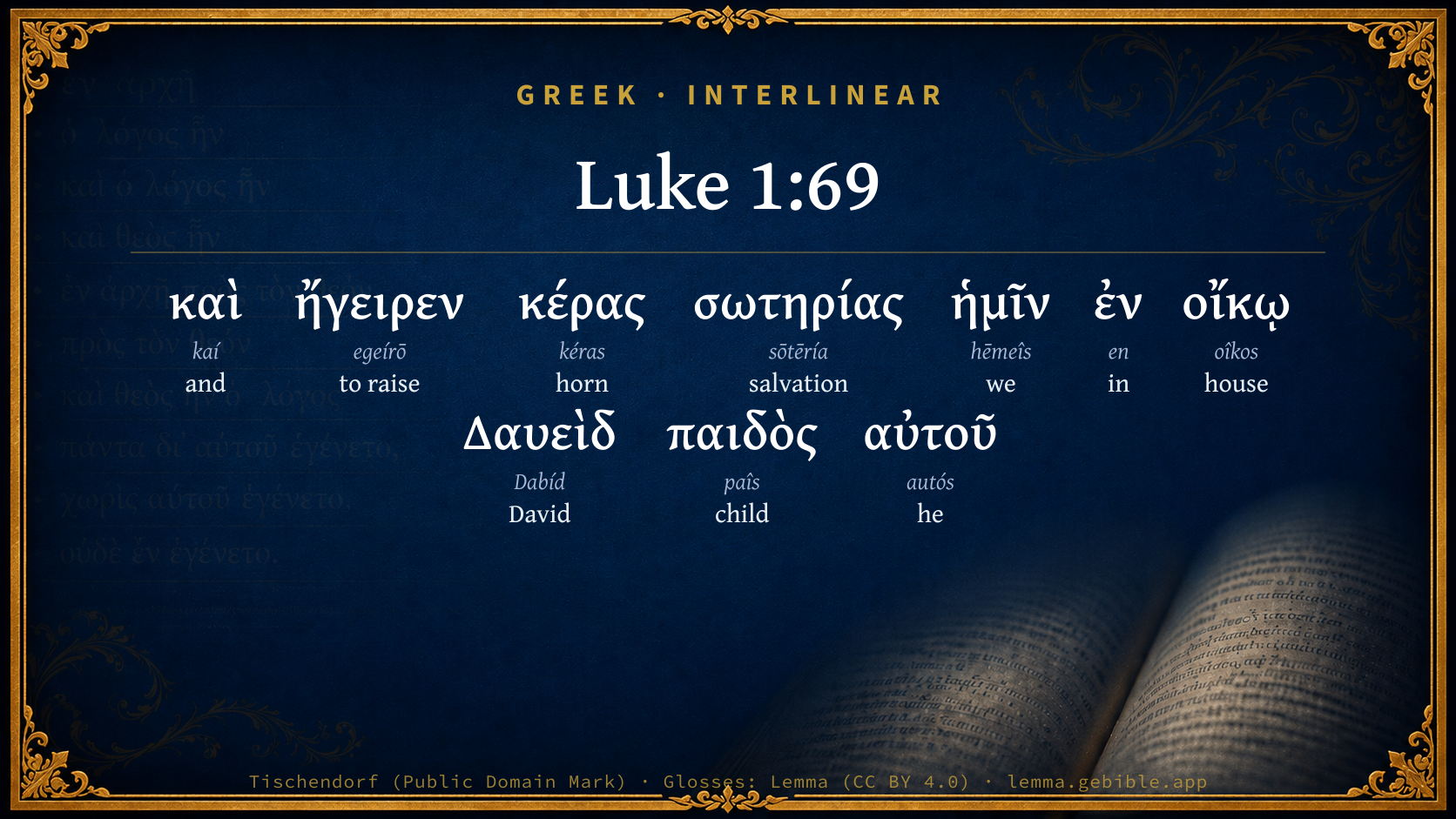
Download image
Cite this verse

Luke 1:69 (World English Bible). Public Domain. Lemma interlinear Bible study tool, https://lemma.gebible.app/v/luke/1/69.

Show BibTeX & RIS
BibTeX
RIS
English Translation
And has raised up a horn of salvation for us in the house of his servant David
World English Bible · Public Domain
Highlights
  • 2 first appearances in the Greek New Testament
Full analysis ↓
Download a study sheet

One document with this verse’s original text, its word-by-word gloss line, the meaning frame, cross-references with their text, attributed commentary, and full source and license credits — printable, and it pastes into notes with its structure intact.

This verse Autodidact and up

Study sheet (.html) Plain text (.txt)

A passage Seminary Student

Up to 50 verses in one chapter. A passage sheet keeps up to 6 commentary sources and 12 cross-references per verse, in the order this page ranks them, and says so on the sheet whenever that leaves anything out. Ask for a single verse and you get the Autodidact verse sheet above.

Everything on this page stays free to read, with no account — the sheet is a download of what is already on screen, not access to it.

Want to remove ads? Support Godless Engineer
Compare translations 3

The same verse in 3 English versions, stacked beneath the original-language interlinear above. Click any original word for its lexicon entry.

Each is an independent rendering of the whole verse — the interlinear is not word-aligned to these translations.

Highlighted words mark where these versions differ — a whole-verse word diff, not a word-by-word alignment.

  • World English Bible Public Domain
    And has raised up a horn of salvation for us in the house of his servant David
  • King James Version Public Domain
    And hath raised up an horn of salvation for us in the house of his servant David;
  • unfoldingWord Literal Text CC BY-SA 4.0
    And he has raised up a horn of salvation for us in the house of his servant David

unfoldingWord Literal Text — © unfoldingWord, licensed CC BY-SA 4.0. Word-aligned USFM3 via Door43 (git.door43.org/unfoldingWord/en_ult).

Versions to compare (up to 4)

3 of 4 selected

Show all 19 translations

Every available English version of this verse, each an independent rendering of the whole verse.

  • World English Bible Public Domain
    And has raised up a horn of salvation for us in the house of his servant David
  • Berean Standard Bible Public Domain
    He has raised up a horn of salvation for us in the house of His servant David,
  • Majority Standard Bible Public Domain
    He has raised up a horn of salvation for us in the house of His servant David,
  • King James Version Public Domain
    And hath raised up an horn of salvation for us in the house of his servant David;
  • American Standard Version (1901) Public Domain
    And hath raised up a horn of salvation for us In the house of his servant David
  • Revised Version (1885) Public Domain
    And hath raised up a horn of salvation for us In the house of his servant David
  • Geneva Bible (1599) Public Domain
    And hath raised vp the horne of saluation vnto vs, in the house of his seruant Dauid,
  • Douay-Rheims (1899) Public Domain
    And hath raised up an horn of salvation to us, in the house of David his servant:
  • Young's Literal Translation Public Domain
    And did raise an horn of salvation to us, In the house of David His servant,
  • Literal Standard Version CC BY-SA 4.0
    And raised a horn of salvation to us, || In the house of His servant David,
  • Unlocked Literal Bible CC BY-SA 4.0
    He has raised up a horn of salvation for us in the house of his servant David
  • unfoldingWord Literal Text CC BY-SA 4.0
    And he has raised up a horn of salvation for us in the house of his servant David
  • Darby Bible Public Domain
    and raised up a horn of deliverance for us in the house of David his servant;
  • World Messianic Bible Public Domain
    and has raised up a horn of salvation for us in the house of his servant David
  • Webster's Bible Public Domain
    And hath raised up a horn of salvation for us, in the house of his servant David:
  • Free Bible Version CC BY-SA 4.0
    He has given us a great Savior from the line of his servant David,
  • Bible in Basic English Public Domain
    Lifting up a horn of salvation for us in the house of his servant David,
  • Text-Critical English NT CC BY 4.0
    He has raised up for us a horn of salvation in the house of his servant David
  • Tyndale New Testament (1534) Public Domain
    And hath reysed vp an horne of salvacion vnto vs in the housse of his servaunt David.

Literal Standard Version (2020), Covenant Press — licensed CC BY-SA 4.0. Text via the HelloAO Bible API (eBible.org). Unlocked Literal Bible (unfoldingWord) — licensed CC BY-SA 4.0. Text via the HelloAO Bible API (eBible.org). unfoldingWord Literal Text — © unfoldingWord, licensed CC BY-SA 4.0. Word-aligned USFM3 via Door43 (git.door43.org/unfoldingWord/en_ult). Free Bible Version, Dr. Jonathan Gallagher — licensed CC BY-SA 4.0. Text via the HelloAO Bible API (eBible.org).

Word by word

More ways to search: Search by grammar → Find every occurrence → Compare this word →

Practice this passage: Drill this verse → Learn its vocabulary →

κέρας
kéras
G2768
“horn”
Noun, Accusative, Singular, Neuter
Part of Speech
Noun
Case
Accusative
Number
Singular
Gender
Neuter
Full Thayer's Definition

Origin: from a primary kar (the hair of the head)

TDNT: 14:09,4

1. a horn a. of animals b. since animals (esp. bulls) defend themselves with their horns, the horn with the Hebrews (and other nations) is a symbol of strength and courage, and used as such in a variety of phrases 1. a mighty and valiant helper, the author of deliverance, of the Messiah c. a projecting extremity in a shape like a horn, a point, apex: as of an altar
  1. καὶ kaí G2532 “and” Conjunction
  2. ἤγειρεν egeírō G1453 “to raise” Verb, Aorist, Active, Indicative, 3rd person, Singular
  3. σωτηρίας sōtēría G4991 “salvation” Noun, Genitive, Singular, Feminine
  4. ἡμῖν hēmeîs G2249 “we” Personal pronoun, 1st person, Dative, Plural
  5. ἐν en G1722 “in” Preposition
  6. οἴκῳ oîkos G3624 “house” Noun, Dative, Singular, Masculine
  7. Δαυεὶδ Dabíd G1138 “David” Noun, Proper, indeclinable
  8. παιδὸς paîs G3816 “child” Noun, Genitive, Singular, Masculine
  9. αὐτοῦ autós G846 “he” Personal pronoun, Genitive, Singular, Masculine

About this verse

These counts appear in no published source. They are computed here, from the morphology-tagged text and Lemma’s own curated glosses. What Lemma adds →

10
words
10
distinct lemmas
Gospels
section

Notable vocabulary

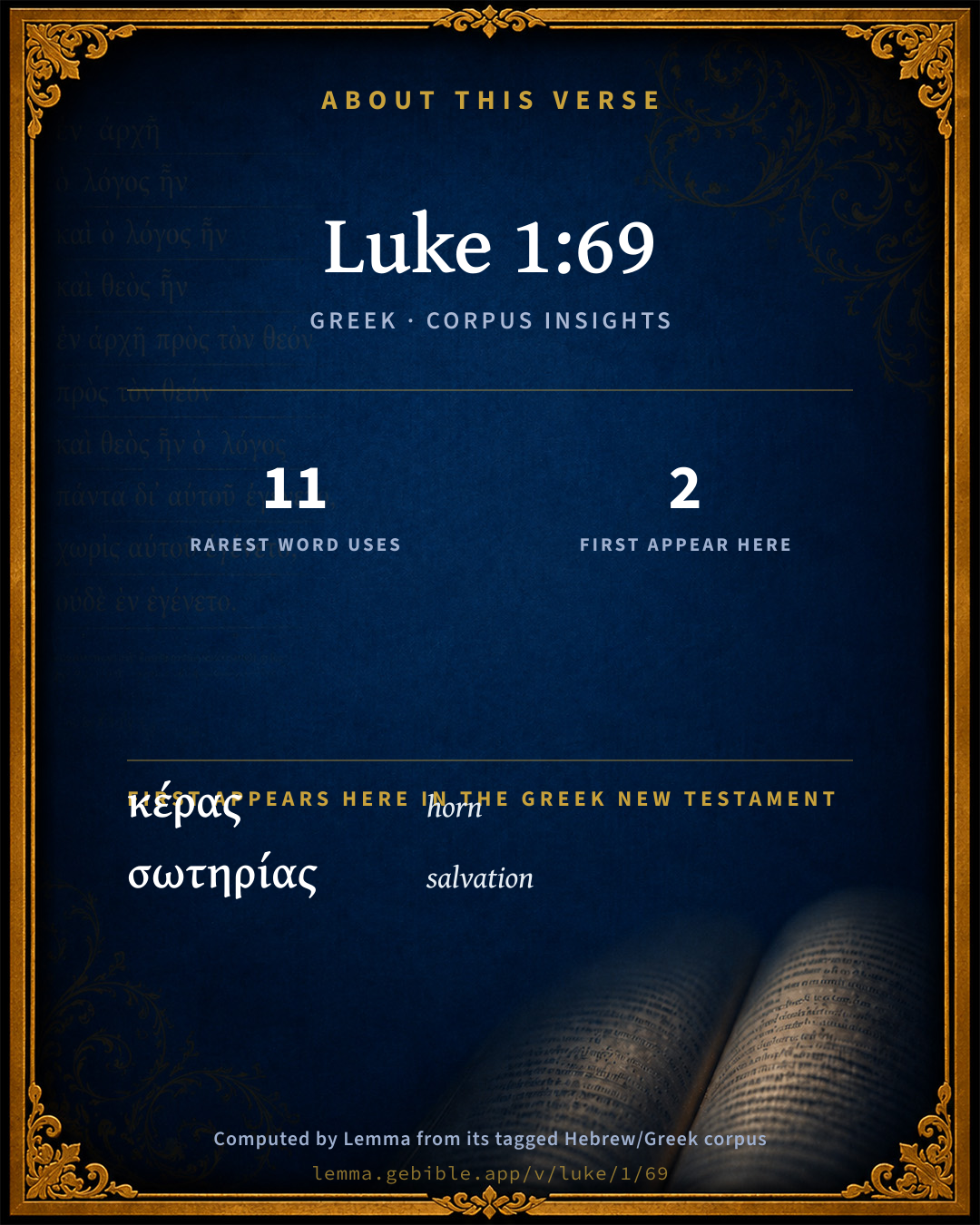
The rarest word here is κέρας horn G2768 — appearing just 11 times in the whole Greek New Testament.

First appearance in Scripture

These words make their first canonical appearance in the Greek New Testament here:

  • κέρας horn G2768
  • σωτηρίας salvation G4991

Shared distinctive vocabulary

κέρας horn G2768 occurs in 10 verses of the Greek New Testament. Also found in:
Cross-references

22

Topical passages linked to Luke 1:69 in the Treasury of Scripture Knowledge — connected by theme and wording, ordered by reader-vote popularity; previews shown in the World English Bible.

  • Psalms 18:2 Yahweh is my rock, my fortress, and my deliverer; My God, my rock, in whom I take refuge; My shield, and the horn of my salvation, my high tower.
  • Ezekiel 29:21 In that day will I cause a horn to bud forth to the house of Israel, and I will give you the opening of the mouth in the midst of them; and they shall know that I am Yahweh.
  • 2 Samuel 22:3 God, my rock, in him will I take refuge; My shield, and the horn of my salvation, my high tower, and my refuge; My savior, you save me from violence.
  • 1 Samuel 2:10 Those who strive with Yahweh shall be broken to pieces; Against them will he thunder in the sky: Yahweh will judge the ends of the earth; He will give strength to his king, Exalt the horn of his anointed.
  • Psalms 89:17 For you are the glory of their strength. In your favor, our horn will be exalted.
  • 1 Samuel 2:1 Hannah prayed, and said: My heart exults in Yahweh; My horn is exalted in Yahweh; My mouth is enlarged over my enemies; Because I rejoice in your salvation.
  • Isaiah 9:6–7 For to us a child is born, to us a son is given; and the government shall be on his shoulder: and his name shall be called Wonderful, Counselor, Mighty God, Everlasting Father, Prince of Peace.
  • Isaiah 11:1–9 There shall come forth a shoot out of the stock of Jesse, and a branch out of his roots shall bear fruit.
  • Jeremiah 33:15–26 In those days, and at that time, will I cause a Branch of righteousness to grow up to David; and he shall execute justice and righteousness in the land.
  • Mark 11:10 Blessed is the kingdom of our father David that is coming in the name of the Lord! Hosanna in the highest!"
  • Psalms 132:17–18 There I will make the horn of David to bud. I have ordained a lamp for my anointed.
  • Jeremiah 23:5–6 Behold, the days come, says Yahweh, that I will raise to David a righteous Branch, and he shall reign as king and deal wisely, and shall execute justice and righteousness in the land.
  • Ezekiel 34:23–24 I will set up one shepherd over them, and he shall feed them, even my servant David; he shall feed them, and he shall be their shepherd.
  • Amos 9:11 In that day I will raise up the tent of David who is fallen, and close up its breaches, and I will raise up its ruins, and I will build it as in the days of old;
  • Romans 1:2–3 which he promised before through his prophets in the holy Scriptures,
  • Revelation 22:16 I, Jesus, have sent my angel to testify these things to you for the assemblies. I am the root and the offspring of David; the Bright and Morning Star."
  • 2 Samuel 7:26 Let your name be magnified forever, saying, Yahweh of hosts is God over Israel; and the house of your servant David shall be established before you.
  • 1 Kings 11:13 However I will not tear away all the kingdom; but I will give one tribe to your son, for David my servant's sake, and for Jerusalem's sake which I have chosen.
  • Psalms 89:3 "I have made a covenant with my chosen one, I have sworn to David, my servant,
  • Psalms 89:20–37 I have found David, my servant. I have anointed him with my holy oil,
  • Ezekiel 37:24–25 My servant David shall be king over them; and they all shall have one shepherd: they shall also walk in my ordinances, and observe my statutes, and do them.
  • Matthew 1:1 The book of the generation of Jesus Christ, the son of David, the son of Abraham.

Cross-references courtesy of OpenBible.info (CC BY 4.0).

Commentary

Notes on Luke 1:69 from classic Christian and Jewish commentators (each source and its license shown beneath its notes). The classic Christian expositions comment on the surrounding passage and are grouped to its opening verse, so a note may address several verses; the Jewish commentaries on the Tanakh (Rashi and others) are per-verse, so they appear only where the commentator wrote on this verse.

Lemma curates 59 commentaries, every one of them public domain or Creative Commons licensed, each selected and text-cleaned for this edition rather than reprinted as found. About our sources →

Tyndale Open Study Notes

Tyndale Open Resources

1:69 He has sent us a mighty Savior (literally has raised up a horn of salvation for us): A “horn of salvation” was the horn of a powerful animal such as a ram or an ox. To “raise up a horn” implies strength and power (see also Pss 89:24; 132:17). • from the royal line of his servant David: See study note on Luke 1:32-33.

Tyndale Open Study Notes — © Tyndale Open Resources, licensed CC BY-SA 4.0. Text via the HelloAO Bible API.

Bengel's Gnomon

Johann Albrecht Bengel

Luk 1:69. Κέρας, a horn) Psa 132:17. This term signifies abundance and kingly strength. The article was not suitable to be added at that early period. So also Luk 1:68; Luk 1:71; Luk 1:78. Afterwards the fact of itself claimed these names more openly as belonging to Jesus Christ alone.—σωτηρίας, of salvation) In allusion to the name, Jesus: comp. Luk 1:71; Luk 1:77. John only gave the knowledge of salvation: the Lord gave salvation itself.—Δαυὶδ, David) Psa 132:17; Psa 132:6.—παιδὸς) עבד, servant, Psa 132:10.

Bengel's Gnomon of the New Testament — English translation (T&T Clark, Edinburgh, 1860) — public domain. Text from a community e-Sword module.

Expositor's Greek Testament

ed. W. Robertson Nicoll

Luk 1:69 . κέρας σ . = βασιλείαν , because kings were anointed with a horn of oil, or = δύναμιν , because in their horn all horned animals have their power (Euthy. Zig.); a thoroughly Hebrew symbol. ἐν οἴκῳ Δ ., pointing to a descendant of David, who has wrought signal deliverance for Israel.

The Expositor's Greek Testament, edited by W. Robertson Nicoll (1897–1910) — public domain. Text from a community e-Sword module.

Geneva Bible (1599)

Geneva Bible translators

This word Horn in the Hebrew tongue signifieth might, and it is a Metaphor, taken from beasts, that fight with their horns: and by raising up the might of Israel, is meant, that the kingdom of Israel was defended, and the enemies thereof laid on the ground, even then when the strength of Israel seemed to be utterly decayed.

Geneva Bible (1599) marginal notes — public domain. Text via Bolls.life.

Jamieson, Fausset & Brown

Robert Jamieson, A. R. Fausset & David Brown

horn of salvation--that is "strength of salvation," or "mighty Salvation," meaning the Saviour Himself, whom Simeon calls "Thy Salvation" (Luk 2:30). The metaphor is taken from those animals whose strength is in their horns (Psa 18:2; Psa 75:10; Psa 132:17).

house of . . . David--This shows that Mary must have been known to be of the royal line, independent of Joseph; of whom Zacharias, if he knew anything, could not know that after this he would recognize Mary.

Jamieson, Fausset & Brown — Commentary Critical and Explanatory on the Whole Bible (1871) — public domain (CC PDM 1.0). Text via the HelloAO Bible API.

Adam Clarke's Commentary

Verse 69. And hath raised up a horn of salvation] That is, a mighty and glorious Saviour: a quotation from Ps 18:2. Horns are the well known emblems of strength, glory, and power, both in the sacred and profane writers, because the strength and beauty of horned animals consist in their horns. Horns have also been considered as emblems of light; therefore the heathen god Apollo is represented with horns, to point out the power, glory, and excellence of the solar light. The Chaldee paraphrast sometimes translates קרן keren, horn, by מלכות malcuth, or מלכותא malcutha, 1Sa 2:10; Jer 48:25, which signify a kingdom: but it is likely that the allusion is here made to the horns of the altar; and as the altar was a place of refuge and safety, and those who laid hold on its horns were considered to be under the protection of the Lord, so, according to the expression of Zacharias, Jesus Christ is a new altar, to which whosoever flees shall find refuge.

Some imagine that this form of speech is taken from the custom of ancient warriors, who had a horn of steel on the top of their helmets, which ordinarily lay flat, till the person came victorious from battle, and then it was erected, as emblematical of the victory gained. Such a horn as this is represented on the helmet of the Abyssinian kings and warriors: see the plates in Bruce's Travels. To this custom of wearing or lifting up the horn, the following scriptures are thought to allude: 1Sa 2:10; Ps 112:9; Ps 148:4; La 2:17. In ancient gems and coins, this form of the horn on helmets is easily discernible, sometimes flat, sometimes erected. A horn, filled with various fruits, was also the emblem of abundance among the ancients: hence their cornu copia, or horn of plenty. From all this we may learn that the Lord Jesus gives a luminous, powerfuly prevalent, glorious, and abundant SALVATION or REFUGE to mankind.

In the house of his servant David] Or, in the family: so the word οικος, house, is often used in the Sacred Writings. In Lu 1:32, the angel states that Mary was of the family of David; and Zacharias, who, from the nature of his office, must have been well acquainted with the public genealogical tables, attests the same thing. This is a matter of considerable importance; because it shows forth the truth of all the prophetic declarations, which uniformly state that the Messiah should come from the family and sit on the throne of DAVID.

Adam Clarke's Commentary on the Bible (1810–1826) — public domain. Text from a community e-Sword/MySword module.

Ellicott's Commentary for English Readers

(69) Hath raised up an horn of salvation.—The symbolism of the horn comes from Psa_132:17, where it is used of the representative of the House of David, and answers to the “Anointed” of the other clause of the verse. It originated obviously in the impression made by the horns of the bull or stag, as the symbols of strength. Here, following in the steps of the Psalmist, Zacharias uses it as a description of the coming Christ, who is to be raised up in the House of David.

A Bible Commentary for English Readers, edited by Charles John Ellicott (1878–1897) — public domain. Text from a community e-Sword module.

The Cambridge Bible for Schools and Colleges

gen. ed. J. J. S. Perowne

69. a horn of salvation] A natural and frequent metaphor. Eze_29:21, “In that day will I cause the horn of the house of Israel to bud forth.” Lam_2:3, “He hath cut off … all the horn of Israel.” Psa_132:17; 1Sa_2:10, “He shall exalt the horn of His anointed.” A Rabbinic writer says that there are ten horns—those of Abraham, Isaac, Joseph, Moses, the horn of the Law, of the Priesthood, of the Temple, and of Israel; and some add of the Messiah. They were all placed on the heads of the Israelites till they sinned, and then they were cut off and given to the Gentiles. Schöttgen, Hor. Hebr. ad loc. We find the same metaphor in classic writers. “Tunc pauper cornua sumit,” Ov. Art. Am. i. 239; “addis cornua pauperi,” Hor. Od. iii. xxi. 18.

his servant] The word does not here mean ‘son’ in the original, being the rendering of the Hebrew ebed, Psa_132:10.

The Cambridge Bible for Schools and Colleges (gen. ed. J. J. S. Perowne; Cambridge University Press, 1878–1918) — public domain. Text from a community e-Sword module.

John Gill's Exposition

And hath raised up an horn of salvation for us,.... Meaning the Messiah, whom God had now raised up:

in the house of his servant David; in David's family, he being now conceived by a virgin of his house; and who, in a little time, would be born in Bethlehem, the city of David. He is called "an horn of salvation", because he is a powerful Saviour. "Horn" denotes power; it being that to a beast, as the arm is to a man, by which it defends itself, and pushes down its enemies; and "salvation" is the work Christ came to effect, and for which he was raised up, and sent: and a Saviour he is, and a mighty one, as appears from his doing and suffering what he has; as bearing all the sins of his people, and making reconciliation for them; obeying all the precepts of the law, and undergoing the penalty of it; being made a curse, and becoming obedient to death, even the death of the cross: as also, from his delivering them from sin, Satan, and the law, which no other could have done; and from his grappling with, conquering, spoiling, and destroying all his, and our enemies. Moreover, the word "horn" signifies regal power, honour, and dignity; see Dan 7:24 and so may not only denote the work of Christ as a Saviour, but his office also as a King, who in the discharge of that is likewise a Saviour; for he not only rules, and governs, but protects, defends, and preserves his, people, by his power; see Sa1 2:10.

John Gill's Exposition of the Whole Bible (1746–1763) — public domain (CC PDM 1.0). Text via the HelloAO Bible API.

Trapp's Complete Commentary

John Trapp

69 And hath raised up an horn of salvation for us in the house of his servant David;

Ver. 69. An horn of salvation] A cornucopia, or a mighty Saviour, qui instar bovis cornupetae inimicos populi Dei prosternat atque deieciat (Piscater), that can bestir him much better than that he-goat, Alexander the Great, who had a notable horn between his eyes, wherewith he cast down the ram to the ground, and stamped upon him, &c., Dan 8:7. Macedones tunc temporis Aegeades, id est caprini dicti sunt. Occasionem vide. (Justin. lib. 7.) The Macedons were at that time called Goat-sprung.

John Trapp, A Commentary or Exposition upon All the Books of the Old and New Testament (1647–1656) — public domain. Text from a community e-Sword module.

Albert Barnes' Notes on the Bible

And hath raised up a horn - A horn is a symbol of strength. The figure is taken from the fact that in horned animals the strength lies in the “horn.” Particularly, the great power of the rhinoceros or unicorn is manifested by the use of a single horn of great “strength,” placed on the head near the end of the nose. When the sacred writers, therefore, speak of great strength they often use the word “horn,” Psa 148:14; Deu 33:17; Dan 7:7-8; Dan 7:21. The word salvation, connected here with the word “horn,” means that this “strength,” or this mighty Redeemer, was able to save. It is possible that this whole figure may be taken from the Jewish “altar.” On each of the four corners of the altar there was an eminence or small projection called a “horn.” To this persons might flee for safety when in danger, and be safe, 1Ki 1:50; 1Ki 2:28. Compare the notes at Luk 1:11. So the Redeemer “may be” called the “horn of salvation,” because those who flee to him are safe.

In the house - In the family, or among the descendants of David.

Albert Barnes' Notes on the Bible (1834–1885) — public domain. Text from a community e-Sword/MySword module.

Haydock's Catholic Bible Commentary

As Christ was born of the race of David, he is here called the horn of salvation in the house of David. As Isaias says, a vineyard is planted in the horn, chap. v. --- A powerful salvation.[10] According to the letter both of the Latin and Greek text, a horn of salvation. But as it is generally agreed, that by horn, in the phraseology of the Scriptures, is understood strength and power, and that horn sounds awkwardly in English, and other languages, I hope it may be literally enough translated, a powerful salvation. (Witham)

===============================

[BIBLIOGRAPHY]

Cornu salutis, Greek: keras soterias. Abscissum est cornu Moab. (Jeremias xlviii. 25.) Cornu David. (Psalm lxxiv. 5.) See also Psalm cxxxi. 17, &c.

George Leo Haydock (1774–1849), Haydock's Catholic Family Bible and Commentary, 1859 edition — public domain. Excludes Psalms (Douay-Rheims chapter numbering differs from Protestant) and Deuterocanonical books (Catholic canon only).

Whedon's Commentary on the Bible

Daniel D. Whedon

69. Raised up a horn of salvation—This image of his Church is taken from nature, after the simplicity of primitive times. A horn is the strength, power, and beauty of the animal that wears it; and so it became an image of power, both in the ancient classic writers and in the Old Testament. So Psa_132:17 : “I will make the horn of David to bud.” From signifying power as a quality, the word is made to signify a power, kingdom, or king.

Rev_17:12 : “The ten horns thou sawest are ten kings.”

Jer_48:25 : “The horn of Moab is cut off.” So here it is applied to the Messiah about to be born.

House—Family lineage, as we say, The house of Bourbon, or of Brunswick.

Daniel D. Whedon (gen. ed.), Commentary on the Old and New Testaments (1874–1909) — public domain. Text from a community e-Sword module.

John Wesley's Explanatory Notes

A horn - Signifies honour, plenty, and strength. A horn of salvation - That is, a glorious and mighty saviour.

John Wesley, Explanatory Notes Upon the Whole Bible (1754–1765) — public domain. Text via the GEBible commentary corpus.

Scofield Reference Notes

C. I. Scofield

horn of

(See Scofield "Rom 1:16")

The Scofield Reference Bible (1917 edition), notes by C. I. Scofield — public domain. Text from a community e-Sword module.

unfoldingWord translationNotes

Door43 World Missions Community

He has raised up a horn of salvation for us

The horn of an animal is a symbol of its power to defend itself. To raise up here is to bring into existence or to enable to act. The Messiah is spoken of as if he were a horn with the power to save Israel. AT: "He has brought to us someone with the power to save us" (See: Metaphor)

in the house of his servant David

David's "house" here represents his family, specifically, his descendants. AT: "in the family of his servant David" or "who is a descendant of his servant David" (See: Metonymy)

as he spoke

"just as God said"

he spoke by the mouth of his holy prophets from long ago

God speaking by the prophets' mouths represents God causing his prophets to say what he wanted them to say. AT: "he caused his holy prophets who lived long ago to say" (See: Metonymy)

from long ago), salvation from our enemies

The abstract noun "salvation" can be expressed with the verbs "save" or "rescue." AT: "from long ago). He will save us from our enemies" (See: Abstract Nouns)

our enemies ... all who hate us

These two phrases mean basically the same thing and are repeated to emphasize how strongly their enemies are against them. (See: Parallelism)

hand

The hand is a metonym for the power that the person uses the hand to exercise. AT: "power" or "control" (See: Metonymy)

translationWords

save

descend

house of David

servant

David

holy

prophet

hand

unfoldingWord translationNotes — © Distant Shores Media and the Door43 World Missions Community, licensed CC BY-SA 4.0. Source: git.door43.org/Door43/en_tn.

Cambridge Greek Testament for Schools and Colleges

69. κέρας σωτηρίας. A natural and frequent metaphor. Eze 29:21, “In that day will I cause the horn of the house of Israel to bud forth.” Lam 2:3, “He hath cut off … all the horn of Israel.” Psa 132:17; 1Sa 2:10, “He shall exalt the horn of His anointed.” (A Rabbinic writer says that there are ten horns—those of Abraham, Isaac, Joseph, Moses, the horn of the Law, of the Priesthood, of the Temple, and of Israel; and some add of the Messiah. They were all placed on the heads of the Israelites till they sinned, and then they were cut off and given to the Gentiles. Schöttgen, Hor. Hebr. ad loc.) We find the same metaphor in classic writers. “Tunc pauper cornua sumit,” Ov. Art. Am. I. 239; “addis cornua pauperi,” Hor. Od. III. xxi.18. The expression has nothing to do with the horns of the altar, 1Ki 1:50, &c.

παιδὸς αὐτοῦ. The word does not here mean ‘son’ in the original, but ‘servant’ being the rendering of the Hebrew ebed, Psa 132:10.

Cambridge Greek Testament for Schools and Colleges (Cambridge University Press, 1896; 21 vols, various authors incl. Carr, Maclear, Plummer, Farrar, Lumby, Moule, M. R. James, Simcox) — public domain. Text from a community e-Sword module.

Alford’s Greek Testament

Henry Alford

69.] κέρας—a metaphor from horned beasts, who are weak and defenceless without, but formidable with their horns: see reff.; and cf. Hor. Od. iii. 21. 18, ‘addis cornua pauperi.’ There does not seem to be any allusion (Selden, &c.) to the horns of the altar—the mere notion of a refuge is never connected with the Messiah’s Kingdom.

Henry Alford, The Greek Testament (1849–1861) — public domain. Text from a community e-Sword module.

International Critical Commentary

69. καὶ ἤγειρεν κέρας σωτηρίας ἡμῖν. For this use of ἐγείρω comp. ἤγειρεν Κύριος σωτῆρα τῷ Ἰσραήν (Jdg 3:9, Jdg 3:15). In Eze 29:21 and Psa 132:17 the verb used is ἀνατέλλω or ἐξανατέλλω (see table). The metaphor of the horn is very freq, in O.T. (1Sa 2:10; 2Sa 22:3; Psa 75:5, Psa 75:6, 11, etc.), and is taken neither from the horns of the altar, nor from the peaks of helmets or head-dresses, but from the horns of animals, especially bulls. It represents, therefore, primarily, neither safety nor dignity, but strength. The wild-ox, wrongly called “unicorn” in AV., was Proverbial for strength (Num 24:8; Job 39:9-11 ; Deu 33:17). In Horace we have addis cornua pauperi, and to Ovid tum pauper cornua sumit. In Psa 18:3 God is called a κέρας σωτηρίας. See below on ver. 71. For παιδὸς αὐτοῦ see on ver. 54. “In the house of His servant David” is all the more true if Mary was of the house of David. But the fact that Jesus was the heir of Joseph is sufficient, and this verse is no proof of Mary’s descent from David.

International Critical Commentary — older volumes (1896–1929), various authors — public domain. Text from a community e-Sword module.

Vincent's Word Studies in the New Testament

Marvin R. Vincent

Horn. Compare Psa 132:17.

Marvin R. Vincent, Word Studies in the New Testament (1887–1900) — public domain. Text from a community e-Sword/MySword module.

Lesson kit

Teaching starters — assembled from the data on this page, not authored interpretation. Every prompt links to the verse data it draws on. Edit before teaching.

Luke, in the Gospels, opens this verse with 10 words (10 distinct Greek lemmas). Its most distinctive word is kéras (“horn”). A historical commentator’s framing appears above. Read the whole chapter for the surrounding context.

Discussion questions

  1. What does “horn” (kéras) contribute to the verse as a whole?
  2. 2 words make their first appearance in Scripture here. What does this debut establish?
  3. How does Revelation 5:6, which shares the word «horn», read alongside this verse?
  4. These translations render this verse differently; the difference is in the English rendering, not the original. What questions does that raise?
  5. Compare how Tyndale Open Study Notes and Bengel's Gnomon read this verse. Where do they agree or differ?

Things to notice

  • 2 words make their first canonical appearance in Scripture here.
  • These translations choose different wording for 1 word in this verse.
  • 10 distinct Greek lemmas span 10 words in this verse.

Reading settings

Reading text

Shown beneath each verse's original-language words.

Old Testament
Old Testament edition

Read the OT as the Masoretic Hebrew (MT) or the Greek Septuagint (LXX).

English shown for the Greek Septuagint (in the Hebrew ↔ Greek comparison).

Comparing translations? Open the Compare panel on any verse page to stack up to four side by side.