

Mark 15:19
Greek (Tischendorf 8th ed.) Mark 15:19 appears in the Greek New Testament. The text above is from the Tischendorf 8th edition. Each word links to its Strong’s number and a concise gloss. Click any word for its full Thayer’s Greek Lexicon entry.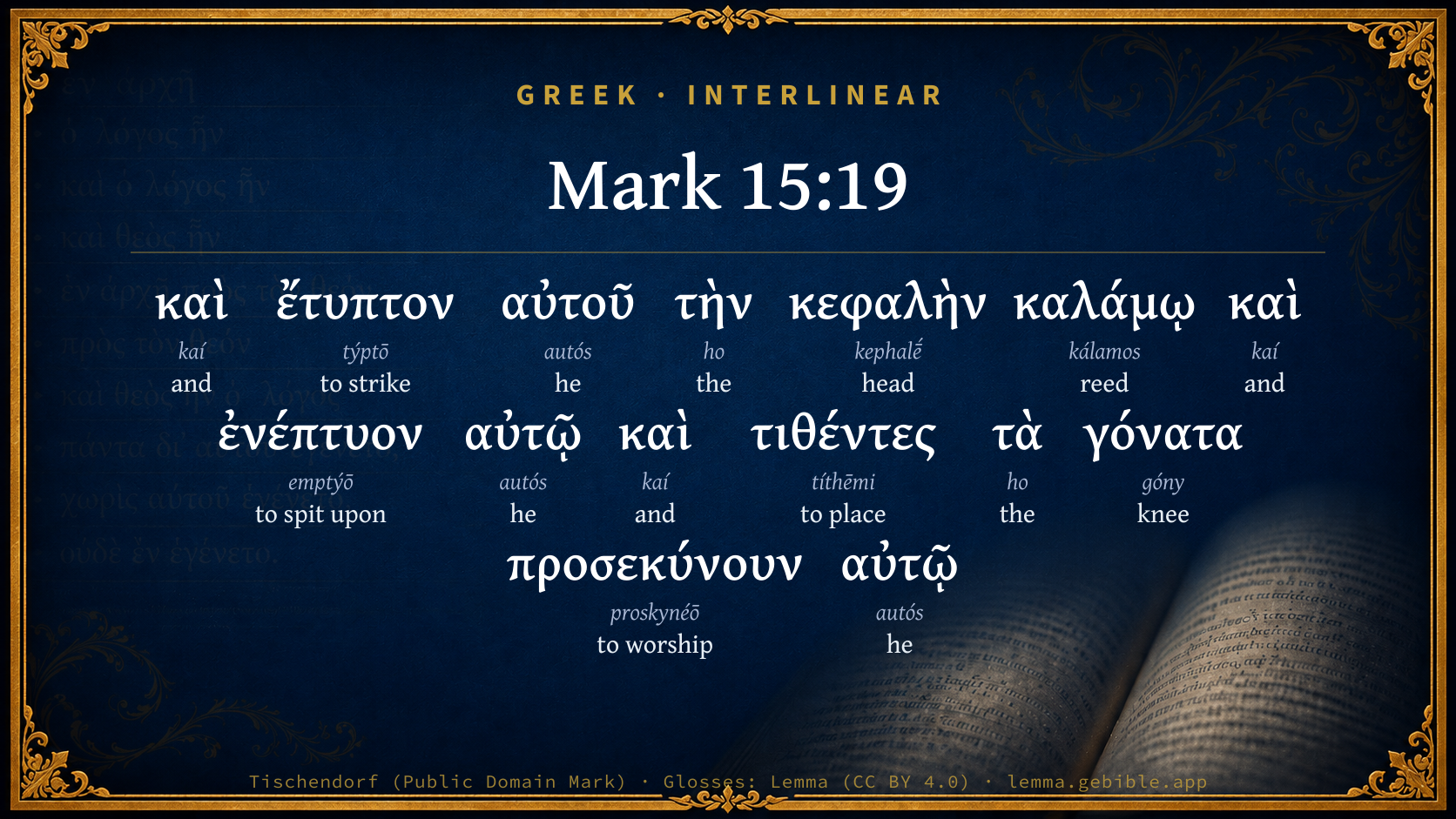
They struck his head with a reed, and spat on him, and bowing their knees, did homage to him.
Download a study sheet
One document with this verse’s original text, its word-by-word gloss line, the meaning frame, cross-references with their text, attributed commentary, and full source and license credits — printable, and it pastes into notes with its structure intact.
This verse Autodidact and up
A passage Seminary Student
Up to 50 verses in one chapter. A passage sheet keeps up to 6 commentary sources and 12 cross-references per verse, in the order this page ranks them, and says so on the sheet whenever that leaves anything out. Ask for a single verse and you get the Autodidact verse sheet above.
Everything on this page stays free to read, with no account — the sheet is a download of what is already on screen, not access to it.
Compare translations 3
The same verse in 3 English versions, stacked beneath the original-language interlinear above. Click any original word for its lexicon entry.
Each is an independent rendering of the whole verse — the interlinear is not word-aligned to these translations.
Highlighted words mark where these versions differ — a whole-verse word diff, not a word-by-word alignment.
-
World English Bible Public Domain
They struck his head with a reed, and spat on him, and bowing their knees, did homage to him.
-
King James Version Public Domain
And they smote him on the head with a reed, and did spit upon him, and bowing their knees worshipped him.
-
unfoldingWord Literal Text CC BY-SA 4.0
And they were striking his head with a reed and spitting on him, and bending the knee, they were bowing down to him.
unfoldingWord Literal Text — © unfoldingWord, licensed CC BY-SA 4.0. Word-aligned USFM3 via Door43 (git.door43.org/unfoldingWord/en_ult).
Show all 19 translations
Every available English version of this verse, each an independent rendering of the whole verse.
-
World English Bible Public Domain
They struck his head with a reed, and spat on him, and bowing their knees, did homage to him.
-
Berean Standard Bible Public Domain
They kept striking His head with a staff and spitting on Him. And they knelt down and bowed before Him.
-
Majority Standard Bible Public Domain
They kept striking His head with a staff and spitting on Him. And they knelt down and bowed before Him.
-
King James Version Public Domain
And they smote him on the head with a reed, and did spit upon him, and bowing their knees worshipped him.
-
American Standard Version (1901) Public Domain
And they smote his head with a reed, and spat upon him, and bowing their knees worshipped him.
-
Revised Version (1885) Public Domain
And they smote his head with a reed, and did spit upon him, and bowing their knees worshipped him.
-
Geneva Bible (1599) Public Domain
And they smote him on the head with a reede, and spat vpon him, and bowed the knees, and did him reuerence.
-
Douay-Rheims (1899) Public Domain
And they struck his head with a reed: and they did spit on him. And bowing their knees, they adored him.
-
Young's Literal Translation Public Domain
And they were smiting him on the head with a reed, and were spitting on him, and having bent the knee, were bowing to him,
-
Literal Standard Version CC BY-SA 4.0
And they were striking Him on the head with a reed, and were spitting on Him, and having bent the knee, were prostrating to Him,
-
Unlocked Literal Bible CC BY-SA 4.0
They struck his head with a reed staff and they spat on him. They bent their knees before him to pretend to worship him.
-
unfoldingWord Literal Text CC BY-SA 4.0
And they were striking his head with a reed and spitting on him, and bending the knee, they were bowing down to him.
-
Darby Bible Public Domain
And they struck his head with a reed, and spat on him, and, bending the knee, did him homage.
-
World Messianic Bible Public Domain
They struck his head with a reed and spat on him, and bowing their knees, did homage to him.
-
Webster's Bible Public Domain
And they struck him on the head with a reed, and spit upon him, and bowing their knees, worshiped him.
-
Free Bible Version CC BY-SA 4.0
They repeatedly beat him around the head with a rod, spat at him, and fell on their knees before him as if in worship.
-
Bible in Basic English Public Domain
And they gave him blows on the head with a stick and put shame on him and, going down on their knees, gave him worship.
-
Text-Critical English NT CC BY 4.0
They kept beating him on the head with a reed, spitting on him, and bending down on their knees to pay homage to him.
-
Tyndale New Testament (1534) Public Domain
And they smoote him on the heed with a rede and spat apon him and kneled doune and worsheped him.
Literal Standard Version (2020), Covenant Press — licensed CC BY-SA 4.0. Text via the HelloAO Bible API (eBible.org). Unlocked Literal Bible (unfoldingWord) — licensed CC BY-SA 4.0. Text via the HelloAO Bible API (eBible.org). unfoldingWord Literal Text — © unfoldingWord, licensed CC BY-SA 4.0. Word-aligned USFM3 via Door43 (git.door43.org/unfoldingWord/en_ult). Free Bible Version, Dr. Jonathan Gallagher — licensed CC BY-SA 4.0. Text via the HelloAO Bible API (eBible.org).
Word by word
More ways to search: Search by grammar → Find every occurrence → Compare this word →
Practice this passage: Drill this verse → Learn its vocabulary →
- Appears 6× in the Greek New Testament
- First appears at Matthew 26:67
- Part of Speech
- Verb
- Tense
- Imperfect
- Voice
- Active
- Mood
- Indicative
- Person
- 3rd person
- Number
- Plural
Full Thayer's Definition
- καὶ kaí G2532 “and” Conjunction
- ἔτυπτον týptō G5180 “to strike” Verb, Imperfect, Active, Indicative, 3rd person, Plural
- αὐτοῦ autós G846 “he” Personal pronoun, Genitive, Singular, Masculine
- τὴν ho G3588 “the” Article, Accusative, Singular, Feminine
- κεφαλὴν kephalḗ G2776 “head” Noun, Accusative, Singular, Feminine
- καλάμῳ kálamos G2563 “reed” Noun, Dative, Singular, Masculine
- καὶ kaí G2532 “and” Conjunction
- ἐνέπτυον emptýō G1716 “to spit upon” Verb, Imperfect, Active, Indicative, 3rd person, Plural
- αὐτῷ autós G846 “he” Personal pronoun, Dative, Singular, Masculine
- καὶ kaí G2532 “and” Conjunction
- τιθέντες títhēmi G5087 “to place” Verb, Present, Active, Participle, Nominative, Plural, Masculine
- τὰ ho G3588 “the” Article, Accusative, Plural, Neuter
- γόνατα góny G1119 “knee” Noun, Accusative, Plural, Neuter
- προσεκύνουν proskynéō G4352 “to worship” Verb, Imperfect, Active, Indicative, 3rd person, Plural
- αὐτῷ autós G846 “he” Personal pronoun, Dative, Singular, Masculine
About this verse
These counts appear in no published source. They are computed here, from the morphology-tagged text and Lemma’s own curated glosses. What Lemma adds →
- 15
- words
- 10
- distinct lemmas
- Gospels
- section
Notable vocabulary
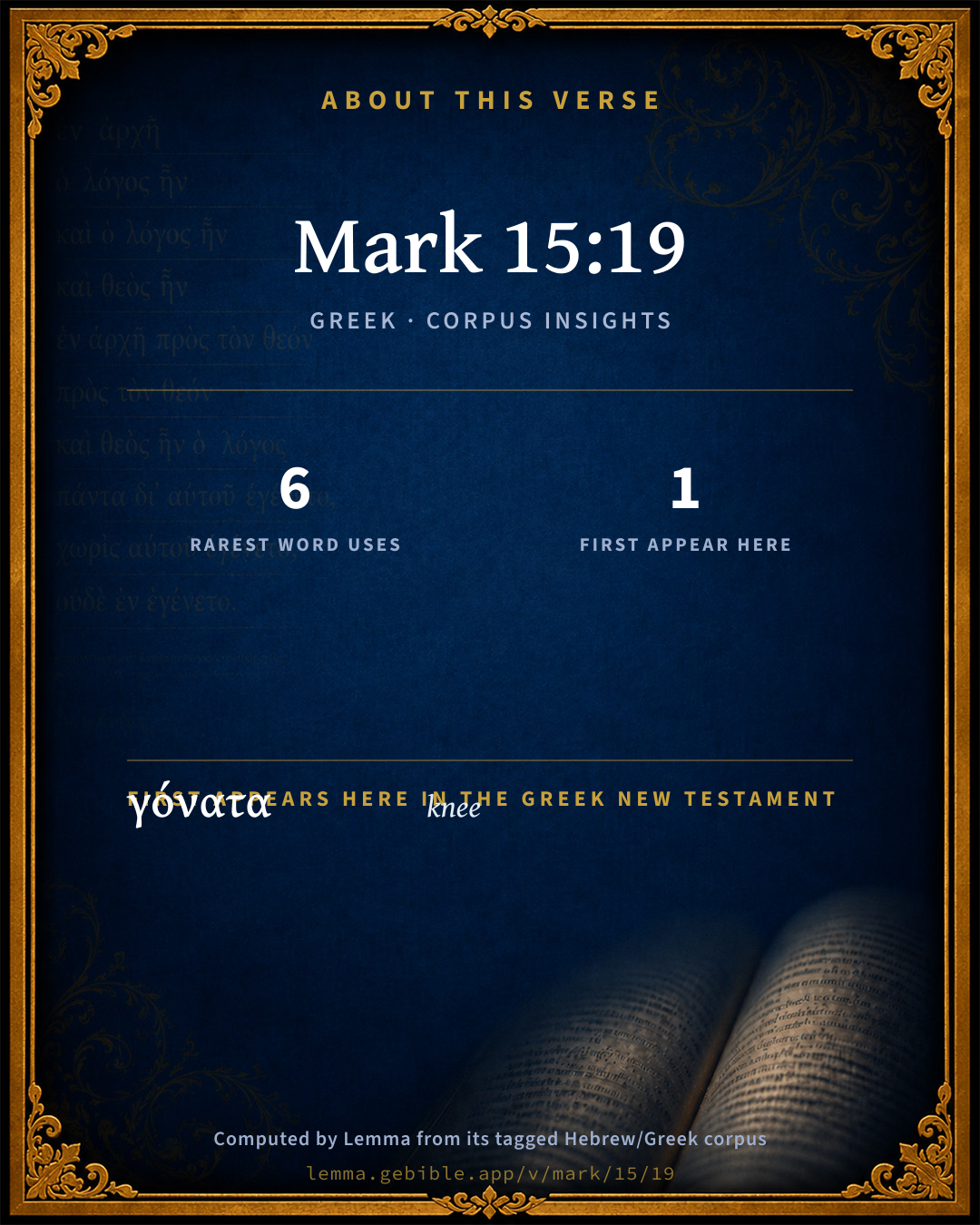
The rarest word here is ἐνέπτυον to spit upon G1716 — appearing just 6 times in the whole Greek New Testament.
First appearance in Scripture
This word makes its first canonical appearance in the Greek New Testament here:
- γόνατα knee G1119
Shared distinctive vocabulary
ἐνέπτυον to spit upon G1716 occurs in 6 verses of the Greek New Testament. Also found in:
Cross-references
29Topical passages linked to Mark 15:19 in the Treasury of Scripture Knowledge — connected by theme and wording, ordered by reader-vote popularity; previews shown in the World English Bible.
- Mark 14:65 Some began to spit on him, and to cover his face, and to beat him with fists, and to tell him, "Prophesy!" The officers struck him with the palms of their hands.
- Isaiah 53:3–5 He was despised, and rejected by men; a man of suffering, and acquainted with disease: and as one from whom men hide their face he was despised; and we didn't respect him.
- Genesis 24:52 It happened that when Abraham's servant heard their words, he bowed himself down to the earth to Yahweh.
- Genesis 43:28 They said, "Your servant, our father, is well. He is still alive." They bowed the head, and did homage.
- 1 Kings 19:18 Yet will I leave [me] seven thousand in Israel, all the knees which have not bowed to Baal, and every mouth which has not kissed him.
- Esther 3:2–5 All the king's servants, who were in the king's gate, bowed down, and did reverence to Haman; for the king had so commanded concerning him. But Mordecai didn't bow down, nor did him reverence.
- Job 13:9 Is it good that he should search you out? Or as one deceives a man, will you deceive him?
- Job 30:8–12 They are children of fools, yes, children of base men. They were flogged out of the land.
- Psalms 22:6–7 But I am a worm, and no man; A reproach of men, and despised by the people.
- Psalms 35:15–17 But in my adversity, they rejoiced, and gathered themselves together. The attackers gathered themselves together against me, and I didn't know it. They tore at me, and didn't cease.
- Psalms 69:12 Those who sit in the gate talk about me. I am the song of the drunkards.
- Psalms 69:19–20 You know my reproach, my shame, and my dishonor. My adversaries are all before you.
- Isaiah 45:23 By myself have I sworn, the word is gone forth from my mouth [in] righteousness, and shall not return, that to me every knee shall bow, every tongue shall swear.
- Isaiah 49:7 Thus says Yahweh, the Redeemer of Israel, [and] his Holy One, to him whom man despises, to him whom the nation abhors, to a servant of rulers: Kings shall see and arise; princes, and they shall worship; because of Yahweh who is faithful, [even] the Holy One of Israel, who has chosen you.
- Isaiah 50:6 I gave my back to the strikers, and my cheeks to those who plucked off the hair; I didn't hide my face from shame and spitting.
- Isaiah 52:14 Like as many were astonished at you (his visage was so marred more than any man, and his form more than the sons of men),
- Micah 5:1 Now you shall gather yourself in troops, Daughter of troops. He has laid siege against us; They will strike the judge of Israel with a rod on the cheek.
- Matthew 20:18–19 "Behold, we are going up to Jerusalem, and the Son of Man will be delivered to the chief priests and scribes, and they will condemn him to death,
- Mark 9:12 He said to them, "Elijah indeed comes first, and restores all things. How is it written about the Son of Man, that he should suffer many things and be despised?
- Mark 10:34 They will mock him, spit on him, scourge him, and kill him. On the third day he will rise again."
- Luke 18:32–33 For he will be delivered up to the Gentiles, will be mocked, treated shamefully, and spit on.
- Luke 22:63 The men who held Jesus mocked him and beat him.
- Luke 23:11 Herod with his soldiers humiliated him and mocked him. Dressing him in luxurious clothing, they sent him back to Pilate.
- Luke 23:36 The soldiers also mocked him, coming to him and offering him vinegar,
- Romans 11:4 But how does God answer him? "I have reserved for myself seven thousand men, who have not bowed the knee to Baal."
- Romans 14:10–11 But you, why do you judge your brother? Or you again, why do you despise your brother? For we will all stand before the judgment seat of Christ.
- Philippians 2:10 that at the name of Jesus every knee should bow, of those in heaven, those on earth, and those under the earth,
- Hebrews 12:2–3 looking to Jesus, the author and perfecter of faith, who for the joy that was set before him endured the cross, despising shame, and has sat down at the right hand of the throne of God.
- Hebrews 13:13 Let us therefore go forth to him outside of the camp, bearing his reproach.
Cross-references courtesy of OpenBible.info (CC BY 4.0).
Lesson kit
Teaching starters — assembled from the data on this page, not authored interpretation. Every prompt links to the verse data it draws on. Edit before teaching.
Mark, in the Gospels, opens this verse with 15 words (10 distinct Greek lemmas). Its most distinctive word is emptýō (“to spit upon”). A historical commentator’s framing appears above. Read the whole chapter for the surrounding context.
Discussion questions
- What does “to spit upon” (emptýō) contribute to the verse as a whole?
- This is the first place “knee” appears in Scripture (first appears here). What does its debut here establish?
- How does Matthew 26:67, which shares the word «to spit upon», read alongside this verse?
- What does the repetition of “and” (3× in this one verse) do in this verse?
- The translations on this page render this verse differently — a whole-verse word diff, not a word-by-word alignment. What might account for the different wordings?
- Compare how Godbey's Commentary on the New Testament and Ellicott's Commentary for English Readers read this verse. Where do they agree or differ?
Things to notice
- 1 word makes its first canonical appearance in Scripture here.
- These translations choose different wording for 14 words in this verse.
- “and” occurs 3× in this single verse.
- 10 distinct Greek lemmas span 15 words in this verse.
Commentary
Notes on Mark 15:19 from classic Christian and Jewish commentators (each source and its license shown beneath its notes). The classic Christian expositions comment on the surrounding passage and are grouped to its opening verse, so a note may address several verses; the Jewish commentaries on the Tanakh (Rashi and others) are per-verse, so they appear only where the commentator wrote on this verse.
Lemma curates 59 commentaries, every one of them public domain or Creative Commons licensed, each selected and text-cleaned for this edition rather than reprinted as found. About our sources →
Godbey's Commentary on the New Testament
William B. Godbey
William B. Godbey, Commentary on the New Testament (1896–1900) — public domain. Text from a community e-Sword module.
Ellicott's Commentary for English Readers
A Bible Commentary for English Readers, edited by Charles John Ellicott (1878–1897) — public domain. Text from a community e-Sword module.
The Cambridge Bible for Schools and Colleges
gen. ed. J. J. S. Perowne
The Cambridge Bible for Schools and Colleges (gen. ed. J. J. S. Perowne; Cambridge University Press, 1878–1918) — public domain. Text from a community e-Sword module.
John Gill's Exposition
John Gill's Exposition of the Whole Bible (1746–1763) — public domain (CC PDM 1.0). Text via the HelloAO Bible API.
Albert Barnes' Notes on the Bible
Albert Barnes' Notes on the Bible (1834–1885) — public domain. Text from a community e-Sword/MySword module.
The Pulpit Commentary
The Pulpit Commentary (1880–1919), ed. H.D.M. Spence-Jones & Joseph S. Exell — public domain. Text from a community e-Sword module.
unfoldingWord translationNotes
Door43 World Missions Community
unfoldingWord translationNotes — © Distant Shores Media and the Door43 World Missions Community, licensed CC BY-SA 4.0. Source: git.door43.org/Door43/en_tn.
Cambridge Greek Testament for Schools and Colleges
Cambridge Greek Testament for Schools and Colleges (Cambridge University Press, 1896; 21 vols, various authors incl. Carr, Maclear, Plummer, Farrar, Lumby, Moule, M. R. James, Simcox) — public domain. Text from a community e-Sword module.
International Critical Commentary
International Critical Commentary — older volumes (1896–1929), various authors — public domain. Text from a community e-Sword module.