
Luke 4:20

Greek (Tischendorf 8th ed.) Luke 4:20 appears in the Greek New Testament. The text above is from the Tischendorf 8th edition. Each word links to its Strong’s number and a concise gloss. Click any word for its full Thayer’s Greek Lexicon entry.
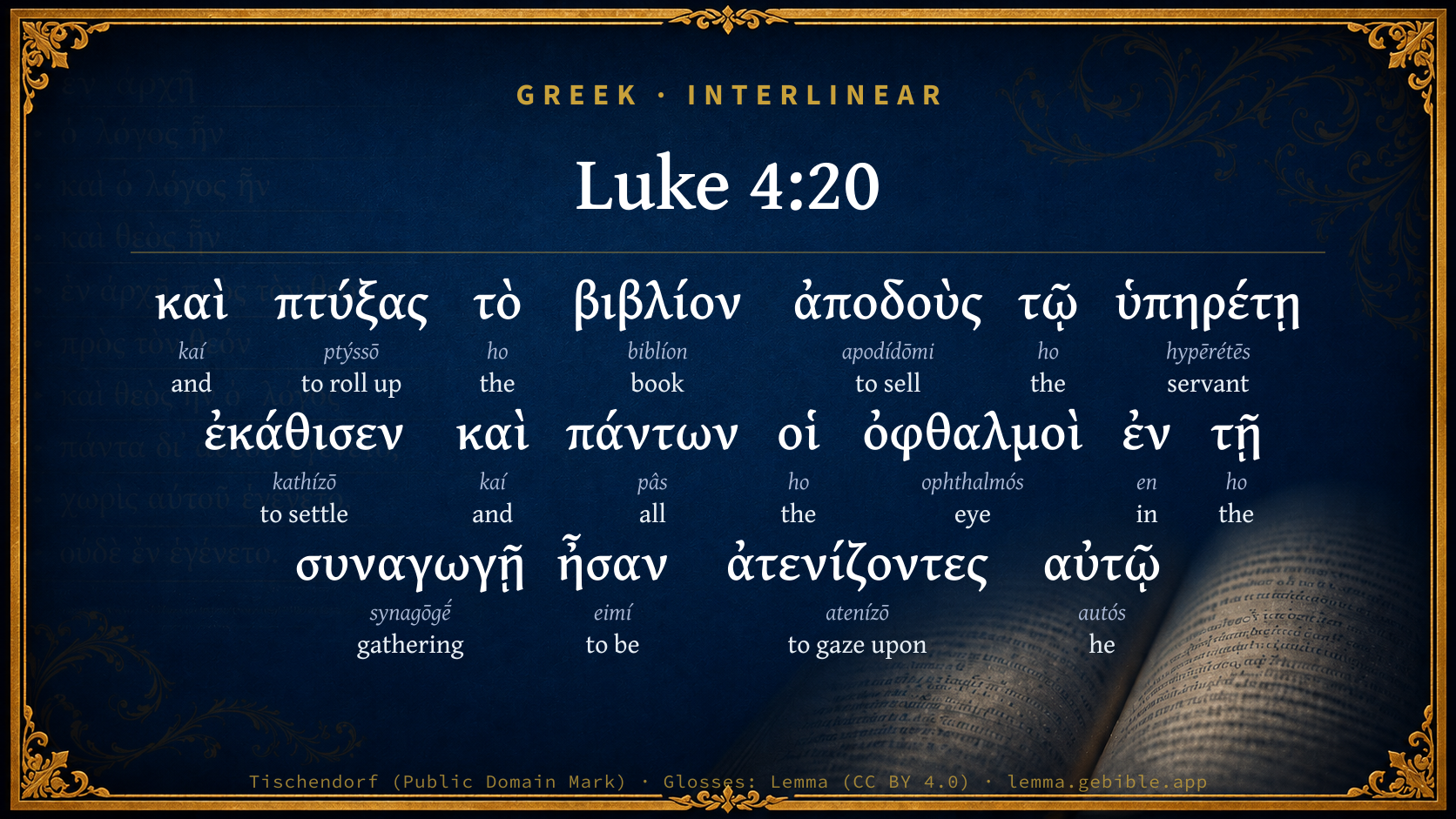
Download image
Cite this verse

Luke 4:20 (World English Bible). Public Domain. Lemma interlinear Bible study tool, https://lemma.gebible.app/v/luke/4/20.

Show BibTeX & RIS
BibTeX
RIS
English Translation
He closed the book, gave it back to the attendant, and sat down. The eyes of all in the synagogue were fastened on him.
World English Bible · Public Domain
Highlights
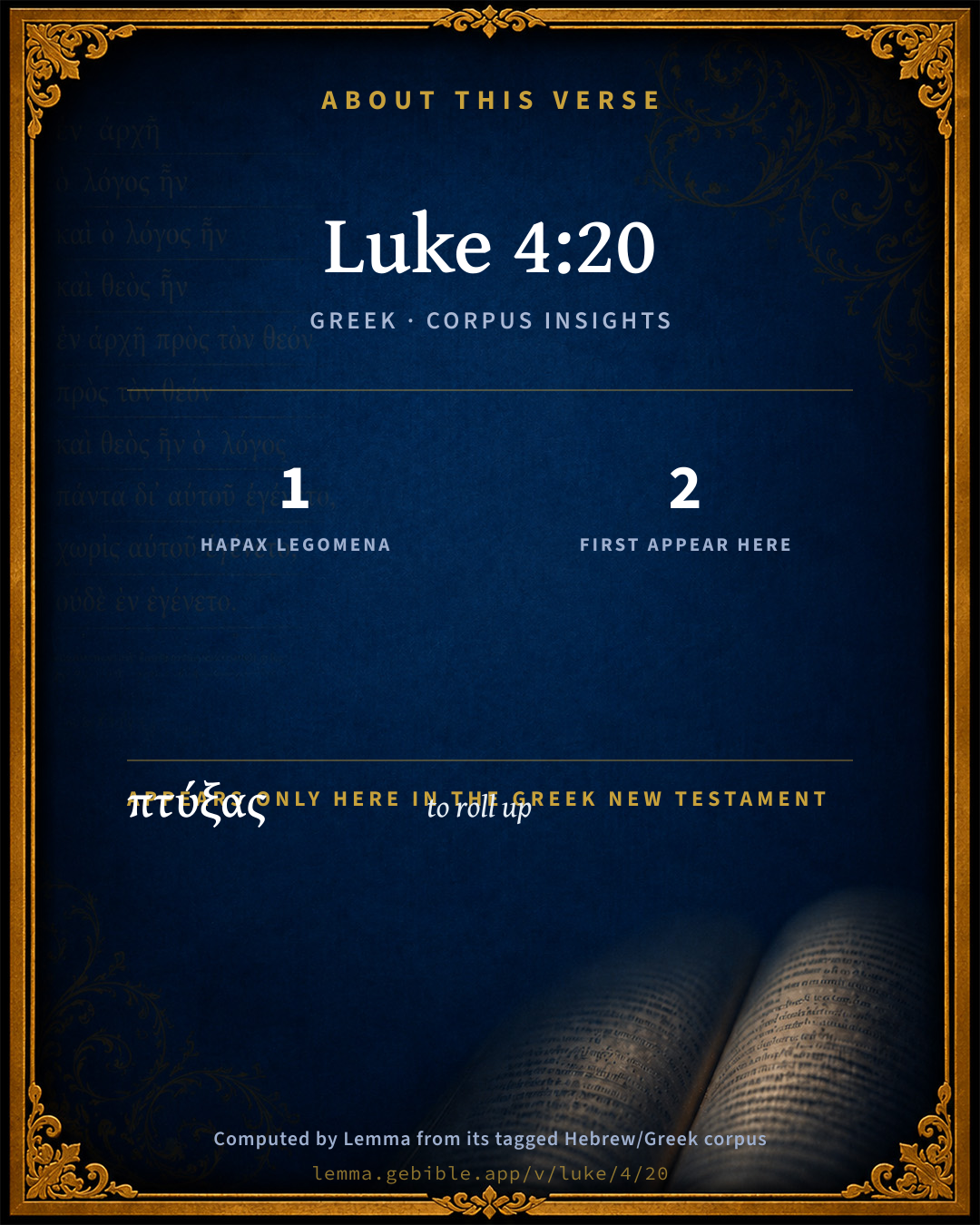
  • 1 hapax legomenon — only here in the Greek New Testament
  • 2 first appearances in the Greek New Testament
Full analysis ↓
Download a study sheet

One document with this verse’s original text, its word-by-word gloss line, the meaning frame, cross-references with their text, attributed commentary, and full source and license credits — printable, and it pastes into notes with its structure intact.

This verse Autodidact and up

Study sheet (.html) Plain text (.txt)

A passage Seminary Student

Up to 50 verses in one chapter. A passage sheet keeps up to 6 commentary sources and 12 cross-references per verse, in the order this page ranks them, and says so on the sheet whenever that leaves anything out. Ask for a single verse and you get the Autodidact verse sheet above.

Everything on this page stays free to read, with no account — the sheet is a download of what is already on screen, not access to it.

Want to remove ads? Support Godless Engineer
Compare translations 3

The same verse in 3 English versions, stacked beneath the original-language interlinear above. Click any original word for its lexicon entry.

Each is an independent rendering of the whole verse — the interlinear is not word-aligned to these translations.

Highlighted words mark where these versions differ — a whole-verse word diff, not a word-by-word alignment.

  • World English Bible Public Domain
    He closed the book, gave it back to the attendant, and sat down. The eyes of all in the synagogue were fastened on him.
  • King James Version Public Domain
    And he closed the book, and he gave it again to the minister, and sat down. And the eyes of all them that were in the synagogue were fastened on him.
  • unfoldingWord Literal Text CC BY-SA 4.0
    And having rolled up the scroll having given it back to the attendant, he sat down. And all the eyes in the synagogue were gazing on him.

unfoldingWord Literal Text — © unfoldingWord, licensed CC BY-SA 4.0. Word-aligned USFM3 via Door43 (git.door43.org/unfoldingWord/en_ult).

Versions to compare (up to 4)

3 of 4 selected

Show all 19 translations

Every available English version of this verse, each an independent rendering of the whole verse.

  • World English Bible Public Domain
    He closed the book, gave it back to the attendant, and sat down. The eyes of all in the synagogue were fastened on him.
  • Berean Standard Bible Public Domain
    Then He rolled up the scroll, returned it to the attendant, and sat down. The eyes of everyone in the synagogue were fixed on Him,
  • Majority Standard Bible Public Domain
    Then He rolled up the scroll, returned it to the attendant, and sat down. The eyes of everyone in the synagogue were fixed on Him,
  • King James Version Public Domain
    And he closed the book, and he gave it again to the minister, and sat down. And the eyes of all them that were in the synagogue were fastened on him.
  • American Standard Version (1901) Public Domain
    And he closed the book, and gave it back to the attendant, and sat down: and the eyes of all in the synagogue were fastened on him.
  • Revised Version (1885) Public Domain
    And he closed the book, and gave it back to the attendant, and sat down: and the eyes of all in the synagogue were fastened on him.
  • Geneva Bible (1599) Public Domain
    And hee closed the booke, and gaue it againe to the minister, and sate downe: and the eyes of all that were in the Synagogue were fastened on him.
  • Douay-Rheims (1899) Public Domain
    And when he had folded the book, he restored it to the minister, and sat down. And the eyes of all in the synagogue were fixed on him.
  • Young's Literal Translation Public Domain
    And having folded the roll, having given `it' back to the officer, he sat down, and the eyes of all in the synagogue were gazing on him.
  • Literal Standard Version CC BY-SA 4.0
    And having folded the scroll, having given [it] back to the officer, He sat down, and the eyes of all in the synagogue were gazing on Him.
  • Unlocked Literal Bible CC BY-SA 4.0
    Then he rolled up the scroll, gave it back to the attendant, and sat down. The eyes of all in the synagogue were fixed on him.
  • unfoldingWord Literal Text CC BY-SA 4.0
    And having rolled up the scroll having given it back to the attendant, he sat down. And all the eyes in the synagogue were gazing on him.
  • Darby Bible Public Domain
    And having rolled up the book, when he had delivered it up to the attendant, he sat down; and the eyes of all in the synagogue were fixed upon him.
  • World Messianic Bible Public Domain
    He closed the scroll, gave it back to the shammash, and sat down. The eyes of all in the synagogue were fastened on him.
  • Webster's Bible Public Domain
    And he closed the book, and he gave it again to the minister, and sat down. And the eyes of all them that were in the synagogue were fastened on him.
  • Free Bible Version CC BY-SA 4.0
    He rolled up the scroll and gave it back to the attendant. Then he sat down. Everybody in the synagogue was staring at him.
  • Bible in Basic English Public Domain
    And shutting the book he gave it back to the servant and took his seat: and the eyes of all in the Synagogue were fixed on him.
  • Text-Critical English NT CC BY 4.0
    Then he rolled up the scroll, gave it back to the attendant, and sat down. The eyes of everyone in the synagogue were fixed upon him,
  • Tyndale New Testament (1534) Public Domain
    And he cloosed the booke and gave it agayne to the minister and sate doune. And the eyes of all that were in the synagoge were fastened on him.

Literal Standard Version (2020), Covenant Press — licensed CC BY-SA 4.0. Text via the HelloAO Bible API (eBible.org). Unlocked Literal Bible (unfoldingWord) — licensed CC BY-SA 4.0. Text via the HelloAO Bible API (eBible.org). unfoldingWord Literal Text — © unfoldingWord, licensed CC BY-SA 4.0. Word-aligned USFM3 via Door43 (git.door43.org/unfoldingWord/en_ult). Free Bible Version, Dr. Jonathan Gallagher — licensed CC BY-SA 4.0. Text via the HelloAO Bible API (eBible.org).

Word by word

More ways to search: Search by grammar → Find every occurrence → Compare this word →

Practice this passage: Drill this verse → Learn its vocabulary →

πτύξας
ptýssō
G4428
“to roll up”
Verb, Aorist, Active, Participle, Nominative, Singular, Masculine
Part of Speech
Verb
Tense
Aorist
Voice
Active
Mood
Participle
Case
Nominative
Number
Singular
Gender
Masculine
Full Thayer's Definition

Origin: probably akin to petannumi (to spread, and thus apparently allied to G4072 through the idea of expansion, and to G4429 through that of flattening, cf G3961 )

TDNT: None

1. to fold together, roll up
  1. καὶ kaí G2532 “and” Conjunction
  2. τὸ ho G3588 “the” Article, Accusative, Singular, Neuter
  3. βιβλίον biblíon G975 “book” Noun, Accusative, Singular, Neuter
  4. ἀποδοὺς apodídōmi G591 “to sell” Verb, Aorist, Active, Participle, Nominative, Singular, Masculine
  5. τῷ ho G3588 “the” Article, Dative, Singular, Masculine
  6. ὑπηρέτῃ hypērétēs G5257 “servant” Noun, Dative, Singular, Masculine
  7. ἐκάθισεν kathízō G2523 “to settle” Verb, Aorist, Active, Indicative, 3rd person, Singular
  8. καὶ kaí G2532 “and” Conjunction
  9. πάντων pâs G3956 “all” Adjective, Genitive, Plural, Masculine
  10. οἱ ho G3588 “the” Article, Nominative, Plural, Masculine
  11. ὀφθαλμοὶ ophthalmós G3788 “eye” Noun, Nominative, Plural, Masculine
  12. ἐν en G1722 “in” Preposition
  13. τῇ ho G3588 “the” Article, Dative, Singular, Feminine
  14. συναγωγῇ synagōgḗ G4864 “gathering” Noun, Dative, Singular, Feminine
  15. ἦσαν eimí G1510 “to be” Verb, Imperfect, Active, Indicative, 3rd person, Plural
  16. ἀτενίζοντες atenízō G816 “to gaze upon” Verb, Present, Active, Participle, Nominative, Plural, Masculine
  17. αὐτῷ autós G846 “he” Personal pronoun, Dative, Singular, Masculine

About this verse

These counts appear in no published source. They are computed here, from the morphology-tagged text and Lemma’s own curated glosses. What Lemma adds →

18
words
14
distinct lemmas
Gospels
section

Notable vocabulary

1 hapax legomenon — a word that appears only here in the entire Greek New Testament:

  • πτύξας to roll up G4428

First appearance in Scripture

These words make their first canonical appearance in the Greek New Testament here:

  • πτύξας to roll up G4428
  • ἀτενίζοντες to gaze upon G816

Shared distinctive vocabulary

ἀτενίζοντες to gaze upon G816 occurs in 14 verses of the Greek New Testament. Also found in:
Repetition

Words recur within this verse:

Cross-references

11

Topical passages linked to Luke 4:20 in the Treasury of Scripture Knowledge — connected by theme and wording, ordered by reader-vote popularity; previews shown in the World English Bible.

  • Luke 4:17 The book of the prophet Isaiah was handed to him. He opened the book, and found the place where it was written,
  • John 8:2 Now very early in the morning, he came again into the temple, and all the people came to him. He sat down, and taught them.
  • Luke 19:48 They couldn't find what they might do, for all the people hung on to every word that he said.
  • Matthew 5:1–2 Seeing the multitudes, he went up onto the mountain. When he had sat down, his disciples came to him.
  • Matthew 13:1–2 On that day Jesus went out of the house, and sat by the seaside.
  • Matthew 26:55 In that hour Jesus said to the multitudes, "Have you come out as against a robber with swords and clubs to seize me? I sat daily in the temple teaching, and you didn't arrest me.
  • Luke 5:3 He entered into one of the boats, which was Simon's, and asked him to put out a little from the land. He sat down and taught the multitudes from the boat.
  • Acts 13:14–16 But they, passing on from Perga, came to Antioch of Pisidia. They went into the synagogue on the Sabbath day, and sat down.
  • Acts 16:13 On the Sabbath day we went forth outside of the city by a riverside, where we supposed there was a place of prayer, and we sat down, and spoke to the women who had come together.
  • Matthew 20:26–28 It shall not be so among you, but whoever desires to become great among you shall be your servant.
  • Acts 3:12 When Peter saw it, he responded to the people, "You men of Israel, why do you marvel at this man? Why do you fasten your eyes on us, as though by our own power or godliness we had made him walk?

Cross-references courtesy of OpenBible.info (CC BY 4.0).

Commentary

Notes on Luke 4:20 from classic Christian and Jewish commentators (each source and its license shown beneath its notes). The classic Christian expositions comment on the surrounding passage and are grouped to its opening verse, so a note may address several verses; the Jewish commentaries on the Tanakh (Rashi and others) are per-verse, so they appear only where the commentator wrote on this verse.

Lemma curates 59 commentaries, every one of them public domain or Creative Commons licensed, each selected and text-cleaned for this edition rather than reprinted as found. About our sources →

Joseph Benson's Commentary

Luk 4:20-21. And he closed the book, and gave it again to the minister — Τω υπηρετη, to the servant, who had brought it to him. “From the manner in which we apply the word minister, in speaking of our churches, the English reader is apt to be led into a mistake by the common version, and to consider the word here as meaning the person who presided in the service; whereas it denotes only a subordinate officer, who attended the minister, and obeyed his orders in what concerned the more servile part of the work. Among other things he had the charge of the sacred books, and delivered them to those to whom he was commanded by his superiors to give them. After the reading was over, he deposited them in their proper place.” — Campbell. And sat down — The Jewish doctors, to show their reverence for the Scriptures, always stood when they read them, but when they taught the people they sat down. See Mat 23:2. Thus we here find our Lord sitting down in the synagogue to preach, after he had read the passage in the prophet, which he made the subject of his discourse. The custom of preaching from a text of Scripture, which now prevails throughout all the Christian churches, seems to have derived its origin from the authority of this example. And the eyes of all were fastened on him — They looked on him with great attention, expecting him to explain the passage. And in addressing the congregation on it, he told them, it was that day fulfilled in their ears — Namely, by what they heard him speak; words which imply, that, whatever allusion there might be in the prophecy to the good news of the deliverance of the Jews from the Babylonish captivity, it was primarily and principally intended to be understood of the spiritual salvation of mankind from ignorance and error, sinfulness and guilt, depravity and misery, by the Messiah, who, and not Isaiah, nor any other prophet, is to be considered as speaking in the passage, as is explained more fully in the notes there.

Joseph Benson's Commentary on the Old and New Testaments (1811–1818) — public domain. Text from a community e-Sword module.

Bengel's Gnomon

Johann Albrecht Bengel

Luk 4:20. Ἀποδοὺς, having given it again) with due decorum.—ἐκάθισε, He sat down) Whilst teaching and applying the text which He had read. He had stood up, Luk 4:16.

Bengel's Gnomon of the New Testament — English translation (T&T Clark, Edinburgh, 1860) — public domain. Text from a community e-Sword module.

Meyer's Critical & Exegetical Commentary

Heinrich August Wilhelm Meyer

Luk_4:20-21. Τῷ ὑπηρέτῃ] הַחַזָן to the officer of the synagogue, who had to take the book-roll back to its place, after it had been folded up by Jesus (πτύξας corresponding to the ἀναπτύξας of Luk_4:17).

ἐκάθισε] in order now to teach upon the passage which had been read,this was done sitting (Zunz, Gottesd. Vorträge d. Juden, p. 337).

ἤρξατο] He began. Bengel appropriately says: Sollenne initium.

ἐν τοῖς ὠσὶν ὑμῶν] in your ears is this Scripture (this which is written, see on Mar_12:10) fulfilledto wit, by the fact that the voice of Him of whom the prophet prophesied has entered into your ears. A concrete individualizing mode of expression. Comp. Luk_1:44, Luk_9:44; Act_11:22; Jam_5:4; Sir_25:9; 1Ma_10:7; Bar_1:3 f.; LXX. Isa_5:9. How decisively the passage before us testifies in favour of the fact that from the beginning of His ministry Jesus already had the clear and certain consciousness that He was the Messiah![88] Moreover, that nothing but the theme of the discourse delivered by Jesus is here given is manifest from the passage itself, as well as from Luk_4:22; but He has placed it remarkably close to the beginning of His discourse, and so led the hearer all at once in mediam rem (comp. Zunz, as above, p. 353). Grotius well says: Hoc exordio usus Jesus explicavit prophetae locum et explicando implevit.

[88] Comp. Beyschlag, Christ. d. N. T. p. 36 f.

Meyer — Critical and Exegetical Commentary on the New Testament — English translation by Peter Christie, edited by Frederick Crombie (T&T Clark, 1880) — public domain. Text from a community e-Sword module.

Expositor's Greek Testament

ed. W. Robertson Nicoll

Luk 4:20 . πτύξας , folding, ἀναπτύξας in Luk 4:17 (T. R.) = unfolding. ὑπηρέτῃ , the officer of the synagogue; cf. the use of the word in Act 13:5 . ἀτενίζοντες , looking attentively ( ἀτενής , intent, from α and τείνω ), often in Acts, vide , e.g. , Luk 13:9 .

The Expositor's Greek Testament, edited by W. Robertson Nicoll (1897–1910) — public domain. Text from a community e-Sword module.

Godet's Commentaries

Frédéric Louis Godet

Vers. 20-22. The Preaching.

The description of the assembly, Luk 4:20, is so dramatic, that it appears to have come from an eye-witness.

The sense of ἤρξατο, He began (Luk 4:21), is not that these were the first words of His discourse; this expression describes the solemnity of the moment when, in the midst of a silence resulting from universal attention, the voice of Jesus sounded through the synagogue.

The last words of the verse signify literally, “This word is accomplished in your ears;” in other words, “This preaching to which you are now listening is itself the realization of this prophecy.” Such was the text of Jesus’ discourse. Luke, without going into His treatment of His theme (comp., for example, Mat 11:28-30), passes (Luk 4:22) to the impression produced. It was generally favourable. The term bare witness alludes to the favourable reports which had reached them; they proved for themselves that His fame was not exaggerated. ᾿Εθαύμαζον signifies here, they were astonished (Joh 7:21; Mar 6:6), rather than they admired. Otherwise the transition to what follows would be too abrupt. So the term gracious words describes rather the matter of Jesus’ preaching—its description of the works of divine grace—than the impression received by His hearers. They were astonished at this enumeration of marvels hitherto unheard of. The words, which proceeded forth out of His mouth, express the fulness with which this proclamation poured forth from His heart.

Two courses were here open to the inhabitants of Nazareth: either to surrender themselves to the divine instinct which, while they listened to this call, was drawing them to Jesus as the Anointed of whom Isaiah spake; or to give place to an intellectual suggestion, allow it to suppress the emotion of the heart, and cause faith to evaporate in criticism. They took the latter course: Is not this Joseph’s son? Announcements of such importance appeared to them altogether out of place in the mouth of this young man, whom they had known from his childhood. What a contrast between the cold reserve of this question, and the enthusiasm which welcomed Jesus everywhere else (glorified of all, Luk 4:15)! For them this was just such a critical moment as was to occur soon after for the inhabitants of Jerusalem (Joh 2:13-22). Jesus sees at a glance the bearing of this remark which went round amongst His hearers: when the impression He has produced ends in a question of curiosity, all is lost; and He tells them so.

Frédéric Louis Godet — Commentaries on Luke, John, Romans, and 1 Corinthians — English translation (T&T Clark, Edinburgh, 1870s–1890s) — public domain. Text from a community e-Sword module.

Jamieson, Fausset & Brown

Robert Jamieson, A. R. Fausset & David Brown

the minister--the chazan, or synagogue-officer.

all eyes . . . fastened on Him--astounded at His putting in such claims.

Jamieson, Fausset & Brown — Commentary Critical and Explanatory on the Whole Bible (1871) — public domain (CC PDM 1.0). Text via the HelloAO Bible API.

Adam Clarke's Commentary

Verse 20. Were fastened on him.] Were attentively fixed on him. The proper import of ατενιζοντες αυτω.

Adam Clarke's Commentary on the Bible (1810–1826) — public domain. Text from a community e-Sword/MySword module.

Ellicott's Commentary for English Readers

(20) And he closed the book.—Better, rolled up, as describing the actual manner of closing. The description is characteristic as indicating (1) that it probably came in the first instance from an eye-witness-and (2) the calmness and deliberation with which our Lord acted.

And sat down.—This conveys to us the idea of falling back to a place of comparative obscurity among the congregation. To the Jew it implied just the opposite. The chair near the place from which the lesson was read was the pulpit of the Rabbi, and to sit down in that chair (as in Mat_5:1; Mat_23:2) was an assumption by our Lord, apparently for the first time in that synagogue, of the preacher’s function. This led to the eager, fixed gaze of wonder which the next clause speaks of.

Fastened on him.—The Greek word so rendered is noticeable as being used twelve times by St. Luke, (chiefly in the Acts), and twice by St. Paul (2Co_3:7; 2Co_3:13), and by no other writer of the New Testament. It had been used by Aristotle in his scientific writings, and was probably a half-technical word which St. Luke’s studies as a physician had brought into his vocabulary, and which St. Paul learnt, as it were, from him.

A Bible Commentary for English Readers, edited by Charles John Ellicott (1878–1897) — public domain. Text from a community e-Sword module.

The Cambridge Bible for Schools and Colleges

gen. ed. J. J. S. Perowne

20. he closed the book] Rather, rolling up. Generally the Haphtarah consists of twenty-one verses, and is never less than three; but our Lord stopped short in the second verse, because this furnished sufficient text for His discourse, and because He wished these gracious words to rest last on their ears, rather than the following words, “the day of vengeance of our God.”

the minister] The Chazzan.

sat down] The ordinary Jewish attitude for the sermon (Mat_23:2).

fastened on him] A favourite word of St Luke, who uses it eleven times; elsewhere it is only found in 2Co_3:7; 2Co_3:13. The attitude of Jesus shewed that now for the first time He intended not only to read but to preach.

The Cambridge Bible for Schools and Colleges (gen. ed. J. J. S. Perowne; Cambridge University Press, 1878–1918) — public domain. Text from a community e-Sword module.

John Gill's Exposition

And he closed the book,.... "Or rolled it up"; and so the high priest did, after he read in the book of the law, on the day of atonement, all that was necessary to be read, , "he rolled the book of the law", and put it in his bosom (f):

and he gave it again to the minister; the Chazan (g), who was the minister, or servant of the congregation, who had the affairs of it upon him, to let in, and bring out, and to order all things; and particularly to take care of the book of the law, and the chest, or ark in which it was. If the same rule was observed giving and taking the book of any prophet, as the book of the law; then Christ gave it to the minister, and he received it with his right hand: for so it is said (h),

"he that gives the book of the law to his friend, may not give it but with the right hand; and he that receives it may not receive it but with the right hand; for so was the giving of it on Mount Sinai, according to Deu 33:2.''

And sat down; as was the manner of the Jews, when they taught, or preached; See Gill on Mat 5:1.

and the eyes of all them that were in the synagogue were fastened on him: they looked very wistly at him, and were very attentive to what he should say, upon such a passage of Scripture, which they knew referred to the Messiah; and the rather, as they had known him formerly, and had heard that he was said to be the Messiah.

(f) Misn. Yoma, c. 7. sect. 1. (g) Bartenora in Misn. Sota, c. 7. sect. 7. (h) Massechet Sopherirn, c. 3. sect. 10.

John Gill's Exposition of the Whole Bible (1746–1763) — public domain (CC PDM 1.0). Text via the HelloAO Bible API.

Trapp's Complete Commentary

John Trapp

20 And he closed the book, and he gave it again to the minister, and sat down. And the eyes of all them that were in the synagogue were fastened on him.

Ver. 20. Were fastened on him] A good help against distractions. Our hearts are fickle and fugitive, if not hard held to it.

John Trapp, A Commentary or Exposition upon All the Books of the Old and New Testament (1647–1656) — public domain. Text from a community e-Sword module.

Albert Barnes' Notes on the Bible

And he closed the book - That is, he rolled it up again. See the notes at Luk 4:17.

And he gave it again to the minister - That is, to the one in the synagogue who had charge of the books. The word means “servant,” and the office was not much unlike that of a sexton now. It was his duty, among other things, to take charge of the books, to hand them to the reader of the law, and then return them to their place.

And sat down - This was usual in speaking in their synagogues. See the notes at Mat 5:1.

Were fastened on him - Were intently fixed on him, waiting to see what explanation he would give of the words.

Albert Barnes' Notes on the Bible (1834–1885) — public domain. Text from a community e-Sword/MySword module.

Haydock's Catholic Bible Commentary

To observe and admire a person that had never learned letters, and who stood up amongst them an experienced teacher. (Menochius) See John vii. 15. and Maldonatus.

George Leo Haydock (1774–1849), Haydock's Catholic Family Bible and Commentary, 1859 edition — public domain. Excludes Psalms (Douay-Rheims chapter numbering differs from Protestant) and Deuterocanonical books (Catholic canon only).

Matthew Poole's English Annotations

Christ observeth the order used in their synagogues, when he that officiates had read such a portion out of the law as was appointed, or out of the prophets, as he pleased, he closed the book, or the roll, and gave it again to the officer, whose work it was to bring it, and then to carry it back, and lay it up; and then sat down, while he made his exhortation upon it. This Christ did, the people being in the mean time very attentive to hear what he would say. He begins to speak, and telleth them this was a prophecy concerning him,

This day is this scripture fulfilled in your ears; that is, it is fulfilled in me, either primarily, or as I am the antitype to Cyrus. We must not think that this was all which Christ said, but thus he began his discourse.

Matthew Poole's English Annotations on the Holy Bible (1683–1685) — public domain. Text from a community e-Sword/MySword module.

Whedon's Commentary on the Bible

Daniel D. Whedon

20. Closed—Rolled it up.

Minister—The chazan.

Fastened—They had known him in childhood and youth. His simple piety, his working at the trade of a carpenter, and humbleness of family, were fresh in their recollections. Strange and wonderful rumours had come home lately in regard to him. He had set up high claims, and pretended abroad to do great works. They will now see if he can stand the searching scrutiny of acute Nazareth. They knew (of course) beforehand that he could not; but they will hear and decide how well he can preach.

Very probably the mother and sisters of Jesus (if not his unbelieving brothers) were present on this occasion. That they resided still at Nazareth is clear from Mat_13:56. From the gallery, which many synagogues contain for women, they may have looked down upon the scene first of honour and then of rejection, through the lattice screen, by which it was separated from the male congregation.

Daniel D. Whedon (gen. ed.), Commentary on the Old and New Testaments (1874–1909) — public domain. Text from a community e-Sword module.

The Pulpit Commentary

And he closed the book, and he gave it again to the minister, and sat down. This was the usual position adopted by a Jewish preacher. The chair of the preacher was placed near the spot where the lesson was read. These synagogues were built with the end pointed towards Jerusalem, in which direction the Jew ever loved to turn as he prayed. (Dan_6:10) The men sat on one side of the building, the women on the other. There was always at the end of the chamber an ark of wood, a memory of the sacred ark of the covenant, which once, with its golden mercy-seat, hallowed now and again with the presence of the visible glory, was the chief treasure of the temple ca Mount Zion. In the "ark" were kept the Law (the five books of Moses) and the rolls of the prophets.

The Pulpit Commentary (1880–1919), ed. H.D.M. Spence-Jones & Joseph S. Exell — public domain. Text from a community e-Sword module.

Kretzmann's Popular Commentary

Paul E. Kretzmann

The sermon and its effect:

v. 20. And He closed the book, and He gave it again to the minister, and sat down. And the eyes of all them that were in the synagogue were fastened on Him.

v. 21. And He began to say unto them, This day is this scripture fulfilled in your ears.

v. 22. And all bare Him witness, and wondered at the gracious words which proceeded out of His mouth. And they said, Is not this Joseph’s son?

When Jesus had finished the reading of the lesson, He rolled the parchment together again and then returned it to the servant of the synagogue, who had charge of the sacred books. The Scriptures were very precious in those days, and every synagogue took the best care of its copies. He then sat down. During the reading of the Scripture-lesson, both the congregation and the reader stood. But during the talk, or sermon, the speaker as well as the audience were seated. His reading and His entire bearing had made such an impression upon all those present that all eyes were fixed upon Him in anxious expectation. Their interest had been aroused. Luke gives only the topic or the beginning of the Lord’s discourse: Today is fulfilled this scripture in your ears. That is the gist of the sermon: He that spoke these words through Isaiah, He stands today, at this moment, before your eyes; the promised Messiah has stepped into your midst. And then He surely invited them to come to Him with meek and contrite hearts, in order that the Scripture might be fulfilled not only in their ears, but also in their hearts. Repentance and forgiveness of sins the Lord preached. The effect of Christ’s sermon is shown in the words: They bore witness to Him and were surprised at the words of grace which issued from His mouth. The confession was wrung from them, though they were reluctant at first about making the concession. The words about the grace of God whereby the prophecy of Isaiah was fulfilled came upon them as a surprise: they had not known that so much beauty was contained in the Old Testament. But that the admission was made very grudgingly in the majority of cases, appears from the question which passed around among the audience: Is not this man the son of Joseph? See Mar 6:2-3. The jealousy of small souls came to the foreground, feeling constrained to spoil the effect of the words of grace.

Paul E. Kretzmann, Popular Commentary of the Bible (1921–1924) — public domain. Text from a community e-Sword module.

The People's New Testament

B. W. Johnson

20. Closed the book. Rolled up the manuscript. Gave it to the minister. Not a rabbi, but an officer who had charge of the building and its furniture. And sat down. It was the custom of the synagogue to stand while reading, to sit while teaching. The eyes of all … in the synagogue. The man brought up among them was about to address them for the first time. The report from other places preceded this visit; the passage was remarkable, and doubtless there was something in the appearance of our Lord, especially under these circumstances, which would command unusual attention—Schaff. His mother, brethren and sisters were probably present.

B. W. Johnson's The People's New Testament with Notes (1889–1891) — public domain. Electronic text from the Christian Classics Ethereal Library (CCEL) ThML edition.

unfoldingWord translationNotes

Door43 World Missions Community

rolled up the scroll

A scroll was closed by rolling it like a tube to protect the writing inside it.

attendant

This refers to a synagogue worker who brought out and put away with proper care and reverence the scrolls containing the scriptures.

were fixed on him

This idiom means "were focused on him" or "were looking intently at him" (See: Idiom)

this scripture has been fulfilled in your hearing

Jesus was saying that he was fulfilling that prophecy by his actions and speech at that very time. This can be stated in active form. AT: "I am fulfilling what this scripture said right now as you are listening to me" (See: Active or Passive)

in your hearing

This idiom means "while you are listening to me" (See: Idiom)

amazed at the gracious words which were coming out of his mouth

"surprised about the gracious things that he was saying." Here "gracious" may refer to 1) how well or how persuasively Jesus spoke, or 2) that Jesus spoke words about God's grace.

Is this not the son of Joseph?

People thought that Joseph was Jesus' father. Joseph was not a religious leader, so they were surprised that his son would preach what he did. AT: "This is just Joseph's son!" or "His father is only Joseph!" (See: Rhetorical Question)

translationWords

synagogue

word of God

fulfill

testimony

amazed

grace

word

Joseph (NT)

unfoldingWord translationNotes — © Distant Shores Media and the Door43 World Missions Community, licensed CC BY-SA 4.0. Source: git.door43.org/Door43/en_tn.

Cambridge Greek Testament for Schools and Colleges

20. πτύξας. ‘Rolling up.’ Generally the Haphtarah consists of twenty-one verses, and is never less than three; but our Lord stopped short in the second verse, because this furnished sufficient text for His discourse, and because He wished these gracious words to rest last on their ears, rather than the following words, “the day of vengeance of our God.”

τῷ ὑπηρέτῃ. The Chazzan, or ‘attendant.’ The word ‘minister’ might be misunderstood by English readers to mean ‘clergyman.’ The Jews had no officials like our parochial clergy.

ἐκάθισεν. The ordinary Jewish attitude for the sermon (Mat 23:2).

ἀτενίζοντες. A favourite word of St Luke, who uses it eleven times; elsewhere it is only found in 2Co 3:7; 2Co 3:13. The attitude of Jesus shewed that now for the first time He intended not only to read but to preach.

Cambridge Greek Testament for Schools and Colleges (Cambridge University Press, 1896; 21 vols, various authors incl. Carr, Maclear, Plummer, Farrar, Lumby, Moule, M. R. James, Simcox) — public domain. Text from a community e-Sword module.

Alford’s Greek Testament

Henry Alford

20. ἐκάθισεν] It was the custom in the synagogues to stand while reading the law, and sit down to explain it. Our Lord on other occasions taught sitting, e.g. Mat 5:1: Mar 4:1; Mar 13:3.

The ὑπηρέτης was the חָזָן whose duty it was to keep the sacred books.

Henry Alford, The Greek Testament (1849–1861) — public domain. Text from a community e-Sword module.

International Critical Commentary

20. The vivid description of what followed the reading of the lesson Points to an eye-witness as the source of the narrative. But the “closed” of AV., and RV. gives a wrong impression of the first incident: it leads one to think of a modern book with leaves. The Rhemish has “folded”; but “rolled up” would be a better rendering of πτύξας. The long strip of parchment, or less probably papyrus (2Jn 1:12), would be wound upon a roller, or possibly upon two rollers, one at each end of the strip. Hence the name megillah (volumen),from gâlal, “to roll.” Such a book was in Greek sometimes called κεφαλὶς (Ezr 6:2; Eze 3:1-3) or κεφαλὶς βιβλίου (Heb 10:7; Psa 39:8; Eze 2:9): and it I said that κεφαλίς originally meant the knob (cornu or umbilicus) at the end of the roller; but no instance of this use of κεφαλίς appears to be known (Wsctt. on Heb 10:7).

ἀποδοὺς τῷ ὑπηρέτῃ. The ἀπο- implies that it was the minister or chazzan who had handed Him the book who received it back again. The τῷ may have the same meaning, just as τὸ βιβλίον means the book which had been given to Him. But τῷ ὑπηρέτῃ more probably means the minister usually found in a synagogue. It was among the duties of the chazzan to take the Scriptures from the ark and put them away again (Surenhusius, Mishna, ii. 246, iii. 266). He taught the children to read, and inflicted the scourgings (Mat 10:17). A Roman epitaph to a Jew who held is office is quoted by Schürer, II. ii. p. 66—

φλαβιος Ιουλιανος υπηρετης

φλαβια Ιουλιανη θυγατηρ πατρι

Εν ειρηνη η κοιμησις σου.

The chazzan of the synagogue became the deacon or sub-deacon the Christian Church.

A ὑπηρέτης is lit. “an under-rower” (ἐρέσσω). The word may be used of almost any kind of attendant or servant (Act 5:22, Act 5:26, Act 5:13:5; Mat 26:58; Mar 14:54, Mar 14:65; Joh 7:32, Joh 7:45; 1Co 4:1). For the two participles, πτύξας … ἀποδούς, without καί, comp. Act 12:4, Act 12:25.

ἐκάθισεν. This was the usual attitude for expounding or preaching, and in the synagogues there was commonly a raised seat for the purpose. On other occasions we find Christ sitting to teach (5:3; Mat 5:1; Mar 4:1; [Joh 8:2]); and the disciples do the same (Act 16:13).

ἦσαν ἀτενίζοντες. “Were fixed intently.” Their intense interest was caused by His reputation as a teacher and as a worker of miracles, as well as by His having been brought up amongst them; perhaps also by His look and manner of reading. That lie had selected an unexpected passage, or had omitted the usual lesson from the Law, and that this surprised them, is pure conjecture. Comp. Act 6:15, where the same verb is used of the whole Sanhedrin riveting their eyes upon Stephen. It is a favourite word with Lk., who uses it a dozen times: elsewhere in N.T. only 2Co 3:7, 2Co 3:13. It occurs in LXX (1 Es. 6:28; Est_3 Mac. 2:26), in Aq. (Job 7:8), and in Jos. (B. J., v. 12, 3). The analytical tense marks the continuance of the action.

International Critical Commentary — older volumes (1896–1929), various authors — public domain. Text from a community e-Sword module.

Vincent's Word Studies in the New Testament

Marvin R. Vincent

He closed [πτυξας] . See on verse 17.

Minister [υπηρετη] . See on Mt 5:25. Lit., as Rev., attendant.

Minister is likely to be misunderstood as referring to the president of the congregation, who, as the teaching elder, would have addressed the people if Jesus had not done so. It means the attendant who had charge of the sacred rolls. He was a salaried officer, a kind of chapel - clerk.

Sat down. As about to teach; that being the habitual position of a Jewish teacher.

Were fastened [ησαν ατενιζοντες] . The participle and finite verb denoting continuous, steadfast attention. The verb, from teinw, to stretch, denotes fixed attention. Indeed, the word attention itself, etymologically considered, conveys the same idea.

Marvin R. Vincent, Word Studies in the New Testament (1887–1900) — public domain. Text from a community e-Sword/MySword module.

Lesson kit

Teaching starters — assembled from the data on this page, not authored interpretation. Every prompt links to the verse data it draws on. Edit before teaching.

Luke, in the Gospels, opens this verse with 18 words (14 distinct Greek lemmas). Its most distinctive word is ptýssō (“to roll up”). A historical commentator’s framing appears above. Read the whole chapter for the surrounding context.

Discussion questions

  1. The word ptýssō carries the sense “to roll up.” How does it shape the verse?
  2. 1 word here appears nowhere else in the Greek New Testament. Why might the author reach for such rare wording?
  3. 2 words make their first appearance in Scripture here. What does this debut establish?
  4. How does Luke 22:56, which shares the word «to gaze upon», read alongside this verse?
  5. What does the repetition of “the” (4× in this one verse) do in this verse?
  6. These translations render this verse differently. What is at stake in choosing one wording over another?
  7. Compare how Joseph Benson's Commentary and Bengel's Gnomon read this verse. Where do they agree or differ?

Things to notice

  • 1 word in this verse appears nowhere else in the Greek New Testament.
  • 2 words make their first canonical appearance in Scripture here.
  • These translations choose different wording for 14 words in this verse.
  • “the” occurs 4× in this single verse.
  • 14 distinct Greek lemmas span 18 words in this verse.

Reading settings

Reading text

Shown beneath each verse's original-language words.

Old Testament
Old Testament edition

Read the OT as the Masoretic Hebrew (MT) or the Greek Septuagint (LXX).

English shown for the Greek Septuagint (in the Hebrew ↔ Greek comparison).

Comparing translations? Open the Compare panel on any verse page to stack up to four side by side.