Mark 14:72

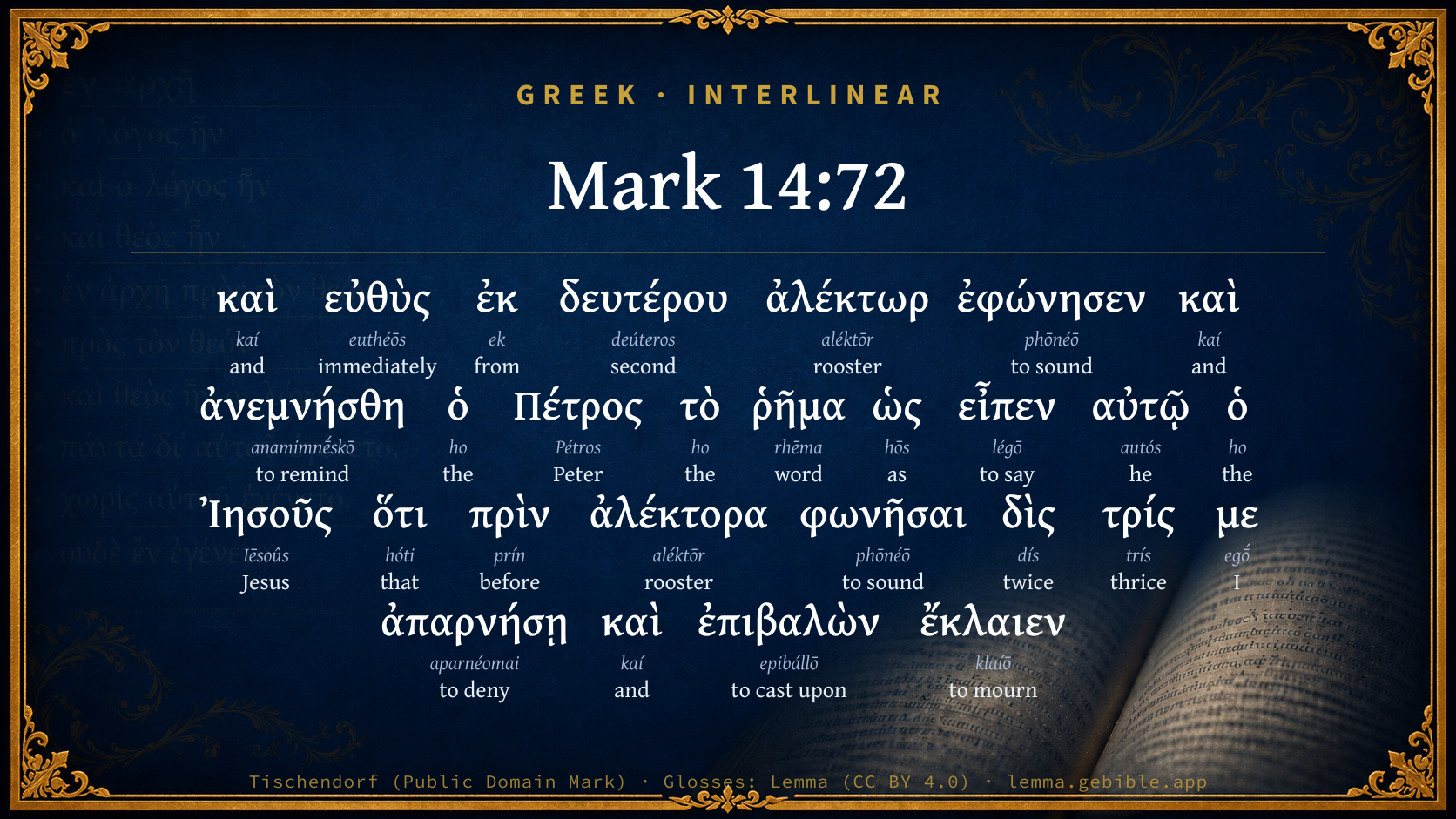
Greek (Tischendorf 8th ed.) Mark 14:72 appears in the Greek New Testament. The text above is from the Tischendorf 8th edition. Each word links to its Strong’s number and a concise gloss. Click any word for its full Thayer’s Greek Lexicon entry.
Download image
Cite this verse

Mark 14:72 (World English Bible). Public Domain. Lemma interlinear Bible study tool, https://lemma.gebible.app/v/mark/14/72.

Show BibTeX & RIS
BibTeX
RIS
English Translation
The rooster crowed the second time. Peter remembered the word, how that Jesus said to him, "Before the rooster crows twice, you will deny me three times." When he thought about that, he wept.
World English Bible · Public Domain
Download a study sheet

One document with this verse’s original text, its word-by-word gloss line, the meaning frame, cross-references with their text, attributed commentary, and full source and license credits — printable, and it pastes into notes with its structure intact.

This verse Autodidact and up

Study sheet (.html) Plain text (.txt)

A passage Seminary Student

Up to 50 verses in one chapter. A passage sheet keeps up to 6 commentary sources and 12 cross-references per verse, in the order this page ranks them, and says so on the sheet whenever that leaves anything out. Ask for a single verse and you get the Autodidact verse sheet above.

Everything on this page stays free to read, with no account — the sheet is a download of what is already on screen, not access to it.

Want to remove ads? Support Godless Engineer
Compare translations 3

The same verse in 3 English versions, stacked beneath the original-language interlinear above. Click any original word for its lexicon entry.

Each is an independent rendering of the whole verse — the interlinear is not word-aligned to these translations.

Highlighted words mark where these versions differ — a whole-verse word diff, not a word-by-word alignment.

  • World English Bible Public Domain
    The rooster crowed the second time. Peter remembered the word, how that Jesus said to him, "Before the rooster crows twice, you will deny me three times." When he thought about that, he wept.
  • King James Version Public Domain
    And the second time the cock crew. And Peter called to mind the word that Jesus said unto him, Before the cock crow twice, thou shalt deny me thrice. And when he thought thereon, he wept.
  • unfoldingWord Literal Text CC BY-SA 4.0
    And immediately a rooster crowed a second time, and Peter remembered the word that Jesus said to him: “Before a rooster crows twice, you will deny me three times,” and having broken down, he was weeping.

unfoldingWord Literal Text — © unfoldingWord, licensed CC BY-SA 4.0. Word-aligned USFM3 via Door43 (git.door43.org/unfoldingWord/en_ult).

Versions to compare (up to 4)

3 of 4 selected

Show all 19 translations

Every available English version of this verse, each an independent rendering of the whole verse.

  • World English Bible Public Domain
    The rooster crowed the second time. Peter remembered the word, how that Jesus said to him, "Before the rooster crows twice, you will deny me three times." When he thought about that, he wept.
  • Berean Standard Bible Public Domain
    And immediately the rooster crowed a second time. Then Peter remembered the word that Jesus had spoken to him: “Before the rooster crows twice, you will deny Me three times.” And he broke down and wept.
  • Majority Standard Bible Public Domain
    And the rooster crowed a second time. Then Peter remembered the word that Jesus had spoken to him: “Before the rooster crows twice, you will deny Me three times.” And he broke down and wept.
  • King James Version Public Domain
    And the second time the cock crew. And Peter called to mind the word that Jesus said unto him, Before the cock crow twice, thou shalt deny me thrice. And when he thought thereon, he wept.
  • American Standard Version (1901) Public Domain
    And straightway the second time the cock crew. And Peter called to mind the word, how that Jesus said unto him, Before the cock crow twice, thou shalt deny me thrice. And when he thought thereon, he wept.
  • Revised Version (1885) Public Domain
    And straightway the second time the cock crew. And Peter called to mind the word, how that Jesus said unto him, Before the cock crow twice, thou shalt deny me thrice. And when he thought thereon, he wept.
  • Geneva Bible (1599) Public Domain
    Then the seconde time the cocke crewe, and Peter remembred the woorde that Iesus had saide vnto him, Before the cocke crowe twise, thou shalt denie me thrise, and waying that with himselfe, he wept.
  • Douay-Rheims (1899) Public Domain
    And immediately the cock crew again. And Peter remembered the word that Jesus had said unto him: Before the cock crow twice, thou shalt thrice deny me. And he began to weep.
  • Young's Literal Translation Public Domain
    and a second time a cock crew, and Peter remembered the saying that Jesus said to him -- `Before a cock crow twice, thou mayest deny me thrice;' and having thought thereon -- he was weeping.
  • Literal Standard Version CC BY-SA 4.0
    and a second time a rooster crowed, and Peter remembered the saying that Jesus said to him, “Before a rooster crows twice, you may deny Me three times”; and having thought thereon—he was weeping.
  • Unlocked Literal Bible CC BY-SA 4.0
    The rooster immediately crowed a second time. Then Peter remembered the words that Jesus had said to him: “Before the rooster crows twice, you will deny me three times,” and he broke down and wept.
  • unfoldingWord Literal Text CC BY-SA 4.0
    And immediately a rooster crowed a second time, and Peter remembered the word that Jesus said to him: “Before a rooster crows twice, you will deny me three times,” and having broken down, he was weeping.
  • Darby Bible Public Domain
    And the second time a cock crew. And Peter remembered the word that Jesus said to him, Before [the] cock crow twice, thou shalt deny me thrice; and when he thought thereon he wept.
  • World Messianic Bible Public Domain
    The rooster crowed the second time. Peter remembered the words that Yeshua said to him, “Before the rooster crows twice, you will deny me three times.” When he thought about that, he wept.
  • Webster's Bible Public Domain
    And the second time the cock crowed. And Peter called to mind the word that Jesus said to him, Before the cock shall crow twice, thou wilt deny me thrice. And when he thought thereon, he wept.
  • Free Bible Version CC BY-SA 4.0
    Immediately the rooster crowed the second time. Then Peter remembered what Jesus had said to him: “Before the rooster crows twice, you will deny me three times.” When he realized what he'd done, he burst into tears.
  • Bible in Basic English Public Domain
    And in the same minute, the cock gave a second cry. And it came to Peter's mind how Jesus had said to him, Before the cock's second cry, you will say three times that you have no knowledge of me. And at this thought he was overcome with weeping.
  • Text-Critical English NT CC BY 4.0
    Then a rooster crowed a second time, and Peter remembered what Jesus had said to him: “Before a rooster crows twice, yoʋ will deny me three times.” And he broke down and wept.
  • Tyndale New Testament (1534) Public Domain
    And agayne the cocke krewe and Peter remembred the worde that Iesus sayd vnto him: before the cocke crowe twyse thou shalt deny me thryse and beganne to wepe.

Literal Standard Version (2020), Covenant Press — licensed CC BY-SA 4.0. Text via the HelloAO Bible API (eBible.org). Unlocked Literal Bible (unfoldingWord) — licensed CC BY-SA 4.0. Text via the HelloAO Bible API (eBible.org). unfoldingWord Literal Text — © unfoldingWord, licensed CC BY-SA 4.0. Word-aligned USFM3 via Door43 (git.door43.org/unfoldingWord/en_ult). Free Bible Version, Dr. Jonathan Gallagher — licensed CC BY-SA 4.0. Text via the HelloAO Bible API (eBible.org).

Word by word

More ways to search: Search by grammar → Find every occurrence → Compare this word →

Practice this passage: Drill this verse → Learn its vocabulary →

ἀνεμνήσθη
anamimnḗskō
G363
“to remind”
Verb, Aorist, Passive, Indicative, 3rd person, Singular
Part of Speech
Verb
Tense
Aorist
Voice
Passive
Mood
Indicative
Person
3rd person
Number
Singular
Full Thayer's Definition

Origin: from G303 and G3403

TDNT: None

1. to call to remembrance, to remind, to admonish 2. to remember, to remember and weigh well and consider
  1. καὶ kaí G2532 “and” Conjunction
  2. εὐθὺς euthéōs G2112 “immediately” Adverb
  3. ἐκ ek G1537 “from” Preposition
  4. δευτέρου deúteros G1208 “second” Adjective, Genitive, Singular, Neuter
  5. ἀλέκτωρ aléktōr G220 “rooster” Noun, Nominative, Singular, Masculine
  6. ἐφώνησεν phōnéō G5455 “to sound” Verb, Aorist, Active, Indicative, 3rd person, Singular
  7. καὶ kaí G2532 “and” Conjunction
  8. ὁ ho G3588 “the” Article, Nominative, Singular, Masculine
  9. Πέτρος Pétros G4074 “Peter” Noun, Nominative, Singular, Masculine
  10. τὸ ho G3588 “the” Article, Accusative, Singular, Neuter
  11. ῥῆμα rhēma G4487 “word” Noun, Accusative, Singular, Neuter
  12. ὡς hōs G5613 “as” Adverb
  13. εἶπεν légō G3004 “to say” Verb, Aorist, Active, Indicative, 3rd person, Singular
  14. αὐτῷ autós G846 “he” Personal pronoun, Dative, Singular, Masculine
  15. ὁ ho G3588 “the” Article, Nominative, Singular, Masculine
  16. Ἰησοῦς Iēsoûs G2424 “Jesus” Noun, Nominative, Singular, Masculine
  17. ὅτι hóti G3754 “that” Conjunction
  18. πρὶν prín G4250 “before” Adverb
  19. ἀλέκτορα aléktōr G220 “rooster” Noun, Accusative, Singular, Masculine
  20. φωνῆσαι phōnéō G5455 “to sound” Verb, Aorist, Active, Infinitive
  21. δὶς dís G1364 “twice” Adverb
  22. τρίς trís G5151 “thrice” Adverb
  23. με egṓ G1473 “I” Personal pronoun, 1st person, Accusative, Singular
  24. ἀπαρνήσῃ aparnéomai G533 “to deny” Verb, Future, Middle deponent, Indicative, 2nd person, Singular
  25. καὶ kaí G2532 “and” Conjunction
  26. ἐπιβαλὼν epibállō G1911 “to cast upon” Verb, Aorist, Active, Participle, Nominative, Singular, Masculine
  27. ἔκλαιεν klaíō G2799 “to mourn” Verb, Imperfect, Active, Indicative, 3rd person, Singular

About this verse

These counts appear in no published source. They are computed here, from the morphology-tagged text and Lemma’s own curated glosses. What Lemma adds →

28
words
22
distinct lemmas
Gospels
section

Notable vocabulary

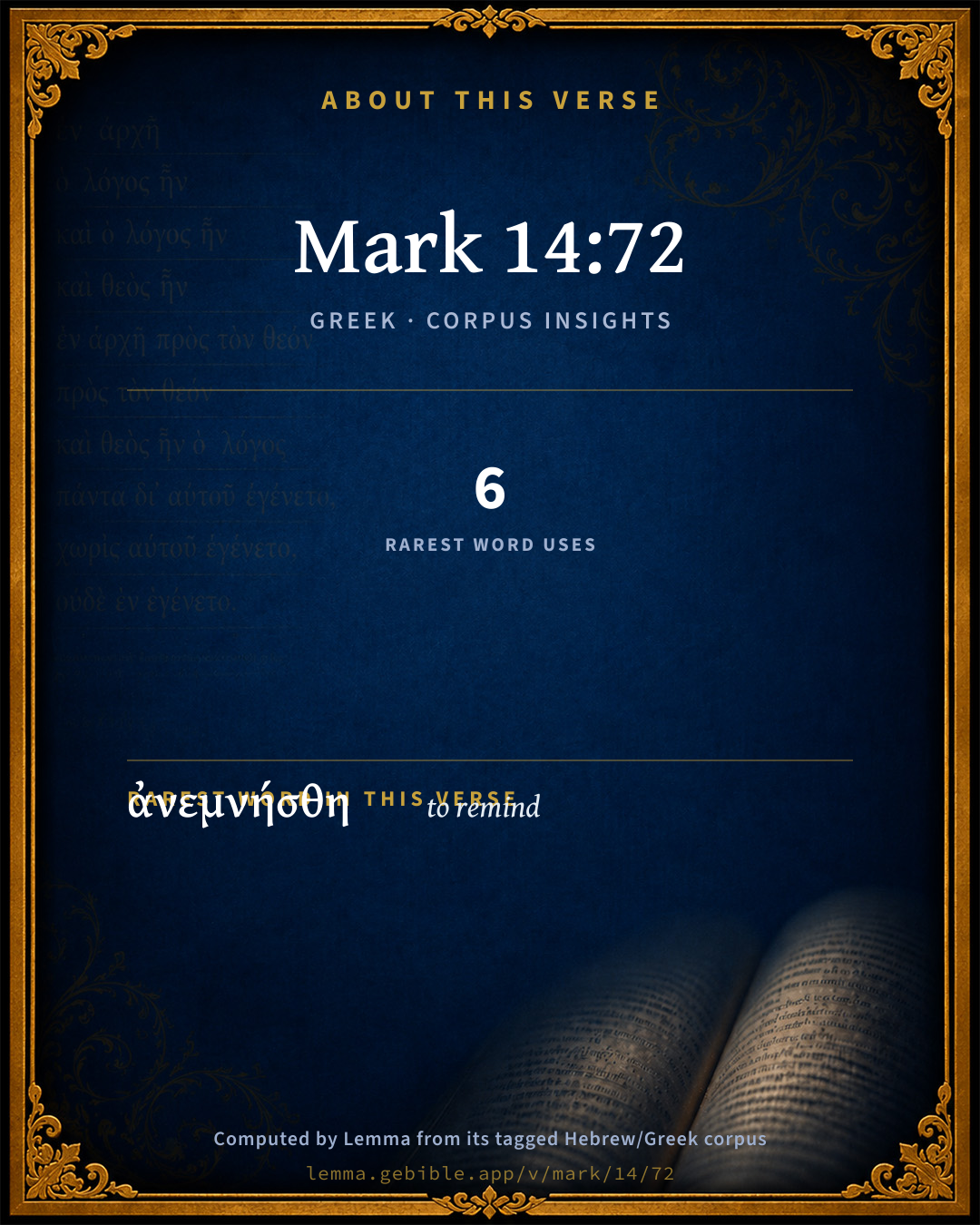
The rarest word here is ἀνεμνήσθη to remind G363 — appearing just 6 times in the whole Greek New Testament.

Shared distinctive vocabulary

ἀνεμνήσθη to remind G363 occurs in 6 verses of the Greek New Testament. Also found in:

Repetition

Words recur within this verse:

  • ἀλέκτωρ rooster G220 ×2
  • ἐφώνησεν to sound G5455 ×2
  • καὶ and G2532 ×3
  • ὁ the G3588 ×3

Cross-references

14

Topical passages linked to Mark 14:72 in the Treasury of Scripture Knowledge — connected by theme and wording, ordered by reader-vote popularity; previews shown in the World English Bible.

  • Mark 14:30 Jesus said to him, "Most assuredly I tell you, that you today, even this night, before the rooster crows twice, you will deny me three times."
  • Mark 14:68 But he denied it, saying, "I neither know, nor understand what you are saying." He went out on the porch, and the rooster crowed.
  • Ezekiel 7:16 But those of those who escape shall escape, and shall be on the mountains like doves of the valleys, all of them moaning, every one in his iniquity.
  • 2 Samuel 24:10 David's heart struck him after that he had numbered the people. David said to Yahweh, I have sinned greatly in that which I have done: but now, Yahweh, put away, I beg you, the iniquity of your servant; for I have done very foolishly.
  • Psalms 119:59–60 I considered my ways, And turned my steps to your statutes.
  • Jeremiah 31:18–20 I have surely heard Ephraim bemoaning himself [thus], You have chastised me, and I was chastised, as a calf unaccustomed [to the yoke]: turn you me, and I shall be turned; for you are Yahweh my God.
  • Ezekiel 16:63 that you may remember, and be confounded, and never open your mouth any more, because of your shame, when I have forgiven you all that you have done, says the Lord Yahweh.
  • Ezekiel 36:31 Then shall you remember your evil ways, and your doings that were not good; and you shall loathe yourselves in your own sight for your iniquities and for your abominations.
  • Matthew 26:34 Jesus said to him, "Most assuredly I tell you that tonight, before the rooster crows, you will deny me three times."
  • Matthew 26:74–75 Then he began to curse and to swear, "I don't know the man!" Immediately the rooster crowed.
  • Luke 15:17–19 But when he came to himself he said, 'How many hired servants of my father's have bread enough to spare, and I'm dying with hunger!
  • Luke 22:60 But Peter said, "Man, I don't know what you are talking about!" Immediately, while he was still speaking, a rooster crowed.
  • Luke 22:62 He went out, and wept bitterly.
  • 2 Corinthians 7:10 For godly sorrow works repentance to salvation, which brings no regret. But the sorrow of the world works death.

Cross-references courtesy of OpenBible.info (CC BY 4.0).

Where the printed editions differ

2 variants

Places in this verse where the major printed Greek editions disagree on the wording in a way that affects the translation — a comparison of editions, not a manuscript-by-manuscript collation. The editions are the modern critical texts (Nestlé-Aland 28/27, SBL, Westcott-Hort, Tregelles, Tyndale House) and the traditional texts behind the KJV (the Textus Receptus and the Byzantine/Majority text). It is not a claim about which reading is original.

  1. Extra text
    εὐθὺς

    “immediately”

    In NA28NA27TynSBLWHTreg Not in TRByz

    εὐθὺς (euthus) 'immediately' is only in older manuscripts (NA28+NA27+Tyn+SBL+WH+Treg)

  2. Extra text
    ὡς

    “[was] like”

    In NA28NA27TynSBLWHTreg Not in TRByz

    ὡς (hōs) '[was] like' is only in older manuscripts (NA28+NA27+Tyn+SBL+WH+Treg)

Textual data: Translators Amalgamated Greek New Testament (STEPBible TAGNT) · CC BY 4.0.

Commentary

Notes on Mark 14:72 from classic Christian and Jewish commentators (each source and its license shown beneath its notes). The classic Christian expositions comment on the surrounding passage and are grouped to its opening verse, so a note may address several verses; the Jewish commentaries on the Tanakh (Rashi and others) are per-verse, so they appear only where the commentator wrote on this verse.

Lemma curates 59 commentaries, every one of them public domain or Creative Commons licensed, each selected and text-cleaned for this edition rather than reprinted as found. About our sources →

The Biblical Illustrator

Joseph S. Exell

Mar_14:68; Mar_14:72

But he denied.

The foulness of Peters sin

1. He denies flatly and peremptorily.

2. He gives a double denial; implying more resolution. And both his denials are distinct and manifest lies.

3. He denies Christ before a multitude.

(1) Bad enough to have denied Christ before one witness. How much worse before so many?

(2) He who denies Christ before any man, shall be denied by Him before the Father. What a great sin to deny Him before all men!

(3) In so great a company were a number of wicked men, and now Peter exposes the name of Christ to all their scorn and opprobrium. He animates and hardens them, and takes part with them in the rejection of Christ.

(4) There were also some weak ones and well-wishes to Christ. Peters action weakens and scandalizes these, and perhaps prevents some of them coming forward in defence of the Lord. (Dr. Thomas Taylor.)

It is hard to confess Christ in danger

1. Because of Satans malice. He will do all in his power to keep men from confessing Christ openly, and to make them deny Him.

2. The strength of our natural corruption makes it difficult to resist Satans attacks.

3. Weakness of faith and graces.

(1) Think it not an easy thing to confess Christ in trial, nor a thing to be performed by our own power; but pray for the Spirit of strength.

(2) Pray for wisdom when and how to confess.

(3) Pray for faith. (Dr. Thomas Taylor.)

The porch of sin

Many step out of the midst of sin but hang about the porch. They would not be outrageous sinners, but retain a snatch or taste; not open adulterers, but adulterous eyes, thoughts, and speeches; not noted drunkards, but company keepers and bibbers; not blasphemous swearers by wounds and bloods, but by faith, troth, God, etc. All this is to remain in the porch of sin. (Dr. Thomas Taylor.)

Difficult to quit bad company

In that Peter sticks in the porch, and comes back among those whom he had forsaken, learn how difficult it is for a man who has been long used to bad company and courses, to be brought to leave it altogether. He will either look back, or else tarry in the porch. Sin and sinners are like bird lime. The more Peter strives to get out, the more he finds himself limed and entangled. (Dr. Thomas Taylor.)

Why God did not prevent Peters fall

1. He would give us and the whole Church an example of infirmity and weakness, by the fall of such a man.

2. The strongest must learn fear and watchfulness, and while they stand take heed lest they fall, lest the enemy suddenly overcome them as he did Peter.

3. To crush mens presumption, and teach them to attribute more to the word of Christ than their own strength. Had Peter done this, he had not so shamefully fallen.

4. To take away all excuse for men in after ages setting up Peter as an idol. (Dr. Thomas Taylor.)

To avoid sin, avoid occasions

He that would avoid sin must carefully avoid occasions, which are the stronger because of our own natural inclination to evil. He that would not be burnt must not touch fire, or go upon the coals. Beware of evil company. Consider thine own weakness, and the power of evil to seduce. (Dr. Thomas Taylor.)

To avoid sin, keep close to Gods Word

He that would avoid occasion of sin, must hold himself to Gods commandment, and within the limits of his own calling. If Peter had done this, he had not fallen so foully. Christ having expressed His will and pleasure, he should not have so much as deliberated upon it, much less resolved against it. But he forgets the word and commandment of Christ, and so falls into sin. (Dr. Thomas Taylor.)

How we are to show love to a friend

Here is a notable rule to be observed in friendships. Examine the love thou showest to thy friend, by the love of God.

1. Take heed thy love be subordinate to the love of God; so that, if thou canst not please both, thou please not thy friend at the cost of Gods displeasure (Mat_10:37). Peter should first have loved Christ as his Lord, and then as his friend. Had he so done, he would have kept His word.

2. Love the Word better than thy friend. Peter should have stuck to Christs road, instead of His person.

3. See thy love to thy friend be not preposterous, that thy affection destroy him not. The subtlety of Satan creeps into our friendships and fellowships, so that by our improvidence, instead of helping, we hurt them more than their enemies could do. We must pray for wisdom and judgment, that neither willingly nor unawares we either council or lead them into any sin, or uphold any sin in them, or hinder in them any good. (Dr. Thomas Taylor.)

The corrupting influence of bad company

See how soon even Gods children are corrupted with wicked company. Even Peter, a great and forward disciple of Christ, full of zeal and courage, who will pray, profess, and immediately before draw the sword in Christs quarrel, now can deny Him among persecutors. Great is the force of wicked company to pervert even a godly mind.

1. There is a proneness in godly men to be withdrawn by evil company. As the body is infected by pestilential air, so the mind by the contagion of bad company.

2. There is a bewitching force in evil company to draw even a good mind beyond his own purpose and resolution. (Dr. Thomas Taylor.)

Reasons for avoiding evil company

1. There cannot be true fellowship with God and His enemies too.

2. Every mans company tells what he is. Ravens flock together by companies; and so do doves. The good man will not willingly stand in the way of sinners.

3. The practice of wicked men should make good men shun their company; for wherein are their sports and delights, but in things which displease God and grieve His Spirit, and the spirits of all who love God and His glory? What can a good man see in such company, but must either infect him, or at least offend him in almost everything? (Dr. Thomas Taylor.)

Godly company the best

It seems very sweet to sit warm among wicked men, to eat and drink and be jovial with them; but there is a bitter sauce for such meats. On the contrary, in company of godly men thou art under the shadow of Gods mercy for their sakes. God loves His children and their friends. For Lots sake His family was saved. (Dr. Thomas Taylor.)

The fall of Peter

A great study in human nature is here presented.

I. The origin of Peters fall. Do not overlook-

1. The quarrel in Peters heart with Christs methods. Christs plan was to conquer by suffering; Peters to conquer by resisting. This inward divergence produced the outward separation. Beware of quarrelling with Gods dealings, or methods, or demands; the most common of all sources of backsliding.

2. Peters pride helped his fall.

II. The process of Peters fall.

1. Following Christ afar off (Luk_22:54)-half-heartedly, not close, not to testify to the Sanhedrin for Him, but simply to see the end (Mat_26:58). Close to Christ in the path of duty you are kept warm; sluggish and distant, the heart chills and grows feeble.

2. He entered into temptation.

3. A subtle snare is laid for him. If the three challenges had taken place in a reversed order, probably Peter would not have fallen by them. Had the men come first, his manhood might have risen to meet the challenge. But a housemaid does not put him on his mettle. Thrown off his guard, he tells his first lie, and it has afterwards to be backed up by more falsehoods and deadlier denials, putting a gulf between himself and Christ which, but for Christs grace, would have been eternal.

III. The commonness of similar transgression. Not a question of who is guilty, but who is guiltless of this fault. All hiding of the face from Christ, all secrecy of fear, which leads people to assume we have nothing to do with Christ, all leaving Him unowned and undefended, is a sin identical in nature with Peters. Each should ask, Lord, is it I? (R. Glover.)

St. Peters fall

Let us take warning from this-

1. Not to rely on our own strength for steadfastness in the moment of trial, but to trust only in Divine grace.

2. Not to suppose our own power of resistance to temptation is greater than that of others. Rather, when we see another sin, let us in him see our own selves, and pray God for him as we would for ourselves. When we see another steadfast in the faith, let us pray that he may preserve that gift which he has unto the end.

3. To heed every warning that is mercifully given us. When the cock crew for the first time, it seems wonderful that St. Peter was not reminded of Christs prediction, nor restrained from subsequent denials. But sin deafens the heart to every voice, and blinds the eye to all signs. (W. Denton, M. A.)

Fall and restoration

There are MSS., you know, called palimpsest, i.e., written upon twice. The original inscription upon them, which was fair, and full of Divine wisdom, has been defaced, and in its place may now be seen letters and words and sentences in contrast to what was described before. So with the characters of men-even good men. Over their better nature you may see scratched in ugly scrawls very obvious imperfections and frailties. But, thank God, often do we witness, after the process of defacement, a process of restoration. Divine grace, through discipline of various descriptions, rubs out the evil and brings back the good, and causes the soul at last to reveal again most distinctly what had only been dimmed and not destroyed; even as there has been discovered a method by which such ancient writings can be made to exhibit once more what seemed-but only seemed-forever spoiled. (Dr. Thomas Taylor.)

Danger of one false step

We see in Peters fall the danger of a first false step. As he entered the house he denied his discipleship to the portress; he did wrong that good might come. He loved his Master; he sought to be with or near Him; he desired to see the end. What was the harm of merely a white lie to gain this great advantage? But the white lie led to black denial, and to a false oath. When he had assured Jesus that, though all might deny Him, yet would not he, Peter had supposed the case of his being brought up for trial before the Sanhedrin. And it is possible that he would have stood firm under such a trial, but this temptation came on him from an unexpected quarter, and when he was unprepared to meet it; that is why he fell. He would have confessed his discipleship before the High Priest, but he denied it to the young woman who kept the gate. From this we learn that we must be always prepared to meet temptation, and that the most treacherous and dangerous of temptations come upon us suddenly, without giving us time to prepare, and in a way unexpected. Peters heart was sound from first to last; he never wavered in his love. His spirit was willing, but the flesh was very weak. This makes the difference between venial and wilful sin. Wilful sin is committed by deliberate consent of the will to what is evil. The fall of Peter was not wilful. Venial sin is the fault of infirmity, the fall through weakness against the propose of the heart. Such was the fall of Peter. We see in his repentance the harmfulness of venial sin. We are apt to make light of sin if it be not wilful. This sin of Peters was not wilful, yet his heart was broken and contrite for it. (S. Baring Gould, M. A.)

Discrepancies in the narratives of the Evangelists may be harmonized

It is well known that there are varieties of detail in the four records of St. Peters three-fold denial. The discrepancies have been spoken of as irreconcilable, and attempts to shake the credibility and trustworthiness of Holy Scripture have been based upon this supposition. Careful examination will show that the incidents given by the different Evangelists are completely in harmony with the belief that there were three denials, i.e., three acts of denial, of which the several writers have taken such features as seemed to be most significant for their purpose. The multiplicity of charges may well be illustrated out of our own experience. We have witnessed, no doubt, a scene in which a crowd of people in a state of excitement are setting upon an individual whom they believe to have done something of which they disapprove. No sooner has one begun to accuse him of it than another comes up and adds to the charge, another insists upon it with gestures of violence, another can prove it if they will only let him speak, and then perhaps several cry out at once. The bewildered man tries to exculpate himself from the Babel of charges. He says anything and everything in the excitement of the moment, and at last, when matters become desperate, loses all control over his words. This is almost exactly what happened in the last act of denial in the courtyard of the High Priests palace. St. Peter was driven to bay by a multitude of excited assailants, and perhaps hardly knowing, certainly not realizing, what he said, he appealed to heaven, and called down Divine vengeance upon his head if his denial were untrue. (H. M. Luckock, D. D.)

Peter denies his Lord

I. The circumstances under which this great guilty act was performed are exceedingly dramatic. The story shifts its phases like pictures in a play.

1. The scene is laid in the quadrangle of the High Priests house in Jerusalem, whither the miscellaneous mob of people had hurried Jesus after His apprehension in the garden of Gethsemane. It will be necessary for those who desire to understand this narrative to form for themselves a conception of Peters precise whereabouts during such a grand crisis of his history. Eastern dwellings of the better sort appear to have been built around a four-sided court-an interior space like a private yard enclosed-frequently paved with flat flagging stone, and open to the sky overhead. Into this area a passage from the street led by an arched opening through one side of the house. Heavy folding doors guarded the entrance, leaving a smaller wicket gate near by for the convenience of visitors who came familiarly or one at a time. Usually this was kept by a porter. Such, in all likelihood, was the general fashion of Caiaphas palace. Simon Peter was inside of the wicket standing there in the courtyard.

2. The company into the midst of which before this John, the beloved disciple, had found his way, and which he does not appear to have unused even to notice as he hurried through, was made up of servants and soldiers. Belated and bewildered by their unwonted excitements on the night of our Saviours trial, they had kindled a fire of coals out in the area. The hour of this arraignment was unusual, the air was chilly, and the confusion was full of discomfort. The entire group appears irritable and maliciously disposed. The girls are coarse, the military men boisterous and brutal, the Levites insolently triumphant, as they see their victim now in what they deem the right hands, and the waiters abusive and impudent. Everything shows picturesquely there among the flitting dresses and uniforms. The flame makes all the quadrangle dance with uncouth shadows, and the faces of the men and maidens are ruddy under the red glow of the coals. Ill-tempered and testy with the raw air of the midnight, they jostle each other and join roughly in gibes about the discomfiture and capture of this Nazarene prophet at last.

3. Enter Simon Peter now, the chief actor in this awful tragedy of the denial. Into the midst of the throng comes a burly figure, a quick-stepping individual, evidently trying to do that peculiar thing which almost everybody, one time or another in his life, has tried to do, and nobody at any time has ever succeeded in accomplishing, namely, to look unconscious and unconcerned when absorbently anxious, and to seem unnoticed and unembarrassed when he knows the rest are all staring at him. That newcomer is our well-known friend Simon, the son of Jonas; and he is now endeavouring to act at perfect ease, although he is certain that he is and ought to be an object of suspicion from the beginning. He sat with the servants (Mar_14:54), and warmed himself at the fire. Picture him now, away from all his friends, among the sullen enemies of his Lord. There is some evidence that this disciple imagined he might pass himself off for one of the crowd who went out to apprehend Jesus, if only he mingled unabashed with the chilly company around the coals. So he pressed nearer, and this was exactly what hastened his exposure.

4. Now commences the dialogue of the drama. A girl kept the outer door; this reminds us of the office of the damsel named Rhoda (Act_12:13), whom we meet in another part of Peters history farther on.

II. We must arrest our study of the melancholy story here, for it is high time that we should seek for the practical lessons taught in this transgression of Peter.

1. We see, for one thing, how commonplace is even the most notable of human sins. This denial of his Lord will always be quoted as the characteristic wickedness of Simon Peter. It stands out in history as one of the vast crimes of the world and the race. To deny Christ is so simple a thing that we can fall into it, and hardly know it at the time. This sin is not singular nor unusual. Christs cause is on trial now as really as was Christ Himself in the High Priests palace. We stand in jeopardy every hour. Satans ingenious policy is to come suddenly upon us with the surprise of a question with ridicule in it. So small a matter as emitting family prayer because a stranger is in our dwelling, as putting on a ribald air when one twits us with being serious, may have in it all the meaning and the meanness of Peters sin. Wherefore let him that thinketh he standeth take heed lest he fall.

2. Again: we see the immeasurable peril of just one act of wrongdoing. Indeed, one act never seems to remain alone. This first denial led to two more of the same sort; then to lying, then to profanity. It is as supreme a folly to talk of a little sin as it would be to talk of a small decalogue that forbids it, or a diminutive God that hates it, or a shallow hell that will punish it. Sin is registered according to heavenly measurements of holiness and majesty.

3. We see, likewise, a ready explanation of the mysterious falls into sin sometimes noticed in the lives of really good men. No one doubts that Simon Peter was a regenerate Christian man: how happens it that he crashes down into wickedness so suddenly? The answer to this question must be found in the disclosures of this disciples previous history. He had for a long time been preparing for this disaster. One of the brightest of our modern writers has given us a simile somewhat like this. If a careless reader lets fall a drop of ink in among the leaves of a book he is just closing, it will strike through the paper both ways. When he opens the volume again, he can begin with the earliest faint appearance of the stain, and measure by its increase his progress towards the great black point of defacement. Open it now anywhere, and he will detect some traces of the coming spot. He can turn back to it; he can turn forward from it. So of this great base act of the Apostle Peter, which we call emphatically the denial. It is a stain in the middle of his life. Most of us have a profound admiration and a tender love for this old Bethsaida fisherman, even if we do deny he was ever set up for the first pope. But hitherto, as we have been studying his biography, we might often have seemed to see the denial coming. Along the way hints of it appear. One who reads the Gospels for the first time would be likely to remark, Here is a man who will be in awful shame and trouble some day, for he thinks he stands safely; he is going to fall. This might be true of most self-confident Christians who lapse into sin; the wickedness has been growing upon them longer than they thought. Men fall, so once said Guizot, on the side towards which they lean. (C. S. Robinson, D. D.)

Peters denial of Jesus

We speak of a sudden death; when the doctor had long been warning the man who has just died that he might die at any moment. We speak of a sudden bankruptcy; which, however, the commercial prophets had long secretly foretold. We speak of the sudden fall of a tree in a tempest; when, under a fair bark and a leafy shade, it had long been only a thing of powder. We speak of the sudden fall of a soul; when in that soul the causation of that fall had long been working out of sight.

I. Think of this deed in connection with a certain weakness in which it began. That sin began, not in a sin, but in a weakness. The strength of a rope is to be measured, not according to what it is in its strongest, but in its weakest point. The strength of a ship is to be estimated, not according to her strongest, but her weakest part; let but the strain come on that, let that be broken, no matter how strong in any other part she may be, the mighty ship, being conquered there, will go down. So it is with the strength of a soul. Peter had many strong points, but one weak one; and that one, undetected by himself, was at the beginning of this disaster. It was the weakness of excessive constitutional impulsiveness. Impulse is beautiful and good; but impulse is only like steam in the works of a factory, or wind in the sails of a yacht. Impulse is a good servant of the soul, but a bad master. Impulse may act with as much emotional force in a wrong direction as in a right. Even when its direction is right, if left to itself, it is not safe. But for this weakness, a soul might often be saved just in time from the special kind of danger to which other weaknesses specially lead. There is a man who feels it a pain to contradict, and a pleasure to acquiesce; and when in the company of errorists, this weakness is his danger. There is a man whose weakness is an agonizing consciousness of ridicule. There is a man, a favourite with us all, whose simplicity we love, at whose heroics we smile, but whose weakness is that he is apt to think too highly of himself. Did any man with all these foibles but take the steadfast poise of principles, did he but take time, he might be saved from the action of them all.

II. Think of this act of Peter in connection with his entrance into the temptation to commit such an act. Enter not into temptation, said the Master; and within a few minutes from the time of that order the servant entered into it. He loved Christ far too deeply to deny Him; be had never denied Him yet, and was not likely to do so now. Ah! he had never yet been tried. You, perhaps, are a man of splendid morality, but you hardly know how much your integrity depends upon circumstances; you have never yet had it tried. There may be no accident before a train starts from the station; but let there be an undetected flaw only in one axle, and, when the locomotive is spinning along the line at the rate of forty miles an hour, there may be a great crash of property and life. Peter thought himself an iron man; but there was a flaw in his iron, though he knew it not until he had entered into a trial for which he was not fitted; then the iron broke!

III. Think of Peters denial of Christ in connection with the account of its three occasions. God pity that youth who has just uttered his first lie! If eventually saved from the evil it has already set working, God alone can save him. No liar can alter the law of the lie, and that law is, that the first lie has a generative power, that one lie compels another, that one lie requires another to back it, that one lie spreads and ramifies into endless evolutions.

IV. Think of Peters denial in connection with the treatment that Christ was receiving at the time. A seer tells us that he once saw heaven, and had a glimpse of the treatment Jesus receives there. This is his report: I saw also the Lord, sitting upon a throne, high and lifted up, and His train filled the temple. Now turn to this place on earth, and see how the Holy One is treated there. Do you not now see how the pictured memory of this episode came into the phrase of John the Divine, the kingdom and patience of Jesus Christ?

V. Think of Peters denial of Christ in connection with Christs act of restoring love. Simultaneously, the startled man turned to look at his Master, and his Master turned to look at him. We are awed before the calm sovereignty of that look, no less than by its loving kindness. He spoke with His eye, says Erasmus. We may not imagine what the look was like, but we know what effect it had upon the disciple. The outgoing power of the Lord that went with it struck his heart, as once the prophets rod struck the rock, and made the waters flew. It touched, and set flowing, frozen memories. With only self to lean upon, lower and lower would have been the inevitable fall; but just in time the Lord lifted him by a look! Some structures can only be saved by being ruined. They have in them such slack work and such bad materials, that it is of no use to patch them, or to shore them up; the only thing to be done is to pull them down altogether and build them again. Some lives can only be saved by a desperate operation. Some souls can be saved only through being for an instant hung, as by a hair, over the pit of the lost. A certain man was seen for many years rich, prosperous, influential in the State; that very man was afterwards seen, down on his hands and knees, in the livery of degradation, scrubbing the floor of a convict prison. In his days of worldly honour he had made profession of the Christian faith, and not without sincerity; but egotism was suffered to master him. He fell. In the shock of that fall, in the recoil that comes of despair, he was saved as by fire. (Charles Stanford, D. D.)

Peters denial

I. Peter never meant to deny his Lord. He believed now, as clearly as he did that day at Caesarea Philippi, Thou art the Christ, etc. He was honest in saying, Though I should die with Thee, yet will I not deny Thee. He proved that soon after by drawing his sword in defence of Christ. Any believer may have a like assurance. There is the peril. If there should come to a Sabbath congregation a voice from heaven, declaring that someone there would one day turn out a thief, how impossible it would seem! Every one would think there must be a mistake; the message has come to the wrong church, or, at least, it does not mean me. Of course not. Satan says to us all, Think of your faith, your virtue, your blood, your position. And when he has beguiled us into such self-complacency, he begins his manoeuvres, not asking us at first to do anything dishonest, but commencing on the borderline between his kingdom and the Lords, knowing if we yield to him in things that are doubtful, we will soon yield to him in things that are sure. A leading member of a city church, caught in a shameful crime, wrote his friends: I am astonished at the blindness and wickedness of my course.

II. Peter went voluntarily into the way of temptation. Peter thought very likely that he was safe in such company, because nobody would know him. A Christian had better not stay at the fire with the ungodly. Satan did not come to him as a roaring lion, but in a mere whisper. Who could draw a sword at a young girl? If he had contemplated her question, he might have had ready an answer that would have been truthful without giving offence. Often the science of truth-telling is to look out for emergencies; to have ready an answer that shall be polite and true. But that is essentially the science of all virtue. It is the trials which take us by surprise that measure our strength; it is at these crises that destiny is made. And such unlooked-for assaults are sure to come to a Christian who goes voluntarily into the way of temptation. One who does not watch has no right to pray. A man, exhorted to abandon a habit of drinking that was fast dragging him to ruin, replied: I magnify more than you do the grace of God. Without drinking anyone could save himself. I believe in grace that can save a man when he does drink. He held that delusion till he died a sot. That is a Divine law with reference to all sin. If you throw yourself from the top of the temple, God has power to keep your bones from breaking; but you had better not do so, for it is written: Thou shalt not tempt the Lord thy God. The precept, Let him that thinketh he standeth take heed lest he fall, means, if you are walking in slippery places, watch every little danger, every least step. One may slip as badly on a foot of ice as on an acre. Peter would not have fallen if he had remembered Christs caution spoken to him: Watch and pray that ye enter not into temptation.

III. Peter repented. There is no other way back to Christ for one who has fallen.

IV. Peter found mercy. (T. J. Holmes.)

The denier

Let us endeavour to understand this melancholy event, Peters denial of his Lord. In order to this, let us advert to the circumstances which attended it, and the causes which led to it; and then consider seriously the improvement which we should make of it.

I. The circumstances under which an offence is committed often greatly affect its character; they sometimes even change its complexion altogether. The first circumstance of aggravation is found in the repeated warnings which he received. Forewarned is forearmed; when, therefore, Peter had been warned by our Lord of his danger, we might have expected on his part the utmost vigilance and prayerfulness. The second circumstance of aggravation is found in the solemn protestations and vows which he made. After each warning he solemnly avowed his willingness to go with his Lord to prison and to death. Humility, self-abasement, prayers, tears, had been far more suitable in his case than those solemn protestations. And ever does it become us to say, Hold Thou me up, and I shall be safe. The third circumstance of aggravation is found in the recentcy of the warnings and vows to which we have adverted. If the warnings had been given, and the vows made, some years before, they might have been forgotten; but they were all given and made the same night in which the offence was committed. A very few hours only could have elapsed between the last warning especially, and the first denial. A fourth circumstance of aggravation is found in the repetition of the offence. It was not once that he denied his Lord, but a second, and again a third time. And this leads to another circumstance of aggravation, that is to say, the profaneness and the perjury with which his denial was attended. We have just seen that the second time he did not simply deny his Lord, but he did it with an oath. He appealed to high heaven as his witness and his judge-when he swore falsely. The last circumstance of aggravation which we shall notice is, that all this was done in the very presence of the Redeemer. It was not done in a corner: it was not a secret offence, which might forever remain unknown; but it was done publicly, before many witnesses. John was there. It was in the presence of this faithful friend that Peter denied his Lord-with oaths and curses. Above all, Jesus was there.

II. Such are the circumstances of aggravation which marked the offence of Peter; we shall now advert with great brevity to the causes of this strange conduct. How can we account for it?

1. One cause is found in the known character of Peter. He was a man of ardour, impetuosity, zeal; but, like many others of a similar temperament, he was destitute of moral courage. There is no necessary connection between physical and moral courage, some of the finest specimens of the former having proved themselves utterly destitute of the latter. How many there are who suffer from the same moral infirmity! Let our young friends especially guard against it, and labour to correct it. In order to this I would earnestly recommend two things.

(1) An intimate acquaintance with some of the noble characters presented to us in history, as well as with some of the writings of choice spirits which have the most direct tendency to strengthen the mind. Let them steep their minds in the noble sentiments which are there so appropriately expressed.

(2) An habitual realization of the Divine presence. Let them feel that Gods eye is ever upon them; and let it be their study to approve themselves to Him.

2. We have another cause in the state of mind which he had recently indulged. I refer particularly to his overweening confidence and pride. The solemn warnings of his Lord ought to have humbled him; but his confidence was in himself, not in his God. God will humble the proud, but will give grace to the lowly.

3. A third cause is found in the danger, real or imaginary, in which he was placed. It would not appear that there was any danger involved in the fact of his discipleship. John was a disciple; known as such to the High Priest, and yet he was in the palace, and appears to have apprehended no danger. But Peter had been active, in one sense mischievously active, in the garden. He had cut off the ear of the servant of the High Priest, and this might be construed into a crime; an attempt to rescue or prevent the capture of a criminal. Hence Peters fears; his wish to be unknown; his denial. How closely rashness and cowardice are allied!

III. Let us now see what instruction we may derive from this mournful spectacle. We regard it as an affecting illustration of the frailty of our nature; as a melancholy proof of what man can do under the influence of temptation, considered simply as a morally imperfect being. It thus presents one phasis at least of human character in an instructive light. Let us illustrate this. We may divide the human family into three classes. First, there are, in the worst sense of the term, wicked beings-beings whose moral nature is entirely perverted, whose good is evil; malevolent beings who can do evil for evils sake, and have real delight in mischief. There are others who have by no means attained to this completeness in evil, who are, nevertheless, the slaves of some one dominant passion. And from his affecting ease we see what evil a man may commit, how low he may sink in moral degradation from mere frailty, from inherent defectiveness of character, when sore pressed by a temptation adapted to his weakness. It may be proper to remark here, that one act, whether good or bad, does not constitute a character. We should guard against the severity, the injustice of representing men as guilty of hypocrisy, of insincerity, because they have once, or even twice, under the influence of temptation, acted in opposition to their professions. The fall of Peter is further instructive to us, as it affords a striking illustration of mans ignorance of himself. How little man knows-can know of what is in him! The fall of Peter calls upon us to review our past history, and to look carefully into our own hearts. We may learn from the case of Peter the nature of true repentance. Peter went out and wept bitterly. If we compare the case of Peter with that of Judas, we shall learn the nature of true repentance, we shall perceive the characteristic difference between that which is true and that which is false, that which is saving and that which is destructive. Wherein does the difference consist?

1. Judas saw clearly the enormity of his conduct, but it was only in and through its consequences; he had no perception of the evil of his conduct in itself.

2. The second point of difference between the repentance of Judas and of Peter is in the subject. (J. J. Davies.)

Peters second denial of Christ

He who once cracks his conscience will not much strain at it the second time.

1. Sin is very bold when once it is bid welcome. If it once enter, it knows the way again, and once admitted will plead, not possession, but prescription. An army is easier kept out than beaten out.

2. The sinner is less able to resist the second time than he was the first. Grace is weakened and decayed by yielding to the first temptation, and the strength of God, which only makes the way of grace easy, is plucked away by grieving His Holy Spirit.

3. The way of sin once set open, is as the gates of a city thrown open for an enemy, by which Satan bringing in his forces, strongly plants them, and quickly so fortifies them, that it will require great strength to remove them.

4. Every sin admitted, not only weakens, but corrupts the faculties of the soul by which it is upheld. It darkens the understanding, corrupts the will, disturbs the affections, and raises a cloud of passions to dazzle reason. (Dr. Thomas Taylor.)

Peters degeneration

A dicer, they say, will grow to be a beggar in a night; and in a night Peter will grow from a dissembler to be a swearer and forswearer. (Dr. Thomas Taylor.)

Why Christians are allowed to fall

Why (it may be asked) does the Lord leave His saints and children to themselves, by withdrawing His grace from them, and so suffer them to fall into sin?

1. To correct their carelessness and carnal security.

2. To stir them up to more watchfulness over themselves for time to come, when they know their own weakness.

3. To pull down their pride, and humble them more thoroughly before God (2Co_12:7).

4. To drive out of them all confidence in themselves, and presumption of their own strength.

5. To make them more compassionate toward others (Luk_22:32).

6. That by this means He may make them examples, and grounds of comfort to other poor sinners. (George Petter.)

The heinousness of Peters third denial

Peter was now in great danger. He hears of the garden, and is likely to be revenged for his tumult, his quarrel, and wronging Malchus. He is pressed by evident signs that he was with Christ, and now if he bestir him not, he shall not avoid present danger; or if he do, he shall be branded for a common liar and perjured person forever; and therefore out of great fear he more stoutly denies his Master than before, and because neither his simple denial will serve him as in the first instance, nor his binding it with oaths and swearing as in the second, as if he had not done enough, he curses and imprecates himself, wishing not only mischief to himself, but calling on God, a just Judge, to avenge that falsehood, and inflict the deserved punishment if he knew Him of Whom they spake. Oh, fearful sin!

1. To deny his Lord and dear Master.

2. After so many warnings on Christs part.

3. After so many confessions and professions of his own.

4. After so often, three several times, so much time of deliberation coming between. One might seem infirmity, but thrice argues resolution.

5. With lying and perjury.

6. With cursing and imprecation. Thus Peter is among the forwardest of those who make falsehood their refuge, and who trust in lies. (Dr. Thomas Taylor.)

Lying a slough of despond

Benvenuto Cellini records in his autobiography the bitter experiences he endured in being tempted to lie to the Duke, his patron, lest he should forfeit the favours of the Duchess-he, who was always a lover of truth and an enemy to falsehood, being then under a necessity of telling lies. As I had begun to tell lies, I plunged deeper and deeper into the mire, till a very slough of despond it became to him. (Francis Jacox.)

Mar_14:72

And Peter called to mind the word.

Peters repentance

That the cock crew again was an ordinary and natural thing, but at this time ordained for a special end.

1. To put Peter in mind of his promise.

2. To bear witness to the words of Christ, which Peter will not, till now, believe to be true.

3. To reprove Peter of His sin.

4. To accuse Peter to his own conscience. He needs the voice of a cock to help him out of his sin! He is admonished by this voice, that the silly cock kept his watch, according to the word of his Creator; but Peter has not kept his watch with his Lord, but fearfully fallen in his station.

I. The time of Peters repentance. Then. The fittest time for repentance is immediately after the sin, without delay.

1. Consider the exhortation in Heb_3:7. Hast thou a lease of thy life till tomorrow, that thou refusest to repent today?

2. Sin gets strength by continuance.

3. Nature teaches in other things to take the fittest season; to sow in seed time, to make hay while the sun shines, to take wind and tide which wait for no man. Let grace teach thee to know thy season, thy day of visitation.

4. Late repentance is seldom true repentance.

II. The means of Peters repentance.

1. External.

(1) The crowing of the cock.

(2) The looking back of Christ.

2. Internal.

(1) Remembering the Lords words.

(2) Weighing the Lords words. (Dr. Thomas Taylor.)

Peter goes out

Peter went out-

1. In respect of the place. The hall and the porch were no places of safety or tranquility, but full of danger and fear and tumult, and no fit place for meditation.

2. In respect of the company. He sees that the longer he stays among wicked men, the more sins he heaps up against the Lord, and against his own conscience, and therefore he sees it high time to be gone.

3. In respect of the business in hand. He is to bewail his sin, to weep bitterly, to get out of himself; and to do this, he must be alone with God. (Dr. Thomas Taylor.)

Reasons for avoiding evil company

1. He that will cleave to God, must sever from Gods enemies. The same grace that binds us to God, looses us from the wicked. Solitariness is better than bad company.

2. What comfort can a sheep have among a herd of swine, which wallow and tumble in foul lusts? or a silly dove among a company of ravens? How can a good heart but grieve in their society whose sports and pleasures are in such things as only grieve the Spirit of God? How can a Christian solace himself among such as care for none but brutish delights, in eating, drinking, sporting, gaming, attended with swearing, railing, drunkenness, and idleness?

3. What safety among evil men, whether we respect themselves or their practices? For themselves, they are so poisonful, so infectious, that we can hardly participate with them in good things and not be defiled. For their practices, how just is it if we join ourselves in their sins, that we should not be disjoined in their judgments!

4. This has been the practice of the godly (Psa_26:4). (Dr. Thomas Taylor.)

How to act in bad company

If we fall among, or be cast into bad company-

1. Let us not fashion ourselves to them.

2. Consider who thou art-a disciple, separated by grace-a son of God.

3. Look upon ungodly examples to detest them, to grieve at the dishonour of God, to grieve at the wickedness of man made in Gods image.

4. See them, to stop them if possible. If there be hope of doing good, admonish them. Warn them of the wrath of God, coming on those who do such things. Win them, and pray for them and their amendment.

5. If their be no hope of winning them, yet by thy godly carriage convince them, check them, confute, shut their mouths. Let thy light shine in spite of their darkness, to glorify thy Father; and at least let them see thy watch end godly care to preserve thyself from their contagion. (Dr. Thomas Taylor.)

Times for calling sins to mind

We ought to take all occasions offered to think of our sins, and to be stirred up to humiliation and repentance for them. Especially, for example-

1. When in the public ministry of the Word we hear such sins reproved as we are guilty of.

2. When we come to Holy Communion.

3. When we read the Scriptures, or hear them read.

4. When we are privately admonished of our sins, either by the ministers of God, or by any other that have a calling to do it.

5. When God lays upon us any grievous affliction or chastisement; such as sickness, loss of goods, loss of near friends by death, etc. When we either see or hear of the judgments of God inflicted upon others for sin. (George Petter.)

Fountains of repentant tears

Repentance is wrought by the Spirit of God. But he works it in us by leading us to think upon the evil of sin. Peter could not help weeping when he remembered his grievous fault. Let us at this time-

I. Study Peters case and use it for our own instruction.

1. He considered that he had denied his Lord. Have we never done the like? It may be done in various ways.

2. He reflected upon the excellence of the Lord whom he had denied.

3. He remembered the position in which his Lord had placed him-making him an apostle, and one of the first of them. Have we not been placed in positions of trust?

4. He bethought him of the special intercourse which he had enjoyed. Have not we known joyous fellowship with our Lord?

5. He recollected that he had been solemnly forewarned by his Lord. Have not we sinned against light and knowledge?

6. He recalled his own vows, pledges, and boasts. Have we not broken very earnest declarations?

7. He thought upon the special circumstances of his Lord when he had so wickedly denied Him. Are there no aggravations in our case?

8. He revolved in his mind his repetitions of the offence, and those repetitions with added aggravations: lie, oath, etc. We ought to dwell on each item of our transgressions, that we may be brought to a more thorough repentance of them.

II. Study our own lives and use the study for our further humiliation.

1. Think upon our transgressions while unrepentant.

2. Think upon our resistance of light, and conscience, and the Holy Spirit, before we were overcome by Divine grace.

3. Think upon our small progress in the Divine life.

4. Think upon our backslidings and heart wanderings.

5. Think upon our neglect of the souls of others.

6. Think upon our little communion with our Lord.

7. Think upon the little glory we are bringing to His great name.

8. Think upon our matchless obligations to His infinite love. Each of these meditations is calculated to make us weep.

III. Study the effect of these thoughts upon our own minds.

1. Can we think of these things without emotion? This is possible; for many excuse their sin on the ground of their circumstances, constitution, company, trade, fate: they even lay the blame on Satan, or some other tempter. Certain hard hearts treat the matter with supreme indifference. This is perilous. It is to be feared that such a man is not Peter, but Judas; not a fallen saint, but a son of perdition.

2. Are we moved by thoughts of these things? There are other reflections which may move us far more. Our Lord forgives us, and numbers us with His brethren. He asks us if we love Him, and He bids us feed His sheep, Surely, when we dwell on these themes, it must be true of each of us-When he thought thereon, he wept. (C. H. Spurgeon.)

Recollection

Peters recollection of what he had formerly heard was another occasion of his repentance. We do not sufficiently consider how much more we need recollection than information. We know a thousand things, but it is necessary that they should be kept alive in our hearts by constant and vivid recollection. It is, therefore, extremely absurd and childish for people to say, You tell me nothing but what I know. I answer, You forget many things, and, therefore, it is necessary that line should be upon line, and precept upon precept. Peter himself afterwards said in his Epistle, I will not be negligent to put you always in remembrance of these things, though ye know them. We are prone to forget what we do know; whereas we should consider that, whatever good thing we know is only so far good to us as it is remembered to purpose. (R. Cecil.)

Peters life-long repentance

Peter falls dreadfully, but by repentance rises sweetly; a look of love from Christ melts him into tears. He knew that repentance was the key to the kingdom of grace. At once his faith was so great that he leaped, as it were, into a sea of waters to come to Christ; so now his repentance was so great that he leaped, as it were, into a sea of tears, for that he had gone from Christ. Some say that, after his sad fall, he was ever and anon weeping, and that his face was even furrowed with continual tears. He had no sooner taken its poison but he vomited it up again, ere it got to the vitals; he had no sooner handled this serpent but he turned it into a rod, to scourge his soul with remorse for sinning against such clear light, and strong love, and sweet discoveries of the heart of Christ to him. Clement notes that Peter so repented that, all his life alter, every night when he heard the cock crow, he would fall upon his knees, and, weeping bitterly, would beg pardon for his sin. Ah! souls, you can easily sin as the saints, but can you repent with the saints? Many can sin with David and Peter, who cannot repent with David and Peter, and so must perish forever. (Thomas Brooks.)

Washing with tears

Nothing will make the faces of Gods children more fair than for them to wash themselves every morning in their tears. (S. Clark.)

Tears of repentance

A saints tears are better than a sinners triumphs. Bernard saith, The tears of penitents are the wine of angels. (Archbishop Secker.)

The fall of St. Peter

And Peter called to mind the word that Jesus said unto him, Before the cock crow twice, thou shalt deny Me thrice. And when he thought thereon, he wept.

I. The first error of the apostle was confidence in the strength of his own virtue, followed by its natural result-the want of watchfulness. This was the commencement of his aberration, and the origin of all his subsequent sorrow. Our only strength is in humble and earnest reliance upon the grace of Christ. It is rare that an humble and watchful soul is overcome by temptation. Temptations are seldom nearer than when we suppose them most distant. If we commit our way unto the Lord, He will direct our steps.

II. The first sinful act of Peter arose from vainglory. He wished to make a display of his courage. One extreme is always liable to be succeeded by its opposite. Rashness is naturally followed by cowardice. He who smote off the servants ear was seen, in a few minutes, hiding himself in the darkness among the trees of the garden.

III. The vacillation of Peter produced its natural result-insufficient and undecided repentance. He could not forsake his Master entirely. He dared not openly confess his fault, and meet the consequences of doing right. He followed Christ afar off. Thus difficult is it to do right, after we have once commenced the doing of wrong. A course only half-way right is as perilous a one as can be chosen. Nothing could have restored to Peter the moral courage of innocence, but going at once to Christ, confessing his sin, and avowing his attachment, no matter what the avowal might have cost him. We may be surprised into sin. Our only safety consists in forsaking it immediately. It we hesitate, our conscience will become defiled, and our resolution weakened. It is also of the utmost importance that our reformation be bold, manly, and entire.

IV. Peter heard Jesus falsely accused, and he uttered not a word in His defence. He was the friend and the witness of Christ. It was his duty to act, and to act promptly. By quietly looking on, when he ought to have acted, Peter prepared himself for all the guilt and misery that ensued. Hence let us learn the danger of being found in any company in which the cause of Christ is liable to be treated with indignity. If we enter such company from choice we are accessory to the breaking of Christs commandments. If our lawful duties call us into society, where the name of Christ is not revered, we can never remain in it innocently for a moment, unless we promptly act as disciples of Christ.

V. Peter attempted to escape from the embarrassments of his situation by equivocation. I know not, said he, nor understand what thou sayest. This only in the end rendered his embarrassment the more inextricable. Let this part of the history teach us the importance of cultivating, on all occasions, the habit of bold and transparent veracity. Equivocation is always a sort of moral absurdity. It is an attempt to make a lie answer the purpose of the truth. He who does this when his attachment to Christ is called in question has already fallen. He denies his Lord in the sight of his all-seeing Judge, though his cowardice will not permit him to do it openly. The man who has gone thus far will soon be brought into circumstances which will openly reveal his guilt.

VI. Peter was rapidly led on to the commission of crimes in themselves most abhorrent to his nature, and crimes of which, at the commencement of his wrong-doing, neither he nor any one else would have believed him capable. He began by nothing more guilty than self-confidence and the want of watchfulness. He ended with shameless and repeated lying-the public denial of his Master, accompanied by the exhibition of frantic rage, and the uttering of oaths and blasphemy in the hearing of all Jerusalem. Thus, step after step, he plunged headlong into more and more atrocious guilt, until, without the power of resistance, he surrendered himself up to do the whole will of the adversary of souls. (Francis Wayland.)

True contrition

When King Henry II, in the ages gone by, was provoked to take up arms against his ungrateful and rebellious son, he besieged him in one of the French towns, and the son being near to death, desired to see his father, and confess his wrong-doing; but the stern old sire refused to look the rebel in the face. The young man, being sorely troubled in his conscience, said to those about him, I am dying; take me from my bed, and let me lie in sackcloth and ashes, in token of my sorrow for my ingratitude to my father. Thus he died; and when the tidings came to the old man, outside the walls, that his boy had died in ashes, repentant for his rebellion, he threw himself upon the earth, like another David, and said, Would God I had died for him. The thought of his boys broken heart touched the heart of the father. (Spurgeon.)

Peters recovery

I. Let no Christian rely on his disposition or feeling for safety from falling. Virtues lean towards their vices: liberty to license; liberality to waste. And when we see only our virtues, others see only our vices.

II. Let no Christian rely upon his past conduct as a safeguard. Peter had been nearest of all the disciples to Christ for three years. He had deep and pure affection.

III. Let no Christian presume to trust in conscience to keep him right in the hour of danger. There are many moral forces which hinder conscience. The danger of Peter had been distinctly pointed out.

IV. From this example learn to realize the bitter memory of good words which come too late. The great regrets of life consist in the memory of graces which might have made us good, but which we have neglected. And oh how awful is this bitterness! (F. Skerry.)

True penitence

The naturally warm and impetuous temperament is liable to extremes under the pressure of circumstances. This tendency to vacillation can only be corrected by a severe trial. There is one sentence in the history which shows that Peter began the downward course when he followed afar off. Had he been close to the Masters side all through the trial his courage would have stood the strain. The florist who forgot to close the skylights of his conservatory, saw his rare plants withered by the frost of the night. So the warm heart of the Christian can only live in the warmth of Divine love.

I. Every sin is in the face of warning. Where there is no law there is no sin, and where there is no warning the transgression is more excusable.

II. Every sin in the face of warning awakens a painful reflection. It is not enough that sin is denounced by justice, and that warning is added to the denunciation; we must be brought into a state of observation and reflection in which to have a deep insight into the nature and consequences of sin. The very painful part of this state is the reappearance of the discarded warning. The mercy of God came to the apostle through a very humble channel; and how often we are awakened to reflection by unimportant incidents! God has blessed the tick of the clock, and the falling of a leaf, to rouse in mans breast a sense of responsibility. A thousand voices in nature call us to reflection, but sometimes a simple incident in daily life has done so more effectually. The hard-hearted father who had listened to remonstrance and warning for many a year, was at last touched. He had heard most of the temperance orators of the day, but he continued the drink. One Sunday afternoon he took his little girl to the Sunday school, intending himself to go after more drink. At the door of the school house he put the child down from his arms, but observed that tears started into her eyes. Why do you cry? he asked. The little one sobbed out her answer, Because you go to public house, and frighten us when you come home. It was enough. He never entered a public house again. God can bless simple means to reach great ends. The narrative states, The Lord turned and looked upon Peter. Nothing can hide us from the Saviours view. It was a living and a life-giving look. It brought back moral sensibility. The living heart of Jesus travelled through that look to the cold heart of Peter. He was moved by it to reflection. The look spurned the offence but recalled the offender. It was a magnet, with both a negative and a positive pole. It repelled sin, but attracted the sinner. There is mercy in Gods rebuke, and an invitation in His warning. The road back to rectitude, to truth, to honesty, to moral courage, and to discipleship was a thorny one.

III. Every sin which awakens a painful reflection leans to true penitence. And when he thought thereon, he wept.

1. His repentance was genuine. St. Matthew says, He went out and wept bitterly. His spirit was broken and his heart contrite.

2. His penitence was effective. He was led to see the error, and to feel the power of forgiveness. Here is an illustration of the power of thought-dive to the depths of sin and rise to the lights of peace. (The Weekly Pulpit.)

Blotting out

The old Greeks thought that memory must be a source of torture in the next world, so they interposed between the two worlds the waters of Lethe, the river of forgetfulness; but believers in Christ want no river of oblivion on the borders of Elysium. Calvary is on this side, and that is enough. (Dr. Alexander Maclaren.)

.

The Biblical Illustrator, edited by Joseph S. Exell (c. 1880s–1900s) — public domain. Text from a community e-Sword module.

Tyndale Open Study Notes

Tyndale Open Resources

14:72 Upon Peter’s third denial, the rooster crowed the second time and Jesus’ prediction was fulfilled (14:30). While Jesus stood boldly before the Sanhedrin, Peter quailed before those with little power, cursed Jesus, and swore that he did not know him. Recalling Jesus’ words, Peter wept.

Tyndale Open Study Notes — © Tyndale Open Resources, licensed CC BY-SA 4.0. Text via the HelloAO Bible API.

Bengel's Gnomon

Johann Albrecht Bengel

Mar 14:72. Ἐπιβαλὼν ἔκλαιε, he betook himself) To weeping, or, as Stapulensis interprets it, He broke forth into weeping. The French happily express it, il sc mit à pleurer Theophr. charact., περὶ λογοποιΐας· εὐθὺς ἐρωτῆσαι—καὶ ἐπιβαλὼν ἐρωτᾶν: as to which see Casaubon [Engl. Ver., When he thought thereon.]

Bengel's Gnomon of the New Testament — English translation (T&T Clark, Edinburgh, 1860) — public domain. Text from a community e-Sword module.

Expositor's Greek Testament

ed. W. Robertson Nicoll

Mar 14:72 . εὐθὺς : omitted in the MSS. which insert a first cock-crow in Mar 14:68 , as implying that this was the first crow at that hour, as in Mt. ἐκ δευτέρου (omitted in [141] [142] because apparently implying a first cock-crow during the denial, which they omit) must be understood with Weiss as referring to the second time of cock-crowing (three in the morning), the first being at midnight. ἐπιβαλὼν : another puzzle in Mk.’s vocabulary; very variously interpreted. Most modern interpreters adopt the rendering in the A. V [143] and R. V [144] , “when he thought thereon” ( ἐπιβαλὼν τὸν νοῦν ). Weizsäcker: “er bedachte es und weinte”. Theophylact took ἐπιβ = ἐπικαλυψάμενος τὴν κεφαλήν , having covered his head (that he might weep unrestrainedly), a rendering which Fritzsche and Field ( Otium Nor. ) decidedly support. Field remarks: “it may have been a trivial or colloquial word, such as would have stirred the bile of a Phrynichus or a Thomas Magister, who would have inserted it in their Index Expurgatorius , with a caution: ἐπιβαλὼν μὴ λέγε ἀλλὰ ἐγκαλυψάμενος ἢ ἐπικαλυψάμενος ”. Brandt ( Die Ev. Gesch. , p. 31), adopting a suggestion by Holwerda, thinks the original word may have been ἐκβαλὼν = going out, or flinging himself out. Klostermann ingeniously suggests: “stopped suddenly in his course of denial, like a man, running headlong, knocking suddenly against an obstacle in his way”. The choice seems to lie between the renderings: “thinking thereon” and “covering his head”.

[141] Codex Sinaiticus (sæc. iv.), now at St. Petersburg, published in facsimile type by its discoverer, Tischendorf, in 1862.

[142] Codex Regius--eighth century, represents an ancient text, and is often in agreement with א and B.

[143] Authorised Version.

[144] Revised Version.

The Expositor's Greek Testament, edited by W. Robertson Nicoll (1897–1910) — public domain. Text from a community e-Sword module.

Cambridge Greek Testament for Schools and Colleges

72. εὐθύς before ἐκ δευτέρου should be retained ([3302][3303][3304][3305][3306] As in Mar 14:30, [3307][3308][3309][3310] omit δίς, but it may be retained ([3311][3312][3313]2[3314][3315][3316][3317][3318]).

[3302] Codex Sinaiticus. 4th cent. Discovered by Tischendorf in 1859 at the Monastery of St Katharine on Mount Sinai. Now at St Petersburg. The whole Gospel, ending at Mar 16:8. Photographic facsimile, 1911.

[3303] Codex Vaticanus. 4th cent., but perhaps a little later than א. In the Vatican Library almost since its foundation by Pope Nicolas V., and one of its greatest treasures. The whole Gospel, ending at Mar 16:8. Photographic facsimile, 1889.

[3304] Codex Bezae. 6th cent. Has a Latin translation (d) side by side with the Greek text, and the two do not quite always agree. Presented by Beza to the University Library of Cambridge in 1581. Remarkable for its frequent divergences from other texts. Contains Mark, except Mar 16:15-20, which has been added by a later hand. Photographic facsimile, 1899.

[3305] Codex Regius. 8th cent. An important witness. At Paris. Contains Mar 1:1 to Mar 10:15; Mar 10:30 to Mar 15:1; Mar 15:20 to Mar 16:20, but the shorter ending is inserted between Mar 16:8 and Mar 16:9, showing that the scribe preferred it to the longer one.

[3306] odex Campianus. 9th cent. At Paris. Gospels complete.

[3307] Codex Sinaiticus. 4th cent. Discovered by Tischendorf in 1859 at the Monastery of St Katharine on Mount Sinai. Now at St Petersburg. The whole Gospel, ending at Mar 16:8. Photographic facsimile, 1911.

[3308] Codex Ephraemi. 5th cent. A palimpsest: the original writing has been partially rubbed out, and the works of Ephraem the Syrian have been written over it; but a great deal of the original writing has been recovered; of Mark we have Mar 1:17 to Mar 6:31, Mar 8:5 to Mar 12:29, Mar 13:19 to Mar 16:20. In the National Library at Paris.

[3309] An asterisk denotes that the word is not found elsewhere in N.T., and such words are included in the index, even if there is no note on them in the commentary.

[3310] Codex Bezae. 6th cent. Has a Latin translation (d) side by side with the Greek text, and the two do not quite always agree. Presented by Beza to the University Library of Cambridge in 1581. Remarkable for its frequent divergences from other texts. Contains Mark, except Mar 16:15-20, which has been added by a later hand. Photographic facsimile, 1899.

[3311] Codex Alexandrinus. 5th cent. Brought by Cyril Lucar, Patriarch of Constantinople, from Alexandria, and afterwards presented by him to King Charles I. in 1628. In the British Museum. The whole Gospel. Photographic facsimile, 1879.

[3312] Codex Vaticanus. 4th cent., but perhaps a little later than א. In the Vatican Library almost since its foundation by Pope Nicolas V., and one of its greatest treasures. The whole Gospel, ending at Mar 16:8. Photographic facsimile, 1889.

[3313] Codex Ephraemi. 5th cent. A palimpsest: the original writing has been partially rubbed out, and the works of Ephraem the Syrian have been written over it; but a great deal of the original writing has been recovered; of Mark we have Mar 1:17 to Mar 6:31, Mar 8:5 to Mar 12:29, Mar 13:19 to Mar 16:20. In the National Library at Paris.

[3314] Codex Regius. 8th cent. An important witness. At Paris. Contains Mar 1:1 to Mar 10:15; Mar 10:30 to Mar 15:1; Mar 15:20 to Mar 16:20, but the shorter ending is inserted between Mar 16:8 and Mar 16:9, showing that the scribe preferred it to the longer one.

[3315] Codex Purpureus. 6th cent. Full text in Texts and Studies v. No. 4, 1899. Contains Mar 5:20 to Mar 7:4; Mar 7:20 to Mar 8:32; Mar 9:1 to Mar 10:43; Mar 11:7 to Mar 12:19; Mar 14:25 to Mar 15:23; Mar 15:33-42. See below on Ψ.

[3316] Codex Monacensis. 10th cent. Contains Mar 6:47 to Mar 16:20. Many verses in 14, 15, 16 are defective.

[3317] Codex Oxoniensis. 9th cent. Contains Mark, except Mar 3:35 to Mar 6:20.

[3318] Codex Athous Laurae. 8th cent. Like N and Σ, it is written in silver letters on purple vellum. Contains Mar 9:5 to Mar 16:20, and, as in L, the shorter ending is inserted between Mar 16:8 and Mar 16:9. As in Δ, the text of Mark is specially good.

72. εὐθύς. So also Mt. and Jn, while Lk. has his favourite παραχρῆμα. See crit. note. All four notice how quickly the cock-crowing followed on the third denial. Mk alone has ἐκ δευτέρου, which [3337][3338] omit, as [3339][3340][3341] omit δίς in Mar 14:30. Lk. alone records Christ’s turning and looking at Peter; but all the Synoptists record that he remembered Christ’s prediction of the three denials and that this made him weep.

[3337] Codex Sinaiticus. 4th cent. Discovered by Tischendorf in 1859 at the Monastery of St Katharine on Mount Sinai. Now at St Petersburg. The whole Gospel, ending at Mar 16:8. Photographic facsimile, 1911.

[3338] Codex Regius. 8th cent. An important witness. At Paris. Contains Mar 1:1 to Mar 10:15; Mar 10:30 to Mar 15:1; Mar 15:20 to Mar 16:20, but the shorter ending is inserted between Mar 16:8 and Mar 16:9, showing that the scribe preferred it to the longer one.

[3339] Codex Sinaiticus. 4th cent. Discovered by Tischendorf in 1859 at the Monastery of St Katharine on Mount Sinai. Now at St Petersburg. The whole Gospel, ending at Mar 16:8. Photographic facsimile, 1911.

[3340] Codex Ephraemi. 5th cent. A palimpsest: the original writing has been partially rubbed out, and the works of Ephraem the Syrian have been written over it; but a great deal of the original writing has been recovered; of Mark we have Mar 1:17 to Mar 6:31, Mar 8:5 to Mar 12:29, Mar 13:19 to Mar 16:20. In the National Library at Paris.

[3341] Codex Bezae. 6th cent. Has a Latin translation (d) side by side with the Greek text, and the two do not quite always agree. Presented by Beza to the University Library of Cambridge in 1581. Remarkable for its frequent divergences from other texts. Contains Mark, except Mar 16:15-20, which has been added by a later hand. Photographic facsimile, 1899.

ἀλέκτωρ ἐφωνήσεν. A cock crew. None of the Gospels has the definite art., which A.V. and R.V. everywhere insert.

τὸ ῥῆμα. As in Mar 9:32, this refers to a particular utterance. Jn uses only the plur., but always of separate sayings; See on Joh 3:34.

δὶς φωνῆσαι. See crit. note. It is remarkable that in the omission of δίς here and Mar 14:30, and of ἐκ δευτέρου in Mar 14:72, authorities vary: [3342] omits in all three places, [3343][3344] omits δίς in both places, but not ἐκ δευτέρου, [3345] omits ἐκ δευτέρου, but not δίς in either place.

[3342] Codex Sinaiticus. 4th cent. Discovered by Tischendorf in 1859 at the Monastery of St Katharine on Mount Sinai. Now at St Petersburg. The whole Gospel, ending at Mar 16:8. Photographic facsimile, 1911.

[3343] Codex Ephraemi. 5th cent. A palimpsest: the original writing has been partially rubbed out, and the works of Ephraem the Syrian have been written over it; but a great deal of the original writing has been recovered; of Mark we have Mar 1:17 to Mar 6:31, Mar 8:5 to Mar 12:29, Mar 13:19 to Mar 16:20. In the National Library at Paris.

[3344] An asterisk denotes that the word is not found elsewhere in N.T., and such words are included in the index, even if there is no note on them in the commentary.

[3345] Codex Regius. 8th cent. An important witness. At Paris. Contains Mar 1:1 to Mar 10:15; Mar 10:30 to Mar 15:1; Mar 15:20 to Mar 16:20, but the shorter ending is inserted between Mar 16:8 and Mar 16:9, showing that the scribe preferred it to the longer one.

καὶ ἐπιβαλὼν ἔκλαιεν. We must be content to share the ignorance of all the ages as to what Mk means by ἐπιβαλών. At an early period ([3346] Latt. Syrr.) καὶ ἤρξατο κλαίειν was substituted for καὶ ἐπιβαλὼν ἔκλαιεν. Euthymius regards ἐπιβαλών as meaning ἀρξάμενος, and J. H. Moulton (p. 131) quotes a Ptolemaic papyrus as confirming this—ἐπιβαλὼν συνέχωσεν τὰ ἐν τῇ ἑαυτοῦ γῇ μέρη, which he translates, “he set to and dammed up.” Lagrange points out that here the meaning may rather be, “he threw on earth and made a dam.” Other unusual meanings for ἐπιβαλών are “in response to this,” and “with vehemence” (πικρῶς, Lk.). Neither is satisfactory. In Mar 4:37 we have τὰ κύματα ἐπέβαλλεν εἰς τὸ πλοῖον, but that hardly justifies “flung himself into space” as the meaning of ἐπιβαλών. Nor is “stopped suddenly,” as if striking against an obstacle, more probable. If we refuse to give any exceptional meaning to ἐπιβαηών, something must be understood. Theophylact supplies τὸ ἱμάτιον. He explains it by ἐπικαλυψάμενος τὴν κεφαλήν. Covering the head is sometimes an expression of grief (2Sa 15:30; 2Sa 19:4), and Field follows Salmasius and C. F. A. Fritzsche in adopting this meaning. It is perhaps a little less violent to supply τὴν διάνοιαν, “when he thought thereon, he wept” (A.V., R.V.). But in all these cases closer parallels than those which are put forward in justification are needed. The superiority of ἔκλαιεν (Mk) to ἔκλαυσεν (Mt., Lk.) is evident. Jn, who greatly abbreviates his friend’s denials (οὐκ εἰμί, οὐκ εἰμί, πάλιν ἠρνήσατο), omits the weeping; when he wrote, Peter’s repentance and heroic death were known in all the Churches.

[3346] Codex Bezae. 6th cent. Has a Latin translation (d) side by side with the Greek text, and the two do not quite always agree. Presented by Beza to the University Library of Cambridge in 1581. Remarkable for its frequent divergences from other texts. Contains Mark, except Mar 16:15-20, which has been added by a later hand. Photographic facsimile, 1899.

It is possible to exaggerate Peter’s baseness for the sake of pointing a moral. His coming to the high-priest’s palace, and being ready to enter the court where the Levitical guard was in attendance, was courageous. His remaining there after he had been repeatedly charged with being an adherent of the Accused was still more courageous. He must have known that he ran the risk of being arrested for his violence in the garden, and for this he was prepared. But he was not prepared for the awkward remark made by a woman. The lie once told was persisted in, and he quickly went from bad to worse.

Cambridge Greek Testament for Schools and Colleges (Cambridge University Press, 1896; 21 vols, various authors incl. Carr, Maclear, Plummer, Farrar, Lumby, Moule, M. R. James, Simcox) — public domain. Text from a community e-Sword module.

Adam Clarke's Commentary

Verse 72. And when he thought thereon, he wept.] Or, he fell a weeping. This Mr. Wakefield thinks comes nearest to the original, επιβαλων εκλαιε. Others think it means the wrapping of his head in the skirts of his garment, through shame and anguish. Others think that επιβαλων rather refers to the violence, or hurry, with which he left the place, being impelled thereto by the terrors and remorse of his guilty conscience. Our own translation is as good as any.

Adam Clarke's Commentary on the Bible (1810–1826) — public domain. Text from a community e-Sword/MySword module.

Ellicott's Commentary for English Readers

(72) When he thought thereon.—The Greek word is a somewhat peculiar one, and means literally “throwing at,” or “on.” The English version assumes that it means “casting his mind or thoughts,” just as “to reflect” is “to bend the mind,” and is probably right. The marginal readings give two conjectures. Yet another may be found in the idea that the word describes St. Peter’s action “casting himself down, he wept,” but there is not enough authority for any other interpretation to justify a change in the text.

A Bible Commentary for English Readers, edited by Charles John Ellicott (1878–1897) — public domain. Text from a community e-Sword module.

The Cambridge Bible for Schools and Colleges

gen. ed. J. J. S. Perowne

72. And Peter called to mind] That glance of sorrow went straight to the Apostle’s heart; all that his Lord had said, all His repeated warnings rushed back to his remembrance, and lit up the darkness of his soul. He could contain himself no longer, and

when he thought thereon] for so we have rendered the original word. Others render it (i) abundantly = “he wept abundantly,” as in the margin; others (ii) “he began to weep;” others (iii) “he threw his mantle over his head;” others (iv) “he flung himself forth and wept,”

he wept] Not with the remorse of Judas, but the godly sorrow of true repentance. Observe that the Apostle has not lessened his fault, for it is from him, doubtless, through St Mark, we are informed “that the first crowing of the cock did not suffice to recal him to his duty, but a second was needed.” Lange.

The Cambridge Bible for Schools and Colleges (gen. ed. J. J. S. Perowne; Cambridge University Press, 1878–1918) — public domain. Text from a community e-Sword module.

Trapp's Complete Commentary

John Trapp

72 And the second time the cock crew. And Peter called to mind the word that Jesus said unto him, Before the cock crow twice, thou shalt deny me thrice. And when he thought thereon, he wept.

Ver. 72. And when he thought thereon] Or adding to his grief, proportioning his sorrow to his sin; {a} or, throwing his garment over his head (which was the garb of deep mourners, 2Sa 15:30; Ezr 6:12), so Theophylact expounds it. Or, prorupit in fletum, he burst out and wept. That is an impudent fable, that, long after this, he solicited the blessed virgin, after her assumption, to intercede to Christ for pardon of his thrice denying him, and that Christ thereupon made him and his successors his vicars here, &c. As Xaverius reporteth in Peter’s life, written by him in the Persian language.

{a} Augens, id est, abunde flevit, επιβαλων.

John Trapp, A Commentary or Exposition upon All the Books of the Old and New Testament (1647–1656) — public domain. Text from a community e-Sword module.

The Pulpit Commentary

And when he thought thereon, he wept (kai epibalw , not eklaune). The word implies a long and continued weeping.

This concludes the preliminary trial, the whole proceedings of which were illegal.

The Pulpit Commentary (1880–1919), ed. H.D.M. Spence-Jones & Joseph S. Exell — public domain. Text from a community e-Sword module.

John Wesley's Explanatory Notes

And he covered his head - Which was a usual custom with mourners, and was fitly expressive both of grief and shame.

John Wesley, Explanatory Notes Upon the Whole Bible (1754–1765) — public domain. Text via the GEBible commentary corpus.

Alford’s Greek Testament

Henry Alford

72. ἐπιβαλών] No entirely satisfactory meaning has yet been given for this word. 1) Hammond and Palairet supply τοὺς ὀφθαλμοὺς τῷ Ἰησοῦ—but besides this being most fanciful, the fact was not so: see Luke ver. 61. 2) The vulgate, ., Euth., Thl.2, Luth., Kuin., take ἐπιβαλὼν ἔκλαιεν for ἐπέβαλεν κλαίειν, ‘he began to weep.’ But granting that this is a later meaning of the word (Kuin. cites ἐπέβαλε τερετίζειν, cantillare cœpit, Diog. Laërt. vi. 2. 4, and has ἐπέβαλεν· ἤρξατο), yet this participial construction will not bear that interpretation. Act 11:4, which Kuin. cites to support it, has quite another meaning—see note there. 3) Grot., Le Clerc, al. render it ‘addens flevit’—i.e. he continued weeping (so ἐπιβαλὼν ἐρωτᾶν Theophr. Char. 8. ἐπιβαλών φησι Diod. Sic. p. 345 b);—but then his beginning to weep would have been noticed before. Grot. wants to give it the sense of ‘prœterea.’ 4) Beza, Raphel, Bretschn., Wahl, al. say, ‘quum se foras projecisset;’ but although ἐπιβάλλειν τινί or ἐπί τι may mean ‘to rush upon’ (see 1 Macc. 4:2), it cannot stand alone in this meaning. The chief support of this sense is the ἐξελθὼν ἔξω of Matt. and Luke: but this cannot decide the matter. 5) Thl. al. supply τὸ ἱμάτιον τῇ κεφαλῇ, ‘casting or drawing his mantle over his head,’ but this, without any precedent for such an ellipsis, although it suits the sense very well, appears fanciful. 6) . al. take it for ‘attendere,’ and some supply τῇ ἀλεκτοροφωνίᾳ, others τῷ ῥήματι: Wetst. and Kypke have however shewn that the word is used absolutely in this sense, in Polyb. and other late writers. One example given by Kypke is much to the point: ‘ἀεὶ μὲν γινώσκει, ἄλλως δὲ καὶ ἄλλως ἐπιβάλλει, καὶ μᾶλλόν ἐστιν ὅτε καὶ ἧττον, semper quidem cognoscit, sed diversis modis res animadvertit, imo magis interdum et minus:’ Hierocl. in carm. Pythag. p. 14.

The above list is taken mainly from De Wette (Exeg. Handb. p. 247), who while preferring this last sense, yet thinks that it was before expressed in ἀνεμνήσθη. But ἐπιβαλών contains more than ἀνεμν.: that was the bare momentary remembrance—the ῥῆμα occurred to him;—this is the thinking, or, as we sometimes say, casting it over; going back step by step through the sad history. This sense, though not wholly satisfactory, appears to me the best.

In ἔκλαιεν, Bp. Wordsw. well points out the imperf. “wept, and continued weeping: something more than ἔκλαυσε.”

Henry Alford, The Greek Testament (1849–1861) — public domain. Text from a community e-Sword module.

International Critical Commentary

72. Καὶ εὐθὺς ἐκ δευτέρου ἀλέκτωρ ἐφώνησε—And immediately, a second time, a cock crowed. τὸ ῥῆμα ὡς3—the word, how. κ. ἐπιβαλὼν ἔκλαιε—and having thought on it, he began to weep. This meaning of the verb is clearly established now, and it is clearly the best rendering, if allowable.4 The impf. denotes the act in its inception, he began to weep. Peter had lost his faith for the time, but that was no reason why he should lose his courage and honesty. But his courage was supported by his faith, and fell with it. Why should he run any risks for a hope that had failed him? This was his thought while he was under pressure. But now he remembers the warning of Jesus, and with it recalls all that Jesus had been to him, whatever might become of the hope that they had all associated with him, and he weeps over his own baseness. But he does not take back his denial.

τὸ ῥῆμα ὡς, instead of τοῦ ῥήματος οἷ, Tisch. Treg. WH. RV. א ABCL Δ Egyptt. Insert εὐθὺς before ἐκ δευτέρου, Tisch. Treg. (Treg. marg.) WH. RV. א BDGL 13, 69, 124, 346, Latt. Pesh.

1 On the use of the future with μήποτε, see Burton, 199. The meaning, lest perchance, belonging to μήποτε in the N.T., is characteristic of later Greek.

2 θόρυβος is used properly of the noise and disturbance of an excited crowd.

Tisch. Tischendorf.

Treg. Tregelles.

WH. Westcott and Hort.

RV. Revised Version.

אԠCodex Sinaiticus.

B Codex Vaticanus.

C Codex Bezae.

D Codex Ephraemi.

L Codex Regius.

Latt. Latin Versions.

Memph. Memphitic.

Harcl. Harclean.

marg. Revided Version marg.

1 The proper form of this word is ἀλάβαστον, without the ρ. The usage seems to vary between the masc. and fem.

Vulg. Vulgate.

A Codex Alexandrinus.

E Codex Basiliensis.

F Codex Borelli.

H Codex Wolfi B.

K Codex Cyprius.

S Codex Vaticanus.

U Codex Nanianus.

V Codex Mosquensis.

X Codex Wolfi A.

Γ̠Codex Tischendorfianus

Π̠Codex Petropolitianus

Δ̠Codex Sangallensis

2 On this omission of κατά after verb compounded with it, see Thay.-Grm. Lex.

1 .Codex Basiliensis

28 Codex Regius.

1 Thay.-Grm. Lex. gives both meanings.

Lat. Vet. Vetus Latina.

2 See on 1:43.

69 Codex Leicestrensis.

3 Deu 15:11.

1 On the use of ἔχω in the sense of possum, see Thay.-Grm. Lex.

2 Win. 54, 4.

3 A Biblical word.

4 J. 12:7.

13 Codex Regius.

209 An unnamed, valuable manuscript.

346 Codex Ambrosianus.

5 A rare word, found only once besides in the N.T. The occurrence of it therefore, here, in both Mt. and Mk., confirms again the interdependence of the Synoptics.

6 See on 3:19.

M Codex Campianus.

1 Exo 12:6.

2 The impf. denotes a customary act.

3 Exo 12:21, Deu 16:5.

4 On this use of the subj. without ἵνα after θέλειν, see Win. 41 a, 4 b; Burton, 171.

1 The common Greek usage separates this word into its parts, οἴκου δεσπότῃ.

2 κατάλυμα is etymologically, a place to relax; hence an inn, or a dining-room. The word belongs to Biblical Greek. See Thay.-Grm. Lex., καταλύω (c.)

3 This word is variously spelled—ἀνάγαιον, ἀνώγαιον, ἀνώγεον, ἀνώγεως, ἀνώγεων, But these are all variant readings, as here. Liddell & Scott, ἀνώγεον.

P Codex Guelpherbytanus.

Egyptt. Egyptian Versions.

1 Cf. Psa 41:9.

2 On this construction, common in later Greek, see Thay.-Grm. Lex. εἷς, 4 c; Win. 37, 3.

3 On the distinction between μή and μήτι, see on 4:21.

Syrr. Syriac Versions.

4 Both ἐμβαπτόμενος and τρυβλίον in this statement occur only in this account in the N.T., and their use by both Mt. and Mk. is thus another strong confirmation of the interdependence of the Synoptics.

Pesh. Peshito.

Theb. Thebaic.

1 See on 4:17.

N Codex Purpureus.

1 See Thay.-Grm. Lex. εἰ, III. 6, 7.

1 ἐκπερισσῶς occurs only here.

1 πειρασμόν is a Biblical word.

1 καταβαρυνόμενοι is found only here in the N.T., and is rare in Greek writers.

AV. Authorised Version.

1 Thay.-Grm. Lex.

2 The pres. used to denote a certain future event. In this case, it is actually beginning with the advent of his captors, v. 43.

Orig. Origen.

1 A word belonging to Biblical Greek.

2 Win. 45, 3b

3 Thay.-Grm. Lex.

1 Mat 26:57.

2 J. 18:15, 24.

3 On the pleonastic use of the prep., see Win. 65, 2.

4 Mat 26:3, Mat 26:58, Mar 15:16, Luk 11:21, J. 18:13.

1 See v. 1.

2 A word found only in the N.T.

33 Codex Regius.

1 Luk 22:63.

1 Mat 26:68, Luk 22:64.

2 See on v. 54.

1 A rare word, found in the N.T. only here.

2 A purely Biblical and ecclesiastical word, found in the N.T. only here, and Act 23:12, Act 23:14, Act 23:21.

3 See Thay.-Grm. Lex. ὡς, I. 6.

4 See Morison for best statement of different views.

International Critical Commentary — older volumes (1896–1929), various authors — public domain. Text from a community e-Sword module.

Vincent's Word Studies in the New Testament

Marvin R. Vincent

When he thought thereon [επιβαλων] . From ejpi, upon, and, ballw, to throw. When he threw his thought upon it. ===Mr_15

CHAPTER XV

Compare verses 1 - 5 with Mt 27:1, 2, 11 - 14.

Marvin R. Vincent, Word Studies in the New Testament (1887–1900) — public domain. Text from a community e-Sword/MySword module.

Lesson kit

Teaching starters — assembled from the data on this page, not authored interpretation. Every prompt links to the verse data it draws on. Edit before teaching.

Mark, in the Gospels, opens this verse with 28 words (22 distinct Greek lemmas). Its most distinctive word is anamimnḗskō (“to remind”). A historical commentator’s framing appears above. Read the whole chapter for the surrounding context.

Discussion questions

  1. What does “to remind” (anamimnḗskō) contribute to the verse as a whole?
  2. How does Mark 11:21, which shares the word «to remind», read alongside this verse?
  3. What does the repetition of “rooster” (2× in this one verse) do in this verse?
  4. The translations on this page render this verse differently — a whole-verse word diff, not a word-by-word alignment. What might account for the different wordings?
  5. Compare how The Biblical Illustrator and Tyndale Open Study Notes read this verse. Where do they agree or differ?

Things to notice

Reading settings

Reading text

Shown beneath each verse's original-language words.

Old Testament
Old Testament edition

Read the OT as the Masoretic Hebrew (MT) or the Greek Septuagint (LXX).

English shown for the Greek Septuagint (in the Hebrew ↔ Greek comparison).

Comparing translations? Open the Compare panel on any verse page to stack up to four side by side.