Mark 15:34

Greek (Tischendorf 8th ed.) Mark 15:34 appears in the Greek New Testament. The text above is from the Tischendorf 8th edition. Each word links to its Strong’s number and a concise gloss. Click any word for its full Thayer’s Greek Lexicon entry.
Download image
Cite this verse

Mark 15:34 (World English Bible). Public Domain. Lemma interlinear Bible study tool, https://lemma.gebible.app/v/mark/15/34.

Show BibTeX & RIS
BibTeX
RIS
English Translation
At the ninth hour Jesus cried with a loud voice, saying, "Eloi, Eloi, lama sabachthani?" which is, being interpreted, "My God, my God, why have you forsaken me?"
World English Bible · Public Domain
Download a study sheet

One document with this verse’s original text, its word-by-word gloss line, the meaning frame, cross-references with their text, attributed commentary, and full source and license credits — printable, and it pastes into notes with its structure intact.

This verse Autodidact and up

Study sheet (.html) Plain text (.txt)

A passage Seminary Student

Up to 50 verses in one chapter. A passage sheet keeps up to 6 commentary sources and 12 cross-references per verse, in the order this page ranks them, and says so on the sheet whenever that leaves anything out. Ask for a single verse and you get the Autodidact verse sheet above.

Everything on this page stays free to read, with no account — the sheet is a download of what is already on screen, not access to it.

Want to remove ads? Support Godless Engineer
Compare translations 3

The same verse in 3 English versions, stacked beneath the original-language interlinear above. Click any original word for its lexicon entry.

Each is an independent rendering of the whole verse — the interlinear is not word-aligned to these translations.

Highlighted words mark where these versions differ — a whole-verse word diff, not a word-by-word alignment.

  • World English Bible Public Domain
    At the ninth hour Jesus cried with a loud voice, saying, "Eloi, Eloi, lama sabachthani?" which is, being interpreted, "My God, my God, why have you forsaken me?"
  • King James Version Public Domain
    And at the ninth hour Jesus cried with a loud voice, saying, Eloi, Eloi, lama sabachthani? which is, being interpreted, My God, my God, why hast thou forsaken me?
  • unfoldingWord Literal Text CC BY-SA 4.0
    And at the ninth hour, Jesus cried out with a loud voice, “Eloi, Eloi, lema sabachthani?” which is translated, “My God, my God, why did you forsake me?”

unfoldingWord Literal Text — © unfoldingWord, licensed CC BY-SA 4.0. Word-aligned USFM3 via Door43 (git.door43.org/unfoldingWord/en_ult).

Versions to compare (up to 4)

3 of 4 selected

Show all 19 translations

Every available English version of this verse, each an independent rendering of the whole verse.

  • World English Bible Public Domain
    At the ninth hour Jesus cried with a loud voice, saying, "Eloi, Eloi, lama sabachthani?" which is, being interpreted, "My God, my God, why have you forsaken me?"
  • Berean Standard Bible Public Domain
    At the ninth hour, Jesus cried out in a loud voice, “Eloi, Eloi, lema sabachthani?” which means, “My God, My God, why have You forsaken Me?”
  • Majority Standard Bible Public Domain
    At the ninth hour, Jesus cried out in a loud voice, “Eloi, Eloi, lima sabachthani?” which means, “My God, My God, why have You forsaken Me?”
  • King James Version Public Domain
    And at the ninth hour Jesus cried with a loud voice, saying, Eloi, Eloi, lama sabachthani? which is, being interpreted, My God, my God, why hast thou forsaken me?
  • American Standard Version (1901) Public Domain
    And at the ninth hour Jesus cried with a loud voice, Eloi, Eloi, lama sabachthani? which is, being interpreted, My God, my God, why hast thou forsaken me?
  • Revised Version (1885) Public Domain
    And at the ninth hour Jesus cried with a loud voice, Eloi, Eloi, lama sabachthani? which is, being interpreted, My God, my God, why hast thou forsaken me?
  • Geneva Bible (1599) Public Domain
    And at the ninth houre Iesus cryed with a loude voyce, saying, Eloi, Eloi, lamma-sabachthani? which is by interpretation, My God, my God, why hast thou forsaken me?
  • Douay-Rheims (1899) Public Domain
    And at the ninth hour, Jesus cried out with a loud voice, saying: Eloi, Eloi, lamma sabacthani Which is, being interpreted, My God, my God, why hast thou forsaken me
  • Young's Literal Translation Public Domain
    and at the ninth hour Jesus cried with a great voice, saying, `Eloi, Eloi, lamma sabachthani?' which is, being interpreted, `My God, my God, why didst Thou forsake me?'
  • Literal Standard Version CC BY-SA 4.0
    and at the ninth hour Jesus cried with a great voice, saying, “Eloi, Eloi, lamma sabachthani?” Which is, being interpreted, “My God, My God, why did You forsake Me?”
  • Unlocked Literal Bible CC BY-SA 4.0
    At the ninth hour Jesus cried out with a loud voice, “Eloi, Eloi, lama sabachthani?” which is interpreted, “My God, my God, why have you forsaken me?”
  • unfoldingWord Literal Text CC BY-SA 4.0
    And at the ninth hour, Jesus cried out with a loud voice, “Eloi, Eloi, lema sabachthani?” which is translated, “My God, my God, why did you forsake me?”
  • Darby Bible Public Domain
    and at the ninth hour, Jesus cried with a loud voice, [saying], Eloi, Eloi, lama sabachthani? which is, being interpreted, My God, my God, why hast thou forsaken me?
  • World Messianic Bible Public Domain
    At the ninth hour Yeshua cried with a loud voice, saying, “Eloi, Eloi, lama sabachthani?” which is, being interpreted, “My God, my God, why have you forsaken me?”
  • Webster's Bible Public Domain
    And at the ninth hour Jesus cried with a loud voice, saying, Eloi, Eloi, lama, sabacthani? which is, being interpreted, My God, my God, why hast thou forsaken me?
  • Free Bible Version CC BY-SA 4.0
    At three o'clock Jesus cried out, “Eloi, Eloi, lama sabachthani,” which means, “My God, my God, why have you abandoned me?”
  • Bible in Basic English Public Domain
    And at the ninth hour, Jesus said in a loud voice, Eloi, Eloi, lama sabachthani? which is, My God, my God, why are you turned away from me?
  • Text-Critical English NT CC BY 4.0
    And at the ninth hour Jesus cried out with a loud voice, “Eloi, Eloi, lima sabachthani?” which means, “ My God, my God, why have yoʋ forsaken me?”
  • Tyndale New Testament (1534) Public Domain
    And at the nynthe houre Iesus cryed with a loude voyce sayinge: Eloi Eloi lamaasbathani which is yf it be interpreted: my God my God why hast thou forsaken me?

Literal Standard Version (2020), Covenant Press — licensed CC BY-SA 4.0. Text via the HelloAO Bible API (eBible.org). Unlocked Literal Bible (unfoldingWord) — licensed CC BY-SA 4.0. Text via the HelloAO Bible API (eBible.org). unfoldingWord Literal Text — © unfoldingWord, licensed CC BY-SA 4.0. Word-aligned USFM3 via Door43 (git.door43.org/unfoldingWord/en_ult). Free Bible Version, Dr. Jonathan Gallagher — licensed CC BY-SA 4.0. Text via the HelloAO Bible API (eBible.org).

Word by word

More ways to search: Search by grammar → Find every occurrence → Compare this word →

Practice this passage: Drill this verse → Learn its vocabulary →

λεμὰ
lamá
G2982
“why”
Aramaic transliteration
Part of Speech
Aramaic transliteration
Full Thayer's Definition

Origin: transliterated from Aramaic

TDNT: None

1. why
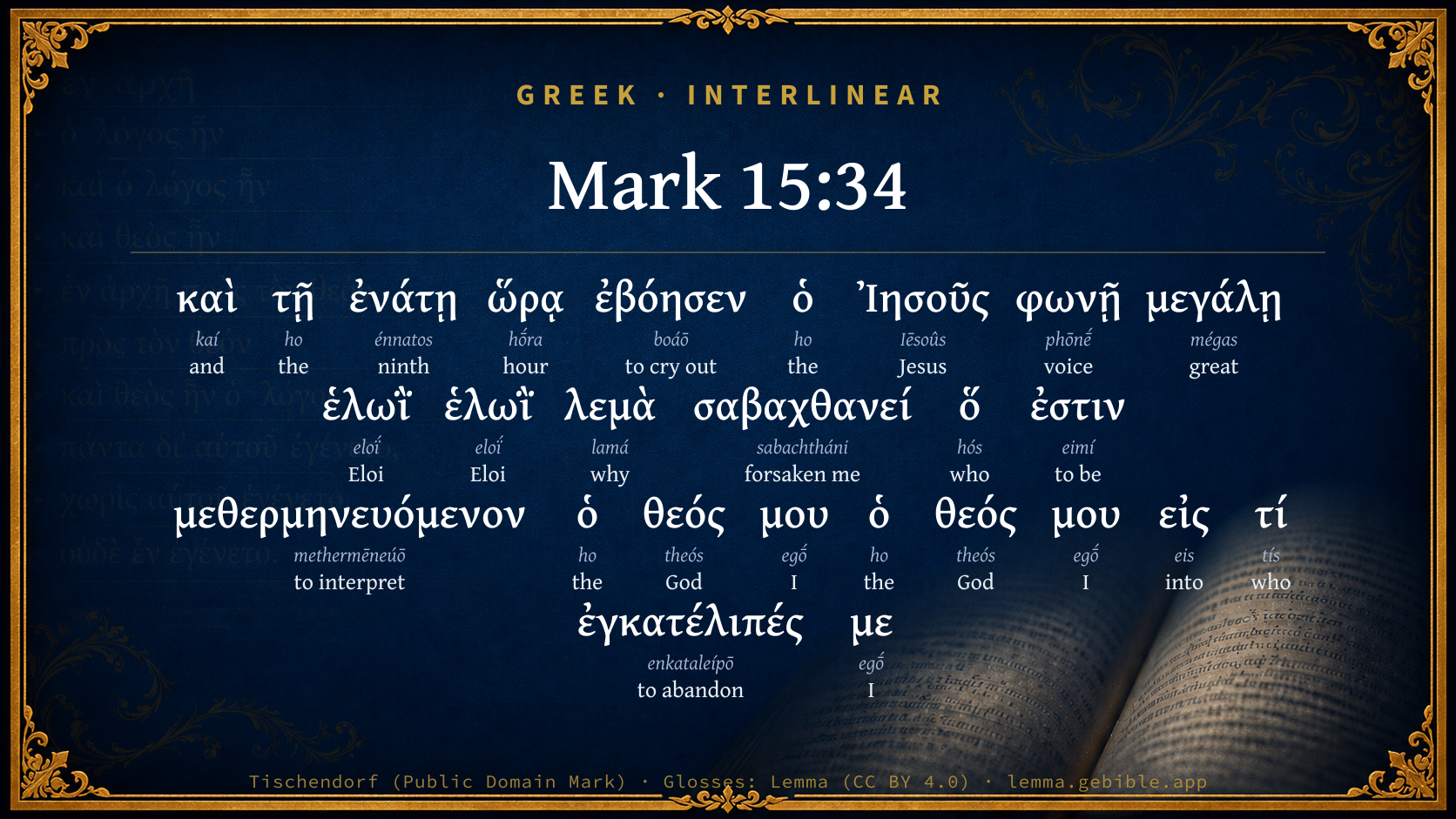
  1. καὶ kaí G2532 “and” Conjunction
  2. τῇ ho G3588 “the” Article, Dative, Singular, Feminine
  3. ἐνάτῃ énnatos G1766 “ninth” Adjective, Dative, Singular, Feminine
  4. ὥρᾳ hṓra G5610 “hour” Noun, Dative, Singular, Feminine
  5. ἐβόησεν boáō G994 “to cry out” Verb, Aorist, Active, Indicative, 3rd person, Singular
  6. ὁ ho G3588 “the” Article, Nominative, Singular, Masculine
  7. Ἰησοῦς Iēsoûs G2424 “Jesus” Noun, Nominative, Singular, Masculine
  8. φωνῇ phōnḗ G5456 “voice” Noun, Dative, Singular, Feminine
  9. μεγάλῃ mégas G3173 “great” Adjective, Dative, Singular, Feminine
  10. ἑλωῒ eloḯ G1682 “Eloi” Aramaic transliteration
  11. ἑλωῒ eloḯ G1682 “Eloi” Aramaic transliteration
  12. σαβαχθανεί sabachtháni G4518 “forsaken me” Aramaic transliteration
  13. ὅ hós G3739 “who” Relative pronoun, Nominative, Singular, Neuter
  14. ἐστιν eimí G1510 “to be” Verb, Present, Active, Indicative, 3rd person, Singular
  15. μεθερμηνευόμενον methermēneúō G3177 “to interpret” Verb, Present, Passive, Participle, Nominative, Singular, Neuter
  16. ὁ ho G3588 “the” Article, Nominative, Singular, Masculine
  17. θεός theós G2316 “God” Noun, Nominative, Singular, Masculine
  18. μου egṓ G1473 “I” Personal pronoun, 1st person, Genitive, Singular
  19. ὁ ho G3588 “the” Article, Nominative, Singular, Masculine
  20. θεός theós G2316 “God” Noun, Nominative, Singular, Masculine
  21. μου egṓ G1473 “I” Personal pronoun, 1st person, Genitive, Singular
  22. εἰς eis G1519 “into” Preposition
  23. τί tís G5101 “who” Interrogative pronoun, Accusative, Singular, Neuter
  24. ἐγκατέλιπές enkataleípō G1459 “to abandon” Verb, Aorist, Active, Indicative, 2nd person, Singular
  25. με egṓ G1473 “I” Personal pronoun, 1st person, Accusative, Singular

About this verse

These counts appear in no published source. They are computed here, from the morphology-tagged text and Lemma’s own curated glosses. What Lemma adds →

26
words
19
distinct lemmas
Gospels
section

Notable vocabulary

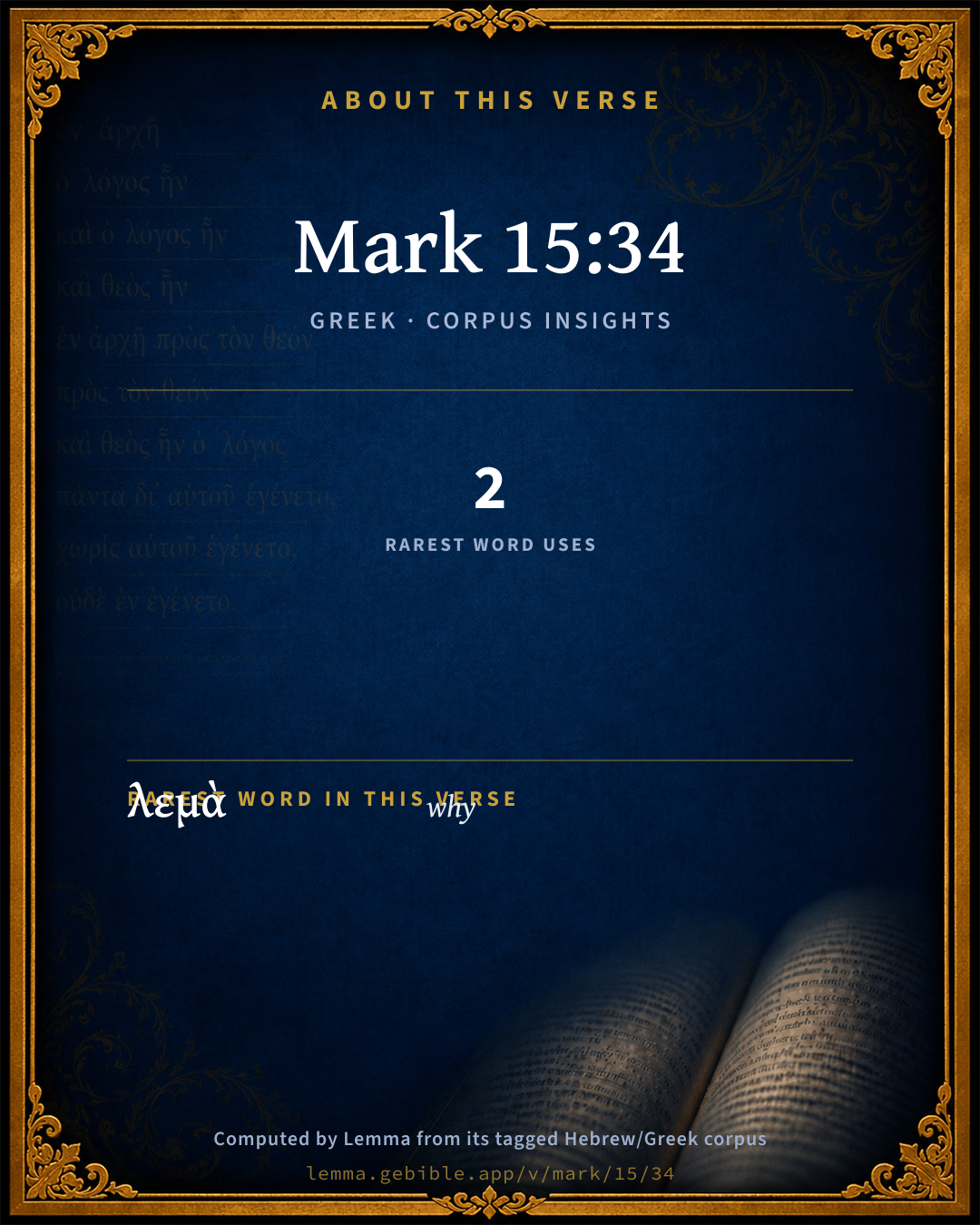
The rarest word here is λεμὰ why G2982 — appearing just 2 times in the whole Greek New Testament.

Shared distinctive vocabulary

λεμὰ why G2982 occurs in 2 verses of the Greek New Testament. Also found in:

Repetition

Words recur within this verse:

Cross-references

13

Topical passages linked to Mark 15:34 in the Treasury of Scripture Knowledge — connected by theme and wording, ordered by reader-vote popularity; previews shown in the World English Bible.

  • Psalms 22:1 My God, my God, why have you forsaken me? Why are you so far from helping me, and from the words of my groaning?
  • Matthew 27:46 About the ninth hour Jesus cried with a loud voice, saying, "Eli, Eli, lima sabachthani?" That is, "My God, my God, why have you forsaken me?"
  • Hebrews 5:7 He, in the days of his flesh, having offered up prayers and petitions with strong crying and tears to him who was able to save him from death, and having been heard for his godly fear,
  • Psalms 27:9 Don't hide your face from me. Don't put your servant away in anger. You have been my help. Don't abandon me, Neither forsake me, God of my salvation.
  • Psalms 71:11 Saying, "God has forsaken him. Pursue and take him, for no one will rescue him."
  • Isaiah 41:17 The poor and needy seek water, and there is none, and their tongue fails for thirst; I, Yahweh, will answer them, I, the God of Israel, will not forsake them.
  • Psalms 42:9 I will ask God, my rock, "Why have you forgotten me? Why do I go mourning because of the oppression of the enemy?"
  • Daniel 9:21 yes, while I was speaking in prayer, the man Gabriel, whom I had seen in the vision at the beginning, being caused to fly swiftly, touched me about the time of the evening offering.
  • Luke 23:46 Jesus, crying with a loud voice, said, "Father, into your hands I commit my spirit!" Having said this, he breathed his last.
  • Acts 10:3 At about the ninth hour of the day, he clearly saw in a vision an angel of God coming to him, and saying to him, "Cornelius!"
  • Lamentations 5:20 Why do you forget us forever, [And] forsake us so long time?
  • Luke 23:44 It was now about the sixth hour, and darkness came over the whole land until the ninth hour.
  • Lamentations 1:12 Is it nothing to you, all you who pass by? Look, and see if there be any sorrow like my sorrow, which is brought on me, With which Yahweh has afflicted [me] in the day of his fierce anger.

Cross-references courtesy of OpenBible.info (CC BY 4.0).

Commentary

Notes on Mark 15:34 from classic Christian and Jewish commentators (each source and its license shown beneath its notes). The classic Christian expositions comment on the surrounding passage and are grouped to its opening verse, so a note may address several verses; the Jewish commentaries on the Tanakh (Rashi and others) are per-verse, so they appear only where the commentator wrote on this verse.

Lemma curates 59 commentaries, every one of them public domain or Creative Commons licensed, each selected and text-cleaned for this edition rather than reprinted as found. About our sources →

The Biblical Illustrator

Joseph S. Exell

Mar_15:34

My God, My God, why hast Thou forsaken Me?

Forsaken of God

One thing we know, He was alone; He had reached the climax of that loneliness in which His whole earthly work had been carried on. It is hardly possible for us to understand the nature of the solitude of the life of Christ. It was not the solitude of the hermit or monk; He ever lived among his fellow men; not the solitude of pride, sullenly refusing all sympathy and aid; not the solitude of selfishness, creating around its icy centre a cold, bleak, barren wilderness; not the solitude of sickly sentimentality, forever crying out that it can find no one to understand or appreciate; but the solitude of a pure, holy, heavenly spirit, into all whose deeper thoughts there was not a single human being near Him, or around Him, who could enter; with all whose deeper feelings there was not one who could sympathize; whose truest, deepest motives, ends, and objects, in living and dying as He did, not one could comprehend. Spiritually, and all throughout, the loneliest man that ever lived was Jesus Christ. (Hanna.) Yet there were times when this loneliness deepened on His soul. Again and again, when in this place or that, He came unto His own, and His own received Him not. But one other stage was reached of yet more utter solitude when, in the darkness of that most mysterious noonday that veiled the scene of Calvary, and in the grossest darkness of unfathomable anguish that enveloped the human soul of Jesus, He trod the winepress of the wrath and justice of God alone, and entered that last stage of solitude in which He could no longer say, I am not alone, because the Father is with Me, but uttered that hitter cry-a cry from the darkest, deepest, dreariest loneliness into which a pure and holy spirit ever passed-My God, My God, why hast Thou forsaken Me? We may in reverence consider three causes which seem to have produced this element of the Sacred Passion. The first cause of this awful desolation was the fact of the accumulated sin of the whole world, from the disobedience of Eden down to the last intention of sin that shall be disturbed by the archangels trumpet, resting upon one Human Soul, to whom the faintest shadow of sin was intolerable. The second cause was the gathering of the hosts of darkness, vanquished in the wilderness, and in the garden, and in many of the souls they had possessed, but now, rallied and marshalled, and massed for one last supreme effort, hurling themselves with the fury of despair and hate upon their Vanquisher. The third cause was the hiding of the Fathers face. He who is of purer eyes than to behold iniquity could not look even upon His beloved Son, when deluged thus in our sin. Beloved, out of the depths of this most bitter woe of the passion of Jesus there comes some solid comfort for us. He endured that utter loneliness that we might never be alone. (Henry S. Miles, M. A.)

Eclipse of the face of God

The black mephitic cloud of a worlds sin came between God and Christ. Necessarily there was an eclipse of the face of God. An eclipse of the sun is caused, as you are all aware, by that opaque body the moon coming between the earth and it. That preternatural darkness of which we read in the preceding verse, was caused by some thick veil of sulphurous clouds being drawn across the face of the sun-the sun veiling his face, that he might not witness the perpetration of the blackest crime ever perpetrated on even our sin-cursed earth-a crime that made even incarnate nature shudder to its innermost core. So when this opaque body of our sins came between Christ and God, when that dark sulphurous cloud of a worlds sins enwrapped the being of Christ like some great funereal pall, necessarily there was an eclipse of the loving face of God, who is light. Necessarily there was, on the part of Christ, spiritual darkness, and desertion, and loneliness-a darkness, and desertion, and loneliness which found expression in the wailing cry, My God, My God, why hast Thou forsaken Me? (J. Black.)

The presence of God the support of the martyrs

What was it that enabled Ignatius, waiting to be thrown to the lions, to say-Let me be food for the wild beasts, if only God be glorified; that enabled the aged Polycarp, the flames lapping his body, to cry-I thank Thee, O Father, that Thou hast numbered me among the martyrs; that enabled Latimer, under the same circumstances, to say-Be of good cheer, Brother Ridley-What but the feeling of His nearness to them; the thought of His approving smile; and that though they were hated and persecuted by men, they were not forsaken of God. But Christ, in His hour of deepest need-He is robbed of that all and alone sufficient help. When He most needs the presence of God, just then God forsakes Him. Friends! we are here brought face to face with a great mystery. Christ Himself feels that. His words, if they, mean anything, mean that. My God, My God, why hast Thou forsaken Me? (J. Black.)

The cry of the forsaken

one:-

I. And first, let us not forget that this cry was a pang put into Old Testament words. To be perfectly fair in any consideration of the phase of anguish expressed by them, we must look to the twenty-second Psalm, where the words first of all occur. Let us read a verse or two of the Psalm. Take verses 7, 8, All they that see me laugh me to scorn: they shoot out the lip, they shake the head, saying, He trusted on the Lord that He would deliver him: let Him deliver him, seeing he delighted in Him; almost the very cry of the railing passers by. Verse sixteen is yet more remarkable in its application: They pierced my hands and my feet. Equally so is the eighteenth verse: They part my garments among them, and cast lots upon my vesture. If the Psalm had been written after the occurrences of that day, it might almost have been given as an historical record of them in these particulars. But I want you to think of the possibility-nay, extreme probability-that while our Lords mind in that dark hour rested upon these portions of the Psalm, it would also recall other portions of it. For mark how from the cry of the twenty-first verse there arises a strong hope: Save me from the lions mouth: for thou hast heard me from the horns of the unicorns. I will declare Thy name unto my brethren: in the midst of the congregation will I praise Thee. From these words forth there is no longer any sense of desolation. For He hath not despised nor abhorred the affliction of the afflicted; neither hath He hid His face from him; but when he cried unto Him, He heard. Now, I say, we ought to remember this in our endeavour to interpret the cry. Heavy enough indeed, with all the suffering it involved, was the hand of God that day as it rested upon the patient Sufferer; and life was ebbing out even while the cry came forth. And yet surely the blessed Saviour was not long bereft of consolation. Did He cling only to the first cry of the Psalm? Was this all? Was there no mounting aloft into the blessed heights of faith and of hope and of praise? I would believe there was; and this, though it may not deprive the scene of all its mysteriousness, helps me somewhat to apprehend its significance, which, as I have already intimated, is about all I thought we could attempt to do-all we purposed to attempt.

II. Next, we will view the words as the revelation of a great anguish. And yet, when we began to think a little more about this, Christs sense of utter desertion and loneliness, in the light especially of His relation to our race as its true head and High Priest; we should find ourselves ready to admit some sort of a congruousness in the fact. For we know that this experience, a sense of God-desertion, is one of the most real of mens troubles. And there seems a fitness in the ordination of the Redemptive scheme which allows a place for this sense of God-desertion in those sufferings by which that Redemption was secured and ratified. So far as we have any knowledge of Christs inner experience during the years before, we fail to discern any trace of this God-desertion. On the contrary, it was the one sweetness and light of His life, even when He thought and told of the coming desertion of His chosen ones, that still amid all circumstances the Father was with Him. It was not always so in the case of the Old Testament saints and worthies. They had, as we have, intervals, when the clear shining of the Divine face is interfered with, and the summer of the soul ceases awhile. When God is nigh, when we feel able to say, The Lord is at my right hand, we can add, I shall not be greatly moved. But up comes the mist from the rolling sea of passion and self-will and pride and human weaknesses, and we find that the light of our life is awhile quenched. Many days we may have lost sight of land and sun and star, and God appears to hide Himself, until the soul cries out passionately, Where is thy God-where? And the tempter echoes and re-echoes the dreary desolate cry, Where, ah, where indeed? And anyone who has ever found himself in such darkness knows that it is most profound; he who has felt such a distance between God and him knows it is most terrible and dreary. He who perfectly fulfilled the Eternal Will, and who was at that very moment fulfilling its more mysterious ordinations, cannot wholly escape this bitterness. And yet, I say, never was Christ more truly fulfilling the Divine Will than now. Never was the Father more delighted in the blessed Son than now. Why, it was the suffering of a perfect sacrifice. It was a true self offering. If Christ had been dragged to this tree against His will, if Christ had tried to escape from the hands of his tormentors, it would have been different. O, my brethren, instead of trying to build upon this cry of the Saviours any strange theory, let us rather think how much of real and abiding comfort we may draw from it. You and I may often have had to pass through the gloomy way unrelieved by any of heavens sunshine. It may seem to us that everything has conspired against us, and that the very heavens are sealed against our cry. Our prayers may seem to return to us unanswered. All may appear to be lost, even God. Let us but at such moments look at the blessed Christ. Let us think how God put His best beloved One through the hottest fires and the most searching tests. He knew once what it was to have the heavens above Him darkened. And yet the Eternal Father loved Him. May He not love you too?

III. And now we come to these words from another point of view. We have seen in them the utterance of a great anguish; let us look at them as the expression of a clinging faith and love. You will perceive why we called attention to the twenty-second Psalm. That Psalm shows us one who felt himself forsaken, and who was by no means actually forsaken; and the words used by Christ may serve also to show us how very close Christ was to the Eternal heart when He uttered them. My God-O, if we can only say this, My God. It matters little what we may say afterward. If we can only say My God, the darkness will not long brood upon our souls. They are words of faith and love, which, when truly spoken, must bring in the daylight. In the battle of the Christian faith and life, the victory is more than half won when we can say, My God. No soul that is lost can say, My God. I turn again to the real comfort wrapped up within the very words which expressed the Saviours agony. How often is this the case. The very words by which we express our sorrow, our trouble, are themselves often charged with deep and true solace and refreshment. We know not how long this cloud rested over the Saviour. I do not think it could be for long. Presently, we know, the Father was looking upon Him with shining, unveiled face; for calmly and restfully He breathed forth the dying sigh of thousands since, Father, into Thy hands I commend My spirit. (C. J. Proctor, B. A.)

Jesus, throwing Himself into the bosom of His Father, implores consolation

This Scripture leads our thoughts to the desolation of our Jesus; to inquiry after the cause; and to the exclamation that passed from His lips, through the intense suffering of His heart.

I. First, the desolation of Jesus. It was not unforeseen. With regard to the desolation of Him, whose love undertook our cause; that we may understand the meaning of the term He used, it becomes us to enter on a clear, a Scriptural view of His person, and of the intimate relation which subsisted between the Father and Himself. He was emphatically the Word, that was in the beginning, eternal, before all time, before the glowing sun came forth from his chamber, as a bridegroom, and rejoiced as a giant to run his course. He was with God-distinct in His Person; and He was God-self-existent in nature or essence. All things were made by Him; then He is the mighty Creator of the universe, of which we form an insignificant part; and without Him was not anything made that was made. As to the nature, then, of this forsaking, of which the lips of Jesus utter lamentation, it is clear, to him who receives the word of Scripture in simplicity, that there was no desertion of His humanity by the Word. This Eternal Word took His human flesh and reasonable soul into union with itself; and that union was never dissolved. By this oneness, the body never saw corruption, although, after death, it was laid in Josephs tomb: nor was it separated from the reasonable soul in Paradise. By this Godhead body and soul were reunited on the morning of the Resurrection; that union is preserved to the present, and will be after that wondrous prediction shall be accomplished, that all things having been subdued unto Him, the Son, the Mediator, the ancient Daysman, shall Himself be subject unto Him that put all things under Him; that God may be all in all. We are instructed likewise by Holy Scripture, as to the nature of that intimate and mysterious relationship that subsisted between the Father and the Son, co-equal, co-eternal. What testimony can be plainer than the words of Christ Jesus, written in St. Joh_10:37-38? If I do not, says He, the works of My Father, believe Me not. But if I do, though ye believe not Me, behove the works: that ye may know, and believe, that the Father is in Me, and I in Him. He entreats, with an earnestness His own, that all the children of faith may be one: as Thou, Father, art in Me, and I in Thee, that they also may be one in Us. If the Word forsook not the humanity, it follows that the Father essentially deserted not the same, because the Father and the Son are One in nature, eternally, inseparably. Hence, then, the question, What are we to understand by the complaint of being forsaken? That He was bereft of the countenance, the comforts, the consolations of the Father, in which He had rejoiced.

II. We have viewed the first part of our subject, namely, Christ forsaken; and come to the cause, which was asked by His lips. The Father gives the answer to this interrogation-Why? Because you have become the Bondsman of sinners, have consented to stand in their stead; therefore, as at your hands, I look for a continual and perfect obedience to the law in its exceeding breadth, so, in your person, I exact the penalty to its utmost tittle. Here Isaiah, who seems to look upon the scene before us: the Lord hath lain on Him the iniquity of us all. Be attentive to Paul: He made Him to be sin for us, therefore to bleed and die, that we might be made the righteousness of God in Him. Little did the Jews imagine, when they exulted in the ignominy of Jesus, who was without sin, and lived without guile, that in gratifying their malice, they were but dealing the second blow; that the first was dealt by a secret, powerful, invisible hand; yet such was the fact, according to the testimony of prophets and apostles. St. Peter, addressing the men of Israel at Jerusalem concerning Israel, says, Him, being delivered by the determinate counsel and foreknowledge of God-there is the secret purpose-ye have taken, and by wicked hands crucified and slain; there is the resulting blow. In a Psalm of the passion (69:26) we read, They persecute Him (the second blow), whom Thou hast smitten (the first stroke), and they talk to the grief of those whom Thou hast wounded. That secret blow was the fruit of sin, which covered perfect innocence with confusion. Thus Jesus speaks, in the seventh verse, Shame hath covered My face. Why? As there was no impatience under the blow, there was no ignorance of the cause. Jesus asks, not for knowledge, but to call our notice to the fearful cause. Himself gives the answer, as me have it in the Vulgate. Far from My deliverance is the matter of My sins.

III. Thirdly, we look at the exclamation that passed through His lips, arising from the intense suffering of the heart. Jesus at this time does not simply speak; and who can imagine the bitterness of that cry-it pierced the heavens-He cried-He cried with a loud voice. It before was the sweet word Father, but not so now. Is He forsaken? why should we wonder at the hiding of Heavens countenance? Jesus in His agony, inquires, Why? Is it not our wisdom to say, Is there not a cause?-to search it out and expose our sore to the pitying eye of a Father? Jesus was made desolate by that Father, that we might be supported, comforted, delivered. Jesus instructs us for a dying hour: He turns from creatures, and occupies Himself with God. Be this our happiness, as it is our privilege; and when heart and flesh both fail, the Lord will be the strength of our heart, and our portion forever. (Thomas Ward, M. A.)

The Biblical Illustrator, edited by Joseph S. Exell (c. 1880s–1900s) — public domain. Text from a community e-Sword module.

Tyndale Open Study Notes

Tyndale Open Resources

15:34 Eloi, Eloi . . . why have you abandoned me: Jesus’ loud cry is reported in its original Aramaic and then translated for Greek readers. • “My God, my God, why have you abandoned me?” Jesus quotes Ps 22:1. This saying is best interpreted in light of Mark 14:27; Ps 22; Isa 53:10; 2 Cor 5:21; and Gal 3:13. The divine purpose in Jesus’ becoming a ransom for many (Mark 10:45) was now being realized.

Tyndale Open Study Notes — © Tyndale Open Resources, licensed CC BY-SA 4.0. Text via the HelloAO Bible API.

Bengel's Gnomon

Johann Albrecht Bengel

Mar 15:34. Ἐλωῒ) Hebr. אֱלהַי, as בַּרְזִלַּי Βερζελλὶ, בֵּבַי βαβὶ, אֲבִישַי Ἀβεσσὰ, etc.: Hiller, Onom. p. 707. For not even שָׂרַי in Greek is Σαραῒ, Gen 17:15. Matthew has ἡλὶ, ἡλί. and so the Hebrew Psaltery [Psa 22:1]: Mark has ἐλωῒ, ἐλωῒ, and so the Syriac Psaltery, as John Gregorius observes.—εἰς τί, for what [why]) See Mat 27:46, note.

Bengel's Gnomon of the New Testament — English translation (T&T Clark, Edinburgh, 1860) — public domain. Text from a community e-Sword module.

Expositor's Greek Testament

ed. W. Robertson Nicoll

Mar 15:34 . ἐλωΐ , ἐλωΐ : the Aramaic form of the words spoken by Jesus, Mt. giving the Hebrew equivalent. On this cry of desertion vide remarks on the parallel place in Mt. ὁ Θεός μου . ὁ Θ . μ .: as in Sept [155] Mt. gives the vocative. εἰς τί , for what end? ἵνα τί in Mt. and Sept [156] [155] Septuagint.

[156]Septuagint.

The Expositor's Greek Testament, edited by W. Robertson Nicoll (1897–1910) — public domain. Text from a community e-Sword module.

Geneva Bible (1599)

Geneva Bible translators

Christ striving mightily with Satan, with sin, and with death, all three armed with the horrible curse of God, grievously tormented in body hanging upon the cross, and in soul plunged in the depth of hell, yet he riddeth himself, crying with a mighty voice: and notwithstanding the wound which he received of death in that that he died, yet by smiting both things above and things beneath, by renting of the veil of the Temple, and by the testimony wrung out of them which murdered him, he showeth evidently unto the rest of his enemies which are as yet obstinate, and mock at him, that he shall be known out of hand to be conqueror and Lord of all.

Geneva Bible (1599) marginal notes — public domain. Text via Bolls.life.

Adam Clarke's Commentary

Verse 34. My God, my God, &c.] See Clarke on Mt 27:46.

Adam Clarke's Commentary on the Bible (1810–1826) — public domain. Text from a community e-Sword/MySword module.

Ellicott's Commentary for English Readers

(34) Eloi, Eloi.—Here, again, the form which St. Mark gives is a closer reproduction of the very sounds of the Aramaic form of the word than that in St. Matthew, who gives the Hebrew as it stands in Psa_22:1.

A Bible Commentary for English Readers, edited by Charles John Ellicott (1878–1897) — public domain. Text from a community e-Sword module.

The Cambridge Bible for Schools and Colleges

gen. ed. J. J. S. Perowne

34. And at the ninth hour] the hour of the offering of the evening sacrifice,

Jesus cried with a loud voice] He now gives utterance to the words of the first verse of the xxiind Psalm, in which, in the bitterness of his soul, David had complained of the desertion of his God, and said,

“Eloï! Eloï! lama sabachthani?”

This is the only one of the “Seven Sayings from the Cross,” which has been recorded by St Mark, and he gives the original Aramaic and its explanation. Observe that of these sayings (i) the first three all referred to others, to (a) His murderers, (b) the penitent malefactor, (c) His earthly mother; (ii) the next three referred to His own mysterious and awful conflict, (a) His loneliness, (b) His sense of thirst, (c) His work now all but ended; (iii) with the seventh He commends His soul into His Father’s hands.

The Cambridge Bible for Schools and Colleges (gen. ed. J. J. S. Perowne; Cambridge University Press, 1878–1918) — public domain. Text from a community e-Sword module.

John Gill's Exposition

And Jesus cried with a loud voice,.... A second time, and said the words which are in Luk 23:46 and in Joh 19:30

and gave up the ghost. The Syriac version renders it, "and finished": his life, his days, his race, his ministry, and the work which was given him to do; See Gill on Mat 27:50.

John Gill's Exposition of the Whole Bible (1746–1763) — public domain (CC PDM 1.0). Text via the HelloAO Bible API.

Trapp's Complete Commentary

John Trapp

34 And at the ninth hour Jesus cried with a loud voice, saying, Eloi, Eloi, lama sabachthani? which is, being interpreted, My God, my God, why hast thou forsaken me?

Ver. 34. Eloi, Eloi, lama sabachthani] Psa 22:1. It is thought by some that he repeated the whole of Psa 22:1-31, which is an admirable narration of the passion, and might well help him the better to bear it.

John Trapp, A Commentary or Exposition upon All the Books of the Old and New Testament (1647–1656) — public domain. Text from a community e-Sword module.

The Pulpit Commentary

Eloi, Eloi, lama sabacthani? St. Mark here uses the Aramaic form St. Matthew refers to the original Hebrew. St. Mark in all probability took his form from St. Peter. It seems from hence that our Lord was in the habit of using the vernacular speech. Why hast thou forsaken me? (eiv ti me egkatelipev). This might be rendered, Why didst thou forsake me? It is generally supposed that our blessed Lord, continually praying upon his cross, and offering himself a sacrifice for the sins of the whole world, recited the whole of the psalm (Ps 22) of which these are the first words, that he might show himself to be the very Being to whom the words refer; so that the Jewish scribes and people might examine and see the cause why he would not descend from the cross; namely, because this very psalm showed that it was appointed that he should suffer these things.

The Pulpit Commentary (1880–1919), ed. H.D.M. Spence-Jones & Joseph S. Exell — public domain. Text from a community e-Sword module.

John Wesley's Explanatory Notes

My God, my God, why hast thou forsaken me - Thereby claiming God as his God; and yet lamenting his Father's withdrawing the tokens of his love, and treating him as an enemy, while he bare our sins.

John Wesley, Explanatory Notes Upon the Whole Bible (1754–1765) — public domain. Text via the GEBible commentary corpus.

Cambridge Greek Testament for Schools and Colleges

34. For ἐγκατέλιπες, [3461] has the surprising reading ὠνίδισας: d, however, has dereliquisti. But c has exprobrasti, i has in opprobrium dedisti, k[3462] maledixisti. See Burkitt in J.T.S. I. p. 278; Nestle, p. 266.

[3461] Codex Bezae. 6th cent. Has a Latin translation (d) side by side with the Greek text, and the two do not quite always agree. Presented by Beza to the University Library of Cambridge in 1581. Remarkable for its frequent divergences from other texts. Contains Mark, except Mar 16:15-20, which has been added by a later hand. Photographic facsimile, 1899.

[3462] An asterisk denotes that the word is not found elsewhere in N.T., and such words are included in the index, even if there is no note on them in the commentary.

34. ἐβόησεν. Like the cry with which He expired, this utterance was a φωνὴ μεγάλη (Mar 15:37). It is the only Word from the Cross recorded by Mk and Mt., and in both Gospels it is given in the original Aramaic, but texts vary somewhat as to the transliteration. Whether Jesus uttered the first word in the Aramaic or the Hebraistic form is, as Dalman remarks, of little moment. “The latter appears to have the greater probability in its favour, as being the less natural in the Aramaic context. It is conceivable that, to secure greater uniformity, one copyist corrected ἠλεί to ἐλωεί, so that the whole should be Aramaic, while another changed λεμᾶ σεβαχθανεί into λαμᾶ [ἀ]ζαφθανεί, so as to have the whole in Hebrew” (Words, p. 54). Here [3523] has ἠλεί, and it would be easier for ἠλεί than ἐλωεί to be twisted into Ἠλείας. Allen thinks “it is difficult not to believe that Christ quoted the Psalm in Hebrew, Eli Eli lama azabhtani” (Studies in the Syn. Prob. p. 305). In that case the Aramaic form in Mk is given for the sake of those to whom Aramaic was more familiar than Hebrew. But even if ἐλωεί be original, there is no difficulty. It was not a case of accidental mishearing. The man, in derision, purposely misquoted the word which Christ had uttered. As to the next word we have λαμᾶ ([3524][3525] λεμᾶ ([3526][3527][3528][3529]), λιμᾶ ([3530][3531][3532][3533][3534][3535][3536]), and λειμᾶ ([3537][3538][3539][3540][3541][3542] as variants, and there are as many of σαβαχθανεί. But the asabtani in German Bibles has no MS. authority, any more than Bnehargem for “Boanerges” (Mar 3:17).

[3523] Codex Bezae. 6th cent. Has a Latin translation (d) side by side with the Greek text, and the two do not quite always agree. Presented by Beza to the University Library of Cambridge in 1581. Remarkable for its frequent divergences from other texts. Contains Mark, except Mar 16:15-20, which has been added by a later hand. Photographic facsimile, 1899.

[3524] Codex Vaticanus. 4th cent., but perhaps a little later than א. In the Vatican Library almost since its foundation by Pope Nicolas V., and one of its greatest treasures. The whole Gospel, ending at Mar 16:8. Photographic facsimile, 1889.

[3525] odex Bezae. 6th cent. Has a Latin translation (d) side by side with the Greek text, and the two do not quite always agree. Presented by Beza to the University Library of Cambridge in 1581. Remarkable for its frequent divergences from other texts. Contains Mark, except Mar 16:15-20, which has been added by a later hand. Photographic facsimile, 1899.

[3526] Codex Sinaiticus. 4th cent. Discovered by Tischendorf in 1859 at the Monastery of St Katharine on Mount Sinai. Now at St Petersburg. The whole Gospel, ending at Mar 16:8. Photographic facsimile, 1911.

[3527] Codex Ephraemi. 5th cent. A palimpsest: the original writing has been partially rubbed out, and the works of Ephraem the Syrian have been written over it; but a great deal of the original writing has been recovered; of Mark we have Mar 1:17 to Mar 6:31, Mar 8:5 to Mar 12:29, Mar 13:19 to Mar 16:20. In the National Library at Paris.

[3528] Codex Regius. 8th cent. An important witness. At Paris. Contains Mar 1:1 to Mar 10:15; Mar 10:30 to Mar 15:1; Mar 15:20 to Mar 16:20, but the shorter ending is inserted between Mar 16:8 and Mar 16:9, showing that the scribe preferred it to the longer one.

[3529] Codex Sangallensis. 9th or 10th cent. Contains the Gospels nearly complete, with an interlinear Latin translation. The text of Mark is specially good, agreeing often with CL. At St Gall.

[3530] Codex Alexandrinus. 5th cent. Brought by Cyril Lucar, Patriarch of Constantinople, from Alexandria, and afterwards presented by him to King Charles I. in 1628. In the British Museum. The whole Gospel. Photographic facsimile, 1879.

[3531] Codex Cyprius. 9th cent. One of the seven uncials which have the Gospels complete, the others being אBMSUΩ. At Paris.

[3532] Codex Campianus. 9th cent. At Paris. Gospels complete.

[3533] Codex Guelpherbytanus. 6th cent. Contains Mar 1:2-11; Mar 3:5-17; Mar 14:13-24; Mar 14:48-61; Mar 15:12-37.

[3534] Codex Monacensis. 10th cent. Contains Mar 6:47 to Mar 16:20. Many verses in 14, 15, 16 are defective.

[3535] Codex Oxoniensis. 9th cent. Contains Mark, except Mar 3:35 to Mar 6:20.

[3536] Codex Petropolitanus. 9th cent. Gospels almost complete. Mar 16:18-20 is in a later hand.

[3537] Codex Basiliensis. 8th cent. At Basle.

[3538] Codex Boreelianus. Once in the possession of John Boreel. 9th cent. At Utrecht. Contains Mk 1–41; Mar 2:8-23; Mar 3:5 to Mar 11:6; Mar 11:27 to Mar 14:54; Mar 15:6-39; Mar 16:19-20.

[3539] Codex Seidelianus I. 9th or 10th cent. Contains Mar 1:13 to Mar 14:18; Mar 14:25 to Mar 16:20.

[3540] Codex Seidelianus II. 9th or 10th cent. Contains Mar 1:1-31; Mar 2:4 to Mar 15:43; Mar 16:14-20.

[3541] Codex Vaticanus. 10th cent. Dated A.D. 949.

[3542] Codex Mosquensis. 9th cent.

Ὁ θεός μου. LXX. also has the nom. with the art. (see on Mar 15:29), while Mt. has Θεέ μου. In N.T. there is perhaps not much difference in tone between the two usages; cf. Mar 15:18. On the other hand, LXX. and Mt. have ἵνα τί, while Mk has εἰς τί. In Mk and Mt., though not in LXX., the μον is repeated; even in this time of apparent desertion, Christ recognizes God as His God. And both Mk and Mt. omit πρόσχες μοι, which is in LXX. but not in the Hebrew. The character of the cry is full guarantee for its historical truth. No Christian would have attributed such words to the Messiah, had He not uttered them. It is possibly because of their perplexing mystery that Lk. and Jn omit them, and that the Gospel of Peter changes them into ἡ δύναμίς μου ἡ δύναμις, κατέλειψάς με. This is one of the Docetic traits in that book, which treats the crucifixion as if it were devoid of suffering. There is a passage in the Testaments (Joseph ii. 4–7) which might serve as a moral drawn from this cry of mental agony. Οὐ γὰρ ἐγκαταλείπει Κύριος τοὺς φοβουμένους αὐτόν … Ἐν βραχεῖ ἀφίσταται εἰς τὸ δοκιμάσαι τῆς ψυχῆς τὸ διαβούλιον … Ὅτι μέγα φάρμακόν ἐστιν ἡ μακροθυμία, καὶ πολλὰ ἀγαθὰ δίδωσιν ἡ ὑπομονή. On the reading ὠνίδισας ([3543] for ἐγκατέλιπες see crit. note. In the Defence of Christianity generally attributed to Macarius Magnes (A.D. 400) “it is remarkable that the objector knew both ὠνείδισας and ἐγκατέλιπες and regarded them as distinct utterances” (Swete).

[3543] Codex Bezae. 6th cent. Has a Latin translation (d) side by side with the Greek text, and the two do not quite always agree. Presented by Beza to the University Library of Cambridge in 1581. Remarkable for its frequent divergences from other texts. Contains Mark, except Mar 16:15-20, which has been added by a later hand. Photographic facsimile, 1899.

Cambridge Greek Testament for Schools and Colleges (Cambridge University Press, 1896; 21 vols, various authors incl. Carr, Maclear, Plummer, Farrar, Lumby, Moule, M. R. James, Simcox) — public domain. Text from a community e-Sword module.

Alford’s Greek Testament

Henry Alford

34.] ἑλωΐ, the Syro-chaldaic form, answering to ἡλί in Matt. Meyer argues that the words in Matt. must have been those actually spoken by our Lord, owing to the taunt, that He called for Elias.

Henry Alford, The Greek Testament (1849–1861) — public domain. Text from a community e-Sword module.

International Critical Commentary

34. Καὶ τῇ ἐνάτῃ ὥρᾳ ἐβόησεν ὁ Ἰησοῦς φωνῇ μεγάλῃ Ἐλωΐ, Ἐλωΐ, λαμὰ σαβαχθανεί;2—And at the ninth hour, Jesus cried with a loud voice, My God, my God, why hast thou forsaken me? The historical meaning of σαβαχθανεί is not to leave alone, but to leave helpless, denoting, not the withdrawal of God himself, but of his help, so that the Psalmist is delivered over into the hands of his enemies. So that, while it is possible to suppose that Jesus is uttering a cry over God’s withdrawal of himself, it is certainly unnecessary. Such a desertion, or even the momentary unconsciousness of the Divine presence on the part of Jesus, makes an insoluble mystery in the midst of what is otherwise profound, but not obscure. Interpreted in the spirit of the original, of the withholding of the Divine help, so that his enemies had their will of him, it falls in with the prayer in Gethsemane, “remove this cup from me,” and becomes a question, while the cup is at his lips, why it was not removed.

Omit λέγων, saying, before Ἐλωΐ, Tisch. Treg. WH. RV. א BDL, mss. Lat. Vet. Memph.

International Critical Commentary — older volumes (1896–1929), various authors — public domain. Text from a community e-Sword module.

Lesson kit

Teaching starters — assembled from the data on this page, not authored interpretation. Every prompt links to the verse data it draws on. Edit before teaching.

Mark, in the Gospels, opens this verse with 26 words (19 distinct Greek lemmas). Its most distinctive word is lamá (“why”). A historical commentator’s framing appears above. Read the whole chapter for the surrounding context.

Discussion questions

  1. What does “why” (lamá) contribute to the verse as a whole?
  2. Matthew 27:46 shares the word «why» with this verse. How do the two illuminate each other?
  3. “Eloi” occurs 2× in this one verse. What is the effect of the repetition?
  4. The translations on this page render this verse differently — a whole-verse word diff, not a word-by-word alignment. What might account for the different wordings?
  5. Reading how The Biblical Illustrator and Tyndale Open Study Notes read this verse, where do the two commentators agree and where do they part?

Things to notice

Reading settings

Reading text

Shown beneath each verse's original-language words.

Old Testament
Old Testament edition

Read the OT as the Masoretic Hebrew (MT) or the Greek Septuagint (LXX).

English shown for the Greek Septuagint (in the Hebrew ↔ Greek comparison).

Comparing translations? Open the Compare panel on any verse page to stack up to four side by side.