
Luke 3:1

Greek (Tischendorf 8th ed.) Luke 3:1 appears in the Greek New Testament. The text above is from the Tischendorf 8th edition. Each word links to its Strong’s number and a concise gloss. Click any word for its full Thayer’s Greek Lexicon entry.
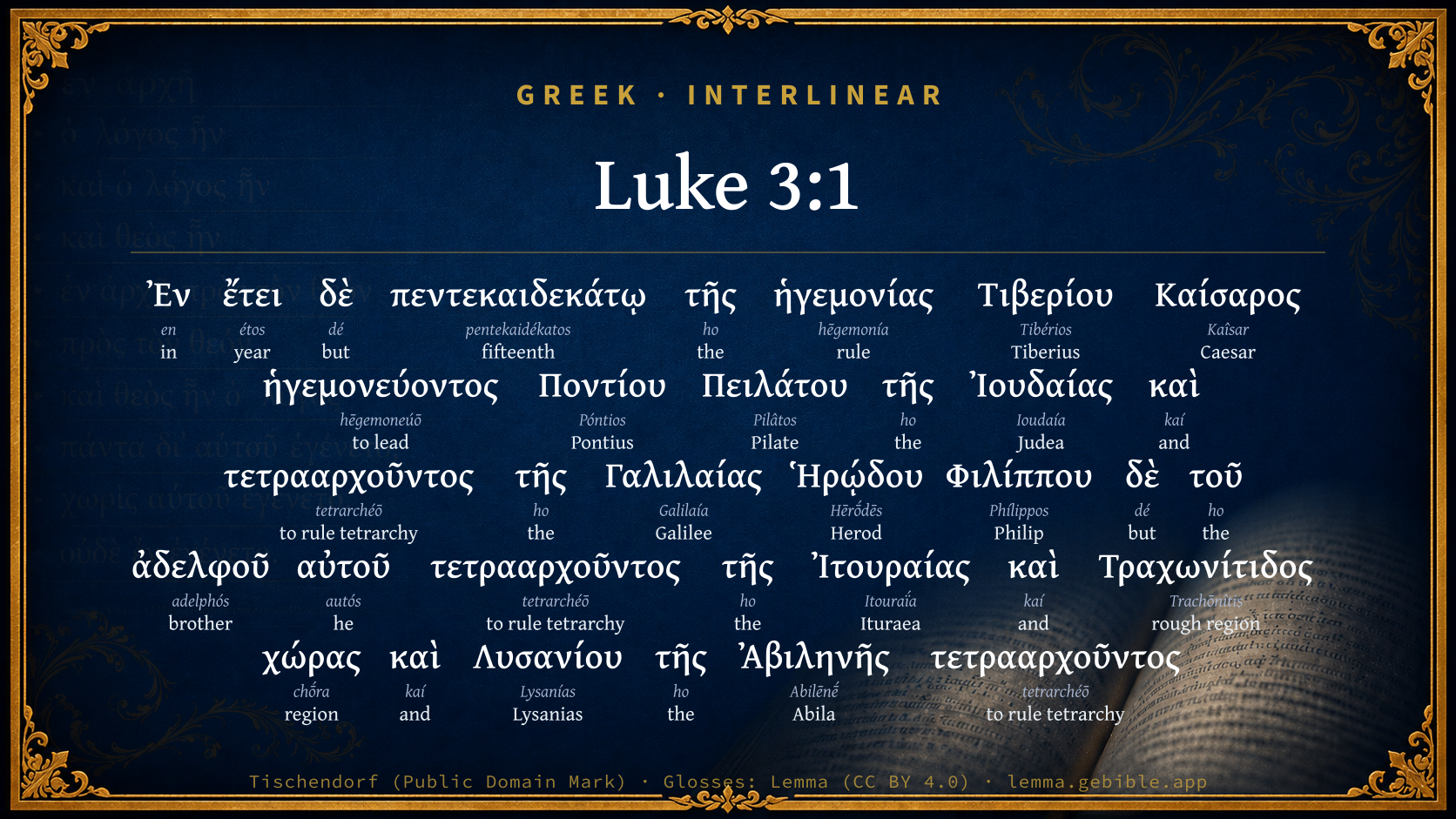
Download image
Cite this verse

Luke 3:1 (World English Bible). Public Domain. Lemma interlinear Bible study tool, https://lemma.gebible.app/v/luke/3/1.

Show BibTeX & RIS
BibTeX
RIS
English Translation
Now in the fifteenth year of the reign of Tiberius Caesar, Pontius Pilate being governor of Judea, and Herod being tetrarch of Galilee, and his brother Philip tetrarch of the region of Ituraea and Trachonitis, and Lysanias tetrarch of Abilene,
World English Bible · Public Domain
Highlights
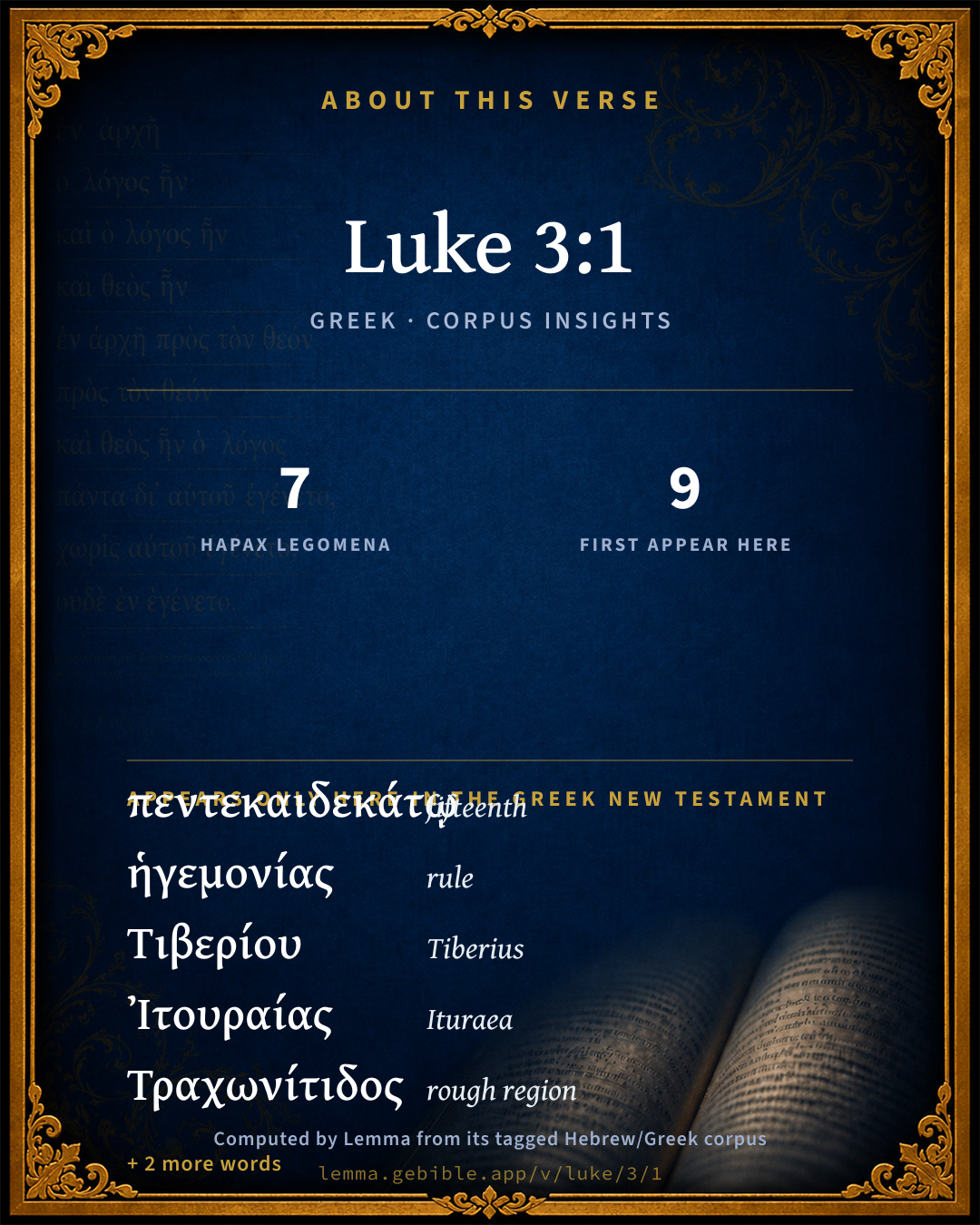
  • 6 hapax legomena — only here in the Greek New Testament
  • 9 first appearances in the Greek New Testament
Full analysis ↓
Download a study sheet

One document with this verse’s original text, its word-by-word gloss line, the meaning frame, cross-references with their text, attributed commentary, and full source and license credits — printable, and it pastes into notes with its structure intact.

This verse Autodidact and up

Study sheet (.html) Plain text (.txt)

A passage Seminary Student

Up to 50 verses in one chapter. A passage sheet keeps up to 6 commentary sources and 12 cross-references per verse, in the order this page ranks them, and says so on the sheet whenever that leaves anything out. Ask for a single verse and you get the Autodidact verse sheet above.

Everything on this page stays free to read, with no account — the sheet is a download of what is already on screen, not access to it.

Want to remove ads? Support Godless Engineer
Compare translations 3

The same verse in 3 English versions, stacked beneath the original-language interlinear above. Click any original word for its lexicon entry.

Each is an independent rendering of the whole verse — the interlinear is not word-aligned to these translations.

Highlighted words mark where these versions differ — a whole-verse word diff, not a word-by-word alignment.

  • World English Bible Public Domain
    Now in the fifteenth year of the reign of Tiberius Caesar, Pontius Pilate being governor of Judea, and Herod being tetrarch of Galilee, and his brother Philip tetrarch of the region of Ituraea and Trachonitis, and Lysanias tetrarch of Abilene,
  • King James Version Public Domain
    Now in the fifteenth year of the reign of Tiberius Caesar, Pontius Pilate being governor of Judaea, and Herod being tetrarch of Galilee, and his brother Philip tetrarch of Ituraea and of the region of Trachonitis, and Lysanias the tetrarch of Abilene,
  • unfoldingWord Literal Text CC BY-SA 4.0
    And in the fifteenth year of the reign of Tiberius Caesar—Pontius Pilate governing Judea, and Herod being tetrarch of Galilee, and his brother Philip being tetrarch of the region of Ituraea and Trachonitis, and Lysanias being tetrarch of Abilene,

unfoldingWord Literal Text — © unfoldingWord, licensed CC BY-SA 4.0. Word-aligned USFM3 via Door43 (git.door43.org/unfoldingWord/en_ult).

Versions to compare (up to 4)

3 of 4 selected

Show all 19 translations

Every available English version of this verse, each an independent rendering of the whole verse.

  • World English Bible Public Domain
    Now in the fifteenth year of the reign of Tiberius Caesar, Pontius Pilate being governor of Judea, and Herod being tetrarch of Galilee, and his brother Philip tetrarch of the region of Ituraea and Trachonitis, and Lysanias tetrarch of Abilene,
  • Berean Standard Bible Public Domain
    In the fifteenth year of the reign of Tiberius Caesar, while Pontius Pilate was governor of Judea, Herod tetrarch of Galilee, his brother Philip tetrarch of Ituraea and Trachonitis, and Lysanias tetrarch of Abilene,
  • Majority Standard Bible Public Domain
    In the fifteenth year of the reign of Tiberius Caesar, while Pontius Pilate was governor of Judea, Herod tetrarch of Galilee, his brother Philip tetrarch of Ituraea and Trachonitis, and Lysanias tetrarch of Abilene,
  • King James Version Public Domain
    Now in the fifteenth year of the reign of Tiberius Caesar, Pontius Pilate being governor of Judaea, and Herod being tetrarch of Galilee, and his brother Philip tetrarch of Ituraea and of the region of Trachonitis, and Lysanias the tetrarch of Abilene,
  • American Standard Version (1901) Public Domain
    Now in the fifteenth year of the reign of Tiberius Caesar, Pontius Pilate being governor of Judaea, and Herod being tetrarch of Galilee, and his brother Philip tetrarch of the region of Ituraea and Trachonitis, and Lysanias tetrarch of Abilene,
  • Revised Version (1885) Public Domain
    Now in the fifteenth year of the reign of Tiberius Caesar, Pontius Pilate being governor of Judaea, and Herod being tetrarch of Galilee, and his brother Philip tetrarch of the region of Ituraea and Trachonitis, and Lysanias tetrarch of Abilene,
  • Geneva Bible (1599) Public Domain
    Nowe in the fifteenth yeere of the reigne of Tiberius Caesar, Pontius Pilate being gouernour of Iudea, and Herod being Tetrarch of Galile, and his brother Philip Tetrarch of Iturea, and of the countrey of Trachonitis, and Lysanias the Tetrarch of Abilene,
  • Douay-Rheims (1899) Public Domain
    Now in the fifteenth year of the reign of Tiberius Caesar, Pontius Pilate being governor of Judea, and Herod being tetrarch of Galilee, and Philip his brother tetrarch of Iturea, and the country of Trachonitis, and Lysanias tetrarch of Abilina;
  • Young's Literal Translation Public Domain
    And in the fifteenth year of the government of Tiberius Caesar -- Pontius Pilate being governor of Judea, and Herod tetrarch of Galilee, and Philip his brother, tetrarch of Ituraea and of the region of Trachonitis, and Lysanias tetrarch of Abilene --
  • Literal Standard Version CC BY-SA 4.0
    And in the fifteenth year of the government of Tiberius Caesar—Pontius Pilate being governor of Judea, and Herod tetrarch of Galilee, and his brother Philip, tetrarch of Ituraea and of the region of Trachonitis, and Lysanias tetrarch of Abilene,
  • Unlocked Literal Bible CC BY-SA 4.0
    In the fifteenth year of the reign of Tiberius Caesar—while Pontius Pilate was governor of Judea, Herod was tetrarch of Galilee, his brother Philip was tetrarch of the region of Ituraea and Trachonitis, and Lysanias was tetrarch of Abilene,
  • unfoldingWord Literal Text CC BY-SA 4.0
    And in the fifteenth year of the reign of Tiberius Caesar—Pontius Pilate governing Judea, and Herod being tetrarch of Galilee, and his brother Philip being tetrarch of the region of Ituraea and Trachonitis, and Lysanias being tetrarch of Abilene,
  • Darby Bible Public Domain
    Now in the fifteenth year of the government of Tiberius Caesar, Pontius Pilate being governor of Judaea, and Herod tetrarch of Galilee, and Philip his brother tetrarch of Ituraea and the region of Trachonitis, and Lysanias tetrarch of Abilene,
  • World Messianic Bible Public Domain
    Now in the fifteenth year of the reign of Tiberius Caesar, Pontius Pilate being governor of Judea, and Herod being tetrarch of Galilee, and his brother Philip tetrarch of the region of Ituraea and Trachonitis, and Lysanias tetrarch of Abilene,
  • Webster's Bible Public Domain
    Now in the fifteenth year of the reign of Tiberius Cesar, Pontius Pilate being governor of Judea, and Herod being tetrarch of Galilee, and his brother Philip tetrarch of Iturea and of the region of Trachonitis, and Lysanius the tetrarch of Abilene,
  • Free Bible Version CC BY-SA 4.0
    By now Tiberias had been Caesar for fifteen years. Pontius Pilate was governor of Judea. Herod was ruler of Galilee, his brother Philip was ruler of Iturea and Trachonitis, and Lysanius was ruler of Abiline.
  • Bible in Basic English Public Domain
    Now in the fifteenth year of the rule of Tiberius Caesar, Pontius Pilate being ruler of Judaea, and Herod being king of Galilee, his brother Philip king of the country of Ituraea and Trachonitis, and Lysanias king of Abilene,
  • Text-Critical English NT CC BY 4.0
    In the fifteenth year of the reign of Tiberius Caesar, when Pontius Pilate was governor of Judea, and Herod was tetrarch of Galilee, and Philip his brother was tetrarch of the region of Ituraea and Trachonitis, and Lysanias was tetrarch of Abilene,
  • Tyndale New Testament (1534) Public Domain
    In the fiftenthe yeare of the raygne of Tiberius the Emperoure Pontius Pylate beinge leftenaut of Iurie and Herode beinge Tetrach of Galile and his brother Philip Tetrach in Iturea and in the region of Traconites and Lysanias the Tetrach of Abyline

Literal Standard Version (2020), Covenant Press — licensed CC BY-SA 4.0. Text via the HelloAO Bible API (eBible.org). Unlocked Literal Bible (unfoldingWord) — licensed CC BY-SA 4.0. Text via the HelloAO Bible API (eBible.org). unfoldingWord Literal Text — © unfoldingWord, licensed CC BY-SA 4.0. Word-aligned USFM3 via Door43 (git.door43.org/unfoldingWord/en_ult). Free Bible Version, Dr. Jonathan Gallagher — licensed CC BY-SA 4.0. Text via the HelloAO Bible API (eBible.org).

Word by word

More ways to search: Search by grammar → Find every occurrence → Compare this word →

Practice this passage: Drill this verse → Learn its vocabulary →

πεντεκαιδεκάτῳ
pentekaidékatos
G4003
“fifteenth”
Adjective, Dative, Singular, Neuter
Part of Speech
Adjective
Case
Dative
Number
Singular
Gender
Neuter
Full Thayer's Definition

Origin: from G4002 and G2532 and G1182

TDNT: None

1. the fifteenth
  1. Ἐν en G1722 “in” Preposition
  2. ἔτει étos G2094 “year” Noun, Dative, Singular, Neuter
  3. δὲ dé G1161 “but” Conjunction
  4. τῆς ho G3588 “the” Article, Genitive, Singular, Feminine
  5. ἡγεμονίας hēgemonía G2231 “rule” Noun, Genitive, Singular, Feminine
  6. Τιβερίου Tibérios G5086 “Tiberius” Noun, Genitive, Singular, Masculine
  7. Καίσαρος Kaîsar G2541 “Caesar” Noun, Genitive, Singular, Masculine
  8. ἡγεμονεύοντος hēgemoneúō G2230 “to lead” Verb, Present, Active, Participle, Genitive, Singular, Masculine
  9. Ποντίου Póntios G4194 “Pontius” Noun, Genitive, Singular, Masculine
  10. Πειλάτου Pilâtos G4091 “Pilate” Noun, Genitive, Singular, Masculine
  11. τῆς ho G3588 “the” Article, Genitive, Singular, Feminine
  12. Ἰουδαίας Ioudaía G2449 “Judea” Noun, Genitive, Singular, Feminine
  13. καὶ kaí G2532 “and” Conjunction
  14. τετρααρχοῦντος tetrarchéō G5075 “to rule tetrarchy” Verb, Present, Active, Participle, Genitive, Singular, Masculine
  15. τῆς ho G3588 “the” Article, Genitive, Singular, Feminine
  16. Γαλιλαίας Galilaía G1056 “Galilee” Noun, Genitive, Singular, Feminine
  17. Ἡρῴδου Hērṓdēs G2264 “Herod” Noun, Genitive, Singular, Masculine
  18. Φιλίππου Phílippos G5376 “Philip” Noun, Genitive, Singular, Masculine
  19. δὲ dé G1161 “but” Conjunction
  20. τοῦ ho G3588 “the” Article, Genitive, Singular, Masculine
  21. ἀδελφοῦ adelphós G80 “brother” Noun, Genitive, Singular, Masculine
  22. αὐτοῦ autós G846 “he” Personal pronoun, Genitive, Singular, Masculine
  23. τετρααρχοῦντος tetrarchéō G5075 “to rule tetrarchy” Verb, Present, Active, Participle, Genitive, Singular, Masculine
  24. τῆς ho G3588 “the” Article, Genitive, Singular, Feminine
  25. Ἰτουραίας Itouraḯa G2484 “Ituraea” Adjective, Genitive, Singular, Feminine
  26. καὶ kaí G2532 “and” Conjunction
  27. Τραχωνίτιδος Trachōnîtis G5139 “rough region” Noun, Genitive, Singular, Feminine
  28. χώρας chṓra G5561 “region” Noun, Genitive, Singular, Feminine
  29. καὶ kaí G2532 “and” Conjunction
  30. Λυσανίου Lysanías G3078 “Lysanias” Noun, Genitive, Singular, Masculine
  31. τῆς ho G3588 “the” Article, Genitive, Singular, Feminine
  32. Ἀβιληνῆς Abilēnḗ G9 “Abila” Noun, Genitive, Singular, Feminine
  33. τετρααρχοῦντος tetrarchéō G5075 “to rule tetrarchy” Verb, Present, Active, Participle, Genitive, Singular, Masculine

About this verse

These counts appear in no published source. They are computed here, from the morphology-tagged text and Lemma’s own curated glosses. What Lemma adds →

34
words
24
distinct lemmas
Gospels
section

Notable vocabulary

7 hapax legomena — words that appear only here in the entire Greek New Testament:

  • πεντεκαιδεκάτῳ fifteenth G4003
  • ἡγεμονίας rule G2231
  • Τιβερίου Tiberius G5086
  • Ἰτουραίας Ituraea G2484
  • Τραχωνίτιδος rough region G5139
  • Λυσανίου Lysanias G3078

First appearance in Scripture

These words make their first canonical appearance in the Greek New Testament here (9 in total — showing 8):

  • πεντεκαιδεκάτῳ fifteenth G4003
  • ἡγεμονίας rule G2231
  • Τιβερίου Tiberius G5086
  • Ποντίου Pontius G4194
  • τετρααρχοῦντος to rule tetrarchy G5075
  • Ἰτουραίας Ituraea G2484
  • Τραχωνίτιδος rough region G5139
  • Λυσανίου Lysanias G3078

Shared distinctive vocabulary

ἡγεμονεύοντος to lead G2230 occurs in 2 verses of the Greek New Testament. Also found in:
Repetition

Words recur within this verse:

  • τετρααρχοῦντος to rule tetrarchy G5075 ×3
  • τῆς the G3588 ×6
  • καὶ and G2532 ×3
  • δὲ but G1161 ×2

Cross-references

15

Topical passages linked to Luke 3:1 in the Treasury of Scripture Knowledge — connected by theme and wording, ordered by reader-vote popularity; previews shown in the World English Bible.

  • Genesis 49:10 The scepter will not depart from Judah, Nor the ruler's staff from between his feet, Until he comes to whom it belongs. To him will the obedience of the peoples be.
  • Matthew 27:2 and they bound him, and led him away, and delivered him up to Pontius Pilate, the governor.
  • Luke 2:1 Now it happened in those days, that a decree went out from Caesar Augustus that all the world should be enrolled.
  • Luke 9:7 Now Herod the tetrarch heard of all that was done by him; and he was very perplexed, because it was said by some that John had risen from the dead,
  • Luke 23:6–11 But when Pilate heard Galilee mentioned, he asked if the man was a Galilean.
  • Luke 23:24 Pilate decreed that what they asked for should be done.
  • Acts 4:27 For truly, in this city against your holy servant, Jesus, whom you anointed, both Herod and Pontius Pilate, with the Gentiles and the people of Israel, were gathered together
  • Matthew 14:1 At that time, Herod the tetrarch heard the report concerning Jesus,
  • Matthew 14:3 For Herod had laid hold of John, and bound him, and put him in prison for the sake of Herodias, his brother Philip's wife.
  • Mark 6:17 For Herod himself had sent out and arrested John, and bound him in prison for the sake of Herodias, his brother Philip's wife, for he had married her.
  • Luke 3:19 but Herod the tetrarch, being reproved by him for Herodias, his brother's wife, and for all the evil things which Herod had done,
  • Luke 23:1–4 The whole company of them rose up and brought him before Pilate.
  • Acts 23:26 "Claudius Lysias to the most excellent governor Felix: Greetings.
  • Acts 24:27 But when two years were fulfilled, Felix was succeeded by Porcius Festus, and desiring to gain favor with the Jews, Felix left Paul in bonds.
  • Acts 26:30 The king rose up with the governor, and Bernice, and those who sat with them.

Cross-references courtesy of OpenBible.info (CC BY 4.0).

Commentary

Notes on Luke 3:1 from classic Christian and Jewish commentators (each source and its license shown beneath its notes). The classic Christian expositions comment on the surrounding passage and are grouped to its opening verse, so a note may address several verses; the Jewish commentaries on the Tanakh (Rashi and others) are per-verse, so they appear only where the commentator wrote on this verse.

Lemma curates 59 commentaries, every one of them public domain or Creative Commons licensed, each selected and text-cleaned for this edition rather than reprinted as found. About our sources →

The Cambridge Bible for Schools and Colleges

gen. ed. J. J. S. Perowne

Ch. Luk_3:1-9. Baptism and Preaching of John the Baptist

1. in the fifteenth year of the reign of Tiberius Cesar] If the accession of Tiberius be dated from the death of Augustus, Aug. 19, a.u.c. 767, this would make our Lord thirty-two at His baptism. St Luke, however, follows a common practice in dating the reign of Tiberius from the period of his association with Augustus as joint Emperor a.u.c. 765. (Tac. Ann. i. 3; Suet. Aug. 97; Vell. Paterc. 103.) Our Lord’s baptism thus took place in a.u.c. 780.

Tiberius Cesar] The stepson and successor of Augustus. At this period of his reign he retired to the island of Capreae (Tac. Ann. iv. 74), where he plunged into horrible private excesses, while his public administration was most oppressive and sanguinary. The recent attempts to defend his character break down under the accumulated and unanimous weight of ancient testimony.

Pontius Pilate] He was Procurator for ten years, a. d. 25–36. His predecessors had been Coponius (a. d. 6–10), M. Ambivius, Annius Rufus, and Valerius Gratus (a. d. 14–25). He was succeeded by Marcellus, Fadus, Tiberius Alexander, Cumanus, Felix, Festus, Albinus and Florus. For an account of him see on Luk_23:1.

governor] His strict title was epitropos or Procurator (Jos. Antt. xx. 6, § 2), which does not however occur in the N. T. except in the sense of ‘steward’ (Luk_8:3). Hegemon was a more general term. (Mat_10:18; 1Pe_2:14.) His relation to the Herods was much the same as that of the Viceroy of India to the subject Maharajahs.

Herod] Herod Antipas, the son of Herod the Great and the Samaritan lady Malthace. He retained his kingdom for more than 40 years, at the end of which he was banished (a. d. 39) to Lugdunum (probably St Bertrand de Comminges), chiefly through the machinations of his nephew Herod Agrippa I. (the Herod of Act_12:1). See the Stemma Herodum on p. 39, and for further particulars of his character see on Luk_13:32.

tetrarch] The word properly means a ruler of a fourth part of a country, but afterwards was used for any tributary prince or ethnarch. At this time Judaea, Samaria and Galilee were the provinces of Judaea. Antipas, Philip and Lysanias are the only three to whom the term ‘tetrarch’ is applied in the N. T. Antipas also had the courtesy-title of ‘king’ (Mar_6:14, &c.), and it was in the attempt to get this title officially confirmed to him that he paid the visit to Rome which ended in his banishment. He was tetrarch for more than 40 years, from b. c. 4 to a. d. 39.

of Galilee] This province is about 25 miles from North to South, and 27 from East to West,—about the size of Bedfordshire. Lower Galilee included the district from the plain of Akka to the shores of the Sea of Galilee, and was mainly composed of the rich plain of Esdraelon (or Jezreel). Upper Galilee included the mountain range between the Upper Jordan and Phoenicia. Galilee was thus the main scene of our Lord’s ministry. It was surpassingly rich and fertile (Jos. B. J. i. 15. 5, iii. 10, §§ 7, 8). See on Luk_1:26. Herod’s dominions included the larger though less populous district of Peraea; but the flourishing towns of Decapolis (Gerasa, Gadara, Damascus, Hippos, Pella, &c.) were independent.

his brother Philip] Herod Philip, son of Herod the Great and Cleopatra, who afterwards married his niece Salome, daughter of the other Herod Philip (who lived in a private capacity at Rome) and of his half-sister and sister-in-law Herodias. This tetrarch seems to have been the best of the Herods (Jos. Antt. xvii. 2. § 4), and the town of Caesarea Philippi which he beautified was named from him.

of Ituraea and of the region of Trachonitis] His tetrarchate also included Batanaea (Bashan), Auranitis (the Hauran), Gaulanitis (Golân), and some parts about Jamnia (Jos. B. J. ii. 6, § 3). Ituraea (now Jedûr) was at the foot of Mount Hermon, and was named from Jetur, son of Ishmael (Gen_25:15-16). The Ituraeans were marauders, famous for the use of the bow, and protected by their mountain fastnesses. (Strabo, xvi. 2; Lucan, Phars. vii. 230.) Trachonitis, also a country of robbers (Jos. Antt. xvi. 9 §§ 1, 2), is the Greek rendering of the Aramaic Argob (a region about 22 miles from N. to S. by 14 from W. to E.), and means ‘a rough or stony tract.’ It is the modern province of el-Lejâh, and the ancient kingdom of Og—“an ocean of basaltic rocks and boulders, tossed about in the wildest confusion, and intermingled with fissures and crevices in every direction.” Herod Philip received this tetrarchate by bequest from his father (Jos. B. J. ii. 6, § 3).

Lysanias the tetrarch of Abilene] The mention of this minute particular is somewhat singular, but shews St Luke’s desire for at least one rigid chronological datum. It used to be asserted that St Luke had here fallen into another chronological error, but his probable accuracy has, in this point also, been completely vindicated. There was a Lysanias king of Chalcis under Mount Lebanon, and therefore in all probability tetrarch of Abilene, in the days of Antony and Cleopatra, 60 years before this period (Jos. B. J. i. 13, § i); and there was another Lysanias, probably a grandson of the former, in the reigns of Caligula and Claudius, 20 years after this period (Jos. Antt. xv. 4, § i). No intermediate Lysanias is recorded in history, but there is not a shadow of proof that the Lysanias here mentioned may not be the second of these two, or more probably some Lysanias who came between them, perhaps the son of the first and the father of the second. Even M. Renan admits that after reading at Baalbek the inscription of Zenodorus (Boeckh, Corp. Inscr. Graec. no. 4521) he infers the correctness of the Evangelist (Vie de Jésus, p. xiii.; Les Évangiles, p. 263). It is indeed, on the lowest grounds, inconceivable that so careful a writer as St Luke should have deliberately gone out of his way to introduce so apparently superfluous an allusion at the risk of falling into a needless error. Lysanias is perhaps mentioned because he had Jewish connexions (Jos. Antt. xiv. 7, § 4).

of Abilene] Abila was a town 18 miles from Damascus and 38 from Baalbek. The district of which it was the capital is probably here mentioned because it subsequently formed part of the Jewish territory, having been assigned by Caligula to his favourite Herod Agrippa I. in a. d. 36. The name is derived from Abel ‘a meadow.’

Annas and Caiaphas being the high priests] Rather, in the high-priesthood of Annas and of Caiaphas, for the true reading is undoubtedly ἀρχιερέως (א, A, B, C, D, E, &c.), and a similar expression occurs in Act_4:6. But here St Luke is charged (on grounds as untenable as in the former instances) with yet another mistake. Annas or Hanan the son of Seth had been High Priest from a. d. 7–14, and had therefore, by this time, been deposed for at least 15 years; and his son-in-law Joseph Caiaphas, the fourth High Priest since his deposition, had been appointed in a. d. 24. The order had been as follows:—

Annas or Ananus (Hanan), a. d. 7.

Ishmael Ben Phabi, a. d. 15.

Eleazar son of Annas, a. d. 15.

Simon son of Kamhith, a. d. 16.

Joseph Caiaphas, a. d. 17.

How then can Annas be called High Priest in a. d. 27? The answer is (i.) that by the Mosaic Law the High priesthood was held for life (Num_35:25), and since Annas had only been deposed by the arbitrary caprice of the Roman Procurator Valerius Gratus he would still be legally and religiously regarded as High Priest by the Jews (Num_35:25); (ii.) that he held in all probability the high office of Sagan haccohanim ‘deputy’ or ‘chief’ of the Priests (2Ki_25:18), or of Nasi ‘President of the Sanhedrin,’ and at least of the Ab Beth Dîn, who was second in the Sanhedrin; (iii.) that the nominal, official, High Priests of this time were mere puppets of the civil power, which appointed and deposed them at will in rapid succession, so that the title was used in a looser sense than in earlier days. The High Priest-hood was in fact at this time in the hands of a clique of some half-dozen Herodian, Sadducaean and alien families, whose ambition it was to bear the title for a time without facing the burden of the necessary duties. Hence any one who was unusually prominent among them would naturally bear the title of ‘High Priest’ in a popular way, especially in such a case as that of Hanan, who, besides having been High Priest, was a man of vast wealth and influence, so that five also of his sons, as well as his son-in-law, became High Priests after him. The language of St Luke and the Evangelists (Joh_11:49) is therefore in strict accordance with the facts of the case in attributing the High Priesthood at this epoch rather to a caste than to a person. Josephus (B. J. ii. 20, § 4) who talks of “one of the High Priests” and the Talmud which speaks of “the sons of the High Priests” use the same sort of language. There had been no less than 28 of these phantom High Priests in 107 years (Jos. Antt. xx. 10, § i), and there must have been at least five living High Priests and ex-High Priests at the Council that condemned our Lord. The Jews, even in the days of David, had been familiar with the sort of co-ordinate High Priesthood of Zadok and Abiathar. For the greed, rapacity and luxury of this degenerate hierarchy, see my Life of Christ, ii. 329, 330, 342.

in the wilderness] Mainly, as appears from the next verse, the Arabah, the sunken valley north of the Dead Sea—el Ghôr—“the deepest and hottest chasm in the world” (Humboldt, Cosmos, 1.150), where the sirocco blows almost without intermission. “A more frightful desert it had hardly been our lot to behold” (Robinson, Researches, ii. 121). See it described by Mr Grove in Smith’s Bibl. Dict. s. v. Arabah. The stern aspect and terrible associations of the spot had doubtless exercised their influence on the mind of John. See on Luk_1:80.

The Cambridge Bible for Schools and Colleges (gen. ed. J. J. S. Perowne; Cambridge University Press, 1878–1918) — public domain. Text from a community e-Sword module.

The Biblical Illustrator

Joseph S. Exell

Luk_3:1

Now in the fifteenth year of the reign of Tiberius Caesar

The fifteenth year of the reign of Tiberius Caesar

In this year, which fell between August, A.. 28, and August, A.D. 29, the Roman empire lay under the shadow of the darkest years of the tyrant, now an old man of seventy-one. Among those alive at the time, and remembered since, for good or for evil, the elder Pliny--afterwards, when a Roman admiral, killed at the first eruption, in historical times, of Mount Vesuvius--was a child of four; Vespasian, hereafter, with his son Titus, to crush Jerusalem, was full of the ambitions and dreams of a youth of nineteen; Caligula, one day to horrify the world by the spectacle of an insane despot at the head of the empire, was a lad of sixteen; Claudius, one day to be emperor, was a poor lame trembling man of thirty-eight; and among the marriages of the year was that of the daughter of the ill-fated Germanicus, from which, nine years later, was born Nero. Pontius Pilate had been two years procurator of Samaria, Judaea, and Idumea; Herod Antipas had been reigning for about thirty-two years over Galilee and Samaria, and was now a man of about fifty; and Philip, his brother, about the same age, and of the same standing as ruler, was still tetrarch of the rest of the land beyond the Jordan, living a quiet life, usefully and worthily. (Dr. C. Geikie.)

The date

Singularly enough this very exactness is a source of difficulty. Augustus Caesar died, and was succeeded by Tiberius in August, A.D. 14. Reckoning from this date, the fifteenth year of Tiberius was from August,

A.D. 28, to August, A.D. 29. But this does not fit with the date which, onother grounds, we are led to assign to the beginning of our Lords ministry, viz., A.D. 27. The solution, however, is simple and satisfactory. The reign of Tiberius as sole emperor began at the death of Augustus; but he had been joint emperor with Augustus--a sort of vice-emperor--for two years previously. The word used by St. Luke, translated reign, by no means implies sole empire, but applies with perfect accuracy to this share in the government, which had special reference to the provinces. We therefore understand the fifteenth year of Tiberius to have begun in August, A.D. 26. (E. R. Condor, D. D.)

Lysanias

It has been said that St. Luke erred in stating that Lysanias was tetrarch of Abilene in the fifteenth year of the reign of Tiberius Caesar. [Strauss, Leben Jesu, § 44.] Lysanias, it is said, died sixty years previously, and St. Luke has ignorantly made him alive, being deceived by the fact that Abilene continued to be called the Abilene of Lysanias, after its former ruler, for sixty or seventy years subsequently. Now, here it is in the first place assumed, without any word of proof, that the Lysanias who died B.C. 34, once ruled over Abilene. Secondly, it is assumed, also without any word of proof, that Abilene came to be known as the Abilene of Lysanias, from him. I venture to assert that there is absolutely no ground for believing that the old Lysanias was ever ruler of Abilene; and I venture to maintain that Abilene came to be called the Abilene of Lysanias from a second or later Lysanias, a son of the former one, who is the person intended by St. Luke. Till recently, Christian apologists were defied to show historically that there was ever more than one Lysanias, and were accused of inventing a second to escape a difficulty. But a few years since a discovery was made which must be regarded by all reasonable persons as having set the whole matter at rest. This was an inscription found near Baalbek, containing a dedication of a memorial tablet or statue to Fenodorus, son of the tetrarch Lysanias, and to Lysanias, her children, by (apparently) the widow of the first and the mother of the second Lysanias. Fenodorus was already known as having succeeded the first Lysanias in his government. It is thus clear that there were, as previously suspected, two persons of the name, a father and a son, and there is not the slightest reason for doubting that the latter was tetrareh of Abilene in the fifteenth of Tiberius. (Professor Rawlinson.)

The Biblical Illustrator, edited by Joseph S. Exell (c. 1880s–1900s) — public domain. Text from a community e-Sword module.

Joseph Benson's Commentary

Luk 3:1-2. Now in the fifteenth year of Tiberius — Reckoning from the time when Augustus made him his colleague in the empire: Pontius Pilate being governor of Judea — He was made governor in consequence of Archelaus being banished, and his kingdom reduced into a Roman province. See note on Mat 2:22. And Herod — Namely, Herod Antipas; being tetrarch of Galilee — The dominions of Herod the Great were, after his death, divided into four parts or tetrarchies: this Herod, his son, reigned over that fourth part of his dominions. His brother Philip reigned over another fourth part, namely, the region of Iturea and that of Trachonitis; (that tract of land on the other side Jordan, which had formerly belonged to the tribe of Manasseh;) and Lysanias, (probably descended from a prince of that name, who was some years before governor of that country,) was tetrarch of Abilene, which was a large city of Syria, whose territories reached to Lebanon and Damascus, and contained great numbers of Jews. Annas and Caiaphas being the high- priests — “By the original constitution of the Israelitish state, one only could be high-priest at one time, and the office was for life. But after the nation had fallen under the power of foreigners, great liberties were taken with the sacred office; and high-priests, though still of the pontifical family of Aaron, were put in or out arbitrarily, as suited the humour, the interest, or the political views of their rulers. And though it does not appear that they ever appointed two to officiate jointly in that station, there is some probability that the Romans about this time made the office annual, and that Annas and Caiaphas enjoyed it by turns. See Joh 11:49; Joh 18:13; Act 4:6. If this was the case, which is not unlikely; or if, as some think, the sagan, or deputy, is comprehended under the same title, we cannot justly be surprised that they should be named as colleagues by the evangelist. In any event it may have been usual, through courtesy, to continue to give the title to those who had ever enjoyed that dignity, which, when they had no king, was the greatest in the nation.” — Campbell. Thus the time of the public appearance of John the Baptist, the harbinger of the Messiah, is distinctly marked by Luke; for he tells us the year of the Roman emperor in which it happened, and mentions, not only the governor or procurator of Judea, and the high-priest who then officiated, but several contemporary princes who reigned in the neighbouring kingdoms. By his care, in this particular, he has fixed exactly the era of the commencement of the gospel. The word of God came unto John — John, the son of Zacharias and forerunner of Jesus, was a priest by descent, and a prophet by office, (Luk 1:76.) He was surnamed the Baptist, from his baptizing his disciples; (see note on Mat 3:1;) and was foretold anciently under the name of Elijah, because he was to come in the spirit and power of that prophet. From his infancy he dwelt in the wilderness, or hill-country, with his father, till the word of God, by prophetic inspiration, or, as some think, by an audible voice from heaven, such as the prophets of old heard, and which he knew to be God’s by the majesty thereof, came to him — Called him forth to enter upon the work to which he was destined before he was conceived in the womb, namely, to prepare the Jews for the reception of the Messiah.

Joseph Benson's Commentary on the Old and New Testaments (1811–1818) — public domain. Text from a community e-Sword module.

Dummelow's Commentary on the Holy Bible

J. R. Dummelow

John's Ministry. Baptism and Genealogy of Jesus

1-14.. Preliminary Ministry of the Baptist (Mat_3:1; Mar_1:1). See on Mt.

1. In the fifteenth year] If the years of Tiberius are reckoned from the death of Augustus, who died 14 a.d., the date is 28, 29 a.d. Most authorities, however, suppose that the years of Tiberius are here reckoned from 11 a.d., when he was made the colleague of Augustus in the empire, with equal authority over all the provinces and armies. This gives the date 25, 26 a.d. for the beginning of the ministry of John. Jesus, who appeared soon afterwards, was, therefore, probably baptised 26 a.d., and kept the first Passover of His ministry (Joh_2:13) 27 a.d. Allowing three Passovers to the ministry, the crucifixion took place in 29 a.d.

Pilate] see on Mat_27:2.

Herod being tetrarch] see art. 'Dynasty of the Herods.'

Philip] the tetrarch, is to be carefully distinguished from his brother Herod Philip, who was of private station. He was the son of Herod the Great by a woman of Jerusalem named Cleopatra. He ruled for 38 years without reproach, and was favourably distinguished from the other sons of Herod by his gentleness and want of ambition. Josephus says of him: 'He was moderate, and peaceful in his rule, and spent his whole life in his country. He went out with only a small retinue, always taking with him the throne on which he might sit and judge. Whenever he met any one who had need of him, he made no delay, but set down the throne wherever he might be, and heard the case.' See, further, art. 'Dynasty of the Herods.'

Lysanias] The only Lysanias mentioned in profane history as ruling over Abilene was executed 36 b.c. by the triumvir Mark Antony, at the instigation of Cleopatra, queen of Egypt. He governed not only Abilene, but also Ituræa and other extensive districts. The Lysanias of St. Luke is probably his grandson.

Abilene] the territory round Abila, a town of some importance, situated on the River Abana, in a gorge of Mt. Antilibanus, 18 Roman m. from Damascus on the way to Heliopolis or Baalbec. There are still to be seen there an ancient temple, ancient aqueducts, and a Roman road.

2. Annas, etc.] RV 'in the high priesthood of Annas and Caiaphas.' A peculiar expression to indicate a peculiar state of things. Annas held office from 7-14 a.d., when he was deposed by Pilate's predecessor, Valerius Gratus. But inasmuch as his successors were either his relations, or entirely devoted to his interests, he retained supreme power, and was probably regarded by orthodox Jews as the rightful high priest. Ex-high priests retained their title, and Annas is called high priest again, Joh_18:19; Act_4:6 : see on Joh_18:13 and Mat_21:12. Caiaphas] see on Mat_26:3; Joh_11:49; Joh_18:13. The word of God came] John received a definite call to his ministry, like Isaiah (Isaiah 6) and Jeremiah (Jeremiah 1). 4. See on Isa_40:3.

5, 6. (Peculiar to Lk.) 'Spiritually interpreted, the valleys would represent unbelief and all sins of omission which must be filled up by the diligent adding of grace to grace (2Pe_1:5-7). The mountains would mean pride and haughtiness and self-will and obstinacy, which must be humbled and cast down. The crooked places would signify, all sorts of deceit and guile and hypocrisy and untruthfulness. The rough ways would picture anger, strife, envy, hatred, malice, and all uncharitableness.'

10-14. See on Matthew 3.

15-17. John's witness to Jesus (Mat_3:11; Mar_1:7). See on Mt.

18-20. John is imprisoned by Herod (Mat_14:3; Mar_6:17). See on Mt.

21, 22. Baptism of Jesus (Mat_3:13; Mar_1:9). See on Mt.

23-38. Genealogy of Jesus. See on Mat_1:1.

23. Thirty years] The legal age for the Levites to begin their ministry (Num_4:3, Num_4:47).

38. Son of Adam] see on Mat_1:1.

J. R. Dummelow, A Commentary on the Holy Bible (Macmillan, 1909) — public domain. Text from a community e-Sword module.

Whedon's Commentary on the Bible

Daniel D. Whedon

§ 15. JOHN THE BAPTIST’S MINISTRY, Luk_3:1-18; Mat_3:1-12; Mar_1:1-8.

From his visit to Jerusalem and the temple, the boy Jesus returned to his mountain home of Nazareth, and probably wrought at his father’s trade as a carpenter. About five years after the return, when Jesus was seventeen years of age, the news came doubtless to Nazareth from Rome, the conquering capital of the world, that Augustus Cesar, emperor of Rome, and acknowledged master of the nations, after a reign of forty years, had gone to the grave. In his young days Augustus had been an unscrupulous and bloody man, for the sake of winning the empire. But when it was attained he became a just and a beneficent ruler, and brought the nations of the world to peace. Thus he, like John the Baptist, though in a different manner, prepared the way for the Prince of Peace. Little knew the proud emperor that he was but the preparer for the boy of Nazareth.

1. Now—As in his preface, Luk_1:1-3, so here, Luke exhibits the true historical spirit. Christianity is a religion of facts. It stands in its place in history. It is neither theory, nor legend, nor myth. Here are its dates, and during the rule of these princes, and in the localities here designated, the commencing events of our religion transpired in open historic day. The challenge is thus boldly given to learned criticism to invalidate the record. Learned criticism has tried its best, and it has totally and signally failed. Luke’s chronology is triumphant over every assault, and is in every point TRUE.

Reign of Tiberius Cesar—He was the cruel and sensual successor of Augustus in the empire of Rome. Reckoning the fifteen years from the death of Augustus, when Jesus was seventeen years of age, Jesus would be thirty-two years of age. But as in fact he was but about thirty, it is beyond doubt that Luke reckons in this fifteen years the two years in which Tiberius reigned in connection with Augustus.

Pontius Pilate—See note on Mat_27:2.

Herod being tetrarch—See note on Mat_14:1-12.

Philip tetrarch—See note on Mat_14:1.

Iturea—The name of the modern province of Jedur, in the Old Testament Jetur, was prolonged in pronunciation by the Greeks, in the day of their predominance, into the euphonius Iturea. Our reader will find it on the map, a tract about thirty miles long and twenty-five broad, lying between the Damascus region on the north, Batanea on the south, the Hermon range of mountains on the west, and the rough Trachonitis on the east. Jetur (1Ch_1:31; 1Ch_5:9) was the name of one of the sons of Ishmael, and thence of his Ishmaelitish tribe who settled this locality. Though this tract in the course of centuries was conquered by different occupants, much of the old stock remained. Aristobulus, king of Judea, about B.C. 100, subdued and compelled them to accept the Jewish faith. Herod the Great, in dividing his kingdom, left Iturea as part of a tetrarchy to his son Philip.

Trachonitis—Lay on the east of Iturea.

Abilene—The tract bordering on the anti-Lebanon ridge, and extending indefinitely eastward, so as to include Abila as its capital, from which the territorial name is derived. Of this Abilene history mentions no Lysanias as ruler, but one who was slain by Mark Antony about sixty years before the point of time here designated by Luke. Hence Strauss, assuming that Luke has this Lysanias in mind, makes a very abortive charge to convict him of chronological mistake. But 1. There is not a word in any history of this point of time to contradict Luke’s statement that a later Lysanias (probably grandson of the historical Lysanias) was tretrach of Abilene; for history leaves the matter perfectly blank; there being no history of that period extant. 2. Josephus, describing the transfer of Abilene to Agrippa, styles it the “Abilene of Lysanias,” which could hardly refer to a Lysanias no later than the Lysanias of seventy years before. 3. Traces of Luke’s Lysanias are found outside of history. A coin has been found, belonging to a period later than Herod’s death, bearing the inscription, “Lysanias, tetrarch and high priest.” A Doric temple in Abila bears the inscription, “Lysanias, tetrarch of Abilene.” This must have been Luke’s Lysanias, for the first Lysanias was not tetrarch, that title having been first adopted after Herod’s death. And we may here note an admonitory warning against drawing arguments against the truth of Scripture history from the nonexistence of confirmatory secular history. No Abilenean history was extant, and so, forsooth, no second Lysanias could have existed. Such was the sceptical argument until an accidental medal authenticated the man named.

Daniel D. Whedon (gen. ed.), Commentary on the Old and New Testaments (1874–1909) — public domain. Text from a community e-Sword module.

The Preacher's Complete Homiletical Commentary

Joseph S. Exell (gen. ed.)

CRITICAL NOTES

Luk_3:1.—This may be regarded as the formal opening of St. Luke’s history. Tiberius Cæsar.—Angus us died A.U.C. 767, and fifteen years added to this would make the time here noted, A.U.C. 782, when Jesus would be thirty-two years of age, having been born before the death of Herod the Great (A.U.C. 750). As this would be inconsistent with Luk_3:23, we must assume that Luke is reckoning from the time when Tiberius was associated with Augustus in the imperial dignity, i.e. in A.U.C. 765. This would make the date of Christ’s baptism A.U.C. 780 or A.D. 26. Pontius Pilate.—Procurator of Judæa, under the Proconsul of Syria, from A.D. 26–36. Herod.—Herod Antipas, son of Herod the Great and Malthace; he was full brother of Archelaus, and was tetrarch from B.C. 4 to A.D. 39. He had the title of “king” by courtesy (Mar_6:14, etc.). It was by him that John the Baptist was imprisoned and put to death. Tetrarch.—Means originally, the ruler of a fourth part of a country; afterwards used for any tributary prince. Philip.—Half-brother of Herod Antipas; son of Herod the Great and Cleopatra. Reigned from B.C. 4 to A.D. 32. The town of Cæsarea Philippi named after him. He was not the Philip spoken of in Mar_6:17, who was another son of Herod the Great (by Mariamne, daughter of Simon). This last-named Philip/was disinherited by his father, and lived in Rome as a private citizen. The districts named in this verse are those within which our Lord’s ministry was confined.

Luk_3:2. Annas and Caiaphas being the high priests.—In theory there could be but one high priest. A better reading is followed by the R.V. “in the high-priesthood of Annas and Caiaphas.” Annas had been deprived of office by Valerius Gratus, Pilate’s predecessor. He was probably regarded by the people as the legitimate high priest, while Joseph Caiaphas, his son-in-law, was accepted as high priest de facto. This would account for the singular expression here used. He had certainly great influence during the priesthood of Caiaphas (v. Joh_18:13; Joh_18:24). The word of God came.—The usual Old Testament formula for prophetic inspiration. The wilderness.—As indicated in Luk_3:3, the desert country about the mouth of the Jordan on the north of the Dead Sea.

Luk_3:3. Baptism of repentance, etc. “A baptism requiring and representing an inward, spiritual change; the pledge of remission of sins to those who were truly penitent” (Speaker’s Commentary).

Luk_3:4.—The passage quoted from Isaiah is understood to refer primarily to the return of the Jews from captivity, and to have only a secondary fulfilment in the preaching of John. But the glowing words find their only adequate fulfilment in the mission of the Baptist.

Luk_3:5. Every valley, etc.—“The metaphor is derived from pioneers who go before the march of a king. The general meaning of the prophecy is that no obstacles, whether they arose from depression, or power, or pride, or cunning perversity, or menacing difficulties, should be able to resist the labours of the pioneers and heralds of the kingdom of God” (Farrar).

Luk_3:7. The multitude.—Rather, “the multitudes” (R.V.)—different classes of men from different quarters. O generation of vipers.—Rather, “ye offspring of vipers” (R.V.). These stern words are addressed specially to Pharisees and Sadducees (Mat_3:7). Our Lord Himself uses the same figure (Mat_23:33). Notice that the Baptist employs figures suggested by the desert—vipers, stones, barren trees.

Luk_3:9.—“The notion is that of a woodman touching a tree with the edge of his axe to measure his blow before he lifts his arm for the sweep which fells it” (Farrar).

Luk_3:10-14 are peculiar to St. Luke.

Luk_3:11.—John says nothing of faith and love, but like Christ lays down self-denial as a first condition of admission into the kingdom of God (Mat_5:40-42). Meat.—I.e. food: the word now usually means “flesh”; but this use of the word is unknown in our A.V.

Luk_3:12. Publicans.—I.e. tax-gatherers; owing to the system of farming taxes which prevailed at this time, the office gave many facilities for dishonesty and extortion, and those who filled it were both despised and hated. A special stigma attached to them among the Jews as agents of a heathen and oppressive power. Master.—I.e. teacher.

Luk_3:14. Soldiers.—The Greek word used means literally, “soldiers on the march.” Do violence to no man.—The word implies, “Do not extort money by threats of violence.” Neither accuse any falsely.—I.e. “do not extort money by false accusation, or the threatening of it.” Be content, etc.—Mutinies on account of pay were frequent.

MAIN HOMILETICS OF THE PARAGRAPH.—Luk_3:1-14

A Call to Repentance.—St. Luke here makes a fresh beginning. What he has hitherto related has been of a more or less private character—incidents affecting the lives and thoughts of individuals and the narrow circles in which they moved. But now he has to tell of the revelation of God in Christ to mankind. He has shown us the source of the stream, and now he points out with special emphasis where it begins to gather strength and flow in a broader, deeper channel. First the forerunner of the Messiah, and then the Messiah Himself, come forth from the seclusion in which they had been buried, and the foundation of the kingdom of heaven is laid in the spiritual movement begun by the preaching of repentance and of baptism for the remission of sins. St. Luke marks the importance of the crisis by his mention of the date at which it occurred, and of the men who bore rule at the time in the world at large, in the land of God’s chosen people, and in the Jewish Church. The great work intrusted to John the Baptist was to prepare the way for Christ, and this he did by summoning the nation to whom He was to be specially revealed to repentance, and by giving assurance that true repentance would be accepted of God. With regard to this call to repentance we notice—

I. That it comes from God.—In as literal a sense as in times of old prophets received messages from God to deliver in His name to men, did “the word of God come to John in the wilderness.” Nor is this Divine interposition exceptional. In every case it is a Divine voice, speaking either through the written word, or through conscience, or through the workings of Providence, that summons the sinner to repentance. It is always God who takes the initiative. He reveals the law that has been transgressed and the penalties that wait upon transgression, awakens godly sorrow for sin, and gives strength to amend the life. He is not an austere man, reaping where He has not sown; but in summoning us to repentance He gives us strength to obey. He asks for nothing which He does not give.

II. It was addressed to all.—Israel is not treated as already in such relations with God as to render repentance unnecessary. The fact of descent from Abraham, on which many prided themselves, is spoken of as being of no value where a faith and a holiness like Abraham’s are not found. Pharisees and Sadducees, rabbis and priests, publicans and soldiers and common people, both those who prided themselves upon their holiness and those who were almost in despair because of their sinfulness, were called to repentance. A purer and more spiritual form of righteousness than any had yet attained to must distinguish those who belong to the kingdom of heaven.

III. This repentance was to be manifested in confession of sins, in submission to the rite which symbolised spiritual cleansing, in amendment of life, and in faith in the Messiah who was shortly to be revealed.—Both sorrow for the past and a change of life in the future were required from those who received the rite of baptism; and it is to be specially noticed that while John the Baptist was able to arouse the consciences of men and excite the feeling of regret for evil done, he had no power to effect the change in conduct which he recommended to his hearers. In this way he turned the attention of the people to One mightier than himself, who would baptize with the Holy Ghost and with fire—who would impart the power needed for true and complete service of God. He fastened upon the characteristic sins of the various classes who came before him, and exhorted his hearers to break them off. The attempt to do so would awaken a sense of helplessness that would lead them to seek for a Divine Helper to aid them in overcoming evil.

IV. Refusal to obey the call to repentance would be followed by chastisement.—The wrath of God against evil-doers was imminent—already the fruitless tree was marked for destruction, and the axe was in the avenger’s hand. But a short delay in the execution of the sentence had been granted, and by the immediate bringing forth of fruits meet for repentance the sentence itself might be averted. In no obscure terms does John announce that the exceptional position and privileges of the Jewish nation were in danger of being forfeited by disobedience, and that a spiritual seed might be raised up to Abraham among those who were not his by natural descent. This warning as to the taking away of blessings and mercies which have been abused and neglected is one we all need to lay to heart in the present day. The overthrow of Christianity in the countries where it was first established is a striking parallel to the rejection of the Jewish people.

SUGGESTIVE COMMENTS ON Luk_3:1-14

Luk_3:1-2. Four Names.—Could any irony be keener or any sarcasm more withering than that which writes these four names—Pontius Pilate, Herod, Annas, and Caiaphas—on the frontispiece of the Gospel, and then adds—“While these were reigning and ruling, while these were offering bullocks and goats in propitiation, the word of God came,” etc.—Vaughan.

Flies in amber.—What a contrast between the exalted rank and the notoriety of these princes and rulers and the obscurity of the men who were so soon to appear on the stage of the world and to inaugurate a movement destined to affect and change the whole of human society! Yet, if we except the name of the Roman emperor, we should probably never have heard of any of these personages but for their connection with the gospel history. In it their names are preserved like the flies and bits of straw sometimes seen in amber.

“The word of God came unto John.”—This expression, which is constantly used of prophets, is never used of Christ. The reason is that the word of God came to them as something foreign to them and from without, whereas Christ was Himself the Word incarnate.

Luk_3:2-3. The Weakness of Mere Asceticism.—The wilderness in which John lived was not altogether a solitary place. There were many there living an ascetic life, protesting against the luxurious and vicious habits of the society from which they had separated themselves, and seeking to attain by holy meditation, by self-denial, and by prayer to a vision of God which the Temple worship could not give them. John the Baptist had much in common with these ascetics, so far as the outward conditions of his life were concerned. But great differences existed between him and them.

I. They had no mission to help and save the world.—They were bent upon the salvation of their own souls, and attempted no reformation of the evils of society. They feared to endanger their own purity by mixing with other men, and so the world at large was little the better for their self-denial and uprightness. John, on the contrary, came forth from the wilderness to do battle with the sins that were ruining men, and to announce the coming of a new era for Israel and for mankind.

II. The ascetics were hopeless of the salvation of those from whom they had separated themselves.—All that they thought possible was their own escape from degradation and ruin. But John did not despair even of those who were sunk in vice, and apparently indifferent to the claims of holiness. His words were full of hope. To all who would listen he spoke of repentance as possible—a fresh start might be made, new habits of righteousness might be cultivated, even by those who were in the lowest depth of degradation. The almighty power of God, which was able to give a heart of flesh in place of the stony heart of unbelief, was a fact on which he laid great stress in all his preaching.

III. John did not substitute one set of outward religious forms for another.—Ascetics think the only remedy for evils is in adopting a manner of life like that which they themselves follow. They attach great importance to matters of dress, and food, and outward observance. But John did not call upon his hearers to leave their homes and occupations for a life of contemplation and devotion in the wilderness, or to copy himself in outward habits. He sought to effect an inward, spiritual change in the hearts of men; and the outward acts to which he exhorted them were not of a formal or ritualistic kind, but such as indicated virtues of kindliness, generosity, compassion, and justice.

Luk_3:2. The Desert Preacher.—A great religious revival is stirring the heart of the nation, and summoning the people, high and low, from the remotest regions of Galilee into the wilderness of Judæa and to the banks of the Jordan. A baptism of repentance is being preached by a young prophet—suddenly, after four hundred years of Divine silence, manifested to Israel—avowedly in preparation for a higher revelation which is to have for its characteristic a baptism of the Holy Ghost and of fire. For the moment this mission of the Baptist has become the Divine dispensation for Israel.—Vaughan.

A Good Preacher.

I. His doctrine is good for us.

II. His rules of life are good for us.

III. His warnings are good for us.—Taylor.

The Characteristics of John’s Preaching.—

1. It was stern, like that of Elijah; the wind, and earthquake, and fire that preceded the “still small voice.”

2. It was absolutely dauntless.

3. It shows remarkable insight into human nature—into the needs and temptations of every class.

4. It was intensely practical.

5. It prophesies of the dawn of the kingdom of Christ.

(1) His first message was, “Repent”;

(2) his second message was, “The kingdom of heaven is at hand”;

(3) his final message was, “Behold the Lamb of God.”

6. It does not claim the credentials of a single miracle.

7. It had only a partial and temporary popularity: he was like the lamp which burns but for a time, and for which there is no need when the sun rises.—Farrar.

“Baptism of repentance.”—This baptism differed from the ceremonial washings prescribed in the Jewish law in that it had direct reference to the immediate coming of the Messiah, who would grant the remission of sins. Those who were baptized

(1) acknowledged their sorrow for past sins,

(2) promised to amend their lives in time to come, and

(3) declared their faith in the Christ, whose forerunner John was.

Luk_3:4. “The voice.”—The prophecy draws attention to the work rather than to the worker: the message, and not the remarkable personality of John, is that on which stress is laid. It is a voice rather than a man. “Are we to content ourselves with a general application of the details of John’s work as a pioneer, or is it allowable to see in the bringing low of mountains and hills the humiliation of Pharisaic pride, in the filling up of valleys the overcoming of Sadducean indifference, in making straight the crooked the correction of the guile and falsehood of others (say of the publicans), and in making smooth the rough ways a removal of the evil habits that are found even in the best of men? However it may be, the general intention of the quotation is to represent repentance as the one distinguishing feature of John’s baptism” (Godet).

Luk_3:6. “All flesh.”—In the preceding verse stress is laid upon the obstacles in the way of those who preach the gospel—the difficulties arising from human pride, indifference, unbelief, and evil passions; in this verse the universality of the salvation offered to mankind is plainly set forth.

Luk_3:7-9. The Preacher of Repentance and Righteousness.

I. His first sledge-hammer blow shatters one false trust—namely, that in external ceremonial as cleansing. What moved John’s anger was the very fact that they had come to be “baptized,” as if that was to do them any good, and was sufficient for escaping the coming wrath.

II. Another swing of his mace crushes another—namely, that in natural descent from the heir of promise. Messiah was to be their Messiah, the people thought. John tells them that God can admit “these stones”—the water-worn rocks littering the channel of the Jordan—to the privileges in which they trusted. Surely this points, however dimly, to the transference of the promises to the Gentiles.

III. The third turn in the hot stream of indignant rebuke goes deeper.—Still in opposition to his hearers’ baseless confidences, he attacks their whole conception of the mission of the Messiah, and declares it to be an immediately impending work of judgment. The negative character of not bearing good fruit is fatal.—Maclaren.

The Baptist’s Message.—When Messiah was near, John was appointed—

I. To give warning, and to tell them that the Saviour whom they had long looked for was at last nigh.

II. He had to tell them, further, that they were not ready for His coming. Their life, unreal and sinful, must be thoroughly reformed before they could meet the King with welcome. “Repent!” was the message of this stern prophet—a message to all—a message that urged a reform that went much deeper than the outside, and involved an entire revolution of the inner nature. But though he could indicate the disease, and make it felt—

III. He could not cure it.—He could not reach down to the inmost defilement and take it away. The water was a fit symbol of the cold, unsatisfying, intellectual character of his ministry, just as the fire with which Jesus Christ baptized was an emblem of the warming, searching character of His ministry.—Nicoll.

Luk_3:7. “Vipers.”—I.e. both malicious and cunning. The comparison is justified

(1) by the corrupt condition of the nation, which showed itself in formalism, hypocrisy, and unbelief; and

(2) by the desire to receive the baptism of John as a precautionary measure against coming wrath, without conforming to the spiritual requirements which alone gave the rite its true value. This cunning was evidence that, though they were descended from Abraham, they were not animated by his faith and devotion. Cf. with this passage Joh_8:37-44, in which Jesus speaks of “their father the devil.”

“Wrath to come.”—The connection of John’s ministry with the prophecy concerning Elias (Mal_3:1; Mal_4:5) would naturally suggest to men’s mind “the wrath to come” there also foretold. It was the general expectation of the Jews that troublous times would accompany the appearance of the Messiah. John is now speaking in the true character of a prophet, foretelling the wrath soon to be poured out on the Jewish nation. Mere fear of the wrath of God is not an adequate foundation for a religious life. It is negative in its character, and like all feelings it is liable to be transitory and to vary in degree from time to time. The true motive to a holy life is “love of the Father” (cf. 1Jn_2:15-17). The warnings in the word of God do appeal to a sense of fear, but they are rather calculated to deter the impenitent than to inspire the holy emotions which go to make up a religious life and character.

The Wrath to Come.—A good many people want to flee from the wrath, but are not willing to give up that which draws the wrath down upon them. There is often terror without penitence. If many were asked, “Who warned you to flee?” the answer could only be, “Fear—the terrors of death and eternity.” John’s question is therefore a very proper one. The only flight that saves from coming wrath is away from sin to Christ. No man is saved who carries his sins with him in his flight. The door of the refuge is wide enough to admit the penitent, but not wide enough to admit any cherished sin.—Miller.

Righteous Anger.—The severity of John’s language may shock us, but we must keep in view

(1) that his was righteous anger against hypocrisy, such as prophets in all times and Jesus Himself manifested—that in it there were no personal feelings of irritation and malice; and

(2) that his rebukes were calculated to remove the evils that excited his anger. The judgments of which he spoke were not inevitable, but might be averted by repentance and sincere faith.

The Pertinacity of Hypocrites.—Those whose habits of uttering falsehoods to God, and of deceiving themselves, lead them to hold out hypocrisy and pretension, instead of the reality, ought to be urged, with greater sharpness than other men, to true repentance. There is an astonishing pertinacity in hypocrites; and until they have been flayed by violence, they obstinately keep their skin.—Calvin.

Who may rebuke with severity?—Severity in reproof of sin is only becoming in the mouths of those of inflexible integrity, and is detestable when shown by those who are in heart inclined to the very sins they condemn with their lips. Frequently those who are intemperate and unchaste are the severest critics of those who give way to these vices. Our objection to severity of rebuke and denunciatory language is, it is to be feared, in many cases the result of indifference to holiness and not of a charitable disposition.

Luk_3:8. “Bring forth fruits.”—Insincerity is the great charge brought by John against his nation: neither multiplied professions of devotion nor submission to new religious rites could work a cure. The only adequate evidence of a radical change would be a change of life. The preaching of John illustrates the operation of the law upon the heart and conscience. He

(1) demands holiness of character and righteousness of life, but

(2) imparts no power by which this great change may be effected. And so the law

(1) awakens and stimulates the conscience, and

(2) by creating within us a sense of our helplessness creates a longing after that salvation which is the gift of God through Jesus Christ.

“Begin not.”—The natural impulse of the unregenerate heart is to seek out excuses and subterfuges when the conscience is touched.

“Abraham to our father.”—But descent from Abraham was not

(1) a mere privilege, securing for all who could claim it inalienable advantages; it was

(2) a relationship that imposed obligations: if it did not lead to a cultivation of Abraham’s faith, it would only draw down a heavier condemnation. Cf. St. Paul’s reasoning in Romans 4 that the privileges and blessings conferred upon Abraham belong to all who manifest his faith. See also Gal_3:7-9.

“God is able,” etc.—He is not dependent upon us for the maintenance of His honour or for the existence of His Church in the world. If we are faithless, He will raise up those who will serve Him with sincerity (cf. Mal_1:9-11). It is to be feared that many regard the Church as an institution which they keep up, and which would suffer perceptibly if they withdrew their support.

“Of these stones.”—As He formed Adam of the dust of the earth.—Bengel.

“Of these stones.”—And so God did. For, as Joshua, the type of Jesus, took up twelve stones from the bed of the same river Jordan (Jos_4:1-9), and set them upon the western bank there for a memorial, so Jesus, the true Joshua, after His baptism in the same river, began to choose His twelve apostles from obscure and unlearned men, like rude and unhewn stones of the wilderness, and to make them to be the foundation-stones of His Church (Rev_21:14), which is the true family of Abraham, the Israel of God, the heavenly Jerusalem, the city that hath foundations, whose builder is God (Heb_11:10).—Wordsworth.

Fruits Worthy of Repentance.—There is only one way to prove that we have truly repented—not saying that we have, but showing the evidence in our lives. Repentance is worthless if it only produces a few tears, a spasm of regret, a little fright, and then a return to the old wicked ways. Leaving the sins we repent of, and walking in the clean new ways of holiness—these are “works worthy of repentance.”—Miller.

Luk_3:9. “The axe is laid unto the root.”—From a statement of what God might possibly do, i.e. raise up from among the Gentiles spiritual children of Abraham, John passes to a statement of what God will certainly do, i.e. execute judgment speedily upon the hypocritical and unbelieving. There is mercy mingled even with this Divine anger against sin:

(1) a warning is given beforehand by this prophet of what may be expected; and

(2) there is a delay in the execution of judgment. None, therefore, on whom the judgment comes can plead ignorance or not having had an opportunity of amendment. The figure of cutting down barren trees is connected with the phrase already used (Luk_3:8)—“fruits worthy of repentance”: it is a figure frequently used in the New Testament.

The Divine Patience.—The picture is a very suggestive one. Judgment is impending. The tree may be cut down at any moment. The axe still lying unused shows patience in the husbandman: he is waiting to see if the fruitless tree will yet bear fruit. The meaning is very plain. God waits long for impenitent sinners to return to Him. He is slow to punish or to close the day of opportunity. He desires all to repent and be saved. Yet we must not trifle with the Divine patience and forbearance. Though not yet lifted to strike, the axe is lying close at hand, ready to be used. God has two axes:

1. One for pruning, removing fruitless branches from fruitful trees.

2. One which He uses only in judgment, cutting down fruitless trees. The whole of life is very critical. On any moment may hang the destinies of eternity.—Miller.

Luk_3:10-14. Our Every-day Life.—From John’s several answers we see that religion is not something entirely apart from our every-day life. The inquirers were to begin at once to do their several every-day works religiously. Not to give up their callings, but to do their duty as good and true men in their callings, to carry the principles of true religion into all their actions—this was the Baptist’s counsel. It is well for all of us to seize and apply the lesson. Religion is living out the principles of Christianity in one’s ordinary weekday life.—Ibid.

The Rudiments of Morality.—The A B C of morality—justice, charity, abstinence from class vices—is all that John requires. These homely pieces of goodness would be the best “fruits” of repentance. Not to do what everybody in the same calling does, and I used to do, is a great proof of a changed man, though the thing itself may be very lowly virtue. We need the lesson quite as much as the multitudes, or the publicans and soldiers.—Maclaren.

Luk_3:10. “What shall we do then?”—Cf. Act_2:37, and notice the very different reply given by St. Peter. John the Baptist says nothing of faith: “the fruits” were acts of kindliness, equity, and humanity, as described in the following verses. These were preparatory to faith (cf. Act_10:35); they are the “honest and good heart” in which the seed of the word of Christ takes root and grows (chap. Luk_8:15). Three classes of inquirers are spoken of:

1. The multitudes (Luk_3:10);

2. Publicans (Luk_3:12);

3. Soldiers (Luk_3:14). John does not summon them to give up their callings and adopt his mode of life, but to remain in their callings, and there to resist the special temptations that might beset them and to serve God with sincerity. It is interesting to notice the special acquaintance with human nature and with the peculiar circumstances of different modes of life which John displays. Though he had lived a recluse, he had not divested himself of interest in human society, and his knowledge of his own heart and of the word of God had taught him the weaknesses and temptations which beset human nature. It often happens that shrewder and truer judgments are formed by those who live apart from society and are accustomed to reading and meditation than by those who are absorbed in the business and active life of the world.

Luk_3:11. “Impart to him that hath none.”—Cf. Jas_2:15; 1Jn_3:17. How quickly would the inequalities in society disappear if this spirit of kindliness and generosity were generally manifested! And yet there is nothing revolutionary in it: the rich and prosperous are told to impart to their less fortunate brethren; the poor are not told to demand a portion of their neighbours’ property.

Luk_3:12-13. “Then came also publicans.—It is remarkable that John does not tell the publicans to abandon their profession, which was regarded by the stricter Jews as an unholy one. And in so far as he does not condemn their calling, he seems to pronounce the opinion afterwards expressed by Jesus that it was lawful to pay tribute to Cæsar (Luk_20:25).

Luk_3:14. “The soldiers likewise.”—“He did not say, Cast away your arms, quit the camp; for he knew that soldiers are not homicides, but ministers of law—not avengers of personal injuries, but defenders of the public safety” (Wordsworth). “The desire of injury, the savageness of revenge, the lust of power, etc.—these are sins which are justly condemned in wars, which are, however, sometimes undertaken by good men for the sake of punishing the violence of others, either by command of God, or of some lawful human authority” (Augustine).

The Preacher's Complete Homiletical Commentary (gen. ed. Joseph S. Exell; Funk & Wagnalls, c. 1892) — public domain (pre-1929). A full-Bible homiletical/sermon-outline anthology covering 65 of 66 books (2 John is absent from the source module). Text from a community e-Sword module.

Lange's Commentary on the Holy Scriptures

PART SECOND

The Beneficent Activity and Holy Behavior of the Son of Man

___________

FIRST SECTION

TESTIMONY BORNE TO MESSIAH

Luke 3

A. By the Preaching and Baptism of John. Luk_3:1-22

1Now, in the fifteenth year of the reign of Tiberius Cæsar, Pontius Pilate being governor [procurator] of Judea, and Herod being tetrarch of Galilee, and his brother Philip tetrarch of Iturea and of the region of Trachonitis, and Lysanias the1 tetrarchof Abilene, 2Annas and Caiaphas being the high priests,2 the word of God came untoJohn, the son of Zacharias [Zachariah], in the wilderness. 3And he came into all the country about [the] Jordan, preaching the baptism of repentance for the remission ofsins; 4As it is written in the book of the words of Esaias [Isaiah] the prophet, saying,3 The voice of one crying in the wilderness, Prepare ye the way of the Lord, make His paths straight. 5Every valley shall be filled, and every mountain and hill shall be brought low; and the crooked shall be made straight, and the rough ways shall bemade smooth; 6And all flesh shall see the salvation of God.

7     Then said he to the multitude [multitudes, ὄχλοις] that came forth to be baptized of [by] him, O generation [Brood] of vipers, who hath warned you to flee from the wrathto come? 8Bring forth therefore fruits worthy of [meet for] repentance; and begin not to say within yourselves, We have Abraham to [for] our father: for I say untoyou, That God is able of these stones to raise up children unto Abraham. 9And now also the axe is laid unto the root of the trees: every tree therefore which bringeth not forth good fruit is hewn down, and cast into the fire. 10, And the people asked him, saying, What [then] shall we do then? 11He answereth and saith unto them, He that hath two coats, let him impart to him that hath none; and he that hath meat [food], let him do likewise.

12     Then came also publicans to be baptized, and said unto him, Master, what shall we do? 13And he said unto them, Exact no more than that which is appointed you. 14And the4 soldiers likewise demanded of him [asked him], saying, And what shall we do? And he said unto them, Do violence to no man [one], neither accuse any falsely; and be content with your wages.

15     And as the people were in expectation, and all men mused [all were reasoning, διαλογιζομένων πάντων] in their hearts of [concerning] John, whether he were the Christ,or not; 16John answered, saying unto them all [answered them all, saying, ἀπεκρίνατο ὁ Ἰ. ἅπασιν λέγων], I indeed baptize you with water [ὕδατι]; but one mightier than I cometh, the latchet of whose shoes I am not worthy to unloose: He shall baptize you17with [in, ἐν] the Holy Ghost, and with fire: Whose fan is in His hand, and He will thoroughly purge His [threshing-] floor, and will gather the wheat into His garner;but the chaff He will burn with fire unquenchable. 18And many other things, in his exhortation [And with many other exhortations he], preached he unto the people.

19     But Herod the tetrarch, being reproved by him for Herodias his brother Philip’s20[brother’s]5 wife, and for all the evils which Herod had done [did, ἐποίησε], Added yet this above all, that he shut up John in prison.

21     Now, when all the people were baptized, it came to pass, that Jesus also being baptized,and praying, the heaven was opened, 22And the Holy Ghost descended in a bodily shape, like a dove, upon Him; and a voice came from heaven, which said,6 Thou art My beloved Son; in Thee I am well pleased.

EXEGETICAL AND CRITICAL

Luk_3:1. In the fifteenth year, etc.—With this chronological notice, Luke points out, as his predecessors had omitted doing, the exact position which the sacred narrative occupies on the wide platform of universal history. We will endeavor to point out, as briefly as possible, what may be deduced from his indication concerning the precise period of the public appearing of John and of Jesus.—(a) The fifteenth year of the reign of Tiberius Cæsar is easily ascertained. Augustus died A.U.C. 767, which, taking this event as the terminus a quo, gives the year 782. It seems, however, probable, that our computation must be made from the time when Tiberius was associated with Augustus in the government of the Empire, two years earlier, which would give us the year 780. The reigning years of a Roman emperor were, indeed, commonly dated from the time when he governed alone; but as Luke is here speaking of ἡγεμονία, and not of μοναρχία or βασιλεία, he seems to include the two preceding years, in which Tiberius, indeed, possessed a power no way inferior to that of Augustus.—(b) Pontius Pilate, the successor of Valerius Gratus, and sixth governor (procurator) of Judea, possessed this dignity for ten years under the above-named Emperor, viz., from 779–789 A.U.C., until he was deprived of his office in consequence of the accusations of the Jews.—(c) Herod (Antipas) became tetrarch of Galilee after the death of his father, Herod the Great, 750, and continued in his government till his deposition in 792.—(d) His brother Philip received, contemporaneously with himself, the tetrarchy of Iturea and Trachonitis, and remained in this post till his death in 786. According to Josephus (Ant. Jdg_17:8; Jdg_17:1), his jurisdiction extended also over Batanæa and Auranitis, while his brother also governed Peræa.—(e) Lysanias, tetrarch of Abilene, was not the ruler from Chalcis, between Lebanon and Anti-Lebanon, who was put to death, four and twenty years before Christ, by Antony, at the instigation of Cleopatra,7 but may have been a second Lysanias, whom Josephus passes over in silence, as less celebrated than the former. It will not seem improbable to any, that two princes of the same name should have ruled over the same district, during the course of so many years.—And lastly, (f) with regard to the high-priests, Annas and Caiaphas. For remarks concerning the latter, see Lange on Mat_26:3 [vol. i. p. 460]; the former had been made high-priest by Cyrenius, but deposed seven years after by Vitellius. He was succeeded by three others, and lastly by Caiaphas. That he should have continued, after his deposition, to bear the name of high-priest in the sacred history, seems owing to the influence he still possessed,—an influence originating in his own character, strengthened by his relationship to Caiaphas, and always employed in opposition to Christianity. He is even always mentioned first, either on account of his age, or because he first bore the office of high-priest, or perhaps because he exercised the office alternately with Caiaphas.8 See, with respect to this latter supposition, Hug, Einl. in’s N. T. ii. p. 218, and Friedlieb, Archäologie der Leidensgeschichte. We shall not be mistaken if, using this notice of Luke as a foundation, we reckon the date of John’s ministry to have been the year 780, and that of our Lord’s birth, thirty years earlier, viz., 750, or about four years before the usual Christian era.—Compare the exact, and, in our estimation, not yet superseded, calculations of Wieseler, in his Chronological Synopsis.9

Luk_3:2. The word of God came.—We can see no reason for supposing (with Wieseler) that this refers, not to the first preaching, but to some later appearance, of the Baptist, which was the immediate cause of his imprisonment. The solemnity of this introduction leads us rather to conclude, that the Evangelist intends to point out the time when John began to exchange his solitary life in the wilderness for one of public activity. And this circumstantial chronology is the more suitable, since the eras of John and of Jesus are inseparable; the baptism of the King of the heavenly kingdom following the public appearing of the forerunner, and taking place in the same year.

Unto John, the son of Zachariah.—See Luk_1:5, etc.—In the wilderness.—The locality is thus indefinitely mentioned by Luke, while the sphere of his activity is only generally stated as extending εἰς πᾶσαν τὴν περίχωρον τοῦ Ἱορδ. For Theophilus, who lived so far from the scene of the sacred history, a more exact indication was unnecessary. Compare, however, Joh_1:28; Joh_3:23, and the remarks on Mat_3:1 [vol. i. p. 68].

Luk_3:4. The voice of one crying in the wilderness, etc.—There is no reason for so closely uniting these words, as to make them designate the voice of John, as a vox clamantis in deserto. The word בַּמִּדְבָּר (Isa_40:3) does not belong to the preceding קוֹל קוֹרֵא, but to the immediately following, præparate viam Domini. The parallelism exacts that we should translate, Prepare ye in the wilderness the way of the Lord, make straight in the desert a highway for our God, Isa_40:3. The voice of the caller is the same mentioned in Luk_3:8. Luke gives this prophetic passage more correctly, and more closely follows the Septuagint, than the other Synoptists, especially in the closing phrase, ὄψεται πᾶσα σάρξ, κ.τ.λ.

Luk_3:5. Every valley, etc.—That the whole of this passage, from Isaiah, is figurative language, derived from the march of a monarch, preceded by his herald, scarcely needs mentioning. The particular, however, which must not be overlooked is, that the prophecy of Isaiah 40. (Luke knows nothing yet of a second Isaiah), though it has a real, has no direct or exclusive reference to John the Baptist. A manifestation of the glory of God is announced, which, beginning with the return from Babylon, is beheld in incomparable splendor at the coming of Christ, and since goes on in growing fulfilment, but is not completed till the last day. Every prophet of the Old Testament going before the face of Jehovah, was a type of John the Baptist, who was to announce the advent of the God-Man; and John again was the type of every apostle, preacher, or missionary, who causes “the voice of one crying” to be heard, before the King Himself can appear. This voice began to sound when Isaiah first perceived and interpreted it; it was heard with unusual power through John’s instrumentality; it will not be silent till the last trumpet shall be heard.

Luk_3:7. To the multitudes—Brood of Vipers!—This mode of address might seem strange to us, without the more detailed account of St. Matthew, who informs us (Luk_3:7), that the people, addressed in this discouraging manner, were by no means anxious inquirers after salvation, but rather Pharisees and Sadducees, or at least such as were infected by their pernicious leaven. Among this multitude must then be reckoned the crowds attracted to the banks of the Jordan by idle curiosity, if by no worse motive, whom the penetrating glance of John appreciates at their proper value. John, on the banks of the Jordan, appears, as Jesus did afterward, with the fan in his hand; and before we accuse him of harshness, we should do well to remember, first, that love itself can be severe, and that the meek Saviour Himself was inexorably so, toward hypocrites; and secondly, that the judgment here announced was not inevitable, but only impending over obstinate impenitence, while John earnestly desires that they may yet escape it, and points out the way of safety. By the terms, “serpents,” “brood of vipers,” the diabolical nature of hypocrisy is pointed out. Comp. 2Co_11:14; Revelation 20.—Who hath warned you?—in other words, who hath taught you, and how came you to think that, while you remain as you are, and without an inward change of mind, you can escape the wrath to come, by compliance with an outward sign alone? The last of the Old Testament prophets had also spoken of the judgment to be executed by the Messiah (Mal_4:5-6; but the Jews pacified themselves with the idea, that this threat applied to the Gentiles, and not to themselves.

Luk_3:8. Bring forth therefore fruits worthy of repentance.—These are the ἔργα mentioned Act_26:20, and detailed in the same connection, Luk_3:11. John requires these, because without them they could not possibly escape the wrath to come (οὖν).

And begin not, etc.—Descent from Abraham, the national boast of the Jews, had now a higher importance in their eyes, because they believed that this, though standing alone, would give them a right to share in the blessings of the Messiah. This idea was, as it were, the shield under which they sought to shelter themselves from the sharp arrows of the preaching of repentance, and which John thus snatches from them.—Of these stones.—He points to the stones of the wilderness, with reference too, perhaps, to the creation, when God made man of the dust of the earth. The notion, that the call of the heathen was now present to the mind of the Baptist, is at least unproved; nor is there in his preaching any reference to this event.

Luk_3:9. The Axe is laid.—There is, in these words, a passing on from the notion of the possibility, to that of the certainty, of the wrath to come. The axe laid, not near to the unfruitful branches, but to the very roots, points to the judgment of extermination about to break forth on the impenitent.—Every tree, etc.—A fruitless fig-tree was afterward made, by our Lord, the representative of the whole Jewish nation (Luk_13:6); but here each tree, about to be hewn down, denotes an impenitent individual, receiving his sentence. John at least does not teach an ἀποκατάστασις πάντων.

Luk_3:10. And the people asked him.—The question of perplexed penitents; not unlike that put to Peter, at the feast of Pentecost, Act_2:37. The answer is given entirely in the Old Testament fashion, and from a legal point of view, without any mention of the higher requisites of faith and love; and is remarkable, as showing how thoroughly practical, temperate, and even comparatively rigorous, was the morality of the preacher of repentance. A man who made the duties of mercy and justice, of brotherly love and fidelity in daily intercourse, so prominent, could scarcely be an enthusiast. Luke is the only Evangelist who has communicated, from some unknown source, these special features of the Baptist’s teaching. His whole answer shows with what penetration he had, even in his secluded life, observed the chief defects of each different class. He who would influence men, must not live so severed from them, that he ceases to know and understand them.

Luk_3:11. He that hath two coats, etc.—They are not required to leave their several callings, but to sacrifice their selfishness while remaining in them. Comp. Isa_58:3-6; Dan_4:24.

Luk_3:13. Exact no more, etc.—The covetousness and selfishness of the publicans, the “immodestia publicanorum,” had become proverbial; John pronounces an irrevocable veto against their exactions.

Luk_3:14. Soldiers.—It is uncertain whether these soldiers were used for purposes of police (Ewald), or whether they belonged to some foreign legion employed by Herod in his wars (Michaelis). At all events, they were men actually employed in military service, and were perhaps, by their question, kindred spirits to the pious centurion Cornelius (Acts 10.)—Διασείειν, to extort by fear, to lay under contribution. Συκοφαντεῖν, to play the spy, thence to slander, to do injustice (to cheat). How much opportunity the military service afforded for such practices, and how much the hardships of the times were thereby enhanced to many, needs no explanation.

[John did not say to the soldiers: Throw away your arms and desert your colors; but: Do not abuse your power. His exhortation plainly implies the lawfulness of the military profession, and consequently the right of war under certain circumstances. Aggressive wars, it is true, are always wrong, but defensive wars against foreign invasion and domestic rebellion are justifiable. War is always a dread calamity, but in the present state of society, it is often an unavoidable necessity, and the only means of defending the rights, the honor, and the very existence of a nation, and may thus prevent still greater evil. It is a destroyer and barbarizer, but in the overruling providence of God it may become a civilizer and even a Christianizer.—P. S.]

Luk_3:15. Whether he were the Christ.—A surprising proof of the deep impression made, by the moral strictness of the Baptist, upon the susceptible mind of the multitude. There was some foundation of truth in this delusion, since, by means of John, Christ Himself, though invisibly, was standing at the door and knocking. The moral greatness of John is shown in the fact, that he made no use of this delusion of the people, but hastened to withdraw within those limits which they would almost have compelled him to pass. Similar conduct was shown by Paul and Barnabas, Act_14:15.

Luk_3:16. John answered them all, saying.—And if we also read that, on an entirely distinct occasion, he gave the same answer to a small section of the Sanhedrin (Joh_1:25), we are by no means forced to the conclusion, that one Evangelist contradicts the other, but rather that John repeated this saying at different times; a saying whose purport was so important, and whose form was figurative language so entirely in the spirit and after the heart of the Baptist, that, having once uttered it, he could not have expressed himself more powerfully and naturally with respect to this vital question.

Luk_3:16. One mightier than I.—A general expression for what he elsewhere declares in a more definite manner, e.g., Joh_1:30. The greater might of the Messiah is here made, by the context, to consist especially in the fact, that His baptism can effect what John’s baptism is powerless to produce. Consequently, He more deserves the reverence and attention of the people, while His forerunner deems himself unworthy to perform the most menial office for Him.

He shall baptize you with [better in] the Holy Ghost, and with fire.—He will, so to speak, wholly immerse you in the Holy Ghost, and in the fire.10 The baptism of the Spirit, which produces renewal, is contrasted with the baptism of water, which can only represent it. The baptism of fire is appointed for the unconverted, as that of the Holy Spirit for believers.11 As Simeon had announced that Christ was set for the fall of some and rising of others, so does John here describe Him as coming with a twofold baptism. Some are renovated by His baptism, others buried in the fiery baptism of final judgment.

Luk_3:17. Whose fan, etc.—See Mat_3:12 [vol. i. p. 72.] The same figure occurs also Jer_15:7, and Luk_22:31; while the internal connection between the κήρυγμα of John and that of Mal_4:1 is self-evident.

Luk_3:18. He preached the Gospel unto the people.—The announcement of the most fearful judgments belongs, then, no less than that of an abundant baptism of the Spirit, to that work of evangelization which the Baptist had commenced. A significant hint to those who consider a representation of the judgments of the Lord fundamentally incompatible with the full and free preaching of the Gospel.

Luk_3:19. But Herod.—The first appearance upon the scene, of the tetrarch, who is hereafter to play so terrible a part in the Baptist’s history. He was the son of Herod the Great, and of Malthace, a Samaritan. He married first the daughter of King Aretas, but afterwards entered into an adulterous connection with his brother Philip’s wife. The account here given by Luke should be specially compared with that of Mark (Luk_6:17-20). Mark tells us that this punishment did not hinder Herod from esteeming John in a certain sense; Luke, that he had not brought it upon himself by reproving this crime alone, but also all the evils that Herod did. There can be no ground for doubting (with Meyer) the historical character of a narrative so psychologically probable. He who is in any measure acquainted with the character of the tetrarch, will not doubt that a preacher of repentance would find material enough for reproving him concerning πονηρά. That these reached their climax in the imprisonment and execution of John, was a conviction which Luke undoubtedly shared with all Christian antiquity, and which needs no justification.

Luk_3:20. That he shut up John in prison.—It is not impossible that he allowed him less and less liberty in the prison to which he had been condemned, and at length cut off all access to him. The whole of Luke’s account of John is summary, and written without regard to chronology: he here collects all that he has to say concerning the forerunner, that he may confine himself for the future to the history of Jesus alone; the narrative of the baptism forming the point of transition.

Luk_3:21. It came to pass, etc.—The necessity of comparing together the accounts of the different Evangelists, in order to obtain an exact description of the chief events of the Gospel history, is here very apparent. Not one Evangelist communicates a complete account of what happened at our Lord’s baptism; and it is only by collating their several contributions, that we obtain a complete view of the occurrence. Matthew gives us the most copious account, and also the dialogue which took place between the Baptist and the Saviour; Mark, according to his usual custom, narrates very concisely, but with the addition of some fresh and graphic incident,—here the opening of the heavens (σχιζομένους τοὺς οὐρ.): John depicts the subjective side of this event, in its high significance to our Lord’s forerunner: Luke presupposes an acquaintance with the occurrence, through the apostolic κήρυγμα, and touches upon it for the sake of completeness, and especially to render conspicuous the testimony borne by the Father to the Son on this occasion. In this condition of things, it is unfairness itself to understand our Evangelist’s expressions, which certainly were never penned with diplomatic exactness, so ad literam as to cause an irreconcilable discrepancy between himself and his fellow-witnesses. Plainly, the words, that Jesus was baptized when all the people were baptized, do not necessarily imply, that both the baptism of the Lord and the opening of the heavens happened in the presence of a numerous multitude,—such a publicity would have been a violation of both human and divine decorum,—but only, that, at the period when the greatest number of baptisms was taking place, the baptism of Jesus of Nazareth took place (and naturally in private) among others. The object of Luke is, not to narrate the baptism for its own sake, but for the sake of the heavenly authentication which the Lord then received.

Luk_3:21. Jesus also being baptized, and praying.—It is one of the singularia Lucœ, that he often mentions that Jesus prayed, even when the other Evangelists make no mention of the circumstance; as, for example, on the night preceding the choosing of His Apostles (Luk_6:12.) By uniting the accounts of all the Evangelists, with reference to our Lord’s practice of private prayer, we find that. He, who always lived in uninterrupted communion with the Father, specially and emphatically hallowed every turning-point of his earthly career—His baptism, choice of Apostles, renunciation of a throne (Joh_6:15), transfiguration, and his journey towards his last sufferings—by solitary prayer. Those who accept the view that the Evangelist describes a public baptism, must surely have lost sight of his account of this act of prayer. Or did He then so pray publice, that the heavens were opened, a sort of show-prayer in fact? As well might we infer from Luke’s words, literally interpreted, the incongruity, that He was baptized with all the people, in massa, and at the same time.

Luk_3:21. The heaven was opened.—The objective character of the narrative is remarkable. According to Matthew and Mark, it is Jesus who sees heaven opened, and for whose sake this occurrence takes place. John expressly states, that the ray fell upon the mind of the Baptist; while Luke relates the event as though uncaused by the subjectivity of any, and in this respect satisfies the higher requirements of historic narrative.

Luk_3:22. In a bodily shape, like a dove.—The mention of the dove by all the four Evangelists, plainly shows, that the descent of the Spirit was usually compared, by the Baptist who saw it, and afterwards by those who related it, to the descent of a dove. It is, however, by no means necessary to infer, from the σωματικὸν εἶδος of Luke, the actual form of a dove. Luke does not say, σωματικῷ εἴδει περιστερᾶς, but ὡς περιστεράν. By supposing a ray of light to have descended from the opened heaven, gently, swiftly, and evenly, like the downward flight of a dove, and to have shone around the head of the praying Saviour for some space of time, we escape many difficulties, and obtain a representation beautiful in itself, and becoming the divine majesty. It is by no means proved, that the dove was, in the days of Jesus, regarded by the Jews as an emblem of the Holy Spirit. The very shy nature of the dove renders it difficult to conceive its descending from heaven, and abiding on a newly baptized person, even in a vision. And if ancient Christian art, exchanging the figure for the fact, constantly introduced a visible dove into every representation of the baptism, it is only probable that this unæsthetic treatment was the result of an exegetical error. Our view also will satisfactorily explain why Justin Martyr (Dial. cum Tryph. c. 88), as well as the Gospel of the Hebrews (Epiphanius, Hœres. xxx. 13), mentions a vivid ray of light as suddenly surrounding the banks of Jordan. By a very natural symbolism, light was regarded by the Jews as an emblem of the Divinity; and we can see no reason why the descent of a ray of light should not also have been compared to the descent of a dove.

[I beg leave to differ from the esteemed author in his ingenious attempt to get rid of the dove. The Holy Spirit did not use, indeed, a real, living dove as His organ (as Satan used a serpent in the history of temptation), else the Evangelists would not connect ὡς or ὡσεί with περιστερὰ, but He assumed, in His form of manifestation to the inward vision of John (comp. the parallel passage of Joh_1:32, I (John) saw, and Mat_3:16, “he saw”), an organized bodily shape, σωματικὸν εἶδος (Luke), and this was, according to the unanimous testimony of all the Evangelists, the shape of a dove, or looked like a dove, ὡς περιστερά, which is the natural symbol of purity and gentleness. The comparison is between the Spirit and the dove, and not (as Bleek and others assume) simply between the descent of the Spirit and the flight of a dove, for this would leave the σωματικὸν εἶδος of Luke unexplained. The whole phenomenon was, of course, not material, but supernatural (a πνευματικὴ θεωρία), yet none the less objective and real.12 Why should the creative Spirit, who in the beginning was brooding (like a dove, as the Talmud has it) over the face of the waters (Gen_1:2), brought cosmos out of chaos, not be able to create an organized shape of deep symbolical significance? A dove is decidedly a more appropriate and expressive medium of His manifestation than the form of “a ray of light from heaven.” There is no good reason, therefore, to deviate here from the old interpretation, which is adopted also by de Wette, Meyer, and Alford, as the plain and natural meaning of Luke.—P. S]

Luk_3:22. A voice from heaven.—There is no reason for understanding this, either of a so-calledבַּת קוֹל, a pure invention of the later Rabbis, or of thunder, which, indeed, is often called the voice of the Lord in the poetical, but never in the historical, books of the Old Testament. Everything compels us to accept this as an actual, extraordinary, and plainly audible voice from heaven; yet such a one as would be understood and interpreted only in a peculiar state of mind and spirit, such as that in which Jesus and John then were. Any interpretation which impugns either the reality or the agency of the voices from heaven, heard during the life of Jesus, is objectionable. Certainly Jesus understood, still better than John, the full force and meaning of the Father’s voice. For the servant it was the decisive intimation, “This same is He;” for the Son, the definite declaration, “Thou art My beloved Son.” The reference to Psa_2:7, Isa_42:1, is evident; but the opinion, that Jesus is here called the Son, in whom the Father is well pleased, only because he is the Messiah of Israel, the theocratic King, is derived from the exegetic commentum, that, in New Testament diction, Χριστός and ὁ νἱὸς Θεοῦ are only two terms to denote the same idea. (On the whole narrative, compare the Disputatio theol. inaug. de locis evang. in quibus Jesum baptismi ritum subiisse traditur, by Dr. J. J. Prins, L. B., 1838; and on John the Baptist, a monograph by G. E. W. de Wys, Schoonhoven, 1852.)

DOCTRINAL AND ETHICAL

1. In the beginning of the third chapter of Luke, compared with the close of the second, we feel how remarkable is the transition from quiet seclusion to unbounded publicity, in the incidents recorded. On the preaching and ministry of John, see the remarks on Matthew 3 [vol. i. p. 67 ff.]

2. In the choice of the time at which the voice of the Baptist, and so shortly after that of the Lord, should begin to be heard, we see another manifest proof of the wisdom of God. What civil, political, and moral misery is associated with the names which Luke here (Luk_3:1-2) mentions! All Israel had, indeed, become a barren wilderness, when “the voice of one crying” was loudly and unexpectedly heard.

3. The preaching of John, as Luke communicates it, is, even in its form, of a prophetic, Old Testament character. The Lord comes in the wind, in the earthquake, and in the fire, but not yet in the still small voice. It is easy to remark the difference between the voice of the law, which resounds here, and that of the gospel, which was afterward heard; but not less necessary, perhaps, to observe their still more striking agreement. Even in the severest tones of the preacher of repentance the evangelical element may be recognized, while we meet with expressions in the discourses of Jesus quite as strong as any which we hear from the lips of John (e.g., Mat_11:20-24; Mat_23:13 f.). If we shrink from the notion, that the Lord Himself, on such occasions, was standing on lower ground, Old Testament ground, from which He afterward rose to greater heights, we shall be obliged to conclude, that the New Testament also recognizes a revelation of wrath not less terrible than was threatened under the Old. Mat_19:6 may aptly be cited in this case.

4. The morality preached by John differs from that of the Lord, inasmuch as the former lays more stress upon the regulation of the external conduct, while Jesus lays more upon that of the inner life. It is, however, self-evident, that all which John requires from the people, the publicans, and the soldiers, is only valuable in his eye so far as it is the fruit and proof of an inward change of mind. John could not be contented with fruits externally united to a dead tree, but must recognize the truth of Mat_7:18. But the more he knew himself to be unable to communicate the new life, the more strenuously would he insist on such conduct as would give unambiguous proof of an inward desire of salvation; and the more emphasis he laid upon the inflexible demands of the law, the more intense must be the desires awakened in the hearts of many.

5. The character of John, as exhibited by his lowly testimony to himself, contrasted with the lofty expectations of the people, is one of the most exalted which the history of the kingdom of God can show. To have been able to enlist thousands on his side by a single word, and not to utter that word, but to direct the attention of these thousands to another, whom they had not yet seen, and as soon as He appears, humbly to retire to the background, yea, even to rejoice in his own abasement, if only this other be exalted (Joh_3:29-30),—when has a more elevated character been seen, and how can such moral greatness be explained, unless the words of Luk_1:15; Luk_1:80 were the expression of unmixed truth?

6. The inquiry concerning the aim and purpose of John’s baptism, is quite independent of that concerning the antiquity and meaning of the baptism of proselytes. He who submitted to it, confessed himself, by this very act, to be impure, and worthy of punishment; acknowledged his obligation, as one called into the kingdom of the Messiah, to lead a holy life; and received the assurance that God would forgive his sins. Even here, then, forgiveness was not to be earned by the sinner’s own previous amendment; but with the announcement of the kingdom of God was revealed the preventing grace of the Father, which promised forgiveness of sins; and only faith in this grace could afford strength for moral improvement, which could alone enable him who was the subject of it fully to taste the joy of pardon. This baptism differed from all former Old Testament washings, by its special reference to the now nearly approaching kingdom of Messiah; while the distinction between the baptism of John and the subsequent Christian baptism was, that the former prepared and separated for the kingdom of God, and the latter admitted within it. On this account, baptism by the disciples of Jesus, and even by the Lord Himself, at the commencement of His public ministry (Joh_3:22; Joh_4:2), can be regarded as only a continuation of this preparatory baptism of John. Christian baptism, the baptism of consecration, could not be instituted till the New Covenant had been instituted in Christ’s blood, the throne of the kingdom of heaven ascended, and the promise of the Holy Spirit fulfilled.

7. Not only did John and Christ stand in external connection with each other, but they are inseparably united. As John preceded Christ, so must the preacher of repentance still cause his voice to be heard in the heart, before Christ can live in us. Through anxiety to peace, through repentance to grace, was not only the way into the kingdom of the Lord for the Jews in those days, but also for Christians in these. Holy strictness is still the true initiation into the exalted joy of the Christian life. He who remains the disciple of John without coming to Christ, endures hunger without obtaining food; he who will go to Christ without having been spiritually a learner in the school of John, finds food, without having any appetite for it.

8. Every answer to the inquiry, why Jesus suffered Himself to be baptized, may be considered unsatisfactory, which either regards baptism as necessary for the Lord, in the same sense as it was for the sinful Israelites, or, on the other hand, sees in this fact only a compliance with an existing usage of no special importance to Himself. John immediately perceived that baptism, as an acknowledgment of guilt and impurity, was unnecessary for Jesus (Mat_3:14.) Nor do we read that any requirement of μετάνοια was made. Perhaps we may even regard the mention, by Matthew, that “when He was baptized, He went up straightway (εὐθύς) out of the water,” as a hint at the difference between His baptism and that of the other Jews, who probably remained some time under the water. If we inquire into the Lord’s own view of the necessity of baptism in His own ease, He calls it a fulfilling of all righteousness. He considers it as fitting that He should now submit to this rite, as, thirty years before, it was considered fitting that He should be circumcised and presented in the temple. He was hereby brought into personal relation with that kingdom of God, the future subjects of which were to be set apart in like manner, and entered into communication with an impure world whose sins He was to bear. And, though no acknowledgment of obligation was necessary in His case, yet a holy and solemn consecration to His high vocation was by no means superfluous. Needing no purification for Himself, He yet receives it, as head of His body the Church, for all His members; and thus proves that He will be in all things like unto His brethren, sin only excepted. Besides, it is seen by the incidents which accompanied and followed it, what it was the will of the Father that this baptism should be to Him, even the heavenly consecration of the Son to the work which the Father had given Him. He consecrates Himself, and at the same time the Father consecrates him, to the kingdom of God.

9. It is apparent, from Isa_11:2, that the anointing with the Holy Spirit was among the characteristics of the Messiah. The peculiarity, however, is, that while He came momentarily upon the elect of the Old Testament, He remained upon Jesus. The same thought is paraphrastically expressed in the old Evangelium Nazarœorum, where the Holy Spirit is introduced at the baptism of the Lord as saying: “My Son, I was waiting in all the prophets till Thou shouldest come, that I might rest upon Thee. Thou art My resting-place (tu enim es requies mea), My only-begotten Son, who rulest forever.”

10. The revelation at the Jordan was neither new nor unnecessary to the God-Man. Undoubtedly the consciousness of the Lord, with respect to His work and person, had been continually increasing in strength, clearness, and depth, since the occurrence recorded of His twelfth year. His very first word to John shows how He places Himself upon a level with the greatest of the prophets; and He who will fulfil all righteousness must well know who He is, and wherefore He is come. But now the revelation from above impresses its unerring seal upon the perfect revelation within, and Luke represents this sealing (Joh_6:27, ἐσφράγισεν) as a definite answer to prayer. As the voice from Heaven (John 12) consecrated Him the atoning High Priest, and that upon Tabor declared Him the greatest of the prophets, who was to be heard before Moses and Elias, so was His formal appointment as King of the heavenly kingdom bestowed upon Him in the presence of the Baptist.

11. The descent of the Holy Spirit at the baptism, and the miraculous birth of our Lord by the power of the Holy Spirit, are by no means inconsistent facts. Undoubtedly, the Son of Man had not lived thirty years upon earth without the Holy Spirit: and it is an arbitrary assumption to suppose that miraculous power was specially bestowed upon Him at this instant. Our Lord, however, had hitherto possessed the gifts of the Holy Spirit only by means of his continual communion with the Father, and of the Father’s unceasing communications to Him. There is nothing unfounded in the opinion, that the Father communicated still more to Him, who already possessed so much, and that the indwelling element of His life was developed, in all its fulness, by a new and mighty afflation from above. We should not be able to determine with certainty what He now received, unless we could compare His inner life before and after His baptism; but for this we are not furnished with sufficient data. It is enough for us to know that the Holy Spirit, who had been for thirty years the bond of communion between the Father and His incarnate Son, now, at the beginning of His public ministry, entered into new relations with Him. He anointed Him as King of the kingdom of heaven, and at the same time as a Prophet, mighty in deed and word before God and the people.

12. The whole history of the baptism of Jesus is highly and abidingly valuable in a doctrinal point of view. It is a pledge to us that our Lord voluntarily undertook His work upon earth, began and ended it with full consciousness, and was furnished with all the gifts and powers which it required. It gives to our faith in the Son of God the objective foundation of divine testimony, which can neither be denied nor recalled. And it presents us with so striking a revelation of the fulness of the divine nature, when the Father gives testimony to the Son, and the Holy Spirit descends in a visible form, that we can scarcely read it without recalling the words of one of the Fathers: I ad Jordanem et videbis Trinitatem.”

HOMILETICAL AND PRACTICAL

John and Jesus in their mutual relation.—The history of the kingdom of God, in its connection with the history of the world.—Tiberius and Herod in princely robes; Annas and Caiaphas in priestly garments; John in the rough clothing of a preacher of repentance.—The forerunner: 1. His severity toward the unholy multitude; 2. his humility toward the holy Christ.—Preparing the way of the Lord, Isaiah , 1. a difficult work; 2. an indispensable necessity; 3. a blessed employment.—The voice of the caller; 1. How much it requires; 2. how gravely it threatens; 3. how gently it comforts and promises.—John must still precede Jesus.—The abasement of all that is high, and the elevation of all that is low, in the heart whereinto Christ enters.—Fruitless efforts to escape the wrath to come.—The fruits of conversion: 1. No true religion without conversion; 2. No true conversion without godliness.—Descent from Abraham gives no precedence in the kingdom of God.—What the power of God can make out of stones: 1. Of stones of the desert, children of Abraham; 2. of stony hearts, hearts of flesh.—The axe laid to the root of the trees: what justice has laid it to the root; what mercy leaves it still lying at the root!—The judgment on unfruitful trees Isaiah , 1. surely to be expected; 2. perfectly to be justified; 3. still to be avoided.—The great inquiry, What shall we do? 1. A question becoming all; 2. a question answered to all.—The answer to the great inquiry of life, 1. from the stand-point of the law (Luk_3:10-14); 2. from the stand-point of grace (Act_2:38.)—No true peace, without a vigorous struggle against besetting sins.—The fundamental law of the kingdom of God, in its application to daily life.—No condition too lowly, or too unfavorable, to allow a man to prove himself a subject of the kingdom of God. The beneficial influence of conversion upon the military profession.—How would it have been, if John had been the Christ?—Baptism with water and the Spirit: 1. The distinction; 2. the connection between them.—Deep humility, the greatness of John the Baptist.—The exalted nature of Jesus, freely owned by John, a confession, 1. honorable to John 2. due to Christ; 3. important to the world, to Israel, to us.—Jesus the true Baptist.—Baptism with the Holy Spirit: with the Spirit, 1. of truth, to enlighten us; 2. of power, to renew us; 3. of grace, to comfort us; 4. of love, to unite us to each other, to Christ, to God.—Baptism with fire considered, 1. on its terrible; 2. on its inevitable; 3. on its beneficial side.—The preaching of the gospel by John is especially the preaching of repentance: 1. As such, it was prophesied of; 2. as such, it was carried on; 3. as such, it worked; 4. as such, it is still needed. The thresher and the fan, the wheat and the barn, the chaff and the unquenchable fire.—John before Herod: 1. The strict preacher of repentance; 2. the innocent victim; 3. the avenging accuser.—John, a faithful court-preacher.—John and our Lord on the banks of the Jordan.—The most exalted solemnity during the Baptist’s life.—The voice from heaven at the Jordan, a revelation for John, for Jesus, for us.—The time of baptism, a time of prayer.—The voice of the Father, the Amen to the prayer of the Son.—Jesus baptized with the Holy Spirit.—The anointing of Christ, the anointing of the Christian.—The first voice from heaven to the Lord’s honor, the key-note of the subsequent voices from heaven.—The heavenly authentication after thirty years of solitary separation.

Starke:—Everything happens at the right time.—The light arises in darkness, when it looks most gloomy.—The chief work of the preacher must ever be to prepare the way to the Lord Jesus.—Repentance no easy matter: it costs time and labor to level mountains.—The Church of God is not confined to any special people.—God seeks fruit; is not contented with mere leaves; and, however high a tree thou mayest be, is no respecter of persons.—The work of God, for the most part, begins with people of low condition.—A preacher must inculcate not merely general, but special duties, according to the condition of his hearers. The multitude generally knows no medium, but would either raise a man to heaven, or plunge him into hell.—Christ can, and will, in His own good time, purify His Church; a comfort for those who mourn over its present corruption.—The Church is not without chaff; heart-Christians and lip-Christians are always mingled.—Christ receives baptism in the same manner as sinful men; what humility!—The mystery of the Trinity is here plainly enough depicted: away with the vain babbling of Jews and Socinians.

Heubner:—The faithful preaching of repentance, an act of heroism.—The solemn voice of truth does not repel, but attracts. The mere preaching of the law cannot lead to salvation; the preaching of the gospel can alone do this.—Christ knows the genuine and the spurious among His followers; what teacher is like Him? Jesus received a heavenly consecration to His calling: we too may enter upon our calling, if we have the inward consciousness that God has chosen us for our work, and the inward witness that we are the children of God.

Arndt:—How does the light arise upon mankind, and upon individual men? The appearance of John may teach us. Day dawns quietly yet powerfully; gravely yet full of promise.—The baptism of Jesus in the Jordan considered, 1. as strange in the sight of man; 2. as pleasing in the sight of God. Schleiermacher:—What must precede the Lord’s entrance into human hearts.—Harless (in a sermon on Luk_3:15-17): On the question, what kind of prophets do we require? Such as (a) think humbly of themselves; (b) know how to reprove the folly of the multitude; and (c) direct attention from themselves to Him who came with the baptism of the Holy Spirit, and will come with the fiery baptism of judgment. Strauss:—[Late court-preacher and professor at Berlin.]—The greatest man and Christ: 1. What is the greatest of men compared with Christ? 2. What is Christ compared with the greatest of men? Palmer:—Testimony for Christ must always be, 1. a voluntary; 2. a just; 3. a constant testimony. F. W. Krummacher:—The kingdom of Christ, according to the preaching of John, Isaiah , 1. a kingdom not of this world, though a world-wide kingdom; 2. a kingdom not of outward show, but a kingdom of truth; 3. a kingdom not of false peace, but of substantial help; 4. not a kingdom of the law, but of salvation; 5. not a kingdom of demands, but a kingdom of grace.

Footnotes:

[1]Luk_3:1.—The article the should be omitted as in governor and the preceding tetrarch.

[2]Luk_3:2.—Or more correctly, according to the oldest reading: Annas being high-priest and Caiaphas, (ἐπὶ ἀρχιερέως Ἀννα καὶ Κ.,) for which the text. rec. reads ἐπ’ ἀρχιερέων—a manifest correction on account of the two names. On Annas or Ananus, and Joseph or Caiaphas, his son-in-law and successor in the office of high-priest, see Mat_26:3; Joh_18:13; Joseph. Antiq. Luk_18:2; Luk_18:2; and Exeg. Notes.

[3]Luk_3:4.—The word saying, λέγοντος, is unnecessary and should be omitted on the authority of Codd. Sin., B., D., L., etc., and the modern critical editions. It was inserted from Mat_3:3.

[4]Luk_3:14.—The article should be omitted as in the Greek.

[5]Luk_3:19.—The text. rec. inserts from Mar_6:17, Φιλίππου after γυναικός, against the best ancient authorities, including Cod. Sin. The modern critical editions omit it.

[6]Luk_3:22.—The words which said, λέγουσαν, should be thrown out of the text, according to Codd. Sin., B., D., L., Vulg., etc. Insertion from Mat_3:17.—P. S.]

[7][Joseph. Antiq. xv. 4, 1; xix. 5, 1; xx. 7, 1; De bello Jud. i. 13, 1; ii. 11, 5; Cass. Dio, 49, 32. Meyer concludes against Strauss that the statement of Luke is confirmed rather than refuted by Josephus.—P. S.]

[8][Wordsworth in loc.: “St. Luke, in a spirit of reverence for the sacred office—instituted by God Himself—of the High-Priesthood, which was hereditary and for life, does not acknowledge that the High-Priest could be lawfully made and unmade by the civil power. He still calls Annas the High-Priest, and yet, since Caiaphas was de facto High-Priest, and was commonly reputed so to be, he adds his name in the second place to that of Annas.”—P. S.]

[9][Comp. also the careful essay of Andrews on the date of Christ’s birth, in his Life of our Lord, pp. 1–22.—P. S.]

[10][The difference between βαπτίζειν ὕδατι without ἐν, and βαπτίζειν ἐν πνεύματι ἁγίῳ καὶ πυρί, should be noticed in the translation by with in the former and in in the latter case: the instrumental dative signifies the element by which, the preposition ἐν the locality or element in which the baptism is performed. Matthew, however, in the parallel passage, Luk_3:11-12, uses ἐν in both cases, while in Mar_1:8 there is a difference of reading; some authorities have ἐν before ὕδατι and πνεύματι, others omit it before both, still others (as Cod. Sin.) read ὕδατι and ἐν πνεύματι. I prefer the latter as being more consistent with Scripture usage, comp. Luk_3:16; Joh_1:33; Act_1:5; Act_11:16, as well as with the nature of the case. Water may be regarded both as the element in which, and as the element by which baptism is performed, and hence may or may not be connected with ἐς; but the Holy Spirit could not properly be conceived as the mere instrument of an act, and hence should in every case be construed with the local preposition ἐν.—As regards the bearing of the phrase to baptize in the Holy Ghost, on the immersion controversy, it is hardly fair to press it one way or the other, since in this case the term is evidently used figuratively, though, of course, with reference to the sacred rite. It means to be overwhelmed or richly furnished with the Holy Spirit. Dr. van Oosterzee, like Dr. Lange and most of the German commentators, adheres to the original and prevailing usage of βαπτίζω; but they do not intend to deny the wider Hellenistic use of the term, much less to convey the idea that immersion is the only proper mode of baptism, the effect and validity of which does not depend either on the quantity or quality of water, or the mode of its application, but upon the power of the Holy Spirit accompanying the water and the administration of the rite in the name of the Holy Trinity and with the intention to baptize. Comp. on this controversy the lengthy remarks in my History of the Apostolic Church, § 142, p.—(of the English edition).—P. S.]

[11][So also Dr. Lange. Comp. my annotation on Mat_3:11, vol. i. p. 72, in dissent from this reference of the baptism of fire to the final judgment.—P. S.]

[12][Comp. Jerome in loc.: “Aperiuntur autem cœli non reseratione elementorum sed spiritualibus oculis, quibus et Ezechiel in principio voluminio sui apertos eos esse commemorat.”—P. S.]

Lange's Commentary on the Holy Scriptures (Critical, Doctrinal, and Homiletical), ed. John Peter Lange, English translation edited by Philip Schaff (1864–1880) — public domain. Text from a community e-Sword module.

MacLaren's Expositions of Holy Scripture

Alexander MacLaren

Luke

JOHN THE PREACHER OF REPENTANCE

Luk 3:1 - Luk 3:14.

Why does Luke enumerate so carefully the civil and ecclesiastical authorities in Luk 3:1 - Luk 3:2? Not only to fix the date, but, in accordance with the world-wide aspect of his Gospel, to set his narrative in relation with secular history; and, further, to focus into one vivid beam of light the various facts which witnessed to the sunken civil and darkened moral and religious condition of the Jews. What more needed to be said to prove how the ancient glory had faded, than that they were under the rule of such a delegate as Pilate, of such an emperor as Tiberius, and that the bad brood of Herod’s descendants divided the sacred land between them, and that the very high-priesthood was illegally administered, so that such a pair as Annas and Caiaphas held it in some irregular fashion between them? It was clearly high time for John to come, and for the word of God to come to him.

The wilderness had nourished the stern, solitary spirit of the Baptist, and there the consciousness of his mission and his message ‘came to him’-a phrase which at once declares his affinity with the old prophets. Out of the desert he burst on the nation, sudden as lightning, and cleaving like it. Luke says nothing as to his garb or food, but goes straight to the heart of his message, ‘The baptism of repentance unto remission of sins,’ in which expression the ‘remission’ depends neither on ‘baptism’ alone, nor on ‘repentance’ alone. The outward act was vain if unaccompanied by the state of mind and will; the state of mind was proved genuine by submitting to the act.

In Luk 3:7 - Luk 3:14 John’s teaching as the preacher of repentance is summarised. Why did he meet the crowds that streamed out to him with such vehement rebuke? One would have expected him to welcome them, instead of calling them ‘offspring of vipers,’ and seeming to be unwilling that they should flee from the wrath to come. But Luke tells why. They wished to be baptized, but there is no word of their repentance. Rather, they were trusting to their descent as exempting them from the approaching storm, so that their baptism would not have been the baptism which John required, being devoid of repentance. Just because they thought themselves safe as being ‘children of Abraham,’ they deserved John’s rough name, ‘ye offspring of vipers.’

Rabbinical theology has much to say about ‘the merits of the fathers.’ John, like every prophet who had ever spoken to the nation of judgments impending, felt that the sharp edge of his words was turned by the obstinate belief that judgments were for the Gentile, and never would touch the Jew. Do we not see the same unbelief that God can ever visit England with national destruction in full force among ourselves? Not the virtues of past generations, but the righteousness of the present one, is the guarantee of national exaltation.

John’s crowds were eager to be baptized as an additional security, but were slow to repent. If heaven could be secured by submitting to a rite, ‘multitudes’ would come for it, but the crowd thins quickly when the administrator of the rite becomes the vehement preacher of repentance. That is so to-day as truly as it was so by the fords of Jordan. John demanded not only repentance, but its ‘fruits,’ for there is no virtue in a repentance which does not change the life, were such possible.

Repentance is more than sorrow for sin. Many a man has that, and yet rushes again into the old mire. To change the mind and will is not enough, unless the change is certified to be real by deeds corresponding. So John preached the true nature of repentance when he called for its fruits. And he preached the greatest motive for it which he knew, when he pressed home on sluggish consciences the close approach of a judgment for which everything was ready, the axe ground to a fine edge, and lying at the root of the trees. If it lay there, there was no time to lose; if it still lay, there was time to repent before it was swinging round the woodman’s head. We have a higher motive for repentance in ‘the goodness of God’ leading to it. But there is danger that modern Christianity should think too little of ‘the terror of the Lord,’ and so should throw away one of the strongest means of persuading men. John’s advice to the various classes of hearers illustrates the truth that the commonest field of duty and the homeliest acts may become sacred. Not high-flying, singular modes of life, abandoning the vulgar tasks, but the plainest prose of jog-trot duty will follow and attest real repentance. Every calling has its temptations-that is to say, every one has its opportunities of serving God by resisting the Devil.

Alexander MacLaren, Expositions of Holy Scripture (1904–1910) — public domain. Text from a community e-Sword module.

The Annotated Bible

Arno C. Gaebelein

II. The Beginnings of His Ministry -- Chapter 3-4:13

CHAPTER 3

1. The Ministry of John the Baptist. (Luk 3:1-14.)

2. His Testimony to Christ and his Imprisonment. (Luk 3:15-20.)

3. The Baptism of the Lord Jesus. (Luk 3:21-22.)

4. The Genealogy of Mary, the Mother of our Lord. (Luk 3:23-38.)

Luk 3:1-14

Eighteen more years of silence follow. It is broken by the voice of the forerunner, John, who preached at Jordan the baptism of repentance for the remission of sins. He is not reported here preaching “the Kingdom of Heaven is at hand.” He preached thus as the witness for the King and the Kingdom about to come. Matthew had to give the report of this preaching. Here we read that “all flesh should see His salvation.” This awaits still its great fulfillment when He comes the second time. John’s call to repentance is answered by the people, by the publicans and by the soldiers. They asked “What shall we do?” How different, however, the question concerning salvation and the answer. (Act 16:30-31).

Luk 3:15-20

Then he gave witness concerning Christ. The expectation among the people was great and some thought that John might be the Messiah. The answer he gives directs the people to the coming One. Luk 3:16-17 blend together the first and second Coming of Christ. The fire-baptism takes place when He comes again; it is the fire of judgment. His first coming has brought for all who believe in Him the baptism with the Holy Spirit.

Luk 3:21-22

We request the reader to turn at this point to the remarks made in our annotations on Matthew and Mark. Luke omits, however, the conversation which took place between our Lord and John; then there is the additional information that our Lord was praying, when heaven opened and the Holy Spirit came upon Him. The descent into the water signified His death and as the result of His death, heaven was opened and the Holy Spirit came down. As He prayed in Jordan so He prayed in Gethsemane as He approached the cross. “Who in the days of His flesh, when He had offered up prayers and supplications with strong crying and tears unto Him that was able to save Him out of death and was heard in that He feared.” (Heb 5:7).

Luk 3:23-38

The age of our Lord, about thirty years, is only given by Luke. In the Gospel of the Manhood this properly belongs. The annotations on the first chapter in Matthew should be carefully considered here and the two genealogies compared. The genealogy in Matthew is that of the King; Luke’s genealogy is that of the Son of Man. Matthew’s genealogy begins with David and Abraham and leads up to Joseph; Luke’s genealogy begins with Joseph and leads up to Adam, the first man. It is a tracing backward to the head of the human race, Adam; and back of Adam is God Himself. So He who is God had come and became the Son of Man, the Second Man, the last Adam. The genealogy in Matthew is that of Joseph, a son of David, through the line of Solomon; Luke’s genealogy is that of Mary, the mother of our Lord, who also is of David through the line of Nathan. Joseph is called in Luke’s genealogy the son of Heli, because Mary was a daughter of Heli. Matthew’s Gospel tells us that Jacob begat Joseph, the husband of Mary.

Arno C. Gaebelein, The Annotated Bible (1913–1922) — public domain. Text from a community e-Sword module.

Kretzmann's Popular Commentary

Paul E. Kretzmann

The Ministry of John the Baptist. Luk 3:1-20

The time of John’s ministry:

v. 1. Now in the fifteenth year of the reign of Tiberius Caesar, Pontius Pilate being governor of Judea, and Herod being tetrarch of Galilee, and his brother Philip tetrarch of Iturea and of the region of Trachonitis, and Lysanias the tetrarch of Abilene,

v. 2. Annas and Caiaphas being the high priests, the word of God came unto John, the son of Zacharias, in the wilderness.

With the historian’s propensity for exact dating of events, Luke here fixes the time when John began his ministry in the wilderness. It was in the fifteenth year of the rule of Emperor Tiberius, who became regent with Augustus in the year 765 after the founding of Rome, and assumed the full functions of Caesar two years later. This would place, the beginning of John’s ministry in the year 26 A. D. , when Jesus was thirty years old, v. 23. Pontius Pilate was the sixth or fifth governor, or procurator, of the Roman province of Judea, from 26 to 36 A. D. Other parts of Palestine were governed by members of the Herod family, by sons of Herod the Great. Herod Antipas became tetrarch of Galilee and Perea after the death of his father, ruling there until 38 A. D. His brother Philip became tetrarch of Iturea and Trachonitis, also of Batanaea, Auranitis, Gaulanitis, and some parts about Jamnia. He died in 32 A. D. Finally, Lysanias, the tetrarch of Abilene, is mentioned. This was the second ruler of this name, the former having ruled sixty years before. This tetrarchy is mentioned by Luke, because the district afterwards formed part of the Jewish territory, "having been assigned by Caligula to his favorite, Herod Agrippa I, in A. D. 36. " Annas and Caiaphas are named as the incumbents of the high priest’s office. Annas had been deposed by the Romans, after having held the office from 7 to 14 A. D. Caiaphas, his son-in-law, became his successor, 14-35 A. D. But Hannas continued to hold high honor among the Jews and exercised great authority. Whenever the two names are mentioned together, that of the influential Hannas receives first place. It appears, then, that Luke’s careful chronology in this instance has again been substantiated by records of secular history. This was God’s appointed time. His word, His command, came to John, the son of Zacharias, in the wilderness. He had the direct authority of God for his ministry; the content of his preaching was given him by the Lord, just as the content of the preaching and the manner of fulfilling all the works of the pastor’s office are definitely fixed by God, to this day, in Holy Scriptures. John, at this time, was in the wilderness, living chiefly in the mountainous wilderness southeast of Jerusalem, toward the Dead Sea, but also in the wilderness of Judea and in the valley of the Jordan.

Paul E. Kretzmann, Popular Commentary of the Bible (1921–1924) — public domain. Text from a community e-Sword module.

Godbey's Commentary on the New Testament

William B. Godbey

CHAPTER 4

MINISTRY OF JOHN THE BAPTIST BY MATTHEW, MARK, AND LUKE

Luk 3:1-2. “In the fifteenth year of the dominion of Tiberius Caesar, Pontius Pilate being governor of Judea, and Herod tetrarch of Galilee, and Philip his brother tetrarch of Iturea and the Trachonitis country, and Lysanias being tetrarch of Abilene, during the high priesthood of Annas and Caiaphas, the word of God came to John, the son of Zacharias, in the wilderness.” Luke gives us important specifications, stating that Tiberius was emperor of the Roman world; Pontius Pilate, governor of Judea; Herod — i.e., Herod Antipas, the son of Herod the Great, who was on the throne of Judea when our Savior was born, and slew the infants — was tetrarch of Galilee. His jurisdiction also included Perea, east of the Jordan. As both of these countries were traversed by our Savior, it is important that they appear in this introductory. The Philip here mentioned, the brother of Herod, and governor of Iturea and Trachonitis, was not the one whose wife, Herodias, Herod Antipas took; but she was the wife of another Philip, who was a half brother to Herod. Abilene, the tetrarchy of Lysanias, was a region of country in Anti-Lebanon, between Damascus and Heliopolis. We have Annas and Caiaphas here, both spoken of as high priests; and we see, in our Lord’s arraignment, He was brought before each one of them. The solution of the matter seems to be that the Roman authorities favored the high-priesthood of Annas, and the Jewish that of Caiaphas. After Zacharias and Elizabeth fled away from Jutta, near Bethlehem, into the wilderness of Judea, to protect their child from the cruelties of Herod, they returned no more during the minority of John. Consequently, upon reaching the age of thirty, he entered at once upon his ministry there in the desert (Mat 3:1-2), “preaching in the desert of Judea, and saying, Repent, for the kingdom of heaven is at hand.”

Mar 1:4, “John came baptizing in the desert, and preaching the baptism of repentance unto the remission of sins.” I here use the word “desert,” in lieu of “wilderness,” because the latter is utterly illusory to the American reader. By wilderness, in this country, we understand a wild region of Country, overgrown with briers, brambles, and brush, as well as forest trees. That is not the Bible meaning of the word eremos, which means a region of country either destitute of water, because the rains do not fall on it, or at least partially destitute, because of insufficiency of rains. Four times have I traveled through the wilderness of Judea, where John the Baptist was brought up and did his first preaching. It is a desert, dry and unproductive, seldom seeing a green leaf, because of insufficient rains. Mosses, ferns, and nettles grow there, fed on by the goats, donkeys, and camels. In the deserts there are oases, like islands in the ocean, where springs of water so irrigate as to produce some sustenance for man and beast, and these are the places of habitation. John was brought up in that poor, wild, sterile desert of Judea, lying between Jerusalem and Bethlehem on the west, and the Dead Sea on the east.

Here we see that the burden of John’s Gospel is repentance unto the remission of sins. When man truly repents, God always forgives. John cried, with stentorian voice, “Repent, because the kingdom of heaven is at hand;” i.e., Christ the King is at hand, who, of course, brings the kingdom with Him. Matthew 3; Mar 1:3; Luk 3:4. “The voice of one roaring in the desert, Prepare ye the way of the Lord: make His paths straight.” “Crying,” E.V. is “boontos,” from “boo,” the noise an ox makes when he lows. Hence it means roaring like an ox. We see from these facts that John had a stalwart, robust constitution, having been brought up in the rough and tumble life of the desert, and now, thirty years old — i.e., a grown young man — in his vigor, filled and flooded with the Holy Ghost, he throws his great mouth wide open, and roars, like an ox bawling. His message was simple and brief. He had but one theme, and that was repentance unto the remission of their sins, confirming their covenant by water baptism. His stentorian voice, and the burning truth, which leaped like forked lightnings from his lips, stir the people terrifically, as he assures them that the King of heaven is already on the earth, and the most important enterprise of life is to prepare to meet Him, which they can only do by repenting of all their sins, unto a conscious experimental remission, which he proposed to confirm by water baptism. A true repentance is accompanied by restitution, which undoes all the bad work of the former life, making all wrongs right so far as possible, God taking the will for the deed in case of impossibility. If you would get saved, the Lord must come into your heart. He will not travel over a crooked road. Hence you must make his paths straight — i.e., make straight ways for the Lord to come into thy heart; i.e., you must straighten out all of your own crooked ways — otherwise the Lord will never come into your heart, and you would better never have been born. John gave the trumpet no uncertain sound. He had both the thunder and the lightning — the former, to call attention and terrify; and the latter, to kill. O how the Lord needs such preachers now, to arouse a slumbering world and a dead Church from the lethargy of swift damnation!

Luke 5, 6. “Every valley shall be filled up, and every mountain and hill shall be brought low.” True repentance brings the king, the queen, the nobleman, the great man, the hon tons of society, down low in the dust at the feet of Jesus, where they can get religion, and be humble enough to black their own shoes, cook, and wash dishes, delighted to wait on themselves and their friends, and live the life of the meek and lowly; while the wonderful redeeming grace of God lifts up beggars, drunkards, and harlots, and transforms the very “filth and offscourmg of the world” into mighty men and saintly women, whose seraphic voices hold multitudes spellbound, and whose mighty works will glorify God in the day of eternity. “Crooked things shall be straight, and rough places shall become the smooth Ways, and all flesh shall see the salvation of God.” These wonderful transformations of redeeming grace and sanctifying power, transforming the roughest reprobates into the most amiable saints, and the most stupid simpletons into fire-baptized witnesses for Jesus, the blackest debauchees into bloodwashed pilgrims for glory bound, tells the wonderful secret of the world’s evangelization. There is no other way to bring about this summum desideratum, for which every true heart sighs night and day. Hence it devolves on the holiness people of all lands to verify the Commission, and “preach the gospel to every Creature.” O what a glorious privilege, to be numbered with the Sacramental Army, going forth to conquer the world for Christ!

JOHN’S LIVING

The great reason why we can’t evangelize the world is, the puzzling problem of ministerial support. The Bible answers all questions and sweeps away all difficulties. Here we have John the Baptist, the greatest’ preacher the world saw in four thousand years, and a paragon for all others to imitate. See this wonderful prophet of the desert, with a huge stone for a pulpit, and an audience of ten thousand, standing on the burning sand, listening hour after hour, so utterly spellbound that the sun goes down before they are aware. The preacher has nothing on his body by way of apparel but the coarse, shaggy, camel’s-hair mantle, worn by the poorest people, and tied around his loins with a strap of rawhide; i.e., actually clothed like a beggar. Now what about boarding the greatest preacher the world had ever seen? It is an unequivocal truth that he lived on the locusts, sweetened with the wild honey gathered from the rocks in the mountains, as the “wilderness [desert] of Judea” is one continuous bed of rugged, precipitous, cavernous, barren mountains, where very little rain falls in the winter, and none in the summer, producing very scanty vegetation but a short period in the year. I am aware that great efforts have been made to explain away the idea that John really ate the locusts. There is a tree in the Holy Land called the carob or horn tree, bearing fruit eaten by poor people, much resembling the American honey-locust. Many have claimed that this was the food of John the Baptist. Even my Arab guide pointed it out to me as the food which John ate. I must state here, once for all, that the theory is utterly untenable. The fruit of that tree is called keration. (Luk 15:16.) The prodigal son actually ate it, along with the hogs, which are very fond of it; while the word translated locusts, and specifying the food of John the Baptist, is akris, and has no meaning except the animal locust. Hence there is no dodging the issue without flatly contradicting the Word of God. So set it down as a matter of fact that John lived on locusts. This clear revelation of God’s Word is abundantly corroborated by all the collateral facts and circumstances appertaining to the case.

(a) This day the locusts abound in the very country where John lived thirty years and entered upon his wonderful ministry.

I have seen them, in quantities so great that I could have filled a bushel basket in a diameter of a single rod.

(b) It is a well-known fact that the Bedouins, living in the desert now, eat the locusts, not simply in case of emergency, but they are very fond of them, regarding them as a luxury, and devouring them voraciously, preferring them cooked, with salt, but eating them unhesitatingly raw, with salt if they have it, and without it if they have it not. They traverse the desert, hunting them; fill great sacks with them; carry them on camels and donkeys to their tents, and feast like kings so long as the locusts last.

(c) The poor people in the desert, with whom John was brought up, habitually eat the locusts.

Of course they invited their preacher to eat with them, giving him such as they had; i.e., locusts sweetened with wild honey. My Arab guide, accompanying me when I saw the locusts in the “wilderness of Judea,” and dismounted so as to enjoy a good look at them, as they manifested no disposition to get out of my way, told me that they taste much like fish, and are quite palatable. I took his word, and was satisfied without testing the matter. The locusts which I saw were very fine looking, and several times so large as the grasshoppers in the American deserts, of which the Indians are so fond.

(d) Good Lord, deliver us from criticizing Thy Word, and give us grace unhesitatingly to take the Bible as it says, and save us from all efforts to explain it away! John the Baptist had no money, and needed none.

We do not conclude from this that we should not give the preachers money, or anything else we have and they need. But we do conclude that the person who waits for money is out of God’s order. John had none, and was not in a place to get any. Myriads are now called by the Holy Ghost under similar circumstances. O how they grieve the Spirit when they wait, year after year, for money to defray traveling expenses, pay board, and purchase clothing and books, while millions are dropping into hell! I find men and women everywhere who confess that they are called by the Spirit, and are not in the work. An awful responsibility awaits them at the judgment bar. They should go, like John the Baptist, waiting for nothing. “The Lord will provide.”

It may not be my way, It may not be thy way; Yet, in His own way, The Lord will provide.”

If I could be a thousand men, I have open doors enough for them all to enter. What about the support? That is already settled with a draft on heaven’s bank.

Can we not have the faith of Sister Amelia Andrew, the wife of the sainted bishop? The Confederate War has swept over the country, a deluge of blood and fire, disorganizing Churches and revolutionizing society. General Lee has surrendered, and the war is over. Bishop Andrew, though now an octogenarian, is much concerned for the work in Texas, which has received no attention during the dark quadrennium.

He says to his sanctified Amelia, “O, how I‘d like to go to Texas, and look after the interest of God’s kingdom in the great ‘Lone Star State!’”

“My dear, why do you not go?” “No money.”

“I can send you to the boat-landing on Tombighee River, in my carriage, without any money.”

“But what can I do when I get there, with no money to defray my traveling expenses?”

“The Lord will provide,” responded the sanctified wife.

The venerable bishop acquiesces, and goes away by faith alone, without a cent of money. On arrival at the boat-landing, he meets a steamboat captain, a dear old friend, who kindly invites him to accept a free ride to New Orleans. On arrival at New Orleans, he meets a sea captain, a precious old friend, so glad to see him, who invites him to enjoy a free ride on his ship to Galveston, Texas. O how the Texans are delighted to receive him! God blesses his ministry. He stays long, sees the glory of God, and returns to his Alabama home with money in his pocket.

But this was a good run of luck. O no! It was the good providence of God.

I have seen it all my life. The difficulty of ministerial support is the devil’s trump-card, in the game he is playing with the Church for the damnation of the world. The argument in the case of John the Baptist is unanswerable, covering all the ground, and applicable under all circumstances.

GENEALOGIES

Matthew 1 and Luke 3. There is but one fact of vital importance in all of these genealogies, and that is the transmission to all generations, an infallible history of our Lord’s progenitorship, setting forth, beyond controversy, the fact of His human descension from Adam. In order to reach man in the plan of salvation, He must be a Man; in order to save men, He must be God. While His miracles and fulfillment of the prophecies prove His Divinity, the inspired genealogies prove His humanity. That the testimony shall be indubitable, it is given by two of our Lord’s inspired biographers, which can not be a copy either of the other, because of their dissimilitude, running in opposite directions.

William B. Godbey, Commentary on the New Testament (1896–1900) — public domain. Text from a community e-Sword module.

McGarvey & Pendleton's Commentaries

J. W. McGarvey

J. W. McGarvey's The Fourfold Gospel [XVII. John the Baptist].

P A R T S E C O N D. BEGINNING OF THE MINISTRY OF JOHN THE BAPTIST, THE FOREUNNER.

XVII. JOHN THE BAPTIST'S PERSON AND PREACHING. (In the wilderness of Judæa, and on the banks of the Jordan, occupying several months, probably A. D. 25 or 26.) aMATT. III. 1-12; bMARK I. 1-8; cLUKE III. 1-18.

b1 The beginning of the gospel [John begins his Gospel from eternity, where the Word is found coexistent with God. Matthew begins with Jesus, the humanly generated son of Abraham and David, born in the days of Herod the king. Luke begins with the birth of John the Baptist, the Messiah's herald; and Mark begins with the ministry of John the Baptist. While the three other evangelists take a brief survey of the preparation of the gospel, Mark looks particularly to the period when it began to be preached. Gospel means good news, and news is not news until it is proclaimed. The gospel began to be preached or proclaimed with the ministry of John the Baptist ( Luk_16:16). His ministry was the dawn of that gospel of which Christ's preaching was the sunrise] of Jesus [Our Lord's name as a human being; it means "Saviour"] Christ [Though this is also sometimes used as a name, it is in reality our Lord's title. It means "the Anointed," and is equivalent to saying that Jesus is our Prophet, Priest and King] the Son of God. [This indicates our Lord's eternal nature; it was divine. Mark's gospel was written to establish that fact, which is the foundation of the church ( Mat_16:18). John's Gospel was written for a like purpose ( Joh_20:31). John uses the phrase "Son of [62] God" twenty-nine times, and Mark seven times. As these two evangelists wrote chiefly for Gentile readers, they emphasized the divinity of Jesus, and paid less attention to his Jewish ancestry. But Matthew, writing for Hebrews, prefers the title "Son of David," which he applies to Jesus some nine times, that he may identify him as the Messiah promised in the seed of David-- 2Sa_7:12, Psa_72:1-17, Psa_89:3, Psa_89:4, Psa_132:11, Psa_132:12.] c1 Now in the fifteenth year of the reign [Tiberius Cæsar, stepson of and successor to Augustus, began to reign as joint ruler with Augustus in August, A. U. C. 765 (A. D. 11). On Aug. 19, 767, Augustus died and Tiberius became sole ruler. Luke counts from the beginning of the joint rule, and his fifteen years bring us to 779. In August, 779, Tiberius began his fifteenth year, and about December of that year Jesus would have completed his thirtieth year] of Tiberius Cæsar [He was born B. C. 41, died March 16, A. D. 37. As a citizen he distinguished himself as orator, soldier and public official. But as emperor he was slothful, self-indulgent, indescribably licentious, vindictive and cruel. He was a master of dissimulation and cunning, and was a veritable scourge to his people. But he still found flatterers even in Palestine, Cæsarea Philippi, and the town Tiberias being named for him], Pontius Pilate [see mention of him in account of our Lord's trial] being governor of Judæa [The province of Judæa was subdued by Pompey and brought under Roman control in B. C. 63. Its history from that date till the governorship of Pilate can be found in Josephus], and Herod [Also called Antipas. The ruler who murdered John the Baptist and who assisted at the trial of Jesus] being tetrarch [this word means properly the ruler of a fourth part of a country, but was used loosely for any petty tributary prince] of Galilee [This province lay north of Samaria, and measured about twenty-five miles from north to south, and twenty-seven miles from east to west. It was a rich and fertile country], and his brother [half-brother] Philip [He was distinguished by justice and moderation, the one decent man in the Herodian family. He married Salome, [63] who obtained John the Baptist's head for a dance. He built Cæsarea Philippi, and transformed Bethsaida Julius from a village to a city, and died there A. D. 44. After his death his domains became part of the Roman province of Syria] tetrarch of the region of Ituræa [A district thirty miles long by twenty-five broad, lying north of Batanæa, east of Mt. Hermon, west of Trachonitis. It received its name from Jetur, son of Ishmael ( Gen_25:15). Its Ishmaelite inhabitants were conquered by Aristobulus, king of Judæa, B. C. 100, and forced by him to accept the Jewish faith. They were marauders, and famous for the use of the bow] and Trachonitis [A district about twenty-two miles from north to south by fourteen from east to west. Its name means "rough" or "stony," and it amply deserves it. It lies between Ituræa and the desert, and has been infested with robbers from the earliest ages. It is called the Argob in the Old Testament, "an ocean of basaltic rock and boulders, tossed about in the wildest confusion, and intermingled with fissures and crevices in every direction"], and Lysanias [Profane history gives us no account of this man. It tells of a Lysanias, king of Chalcis, under Mt. Lebanon, who was put to death by Mark Antony, B. C. 36, or sixty-odd years before this, and another who was tetrarch of Abilene in the reigns of Caligula and Claudius twenty years after this. He probably was son of the first and father of the second] tetrarch of Abilene [The city of Abila (which comes from the Hebrew word "abel," meaning "meadow") is eighteen miles from Damascus and thirty-eight from Baalbec. The province laying about it is mentioned because it subsequently formed part of the Jewish territory, being given to Herod Agrippa I. by Emperor Claudius about A. D. 41], 2; in the high priesthood of Annas and Caiaphas [Annas had been high priest 7-14 A. D., when he was deposed by the procurator, Gratus. Caiaphas was son-in-law of and successor to Annas. Luke gives both names, one as the rightful and the other as the acting high priest. Compare Act_4:6. Gentile innovations had made sad havoc with the Jewish law as to this office. In the last one [64] hundred and seven years of the temple's existence there were no less than twenty-eight high priests. Luke is the only one who fixes the time when Jesus began his ministry. He locates it by emperor and governor, tetrarch and high priest, as an event of world-wide importance, and of concern to all the kingdoms of men. He conceives of it as Paul did-- Act_26:26], the word of God [The divine commission which bade John enter his career as a prophet ( Jer_1:2, Eze_6:1). Prophets gave temporary and limited manifestations of God's will ( Heb_1:1, Heb_1:2). Jesus is the everlasting and unlimited manifestation of the divine purpose and of the very Godhead-- Joh_14:9, Joh_12:45, Col_1:15, Heb_1:3, 2Co_4:6] came unto John the son of Zacharias, in the wilderness. [The wilderness of Judæa is that almost uninhabitable mass of barren ridges extending the whole length of the Dead Sea, and a few miles further north. It is from five to ten miles wide.] a1 And in those days [Some take this expression as referring to the years when Jesus dwelt at Nazareth. But it is better to regard it as a Hebraism equivalent to "that age" or "that era" ( Exo_2:11). It contrasts the era when the Baptist lived with the era when Matthew wrote his Gospel, just as we say "in these days of enlightenment" when we wish to contrast the present time with the days of the American Revolution] cometh John [he was cousin to Jesus] the Baptist [So called because God first gave through him the ordinance of baptism. It has been erroneously thought by some that John borrowed this ordinance from the Jewish practice of proselyte baptism. This could not be, for John baptized his converts, but Jewish proselytes baptized themselves. The law required such self-baptism of all persons who were unclean ( Lev_14:9, Num_19:19, Num_8:7, Lev_1-16:34.). More than twenty distinct cases are specified in which the law required bathing or self-baptism, and it is to these Paul refers when he states that the law consisted in part "of divers baptisms" ( Heb_9:10). But the law did not require this of proselytes, and proselyte baptism was a human appendage to the divinely given Jewish [65] ritual, just as infant baptism is to the true Christian ritual. Proselyte baptism is not mentioned in history till the third century of the Christian era. Neither Josephus, nor Philo, nor the Apocrypha, nor the Targums say anything about it, though they all mention proselytes. In fact, the oldest mention of it in Jewish writings is in the Babylonian Gemara, which was completed about five hundred years years after Christ. The New Testament implies the non-existence of proselyte baptism ( Mat_21:25, Joh_1:25, Joh_1:33). John could hardly have been called the Baptist, had he used an old-time rite in the accustomed manner. The Baptist was a link between the Old and New Testament. Belonging to the Old, he announced the New], preaching [Not sermonizing, but crying out a message as a king's herald making a proclamation, or a policeman crying "Fire!" in a slumbering town. His discourse was brief and unembellished. Its force lay in the importance of the truth announced. It promised to the Hebrew the fulfillment of two thousand years of longing. It demanded repentance, but for a new reason. The old call to repentance had wooed with the promise of earthly blessings, and warned with the threat of earthly judgments; but John's repentance had to do with the kingdom of heaven and things eternal. It suggested the Holy Spirit as a reward, and unquenchable fire as the punishment] in the wilderness of Judæa [that part of the wilderness which John chose for the scene of his ministry is a desert plain, lying along the western bank of the Jordan, between Jericho and the Dead Sea], saying, 2 Repent ye [to repent is to change the will in reference to sin, resolving to sin no more] for [John sets forth the motive for repentance. Repentance is the duty, and the approach of the kingdom is the motive inciting to it. Only by repentance could the people be prepared for the kingdom. Those who are indifferent to the obligations of an old revelation would be ill-prepared to receive a new one] the kingdom of heaven is at hand [ Dan_2:44. "Kingdom of heaven" is peculiar to Matthew, who uses it thirty-one times. He also joins with the other evangelists in calling it the kingdom of God. We know not why [66] he preferred the expression, "kingdom of heaven."] 3 For this is he that was spoken of through Isaiah the prophet, c3 And he came [he made his public appearance, and, like that of Elijah, it was a sudden one-- 1Ki_17:1] into all the region about the Jordan [The Jordan valley is called in the old Testament the Arabah, and by the modern Arabs the Ghor. It is the deepest valley in the world, its lowest part being about thirteen hundred feet below the level of the ocean] preaching the baptism of repentance unto the remission of sins [as a change leading to remission or forgiveness of sins] beven c4 as it is written in the book of the words of Isaiah the prophet [Isaiah flourished from about 759 to 699 B. C.], asaying, bBehold [The clause beginning with "Behold," and ending with "way," is taken from Mal_3:1. The Revised Version makes Mark quote this passage as if it were from Isaiah, the reading being "written in Isaiah the prophet," but the King James' version gives the reading "written in the prophets." Following the reasoning of Canon Cook, we hold that the latter was the original reading--see Speaker's Commentary, note at the end of Mark i.] I send my messenger [John the Baptist was that messenger] before thy face [Malachi says, "my face." "Thy" and "my" are used interchangeably, because of the unity of the Deity-- Joh_10:30], who shall prepare thy way [Mark says little about the prophets, but at the outset of his Gospel he calls attention to the fact that the entire pathway of Jesus was the subject of prophetical prediction]; cThe voice [ Isa_40:3, Isa_40:4, quoted from the LXX. The words were God's, the voice was John's. So Paul also spake ( 1Th_2:1-13). It was prophesied before he was born that John should be a preparing messenger for Christ-- Luk_1:17] of one crying in the wilderness [This prophecy of Isaiah's could relate to none but John, for no other prophet ever made the wilderness the scene of his preaching. But John always preached there, and instead of going to the people, he compelled the people to come out to him. John was the second Elijah. The claims of all who in these days profess to be reincarnations of Elijah [67] may be tested and condemned by this prophecy, for none of them frequent the wilderness], Make ye ready the way [See also Isa_35:8-10. Isaiah's language is highly figurative. It represents a band of engineers and workmen preparing the road for their king through a rough, mountainous district. The figure was familiar to the people of the East, and nearly every generation there witnessed such road-making. The haughty Seriramis leveled the mountains before her. Josephus, describing the march of Vespasian, says that there went before him such as were to make the road even and straight, and if it were anywhere rough and hard, to smooth it over, to plane it, and to cut down woods that hindered the march, that the army might not be tired. Some have thought that Isaiah's prophecy referred primarily to the return of the Jewish captives from Babylon. But it refers far more directly to the ministry of the Baptist; for it is not said that the way was to be prepared for the people, but for Jehovah himself. It is a beautiful figure, but the real preparation was the more beautiful transformation of repentance. By inducing repentance, John was to prepare the people to receive Jesus and his apostles, and to hearken to their preaching] of the Lord, Make his paths straight. 5 Every valley shall be filled, And every mountain and hill shall be brought low; And the crooked shall become straight, And the rough way smooth [The literal meaning of this passage is expressed at Isa_2:12-17. See also Zec_4:7. Commentators give detailed application of this prophecy, and, following their example, we may regard the Pharisees and Sadducees as mountains of self-righteousness, needing to be thrown down, and thereby brought to meekness and humility; the outcasts and harlots as valleys of humiliation, needing to be exalted and filled with hope; and the publicans and soldiers as crooked and rough byways, needing to be straightened and smoothed with proper details of righteousness. But the application is general, and not to be limited to such details. However, civil tyranny, and ecclesiastical pride must be leveled, and the rights of the common people must be exalted before for kingdom of God can [68] enter in]; 6 And all flesh shall see the salvation of God [This last clause of the prophecy is added by Luke alone. He loves to dwell upon the universality of Christ's gospel.] b4 John came, who baptized in the wilderness and preached the baptism of repentance unto the remission of sins. [Pardoning mercy was to be found in Christ, and all rites then looked forward to the cleansing effected by the shedding of his blood, as all rites now look back to it. But in popular estimation John's baptism was no doubt regarded as consummating an immediate forgiveness] a4 Now John himself [Himself indicates that John's manner of life differed from that of his disciples. He did not oblige them to practice the full measure of his abstinence] had his raiment of [John's dress and food preached in harmony with his voice. His clothing and fare rendered him independent of the rich and great, so that he could more freely and plainly rebuke their sins. Calling others to repentance, he himself set an example of austere self-denial. So much so that the Pharisees said he had a demon-- Mat_11:18] b6 And was clothed with acamel's hair [Camels were plentiful in the East. Their finer hair was woven into elegant cloths; but that which was coarser and shaggier was made into a fabric like our druggets, and used for the coats of shepherds and camel-drivers, and for the covering of tents. Prophets often wore such cloth ( Zec_13:4), and no doubt it was the habitual garb of John's prototype ( Mal_4:5), the prophet Elijah ( 2Ki_1:8). In Elijah's day there was demand for protest against the sad havoc which Phoenician luxury and licentiousness were making with the purer morals of Israel; and in John's day a like protest was needed against a like contamination wrought by Greek manners and customs. Both prophets, by their austerity, rebuked such apostasy, and Jezebel answered the rebuke by attempting Elijah's life, while Herodias actually took the life of John. As a herald, John was suited to the King whose appearing he was to announce, for Jesus was meek and lowly ( Zec_9:9), and had no form nor comeliness that he should be desired-- Isa_53:2], [69] and a leathern girdle about his loins [The loose skirts worn in the East required a girdle to bind them to the body. This was usually made of linen or silk, but was frequently more costly, being wrought with silver and gold. John's girdle was plain, undressed leather]; And his food was { band did eat alocusts [Locusts, like Western grasshoppers, were extremely plentiful ( Joe_1:4, Isa_33:4, Isa_33:5). The law declared them clean, and thus permitted the people to eat them for food ( Lev_11:22). Arabs still eat them, and in some Oriental cities they are found for sale in the market. But they are regarded as fit only for the poor. They are frequently seasoned with camel's milk and honey] and wild honey. [Canaan was promised as a land flowing with milk and honey ( Exo_2:8-17, Exo_13:15, 1Sa_14:26). Many of the trees in the plains of Jericho, such as the palm, fig, manna, ash and tamarisk, exuded sweet gums, which went by the name of tree honey, but there is no need to suppose, as some do, that this was what John ate. The country once abounded in wild bees, and their honey was very plentiful. We have on the record an instance of the speed with which they could fill the place which they selected for their hives ( Jdg_14:5-9). The diet of the Baptist was very light, and Jesus so speaks of it ( Mat_11:18). He probably had no set time for his meals, and all days were more or less fast-days. Thus John gave himself wholly to his ministry, and became a voice--all voice. John took the wilderness for a church, and filled it. He courted no honors, but no Jew of his time received more of them, and by some he was even regarded as Messiah-- Luk_3:15.] b5 And there a5 Then went out unto him ball [A hyperbole common with Hebrew writers and such as we use when we say, "the whole town turned out," "everybody was there," etc. Both Matthew and Luke show that some did not accept John's baptism ( Mat_21:23-25, Luk_7:30). But from the language of the evangelist we might infer that, first and last, something like a million people may have attended John's ministry] the country of Judæa, and all they of Jerusalem; aall [70] the region round about the Jordan [The last phrase includes the entire river valley. On both sides of the river between the lake of Galilee and Jericho, there were many important cities, any one of which would be more apt to send its citizens to John's baptism than the proud capital of Jerusalem]; 6 and they were baptized of him [Literally, immersed by him. In every stage of the Greek language this has been the unquestioned meaning of the verb baptizo, and it still retains this meaning in modern Greek. In accordance with this meaning, the Greek Church, in all its branches, has uniformly practiced immersion from the earliest period to the present time. Greek Christians never speak of other denominations as "baptizing by sprinkling," but they say, "they baptize instead of baptizing." John's baptism was instituted of God ( Joh_1:33), just as Christian baptism was instituted by Christ ( Mat_28:19). The Pharisees recognized John's rite as so important as to require divine authority, and even then they underestimated it, regarding it as a mere purification--Josephus Ant. xviii. 5, 2] in the river Jordan, confessing their sins. [As John's baptism was for the remission of sins, it was very proper that it should be preceded by a confession. The context indicates that the confession was public and general. There is no hint of such auricular confession as is practiced by the Catholics. See also Act_19:18. John, writing to baptized Christians, bids them to confess their sins, that Jesus may forgive them ( 1Jo_1:9). Christian baptism is also for the remission of sins ( Act_2:38), the ordinance itself a very potent confession that the one baptized has sins to be remitted, and it seems to be a sufficient pubic expression of confession as to sins; for while John's baptism called for a confession sins, Christian baptism calls only for a confession of faith in Christ-- Act_22:16, Rom_10:9, Rom_10:10, Mar_16:16.] 7 But when he saw many of the Pharisees and Sadducees [Josephus tells us that these two leading sects of the Jews started about the same time in the days of Jonathan, the high priest, or B. C. 159-144. But the sentiments which at that time divided the [71] people into two rival parties entered the minds and hearts of the Jews immediately after the return from the Babylonian captivity. These returned Jews differed as to the attitude and policy which Israel should manifest toward the neighboring heathen. Some contended for a strict separation between the Jews and all pagan peoples. These eventually formed the Pharisee party, and the name Pharisee means "the separate." Originally these men were genuine patriots and reformers, but afterwards the majority of them became mere formalists. As theologians the Pharisees represented the orthodox party, and were followed by the vast majority of the people. They believed (1) in the resurrection of the dead; (2) a future state with rewards and punishments; (3) angels and spirits; and (4) a special providence of God carried out by angels and spirits. As a sect they are said to have numbered six thousand at the time of Herod's death. They were the patriotic party, and the zealots were their extreme section. They covered an extremely selfish spirit with a pious formalism, and by parading their virtues they obtained an almost unbounded influence over the people. By exposing their hypocrisy, Jesus sought to destroy their power over the multitude, and incurred that bitter enmity with which they pursued him to his death. But certain other of the captives who returned from Babylon desired a freer intercourse with the pagans, and sought to break away from every restraint which debarred therefrom. These became Sadducees. They consented to no other restraint than the Scriptures themselves imposed, and they interpreted these as laxly as possible. Some take their name to means "the party of 'righteousness,'" but more think it comes from their founder, Zadok, and is a corruption of the word Zadokite. Zadok flourished 260 B. C. His teacher, Antigonus Sochæus, taught him to serve God disinterestedly--that is, without hope of reward or punishment. From his teaching Zadok inferred that there was no future state of rewards or punishment, and on this belief founded his sect. From this fundamental doctrine sprang the other tenets of the Sadducees. They denied all the four points held by the Pharisees, [72] asserting that there was no resurrection; no rewards and punishments hereafter; no angels, no spirits. They believed there was a God, but denied that he had any special supervision of human affairs ( Mat_22:23, Act_23:8). They were the materialists of that day. Considering all God's promises as referring to this world, they looked upon poverty and distress as evidence of God's curse. Hence to relieve the poor was to sin against God in interfering with his mode of government. Far fewer than the Pharisees, they were their rivals in power; for they were the aristocratic party, and held the high-priesthood, with all its glories. Their high political position, their great wealth, and the Roman favor which they courted by consenting to foreign rule and pagan customs, made them a body to be respected and feared] coming to his baptism, he said { ctherefore to the multitudes that went out to be baptized on him aunto them [John spoke principally to the leaders, but his denunciation indirectly included the multitude who followed their leadership], Ye offspring of vipers [A metaphor for their likeness to vipers--as like them as if they had been begotten of them. The viper was a species of serpent from two to five feet in length, and about one inch thick. Its head is flat, and its body a yellowish color, speckled with long brown spots. It is extremely poisonous ( Act_28:6). John here uses the word figuratively, and probably borrows the figure from Isa_59:5. It means that the Jewish rulers were full of guile and malice, cunning and venom. With these words John gave them a vigorous shaking, for only thus could he hope to waken their slumbering consciences. But only one who has had a vision of "the King in his beauty," should presume thus to address his fellow-men. The serpent is an emblem of the devil ( Gen_3:1, Rev_12:9, Rev_12:14, Rev_12:15), and Jesus not only repeated John's words ( Mat_12:35, Mat_23:23, Mat_23:33), but he interpreted the words, and told them plainly that they were "the children of the devil" ( Joh_8:44). The Jewish rulers well deserved this name, for they poisoned the religious principles of the nation, and accomplished the crucifixion of the Son of God], who warned [73] you to flee [John's baptism, like that of Moses at the Red Sea ( 1Co_10:2), was a way of escape from destruction, of rightly used. Christian baptism is also such a way, and whosoever will may enter thereby into the safety of the kingdom of Christ, but baptism can not be used as an easy bit of ritual to charm away evil. It must be accompanied by all the spiritual changes which the ordinance implies] from the wrath to come? [Prophecy foretold that Messiah's times would be accompanied with wrath ( Isa_63:3-6, Dan_7:10-26); but the Jews were all of the opinion that this wrath would be meted out upon the Gentiles and were not prepared to hear John apply the prophecy to themselves. To all his hearers John preached the coming kingdom; to the impenitent, he preached the coming wrath. Thus he prepared the way for the first coming of the Messiah, and those who would prepare the people for his second coming would do well to follow his example. The Bible has a voice of warning and denunciation, as well as words of invitation and love. Whosoever omits the warning of the judgment, speaks but half the message which God would have him deliver. God's wrath is his resentment against sin-- Mat_18:34, Mat_22:7, Mar_3:5.] 8 Bring forth therefore fruit worthy of repentance [John had demanded repentance, he now demands the fruits of it. By "fruit" or "fruits," as Luke has it, he means the manner of life which shows a real repentance]: 9 and think not { cbegin not [John nips their self-excuse in the bud] ato say within yourselves [speaking to your conscience to quiet it], We have Abraham to our father [The Jews thought that Messiah would rule over them as a nation, and that all Jews would, therefore, be by birthright citizens of his kingdom. They thought that descent from Abraham was all that would be necessary to bring them into that kingdom. John's words must have been very surprising to them. The Talmud is full of expressions showing the extravagant value which Jews of a later age attached to Abrahamic descent. "Abraham," it says, "sits next the gates of hell, and doth not permit any wicked Israelite to go [74] down into it." Again, it represents God as saying to Abraham, "If thy children were like dead bodies without sinews or bones, thy merit would avail for them." Again, "A single Israelite is worth more before God than all the people who have been or shall be." Again, "The world was made for their [Israel's] sake." This pride was the more inexcusable because the Jews were clearly warned by their prophets that their privileges were not exclusive, and that they would by no means escape just punishment for their sins ( Jer_7:3, Jer_7:4, Mic_3:11, Isa_48:2). John repeated this message, and Jesus reiterated it ( Mat_8:11, Mat_8:12, Luk_16:23). We should note that in this preparation for the gospel a blow was struck at confidence and trust in carnal descent. Birth gives no man any privileges in the kingdom of God, for all are born outside of it, and all must be born again into it ( Joh_1:13, Joh_3:3); yet many still claim peculiar rights from Christian parentage, and infant baptism rests on this false conception. The New Testament teaches us that we are children of Abraham by faith, and not by blood; by spiritual and not carnal descent ( Rom_4:12-16, Gal_3:26, Gal_6:15, Joh_8:39). It had been better for the Jews never to have heard of Abraham, than to have thus falsely viewed the rights which they inherited from him]: for I say unto you, that God is able of these stones to raise up children unto Abraham [John meant that their being children of Abraham by natural descent gave them no more merit than children of Abraham made out of stone would have. He pointed to the stones along the bank of Jordan as he spoke.] 10 And even now the axe calso alieth at the root of the trees: every tree therefore that bringeth not forth good fruit is hewn down [The threatened cutting down means the end of the probation of each hearer, when, if found fruitless, he would be cast into the fire mentioned below], and cast into the fire. [Used as fuel.] c10 And the multitudes asked him, saying, What then must we do? [This is the cry of the awakened conscience ( Act_2:37, Act_16:30, Act_22:10). John answered it by recommending them to do the very reverse of what they [75] were doing, which, in their case, was true fruit of repentance.] 11 And he answered and said unto them, He that hath two coats [By coat is meant the tunic, or inner garment, worn next to the skin. It reached to the knees, and sometimes to the ankles, and generally had sleeves. Two tunics were a luxury in a land where thousands were too poor to own even one. Wrath was coming, and he that would obtain mercy from it must show mercy-- Mat_5:7], let him impart to him that hath none [For a like precept given to Christians, see 2Co_8:13-15, Jam_2:15-17, 1Jo_3:17]; and he that hath food, let him do likewise. 12 And there came also publicans [The Roman Government did not collect its own taxes. Instead of doing so, it divided the empire into districts, and sold the privilege of collecting the taxes in these districts to certain capitalists and men of rank. The capitalists employed agents to do the actual collecting. These agents were usually natives of the districts in which they lived, and those in Palestine were called publicans. Their masters urged and encouraged them to make the most fraudulent and vexatious exactions. They systematically overcharged the people and often brought false accusation to obtain money by blackmail. These publicans were justly regarded by the Jews as apostates and traitors, and were classed with the lowest and most abandoned characters. The system was bad, but its practitioners were worse. The Greeks regarded the word "publican" as synonymous with "plunderer." Suidas pictures the life of a publican as "unrestrained plunder, unblushing greed, unreasonable pettifogging, shameless business." The Turks to-day collect by this Roman method. Being publicly condemned, and therefore continually kept conscious of their sin, the publicans repented more readily than the self-righteous Pharisees. Conscience is one of God's greatest gifts, and he that destroys it must answer for it] to be baptized, and they said unto him, Teacher [The publicans, though lowest down, gave John the highest title. Self-abnegation is full of the virtue of reverence, but self-righteousness utterly lacks it], what must we do? 13 And he [76] said unto them, Extort no more than that which is appointed you. [Such was their habitual, universal sin. No man should make his calling an excuse for evil-doing.] 14 And soldiers [These soldiers were probably Jewish troops in the employ of Herod. Had they been Romans, John would doubtless have told them to worship God] also asked him, saying, And we, what must we do? And he said unto them, Extort from no man by violence [The soldiers, poorly paid, often found it convenient to extort money by intimidation. Strong in their organization, they terrified the weak and enforced gratuities by acts of violence], neither accuse i any one wrongfully [John here condemns the custom of blackmailing the rich by acting as informers and false accusers against them]; and be content with your wages. [The term wages included rations and money. The soldiers were not to add to their receipts by pillage or extortion. Soldiers' wages were about three cents a day, so they were exposed to strong temptation. Yet John did not bid them abandon their profession, and become ascetics like himself. His teachings was practical. He allowed war as an act of government. Whether Christianity sanctions it or not, is another question.] 15 And as the people were in expectation [Expecting the Christ--see Joh_1:19-28], and all men reasoned in their hearts concerning John, whether haply he were the Christ [Prophecy induced a Messianic expectation. The scepter had departed from Judah, and Cæsar's deputies ruled. Tetrarchs and procurators held the whole civil government. In their hands lay the power of life and death from which only Roman citizens could appeal ( Act_25:11). The power of the Jewish courts was limited to excommunication or scourging. The seventy weeks of Daniel were now expiring, and other prophecies indicated the fullness of time. But distress, rather than prophecy, enhanced their expectation. Tiberius, the most infamous of men, governed the world. Pontius Pilate, insolent, cruel, was making life irksome and maddening the people. Herod Antipas, by a course of reckless apostasy and unbridled lust, [77] grieved even the religious sense of the hypocrite. Annas and Caiaphas, impersonators of materialism, sat in the chief seat of spiritual power. Men might well look for a deliverer, and hasten with joy to hear of a coming King. But, nevertheless, we could have no more forceful statement of the deep impression made by John's ministry than that the people were disposed to take him for the Christ]; 16 John answered, saying unto them all, b7 And he preached, saying, a11 I indeed baptize bbaptized ayou in cwith water unto repentance [That is, unto the completion of your repentance. Repentance had to begin before the baptism was administered. After the sinner repented, baptism consummated his repentance, being the symbolic washing away of that from which he had repented and the bringing of the candidate into the blessings granted to the repentant-- Mar_1:4, Luk_3:3]: cBut there ahe that [John preached repentance because of a coming King; he now announces who the King is. He pictures this King as, first, administering a different baptism from his own; second, as a judge who would separate the righteous from the wicked, just as a husbandman sifts the wheat from the chaff] bcometh after me [Subsequent to me in ministry. But John indicates that the coming of Christ would be closely coupled with his own appearing. One event was to immediately follow the other. So Malachi binds together in one time the appearing of both forerunner and judge-- Mal_3:1-3] he that is mightier than I [mightier both to save and to punish], awhose shoes [The sandal then worn was a piece of wood or leather bound to the sole of the foot to protect it from the burning sand or the sharp stones. It was the forerunner of our modern shoe] I am not worthy to bear [To untie or carry away the shoe of the master or his guest was the work of the lowest slave of the household. As a figure of speech, the shoe is always associated with subjugation and slavery ( Psa_60:8). John means, "I am not worthy to be his servant." John was simply the forerunner of Jesus; the higher office and honor of being Jesus' attendants was reserved for others-- Mat_11:11]: bthe latchet [the lace or strap] of whose shoes I am [78] not worthy to stoop down and unloose. che shall baptize you in the Holy Spirit [That which is here referred to was foretold by the prophets ( Isa_44:3, Joe_2:28). In the early church there was an abundant outpouring of the Spirit of God ( Tit_3:5, Tit_3:6, Act_2:3, Act_2:4, Act_2:17, Act_10:44). This prophecy began to be fulfilled on the day of Pentecost ( Act_1:5, Act_2:4). In the choice of the word "baptize" God indicated through his prophet how full this flooding of the Spirit would be] and i in fire [Many learned commentators regard the expression "in fire" as a mere amplification of the spiritual baptism added to express the purging and purifying effects of that baptism, but the context forbids this, for, in Mat_3:10, casting the unfruitful trees into the fire represents the punishment of the wicked, and, in Mat_3:12, the burning of the chaff with fire does the same, and consequently the baptizing in fire of the intervening verse must, according to the force of the context have the same reference. True, the expression "he will baptize you in the Holy Spirit and with fire," does not separate the persons addressed into two parties, and, if the context is disregarded, might be understood as meaning that the same persons were to be baptized in both; yet the context must not be disregarded, and it clearly separates them]: 17 whose fan [Winnowing shovel. In the days of John the Baptist, and in that country at the present day, wheat and other grain was not threshed by machinery. It was beaten out by flails, or trodden out by oxen on some smooth, hard plot of ground called the threshing-floor. These threshing-floors were usually on elevations where the wind blew freely. When the grain was trodden out, it was winnowed or separated from the chaff by being tossed into the air with a fan or winnowing shovel. When so tossed, the wind blew the chaff away, and the clean grain fell upon the threshing-floor] is in his hand [Ready for immediate work. Both John and Malachi, who foretold John, are disposed to picture Jesus as the judge ( Mal_3:2-5). Of all the pictures of God which the Bible gives, that of a judge is the most common and frequent], thoroughly to { aand he will thoroughly ccleanse his threshing-floor [Removing the [79] chaff is called purging the floor. Humanity is a mixture of good and bad, and to separate this mixture, save the good and destroy the bad, is the work of Christ. He partially purges the floor in this present time by gathering his saints into the church and leaving the unrepentant in the world. But hereafter on the day of judgment he will make a complete and final separation between the just and the unjust by sending the evil from his presence and gathering his own into the garner of heaven ( Mat_25:32, Mat_25:33). He shall also winnow our individual characters, and remove all evil from us-- Luk_22:31, Luk_22:32, Rom_7:21-25], and to { aand he will cgather the ahis cwheat into his athe cgarner [Eastern garners or granaries were usually subterranean vaults or caves. Garnered grain rested in safety. It was removed from peril of birds, storms, blight and mildew. Christians are now on God's threshing-floor; hereafter they will be gathered into the security of his garner]; but the chaff [when the Bible wishes to show the worthlessness and the doom of the ungodly, chaff is one of its favorite figures-- Job_21:18, Psa_1:4, Isa_17:13, Jer_15:7, Hos_13:3, Mal_4:1] he will burn up [To prevent chaff from being blown back and mixed again with the wheat, it was burned up. All the chaff in the church shall be consumed on the day of judgment ( 1Co_3:12, 1Co_3:13), and there shall be no mixing of good and bad after death-- Luk_16:26] with unquenchable fire [In this and in other places ( 2Th_1:8, 2Th_1:9, Mar_9:48, Mat_25:41), the future suffering of the wicked is taught in the Bible. He shows no kindness to his neighbor, no friendship toward mankind, who conceals the terrors of the Lord. These terrors are set forth in no uncertain terms. Many believe that God will restore the wicked and eventually save all the human race. Others hold that God will annihilate the wicked, and thus end their torment. This passage and the one cited in Mark would be hard to reconcile with either of these views; they indicate that there will be no arrest of judgment nor stay of punishment when once God begins to execute his condemnation. God purged the world with water [80] at the time of the flood; he will again purge it with fire on the day of judgment-- 2Pe_3:7-10.] 18 With many other exhortations [The sermon here given is in the nature of a summary. It embodies the substance of John's preaching. Afterwards John preached Christ more directly-- Joh_1:29-36] therefore preached he good tidings unto the people. [but, like the good tidings of the angel at Bethlehem, it was good only to those who, by repentance, made themselves well pleasing to God.] [81]

[FFG 62-81]

J. W. McGarvey (with Philip Y. Pendleton), Commentaries on the New Testament (The Fourfold Gospel, 1914; Acts; and the epistles) — public domain. Text from a community e-Sword/MySword module.

F. W. Grant's Numerical Bible

Subdivision 3. (Luk 3:1-38; Luk 4:1-13.)

Manifested and Sealed with the Spirit.

We have next, after eighteen years more of silence from that passover at Jerusalem, the manifestation of Christ in the midst of Israel. His forerunner, John; proclaims Him as at hand; then, after His baptism by John; He is borne witness to by the Father’s voice from heaven; is openly sealed by the Spirit of God descending in bodily form, like a dove, upon Him; lastly, He is vindicated under trial, tempted by the devil in the wilderness. In all this, Luke follows in the track of the other Synoptic Gospels; although Mark omits the details of the temptation. We shall seek to compare the three accounts as we may be enabled.

1. The first part is introductory, the voice of the Old Testament in the New, John the Baptist coming in the way of righteousness, as the Lord characterizes him, and therefore with his baptism of repentance, since the legal requirement of righteousness only brands all men as under hopeless condemnation; and repentance is but the heart-acknowledgement of this, that grace may appear in its own sovereignty. Luke is fuller in detail here than either Matthew or Mark, though he has less of austerity in the Baptist’s ways: neither his rough dress nor diet is mentioned. On the other hand the way of the Lord is more insisted on as to be prepared only by the bringing down of the mountains and the filling up of the valleys, -bringing all flesh to a common level before God, that the salvation of God may be seen by all. Thus baptism is to Jordan; the river of death, to which men’s sins bring them, and not their goodness, but to find remission.

The very description of the time shows the condition of ruin in Israel -of the people under law. Even the show of a united kingdom in Israel is gone, Herod’s being quartered -the sign of weakness being stamped upon it in the tetrarchies; and a fourth part, Judea itself, under a Roman governor. The high priesthood is divided between the two Sadducees, Arenas and Caiaphas. Judah is losing its tribal rod, and Shiloh must appear, to gather the peoples.

John’s is truly a solitary voice in a barren land. It is characteristic of Luke that what is addressed in Matthew to Pharisees and Sadducees is here to the people at large. They can no longer plead the privileges of children of Abraham. The axe is at the root of the trees; while on the other hand, God is able to raise such out of the very stones. To those who ask of him what they are to do, he prescribes no asceticism, but practical righteousness and love; while yet no claim upon God is allowed on this account. As the Lord says at an after-time, no such claim is possible for a creature: "when ye have done all say, We are unprofitable servants: we have done that which it was our duty to do."

2. But John does not end with this. The people, full of expectation, are reasoning in their hearts whether this might be the Christ; and this brings him out to disclaim entirely any such pretension. He is not fit to loose the shoe-latchet of Him who comes after him. He would baptize, not with water merely, but with the Holy Spirit and fire. He would purge His threshing-floor, separating between the wheat and the chaff: the one preserved for the garner, the other to be burnt up with unquenchable fire (See notes on Matthew pp. 55, 56.)

Luke passes on with this to John’s imprisonment at the hands of Herod, and the occasion of it; the fore-runner precedes also in his suffering and death the Prince of sufferers.

3. The Father’s voice is now heard owning His beloved Son, upon whom the Spirit descends out of the opened heaven; in bodily form like a dove. He is thus now in full reality the Christ, the Anointed; the Spirit of God finding a congenial habitation in a "Second Man," the First-born of a new family, from whom, however, the stream of blessing flows back also through the ages, so that Adam shall once more, though not as of the old creation; be the "son of God."

(1) The meaning of the Lord’s baptism by John has been considered in Matthew. It was the pledge on His part to that other baptism unto death in which He met the need of those who as sinners took their place in death their due. In Luke alone it is noticed that He is praying; which we may thus connect with His prayer in Gethsemane, and with Heb 5:7. Thereon heaven opens, as in fact that death opened it, and the Spirit descends on Him in bodily form like a dove. The dove being the bird of sacrifice, Christ and the Spirit of Christ are One as seen in it, the First-born -man as presented by Christ in this new family -being wholly according to His mind. Thus the Voice from heaven owns Him: Thou art My beloved Son; in Thee I am well pleased."

So had the angels declared God’s "good pleasure in men," as that which the Babe of Bethlehem bore witness to and justified. "Whom He foreknew He also fore-ordained to be conformed to the image of His Son; that He might be the First-born among many brethren."

(2) Thus a genealogy follows here traced backward, and not, as in Matthew, forward; and not to Abraham merely, as in Matthew, but to Adam. It is a genealogy, not of the King, (and so giving the legal title, the descent from David) but of the Son of man.

But what need of a genealogy in this case? If He be man; must He not be Son of man -of Adam? True; and so, as has been said, the stream runs backward. The Son of man is also the Second Man; and each link in the chain at least suggests a link of salvation. Thus the genealogy is not put in connection with His birth, but with that coming forward to be baptized of John in Jordan, which was His entrance upon His ministry of salvation; and He is then thirty years of age, the time of the commencement of Levite service.

Son of man as He is generically, Christ is no less Seed of the woman; and it is doubtless Mary’s line that is given us here. Joseph is, as husband of Mary, the son of Heli. In the Gospel of the Manhood it is as naturally Mary who would be before us, as in the Gospel of the Kingship it would be Joseph; and the respective histories conform themselves to this.

4. (1) The temptation in the wilderness follows the public testimony of God to His Son. It is founded on it: -"If Thou be the Son of God"; and necessarily follows it. This is the divine order: for it would have been dishonor to both, if God had waited to see if His Son could stand all tests before approving Him. On the other hand that approval was a challenge to the accuser, the Spirit leading Christ in the wilderness forty days, while Satan was permitted to assail Him. Fasting and hungry with the famine of those days upon Him, the devil appeals to Him, if He be the Son of God, to put forth His power and make bread of the stones which are around Him. Thus He would take Himself out of the place of dependence by using a power which had not been given to man. But the true life of man is not that which is sustained by bread but by the word of God. Obedience, dependence, communion; are its characteristics and its strength. Against one walking in such a path all the suggestions of the enemy are unavailing.

2 The second and third temptations are in reverse order in Matthew and Luke. The historical order seems to be that which is found in Matthew, the second being marked by "then" as following the first; while the third is marked as the closing one by the Lord’s "Get thee hence, Satan," which lays bare and dismisses the tempter. Indeed the proposal here in its very nature seems to close the whole matter. Yet there must, of course, be a reason for the change in order here, and that whether we are able or not to discover it; the limit of our knowledge is not that of the word of God which He has given us.

The first answer of the Lord to Satan has shown us man in the true life of dependent obedience for which he was created. Than such a life there could be nothing freer, nothing happier, nothing nobler. Living such a life, the world was his, and all was subjected to him as the image of his Maker. Aspiring to independency he lost it all, and became, by the lusts through which he governed him, Satan’s poor drudge and bondsman. This is the empire of which the devil boasts now to the Lord; spreading it before Him in a moment, as if to dazzle Him with it. But all this authority and the glory of earth’s kingdoms he whose it now was would give Him, if He would do homage for it.

The dragon has in this way, in the book of Revelation; the heads and horns of the last world-empire: he is the spirit of it, the "prince of this world" (Rev 12:3). Later, he is giving authority to the beast, -"the dragon gave him his power and his throne and great authority" (Rev 13:2). His terms have been always similar, and the children of the fallen first man have been constantly repeating their father’s forfeiture of his birthright freedom.

But the Second Man is now come, the Seed of the woman, who is to bruise the serpent’s head; and the conflict is already begun in victory. The prince of this world finds nothing in Him who is here not to do His own will, but the will of Him that sent Him. To such an one he can present no motive that has force. The strong man is bound.

(3) The temptation by the word of God itself comes last therefore: it is all that remains. He cannot be seduced from it; can it be so presented as that He should be seduced by it? We have already looked at this in Matthew, and seen how it necessarily involved the perversion of the Word, and this by the impatience for the fulfilment of it which would take it out of God’s hand instead of leaving Him to fulfil it in His own way. This impatience is only distrust, and to act upon it is to tempt the Lord our God. We are seeking an easier path than His, as if His wisdom had failed, or His power were insufficient for the difficulties of the way. Whereas to "wait on the Lord" is to "spring up with wings as eagles;" it is to "run and not be weary," and to "walk and not faint" (Isa 40:31).

The devil has now ended all the temptation; and departs, but only "for a season." He will return as "prince of this world" (Joh 14:30), with the men of this world behind him, to show the sad reality of that dominion over them which he has vaunted, and to gain an apparent victory which will be in the end his complete overthrow.

F. W. Grant, The Numerical Bible (4th ed., 1903) — public domain. Text from a community e-Sword module.

Tyndale Open Study Notes

Tyndale Open Resources

3:1–4:13 After the birth narrative, Luke sets the stage for Jesus’ public ministry. He tells about the ministry of John the Baptist as forerunner of the Messiah and Jesus’ baptism, genealogy, and temptation.

3:1 the fifteenth year of the reign of Tiberius: Tiberius Caesar became co-emperor with his stepfather Caesar Augustus in AD 11 and full emperor in AD 14, reigning until AD 37. Depending on which date Luke is referring to, John’s public ministry began around AD 26/27 or AD 29/30; Jesus began his own ministry shortly thereafter. • Pilate: Pontius Pilate was governor of Judea from AD 26–36 (see “Pontius Pilate” Profile). • Herod Antipas: See “Herod Antipas” Profile. • Antipas’s half brother Philip, another son of Herod the Great, was ruler (literally tetrarch) of the region northeast of Galilee from 4 BC until his death in AD 34. Tetrarch means “the ruler of a fourth of a kingdom”; the term came to mean any minor ruler. Philip the Tetrarch was a half brother of both Antipas and Herod Philip (Matt 14:3; Mark 6:17).

Tyndale Open Study Notes — © Tyndale Open Resources, licensed CC BY-SA 4.0. Text via the HelloAO Bible API.

Bengel's Gnomon

Johann Albrecht Bengel

Luk 3:1. Ἐν ἔτει, in the year) The most important of all epochs of the Church: Mar 1:1 (Comp. 1Ki 6:1 as to the epoch of the temple); with which also the thirtieth year of Christ is associated, Luk 3:23. Here as it were the whole scene of the New Testament is thrown open. [The year 27 of the common era, verging towards autumn, was then in course of progress. Three years before the beginning of that era, Christ was born, and Herod died.—V. g.] Not even the nativity of Christ, or His death, resurrection, and ascension, have their dates so precisely and definitively marked as this: ch. Luk 2:1. Moreover the mode of marking the date is not taken from the Roman consuls, but from the emperors. Scripture is wont accurately to define the epochs of great events: this, in the case of the New Testament, is done in the present passage alone; and even for this reason alone, this book of Luke is a necessary part of the Scriptures of the New Testament. See Ord. Temp., p. 219, etc. [Ed. ii. p. 191, etc.]—Καίσαρος, Cæsar) The Church has its existence [manifests itself externally] in the state [the commonwealth]: on this account, the epoch receives its denomination from the empire. [The first year of Tiberius, as Luke counts it, begins with the month Tisri of that Jewish year, in which Augustus died. It was in the same year as John that Jesus BEGAN, i.e. made a beginning of His public proceedings.—Not. Crit.]—καὶ, and) Ituræa and the region of Trachonitis, beyond Jordan, form two tetrarchies.—Αβιληνῆς, Abilene) beyond the region of Trachonitis towards the north.

Bengel's Gnomon of the New Testament — English translation (T&T Clark, Edinburgh, 1860) — public domain. Text from a community e-Sword module.

Meyer's Critical & Exegetical Commentary

Heinrich August Wilhelm Meyer

Luk_3:1-2. As, on the one hand, Mat_3:1 introduces the appearance of the Baptist without any definite note of time, only with ἐν δὲ ταῖς ἡμέραις ἐκείναις; so, on the other, Luke (the first writer who frames the Gospel history into the great history of the world by giving precise dates, Ewald), in fulfilment of his intention, Luk_1:3, gives for that highly important starting-point of the proclamation of the Gospel (hic quasi scena N. T. panditur, Bengel) a date specified by a sixfold reference to the history of the period, so as to indicate the emperor at Rome and the governors of Palestine, as well as the high priest of the time; namely(1) in the fifteenth year of the reign of Tiberius Caesar. Augustus, who was succeeded by his step-son Tiberius, died on the 19th August 767, or the fourteenth year of the era of Dionysius. See Suetonius, Octav. 100. Accordingly, it might appear doubtful whether Luke reckons the year 767 or the year 768 as the first; similarly, as Tiberius became co-regent at the end of 764, or in January 765 (Tacit. Ann. i. 3; Sueton. Tib. 20 f.; Velleius Paterculus, ii. 121), whether Luke begins to reckon from the commencment of the co-regency (Ussher, Voss, Pagius, Clericus, Sepp, Lichtenstein, Tischendorf, and others), or of the sole-government. Since, however, no indication is added which would lead us away from the mode of reckoning the years of the emperors usual among the Romans, and followed even by Josephus,[65] we must abide by the view that the fifteenth year in the passage before us is the year from the 19th August 781 to the same date 782. See also Anger, zur Chronologie d. Lehramtes Christi, I., Leipzig 1848; Ideler, Chronol. I. p. 418. Authentication from coins; Saulcy, Athen. français. 1855, p. 639 f.(2) When Pontius Pilate (see on Mat_27:2) was procurator of Judaea. He held office from the end of 778, or beginning of 779, until 789, in which year he was recalled after an administration of ten years; Joseph. Antt. xviii. 4. 2.(3) When Herod was tetrarch of Galilee. Herod Antipas (see on Mat_2:22; Mat_14:1); this crafty, unprincipled man of the world became tetrarch after the death of his father Herod the Great in 750, and remained so until his deposition in 792.(4) When Philip his brother was tetrarch of Ituraea and Trachonitis. This paternal prince (see Ewald, Gesch. Chr. p. 45 f.) became prince in 750, and his reign lasted till his death in 786 or 787, Joseph. Antt. xviii. 4. 6. His government extended also over Batanaea and Auranitis, Joseph. Antt. xvii. 11. 4, as that of Herod Antipas also took in Peraea. For information as to Ituraea, the north-eastern province of Palestine (Münter, de rebus Ituraeor. 1824), and as to the neighbouring Trachonitis between the Antilibanus and the Arabian mountain ranges, see Winer, Realwört.(5) When Lysanias was tetrarch of Abilene. See especially, Hug, Gutacht. I. p. 119 ff.; Ebrard, p. 180 ff.; Wieseler, p. 174 ff.; Schweizer in the Theol. Jahrb. 1847, p. 1 ff. (who treats the chronology of Luke very unfairly); Wieseler in Herzogs Encykl. I. p. 64ff.; Lichtenstein, p. 131 ff.; Bleek in loc. The Lysanias, son of Ptolemaeus, known from Josephus, Antt. xv. 4. 1; Dio Cass. 49. 32, as having been murdered by Antony at the instigation of Cleopatra in 718, cannot here be meant, unless Luke has perpetrated a gross chronological blunder; which latter case, indeed, Strauss, Gfrörer, B. Bauer, Hilgenfeld take for granted; while Valesius, on Eus. H. E. i. 10; Michaelis, Paulus,[66] Schneckenburger in the Stud. u. Krit. 1833, p. 1064, would mend matters uncritically enough by omitting τετραρχοῦντος (which is never omitted in Luke, see Tischendorf); and the remaining expression: ΚΑῚ Τῆς ΛΥΣΑΝΊΟΥ ἈΒΙΛΗΝῆς some have attempted to construe, others to guess at the meaning. After the murder of that older Lysanias who is mentioned as ruler of (ΔΥΝΑΣΤΕΎΩΝ) Chalcis, between Lebanon and Antilibanus (Joseph. Antt. xiv. 7. 4), Antony presented a great part of his possessions to Cleopatra (see Wieseler, p. 179), and she leased them to Herod. Soon afterwards Zenodorus received the lease of the οἶκος τοῦ Λυσανίου (Joseph. Antt. xv. 10. 1; Bell. Jud. i. 20. 4); but Augustus in 724 compelled him to give up a portion of his lands to Herod (Joseph. as above), who after the death of Zenodorus in 734 obtained the rest also, Antt. xv. 10. 3. After Herods death a part of the οἴκου τοῦ Ζηνοδώρου passed over to Philip (Antt. xvii. 11. 4; Bell. Jud. ii. 6. 3). It is consequently not to be proved that no portion of the territory of that older Lysanias remained in his family. This is rather to be assumed (Casaubon, Krebs, Süskind the elder, Kuinoel, Süskind the younger in the Stud. u. Krit. 1836, p. 431 ff.; Winer, and others), if it is supposed that Abilene also belonged to the principality of that elder Lysanias. But this supposition is itself deficient in proof, since Josephus designates the territory of the elder Lysanias as Chalcis (see above), and expressly distinguishes the kingdom of a later Lysanias, which Caligula (Antt. xviii. 6. 10) and Claudius bestowed on Agrippa I. (Antt. xix. 5. 1, xx. 7. 1; Bell. ii. 11. 5, ii. 12. 8) from the region of Chalcis (Bell. ii. 12. 8). But since Abila is first mentioned as belonging to the tetrarchy of this later Lysanias (Antt. xix. 5. 1), and since the kingdom of the elder Lysanias is nowhere designated a tetrarchy, although probably the territory of that younger one is so named,[67] it must be assumed that Josephus, when he mentions Ἄβιλαν τὴν Λυσανίου (Antt. xix. 5. 1), and speaks of a tetrarchy of Lysanias (Antt. xx. 7. 1; comp. Bell. ii. 11. 5, ii. 12. 8), still designates the region in question after that older Lysanias; but that before 790, when Caligula became emperor, a tetrarchy of a later Lysanias existed to which Abila[68] belonged, doubtless as his residence, whereas it is quite another question whether this latter Lysanias was a descendant or a relation of that elder one (see Krebs, Obss. p. 112). Thus the statement of Luke, by comparison with Josephus, instead of being shown to be erroneous, is confirmed.[69](6) When Annas was high priest, and Caiaphas. Comp. Act_4:6. The reigning high priest at that time was Joseph, named Caiaphas (see on Mat_26:3), who had been appointed by Valerius Gratus, the predecessor of Pontius Pilate, Joseph. Antt. xviii. 2, 2. His father-in-law Annas held the office of high priest some years before, until Valerius Gratus became procurator, when the office was taken away from him by the new governor, and conferred first on Ismael, then on Eleazar (a son of Annas), then on Simon, and after that on Caiaphas. See Josephus, l.c. This last continued in office from about 770 till 788 or 789. But Annas retained withal very weighty influence (Joh_18:12 ff.), so that not only did he, as did every one who had been ἀρχιερεύς, continue to be called by the name, but, moreover, he also partially discharged the functions of high priest. In this way we explain the certainly inaccurate expression of Luke (in which Lange, L. J. II. 1, p. 165, finds a touch of irony, an element surely quite foreign to the simply chronological context), informing the reader who may not be acquainted with the actual state of the case, that Annas was primarily and properly high priest, and next to him Caiaphas also. But according to Act_4:6, Luke himself must have had this view, so that it must be conceded as a result that this expression is erroneous,an error which, as it sprang from the predominating influence of Annas, was the more easily possible in proportion to the distance at which Luke stood from that time in which the high priests had changed so frequently; while Annas (whose son-in-law and five sons besides filled the office, Joseph. Antt. xx. 9. 1) was accustomed to keep his hand on the helm. To agree with the actual historical relation, Luke would have been obliged to write: ἐπὶ ἀρχιερέως Καϊάφα καὶ Ἄννα. Arbitrary shifts have been resorted to, such as: that at that period the two might have exchanged annually in the administration of the office (Beza, Chemnitz, Selden, Calovius, Hug, Friedlieb, Archäol. d. Leidensgesch. p. 73 ff.); that Annas was vicar (סגן, Lightfoot, p. 744 f.) of the high priest (so Scaliger, Casaubon, Grotius, Lightfoot, Reland, Wolf, Kuinoel, and others, comp. de Wette), which, however, is shown to be erroneous by his name being placed first; that he is here represented as princeps Synedrii (נשיא, Lightfoot, p. 746). So Selden, Saubert, Hammond, and recently Wieseler, Chronol. Synopse, p. 186 ff., and in Herzogs Encykl. I. p. 354. But as ἀρχιερεύς nowhere of itself means president of the Sanhedrim, but in every case nothing else than chief priest, it can in this place especially be taken only in this signification, since ΚΑῚ ΚΑΪΆΦΑ stands alongside. If Luke had intended to say: under the president Annas and the high priest Caiaphas, he could not have comprehended these distinct offices, as they were at that time actually distinguished (which Selden has abundantly proved), under the one term ἈΡΧΙΕΡΈΩς. Even in Luk_22:54, ἈΡΧΙΕΡ. is to be understood of Annas.

ἘΓΈΝΕΤΟ ῬῆΜΑ ΘΕΟῦ Κ.Τ.Λ.] Comp. Jer_1:2; Isa_38:4 f. From this, as from the following ΚΑῚ ἮΛΘΕΝ Κ.Τ.Λ., Luk_3:3, it is plainly manifest that Luke by his chronological statements at Luk_3:1-2 intends to fix the date of nothing else than the calling and first appearance of John, not the year of the death of Jesus (Sanclemente and many of the Fathers, who, following Luk_4:19, comp. Isa_61:1 ff., erroneously ascribe to Jesus only one year of his official ministry), but also not of a second appearance of the Baptist and his imprisonment (Wieseler[70]), or of his beheading (Schegg). The mention of the imprisonment, Luk_3:19-20, is rather to be regarded only as a digression, as the continuance of the history proves (Luk_3:21). The first appearance of John, however, was important enough to have its chronology fixed, since it was regarded as the ἈΡΧῊ ΤΟῦ ΕὐΑΓΓΕΛΊΟΥ (Mar_1:1). It was the epoch of the commencement of the work of Jesus Himself (comp. Act_1:22; Act_10:37; Act_13:24), and hence Luke, having arrived at this threshold of the Gospel history, Luk_3:22, when Jesus is baptized by John, makes at this point a preliminary pause, and closes the first section of the first division of his book with the genealogical register, Luk_3:23 ff., in order to relate next the Messianic ministry of Jesus, ch. 4 ff.

[65] Also Antt. xviii. 6. 10, where σχὼν αὐτὸς τὴν ἀρχήν does not refer back to an earlier co-regency of Tiberius, so that αὐτός would be equivalent to μόνος; but this αὐτός indicates simply a contrast betweeen him and Caius, who had been nominated his successor.

[66] In his Commentary. But in his Exeget. Handb. he acquiesces in the text as it stands, and forces upon it, contrary to the letter, the meaning: when Philip the tetrarch of Ituraea and Trachonitis was also tetrarch over Abilene of Lysanias. Thus, indeed, the former old Lysanias would also here be meant.

[67] Of whom, therefore, we have to think even in respect of the Greek inscription which Pococke (Morgenl. II. § 177) found at Nebi Abel (the ancient Abila), and in which Lysanias is mentioned as tetrareh. Comp. Böckh, Inscr. 4521, 4523.

[68] It was situated in the region of the Lebanon, eighteen miles north from Damascus, and thirty-eight miles south from Heliopolis. Ptolem. v. 18; Anton. Itiner.; Ritter, Erdk. XV. p. 1060. To be distinguished from Abila in Decapolis, and other places of this name (Joseph, v. 1. 1; Bell. ii. 13. 2, iv. 7. 5).

[69] It is, however, altogether precarious with Lichtenstein, following Hofmann, to gather from the passage before us a proof that Luke did not write till after the destruction of Jerusalem, because, namely, after that crumbling to pieces of the Herodian territories, no further interest would be felt in discovering to whom Abilene belonged at the time of Tiberius. But why not? Not even a chronological interest?

[70] See in opposition to Wieseler, Ebrard, p. 187; Lichtenstein, p. 137 ff.

Meyer — Critical and Exegetical Commentary on the New Testament — English translation by Peter Christie, edited by Frederick Crombie (T&T Clark, 1880) — public domain. Text from a community e-Sword module.

Expositor's Greek Testament

ed. W. Robertson Nicoll

Luk 3:1-2 . General historic setting of the beginnings . For Mt.’s vague “in those days” (Luk 3:1 ), which leaves us entirely in the dark at what date and age Jesus entered on His prophetic career, Lk. gives a group of dates connecting his theme with the general history of the world and of Palestine; the universalistic spirit here, as in Luk 2:1-2 , apparent. This spirit constitutes the permanent ethical interest of what may seem otherwise dry details: for ordinary readers of the Gospel little more than a collection of names, personal and geographical. Worthy of note also, as against those who think Lk. was to a large extent a free inventor , is the indication here given of the historical spirit, the desire to know the real facts (Luk 1:3 ). The historic data, six in all, define the date of John’s ministry with reference to the reigning Roman emperor, and the civil and ecclesiastical rulers of Palestine.

Luk 3:1 . ἐν ἔτει , etc., in the fifteenth year of the reign of Tiberius as Caesar. This seems a very definite date, rendering all the other particulars, so far as fixing time is concerned, comparatively superfluous. But uncertainty comes in in connection with the question: is the fifteenth year to be reckoned from the death of Augustus (19 Aug., 767 A.U.C.), when Tiberius became sole emperor, or from the beginning of the regency of Tiberius, two years earlier? The former mode of calculation would give us 28 or 29 A.D. as the date of John’s ministry and Christ’s baptism, making Jesus then thirty-two years old; the latter, 26 A.D., making Jesus then thirty years old, agreeing with Luk 3:23 . The former mode of dating would be more in accordance with the practice of Roman historians and Josephus; the latter lends itself to apologetic and harmonistic interests, and therefore is preferred by many ( e.g. , Farrar and Hahn). Ποντίου Πιλάτου . Pilate was governor of the Roman province of Judaea from 26 A.D. to 36 A.D., the fifth in the series of governors. His proper title was ἐπίτροπος (hence the reading of [38] : ἐπιτροπευοντος π . π .); usually ἡγεμὼν in Gospels. He owes his place here in the historic framework to the part he played in the last scenes of our Lord’s life. Along with him are named next two joint rulers of other parts of Palestine, belonging to the Herod family; brought in, though of no great importance for dating purposes, because they, too, figure occasionally in the Gospel story. τετραρχοῦντος , acting as tetrarch. The verb means primarily: ruling over a fourth part, then by an easy transition acting as a tributary prince. Γαλιλαίας : about twenty-five miles long and broad, divided into lower (southern) Galilee and upper (northern). With Galilee was joined for purposes of government Peraea. Ἡρώδου , Herod Antipas, murderer of the Baptist, and having secular authority over Jesus as his subject. Φιλίππου , Herod Philip, brother of Antipas, whose name reappears in the new name of Paneas, rebuilt or adorned by him, Caesarea Philippi. τῆς Ἰτουραίας καὶ Τραχωνίτιδος χώρας : so Lk. designates the territory ruled over by Philip. The words might be rendered: the Ituraean and Trachonitic territory, implying the identity of Ituraea and Trachonitis (as in Eusebius. For a defence of this view, vide article by Professor Ramsay in Expositor , February, 1894); or, as in A. V [39] , of Ituraea and of the region of Trachonitis. The former was a mountainous region to the south of Mount Hermon, inhabited by a hardy race, skilled in the use of the bow; the latter (the rough country) = the modern El-Lejah, the kingdom of Og in ancient times, was a basaltic region south of Damascus, and east of Golan. It is probable that only a fragment of Ituraea belonged to Philip, the region around Paneas. On the other hand, according to Josephus, his territories embraced more than the regions named by Lk.: Batanaea, Auranitis, Gaulonitis, and some parts about Jamnia (various places in Ant. and B. J.). Λυσανίου , etc. This last item in Lk.’s dating apparatus is the most perplexing, whether regard be had to relevancy or to accuracy. To what end this reference to a non-Jewish prince, and this outlying territory between the Lebanon ranges? What concern has it with the evangelic history, or of what use is it for indicating the place of the latter in the world’s history? By way of answer to this question, Farrar (C. G. T.) suggests that the district of Abilene (Abila the capital) is probably mentioned here “because it subsequently formed part of the Jewish territory, having been assigned by Caligula to his favourite, Herod Agrippa I., in A.D. 36”. As to the accuracy: it so happens that there was a Lysanias, who ruled over Chalchis and Abilene sixty years before the time of which Lk. writes, who probably bore the title tetrarch. Does Lk., misled by the title, think of that Lysanias as a contemporary of Herod Antipas and Herod Philip, or was there another of the name really their contemporary, whom the evangelist has in his view? Certain inscriptions cited by historical experts make the latter hypothesis probable. Schürer ( The Jewish People , Div. I., vol. ii., appendix 1, on the History of Chalchis, Ituraea, and Abilene , p. 338) has no doubt on the point, and says: “the evangelist, Lk., is thoroughly correct when he assumes that in the fifteenth year of Tiberias there was a Lysanias tetrarch of Abilene”.

[38] Codex Bezae

[39] Authorised Version.

The Expositor's Greek Testament, edited by W. Robertson Nicoll (1897–1910) — public domain. Text from a community e-Sword module.

Cambridge Greek Testament for Schools and Colleges

Luk 3:1-9. BAPTISM AND PREACHING OF JOHN THE BAPTIST

1. ἐν ἔτει δὲ πεντεκαιδεκάτῳ τῆς ἡγεμονίας Τιβερίου Καίσαρος. St Luke here gives a sixfold intimation of the date,—a method characteristic of his learned and careful research. If the accession of Tiberius be dated from the death of Augustus, Aug. 19, A.U.C. 767, this would make our Lord thirty-two at His baptism. St Luke, however, follows a common practice in dating the reign of Tiberius from the period of his association with Augustus as joint Emperor A.U.C. 765. (Tac. Ann. I. 3; Suet. Aug. 97; Vell. Paterc. 103.) Our Lord’s baptism thus took place in a.u.c. 780. By thus giving precise dates St Luke becomes, as Ewald says, “the first writer who frames the Gospel History into the great history of the world.”

τῆς ἡγεμονίας. Wieseler (Beiträge 191) is perhaps hypercritical in seeing in this word an indication that only the regency of Tiberius is implied; but he shews from coins and medals that at Antioch (the probable home of St Luke) it was customary to date the accession of Tiberius from A.U.C. 765.

Τιβερίου Καίσαρος. Winer takes Καίσαρος to be an appellative—“of Tiberius as Emperor” (Winer, p. 173). Tiberius was the stepson and successor of Augustus. At this period of his reign he retired to the island of Capreae (Tac. Ann. IV. 74), where he plunged into horrible private excesses, while his public administration was most oppressive and sanguinary. The recent attempts to defend his character break down under the accumulated and unanimous weight of ancient testimony.

Ποντίου Πιλάτου. He was Procurator for ten years, A.D. 25–36). His predecessors had been Coponius (A.D. 6–10), M. Ambivius, Annius Rufus, and Valerius Gratus (A.D. 14–25). He was succeeded by Marcellus, Fadus, Tiberius Alexander, Cumanus, Felix, Festus, Albinus and Florus. For an account of him see on Luk 23:1.

ἡγεμονεύοντος. His strict title was ἐπίτροπος or Procurator (Jos. Antt. xx. 6, § 2), which does not however occur in the N. T. except in the sense of ‘steward’ (Luk 8:3). Ἠγεμών was a more general term. (Mat 10:18; 1Pe 2:14.) His relation to the Herods was much the same as that of the Viceroy of India to the subject Maharajahs.

Ἡρώδου. Herod Antipas, the son of Herod the Great and the Samaritan lady Malthace. He retained his kingdom for more than 40 years, at the end of which he was banished (A.D. 39) to Lugdunum (probably St Bertrand de Comminges), chiefly through the machinations of his nephew Herod Agrippa I. (the Herod of Act 12:1). See the Stemma Herodum on p. li, and for further particulars of his character see on Luk 13:32.

τετραρχοῦντος. The word properly means the ruler of a fourth part of a country, but afterwards was used for any tributary prince or ethnarch. At this time Judaea, Samaria and Galilee were the provinces of Palestine. Antipas, Philip and Lysanias are the only three to whom the word ‘tetrarch’ is applied in the N. T. Antipas also had the courtesy-title of ‘king’ (Mar 6:14, &c.), and it was in the attempt to get this title officially confirmed to him that he paid the visit to Rome which ended in his banishment. He was tetrarch from B.C. 4 to A.D. 39. Herod the Great, in his will, divided his kingdom between Archelaus as ethnarch, and Antipas and Philip as tetrarchs.

τῆς Γαλιλαίας. This province is about 25 miles from North to South, and 27 from East to West,—about the size of Bedfordshire. Lower Galilee included the district from the plain of Akka to the shores of the Sea of Galilee, and was mainly composed of the rich plain of Esdraelon (or Jezreel). Upper Galilee included the mountain range between the upper Jordan and Phoenicia. Galilee was thus the main scene of our Lord’s ministry. It was surpassingly rich and fertile (Jos. B. J. I. 15, 5, III. 10, §§ 7, 8). See on Luk 1:26. Herod’s dominions included the larger though less populous district of Peraea; but the flourishing towns of Decapolis (Gerasa, Gadara, Damascus, Hippos, Pella, &c.) were independent.

Φιλίππου δὲ τοῦ ἀδελφοῦ. Herod Philip, son of Herod the Great and Cleopatra, who afterwards married his niece Salome, daughter of the other Herod Philip (who lived in a private capacity at Rome) and of his half-sister-in-law Herodias. This tetrarch seems to have been the best of the Herods (Jos. Antt. XVII. 2, § 4), and the town of Caesarea Philippi which he beautified was named from him. He also changed the name of the northern Bethsaida into Julias after the miserable daughter of Augustus. He was a devoted adherent of the Caesars but so just and generous that “in his person it is possible to become reconciled to the House of Herod.” (See Jos. B. J. II. 9, 1. 6; Antt. XVIII. 4, § 6; Ewald, Gesch. Isr. v. 46; Keim, Gesch. Jesu, I. 206.) He reigned 37 years.

Ἰτουραίας καὶ Τραχωνίτιδος χώρας. His tetrarchate also included Batanaea (Bashan), Auranitis (the Hauran), Gaulanitis (Golân), and some parts about Jamnia (Jos. B. J. II. 6, § 3). Ituraea (now Jedûr) was at the foot of Mount Hermon, and was named from Jetur, son of Ishmael (Gen 25:15-16). The Ituraeans were marauders, famous for the use of the bow, and protected by their mountain fastnesses. (Strabo, XVI. 2; Lucan, Phars. VII. 230.) Trachonitis, also a country of robbers (Jos. Antt. XVI. 9, §§ 1, 2), is the Greek rendering of the Aramaic Argob (a region about 22 miles from N. to S. by 14 from W. to E.), and means ‘a rough or stony tract.’ It is the modern province of el-Lejâh, and the ancient kingdom of Og—“an ocean of basaltic rocks and boulders, tossed about in the wildest confusion, and intermingled with fissures and crevices in every direction.” Herod Philip received this tetrarchate by bequest from his father (Jos. B. J. II. 6, § 3).

Λυσανίου τῆς Ἀβιληνῆς τετραρχοῦντος. The mention of this minute particular is somewhat singular, but shews St Luke’s desire for at least one rigid chronological datum. It used to be asserted that St Luke had here fallen into another chronological error, but his probable accuracy has, in this point also, been completely vindicated. There was a Lysanias king of Chalcis under Mount Lebanon, and therefore in all probability tetrarch of Abilene, in the days of Antony and Cleopatra, 60 years before this period (Jos. Antt. XV. 4, § 1, B. J. I. 13, § 1); and there was another Lysanias, probably a grandson of the former, in the reigns of Caligula and Claudius, 20 years after this period (Jos. Antt. XV. 4, § 1). No intermediate Lysanias is recorded in history, but there is not a shadow of proof that the Lysanias here mentioned may not be the second of these two, or more probably some Lysanias who came between them, perhaps the son of the first and the father of the second. Even M. Renan admits that after reading at Baalbek the inscription of Zenodorus (Boeckh, Corp. Inscr. Graec. no. 4521, Jos. B. J. II. 6, § 31) he infers the correctness of the Evangelist (Vie de Jésus, p. xiii.; Les Évangiles, p. 263). It is indeed, on the lowest grounds, inconceivable that so careful a writer as St Luke should have deliberately gone out of his way to introduce so apparently superfluous an allusion at the risk of falling into a needless error. Lysanias is perhaps mentioned because he had Jewish connexions (Jos. Antt. XIV. 7, § 4). The minuteness of the effort to fix the date marks St Luke as a true historian, and Keim only shews the prejudice of hostile criticism when he asserts (Gesch. Jesu, I. 619) that “there never was but one historical Lysanias.” Augustus was fond of restoring kingdoms to young princes, whose fathers Antony had murdered, as he did to the young Iamblichus of Emesa (Godet). It may however be doubted whether St Luke meant to draw attention to the dismemberment of the Holy Land.

τῆς Ἀβιληνῆς. Abila was a town 18 miles from Damascus and 38 from Baalbek. The district of which it was the capital is probably here mentioned because it subsequently formed part of the Jewish territory, having been assigned by Caligula to his favourite Herod Agrippa I. in A.D. 36. The name is derived from Abel ‘a meadow.’

Cambridge Greek Testament for Schools and Colleges (Cambridge University Press, 1896; 21 vols, various authors incl. Carr, Maclear, Plummer, Farrar, Lumby, Moule, M. R. James, Simcox) — public domain. Text from a community e-Sword module.

Alford’s Greek Testament

Henry Alford

Chap.

3:1-22.] Preaching and Baptism of John. Divine testimony to Jesus at His Baptism. Mat 3:1-17. Mar 1:4-11.

1.] These dates are consistent with the ἀκριβῶς παρακολουθεῖν which Luke predicates of himself, ch. 1:3. In Mat 3:1 we have the same events indicated as to time by only ἐν ταῖς ἡμ. ἐκείναις.

The fifteenth year of the sole principate of Tiberius began Aug. 19, u.c. 781, and reckoning backwards thirty years from that time (see ver. 23), we should have the birth of our Lord in u.c. 751 or about then; for ὡσεὶ τριάκ. will admit of some latitude. But Herod the Great died in the beginning of the year 750, and our Lord’s birth must be fixed some months at least before the death of Herod. If then it be placed in 749, He would have been at least thirty-two at the time of His baptism, seeing that it took place some time after the beginning of John’s ministry. This difficulty has led to the supposition that this fifteenth year is not to be dated from the sole but from the associated principate of Tiberius, which commenced most probably at the end of u.c. 764. According to this, the fifteenth of Tiberius will begin at the end of u.c. 779—and our Lord’s birth would be u.c. 749 or 50: which will agree with the death of Herod. This latter explanation has usually been adopted. Our present æra was fixed by Dionysius Exiguus, in the sixth century, and places the birth of our Lord in 754 u.c. It may be doubted, however, whether in all these reckonings more accuracy has not been sought than the Gospel narrative warrants any expectation of our finding. The ὡσεὶ ἐτῶν τρ. is a wide expression, and might cover any age from thirty (see note on ver. 23) to thirty-two or thirty-three.

See on Mat 2:2, where it appears probable from astronomical considerations, that our Lord was born as early as u.c. 747. Mr. Greswell has devoted several Dissertations to this enquiry: see his vol. i. p. 189 ff.

ἡγεμ. Π. Πιλ.] Pilate was only Procurator of Judæa: the words cognate to ἡγεμών being used promiscuously of the leading officers of the Roman government. Pontius Pilate was the sixth procurator from the deposition of Archelaus, and came to Judæa about u.c. 779. He held the province ten years, and was sent to Rome to answer for his conduct by Vitellius, prefect of Syria, u.c. 789, the year of the death of Tiberius. See chronological table in Prolegg. Vol. II.

Ἡρώδσυ] See note on Mat 14:1. Herod Antipas became tetrarch of Galilee after the death of his father Herod, u.c. 750, and continued till he was deposed in 792.

Φιλίππου] Son of Herod the Great by Cleopatra, a woman of Jerusalem, Jos. Antt. xvii. 1. 3. He was brought up at Rome, and after his father’s death in u.c. 750 was made tetrarch of Batanæa, Gaulonitis, Trachonitis, Panias, Auranitis (Batanæa + Auranitis = Ituræa), and continued till his death in u.c. 786 or 787. He built Cæsarea Philippi. He was by far the best of Herod’s sons, and ruled his portion mildly and well. He must not be confounded with his half-brother Philip, whose wife Herodias Herod Antipas seduced. This latter was disinherited by his father, and lived in privacy. See note on Mat 14:1.

Λυσαν. τ. Ἀβ. τετρ.] Abilene, the district round Abila, a town eighteen miles north of Damascus, now, according to Pococke, Nebi Abel. It must not be confounded with Abila in Decapolis, Josephus, Antt. xix. 5. 1, mentions it as among the districts which Claudius gave to king Agrippa I. under the name of Ἄβιλα ἡ Λυσανίου, and in B. J. ii. 11. 5, as ἑτέρα βασιλεία ἡ Λυσανίου καλουμένη.

In Antt. xx. 7. 1, he has Ἀβίλᾳ. Λυσανίᾳ δὲ αὕτη ἐγεγόνει τετραρχία: cf. also Ptolem. v. 15, Ἄβιλα ἐπικληθεῖσα Λυσανίου (making it, however, one of the cities of Decapolis). This Lysanias however was son of Ptolemy, the son of Minnæus (B. J. i. 13. 1), and was killed by Antony, at Cleopatra’s instigation (b.c. 34). The Lysanias here mentioned may be some descendant of the other, since we find him here only ruling Abilene, whereas the other is called by Dio (xlix. 32), king of Ituræa. Now at his death we learn that the οἶκος τοῦ Λυσ. was farmed by one Zenodorus (Antt. xv. 10. 1), whom (ib. § 3) Augustus deprived of his ἐπαρχία, and at his death, which immediately followed, gave the principal of his districts, Trachonitis, Auranitis (Antt. xvii. 11. 4), &c., to Herod, b.c. 23. Among these Abilene is not named, and it therefore is possible that it may have been granted to a descendant of the former possessor. The silence of Josephus is no reason against this supposition, as he does not minutely relate the fortunes of districts which do not lie in the path of his history. The appellation of Ἄβιλα ἡ Λυσανίου again in the time of Claudius, after this appellation has disappeared so long, looks as if there had been another Λυσανίας between. See Wieseler, i. 175 ff. Meyer, Comm. in loc. Bleek, Synoptische Erkl. in loc.

Henry Alford, The Greek Testament (1849–1861) — public domain. Text from a community e-Sword module.

International Critical Commentary

3:1-9:50. THE MINISTRY

3:1-22. The External Preparation for the Ministry of the Christ: the Ministry of John the Baptist, Mat 3:1-12; Mar 1:1-8; Joh 1:15-28

Hic quasi scena N. T. panditur is Bengel’s illuminative remark. “It was the glory of John the Baptist to have revived the function of the prophet” (Ecce Homo, p. 2); and it is difficult for us to realize what that meant. A nation, which from Samuel to Malachi had scarcely ever been without a living oracle of God, had for three or four centuries never heard the voice of a Prophet. It seemed as if Jehovah had withdrawn from His people. The breaking of this oppressive silence by the voice of the Baptist caused a thrill through the whole Jewish population throughout the world. Lk. shows his appreciation of the magnitude of the crisis by the sixfold attempt to give it an exact date. Of the four Evangelists he is the only one to whom the title of historian in the full sense of the term can be given; and of Christian writers he is the first who tries to fit the Gospel history into the history of the world. It is with a similar wish to do justice to a crisis that Thucydides gives a sixfold date of the entry of the Thebans into Platæa, by which the thirty years’ truce was manifestly broken and the Peloponnesian War begun (ii. 2; comp. v. 20).

The section is carefully arranged. First the Date (1, 2); then a Description of the new Prophet (3-6); then an account of his Preaching and its Effects (7-17); and an Explanation as to how it came to an End (18-20). He baptizes the Christ (21, 22).

1, 2. The Date. The event that is thus elaborately dated is the appearance of the new Prophet, not the beginning of Christ’s ministry. See below on the conclusion of ver. 2. Ellicott considers it the date of the captivity of the Baptist. This had been advocated by Wieseler in his Synopsis (ii. ch. ii. Eng. tr. p. 178), but he abandoned it in his Beiträge. Others would make it refer to Christ’s baptism, which may have followed closely upon John’s first appearance as a preacher (Caspari, Chron. Einl. § 33, Eng, tr. p. 41). But the interval between the beginning of John’s ministry and his baptizing Jesus cannot be determined Some estimate it at one month, others at six months, because John was six months older than Jesus (Lewin, Fasti Sacri, 1171). Weiss (Leben Jesu, I. ii. 8, Eng. tr. 1. p. 316) shows that the interval was not more than six months. The appearance of one who seemed to be a Prophet soon attracted immense attention; and when large numbers accepted his doctrine and baptism, it became imperative that the hierarchy should make inquiry as to his authority and claims. But it appears from Joh 1:19-28 that the first investigation made by the Sanhedrin was about the time when the Baptist met Jesus. In neither case can year or time of year be determined. If Jesus was born towards the end, John about the middle, of 749 (b.c. 5), then John might begin to preach about the middle of 779, and Jesus be baptized early in 780 (a.d. 27).

It is little or no confirmation of this result that both the Greek and the Roman Churches celebrate the Baptism of Christ on Jan. 6th. Originally, the Nativity, the Visit of the Magi, and the Baptism were all celebrated on Jan. 6th. When Dec. 25th was adopted as the date of the Nativity, the Roman Church continued to celebrate the Baptism with the Epiphany to the Gentiles on Jan. 6th, while the Greek Church transferred the latter along with the Nativity to Dec. 25th, commemorating the Baptism alone on Jan. 6th. The fact that both the Eastern and the Western Church have concurred in celebrating the Baptism on Jan. 6th seems at first sight to be imposing testimony. But there is little doubt that all trustworthy evidence had perished before any of these dates were selected.1

Instead of the elaborate dates given in these first two verses, Mt. (3:1) has simply Ἐν δὲ ταῖς ἡμέραις ἐκείναις, while Mk. (1:4) has nothing. Comp. the somewhat similar dating of the erection of Solomon’s temple (1Ki 6:1). Beng. says of this date, Epocha eccltsiæ omnium maxima. Hic quasi scena N.T. panditur. Ne nativitatis quidem, aut mortis, resurrectionis, ascensionis christi tempus tam præcise definitur.

1. Ἐν ἔτει δὲ πεντεκαιδεκάτῳ τῆς ἡγεμονίας Τιβερίου Καίσαρος. He naturally begins with the Roman Empire, and then takes the local governors, civil and ecclesiastical. “Now in the 15th year of the reign of Tiberius Cæsar,” or “of Tiberius as Cæsar.” Is the 15th year to be counted from the death of Augustus, Aug. 19th, a.u.c. 767, a.d. 14? or from the time when he was associated with Augustus as joint ruler at the end of 764 or beginning of 765, a.d. 11 or 12? It is impossible to determine this with certainty. Good authorities (Zumpt, Wieseler, Weiss) plead for the latter reckoning, which makes the Gospel chronology as a whole run more smoothly; but it is intrinsically less probable, and seems to be inconsistent with the statements of Tacitus and Suetonius. See Hastings, D.B. i. p. 405.

The main points are these. 1. Tiberius was not joint Emperor with Augustus; he was associated with him only in respect of the provinces and armies: ut provincias cum Augusto communiter administraret, simulque censum ageret (Suet. Tib. 21.); ut æquum ei jus in omnibus provinciis exercitibusque esset (Vell. Paterc. 2:121); filius, collega imperii, consors tribuniciæ protestatis adsumitur, omnisque per exercitus ostentatur (Tac. Ann. 1:3, 3; comp. i. 11. 2 and iii. 56, 2). 2. It is clear from Tacitus (Ann. 1:5-7) that, when Augustus died, Tiberius was not regarded by himself or by others as already Emperor. Suetonius confirms this by saying that Tiberius, while manifestly getting the imperial power into his hands, for a time refused the offer of it (Tib. 24.). 3. No Instance is known of reckoning the reign of Tiberius from his association with Augustus. The coins of Antioch, Lk.’s own city, which helped to convert Wieseler from the one view to the other by seeming to date the reign of Tiberius from the association, are not admitted by Eckhel to be genuine. On the other hand, there are coins of Antioch which date the reign of Tiberius from the death of Augustus. It remains, therefore, that, although to reckon from the association was a possible method, especially in the provinces, for there Tiberius had been really a consort of Augustus, yet it is more probable that Lk. reckons in the usual way from the death of the predecessor (see Wieseler, Chron. Synop. 2Ch_2.; Keim, Jesus of Naz. ii. pp 381, 382; Lewin, Fasti Sacri, 1044; Sanday, Fourth Gospel, p. 65). Fifteen years from the death of Augustus would be a.d. 29, at which time our Lord would probably be 32 years of age, which sufficiently agrees with Lk.’s “about 30” (ver. 23).If the earlier date is admissible, the agreement becomes exact.

ἡγεμονίας. Quite a vague term, and applicable to the rule of emperor, king, legatus, or procurator, as is shown by Jos. Ant. 18:4, 2, and by the use of ἡγεμών in N.T.: 20:20, 21:12; Act 23:24, Act 23:26, Act 23:33, etc. Wieseler is alone in seeing in this word (instead of μοναρχία). and in καῖσαρ (instead of Σεβαστός), evidence that the co-regency of Tiberius is meant (Beiträge z. richtigen Würdigung d. Evan. 1869, pp. 191-194). From the Emperor Lk. passes to the local governor under him.

ἡγεμονεύοντος. The more exact ἐπιτροπεύοντος of D and other authorities is an obvious correction to mark his office with precision: ἐπίτρπος=procurator. Pilate succeeded Valerius Gratus a.d. 25, and was recalled a.d. 36 or 37 by Tiberius, who died, March a.d. 37, before Pilate reached Rome. Having mentioned the Roman officials, Lk. next gives the local national rulers.

τετραρχοῦντος. The word occurs nowhere else in N.T., but is used by Josephus of Philip, tetrarch of Trachonitis (B. J. iii. 10, 7). The title tetrarch was at first used literally of the governor of a fourth; e.g. of one of the four provinces of Thessaly (Eur. Alc. 1154), or one of the fourths into which each of the three divisions of Galatia were divided (Strabo, 430, 540, 560, 567). But after-wards it came to mean the governor of any division, as a third or a half, or of any small country; any ruler not a βασιλεύς (How Sat. 1:3, 12). Such seems to be the meaning here; but it may be used in its literal sense, Pilate’s province representing the fourth tetrarchy, viz. the dominions of Archelaus.

In d we have the singular rendering: in anno quintodecimo ducatus Tibert Cæsaris procurants Pontio Pilato Judææ, quaterducatus Galilææ Herode.

Ἡρῴδου. Antipas, son of Herod the Great and Malthace the Samaritan. See small print on 1:5 for the iota subscript. Two inscriptions have been found, one at Cos and one at Delos, which almost certainly refer to him as tetrarch, and son of Herod the king (Schürer, Jewish People in the T. of J. C. I. vol. 2. p. 17). His coins have the title tetrarch, and, like those of his father, bear no image. Herod Philip was the first to have any portrait on the coins of a Jewish prince. He had the images of Augustus and Tiberius put upon his coins. As his dominions were wholly heathen, this would cause little scandal. He even went so far as to put the temple of Augustus at Panias on his coins. Herod Antipas was made tetrarch of Peræa and Galilee, b.c. 4 (Jos. Ant. 17:11, 4; B. J. 2:6, 3). As he ruled this district until a.d. 39 or 40, the whole of Christ’s life falls within his reign, and nearly the whole of Christ’s ministry took place within his dominions. For his character see on 13:32. He was by courtesy allowed the title of βασιλεύς (Mar 6:14); and as Agrippa had obtained this by right, Antipas and Herodias went to Rome, a.d. 39, to try and get the courtesy title made a real one by Caligula. The attempt led to his banishment, the details of which are uncertain, for Josephus makes inconsistent statements. Either he was banished at Baiæ, a.d. 39, to Lugdunum (Ant. 18:7, 2), or he had a second audience with Caligula at Lugdunum, a.d. 40, and was banished to Spain (B. J. 2:9, 6). The latter is probably correct (Lewin, Fasti Sacri, 1561). But see Farrar, Herods, p. 178.

Θιλίππου. Herod Philip, son of Herod the Great and Cleopatra. He reigned for nearly 37 years, b.c. 4 to a.d. 33, when he died at Julias, which he had built and named in honour of the infamous Julia, d. of Augustus and wife of Tiberius. He was the builder of Cæsarea Philippi (B. J. 2:9, 1), and was the best of the Herods (Ant. 18:4, 6). He married his niece Salome soon after she had danced for the head of the Baptist, c. a.d. 31 (Ant. 18:5, 4). Trachonitis τραχών = τραχὺς καὶ πετρώδης τόπος derived its name from the rugged character of the country. It lay N.E. of Galilee in the direction of Damascus, and its inhabitants were skilled archers and very often banditti (Ant. xv. 10. 1). The expression τῆς Ἰτ. καὶ Τρ. χώρας, “the region of Ituræa and Trachonitis,” seems to indicate that more than these two is included; probably Auranitis and Batanæa. Ἰτυραία, both here and perhaps everywhere, is an adjective. Farrar, p. 164.

Λυσανίου τῆς Ἀβιληνῆς τετρ. Not merely Strauss, Gfrörer, B. Bauer, and Hilgenfeld, but even Keim and Holtzmann, attribute to Lk. the gross chronological blunder of supposing that Lysanias, son of Ptolemy, who ruled this region previous to b.c. 36, when he was killed by M. Antony, is still reigning 60 years after his death. Such a mistake is very improbable; and the only difficulty about Lk.’s statement is that we have no indisputable evidence of this tetrarch Lysanias. D.C.G. art. “Lysanias.”

But 1. Lysanias, son of Ptolemy, was styled king and not tetrarch, and the seat of his kingdom was Chalcis in Cœle-Syria, not Abila in Abilene. 2. It is pure assumption that no one of his name ever ruled in these parts afterwards. 3. Josephus (Ant. xix. 5, 1) speaks of “Abila of Lysanias,” and (xx. 7, 1) of a tetrarchy of Lysanias (comp. B. J. ii. 11, 5, 12. 8); and as the son of Ptolemy was not called tetrarch, nor was connected with Abila, and, moreover, reigned for only 5 or 6 years, it is improbable that “Abila of Lysanias” was called after him. Therefore these passages in Josephus confirm rather than oppose Luk_4. A medal found by Pococke designates Lysanias “tetrarch and high priest.” If this refers to either, it is more likely to refer to Lk.’s Lysanias. 5. Two inscriptions exist, one of which proves that Lysanias, the son of Ptolemy, left children; the other, that at the time when Tiberius was associated with Augustus there was a “tetrarch Lysanias” (Boeckh, Corp. inscr. Gr. 4523, 4521). See Davidson, Intr. to N. T. 1. pp. 214-221, 1st ed.; Rawlinson, Bampton Lectures for 1859, P. 203; Wieseler in Herzog,2 1. PP. 87-89; and the reff. in Thayer’s Grimm under Λυσανίας.

International Critical Commentary — older volumes (1896–1929), various authors — public domain. Text from a community e-Sword module.

Godet's Commentaries

Frédéric Louis Godet

First Narrative: The Ministry of John the Baptist, Luk 3:1-20.

We already know from Luk 1:77 why the Messiah was to have a forerunner. A mistaken notion of salvation had taken possession of Israel. It was necessary that a man clothed with divine authority should restore it to its purity before the Messiah laboured to accomplish it. Perhaps no more stirring character is presented in sacred history than that of John the Baptist. The people are excited at his appearing; their consciences are aroused; multitudes flock to him. The entire nation is filled with solemn expectation; and just at the moment when this man has only to speak the word to make himself the centre of this entire movement, he not only refrains from saying this word, but he pronounces another. He directs all the eager glances that were fixed upon himself to One coming after him, whose sandals he is not worthy to carry. Then, as soon as his successor has appeared, he retires to the background, and gives enthusiastic expression to his joy at seeing himself eclipsed. Criticism is fertile in resources of every kind; but with this unexampled moral phenomenon to account for, it will find it difficult to give any satisfactory explanation of it, without appealing to some factor of a higher order.

Luke begins by framing the fact which he is about to relate in a general outline of the history of the time (Luk 3:1-2). He next describes the personal appearance of John the Baptist (Luk 3:3-6); he gives a summary of his preaching (Luk 3:7-18); and he finishes with an anticipatory account of his imprisonment (Luk 3:19-20).

SECOND PART: THE ADVENT OF THE MESSIAH, Luk 3:1 to Luk 4:13.

For eighteen years Jesus lived unknown in the seclusion of Nazareth. His fellow townsmen, recalling this period of His life, designate Him the carpenter (Mar 6:3). Justin Martyr—deriving the fact, doubtless, from tradition—represents Jesus as making ploughs and yokes, and teaching men righteousness by these products of His peaceful toil. Beneath the veil of this life of humble toil, an inward development was accomplished, which resulted in a state of perfect receptivity for the measureless communication of the Divine Spirit. This result was attained just when Jesus reached the climacteric of human life, the age of thirty, when both soul and body enjoy the highest degree of vitality, and are fitted to become the perfect organs of a higher inspiration. The forerunner then having given the signal, Jesus left His obscurity to accomplish the task which had presented itself to Him for the first time in the temple, when He was twelve years of age, as the ideal of His life—the establishment of the kingdom of God on the earth. Here begins the second phase of His existence, during which He gave forth what He had received in the first.

This transition from private life to public activity is the subject of the following part, which comprises four sections: 1. The ministry of John the Baptist (Luk 3:1-20); 2. The baptism of Jesus (Luk 3:21-22); 3. The genealogy (Luk 3:23-38); 4. The temptation (Luk 4:1-13). The corresponding part in the two other synoptics embraces only Numbers 1, 2, , 4. We shall have no difficulty in perceiving the connection between these three sections, and the reason which induced St. Luke to intercalate the fourth.

1. Luk 3:1-2. In this concise description of the epoch at which John appeared, Luke begins with the largest sphere—that of the empire. Then, by a natural transition furnished by his reference to the representative of imperial power in Judaea, he passes to the special domain of the people of Israel; and he shows us the Holy Land divided into four distinct states. After having thus described the political situation, he sketches in a word the ecclesiastical and religious position, which brings him to his subject. It cannot be denied that there is considerable skill in this preamble. Among the evangelists, Luke is the true historian.

And first, the empire. Augustus died on the 19th August of the year 767 U.C., corresponding to the year 14 and 15 of our era. If Jesus was born in 749 or 750 U.C., He must have been at this time about eighteen years of age. At the death of Augustus, Tiberius had already, for two years past, shared his throne. The fifteenth year of his reign may consequently be reckoned, either from the time when he began to share the sovereignty with Augustus, or from the time when he began to reign alone, upon the death of the latter. The Roman historians generally date the reign of Tiberius from the time when he began to reign alone. According to this mode of reckoning, the fifteenth year would be the year of Rome 781 to 782, that is to say, 28 to 29 of our era. But at this time Jesus would be already thirty-two to thirty-three years of age, which would be opposed to the statement Luk 3:23, according to which He was only thirty years old at the time of His baptism, towards the end of John’s ministry. According to the other mode of reckoning, the fifteenth year of the reign of Tiberius would be the year of Rome 779 to 780, 26 to 27 of our era. Jesus would be about twenty-nine years old when John the Baptist appeared; and supposing that the public ministry of the latter lasted six months or a year, He would be “about thirty years of age” when He received baptism from him. In this way agreement is established between the two chronological data, Luk 3:1; Luk 3:23. It has long been maintained that this last mode of reckoning, as it is foreign to the Roman writers, could only be attributed to Luke to meet the requirements of harmonists. Wieseler, however, has just proved, by inscriptions and medals, that it prevailed in the East, and particularly at Antioch, whence Luke appears originally to have come, and where he certainly resided for some time.

The circle narrows. We return to the Holy Land. The title of Pontius Pilate was properly ἐπίτροπος, procurator. That of ἡγεμών belonged to his superior, the governor of Syria. But as, in Judaea, the military command was joined to the civil authority, the procurator had a right to the title of ἡγεμών. Upon the deprivation of Archelaus, son of Herod, in the year 6 of our era, Judaea was united to the empire. It formed, with Samaria and Idumea, one of the districts of the province of Syria. Pilate was its fifth governor. He arrived there in the year 26, or sooner, in the autumn of the year 25 of our era; thus, in any case, a very short time before the ministry of John the Baptist. He remained in power ten years.

Herod, in his will, made a division of his kingdom. The first share was given to Archelaus, with the title of ethnarch,—an inferior title to that of king, but superior to that of tetrarch. This share soon passed to the Romans. The second, which comprised Galilee and the Peraea, was that of Herod Antipas. The title of tetrarch, given to this prince, signifies properly sovereign of a fourth. It was then employed as a designation for dependent petty princes amongst whom had been shared (originally in fourths) certain territories previously united under a single sceptre. Herod Antipas reigned for forty-two years, until the year 39 of our era. The entire ministry of our Lord was therefore accomplished in his reign. The third share was Philip’s, another son of Herod, who had the same title as Antipas. It embraced Ituraea (Dschedur), a country situated to the south-east of the Libanus, but not mentioned by Josephus amongst the states of Philip, and in addition, Trachonitis and Batanaea. Philip reigned 37 years, until the year 34 of our era. If the title of tetrarch be taken in its etymological sense, this term would imply that Herod had made a fourth share of his states; and this would naturally be that which Luke here designates by the name of Abilene, and which he assigns to Lysanias. Abila was a town situated to the north-west of Damascus, at the foot of the Anti-Libanus. Half a century before the time of which we are writing, there reigned in this country a certain Lysanias, the son and successor of Ptolemy king of Chalcis. This Lysanias was assassinated thirty-six years before our era by Antony, who gave a part of his dominions to Cleopatra. His heritage then passed into various hands. Profane history mentions no Lysanias after that one; and Strauss is eager to accuse Luke of having, by a gross error, made Lysanias live and reign sixty years after his death. Keim forms an equally unfavourable estimate of the statement of Luke. But while we possess no positive proof establishing the existence of a Lysanias posterior to the one of whom Josephus speaks, we ought at least, before accusing Luke of such a serious error, to take into consideration the following facts:

1. The ancient Lysanias bore the title of king, which Antony had given him (Dion Cassius, 49:32), and not the very inferior title of tetrarch.

2. He only reigned from four to five years; and it would be difficult to understand how, after such a short possession, a century afterwards, had Abilene even belonged to him of old, it should still have borne for this sole reason, in all the historians, the name of Abilene of Lysanias (Jos. Antiq. 18.6.10, 19.5.1, etc.; Ptolem. 5.18).

3. A medal and an inscription found by Pococke mention a Lysanias tetrarch and high priest, titles which do not naturally apply to the ancient king Lysanias. From all these facts, therefore, it would be reasonable to conclude, with several interpreters, that there was a younger Lysanias,—a descendant, doubtless, of the preceding,—who possessed, not, as his ancestor did, the entire kingdom of Chalcis, but simply the tetrarchate of Abilene. This natural supposition may at the present day be asserted as a fact.

Two inscriptions recently deciphered prove:

1. That at the very time when Tiberius was co-regent with Augustus, there actually existed a tetrarch Lysanias. For it was a freedman of this Lysanias, named Nymphaeus (Νύμφαιος...Λυσανίου τετράρχου ἀπελεύθερος), who had executed some considerable works to which one of these inscriptions refers (Boeckh’s Corpus inscript. Gr. No. 4521).

2. That this Lysanias was a descendant of the ancient Lysanias. This may be inferred, with a probability verging on certainty, from the terms of the other inscription: “and to the sons of Lysanias” (ibid. No. 4523).

Augustus took pleasure in restoring to the children what his rivals had formerly taken away from their fathers. Thus the young Jamblichus, king of Emesa, received from him the inheritance of his father of the same name, slain by Antony. In the same way, also, was restored to Archelaus of Cappadocia a part of Cilicia, which had formerly belonged to his father of the same name. Why should not Augustus have done as much for the young Lysanias, whose ancestor had been slain and deprived by Antony? That this country should be here considered by Luke as belonging to the Holy Land, is explained, either by the fact that Abilene had been temporarily subject to Herod,—and it is something in favour of this supposition, that when Claudius restored to Agrippa I. all the dominions of his grandfather Herod the Great, he also gave him Abilene,—or by this, that the inhabitants of the countries held by the ancient Lysanias had been incorporated into the theocracy by circumcision a century before Christ, and that the ancient Lysanias himself was born of a Jewish mother, an Asmonaean, and thus far a Jew. This people, therefore, in a religious point of view, formed part of the holy people as well as the Idumaeans.

The intention of Luke in describing the dismemberment of the Holy Land at this period, is to make palpable the political dissolution into which the theocracy had fallen at the time when He appeared who was to establish it in its true form, by separating the eternal kingdom from its temporary covering.

Luke passes to the sphere of religion (Luk 3:2). The true reading is doubtless the sing. ἀρχιερέως, the high priest Annas and Caiaphas. How is this strange phrase to be explained? It cannot be accidental, or used without thought. The predecessor of Pilate, Valerius Gratus, had deposed, in the year 14, the high priest Annas. Then, during a period covering some years, four priestly rulers were chosen and deposed in succession. Caiaphas, who had the title, was son-in-law of Annas, and had been appointed by Gratus about the year 17 of our era. He filled this office until 36. It is possible that, in conformity with the law which made the high-priesthood an office for life, the nation continued to regard Annas, notwithstanding his deprivation and the different elections which followed this event, as the true high priest, whilst all those pontiffs who had followed him were only, in the eyes of the best part of the people, titular high priests. In this way Luke’s expression admits of a very natural explanation: “Annas and Caiaphas being the high priests,” that is to say, the two high priests,—one by right, the other in fact. This expression would have all the better warrant, because, as history proves, Annas in reality continued, as before, to hold the reins of government. This was especially the case under the pontificate of Caiaphas, his son-in-law. John indicates this state of things in a striking way in two passages relating to the trial of Jesus, Luk 18:13; Luk 18:24: “And they bound Jesus, and led Him away to Annas first; for he was father-in-law to Caiaphas....And Annas sent Jesus bound to Caiaphas, the high priest.” These words furnish in some sort a commentary on Luke’s expression. These two persons constituted really one and the same high priest. Add to this, as we are reminded by Wieseler, that the higher administration was then shared officially between two persons whom the Talmud always designates as distinct,—the nasi, who presided over the Sanhedrin, and had the direction of public affairs; and the high priest properly so called, who was at the head of the priests, and superintended matters of religion. Now it is very probable that the office of nasi at that time devolved upon Annas. We are led to this conclusion by the powerful influence which he exerted; by the part which, according to John, he played in the trial of Jesus; and by the passage Act 4:6, where he is found at the head of the Sanhedrin with the title of ἀρχιερεύς, while Caiaphas is only mentioned after him, as a simple member of this body. This separation of the office into two functions, which, united, had constituted, in the regular way, the true and complete theocratic high-priesthood, was the commencement of its dissolution. And this is what Luke intends to express by this gen. sing. ἀρχιερέως, in apposition with two proper names. It is just as if he had written: “under the high priest Annas-Caiaphas.” Disorganization had penetrated beneath the surface of the political sphere (Luk 3:1), to the very heart of the theocracy. What a frame for the picture of the appearing of the Restorer!

The expression, the word came to John (lit. came upon), indicates a positive revelation, either by theophany or by vision, similar to that which served as a basis for the ministry of the ancient prophets: Moses, Exodus 3; Isaiah 6; Jeremiah 1; Ezekiel 1-3; comp. Joh 1:33, and see Luk 1:80. The word in the wilderness expressly connects this portion with that last passage.

Frédéric Louis Godet — Commentaries on Luke, John, Romans, and 1 Corinthians — English translation (T&T Clark, Edinburgh, 1870s–1890s) — public domain. Text from a community e-Sword module.

Geneva Bible (1599)

Geneva Bible translators

John cometh at the time foretold of the Prophets, and layeth the foundation of the Gospel which is exhibited unto us, setting forth the true observing of the Law, and free mercy in Christ, which cometh after him, using also baptism the effectual sign both of regeneration and also of forgiveness of sins.

Geneva Bible (1599) marginal notes — public domain. Text via Bolls.life.

Matthew Henry's Commentary

John's baptism introducing a new dispensation, it was requisite that we should have a particular account of it. Glorious things were said of John, what a distinguished favourite of Heaven he should be, and what a great blessing to this earth (Luk 1:15, Luk 1:17); but we lost him in the deserts, and there he remains until the day of his showing unto Israel, Luk 1:80. And now at last that day dawns, and a welcome day it was to them that waited for it more than they that waited for the morning. Observe here,

I. The date of the beginning of John's baptism, when it was that he appeared; this is here taken notice of, which was not by the other evangelists, that the truth of the thing might be confirmed by the exact fixing of the time. And it is dated,

1. By the government of the heathen, which the Jews were under, to show that they were a conquered people, and therefore it was time for the Messiah to come to set up a spiritual kingdom, and an eternal one, upon the ruins of all the temporal dignity and dominion of David and Judah.

(1.) It is dated by the reign of the Roman emperor; it was in the fifteenth year of Tiberius Caesar, the third of the twelve Caesars, a very bad man, given to covetousness, drunkenness, and cruelty; such a man is mentioned first (saith Dr. Lightfoot), as it were, to teach us what to look for from that cruel and abominable city wherein Satan reigned in all ages and successions. The people of the Jews, after a long struggle, were of late made a province of the empire, and were under the dominion of this Tiberius; and that country which once had made so great a figure, and had many nations tributaries to it, in the reigns of David and Solomon, is now itself an inconsiderable despicable part of the Roman empire, and rather trampled upon than triumphed in.

- En quo discordia cives, Perduxit miseros

- What dire effects from civil discord flow!

The lawgiver was now departed from between Judah's feet; and, as an evidence of that, their public acts are dated by the reign of the Roman emperor, and therefore now Shiloh must come.

(2.) It is dated by the governments of the viceroys that ruled in the several parts of the Holy Land under the Roman emperor, which was another badge of their servitude, for they were all foreigners, which bespeaks a sad change with that people whose governors used to be of themselves (Jer 30:21), and it was their glory. How is the gold become dim! [1.] Pilate is here said to be the governor, president, or procurator, of Judea. This character is given of him by some other writers, that he was a wicked man, and one that made no conscience of a lie. He reigned ill, and at last was displaced by Vitellius, president of Syria, and sent to Rome, to answer for his mal-administrations. [2.] The other three are called tetrarchs, some think from the countries which they had the command of, each of them being over a fourth part of that which had been entirely under the government of Herod the Great. Others think that they are so called from the post of honour they held in the government; they had the fourth place, or were fourth-rate governors: the emperor was the first, the pro-consul, who governed a province, the second, a king the third, and a tetrarch the fourth. So Dr. Lightfoot.

2. By the government of the Jews among themselves, to show that they were a corrupt people, and that therefore it was time that the Messiah should come, to reform them, Luk 3:2. Annas and Caiaphas were the high priests. God had appointed that there should be but one high priest at a time, but here were two, to serve some ill turn or other: one served one year and the other the other year; so some. One was the high priest, and the other the sagan, as the Jews called him, to officiate for him when he was disabled; or, as others say, one was high priest, and represented Aaron, and that was Caiaphas; Annas, the other, was nasi, or head of the sanhedrim, and represented Moses. But to us there is but one high priest, one Lord of all, to whom all judgment is committed.

II. The origin and tendency of John's baptism.

1. The origin of it was from heaven: The word of God came unto John, Luk 3:2. He received full commission and full instructions from God to do what he did. It is the same expression that is used concerning the Old Testament prophets (Jer 1:2); for John was a prophet, yea, more than a prophet, and in him prophecy revived, which had been long suspended. We are not told how the word of the Lord came to John, whether by an angel, as to his father, or by dream, or vision, or voice, but it was to his satisfaction, and ought to be to ours. John is here called the son of Zacharias, to refer us to what the angel said to his father, when he assured him that he should have this son. The word of the Lord came to him in the wilderness; for those whom God fits he will find out, wherever they are. As the word of the Lord is not bound in a prison, so it is not lost in a wilderness. The word of the Lord made its way to Ezekiel among the captives by the river of Chebar, and to John in the isle of Patmos. John was the son of a priest, now entering upon the thirtieth year of his age; and therefore, according to the custom of the temple, he was now to be admitted into the temple-service, where he should have attended as a candidate five years before. But God had called him to a more honourable ministry, and therefore the Holy Ghost enrols him here, since he was not enrolled in the archives of the temple: John the son of Zacharias began his ministration such a time.

2. The scope and design of it were to bring all the people of his country off from their sins and home to their God, Luk 3:3. He came first into all the country about Jordan, the neighbourhood wherein he resided, that part of the country which Israel took possession of first, when they entered the land of promise under Joshua's conduct; there was the banner of the gospel first displayed. John resided in the most solitary part of the country: but, when the word of the Lord came to him, he quitted his deserts, and came into the inhabited country. Those that are best pleased in their retirements must cheerfully exchange them, when God calls them into places of concourse. He came out of the wilderness into all the country, with some marks of distinction, preaching a new baptism; not a sect, or party, but a profession, or distinguishing badge. The sign, or ceremony, was such as was ordinarily used among the Jews, washing with water, by which proselytes were sometimes admitted, or disciples to some great master; but the meaning of it was, repentance for the remission of sins: that is, all that submitted to his baptism,

(1.) Were thereby obliged to repent of their sins, to be sorry for what they had done amiss, and to do so no more. The former they professed, and were concerned to be sincere in their professions; the latter they promised, and were concerned to make good what they promised. He bound them, not to such ceremonious observances as were imposed by the tradition of the elders, but to change their mind, and change their way, to cast away from them all their transgressions, and to make them new hearts and to live new lives. The design of the gospel, which now began, was to make men devout and pious, holy and heavenly, humble and meek, sober and chaste, just and honest, charitable and kind, and good in every relation, who had been much otherwise; and this is to repent.

(2.) They were thereby assured of the pardon of their sins, upon their repentance. As the baptism he administered bound them not to submit to the power of sin, so it sealed to them a gracious and pleadable discharge from the guilt of sin. Turn yourselves from all your transgressions, so iniquity shall not be your ruin; agreeing with the word of the Lord, by the Old Testament prophets, Eze 18:30.

III. The fulfilling of the scriptures in the ministry of John. The other evangelists had referred us to the same text that is here referred to, that of Esaias, Isa 40:3. It is written in the book of the words of Esaias the prophet, which he heard from God, which he spoke for God, those words of his which were written for the generations to come. Among them it is found that there should be the voice of one crying in the wilderness; and John is that voice, a clear distinct voice, a loud voice, an articulate one; he cries, Prepare ye the way of the Lord, and make his paths straight. John's business is to make way for the entertainment of the gospel in the hearts of the people, to bring them into such a frame and temper as that Christ might be welcome to them, and they welcome to Christ. Luke goes further on with the quotation than Matthew and Mark had done, and applies the following words likewise to John's ministry (Luk 3:5, Luk 3:6), Every valley shall be filled. Dr. Hammond understands this as a prediction of the desolation coming upon the people of the Jews for their infidelity: the land should be made plain by the pioneers for the Roman army, and should be laid waste by it, and there should then be a visible distinction made between the impenitent on the one side and the receivers of the gospel on the other side. But it seems rather to be meant of the gospel of Christ, of which that was the introduction. 1. The humble shall by it be enriched with grace: Every valley that lies low and moist shall be filled and be exalted. 2. The proud shall by it be humbled; the self-confident that stand upon their own bottom, and the self-conceited that lift up their own top, shall have contempt put upon them: Every mountain and hill shall be brought low. If they repent, they are brought to the dust; if not, to the lowest hell. 3. Sinners shall be converted to God: The crooked ways and the crooked spirits shall be made straight; for, though none can make that straight which God hath made crooked (Ecc 7:13), yet God by his grace can make that straight which sin hath made crooked. 4. Difficulties that were hindering and discouraging in the way to heaven shall be removed: The rough ways shall be made smooth; and they that love God's law shall have great peace, and nothing shall offend them. The gospel has made the way to heaven plain and easy to be found, smooth and easy to be walked in. 5. The great salvation shall be more fully discovered than ever, and the discovery of it shall spread further (Luk 3:6): All flesh shall see the salvation of God; not the Jews only, but the Gentiles. All shall see it; they shall have it set before them and offered to them, and some of all sorts shall see it, enjoy it, and have the benefit of it. When way is made for the gospel into the heart, by the captivation of high thoughts and bringing them into obedience to Christ, by the leveling of the soul and the removing of all obstructions that stand in the way of Christ and his grace, then prepare to bid the salvation of God welcome.

IV. The general warnings and exhortations which he gave to those who submitted to his baptism, Luk 3:7-9. In Matthew he is said to have preached these same things to many of the Pharisees and Sadducees, that came to his baptism (Mat 3:7-10); but here he is said to have spoken them to the multitude, that came forth to be baptized of him, Luk 3:7. This was the purport of his preaching to all that came to him, and he did not alter it in compliment to the Pharisees and Sadducees, when they came, but dealt as plainly with them as with any other of his hearers. And as he did not flatter the great, so neither did he compliment the many, or make his court to them, but gave the same reproofs of sin and warnings of wrath to the multitude that he did to the Sadducees and Pharisees; for, if they had not the same faults, they had others as bad. Now observe here,

1. That the guilty corrupted race of mankind is become a generation of vipers; not only poisoned, but poisonous; hateful to God, hating one another. This magnifies the patience of God, in continuing the race of mankind upon the earth, and not destroying that nest of vipers. He did it once by water, and will again by fire.

2. This generation of vipers is fairly warned to flee from the wrath to come, which is certainly before them if they continue such; and their being a multitude will not be at all their security, for it will be neither reproach nor loss to God to cut them off. We are not only warned of this wrath, but are put into a way to escape it, if we look about us in time.

3. There is no way of fleeing from the wrath to come, but by repentance. They that submitted to the baptism of repentance thereby evidenced that they were warned to flee from the wrath to come and took the warning; and we by our baptism profess to have fled out of Sodom, for fear of what is coming upon it.

4. Those that profess repentance are highly concerned to live like penitents (Luk 3:8): "Bring forth therefore fruits meet for repentance, else, notwithstanding your professions of repentance, you cannot escape the wrath to come." By the fruits of repentance it will be known whether it be sincere or no. By the change of our way must be evidenced the change of our mind.

5. If we be not really holy, both in heart and life, our profession of religion and relation to God and his church will stand us in no stead at all: Begin not now to frame excuses from this great duty of repentance, by saying within yourselves, We have Abraham to our father. What will it avail us to be the children of godly parents if we be not godly, to be within the pale of the Church if we be not brought into the bond of the covenant?

6. We have therefore no reason to depend upon our external privileges and professions of religion, because God has no need of us or of our services, but can effectually secure by his own honour and interest without us. If we were cut off and ruined, he could raise up to himself a church out of the most unlikely, - children to Abraham even out of stones.

7. The greater professions we make of repentance, and the greater assistances and encouragements are given us to repentance, the nearer and the sorer will our destruction be if we do not bring forth fruits meet for repentance. Now that the gospel begins to be preached, now that the kingdom of heaven is at hand, now that the axe is laid to the root of the tree, threatenings to the wicked and impenitent are now more terrible than before, as encouragements to the penitent are now more comfortable. "Now that you are upon your behaviour, look to yourselves."

8. Barren trees will be cast into the fire at length; it is the fittest place for them: Every tree that doth not bring forth fruit, good fruit, is hewn down, and cast into the fire. If it serve not for fruit, to the honour of God's grace, let it serve for fuel, to the honour of his justice.

V. The particular instructions he gave to several sorts of persons, that enquired of him concerning their duty: the people, the publicans, and the soldiers. Some of the Pharisees and Sadducees came to his baptism; but we do not find them asking, What shall we do? They thought they knew what they had to do as well as he could tell them, or were determined to do what they pleased, whatever he told them. But the people, the publicans, and the soldiers, who knew that they had done amiss, and that they ought to do better, and were conscious to themselves of great ignorance and unacquaintedness with the divine law, were particularly inquisitive: What shall we do? Note, 1. Those that are baptized must be taught, and those that have baptized them are concerned, as they have opportunity, to teach them, Mat 28:19, Mat 28:20. 2. Those that profess and promise repentance in general must evidence it by particular instances of reformation, according as their place and condition are. 3. They that would do their duty must desire to know their duty, and enquire concerning it. The first good word Paul said, when he was converted, was, Lord, what wilt thou have me to do? These here enquire, not, What shall this man do? but, What shall we do? What fruits meet for repentance shall we bring forth? Now John gives answer to each, according to their place and station.

(1.) He tells the people their duty, and that is to be charitable (Luk 3:11): He that has two coats, and, consequently, one to spare, let him give, or lend at least, to him that has none, to keep him warm. Perhaps he saw among his hearers some that were overloaded with clothes, while others were ready to perish in rags, and he puts those who had superfluities upon contributing to the relief of those that had not necessaries. The gospel requires mercy, and not sacrifice; and the design of it is to engage us to do all the good we can. Food and raiment are the two supports of life; he that hath meat to spare, let him give to him that is destitute of daily food, as well as he that hath clothes to spare: what we have we are but stewards of, and must use it, accordingly, as our Master directs.

(2.) He tells the publicans their duty, the collectors of the emperor's revenue (Luk 3:13): Exact no more than that which is appointed you. They must do justice between the government and the merchant, and not oppress the people in levying the taxes, nor any way make them heavier or more burdensome than the law had made them. They must not think that because it was their office to take care that the people did not defraud the prince they might therefore, by the power they had, bear hard upon the people; as those that have ever so little a branch of power are apt to abuse it: "No, keep to your book of rates, and reckon it enough that you collect for Caesar the things that are Caesar's, and do not enrich yourselves by taking more." The public revenues must be applied to the public service, and not to gratify the avarice of private persons. Observe, He does not direct the publicans to quit their places, and to go no more to the receipt of custom; the employment is in itself lawful and necessary, but let them be just and honest in it.

(3.) He tells the soldiers their duty, Luk 3:14. Some think that these soldiers were of the Jewish nation and religion: others think that they were Romans; for it was not likely either that the Jews would serve the Romans or that the Romans would trust the Jews in their garrisons in their own nation; and then it is an early instance of Gentiles embracing the gospel and submitting to it. Military men seldom seem inclined to religion; yet these submitted even to the Baptist's strict profession, and desired to receive the word of command from him: What must we do? Those who more than other men have their lives in their hands, and are in deaths often, are concerned to enquire what they shall do that they may be found in peace. In answer to this enquiry, John does not bid them lay down their arms, and desert the service, but cautions them against the sins that soldiers were commonly guilty of; for this is fruit meet for repentance, to keep ourselves from our iniquity. [1.] They must not be injurious to the people among whom they were quartered, and over whom indeed they were set: "Do violence to no man. Your business is to keep the peace, and prevent men's doing violence to one another; but do not you do violence to any. Shake no man" ( so the word signifies); "do not put people into fear; for the sword of war, as well as that of justice, is to be a terror only to evil doers, but a protection to those that do well. Be not rude in your quarters; force not money from people by frightening them. Shed not the blood of war in peace; offer no incivility either to man or woman, nor have any hand in the barbarous devastations that armies sometimes make." Nor must they accuse any falsely to the government, thereby to make themselves formidable, and get bribes. [2.] They must not be injurious to their fellow-soldiers; for some think that caution, not to accuse falsely, has special reference to them: "Be not forward to complain one of another to your superior officers, that you may be revenged on those whom you have a pique against, or undermine those above you, and get into their places." Do not oppress any; so some think the word here signifies as used by the Septuagint in several passages of the Old Testament. [3.] They must not be given to mutiny, or contend with their generals about their pay: "Be content with your wages. While you have what you agreed for, do not murmur that it is not more." It is discontent with what they have that makes men oppressive and injurious; they that never think they have enough themselves will not scruple at any the most irregular practices to make it more, by defrauding others. It is a rule to all servants that they be content with their wages; for they that indulge themselves in discontents expose themselves to many temptations, and it is wisdom to make the best of that which is.

Matthew Henry's Commentary on the Whole Bible (1708–1710) — public domain (CC PDM 1.0). Text via the HelloAO Bible API.

Adam Clarke's Commentary

CHAPTER III.

The time in which John the Baptist began to preach, 1-3.

The prophecies which were fulfilled in him, 4-6.

The matter and success of his preaching, 7-9;

among the people, 10, 11;

among the publicans, 12, 13;

among the soldiers, 14.

His testimony concerning Christ, 15-18.

The reason why Herod put him afterwards in prison, 19, 20.

He baptizes Christ, on whom the Spirit of God descends, 21, 22.

Our Lord's genealogy, 23-38.

NOTES ON CHAP. III.

Verse 1. Fifteenth year] This was the fifteenth of his principality and thirteenth of his monarchy: for he was two years joint emperor, previously to the death of Augustus.

Tiberius Caesar] This emperor succeeded Augustus, in whose reign Christ was born. He began his reign August 19, A.D. 14, reigned twenty-three years, and died March 16, A.D. 37, aged seventy eight years. He was a most infamous character. During the latter part of his reign especially, he did all the mischief he possibly could; and that his tyranny might not end with his life, he chose Caius Caligula for his successor, merely on account of his bad qualities; and of whom he was accustomed to say, This young prince will be a SERPENT to the Roman people, and a PHAETHON to the rest of mankind.

Herod] This was Herod Antipas, the son of Herod the Great who murdered the innocents. It was the same Herod who beheaded John Baptist, and to whom our Lord was sent by Pilate. See the account of the Herod family in the notes on Mt 2:1.

Iturea and Trachonitis] Two provinces of Syria, on the confines of Judea.

Abilene] Another province of Syria, which had its name from Abila, its chief city.

These estates were left to Herod Antipas and his brother Philip by the will of their father, Herod the Great; and were confirmed to them by the decree of Augustus.

That Philip was tetrarch of Trachonitis, in the fifteenth year of Tiberius, we are assured by Josephus, who says that Philip the brother of Herod died in the twentieth year of Tiberius, after he had governed Trachonitis, Batanea, and Gaulonitis thirty-seven years. Antiq. b. xviii. c. 5, s. 6. And Herod continued tetrarch of Galilee till he was removed by Caligula, the successor of Tiberius. Antiq. b. xviii. c. 8, s. 2.

That Lysanius was tetrarch of Abilene is also evident from Josephus. He continued in this government till the Emperor Claudius took it from him, A.D. 42, and made a present of it to Agrippa. See Antiq. b. xix. c. 5, s. 1.

Tetrarch signifies the ruler of the fourth part of a country. See Clarke on Mt 14:1.

Adam Clarke's Commentary on the Bible (1810–1826) — public domain. Text from a community e-Sword/MySword module.

Ellicott's Commentary for English Readers

III.

(1) Now in the fifteenth year . . .—The opening of the main narrative is characteristic of St. Luke’s desire to follow in the footsteps of regular historians, and to name the rulers of any regions that were affected, directly or indirectly, by the events which he narrates.

Tiberius Cæsar.—He had succeeded Augustus A.D. 14, so that we get the date A.D. 29 for the commencement of the Baptist’s ministry. The history of his rule lies outside the scope of this Commentary; but the rise of the city Tiberias, and the new name—the sea of Tiberias—given to the lake of Galilee, may be noted as evidence of the desire of the Tetrarch Antipas to court his favour.

Pontius Pilate.—See Note on Mat_27:2. He had entered on his office of Procurator in A.D. 26.

Herod being tetrarch of Galilee.—The Tetrarch was commonly known as Antipas (a shortened form of Antipater) to distinguish him from his brothers. He had succeeded his father on his death, B.C. 4 or 3. The date of his birth is uncertain, but he must have been over fifty at this time. He was deposed A.D. 39.

Philip tetrarch of Ituræa.—Not the Philip whose wife Antipas had married (see Note on Mat_14:3), and who was the son of Mariamne, but his half-brother, the son of a Cleopatra of Jerusalem. On the division of Herod’s kingdom he received Batanæa, Trachonitis, Auranitis, and a district near Jamnia, and governed with equity and moderation. The city of Cæsarea Philippi, on the site of Paneas, was built by him (see Note on Mat_16:13), and he raised the eastern Bethsaida to the rank of a city under the name of Julias. Our Lord’s ministry brought Him into the region under Philip’s rule just before the Transfiguration (Mat_17:1).

Ituræa offers a link between the Old Testament and the New. It. was named after Jetur (pronounced Yetur) a son of Ishmael (Gen_25:15). Aristobulus conquered it about B.C. 55, and offered its inhabitants the choice of exile or Judaism. Some submitted, others found a refuge in the slopes of Hermon. When conquered by Augustus, B.C. 20, it was given to Herod the Great, and was bequeathed by him to Philip. The region lay between Hermon, Trachonitis, Gaulanitis, and the plain of Damascus, and consisted generally of basaltic rock. The old name appears in the modern Jedur.

Trachonitis.—This, like Ituræa, is mentioned here, and here only, in the Bible. It corresponds with the Argob of Deu_3:14, and with the modern El Lejah. Both the Hebrew and the Greek names point to the rocky character of the region with its caves and cliffs. It was conquered, like Ituræa, by Augustus, and by him given to Herod. It lay somewhat to the south of that province and to the north of the Hauran.

Lysanias the tetrarch of Abilene.—The district so named (probably from Abel, the Hebrew for a “grassy meadow”) lay on the eastern slope of the range of the Anti-Libanus, and was watered by the Barada. The name of Lysanias appears as its ruler from the time of Antony and Cleopatra to that of Claudius, and passed probably, therefore, through two or three generations. An inscription, with his name as tetrarch, was found by Pococke in the seventeenth century. There is no reason for thinking that our Lord’s journeyings ever extended thus far, but St. Luke’s may very probably have done so, and this may account for his mentioning the district and its ruler.

(1) In St. Matthew, Joseph appears as the son of Matthan, the grandson of Jacob; here as the son of Heli, and grandson of Matthat.

(1) The difficulty presented here admits of at least three explanations, (a) Joseph may have been the son of Jacob by birth, and of Heli by adoption, or conversely. (b) Jacob and Heli may have been half brothers—sons of the same mother—by different fathers, Matthan and Matthat, or these two may be different forms of the name of the same person, and one of the two brothers may have died without issue, and the other married his widow to raise up seed unto his brother. On either of these assumptions, both the genealogies give Joseph’s descent. This would be sufficient, as St. Matthew’s record shows, to place the son of Mary in the position of the heir of the house of David. We have, however, on this theory, to account for the fact that two different genealogies were treasured up in the family of Joseph; and the explanation commonly offered is natural enough. St. Matthew, it is said, gives the line of kingly succession, the names of those who were, one after another, the heirs of the royal house; St. Luke that of Joseph’s natural parentage, descending from David as the parent stock, but through the line of Nathan, and taking by adoption its place in the royal line when that had failed. The fact that from David to Salathiel St. Matthew gives us the line of kings, and St. Luke that of those who were outside the line, is so far in favour of this hypothesis. (c) A third and, as it seems to the present writer, more probable view is, that we have here the genealogy, not of Joseph, but of Mary, the words “being (as was supposed) the son of Joseph” being a parenthesis, and the first link being Jesus (the heir, and in that sense, son, of Heli). On this hypothesis, the Virgin, as well as Joseph, was of the house and lineage of David; and our Lord was literally, as well as by adoption, “of the seed of David according to the flesh” (Rom_1:3), on the mother’s side through the line of Nathan, on the reputed father’s through that of Solomon. This view has at least the merit of giving a sufficient reason for the appearance of the two different genealogies. Everything too, as we have seen in the Introduction, points to the conclusion that the materials for the first three chapters of St. Luke’s Gospel came to him through the company of devout women who gathered round the mother of Jesus; and if so, what more natural than that they should have preserved and passed on to him the document on which she rested her claim to be of David’s lineage?

A Bible Commentary for English Readers, edited by Charles John Ellicott (1878–1897) — public domain. Text from a community e-Sword module.

Trapp's Complete Commentary

John Trapp

1 Now in the fifteenth year of the reign of Tiberius Caesar, Pontius Pilate being governor of Judaea, and Herod being tetrarch of Galilee, and his brother Philip tetrarch of Ituraea and of the region of Trachonitis, and Lysanias the tetrarch of Abilene,

Ver. 1. Pontius Pilate being governor] Tacitus calleth him procurator only of Judea. But St Luke here makes little difference between his office and the imperial honour of his master Tiberius; for he useth the same word to express both, ηγεμονευοντος ηγεμονια. The Earl of Flanders counts it a great prerogative, that he writes himself Comes Dei gratia. Others only Dei clementia. The Duke of Milan, that he is the prime duke of Europe. The deputy of Ireland, that there cometh no vicegerent in Europe more near the majesty and prerogative of a king than he, &c.

John Trapp, A Commentary or Exposition upon All the Books of the Old and New Testament (1647–1656) — public domain. Text from a community e-Sword module.

Albert Barnes' Notes on the Bible

Now in the fifteenth year - This was the “thirteenth” year of his being sole emperor. He was “two” years joint emperor with Augustus, and Luke reckons from the time when he was admitted to share the empire with Augustus Caesar. See Lardner’s “Credibility,” vol. i.

Tiberius Caesar - Tiberius succeeded Augustus in the empire, and began his “sole” reign Aug. 19th, 14 a.d. He was a most infamous character - a scourge to the Roman people. He reigned 23 years, and was succeeded by “Caius Caligula,” whom he appointed his successor on account of his notorious wickedness, and that he might be, as he expressed it, a “serpent” to the Romans.

Pontius Pilate - Herod the Great left his kingdom to three sons. See the notes at Mat 2:22. To “Archelaus” he left “Judea.” Archelaus reigned “nine” years, when, on account of his crimes, he was banished into Vienne, and Judea was made a Roman province, and placed entirely under Roman governors or “procurators,” and became completely tributary to Rome. “Pontius Pilate” was the “fifth” governor that had been sent, and of course had been in Judea but a short time. (See the chronological table.)

Herod being tetrarch of Galilee - This was “Herod Antipas” son of Herod the Great, to whom Galilee had been left as his part of his father’s kingdom. The word “tetrarch” properly denotes one who presides over a “fourth part” of a country or province; but it also came to be a general title, denoting one who reigned over any part - a third, a half, etc. In this case Herod had a “third” of the dominions of his father, but he was called tetrarch. It, was this Herod who imprisoned John the Baptist, and to whom our Saviour, when arraigned, was sent by Pilate.

And his brother Philip tetrarch of Iturea - “Iturea” was so called from “Jetur,” one of the sons of Ishmael, Gen 25:15; 1Ch 1:31. It was situated on the east side of the Jordan, and was taken from the descendants of Jetur by the tribes of Reuben and Gad and the half tribe of Manasseh, 1Ch 5:19.

Region of Trachonitis - This region was also on the east of the Jordan, and extended northward to the district of Damascus and eastward to the deserts of Arabia. It was bounded on the west by Gaulonitis and south by the city of Bostra. Philip had obtained this region from the Romans on condition that he would extirpate the robbers.

Lysanias the tetrarch of Abilene - Abilene was so called from “Abila,” its chief city. It was situated in Syria, northwest of Damascus and southeast of Mount Lebanon, and was adjacent to Galilee.

Albert Barnes' Notes on the Bible (1834–1885) — public domain. Text from a community e-Sword/MySword module.

Haydock's Catholic Bible Commentary

Pilate being governor of Judea, literally, procurator; i.e. with a subordination to the president of Syria. (Witham) --- This was Herod Antipas, son of Herod the great, mentioned in Chap. i, ver. 5.

George Leo Haydock (1774–1849), Haydock's Catholic Family Bible and Commentary, 1859 edition — public domain. Excludes Psalms (Douay-Rheims chapter numbering differs from Protestant) and Deuterocanonical books (Catholic canon only).

Matthew Poole's English Annotations

The evangelist having given us an account both of the birth of John the Baptist and of our Saviour, and of all the prophecies preceding and attending them both, leaving the history of our Saviour a little, cometh to give us an account of the history of John the Baptist, his entrance upon his public ministry, and fulfilling of it. John the Baptist had six months seniority of our Saviour, and probably did appear so long before him to the world as a public minister; the time of his beginning was in

the fifteenth year of the reign of Tiberius Caesar. Tiberius Caesar was he who next succeeded Augustus (for all the Roman emperors after Julius Caesar were called Caesars, as all the kings of Egypt were called Pharaohs): he was as wicked a prince as most who ruled the Roman empire. Herod the Great (in whose time Christ was born) was some time since dead. Archelaus began to rule in his stead as a king, but the Romans changing the government from a monarchy to a tetrarchy, (that is, a government of four), Archelaus had only the government of Judea; Herod Antipas, another son of Herod the Great, had the government of Galilee under the title of tetrarch; Philip, another son of his, had the government of Iturea and Trachonitis, under the same title of tetrarch; and one Lysanias had the government of Abilene: all four strangers. So as at this time the Jews were all under the government of foreigners, the sceptre or government was wholly departed from Judah. Archelaus was soon after sent into France, and Pontius Pilate made procurator or governor of Judea and Samaria. Annas and Caiaphas were the high priests. By the law of God, the eldest son of the family of Aaron was to be the high priest. How there came to be at this time two high priests is not agreed amongst interpreters. Those who are curious in this inquiry may see what Mr. Pool hath collected for their satisfaction in his Synopsis. We must know, that at this time the Jews were under the power of the Romans, and all things amongst them were out of order. Some say the Jews had liberty to choose their high priest, but then their conquerors would turn him out, and sell the place to another. Others say that the high priest had his deputy, who also obtained the same title. Others think, that as they had made the high priesthood an office, to which they chose one annually, (which was by God’s law an office for life), so the high priest of the former year still retained his title for another year. We are at no certainty in these things. It is certain that at this time there were two that bore the title of the high priest, upon what account we cannot tell. It appeareth from Joh 18:13, that the same men three or four years after bore this title of high priest, whether chosen again or not we do not know.

But this was the time when the word of God came unto John the son of Zacharias in the wilderness; the same John of which we heard before. The word of the Lord came to him, commanding him out to preach the gospel. It is a phrase which is often used in the Old Testament, to signify the influence of the Spirit of God upon the prophets, quickening them to their work; and signifieth to us, that no man ought to take this honour unto himself until he be called of God, nor to speak in the name of the Lord until first the word of God cometh to him.

Matthew Poole's English Annotations on the Holy Bible (1683–1685) — public domain. Text from a community e-Sword/MySword module.

The Pulpit Commentary

Vers. 1-22. THE BAPTISM OF JOHN.

Now in the fifteenth year of the reign of Tiberius Caesar. St. Luke"s Gospel is framed after the model of approved histories. He commenced with an elaborate rhetorical preface, most carefully worded, stating, in a few well-chosen sentences, the reasons which had induced him to undertake the work. He then (Luk_1:5-80; Luk_2:1-52) skillfully wove into the text of his narrative one or more original documents; these he translated, preserving, with great art, as closely as possible, the spirit, and oftentimes the very words, of his original authority. Now, in this chapter he comes to a period more generally known. Here he has a vast number of sources for his story, written and oral; these he shapes into a regular history, beginning, as was the ordinary custom with works of this description, with the names of the chief rulers of the countries in which the events, which he proposed to relate, took place. He first speaks generally of the great Roman Empire under whose shadow the Holy Land at that time cowered. Then he proceeds to describe more fully the political divisions of Palestine; and, lastly, he writes of the great Jewish ecclesiastical governors of the day. Tiberius was the stepson of the Emperor Augustus, whom he succeeded. It was about this time that this monarch retired to the island of Capreae, where his life was disfigured with the grossest crimes. The government of his ministers, who ruled absolutely in his name, has become a byword for evil and tyrannical government. The influence of the Roman emperors at this time in Palestine appears from the attempts at adulation on the part of the local rulers, who, among many other localities, renamed the Lake of Galilee, where so many of the scenes narrated in our story took place, "the Sea of Tiberius." The city of Tiberius, on the shores of this inland sea, was named after the emperor. Pontius Pilate being governor of Judea. His proper title was epitropov , procurator. In Judaea this civil functionary was also military commander. This double office gave the procurator of Judaea a higher rank and title; his official superior was the Roman Governor of Syria. Pilate became procurator in A.D. 26, and held the appointment for ten years. Herod being tetrarch of Galilee. This Herod is usually known as "Antipas" (properly, Antipater). He was a son of Herod the Great, and reigned for more than forty years; he was eventually deposed by the Roman authorities and" banished to Gaul. Galilee at this period was the most flourishing and densely populated portion of the land of promise. Roughly speaking, it occupied all the center of Palestine, the rich plain of Esdraelon (Jezreel) and the surrounding districts. His brother Philip tetrarch of Ituraea and of the region of Trachonitis. Herod Philip, another of the great Herod"s sons, is well spoken of as a fair and judicious ruler. Caesarea Philippi was built by him. His tetrarchate included the ancient Bashan and the Hauran, and the country lying round the base of Hermon. Lysanias the tetrarch of Abilene. This district lay to the east of the mountain range of Anti-Libanus, the river Barada flowing through it.

Vers. 1-18The forerunner, and his ministry.

Some thirty years have passed since the birth of a son of the old age had filled the house of the good priest Eacharias with the voice of rejoicing. The blameless priest and his blameless wife are dead. The son who, when an unconscious babe, was called "the prophet of the Highest," has lived the life of a recluse, receiving his inspirations wholly from the study of the Law of the Lord, from lonely communings with God and truth in the great temple of nature. There were many solitaries in that period. There were the Essenes, one of the sects of the Jewish nation. Eremites, too, dwelt in dens and eaves, fleeing far from the world, with its strife and tumult. But this man was no mere Essene, no mere Eremite. There was a vocation before him; like the Master who was to come after him, he was being filled with the Holy Ghost for the work the striking of whose hour is related in the passage. A man sternly, austerely simple. No phylacteries and fringes about him; no soft clothing and signs of luxurious culture. For dress there is only the skin of a camel thrown around him and held together by a rough leather band. His sole nourishment is the honey which he gathers in the moorland, and locusts steeped in water and dried in the sun. He wants nothing which the world can give to him, and he fears nothing which the world can do to him. He can stand alone, for God is with him. To him, in the fifteenth year of Tiberius, comes the Word of the Lord.

I Observe, at the outset, THE TIME AND THE PROPHETIC DESIGNATION OF THEIR MINISTRY. The date bids us back to one of those times of confusion and uncertainty which mark the passing away of the old and the preparation for a new day or period. Note the names in Ver. 1. Tiberius, a low, dull, sottish despot; Pontius Pilate, indolent, overbearing, greedy; Herod, disgracing his tetrarchate by open licentiousness; Caiaphas and Anuas disputing for the priesthood, and neither of them worthy of respect Typical of the world on which from his Judaean retreat the son of Zacharias looked forth. "The godly man ceased, for the faithful were failing from the children of men." Then reminding us of Elijah the Tishbite, who abruptly confronts Ahab in his purple, protesting, "as the Lord God of Israel liveth before whom I stand on a sudden the popular vision is arrested, the popular imagination is excited, by the figure and preaching of John. The evangelist sees in this preaching the fulfillment of the sublime prophecy of Isaiah. (Isa_40:3-5) Looking at this prophecy, we are struck with the greatness of the announcement, and the apparent insignificance of the fulfillment. There is nothing incongruous in applying to John the description, "a voice crying in the wilderness." But the results declared the filling of every valley, the bringing low of every mountain and hill, etc. seem too vast as a representation of the effect of John"s cry. Reading Isaiah"s sentences we imagine a work with inspiring circumstances, with grand, striking evidences of its accomplishment; turning to the Gospel pages we are introduced only to a rough preacher of the desert, uttering sharp sentences, and aiming at a spiritual repentance for the remission of sins. Yet in this preacher and in his work the prediction was fulfilledin God"s way. Let no one despise the poverty of the instrument. "The excellency of the power is of God." The chapter reminds us of a wonderful blaze of popularity. On the effete religiousness of Judea it came as a new sensation to hear that a man, recalling the image of Elijah, was speaking in sentences which fell like thunderbolts; and forth from priestly Hebron, from Pharisee-worshipping Jerusalem, from city and village, there poured a mighty throng, all hastening to the desert-sanctuary of John. Again the long-silent Spirit of God was speaking; the chain of prophecy, which seemed to have ended with Malachi, had again been formed. They gather trembling and awe-struck around that strange, uncouth-looking saint; he bids them submit to his baptism; they do so; and sanctimonious religionist and haughty soldier and corrupt publican demand, "What shall we do?" It was a great religious revival, raising the question, "Can this be the dawn of Messiah"s day? Is this indeed the Messiah promised to our fathers?

II Regard THE PREACHER AND HIS MESSAGE. What is the force of the man? What is the relation of his word to Christ?

1. The preacher.

(1) There is the force of earnestness. He has looked through all the appearances and shams of his age, and has seen how hollow they are. He has been communing with the unseen realities; and to him heaven and hell are no distant futures, but are states actually encompassing men. He is possessed by the word which has come to him, and therefore he is beyond the region of fear. What are either smiles or frowns to him? Therefore, too, his is the eloquence of action. A man in earnest will not trifle among the flowers of rhetoric; he has no time to hunt for metaphors and tropes. Is not life very short? He must get by the most direct road possible to the human conscience. Ah! that is the power of the God-sent preacher. When men feel that there is no second-hand repeating, that there is no mere playing at dialectics, that there is no part-acting, that the utterance proceeds from conviction, that it is the expression of truth which is swaying the soul, they cannot but listen; so far they will yield. Earnestness is not noisy rant; but, calm and quiet as it is, like the kingdom of heaven, it breaks in with violence. It must work, fight, win.

(2) There is the force, too, of plain, downright, practical teaching. To the anxious inquirers he returns answers which prove his tact in dealing with human nature. See how he hits each class at the point of its special temptation and besetting sin, and how at once he insists on the application of Isaiah"s rule: (Isa_1:16) "Wash you, make you clean; put away the evil of your doings from before mine eyes; cease to do evil; learn to do well." It was a solemn peremptory summons to yield to the Eternal Righteousness. There were no honeyed phrases. The preacher laid the axe at the root of the tree; for it was no time for clippings and loppings here and there. No mercy was shown for the piety of outside appearances. Privilege! what mattered that if it was only a bed on which to sleep? He who conferred the privilege can take it away; nay, he is able of these stones to raise up children to Abraham. Was it wonderful that the crowd listened with bated breath; that souls cowered beneath the eagle eye and the searching incisive teaching of the mighty prophet of the wilderness?

(3) Add to this the thorough honesty and humility of the teacher. Every person knows that the ordinary ambitions of men have no charm for him; even the extraordinary ambitions to be a leader of thought, to guide and direct spiritual movement, to stamp the impression of his own mind on others have no power over him. He claims to be only the voice. "Art thou the Christ?" so deputations of the Pharisees ask; to this effect the people muse. "No" is the answer; "there is One behind me. I am only the witness, only the herald. Mine is only the poor baptism with water. His is the baptism with the Holy Ghost and with fire." Thoroughly honest, unselfish, noble, is this prophet of the desert.

2. Now consider his message as that is stated by St. Luke.

(1) Its great word, "Repent! the word which in every time, and never more than in this nineteenth century, is apt to be softened. People applaud discourses about faith and love, and the search for truth, and so forth; but proclaim the need of repentance, bring persons individually face to face with that need, and one of two things follow either the resistance of the heart to condemnation, or the conviction of the soul to salvation. Have we not far too little of the preaching of "repentance for the remission of sins"? Mark this: There can be no real sending away of sin from between the soul and God without a change of mind, caused by the sight of sin as sin, as darkness, as death. God will never bless a man in his sins. "Repent" is the burden of all preaching on which the Holy Spirit sets his seal.

(2) The sacrament which accompanies the word. There is the baptism of repentance. Sinners must take their stand with God as to their sins, joining him in his condemnation. They must confess their sins. They are commanded to do this in expressive act to go down, soiled with dust and weary with their journey, into the river; standing there, with eye uplifted to heaven, to say, "I acknowledge my transgressions; against thee, thee only, have I sinned. God be merciful to me a sinner!" And then, as they sink beneath the water, they seem to have sunk in it their old sinful life; they arise, white and clean, pledged to walk henceforth in newness of life. A type yet to be fulfilled! John distinctly protested, "This baptism is only an installment; the laver of regeneration is not with me." But it was a symbol rich with meaning; it was the act which expressed the word that rang through the wilderness, "Repent!

(3) The hand which pointed forward. This man, with the true second sight, sees the measure of iniquity all but filled up. He sees the tokens of rapidly hastening judgment. The nation is only the carcase of a nation, and the eagles are swooping down on it. "Flee, flee from the wrath to come." How? "Repent!" Whither? "The kingdom of heaven is at hand." He is there to prepare them for it, to lead them to it. Note: The preacher knows that a new order, that of the Coming One, is close on them But he knows no more. "While he is preaching, that new order is moving towards him in the person of the Cousin on whom his eyes, for long years, had never rested perhaps, indeed, he had never even seen him. "I knew him not," he could afterwards say. All that he then knew, he knew through an inner teaching which was no lie, "One mightier than I cometh, and with him cometh the kingdom of heaven.

HOMILIES BY W. CLARKSON Vers. 1, 2. Roman worldliness and Hebrew devotedness.

We have these historical personages brought into view in order to fix the year when John began his ministry. At the time when they lived they would have scorned the idea that their names were only to be valuable in proportion as they shed light on the life and the work of this rugged Jewish saint. But so it is. We only care to know about these Romans because their figures cross the stage of sacred history, and because they came into temporary relationship with John and with John"s great Master. Their names, however, being brought into conjunction with his, let us notice the contrast which they present to us.

I THEY WERE UNLIKE AS THEY COULD BE TO ONE ANOTHER IN THE CIRCUMSTANCES AND SURROUNDINGS OF THEIR LIFE. These Roman worldlings dwelt in palaces, lived in luxury, surrounded themselves with everything that could minister to comfort and enjoyment; they were gorgeously apparelled, and lived delicately in their kingly courts. (Luk_7:25) John was a man who despised delicacies, and deliberately chose that which was coarse in garment, unpalatable in food, rude in dwelling. His life was positively devoid of that which was refreshing, comforting, delightful, so far as the outward and the visible were concerned.

II THEY WERE DIAMETRICALLY OPPOSED IN CHARACTER. If we except Philip, who left a reputation for justice and moderation, and Lysanias, of whom nothing or little is known, we may say of the others that they were men whose character was not only reprehensible, but even hideous. Of Tiberius Caesar we read that, after he came to the throne, he entirely disappointed the promise of his earlier years, and that he "wallowed in the very kennel of the low and debasing." Of Pilate we know from the evangelists" story that he was a man, not indeed without some sense of justice and pity, not incapable of being moved at the sight of sublime patience and innocence, but yet sceptical, superstitious, entirely wanting in political principle, ready to sacrifice righteousness to save his own position. Of Herod Antipas we know from Scripture that he was cunning, licentious, superstitious. But of John, the Hebrew prophet, we know that he was utterly fearless and disregardful of his own interests when duty called him to speak freely (ver. 19); that he was a faithful preacher of Divine truth (vers. 7-14); that he was perfectly loyal to that One who was so much greater than himself (ver. 16); that he was capable of a most noble magnanimity. (Joh_3:29) He was a godly, upright, heroic soul.

III THEY HAVE LEFT VERY DIFFERENT MEMORIES BEHIND THEM. Of one of these Romans (Tiberius) we read that he "deserved the scorn and abhorrence of mankind." Perhaps this language, only a very little weakened, might be used of two others of them. But concerning John, after our Lord"s own eulogium, (Luk_7:25) we feel that we can be in little danger of thinking of him too highly and of honoring him too much.

IV THEY RESEMBLED ONE ANOTHER ONLY IN THAT THEY BOTH RAN GREAT RISKS OF EARTHLY ILL. Devotedness in the person of John exposed itself to severe penalties, to the condemnation of man, to imprisonment and death. But worldliness in the person of these Roman dignitaries ran great risks also; it had to encounter human fickleness and human wrath. Tiberius is believed to have become insane. Pilate committed suicide. Herod died in exile. Worldly policy may succeed for a time, may stand in high places, may drink of very sweet cups, but it runs great risks, and very often it has to endure great calamities. Alas for it, that, when these come, it is wholly destitute of the more precious consolations!

V AT DEATH THEY CONFRONTED A VERY DIFFERENT FUTURE. Well might the least guilty of them shrink from that judgment-seat at which all men must stand! how must the worst of them be covered with shame in that awful Presence! and how serious must be the penalty that will be attached to such flagitious abuse of position and opportunity! On the other hand, how high is the power, how bright and broad the sphere, how blessed the hope, into which the faithful forerunner has entered! He has "passed into that country where it matters little whether a man has been clothed in finest linen or in coarsest camel"s hair, that still country where the struggle storm of life is over, and such as John find their rest at last in the home of God, which is reserved for the true and brave. C.

HOMILIES BY R.M. EDGAR Vers. 1-20. The ministry of the Baptist.

We left Jesus, when last we studied Luke"s narrative, in Nazareth, subject to his parents and realizing a gracious development in subjection. We have now to pass over about eighteen years, of which we know only that during them he had become a carpenter, (cf. Mar_6:3) that we may contemplate the preparatory movement under John the Baptist. In these verses we find Luke entering upon the description with the hand of a true artist. He summarizes for us a whole life in fewer verses a great deal than it had years. And yet they are so deftly written that, had John Baptist no other memorial, they would secure for him undying fame. Let us take the facts as they are put before us by Luke, noting such lessons as they are well fitted to suggest. And

I THE BAPTIST APPEARED WHEN DECAY HAD SET IN BOTH IN CHURCH AND STATE. (Vers. 1, 2) The Jewish kingdom, which had a unity until the death of Herod the Great, has now been parcelled into tetrarchies, each governor reigning by grace of the Roman emperor. The scepter is assuredly departing from Judah. The ancient glory of the Israelitish monarchy only makes the present decline the more impressive. The kingdom needs resuscitation or to be supplanted by a better kingdom. A national leader was never more needful than now. The fullness of time has surely come. Again, decay has seized upon the Jewish Church. The singular number used here (arcierewv) while two names are associated with the high priesthood, shows to what a condition the affairs of the Church had come. Annas is not allowed his lifetime of the office, according to the Law of Moses, but Caiaphas, his son-in-law happily, has been appointed by the civil power in his room. Reformation is, therefore, sadly needed; the hour has struck, and happily the man is here.

II THE BAPTIST CAME AS THE PIONEER OF THE LORD. (Vers. 36) Luke here borrows imagery from the prophecy of Isaiah, (Isa_40:3-5) and a careful study of the passage endorses the application of it to the preparatory work in view of the advent of Messiah. John, like a pioneer, is to make a smooth path for the Prince of Peace; but the valleys to be raised, the mountains to be laid low, the crooked to be made straight, and the rough ways to be made smooth, are not outward and physical obstacles. It is not by force they are to be overcome, but by a voice, by a cry. They represent consequently the characters of men. The valleys represent the depressed and despairing; the mountains, the exalted and proud; the crooked, the tortuous in sin; the rough ways, the rugged and uncouth in nature. All these classes, through John"s preaching, are to be prepared for a sight of God"s salvation in the Person of Messiah. How, then, did John try to prepare his generation for Jesus? By "preaching the baptism of repentance for the remission of sins." Now, this new rite introduced by John (cf. Godet, in loc.) was a tremendous indictment, so to speak, against human nature. It was as much as to say to every man, "You need to be washed, entirely washed; you are so defiled, you are sinners against God to such a degree that you must be not only washed and purified, but also pardoned, before you can take your places in the kingdom of Messiah." It was the proclamation to all his contemporaries that the one reformation needed in order to better times was self-reformation reformation beginning at home in one"s own bosom by the grace of God, as the most important preliminary to the reformation of the world. Repentance has been well defined as a taking of God"s side against ourselves; and this was the spirit of John"s reformation. It was a call to arms, but to arms against self, not against one"s neighbors. And it is here that every true reformer must begin. We must reform ourselves first by the grace of God, or we shall be quite unequal to any large reformation in the world.

III THE BAPTIST"S PREACHING WAS EXCEEDINGLY PLAIN AND PRACTICAL. (Vers. 7-9) Luke here gives a resume of John"s discourses. They were not certainly very conciliatory. They did not mince matters. The vast multitude which came to hear him was, he knew, largely of the Pharisaic class. They were proud to be children of Abraham according to the flesh. They fancied this was sufficient to secure their acceptance with God. But in spite of their good pedigree they were venomous at heart, would sting a neighbor like a viper, and do the most unbrotherly things. Hence, as a faithful messenger from God, John tells his hearers what they are but "a generation of vipers." He asks them further who has warned them to flee from "the wrath to come," that is, the judgments of Messiah? He exhorts them in such circumstances to put away their fancied merit as children of Abraham, and to bring forth fruits worthy of repentance, for in case they did not do so, they would be cut down and cast into the fire. The "fruits" demanded were not, of course, graces of the Spirit, which they could not of themselves produce; but acts of reparation, of justice, and such like, which were fitted to show the better view they were taking of their previous life, and the amends it demanded at their hands. If sorrow for sin is genuine with us, it will work a reformation immediately in our conduct; we shall not do the old hard-hearted things we once were guilty of. Now, John, in thus dealing with the question of human nature and its depravity, is an example to all our reformers. It is here that reformation is required, and the philosophy that fails here has no pretensions to the leadership of the world. No wonder, therefore, that "pessimism "hangs like a nightmare on the boasted philosophy of the time, and men by philosophy alone cannot get rid of it.

IV THE PRACTICAL ADVICE GIVEN TO DIFFERENT CLASSES BY JOHN. (Vers. 10-14) The real success of preaching is proved by inquirers. When people begin to ask what they must do, the message has begun to tell. Now, different classes became inquirers. They were from the lower ranks of the people. The Pharisees largely declined baptism, as Luk_7:30 shows. And:

1. The common people asked John"s advice as to what they should do. He tells them to be brotherly instead of grasping. He preached "fraternity." He that had a second coat, or some meat to spare, would do well to impart to a needy brother. Cooperation in the battle of life is our first duty.

2. The tax-gatherers ask what they should do. John tells them to avoid their easily besetting sin of extortion. In fact, here, as always, the gospel begins by antagonizing man"s selfish impulses.

3. The soldiers also ask his advice. These are believed to have been soldiers on the march to a war in Arabia Petraea on behalf of Herod Antipas, and to have been caught at the fords of the Jordan by the wave of religious excitement which was surging there. The brave Baptist advises them to avoid

a. violence,

b. perjury, and

c. grumbling about better wages.

He thus sets each class to fight against its easily besetting sins.

V THE BAPTIST"S MISSION WAS BUT A PROMISE OF A BETTER BAPTISM, (Vers. 15-18) When John"s preaching had proved so successful, the people began to wonder if he were not Messiah himself; and then it was that he declined leadership and spoke of a greater Leader and a far more important baptism. So great was his successor to be, that John was not worthy to unloose his shoe-latchet; and he was to have the grand prerogative of baptizing the people with the Holy Ghost and with fire, or, as it perhaps had better be, in the Holy Ghost and fire (en pneumati agiw kai puri)." The Spirit is an Agent, not a means, as water is; and his agency has all the purifying and sublimating effect of fire, rendering those on whom he descends pure and ardent in the service of the Lord. This baptism of the Spirit is what characterizes the dispensation of Messiah.But Messiah will exercise authority and execute judgment, as well as baptize with fire. He will separate by his doctrine, which is his fan, the wheat from the chaff; and those who demonstrate their worthlessness by rejecting the gospel, will be consigned by him to fire unquenchable. If we will not accept of fire as purification, we shall receive it in another form as fire of judgment (cf. Godet, in loc.). Hence the solemn alternative which Jesus sets before us in his gospel.

VI THE REWARD THE WORLD GIVES ITS SPIRITUAL HEROES. (Vers. 19, 20) It has been supposed that John accepted a crafty invitation from Herod Antipas to come to his court. The last act in the tragedy of his life is when he appears before us as a courageous "court-preacher." Here the Baptist would not take things easily, as courtiers do, but denounced the infamy of the monarch. His reward is a dungeon. The finale is his murder.

So has the world rewarded its spiritual heroes. It has nothing better for the noblest than a castle-dungeon and a headsman"s sword. This shadow is inserted in Luke"s history by anticipation. But there is artistic power in so inserting it. It completes the picture of a great ministry. The forerunner of Messiah has not a much better fate than Messiah himself. The age of heroes is beginning in the person of John, the heroes who had heart to die for truth. Their blood is truth"s most precious seed, and the gospel which can command "the noble army of martyrs" is destined to endure! R.M.E.

The Pulpit Commentary (1880–1919), ed. H.D.M. Spence-Jones & Joseph S. Exell — public domain. Text from a community e-Sword module.

John Wesley's Explanatory Notes

The fifteenth year of Tiberius - Reckoning from the time when Angustus made him his colleague in the empire. Herod being tetrarch of Galilee - The dominions of Herod the Great were, after his death, divided into four parts or tetrarchies. This Herod his son was tetrarch of Galilee, reigning over that fourth part of his dominions. His brother reigned over two other fourth parts, the region of Iturea, and that of Trachonitis (that tract of land on the other side Jordan, which had formerly belonged to the tribe of Manasseh.) And Lysanias (probably descended from a prince of that name, who was some years before governor of that country) was tetrarch of the remaining part of Abilene, which was a large city of Syria, whose territories reached to Lebanon and Damascus, and contained great numbers of Jews. Matt. iii, 1; Mark i, 1.

John Wesley, Explanatory Notes Upon the Whole Bible (1754–1765) — public domain. Text via the GEBible commentary corpus.

Scofield Reference Notes

C. I. Scofield

Herod

Also Luk 3:19; Mat 14:1 (See Scofield "Mat 14:1")

The Scofield Reference Bible (1917 edition), notes by C. I. Scofield — public domain. Text from a community e-Sword module.

The Sermon Bible

William Robertson Nicoll (ed.)

Luk 3:2-14

I. How shall we picture John the Baptist to ourselves? Great painters, greater than the world seems likely to see again, have exercised their fancy upon his face, his figure, and his actions. We must put out of our minds, I fear, at once, many of the loveliest of them all, those in which Raffaelle and others have depicted the child John, in his camel’s-hair raiment, with a child’s cross in his hand, worshipping the Infant Christ. There is also one exquisite picture, by Annibale Caracci, in which the blessed Babe is lying asleep, and the blessed Virgin signs to St. John, pressing forward to adore Him, not to awake his sleeping Lord and God. But such imaginations, beautiful as they are and true in heavenly, spiritual sense, which therefore is true eternally for you and me and all mankind, are not historic fact. For St. John the Baptist said himself, "And I knew Him not." The best picture which I can recollect of John is the great picture by Guido of the magnificent lad sitting on the rock, half-clad in his camel’s-hair robe, his stalwart hand lifted up to denounce he hardly knows what, save that things are going all wrong, utterly wrong to him. The wild rocks are around him, the clear sky is over him, and nothing more.

II. St. John preached the most common—let me say boldly, the most vulgar, in the good old sense of the word—the most vulgar morality. He tells his hearers that an awful ruin was coming unless they repented and mended. How fearfully true his words were the next fifty years proved. The axe, he said, was laid to the root of the tree, and the axe was the heathen Roman, even then master of the land. But God, not the Roman Cæsar merely, was laying the axe. And He was a good God, who only wanted goodness, which He would preserve; not badness, which He would destroy. Therefore men must not merely repent and do penance, they must bring forth fruits meet for penance; do right instead of doing wrong lest they be found barren trees to be cut down and cast into that everlasting fire of God, which, thanks be to His Holy Name, burns for ever, unquenchable by all men’s politics and systems and political or other economies, to destroy out of God’s kingdom all that offendeth and whatsoever loveth and maketh a lie—oppressors, quacks, cheats, hypocrites, and the rest.

C. Kingsley, All Saints’ Day and Other Sermons, p. 256.

Reference: Luk 3:2.—J. M. Sloan, Christian World Pulpit, vol. xix., p. 355.

Luk 3:3

I. The teaching of St. John the Baptist, as it is described to us in Scripture, was perhaps different to what many would have expected. He had not only been sanctified to God in the world, and had been born of holy parents and kept unspotted from the world; but when he came forth to preach repentance he had been dwelling for thirty years in the wilderness, not only apart from other men, but living in a very hard and severe way, unlike other men. When, therefore, he came down among the cities of men as the great preacher of repentance; and found himself surrounded with multitudes of all kinds given up to sins and vices of which he knew nothing; we might have expected that he would have said something of the desert and his own more excellent mode of life, that he would have called upon all men to retire from so wicked a world, and to live, like himself, quite disengaged from all temporal things. But the holy Baptist’s teaching was far different from this; he was as gentle and considerate to others as he was severe and unsparing to himself; they confessed their sins unto him, and he entered into all their temptations; and instead of requiring of them great and difficult things, he told them to avoid their besetting sins and temptations, and so amend their lives.

II. It may be observed that the teaching of the Bible is throughout of this nature. Men are inclined to put themselves forward for great things, and for putting great things before others, because this gratifies the secret pride of our hearts; and certain it is that there is nothing so great but that we ought to do it in religion and which God will, if we seek Him, give us strength to do. But this great thing probably lies much nearer home than we are willing to suppose; it consists in overcoming ourselves and in breaking through some besetting sin which may seem a small matter: so it was in the teaching of the great preacher of repentance; he told men of some besetting temptation which lay at their own door—of that evil spirit who was watching and waiting for them in their daily life; which was first and beyond all things to be attended to.

Plain Sermons by Contributors to "Tracts for the Times," vol. i., p. 20.

References: Luk 3:3.—Homiletic Magazine, vol. x., p. 99. Luk 3:3, Luk 3:4.—F. W. Robertson, The Human Race and Other Sermons, p. 267.

Luk 3:4

It may be that many have never clearly understood what was meant by John being Christ’s forerunner, why any forerunner was needed, and what truth is declared to us in this part of God’s dispensations, which showed that he was needed.

I. The subject is very vast, and might be illustrated by many examples, taken either from history or from private life. And the truth contained in it is this: that Christ’s work has never been done effectually in men’s hearts, except so far as the work of His forerunner has been done beforehand; that the baptism of the Spirit requires the previous baptism of water; or, in other words, that no man can profitably receive the truths of the Gospel, unless they find his heart made ready by repentance; unless they find him in that state that he knows the evil of his heart, and hates it, and longs to be delivered from it.

II. Why is it that, within our own knowledge, the work of Christ’s Spirit is yet wrought so imperfectly? Why are not our lives and thoughts Christian, as well as our outward profession? Is it not because with us too, in so many instances, Christ had been preached to us without His forerunner; because we have never been prepared by repentance to seek His salvation aright?

III. Again, the preparation of Christ’s forerunner is needed, because we are apt, as the world goes on, to take up our notions of right and wrong from those about us; to call good what the world calls good, and evil what the world calls evil. The business of Christ’s forerunner was to make men aware of this; to show them that their notions of good and evil wanted correction; that far less faults than they dreamed of would be their condemnation in God’s judgment; that far higher virtues than those which they thought excellent were needed to enter into the kingdom of heaven.

T. Arnold, Sermons, vol. vi., p. 109.

Luk 3:4-6

Earnestness.

Of all men that ever lived, John the Baptist was one great concentrated earnestness. The earnestness of which I wish to speak consists in a "prepared way" and straight paths.

I. Before there can be earnestness, there must first be: (1) A fixed conviction that God loves you; that God desires to have you; that Christ is waiting to come into your heart; that He will soon be here; and that your eternal happiness depends upon whether you are ready to meet Him as a forgiven man, as a holy man, as a prepared man. (2) Next, upon these facts it is to have made up your mind thoroughly, once and for all, that you will be a Christian—cost what it may. (3) It is to have made up your mind that nothing whatever shall stand in the way—no object, however dear, no sin, however pleasant. (4) It is to have some great object in view, something steadily in hand, something you are living up to—some good work which you will enterprise, something for love, something for God. (5) It is to be faithful and diligent in the use of means, as one who feels very weak, whose new warmth makes him feel very cold. (6) It is to do all as in a very short time. "My Saviour will soon be here,—I must keep all the approaches clear."

II. Let me ask three things: (1) Are you, as yet, really in earnest about your soul? Are you earnest in proportion to the greatness of the subject? (2) Is the way of God prepared? Is it a highway? Could He come in and find everything open and ready to receive Him? (3) Are all your "paths," your little "ways"—your paths, are they all straight, quite straight? With a God so earnest in all He is doing for you, with death so earnest all about you, with an enemy so very earnest in your breast, with so much to be done in that heart of yours before it is ready, with such a work for God to be done in the world before you die, with such issues at stake—a Christ so near—it is time to be earnest.

J. Vaughan, Sermons, 1871, p. 137.

References: Luk 3:4.—Spurgeon, Evening by Evening, p. 3. Luk 3:7.—New Manual of Sunday School Addresses, p. 52. Luk 3:7-18.—Preacher’s Monthly, vol. i., p. 127. Luk 3:8, Luk 3:9.—Ibid., p. 46.

Luk 3:10

Duty.

The final stage of religion is duty. Everything else, however comforting, however holy, however true, is only its cradle. The maturity of man is his obedience. If I had to define duty, I should say that it is doing what is right—that is, what conscience and the Bible tell us to do—in any relation of life. And since we have all a relation to God in everything we do, it is doing what is right towards God, or what is right towards man, for God’s sake. But we have to do this morning with duty as it connects itself with Advent. And let me mention one of the two points in which duty and Advent meet.

I. In every Advent of Christ, whether it be those continual Advents by which He now approaches and knocks at the door of a man’s heart, or whether it be the early harbingers and the tokens of His arrival, when He shall return to our earth again, it is of immense importance that we shall be able quickly to recognise and clearly to perceive it. Now keen religious perception always goes with a high moral state. Trace it as you may, the fact is certain, that a life of duty and a ready apprehension of truth always go together.

II. Another link which fastens duty to Advent is this: that our Lord, when He comes, would wish to find us each at our own proper work, whatever that work may be. I gather this from three things: (1) First, as far as we have any record, Christ, when He came before, always chose those whom He found at their work. The call did not find them in their retirement, but in their engagements. (2) Christ Himself has said it, speaking of domestic duties, "Blessed is that servant whom his Lord, when He cometh, shall find so doing." (3) The Advent will be the end of all earthly work; and therefore it must find it done, else it will be undone for ever. Would you not wish Christ to have the joy of finding you, when He comes, where you ought to be, copying His busy, useful life, and doing right and important things for His glory, with the very motive that may be blessed when He comes to see you?

J. Vaughan, Sermons, 1871, p. 153.

Luk 3:10-14

I. St. John’s three answers all go upon the principle of "doing our duty in that state of life unto which it hath pleased God to call us;" but they are the more striking as coming from a person like St. John, a person so entirely out of the ordinary course, to whom any of the names with which careless people delighted to brand those who have been led to a more than usually solemn sense of their condition before God, might be most fitly applied; he might be called an enthusiast, one who held very strange notions, a man whose religion had turned his head, and so forth; and yet you will perceive that this strange preacher of repentance who appeared to hold such extreme views about fasting and penance and the like, did, when applied to, give rules of holiness which seem to err all on the other side. Some persons would tell us that there is no religion in them at all, that they are only rules of morality, and that spiritual religion is something different from and beyond morality. Well, be it so; but still these were St. John’s directions for preparing to meet Christ.

II. St. John did not say that this was the whole of the religion which He who came after him would have to teach; on the other hand, he used some mysterious language about a "baptism with the Holy Ghost and with fire," which should contrast strongly with his own baptism, which was merely a baptism with water unto repentance. But although St. John knew better than most men the truth that Christ was coming as a revealer of mysteries, and a founder of a more spiritual religion, and a medium of much nearer communion with God than any which had yet been vouchsafed to man, he still laid the foundation in the performance of common duties, he still preached this as the best preparation for the coming of Christ, that men should each in their own calling do their duty as in the fear of God. Do your duty where God has placed you; be honest, be diligent, be kind, be pitiful, not slothful in business, but yet in all things fearing the Lord; and though this may not be all, yet at least it is the beginning of all good things, and is the true foundation of the house not made with hands, eternal in the heavens.

Bishop Harvey Goodwin, Parish Sermons, 4th series, p. 346.

References: Luk 3:10-14.—Homiletic Magazine, vol. viii., p. 151. Luk 3:10-15.—Outline Sermons to Children, p. 153. Luk 3:15-22.—Preacher’s Monthly, vol. i., p. 449.

Luk 3:16

Expectation.

Have you never observed that everyone’s character is determined by what he is living up to? Why is the Mohammedan an idle and self-indulgent man? Because he lives up to a corporeal and indolent and sensuous heaven. Why is the Brahmin a man of apathy? Because, after all his transmigrations, he has nothing to expect, according to his creed, but annihilation, absolute annihilation. Why does the believer grow holy and loving, but because he is always realising in his mind the heaven of holiness and love to which he is going? Certainly expectation is a duty.

I. But God has done with this faculty of expectation what He has done with all the natural powers and habits of the human mind—He has sanctified it and elevated it. And this is the way God has done it. He has thrown into it first truth, then affection, and then great delight, so He has made it hope. What is it? Expectation with desire from the beginning, hope has been the great principle of God’s moral government of the world. The moment that man fell, and the present became unhappy, the antidote was hope: "I will put enmity;" "the seed of the woman shall bruise the serpent’s head." Observe, at once, the mind was sent off into the future for its comfort. It was the same with Abraham; he had nothing, he was to have everything. The Jews lived by their prophecies. All sacrifice speaks the same language. And now what is the aim, the consolation, the theme, the life of the whole Church, but the coming back of her dear Lord? And when He comes, there may be another future to look forward to still, and probably another and another and another.

II. Notice in this long line of expectation that the next thing in the succession is always greater and better than that which preceded it. The series is always rising—every prophecy has its range of fulfilment; first an early and historical one, then an inward and spiritual one, then an evangelical one in the life and death of Jesus Christ, then an ultimate one in yet future glories. If you could read it so, whenever anything happy comes to you—an answered prayer, a gift of God—you may always hear it saying, "I am only a pledge of something else; there is something better than I am behind." All along, at every stage, the principle is the same, and the words of the Baptist have their echo and their counterpart everywhere: "One mightier than I cometh."

J. Vaughan, Sermons, 1871, p. 170.

References: Luk 3:16.—Spurgeon, Sermons, vol. xviii., No. 1044; Homiletic Magazine, vol. i., p. 99.

Luk 3:17

Judaism and Christianity.

Christ came and hewed out for the waters of the old Judaism a new and fitting channel. He led it away from the political groove where it would have been destroyed by uniting it with a spiritual kingdom. He added to it other and deeper thoughts. Instead of saying that Christ caused a revolution which put back the progress of the world, we should say that He saved the revolution which was necessary from the violence which would have brought about its ruin; that He saved it from having to be done all over again; as, to give a political illustration, has been the case with the French Revolution. What now were the characteristics of the revolution?

I. It was destructive. Christ saw that the time had come, that the whole world of Jews and heathens was so choked up with chaff that a slow process would be ruin. He seized the moment, He accepted its dangers, and He sent forth ideas which flew along like flame, consuming, destroying, but also assimilating. "The chaff He burned up with unquenchable fire."

II. But if Christianity was destructive as a revolution it was also preservative. If Christ sent forth ideas which consumed the chaff, He sent them forth also to gather the wheat into His garner. No noble feelings or true thought, either in Judaism or in heathenism, perished. They were taken up and woven into the new fabric.

III. Its third element was a civilising power. Neither Greek science nor Roman culture had power to spread beyond themselves. Rome did not try to civilise in the right way. Instead of drawing forth the native energies of conquered nations, it imposed on them from without the Roman education. It tried to turn them into Romans. The Christian teachers reversed the Roman mode of proceeding. Hence the peculiar character of any nation was not lost in Christianity, but so far as it was good developed and intensified. The people grew naturally into their distinctive place in the world.

S. A. Brooke, Christ in Modern Life, p. 47.

References: Luk 3:18-20.—Homiletic Magazine, vol. xi., p. 49. Luk 3:19, Luk 3:20.—Ibid., p. 235; F. W. Robertson, Sermons, 3rd series, p. 270.

Luk 3:21-22

Christ’s Baptism, a Token of Pentecost.

Without all question, there is a deep and mysterious connection between the baptism of our Saviour and the coming of the Holy Ghost upon the Apostles. They are, if we may so speak, parts of the same wonderful work of God, the saving Christian people by the kingdom of heaven. Christ’s baptism was the beginning, the coming down of the Holy Ghost on the day of Pentecost was the middle, the baptism of each Christian is, in a certain sense, part of the end.

I. Our Saviour was praying after His baptism when the Holy Ghost came upon Him; so the Apostles, when they returned from witnessing His ascension, continued with one accord in prayer and supplication, until He sent the Comforter, according to His promise. As it was the same heavenly Person who came down first upon the Head and afterwards upon the members, so there was, by God’s providence, a great resemblance between the outward tokens given in the one case and in the other.

II. These outward tokens of the Holy Comforter’s presence do not only make us sure of that presence, but also instruct us not a little in the manner and in the greatness of the change He works in us. (1) Water, for example, pure water, springing out of the earth, or dropping from heaven by the immediate gift of God, who sees not that it represents the refreshing and cleansing power of that Divine grace which, coming direct from God, purifies the stain of our hearts, and makes us strong and active to keep the commandments? Who is not reminded by it of the living water which the Lord has promised to give us, not only to quench our thirst for the time, but to be in us "a well of water springing up to everlasting life"? (2) Again, what signified the fiery tongues? Surely they had the substance of of fire, because of the searching power of Christ’s Spirit, which in a wonderful manner tries every man’s heart of what sort it is, penetrating into all the dark corners of our souls, and where it is not resisted, enlightening, warming, melting all. (3) What are we to learn from the appearance of the Holy Ghost as a dove? The voice of the Holy Ghost in prayer, inwardly uttered in a Christian’s heart, is like the unwearied melancholy tones of the dove. This reason is given us by a great and holy bishop, St. Augustine; and he adds another—the simple, harmless innocence of the dove; and yet another—its gentle, peaceful, loving nature, whereby it becomes the token both of truth and charity.

Plain Sermons by Contributors to "Tracts for the Times," vol. vii., p. 136; see also J. Keble, Sermons from Ascension Day to Trinity, p. 176.

References: Luk 3:21, Luk 3:22.—G. Brooks, Five Hundred Outlines, p. 75; Homiletic Magazine, vol. vi., p. 75; vol. x., p. 294. Luk 3:21-23.—W. Hanna, Our Lord’s Life on Earth, p. 50.

Luk 3:22

The descent of the Holy Ghost in the form of a dove was an emblem of the new dispensation which the Saviour came to announce; and instead of the fiery law, delivered in the midst of blackness and darkness and tempest, and the deafening sound of the trumpet, the blessed Spirit descended in the form of a dove, and the assuring truth was taught that grace and truth had come by Jesus Christ.

I. As the brooding of the Spirit of God upon the face of the deep produced order and life in the beginning, so does He impart new life to the soul and open the eyes of the understanding, that we may behold the wonders of God’s law.

II. In the fact that the Holy Ghost descended upon the Lord Jesus in the form of a dove, we are reminded that quietness is often essential to many of the operations of grace.

III. As the dove is an appropriate emblem of love, so the soul which is influenced by the blessed Spirit will abound in love to God and love to His people, IV. The descent of the Holy Spirit in the form of a dove should remind us that gentleness is a distinguishing mark of Christian character in which most of us have very much to learn. The sight of a gentle dove picking its food quietly in the midst of a crowded street, noisy with the busy hum of traffic, suggested a pleasant thought. The beautiful bird did not seem out of place, but it rather appeared to say, by its guileless, innocent ways, that worldly employments have no triumphs so complete as to excuse the surrender of the pure and meek virtues of which the dove is a symbol. Its white glistening plumage casts rays of brightness even on the stony pavement, trodden by the hurried footsteps of the trader and the money-changers, and its gentle eyes reflected the spirit of the Saviour’s words: "Be ye wise as serpents, and harmless as doves."

J. N. Norton, Every Sunday, p. 288.

Luk 3:23

The Divinity of Christ.

Our discourse will turn upon the words, "As was supposed." Our blessed Lord and Saviour Jesus Christ was "supposed" to be the son of Joseph. But the words of the text seem to imply that He was not actually the son of Joseph: they are an indirect testimony to that grand truth which the evangelist St. Luke has already recorded, and the taking away of which would be the overthrow of the Christian religion: "Therefore also that Holy Thing which shall be born of thee shall be called the Son of God."

I. There is no dispute that Christ is spoken of in the Bible as God, but there is much dispute as to the sense in which the language ought to be understood. There can be no dispute that the name "God" is often used in the Bible, when it cannot for a moment be supposed that it is used in its high and incommunicable sense. Thus it is said to Moses, "I have made thee a god to Pharaoh,"—where Moses is so called evidently not as being properly a god, but as being in that instance or circumstance in the place of God, and doing that which it is God’s office to do. But when you turn to the Bible, in order to determine whether it can only be in this secondary or figurative way that Christ is styled God, we are overwhelmed with proof that it must be in the same sense, and in as high a sense as the Father Himself is so styled. For Christ is called the Jehovah—a word of absolute signification, which is never given to any but the one true God.

II. Not only the titles but the attributes of Deity are ascribed in Scripture to Christ. The eternity of the Son is distinctly asserted; for Christ spoke of Himself as "He which is, and which was, and which is to come"—words which, like the name Jehovah, can only be interpreted as denoting independent and therefore eternal substance. Christ is also declared to be immutable, "Jesus Christ, the same yesterday and today and for ever;" omniscient, "Lord, Thou knowest all things;" omnipresent, "Where two or three are gathered together in My Name, there am I in the midst of them." These attributes are all ascribed to Him whom some suppose to have been only Joseph’s son, and regard it as monstrous to look upon Him as God. Who can God be, if Christ be only man—Christ the eternal, Christ the omniscient, Christ the omnipresent?

H. Melvill, Penny Pulpit, No. 2,281.

The Sermon Bible, ed. William Robertson Nicoll (1888–1900) — public domain. Text from a community e-Sword module.

Burkitt's Expository Notes on the New Testament

William Burkitt

The two foregoing chapters give us an account of the birth of our Saviour Christ, and of John the Baptist. The evangelist now leaving the history of our blessed Saviour for eighteen years, namely till he was thirty years old, (the Holy Ghost having thought fit to conceal that part of our Saviour’s private life from our knowledge,) he begins this chapter with a relation of the Baptist’s ministry, acquainting us with the time when, and the place where, and the doctrine which, the Baptist taught.

Observe 1. The time described when St. John began his public ministry, namely, when Tiberius was emperor, and Annas and Caiaphas high priests.

Observe 2. In the fifteenth year of Tiberius, when the Jews were entirely under the power of the Romans, who set four governors over them, called Tetrarchs, so named from their ruling over a fourth part of the kingdom.

From hence the Jews might have observed, had not prejudice blinded their eyes, that the sceptre being thus departed from Judah, according to Jacob’s prophecy, Gen 49:10 Shiloh, or the Messiah was now come.

Again, the time when St. John began his ministry was when Annas and Caiaphas were high priests. Under the law there were three sorts of ministers that attended the service of the temple, namely, priests, Levites, and Nethinims; over these the high priest was chief, who by God’s command was to be the first-born of Aaron’s family.

But how came two high priests here, seeing God never appointed but one at a time?

In answer to this, say some, the power and covetousness of the Romans put in high priests at pleasure to officiate for gain.

Say others, the high priest was allowed his assistant or deputy who in case of his pollution and sickness, did officiate in his place.

But that which we may profitably observe from hence, is this, the exactness and faithfulness of this historian, St. Luke, in relating the circumstances of our Saviour’s nativity, and the Baptist’s ministry. That the truth might evidently appear, he is exact in recording the time.

William Burkitt's Expository Notes on the New Testament (1700–1703) — public domain. Text from a community e-Sword module.

Darby's Synopsis of the New Testament

John Nelson Darby

Luke Chapter 3

In chapter 3 we find the exercise of the ministry of the word towards Israel, and that for the introduction of the Lord into this world. It is not the promises to Israel and the privileges secured to them by God, nor the birth of that child who was heir to all the promises; the empire, itself a testimony to Israel’s captivity, being an instrument for the accomplishment of the word respecting the Lord. The years are here reckoned according to the reign of the Gentiles. Judea is a province in the hands of the Gentile empire, and the other parts of Canaan are divided under different chiefs, subordinate to the empire.

The Jewish system continues nevertheless; and the high priests were there to note the years of their subjection to the Gentiles by their names, and at the same time to preserve the order, the doctrine, and the ceremonies of the Jews, as far as could be done in their circumstances at that period.

Now the word of God is ever sure, and it is when the relationships of God with His people fail on the side of their faithfulness, that God in sovereignty maintains His relationship by means of communications through a prophet. His sovereign word maintains it when there are no other means.

But in this case Jehovah’s message to His people had a peculiar character; for Israel was already ruined, having forsaken the Lord. The goodness of God had still left the people outwardly in their land; but the throne of the world was transferred to the Gentiles. Israel was now called to repent, to be forgiven, and to take a new place through the coming of the Messiah.

The testimony of God is therefore not in connection with His ordinances at Jerusalem, although the righteous submit to them. Nor does the prophet call them back to faithfulness on the ground on which they were. It is His voice in the wilderness, making His paths straight, in order that He may come, as from without, to those who repented and prepared themselves for His coming. Moreover, since it was the Jehovah Himself who came, His glory should not be confined within the narrow limits of Israel. All flesh should see the salvation wrought by God. The condition of the nation itself was that out of which God called them to come by repentance, proclaiming the wrath that was about to fall upon a rebellious people. Besides, if God came, He would have realities, the true fruits of righteousness, and not the mere name of a people. And He came in His sovereign power, which was able to raise up out of nothing that which He would have before Him. God comes. He would have righteousness as to man’s responsibility, because He is righteous. He could raise up a seed unto Abraham by His divine power, and that from the very stones, if He saw fit. It is the presence, the coming of God Himself, that here characterises everything.

Now, the axe was already at the root of the trees, and each was to be judged according to its fruits. It was in vain to plead that they were Jews; if they enjoyed that privilege, where were its fruits? But God did not accept any according to man’s estimate of righteousness and privilege, nor the proud judgment the self-righteous might form of others. He addressed Himself to the conscience of all.

Accordingly the publicans, objects of hatred to the Jews, as instruments of the fiscal oppression of the Gentiles; and the soldiers, who executed the arbitrary mandates of the kings, imposed on the people by the Roman will, or that of heathen governors, were exhorted to act in accordance with that which the true fear of God would produce, in contrast with the iniquity habitually practised in accordance with the will of man; the multitude were exhorted to practical charity, while the people, considered as a people, were treated as a generation of vipers, on whom the wrath of God was coming. Grace dealt with them in warning of judgment, but judgment was at the door.

Thus, from Luk 3:3-14, we have these two things: in 3-6 the position of John towards the people as such, in the thought that God Himself would soon appear; in Luk 3:6-14 his address to the conscience of individuals; Luk 3:7-9 teaching them that the formal privileges of the people would afford no shelter in the presence of the holy and righteous God, and that to take refuge in national privilege was only to bring wrath upon themselves-for the nation was under judgment and exposed to the wrath of God. In Luk 3:10 he comes to details. In Luk 3:15-17 the question as to the Messiah is solved.

The great subject however of this passage-the great truth which the testimony of John displayed before the eyes of the people-was that God Himself was coming. Man was to repent. Privileges, granted meanwhile as means of blessing, could not be pleaded against the nature and the righteousness of Him who was coming, nor destroy the power by which He could create a people after His own heart. Nevertheless the door of repentance was open according to His faithfulness towards a people whom He loved.

But there was a special work for the Messiah according to the counsels, the wisdom, and the grace of God He baptised with the Holy Ghost and with fire. That is to say, He brought in the power and the judgment which dispelled evil, whether in holiness and blessing, or in destruction.

He baptises with the Holy Ghost. This is not merely a renewal of desires, but power, in grace, in the midst of evil.

He baptises with fire. This is judgment that consumes the evil.

This judgment is thus applied to Israel, His threshing-floor. He would gather His wheat in safety elsewhere; the chaff should be burnt up in judgment.

But at length John is put in prison by the regal head of the people. Not that this event took place historically at that moment; but the Spirit of God would set forth morally the end of his testimony, in order to commence the life of Jesus, the Son of man, but born the Son of God in this world.

It is with Luk 3:21 that this history begins, and in a manner both wonderful and full of grace. God, by John the Baptist, had called His people to repentance; and those on whom His word produced its effect came to be baptised by John. It was the first sign of life and of obedience. Jesus, perfect in life and in obedience, come down in grace for the remnant of His people, goes thither, taking His place with them, and is baptised with the baptism of John as they were. Touching and marvellous testimony! He does not love at a distance, nor merely in bestowing pardon; He comes by grace into the very place where the sin of His people had brought them, according to the sense of that sin which the converting and quickening power of their God had wrought in them. He leads His people there by grace, but He accompanies them when they go. He takes His place with them in all the difficulties of the way, and goes with them to meet all the obstacles that present themselves; and truly, as identifying Himself with the poor remnant, those excellent of the earth, in whom was all His delight, calling Jehovah His Lord; and making Himself of no reputation, not saying that His goodness extended to God, not taking His eternal place with God, but the place of humiliation; and, for that very reason, of perfection in the position to which He had humbled Himself, but a perfection that recognised the existence of sin, because in fact there was sin, and it behoved the remnant to be sensible of it in returning to God. To be sensible of it was the beginning of good. Hence He can go with them. But in Christ, however humble grace might be, His taking that path with them was grace that wrought in righteousness; for in Him it was love and obedience, and the path by which He glorified His Father. He went in by the door.

Jesus therefore, in taking this place of humiliation which the state of the beloved people required, and to which grace brought Him, found Himself in the place of the fulfilment of righteousness, and of all the good pleasure of the Father, of which He thus became the object, as in this place.

The Father could acknowledge Him, as the One who satisfied His heart in the place where sin and, at the same time, the objects of His grace, were found, that He might give free course to His grace. The cross was the full accomplishment of this. We shall say a word on the difference when speaking of the temptation of the Lord; but it is the same principle as to Christ’s loving will and obedience. Christ was here with the remnant, instead of being substituted for them and put in their place to atone for sin; but the object of the Father’s delight had, in grace, taken His place with the people, viewed as confessing their sins [9] before God, and presenting themselves to God as concerned in them, while by this really morally out of them, and renewed in heart to confess them, without which the Lord could not have been with them, except as a witness to preach grace to them prophetically.

Jesus having taken this position, and praying-appearing as the godly man, dependent on God and lifting up His heart to God, thus also the expression of perfection in that position-heaven opens to Him. By baptism He took His place with the remnant; in praying-being there-He exhibited perfection in His own relationship with God. Dependence, and the heart going up to God, as the first thing and as the expression, so to say, of its existence, is the perfection of man here below; and, in this case, of man in such circumstances as these. Here then heaven can open. And observe, it was not heaven opening to seek some one afar from God, nor grace opening the heart to a certain feeling; but it was the grace and perfection of Jesus which caused heaven to open. As it is said, “Therefore doth my Father love me, because I lay down my life.” Thus also it is the positive perfection of Jesus [10] that is the reason of heaven’s opening. Remark also here that, when once this principle of reconciliation is brought in, heaven and earth are not so far from each other. It is true that, till after the death of Christ, this intimacy must be centred in the Person of Jesus and realised by Him alone, but that comprised all the rest. Proximity was established, although the grain of wheat had to remain alone, until it should “fall into the ground and die.” Nevertheless the angels, as we have seen, could say, “Peace on earth, the good pleasure [of God] in men.” And we see the angels with the shepherds, and the heavenly host in the sight and hearing of earth praising God for that which had taken place; and here, heaven open upon man, and the Holy Ghost descending visibly upon Him.

Let us examine the import of this last case. Christ has taken His place with the remnant in their weak and humble condition, but in it fulfilling righteousness. The entire favour of the Father rests upon Him, and the Holy Ghost comes down to seal and anoint Him with His presence and His power. Son of God, man on earth, heaven is open to Him, and all the affection of heaven is centred upon Him, and upon Him associated with His own. [11] The first step which these humbled souls take in the path of grace and of life finds Jesus there with them, and, He being there, the favour and delight of the Father, and the presence of the Holy Ghost. And let us always remember that it is upon Him as man while Son of God.

Such is the position of man accepted before God. Jesus is its measure, its expression. It has these two things-the Father’s delight, and the power and seal of the Holy Ghost; and that in this world, and known by him who enjoys it. There is now this difference, already noticed, that we look by the Holy Ghost into heaven where Jesus is, but we take His place down here.

Let us contemplate man thus in Christ-heaven open-the power of the Holy Ghost upon Him and in Him-the testimony of the Father, and the relationship of the Son with the Father.

It will be remarked that the genealogy of Christ is here traced, not to Abraham and David, that He should be the heir of the promises after the flesh, but to Adam; in order to exhibit the true Son of God a man on earth, where the first Adam lost his title, such as it was. The last Adam, the Son of God, was there, accepted of the Father, and preparing to take upon Himself the difficulties into which the sin and fall of the first Adam had brought those of his race who drew nigh to God under the influence of His grace.

The enemy was through sin in possession of the first Adam; and Jesus must gain the victory over Satan, if He would deliver those who are under his power. He must bind the strong man. To conquer him practically is the second part of the Christian life. Joy in God, conflict with the enemy, make up the life of the redeemed, sealed with the Holy Ghost and walking by His power. In both these things the believer is with Jesus, and Jesus with him.

Footnotes for Luke Chapter 3

9: He took it in and with the godly remnant, in the act which distinguished them from the unrepentant, but was the right place of the people, the first act of spiritual life. The remnant with John is the true Jew taking his true place with God. This Christ goes with them in.

10: Remark here, Christ has no object in heaven to fix His attention on, as Stephen; He is the object of heaven. So He was to Stephen by the Holy Ghost, when heaven was open to the saint. His Person is always clearly evident, even when He puts His people in the same place with Himself or connects Himself with them. See on this Matthew.

11: I do not speak here of the union of the church with Christ in heaven, but His taking His place with the remnant, who come to God through grace, led by the efficacy of His word, and by the power of the Spirit This is the reason I apprehend that we find all the people baptised, and then Jesus comes and is associated with them.

John Nelson Darby — Synopsis of the Books of the Bible: the New Testament (c. 1857–1862) — public domain. Text from a community e-Sword module.

The People's New Testament

B. W. Johnson

1. In the fifteenth year of the reign of Tiberius Cæsar. Tiberius, the second Roman emperor, was the step-son and successor of Augustus Cæsar (see Luke 2:1, note). Tiberius was raised to the throne A.U.C. 764 (after the founding of Rome), and the fifteenth year would be A.U.C. 779. Counting back thirty years from this, brings us to A.U.C. 749, which is about four years earlier than the common date of the birth of Jesus and before the death of Herod the king. See notes on Matt. 2:1. Pilate being governor of Judea. Archelaus, the son of “Herod the king,” was deposed after ten years of rule, and Judea made a province under the rule of a Roman governor. Pontius Pilate was the fifth of these. Herod being tetrarch of Galilee. See notes on the Herods under Matt. 2:1. It was this Herod, Herod Antipas, who murdered John the Baptist. His brother Philip. This was not the husband of Herodias, but another brother Philip. Abilene. North of Palestine.

B. W. Johnson's The People's New Testament with Notes (1889–1891) — public domain. Electronic text from the Christian Classics Ethereal Library (CCEL) ThML edition.

unfoldingWord translationNotes

Door43 World Missions Community

Connecting Statement:

As the prophet Isaiah had foretold, John begins to preach good news to the people.

General Information:

These verses give background information to tell what is happening when Jesus' cousin John begins his ministry.

In the fifteenth year of the reign of Tiberius Caesar

"when Tiberius Caesar had ruled for fifteen years" (See: Ordinal Numbers)

Philip ... Lysanias

These are the names of men. (See: How to Translate Names)

Ituraea and Trachonitis ... Abilene

These are names of territories. (See: How to Translate Names)

during the high priesthood of Annas and Caiaphas

"while Annas and Caiaphas were serving together as the high priest." Annas was the high priest, and the Jews continued to recognize him as such even after the Romans appointed his son-in-law, Caiaphas, to replace him as high priest.

the word of God came

The writer speaks of God's message as though it were a person who moved toward those who heard it. AT: "God spoke his message"

translationWords

Caesar

Pilate

govern

Judea

Herod Antipas

tetrarch

Galilee

high priest

Annas

Caiaphas

word of God

John (the Baptist)

Zechariah (NT)

desert

unfoldingWord translationNotes — © Distant Shores Media and the Door43 World Missions Community, licensed CC BY-SA 4.0. Source: git.door43.org/Door43/en_tn.

Vincent's Word Studies in the New Testament

Marvin R. Vincent

Pontius Pilate. Wyc., Pilat of Pounce. Tetrarch. See on Mt 14:1.

Marvin R. Vincent, Word Studies in the New Testament (1887–1900) — public domain. Text from a community e-Sword/MySword module.

Lesson kit

Teaching starters — assembled from the data on this page, not authored interpretation. Every prompt links to the verse data it draws on. Edit before teaching.

Luke, in the Gospels, opens this verse with 34 words (24 distinct Greek lemmas). Its most distinctive word is pentekaidékatos (“fifteenth”). A historical commentator’s framing appears above. Read the whole chapter for the surrounding context.

Discussion questions

  1. The word pentekaidékatos carries the sense “fifteenth.” How does it shape the verse?
  2. 7 words here appear nowhere else in the Greek New Testament. Why might the author reach for such rare wording?
  3. 9 words make their first appearance in Scripture here. What does this debut establish?
  4. How does Luke 2:2, which shares the word «to lead», read alongside this verse?
  5. What does the repetition of “to rule tetrarchy” (3× in this one verse) do in this verse?
  6. The translations on this page render this verse differently — a whole-verse word diff, not a word-by-word alignment. What might account for the different wordings?
  7. Compare how The Cambridge Bible for Schools and Colleges and The Biblical Illustrator read this verse. Where do they agree or differ?

Things to notice

  • 7 words in this verse appear nowhere else in the Greek New Testament.
  • 9 words make their first canonical appearance in Scripture here.
  • These translations choose different wording for 8 words in this verse.
  • “to rule tetrarchy” occurs 3× in this single verse.
  • 24 distinct Greek lemmas span 34 words in this verse.

Reading settings

Reading text

Shown beneath each verse's original-language words.

Old Testament
Old Testament edition

Read the OT as the Masoretic Hebrew (MT) or the Greek Septuagint (LXX).

English shown for the Greek Septuagint (in the Hebrew ↔ Greek comparison).

Comparing translations? Open the Compare panel on any verse page to stack up to four side by side.