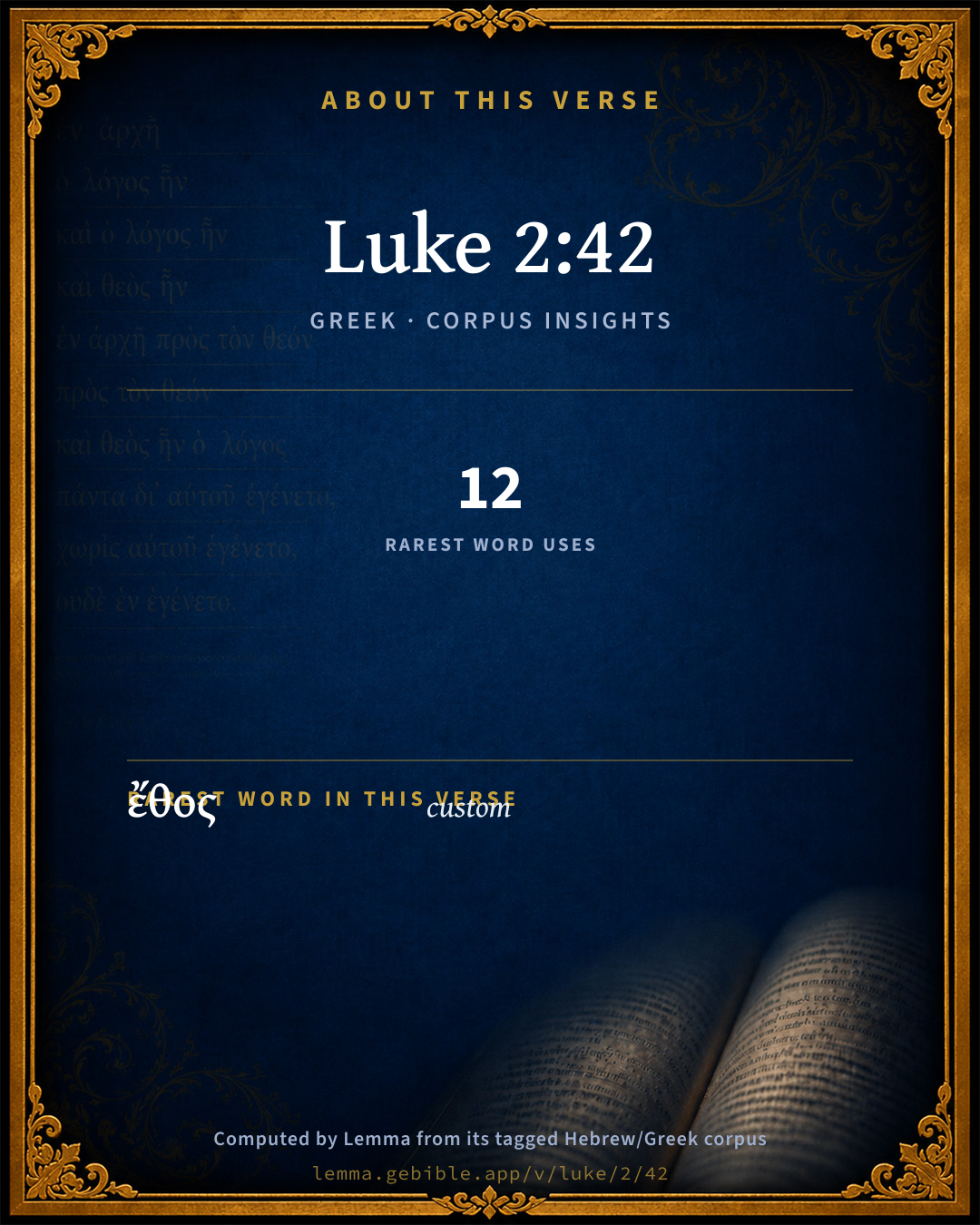
Luke 2:42

Greek (Tischendorf 8th ed.) Luke 2:42 appears in the Greek New Testament. The text above is from the Tischendorf 8th edition. Each word links to its Strong’s number and a concise gloss. Click any word for its full Thayer’s Greek Lexicon entry.
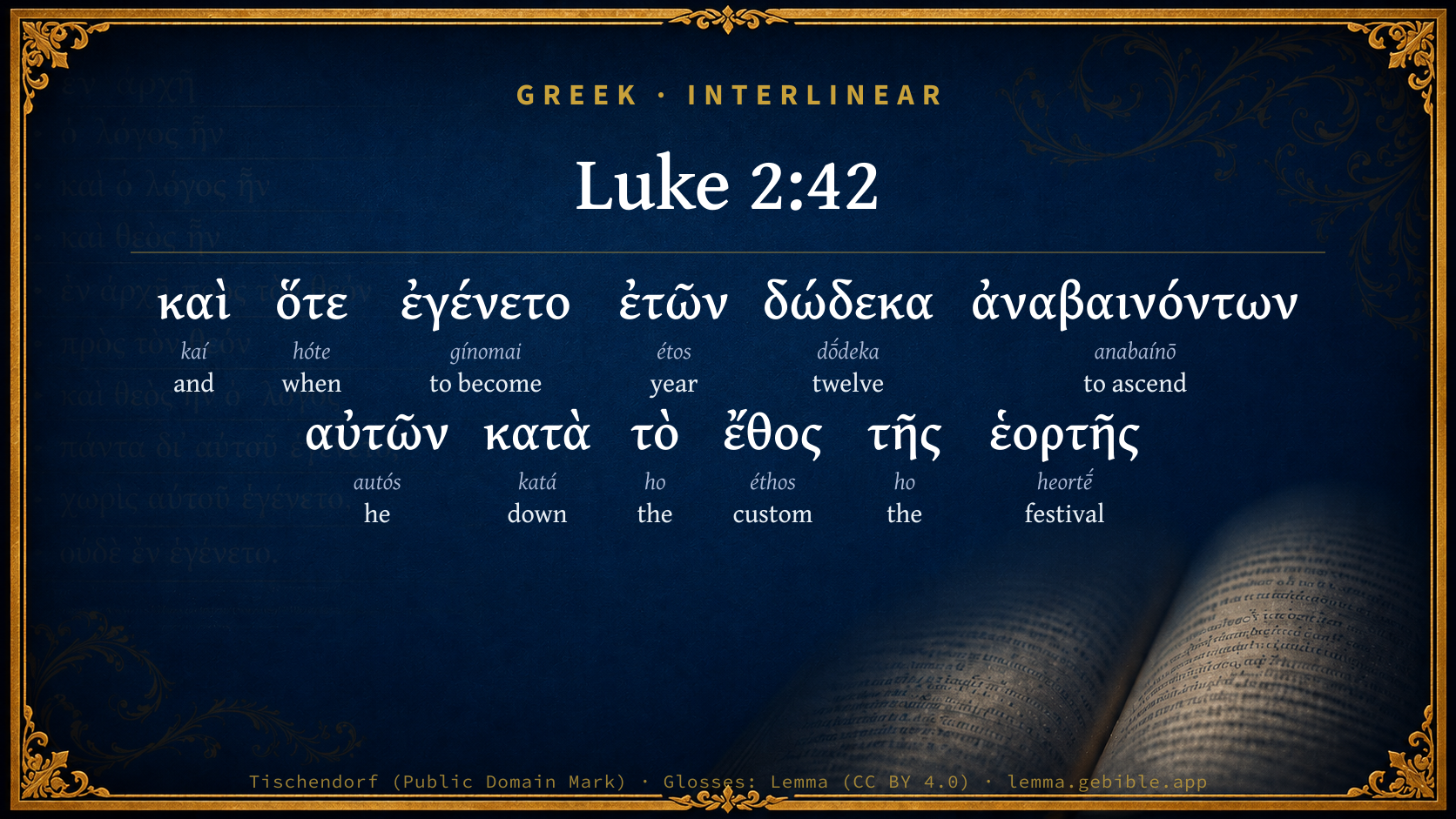
Download image
Cite this verse

Luke 2:42 (World English Bible). Public Domain. Lemma interlinear Bible study tool, https://lemma.gebible.app/v/luke/2/42.

Show BibTeX & RIS
BibTeX
RIS
English Translation
When he was twelve years old, they went up to Jerusalem according to the custom of the feast,
World English Bible · Public Domain
Download a study sheet

One document with this verse’s original text, its word-by-word gloss line, the meaning frame, cross-references with their text, attributed commentary, and full source and license credits — printable, and it pastes into notes with its structure intact.

This verse Autodidact and up

Study sheet (.html) Plain text (.txt)

A passage Seminary Student

Up to 50 verses in one chapter. A passage sheet keeps up to 6 commentary sources and 12 cross-references per verse, in the order this page ranks them, and says so on the sheet whenever that leaves anything out. Ask for a single verse and you get the Autodidact verse sheet above.

Everything on this page stays free to read, with no account — the sheet is a download of what is already on screen, not access to it.

Want to remove ads? Support Godless Engineer
Compare translations 3

The same verse in 3 English versions, stacked beneath the original-language interlinear above. Click any original word for its lexicon entry.

Each is an independent rendering of the whole verse — the interlinear is not word-aligned to these translations.

Highlighted words mark where these versions differ — a whole-verse word diff, not a word-by-word alignment.

  • World English Bible Public Domain
    When he was twelve years old, they went up to Jerusalem according to the custom of the feast,
  • King James Version Public Domain
    And when he was twelve years old, they went up to Jerusalem after the custom of the feast.
  • unfoldingWord Literal Text CC BY-SA 4.0
    And when he was 12 years old, they went up according to the custom of the feast.

unfoldingWord Literal Text — © unfoldingWord, licensed CC BY-SA 4.0. Word-aligned USFM3 via Door43 (git.door43.org/unfoldingWord/en_ult).

Versions to compare (up to 4)

3 of 4 selected

Show all 19 translations

Every available English version of this verse, each an independent rendering of the whole verse.

  • World English Bible Public Domain
    When he was twelve years old, they went up to Jerusalem according to the custom of the feast,
  • Berean Standard Bible Public Domain
    And when He was twelve years old, they went up according to the custom of the Feast.
  • Majority Standard Bible Public Domain
    And when He was twelve years old, they went up to Jerusalem according to the custom of the Feast.
  • King James Version Public Domain
    And when he was twelve years old, they went up to Jerusalem after the custom of the feast.
  • American Standard Version (1901) Public Domain
    And when he was twelve years old, they went up after the custom of the feast;
  • Revised Version (1885) Public Domain
    And when he was twelve years old, they went up after the custom of the feast;
  • Geneva Bible (1599) Public Domain
    And when hee was twelue yeere olde, and they were come vp to Hierusalem, after the custome of the feast,
  • Douay-Rheims (1899) Public Domain
    And when he was twelve years old, they going up into Jerusalem, according to the custom of the feast,
  • Young's Literal Translation Public Domain
    and when he became twelve years old, they having gone up to Jerusalem, according to the custom of the feast,
  • Literal Standard Version CC BY-SA 4.0
    and when He became twelve years old, they having gone up to Jerusalem according to the custom of the celebration,
  • Unlocked Literal Bible CC BY-SA 4.0
    When he was twelve years old, they again went up at the customary time for the feast.
  • unfoldingWord Literal Text CC BY-SA 4.0
    And when he was 12 years old, they went up according to the custom of the feast.
  • Darby Bible Public Domain
    And when he was twelve years old, and they went up [to Jerusalem] according to the custom of the feast
  • World Messianic Bible Public Domain
    When he was twelve years old, they went up to Jerusalem according to the custom of the feast;
  • Webster's Bible Public Domain
    And when he was twelve years old, they went up to Jerusalem according to the custom of the feast.
  • Free Bible Version CC BY-SA 4.0
    When Jesus was twelve years old, they went to the festival as they always did.
  • Bible in Basic English Public Domain
    And when he was twelve years old, they went up, as their way was, to the feast;
  • Text-Critical English NT CC BY 4.0
    When he was twelve years old, they went up to Jerusalem according to the custom of the feast.
  • Tyndale New Testament (1534) Public Domain
    And when he was.xii. yere olde they went vp to Hierusalem after the custome of the feeste.

Literal Standard Version (2020), Covenant Press — licensed CC BY-SA 4.0. Text via the HelloAO Bible API (eBible.org). Unlocked Literal Bible (unfoldingWord) — licensed CC BY-SA 4.0. Text via the HelloAO Bible API (eBible.org). unfoldingWord Literal Text — © unfoldingWord, licensed CC BY-SA 4.0. Word-aligned USFM3 via Door43 (git.door43.org/unfoldingWord/en_ult). Free Bible Version, Dr. Jonathan Gallagher — licensed CC BY-SA 4.0. Text via the HelloAO Bible API (eBible.org).

Word by word

More ways to search: Search by grammar → Find every occurrence → Compare this word →

Practice this passage: Drill this verse → Learn its vocabulary →

About this verse

These counts appear in no published source. They are computed here, from the morphology-tagged text and Lemma’s own curated glosses. What Lemma adds →

12
words
11
distinct lemmas
Gospels
section

Notable vocabulary

The rarest word here is ἔθος custom G1485 — appearing just 12 times in the whole Greek New Testament.

Shared distinctive vocabulary

ἔθος custom G1485 occurs in 12 verses of the Greek New Testament. Also found in:

Repetition

A word recurs within this verse:

Where the printed editions differ

1 variant

Places in this verse where the major printed Greek editions disagree on the wording in a way that affects the translation — a comparison of editions, not a manuscript-by-manuscript collation. The editions are the modern critical texts (Nestlé-Aland 28/27, SBL, Westcott-Hort, Tregelles, Tyndale House) and the traditional texts behind the KJV (the Textus Receptus and the Byzantine/Majority text). It is not a claim about which reading is original.

  1. Extra text
    εἰς Ἱεροσόλυμα

    “into Jerusalem”

    In TregTRByz Not in NA28NA27TynSBLWH

    εἰς Ἱεροσόλυμα (eis Hi'erosoluma) 'into Jerusalem' is only in traditional manuscripts (Treg+TR+Byz)

Textual data: Translators Amalgamated Greek New Testament (STEPBible TAGNT) · CC BY 4.0.

Commentary

Notes on Luke 2:42 from classic Christian and Jewish commentators (each source and its license shown beneath its notes). The classic Christian expositions comment on the surrounding passage and are grouped to its opening verse, so a note may address several verses; the Jewish commentaries on the Tanakh (Rashi and others) are per-verse, so they appear only where the commentator wrote on this verse.

Lemma curates 59 commentaries, every one of them public domain or Creative Commons licensed, each selected and text-cleaned for this edition rather than reprinted as found. About our sources →

Tyndale Open Study Notes

Tyndale Open Resources

2:42 Jesus was twelve years old: A Jewish boy entered into his covenant responsibilities at age thirteen (the bar mitzvah ceremony developed later to express this custom). With this visit, Jesus’ parents were preparing him to fulfill his role in the covenant community.

Tyndale Open Study Notes — © Tyndale Open Resources, licensed CC BY-SA 4.0. Text via the HelloAO Bible API.

Bengel's Gnomon

Johann Albrecht Bengel

Luk 2:42. Ἔτων δώδεκα, twelve years old) This step in the age must doubtless have had something remarkable connected with it in the case of pious boys, judging from the blessed example of the Saviour, who was wont to adapt Himself to the times of human age (to the epochs observed in the life of man): ch. Luk 3:23. No doubt from that time He every year came to the Passover. [Moreover the specimen of His glory given in this passage, dividing as it does the period of thirty years that elapsed from the nativity to the baptism of Christ into two almost equal parts, revived the remembrance of those miraculous facts (connected with His birth), the forgetting of which might otherwise have seemed to admit of excuse.—Harm., p. 59.]

Bengel's Gnomon of the New Testament — English translation (T&T Clark, Edinburgh, 1860) — public domain. Text from a community e-Sword module.

Expositor's Greek Testament

ed. W. Robertson Nicoll

Luk 2:42 . ἐτῶν δώδεκα : this mention of the age of Jesus is meant to suggest, though it is not directly stated, that this year He went up to Jerusalem with His parents; ἀναβαινόντων includes Him. At twelve a Jewish boy became a son of the law, with the responsibility of a man, putting on the phylacteries which reminded of the obligation to keep the law ( vide Wünsche, Beiträge, ad loc. ).

The Expositor's Greek Testament, edited by W. Robertson Nicoll (1897–1910) — public domain. Text from a community e-Sword module.

Jamieson, Fausset & Brown

Robert Jamieson, A. R. Fausset & David Brown

FIRST CONSCIOUS VISIT TO JERUSALEM. (Luk 2:41-52)

went up--"were wont to go." Though males only were required to go up to Jerusalem at the three annual festivals (Exo 23:14-17), devout women, when family duties permitted, went also, as did Hannah (Sa1 1:7), and, as we here see, the mother of Jesus.

when twelve years old--At this age every Jewish boy was styled "a son of the law," being put under a course of instruction and trained to fasting and attendance on public worship, besides being set to learn a trade. At this age accordingly our Lord is taken up for the first time to Jerusalem, at the passover season, the chief of the three annual festivals. But oh, with what thoughts and feelings must this Youth have gone up! Long ere He beheld it, He had doubtless "loved the habitation of God's house and the place where His honor dwelt" (Psa 26:8), a love nourished, we may be sure, by that "word hid in His heart," with which in afterlife He showed so perfect a familiarity. As the time for His first visit approached, could one's ear have caught the breathings of His young soul, he might have heard Him whispering, "As the hart panteth after the water brooks, so panteth my soul after Thee, O God. The Lord loveth the gates of Zion more than all the dwellings of Jacob. I was glad when they said unto me, Let us go unto the house of the Lord. Our feet shall stand within thy gates, O Jerusalem!" (Psa 42:1; Psa 87:2; Psa 122:1-2). On catching the first view of "the city of their solemnities," and high above all in it, "the place of God's rest," we hear Him saying to Himself, "Beautiful for situation, the joy of the whole earth is Mount Zion, on the sides of the north, the city of the great King: Out of Zion, the perfection of beauty, God doth shine" (Psa 48:2; Psa 50:2). Of His feelings or actions during all the eight days of the feast not a word is said. As a devout child, in company with its parents, He would go through the services, keeping His thoughts to Himself. But methinks I hear Him, after the sublime services of that feast, saying to Himself, "He brought me to the banqueting house, and his banner over me was love. I sat down under his shadow with great delight, and his fruit was sweet to my taste" (Sol 2:3-4).

Jamieson, Fausset & Brown — Commentary Critical and Explanatory on the Whole Bible (1871) — public domain (CC PDM 1.0). Text via the HelloAO Bible API.

Ellicott's Commentary for English Readers

(42)When he was twelve years old.—The stages of Jewish childhood were marked as follows:—At three the boy was weaned, and wore for the first time the fringed or tasselled garment prescribed by Num_15:38-41, and Deu_22:12. His education began, at first under the mother’s care. At five he was to learn the Law, at first by extracts written on scrolls of the more important passages, the Shemk or Creed of Deu_2:4, the Hallel or Festival Psalms (Psalms 114-118, 136), and by catechetical teaching in school. At twelve he became more directly responsible for his obedience to the Law, and on the day when he attained the age of thirteen, put on for the first time the phylacteries which were worn at the recital of his daily prayer. (See Note on Mat_23:5.) It was accordingly an epoch of transition analogous to that which obtains among us at Confirmation. It was, therefore in strict accordance with usage, with perhaps a slight anticipation of the actual day, that the “child Jesus” should, at the age of twelve, have gone up with His parents to Jerusalem. If the conjecture suggested in the Notes on Luk_2:8, that the birth of our Lord coincided with the Paschal Season, be accepted, He may actually have completed His thirteenth year during the Feast; and so have become, in the fullest sense, one of the “children of the Law,” bound to study it and know its meaning. This at least fits in with, and in fact explains, the narrative that follows. In the later Maxims of the Fathers (Pirke Aboth) two other stages of education were marked out. At ten, a boy was to enter on the study of the Mischna (= “comments”), or body of traditional interpretations of the Law; at eighteen, on that of the Gemara (= “completeness”), or wider collection of sayings or legends, which, with the Mischna, made up what is known as the Talmud (= “learning,” or “doctrine”).

A Bible Commentary for English Readers, edited by Charles John Ellicott (1878–1897) — public domain. Text from a community e-Sword module.

The Cambridge Bible for Schools and Colleges

gen. ed. J. J. S. Perowne

42. when he was twelve years old] No single word breaks the silence of the Gospels respecting the childhood of Jesus from the return to Nazareth till this time. We infer indeed from scattered hints in Scripture that He “began to do” His work before He “began to teach,” and being “tempted in all points like as we are” won the victory from His earliest years, alike over positive and negative temptations. (Heb_5:8. See Ullmann, Sinlessness of Jesus, E. Tr. p. 140.) Up to this time He had grown as other children grow, only in a childhood of stainless and sinless beauty—“as the flower of roses in the spring of the year, and as lilies by the waters,” Sir_39:13-14. This incident of His ‘confirmation,’ as in modern language we might call it, is “the solitary flowret out of the wonderful enclosed garden of the thirty years, plucked precisely there where the swollen bud at a distinctive crisis bursts into flower.” Stier, Words of Jesus, i. 18.

This silence of the Evangelists is a proof of their simple faithfulness, and is in striking contrast with the blaze of foolish and dishonouring miracles with which the Apocryphal Gospels degrade the Divine Boyhood. See my Life of Christ, 1. 58–66. Meanwhile we are permitted to see (i) That our Lord never attended the schools of the Rabbis (Mar_6:2; Joh_6:42; Joh_7:15), and therefore that His teaching was absolutely original, and that He would therefore be regarded by the Rabbis as a ‘man of the people,’ or ‘unlearned person.’ (See Act_4:13; T. B. Berachôth, f. 47. 2; Sir_38:24 fg.) (ii) That He had learnt to write (Joh_8:6). (iii) That He was acquainted not only with Aramaic, but with Hebrew, Greek, and perhaps Latin (Life of Christ, i. 91); and (iv) That he had been deeply impressed by the lessons of nature (id. i. 93).

twelve years old] Up to this age a Jewish boy was called ‘little,’ afterwards he was called ‘grown up,’ and became a ‘Son of the Law,’ or ‘Son of the Precepts.’ At this age he was presented on the Sabbath called the ‘Sabbath of Phylacteries’ in the Synagogue, and began to wear the phylacteries with which his father presented him. According to the Jews twelve was the age at which Moses left the house of Pharaoh’s daughter, and Samuel was called, and Solomon gave his judgment, and Josiah carried out his reform. (Jos. Antt. ii. 9. 6, v. 10. 4.)

The Cambridge Bible for Schools and Colleges (gen. ed. J. J. S. Perowne; Cambridge University Press, 1878–1918) — public domain. Text from a community e-Sword module.

John Gill's Exposition

And when they had fulfilled the days,.... The seven days of the fear of unleavened bread, for so many days that feast was observed; and though it was not absolutely necessary, and obligatory upon them to stay all that time at Jerusalem, yet Mary and Joseph seem so to have done, as did the more religious and devout persons:

as they returned; at the time when they were going from Jerusalem home again:

the child Jesus tarried behind in Jerusalem; being desirous of hearing the discourses of the doctors about the sense of the Scriptures, the meaning of the laws, and the traditions of the elders, and of conversing with them:

and Joseph, and his mother, knew not of it; of his intention to tarry longer, nor of his design in so doing: he did not ask leave of them, since his stay was about an affair of his heavenly Father's; and therefore this action of Christ is not to be drawn into an example, or precedent for children, to act without consulting, or asking leave of their parents. They had no notion at all of his staying behind them, nor any suspicion of it; nor did they miss him for a considerable time; which might be owing to the large numbers that went in company together, so that they could not tell but that he was in the crowd, though they did not see him; or to the men and women travelling in separate companies, as is thought; so that Joseph might think he was with Mary, and Mary might conclude he was with Joseph, till they came to the end of their first day's journey, when they came together, and then missed him.

John Gill's Exposition of the Whole Bible (1746–1763) — public domain (CC PDM 1.0). Text via the HelloAO Bible API.

Trapp's Complete Commentary

John Trapp

42 And when he was twelve years old, they went up to Jerusalem after the custom of the feast.

Ver. 42. And when he was twelve years old] What he did from his infancy hitherto, the Scripture is silent; Papists feign many idle relations, and thereby expose us to the jeers of Jewish and Turkish miscreants. Where the Scripture hath no tongue, we must have no ears.

John Trapp, A Commentary or Exposition upon All the Books of the Old and New Testament (1647–1656) — public domain. Text from a community e-Sword module.

Albert Barnes' Notes on the Bible

Twelve years old - All males among the Hebrews were required to appear three times a year before God, to attend on the ordinances of religion in the temple, and it is probable that this was the age at which they first went up to Jerusalem, Exo 23:14-17; Deu 16:16.

To Jerusalem - Where the feasts of the Jews were all held. This was a journey from Nazareth of about 70 miles.

After the custom of the feast - According to the usual manner of the feast.

Albert Barnes' Notes on the Bible (1834–1885) — public domain. Text from a community e-Sword/MySword module.

Matthew Poole's English Annotations

It is said by those who are learned in the Jewish writings, that till a child was of this age he was not obliged by the law to go. We have in Scripture nothing to ascertain us in the case; it is certain that our Saviour went at this age,

after the custom of the feast, that is, so as to be there about the fourteenth day of the month Nisan.

Matthew Poole's English Annotations on the Holy Bible (1683–1685) — public domain. Text from a community e-Sword/MySword module.

Whedon's Commentary on the Bible

Daniel D. Whedon

42. Twelve years old—At twelve the Jewish child was called the “son of the law,” and was held subject to its precepts. At this age, therefore, and probably for the first time, Jesus obeys the law to attend the Passover. The scenes of this great festival, of which he was himself the predicted subject, and in which he was himself at his crucifixion to perform so sorrowful and so finishing a part, must have opened his mind wonderfully, and have brought his soul to a sublime excitement.

Daniel D. Whedon (gen. ed.), Commentary on the Old and New Testaments (1874–1909) — public domain. Text from a community e-Sword module.

The Pulpit Commentary

And when he was twelve years old, they went up to Jerusalem after the custom of the feast. When a Jewish boy was three years old he was given the tasselled garment directed by the Law. (Num_15:38-41 Deu_22:12) At five he usually began to learn portions of the Law, under his mother"s direction; these were passages written on scrolls, such as the shema or creed of Deu_6:4, the Hallel Psalms. (Ps 114 Ps 118 Ps 136) When the boy was thirteen years old he wore, for the first time, the phylacteries, which the Jew always put on at the recital of the daily prayer. In the well-known and most ancient "Maxims of the Fathers" ("Pirke Avoth"), we read that, at the age of ten, a boy was to commence the study of the Mishna (the Mishna was a compilation of traditional interpretations of the Law); at eighteen he was to be instructed in the Gemara (the Gemara was a vast collection of interpretations of the Mishna. The Mishua and Gemara together make up the Talmud. The Mishna may roughly be termed the text, the Gemara the commentary, of the Talmud).

The Pulpit Commentary (1880–1919), ed. H.D.M. Spence-Jones & Joseph S. Exell — public domain. Text from a community e-Sword module.

The People's New Testament

B. W. Johnson

42. When he was twelve years old. At the age of twelve a boy was called by the Jews “son of the law,” and first incurred legal obligation. Henceforth it would be his personal duty to keep the law.

B. W. Johnson's The People's New Testament with Notes (1889–1891) — public domain. Electronic text from the Christian Classics Ethereal Library (CCEL) ThML edition.

Cambridge Greek Testament for Schools and Colleges

42. ἐτῶν δώδεκα. No single word breaks the silence of the Gospels respecting the childhood of Jesus from the return to Nazareth till this time. We infer indeed from scattered hints in Scripture that He “began to do” His work before He “began to teach,” and being “tempted in all points like as we are” won the victory from His earliest years, alike over positive and negative temptations. (Heb 5:8. See Ullmann, Sinlessness of Jesus, E. Tr. p. 140.) Up to this time He had grown as other children grow, only in a childhood of stainless and sinless beauty—“as the flower of roses in the spring of the year, and as lilies by the waters,” Sir 39:13-14. This incident of His ‘confirmation,’ as in modern language we might call it, is the “solitary floweret out of the wonderful enclosed garden of the thirty years, plucked precisely there where the swollen but at a distinctive crisis bursts into flower.” Stier, Words of Jesus, I. 18.

This silence of the Evangelists is a proof of their simple faithfulness, and is in striking contrast with the blaze of foolish and dishonouring miracles with which the Apocryphal Gospels degrade the Divine Boyhood. Meanwhile we are permitted to see (i) That our Lord never attended the schools of the Rabbis (Mar 6:2; Joh 6:42; Joh 7:15). His teaching was absolutely original, and He would therefore be regarded by the Rabbis as a ‘man of the people,’ or ‘unlearned person.’ (See Act 4:13; T. B. Berachôth, f. 47. 2; Sir 38:24 fg.) (ii) That He had learnt to write (Joh 8:6). (iii) That He was acquainted not only with Aramaic, but with Hebrew, Greek, and perhaps Latin (Life of Christ, I. 91); and (iv) That He had been deeply impressed by the lessons of nature (id. I.93).

δώδεκα. Up to this age a Jewish boy was called ‘little,’ afterwards he was called ‘grown up,’ and became a ‘Son of the Law,’ or ‘Son of the Precepts.’ At this age he was presented on the Sabbath called the ‘Sabbath of Phylacteries’ in the Synagogue, and began to wear the phylacteries with which his father presented him. According to the Jews twelve was the age at which Moses left the house of Pharaoh’s daughter, and Samuel was called, and Solomon gave his judgment, and Josiah carried out his reform. (Jos. Antt. II. 9. 6, v. 10. 4.)

Cambridge Greek Testament for Schools and Colleges (Cambridge University Press, 1896; 21 vols, various authors incl. Carr, Maclear, Plummer, Farrar, Lumby, Moule, M. R. James, Simcox) — public domain. Text from a community e-Sword module.

Alford’s Greek Testament

Henry Alford

42.] At the age of twelve, a boy was called by the Jews בֵּן הַתּוֹרָה, ‘son of the law,’ and first incurred legal obligation. At that time, then, commences the second step (see note on ver. 52) of the life of the Lord, the time when the τὰ πρέποντα for Him began; his course of blameless legal obedience (see note on ver. 21) in his own person and by his own will. Now first (ver. 49) appear those higher consciousnesses to have found expression, which unfolded within Him, till the full time of his public ministry arrived. It cannot be inferred from this narrative, that it was the first time the holy Child had accompanied them to the Passover.

Henry Alford, The Greek Testament (1849–1861) — public domain. Text from a community e-Sword module.

International Critical Commentary

42. ἐτῶν δώδεκα. At the age of twelve a young Jew became “a son of the Law,” and began to keep its enactments respecting feasts, fasts, and the like. The mention of the age implies that since the Presentation Jesus had not been up to Jerusalem.— ἀναβαινόντων. Imperf. part. “On their usual going up.”—κατὰ τὸ ἔθος. See small print on 1:9 ; also Deissmann, Bible Studies, p. 251.

International Critical Commentary — older volumes (1896–1929), various authors — public domain. Text from a community e-Sword module.

Vincent's Word Studies in the New Testament

Marvin R. Vincent

Twelve years old. At which age he was known as a son of the law, and came under obligation to observe the ordinances personally.

Marvin R. Vincent, Word Studies in the New Testament (1887–1900) — public domain. Text from a community e-Sword/MySword module.

Lesson kit

Teaching starters — assembled from the data on this page, not authored interpretation. Every prompt links to the verse data it draws on. Edit before teaching.

Luke, in the Gospels, opens this verse with 12 words (11 distinct Greek lemmas). Its most distinctive word is éthos (“custom”). A historical commentator’s framing appears above. Read the whole chapter for the surrounding context.

Discussion questions

  1. How does “custom” (éthos) shape what this verse is saying?
  2. How does Luke 1:9, which shares the word «custom», read alongside this verse?
  3. What does the repetition of “the” (2× in this one verse) do in this verse?
  4. These translations render this verse differently; the difference is in the English rendering, not the original. What questions does that raise?
  5. Compare how Tyndale Open Study Notes and Bengel's Gnomon read this verse. Where do they agree or differ?

Things to notice

Reading settings

Reading text

Shown beneath each verse's original-language words.

Old Testament
Old Testament edition

Read the OT as the Masoretic Hebrew (MT) or the Greek Septuagint (LXX).

English shown for the Greek Septuagint (in the Hebrew ↔ Greek comparison).

Comparing translations? Open the Compare panel on any verse page to stack up to four side by side.