Mark 15:26

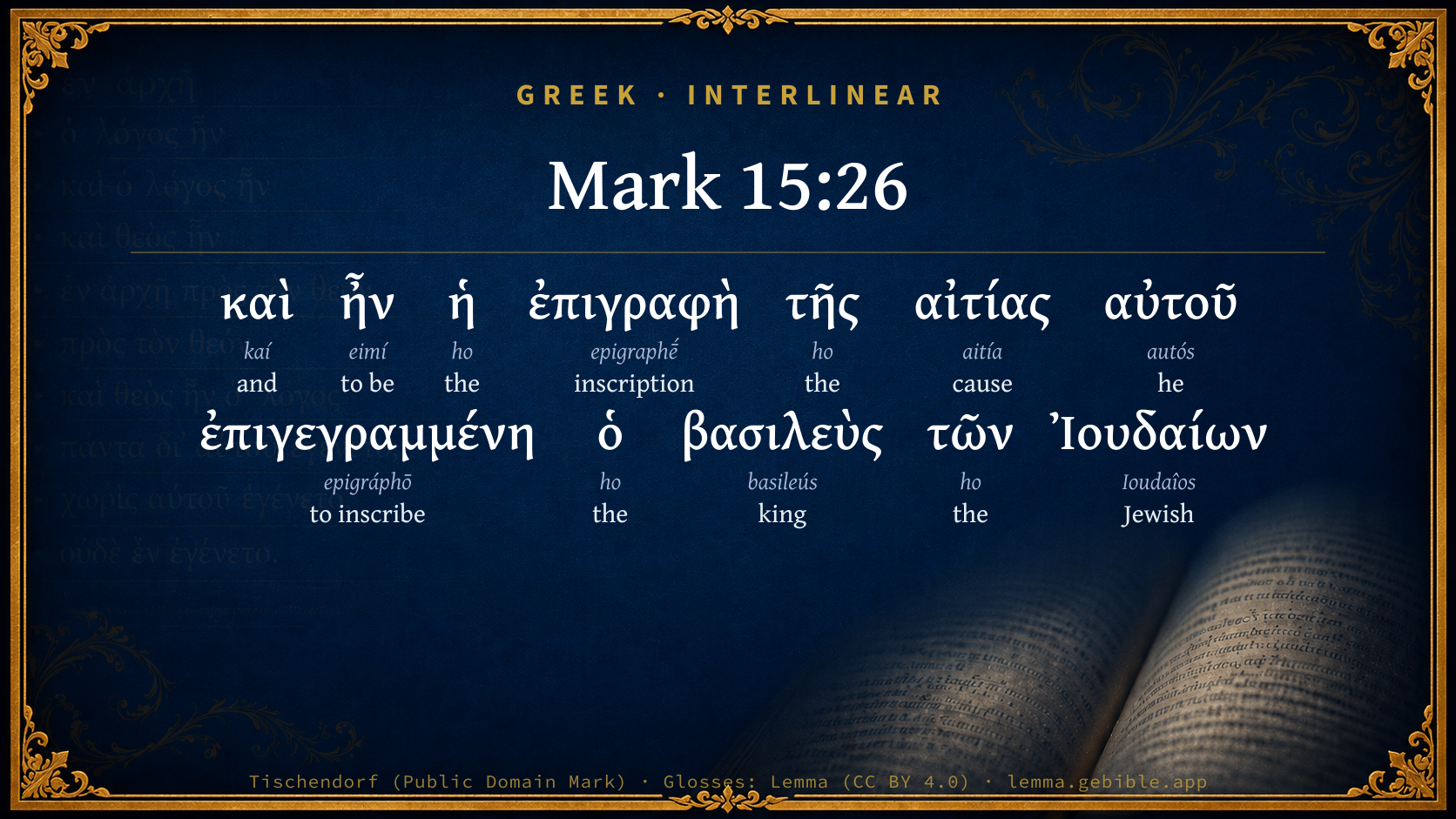
Greek (Tischendorf 8th ed.) Mark 15:26 appears in the Greek New Testament. The text above is from the Tischendorf 8th edition. Each word links to its Strong’s number and a concise gloss. Click any word for its full Thayer’s Greek Lexicon entry.
Download image
Cite this verse

Mark 15:26 (World English Bible). Public Domain. Lemma interlinear Bible study tool, https://lemma.gebible.app/v/mark/15/26.

Show BibTeX & RIS
BibTeX
RIS
English Translation
The superscription of his accusation was written over him, "THE KING OF THE JEWS."
World English Bible · Public Domain
Highlights
  • 1 first appearance in the Greek New Testament
Full analysis ↓
Download a study sheet

One document with this verse’s original text, its word-by-word gloss line, the meaning frame, cross-references with their text, attributed commentary, and full source and license credits — printable, and it pastes into notes with its structure intact.

This verse Autodidact and up

Study sheet (.html) Plain text (.txt)

A passage Seminary Student

Up to 50 verses in one chapter. A passage sheet keeps up to 6 commentary sources and 12 cross-references per verse, in the order this page ranks them, and says so on the sheet whenever that leaves anything out. Ask for a single verse and you get the Autodidact verse sheet above.

Everything on this page stays free to read, with no account — the sheet is a download of what is already on screen, not access to it.

Want to remove ads? Support Godless Engineer
Compare translations 3

The same verse in 3 English versions, stacked beneath the original-language interlinear above. Click any original word for its lexicon entry.

Each is an independent rendering of the whole verse — the interlinear is not word-aligned to these translations.

Highlighted words mark where these versions differ — a whole-verse word diff, not a word-by-word alignment.

  • World English Bible Public Domain
    The superscription of his accusation was written over him, "THE KING OF THE JEWS."
  • King James Version Public Domain
    And the superscription of his accusation was written over, THE KING OF THE JEWS.
  • unfoldingWord Literal Text CC BY-SA 4.0
    And this was the inscription of his charge, having been written: “The King of the Jews.”

unfoldingWord Literal Text — © unfoldingWord, licensed CC BY-SA 4.0. Word-aligned USFM3 via Door43 (git.door43.org/unfoldingWord/en_ult).

Versions to compare (up to 4)

3 of 4 selected

Show all 19 translations

Every available English version of this verse, each an independent rendering of the whole verse.

  • World English Bible Public Domain
    The superscription of his accusation was written over him, "THE KING OF THE JEWS."
  • Berean Standard Bible Public Domain
    And the charge inscribed against Him read: THE KING OF THE JEWS.
  • Majority Standard Bible Public Domain
    And the charge inscribed against Him read: THE KING OF THE JEWS.
  • King James Version Public Domain
    And the superscription of his accusation was written over, THE KING OF THE JEWS.
  • American Standard Version (1901) Public Domain
    And the superscription of his accusation was written over, THE KING OF THE JEWS.
  • Revised Version (1885) Public Domain
    And the superscription of his accusation was written over, THE KING OF THE JEWS.
  • Geneva Bible (1599) Public Domain
    And ye title of his cause was written aboue, THAT KING OF THE JEWES.
  • Douay-Rheims (1899) Public Domain
    And the inscription of his cause was written over: THE KING OF THE JEWS.
  • Young's Literal Translation Public Domain
    and the inscription of his accusation was written above -- `The King of the Jews.'
  • Literal Standard Version CC BY-SA 4.0
    and the inscription of His accusation was written above: “THE KING OF THE JEWS.”
  • Unlocked Literal Bible CC BY-SA 4.0
    On a sign they wrote the charge against him, “The king of the Jews.”
  • unfoldingWord Literal Text CC BY-SA 4.0
    And this was the inscription of his charge, having been written: “The King of the Jews.”
  • Darby Bible Public Domain
    And the superscription of what he was accused of was written up: The King of the Jews.
  • World Messianic Bible Public Domain
    The superscription of his accusation was written over him: “THE KING OF THE JEWS.”
  • Webster's Bible Public Domain
    And the superscription of his accusation was written over, THE KING OF THE JEWS.
  • Free Bible Version CC BY-SA 4.0
    A sign with the written charge against him read: “The King of the Jews.”
  • Bible in Basic English Public Domain
    And the statement of his crime was put in writing on the cross, THE KING OF THE JEWS.
  • Text-Critical English NT CC BY 4.0
    The inscription of the charge against him was written as follows: “The King of the Jews.”
  • Tyndale New Testament (1534) Public Domain
    And the tytle of his cause was wrytten: The kynge of the Iewes.

Literal Standard Version (2020), Covenant Press — licensed CC BY-SA 4.0. Text via the HelloAO Bible API (eBible.org). Unlocked Literal Bible (unfoldingWord) — licensed CC BY-SA 4.0. Text via the HelloAO Bible API (eBible.org). unfoldingWord Literal Text — © unfoldingWord, licensed CC BY-SA 4.0. Word-aligned USFM3 via Door43 (git.door43.org/unfoldingWord/en_ult). Free Bible Version, Dr. Jonathan Gallagher — licensed CC BY-SA 4.0. Text via the HelloAO Bible API (eBible.org).

Word by word

More ways to search: Search by grammar → Find every occurrence → Compare this word →

Practice this passage: Drill this verse → Learn its vocabulary →

ἐπιγραφὴ
epigraphḗ
G1923
“inscription”
Noun, Nominative, Singular, Feminine
Part of Speech
Noun
Case
Nominative
Number
Singular
Gender
Feminine
Full Thayer's Definition

Origin: from G1924

TDNT: None

1. an inscription, title a. in the NT of an inscription in black letters upon a whitened tablet b. of the inscription on a coin
  1. καὶ kaí G2532 “and” Conjunction
  2. ἦν eimí G1510 “to be” Verb, Imperfect, Active, Indicative, 3rd person, Singular
  3. ἡ ho G3588 “the” Article, Nominative, Singular, Feminine
  4. τῆς ho G3588 “the” Article, Genitive, Singular, Feminine
  5. αἰτίας aitía G156 “cause” Noun, Genitive, Singular, Feminine
  6. αὐτοῦ autós G846 “he” Personal pronoun, Genitive, Singular, Masculine
  7. ἐπιγεγραμμένη epigráphō G1924 “to inscribe” Verb, Perfect, Passive, Participle, Nominative, Singular, Feminine
  8. ὁ ho G3588 “the” Article, Nominative, Singular, Masculine
  9. βασιλεὺς basileús G935 “king” Noun, Nominative, Singular, Masculine
  10. τῶν ho G3588 “the” Article, Genitive, Plural, Masculine
  11. Ἰουδαίων Ioudaîos G2453 “Jewish” Adjective, Genitive, Plural, Masculine

About this verse

These counts appear in no published source. They are computed here, from the morphology-tagged text and Lemma’s own curated glosses. What Lemma adds →

12
words
9
distinct lemmas
Gospels
section

Notable vocabulary

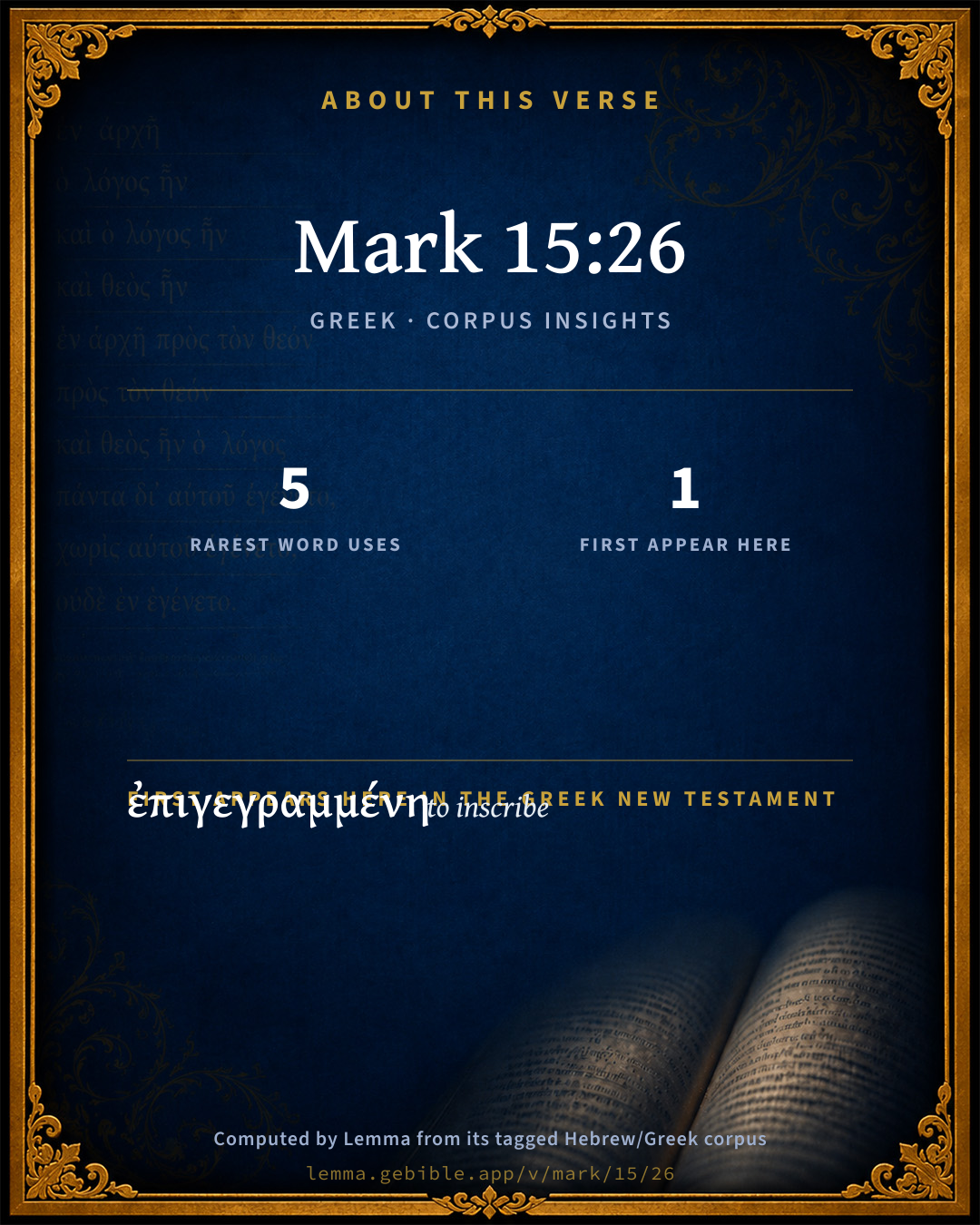
The rarest word here is ἐπιγραφὴ inscription G1923 — appearing just 5 times in the whole Greek New Testament.

First appearance in Scripture

This word makes its first canonical appearance in the Greek New Testament here:

  • ἐπιγεγραμμένη to inscribe G1924

Shared distinctive vocabulary

ἐπιγραφὴ inscription G1923 occurs in 5 verses of the Greek New Testament. Also found in:

Repetition

A word recurs within this verse:

Cross-references

11

Topical passages linked to Mark 15:26 in the Treasury of Scripture Knowledge — connected by theme and wording, ordered by reader-vote popularity; previews shown in the World English Bible.

  • Matthew 27:37 They set up over his head the accusation against him written, "THIS IS JESUS, THE KING OF THE JEWS."
  • Zechariah 9:9 Rejoice greatly, daughter of Zion! Shout, daughter of Jerusalem! Behold, your king comes to you! He is righteous, and having salvation; Lowly, and riding on a donkey, Even on a colt, the foal of a donkey.
  • Matthew 2:2 "Where is he who is born King of the Jews? For we saw his star in the east, and have come to worship him."
  • Luke 23:37–38 and saying, "If you are the King of the Jews, save yourself!"
  • John 19:18–22 where they crucified him, and with him two others, on either side one, and Jesus in the middle.
  • Psalms 2:6 "Yet I have set my king on my holy hill of Zion."
  • Proverbs 21:1 The king's heart is in Yahweh's hand like the watercourses. He turns it wherever he desires.
  • Isaiah 10:7 However he doesn't mean so, neither does his heart think so; but it is in his heart to destroy, and to cut off not a few nations.
  • Mark 15:2 Pilate asked him, "Are you the King of the Jews?" He answered, "So you say."
  • Deuteronomy 23:5 Nevertheless Yahweh your God wouldn't listen to Balaam; but Yahweh your God turned the curse into a blessing to you, because Yahweh your God loved you.
  • Isaiah 46:10 declaring the end from the beginning, and from ancient times things that are not [yet] done; saying, My counsel shall stand, and I will do all my pleasure;

Cross-references courtesy of OpenBible.info (CC BY 4.0).

Commentary

Notes on Mark 15:26 from classic Christian and Jewish commentators (each source and its license shown beneath its notes). The classic Christian expositions comment on the surrounding passage and are grouped to its opening verse, so a note may address several verses; the Jewish commentaries on the Tanakh (Rashi and others) are per-verse, so they appear only where the commentator wrote on this verse.

Lemma curates 59 commentaries, every one of them public domain or Creative Commons licensed, each selected and text-cleaned for this edition rather than reprinted as found. About our sources →

The Biblical Illustrator

Joseph S. Exell

Mar_15:26

The King of the Jews.

Jesus mocked and crucified

Jesus suffered and died under the forms of law. His execution was the result of a six-fold trial-three trials at the hands of the Jews, and three at the hands of the Romans. When Jesus was led to Golgotha bearing His cross, He had stood at the focal point of the worlds best light and been pronounced guilty of death. For what offence? Pilate, as the custom was, with his own hand wrote the charge. And the superscription of His accusation was written over, The King of the Jews.

I. The words of the superscription correctly express what Jesus claimed. He was condemned, not so much upon the testimony of the non-agreeing witnesses, as upon His own admission of this. He maintained it to the last. No terror from the sight of the cross could make Him withdraw the claim. He died resolutely claiming that He was King.

II. The words of the superscription indicate the claim Christ makes today. Eighteen centuries have not dimmed the title Pilate wrote. As decisively now as then He stands at every court, at every public and private tribunal, at the door of every mans heart, at every turn in our journey, before every thought of our mind, every choice of our will, every act of our life, and says, I am King. If He be indeed King, His offices and attributes are kingly and He has the right to demand that no one dim the lustre of His crown, or weaken the sway of His sceptre. It is sometimes said that it matters little what place we assign to Christ, or with what attributes we clothe Him, so that life is only upright, and our conduct such as He would not condemn. At His trial before the Jewish and Roman Courts it mattered much what place was allotted Him and what title He should be allowed to bear. He died rather than disown His royal title. Is He less mindful of it now in His exalted glory, and less regardful of those attributes which rightfully constitute His regal claim? If He be a King, His is the right to hold the name and place thereof. Who shall dare to put forth the hand and pluck one jewel from His diadem of omnipotence, or efface one ray from His halo of infinite wisdom?

III. The words of the superscription indicate why so many now reject Christ. Because He asserts kingly authority-the right to rule, and to control mens hearts and lives. Men exalt the compassion of Jesus; they praise His teachings; they laud the good deeds with which His life was full; they extol the lustre of His example; but when asked if they have placed within their heart a throne on which He may sit and reign, they falter. The title they apply to Him is burden bearer rather than lawmaker, benefactor rather than king, counsellor rather than judge, one to admire and extol rather than obey.

IV. The wonts of the superscription indicate in what way Christ is now to be received. As the worlds Redeemer Christ fulfils the threefold office of Prophet, Priest, and King. To accept Him as the first is to believe and adopt His teachings; as the second, to rely for pardon and approach to God upon His atonement and intercession; as the third, to add to the others a surrender of the will to Him in loyalty and love, to install Him as ruler of our hearts and lives. We thus receive Him as our Saviour and Lord; we at once believe in Him and submit to Him; we ask Him to both pardon us and control us; and while He justifies He takes us, with our cordial consent, into His own care for the direction and government of our life both here and hereafter. Henceforth the thought that Christ is King is welcome. A place is gladly made in the heart for His throne to stand immutably. He is supreme. His will is law. (P. B. Davis.)

Christ the King of kings

When Mr. Dawson was preaching in South Lambeth on the offices of Christ, he presented Him as Prophet and Priest, and then as the King of saints. He marshalled patriarchs, kings, prophets and apostles, martyrs and confessors of every age and clime, to place the insignia of royalty upon the head of the King of kings. The audience was wrought up to the highest pitch of excitement, and, as if waiting to hear the anthem peal out the coronation hymn, the preacher commenced singing All hail the power of Jesus Name. The audience, rising as one man, sang the hymn as perhaps it was never sung before. (Fosters Cyclopaedia.)

The Biblical Illustrator, edited by Joseph S. Exell (c. 1880s–1900s) — public domain. Text from a community e-Sword module.

Tyndale Open Study Notes

Tyndale Open Resources

15:26 Although the title King of the Jews was intended to mock Jesus, it was accurate and meaningful for Mark.

Tyndale Open Study Notes — © Tyndale Open Resources, licensed CC BY-SA 4.0. Text via the HelloAO Bible API.

Expositor's Greek Testament

ed. W. Robertson Nicoll

Mar 15:26 . ἐπιγραφὴ ἐπιγεγραμμένη : awkwardly expressed; Mt. and Lk. have phrases which look like corrections of style. ὁ βασ . τῶν Ἰουδ .: the simplest form of the inscription.

The Expositor's Greek Testament, edited by W. Robertson Nicoll (1897–1910) — public domain. Text from a community e-Sword module.

Ellicott's Commentary for English Readers

(26) The King of the Jews.—St. Mark gives the shortest form of the inscription.

A Bible Commentary for English Readers, edited by Charles John Ellicott (1878–1897) — public domain. Text from a community e-Sword module.

The Cambridge Bible for Schools and Colleges

gen. ed. J. J. S. Perowne

26. And the superscription] “and the title of his cause was written,” Wyclif. The cause of execution was generally, as we have seen, inscribed on a white tablet, titulus, smeared with gypsum. It had been borne before Him on His way to the Cross, or suspended round His neck. It was now nailed on the projecting top of the cross over His head.

The King of the Jews] Pilate had caused it to be written in three languages, that all classes might be able to read it. The ordinary Hebrew or Aramaic of the people, the official Latin of the Romans, and the Greek of the foreign population (Joh_19:20). For the endeavour of the Jewish high-priest to get the title altered see St Joh_19:21-22.

The Cambridge Bible for Schools and Colleges (gen. ed. J. J. S. Perowne; Cambridge University Press, 1878–1918) — public domain. Text from a community e-Sword module.

John Gill's Exposition

And the Scripture was fulfilled, which saith,.... In Isa 53:12;

and he was numbered with the transgressors: he was no transgressor of the law of God himself, but was perfectly conformable to it in his holy nature, harmless conversation, and complete obedience: he knew no sin, nor committed any in thought, word, or deed, nor could any be found in him by men or devils; and yet he was traduced as a sinner, and charged with many foul things, none of which could be proved upon him: but inasmuch as he stood in the room, and stead of sinners, and had all the sins of his people imputed to him, and laid upon him, with his own consent, he was treated by the justice of God as if he had been a transgressor, and was reckoned as such; of which his being placed between two thieves, was a symbol and representation: hence he was stricken, and wounded, and died, for the sins of those in whose place he stood. The fifty third chapter of Isaiah, where this passage stands, is a manifest prophecy of the Messiah, as several of the Jewish writers themselves, both ancient and modern, acknowledge; though some would apply it to some other persons (y).

(y) See my Book of the Prophecies of the Old Testament, &c. p. 160, 161, &c.

John Gill's Exposition of the Whole Bible (1746–1763) — public domain (CC PDM 1.0). Text via the HelloAO Bible API.

Trapp's Complete Commentary

John Trapp

26 And the superscription of his accusation was written over, THE KING OF THE JEWS.

Ver. 26. {See Trapp on "Mat 27:37"}

John Trapp, A Commentary or Exposition upon All the Books of the Old and New Testament (1647–1656) — public domain. Text from a community e-Sword module.

Albert Barnes' Notes on the Bible

The superscription - The writing over his head upon the cross.

The King of the Jews - See the notes at Mat 27:37.

Albert Barnes' Notes on the Bible (1834–1885) — public domain. Text from a community e-Sword/MySword module.

Haydock's Catholic Bible Commentary

It was written on a board, or rather on parchment fixed to a board, (as Leipsius informs us) expressing the cause why he was crucified, viz. because he was the King of the Jews. And, indeed, Pilate himself was fully persuaded that he was the Messias promised to the Jews: and though he knew him to be innocent, he connived the more at his death through fear lest he might attempt something against the Roman empire, if he were permitted to continue. At the same time, by putting up his cause, he wished to revenge himself of the Jews, for their importunity and obstinacy in compelling him, partly against his will, to condemn him to death. For what could be more ignominious to the Jews than to see their king crucified at their own request, and for no other reason than because he was their king, and they did not wish him to reign over them. Thus did they receive the king for whose coming they had so long sighed, and from whom they had expected delivery from the Roman yoke, and the subjugation of the whole world to their own power. (Sirinus)[perhaps (Tirinus) is meant here.]

George Leo Haydock (1774–1849), Haydock's Catholic Family Bible and Commentary, 1859 edition — public domain. Excludes Psalms (Douay-Rheims chapter numbering differs from Protestant) and Deuterocanonical books (Catholic canon only).

The Pulpit Commentary

And the superscription of his accusation was written over, THE KING OF THE JEWS. This would probably be the shortest form of inscription, and in Latin, "Rex Judaeorum." All the evangelists mention the inscription; but no two of them in precisely the same words. It appears by comparison of them that the whole title was, "This is Jesus of Nazareth, the King of the Jews." In the ease of remarkable prisoners the accusation was written on a white tablet, and carried before them as they went to the place of execution. It was then placed over their heads when the cross was erected. St. John tells us that our Lord"s title was written in three languages Hebrew, Latin, and Greek. Such appears to be the proper order of the words, namely, the national, the official, and the common dialect. St. Mark, writing at Rome, would naturally mention the Latin title. It is quite possible that the superscription may have varied in the different renderings in which it was given. It is evident from St. John (Joh_21:19-22) that the title was much canvassed by the Jews and the chief priests. Bode says that this title was fitly placed over his head, because, although he was crucified in weakness for us, yet he shone with the majesty of a King above his cross. The title proclaimed that he was after all a King; and that from henceforth he began to reign from his cross over the Jews. And therefore Pilate was divinely restrained from making any alteration in the title, so that it should mean anything less than this.

The Pulpit Commentary (1880–1919), ed. H.D.M. Spence-Jones & Joseph S. Exell — public domain. Text from a community e-Sword module.

Scofield Reference Notes

C. I. Scofield

superscription

See note, (See Scofield "Mat 27:37").

The Scofield Reference Bible (1917 edition), notes by C. I. Scofield — public domain. Text from a community e-Sword module.

Kretzmann's Popular Commentary

Paul E. Kretzmann

The sufferings of the cross:

v. 26. And the superscription of His accusation was written over, The King of the Jews.

v. 27. And with Him they crucify two thieves, the one on His right hand and the other on His left.

v. 28. And the scripture was fulfilled which saith, And He was numbered with the transgressors.

v. 29.And they that passed by railed on Him, wagging their heads and saying, Ah, Thou that destroyest the Temple, and buildest it in three days,

v. 30. save Thyself, and come down from the cross!

v. 31. Likewise also the chief priests, mocking, said among themselves with the scribes, He saved others; Himself He cannot save.

v. 32. Let Christ, the King of Israel, descend now from the cross, that we may see and believe. And they that were crucified with Him Revelation led Him.

In a spirit which savored of vengeful spite, Pilate had prepared a superscription for the cross of Jesus, stating the cause of His punishment, in much the same form as it had been given to Him by the Jewish authorities: The King of the Jews. Neither he nor the Jews themselves knew how true the words were, that this man was indeed, as the Redeemer of the world, the King of all mankind. But they had rejected Him and His message and thereby willfully excluded themselves from the blessings of the Kingdom. The evangelist notes the exactness with which the Old Testament prophecies were being fulfilled in all the incidents of the Passion, even in those of a secondary nature, by remarking that two robbers, common criminals, were crucified at the same time, one on either side of Jesus, placing Him on an absolute level with the scum of the earth, Isa 53:12. And now came the procession from Jerusalem, unconsciously, but none the less surely, to fulfill another prophecy which was spoken concerning the suffering of the Savior, Psa 22:7-17. First came the common people, with whom the bloodthirstiness had now abated, leaving in its stead the satisfaction of having gained their object and having forced the procurator to do their bidding. They moved their heads from one side to the other, as though questioning the sanity of the Lord in making such statements as they quoted, of His being able to destroy the Temple and to erect it again in three days. Jeeringly they challenge Him to save Himself by stepping down from the cross. Then came the high priests, not minding, for once, the contamination which might result to them from mingling with the common people. They called out to each other and to some of the scribes that also came to enjoy the spectacle in gleeful mockery. They now felt free to admit what they formerly would have denied with the greatest vehemence, the fact that Christ had actually helped others. They are merely surprised and act astonished over the fact that He cannot help Himself. They want a proof of His Messiahship. If He should come down from the cross in plain sight before them, then they would be willing to believe Him. All this was hypocritical mockery. They had rejected Him as the Messiah of Israel, they had hardened their hearts against His message of salvation, they had refused to believe and to draw the correct conclusions in the case of far greater miracles; and they would not have believed Him now. And finally, the robbers that were hanging on either side of the Lord, impelled, perhaps, by the excruciating agony of the crucifixion, began to vituperate Him, to heap blasphemous epithets upon Him. It was a veritable orgy of blasphemy of every kind that was held there under the cross. And all the time the Lord was hanging there, meekly, patiently suffering and dying for them, for the very men that were casting the most insulting epithets into His face. That is one of the most inexplicable marvels of history.

Paul E. Kretzmann, Popular Commentary of the Bible (1921–1924) — public domain. Text from a community e-Sword module.

Cambridge Greek Testament for Schools and Colleges

26. ἦ ἡ ἐπιγραφὴ τῆς αἰτίας αὐτοῦ ἐπιγεγραμμένη. A titulus, stating the crime for which he was to suffer, was commonly fastened to the criminal’s neck before he was taken to execution, but we lack evidence as to its being fastened to the cross. The space above the head would be likely to be used in this way.

Just as no two authorities agree as to the words used at the Institution of the Eucharist, or as to the prayers in Gethsemane, or as to Peter’s denials, so no two Gospels agree as to the wording of the title on the Cross. All four, however, have Ὁ Βασιλεὺς τῶν Ἰουδαίων. St John had gazed at it and read it repeatedly, and he is doubtless accurate in stating that these words were preceded by Ἰησοῦς ὁ Ναζωραῖος, and that the inscription was in the two languages of the country, Aramaic and Greek, as well as in the official Latin. The Gospel of Peter gives the improbable wording, “This is the King of Israel.” Pilate would know no such expression; cf. Mar 15:32.

Cambridge Greek Testament for Schools and Colleges (Cambridge University Press, 1896; 21 vols, various authors incl. Carr, Maclear, Plummer, Farrar, Lumby, Moule, M. R. James, Simcox) — public domain. Text from a community e-Sword module.

International Critical Commentary

26. ἐπιγράφη … ἐπιγεγραμμένη—the inscription was inscribed. The prep. does not denote the position of this over his head, but its inscription on the tablet. The EV. conveys a wrong idea, not of the fact, but of the meaning of the words. Ὁ βασιλεὺς τῶν Ἰουδαίων—The king of the Jews. Verse 14 shows that Pilate’s verdict was that Jesus was innocent of any crime, and that he only yielded finally to the clamor of the people in sentencing him. But v. 2, 9, 12, 18 show that this claim to be king was the charge on which the authorities asked for sentence. It was, that is to say, a charge of treason.

International Critical Commentary — older volumes (1896–1929), various authors — public domain. Text from a community e-Sword module.

Vincent's Word Studies in the New Testament

Marvin R. Vincent

The superscription of his accusation. Matthew, simply accusation; Luke, superscription; John, title. See on Mt 27:37.

Marvin R. Vincent, Word Studies in the New Testament (1887–1900) — public domain. Text from a community e-Sword/MySword module.

Lesson kit

Teaching starters — assembled from the data on this page, not authored interpretation. Every prompt links to the verse data it draws on. Edit before teaching.

Mark, in the Gospels, opens this verse with 12 words (9 distinct Greek lemmas). Its most distinctive word is epigraphḗ (“inscription”). A historical commentator’s framing appears above. Read the whole chapter for the surrounding context.

Discussion questions

  1. The word epigraphḗ carries the sense “inscription.” How does it shape the verse?
  2. This is the first place “to inscribe” appears in Scripture (first appears here). What does its debut here establish?
  3. How does Matthew 22:20, which shares the word «inscription», read alongside this verse?
  4. What does the repetition of “the” (4× in this one verse) do in this verse?
  5. These translations render this verse differently. What is at stake in choosing one wording over another?
  6. Compare how The Biblical Illustrator and Tyndale Open Study Notes read this verse. Where do they agree or differ?

Things to notice

  • 1 word makes its first canonical appearance in Scripture here.
  • These translations choose different wording for 8 words in this verse.
  • “the” occurs 4× in this single verse.
  • 9 distinct Greek lemmas span 12 words in this verse.

Reading settings

Reading text

Shown beneath each verse's original-language words.

Old Testament
Old Testament edition

Read the OT as the Masoretic Hebrew (MT) or the Greek Septuagint (LXX).

English shown for the Greek Septuagint (in the Hebrew ↔ Greek comparison).

Comparing translations? Open the Compare panel on any verse page to stack up to four side by side.