Mark 15:22

Greek (Tischendorf 8th ed.) Mark 15:22 appears in the Greek New Testament. The text above is from the Tischendorf 8th edition. Each word links to its Strong’s number and a concise gloss. Click any word for its full Thayer’s Greek Lexicon entry.
Download image
Cite this verse

Mark 15:22 (World English Bible). Public Domain. Lemma interlinear Bible study tool, https://lemma.gebible.app/v/mark/15/22.

Show BibTeX & RIS
BibTeX
RIS
English Translation
They brought him to the place called Golgotha, which is, being interpreted, "The place of a skull."
World English Bible · Public Domain
Download a study sheet

One document with this verse’s original text, its word-by-word gloss line, the meaning frame, cross-references with their text, attributed commentary, and full source and license credits — printable, and it pastes into notes with its structure intact.

This verse Autodidact and up

Study sheet (.html) Plain text (.txt)

A passage Seminary Student

Up to 50 verses in one chapter. A passage sheet keeps up to 6 commentary sources and 12 cross-references per verse, in the order this page ranks them, and says so on the sheet whenever that leaves anything out. Ask for a single verse and you get the Autodidact verse sheet above.

Everything on this page stays free to read, with no account — the sheet is a download of what is already on screen, not access to it.

Want to remove ads? Support Godless Engineer
Compare translations 3

The same verse in 3 English versions, stacked beneath the original-language interlinear above. Click any original word for its lexicon entry.

Each is an independent rendering of the whole verse — the interlinear is not word-aligned to these translations.

Highlighted words mark where these versions differ — a whole-verse word diff, not a word-by-word alignment.

  • World English Bible Public Domain
    They brought him to the place called Golgotha, which is, being interpreted, "The place of a skull."
  • King James Version Public Domain
    And they bring him unto the place Golgotha, which is, being interpreted, The place of a skull.
  • unfoldingWord Literal Text CC BY-SA 4.0
    And they bring him to the place Golgotha, which is translated, “Place of a Skull.”

unfoldingWord Literal Text — © unfoldingWord, licensed CC BY-SA 4.0. Word-aligned USFM3 via Door43 (git.door43.org/unfoldingWord/en_ult).

Versions to compare (up to 4)

3 of 4 selected

Show all 19 translations

Every available English version of this verse, each an independent rendering of the whole verse.

  • World English Bible Public Domain
    They brought him to the place called Golgotha, which is, being interpreted, "The place of a skull."
  • Berean Standard Bible Public Domain
    They brought Jesus to a place called Golgotha, which means The Place of the Skull.
  • Majority Standard Bible Public Domain
    They brought Jesus to a place called Golgotha, which means The Place of the Skull.
  • King James Version Public Domain
    And they bring him unto the place Golgotha, which is, being interpreted, The place of a skull.
  • American Standard Version (1901) Public Domain
    And they bring him unto the place Golgotha, which is, being interpreted, The place of a skull.
  • Revised Version (1885) Public Domain
    And they bring him unto the place Golgotha, which is, being interpreted, The place of a skull.
  • Geneva Bible (1599) Public Domain
    And they brought him to a place named Golgotha, which is by interpretation, the place of dead mens skulles.
  • Douay-Rheims (1899) Public Domain
    And they bring him into the place called Golgotha, which being interpreted is, The place of Calvary.
  • Young's Literal Translation Public Domain
    and they bring him to the place Golgotha, which is, being interpreted, `Place of a skull;'
  • Literal Standard Version CC BY-SA 4.0
    and they bring Him to the place [called] Golgotha, which is, being interpreted, “Place of [the] Skull”;
  • Unlocked Literal Bible CC BY-SA 4.0
    The soldiers brought Jesus to the place called Golgotha (which interpreted means, “Place of a Skull”).
  • unfoldingWord Literal Text CC BY-SA 4.0
    And they bring him to the place Golgotha, which is translated, “Place of a Skull.”
  • Darby Bible Public Domain
    And they bring him to the place [called] Golgotha, which, being interpreted, is Place of a skull.
  • World Messianic Bible Public Domain
    They brought him to the place called Golgotha, which is, being interpreted, “The place of a skull.”
  • Webster's Bible Public Domain
    And they bring him to the place Golgotha, which is, being interpreted, The place of a skull.
  • Free Bible Version CC BY-SA 4.0
    They brought Jesus to the place called Golgotha, which means “the Place of the Skull.”
  • Bible in Basic English Public Domain
    And they took him to the place named Golgotha, which is, Dead Man's Head.
  • Text-Critical English NT CC BY 4.0
    and they brought Jesus to the place called Golgotha (which means, “Place of the Skull”).
  • Tyndale New Testament (1534) Public Domain
    And they brought him to a place named Golgotha (which is by interpretacion the place of deed mens scoulles)

Literal Standard Version (2020), Covenant Press — licensed CC BY-SA 4.0. Text via the HelloAO Bible API (eBible.org). Unlocked Literal Bible (unfoldingWord) — licensed CC BY-SA 4.0. Text via the HelloAO Bible API (eBible.org). unfoldingWord Literal Text — © unfoldingWord, licensed CC BY-SA 4.0. Word-aligned USFM3 via Door43 (git.door43.org/unfoldingWord/en_ult). Free Bible Version, Dr. Jonathan Gallagher — licensed CC BY-SA 4.0. Text via the HelloAO Bible API (eBible.org).

Word by word

More ways to search: Search by grammar → Find every occurrence → Compare this word →

Practice this passage: Drill this verse → Learn its vocabulary →

Γολγοθᾶν
Golgothâ
G1115
“Golgotha”
Noun, Accusative, Singular, Feminine
Part of Speech
Noun
Case
Accusative
Number
Singular
Gender
Feminine
Full Thayer's Definition

Origin: of Aramaic origin [cf G1538 ]

TDNT: None

Golgotha = "skull" 1. the name of a place outside Jerusalem where Jesus was crucified; so called, apparently because its form resembled a skull
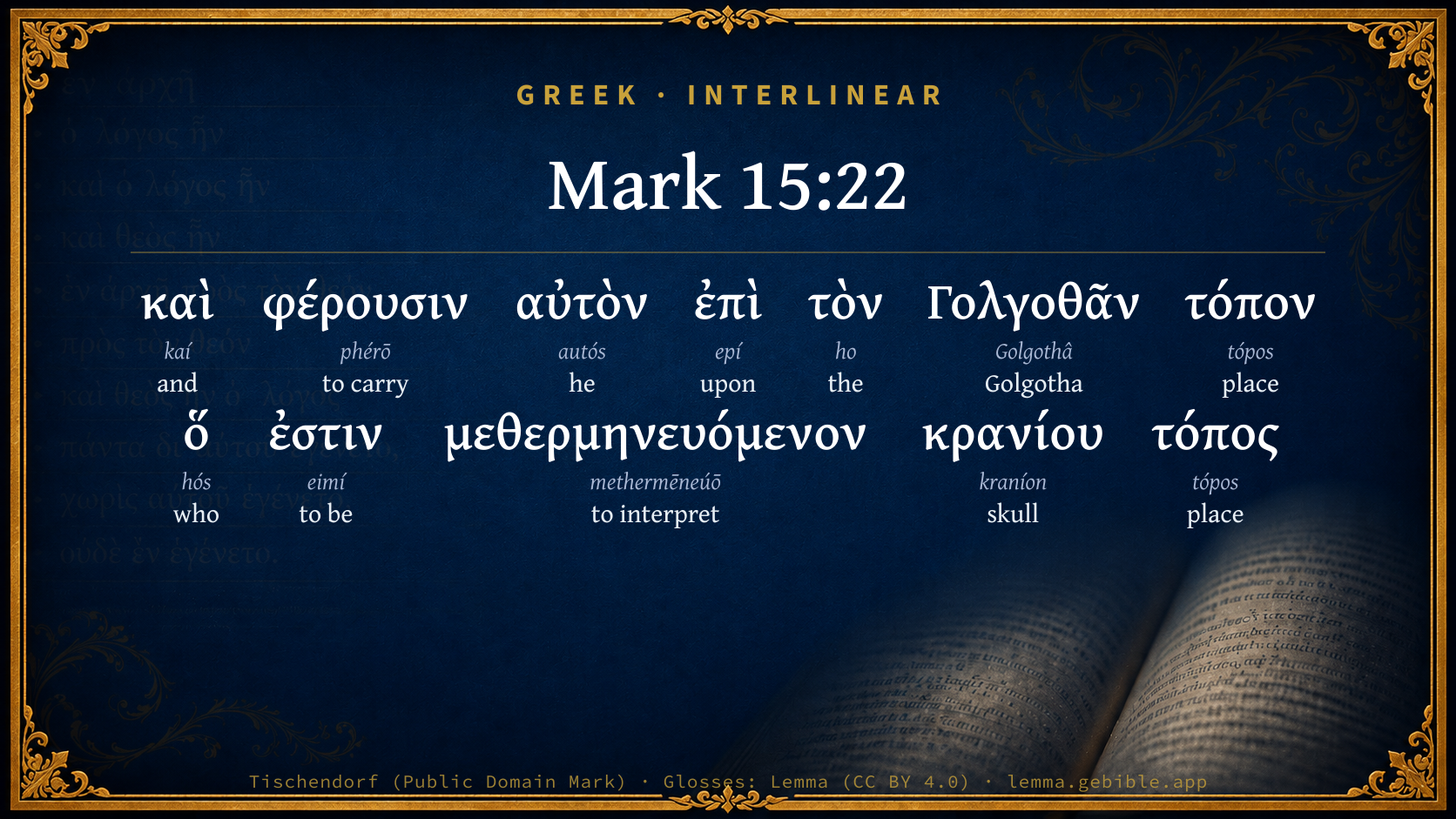
  1. καὶ kaí G2532 “and” Conjunction
  2. φέρουσιν phérō G5342 “to carry” Verb, Present, Active, Indicative, 3rd person, Plural
  3. αὐτὸν autós G846 “he” Personal pronoun, Accusative, Singular, Masculine
  4. ἐπὶ epí G1909 “upon” Preposition
  5. τὸν ho G3588 “the” Article, Accusative, Singular, Masculine
  6. τόπον tópos G5117 “place” Noun, Accusative, Singular, Masculine
  7. ὅ hós G3739 “who” Relative pronoun, Nominative, Singular, Neuter
  8. ἐστιν eimí G1510 “to be” Verb, Present, Active, Indicative, 3rd person, Singular
  9. μεθερμηνευόμενον methermēneúō G3177 “to interpret” Verb, Present, Passive, Participle, Nominative, Singular, Neuter
  10. κρανίου kraníon G2898 “skull” Noun, Genitive, Singular, Neuter
  11. τόπος tópos G5117 “place” Noun, Nominative, Singular, Masculine

About this verse

These counts appear in no published source. They are computed here, from the morphology-tagged text and Lemma’s own curated glosses. What Lemma adds →

12
words
11
distinct lemmas
Gospels
section

Notable vocabulary

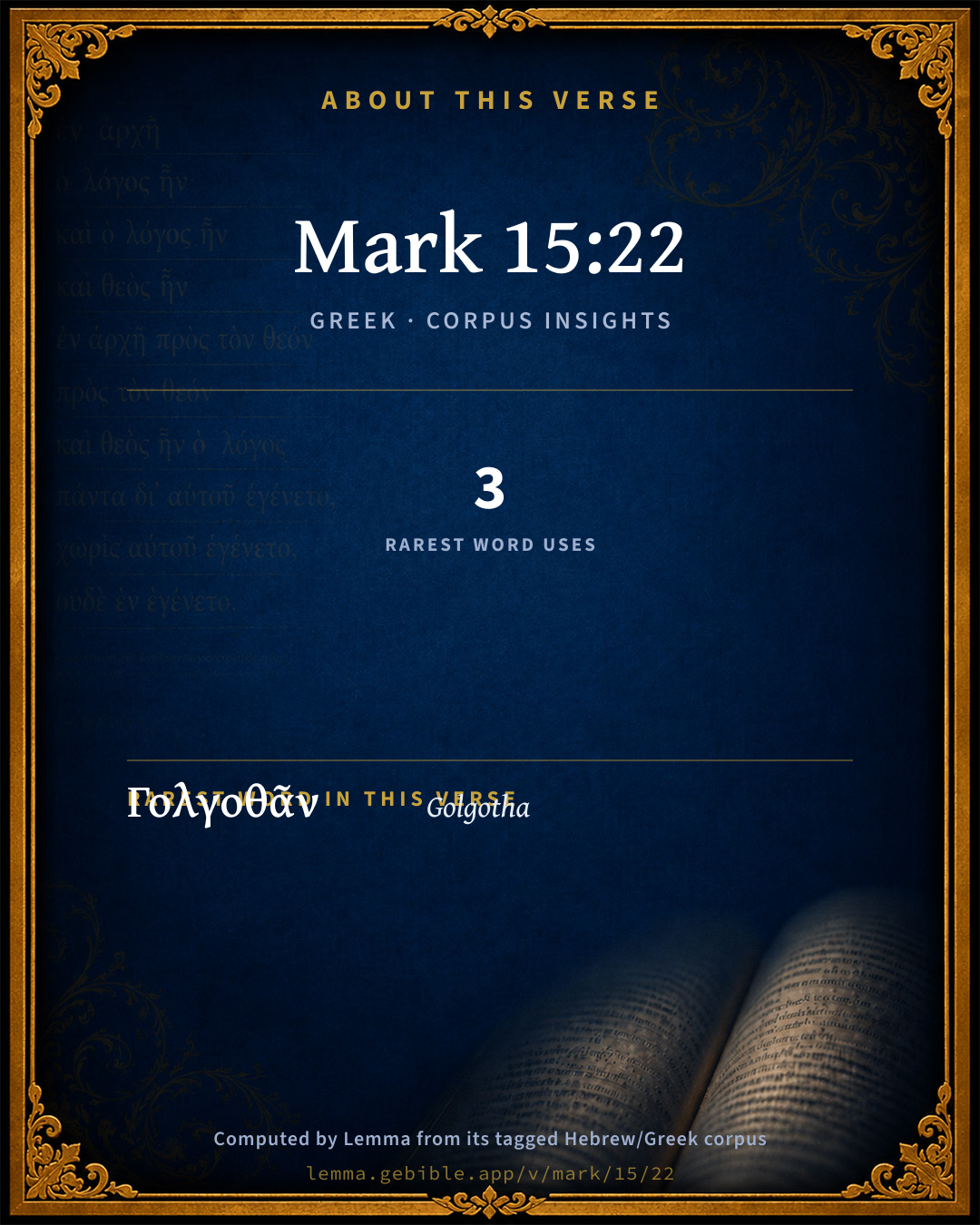
The rarest word here is Γολγοθᾶν Golgotha G1115 — appearing just 3 times in the whole Greek New Testament.

Shared distinctive vocabulary

Γολγοθᾶν Golgotha G1115 occurs in 3 verses of the Greek New Testament. Also found in:

Repetition

A word recurs within this verse:

  • τόπον place G5117 ×2

Cross-references

3

Topical passages linked to Mark 15:22 in the Treasury of Scripture Knowledge — connected by theme and wording, ordered by reader-vote popularity; previews shown in the World English Bible.

  • Matthew 27:33–44 They came to a place called "Golgotha," that is to say, "The place of a skull."
  • John 19:17–27 He went out, bearing his cross, to the place called "The Place of a Skull," which is called in Hebrew, "Golgotha,"
  • Luke 23:27–38 A great multitude of the people followed him, including women who also mourned and lamented him.

Cross-references courtesy of OpenBible.info (CC BY 4.0).

Commentary

Notes on Mark 15:22 from classic Christian and Jewish commentators (each source and its license shown beneath its notes). The classic Christian expositions comment on the surrounding passage and are grouped to its opening verse, so a note may address several verses; the Jewish commentaries on the Tanakh (Rashi and others) are per-verse, so they appear only where the commentator wrote on this verse.

Lemma curates 59 commentaries, every one of them public domain or Creative Commons licensed, each selected and text-cleaned for this edition rather than reprinted as found. About our sources →

The Biblical Illustrator

Joseph S. Exell

Mar_15:22

The place Golgotha.

Golgotha.

The place of execution

Calvary, or Golgotha, is not now distinguishable as a hill, partly because of the accumulation of rubbish from the ruin of the city, in the hollows and valleys, and partly because it is doubtful whether it ever was, properly, a hill. It stood below Zion, and was looked down on from Herods new palace, but it was slightly above the elevation of the lower town. Its name, Golgotha, more correctly, Golgoltha, comes from the same root as Gilgal, that signifies a hill, and the term golgoi was used for sacred stones, employed in the heathen rites of the Canaanites and Phoenicians, in their worship of Venus (Baaltis). As in Wales and Cornwall, and in Scotland, Pen means head and mountain, so this word golgol came to have a double meaning. Among the early Christians a legend existed, that Calvary took its name from Adams skull having been buried there, and it is possible that the Jewish rabbis had such a story; but the name Calvary, or Golgotha, properly means only the rounded stone, and by a corruption of the original signification was taken to signify the place of a skull. Just in the same way, the Capitoline hill, in Rome, was so called, because it was a rounded elevation, but afterwards a fable grew up that it took its designation from the head of a certain Tolus having been dug up there. The spot, Calvary, would seem to have been the place of execution from an ancient date. It is probably mentioned by Jeremiah (31:38, 39), in a prophecy concerning the rebuilding and enlargement of Jerusalem, in which he foretells that the wall would be built in an extended are from the hill of Gareb in the East, sweeping round, along the North, to the hill of Goath in the West-and Goath, here, answers to Calvary, and means the place of execution. His prophecy was fulfilled about seven years after the death of Christ, by Agrippa, when Golgotha was actually enclosed within the new walls; and at the present day it lies within the city. (S. Baring Gould, M. A.)

The Biblical Illustrator, edited by Joseph S. Exell (c. 1880s–1900s) — public domain. Text from a community e-Sword module.

Joseph Benson's Commentary

Mar 15:22-28. They bring him, unto the place Golgotha — See these verses elucidated in the notes on Mat 27:33-44. When they had crucified him, they parted his garments — Mark seems to intimate, that they first nailed him to the cross, then parted his garments, and afterward reared up the cross. The English word to crucify, denotes properly, to put to death by nailing to the cross; but the Greek word σταυροω, here used, means no more than to fasten to the cross with nails. In strict propriety, we should not say, a man cried out after he was crucified, but after he was nailed to the cross. And it was the third hour — Or nine o’clock in the morning, when they thus brought him to mount Calvary. John says, it was about the sixth hour, even when he was condemned to be crucified. “But then, it must be observed, that the Greek manuscripts produced by Camerarius, Beza, and R. Stephanus, read in John, ωσει τριτη, about the third hour; that Nonnus seems to have read so, his paraphrase running after this manner, the third hour was not yet past; that Theophylact contends it ought to be so read, and that because the three other evangelists unanimously say that the darkness began at the sixth hour, which yet began not, till after our Lord had hung upon the cross some considerable time; till after the soldiers had divided his garments, the Jews had mocked him, and bid him come down from the cross, and the discourse had passed between the two thieves among themselves, and between the repenting thief and our Lord. And lastly, the author of the Constantinopolitan Chronicle saith expressly, that the exacter copies, and the manuscript of St. John, kept till his time at Ephesus, read ωρα ωσει τριτη, about the third hour. See Jerome on Psalms 77. And the change from γ, the third, to ζ, the sixth, is so easy, that this may very reasonably be owned in the later copies of John’s gospel; especially if we consider how punctual Mark is in the enumeration of the hours, saying, it was the third hour, and they crucified him, or began to lead him away to be crucified; and, Mar 15:33, when the sixth hour was come, from that time there was darkness over the whole land till the ninth hour; and, Mar 15:34, at the ninth hour Jesus expired.” — Whitby. And the scripture was fulfilled — Namely, Isa 53:12, And he was numbered with the transgressors — The prophet thus speaking with amazing plainness of the sufferings of the Messiah.

Joseph Benson's Commentary on the Old and New Testaments (1811–1818) — public domain. Text from a community e-Sword module.

Bengel's Gnomon

Johann Albrecht Bengel

Mar 15:22. Φέρουσιν, they bring [bear or take]) not merely lead.—Γολγοθᾶ) The genitive.

Bengel's Gnomon of the New Testament — English translation (T&T Clark, Edinburgh, 1860) — public domain. Text from a community e-Sword module.

Meyer's Critical & Exegetical Commentary

Heinrich August Wilhelm Meyer

Mar_15:22-27. See on Mat_27:33-38. Comp. Luk_23:33 f., who here narrates summarily, but yet not without bringing in a deeply vivid and original trait (Mar_15:34), and has previously the episode of the daughters of Jerusalem.

τὸν Γολγοθᾶ τόπον] Γολγ. corresponds to the subsequent κρανίου, and is therefore to be regarded as a genitive. According to Mark, the place was called the place of Golgotha, which name (ὅ) interpreted is equivalent to place of a skull.

Mar_15:23. ἐδίδουν] they offered. This is implied in the imperfect. See Bernhardy, p. 373.

ἐσμυρνισμ.] See, on this custom of giving to criminals wine mingled with myrrh or similar bitter and strong ingredients for the purpose of blunting their sense of feeling, Wetstein in loc.; Dougtaeus, Anal. II. p. 42.

Mar_15:24. ἐπʼ αὐτά] according to Psa_22:19 : upon them (the clothes were lying there), as Act_1:26. Whether the casting of the lot was done by dice, or by the shaking of the lot-tokens in a vessel (helmet), so that the first that fell out decided for the person indicated by it (see Duncan, Lex., ed. Rost, p. 635), is a question that must be left open.

τίς τί ἄρῃ] i.e. who should receive anything, and what he was to receive. See, on this blending of two interrogative clauses, Bernhardy, p. 444; Ellendt, Lex. Soph. II. p. 824; Winer, p. 553 [E. T. 783].

Mar_15:25. This specification of time (comp. Mar_15:33), which is not, with Baur and Hilgenfeld, to be derived from the mere consideration of symmetry (of the third hour to that of Mar_15:33), is in keeping with Mat_27:45; Luk_23:44. As to the difference, however, from Joh_19:14, according to which, at about the sixth hour, Jesus still stood before Pilate, and as to the attempts at reconciliation made in respect thereof, see on John.

καὶ ἐστ. αὐτ.] ἐστ. is not to be translated as a pluperfect (Fritzsche), but: and it was the third hour, and they crucified Him, i.e. when they crucified Him;[175] as also in classical writers after the specification of the time the fact is often linked on by the simple καί. See Thuc. i. 50, iii. 108; Xen. Anab. ii. 1. 7, vii. 4. 12. Comp. on Luk_19:43. Stallbaum, ad Plat. Symp. p. 220 C.

[175] Euthymius Zigabenus here gives a warning illustration of forced harmonizing: ἦν δέ, φησιν, ὥφα τρίτη, ὅτε δηλονότι ἤρξατο πάσχειν ὑπὸ τῶν στρατιωτῶν τοῦ Πιλάτου. Εἶτα τὸ ἑξῆς ἀναγνωστέον καθʼ ἑαυτό· καὶ ἐσταύρωσαν αὐτὸν, ἐν ἕκτῃ δηλαδὴ ὥρᾳ. So also Luther in his gloss, and Fr. Schmid; comp. Calovius: hora tertia inde a traditione Pilato facta. With more shrewdness Grotius suggests: jam audita erat tuba horae tertiae, quod dici solebat donec caneret tuba horae sextae. In the main even at this day Roman Catholics (see Friedlieb and Bisping) similarly still make out of the third hour the second quarter of the day (9 to 12 oclock).

Meyer — Critical and Exegetical Commentary on the New Testament — English translation by Peter Christie, edited by Frederick Crombie (T&T Clark, 1880) — public domain. Text from a community e-Sword module.

Expositor's Greek Testament

ed. W. Robertson Nicoll

Mar 15:22 . φέρουσιν α ., they carry Him: “ferunt, non modo ducunt,” Bengel. It would appear that Jesus was so weak through the strain of the last few days, and the scourging, that He was unable to walk, not to speak of carrying His cross. He had to be borne as the sick were borne to Him (Mar 1:32 ).

The Expositor's Greek Testament, edited by W. Robertson Nicoll (1897–1910) — public domain. Text from a community e-Sword module.

Geneva Bible (1599)

Geneva Bible translators

Christ is led out of the walls of the earthly Jerusalem, into a foul place of dead men’s carcasses, as a man most unclean, not touching himself, but touching our sins, which were laid upon him, to the end that we being made clean by his blood, might be brought into the heavenly Sanctuary.

Geneva Bible (1599) marginal notes — public domain. Text via Bolls.life.

Matthew Henry's Commentary

We have here the crucifixion of our Lord Jesus.

I. The place where he was crucified; it was called Golgotha - the place of a scull: some think, because of the heads of malefactors that were there cut off: it was the common place of execution, as Tyburn, for he was in all respects numbered with the transgressors. I know not how to give any credit to it, but divers of the ancients mention it as a current tradition, that in this place our first father Adam was buried, and they think it highly congruous that there Christ should be crucified; for as in Adam all die, so in Christ shall all be made alive. Tertullian, Origen, Chrysostom, and Epiphanius (great names), take notice of it; nay, Cyprian adds, Creditur piis - Many good people believe that the blood of Christ crucified did trickle down upon the scull of Adam, who was buried in the same place. Something more credible is the tradition, that this mount Calvary was that mountain in the land of Moriah (and in the land of Moriah it certainly was, for so the country about Jerusalem was called), on which Isaac was to be offered; and the ram was offered instead of him; and then Abraham had an eye to this day of Christ, when he called the place Jehovah-jireh - The Lord will provide, expecting that so it would be seen in the mount of the Lord.

II. The time when he was crucified; it was the third hour, Mar 15:25. He was brought before Pilate about the sixth hour (Joh 19:14), according to the Roman way of reckoning, which John uses, with which ours at this day agrees, that is at six o'clock in the morning; and then, at the third hour, according to the Jews' way of reckoning, that is, about nine of the clock in the morning, or soon after, they nailed him to the cross. Dr. Lightfoot thinks the third hour is here mentioned, to intimate an aggravation of the wickedness of the priests, they were here prosecuting Christ to the death, though it was after the third hour, when they ought to have been attending the service of the temple, and offering the peace-offerings; it being the first day of the feast of unleavened bread, when there was to be a holy convocation. At that very time, when they should have been, according to the duty of their place, presiding in the public devotions, were they here venting their malice against the Lord Jesus; yet these were the men that seemed so zealous for the temple, and condemned Christ for speaking against it. Note, There are many who pretend to be for the church, who yet care not how seldom they go to church.

III. The indignities that were done him, when he was nailed to the cross; as if that had not been ignominious enough, they added several things to the ignominy of it.

1. It being the custom to give wine to persons that were to be put to death, they mingled his with myrrh, which was bitter, and made it nauseous; he tasted it, but would not drink it; was willing to admit the bitterness of it, but not the benefit of it.

2. The garments of those that were crucified, being, as with us, the executioners' fee, the soldiers cast lots upon his garments (Mar 15:24), threw dice (as our soldiers do upon a drum-head), for them: so making themselves merry with his misery, and sitting at their sport while he was hanging in pain.

3. They set up a superscription over his head, by which they intended to reproach him, but really did him both justice and honour, The king of the Jews, Mar 15:26. Here was no crime alleged, but his sovereignty owned. Perhaps Pilate meant to cast disgrace upon Christ as a baffled king, or upon the Jews, who by their importunity had forced him, against his conscience, to condemn Christ, as a people that deserved no better a king than he seemed to be: however, God intended it to be the proclaiming even of Christ upon the cross, the king of Israel; though Pilate know not what he wrote, any more than Caiaphas what he said, Joh 11:51. Christ crucified is king of his church, his spiritual Israel; and even then when he hung on the cross, he was like a king, conquering his and his people's enemies, and triumphing over them, Col 2:15. Now he was writing his laws in his own blood, and preparing his favours for his subjects. Whenever we look unto Christ crucified, we must remember the inscription over his head, that he is a king, and we must give up ourselves to be his subjects, as Israelites indeed.

4. They crucified two thieves with him, one on his right hand, the other on his left, and him in the midst as the worst of the three (Mar 15:27); so great a degree of dishonour did they hereby intend him. And, no doubt, it gave him disturbance too. Some that have been imprisoned in the common gaols, for the testimony of Jesus, have complained of the company of cursing, swearing prisoners, more than any other of the grievances of their prison. Now, in the midst of such our Lord Jesus was crucified; while he lived he had, and there was occasion, associated with sinners, to do them good; and now when he died, he was for the same purpose joined with them, for he came into the world, and went out of it, to save sinners, even the chief. But this evangelist takes particular notice of the fulfilling of the scriptures in it, Mar 15:28. In that famous prediction of Christ's sufferings (Isa 53:12), it was foretold that he should be numbered with the transgressors, because he was made sin for us.

5. The spectators, that is, the generality of them, instead of condoling with him in his misery, added to it by insulting over him. Surely never was such an instance of barbarous inhumanity toward the vilest malefactor: but thus the devil showed the utmost rage against him, and thus he submitted to the greatest dishonours that could be done him.

(1.) Even they that passed by, that were no way concerned, railed on him, Mar 15:29. If their hearts were so hardened, that their compassions were not moved with such a spectacle, yet they should have thought it enough to have their curiosity gratified; but that will not serve: as if they were not only divested of all humanity, but were devils in human shape, they taunted him, and expressed themselves with the utmost detestation of him, and indignation at him, and shot thick at him their arrows, even bitter words. The chief priests, no doubt, put these sarcasms into their mouths, Thou that destroyest the temple, and buildest it in three days, now, if thou canst, save thyself, and come down from the cross. They triumph as if now that they had got him to the cross, there were no danger of his destroying the temple; whereas the temple of which he spoke, he was now destroying, and did within three days build it up; and the temple of which they spoke, he did by men, that were his sword and his hand, destroy not many years after. When secure sinners think the danger is over, it is then most ready to seize them: the day of the Lord comes as a thief upon those that deny his coming, and say, Where is the promise of it? much more upon those that defy his coming, and say, Let him make speed, and hasten his work.

(2.) Even the chief priests, who, being taken from among men and ordained for men, should have compassion even on those that are out of the way, should be tender of those that are suffering and dying (Heb 5:1, Heb 5:2), yet they poured vinegar instead of oil into his wounds, they talked to the grief of him whom God had smitten (Psa 69:26), they mocked him, they said, He saved others, healed and helped them, but now it appears that it was not by his own power, for himself he cannot save. They challenged him to come down from the cross, if he could, Mar 15:32. Let them but see that, and they would believe; whereas they would not believe, when he gave them a more convincing sign than that, when he came up from the grave. These chief priests, one would think, might now have found themselves other work to do: if they would not go to do their duty in the temple, yet they might have been employed in an office not foreign to their profession; though they would not offer any counsel or comfort to the Lord Jesus, yet they might have given some help to the thieves in their dying moments (the monks and priests in Popish countries are very officious about criminals broken upon the wheel, a death much like that of the cross); but they do not think that their business.

(3.) Even they that were crucified with him, reviled him (Mar 15:32); one of them did, so wretchedly was his heart hardened even in the depth of misery, and at the door of eternity.

Matthew Henry's Commentary on the Whole Bible (1708–1710) — public domain (CC PDM 1.0). Text via the HelloAO Bible API.

The Cambridge Bible for Schools and Colleges

gen. ed. J. J. S. Perowne

22. the place Golgotha] St Mark gives the explanation of the Hebrew word “Golgotha.” St Luke omits it altogether. It was a bare hill or rising ground on the north or north-west of the city, having the form on its rounded summit of a skull, whence its name. It was (a) apparently a well-known spot; (b) outside the gate (comp. Heb_13:12); but (c) near the city (Joh_19:20); (d) on a thoroughfare leading into the country (Luk_23:26); and (e) contained a “garden” or “orchard” (Joh_19:41). From the Vulgate rendering of Luk_23:33, “Et postquam venerunt in locum, qui vocatur Calvariæ” (= a bare skull, “the place of Caluarie,” Wyclif), the word Calvary has been introduced into the English Version, obscuring the meaning of the Evangelist. There is nothing in the name to suggest the idea that the remains of malefactors who had been executed were strewn about, for the Jews always buried them.

The Cambridge Bible for Schools and Colleges (gen. ed. J. J. S. Perowne; Cambridge University Press, 1878–1918) — public domain. Text from a community e-Sword module.

John Gill's Exposition

And when they had crucified him,.... Had fastened him to the cross, and reared it up, and he was hanging upon it:

they parted his garments, casting lots upon them, what every man should take. This last clause, "what every man should take", is left out in the Arabic version. His garments they divided into four parts; and each soldier, as there were four of them, took a part; and upon his vesture, or seamless coat, because they would not rend it, they cast lots who should have it, and so fulfilled a prophecy in Psa 22:18; See Gill on Mat 27:35.

John Gill's Exposition of the Whole Bible (1746–1763) — public domain (CC PDM 1.0). Text via the HelloAO Bible API.

Trapp's Complete Commentary

John Trapp

22 And they bring him unto the place Golgotha, which is, being interpreted, The place of a skull.

Ver. 22. St Mark very diligently describeth what happened at Calvary; what Christ did and said on the cross, what was done and said to him there, how he gave up the ghost, &c., that we might have these things as ready, and at our fingers’ ends, as he had who wrote the whole history of our Saviour’s passion upon the nails of his hands.

John Trapp, A Commentary or Exposition upon All the Books of the Old and New Testament (1647–1656) — public domain. Text from a community e-Sword module.

The Pulpit Commentary

And they bring him (ferousin); literally, they bear him. At ver. 20 another word has been used exagousin "they lead him out." It seems as though, when they had reached the gate of the city, they saw symptoms that our Lord was fainting under his burden; and so they pressed Simon into the service, that he might be ready to assist. At first our Lord carried his own cross. Tradition says (Cornelius a Lapide) that the cross was fifteen feet long, the transverse limb being eight feet; and that he so carried it that the upper portion rested on his shoulder, while the foot of the cross trailed on the ground. When they saw that he was breaking down under the weight of the cross, they laid it on Simon, that they might the more quickly reach the place of crucifixion. The place Golgotha, which is, being interpreted, The place of a skull. "Golgotha" is a Hebrew, or rather Chaldaic, word, applied to the skull on account of its roundness, that being the idea which lies in the root of the word. The Greek equivalent to the word is Kranion ; and this is rendered in the Vulgate, Calvaria, a skull, from calva, bald. St. Luke is the only evangelist in whose Gospel (Luk_23:33) this word is rendered "Calvary." In the Revised Version it is rendered "the skull" The place was so called, either from its having been the spot where executions ordinarily took place (though in this case we might have expected to find it called topov kraniwn rather than kranion); or, more probably, it was derived from the configuration of the place itself, perhaps a round-like mound, or knoll, sufficiently elevated to be seen at a little distance and by a large number. As to the actual site of Golgotha, recent researches seem to have done much to confirm the ancient tradition. The Bordeaux pilgrim, A.D. 333, says, "On the left side of the original Church of the Holy Sepulchre is the hillock (monticulus) Golgotha, where the Lord was crucified. Hence, about a stone"s throw distant, is the crypt where his body was deposited." St. Cyril of Jerusalem alludes to the spot frequently, and there was no doubt about it in the time of Eusebius, A.D. 315. Professor Willis says that the rock of Calvary still stands up, some fifteen feet above the pavement. "It appears likely," he says, "that in its original state this rock was part of a little swell of the ground that jutted out from the slope of Sepulchre Street, and probably always formed a somewhat abrupt view on the west and south sides" (see "Speaker"s Commentary" on St. Matthew). Captain Conder (Palestine Exploration Fund, Quarterly Statement July, 1882) thinks that he shall be able to show that the traditional Golgotha is the site of the original temple of Ashtoreth, and that this temple was the Jebusite sanctuary before David took Jerusalem, and round which the sepulchres of the kings were hewn after the worship of Jehovah had consecrated the temple hill.

The Pulpit Commentary (1880–1919), ed. H.D.M. Spence-Jones & Joseph S. Exell — public domain. Text from a community e-Sword module.

John Wesley's Explanatory Notes

Matt. xxvii, 33; Luke xxiii, 33; John xix, 17.

John Wesley, Explanatory Notes Upon the Whole Bible (1754–1765) — public domain. Text via the GEBible commentary corpus.

MacLaren's Expositions of Holy Scripture

Alexander MacLaren

Mark

THE DEATH WHICH GIVES LIFE

Mar 15:21 - Mar 15:39.

The narrative of the crucifixion is, in Mark’s hands, almost entirely a record of what was done to Jesus, and scarcely touches what was done by Him. We are shown the executioners, the jeering rabble, the triumphant priests, the fellow-sufferers reviling; but the only glimpses we get of Him are His refusal of the stupefying draught, His loud cries, and His giving up the ghost. The narrative is perfectly calm, as well as reverently reticent. It would have been well if our religious literature had copied the example, and treated the solemn scene in the same fashion. Mark’s inartificial style of linking long paragraphs with the simple ‘and’ is peculiarly observable here, where every verse but vv. Mar 15:30 and Mar 15:32, which are both quotations, begins with it. The whole section is one long sentence, each member of which adds a fresh touch to the tragic picture. The monotonous repetition of ‘and,’ ‘and,’ ‘and,’ gives the effect of an endless succession of the wares of sorrow, pain, and contumely which broke over that sacred head. We shall do best simply to note each billow as it breaks.

The first point is the impressing of Simon to bear the Cross. That was not dictated by compassion so much as by impatience. Apparently the weight was too heavy for Jesus, and the pace could be quickened by making the first man who could be laid hold of help to carry the load. Mark adds that Simon was the ‘father of Alexander and Rufus,’ whom he supposes to need no introduction to his readers. There is a Rufus mentioned in Rom 16:13 as being, with his mother, members of the Roman Church. Mark’s Gospel has many traces of being primarily intended for Romans. Possibly these two Rufuses are the same; and the conjecture may be allowable that the father’s fortuitous association with the crucifixion led to the conversion of himself and his family, and that his sons were of more importance or fame in the Church than he was. Perhaps, too, he is the ‘Simeon called Niger’ {bronzed by the hot African sun} who was a prophet of Antioch, and stands by the side of a Cyrenian {Act 13:1}. It is singular that he should be the only one of all the actors in the crucifixion who is named; and the fact suggests his subsequent connection with the Church. If so, the seeking love of God found him by a strange way. On what apparently trivial accidents a life may be pivoted, and how much may depend on turning to right or left in a walk! In this bewildering network of interlaced events, which each ramifies in so many directions, the only safety is to keep fast hold of God’s hand and to take good care of the purity of our motives, and let results alone.

The next verse brings us to Golgotha, which is translated by the three Evangelists, who give it as meaning ‘the place of a skull.’ The name may have been given to the place of execution with grim suggestiveness; or, more probably, Conder’s suggested identification is plausible, which points to a little, rounded, skull-shaped knoll, close outside the northern wall, as the site of the crucifixion. In that case, the name would originally describe the form of the height, and be retained as specially significant in view of its use as the place of execution. That was the ‘place’ to which Israel led its King! The place of death becomes a place of life, and from the mournful soil where the bones of evildoers lay bleaching in the sun springs the fountain of water of life.

Arrived at that doleful place, a small touch of kindness breaks the monotony of cruelty, if it be not merely apart of the ordinary routine of executions. The stupefying potion would diminish, but would therefore protract, the pain, and was possibly given for the latter rather than the former effect. But Jesus ‘received it not.’ He will not, by any act of His, lessen the bitterness. He will drink to the dregs the cup which His Father hath given Him, and therefore He will not drink of the numbing draught. It is a small matter comparatively, but it is all of a piece with the greater things. The spirit of His whole course of voluntary, cheerful endurance of all the sorrows needful to redeem the world, is expressed in His silent turning away from the draught which might have alleviated physical suffering, but at the cost of dulling conscious surrender.

The act of crucifixion is but named in a subsidiary clause, as if the writer turned away, with eyes veiled in reverence, from the sight of man’s utmost sin and Christ’s utmost mystery of suffering love. He can describe the attendant circumstances, but his pen refuses to dwell upon the central fact. The highest art and the simplest natural feeling both know that the fewest words are the most eloquent. He will not expressly mention the indignity done to the sacred Body in which ‘dwelt all the fulness of the Godhead,’ but leaves it to be inferred from the parting of Christ’s raiment, the executioner’s perquisite. He had nothing else belonging to Him, and of even that poor property He is spoiled. According to John’s more detailed account, the soldiers made an equal parting of His garments except the seamless robe, for which they threw lots. So the ‘parting’ applies to one portion, and the ‘casting lots’ to another. The incident teaches two things: on the one hand, the stolid indifference of the soldiers, who had crucified many a Jew, and went about their awful work as a mere piece of routine duty; and, on the other hand, the depth of the abasement and shame to which Jesus bowed for our sakes. ‘Naked shall I return thither’ was true in the most literal sense of Him whose earthly life began with His laying aside His garments of divine glory, and ended with rude legionaries parting ‘His raiment’ among them.

Mark alone tells the hour at which Jesus was nailed to the Cross {Mar 15:25}. Matthew and Luke specify the sixth and ninth hours as the times of the darkness and of the death; but to Mark we owe our knowledge of the fact that for six slow hours Jesus hung there, tasting death drop by drop. At any moment of all these sorrow-laden moments He could have come down from the Cross, if He would. At each, a fresh exercise of His loving will to redeem kept Him there.

The writing on the Cross is given here in the most condensed fashion {Mar 15:26}. The one important point is that His ‘accusation’ was-’King of the Jews.’ It was the official statement of the reason for His crucifixion, put there by Pilate as a double-barrelled sarcasm, hitting both Jesus and the nation. The rulers winced under the taunt, and tried to get it softened; but Pilate sought to make up for his unrighteous facility in yielding Jesus to death, by obstinacy and jeers. So the inscription hung there, a truth deeper than its author or its angry readers knew, and a prophecy which has not received all its fulfilment yet.

The narrative comes back, in Mar 15:27, to the sad catalogue of the insults heaped on Jesus. Mar 15:28 is probably spurious here, as the Revised Version takes it to be; but it truly expresses the intention of the crucifixion of the thieves as being to put Him in the same class as they, and to suggest that He was a ringleader, pre-eminent in evil. Possibly the two robbers may have been part of Barabbas’ band, who had been brigands disguised as patriots; and, if so, the insult was all the greater. But, in any case, the meaning of it was to bring Him down, in the eyes of beholders, to the level of vulgar criminals. If a Cranmer or a Latimer had been bound to the stake with a housebreaker or a cut-throat, that would have been a feeble image of the malicious contumely thus flung at Jesus; but His love had identified Him with the worst sinners in a far deeper and more real way, and not a crime had stained these men’s hands, but its weight pressed on Him. He numbered Himself with transgressors, that they may be numbered with His saints.

Then follows {Mar 15:29 - Mar 15:32} the threefold mockery by people, priests, and fellow-sufferers. That is spread over three hours, and is all which Mark has to tell of them. Other Evangelists give us words spoken by Jesus; but this narrative has only one of the seven words from the Cross, and gives us the picture rather of the silent Sufferer, bearing in meek resolution all that men can lay on Him. Both pictures are true, for the words are too few to make notable breaches in the silence. The mockery harps on the old themes, and witnesses at once the malicious cruelty of the mockers and the innocence of the Victim, at whom even such malice could find nothing to fling except these stale taunts. The chance passengers, of whom there would be a stream to and from the adjacent city gate, ‘wag their heads’ in gratified and fierce hate. The calumny of the discredited witnesses, although even the biased judges had not dared to treat it as true, has lodged in the popular mind, and been accepted as proved. Lies are not killed when they are shown to be lies. They travel faster than truth. Ears were greedily open for the false witnesses’ evidence which had been closed to Christ’s gracious teaching. The charge that He was a would-be destroyer of the Temple obliterated all remembrance of miracles and benefits, and fanned the fire of hatred in men whose zeal for the Temple was a substitute for religion. Are there any of them left nowadays-people who have no real heart-hold of Christianity, but are fiercely antagonistic to supposed destroyers of its externals, and not over-particular to the evidence against them? These mockers thought that Christ’s being fastened to the Cross was a reductio ad absurdum of His claim to build the Temple. How little they knew that it led straight to that rebuilding, or that they, and not He, were indeed the destroyers of the holy house which they thought that they were honouring, and were really making ‘desolate’! The priests do not take up the people’s mockery, for they know that it is based upon a falsehood; but they scoff at His miracles, which they assume to be disproved by His crucifixion. Their venomous gibe is profoundly true, and goes to the very heart of the gospel. Precisely because ‘He saved others,’ therefore ‘Himself He cannot save’-not, as they thought, for want of power, but because His will was fixed to obey the Father and to redeem His brethren, and therefore He must die and cannot deliver Himself. But the necessity and inability both depend on His will. The priests, however, take up the other part of the people’s scoff. They unite the two grounds of condemnation in the names ‘the Christ, the King of Israel,’ and think that both are disproved by His hanging there. But the Cross is the throne of the King. A sacrificial death is the true work of the Messiah of law, prophecy, and psalm; and because He did not come down from the Cross, therefore is He ‘crowned with glory and honour’ in heaven, and rules over grateful and redeemed hearts on earth.

The midday darkness lasted three hours, during which no word or incident is recorded. It was nature divinely draped in mourning over the sin of sins, the most tragic of deaths. It was a symbol of the eclipse of the Light of the world; but ere He died it passed, and the sun shone on His expiring head, in token that His death scattered our darkness and poured day on our sad night. The solemn silence was broken at last by that loud cry, the utterance of strangely blended consciousness of possession of God and of abandonment by Him, the depths of which we can never fathom. But this we know: that our sins, not His, wove the veil which separated Him from His God. Such separation is the real death. Where cold analysis is out of place, reverent gratitude may draw near. Let us adore, for what we can understand speaks of a love which has taken on itself the iniquity of us all. Let us silently adore, for all words are weaker than that mystery of love.

The first hearers of that cry misunderstood it, or cruelly pretended to do so, in order to find fresh food for mockery. ‘Eloi’ sounded like enough to ‘Elijah’ to suggest to some of the flinty hearts around a travesty of the piteous appeal. They must have been Jews, for the soldiers knew nothing about the prophet; and if they were Scribes, they could scarcely fail to recognise the reference to the Twenty-second Psalm, and to understand the cry. But the opportunity for one more cruelty was too tempting to be resisted, and savage laughter was man’s response to the most pitiful prayer ever uttered. One man in all that crowd had a small touch of human pity, and, dipping a sponge in the sour drink provided for the soldiers, reached it up to the parched lips. That was no stupefying draught, and was accepted. Matthew’s account is more detailed, and represents the words spoken as intended to hinder even that solitary bit of kindness.

The end was near. The lips, moistened by the ‘vinegar,’ opened once more in that loud cry which both showed undiminished vitality and conscious victory; and then He ‘gave up the ghost,’ sending away His spirit, and dying, not because the prolonged agony had exhausted His energy, but because He chose to die, He entered through the gate of death as a conqueror, and burst its bars when He went in, and not only when He came out.

His death rent the Temple veil. The innermost chamber of the Divine Presence is open now, and sinful men have ‘access with confidence by the faith of Him,’ to every place whither He has gone before. Right into the secret of God’s pavilion we can go, now and here, knowledge and faith and love treading the path which Jesus has opened, and coming to the Father by Him. Bight into the blaze of the glory we shall go hereafter; for He has gone to prepare a place for us, and when He overcame the sharpness of death He opened the gate of heaven to all believers.

Jews looked on, unconcerned and unconvinced by the pathos and triumph of such a death. But the rough soldier who commanded the executioners had no prejudices or hatred to blind his eyes and ossify his heart. The sight made its natural impression on him; and his exclamation, though not to be taken as a Christian confession or as using the phrase ‘Son of God’ in its deepest meaning, is yet the beginning of light. Perhaps, as he went thoughtfully to his barrack that afternoon, the process began which led him at last to repeat his first exclamation with deepened meaning and true faith. May we all gaze on that Cross, with fuller knowledge, with firm trust, and endless love!

Alexander MacLaren, Expositions of Holy Scripture (1904–1910) — public domain. Text from a community e-Sword module.

unfoldingWord translationNotes

Door43 World Missions Community

Connecting Statement:

The soldiers bring Jesus to Golgotha, where they crucify him with two others. Many people mock him.

Place of a Skull

"Skull Place" or "Place of the Skull." This the name of a place. It does not mean that there are lots of skulls there. (See: How to Translate Names)

Skull

A skull is the head bones, or a head without any flesh on it.

wine mixed with myrrh

It may be helpful to explain that myrrh is a pain-relieving medicine. AT: "wine mixed with a medicine called myrrh" or "wine mixed with a pain-relieving medicine called myrrh" (See: Assumed Knowledge and Implicit Information)

translationWords

Golgotha

myrrh

crucify

lots

unfoldingWord translationNotes — © Distant Shores Media and the Door43 World Missions Community, licensed CC BY-SA 4.0. Source: git.door43.org/Door43/en_tn.

Cambridge Greek Testament for Schools and Colleges

22. φέρουσιν αὐτόν. This may mean that He was so exhausted that the soldiers had to carry Him for the remainder of the way (Mar 1:32, Mar 2:3); but it probably means “bring, conduct” (Mar 7:32, Mar 8:22, Mar 9:17; Mar 9:19, Mar 11:2; Mar 11:7). Latin versions have perducunt, adducunt, duxerunt; k has ferunt illam, “bring the cross.”

Κρανίου τόπος. Mk, Mt., and Jn give this as the meaning of Golgotha, while Lk. has simply Κρανίον, which favours the view that it was so called from the shape of the rock. That Jews allowed the skulls of criminals to lie there unburied is incredible, though Jerome seems to accept it: in that case it would have been called the “place of skulls.” The legend that Adam’s skull lay there, thus bringing the fatal death of the first Adam into connexion with the lifegiving death of the second Adam, appears to be believed by Ambrose. But Chrysostom gives it as a mere report, and Jerome rejects it as an attractive interpretation of the name and mulcens aurem populi, nec tamen vera. The Ethiopic Melchisedek legend makes Golgotha itself to be Adam’s skull. Golgotha is not a pure transliteration, but is a Greek modification, for the sake of euphony, of Goulgoltha, Gougaltha, and Gogoltha. The familiar “Calvary” comes from Vulg. Calvariae locus, Lk. Calvariae. We have not sufficient evidence to decide either the site or the origin of the name. The literature is large. Sanday, Sacred Sites, pp. 54, 68–77; D.C.G. art. “Golgotha.” Nor is the route through the city to it known. What is called the Via Dolorosa is a mediaeval conjecture.

Cambridge Greek Testament for Schools and Colleges (Cambridge University Press, 1896; 21 vols, various authors incl. Carr, Maclear, Plummer, Farrar, Lumby, Moule, M. R. James, Simcox) — public domain. Text from a community e-Sword module.

Alford’s Greek Testament

Henry Alford

22.] Γολγοθᾶν must be regarded as accusative from Γολγοθᾶς, the name being Græcised. The construction is varied in the interpretation.

Henry Alford, The Greek Testament (1849–1861) — public domain. Text from a community e-Sword module.

International Critical Commentary

22. τὸν Γολγοθᾶν τόπον—the place Golgotha. The Hebrew word means, a skull, not the place of a skull. The name probably comes from the shape of the place.

τὸν Γολγοθᾶν τόπον, instead of Γολγοθᾶ τόπον, Tisch. WH. (τὸν) Γολγοθὰ, Treg. τὸν, א BC2 FLN Δ, 13, 33, 69, 124, 127, 131, 346. Γολγοθὰν, א BFGKLMNSUV ΓΔ.

International Critical Commentary — older volumes (1896–1929), various authors — public domain. Text from a community e-Sword module.

Vincent's Word Studies in the New Testament

Marvin R. Vincent

Golgotha. See on Mt 27:33.

Marvin R. Vincent, Word Studies in the New Testament (1887–1900) — public domain. Text from a community e-Sword/MySword module.

Lesson kit

Teaching starters — assembled from the data on this page, not authored interpretation. Every prompt links to the verse data it draws on. Edit before teaching.

Mark, in the Gospels, opens this verse with 12 words (11 distinct Greek lemmas). Its most distinctive word is Golgothâ (“Golgotha”). A historical commentator’s framing appears above. Read the whole chapter for the surrounding context.

Discussion questions

  1. The word Golgothâ carries the sense “Golgotha.” How does it shape the verse?
  2. How does Matthew 27:33, which shares the word «Golgotha», read alongside this verse?
  3. What does the repetition of “place” (2× in this one verse) do in this verse?
  4. The translations on this page render this verse differently — a whole-verse word diff, not a word-by-word alignment. What might account for the different wordings?
  5. Compare how The Biblical Illustrator and Joseph Benson's Commentary read this verse. Where do they agree or differ?

Things to notice

  • These translations choose different wording for 6 words in this verse.
  • “place” occurs 2× in this single verse.
  • 11 distinct Greek lemmas span 12 words in this verse.

Reading settings

Reading text

Shown beneath each verse's original-language words.

Old Testament
Old Testament edition

Read the OT as the Masoretic Hebrew (MT) or the Greek Septuagint (LXX).

English shown for the Greek Septuagint (in the Hebrew ↔ Greek comparison).

Comparing translations? Open the Compare panel on any verse page to stack up to four side by side.