Luke 1:10

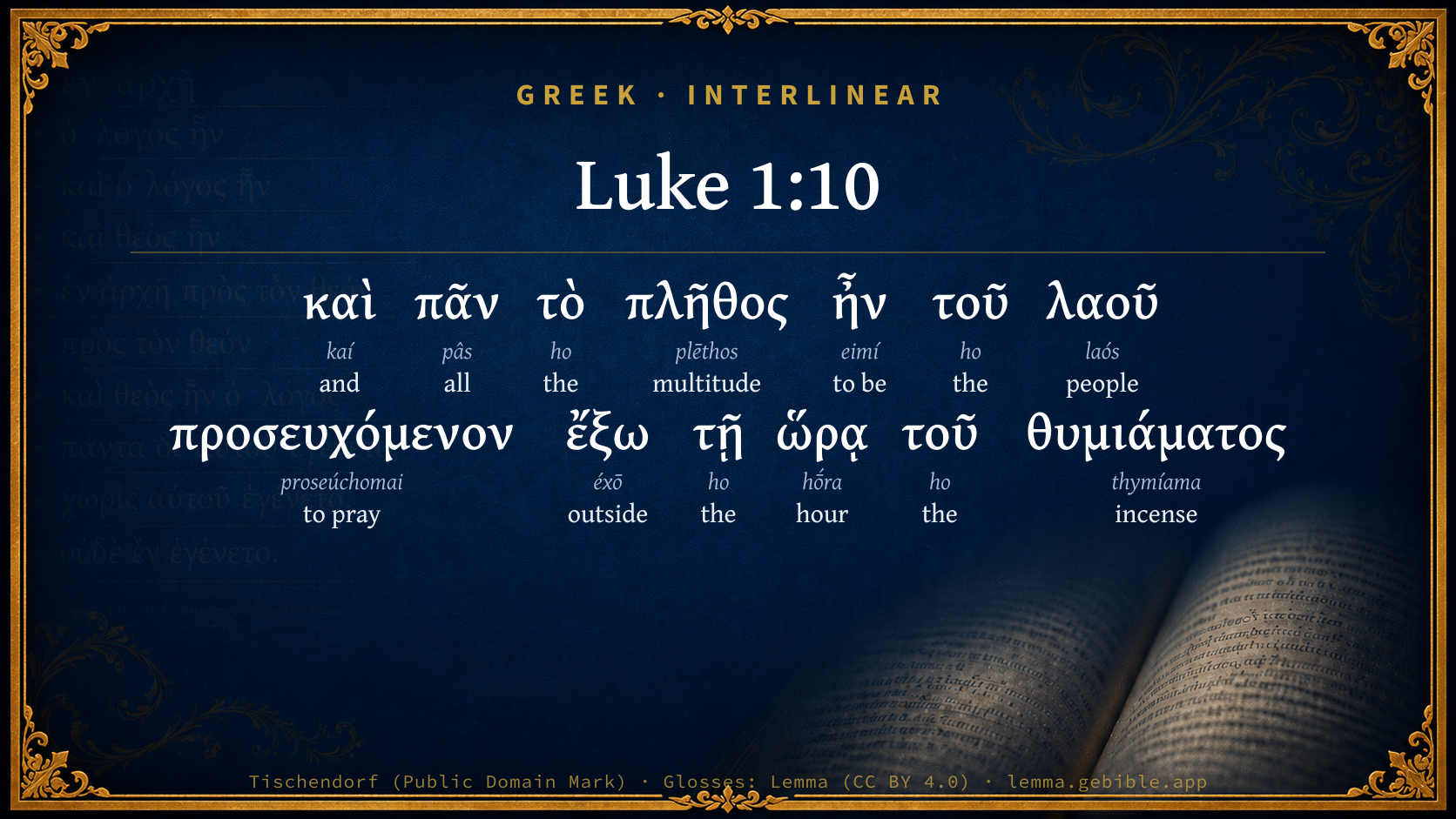
Greek (Tischendorf 8th ed.) Luke 1:10 appears in the Greek New Testament. The text above is from the Tischendorf 8th edition. Each word links to its Strong’s number and a concise gloss. Click any word for its full Thayer’s Greek Lexicon entry.
Download image
Cite this verse

Luke 1:10 (World English Bible). Public Domain. Lemma interlinear Bible study tool, https://lemma.gebible.app/v/luke/1/10.

Show BibTeX & RIS
BibTeX
RIS
English Translation
The whole multitude of the people were praying outside at the hour of incense.
World English Bible · Public Domain
Highlights
  • 1 first appearance in the Greek New Testament
Full analysis ↓
Download a study sheet

One document with this verse’s original text, its word-by-word gloss line, the meaning frame, cross-references with their text, attributed commentary, and full source and license credits — printable, and it pastes into notes with its structure intact.

This verse Autodidact and up

Study sheet (.html) Plain text (.txt)

A passage Seminary Student

Up to 50 verses in one chapter. A passage sheet keeps up to 6 commentary sources and 12 cross-references per verse, in the order this page ranks them, and says so on the sheet whenever that leaves anything out. Ask for a single verse and you get the Autodidact verse sheet above.

Everything on this page stays free to read, with no account — the sheet is a download of what is already on screen, not access to it.

Want to remove ads? Support Godless Engineer
Compare translations 3

The same verse in 3 English versions, stacked beneath the original-language interlinear above. Click any original word for its lexicon entry.

Each is an independent rendering of the whole verse — the interlinear is not word-aligned to these translations.

Highlighted words mark where these versions differ — a whole-verse word diff, not a word-by-word alignment.

  • World English Bible Public Domain
    The whole multitude of the people were praying outside at the hour of incense.
  • King James Version Public Domain
    And the whole multitude of the people were praying without at the time of incense.
  • unfoldingWord Literal Text CC BY-SA 4.0
    And the whole crowd of the people was praying outside at the hour of the incense offering.

unfoldingWord Literal Text — © unfoldingWord, licensed CC BY-SA 4.0. Word-aligned USFM3 via Door43 (git.door43.org/unfoldingWord/en_ult).

Versions to compare (up to 4)

3 of 4 selected

Show all 19 translations

Every available English version of this verse, each an independent rendering of the whole verse.

  • World English Bible Public Domain
    The whole multitude of the people were praying outside at the hour of incense.
  • Berean Standard Bible Public Domain
    And at the hour of the incense offering, the whole congregation was praying outside.
  • Majority Standard Bible Public Domain
    And at the hour of the incense offering, the whole congregation was praying outside.
  • King James Version Public Domain
    And the whole multitude of the people were praying without at the time of incense.
  • American Standard Version (1901) Public Domain
    And the whole multitude of the people were praying without at the hour of incense.
  • Revised Version (1885) Public Domain
    And the whole multitude of the people were praying without at the hour of incense.
  • Geneva Bible (1599) Public Domain
    And the whole multitude of the people were without in prayer, while the incense was burning.
  • Douay-Rheims (1899) Public Domain
    And all the multitude of the people was praying without, at the hour of incense.
  • Young's Literal Translation Public Domain
    and all the multitude of the people were praying without, at the hour of the perfume.
  • Literal Standard Version CC BY-SA 4.0
    and all the multitude of the people were praying outside, at the hour of the incense.
  • Unlocked Literal Bible CC BY-SA 4.0
    The whole crowd of people was praying outside at the hour when the incense was burned.
  • unfoldingWord Literal Text CC BY-SA 4.0
    And the whole crowd of the people was praying outside at the hour of the incense offering.
  • Darby Bible Public Domain
    And all the multitude of the people were praying without at the hour of incense.
  • World Messianic Bible Public Domain
    The whole multitude of the people were praying outside at the hour of incense.
  • Webster's Bible Public Domain
    And the whole multitude of the people were praying without, at the time of incense.
  • Free Bible Version CC BY-SA 4.0
    During the time of offering incense a large crowd of people were praying outside.
  • Bible in Basic English Public Domain
    And all the people were offering prayers outside, at the time of the burning of perfumes.
  • Text-Critical English NT CC BY 4.0
    At the hour of incense a great crowd was assembled outside, praying.
  • Tyndale New Testament (1534) Public Domain
    and the whoale multitude of the people were with out in prayer whill the incense was aburnynge.

Literal Standard Version (2020), Covenant Press — licensed CC BY-SA 4.0. Text via the HelloAO Bible API (eBible.org). Unlocked Literal Bible (unfoldingWord) — licensed CC BY-SA 4.0. Text via the HelloAO Bible API (eBible.org). unfoldingWord Literal Text — © unfoldingWord, licensed CC BY-SA 4.0. Word-aligned USFM3 via Door43 (git.door43.org/unfoldingWord/en_ult). Free Bible Version, Dr. Jonathan Gallagher — licensed CC BY-SA 4.0. Text via the HelloAO Bible API (eBible.org).

Word by word

More ways to search: Search by grammar → Find every occurrence → Compare this word →

Practice this passage: Drill this verse → Learn its vocabulary →

About this verse

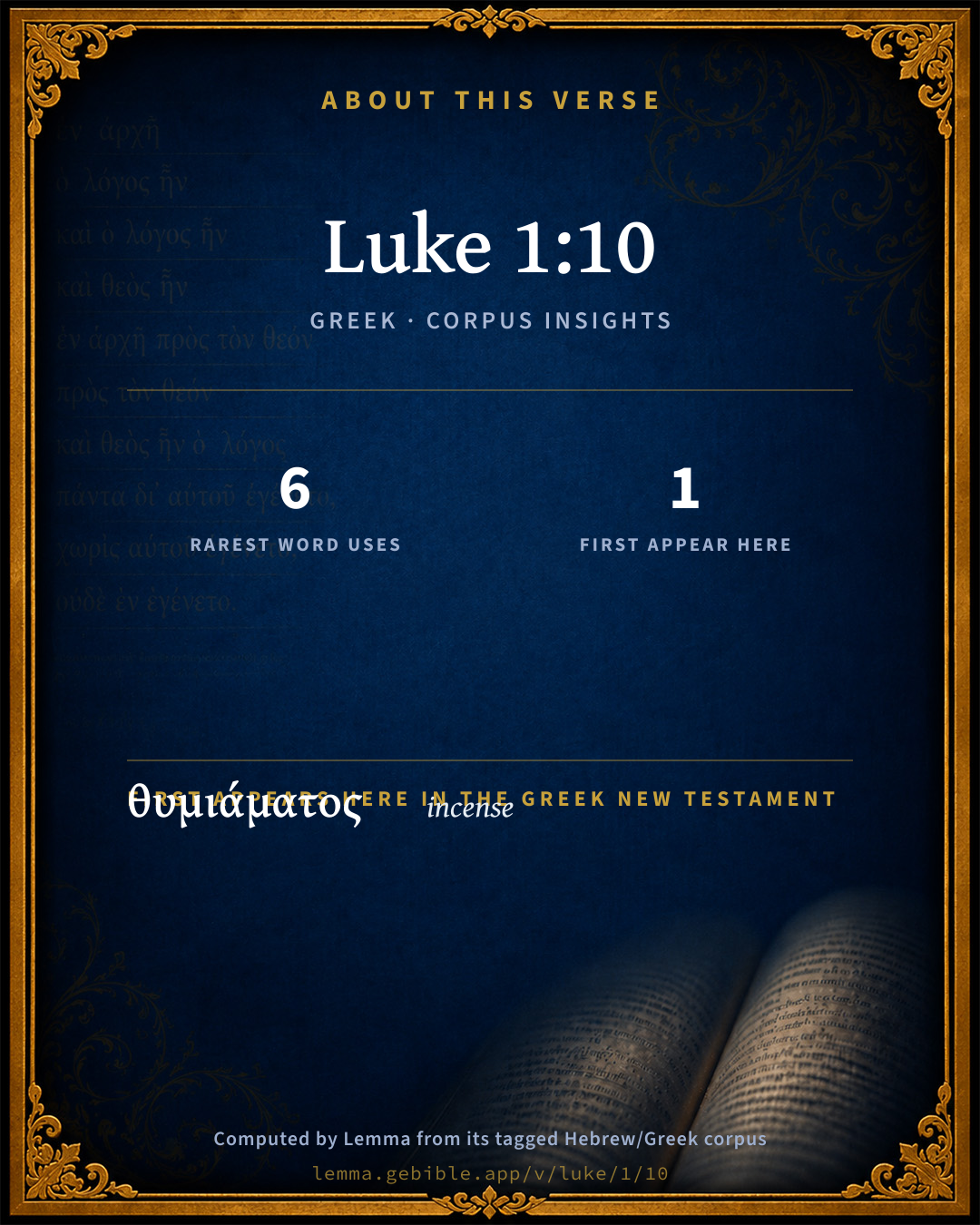
These counts appear in no published source. They are computed here, from the morphology-tagged text and Lemma’s own curated glosses. What Lemma adds →

13
words
10
distinct lemmas
Gospels
section

Notable vocabulary

The rarest word here is θυμιάματος incense G2368 — appearing just 6 times in the whole Greek New Testament.

First appearance in Scripture

This word makes its first canonical appearance in the Greek New Testament here:

  • θυμιάματος incense G2368

Shared distinctive vocabulary

θυμιάματος incense G2368 occurs in 6 verses of the Greek New Testament. Also found in:

Repetition

A word recurs within this verse:

Cross-references

4

Topical passages linked to Luke 1:10 in the Treasury of Scripture Knowledge — connected by theme and wording, ordered by reader-vote popularity; previews shown in the World English Bible.

  • Leviticus 16:17 There shall be no one in the Tent of Meeting when he enters to make atonement in the Holy Place, until he comes out, and has made atonement for himself and for his household, and for all the assembly of Israel.
  • Revelation 8:3 Another angel came and stood over the altar, having a golden censer. Much incense was given to him, that he should add it to the prayers of all the saints on the golden altar which was before the throne.
  • Hebrews 4:14 Having then a great high priest, who has passed through the heavens, Jesus, the Son of God, let us hold tightly to our confession.
  • Hebrews 9:24 For Christ hasn't entered into holy places made with hands, which are representations of the true, but into heaven itself, now to appear in the presence of God for us;

Cross-references courtesy of OpenBible.info (CC BY 4.0).

Commentary

Notes on Luke 1:10 from classic Christian and Jewish commentators (each source and its license shown beneath its notes). The classic Christian expositions comment on the surrounding passage and are grouped to its opening verse, so a note may address several verses; the Jewish commentaries on the Tanakh (Rashi and others) are per-verse, so they appear only where the commentator wrote on this verse.

Lemma curates 59 commentaries, every one of them public domain or Creative Commons licensed, each selected and text-cleaned for this edition rather than reprinted as found. About our sources →

Joseph Benson's Commentary

Luk 1:10. The whole multitude of the people, &c. — The manner in which the evangelist expresses himself here, shows that a more than ordinary concourse of the people was in the temple on this occasion, from which we may infer that it was a sabbath, or some high festival time; for often on ordinary week-days, few of the people were present at the morning and evening sacrifices, and therefore “four and twenty men were employed to attend this service, as representatives of the people of Israel, to lay their hands on the head of the sacrifice, to pray, and to receive the blessing. These were called, from their office, stationary men.” — Macknight. This circumstance of there being a multitude present, would give great publicity to the facts here recorded, and cause them to become the subject of much inquiry and conversation, both in Jerusalem and through all the country. In consequence of which, doubtless, an expectation would be excited in the minds of many, that God was about to visit his people in some extraordinary way; which would tend greatly to prepare them for the reception of the gospel, when it should be offered to them. The people were praying without at the time of incense — This the pious Jews constantly did, and that not only in the temple, but everywhere else; choosing to present their supplications to God at the hours of sacrifice and incense, while the ministers of religion interceded for the nation. Hence these hours were called the hours of prayer, Act 3:1. And this was the foundation of that elegant figure, by which prayer is, in Scripture, so often compared to incense. And perhaps one reason of ordaining incense might be, to intimate the acceptableness of those pious prayers which accompanied it, as well as to remind the worshippers of that sacrifice of a sweet-smelling savour, which was in due time to be offered to God for them, and of that incense which was and is continually offered with the prayers of the saints, upon the golden altar that is before the throne, Rev 8:3-4. Observe, reader, 1st, All the prayers which we offer to God here, in his courts, are acceptable and successful only by virtue of Christ’s intercession in the temple of God above. 2d, We cannot expect to have an interest in his intercession, if we do not unite our own supplications to his, and sincerely and fervently pray for ourselves. Nor, 3d, is it sufficient for us to be present where God is worshipped, if our hearts do not join in the worship, and go along with the minister in all the parts of it. If he burn the incense ever so well; if he pray in ever so pertinent, judicious, and lively a manner, if we be not at the same time engaged in prayer in concurrence with him, what will it avail us?

Joseph Benson's Commentary on the Old and New Testaments (1811–1818) — public domain. Text from a community e-Sword module.

Bengel's Gnomon

Johann Albrecht Bengel

Luk 1:10. Πᾶν, all) It must therefore have been a solemn day, and perhaps the Sabbath, on which Zacharias entered upon his duty, Luk 1:22-23.

Bengel's Gnomon of the New Testament — English translation (T&T Clark, Edinburgh, 1860) — public domain. Text from a community e-Sword module.

Meyer's Critical & Exegetical Commentary

Heinrich August Wilhelm Meyer

Luk_1:10. And now, while this burning of incense (symbol of adoration; see Bähr, Symbol. I. p. 463469; Leyrer, l.c. p. 510 f.) allotted to him was taking place in the sanctuary, the entire multitude of the people (which expression does not exactly presuppose a festival, as Chrysostom, Chemnitz, and Calovius hold) was found (ἦν) in the forecourts, silently praying. This was implied in the arrangements for worship; see Deyling, Obss. III. p. 343 f.; Leyrer, l.c. p. 509.

τοῦ θυμιάματος] not: of burning incense (θυμίασις), but: of incense (see Luk_1:11; Rev_5:8; Rev_8:3-4; Wis_18:21; Sir_45:6; 1Ma_4:49; 2Ma_2:5; Plat. Pol. ii. p. 373 A, Legg. viii. p. 847 C; Herod, i. 198, iv. 71, viii. 99; Soph. O. R. 4), namely, at which this was burnt.

Meyer — Critical and Exegetical Commentary on the New Testament — English translation by Peter Christie, edited by Frederick Crombie (T&T Clark, 1880) — public domain. Text from a community e-Sword module.

Expositor's Greek Testament

ed. W. Robertson Nicoll

Luk 1:10 . πλῆθος : there might be a crowd within the temple precincts at the hour of prayer any day of the week, not merely on Sabbath or on a feast day (“dies solennis, et fortasse sabbatum,” Bengel).

The Expositor's Greek Testament, edited by W. Robertson Nicoll (1897–1910) — public domain. Text from a community e-Sword module.

Jamieson, Fausset & Brown

Robert Jamieson, A. R. Fausset & David Brown

praying without--outside the court in front of the temple, where stood the altar of burnt offering; the men and women in separate courts, but the altar visible to all.

the time of incense--which was offered along with the morning and evening sacrifice of every day; a beautiful symbol of the acceptableness of the sacrifice offered on the altar of burnt offering, with coals from whose altar the incense was burnt (Lev 16:12-13). This again was a symbol of the "living sacrifice" of themselves and their services offered daily to God by the worshippers. Hence the language of Psa 141:2; Rev 8:3. But that the acceptance of this daily offering depended on the expiatory virtue presupposed in the burnt offering, and pointing to the one "sacrifice of a sweet-smelling savor" (Eph 5:2), is evident from Isa 6:6-7.

Jamieson, Fausset & Brown — Commentary Critical and Explanatory on the Whole Bible (1871) — public domain (CC PDM 1.0). Text via the HelloAO Bible API.

Adam Clarke's Commentary

Verse 10. The whole multitude - were praying] The incense was itself an emblem of the prayers and praises of the people of God: see Ps 141:2; Re 8:1. While, therefore, the rite is performing by the priest, the people are employed in the thing signified. Happy the people who attend to the spirit as well as the letter of every divine institution! Incense was burnt twice a day in the temple, in the morning and in the evening, Ex 30:7-8; but the evangelist does not specify the time of the day in which this transaction took place. It was probably in the morning.

Adam Clarke's Commentary on the Bible (1810–1826) — public domain. Text from a community e-Sword/MySword module.

Ellicott's Commentary for English Readers

(10) The whole multitude.—Knowing as we do from this Gospel, what hopes were cherished by devout hearts at this time, we may well believe that the prayers of the people, no less than those of the priest, turned towards the manifestation of the kingdom of God. In that crowd, we may well believe, were the aged Simeon (Luk_2:25), and Anna the prophetess (Luk_2:36), and many others who waited for redemption in Jerusalem (Luk_2:38). What followed was, on this view, an answer to their prayers.

A Bible Commentary for English Readers, edited by Charles John Ellicott (1878–1897) — public domain. Text from a community e-Sword module.

The Cambridge Bible for Schools and Colleges

gen. ed. J. J. S. Perowne

10. the whole multitude] This seems to shew that the vision took place either on a sabbath, or some great feast-day.

praying] The Temple was mainly used for sacrifice. Prayer in the Tabernacle is only once mentioned in the Pentateuch (Deu_26:12-15). But the Temple had naturally become a ‘House of Prayer’ (Isa_56:7; Neh_11:17; Mat_21:13). One of the Rabbis went so far as to argue that prayer was a Rabbinic not a Mosaic institution! See Cohen, Jud. Gottesdienst, p. 186.

The Cambridge Bible for Schools and Colleges (gen. ed. J. J. S. Perowne; Cambridge University Press, 1878–1918) — public domain. Text from a community e-Sword module.

John Gill's Exposition

And the whole multitude of the people were praying without,.... In the court of the Israelites, whilst Zacharias was in the holy place; though not in the holy of holies, where only the high priest entered: it looks, as Dr. Lightfoot conjectures, as if this was on a sabbath day, since there was such a multitude of people together; for on the weekday, there were only the priests and Levites of the course, and the stationary men, which represented the Israelites, and some of the more devout sort of the people; but here was the whole multitude of the people; or as the Ethiopic version renders it, "all the people were in a full congregation praying": prayer, was wont to be made at the time of incense; hence it is compared to it, Psa 141:2. And hence it is, that Christ is said to offer up the prayers of all saints, with his much incense, Rev 8:3.

in the time of incense: whether it was morning or evening, the people were obliged to be at a distance, whilst that was burning; the Jewish canons confirm this (i):

"in the time they burn the incense in the temple every day, , "they separate all the people", from the temple, and from between the porch and the altar; there is not a man there, till he comes out that burns the incense.

(i) Maimon. Hilch. Tamidin, c. 3. sect. 3. 9. & Yore. haccipurim, c. 4. sect. 2. Vid. T. Bab. Yoma, fol. 44. 1.

John Gill's Exposition of the Whole Bible (1746–1763) — public domain (CC PDM 1.0). Text via the HelloAO Bible API.

Trapp's Complete Commentary

John Trapp

10 And the whole multitude of the people were praying without at the time of incense.

Ver. 10. Praying without at the time of incense] Son 3:6, the Church is said to ascend out of the wilderness of this world with pillars of smoke, elationibus fumi, that is, with affections, thoughts, desires toward heaven. And although she be black as smoke, in regard of infirmities, yet hath she a principle to carry her upwards.

John Trapp, A Commentary or Exposition upon All the Books of the Old and New Testament (1647–1656) — public domain. Text from a community e-Sword module.

Albert Barnes' Notes on the Bible

The whole multitude - This was the regular time of evening prayer, and multitudes came up to the temple to worship.

Praying without - That is, in the courts around the temple, particularly in the court of the women.

Albert Barnes' Notes on the Bible (1834–1885) — public domain. Text from a community e-Sword/MySword module.

Haydock's Catholic Bible Commentary

And all the ... people were praying without: i.e. in that part of the temple called the court of the Israelites. For the Jews themselves were not permitted to enter into the first part of the tabernacle, called the holy, much less into the second part of it, called the holy of holies; the people then prayed, and performed their private devotions, in that division of the temple called the court of the Israelites, and were there waiting for the coming out of the priest Zacharias. (Witham) --- We here see that the priest’s functions profited the people, though they neither heard not saw the priest, but only joined in intention with him; and so may the prayers of the priest in the Catholic Church, though offered up in an unknown tongue.

George Leo Haydock (1774–1849), Haydock's Catholic Family Bible and Commentary, 1859 edition — public domain. Excludes Psalms (Douay-Rheims chapter numbering differs from Protestant) and Deuterocanonical books (Catholic canon only).

Matthew Poole's English Annotations

We are told, that the order of the Jewish daily service was this: twice in the day the priests whose course it was to minister, or such of them whose lot it was, went into the holy place to burn incense, according to the law, Exo 30:7. When they went in, a bell rung, to give notice that it was the hour of prayer. There were constantly there,

1. The rest of the priests of the same course.

2. The Levites.

3. Their stationary men, who represented the whole congregation, and laid their hands upon the beast slain.

4. So many more of the people as would voluntarily come; and it was very ordinary for many to go.

Thus we read, Act 3:1, of Peter and John going into the temple at the hour of prayer. These made the multitude, of whom it is said, that while the priest was burning incense they were without, not without the temple, but in the court of Israel, without the holy place, in which the priests were burning incense, praying; so they used to do privately by themselves. There is a text in Ecclesiasticus, Ecc 1:15, which (though it be not canonical Scripture) is as credible as any other civil history, and will much help to make the readers understand the order of the Jewish service, and what this text saith.

Matthew Poole's English Annotations on the Holy Bible (1683–1685) — public domain. Text from a community e-Sword/MySword module.

Whedon's Commentary on the Bible

Daniel D. Whedon

10. People were praying—When the priest within the Holy Place, sprinkles the incense in the censor upon the burning altar, as the column of incense rises, the prayers of the people also ascend, of which the incense was the sacred type; and while the incense is ascending the bleeding victim is on the altar. Just so, when our prayers ascend, the great atoning victim avails in our behalf. So does the scene which introduces the new dispensation typify the results for which the new dispensation took existence.

Daniel D. Whedon (gen. ed.), Commentary on the Old and New Testaments (1874–1909) — public domain. Text from a community e-Sword module.

The Pulpit Commentary

And the whole multitude of the people were praying without at the time of incense. This would indicate that the day in question was a sabbath or some high day. Dean Plumptre suggests that, lost among that praying crowd, were, "we may well believe, the aged Simeon (Luk_2:25) and Anna the prophetess, (Luk_2:36) and many others who waited for redemption in Jerusalem."

The Pulpit Commentary (1880–1919), ed. H.D.M. Spence-Jones & Joseph S. Exell — public domain. Text from a community e-Sword module.

John Wesley's Explanatory Notes

The people were praying without, at the time of the incense - So the pious Jews constantly did. And this was the foundation of that elegant figure, by which prayer is in Scripture so often compared to incense. Perhaps one reason of ordaining incense might be, to intimate the acceptableness of the prayer that accompanied it; as well as to remind the worshippers of that sacrifice of a sweet-smelling savour, which was once to be offered to God for them, and of that incense, which is continually offered with the prayers of the saints, upon the golden altar that is before the throne, Rev. viii, 3, 4.

John Wesley, Explanatory Notes Upon the Whole Bible (1754–1765) — public domain. Text via the GEBible commentary corpus.

Burkitt's Expository Notes on the New Testament

William Burkitt

Observe here, 1. While the incense was burning, the people were praying; while the priest sends up his incense in the temple within, the people send up their prayers in the court without. The incense of the priest and the prayers of the people meet, and go up to heaven together.

Hence learn, that it is a blessed thing when both minister and people jointly offer up their prayers for each other at the same throne of grace, and mutually strive together in their supplications, one with, and one for another.

Observe, 2. How both priest and people keep their place and station; the priest burns incense in the holy place, and the people offer up their prayers in the outward court. The people might no more go into the holy place to offer up their prayers, than Zacharias might go into the holy of holies to burn incense. Whilst the partition wall stood betwixt Jew and Gentile, there was also a partition betwixt the Jews themselves. But now, under the gospel, every man is a priest to God, and may enter the holy of holies by the blood of Jesus. But, Lord! what are we the better for this great and gracious freedom of access to thee, if we want hearts to prize and improve our privilege from thee?

William Burkitt's Expository Notes on the New Testament (1700–1703) — public domain. Text from a community e-Sword module.

The People's New Testament

B. W. Johnson

10. Praying without. The incense itself was a symbol of prayer (Psa. 141:2; Rev. 5:8), and when offered by the priest a bell was rung as a signal to the people in the courts without, who all engaged in prayer in deep silence.

B. W. Johnson's The People's New Testament with Notes (1889–1891) — public domain. Electronic text from the Christian Classics Ethereal Library (CCEL) ThML edition.

Cambridge Greek Testament for Schools and Colleges

10. πᾶν τὸ πλῆθος. This seems to shew that the vision took place either on a sabbath, or some great feast-day.

προσευχόμενον. The prayer of the people without was typified by the rising incense-smoke within. The analytic form ἦν προσευχόμενον for προσεύχετο slightly emphasises the delay. Comp. ἡ καρδία αὐτῶν ἦν καιομένη, Luk 24:32. The imperfect was no longer sufficient when the continuance needed to be emphasised. (Cf. ἦν διανεύων, 22, ἦν προσδοκῶν, 21). The Temple was mainly used for sacrifice. Prayer in the Tabernacle is only once mentioned in the Pentateuch (Deu 26:12-15). But the Temple had naturally become a ‘House of Prayer’ (Isa 56:7; Neh 11:17; Mat 21:13). One of the Rabbis went so far as to argue that prayer was a Rabbinic not a Mosaic institution! See Cohen, Jud. Gottesdienst, p. 186.

τοῦ θυμιάματος. The hour of “the incense.” More accurately it would be τῆς θυμιάσεως ‘of the burning of the incense.’

Cambridge Greek Testament for Schools and Colleges (Cambridge University Press, 1896; 21 vols, various authors incl. Carr, Maclear, Plummer, Farrar, Lumby, Moule, M. R. James, Simcox) — public domain. Text from a community e-Sword module.

Alford’s Greek Testament

Henry Alford

10. τοῦ θυμιᾶσαι (not θυμιάσαι)] This was the most honourable office which was allotted among the priests each day, and the same person could not serve it more than once. On the manner of casting the lots, see Lightfoot in loc.

τοῦ θ. εἰσελθών = to go in and to burn incense. The gen. τοῦ is in government after the verb ἔλαχεν: see Winer, § 44. 4. a. This verb commonly governs an accusative, but now and then a genitive: see Kühner, § 521: and cf. Il. ω. 76.

τὸν ναόν] the holy place: see Heb 9:1-6, and Exo 30:7.

An account of John Hyrcanus the high-priest having a vision at the time of offering incense occurs Jos. Antt. xiii. 10. 3: φασὶ γὰρ ὅτι κατʼ ἐκείνην τὴν ἡμέραν καθʼ ἣν οἱ παῖδες αὐτοῦ τῷ Κυζικηνῷ συνέβαλον, αὐτὸς ἐν τῷ ναῷ θυμιῶν μόνος, ὢν ὁ ἀρχιερεύς, ἀκούσειε φωνῆς ὡς οἱ παῖδες αὐτοῦ νενικήκασιν ἀρτίως τὸν Ἀντίοχον. καὶ τοῦτο προελθὼν ἐκ τοῦ ναοῦ παντὶ τῷ πλήθει φανερὸν ἐποίησε· καὶ συνέβη οὕτως γενέσθαι. Here also we have the people outside (in the courts of the men and women):—their prayers were offered while the incense was burnt, as the smoke was symbolical of the ascent of prayer, Rev 8:3, Rev 8:4.

It appears, from the allotment having been just mentioned, to have been the morning incense burning. So Meyer. Theophylact and others understand the whole as describing the entry into the Holy of holies on the great day of Atonement, Lev_16. But this is manifestly an error: for it would necessitate Zacharias having been high-priest, which he never was; and in this case there would have been no casting of lots.

Henry Alford, The Greek Testament (1849–1861) — public domain. Text from a community e-Sword module.

International Critical Commentary

10. πᾶν τὸ πλῆθος ἦν τοῦ λαοῦ προσευχόμενον. Cod. Am. has the same order, omnis multitudo erat populi orans. The position of τοῦ λαοῦ is against taking ἦν with προσευχόμενον as the analytical tense instead of the imperf., a constr. of which Lk. is very fond (vv. 20, 21, 22, 2:33, 4:17, 31. 38, 44, etc.); ἦν may mean “was there,” or “there was,” and τοῦ λαοῦ be epexegetic of τὸ πλῆθος. But certainty is unattainable and unimportant. We need not infer from πᾶν τὸ πλῆθος that there was a great multitude. As compared with the solitary priest in the ναός, all the worshippers outside were a πλῆθος. The word is a favourite one with Lk., who uses it twenty-five times against seven in the rest of N.T. It is remarkable that prayer is not expressly mentioned in the Law as part of public worship, except in connexion with the offering of the first-fruits (Deu 26:15). But comp. 1Ki 8:33-48, 2Ch 6:14-42; Isa 56:7. The people were inside the ἱερόν, although outside (ἔξω) the ναός, and the other priests would be between them and the ναός. Syr-Sin. omits ἔξω.

International Critical Commentary — older volumes (1896–1929), various authors — public domain. Text from a community e-Sword module.

Lesson kit

Teaching starters — assembled from the data on this page, not authored interpretation. Every prompt links to the verse data it draws on. Edit before teaching.

Luke, in the Gospels, opens this verse with 13 words (10 distinct Greek lemmas). Its most distinctive word is thymíama (“incense”). A historical commentator’s framing appears above. Read the whole chapter for the surrounding context.

Discussion questions

  1. The word thymíama carries the sense “incense.” How does it shape the verse?
  2. This is the first place “incense” appears in Scripture (first appears here). What does its debut here establish?
  3. How does Luke 1:11, which shares the word «incense», read alongside this verse?
  4. What does the repetition of “the” (4× in this one verse) do in this verse?
  5. The translations on this page render this verse differently — a whole-verse word diff, not a word-by-word alignment. What might account for the different wordings?
  6. Compare how Joseph Benson's Commentary and Bengel's Gnomon read this verse. Where do they agree or differ?

Things to notice

  • 1 word makes its first canonical appearance in Scripture here.
  • These translations choose different wording for 7 words in this verse.
  • “the” occurs 4× in this single verse.
  • 10 distinct Greek lemmas span 13 words in this verse.

Reading settings

Reading text

Shown beneath each verse's original-language words.

Old Testament
Old Testament edition

Read the OT as the Masoretic Hebrew (MT) or the Greek Septuagint (LXX).

English shown for the Greek Septuagint (in the Hebrew ↔ Greek comparison).

Comparing translations? Open the Compare panel on any verse page to stack up to four side by side.