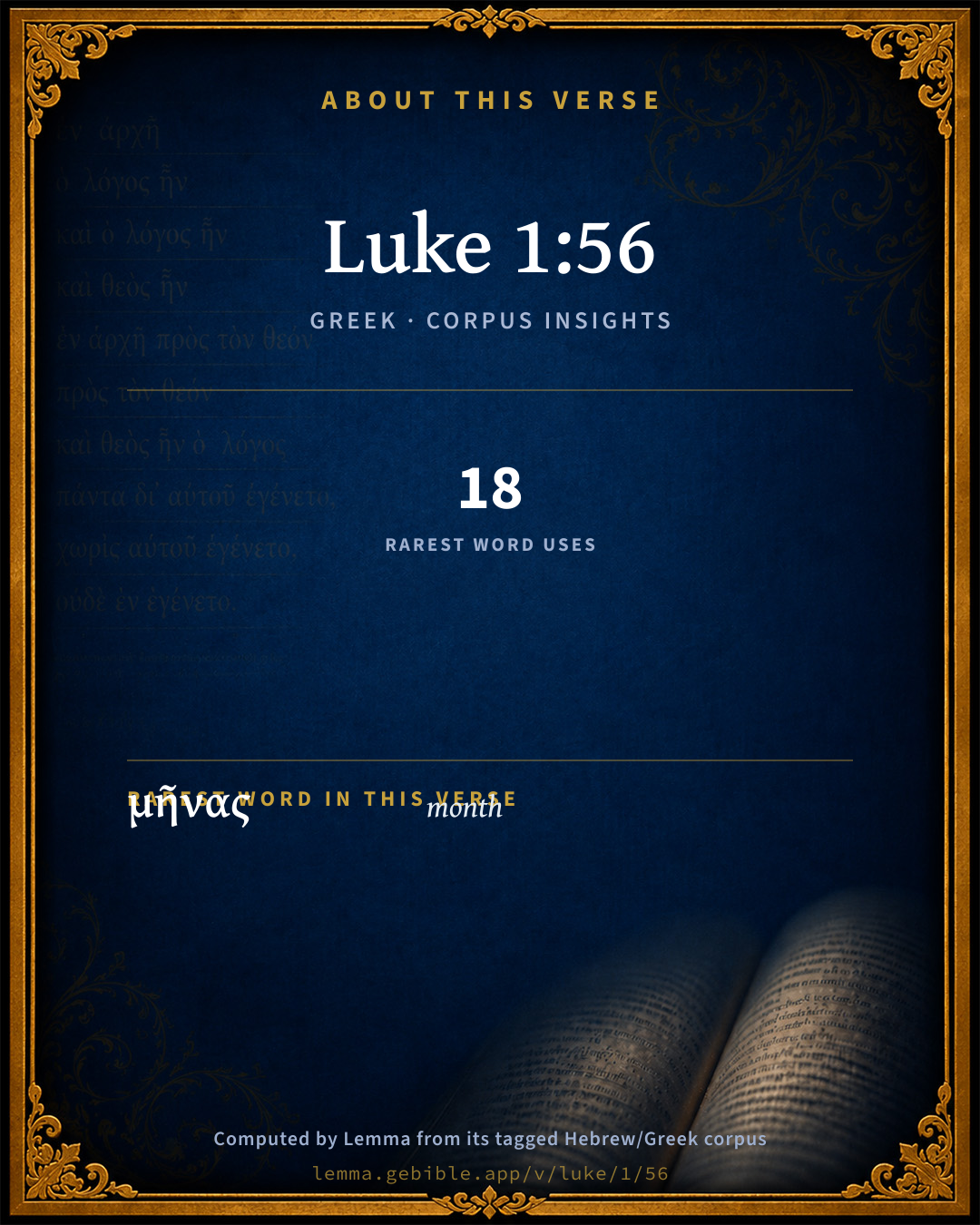
Luke 1:56

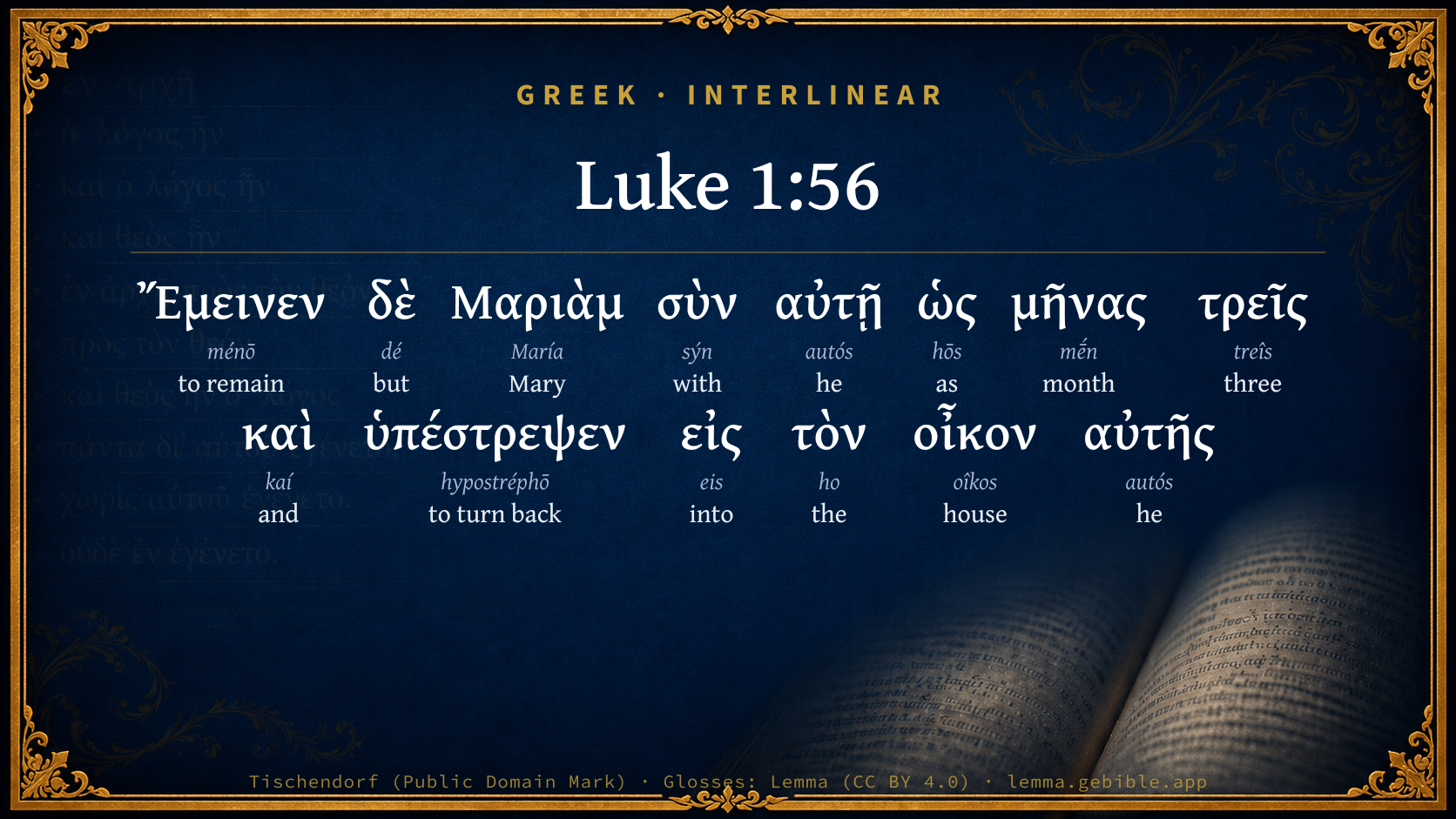
Greek (Tischendorf 8th ed.) Luke 1:56 appears in the Greek New Testament. The text above is from the Tischendorf 8th edition. Each word links to its Strong’s number and a concise gloss. Click any word for its full Thayer’s Greek Lexicon entry.
Download image
Cite this verse

Luke 1:56 (World English Bible). Public Domain. Lemma interlinear Bible study tool, https://lemma.gebible.app/v/luke/1/56.

Show BibTeX & RIS
BibTeX
RIS
English Translation
Mary stayed with her about three months, and then returned to her house.
World English Bible · Public Domain
Download a study sheet

One document with this verse’s original text, its word-by-word gloss line, the meaning frame, cross-references with their text, attributed commentary, and full source and license credits — printable, and it pastes into notes with its structure intact.

This verse Autodidact and up

Study sheet (.html) Plain text (.txt)

A passage Seminary Student

Up to 50 verses in one chapter. A passage sheet keeps up to 6 commentary sources and 12 cross-references per verse, in the order this page ranks them, and says so on the sheet whenever that leaves anything out. Ask for a single verse and you get the Autodidact verse sheet above.

Everything on this page stays free to read, with no account — the sheet is a download of what is already on screen, not access to it.

Want to remove ads? Support Godless Engineer
Compare translations 3

The same verse in 3 English versions, stacked beneath the original-language interlinear above. Click any original word for its lexicon entry.

Each is an independent rendering of the whole verse — the interlinear is not word-aligned to these translations.

Highlighted words mark where these versions differ — a whole-verse word diff, not a word-by-word alignment.

  • World English Bible Public Domain
    Mary stayed with her about three months, and then returned to her house.
  • King James Version Public Domain
    And Mary abode with her about three months, and returned to her own house.
  • unfoldingWord Literal Text CC BY-SA 4.0
    And Mary stayed with her about three months, and returned to her house.

unfoldingWord Literal Text — © unfoldingWord, licensed CC BY-SA 4.0. Word-aligned USFM3 via Door43 (git.door43.org/unfoldingWord/en_ult).

Versions to compare (up to 4)

3 of 4 selected

Show all 19 translations

Every available English version of this verse, each an independent rendering of the whole verse.

  • World English Bible Public Domain
    Mary stayed with her about three months, and then returned to her house.
  • Berean Standard Bible Public Domain
    Mary stayed with Elizabeth for about three months and then returned home.
  • Majority Standard Bible Public Domain
    Mary stayed with Elizabeth for about three months and then returned home.
  • King James Version Public Domain
    And Mary abode with her about three months, and returned to her own house.
  • American Standard Version (1901) Public Domain
    And Mary abode with her about three months, and returned unto her house.
  • Revised Version (1885) Public Domain
    And Mary abode with her about three months, and returned unto her house.
  • Geneva Bible (1599) Public Domain
    And Marie abode with her about three moneths: after, shee returned to her owne house.
  • Douay-Rheims (1899) Public Domain
    And Mary abode with her about three months; and she returned to her own house.
  • Young's Literal Translation Public Domain
    And Mary remained with her about three months, and turned back to her house.
  • Literal Standard Version CC BY-SA 4.0
    And Mary remained with her about three months, and turned back to her house.
  • Unlocked Literal Bible CC BY-SA 4.0
    Mary stayed with Elizabeth about three months and then returned to her house.
  • unfoldingWord Literal Text CC BY-SA 4.0
    And Mary stayed with her about three months, and returned to her house.
  • Darby Bible Public Domain
    And Mary abode with her about three months, and returned to her house.
  • World Messianic Bible Public Domain
    Miriam stayed with her about three months, and then returned to her house.
  • Webster's Bible Public Domain
    And Mary abode with her about three months, and returned to her own house.
  • Free Bible Version CC BY-SA 4.0
    Mary stayed with her for three months and then returned home.
  • Bible in Basic English Public Domain
    And Mary was with her for about three months and then went back to her house.
  • Text-Critical English NT CC BY 4.0
    And Mary remained with Elizabeth for about three months and then returned to her house.
  • Tyndale New Testament (1534) Public Domain
    And mary aboode with hyr aboute a.iii. monethes and retourned agayne to hyr awne housse.

Literal Standard Version (2020), Covenant Press — licensed CC BY-SA 4.0. Text via the HelloAO Bible API (eBible.org). Unlocked Literal Bible (unfoldingWord) — licensed CC BY-SA 4.0. Text via the HelloAO Bible API (eBible.org). unfoldingWord Literal Text — © unfoldingWord, licensed CC BY-SA 4.0. Word-aligned USFM3 via Door43 (git.door43.org/unfoldingWord/en_ult). Free Bible Version, Dr. Jonathan Gallagher — licensed CC BY-SA 4.0. Text via the HelloAO Bible API (eBible.org).

Word by word

More ways to search: Search by grammar → Find every occurrence → Compare this word →

Practice this passage: Drill this verse → Learn its vocabulary →

μῆνας
mḗn
G3376
“month”
Noun, Accusative, Plural, Masculine
Part of Speech
Noun
Case
Accusative
Number
Plural
Gender
Masculine
Full Thayer's Definition

Origin: a primary word

TDNT: 14:38,6

1. a month 2. the time of the new moon, new moon (the first day of each month, when the new moon appeared was a festival among the Hebrews)
  1. Ἔμεινεν ménō G3306 “to remain” Verb, Aorist, Active, Indicative, 3rd person, Singular
  2. δὲ dé G1161 “but” Conjunction
  3. Μαριὰμ María G3137 “Mary” Noun, Proper, indeclinable
  4. σὺν sýn G4862 “with” Preposition
  5. αὐτῇ autós G846 “he” Personal pronoun, Dative, Singular, Feminine
  6. ὡς hōs G5613 “as” Adverb
  7. τρεῖς treîs G5140 “three” Adjective, Accusative, Plural, Masculine
  8. καὶ kaí G2532 “and” Conjunction
  9. ὑπέστρεψεν hypostréphō G5290 “to turn back” Verb, Aorist, Active, Indicative, 3rd person, Singular
  10. εἰς eis G1519 “into” Preposition
  11. τὸν ho G3588 “the” Article, Accusative, Singular, Masculine
  12. οἶκον oîkos G3624 “house” Noun, Accusative, Singular, Masculine
  13. αὐτῆς autós G846 “he” Personal pronoun, Genitive, Singular, Feminine

About this verse

These counts appear in no published source. They are computed here, from the morphology-tagged text and Lemma’s own curated glosses. What Lemma adds →

14
words
13
distinct lemmas
Gospels
section

Notable vocabulary

The rarest word here is μῆνας month G3376 — appearing just 18 times in the whole Greek New Testament.

Shared distinctive vocabulary

μῆνας month G3376 occurs in 18 verses of the Greek New Testament. Also found in:

Repetition

A word recurs within this verse:

  • αὐτῇ he G846 ×2

Commentary

Notes on Luke 1:56 from classic Christian and Jewish commentators (each source and its license shown beneath its notes). The classic Christian expositions comment on the surrounding passage and are grouped to its opening verse, so a note may address several verses; the Jewish commentaries on the Tanakh (Rashi and others) are per-verse, so they appear only where the commentator wrote on this verse.

Lemma curates 59 commentaries, every one of them public domain or Creative Commons licensed, each selected and text-cleaned for this edition rather than reprinted as found. About our sources →

The Biblical Illustrator

Joseph S. Exell

Luk_1:56-80

Now Elisabeths full time came that she should he delivered

The nativity of John the Baptist

That which was miraculous at the beginning became natural towards the close.

This is seen in the case of Elisabeth, as recorded in the fifty-seventh verse. True also of spiritual generation. Begins in mystery and proceeds to prove itself by all that is practical in behaviour. The work of the Holy Ghost in the heart of man can never be explained; it will ever be as miraculous as the overshadowing of Mary, or the overruling of nature in the case of Elisabeth; but, as the motherhood of Mary and Elisabeth was never doubted, so Christian life in all its tempers and charities will establish itself in the confidence of men notwithstanding the miracle in which the new life began. The neighbours and cousins of Elisabeth were proceeding upon the usual plan of naming the child. They would have dragged down the miraculous to the ordinary, and surrounded this speciality of Divine favour with all that was ancient and traditional in the family. They knew not that another and better kindred was about to be inaugurated, and in fact that the whole law of kinship was about to undergo revolution and sanctification. Think of the particularity of Divine providence in giving this childs name. Did not God say unto Moses, I know thee by name? Did not Jesus call Zacchaeus by name? Could not God give every child his name, as well as number the hairs of his head, and take charge of all his going in the world? Zacharias confirmed the decision of Elisabeth, and so determined the name of the child, notwithstanding the wonder and apparent opposition of the neighbours and cousins. When the mouth of Zacharias was opened, the language of praise and exultation seemed to pour from his grateful and thankful lips like a river which for a season had been impeded. This speech gives us insight into the meaning of inspiration, for it is distinctly said that Zacharias was filled with the Holy Ghost and prophesied. What then is the meaning of Divine inspiration? Mark the pure and sublime religiousness of the speech. From beginning to end it lives and glows with the name of God. Any professed inspiration that leads men down to superficiality and contracted views of life, and to the praise of secondary causes, is presumptively false. Any inspiration that leads men to profounder reverence, to higher aspiration, to nobler charity, is presumptive]y true. The inspiration of Zacharias recognized most emphatically the preceding inspiration with which God had favoured His Church. Zacharias seems to be standing in the midst of that summer of which Old Testament times were but the spring. And as, on the one hand, his inspiration seemed to contract the past until Abraham lived but yesterday; so, on the other, it contracts the future, and makes John already the full-grown messenger and herald of the Messiah. This is what inspiration does for a man; when it does less it may be suspected or denied. The child grew! The child waxed strong in spirit 1 The child lingered in the deeper parts of the wilderness until the time of his showing forth unto Israel had ripened! He that believeth shall not make haste. The days we spend in silence and obscurity are not wasted, for what man ought to hasten into the Lords work as if the Lord had been waiting for him in the weakness of impatience? We shall be better prophets as we become better students. In the silent time we are gathering elements, consolidating character, and undergoing discipline, all of which will be wanted when the trumpet calls us to the battle. (Dr. Parker.)

The birth and training of John the Baptist

Such is the story of the birth and training of the Harbinger. The story suggests many lessons. I will mention but two.

I. It is a fine illustration of the proverb, COMING EVENTS CAST THEIR SHADOWS BEFORE. It was meet that the King of kings, in making advent, should have His avant-courier. Yes, it was meet that the Sun of Righteousness should have His morning star.

II. THE PLACE OF ASCETICISM IN THE CHRISTIAN LIFE. For it cannot be denied that Christs religion demands as one of its essential conditions self-denial. Presupposing a fallen, inverted nature, where the outward has usurped the inward--the flesh, the spirit--Christianity undertakes a restoration of the primal order, proposing victory in the very sphere of defeat. Thus, St. Paul himself buffeted his own body, and brought it into bondage. It was true of Moses, of David, of Daniel. Our blessed Lord Himself went into the wilderness, and fasted forty days and forty nights. So, also, many of the noblest characters in Christian history have been ascetics: witness a Basil, Gregory Nazianzen, Chrysostom, Jerome, Columba, Augustine of Canterbury. Their power lay, in part at least, in their asceticism. It certainly was so in the case of John of the Desert. His hermit-life gave him simplicity of manners, freedom from the entanglements of society and the elaborate artifices of a complicated civilization. It also gave him self-reliance, fortitude, courage. An ascetic life is ever apt to make what in some respects is a grand character. Yet an ascetic life is fraught with perils. It tempts to self-righteousness, morbid gloom, and fanaticism. We only need recall the abominable vices of the mediaeval monks--their indolence, avarice, hypocrisy, and sensuality--to be certified that monasticism has no just place in the Christian economy. Happy the day for those European countries when the monasteries were suppressed! No, man was made for man. He may escape society, but in escaping society, he disowns duty. The leaven of the kingdom must be put into the meal of the world. The asceticism which Jesus Christ, alike by word and by example, demands is self-denial, not for self-denials own sake, but for the sake of others. (G. D. Boardman.)

To children

I. THE NAMING OF JOHN. His name Is John, not may be, or ought to be, but is. And why was it so clearly, fully, and inevitably settled? Simply because God had decided the matter, and good old Zacharias never dreamt for a moment of questioning that decision. The Word of God settles matters, and allows of no appeal.

II. THE GODFATHER OF JOHN. John signifies the grace, or gift of God. And who but the eternal God Himself could give him such a name as this?

III. THE CHARACTER OF JOHN. He was the gift of God in a peculiar sense. He was a man sent from God, too, for a special purpose. But his character was undoubtedly the gift of God, and an instance of His grace and mercy. How entirely he seems to have lost himself in his office! Are you showing, by a holy and consistent and unblameable walk, that your name of Christian has been given from above? (Study and Homiletic Monthly.)

These opening chapters of Luke very jubilant

Heaven and earth sing, angels and men. The high occasion justifies it. Song even from the dumb! Yes. He had doubted the word of the angel, and so was stricken dumb. Unbelief cannot sing. But Zacharias is rebuked; no longer of doubtful mind. Now he sings, rises into rapture. His song rather of Christ than of John. No wonder. Who ever stops thought with the herald, the ambassador? There is a psalm of life as well as song of the hour; and all hour-songs are to deepen that life-psalm. (G. B. Johnson.)

Naming a child

It was likewise not customary among the Arabs to give the children names which had never been borne by any person in the family. When, therefore, on the seventh day after Mahomet was born, his grandfather invited the members of the tribe of the Koreischites to a feast, the guests asked, after the conclusion of it, what name he would give his grandson, on whose account he had treated them so magnificently; when he said, Mahomet. They replied, Then you mean to give him a name alien to his family. The same custom prevails among some North American tribes. Lafitua says, Among the Hurons and Iroquois they always retain in every family a certain number of names of the ancestors of the family, both of men and women. These names are quite peculiar to them, and it is presumed to be generally known that they belong to such or such a family. Now in every family it is the custom, as it were, to revive, to call back to life, those members of it who have made themselves famous. They therefore look out at the same time the names of those whom they revere, and give them to such of their descendants as are to represent them. The latter acquire more or less consideration in proportion as those who formerly bore these names were distinguished for their qualities, virtues, or deeds. The Jews had, in the same manner, certain names in every family which they took care to preserve; and these were taken only from the fathers family, as appears from what passed, according to the Scripture, at naming John the Baptist. But among the Hurons and Iroquois the names of the boys are at present taken, as formerly among the Lycians, from the family of the mother only. (Biblical Treasury.)

Birth and naming of the Baptist

Three-fourths of a year before portentous events had intimated the return of prophecy and miracles to Israel--Zacharias in the temple. One-fourth of a year since, another manifestation from heaven--Mary and Gabriel. Expectation high! Gleam of sunshine in darkness, Music in storm. Hills of Zion shining with early rays of twilight. And now the morning star shining bright in the cold, chilly dawn, heralds the speedy rising of the Sun of Righteousness with health and healing in His wings! For it was now to be seen that what God promised should be performed.

I. THE BIRTH OF JOHN.

1. Remember circumstances of his being promised, and the astonishing testimony to the divinity of future Jesus, when the two mothers met.

2. Now the promises begin to be accomplished. John born. Neighbours and kinsfolk rejoice with her. A subject of attention, for it was

(1) miraculous;

(2) promised.

II. NAMING OF CIRCUMCISION.

1. Circumcision, eighth day. A duty. Analogy in baptism (Col_2:11-12). Baptism also should be in infancy.

2. Naming took place then. So Christian name is given at baptism, not by registration.

III. THE MIRACLE (verse 64). Reward to faith.

IV. ZACHARIAS SONG OF PRAISE. Christ came, not to make men sullen, low, morose, desponding; but to pour out blessings in rich abundance, and to turn the captivity of His people as the rivers in the south. Has this song been realized in you? Is God visiting you? Has darkness vanished, and the true light shone in you? Make sure! Dont grasp the shadows of time, and lose the substance of eternity. (G. Venables, S. C. L.)

The dumb learning to praise God

A beautiful incident occurred only a short time since in the school to teach mutes articulation and lip-reading, at Mystic River, Connecticut. Miss P., an interesting graduate of one of the oldest institutions for the education of deaf mutes, having a desire to learn to speak and read the lips of her speaking friends, was recommended by her old principal to try Mr. Whipples school, and she entered it last term. She made rapid progress, and was much aided by the natural alphabet, the invention of her teacher. This alphabet curiously suggests sound, or the right position of the organs to utter sound, as well as form; and whenever a mute pupil can read and write it, he or she can generally give any of the forty sounds of our difficult language with great precision and discrimination, and often with remarkable correctness. This young lady, filled with enthusiasm at every step, mastered the alphabet with little difficulty, and one day came to her teacher with something written on her slate, which she asked him to correct, her mind being agitated with emotion. It proved to be the Lords Prayer, put into the language of articulation. Perceiving her agitation, the teacher could scarce restrain his own tears as he corrected a few unimportant errors of pronunciation, and delicately returned it. The next morning the young lady came exultingly to her teacher, exclaiming: I prayed last night for the first time in my life with my voice; and neither of them could restrain their emotions. He ventured to ask her if she had ever prayed before. Oh, yes; I have thought my prayers, but I never spoke before. My lips shall praise Thee, O God. Attend to the voice of my supplications, O Lord.

Praising God

Praise is the rent-charge we owe to God for His blessings. David said, As long as I live I will praise the Lord, In ancient places of Christian worship it was arranged that one set of worshippers should keep on praising God, till another set came, so that praise might always be going up to heaven, night and day. Commodore Good-enough, when dying, said, I have not breath left to praise God for all His mercies. Mr. Wesleys last words were, Ill praise! Ill praise! Swiss herdsmen at sunset call forth, Praise ye the Lord! This shout is repeated from one to another till every valley, peak, and hill reverberates with the ascriptions of gratitude to the Giver of all good. In the last four Psalms, how many exhortations we have to praise God! In the last verse of the last Psalm we read, Let every thing that hath breath praise the Lord. (H. R. Burton.)

The Biblical Illustrator, edited by Joseph S. Exell (c. 1880s–1900s) — public domain. Text from a community e-Sword module.

Bengel's Gnomon

Johann Albrecht Bengel

Luk 1:56. Τρεῖς, three) She departed before the birth-giving [confinement] of Elisabeth.—εἰς τὸν οἶκον αὐτῆς, to her own house) from which she had been some time before commanded to go, in order to stop at Bethlehem. [Therefore it is to this (point of time) belong the statements which Matthew has inserted, at his ch. Luk 1:18-24, in the narrative itself concerning the nativity of Christ.—Harm., p. 42.]

Bengel's Gnomon of the New Testament — English translation (T&T Clark, Edinburgh, 1860) — public domain. Text from a community e-Sword module.

Expositor's Greek Testament

ed. W. Robertson Nicoll

Luk 1:56 . Mary returns to her home . ἔμεινε : the time of Mary’s sojourn with her kinswoman is given as “about three months”. This would bring her departure near to the time of Elizabeth’s confinement. Did she remain till the event was over? That is left doubtful.

The Expositor's Greek Testament, edited by W. Robertson Nicoll (1897–1910) — public domain. Text from a community e-Sword module.

Jamieson, Fausset & Brown

Robert Jamieson, A. R. Fausset & David Brown

abode with her about three months--What an honored roof was that which, for such a period, overarched these cousins! and yet not a trace of it is now to be seen, while the progeny of those two women--the one but the honored pioneer of the other--have made the world new.

returned to her own house--at Nazareth, after which took place what is recorded in Mat 1:18-25.

Jamieson, Fausset & Brown — Commentary Critical and Explanatory on the Whole Bible (1871) — public domain (CC PDM 1.0). Text via the HelloAO Bible API.

Adam Clarke's Commentary

Verse 56. And Mary abode with her about three months] According to some, the departure of Mary from Hebron must have been but a few days before the birth of John; as nine months had now elapsed since Elisabeth's conception; see Lu 1:36. Hence it immediately follows:-

Adam Clarke's Commentary on the Bible (1810–1826) — public domain. Text from a community e-Sword/MySword module.

Ellicott's Commentary for English Readers

(56) And Mary abode with her about three months.—This brings the time so close to the birth of the Baptist that we might well deem it likely that the Virgin waited for it. On the other hand, the next verse seems almost to imply her previous departure. In any case, we may think of the three months as a time of much communion of heart and hope on the great things which God had done and was about to do for Israel.

A Bible Commentary for English Readers, edited by Charles John Ellicott (1878–1897) — public domain. Text from a community e-Sword module.

The Cambridge Bible for Schools and Colleges

gen. ed. J. J. S. Perowne

56. about three months] As this would complete the nine months of Elizabeth’s ‘full time,’ it might seem probable that the Virgin Mary at least remained until the birth of the Baptist.

returned] The word used—hupestrepsen—is a favourite word of St Luke, and almost (Gal_1:17; Heb_7:1) peculiar to him. It occurs twenty-one times in this Gospel.

The Cambridge Bible for Schools and Colleges (gen. ed. J. J. S. Perowne; Cambridge University Press, 1878–1918) — public domain. Text from a community e-Sword module.

John Gill's Exposition

And Mary abode with her about three months,.... That is, she continued with Elisabeth, as the Syriac and Persic versions express, about the space of three months; in which time, she had full satisfaction of the truth of the sign the angel had given her; namely, of Elisabeth's conception and pregnancy, for by this time she was ready to give birth; and she must now be fully assured, that she was with child herself: this space of three months is a term of time fixed by the Jewish doctors, to know whether a woman is with child or not, as in case of divorce or death: the rule runs thus (k),

"every woman that is divorced, or becomes a widow, lo! she may not marry, nor be betrothed, until she waits, , ninety days (i.e. three months), exclusive of the day in which she is divorced, or her husband dies, and of the day in which she is betrothed; that so it may be known whether she is with child or not, in order to distinguish between the seed of the former, and the seed of the second husband.

And so in the case of marrying the wife of a brother, that died without issue (l), and of newly married couples mistaking their spouses (m):

and returned to her own house; at Nazareth, in Galilee; and now it was, that Joseph, to whom she was betrothed, perceived she was with child; and suspecting evil, had a mind to put her away privately; but was informed by an angel of God, in a dream, of the whole matter; and was advised and encouraged to take her to wife, which he accordingly did; see Mat 1:18.

(k) Maimon. Hilch. Gerushin, c. 11. sect. 18. Vid. T. Bab. Becorot, fol. 47. 1. (l) Misn. Yebamot, c. 4. sect. 10. T. Hieros, Yebamot, fol. 6. 1. T. Bab. ib. fol. 34. 2. & 35. 1. Maimon. Hilch. Yebum, c. 1. sect 19. T. Bab. Erubin, fol. 47. 1. (m) Misn. Yebamot, c. 3. sect. 10.

John Gill's Exposition of the Whole Bible (1746–1763) — public domain (CC PDM 1.0). Text via the HelloAO Bible API.

Trapp's Complete Commentary

John Trapp

56 And Mary abode with her about three months, and returned to her own house.

Ver. 56. And returned to her own house] An honest heart is found where its calling is. Such a one, when he is abroad, is like a fish in the air; whereinto if it leap for recreation or necessity, yet it soon returns to its own element.

John Trapp, A Commentary or Exposition upon All the Books of the Old and New Testament (1647–1656) — public domain. Text from a community e-Sword module.

Matthew Poole's English Annotations

It is most probable that she staid with her until she was brought to bed, not leaving her just at the time of her travail, but she staid not long after, but went home: by this time she must herself know that she was with child; and here in the true order of the history cometh in what we had Mat 1:18-25; See Poole on "Mat 1:18" and following verses to Mat 1:25.

Matthew Poole's English Annotations on the Holy Bible (1683–1685) — public domain. Text from a community e-Sword/MySword module.

John Wesley's Explanatory Notes

Mary returned to her own house - And thence soon after to Bethlehem.

John Wesley, Explanatory Notes Upon the Whole Bible (1754–1765) — public domain. Text via the GEBible commentary corpus.

Burkitt's Expository Notes on the New Testament

William Burkitt

Two things are here observable, 1. The civil courtesy of the Virgin Mary, towards her cousin Elizabeth. She stays with her three months, probably till she was delivered and brought to bed, not leaving her just at the time of travail: for the angel told Mary, Luk 1:36, that it was then the sixth month with Elizabeth, after which Mary stays with her three months, which made up the full time. To visit and accompany our friends in the time of their distress, is not only an act of civil courtesy, but of religious piety; not a matter of indifference, but of duty, Jas 1:27. "Pure religion, and undefiled is this, to visit in affliction;" that is, this is an eminent act and exercise of religion, the evidence and fruit of sincere religion; and the virgin’s doing this was an act and instance of her piety, as well as of her civil courtesy.

Observe, 2. The religious joy, and spiriutal rejoicing, which the neighbours and kindred expressed at the lying-in of Elizabeth: they did not meet together upon that great occasion, only to eat and drink and make merry; " but they rejoiced that the Lord had shewed great mercy upon her." Oh, how rarely is this example followed in our age! At the delivery of the mother, and at the birth of the child, how little is God taken notice of! How little is his power magnified, and his goodness celebrated, in opening the womb, in giving strength to bring forth! And how rarely is this the subject of discourse at the woman’s labour! Verily, if the mercy of a child, and the safe delivery of the mother, be not the first and principal things taken notice of at such rejoicing meetings, they look more like Pagan than Christian rejoicings.

William Burkitt's Expository Notes on the New Testament (1700–1703) — public domain. Text from a community e-Sword module.

unfoldingWord translationNotes

Door43 World Missions Community

Connecting Statement:

Elizabeth delivers her baby and then Zechariah names their baby.

returned to her house

"Mary returned to her (Mary's) house" or "Mary returned to her own house"

Now

This word marks the beginning of the next event in the story.

deliver her baby

"give birth to her baby"

Her neighbors and her relatives

"Elizabeth's neighbors and relatives"

shown his great mercy to her

"been very kind to her"

translationWords

Mary

Elizabeth

neighbor

mercy

joy

unfoldingWord translationNotes — © Distant Shores Media and the Door43 World Missions Community, licensed CC BY-SA 4.0. Source: git.door43.org/Door43/en_tn.

Cambridge Greek Testament for Schools and Colleges

56. ὡς μῆνας τρεῖς. As this would complete the nine months of Elizabeth’s ‘full time,’ it might seem probable that the Virgin Mary remained at least until the birth of the Baptist.

ὑπέστρεψεν. This is a favourite word of St Luke, and almost (Gal 1:17; Heb 7:1) peculiar to him. It occurs twenty-one times in this Gospel.

Cambridge Greek Testament for Schools and Colleges (Cambridge University Press, 1896; 21 vols, various authors incl. Carr, Maclear, Plummer, Farrar, Lumby, Moule, M. R. James, Simcox) — public domain. Text from a community e-Sword module.

International Critical Commentary

56. Ἔμεινεν δὲ Μαριὰμ σὺν αὐτῇ. Lk. greatly prefers σύν to μετά. He uses σύν much more often than all N.T. writers put together. In his Gospel we find him using, σύν where the parallel passage in Mt. or Mk. has μετά or καί; e.g. 8:38, 51, 20:1, 22:14, 56. We have σύν three times in these first two chapters; here, 2:5 and 13. It is not likely that an interpolator would have caught all these minute details in Lk.’s style: see Introd. § 6.

ὡς μῆνας τρεῖς. This, when compared with μὴν ἕκτος (ver. 36), leads us to suppose that Mary waited until the birth of John the Baptist. She would hardly have left when that was imminent. Lk. mentions her return before mentioning the birth in order to complete one narrative before beginning another; just as he mentions the imprisonment of the Baptist before the Baptism of the Christ in order to finish his account of John’s ministry before beginning to narrate the ministry of Jesus (3:20, 21). That Mary is not named in vv. 57, 58 is no evidence that she was not present. It would be unnatural to say that one of the household heard of the event; and, in fact, οἱ συγγενεῖς would include her, whether it is intended to do so or not. Origen, Ambrose, Bede, and others believe that she remained until the birth of John. For the patristic arguments for and against see Corn. à Lap. Lk. leaves us in doubt, probably because his authority left him in doubt; but Didon goes too far in saying that Lk. insinuates that she was not presents. 1

For this use of ὡς comp. 8:42 (not 2:37); Act 1:15, Act 1:5:7, 36. Lk. more often uses ὡσεί in thus sense (3:23, 9:14, 28, 22:41, 59, 23:44; Act 2:41, etc.). In ὑπέστρεψεν we have another very favourite word which runs through both Gospel and Acts. It is found elsewhere only Mar 14:40; Gal 1:17; Heb 7:1; 2Pe 2:21.

Meyer righly remarks that “the historical character of the Visitation of Mary stands or falls with that of the Annunciation.” The arguments against it are very inconclusive. 1. That it does not harmonize with Joseph’s dream in Mat 1:20; which has been shown to be incorrect. 2. That there is no trace elsewhere of great intimacy between the two families; which proves absolutely nothing. 3. That the obvious purpose of the narrative is to glorify Jesus, in making the unborn Baptist acknowledge Him as the Messiah; which is mere assertion. 4. That the poetic splendour of the narrative lifts it out of the historical sphere; which implies that what is expressed with great poetic beauty cannot be historically true,—a canon which would be fatal to a great deal of historical material. We may assert of this narrative, as of that of the Annunciation, that no one in the first or second century could have imagined either. Least of all could any one have given us the Magnificat, —“the most magnificent cry of Joy that has ever issued from a human breast.” Nothing that has come down to us of that age leads us to suppose that any writer could have composed these accounts without historic truth to guide him, any more than an architect of that age could have produced Milan cathedral. Comp. the Protevangelium of James xii.-xiv.; the Pseudo-Matthew ix.-xii.; the Hist. of Joseph the Carpenter iii.-vi.

International Critical Commentary — older volumes (1896–1929), various authors — public domain. Text from a community e-Sword module.

Godet's Commentaries

Frédéric Louis Godet

Ver. 56 is a historical conclusion.

Did the departure of Mary take place before the birth of John the Baptist? We might suppose so from the particle δέ and the aorist ἐπλήσθη (Luk 1:57), which very naturally imply a historical succession. But, on the other hand, it would be hardly natural that Mary should leave at a time when the expected deliverance of Elizabeth was so near at hand. This verse, therefore, must be regarded as a historical anticipation, such as is frequently found in Luke. Comp. Luk 1:65, Luk 3:19-20, etc.

Frédéric Louis Godet — Commentaries on Luke, John, Romans, and 1 Corinthians — English translation (T&T Clark, Edinburgh, 1870s–1890s) — public domain. Text from a community e-Sword module.

Lesson kit

Teaching starters — assembled from the data on this page, not authored interpretation. Every prompt links to the verse data it draws on. Edit before teaching.

Luke, in the Gospels, opens this verse with 14 words (13 distinct Greek lemmas). Its most distinctive word is mḗn (“month”). A historical commentator’s framing appears above. Read the whole chapter for the surrounding context.

Discussion questions

  1. How does “month” (mḗn) shape what this verse is saying?
  2. How does Luke 1:24, which shares the word «month», read alongside this verse?
  3. What does the repetition of “he” (2× in this one verse) do in this verse?
  4. The translations on this page render this verse differently — a whole-verse word diff, not a word-by-word alignment. What might account for the different wordings?
  5. Compare how The Biblical Illustrator and Bengel's Gnomon read this verse. Where do they agree or differ?

Things to notice

Reading settings

Reading text

Shown beneath each verse's original-language words.

Old Testament
Old Testament edition

Read the OT as the Masoretic Hebrew (MT) or the Greek Septuagint (LXX).

English shown for the Greek Septuagint (in the Hebrew ↔ Greek comparison).

Comparing translations? Open the Compare panel on any verse page to stack up to four side by side.