
Mark 15:47

Greek (Tischendorf 8th ed.) Mark 15:47 appears in the Greek New Testament. The text above is from the Tischendorf 8th edition. Each word links to its Strong’s number and a concise gloss. Click any word for its full Thayer’s Greek Lexicon entry.
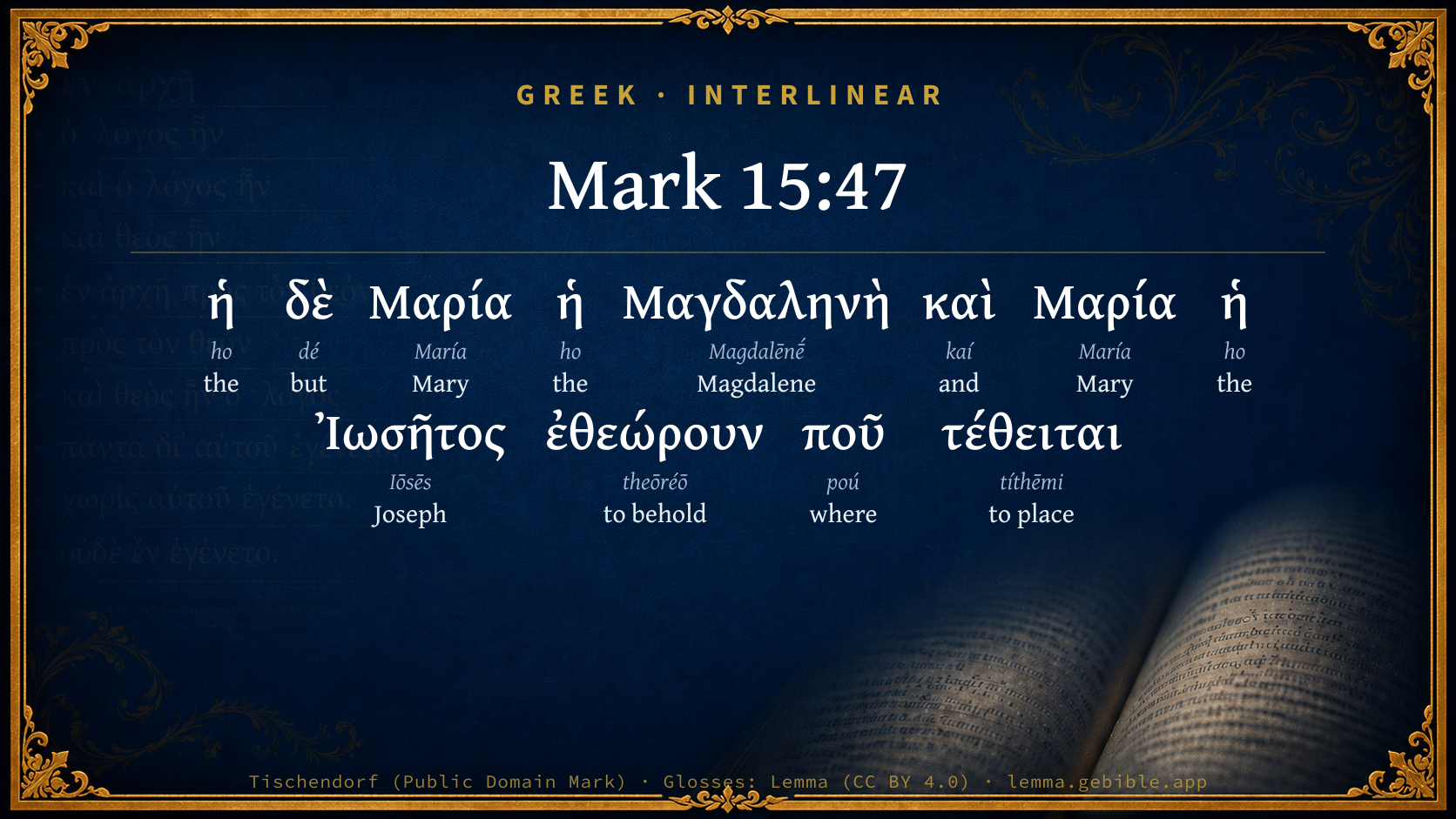
Download image
Cite this verse

Mark 15:47 (World English Bible). Public Domain. Lemma interlinear Bible study tool, https://lemma.gebible.app/v/mark/15/47.

Show BibTeX & RIS
BibTeX
RIS
English Translation
Mary Magdalene and Mary, the mother of Joses, saw where he was laid.
World English Bible · Public Domain
Highlights
  • 1 first appearance in the Greek New Testament
Full analysis ↓
Download a study sheet

One document with this verse’s original text, its word-by-word gloss line, the meaning frame, cross-references with their text, attributed commentary, and full source and license credits — printable, and it pastes into notes with its structure intact.

This verse Autodidact and up

Study sheet (.html) Plain text (.txt)

A passage Seminary Student

Up to 50 verses in one chapter. A passage sheet keeps up to 6 commentary sources and 12 cross-references per verse, in the order this page ranks them, and says so on the sheet whenever that leaves anything out. Ask for a single verse and you get the Autodidact verse sheet above.

Everything on this page stays free to read, with no account — the sheet is a download of what is already on screen, not access to it.

Want to remove ads? Support Godless Engineer
Compare translations 3

The same verse in 3 English versions, stacked beneath the original-language interlinear above. Click any original word for its lexicon entry.

Each is an independent rendering of the whole verse — the interlinear is not word-aligned to these translations.

Highlighted words mark where these versions differ — a whole-verse word diff, not a word-by-word alignment.

  • World English Bible Public Domain
    Mary Magdalene and Mary, the mother of Joses, saw where he was laid.
  • King James Version Public Domain
    And Mary Magdalene and Mary the mother of Joses beheld where he was laid.
  • unfoldingWord Literal Text CC BY-SA 4.0
    Now Mary Magdalene and Mary the of Joses were watching where he had been put.

unfoldingWord Literal Text — © unfoldingWord, licensed CC BY-SA 4.0. Word-aligned USFM3 via Door43 (git.door43.org/unfoldingWord/en_ult).

Versions to compare (up to 4)

3 of 4 selected

Show all 19 translations

Every available English version of this verse, each an independent rendering of the whole verse.

  • World English Bible Public Domain
    Mary Magdalene and Mary, the mother of Joses, saw where he was laid.
  • Berean Standard Bible Public Domain
    Mary Magdalene and Mary the mother of Joseph saw where His body was placed.
  • Majority Standard Bible Public Domain
    Mary Magdalene and Mary the mother of Joses saw where His body was placed.
  • King James Version Public Domain
    And Mary Magdalene and Mary the mother of Joses beheld where he was laid.
  • American Standard Version (1901) Public Domain
    And Mary Magdalene and Mary the `mother' of Joses beheld where he was laid.
  • Revised Version (1885) Public Domain
    And Mary Magdalene and Mary the mother of Joses beheld where he was laid.
  • Geneva Bible (1599) Public Domain
    And Marie Magdalene, and Marie Ioses mother, behelde where he should be layed.
  • Douay-Rheims (1899) Public Domain
    And Mary Magdalen, and Mary the mother of Joseph, beheld where he was laid.
  • Young's Literal Translation Public Domain
    and Mary the Magdalene, and Mary of Joses, were beholding where he is laid.
  • Literal Standard Version CC BY-SA 4.0
    and Mary the Magdalene, and Mary of Joses, were beholding where He is laid.
  • Unlocked Literal Bible CC BY-SA 4.0
    Mary Magdalene and Mary the mother of Joses saw the place where Jesus was buried.
  • unfoldingWord Literal Text CC BY-SA 4.0
    Now Mary Magdalene and Mary the of Joses were watching where he had been put.
  • Darby Bible Public Domain
    And Mary of Magdala and Mary the [mother] of Joses saw where he was put.
  • World Messianic Bible Public Domain
    Miriam Magdalene and Miriam the mother of Yosi, saw where he was laid.
  • Webster's Bible Public Domain
    And Mary Magdalene and Mary the mother of Joses, beheld where he was laid.
  • Free Bible Version CC BY-SA 4.0
    Mary Magdalene and Mary the mother of Joses were watching where he was laid.
  • Bible in Basic English Public Domain
    And Mary Magdalene and Mary, the mother of Joses, saw where he was put.
  • Text-Critical English NT CC BY 4.0
    And Mary Magdalene and Mary the mother of Joses saw where he was laid.
  • Tyndale New Testament (1534) Public Domain
    And Mary Magdalen and Mary Ioses beheld where he was layde.

Literal Standard Version (2020), Covenant Press — licensed CC BY-SA 4.0. Text via the HelloAO Bible API (eBible.org). Unlocked Literal Bible (unfoldingWord) — licensed CC BY-SA 4.0. Text via the HelloAO Bible API (eBible.org). unfoldingWord Literal Text — © unfoldingWord, licensed CC BY-SA 4.0. Word-aligned USFM3 via Door43 (git.door43.org/unfoldingWord/en_ult). Free Bible Version, Dr. Jonathan Gallagher — licensed CC BY-SA 4.0. Text via the HelloAO Bible API (eBible.org).

Word by word

More ways to search: Search by grammar → Find every occurrence → Compare this word →

Practice this passage: Drill this verse → Learn its vocabulary →

About this verse

These counts appear in no published source. They are computed here, from the morphology-tagged text and Lemma’s own curated glosses. What Lemma adds →

12
words
9
distinct lemmas
Gospels
section

Notable vocabulary

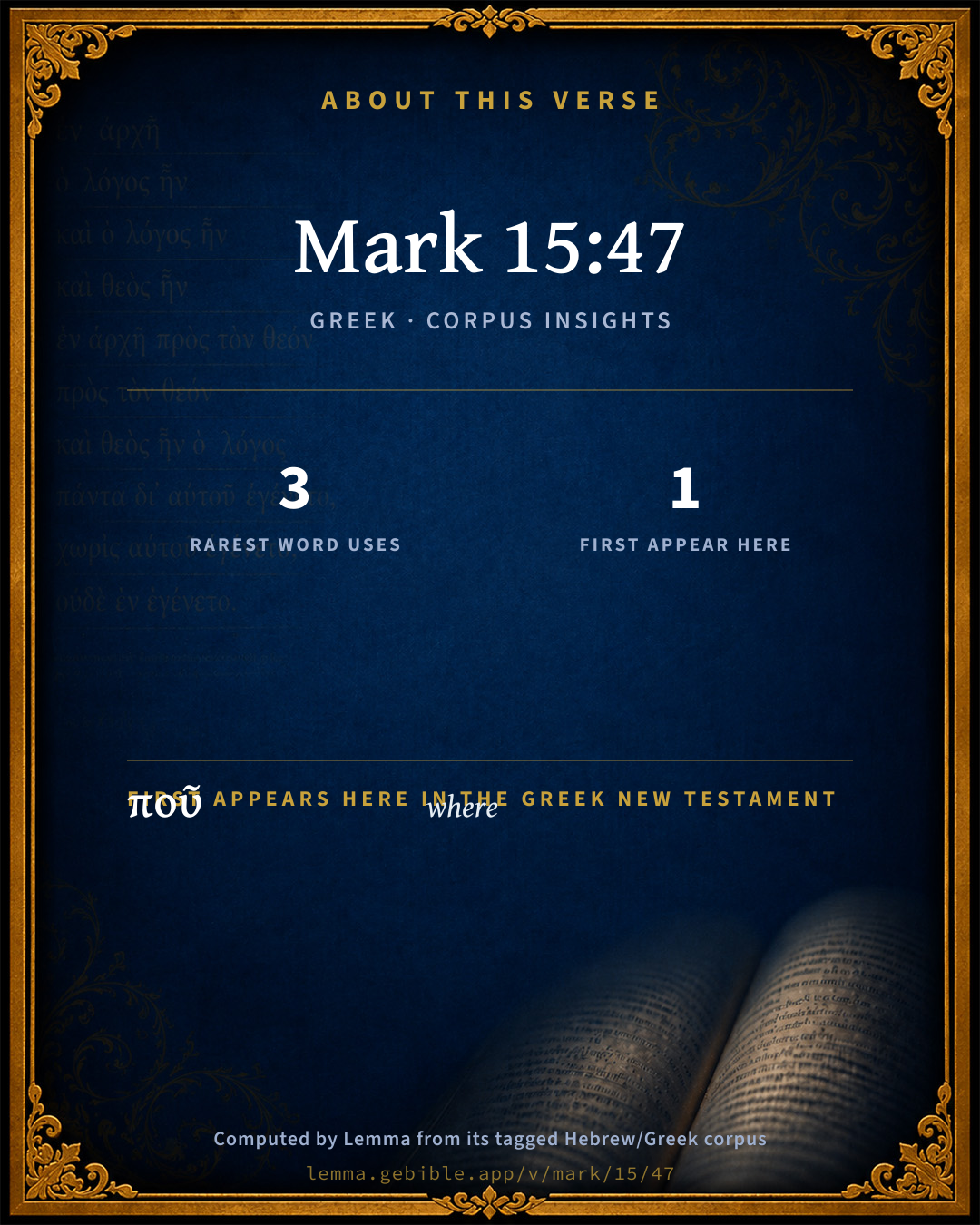
The rarest word here is Ἰωσῆτος Joseph G2500 — appearing just 3 times in the whole Greek New Testament.

First appearance in Scripture

This word makes its first canonical appearance in the Greek New Testament here:

Shared distinctive vocabulary

Ἰωσῆτος Joseph G2500 occurs in 3 verses of the Greek New Testament. Also found in:
Repetition

Words recur within this verse:

Cross-references

5

Topical passages linked to Mark 15:47 in the Treasury of Scripture Knowledge — connected by theme and wording, ordered by reader-vote popularity; previews shown in the World English Bible.

  • Mark 15:40 There were also women watching from afar, among whom were both Mary Magdalene, and Mary the mother of James the less and of Joses, and Salome;
  • Mark 16:1 When the Sabbath was past, Mary Magdalene, and Mary the mother of James, and Salome, bought spices, that they might come and anoint him.
  • Matthew 27:61 Mary Magdalene was there, and the other Mary, sitting opposite the tomb.
  • Matthew 28:1 Now after the Sabbath, as it began to dawn on the first day of the week, Mary Magdalene and the other Mary came to see the tomb.
  • Luke 23:55–24:2 The women, who had come with him out of Galilee, followed after, and saw the tomb, and how his body was laid.

Cross-references courtesy of OpenBible.info (CC BY 4.0).

Commentary

Notes on Mark 15:47 from classic Christian and Jewish commentators (each source and its license shown beneath its notes). The classic Christian expositions comment on the surrounding passage and are grouped to its opening verse, so a note may address several verses; the Jewish commentaries on the Tanakh (Rashi and others) are per-verse, so they appear only where the commentator wrote on this verse.

Lemma curates 59 commentaries, every one of them public domain or Creative Commons licensed, each selected and text-cleaned for this edition rather than reprinted as found. About our sources →

Expositor's Greek Testament

ed. W. Robertson Nicoll

Mar 15:47 . τέθειται : from the perfect Meyer and Weiss infer that the women were not present at the burial, but simply approached and took note where Jesus lay after burial. Schanz dissents, and refers to the καὶ before ὅτε in Mar 15:41 in some MSS., as proving that they had come to render the last office to Jesus.

The Expositor's Greek Testament, edited by W. Robertson Nicoll (1897–1910) — public domain. Text from a community e-Sword module.

Adam Clarke's Commentary

Verse 47. Beheld where he was laid.] The courage and affection of these holy women cannot be too much admired. The strength of the Lord is perfected in weakness; for here a timid man, and a few weak women, acknowledge Jesus in death, when the strong and the mighty utterly forsook him.

HUMAN strength and human weakness are only names in religion. The mightiest MAN, in the hour of trial, can do nothing without the strength of God; and the weakest WOMAN can do all things, if Christ strengthen her. These truths are sufficiently exemplified in the case of Peter and all his brother disciples on the one hand; and Joseph of Arimathea and the two Marys on the other. And all this is recorded, equally to prevent both presumption and despair. Reader, let not these examples be produced before thee in vain.

Adam Clarke's Commentary on the Bible (1810–1826) — public domain. Text from a community e-Sword/MySword module.

Ellicott's Commentary for English Readers

(47) Mary the mother of Joses.—In Mat_27:61 she is described simply as “the other Mary.”

A Bible Commentary for English Readers, edited by Charles John Ellicott (1878–1897) — public domain. Text from a community e-Sword module.

The Cambridge Bible for Schools and Colleges

gen. ed. J. J. S. Perowne

47. Mary Magdalene] and Mary the mother of Joses (see note above, Mar_15:40) and the other women (Luk_23:55), “beheld,” i. e. observed carefully, the place where He was laid, and where, surrounded by all the mystery of death,

“Still He slept, from Head to Feet

Shrouded in the winding-sheet,

Lying in the rock alone,

Hidden by the sealèd stone.”

The Cambridge Bible for Schools and Colleges (gen. ed. J. J. S. Perowne; Cambridge University Press, 1878–1918) — public domain. Text from a community e-Sword module.

Trapp's Complete Commentary

John Trapp

47 And Mary Magdalene and Mary the mother of Joses beheld where he was laid.

Ver. 47. {See Trapp on "Mat 27:61"}

John Trapp, A Commentary or Exposition upon All the Books of the Old and New Testament (1647–1656) — public domain. Text from a community e-Sword module.

Albert Barnes' Notes on the Bible

Beheld where he was laid - The affection of these pious females never forsook them, in all the trials and sufferings of their Lord. With true love they followed him to the cross; they came as near to him as they were permitted to come in his last moments; they followed him when taken down and laid in the tomb. The strong, the mighty, the youthful, had fled; but female love never forsook him, even in his deepest humiliation. This is the nature of true love; it is strongest in such scenes. While “professed” attachment will abound in prosperity and live most in sunshine, it is only genuine love that will go into the dark shades of adversity and flourish there. In scenes of poverty, want, affliction, and death, it shows its genuineness. That which lives there is genuine. That which turns away from such scenes is spurious.

Albert Barnes' Notes on the Bible (1834–1885) — public domain. Text from a community e-Sword/MySword module.

The Pulpit Commentary

And Mary Magdalene and Mary the mother of Joses beheld where he was laid (eyewroun pou tiyetai); literally, were beholding where he was laid. These women were two of the group mentioned at ver. 40. They remained, after the body of our Lord had been deposited, in sad and silent contemplation. The women appear to have broken up into two groups. One group went alone to purchase spices and ointments, which it was necessary for them to do before six o"clock, when the sabbath commenced; in readiness for the embalming. Mary Magdalene and Mary the mother of Joses and Salome appear to have bought them after six o"clock on the Saturday night.

The Pulpit Commentary (1880–1919), ed. H.D.M. Spence-Jones & Joseph S. Exell — public domain. Text from a community e-Sword module.

Scofield Reference Notes

C. I. Scofield

Mary

(See Scofield "Mat 1:16")

The Scofield Reference Bible (1917 edition), notes by C. I. Scofield — public domain. Text from a community e-Sword module.

Cambridge Greek Testament for Schools and Colleges

47. τέθειται ([3506]c[3507][3508][3509][3510][3511][3512][3513] 33) rather than τίθεται ([3514][3515]).

[3506] Codex Sinaiticus. 4th cent. Discovered by Tischendorf in 1859 at the Monastery of St Katharine on Mount Sinai. Now at St Petersburg. The whole Gospel, ending at Mar 16:8. Photographic facsimile, 1911.

[3507] Codex Alexandrinus. 5th cent. Brought by Cyril Lucar, Patriarch of Constantinople, from Alexandria, and afterwards presented by him to King Charles I. in 1628. In the British Museum. The whole Gospel. Photographic facsimile, 1879.

[3508] Codex Vaticanus. 4th cent., but perhaps a little later than א. In the Vatican Library almost since its foundation by Pope Nicolas V., and one of its greatest treasures. The whole Gospel, ending at Mar 16:8. Photographic facsimile, 1889.

[3509] Codex Ephraemi. 5th cent. A palimpsest: the original writing has been partially rubbed out, and the works of Ephraem the Syrian have been written over it; but a great deal of the original writing has been recovered; of Mark we have Mar 1:17 to Mar 6:31, Mar 8:5 to Mar 12:29, Mar 13:19 to Mar 16:20. In the National Library at Paris.

[3510] Codex Bezae. 6th cent. Has a Latin translation (d) side by side with the Greek text, and the two do not quite always agree. Presented by Beza to the University Library of Cambridge in 1581. Remarkable for its frequent divergences from other texts. Contains Mark, except Mar 16:15-20, which has been added by a later hand. Photographic facsimile, 1899.

[3511] Codex Sangallensis. 9th or 10th cent. Contains the Gospels nearly complete, with an interlinear Latin translation. The text of Mark is specially good, agreeing often with CL. At St Gall.

[3512] Codex Petropolitanus. 9th cent. Gospels almost complete. Mar 16:18-20 is in a later hand.

[3513] Codex Athous Laurae. 8th cent. Like N and Σ, it is written in silver letters on purple vellum. Contains Mar 9:5 to Mar 16:20, and, as in L, the shorter ending is inserted between Mar 16:8 and Mar 16:9. As in Δ, the text of Mark is specially good.

[3514] Codex Campianus. 9th cent. At Paris. Gospels complete.

[3515] Codex Oxoniensis. 9th cent. Contains Mark, except Mar 3:35 to Mar 6:20.

47. [3546] ἡ Ἰωσῆτος. This probably means “the mother of Joses” (Mar 15:40); if she had not been mentioned before, “the daughter of Joses” would be the probable rendering. [3547] ff n q and Syr-Sin. have “the daughter of James.” These two women had watched the pious work of Joseph and Nicodemus, who may have had assistants, but might wish to do without them. They desired to see the last of the Master, and to know exactly how to arrange for their own pious work. Apparently, after the men had departed, the two women still sat on and gazed.

[3546] Codex Campianus. 9th cent. At Paris. Gospels complete.

[3547] Codex Bezae. 6th cent. Has a Latin translation (d) side by side with the Greek text, and the two do not quite always agree. Presented by Beza to the University Library of Cambridge in 1581. Remarkable for its frequent divergences from other texts. Contains Mark, except Mar 16:15-20, which has been added by a later hand. Photographic facsimile, 1899.

Some critics suggest that all these details have been invented in order to make a foundation for the theory of the Resurrection. Such criticism renders history impossible. The strongest evidence can be shown to be possibly untrue by such methods. Mk’s simple narrative is thoroughly coherent. The women witness the hasty burial before sunset on Friday. When the Sabbath is over at sunset on Saturday, they buy spices. Very early on Sunday they set out to use the spices, evidently without any hope of a Resurrection. Their experiences at the tomb lead them to believe that Jesus is risen.

Cambridge Greek Testament for Schools and Colleges (Cambridge University Press, 1896; 21 vols, various authors incl. Carr, Maclear, Plummer, Farrar, Lumby, Moule, M. R. James, Simcox) — public domain. Text from a community e-Sword module.

Alford’s Greek Testament

Henry Alford

47.] Μ. ἡ Ἰωσῆτος—understand, mother: see ver. 40. That she is so called here, and Μαρία ἡ τοῦ Ἰακώβου in the next verse, points to a difference of origin in the two accounts here, of the Crucifixion and Resurrection.

The mother of the Lord had in all probability previously departed: see notes on Mat 27:56 and Joh 19:27.

Luke generalizes, and says, the women who came with Him from Galilee.

Some have understood by Μ. Ἰωσῆτος or Ἰωσῆ or Ἰωσήφ, the wife or daughter of Joseph of Arimathæa—some, the mother of the Lord: but both unnecessarily, and without proof. The perf. τεθεῖται is to shew that they came up after the burial had taken place; the pres. (τίθεται, .) would imply that they were present at the entombment. So Meyer.

Henry Alford, The Greek Testament (1849–1861) — public domain. Text from a community e-Sword module.

International Critical Commentary

47. Ἡ δὲ Μαρία ἡ Μαγδαληνὴ καὶ Μαρία Ἰωσῆτος ἐθεώρουν ποῦ τέθειται—And Mary (the) Magdalene, and Mary the mother of Joses, were observing where he was laid. Beheld, EV., is inadequate to translate the verb here, as it leaves out the idea of purpose. It is evident that they constituted themselves a party of observation.

τέθειται, instead of τίθεται, Tisch. Treg. WH. RV. אc ABCDL ΔΠ 33, 69, 131, 229, 238.

1 See Holtzmann.

2 See Edersheim, Life of Jesus, 2Ch 13:3.

3 Luk 22:66-71.

AV. Authorised Version.

RV. Revised Version.

4 Luk 3:1.

Tisch. Tischendorf.

Treg. Tregelles.

WH. Westcott and Hort.

אԠCodex Sinaiticus.

B Codex Vaticanus.

C Codex Bezae.

D Codex Ephraemi.

L Codex Regius.

Lat. Vet. Vetus Latina.

Egyptt. Egyptian Versions.

marg. Revided Version marg.

5 See Thayer, Art. in Journal Bib. Lit. 1894.

Memph. Memphitic.

1 .Codex Basiliensis

209 An unnamed, valuable manuscript.

1 Luk 23:5.

U Codex Nanianus.

13 Codex Regius.

33 Codex Regius.

69 Codex Leicestrensis.

Harcl. Harclean.

Theb. Thebaic.

Latt. Latin Versions.

1 Cf. Isa 53:7.

A Codex Alexandrinus.

K Codex Cyprius.

Vulg. Vulgate.

Δ̠Codex Sangallensis

1 So Weiss.

1 On this use of γάρ in questions, see Win. 53, 8 c). The answer to the question in such cases is causal with reference to what precedes, here with reference to Σταύρωσον αὐτόν.

G Codex Wolfi A.

H Codex Wolfi B.

M Codex Campianus.

Π̠Codex Petropolitianus

2 The Lat. verb flagellare. The Grk. verb is μαστιγόω.

3 Edersheim, Life of Jesus, p. 579.

1 J. 19:12-16.

1 See Thay.-Grm. Lex., B.D. Procurator.

2 On this use of αὐλή, see Thay.-Grm. Lex.

3 A biblical word.

4 Mat 27:28.

F Codex Borelli.

5 See Burton, 48, 52. This seems to belong to the cases in which B. considers the plup. necessary to the Grk. idiom. The earlier event is necessarily thought of as completed at the time of the subsequent event. Goodwin, Gr. Moods and Tenses, says that the aor. is used, instead of the plup., after particles of time.

N Codex Purpureus.

P Codex Guelpherbytanus.

6 A Persian word, meaning to press into the service of the royal couriers, ἄγγαροι. See Mat 5:41.

346 Codex Ambrosianus.

S Codex Vaticanus.

V Codex Mosquensis.

Γ̠Codex Tischendorfianus

1 See Art. Myrrh, Encyclopædia Brit.

2 Meyer cites passages from Xen. and Thuc. to show that it was not uncommon to join a statement of time with the statement of what took place at the time by καί. But in all the passages which he cites, both the time and the event are additional matter, and may easily be connected in this way, the statement being the same as, when the time came, the event happened. But in this case, the time only is additional matter, the event, the crucifixion, being just mentioned in v. 24, so that this is the same as, it was three o’cl. when they crucified him. And for this, the independent statements connected by καί are not an idiomatic expression.

1 An onomatopoetic word belonging to Biblical Greek, and not found elsewhere in the N.T.

2 See 14:58.

1 Notice how exactly the language of v. 29-32 corresponds to Mat 27:39-42, Mat 27:44.

28 Codex Regius.

Pesh. Peshito.

2 These words are from Psa 22:1. Ἐλωΐ is the Syriac form for the Heb. אֵלִי, Ἠλεί, which is the form given by Mat 27:46. σαβαχθανεί is the Chaldaic form for the Heb. עֲזַבְתָּנִי azabtani. Mk. reproduces the language of Jesus, which translates the Heb. into the current language. The Grk. ὁ θεός μου, ὁ θεός μου, εἰς τἰ (ίνατί) ἐγκατε λιπές με; is from the Sept.

1 See Mal 4:5.

2 The translation vinegar, EV., is incorrect, as it denotes the wine after it has passed the acetous fermentation; but this is simply the ordinary sour wine of the country, which would be procured probably from the soldiers.

3 Mat 27:48, Mat 27:49.

4 Lat. emittere vocem.

5 κεντυρίων is the Latin name of the officer in charge of the execution. Mt. and Lk. give the Greek name ἑκατοντάρχης. The centurion commanded a maniple, or century, sixty of which made up the legion.

1 For statements of the two sides of this question, see B.D. Art. James and Brother

1 A Biblical word, found in the N.T. only here.

2 1 S. 1:1, 19.

3 εὐσχήμων means primarily elegant in appearance.

Hier. Jerusalem Lectionary.

1 For this word, see on 6:29.

2 See 16:1.

3 J. 19:39, 40.

International Critical Commentary — older volumes (1896–1929), various authors — public domain. Text from a community e-Sword module.

Vincent's Word Studies in the New Testament

Marvin R. Vincent

Beheld [εθεωρουν] . Imperfect tense. Were looking on meanwhile. The verb also implies steady and careful contemplation. They took careful note.

Marvin R. Vincent, Word Studies in the New Testament (1887–1900) — public domain. Text from a community e-Sword/MySword module.

Lesson kit

Teaching starters — assembled from the data on this page, not authored interpretation. Every prompt links to the verse data it draws on. Edit before teaching.

Mark, in the Gospels, opens this verse with 12 words (9 distinct Greek lemmas). Its most distinctive word is Iōsēs (“Joseph”). A historical commentator’s framing appears above. Read the whole chapter for the surrounding context.

Discussion questions

  1. What does “Joseph” (Iōsēs) contribute to the verse as a whole?
  2. The word “where” first appears here in Scripture. What is being introduced at this debut?
  3. Mark 6:3 shares the word «Joseph» with this verse. How do the two illuminate each other?
  4. “Mary” occurs 2× in this one verse. What is the effect of the repetition?
  5. These translations render this verse differently; the difference is in the English rendering, not the original. What questions does that raise?
  6. Reading how Expositor's Greek Testament and Adam Clarke's Commentary read this verse, where do the two commentators agree and where do they part?

Things to notice

  • 1 word makes its first canonical appearance in Scripture here.
  • These translations choose different wording for 9 words in this verse.
  • “Mary” occurs 2× in this single verse.
  • 9 distinct Greek lemmas span 12 words in this verse.

Reading settings

Reading text

Shown beneath each verse's original-language words.

Old Testament
Old Testament edition

Read the OT as the Masoretic Hebrew (MT) or the Greek Septuagint (LXX).

English shown for the Greek Septuagint (in the Hebrew ↔ Greek comparison).

Comparing translations? Open the Compare panel on any verse page to stack up to four side by side.