

Mark 16:16
Greek (Tischendorf 8th ed.) Mark 16:16 appears in the Greek New Testament. The text above is from the Tischendorf 8th edition. Each word links to its Strong’s number and a concise gloss. Click any word for its full Thayer’s Greek Lexicon entry.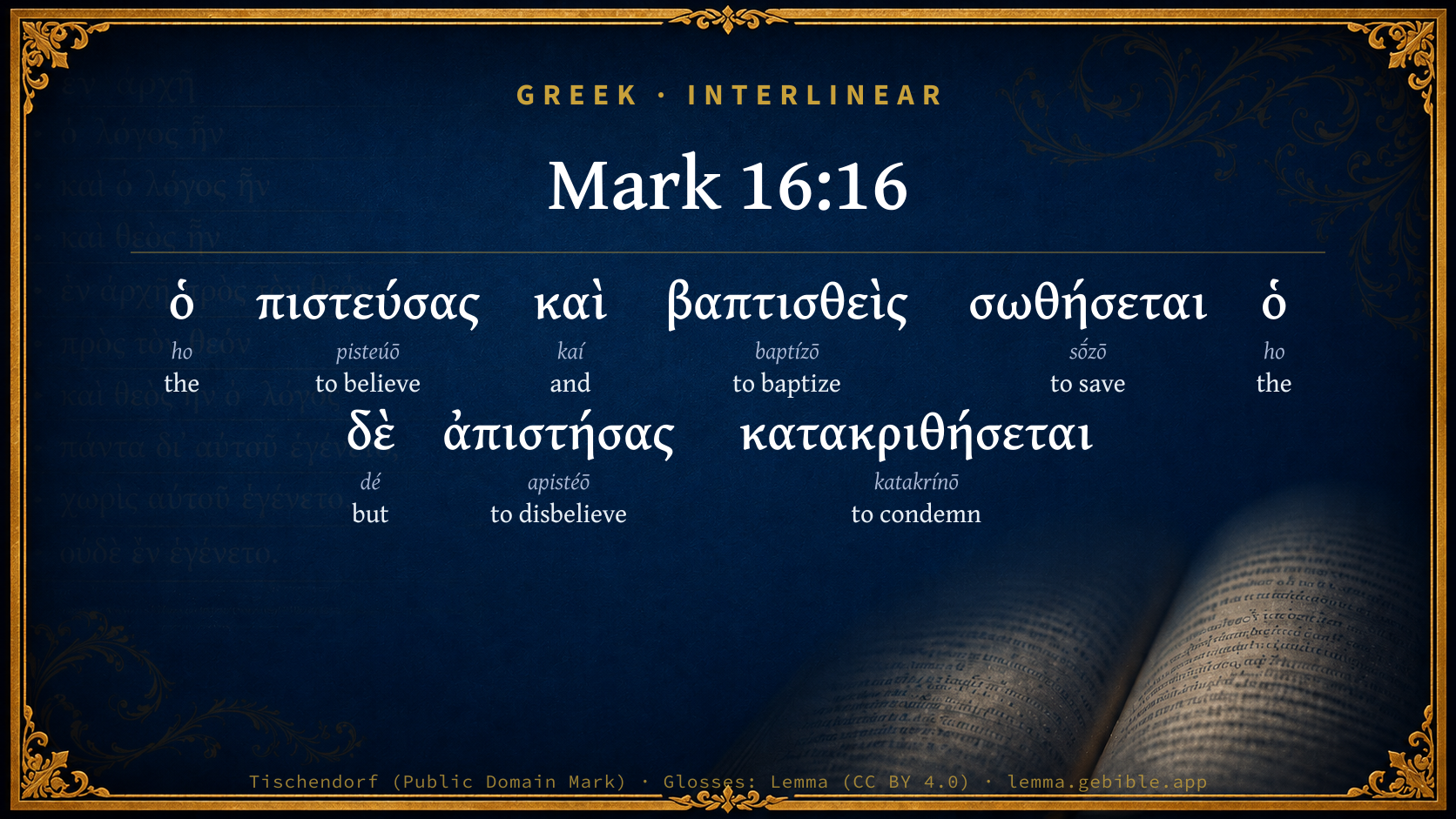
He who believes and is baptized will be saved; but he who disbelieves will be condemned.
Download a study sheet
One document with this verse’s original text, its word-by-word gloss line, the meaning frame, cross-references with their text, attributed commentary, and full source and license credits — printable, and it pastes into notes with its structure intact.
This verse Autodidact and up
A passage Seminary Student
Up to 50 verses in one chapter. A passage sheet keeps up to 6 commentary sources and 12 cross-references per verse, in the order this page ranks them, and says so on the sheet whenever that leaves anything out. Ask for a single verse and you get the Autodidact verse sheet above.
Everything on this page stays free to read, with no account — the sheet is a download of what is already on screen, not access to it.
Compare translations 3
The same verse in 3 English versions, stacked beneath the original-language interlinear above. Click any original word for its lexicon entry.
Each is an independent rendering of the whole verse — the interlinear is not word-aligned to these translations.
Highlighted words mark where these versions differ — a whole-verse word diff, not a word-by-word alignment.
-
World English Bible Public Domain
He who believes and is baptized will be saved; but he who disbelieves will be condemned.
-
King James Version Public Domain
He that believeth and is baptized shall be saved; but he that believeth not shall be damned.
-
unfoldingWord Literal Text CC BY-SA 4.0
The one having believed and having been baptized will be saved, but the one not having believed will be condemned.
unfoldingWord Literal Text — © unfoldingWord, licensed CC BY-SA 4.0. Word-aligned USFM3 via Door43 (git.door43.org/unfoldingWord/en_ult).
Show all 19 translations
Every available English version of this verse, each an independent rendering of the whole verse.
-
World English Bible Public Domain
He who believes and is baptized will be saved; but he who disbelieves will be condemned.
-
Berean Standard Bible Public Domain
Whoever believes and is baptized will be saved, but whoever does not believe will be condemned.
-
Majority Standard Bible Public Domain
Whoever believes and is baptized will be saved, but whoever does not believe will be condemned.
-
King James Version Public Domain
He that believeth and is baptized shall be saved; but he that believeth not shall be damned.
-
American Standard Version (1901) Public Domain
He that believeth and is baptized shall be saved; but he that disbelieveth shall be condemned.
-
Revised Version (1885) Public Domain
He that believeth and is baptized shall be saved; but he that disbelieveth shall be condemned.
-
Geneva Bible (1599) Public Domain
He that shall beleeue and be baptized, shalbe saued: but he that will not beleeue, shalbe damned.
-
Douay-Rheims (1899) Public Domain
He that believeth and is baptized, shall be saved: but he that believeth not shall be condemned.
-
Young's Literal Translation Public Domain
he who hath believed, and hath been baptized, shall be saved; and he who hath not believed, shall be condemned.
-
Literal Standard Version CC BY-SA 4.0
he who has believed and has been immersed will be saved; and he who has not believed will be condemned.
-
Unlocked Literal Bible CC BY-SA 4.0
He who believes and is baptized will be saved, and he who does not believe will be condemned.
-
unfoldingWord Literal Text CC BY-SA 4.0
The one having believed and having been baptized will be saved, but the one not having believed will be condemned.
-
Darby Bible Public Domain
He that believes and is baptised shall be saved, and he that disbelieves shall be condemned.
-
World Messianic Bible Public Domain
He who believes and is immersed will be saved; but he who disbelieves will be condemned.
-
Webster's Bible Public Domain
He that believeth and is baptized, shall be saved; but he that believeth not shall be damned.
-
Free Bible Version CC BY-SA 4.0
Anyone who trusts in me and is baptized will be saved, but anyone who chooses not to trust will be condemned.
-
Bible in Basic English Public Domain
He who has faith and is given baptism will get salvation; but he who has not faith will be judged.
-
Text-Critical English NT CC BY 4.0
Whoever believes and is baptized will be saved, but whoever does not believe will be condemned.
-
Tyndale New Testament (1534) Public Domain
he that beleueth and is baptised shall be saved. But he that beleveth not shalbe dampned.
Literal Standard Version (2020), Covenant Press — licensed CC BY-SA 4.0. Text via the HelloAO Bible API (eBible.org). Unlocked Literal Bible (unfoldingWord) — licensed CC BY-SA 4.0. Text via the HelloAO Bible API (eBible.org). unfoldingWord Literal Text — © unfoldingWord, licensed CC BY-SA 4.0. Word-aligned USFM3 via Door43 (git.door43.org/unfoldingWord/en_ult). Free Bible Version, Dr. Jonathan Gallagher — licensed CC BY-SA 4.0. Text via the HelloAO Bible API (eBible.org).
Word by word
More ways to search: Search by grammar → Find every occurrence → Compare this word →
Practice this passage: Drill this verse → Learn its vocabulary →
- Appears 8× in the Greek New Testament
- First appears at Mark 16:11
- Part of Speech
- Verb
- Tense
- Aorist
- Voice
- Active
- Mood
- Participle
- Case
- Nominative
- Number
- Singular
- Gender
- Masculine
Full Thayer's Definition
- ὁ ho G3588 “the” Article, Nominative, Singular, Masculine
- πιστεύσας pisteúō G4100 “to believe” Verb, Aorist, Active, Participle, Nominative, Singular, Masculine
- καὶ kaí G2532 “and” Conjunction
- βαπτισθεὶς baptízō G907 “to baptize” Verb, Aorist, Passive, Participle, Nominative, Singular, Masculine
- σωθήσεται sṓzō G4982 “to save” Verb, Future, Passive, Indicative, 3rd person, Singular
- ὁ ho G3588 “the” Article, Nominative, Singular, Masculine
- δὲ dé G1161 “but” Conjunction
- ἀπιστήσας apistéō G569 “to disbelieve” Verb, Aorist, Active, Participle, Nominative, Singular, Masculine
- κατακριθήσεται katakrínō G2632 “to condemn” Verb, Future, Passive, Indicative, 3rd person, Singular
About this verse
These counts appear in no published source. They are computed here, from the morphology-tagged text and Lemma’s own curated glosses. What Lemma adds →
- 9
- words
- 8
- distinct lemmas
- Gospels
- section
Notable vocabulary
The rarest word here is ἀπιστήσας to disbelieve G569 — appearing just 8 times in the whole Greek New Testament.
Shared distinctive vocabulary
ἀπιστήσας to disbelieve G569 occurs in 8 verses of the Greek New Testament. Also found in:
Repetition
A word recurs within this verse:
- ὁ the G3588 ×2

Cross-references
36Topical passages linked to Mark 16:16 in the Treasury of Scripture Knowledge — connected by theme and wording, ordered by reader-vote popularity; previews shown in the World English Bible.
- John 11:25–26 Jesus said to her, "I am the resurrection and the life. He who believes in me, though he die, yet will he live.
- John 3:36 One who believes in the Son has eternal life, but one who disobeys the Son won't see life, but the wrath of God remains on him."
- Romans 10:9–14 that if you will confess with your mouth the Lord Jesus, and believe in your heart that God raised him from the dead, you will be saved.
- John 3:18–19 He who believes in him is not judged. He who doesn't believe has been judged already, because he has not believed in the name of the one and only Son of God.
- John 3:15–16 that whoever believes in him should not perish, but have eternal life.
- Acts 2:38 Peter said to them, "Repent, and be baptized, everyone of you, in the name of Jesus Christ for the forgiveness of sins, and you will receive the gift of the Holy Spirit.
- John 5:24 "Most assuredly I tell you, he who hears my word, and believes him who sent me, has eternal life, and doesn't come into judgment, but has passed out of death into life.
- John 8:24 I said therefore to you that you will die in your sins; for unless you believe that I am he, you will die in your sins."
- John 12:46–48 I have come as a light into the world, that whoever believes in me may not remain in the darkness.
- 1 John 5:10–13 He who believes in the Son of God has the testimony in himself. He who doesn't believe God has made him a liar, because he has not believed in the testimony that God has given concerning his Son.
- John 6:29 Jesus answered them, "This is the work of God, that you believe in him whom he has sent."
- John 3:5 Jesus answered, "Most assuredly I tell you, unless one is born of water and spirit, he can't enter into the Kingdom of God!
- Acts 10:43 All the prophets testify about him, that through his name everyone who believes in him will receive remission of sins."
- John 7:37–38 Now on the last and greatest day of the feast, Jesus stood and cried out, "If anyone is thirsty, let him come to me and drink!
- John 20:31 but these are written, that you may believe that Jesus is the Christ, the Son of God, and that believing you may have life in his name.
- Acts 16:30–32 and brought them out and said, "Sirs, what must I do to be saved?"
- Revelation 20:15 If anyone was not found written in the book of life, he was cast into the lake of fire.
- John 6:35 Jesus said to them, "I am the bread of life. He who comes to me will not be hungry, and he who believes in me will never be thirsty.
- 1 Peter 3:21 This is a symbol of baptism, which now saves you-- not the putting away of the filth of the flesh, but the answer of a good conscience toward God, through the resurrection of Jesus Christ,
- Mark 1:15 and saying, "The time is fulfilled, and the Kingdom of God is at hand! Repent, and believe in the Gospel."
- Acts 22:16 Now why do you wait? Arise, be baptized, and wash away your sins, calling on the name of the Lord.'
- John 6:40 This is the will of the one who sent me, that everyone who sees the Son, and believes in him, should have eternal life; and I will raise him up at the last day."
- John 1:12–13 But as many as received him, to them he gave the right to become God's children, to those who believe in his name:
- Acts 2:41 Then those who gladly received his word were baptized. There were added that day about three thousand souls.
- 1 Peter 1:21 who through him are believers in God, who raised him from the dead, and gave him glory; so that your faith and hope might be in God.
- Matthew 28:19 Therefore go, and make disciples of all nations, baptizing them in the name of the Father and of the Son and of the Holy Spirit,
- Luke 8:12 Those along the road are those who hear, then the devil comes, and takes away the word from their heart, that they may not believe and be saved.
- Hebrews 10:38–39 But the righteous will live by faith. If he shrinks back, my soul has no pleasure in him."
- Revelation 21:8 But for the cowardly, unbelieving, sinners, abominable, murderers, sexually immoral, sorcerers, idolaters, and all liars, their part is in the lake that burns with fire and sulfur, which is the second death."
- Acts 8:36–39 As they went on the way, they came to some water, and the eunuch said, "Behold, here is water. What is keeping me from being baptized?"
- Acts 13:39 and by him everyone who believes is justified from all things, from which you could not be justified by the law of Moses.
- Romans 4:24 but for our sake also, to whom it will be accounted, who believe in him who raised Jesus, our Lord, from the dead,
- 2 Thessalonians 1:8 giving vengeance to those who don't know God, and to those who don't obey the Gospel of our Lord Jesus,
- 2 Thessalonians 2:12 that they all might be judged who didn't believe the truth, but had pleasure in unrighteousness.
- Acts 13:46 Paul and Barnabas spoke out boldly, and said, "It was necessary that God's word should be spoken to you first. Since indeed you thrust it from you, and judge yourselves unworthy of eternal life, behold, we turn to the Gentiles.
- Romans 3:6 May it never be! For then how will God judge the world?
Cross-references courtesy of OpenBible.info (CC BY 4.0).
Where the printed editions differ
1 variantPlaces in this verse where the major printed Greek editions disagree on the wording in a way that affects the translation — a comparison of editions, not a manuscript-by-manuscript collation. The editions are the modern critical texts (Nestlé-Aland 28/27, SBL, Westcott-Hort, Tregelles, Tyndale House) and the traditional texts behind the KJV (the Textus Receptus and the Byzantine/Majority text). It is not a claim about which reading is original.
-
Extra text
ὁ πιστεύσας καὶ βαπτισθεὶς σωθήσεται· ὁ δὲ ἀπιστήσας κατακριθήσεται.
“The [one] having believed and having been baptized will be saved; the [one] however having disbelieved will be condemned.”
In NA28NA27TynWHTregTRByz Not in SBLὁ πιστεύσας καὶ βαπτισθεὶς σωθήσεται· ὁ δὲ ἀπιστήσας κατακριθήσεται.¶ (ho pisteusas kai baptistheis sōthēsetai ho de apistēsas katakrithēsetai) 'The [one] having believed and having been baptized will be saved; the [one] however having disbelieved will be condemned.' is only in traditional manuscripts
Textual data: Translators Amalgamated Greek New Testament (STEPBible TAGNT) · CC BY 4.0.
Lesson kit
Teaching starters — assembled from the data on this page, not authored interpretation. Every prompt links to the verse data it draws on. Edit before teaching.
Mark, in the Gospels, opens this verse with 9 words (8 distinct Greek lemmas). Its most distinctive word is apistéō (“to disbelieve”). A historical commentator’s framing appears above. Read the whole chapter for the surrounding context.
Discussion questions
- How does “to disbelieve” (apistéō) shape what this verse is saying?
- How does Mark 16:11, which shares the word «to disbelieve», read alongside this verse?
- What does the repetition of “the” (2× in this one verse) do in this verse?
- The translations on this page render this verse differently — a whole-verse word diff, not a word-by-word alignment. What might account for the different wordings?
- Compare how The Biblical Illustrator and Bengel's Gnomon read this verse. Where do they agree or differ?
Things to notice
- These translations choose different wording for 12 words in this verse.
- “the” occurs 2× in this single verse.
- 8 distinct Greek lemmas span 9 words in this verse.
Commentary
Notes on Mark 16:16 from classic Christian and Jewish commentators (each source and its license shown beneath its notes). The classic Christian expositions comment on the surrounding passage and are grouped to its opening verse, so a note may address several verses; the Jewish commentaries on the Tanakh (Rashi and others) are per-verse, so they appear only where the commentator wrote on this verse.
Lemma curates 59 commentaries, every one of them public domain or Creative Commons licensed, each selected and text-cleaned for this edition rather than reprinted as found. About our sources →
The Biblical Illustrator
Joseph S. Exell
The Biblical Illustrator, edited by Joseph S. Exell (c. 1880s–1900s) — public domain. Text from a community e-Sword module.
Bengel's Gnomon
Johann Albrecht Bengel
Bengel's Gnomon of the New Testament — English translation (T&T Clark, Edinburgh, 1860) — public domain. Text from a community e-Sword module.
Meyer's Critical & Exegetical Commentary
Heinrich August Wilhelm Meyer
Meyer — Critical and Exegetical Commentary on the New Testament — English translation by Peter Christie, edited by Frederick Crombie (T&T Clark, 1880) — public domain. Text from a community e-Sword module.
Expositor's Greek Testament
ed. W. Robertson Nicoll
The Expositor's Greek Testament, edited by W. Robertson Nicoll (1897–1910) — public domain. Text from a community e-Sword module.
Adam Clarke's Commentary
Adam Clarke's Commentary on the Bible (1810–1826) — public domain. Text from a community e-Sword/MySword module.
Ellicott's Commentary for English Readers
A Bible Commentary for English Readers, edited by Charles John Ellicott (1878–1897) — public domain. Text from a community e-Sword module.
The Cambridge Bible for Schools and Colleges
gen. ed. J. J. S. Perowne
The Cambridge Bible for Schools and Colleges (gen. ed. J. J. S. Perowne; Cambridge University Press, 1878–1918) — public domain. Text from a community e-Sword module.
John Gill's Exposition
John Gill's Exposition of the Whole Bible (1746–1763) — public domain (CC PDM 1.0). Text via the HelloAO Bible API.
Trapp's Complete Commentary
John Trapp
John Trapp, A Commentary or Exposition upon All the Books of the Old and New Testament (1647–1656) — public domain. Text from a community e-Sword module.
Albert Barnes' Notes on the Bible
Albert Barnes' Notes on the Bible (1834–1885) — public domain. Text from a community e-Sword/MySword module.
Haydock's Catholic Bible Commentary
George Leo Haydock (1774–1849), Haydock's Catholic Family Bible and Commentary, 1859 edition — public domain. Excludes Psalms (Douay-Rheims chapter numbering differs from Protestant) and Deuterocanonical books (Catholic canon only).
Whedon's Commentary on the Bible
Daniel D. Whedon
Daniel D. Whedon (gen. ed.), Commentary on the Old and New Testaments (1874–1909) — public domain. Text from a community e-Sword module.
John Wesley's Explanatory Notes
John Wesley, Explanatory Notes Upon the Whole Bible (1754–1765) — public domain. Text via the GEBible commentary corpus.
Scofield Reference Notes
C. I. Scofield
The Scofield Reference Bible (1917 edition), notes by C. I. Scofield — public domain. Text from a community e-Sword module.
The People's New Testament
B. W. Johnson
B. W. Johnson's The People's New Testament with Notes (1889–1891) — public domain. Electronic text from the Christian Classics Ethereal Library (CCEL) ThML edition.
Cambridge Greek Testament for Schools and Colleges
Cambridge Greek Testament for Schools and Colleges (Cambridge University Press, 1896; 21 vols, various authors incl. Carr, Maclear, Plummer, Farrar, Lumby, Moule, M. R. James, Simcox) — public domain. Text from a community e-Sword module.
Alford’s Greek Testament
Henry Alford
Henry Alford, The Greek Testament (1849–1861) — public domain. Text from a community e-Sword module.
International Critical Commentary
International Critical Commentary — older volumes (1896–1929), various authors — public domain. Text from a community e-Sword module.
Vincent's Word Studies in the New Testament
Marvin R. Vincent
Marvin R. Vincent, Word Studies in the New Testament (1887–1900) — public domain. Text from a community e-Sword/MySword module.