Luke 1:45

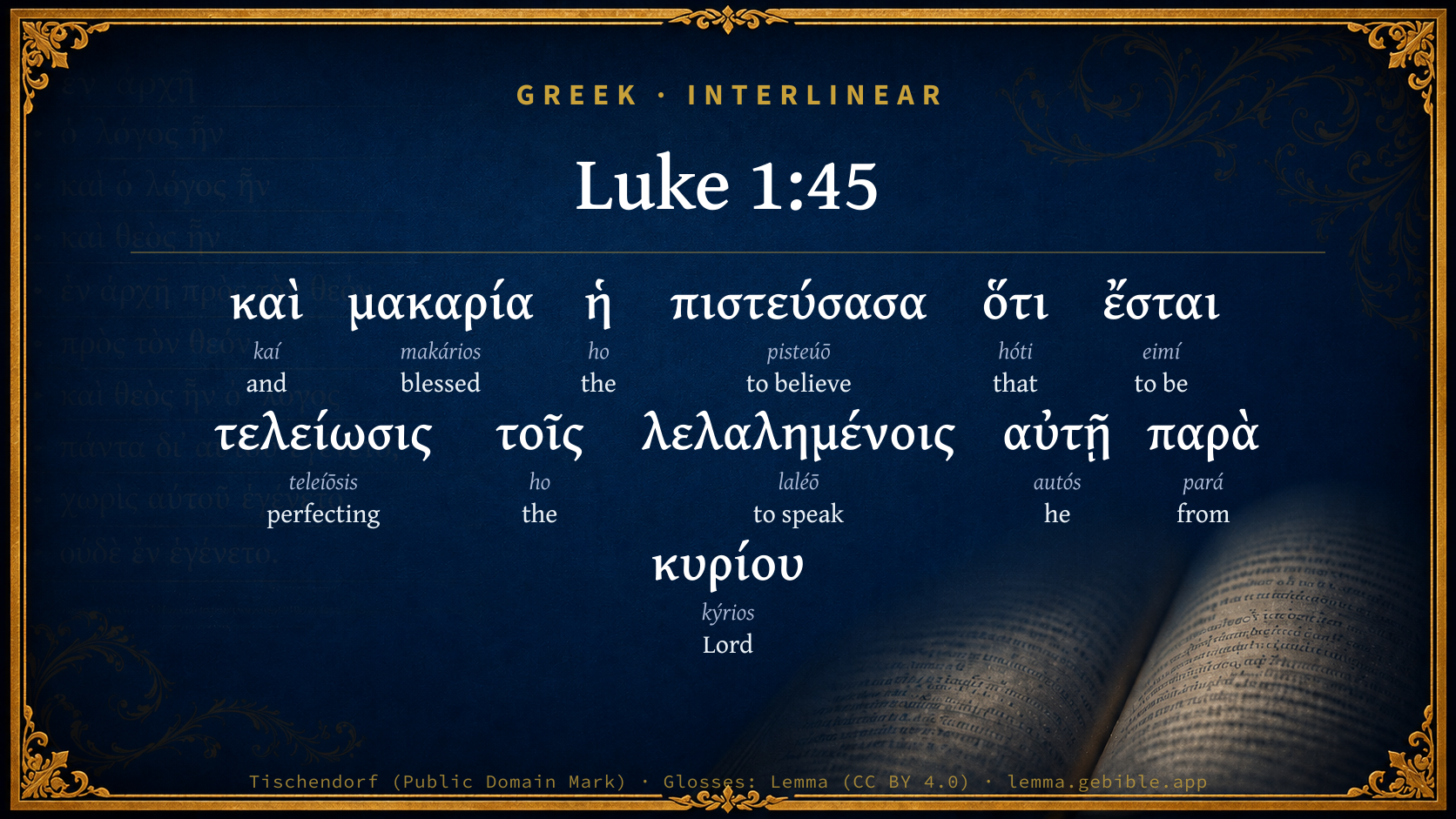
Greek (Tischendorf 8th ed.) Luke 1:45 appears in the Greek New Testament. The text above is from the Tischendorf 8th edition. Each word links to its Strong’s number and a concise gloss. Click any word for its full Thayer’s Greek Lexicon entry.
Download image
Cite this verse

Luke 1:45 (World English Bible). Public Domain. Lemma interlinear Bible study tool, https://lemma.gebible.app/v/luke/1/45.

Show BibTeX & RIS
BibTeX
RIS
English Translation
Blessed is she who believed, for there will be a fulfillment of the things which have been spoken to her from the Lord!"
World English Bible · Public Domain
Highlights
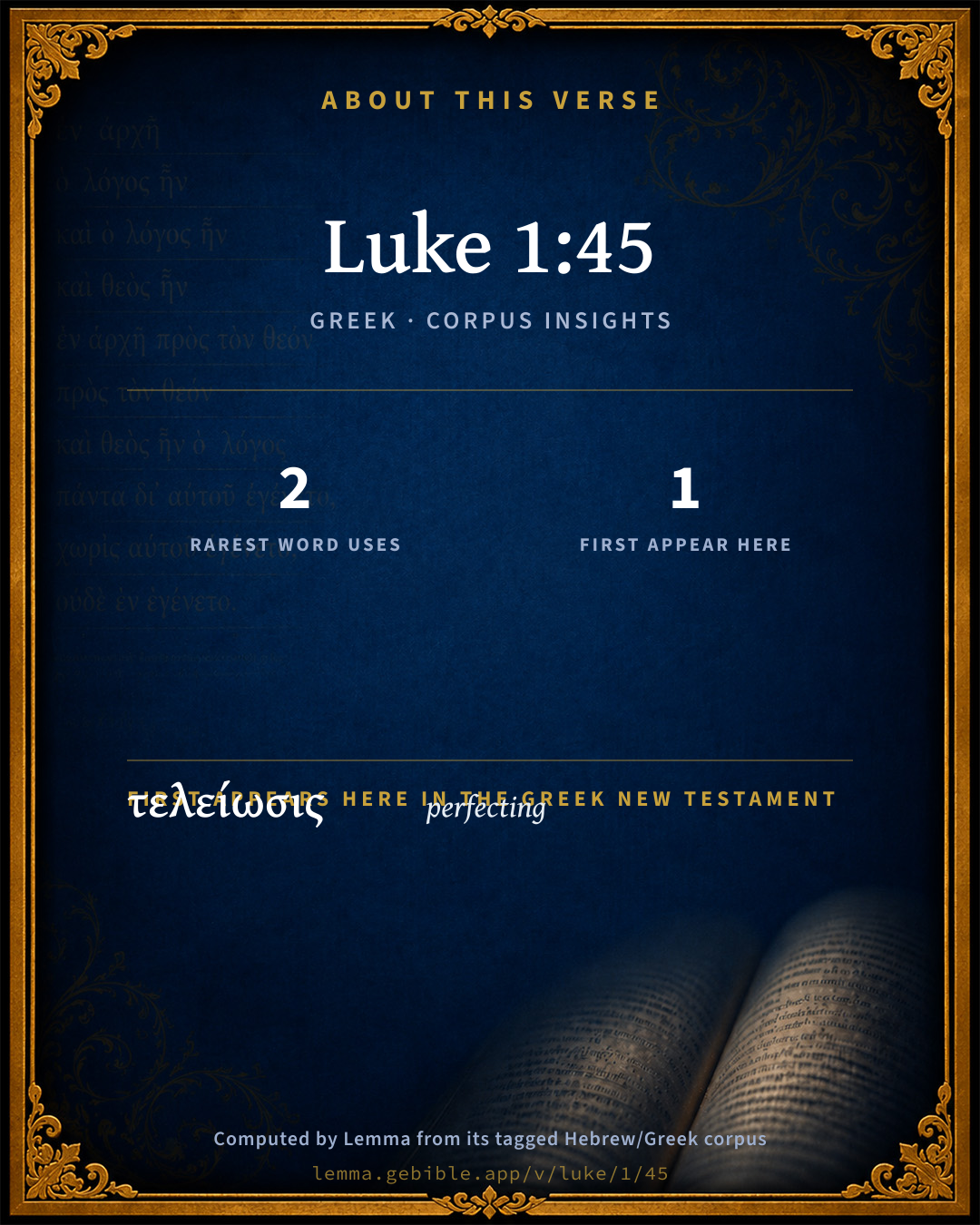
  • 1 first appearance in the Greek New Testament
Full analysis ↓
Download a study sheet

One document with this verse’s original text, its word-by-word gloss line, the meaning frame, cross-references with their text, attributed commentary, and full source and license credits — printable, and it pastes into notes with its structure intact.

This verse Autodidact and up

Study sheet (.html) Plain text (.txt)

A passage Seminary Student

Up to 50 verses in one chapter. A passage sheet keeps up to 6 commentary sources and 12 cross-references per verse, in the order this page ranks them, and says so on the sheet whenever that leaves anything out. Ask for a single verse and you get the Autodidact verse sheet above.

Everything on this page stays free to read, with no account — the sheet is a download of what is already on screen, not access to it.

Want to remove ads? Support Godless Engineer
Compare translations 3

The same verse in 3 English versions, stacked beneath the original-language interlinear above. Click any original word for its lexicon entry.

Each is an independent rendering of the whole verse — the interlinear is not word-aligned to these translations.

Highlighted words mark where these versions differ — a whole-verse word diff, not a word-by-word alignment.

  • World English Bible Public Domain
    Blessed is she who believed, for there will be a fulfillment of the things which have been spoken to her from the Lord!"
  • King James Version Public Domain
    And blessed is she that believed: for there shall be a performance of those things which were told her from the Lord.
  • unfoldingWord Literal Text CC BY-SA 4.0
    And blessed the one having believed that there would be a fulfillment of the had been spoken to her from the Lord.”

unfoldingWord Literal Text — © unfoldingWord, licensed CC BY-SA 4.0. Word-aligned USFM3 via Door43 (git.door43.org/unfoldingWord/en_ult).

Versions to compare (up to 4)

3 of 4 selected

Show all 19 translations

Every available English version of this verse, each an independent rendering of the whole verse.

  • World English Bible Public Domain
    Blessed is she who believed, for there will be a fulfillment of the things which have been spoken to her from the Lord!"
  • Berean Standard Bible Public Domain
    Blessed is she who has believed that the Lord’s word to her will be fulfilled.”
  • Majority Standard Bible Public Domain
    Blessed is she who has believed that the Lord’s word to her will be fulfilled.”
  • King James Version Public Domain
    And blessed is she that believed: for there shall be a performance of those things which were told her from the Lord.
  • American Standard Version (1901) Public Domain
    And blessed `is' she that believed; for there shall be a fulfilment of the things which have been spoken to her from the Lord.
  • Revised Version (1885) Public Domain
    And blessed is she that believed; for there shall be a fulfillment of the things which have been spoken to her from the Lord.
  • Geneva Bible (1599) Public Domain
    And blessed is shee that beleeued: for those things shall be perfourmed, which were tolde her from the Lord.
  • Douay-Rheims (1899) Public Domain
    And blessed art thou that hast believed, because those things shall be accomplished that were spoken to thee by the Lord.
  • Young's Literal Translation Public Domain
    and happy `is' she who did believe, for there shall be a completion to the things spoken to her from the Lord.'
  • Literal Standard Version CC BY-SA 4.0
    and blessed [is] she who believed, for there will be a completion to the things spoken to her from the LORD.”
  • Unlocked Literal Bible CC BY-SA 4.0
    Blessed is she who believed that there would be a fulfillment of the things that were told her from the Lord.”
  • unfoldingWord Literal Text CC BY-SA 4.0
    And blessed the one having believed that there would be a fulfillment of the had been spoken to her from the Lord.”
  • Darby Bible Public Domain
    And blessed [is] she that has believed, for there shall be a fulfilment of the things spoken to her from [the] Lord.
  • World Messianic Bible Public Domain
    Blessed is she who believed, for there will be a fulfillment of the things which have been spoken to her from the Lord!”
  • Webster's Bible Public Domain
    And blessed is she that believed that there will be a performance of those things which were told her from the Lord.
  • Free Bible Version CC BY-SA 4.0
    How fortunate you are, because you are convinced that the Lord will do what he has promised you!”
  • Bible in Basic English Public Domain
    Happy will she be who had faith that the things which the Lord has said to her will be done.
  • Text-Critical English NT CC BY 4.0
    Blessed is she who has believed, for what the Lord has spoken to her will be fulfilled.”
  • Tyndale New Testament (1534) Public Domain
    And blessed arte thou that belevedst: for thoose thinges shalbe performed wich were tolde the from the lorde.

Literal Standard Version (2020), Covenant Press — licensed CC BY-SA 4.0. Text via the HelloAO Bible API (eBible.org). Unlocked Literal Bible (unfoldingWord) — licensed CC BY-SA 4.0. Text via the HelloAO Bible API (eBible.org). unfoldingWord Literal Text — © unfoldingWord, licensed CC BY-SA 4.0. Word-aligned USFM3 via Door43 (git.door43.org/unfoldingWord/en_ult). Free Bible Version, Dr. Jonathan Gallagher — licensed CC BY-SA 4.0. Text via the HelloAO Bible API (eBible.org).

Word by word

More ways to search: Search by grammar → Find every occurrence → Compare this word →

Practice this passage: Drill this verse → Learn its vocabulary →

About this verse

These counts appear in no published source. They are computed here, from the morphology-tagged text and Lemma’s own curated glosses. What Lemma adds →

12
words
11
distinct lemmas
Gospels
section

Notable vocabulary

The rarest word here is τελείωσις perfecting G5050 — appearing just 2 times in the whole Greek New Testament.

First appearance in Scripture

This word makes its first canonical appearance in the Greek New Testament here:

  • τελείωσις perfecting G5050

Shared distinctive vocabulary

τελείωσις perfecting G5050 occurs in 2 verses of the Greek New Testament. Also found in:

Repetition

A word recurs within this verse:

Cross-references

5

Topical passages linked to Luke 1:45 in the Treasury of Scripture Knowledge — connected by theme and wording, ordered by reader-vote popularity; previews shown in the World English Bible.

  • John 20:29 Jesus said to him, "Because you have seen me, you have believed. Blessed are those who have not seen, and have believed."
  • John 11:40 Jesus said to her, "Didn't I tell you that if you believed, you would see God's glory?"
  • Luke 11:27–28 It came to pass, as he said these things, a certain woman out of the multitude lifted up her voice, and said to him, "Blessed is the womb that bore you, and the breasts which nursed you!"
  • Luke 1:20 Behold, you will be silent and not able to speak, until the day that these things will happen, because you didn't believe my words, which will be fulfilled in their proper time."
  • 2 Chronicles 20:20 They rose early in the morning, and went forth into the wilderness of Tekoa: and as they went forth, Jehoshaphat stood and said, Hear me, Judah, and you inhabitants of Jerusalem: believe in Yahweh your God, so shall you be established; believe his prophets, so shall you prosper.

Cross-references courtesy of OpenBible.info (CC BY 4.0).

Commentary

Notes on Luke 1:45 from classic Christian and Jewish commentators (each source and its license shown beneath its notes). The classic Christian expositions comment on the surrounding passage and are grouped to its opening verse, so a note may address several verses; the Jewish commentaries on the Tanakh (Rashi and others) are per-verse, so they appear only where the commentator wrote on this verse.

Lemma curates 59 commentaries, every one of them public domain or Creative Commons licensed, each selected and text-cleaned for this edition rather than reprinted as found. About our sources →

The Biblical Illustrator

Joseph S. Exell

Luk_1:45

And blessed is she that believeth,--

Blessedness of firmly believing

Doubting nothing! That is the secret of liberty, of efficiency, of success in every work which is undertaken by men: a confidence in the practicability, in the value of the work, in the Divine authority which imposes it upon us as an obligatory work, and in the Divine providence and power which will bring it to a successful performance.

It is the secret of success, of enthusiasm in any secular enterprise. You see it in the inventor who is perfectly certain of the combination of instruments by which he is to accomplish a certain result--a result which is of value and importance to mankind. Nothing can hinder his endeavour, nothing can obscure or damp his enthusiasm, because he is certain of ultimate success. You see it in the teacher who knows that he has a truth to communicate to men, a truth which it is of importance to them to apprehend and to understand, who is not groping among uncertainties as he speaks it, who is not vaguely feeling after conjectures while he utters it, who is able to affirm it to others, because he has it affirmed in his own intelligent and intuitive spirit--the principle which he is declaring to the world. Kepler said: God has waited so many centuries for an observer of the heavens, I can wait for years for an interpreter of those observations. And every man who as certainly knew that he had apprehended truth and had it conveyed to others has been reinforced, inspired by this confidence, and gone to his work doubting nothing. See it in the soldier who knows, because he knows the commander, that the order which has been given is wise, practicable, needful; that no life will be wasted which can be saved, and no endeavour commanded which is not indispensable to the great result. See it in the sailor who trusts his clock and his compass, and is absolutely certain that the sun, of which he takes the meridian observation, will not tell him a lie, but will point out exactly the point on the ocean where the ship at that moment is; and he goes on his course, after his observation, doubting nothing, knowing where he is as exactly as if the commerce of nations had built at that very spot a beacon and had labelled it in immense letters of light in all the languages of the world: This is at such a point on such a meridian. He knows as certainly as he could know then, when he has caught the ray of the sun upon his instrument, where he is on the ocean, which to others seems pathless and intricate. Everywhere, then, this confidence is the condition of enthusiasm and of success, and in Christian enterprises, precisely as in secular enterprises, it is a confidence not merely in the usefulness of the work, but in the Divine authority which connects itself with that work, and the Divine care and the Divine affection, the Divine impulse which attend us in our endeavours to perform it. (R. Storrs.)

Saving faith

I. IN THE SIMPLICITY OF ITS NATURE.

II. IN THE IMPORTANCE OF ITS OBJECTS.

III. IN THE SUFFICIENCY OF ITS GROUNDS.

IV. IN THE PROPRIETY OF ITS ACTS.

V. IN THE BENEFITS OF ITS EXERCISE. Blessed is she that believeth; for there shall be a performance, and only a performance when we believe. (William Dawson.)

Trust in God

Marys faith, astounding in itself, the most supreme example probably of perfect trust in God and absolute self-devotion to Him that human flesh has ever given, was all the more striking to Elisabeth on account of its contrast with the unbelief of her own husband under a far less severe trial. No wonder that when Mary appeared before her spirit-illuminated eyes, she seemed the embodiment of Faith--that modest virgin, with clasped hands, whom Hermas saw in vision, though whom the elect of God are saved, and from whom spring all the Christian graces as fair daughters of a fair mother. Mary is thus, in Elisabeths eyes, the most blessed of women, because the most faithful; and it suits well that the first psalm of the New Testament should take the form of a praise of the fundamental evangelical virtue. (Professor Warfield.)

The Biblical Illustrator, edited by Joseph S. Exell (c. 1880s–1900s) — public domain. Text from a community e-Sword module.

Bengel's Gnomon

Johann Albrecht Bengel

Luk 1:45. Μακαρία, blessed) This is evident from the instance of Zacharias on the opposite side.—πιστεύσασα, who hath believed) Luk 1:38.—ὅτι ἔσται) that [but Engl Vers. for) there shall be.—αὐτῇ, to her [in particular]) This has an emphatic reference to ἡ πιστεύσασα, who hath believed, and is put instead of, to thee: just as in ch. Luk 13:34.

Bengel's Gnomon of the New Testament — English translation (T&T Clark, Edinburgh, 1860) — public domain. Text from a community e-Sword module.

Expositor's Greek Testament

ed. W. Robertson Nicoll

Luk 1:45 . μακαρία , here, as elsewhere, points to rare and high felicity connected with heroic moods and achievements. ὅτι , because or that , which? great conflict of opinion among commentators. The former sense would make ὅτι give the reason for calling Mary blessed = blessed because the things she hopes for will surely come to pass. The latter makes ὅτι indicate the object of faith = blessed she who believes that what God has said will come to pass, with possible allusion to her own husband’s failure in faith.

The Expositor's Greek Testament, edited by W. Robertson Nicoll (1897–1910) — public domain. Text from a community e-Sword module.

Jamieson, Fausset & Brown

Robert Jamieson, A. R. Fausset & David Brown

An additional benediction on the Virgin for her implicit faith, in tacit and delicate contrast with her own husband.

for--rather, as in the Margin, "that."

Jamieson, Fausset & Brown — Commentary Critical and Explanatory on the Whole Bible (1871) — public domain (CC PDM 1.0). Text via the HelloAO Bible API.

Adam Clarke's Commentary

Verse 45. Blessed is she that believed; for there shall be, &c.] Or, Blessed is she who hath believed that there shall be, &c. This I believe to be the proper arrangement of the passage, and is thus noticed in the marginal reading. Faith is here represented as the foundation of true happiness, because it receives the fulfilment of God's promises. Whatever God has promised, he intends to perform. We should believe whatever he has spoken-his own authority is a sufficient reason why we should believe. Let us only be convinced that God has given the promise, and then implicit faith becomes an indispensable duty: in this case not to believe implicitly would be absurd and unreasonable - God will perform his promise, for HE cannot lie.

Adam Clarke's Commentary on the Bible (1810–1826) — public domain. Text from a community e-Sword/MySword module.

Ellicott's Commentary for English Readers

(45) Blessed is she that believed.—The two renderings, “for there shall be,” and “that there shall be,” are equally tenable grammatically. On internal grounds there seems a balance in favour of the latter, as the other interpretation appears to make the fulfilment of the promise dependent upon the Virgin’s faith.

A Bible Commentary for English Readers, edited by Charles John Ellicott (1878–1897) — public domain. Text from a community e-Sword module.

The Cambridge Bible for Schools and Colleges

gen. ed. J. J. S. Perowne

45. blessed is she that believed] Perhaps Elizabeth had in mind the affliction which had followed her husband’s doubt. Comp. Joh_20:29.

for there shall be a performance] The words may also mean ‘she that believed that there shall be,’ &c.

The Cambridge Bible for Schools and Colleges (gen. ed. J. J. S. Perowne; Cambridge University Press, 1878–1918) — public domain. Text from a community e-Sword module.

John Gill's Exposition

And blessed is she that believed..... Meaning Mary, a woman, a very young woman, and who had had things very incredible to nature and reason told her; and yet she believed, without objecting thereto, or requiring a sign; tacitly referring to the unbelief of Zacharias, who was a man, a man in years, a priest by office; and yet had been very incredulous, in a thing that was much more possible; because there had been instances of it before, in Sarah, Hannah, and Manoah's wife; than what was related to the virgin, of which there had been none; and which to reason, and with men, was impossible: and happy indeed is every one, that has true faith in any degree; for faith is the faith of God's elect, and is both a fruit and evidence of electing grace, which is the source of all blessings; it is the gift of God, and the operation of his Spirit, and can never be lost: many are the blessings such as believe are in the possession of, and openly entitled to; as the justification of their persons, the remission of their sins, their adoption into the household of God, liberty at the throne of grace, and a right to the eternal inheritance; they enjoy much solid peace, joy, and comfort in their own souls; bring much glory to God, and shall be saved in the Lord, with an everlasting salvation:

for there shall be a performance of those things which were told her from the Lord: these words may be considered, either as the subject matter of her faith, and be rendered in connection with the former, thus, "blessed is she that believed, that there shall be a performance, &c", being fully persuaded, that what the angel had told her, concerning the conception and birth of a son, concerning his name, and the greatness of his person, and the nature, extent, and duration of his kingdom, should be certainly and punctually fulfilled; or as a reason of her happiness, because there should be a sure accomplishment of them. Whatever God has spoken to any of his people, whether it be with respect to things temporal, spiritual, or eternal, shall be performed; as may be strongly concluded from the veracity of God, who cannot lie; and from his power, who is able to do all things; and from his faithfulness, which he will never suffer to fail; and from instances, and matters of fact; from the experience of the saints in all ages, who know, and are conscious to themselves, that not one of the good things the Lord God has spoken to them, has ever failed, but that all have come to pass; see Jos 23:14.

John Gill's Exposition of the Whole Bible (1746–1763) — public domain (CC PDM 1.0). Text via the HelloAO Bible API.

Trapp's Complete Commentary

John Trapp

45 And blessed is she that believed: for there shall be a performance of those things which were told her from the Lord.

Ver. 45. Blessed is she, &c.] Mary believed, so did not Zacharias, though a man, a priest, aged, learned, eminent, and the message to him of more appearing possibility. This, Elisabeth here seems to have an eye to.

Believed that there shall be, &c.] The same may be said of every believer. It is true also in cases ordinary. A persuasion that God will help and keep us, will indeed help and keep us, Mar 9:23.

John Trapp, A Commentary or Exposition upon All the Books of the Old and New Testament (1647–1656) — public domain. Text from a community e-Sword module.

Albert Barnes' Notes on the Bible

Blessed is she that believed - That is, “Mary” who believed what the angel spoke to her. She was blessed not only in the act of believing, but because the thing promised would certainly be fulfilled.

From these expressions of Elizabeth we may learn:

That the spirit of prophecy had not entirely ceased among the Jews. That the Holy Spirit is the source of light, comfort, and joy. That everything about the birth of Jesus was remarkable, and that he must have been more than a mere man. That the prospect of the coming of the Messiah was one of great joy and rejoicing to ancient saints; and, That it was a high honor to be “the mother” of him that should redeem mankind.

It is from “that honor” that the Roman Catholics have determined that it is right to worship the Virgin Mary and to offer prayers to her - an act of worship as idolatrous as any that could be offered to a creature. Because:

It is not anywhere commanded in the Bible. It is expressly forbidden to worship any being but God, Exo 34:14; Exo 20:4-5; Deu 6:13-14; Isa 45:20. It is idolatry to worship or pray to a creature. It is absurd to suppose that the Virgin Mary can be in all places at the same time to hear the prayers of thousands at once, or to aid them. There is no idolatry more gross, and of course more wicked, than to worship the creature more than the Creator, Rom 1:25.

Albert Barnes' Notes on the Bible (1834–1885) — public domain. Text from a community e-Sword/MySword module.

Matthew Poole's English Annotations

Some will have this given as a reason why Elisabeth pronounced her blessed, because she believed that what God had said should have its effect; as, Luk 11:27,28, when the woman blessed the womb that bare Christ, and the paps that gave him suck, Christ saith, Yea, rather, blessed are they that hear the word of God, and keep it. Mary was blessed not in this so much, that she brought forth Christ, as in this, that she believed in him. The words are certainly a great confirmation of what the angel had before told her, and it must needs be a great satisfaction to her to hear to her kinswoman, by the Spirit of prophecy, coming extraordinarily upon her, confirming what the angel had before told her.

Matthew Poole's English Annotations on the Holy Bible (1683–1685) — public domain. Text from a community e-Sword/MySword module.

Whedon's Commentary on the Bible

Daniel D. Whedon

45. She that believed—The believing Mary, whose faith stood in contrast with Zacharias’s unbelief, and should be rewarded with the performance.

Daniel D. Whedon (gen. ed.), Commentary on the Old and New Testaments (1874–1909) — public domain. Text from a community e-Sword module.

John Wesley's Explanatory Notes

Happy is she that believed - Probably she had in her mind the unbelief of Zacharias.

John Wesley, Explanatory Notes Upon the Whole Bible (1754–1765) — public domain. Text via the GEBible commentary corpus.

Cambridge Greek Testament for Schools and Colleges

45. μακαρία ἡ πιστεύσασα. Perhaps Elizabeth had in mind the affliction which had followed her husband’s doubt. Comp. Joh 20:29.

ὅτι ἔσται τελείωσις. The words may also mean ‘she that believed that there shall be,’ &c.

Cambridge Greek Testament for Schools and Colleges (Cambridge University Press, 1896; 21 vols, various authors incl. Carr, Maclear, Plummer, Farrar, Lumby, Moule, M. R. James, Simcox) — public domain. Text from a community e-Sword module.

Alford’s Greek Testament

Henry Alford

45.] Either (as E. V., Vulg., Erasm., Beza, Meyer) blessed is she that believed, for, &c., or blessed is she that believed that there shall be, &c. The last is maintained by Bengel and De Wette, and supported by Act 27:25. But I own it seems to me very improbable here; the sense and the period would both suffer;—and the usage of these first chapters is to render a reason by ὅτι: see vv. 37, 48, 49, 68.

De Wette and Bleek urge against it, that we should thus look for σοί and not αὐτῇ. But surely the preceding ἡ πιστεύσασα, rendering the sentence axiomatic, would prepare the way for the demonstrative pronoun of the third person, on either view of ὅτι. I much prefer the former rendering, as agreeable likewise to the analogy of Scripture, where faith, in the recipient of the divine purposes, is so often represented as a co-ordinate cause of the fulfilment of those purposes. Lightf. well suggests, that there may have been present to the mind of Elisabeth the unbelief of her husband, as contrasted with Mary’s faith.

Henry Alford, The Greek Testament (1849–1861) — public domain. Text from a community e-Sword module.

International Critical Commentary

45. μακαρία ἡ πιστεύσασα ὅτι. Latin texts, both of Lat. Vet. and of Vulg., vary much between beata quæ credidit quoniam and beata quæ credidisti quoniam. English Versions are equally varied, even Wic. and Rhem. being different. “Blessed is she that believed” is probably right. This is the first beatitude in the Gospel; and it is also the last: μακάριοι οἱ μὴ ἰδόντες καὶ πιστεύσαντες (Joh 20:29). In Mk. μακάριος does not occur; and in Jn. only 13:17 and 20:29. It is specially common in Lk.

This verse is one of many places in N.T. in which ὅτι may be either “that” or “because”: see on 7:16. There can be little doubt that Luther, Erasmus, Beza, and all Latin and English Versions are right in taking the latter sense here. The ὅτι introduces the reason why the belief is blessed and not the contents (Syr. Sin.) of the belief. There is no need to state what Mary believed. Elisabeth adds her faith to Mary’s, and declares that, amazing as the promise is, it will assuredly be fulfilled. Only a small portion of what had been promised (31-33) had as yet been accomplished; and hence the ἔσται τελείωσις, “There shall be a bringing to perfection, an accomplishment” (Heb 7:11). Comp. ἐξελεύσομαι εἰς τελείωσιν τῶν λόγων ὧν ἐλαλήσατε μετʼ ἐμοῦ (Judith 10:9).

International Critical Commentary — older volumes (1896–1929), various authors — public domain. Text from a community e-Sword module.

Vincent's Word Studies in the New Testament

Marvin R. Vincent

For [οτι] . Many, however, prefer that, referring to the substance of her belief : "She believed that there shall be a fulfilment," etc. It is urged that the conception, which was the principal point of faith, had already taken place, so that the fulfilment was no longer future. On the other hand, the angel 's announcement to Mary included more than the fact of conception; and Elizabeth, in the spirit of prophecy, may have alluded to what is predicted in vv. 32, 33.

Marvin R. Vincent, Word Studies in the New Testament (1887–1900) — public domain. Text from a community e-Sword/MySword module.

Lesson kit

Teaching starters — assembled from the data on this page, not authored interpretation. Every prompt links to the verse data it draws on. Edit before teaching.

Luke, in the Gospels, opens this verse with 12 words (11 distinct Greek lemmas). Its most distinctive word is teleíōsis (“perfecting”). A historical commentator’s framing appears above. Read the whole chapter for the surrounding context.

Discussion questions

  1. What does “perfecting” (teleíōsis) contribute to the verse as a whole?
  2. This is the first place “perfecting” appears in Scripture (first appears here). What does its debut here establish?
  3. How does Hebrews 7:11, which shares the word «perfecting», read alongside this verse?
  4. What does the repetition of “the” (2× in this one verse) do in this verse?
  5. These translations render this verse differently. What is at stake in choosing one wording over another?
  6. Compare how The Biblical Illustrator and Bengel's Gnomon read this verse. Where do they agree or differ?

Things to notice

  • 1 word makes its first canonical appearance in Scripture here.
  • These translations choose different wording for 15 words in this verse.
  • “the” occurs 2× in this single verse.
  • 11 distinct Greek lemmas span 12 words in this verse.

Reading settings

Reading text

Shown beneath each verse's original-language words.

Old Testament
Old Testament edition

Read the OT as the Masoretic Hebrew (MT) or the Greek Septuagint (LXX).

English shown for the Greek Septuagint (in the Hebrew ↔ Greek comparison).

Comparing translations? Open the Compare panel on any verse page to stack up to four side by side.