Mark 14:66

Greek (Tischendorf 8th ed.) Mark 14:66 appears in the Greek New Testament. The text above is from the Tischendorf 8th edition. Each word links to its Strong’s number and a concise gloss. Click any word for its full Thayer’s Greek Lexicon entry.
Download image
Cite this verse

Mark 14:66 (World English Bible). Public Domain. Lemma interlinear Bible study tool, https://lemma.gebible.app/v/mark/14/66.

Show BibTeX & RIS
BibTeX
RIS
English Translation
As Peter was in the courtyard below, one of the maids of the high priest came,
World English Bible · Public Domain
Download a study sheet

One document with this verse’s original text, its word-by-word gloss line, the meaning frame, cross-references with their text, attributed commentary, and full source and license credits — printable, and it pastes into notes with its structure intact.

This verse Autodidact and up

Study sheet (.html) Plain text (.txt)

A passage Seminary Student

Up to 50 verses in one chapter. A passage sheet keeps up to 6 commentary sources and 12 cross-references per verse, in the order this page ranks them, and says so on the sheet whenever that leaves anything out. Ask for a single verse and you get the Autodidact verse sheet above.

Everything on this page stays free to read, with no account — the sheet is a download of what is already on screen, not access to it.

Want to remove ads? Support Godless Engineer
Compare translations 3

The same verse in 3 English versions, stacked beneath the original-language interlinear above. Click any original word for its lexicon entry.

Each is an independent rendering of the whole verse — the interlinear is not word-aligned to these translations.

Highlighted words mark where these versions differ — a whole-verse word diff, not a word-by-word alignment.

  • World English Bible Public Domain
    As Peter was in the courtyard below, one of the maids of the high priest came,
  • King James Version Public Domain
    And as Peter was beneath in the palace, there cometh one of the maids of the high priest:
  • unfoldingWord Literal Text CC BY-SA 4.0
    And Peter being below in the courtyard, one of the servant girls of the high priest comes.

unfoldingWord Literal Text — © unfoldingWord, licensed CC BY-SA 4.0. Word-aligned USFM3 via Door43 (git.door43.org/unfoldingWord/en_ult).

Versions to compare (up to 4)

3 of 4 selected

Show all 19 translations

Every available English version of this verse, each an independent rendering of the whole verse.

  • World English Bible Public Domain
    As Peter was in the courtyard below, one of the maids of the high priest came,
  • Berean Standard Bible Public Domain
    While Peter was in the courtyard below, one of the servant girls of the high priest came down
  • Majority Standard Bible Public Domain
    While Peter was in the courtyard below, one of the servant girls of the high priest came down
  • King James Version Public Domain
    And as Peter was beneath in the palace, there cometh one of the maids of the high priest:
  • American Standard Version (1901) Public Domain
    And as Peter was beneath in the court, there cometh one of the maids of the high priest;
  • Revised Version (1885) Public Domain
    And as Peter was beneath in the court, there cometh one of the maids of the high priest;
  • Geneva Bible (1599) Public Domain
    And as Peter was beneath in the hal, there came one of the maides of the hie Priest.
  • Douay-Rheims (1899) Public Domain
    Now when Peter was in the court below, there cometh one of the maidservants of the high priest.
  • Young's Literal Translation Public Domain
    And Peter being in the hall beneath, there doth come one of the maids of the chief priest,
  • Literal Standard Version CC BY-SA 4.0
    And Peter being in the hall beneath, there comes one of the maids of the chief priest,
  • Unlocked Literal Bible CC BY-SA 4.0
    While Peter was below in the courtyard, one of the servant girls of the high priest came to him.
  • unfoldingWord Literal Text CC BY-SA 4.0
    And Peter being below in the courtyard, one of the servant girls of the high priest comes.
  • Darby Bible Public Domain
    And Peter being below in the palace-court, there comes one of the maids of the high priest,
  • World Messianic Bible Public Domain
    As Peter was in the courtyard below, one of the maids of the high priest came,
  • Webster's Bible Public Domain
    And as Peter was below in the palace, there cometh one of the maids of the high priest:
  • Free Bible Version CC BY-SA 4.0
    Meanwhile Peter was down below in the courtyard. One of the high priest's servant-girls passed by,
  • Bible in Basic English Public Domain
    And while Peter was down in the open square of the building, one of the servant-girls of the high priest came;
  • Text-Critical English NT CC BY 4.0
    Now as Peter was in the courtyard below, one of the servant girls of the high priest came.
  • Tyndale New Testament (1534) Public Domain
    And as Peter was beneeth in the pallys ther came one of the weches of the hyest preste:

Literal Standard Version (2020), Covenant Press — licensed CC BY-SA 4.0. Text via the HelloAO Bible API (eBible.org). Unlocked Literal Bible (unfoldingWord) — licensed CC BY-SA 4.0. Text via the HelloAO Bible API (eBible.org). unfoldingWord Literal Text — © unfoldingWord, licensed CC BY-SA 4.0. Word-aligned USFM3 via Door43 (git.door43.org/unfoldingWord/en_ult). Free Bible Version, Dr. Jonathan Gallagher — licensed CC BY-SA 4.0. Text via the HelloAO Bible API (eBible.org).

Word by word

More ways to search: Search by grammar → Find every occurrence → Compare this word →

Practice this passage: Drill this verse → Learn its vocabulary →

κάτω
kátō
G2736
“lower”
Adverb
Part of Speech
Adverb
Full Thayer's Definition

Origin: AV - down G5 , beneath G3 , bottom G2 , under G1

TDNT: 11

- Original: κάτωκατωτέρω - Transliteration: Kato - Phonetic: kat'-o - Definition: - Origin: AV - down G5 , beneath G3 , bottom G2 , under G1 - TDNT entry: 11 - Part(s) of speech: - Strong's: [Compare G2737 ]; adverb from G2596 ; downwards : - beneath bottom down under.
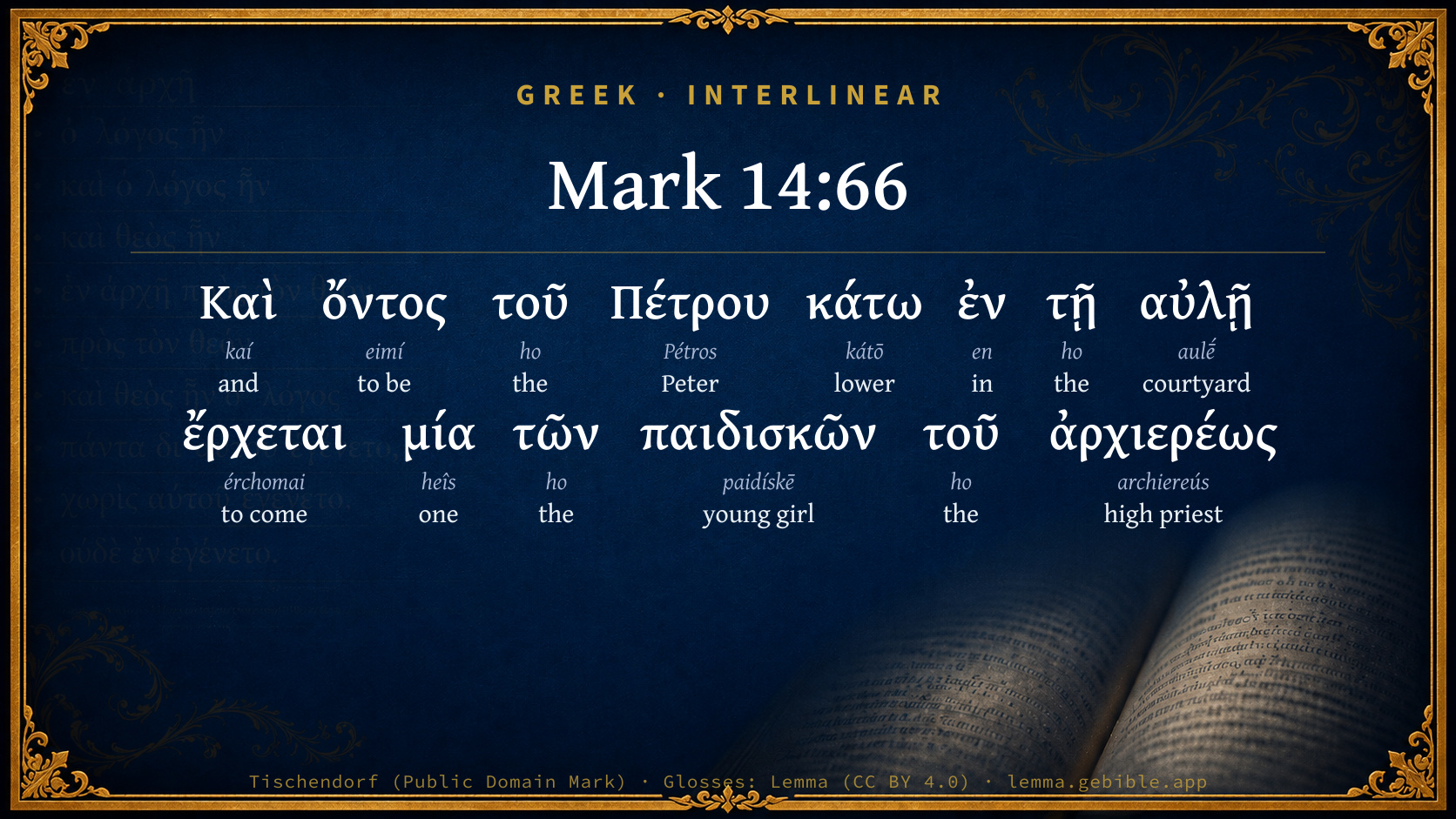
  1. Καὶ kaí G2532 “and” Conjunction
  2. ὄντος eimí G1510 “to be” Verb, Present, Active, Participle, Genitive, Singular, Masculine
  3. τοῦ ho G3588 “the” Article, Genitive, Singular, Masculine
  4. Πέτρου Pétros G4074 “Peter” Noun, Genitive, Singular, Masculine
  5. ἐν en G1722 “in” Preposition
  6. τῇ ho G3588 “the” Article, Dative, Singular, Feminine
  7. αὐλῇ aulḗ G833 “courtyard” Noun, Dative, Singular, Feminine
  8. ἔρχεται érchomai G2064 “to come” Verb, Present, Middle or Passive deponent, Indicative, 3rd person, Singular
  9. μία heîs G1520 “one” Adjective, Nominative, Singular, Feminine
  10. τῶν ho G3588 “the” Article, Genitive, Plural, Feminine
  11. παιδισκῶν paidískē G3814 “young girl” Noun, Genitive, Plural, Feminine
  12. τοῦ ho G3588 “the” Article, Genitive, Singular, Masculine
  13. ἀρχιερέως archiereús G749 “high priest” Noun, Genitive, Singular, Masculine

About this verse

These counts appear in no published source. They are computed here, from the morphology-tagged text and Lemma’s own curated glosses. What Lemma adds →

14
words
11
distinct lemmas
Gospels
section

Notable vocabulary

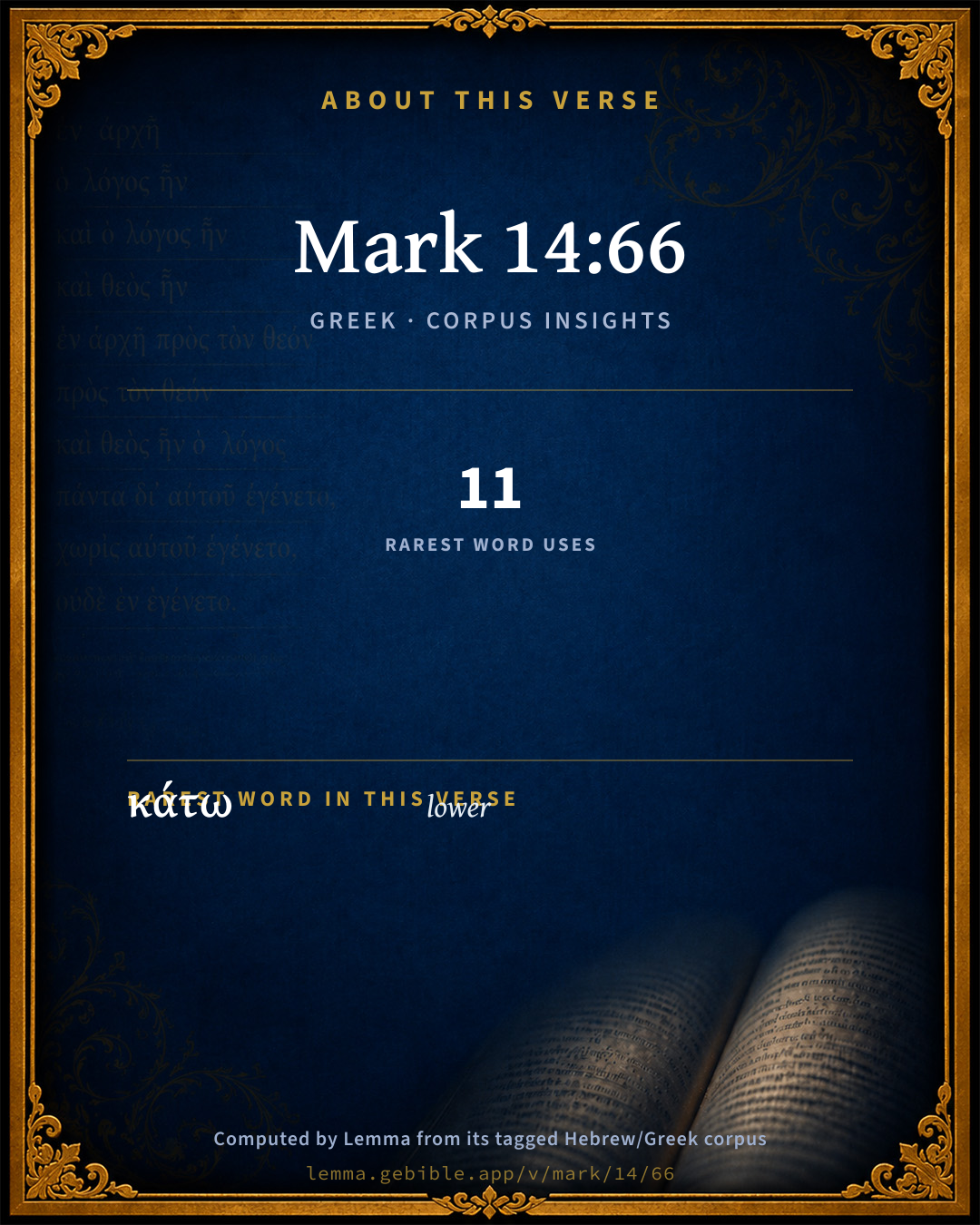
The rarest word here is κάτω lower G2736 — appearing just 11 times in the whole Greek New Testament.

Shared distinctive vocabulary

κάτω lower G2736 occurs in 11 verses of the Greek New Testament. Also found in:

Repetition

A word recurs within this verse:

Cross-references

6

Topical passages linked to Mark 14:66 in the Treasury of Scripture Knowledge — connected by theme and wording, ordered by reader-vote popularity; previews shown in the World English Bible.

  • Mark 14:54 Peter had followed him from a distance, until he came into the court of the high priest. He was sitting with the officers, and warming himself in the light of the fire.
  • Matthew 26:69–75 Now Peter was sitting outside in the court, and a maid came to him, saying, "You were also with Jesus, the Galilean!"
  • Matthew 26:58 But Peter followed him from a distance, to the court of the high priest, and entered in and sat with the officers, to see the end.
  • John 18:15–18 Simon Peter followed Jesus, as did another disciple. Now that disciple was known to the high priest, and entered in with Jesus into the court of the high priest;
  • John 18:25–27 Now Simon Peter was standing and warming himself. They said therefore to him, "You aren't also one of his disciples, are you?" He denied it, and said, "I am not."
  • Luke 22:55–62 When they had kindled a fire in the middle of the courtyard, and had sat down together, Peter sat among them.

Cross-references courtesy of OpenBible.info (CC BY 4.0).

Commentary

Notes on Mark 14:66 from classic Christian and Jewish commentators (each source and its license shown beneath its notes). The classic Christian expositions comment on the surrounding passage and are grouped to its opening verse, so a note may address several verses; the Jewish commentaries on the Tanakh (Rashi and others) are per-verse, so they appear only where the commentator wrote on this verse.

Lemma curates 59 commentaries, every one of them public domain or Creative Commons licensed, each selected and text-cleaned for this edition rather than reprinted as found. About our sources →

The Biblical Illustrator

Joseph S. Exell

Mar_14:66

And as Peter was beneath in the palace.

The High Priests palace

The palace of the High Priest was in all probability built much in the Roman style. There was what was called the vestibulum, an entrance adorned with pillars; in this was the ostium, or entrance hall, closed with doors. On one side lived the porter. This hall gave admission to the atrium, called in a Greek house the aule, a square or oblong apartment, open in the middle to the sky, with, in Roman houses, a small water tank in the middle, and beside it the image of the tutelary god and a small altar on which incense was burnt. At the further end of this great hall was a large and handsome room, opening to it by steps, called the tablinum. It was the grand reception room, and was richly adorned. In the tablinum, which was sometimes square, sometimes semi-circular, the court was held in the house of Caiaphas. Without, below the marble steps in the atrium, were the servants of the house. There was no image of a god there, but there was a brazier in the place of the altar of incense. That there was an impluvium or tank is likely enough; as so much importance was ascribed to washings, and water had been conveyed throughout Jerusalem by means of subterranean canals and aqueducts. Out of the tablinum sometimes a door opened into a small bedroom, which was without a window. It was in this little room that the false witnesses were kept concealed till summoned to appear. They were perfectly in the dark, and could not be seen, whereas Christ was visible distinctly because of the torches held, as Jewish law required, before Him to make His face clearly distinguishable. In the tablinum were also seats or benches, of marble, of alabaster, or costly woods. On these benches sat the council. Whilst the trial was going on in the tablinum, another trial was going on in the atrium, a step or two below the tablinum. The Master was tried in the upper court, and found guilty, though innocent. The disciple was tried in the lower court, and found guilty by his own conscience, or rather, let me say, by that Master who was receiving sentence a few steps above him. Both were irradiated by the red light of fire in the midst of the prevailing darkness. Probably the only lights then burning were the fire of charcoal in the brazier on the edge of the water tank, and the torches held aloft by the serjeants of the guard before Jesus. Very generally, the tablinum opened into a garden behind, so that those in the atrium or hall looked through it into the garden, which was surrounded by a colonnade. When this was the case, the seats were between the steps from the atrium and the garden door, and the little bedroom door was opposite the seats. Now, perhaps, you can picture the scene. In the foreground are the servants and soldiers moving about the hall, women bringing bundles of thorn, or shovels of charcoal to the fire in the brazier. Beyond, raised like a low stage of a theatre, is the tablinum, with the judges seated on the right. On the left, peering out of the dark door, are the evil faces of the hired spies and witnesses. A little forward, on a small raised platform, is Christ, with bound hands, and on either side stands an officer holding a flaring torch. Behind, like the scene in a theatre, is the garden, with the setting moon casting long shadows from the black cypresses over the gravel and high aloft in the sky twinkles one star. (S. Baring Gould, M. A.)

The Biblical Illustrator, edited by Joseph S. Exell (c. 1880s–1900s) — public domain. Text from a community e-Sword module.

Joseph Benson's Commentary

Mar 14:66-72. And as Peter was beneath in the palace — This whole paragraph respecting Peter’s three-fold denial of Christ is explained at large in the notes on Mat 26:69-75. When he thought thereon he wept — In the original it is, και επιβαλων εκλαιε, which words are interpreted very differently by different commentators. Dr. Whitby thinks our translation of the words may be maintained; “for though Casaubon,” says he, “gave no instance of this signification of the word, Constantine proves, out of Philoponus, Dionysius, and Basil, that it signifies κατανοειν, to consider of, and ponder, or fix the mind upon a thing. So Eustathius; ‘the word επιβαλλω, respects either the action, and then it signifies exactly to take it in hand, or the mind, and then it signifies to consider of it, as we are able;’ or as Phavorinus interprets it, επιβαλως νοειν, aptly and wisely to consider of it.” Dr. Campbell, also, after a critical examination of the text, and of the different interpretations which learned men have given of it, says, “I think, with Wetstein, that the sense exhibited by the English translation is the most probable.” Dr. Macknight, however, gives it as his opinion, that the original expression should be rendered, and throwing his garment (that is, the veil which the Jewish men used to wear) over his head, he wept; “For the expression,” says he, “is elliptical, and must be supplied thus, Επιβαλων ιματιον τη κεφαλη αυτου, as is evident from Lev 19:19, LXX. Besides, it was the custom of persons in confusion to cover their heads, Jer 14:3-4.” Thus also Elsner, Salmasius, Bos, and Waterland understand the words. It may not be improper to mention one more interpretation of the passage, adopted by Raphelius and some other learned critics, which is, throwing himself out of the company, namely, in a passionate manner, (which it is very probable he did,) he wept. This exposition, it must be acknowledged, makes Mark’s words agree in sense with those of the other evangelists, who say, He went forth and wept; and “plain it is,” says Dr. Whitby, “that in the book of Maccabees the word often signifies, irruens, or se projiciens, rushing, or, casting one’s self out.”

Joseph Benson's Commentary on the Old and New Testaments (1811–1818) — public domain. Text from a community e-Sword module.

The Expositor's Bible

CHAPTER 14:66-72 (Mar_14:66-72)

THE FALL OF PETER

"And as Peter was beneath in the court, there cometh one of the maids of the high priest; and seeing Peter warming himself, she looked upon him, and saith, Thou also wast with the Nazarene, even Jesus. But he denied, saying, I neither know, nor understand what thou sayest: and he went out into the porch; and the cock crew. And the maid saw him, and began again to say to them that stood by, This is one of them. But he again denied it. And after a little while again they that stood by said to Peter, Of a truth thou art one of them; for thou art a Galilean. But he began to curse, and to swear, I know not this man of whom ye speak. And straightway the second time the cock crew. And Peter called to mind the word, how that Jesus said unto him, Before the cock crow twice, thou shalt deny Me thrice. And when he thought thereon, he wept." Mar_14:66-72 (R.V.)

THE fall of Peter has called forth the easy scorn of multitudes who never ran any risk for Christ. But if he had been a coward, and his denial a dastardly weakness, it would not be a warning for the whole Church, but only for feeble natures. Whereas the lesson which it proclaims is this deep and solemn one, that no natural endowments can bear the strain of the spiritual life. Peter had dared to smite when only two swords were forthcoming against the band of Roman soldiers and the multitude from the chief priests. After the panic in which all forsook Jesus, and so fulfilled the prediction "ye shall leave Me alone," none ventured so far as Peter. John indeed accompanied him; but John ran little risk, he had influence and was therefore left unassailed, whereas Peter was friendless and a mark for all men, and had made himself conspicuous in the garden. Of those who declaim about his want of courage few indeed would have dared so much. And whoever misunderstands him, Jesus did not. He said to him, "Satan hath desired to have you (all) that he may sift you like wheat, but I have prayed for thee (especially) that thy strength fail not." Around him the fiercest of the struggle was to rage, as around some point of vantage on a battlefield; and it was he, when once he had turned again, who should stablish his brethren (Luk_22:31-32).

God forbid that we should speak one light or scornful word of this great apostle! God grant us, if our footsteps slip, the heart to weep such tears as his.

Peter was a loving, brave and loyal man. But the circumstances were not such as human bravery could deal with. Resistance, which would have kindled his spirit, had been forbidden to him, and was now impossible. The public was shut out, and he was practically alone among his enemies. He had come "to see the end," and it was a miserable sight that he beheld. Jesus was passive, silent, insulted: His foes fierce, unscrupulous and confident. And Peter was more and more conscious of being alone, in peril, and utterly without resource. Moreover sleeplessness and misery lead to physical languor and cold, [8] and as the officers had kindled a fire, he was drawn thither, like a moth, by the double wish to avoid isolation and to warm himself. In thus seeking to pass for one of the crowd, he showed himself ashamed of Jesus, and incurred the menaced penalty, "of him shall the Son of man be ashamed, when he cometh." And the method of self-concealment which he adopted only showed his face, strongly illuminated, as St. Mark tells us, by the flame.

If now we ask for the secret of his failing resolution, we can trace the disease far back. It was self-confidence. He reckoned himself the one to walk upon the waters. He could not be silent on the holy mount, when Jesus held high communion with the inhabitants of heaven. He rebuked the Lord for dark forebodings. When Jesus would wash his feet, although expressly told that he should understand the act hereafter, he rejoined, Thou shalt never wash my feet, and was only sobered by the peremptory announcement that further rebellion would involve rejection. He was sure that if all the rest were to deny Jesus, he never should deny Him. In the garden he slept, because he failed to pray and watch. And then he did not wait to be directed, but strove to fight the battle of Jesus with the weapons of flesh. Therefore he forsook Him and fled. And the consequences of that hasty blow were heavy upon him now. It marked him for the attention of the servants: it drove him to merge himself in the crowd. But his bearing was too suspicious to enable him to escape unquestioned.

The first assault came very naturally, from the maid who kept the door, and had therefore seen him with John. He denied indeed, but with hesitation, not so much affirming that the charge was false as that he could not understand it. And thereupon he changed his place, either to escape notice or through mental disquietude; but as he went into the porch the cock crew. The girl however was not to be shaken off: she pointed him out to others, and since he had forsaken the only solid ground, he now denied the charge angrily and roundly. An hour passed, such an hour of shame, perplexity and guilt, as he had never known, and then there came a still more dangerous attack. They had detected his Galilean accent, while he strove to pass for one of them. And a kinsman of Malchus used words as threatening as were possible without enabling a miracle to be proved, since the wound had vanished: "Did I myself not see thee in the garden with Him?" Whereupon, to prove that his speech had nothing to do with Jesus, he began to curse and swear, saying, I know not the man. And the cock crew a second time, and Peter remembered the warning of his Lord, which then sounded so harsh, but now proved to be the means of his salvation. And the eyes of his Master, full of sorrow and resolution, fell on him. And he knew that he had added a bitter pang to the sufferings of the Blessed One. And the crowd and his own danger were forgotten, and he went out and wept.

It was for Judas to strive desperately to put himself right with man: the sorrow of Peter was for himself and God to know.

What lessons are we taught by this most natural and humbling story? That he who thinketh he standeth must take heed lest he fall. That we are in most danger when self-confident, and only strong when we are weak. That the beginning of sin is like the letting out of water. That Jesus does not give us up when we cast ourselves away, but as long as a pulse of love survives, or a spark of loyalty, He will appeal to that by many a subtle suggestion of memory and of providence to recall His wanderer to Himself.

And surely we learn by the fall of this great and good apostle to restore the fallen in the spirit of meekness, considering ourselves lest we also be tempted, remembering also that to Peter, Jesus sent the first tidings of His resurrection, and that the message found him in company with John, and therefore in the house with Mary. What might have been the issue of his anguish if these holy ones had cast him off?

William Robertson Nicoll, ed., The Expositor's Bible (London: Hodder & Stoughton, 1887–1910) — public domain. 65 of 66 books (1 Corinthians is not separately keyed, as that volume carries no machine-parseable verse references); section-level commentary keyed to the opening verse. Introductory and overview sections not keyed to a specific passage are excluded.

Tyndale Open Study Notes

Tyndale Open Resources

14:66-72 Peter’s predicted denials (see 14:30) occurred during Jesus’ trial.

Tyndale Open Study Notes — © Tyndale Open Resources, licensed CC BY-SA 4.0. Text via the HelloAO Bible API.

Bengel's Gnomon

Johann Albrecht Bengel

Mar 14:66. Κάτω, beneath) There seem to have been a flight of steps there.

Bengel's Gnomon of the New Testament — English translation (T&T Clark, Edinburgh, 1860) — public domain. Text from a community e-Sword module.

Meyer's Critical & Exegetical Commentary

Heinrich August Wilhelm Meyer

Mar_14:66-72. See Mat_26:69-75. Comp. Luk_22:56-62.

κάτω] below, in contrast to the buildings that were situated higher, which surrounded the court-yard (see on Mat_26:3).

Mar_14:68. οὔτε οἶδα, οὔτε ἐπίσταμαι] (see the critical remarks) I neither know nor do I understand. Thus the two verbs that are negatived are far more closely connected (conceived under one common leading idea) than by οὐκ … οὐδέ. See Klotz, ad Devar. p. 706 f. On the manner of the denial in the passage before us, comp. Test. XII patr. p. 715: οὐκ οἶδα ὃ λέγεις. The doubling of the expression denotes earnestness; Bornemann, Schol. in Luk. p. xxxi. f.

προαύλιον] Somewhat otherwise in Mat_26:71. See in loc.

καὶ ἀλ. ἐφ.] and a cock crew; peculiar to Mark in accordance with Mar_14:30.

Mar_14:69. ἡ παιδίσκη] consequently the same; a difference from Mat_26:71. It is still otherwise in Luk_22:58.

πάλιν] would, if it belonged to ἰδοῦσα αὐτόν (as taken usually), stand before these words, since it would have logical emphasis in reference to ἰδοῦσα, Mar_14:67. Comp. subsequently πάλιν ἠρνεῖτο. Hence it is, with Erasmus, Luther, Grotius, and Fritzsche, to be attached to ἤρξατο, on which account, moreover, C L Δ א have placed it only after ἤρξ. So Tischendorf. Still the word on the whole is critically suspicious, although it is quite wanting only in B M, vss.: the addition of it was natural enough, even although the λέγειν here is not addressed again to Peter.

ἤρξατο] graphic.

Mar_14:70. ἠρνεῖτο] Tempus adumbrativum (as so often in Mark). The second πάλιν introduces a renewed address, and this, indeed, ensued on the part of those who were standing by. Hence it is not: πάλιν ἔλεγον οἱ παρ., but: πάλιν οἱ παρ. ἔλεγον.

καὶ γὰρ Γαλιλ. εἶ] for thou art also a Galilean; i.e. for, besides whatever else betrays thee, thou art, moreover, a Galilean. They observed this from his dialect, as Matthew, following a later shape of the tradition, specifies.

ἐπιβαλών] not: coepit flere (Vulg. It. Goth. Copt. Syr. Euthymius Zigabenus, Luther, Castalio, Calvin, Heinsius, Loesner, Michaelis, Kuinoel, and others), as D actually has ἤρξατο κλαίειν, which certainly also those versions have read; expressed with ἐπιβάλλειν, it must have run ἐπέβαλε κλαίειν, and this would only mean: he threw himself on, set himself to, the weeping (comp. Erasmus and Vatablus: prorupit in fletum; see also Bengel); nor yet: cum, se foras projecisset (Beza, Raphel, Vater, and various others), since ἐπιβαλών might doubtless mean: when he had rushed away, but not: when he had rushed out,an alteration of the meaning which Mat_26:75, Luk_22:62, by no means warrant;[172] nor yet: veste capiti injecta flevit (Theophylact, Salmasius, de foen. Trap. p. 272; Calovius, L. Bos, Wolf, Elsner, Krebs, Fischer, Rosenmüller, Paulus, Fritzsche, and others[173]), which presupposes a supplement not warranted in the context and without precedent in connection with ἐπιβάλλειν, and would, moreover, require the middle voice; neither, and that for the same reason, is it: after he had cast his eyes upon Jesus (Hammond, Palairet); nor: addens, i.e. praeterea (Grotius), which is at variance with linguistic usage, or repetitis vicibus flevit (Clericus, Heupel, Münthe, Bleek), which would presuppose a weeping as having already previously occurred (Theophrastus, Char. 8; Diodorus Siculus, p. 345 B). Ewald is linguistically correct in rendering: Breaking in with the tears of deep repentance upon the sound of the cock arousing him. See Polyb. i. 80. 1, xxiii. 1. 8; Stephani Thes., ed. Hase, III. p. 1526; Schweighäuser, Lex. Polyb. p. 244 f. Thus we should have to conceive of a loud weeping, answering, as it were, to the cock-crowing. From a linguistic point of view Casaubon is already correct (κατανοήσας); then Wetstein, Kypke, Glöckler, de Wette, Bornemann (in the Stud. u. Krit. 1843, p. 139), Buttmann, neut. Gr. p. 127 [E. T. 145]: when he had attended thereto, namely, to this ῥῆμα of Jesus, when he had directed his reflection to it. See the examples for this undoubted use of ἐπιβάλλειν with and without τὸν νοῦν or τὴν διάνοιαν, in Wetstein, p. 632 f.; Kypke, I. p. 196 f. The latter mode of taking it (allowed also by Beza) appears more in accordance with the context, because ἀνεμνήσθη κ.τ.λ. precedes, so that ἐπιβαλών corresponds to the ἀνεμνήσθη as the further mental action that linked itself thereto, and now had as its result the weeping. Peter remembers the word, reflects thereupon, weeps!

[172] Lange: he rushed out thereupon, namely, on the cock crowing as the awakening cry of Christ. First a rushing out as if he had an external purpose, then a painful absorption into himself and weeping.… Outside he found that the cry went inward and upward, and now he paused, and wept. A characteristic piece of fancy.

[173] So also Linder in the Stud. u. Krit. 1862, p. 562 f., inappropriately comparing περιβάλλειν, and appealing to 2Ki_8:15 (where the word, however, does not at all stand absolutely) and to Lev_13:45 (where the middle voice is used).

Meyer — Critical and Exegetical Commentary on the New Testament — English translation by Peter Christie, edited by Frederick Crombie (T&T Clark, 1880) — public domain. Text from a community e-Sword module.

Expositor's Greek Testament

ed. W. Robertson Nicoll

Mar 14:66-72 . Peter’s denial (Mat 26:69-75 , Luk 22:54-62 ).

Mar 14:66 . κάτω ἐ . τ . α ., below in the court, implying that the trial of Jesus had taken place in a chamber on a higher level. ἔρχεται μία , etc., cometh one of the maids of the high priest a servant in his palace, on some errand that night when all things were out of their usual course. That a maid should be astir and on duty at that unseasonable hour was itself a sign that something extraordinary was going on.

The Expositor's Greek Testament, edited by W. Robertson Nicoll (1897–1910) — public domain. Text from a community e-Sword module.

Geneva Bible (1599)

Geneva Bible translators

An heavy example of the frailness of man, together with a most comfortable example of the mercy of God, who giveth the spirit of repentance and faith to his elect.

Geneva Bible (1599) marginal notes — public domain. Text via Bolls.life.

Matthew Henry's Commentary

We have here the story of Peter's denying Christ.

1. It began in keeping at a distance from him. Peter had followed afar off (Mar 14:54), and now was beneath in the palace, at the lower end of the hall. Those that are shy of Christ, are in a fair way to deny him, that are shy of attending on holy ordinances, shy of the communion of the faithful, and loth to be seen on the side of despised godliness.

2. It was occasioned by his associating with the high priest's servants, and sitting among them. They that think it dangerous to be in company with Christ's disciples, because thence they may be drawn in to suffer for him, will find it much more dangerous to be in company with his enemies, because there they may be drawn in to sin against him.

3. The temptation was, his being charged as a disciple of Christ; Thou also wert with Jesus of Nazareth, Mar 14:67. This is one of them (Mar 14:69), for thou art a Galilean, one may know that by thy speaking broad, Mar 14:70. It doth not appear that he was challenged upon it, or in danger of being prosecuted as a criminal for it, but only bantered upon it, and in danger of being ridiculed as a fool for it. While the chief priests were abusing the Master, the servants were abusing the disciples. Sometimes the cause of Christ seems to fall so much on the losing side, that every body has a stone to throw at it, and even the abjects gather themselves together against it. When Job was on the dunghill, he was had in derision of those that were the children of base men, Job 30:8. Yet, all things considered, the temptation could not be called formidable; it was only a maid that casually cast her eye upon him, and, for aught that appears, without design of giving him any trouble, said, Thou art one of them, to which he needed not to have made any reply, or might have said, "And if I be, I hope that is no treason."

4. The sin was very great; he denied Christ before men, at a time when he ought to have confessed and owned him, and to have appeared in court a witness for him. Christ had often given notice to his disciples of his own sufferings; yet, when they came, they were to Peter as great a surprise and terror as if he had never heard of them before. He had often told them that they must suffer for him, must take up their cross, and follow him; and yet Peter is so terribly afraid of suffering, upon the very first alarm of it, that he will lie and swear, and do any thing, to avoid it. When Christ was admired and flocked after, he could readily own him; but now that he is deserted, and despised, and run down, he is ashamed of him, and will own no relation to him.

5. His repentance was very speedy. He repeated his denial thrice, and the third was worst of all, for then he cursed and swore, to confirm his denial; and that the third blow, which, one would think, should have stunned him, and knocked him down, startled him, and roused him up. Then the cock crew the second time, which put him in mind of his Master's words, the warning he had given him, with that particular circumstance of the cock crowing twice; by recollecting that, he was made sensible of his sin and the aggravations of it; and when he thought thereon, he wept. Some observe that this evangelist, who wrote, as some have thought, by St. Peter's direction, speaks as fully of Peter's sin as any of them, but more briefly of his sorrow, which Peter, in modesty, would not have to be magnified, and because he thought he could never sorrow enough for great a sin. His repentance here is thus expressed, epibalōn eklaie, where something must be supplied. He added to weep, so some; making it a Hebraism; he wept, and the more he thought of it, the more he wept; he continued weeping; he flung out, and wept; burst out into tears; threw himself down, and wept; he covered his face, and wept, so some; cast his garment about his head, that he might not be seen to weep; he cast his eyes upon his Master, who turned, and looked upon him; so Dr. Hammond supplies it, and it is a probable conjecture. Or, as we understand it, fixing his mind upon it, he wept. It is not a transient thought of that which is humbling, that will suffice, but we must dwell upon it. Or, what if this word should mean his laying a load upon himself, throwing a confusion into his own face? he did as the publican that smote his breast, in sorrow for sin; and this amounts to his weeping bitterly.

Matthew Henry's Commentary on the Whole Bible (1708–1710) — public domain (CC PDM 1.0). Text via the HelloAO Bible API.

Ellicott's Commentary for English Readers

(66) And as Peter was beneath.—See Notes on Mat_26:69-75.

A Bible Commentary for English Readers, edited by Charles John Ellicott (1878–1897) — public domain. Text from a community e-Sword module.

The Cambridge Bible for Schools and Colleges

gen. ed. J. J. S. Perowne

66–72. The Denial of our Lord by St Peter

66. And as Peter] During the sad scene enacted in the hall of trial above, an almost sadder moral tragedy had been enacted in the court below.

The Cambridge Bible for Schools and Colleges (gen. ed. J. J. S. Perowne; Cambridge University Press, 1878–1918) — public domain. Text from a community e-Sword module.

John Gill's Exposition

And he denied it again,.... That he was one of the disciples of Jesus:

and a little after; about an hour after, Luk 22:59;

they that stood by, said again to Peter, surely thou art one of them; one confidently affirmed that he was with Jesus, and another challenged him with seeing him in the garden with him, Luk 22:59, and in general they were of opinion, that he must be one of that sect, giving this as a reason,

for thou art a Galilean: as they supposed Jesus to be; and knowing that in Galilee he had chiefly preached, and wrought his miracles, and had there a large number of followers:

and thy speech agreeth thereto; he used words and phrases peculiar to the Galileans, and pronounced as they did: See Gill on Mat 26:73. This clause is omitted in the Vulgate Latin, and is wanting in Beza's most ancient copy; but is in the other copies, and in all the eastern versions.

John Gill's Exposition of the Whole Bible (1746–1763) — public domain (CC PDM 1.0). Text via the HelloAO Bible API.

Trapp's Complete Commentary

John Trapp

66 And as Peter was beneath in the palace, there cometh one of the maids of the high priest:

Ver. 66. {See Trapp on "Mat 26:69"}

John Trapp, A Commentary or Exposition upon All the Books of the Old and New Testament (1647–1656) — public domain. Text from a community e-Sword module.

Matthew Poole's English Annotations

All four evangelists give us an account of this history of Peter’s denial of his Master. We have considered what they all say, to complete the history, in our notes on Mat 26:69-75; to which I see no reason to add any thing but the observation,

1. How contemptible means God often useth to take down our pride and self-confidences. Peter, a great apostle, is here humbled by the means of two maids.

2. How naturally one sin draws on another. Peter first tells a lie, then to lying addeth swearing and cursing.

3. How necessary it is for those that would keep from sin to keep out of sinners’ company. I am (saith David) a companion of them that fear thee, Psa 119:63.

4. How profitable words from God are for the time to come, though at present we find not the use and advantage of them.

5. How different the sinnings of reprobates and saints are, as to the consequences and issues.

Judas sins, repents, and hangs himself; Peter goeth out and weepeth bitterly. Judas repented unto death; Peter repenteth unto life. See more with reference to this history in our notes on Mat 26:75. Thus far we have heard Christ’s trial before the ecclesiastical court of the Jews. Thus far what he said Mar 10:33 is made good. He is delivered to the chief priests, and the scribes, and they have (as we have heard) condemned him to death. But he also said there, —and they shall deliver him to the Gentiles: and they shall mock him, and shall scourge him, and shall spit upon him, and shall kill him. We must see those words verified in the ensuing part of the history, in the next chapter.

Matthew Poole's English Annotations on the Holy Bible (1683–1685) — public domain. Text from a community e-Sword/MySword module.

The Pulpit Commentary

And as Peter was beneath in the court. The room in which the Sanhedrim were assembled was an upper chamber.

Vers. 66-72. Peter"s denial.

The story of our Savior"s humiliation and suffering is a story not only of the malice and the injustice of his enemies, but of the frailty and unfaithfulness of his professed friends. It is true that the priests and elders apprehended him with violence and condemned him with unrighteousness; and that the Roman governor, against his own convictions, and influenced by his weakness and his selfish interests, condemned him to a cruel death. But it is also true, that of the twelve chosen and intimate associates one betrayed him and another denied him.

I THIS CONDUCT WAS AT VARIANCE WITH PETER"S USUAL PRINCIPLES AND HABITS. No candid reader of the Gospel narrative can doubt either the faith or the love of this leader among the twelve. His confidence in the Master and his attachment to him were thoroughly appreciated by Christ himself. Had not Jesus named him the Rock? Had he not, upon the occasion of his memorable confession that Jesus was the Son of God, warmly exclaimed, "Blessed art thou," etc.? A warm and eager nature had found a Being deserving of all trust, affection, and devotion; and the Lord knew that in Peter he had a friend, ardent, attached, and true. He admitted the son of Jonas into the inner circle of three; he was one of the elect among the elect.

II THIS CONDUCT WAS AT VARIANCE WITH PETER"S PREVIOUS INTENTION AND PROFESSION. When the seizure and capture were approaching, the Lord warned his servant that he would be found unfaithful. Peter"s declaration had been, "I am ready to go with thee, both into prison, and to death;" "If I must die with thee, I will not deny thee." And he was no doubt sincere in this bold and confident declaration. But sincerity is not enough; there must be stability as well. The professions of the ardent, experience teaches, must not always be taken with implicit trust. Time tries all; and endurance in trial is the true test of character. Peter"s fall is a lesson of caution to the confident and the ardent.

III THIS CONDUCT WAS FORESEEN AND FORETOLD BY THE LORD JESUS. The Master knew his servant better than he knew himself. In warning him of his impending fall, Christ had assured Peter that only his prayers should secure him from moral destruction.

IV THIS CONDUCT MUST BE EXPLAINED BY THE COMBINATION IN PETER"S MIND OF LOVE AND FEAR. It was his affection for Jesus which led this apostle to enter the court, and to remain in the neighborhood of the Lord during his mock-trial. The others had forsaken their Master, and had fled; John only, being known, and Peter, being introduced by his friend, clung thus to the scene of their Master"s woe. Peter, like John, felt unable to desert his Lord. Strange that he should feel able to deny him. He felt for his Master, but he feared for himself. Cowardice for the time overpowered the course which first brought him to the spot and then deserted him.

V THIS CONDUCT IS AN INSTANCE OF THE TENDENCY OF SIN TO REPEAT ITSELF. A single falsehood often brings on others in its train. To get it believed, the liar lies again, and confirms his falsehood with oaths. Peter found himself in a position in which he must either repeatedly deny his Lord, or else expose his own falseness, and run into the very danger which he had sinned to escape. Ah! how slippery are the paths of sin! How easy it is to go wrong, and how difficult to recover the right way! Who knows, when once he lies, or cheats, or sins in any way, where, if ever, he shall stop? How needful the prayer, "Hold up my goings in thy paths, that my footsteps slip not"!

VI THIS CONDUCT COULD NOT ENDURE THE REBUKE OF CONSCIENCE AND THE REPROACH OF CHRIST. There was inconsistency between what Peter felt in his inmost heart, between the prayers which he was wont to offer, and what in this night he did and said. The falsehood and the fear were on the outside of his nature; below, there was a sensitive conscience and a loving heart. It was the look of the Master, as he was led through the open court, and met his faithless servant"s eye, which melted Peter"s heart, recalling in a moment the warning which had been disregarded and the profession which had been belied. If there had not been a heart, a conscience, responsive to the appeal and the reproach conveyed in that look, those eyes would have met in vain. All Christ"s servants are liable to temptation, and it is possible that any one among them may be betrayed into faithlessness towards Christ; but it is only where there is true love that there is susceptibility to the Savior"s tender expostulation and affectionate rebuke. It is thus that the Lord makes manifest who are his; he shames them because of their own weakness and cowardice, and awakens what is best within them to a sense of personal unworthiness, and to a desire of reconciliation and renewal.

VII THIS CONDUCT WAS THE OCCASION OF SHAME AND CONTRITION. "When he thought thereon, he wept." Thought, reflection, especially upon the words of Jesus, are fitted to bring the misguided soul to itself. It is the haste and hurry of men"s lives which often hinder true repentance and reformation. "They that lack time to mourn lack time to mend." These tears were the turning-point, and the earnest and the beginning of better things. Another evangelist relates to us at length the restoration of Peter to favor, and his new commission of service. But the simple words with which this narrative closes furnish the key to what follows, to the rest of Peter"s life. Judas"s sin led him to remorse; Peter"s sin led him to repentance. The root of the difference lay in the two men"s distinct and opposed characters. Judas"s principle was love of self; Peter"s was love of Christ. The recovery, which was possible for the one, was therefore morally impossible for the other.

APPLICATION.

1. A warning against self-confidence.

2. A suggestion as to the spirit in which to encounter temptation: Watch and pray; look to Jesus!

3. An encouragement to true penitents.

Vers. 66-72. Extremes meet in character.

I SELF-CONFIDENCE AND WEAKNESS. What is a man without self-reliance? Yet it seems to fail, and offers no security in temptation. In a true self-reliance is contained dependence and trust. Confidence in our thought is right, if we recognize that our true views are revealed to us; that it is not we who think, but God who thinks in us. Separated from our root in God, whether in thought or will, we become mere individuals. Once isolate the picture of yourself and your powers and activities from the Divine whole to which it belongs, and it will soon be found that you are in a false position.

II IMPETUOSITY AND DELIBERATION. We admire the generous eagerness of Peter, but it topples over into precipitous haste. And the hasty falsehood is followed by the deliberate persistence in it. Brazening it out one moment, the next he breaks into a flood of remorseful tears. "Who can understand his errors?" Easy to criticize Peter, not easy to act better. Let us humbly own that he represents us all, in greater or less degree. Our life oscillates between extremes. God can make profitable to us the experience of our sins and errors. The chemistry of his love can bring our tragic scenes to a happy ending. J.

The Pulpit Commentary (1880–1919), ed. H.D.M. Spence-Jones & Joseph S. Exell — public domain. Text from a community e-Sword module.

John Wesley's Explanatory Notes

Matt. xxvi, 69; Luke xxii, 56; John xviii, 25.

John Wesley, Explanatory Notes Upon the Whole Bible (1754–1765) — public domain. Text via the GEBible commentary corpus.

Kretzmann's Popular Commentary

Paul E. Kretzmann

The Denial of Peter.

The first denial:

v. 66. And as Peter was beneath in the palace, there cometh one of the maids of the high priest.

v. 67. And when she saw Peter warming himself, she looked upon him and said, And thou also wast with Jesus of Nazareth.

v. 68. But he denied, saying, I know not, neither understand I what thou sayest. And he went out into the porch; and the cock crew.

Beneath in the court Peter was; the session of the Sanhedrin was held in an upper room. He was sitting at the fire, where the light from the flames brought out his features very plainly. Now one of the maids of the high priest, the janitress that had admitted Peter into the vestibule, walking past the fire and seeing Peter sitting there and warming himself, had a good chance to observe his features. She promptly pointed him out to the rest of the servants, accusing him of belonging to the party of this Jesus of Nazareth. The matter rather took Peter by surprise; he may have thought himself secure, since he had been admitted to the court. But he thinks himself quick-witted in feigning lack of understanding: I neither know nor understand what thou sayest. It was a lie and a denial of his Lord, as Peter should have felt at once. As a matter of fact, his conscience seems to have been a little uneasy, for he now left his place by the fire and went out into the arched doorway, in the shadow of the portico.

Paul E. Kretzmann, Popular Commentary of the Bible (1921–1924) — public domain. Text from a community e-Sword module.

Burkitt's Expository Notes on the New Testament

William Burkitt

This last paragraph of the chapter gives us an account of the fall and rising of Peter; of his sin in denying Christ, and of his recovery by repentance. Both are considered distinctly in the notes of Mat 26:69. that which is here farther to be taken notice of, is as followeth.

Observe, 1. That amongst all the apostles and disciples of Christ, we meet not with any so extraordinary, either for faith or professor, Mat 4:18 and a glorious confessor, Mat 16:16. Thou art the Christ, the Son of the living God. Which be the foundation of the gospel church in all ages: and Christ was pleased to put that honour upon Peter, as to use his ministry, in first laying the foundation of a Christian church among the Jews and Gentiles, he being the first preacher to them of that faith which he did here confess.

To the Jews, Acts 2. where we read of three thousand souls converted and baptized; and to the Gentiles, Acts 10. in the conversion of Cornelius and his friends, whom God directed to send, not to Jerusalem for James, not to Damascus for St. Paul, but to Joppa for Peter; whom Christ had appointed for that work, that he might tell him words by which he and his household should be saved.

Observe, 2. The great and mighty courage which was found in St. Peter.

1. At the command of Christ he adventures to walk on the waves of the sea, Mat 14:28. being firmly persuaded, that whatsoever Christ commanded his disciples to do, he would give them strength and ability to perform.

And, 2. It was a noble courage which enabled him to say, Thou I die with thee, yet will I not deny thee. No doubt the good man really resolved to do as he said, little suspecting that he should, with horrid oaths and bitter imprecautions, deny and abjure his dying Master.

"Lord! how prone are we to think our hearts better than they are! our grace stronger than it is! Not all the instances we have of human frailty in ourselves, or all the scars, marks, and wounds, upon some of the best and holiest of men, by reason of their sad and shameful falls, will sufficiently convince us of our wretched impotency, and how unable we are to do good or resist evil, by our own shattered and impaired strength."

3. An undaunted courage, and heroic greatness of mind, appeared in this apostle, when he told the Jews to their faces that they were guilty of murder, and must never expect salvation any other way, than by faith in that Jesus whom they had ignominioiusly crucified, and unjustly slain. Nor did St. Peter say this in a corner, or behind the curtain, but in the sanhedrin, that open court of judicature, which had so lately sentenced and condemned his Lord and Master.

Observe, 3. St. Peter’s profound humility and lowliness of mind: it was a mighty honour that Christ put upon him in making use of his ministry, for laying the foundation of a Christian church, both among Jews and Gentiles.

And, accordingly, Cornelius, Acts 10 would have entertained him with expressions of more than ordinary honour and veneration, falling down at his feet, and ready to adore him; but this humble apostle was so afar from complying with it, that he plainly told him that he was no other than such a man as himself. And when our Lord, by a stupendous act of condescension, stooped so low as to wash his disciple’s feet, St. Peter could by no means be persuaded to admit of it neither could be introduced personally to accept it, till Christ was in a sort forced to threaten him into obedience, and a compliance with it, Joh 13:8.

Observe, How admirable was his love unto, and how burning his zeal for, his Lord and Master, insomuch that he could and did appeal to his omnisciency for the truth and sincerity of it; Lord, thou knowest all things; thou knowest that I love thee.

It was love that caused him to draw his sword in his Master’s defence against a band of soldiers, and an armed multitude.

It was love that caused him to adventure on the greatest difficulties, and to expose his life to the greatest hazards.

It was love that caused him to engage so deep, as to suffer and die, rather than deny him.

These were his exemplary virtues. His failings were these:

First, too great a confidence of his own strength, notwithstanding Christ had particularly told him that Satan had desired to winnow him as wheat. None are so likely to be overcome by a temptation, as those who are least afraid of it; none so ready to fall, as those that think it impossible to fall. It is a dangerous thing to believe, that because we have long kept our innocence, we can never lose it; and to conclude, because we have been once or twice victorious over temptations, we must be ever conquerors, Let him that thinketh he standeth, take heed lest he fall 1Co 10:12 : that is, let him keep a jealous eye upon the weakness and inconstancy of his nature, and with a believing eye look up to the power and promise of God, that he may be preserved from falling, and presented faultless in the day of Christ.

Secondly, His fears overcame his faith. The insolent affronts offered to his injured Master caused him to forget his former resolutions, and instead of being a valiant confessor, he turns a shameful renegado, renouncing him for whom a little before he resolved to die.

Learn hence, That slavish fear is a most tumultuous and ungovernable passion; its powerful assaults not only vanquish the strongest reason, but sometimes overcome the strongest faith. It is a weapon which the tempter uses, to the discomfort of some, and destruction of others, and therefore ought to be guarded against by those who set any value on the peace and comfort of their souls.

Thirdly, One sin drew on another; his sinful equivocation in saying, I know not the man, prepared him for a downright denial, and that for an abjuration of him, with an imprecation and an anathema, swearing that he knew not the man.

"Ah Peter! is this thy owning thy Lord? Is this thy not being offended, though all should be offended? Is this thy dying with him, rather than deny him? What! hast thou forgot all thy promises and engagements to him, and all the dear and sweet pledges of his love, so lately shown to thee? Surely I have learnt from thy example, that it is as dangerous to trust an heart of flesh, as to rely upon an arm of flesh; for had not thy denied and forsaken Master prayed for thee, and timely succoured thee, Satan would not only have winnowed thee like wheat, but ground thee to powder."

Fourthly, Observe how many complicated sins were included in this sin of Peter’s. The highest ingratitude to his Master; unpardonable rashness, in venturing into such company, tarrying there so long, and without a call, making bold with a temptation; and for a time there was impenitence and hardness of heart.

It is holy and safe to resist the beginnings of sin; if we yield to Satan in one temptation, he will certainly assault us with more and stronger.

Peter proceeded here from a denial to a lie, from a lie to an oath, from an oath to a curse. Let us resist sin at first: for then have we most power, and sin has least. And the Lord looked on Peter, and Peter remembered the word of the Lord, and went out, and wept bitterly.

Observe, If Christ had not looked towards Peter, Peter would never more have looked after Christ; nor was it barely the turn of Christ’s bodily eye that wrought this disciple to a sorrowful remembrance of his sin; had not this outward look been accompanied with the inward and secret influences of his Spirit, it had certainly proved ineffectual.

Christ looked on Judas after his treason; aye, and reproved him too: but neither that look nor that reproof did break his heart. As the sun with the same beams softens wax and hardens clay, so a look from the same Christ leaves Judas hard and impenitent, and melts down Peter to tears.

Though none can say, that tears are always a sign of true repentance, yet certainly when they flow from a heart duly sensible of sin, and deeply affected with sorrow, it administers matter of hope that there is sincere repentance. Peter, after he had wept bitterly for sin, never more returned to the after-commission of sin; but he that was before timorous as an hare became afterward bold as a lion. He that once so shamefully denied, nay, abjured, his Master, afterwards openly confessed with his blood.

It is usually observed, that a broken bone once well set, never more breaks again in the same place; a returning backslider, when once restored, contracts such an hatred of former sins, as never more to run into the commission of them.

Let St. Peter;s fall then be a warning to all professors against presumptuous confidence, and his restoration be an encouragement to all backsliders to renew their faith and repentance. Amen.

William Burkitt's Expository Notes on the New Testament (1700–1703) — public domain. Text from a community e-Sword module.

The People's New Testament

B. W. Johnson

66–72. As Peter was beneath in the palace. See notes on Matt. 26:69–75. Compare Luke 22:54–62; John 18:15–17, 25–27. He wept. The form of the Greek verb (imperfect) implies that he continued weeping. “It is a touching and beautiful tradition, true to the sincerity of his repentance, if not as a historical reality, that, all his life long, the remembrance of this night never left him, and that, morning by morning, he rose at the hour when the look of his Master had entered his soul, to pray once more for pardon.”—Geikie.

B. W. Johnson's The People's New Testament with Notes (1889–1891) — public domain. Electronic text from the Christian Classics Ethereal Library (CCEL) ThML edition.

unfoldingWord translationNotes

Door43 World Missions Community

Connecting Statement:

As Jesus had predicted, Peter denies Jesus three times before the rooster crows.

below in the courtyard

"outside in the courtyard"

one of the servant girls of the high priest

The servant girls worked for the high priest. AT: "one of the servant girls who worked for the high priest" (See: Assumed Knowledge and Implicit Information)

denied

This means to claim that something is not true. In this case, Peter was saying that what the servant girl said about him was not true.

neither know nor understand what you are talking about

Both "know" and "understand" have the same meaning here. The meaning is repeated to add emphasis to what Peter is saying. AT: "I really do not understand what you are talking about" (See: Doublet)

translationWords

Peter

court

servant

Nazareth

understand

unfoldingWord translationNotes — © Distant Shores Media and the Door43 World Missions Community, licensed CC BY-SA 4.0. Source: git.door43.org/Door43/en_tn.

Cambridge Greek Testament for Schools and Colleges

66–72. PETER’S THREE DENIALS OF HIS MASTER

Mat 26:69-75. Luk 22:56-62. Joh 18:17; Joh 18:25-27

66. μία τῶν παιδισκῶν. We have four accounts of the three denials. They exhibit, what is frequently found in honest witnesses, agreement in the main features combined with considerable difference in the details. The four records may be reduced to three, for Mt. is dependent on Mk. It is possible that Lk. is sometimes influenced by Mk, but in this section Mk, Lk., and Jn may be regarded as three independent witnesses. All four agree that the person who provoked the first denial was a woman, but they do not agree as to what she said, and they agree still less as to Peter’s reply. This παιδίσκη was a female slave in the high-priest’s household. See notes on Joh 18:25-27. The second denial is given very briefly by all four; but the first and third are reproduced with much fulness in Mk.

Cambridge Greek Testament for Schools and Colleges (Cambridge University Press, 1896; 21 vols, various authors incl. Carr, Maclear, Plummer, Farrar, Lumby, Moule, M. R. James, Simcox) — public domain. Text from a community e-Sword module.

Alford’s Greek Testament

Henry Alford

66-72.] Our Lord is thrice denied by Peter. Mat 26:69-75.Luk 22:56-62Luk 22:56-62. Joh 18:17, 18, 25-27. See the comparative table, and notes, on Matt.

66.] κάτω, because the house was built round the αὐλή, and the rooms looked down into it. See note on Mat 26:69.

Henry Alford, The Greek Testament (1849–1861) — public domain. Text from a community e-Sword module.

International Critical Commentary

66-72. While the trial is going on, Peter is at the fire in the court of the palace. One of the maid-servants of the high priest sees him there, and charges him with being a follower of Jesus. Peter denies it, and pretends not even to understand what she says. But he sees that the situation is becoming dangerous, and goes out into the vestibule, leading from the court into the street, when a cock crowed. There the servant repeats her charge, and Peter his denial. Finally, after a short time, the bystanders detect the Galilean burr in Peter’s speech, and renew the charge. Then Peter begins to protest with oaths that he does not know whom they are talking about. It is the third denial, and the cock crowed a second time, which brought to his mind Jesus’ warning, and having thought on it, Peter wept.

International Critical Commentary — older volumes (1896–1929), various authors — public domain. Text from a community e-Sword module.

Vincent's Word Studies in the New Testament

Marvin R. Vincent

Beneath. In relation to the chambers round the court above.

Marvin R. Vincent, Word Studies in the New Testament (1887–1900) — public domain. Text from a community e-Sword/MySword module.

Lesson kit

Teaching starters — assembled from the data on this page, not authored interpretation. Every prompt links to the verse data it draws on. Edit before teaching.

Mark, in the Gospels, opens this verse with 14 words (11 distinct Greek lemmas). Its most distinctive word is kátō (“lower”). A historical commentator’s framing appears above. Read the whole chapter for the surrounding context.

Discussion questions

  1. How does “lower” (kátō) shape what this verse is saying?
  2. Matthew 2:16 shares the word «lower» with this verse. How do the two illuminate each other?
  3. “the” occurs 4× in this one verse. What is the effect of the repetition?
  4. The translations on this page render this verse differently — a whole-verse word diff, not a word-by-word alignment. What might account for the different wordings?
  5. Reading how The Biblical Illustrator and Joseph Benson's Commentary read this verse, where do the two commentators agree and where do they part?

Things to notice

Reading settings

Reading text

Shown beneath each verse's original-language words.

Old Testament
Old Testament edition

Read the OT as the Masoretic Hebrew (MT) or the Greek Septuagint (LXX).

English shown for the Greek Septuagint (in the Hebrew ↔ Greek comparison).

Comparing translations? Open the Compare panel on any verse page to stack up to four side by side.