
Mark 15:29

Greek (Tischendorf 8th ed.) Mark 15:29 appears in the Greek New Testament. The text above is from the Tischendorf 8th edition. Each word links to its Strong’s number and a concise gloss. Click any word for its full Thayer’s Greek Lexicon entry.
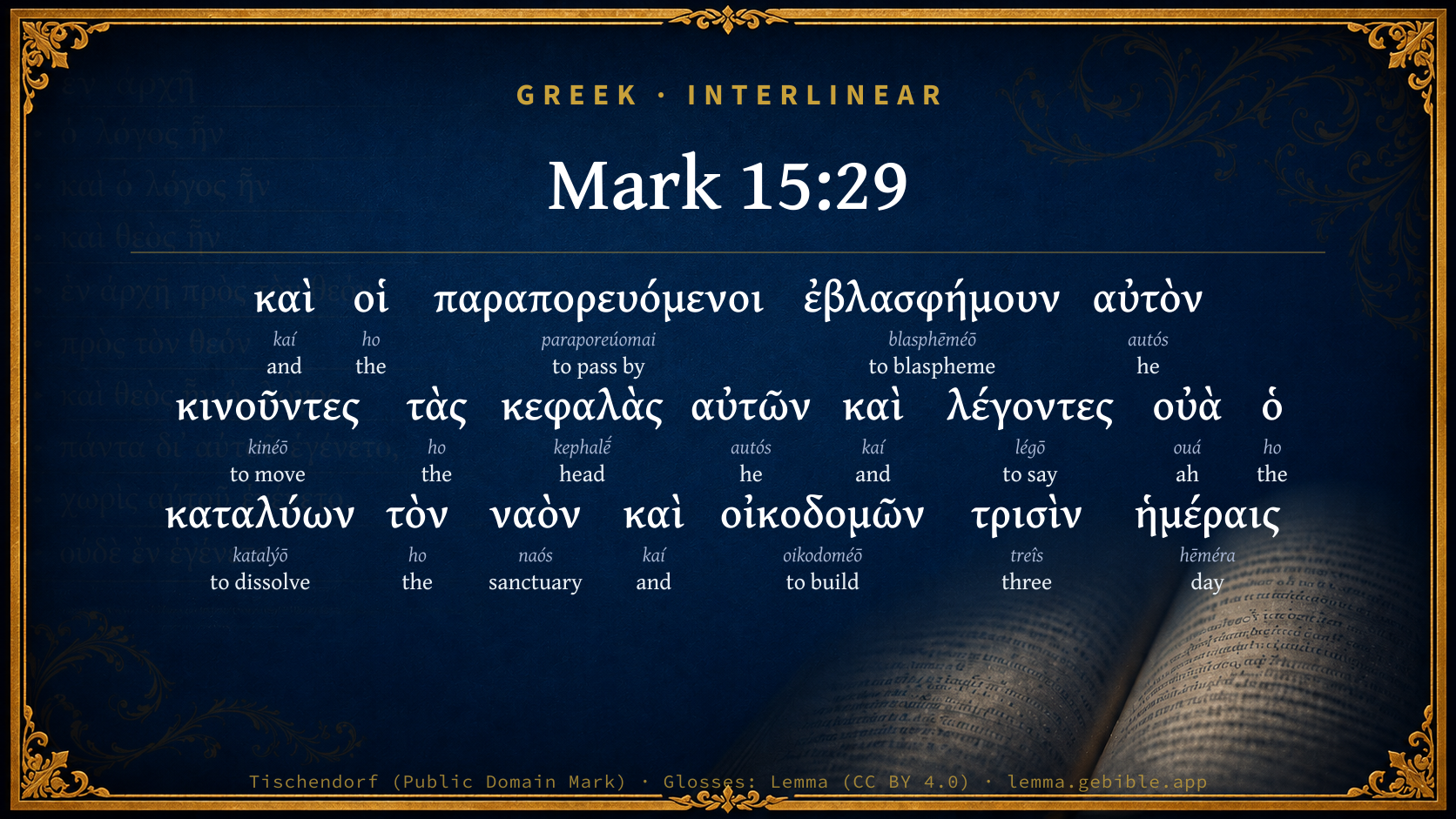
Download image
Cite this verse

Mark 15:29 (World English Bible). Public Domain. Lemma interlinear Bible study tool, https://lemma.gebible.app/v/mark/15/29.

Show BibTeX & RIS
BibTeX
RIS
English Translation
Those who passed by blasphemed him, wagging their heads, and saying, "Ha! You who destroy the temple, and build it in three days,
World English Bible · Public Domain
Highlights
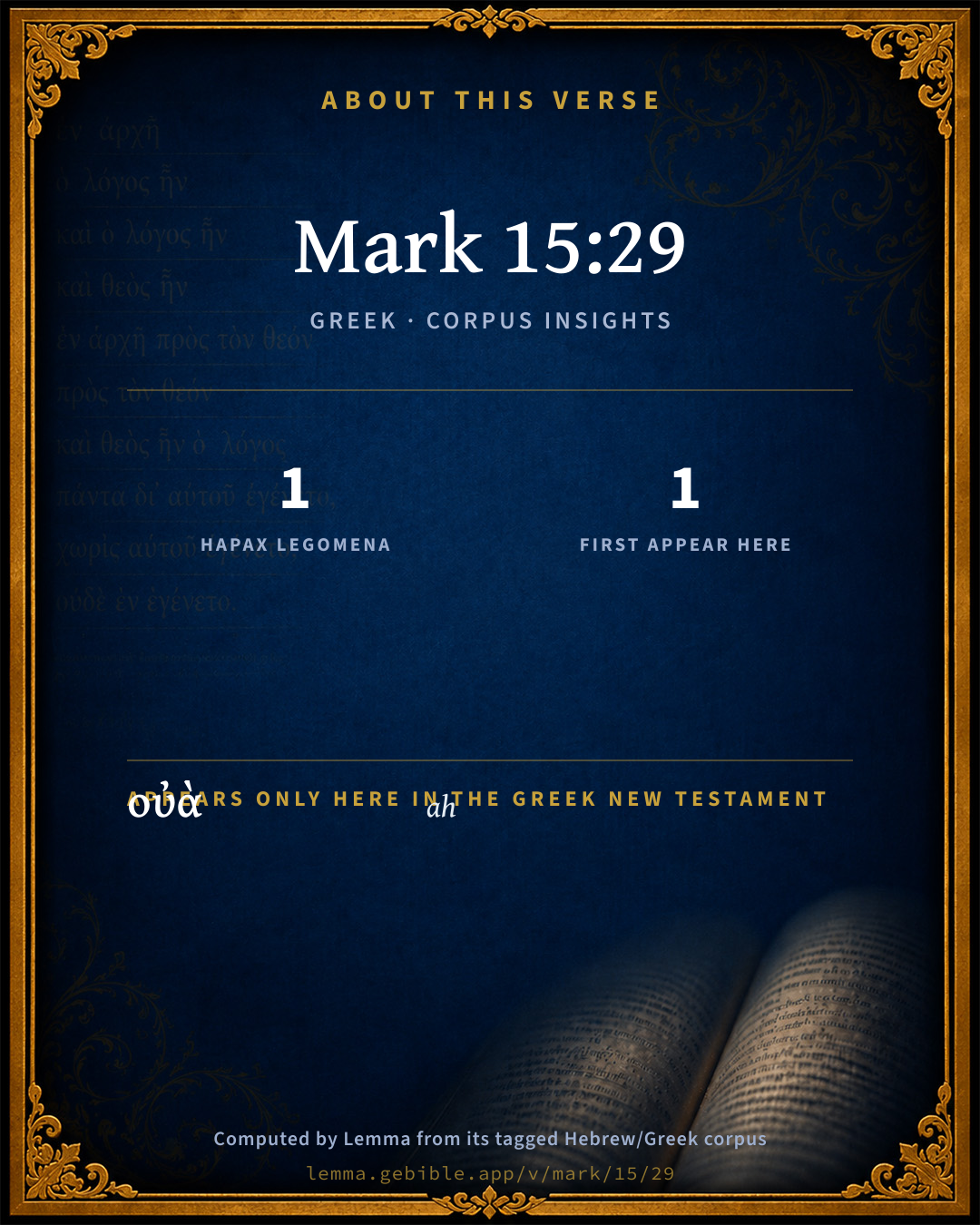
  • 1 hapax legomenon — only here in the Greek New Testament
  • 1 first appearance in the Greek New Testament
Full analysis ↓
Download a study sheet

One document with this verse’s original text, its word-by-word gloss line, the meaning frame, cross-references with their text, attributed commentary, and full source and license credits — printable, and it pastes into notes with its structure intact.

This verse Autodidact and up

Study sheet (.html) Plain text (.txt)

A passage Seminary Student

Up to 50 verses in one chapter. A passage sheet keeps up to 6 commentary sources and 12 cross-references per verse, in the order this page ranks them, and says so on the sheet whenever that leaves anything out. Ask for a single verse and you get the Autodidact verse sheet above.

Everything on this page stays free to read, with no account — the sheet is a download of what is already on screen, not access to it.

Want to remove ads? Support Godless Engineer
Compare translations 3

The same verse in 3 English versions, stacked beneath the original-language interlinear above. Click any original word for its lexicon entry.

Each is an independent rendering of the whole verse — the interlinear is not word-aligned to these translations.

Highlighted words mark where these versions differ — a whole-verse word diff, not a word-by-word alignment.

  • World English Bible Public Domain
    Those who passed by blasphemed him, wagging their heads, and saying, "Ha! You who destroy the temple, and build it in three days,
  • King James Version Public Domain
    And they that passed by railed on him, wagging their heads, and saying, Ah, thou that destroyest the temple, and buildest it in three days,
  • unfoldingWord Literal Text CC BY-SA 4.0
    And the ones passing by were blaspheming him, wagging their heads and saying, “Aha! The one destroying the temple and rebuilding in three days,

unfoldingWord Literal Text — © unfoldingWord, licensed CC BY-SA 4.0. Word-aligned USFM3 via Door43 (git.door43.org/unfoldingWord/en_ult).

Versions to compare (up to 4)

3 of 4 selected

Show all 19 translations

Every available English version of this verse, each an independent rendering of the whole verse.

  • World English Bible Public Domain
    Those who passed by blasphemed him, wagging their heads, and saying, "Ha! You who destroy the temple, and build it in three days,
  • Berean Standard Bible Public Domain
    And those who passed by heaped abuse on Him, shaking their heads and saying, “Aha! You who are going to destroy the temple and rebuild it in three days,
  • Majority Standard Bible Public Domain
    And those who passed by heaped abuse on Him, shaking their heads and saying, “Aha! You who are going to destroy the temple and rebuild it in three days,
  • King James Version Public Domain
    And they that passed by railed on him, wagging their heads, and saying, Ah, thou that destroyest the temple, and buildest it in three days,
  • American Standard Version (1901) Public Domain
    And they that passed by railed on him, wagging their heads, and saying, Ha! Thou that destroyest the temple, and buildest it in three days,
  • Revised Version (1885) Public Domain
    And they that passed by railed on him, wagging their heads, and saying, Ha! thou that destroyest the temple, and buildest it in three days,
  • Geneva Bible (1599) Public Domain
    And they that went by, railed on him, wagging their heads, and saying, Hey, thou that destroyest the Temple, and buildest it in three dayes,
  • Douay-Rheims (1899) Public Domain
    And they that passed by blasphemed him, wagging their heads, and saying: Vah, thou that destroyest the temple of God, and in three days buildest it up again;
  • Young's Literal Translation Public Domain
    And those passing by were speaking evil of him, shaking their heads, and saying, `Ah, the thrower down of the sanctuary, and in three days the builder!
  • Literal Standard Version CC BY-SA 4.0
    And those passing by were slandering Him, shaking their heads, and saying, “Ha! The [One] throwing down the temple, and building [it] in three days!
  • Unlocked Literal Bible CC BY-SA 4.0
    Those who passed by insulted him, shaking their heads and saying, “Aha! You who would destroy the temple and rebuild it in three days,
  • unfoldingWord Literal Text CC BY-SA 4.0
    And the ones passing by were blaspheming him, wagging their heads and saying, “Aha! The one destroying the temple and rebuilding in three days,
  • Darby Bible Public Domain
    And they that passed by reviled him, shaking their heads, and saying, Aha, thou that destroyest the temple and buildest it in three days,
  • World Messianic Bible Public Domain
    Those who passed by blasphemed him, wagging their heads and saying, “Ha! You who destroy the temple and build it in three days,
  • Webster's Bible Public Domain
    And they that passed by, railed on him, wagging their heads, and saying, Ah, thou that destroyest the temple, and buildest it in three days,
  • Free Bible Version CC BY-SA 4.0
    People passing by shouted insults at him, shaking their heads, and saying. “Aha! You who claimed you were going to destroy the Temple and rebuild it in three days;
  • Bible in Basic English Public Domain
    And those who went by made sport of him, shaking their heads, and saying, Ha! you who give the Temple to destruction, and put it up again in three days,
  • Text-Critical English NT CC BY 4.0
    Those who passed by reviled him, shaking their heads and saying, “Ha! Yoʋ who would destroy the temple and build it in three days,
  • Tyndale New Testament (1534) Public Domain
    And they that went by rayled on him: waggynge their heedes and sayinge: A wretche that destroyest the temple and byldest it in thre dayes:

Literal Standard Version (2020), Covenant Press — licensed CC BY-SA 4.0. Text via the HelloAO Bible API (eBible.org). Unlocked Literal Bible (unfoldingWord) — licensed CC BY-SA 4.0. Text via the HelloAO Bible API (eBible.org). unfoldingWord Literal Text — © unfoldingWord, licensed CC BY-SA 4.0. Word-aligned USFM3 via Door43 (git.door43.org/unfoldingWord/en_ult). Free Bible Version, Dr. Jonathan Gallagher — licensed CC BY-SA 4.0. Text via the HelloAO Bible API (eBible.org).

Word by word

More ways to search: Search by grammar → Find every occurrence → Compare this word →

Practice this passage: Drill this verse → Learn its vocabulary →

οὐὰ
ouá
G3758
“ah”
Interjection
Part of Speech
Interjection
Full Thayer's Definition

Origin: a primary exclamation of surprise

TDNT: None

1. ah! ha! an interjection of wonder and amazement
  1. καὶ kaí G2532 “and” Conjunction
  2. οἱ ho G3588 “the” Article, Nominative, Plural, Masculine
  3. παραπορευόμενοι paraporeúomai G3899 “to pass by” Verb, Present, Middle or Passive deponent, Participle, Nominative, Plural, Masculine
  4. ἐβλασφήμουν blasphēméō G987 “to blaspheme” Verb, Imperfect, Active, Indicative, 3rd person, Plural
  5. αὐτὸν autós G846 “he” Personal pronoun, Accusative, Singular, Masculine
  6. κινοῦντες kinéō G2795 “to move” Verb, Present, Active, Participle, Nominative, Plural, Masculine
  7. τὰς ho G3588 “the” Article, Accusative, Plural, Feminine
  8. κεφαλὰς kephalḗ G2776 “head” Noun, Accusative, Plural, Feminine
  9. αὐτῶν autós G846 “he” Personal pronoun, Genitive, Plural, Masculine
  10. καὶ kaí G2532 “and” Conjunction
  11. λέγοντες légō G3004 “to say” Verb, Present, Active, Participle, Nominative, Plural, Masculine
  12. ὁ ho G3588 “the” Article, Nominative, Singular, Masculine
  13. καταλύων katalýō G2647 “to dissolve” Verb, Present, Active, Participle, Nominative, Singular, Masculine
  14. τὸν ho G3588 “the” Article, Accusative, Singular, Masculine
  15. ναὸν naós G3485 “sanctuary” Noun, Accusative, Singular, Masculine
  16. καὶ kaí G2532 “and” Conjunction
  17. οἰκοδομῶν oikodoméō G3618 “to build” Verb, Present, Active, Participle, Nominative, Singular, Masculine
  18. τρισὶν treîs G5140 “three” Adjective, Dative, Plural, Feminine
  19. ἡμέραις hēméra G2250 “day” Noun, Dative, Plural, Feminine

About this verse

These counts appear in no published source. They are computed here, from the morphology-tagged text and Lemma’s own curated glosses. What Lemma adds →

20
words
14
distinct lemmas
Gospels
section

Notable vocabulary

1 hapax legomenon — a word that appears only here in the entire Greek New Testament:

First appearance in Scripture

This word makes its first canonical appearance in the Greek New Testament here:

Shared distinctive vocabulary

παραπορευόμενοι to pass by G3899 occurs in 5 verses of the Greek New Testament. Also found in:
Repetition

Words recur within this verse:

Cross-references

14

Topical passages linked to Mark 15:29 in the Treasury of Scripture Knowledge — connected by theme and wording, ordered by reader-vote popularity; previews shown in the World English Bible.

  • Psalms 109:25 I have also become a reproach to them. When they see me, they shake their head.
  • Mark 14:58 "We heard him say, 'I will destroy this temple that is made with hands, and in three days I will build another made without hands.'"
  • Lamentations 1:12 Is it nothing to you, all you who pass by? Look, and see if there be any sorrow like my sorrow, which is brought on me, With which Yahweh has afflicted [me] in the day of his fierce anger.
  • Lamentations 2:15 All that pass by clap their hands at you; They hiss and wag their head at the daughter of Jerusalem, [saying], Is this the city that men called The perfection of beauty, The joy of the whole earth?
  • John 2:18–22 The Jews therefore answered him, "What sign do you show us, seeing that you do these things?"
  • Genesis 37:19–20 They said one to another, "Behold, this dreamer comes.
  • Psalms 22:7–8 All those who see me mock me. They insult me with their lips. They shake their heads, saying,
  • Psalms 22:12–14 Many bulls have surrounded me. Strong bulls of Bashan have encircled me.
  • Psalms 35:15–21 But in my adversity, they rejoiced, and gathered themselves together. The attackers gathered themselves together against me, and I didn't know it. They tore at me, and didn't cease.
  • Psalms 69:7 Because for your sake, I have borne reproach. Shame has covered my face.
  • Psalms 69:19–20 You know my reproach, my shame, and my dishonor. My adversaries are all before you.
  • Psalms 69:26 For they persecute him whom you have wounded. They tell of the sorrow of those whom you have hurt.
  • Matthew 26:61 and said, "This man said, 'I am able to destroy the temple of God, and to build it in three days.'"
  • Matthew 27:39–40 Those who passed by blasphemed him, wagging their heads,

Cross-references courtesy of OpenBible.info (CC BY 4.0).

Commentary

Notes on Mark 15:29 from classic Christian and Jewish commentators (each source and its license shown beneath its notes). The classic Christian expositions comment on the surrounding passage and are grouped to its opening verse, so a note may address several verses; the Jewish commentaries on the Tanakh (Rashi and others) are per-verse, so they appear only where the commentator wrote on this verse.

Lemma curates 59 commentaries, every one of them public domain or Creative Commons licensed, each selected and text-cleaned for this edition rather than reprinted as found. About our sources →

Godbey's Commentary on the New Testament

William B. Godbey

THEY REVILE HIM ON THE CROSS

Mar 15:29-32; Luk 23:35-43; Mat 27:39-44. “And passing by, they continued to blaspheme Him, wagging their heads, and saying, Thou that destroyest the temple, and buildest it in three days, save Thyself. If Thou art the Son of God, come down from the cross. Likewise the high priests mocking Him, with the scribes and elders, continued to say, He saved others; Himself He is not able to save. If He is the King of Israel, let Him now come down from the cross, and we will believe on Him. He trusted in God; let Him now deliver Him, if He wishes Him: for He said, I am the Son of God.” This scene, led off by the high priests, elders, and scribes, whose honorable example, of course, many thoughtless people followed, both citizens and soldiers, was not only barbaric in the extreme and infinitely worse than brutal, but diabolical in the superlative degree. And yet it was perpetrated by the ministers and elders standing at the head of the Church, illustrating the significant fact that collegiate education, religious professions, official dignity, and clerical sanctity are no guarantee against the vilest and most demoniacal persecutions when the devil is in them. Shall we not all learn a profitable lesson by this scene, and that is, to have no faith in man, but all in God?

“The thieves also, being crucified along with Him, continued to cast this same reproach on Him.” Luk 22:39-43 : “But one of the malefactors, having been hanged up, continued to blaspheme Him, If Thou art the Christ, save Thyself and us.” There is no contradiction of the preceding with the following. Simply recognize the fact that both of the robbers at first joined with the high priest and the rabble in reproaching Him. But after so long a time, something in the look or the manner of Jesus sent conviction deep into the heart of one of the malefactors, superinducing a tremendous reaction, such as to evoke from the repentant thief the following: “And the other one, responding, continued to rebuke him, saying, Dost thou not fear God, because thou art in the same condemnation? And we indeed justly; for we are receiving the punishment worthy of the crimes which we have committed; but this One has done nothing wrong. He said to Jesus, Lord, when Thou mayest come in Thy kingdom, remember me. And Jesus said to him, Truly I say unto thee, This day thou shalt be with Me in paradise.” On the resurrection morn, three days subsequently, Jesus said to Mary, “I have not yet ascended unto My Father,” setting forth the indisputable fact that He had not met the thief in heaven. He was a Jew, and was saved under the Abrahamic covenant, which all concentrates in Christ. So he went to Abraham’s bosom (Luke 16), whither Lazarus and all of the Old Testament saints had been gathering since the days of Abel. Jesus, expiring on the cross, His disembodied human soul (1Pe 3:19) went and proclaimed to the spirits in prison — i. e. the inmates of hell — the victory won on Calvary (Act 2:27-31); then, crossing the impassable chasm, entered the intermediate paradise — i. e., Abraham’s bosom — and met the thief before the expiration of that day at midnight; spent a wonderful hallelujah Sabbath with the patriarchs and prophets and all of the Old Testament saints; early, the first day of the week, abolished the intermediate paradise, and led up all the inmates with Him (Eph 4:8-10), and, coming to the tomb, received His body, the mighty host of Old Testament saints — being invisible, because not having their bodies — accompanied Him the forty days, and finally ascended with Him up to heaven. The prophetic eye of David (Psalms 24) catching the vision of the triumphant host, hears the shout, “Lift up your heads, O ye gates, and be ye lifted up, ye everlasting doors, and let the King of glory come in.” Then the shout roars back from the celestial portals, “Who is this King of glory?” The answer is prompt, “The Lord, mighty to save and strong to deliver; He is the King of glory.” Now the gates swing high, and millions of glorified spirits shout Him welcome, with the triumphant host captured from the cruel clutches of Satan. The grandest ovation heaven has seen in all the ages now monopolizes the interest of the celestial universe, while the Conqueror of Mount Calvary leads His blood-washed pilgrims up into the august presence of the Almighty Father, presenting them before Him, “Behold, I and the children whom Thou hast given unto Me.” O what a thrilling testimony-meeting follows, Father Abraham, the patriarchs and prophets, all participating, to the most delectable edification of angels, archangels, cherubim, and seraphim! A false exegesis has been put on this passage, in order to sustain that miserable materialistic heresy which deprives man of his soul, ignoring the idea that the soul is ever separate from the body, as this false dogma does not concede that you have a soul. As this positive statement of Jesus to the thief, “This day thou shalt be with Me in paradise,” so clearly and unequivocally recognizes the soul of the thief as going out of the body hanging on the cross and entering paradise that very day, to their ineffaceable shame be it said, they have condescended to the diabolical audacity to change the punctuation of the very identical words which Jesus spoke, so moving the comma as to make it read, “Truly I say unto thee this day, Thou shalt be with Me in paradise,” making the adverb semeron, “this day,” qualify “say unto thee,” instead of “thou shalt be with Me in paradise,” thus making our Savior commit a solecism and talk nonsense. As this occult form of infidelity — i. e., soul-sleeping materialism has been sown by Satan throughout this continent, we feel it our duty to expose it, as it is utterly destitute of truth. The salvation of the thief on the cross is infinitely consolatory to penitent sinners in the hour and article of death. However, it is awfully risky to make our Lord’s mercy in this notable instance an apology for continuing in sin. All should bear in mind the obvious fact that this poor thief had never seen Jesus before, nor hardened his heart by slighting opportunities.

William B. Godbey, Commentary on the New Testament (1896–1900) — public domain. Text from a community e-Sword module.

Tyndale Open Study Notes

Tyndale Open Resources

15:29-32 Jesus was being mocked and abused by the people passing by, the religious leaders, and the revolutionaries. • The people passing by shouted abuse (literally blasphemed), wagged their heads in contempt (see Lam 2:15), and ridiculed his claim that he would destroy the Temple (see Mark 14:58).

Tyndale Open Study Notes — © Tyndale Open Resources, licensed CC BY-SA 4.0. Text via the HelloAO Bible API.

Bengel's Gnomon

Johann Albrecht Bengel

Mar 15:29. Οὐὰ, Ah!) An interjection and exclamation, having the force of expressing astonishment, as Franc. Bernardinus Ferrarius, L. 3. de Acclam. Vet. c. 15, shows at large. In this passage, it has the force of expressing wonder along with irony.

Bengel's Gnomon of the New Testament — English translation (T&T Clark, Edinburgh, 1860) — public domain. Text from a community e-Sword module.

Meyer's Critical & Exegetical Commentary

Heinrich August Wilhelm Meyer

Mar_15:29-41. See on Mat_27:39-56. Comp. Luk_23:35-49.

οὐά] the Latin vah! an exclamation of (here ironical) amazement. Dio Cass. lxiii. 20; Arrian, Epict. iii. 23. 24; Wetstein in loc.

ὁ καταλύων κ.τ.λ.] gives us a glimpse of the original affirmation of the witnesses, as it is preserved in Mat_26:61 (not in Mar_14:58).

Mar_15:31. πρὸς ἀλλήλ., inter se invicem, belongs to ἐμπαίζ.

Mar_15:32. Let the Messiah the King of Israel come down now, etc.,a bitter mockery! The ὁ Χριστός applies to the confession before the supreme council, Mar_14:61 f., and ὁ βασιλ. τ. Ἰσρ. to that before Pilate, Mar_15:2. Moreover, we may attach either the two forms of address (Lachmann, Tischendorf), or the first of them (Ewald), to what precedes. But the customary mode of apprehending it as a double address at the head of what follows is more in keeping with the malicious triumph.

πιστεύσ.] namely, that He is the Messiah, the King of Israel. καὶ οἱ συνεσταυρ.] agrees with Matthew, but not with Luke. See on Mat_27:44. It is to be assumed that Mark had no knowledge of the narrative of Luk_23:39 ff., and that the scene related by Luke belongs to a later tradition, in which had been preserved more special traits of the great event of the crucifixion, but with which the historical character of the exceedingly characteristic scene is not lost. See on Luke, l.c.

Mar_15:34.[176] ἐλωΐ] the Syriac form for אֵלִי (Matthew), which latter appears to have been what Jesus uttered, as is to be inferred from the scoff: ἨΛΊΑΝ ΦΩΝΕῖ.

Mar_15:36. ΛΈΓΩΝ,] a difference from Mat_27:49, whose account is more original (in opposition to Holtzmann), because to remove the aspect of friendliness must appear more in keeping with the later development. In consequence of this difference, moreover, ἄφετε is to be understood quite otherwise than ἄφες in Matthew, namely, allow it, what I am doing, let me have my way,which has reference to the scoffing conception, as though the proffered draught would preserve the life till Elias should come. The view that in Mar_15:35 f. friends of Jesus are meant who misunderstood His cry of ἘΛΩΐ, and one of whom had wished still to cheer Him as regards the possible coming of Elias (Ewald, Gesch. Chr. p. 490), is in itself improbable even on account of the well-known cry of the Psalm, as indeed the ἄφετε, ἴδωμεν κ.τ.λ., comp. Mar_15:30, sounds only like malicious mockery.

Mar_15:37. ἘΞΈΠΝΕΥΣΕ] He breathed out, i.e. He died. It is often used in this meaning absolutely in the Greek writers (Soph. Aj. 1025; Plut. Arist. 20).

Mar_15:39. According to Mark, the centurion concluded from the fact of Jesus dying after having cried out in such a manner, i.e. with so loud a voice (Mar_15:37), that He was a hero. The extraordinary power (ΟὝΤΩ ΔΕΣΠΟΤΙΚῶς ἘΞΈΠΝΕΥΣΕ, Theophylact, comp. Victor Antiochenus: ΜΕΤʼ ἘΞΟΥΣΊΑς ἈΠΈΘΑΝΕ) which the Crucified One manifested in His very departing, made on the Gentile this impressionin which his judgment was naturally guided by the circumstance that he had heard (Mat_27:40) of the charge brought against Jesus, that He claimed to be Son of God. According to others (as Michaelis, Kuinoel, de Wette), the unexpectedly speedy dying of Jesus, who had just before emitted a vigorous cry, made that impression, upon the Gentile, who saw in it a favour of the gods. But in order to express this, there would have been necessary under the circumstances before ἘΞΈΠΝ. an accompanying definition, such as ἬΔΗ or ΕὐΘΈΩς. Baur, Markusev. p. 108 f., illustrates the remark even from the crying out of the demons as they went forth (Mar_1:26, Mar_5:7, Mar_9:26); holding that Mark correspondingly conceived of the forcible separation of the higher spirit, through which Jesus had been the Son of God,therefore after a Gnostic manner. Comp. also Hilgenfeld and Köstlin. Wrongly; because opposed to the doctrine of the entire N. T. regarding Christ the born Son of God, as indeed the heathen centurion, according to the measure of his conception of sons of God, could not conceive of Him otherwise. We may add that the circumstantial and plain statement of motive, as given by Matthew and Luke for the centurions judgment, betrays the later manipulators (Zeller in Hilgenfelds Zeitschr. 1865, p. 385 ff., gives a contrary opinion), to whom Mark in this place seemed obscure or unsatisfactory.

ἦν] in His life.

Mar_15:40. ἮΣΑΝ] aderant; comp. Mar_8:1.

καὶ Μαρ.] among others also Mary.

ΤΟῦ ΜΙΚΡΟῦ] cannot according to the meaning of the word be without arbitrariness explained as: the younger, although the James designated is the so-called Younger, but as: the little (of stature, comp. Luk_19:3). Hom. Il. v. 801: Τυδεύς τοι μικρὸς μὲν ἔην δέμας, Xen. Cyr. viii. 4. 20. An appeal is wrongly made to Jdg_6:15, where in fact ΜΙΚΡΌς is not the youngest, but the least, that is, the weakest in warlike aptitude.

Mark does not name Salome, but he indicates her. According to Joh_19:25, she was the sister of the mother of Jesus. Comp. also Ewald, Gesch. Chr. p. 171. Thus there are three women here recorded by Mark. So also Mat_27:56. To distinguish the Mary of James from the mother of Joses, so that four should be adduced (Ewald, l.c. p. 324), there appears to be no sufficient ground (comp. the Remark after Mar_15:47); on the contrary, Mark and Matthew would have here expressed themselves in a way very liable to be misunderstood; comp. on Matthew.

Mar_15:41. αἳ καὶ κ.τ.λ.] as they were now in the company around Jesus, so also they were, while He was in Galilee, in His train, ΑἽ applies, we may add, to the three who were named. Beside these there were among the women present yet many others, who had gone up with Him to Jerusalem.

[176] Mark has only this one of the sayings of Jesus on the cross, and Schenkel regards only this one as absolutely undoubted,in which opinion he does great injustice specially to John. Schleiermacher, L. J. p. 451, takes offence at this very saying, and only finds it conceivable as a reference to the whole twenty-second Psalm.

Meyer — Critical and Exegetical Commentary on the New Testament — English translation by Peter Christie, edited by Frederick Crombie (T&T Clark, 1880) — public domain. Text from a community e-Sword module.

Expositor's Greek Testament

ed. W. Robertson Nicoll

Mar 15:29-32 . Taunts of spectators (Mat 27:39-44 , Luk 23:35 ; Luk 23:37 ; Luk 23:39 ).

Mar 15:29 . οὐὰ = Latin, vah , expressing here ironical admiration: “admirandi vim cum ironia habet,” Bengel. Raphel remarks that this word was not given in the Greek Lexicons, but that it is not therefore to be regarded as a Latinism peculiar to Mk., but rather as a word which had been adopted and used by the later Greeks, e.g. , Arrian. Here only in N. T.

The Expositor's Greek Testament, edited by W. Robertson Nicoll (1897–1910) — public domain. Text from a community e-Sword module.

Ellicott's Commentary for English Readers

(29) Ah.—The interjection, which in its Greek form expresses a kind of inarticulate scorn, is peculiar to St. Mark, and may be noted as another instance of his habit of reproducing the very sounds that had been uttered.

A Bible Commentary for English Readers, edited by Charles John Ellicott (1878–1897) — public domain. Text from a community e-Sword module.

The Cambridge Bible for Schools and Colleges

gen. ed. J. J. S. Perowne

29. railed on him] The instincts of ordinary pity were quenched in the fierceness of malignant hatred and religious bigotry.

Ah] “Fyz,” Wyclif. It is an exclamation of exultant derision = the Latin Vah.

that destroyest the temple] This saying of our Lord at His first cleansing of the Temple was never forgotten. Perhaps some of the false witnesses of the previous night were now present.

The Cambridge Bible for Schools and Colleges (gen. ed. J. J. S. Perowne; Cambridge University Press, 1878–1918) — public domain. Text from a community e-Sword module.

John Gill's Exposition

Let Christ the king of Israel,.... Who sets up for the Messiah, and whose followers call him the king of Israel, whom the nation expected: and if he is so, let him

descend now from the cross, that we may see; see him come down, and be eyewitnesses of his power:

and believe; that he is the Messiah that was prophesied of, and has been waiting for:

and they that were crucified with him reviled him; that is, the thieves, at least one of them; See Gill on Mat 27:44.

John Gill's Exposition of the Whole Bible (1746–1763) — public domain (CC PDM 1.0). Text via the HelloAO Bible API.

The Pulpit Commentary

Vers. 29, 30. And they that passed by railed on him, wagging their heads. Here was another fulfillment of prophecy, and other aggravation of the misery of Christ. "All they that see me laugh me to scorn they shoot out the lip, they shake the head, saying, He trusted on the Lord that he would deliver him; let him deliver him, seeing he delighteth in him". (Psa_22:7, Psa_22:8) The torment of crucifixion itself was terrible; but it was a still greater torment to the Crucified to be insulted in his agony. Our Lord may well have had these words in his mind, persecute him whom thou hast smitten, and they tell of the sorrow of those whom thou hast wounded". (Psa_69:26) They that passed by. Calvary was probably near to one of the thoroughfares leading to the city; so that there would be a continual stream of persons passing to and fro; more especially at this time, when Jerusalem was thronged with visitors. And no doubt the words of the accusation against him in its incorrect form would pass freely from mouth to mouth, Ha! thou that destroyest the temple, and buildest it in three days, save thyself. If you could make such a boast as this, show your power by coming down from the cross.

The Pulpit Commentary (1880–1919), ed. H.D.M. Spence-Jones & Joseph S. Exell — public domain. Text from a community e-Sword module.

John Wesley's Explanatory Notes

Matt. xxvii, 39.

John Wesley, Explanatory Notes Upon the Whole Bible (1754–1765) — public domain. Text via the GEBible commentary corpus.

unfoldingWord translationNotes

Door43 World Missions Community

shaking their heads

This is an action people do to show that they disapproved of Jesus.

Aha!

This is a exclamation of mockery. Use the appropriate exclamation in your language. (See: Exclamations)

You who would destroy the temple and rebuild it in three days

The people refer to Jesus by what he earlier prophesied that he would do. AT: "You who said you would destroy the temple and rebuild it in three days" (See: Assumed Knowledge and Implicit Information)

translationWords

temple

cross

unfoldingWord translationNotes — © Distant Shores Media and the Door43 World Missions Community, licensed CC BY-SA 4.0. Source: git.door43.org/Door43/en_tn.

Cambridge Greek Testament for Schools and Colleges

29. οἱ παραπορευόμενοι. Syr-Sin. omits. Cicero (In Verr. v. 66) says that public places along the highways were chosen for crucifixions; that the sufferers might serve as scares to criminals and warnings to passers by. The executed were treated as vermin, nailed to a tree or door. To this public place outside Jerusalem “passers by” would be brought by animosity, curiosity, business, or accident. The expression at once recalls Lam 1:12; Lam 2:15; but Psa 22:8 may also be in the minds of the Synoptists. In O.T. “shaking the head” is often given as a sign of mock pity or derision; 2Ki 19:21; Psa 22:7; Psa 109:25; Job 16:4; Isa 37:22.

ἐβλασφήμουν. Cf. Act 13:45; Act 18:6; Rom 3:8.

Οὐᾶ. Here only in Bibl. Grk. It expresses respect or amazement, genuine or sarcastic, while οὐαί, which is frequent in LXX. and N.T., expresses pity. There is much the same difference between vah and vae.

ὁ καταλύων. Nom. with art. for voc. as often; cf. Mar 5:8; Mar 5:41, Mar 9:25; and especially Rev 18:10.

Cambridge Greek Testament for Schools and Colleges (Cambridge University Press, 1896; 21 vols, various authors incl. Carr, Maclear, Plummer, Farrar, Lumby, Moule, M. R. James, Simcox) — public domain. Text from a community e-Sword module.

Alford’s Greek Testament

Henry Alford

29-32.] He is mocked on the cross. Mat 27:39-44.Luk 23:35-37Luk 23:35-37, Luk 23:39-43. (Joh 19:25-27.) Our narrative, derived from a common source with that of Matt., omits the scriptural allusion, ‘He trusted in God,’ &c. Matt. ver. 43.

29.] οὐά, an expression of reproach:—sometimes one of admiration and respect, as in Dio Cassius, lxiii. 20, where the Romans shout after Nero, on his triumphal entry after his victories in the Grecian games, ὀλυμπιονίκα, οὐά, πυθιονίκα, οὐὰ αὔγουστε, αὔγουστε.

Henry Alford, The Greek Testament (1849–1861) — public domain. Text from a community e-Sword module.

International Critical Commentary

29, 30. These taunts that follow have all the single point that now is the time to test all of Jesus’ pretensions, especially to supernatural power and aid, and that his powerlessness now at this supreme moment makes these pretensions absurd. Οὐα,1 ὁ καταλύων τὸν ναόν, καὶ οἰκοδομῶν (ἐν) τρισὶν ἡμέραις, σῶσον σεαυτόν, καταβὰς ἀπὸ τοῦ σταυροῦ—Ha, you that destroy the temple, and build it in three days,2 save yourself by coming down from the cross. The part. καταβὰς denotes the manner of σῶσον. The populace seize on this claim, the only one that Jesus ever made of the same kind, and match its seeming pretentiousness against his powerlessness now.

καταβὰς, instead of καὶ κατάβα, Tisch. Treg. WH. RV. א ABDgr. LΔ, one mss. Lat. Vet. Vulg. Memph.

International Critical Commentary — older volumes (1896–1929), various authors — public domain. Text from a community e-Sword module.

Vincent's Word Studies in the New Testament

Marvin R. Vincent

Ah! [ουα] . The Latin vah!

Destroyest. The same word as at Mr 13:2.

Marvin R. Vincent, Word Studies in the New Testament (1887–1900) — public domain. Text from a community e-Sword/MySword module.

Lesson kit

Teaching starters — assembled from the data on this page, not authored interpretation. Every prompt links to the verse data it draws on. Edit before teaching.

Mark, in the Gospels, opens this verse with 20 words (14 distinct Greek lemmas). Its most distinctive word is ouá (“ah”). A historical commentator’s framing appears above. Read the whole chapter for the surrounding context.

Discussion questions

  1. What does “ah” (ouá) contribute to the verse as a whole?
  2. This verse holds 1 word here found nowhere else in the Greek New Testament. What might the rare word draw attention to?
  3. The word “ah” first appears here in Scripture. What is being introduced at this debut?
  4. Matthew 27:39 shares the word «to pass by» with this verse. How do the two illuminate each other?
  5. “the” occurs 4× in this one verse. What is the effect of the repetition?
  6. These translations render this verse differently; the difference is in the English rendering, not the original. What questions does that raise?
  7. Reading how Godbey's Commentary on the New Testament and Tyndale Open Study Notes read this verse, where do the two commentators agree and where do they part?

Things to notice

  • 1 word in this verse appears nowhere else in the Greek New Testament.
  • 1 word makes its first canonical appearance in Scripture here.
  • These translations choose different wording for 18 words in this verse.
  • “the” occurs 4× in this single verse.
  • 14 distinct Greek lemmas span 20 words in this verse.

Reading settings

Reading text

Shown beneath each verse's original-language words.

Old Testament
Old Testament edition

Read the OT as the Masoretic Hebrew (MT) or the Greek Septuagint (LXX).

English shown for the Greek Septuagint (in the Hebrew ↔ Greek comparison).

Comparing translations? Open the Compare panel on any verse page to stack up to four side by side.