
Luke 1:23

Greek (Tischendorf 8th ed.) Luke 1:23 appears in the Greek New Testament. The text above is from the Tischendorf 8th edition. Each word links to its Strong’s number and a concise gloss. Click any word for its full Thayer’s Greek Lexicon entry.
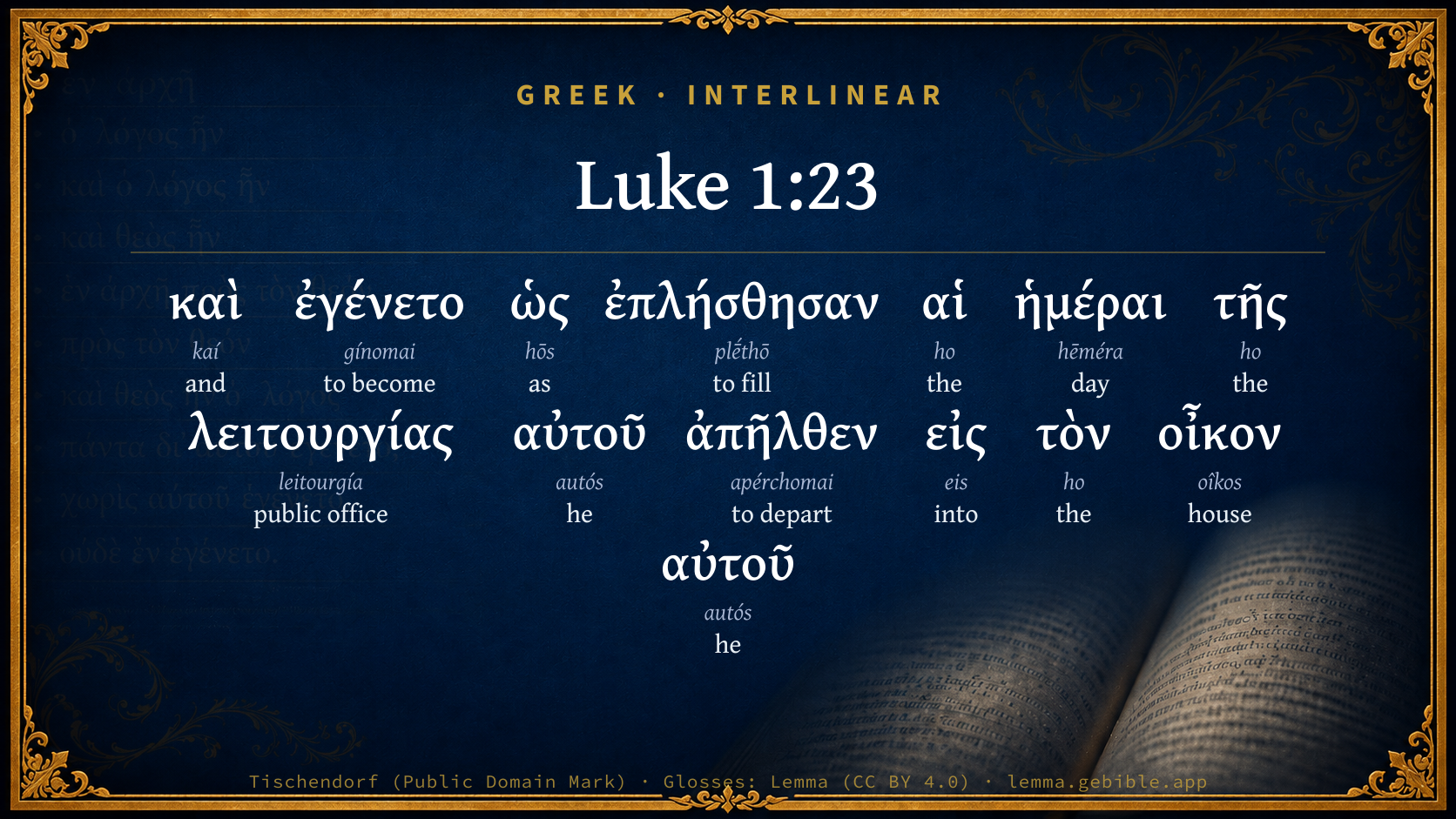
Download image
Cite this verse

Luke 1:23 (World English Bible). Public Domain. Lemma interlinear Bible study tool, https://lemma.gebible.app/v/luke/1/23.

Show BibTeX & RIS
BibTeX
RIS
English Translation
It happened, when the days of his service were fulfilled, he departed to his house.
World English Bible · Public Domain
Highlights
  • 1 first appearance in the Greek New Testament
Full analysis ↓
Download a study sheet

One document with this verse’s original text, its word-by-word gloss line, the meaning frame, cross-references with their text, attributed commentary, and full source and license credits — printable, and it pastes into notes with its structure intact.

This verse Autodidact and up

Study sheet (.html) Plain text (.txt)

A passage Seminary Student

Up to 50 verses in one chapter. A passage sheet keeps up to 6 commentary sources and 12 cross-references per verse, in the order this page ranks them, and says so on the sheet whenever that leaves anything out. Ask for a single verse and you get the Autodidact verse sheet above.

Everything on this page stays free to read, with no account — the sheet is a download of what is already on screen, not access to it.

Want to remove ads? Support Godless Engineer
Compare translations 3

The same verse in 3 English versions, stacked beneath the original-language interlinear above. Click any original word for its lexicon entry.

Each is an independent rendering of the whole verse — the interlinear is not word-aligned to these translations.

Highlighted words mark where these versions differ — a whole-verse word diff, not a word-by-word alignment.

  • World English Bible Public Domain
    It happened, when the days of his service were fulfilled, he departed to his house.
  • King James Version Public Domain
    And it came to pass, that, as soon as the days of his ministration were accomplished, he departed to his own house.
  • unfoldingWord Literal Text CC BY-SA 4.0
    And it happened that, when the days of his priestly service were fulfilled, he went away to his home.

unfoldingWord Literal Text — © unfoldingWord, licensed CC BY-SA 4.0. Word-aligned USFM3 via Door43 (git.door43.org/unfoldingWord/en_ult).

Versions to compare (up to 4)

3 of 4 selected

Show all 19 translations

Every available English version of this verse, each an independent rendering of the whole verse.

  • World English Bible Public Domain
    It happened, when the days of his service were fulfilled, he departed to his house.
  • Berean Standard Bible Public Domain
    And when the days of his service were complete, he returned home.
  • Majority Standard Bible Public Domain
    And when the days of his service were complete, he returned home.
  • King James Version Public Domain
    And it came to pass, that, as soon as the days of his ministration were accomplished, he departed to his own house.
  • American Standard Version (1901) Public Domain
    And it came to pass, when the days of his ministration were fulfilled, he departed unto his house.
  • Revised Version (1885) Public Domain
    And it came to pass, when the days of his ministration were fulfilled, he departed unto his house.
  • Geneva Bible (1599) Public Domain
    And it came to passe, when the daies of his office were fulfilled, that he departed to his owne house.
  • Douay-Rheims (1899) Public Domain
    And it came to pass, after the days of his office were accomplished, he departed to his own house.
  • Young's Literal Translation Public Domain
    And it came to pass, when the days of his service were fulfilled, he went away to his house,
  • Literal Standard Version CC BY-SA 4.0
    And it came to pass, when the days of his service were fulfilled, he went away to his house,
  • Unlocked Literal Bible CC BY-SA 4.0
    It came about that when the days of his service were over, he went to his house.
  • unfoldingWord Literal Text CC BY-SA 4.0
    And it happened that, when the days of his priestly service were fulfilled, he went away to his home.
  • Darby Bible Public Domain
    And it came to pass, when the days of his service were completed, he departed to his house.
  • World Messianic Bible Public Domain
    When the days of his service were fulfilled, he departed to his house.
  • Webster's Bible Public Domain
    And it came to pass, that as soon as the days of his ministration were accomplished, he departed to his own house.
  • Free Bible Version CC BY-SA 4.0
    After he'd finished his time of service, he went back home.
  • Bible in Basic English Public Domain
    And when the days of his work in the Temple were ended, he went back to his house.
  • Text-Critical English NT CC BY 4.0
    And when the days of his service had come to an end, he returned to his home.
  • Tyndale New Testament (1534) Public Domain
    And it fortuned assone as the tyme of his office was oute he departed home into his awne housse.

Literal Standard Version (2020), Covenant Press — licensed CC BY-SA 4.0. Text via the HelloAO Bible API (eBible.org). Unlocked Literal Bible (unfoldingWord) — licensed CC BY-SA 4.0. Text via the HelloAO Bible API (eBible.org). unfoldingWord Literal Text — © unfoldingWord, licensed CC BY-SA 4.0. Word-aligned USFM3 via Door43 (git.door43.org/unfoldingWord/en_ult). Free Bible Version, Dr. Jonathan Gallagher — licensed CC BY-SA 4.0. Text via the HelloAO Bible API (eBible.org).

Word by word

More ways to search: Search by grammar → Find every occurrence → Compare this word →

Practice this passage: Drill this verse → Learn its vocabulary →

λειτουργίας
leitourgía
G3009
“public office”
Noun, Genitive, Singular, Feminine
Part of Speech
Noun
Case
Genitive
Number
Singular
Gender
Feminine
Full Thayer's Definition

Origin: from G3008

TDNT: 07:35,5

1. a public office which a citizen undertakes to administer at his own expense 2. any service a. of military service b. of the service of workmen c. of that done to nature in the cohabitation of man and wife 3. biblical usage a. a service or ministry of the priests relative to the prayers and sacrifices offered to God b. a gift or benefaction for the relief of the needy
  1. καὶ kaí G2532 “and” Conjunction
  2. ἐγένετο gínomai G1096 “to become” Verb, Aorist, Middle deponent, Indicative, 3rd person, Singular
  3. ὡς hōs G5613 “as” Adverb
  4. ἐπλήσθησαν plḗthō G4130 “to fill” Verb, Aorist, Passive, Indicative, 3rd person, Plural
  5. αἱ ho G3588 “the” Article, Nominative, Plural, Feminine
  6. ἡμέραι hēméra G2250 “day” Noun, Nominative, Plural, Feminine
  7. τῆς ho G3588 “the” Article, Genitive, Singular, Feminine
  8. αὐτοῦ autós G846 “he” Personal pronoun, Genitive, Singular, Masculine
  9. ἀπῆλθεν apérchomai G565 “to depart” Verb, Aorist, Active, Indicative, 3rd person, Singular
  10. εἰς eis G1519 “into” Preposition
  11. τὸν ho G3588 “the” Article, Accusative, Singular, Masculine
  12. οἶκον oîkos G3624 “house” Noun, Accusative, Singular, Masculine
  13. αὐτοῦ autós G846 “he” Personal pronoun, Genitive, Singular, Masculine

About this verse

These counts appear in no published source. They are computed here, from the morphology-tagged text and Lemma’s own curated glosses. What Lemma adds →

14
words
11
distinct lemmas
Gospels
section

Notable vocabulary

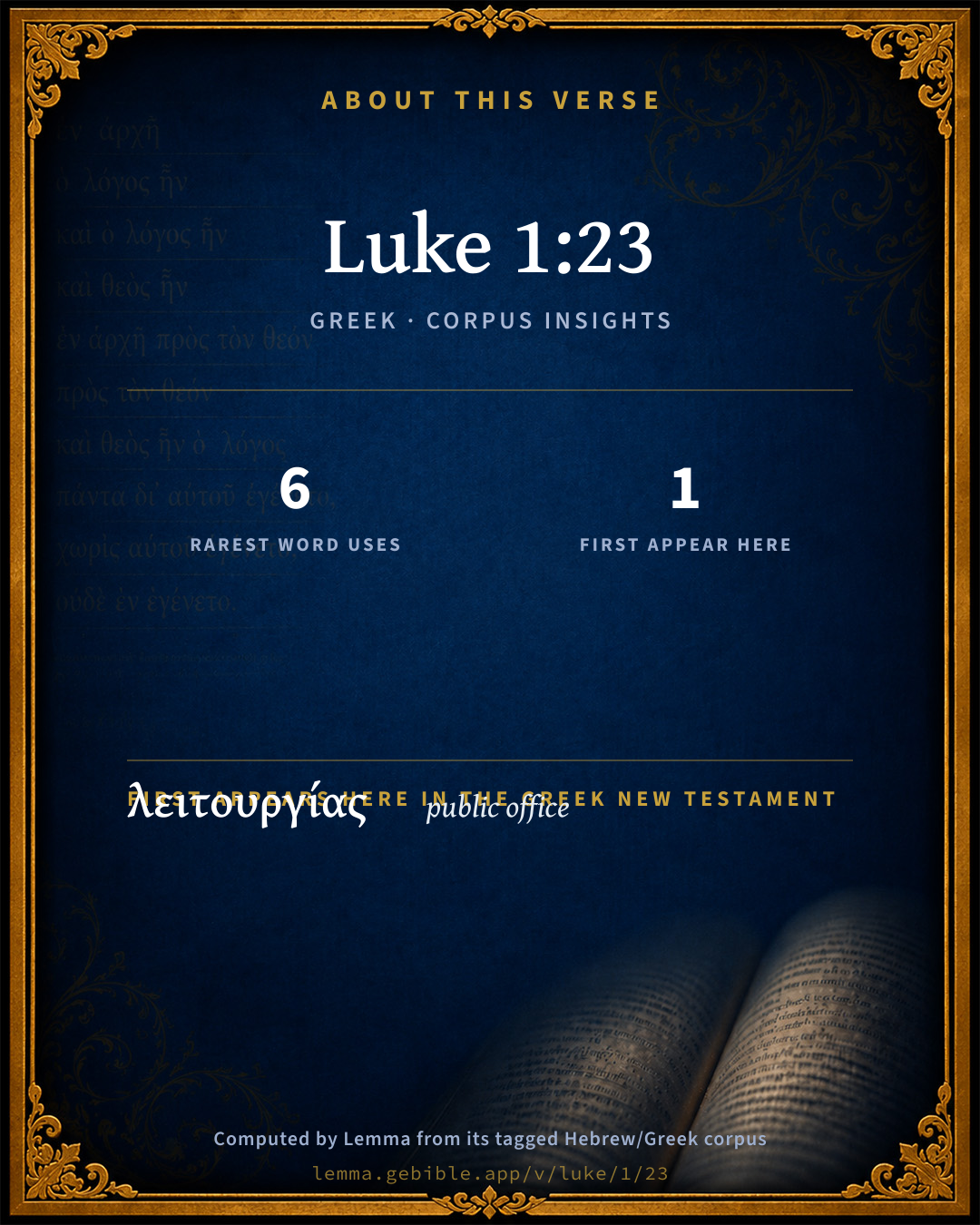
The rarest word here is λειτουργίας public office G3009 — appearing just 6 times in the whole Greek New Testament.

First appearance in Scripture

This word makes its first canonical appearance in the Greek New Testament here:

  • λειτουργίας public office G3009

Shared distinctive vocabulary

λειτουργίας public office G3009 occurs in 6 verses of the Greek New Testament. Also found in:
Repetition

Words recur within this verse:

  • αἱ the G3588 ×3
  • αὐτοῦ he G846 ×2

Cross-references

2

Topical passages linked to Luke 1:23 in the Treasury of Scripture Knowledge — connected by theme and wording, ordered by reader-vote popularity; previews shown in the World English Bible.

  • 1 Chronicles 9:25 Their brothers, in their villages, were to come in every seven days from time to time to be with them:
  • 2 Kings 11:5–7 He commanded them, saying, This is the thing that you shall do: a third part of you, who come in on the Sabbath, shall be keepers of the watch of the king's house;

Cross-references courtesy of OpenBible.info (CC BY 4.0).

Commentary

Notes on Luke 1:23 from classic Christian and Jewish commentators (each source and its license shown beneath its notes). The classic Christian expositions comment on the surrounding passage and are grouped to its opening verse, so a note may address several verses; the Jewish commentaries on the Tanakh (Rashi and others) are per-verse, so they appear only where the commentator wrote on this verse.

Lemma curates 59 commentaries, every one of them public domain or Creative Commons licensed, each selected and text-cleaned for this edition rather than reprinted as found. About our sources →

Joseph Benson's Commentary

Luk 1:23-25. As soon as the days of his ministration were accomplished — Though he was both deaf and dumb, he was still able to burn incense, and perform the other duties of his office. He therefore continued at the temple till the time of his ministration was ended; when he returned to his house; which is generally supposed to have been at Hebron, a city of the priests, about twenty miles from Jerusalem. See on Luk 1:39. And after these days — Probably very soon after; his wife Elisabeth conceived — According to the prediction of the angel; and hid herself five months — Retired from company, that she might have the more leisure to meditate on the wonderful goodness of God toward her and her husband, and might praise him for it, and rejoice therein. Or, as some think, she kept herself retired, and avoided seeing company, that she might conceal her pregnancy for a while, lest she should expose herself to ridicule by speaking of it before she knew certainly that it was a reality. Saying, Thus hath the Lord dealt with me — Hath miraculously interposed, and done this great work for me; in the days wherein he looked upon me — In his own good time, in which he hath had respect to me, to take away my reproach — Namely, barrenness, which was a great reproach among the Jews. To which may be added, “that a branch of the family of Aaron should fail, would be looked upon as a particular calamity, and might be interpreted as a judgment; and so much the rather, considering the many promises God had made to increase the families of his obedient people.” Thus Dr. Doddridge, who takes occasion here to observe further, “that, considering how the whole Jewish polity was interwoven with those acts of religion which were to be performed by the priests alone, it might seem wonderful that no provision at all should be made for entailing the priesthood on any other family, if that of Aaron should happen to be extinct. Leaving this contingency unprovided for, was, in effect, putting the whole credit of the Jewish religion upon the perpetual continuance of the male branches of that family; an issue on which no man of Moses’s prudence, nor indeed of common sense, would have rested his legislation, if he had not been truly conscious of its divine origin, especially after two of Aaron’s four sons had been cut off in one day, for a rash act in the execution of their office, as soon as they were initiated into it, and died without any children, Num 3:4.

Joseph Benson's Commentary on the Old and New Testaments (1811–1818) — public domain. Text from a community e-Sword module.

Bengel's Gnomon

Johann Albrecht Bengel

Luk 1:23. Εἰς τὸν οἶκον αὐτοῦ, to his own house) An abbreviated form of expression: the city, in which Zacharias dwelt, requiring to be understood. Comp. Luk 1:39. So also Luk 1:56. The house of Zacharias is put in antithesis to the temple of the Lord: see Luk 1:9.

Bengel's Gnomon of the New Testament — English translation (T&T Clark, Edinburgh, 1860) — public domain. Text from a community e-Sword module.

Expositor's Greek Testament

ed. W. Robertson Nicoll

Luk 1:23-25 . Returns home . The week of service over, Zechariah went back to his own house. λειτουργίας : in Biblical Greek used in reference to priestly service; elsewhere of public service rendered by a citizen at his own expense or of any sort of service.

The Expositor's Greek Testament, edited by W. Robertson Nicoll (1897–1910) — public domain. Text from a community e-Sword module.

Godet's Commentaries

Frédéric Louis Godet

3. The accomplishment of the promise: Luk 1:23-25. The subject of ἐγένετο, it came to pass, is all that follows to the end of Luk 1:25. Comp. a similar ἐγένετο, Act 9:3.

The active form περιέκρυβεν ἑαυτήν, literally, she kept herself concealed, expresses a more energetic action than that designated by the middle περιεκρύψατο. Elizabeth isolated herself intentionally, rendering herself invisible to her neighbours. Her conduct has been explained in many ways. Origen and Ambrose thought that it was the result of a kind of false modesty. Paulus supposed that Elizabeth wished to obtain assurance of the reality of her happiness before speaking about it. According to De Wette, this retreat was nothing more than a precaution for her health. It was dictated, according to Bleek and Oosterzee, by a desire for meditation and by sentiments of humble gratitude. Of all these explanations, the last certainly appears the best. But it in no way accounts for the term for five months, so particularly mentioned. Further, how from this point of view are we to explain the singular expression, Thus hath the Lord dealt with me? The full meaning of this word thus is necessarily weakened by applying it in a general way to the greatness of the blessing conferred on Elizabeth, whilst this expression naturally establishes a connection between the practice she pursues towards herself from this time, and God’s method of dealing with her. What is this connection? Does she not mean, “I will treat myself as God has treated my reproach. He has taken it away from me; I will therefore withdraw myself from the sight of men, so long as I run any risk of still bearing it, when I am in reality delivered from it?” Restored by God, she feels that she owes it to herself, as well as to Him who has honoured her in this way, to expose herself no more to the scornful regards of men until she can appear before them evidently honoured by the proofs of the divine favour. In this way the term five months, which she fixes for her seclusion, becomes perfectly intelligible. For it is after the fifth month that the condition of a pregnant woman becomes apparent. Therefore it is not until then that she can appear again in society, as what she really is, restored. In this conduct and declaration there is a mixture of womanly pride and humble gratitude which makes them a very exquisite expression of maternal feeling for one in such a position. We should like to know what later narrator would have invented such a delicate touch as this. But the authenticity of this single detail implies the authenticity of the whole of the preceding narrative. ῞Οτι must be taken here in the sense of because; Elizabeth wants to justify whatever is unusual in the course of conduct she has just adopted.—᾿Επεῖδεν ἀφελεῖν, “He has regarded me in a manner that takes away;” he has cast on me one of those efficacious looks which, as the Psalmist says, are deliverance itself.

On barrenness as a reproach, comp. Gen 30:23, where, after the birth of her first-born, Rachel cries, “God has taken away my reproach.”

This saying of Elizabeth’s discloses all the humiliations which the pious Israelite had endured from her neighbours during these long years of barrenness. This also comes out indirectly from Luk 1:36, in which the angel makes use of the expression, “Her who was called barren.” This epithet had become a kind of sobriquet for her in the mouth of the people of the place.

Frédéric Louis Godet — Commentaries on Luke, John, Romans, and 1 Corinthians — English translation (T&T Clark, Edinburgh, 1870s–1890s) — public domain. Text from a community e-Sword module.

Adam Clarke's Commentary

Verse 23. As soon as the days of his ministration were accomplished] Each family of the priesthood officiated one whole week, 2Kg 11:17.

There is something very instructive in the conduct of this priest; had he not loved the service he was engaged in, he might have made the loss of his speech a pretext for immediately quitting it. But as he was not thereby disabled from fulfilling the sacerdotal function, so he saw he was bound to continue till his ministry was ended; or till God had given him a positive dismission. Preachers who give up their labour in the vineyard because of some trifling bodily disorder by which they are afflicted, or through some inconvenience in outward circumstances, which the follower of a cross-bearing, crucified Lord should not mention, show that they either never had a proper concern for the honour of their Master or for the salvation of men, or else that they have lost the spirit of their Master, and the spirit of their work. Again, Zacharias did not hasten to his house to tell his wife the good news that he had received from heaven, in which she was certainly very much interested: the angel had promised that all his words should be fulfilled in their season, and for this season he patiently waited in the path of duty. He had engaged in the work of the Lord, and must pay no attention to any thing that was likely to mar or interrupt his religious service. Preachers who profess to be called of God to labour in the word and doctrine, and who abandon their work for filthy lucre's sake, are the most contemptible of mortals, and traitors to their God.

Adam Clarke's Commentary on the Bible (1810–1826) — public domain. Text from a community e-Sword/MySword module.

Ellicott's Commentary for English Readers

(23) The days of his ministration.—The word used for “ministration” conveys, like the ministering spirits” of Heb_1:14, the idea of liturgical service. The “days” were, according to the usual order of the Temple, from Sabbath to Sabbath (2Ki_11:5).

A Bible Commentary for English Readers, edited by Charles John Ellicott (1878–1897) — public domain. Text from a community e-Sword module.

The Cambridge Bible for Schools and Colleges

gen. ed. J. J. S. Perowne

23. the days of his ministration] They lasted from the evening of one Sabbath to the morning of the next. 2Ki_11:5.

The Cambridge Bible for Schools and Colleges (gen. ed. J. J. S. Perowne; Cambridge University Press, 1878–1918) — public domain. Text from a community e-Sword module.

John Gill's Exposition

And it came to pass, that as soon as the days of his ministration,.... In the order of the course, which might be three, four, five, or six days, according to the number of the heads of the house of their fathers in the course; See Gill on Luk 1:5.

were accomplished: for though he was deaf and dumb, he was not hereby disqualified for service. Deafness and dumbness excused persons from various duties (s) but did not disqualify priests: a Levite, if he had lost his voice, was disqualified, but not a priest; (t) the reason was this, because it was one part of the work of the Levites to sing, and therefore could not perform it without a voice; but such was the work of the priests, that though deaf and dumb, they could discharge it; as cleansing the altar, trimming the lamps, carrying the parts to the altar, laying them upon it, and burning them, or offering any sacrifice, burning incense, &c. which was the business of Zacharias; which when he had fulfilled, he departed to his own house; which was not at Jerusalem, but in the hill country, in a city of Judah there; see Luk 1:39.

(s) Misn. Trumot, c. 1. sect. 1, 2. Chagiga, c. 1. sect. 1. (t) Maimon. & Bartenora in Misn. Cholin, c. 1. sect. 6.

John Gill's Exposition of the Whole Bible (1746–1763) — public domain (CC PDM 1.0). Text via the HelloAO Bible API.

Trapp's Complete Commentary

John Trapp

23 And it came to pass, that, as soon as the days of his ministration were accomplished, he departed to his own house.

Ver. 23. As soon as the days, &c.] Zacharias, though he ceased to speak, yet he ceased not to minister. Though he were dumb, yet he was not lame, but could do sacrifice, and did it. We may not straight take occasions of withdrawing ourselves from the public services.

John Trapp, A Commentary or Exposition upon All the Books of the Old and New Testament (1647–1656) — public domain. Text from a community e-Sword module.

Albert Barnes' Notes on the Bible

As soon as the days of his ministration ... - As soon as he had fulfilled the duties of the week. It might have been supposed that the extraordinary occurrence in the temple, together with his own calamity, would have induced him at once to leave this place and return home; but his duty was in the temple. His piety prompted him to remain there in the service of God. He was not unfitted for burning incense by his dumbness, and it was not proper for him to leave his post. It is the duty of ministers of religion to remain at their work until they are unfitted for it, and unable to serve God in their profession. Then they must retire. But until that time, he that for trifling causes forsakes his post is guilty of unfaithfulness to his Master.

Albert Barnes' Notes on the Bible (1834–1885) — public domain. Text from a community e-Sword/MySword module.

Haydock's Catholic Bible Commentary

After the days of his office were accomplished; i.e. the weekly ministry; for during that time, the priests lodged in buildings joining to the temple, separated from their wives. (Witham) --- When it fell to the lot of any of the priests to offer incense, they not only separated from their wives, but left their house; wherefore it is said, as soon as the day, &c. As it was ordained that the priesthood should continue in the family of Aaron, it was necessary they should have wives. But, as we do not now so much seek after priests of the same family, as those who are virtuous, it has been decreed, that priests should observe perpetual continency, that they may be able to assist at all times at the altar. (Ven. Bede) --- For the law of perpetual celibacy of the clergy, See St. Jerome, lib. i. chap. ix. 19. advers Jovin. et. ep. 50; also St. Ambrose, in 1 Tim iii.

George Leo Haydock (1774–1849), Haydock's Catholic Family Bible and Commentary, 1859 edition — public domain. Excludes Psalms (Douay-Rheims chapter numbering differs from Protestant) and Deuterocanonical books (Catholic canon only).

Whedon's Commentary on the Bible

Daniel D. Whedon

23. The days of his ministration—The week of the priestly course of Abia. During their week the priests did not visit their own homes, but remained in the temple enclosures.

Daniel D. Whedon (gen. ed.), Commentary on the Old and New Testaments (1874–1909) — public domain. Text from a community e-Sword module.

Burkitt's Expository Notes on the New Testament

William Burkitt

The priest, during the time of their administration, had their lodgings in buildings appertaining to the temple. Zachary having ended his administration, leaves his lodgings, and returns to his house, where his wife Elizabeth conceiving, she hides herself; that is, retires from company partly to prevent the discourse of people, until it was out of all doubt that she had conceived, and partly to give herself opportunity of returning her thankful acknowlegments unto God, who had given her this miraculous mercy; and had thereby taken away, the reproach of barrenness which was so heavy and insupportable among the Jews.

Note here, two things, 1. How piously Elizabeth ascribes this mercy to the power of God: Thus hath the Lord dealt with me. It is God that keeps the key of the womb in his own hand, and makes the fruit of it his reward, and therefore children are to be owned as his special gift.

Note, 2. How great a reproach bodily barrenness is in the sight of man, but not so great as spiritual barrenness in the sight of God; for this is at once a reproach to God, a reproach to religion, a reproach to professors, and to ourselves.

William Burkitt's Expository Notes on the New Testament (1700–1703) — public domain. Text from a community e-Sword module.

The People's New Testament

B. W. Johnson

23. To his own house. To his own city and home.

B. W. Johnson's The People's New Testament with Notes (1889–1891) — public domain. Electronic text from the Christian Classics Ethereal Library (CCEL) ThML edition.

Cambridge Greek Testament for Schools and Colleges

23. ἐπλήσθησαν. The same verb occurs in 57, Luk 2:6; Luk 2:21, &c.

αἱ ἡμέραι τῆς λειτουργίας αὐτοῦ. The word λειτουργία is derived from λεώς, ἔργον, a service done for the people. The time of a priest’s “liturgy” lasted from the evening of one Sabbath to the morning of the next. 2Ki 11:5.

εἰς τὸν οἶκον αὐτοῦ. The simplicity of the narrative is marked by the recurrence of the phrase Luk 1:39; Luk 1:56.

Cambridge Greek Testament for Schools and Colleges (Cambridge University Press, 1896; 21 vols, various authors incl. Carr, Maclear, Plummer, Farrar, Lumby, Moule, M. R. James, Simcox) — public domain. Text from a community e-Sword module.

Alford’s Greek Testament

Henry Alford

23. ὡς ἐπλήσ.] The week during which his course was on duty. Mr. Greswell, by much elaborate calculation, has made it probable, but only as one out of several alternatives, that this week was Tisri 18-25, = September 30-October 7, of the sixth year before the Christian era (Prolegg. p. 85 sqq.).

A deaf and dumb person, we thus see, was not precluded from some of the sacerdotal ministrations.

24,

Henry Alford, The Greek Testament (1849–1861) — public domain. Text from a community e-Sword module.

International Critical Commentary

23. ὡς ἐπλήσθησαν αἱ ἡμέραι τῆς λειτουργίας αὐτοῦ. When the week for which the course of Abijah was on duty for public service was at an end. See on vv. 15 and 57. In class. Grk. λειτουργία (λεώς, ἔργον) is freq. of public service undertaken by a citizen at his own expense. In bibl. Grk. it is used of priestly service in the worship of God (Heb 8:6, Heb 8:9:21; Num 8:22, Num 8:16:9, Num 8:18:4; 2Ch 31:2), and also of service to the needy (2Co 9:12: Php 2:30). See Deissmann, Bible Studies, p. 140.

ἀπῆλθεν εἰς τὸν οἶκον αὐτοῦ. This was not in Jerusalem, in the Ophel quarter, where many of the priests resided, but in an unnamed town in the hill-country south of Jerusalem (ver. 39). It is probable that most of the priests who did not live in the city itself resided in the towns and villages in the neighbourhood. Convenience would suggest that they should live inside Judæa. In Neh 11:10-19 we have 1192 priests in Jerusalem; in 1Ch 9:13 we have 1760. Later authorities speak of 24,000; but such figures are very untrustworthy. The whole question of the residences of the priests is an obscure one, and Jos_21. must not be quoted as evidence for more than a projected arrangement. That it was carried into effect and maintained, or that it was revived after the Exile, is a great deal more than we know. Schürer, Jewish People in the T. of J. C. ii. I, p. 229.

International Critical Commentary — older volumes (1896–1929), various authors — public domain. Text from a community e-Sword module.

Vincent's Word Studies in the New Testament

Marvin R. Vincent

Ministration [λειτουργιας] . From leitov, belonging to the people, public, and ergon, a work. Hence service of the state in a public office. Trench observes that "when the Christian Church was forming its terminology, which it did partly by shaping new words, and partly by elevating old ones to higher than their previous uses, of the latter it more readily adopted those before employed in civil and political life, than such as had played their part in religious matters." Hence it adopted this word, already in use in the Septuagint, as the constant word for performing priestly and ministerial functions; and so in the New Testament of the ministry of the apostles, prophets, and teachers.

Marvin R. Vincent, Word Studies in the New Testament (1887–1900) — public domain. Text from a community e-Sword/MySword module.

Lesson kit

Teaching starters — assembled from the data on this page, not authored interpretation. Every prompt links to the verse data it draws on. Edit before teaching.

Luke, in the Gospels, opens this verse with 14 words (11 distinct Greek lemmas). Its most distinctive word is leitourgía (“public office”). A historical commentator’s framing appears above. Read the whole chapter for the surrounding context.

Discussion questions

  1. The word leitourgía carries the sense “public office.” How does it shape the verse?
  2. This is the first place “public office” appears in Scripture (first appears here). What does its debut here establish?
  3. How does 2 Corinthians 9:12, which shares the word «public office», read alongside this verse?
  4. What does the repetition of “the” (3× in this one verse) do in this verse?
  5. The translations on this page render this verse differently — a whole-verse word diff, not a word-by-word alignment. What might account for the different wordings?
  6. Compare how Joseph Benson's Commentary and Bengel's Gnomon read this verse. Where do they agree or differ?

Things to notice

  • 1 word makes its first canonical appearance in Scripture here.
  • These translations choose different wording for 16 words in this verse.
  • “the” occurs 3× in this single verse.
  • 11 distinct Greek lemmas span 14 words in this verse.

Reading settings

Reading text

Shown beneath each verse's original-language words.

Old Testament
Old Testament edition

Read the OT as the Masoretic Hebrew (MT) or the Greek Septuagint (LXX).

English shown for the Greek Septuagint (in the Hebrew ↔ Greek comparison).

Comparing translations? Open the Compare panel on any verse page to stack up to four side by side.