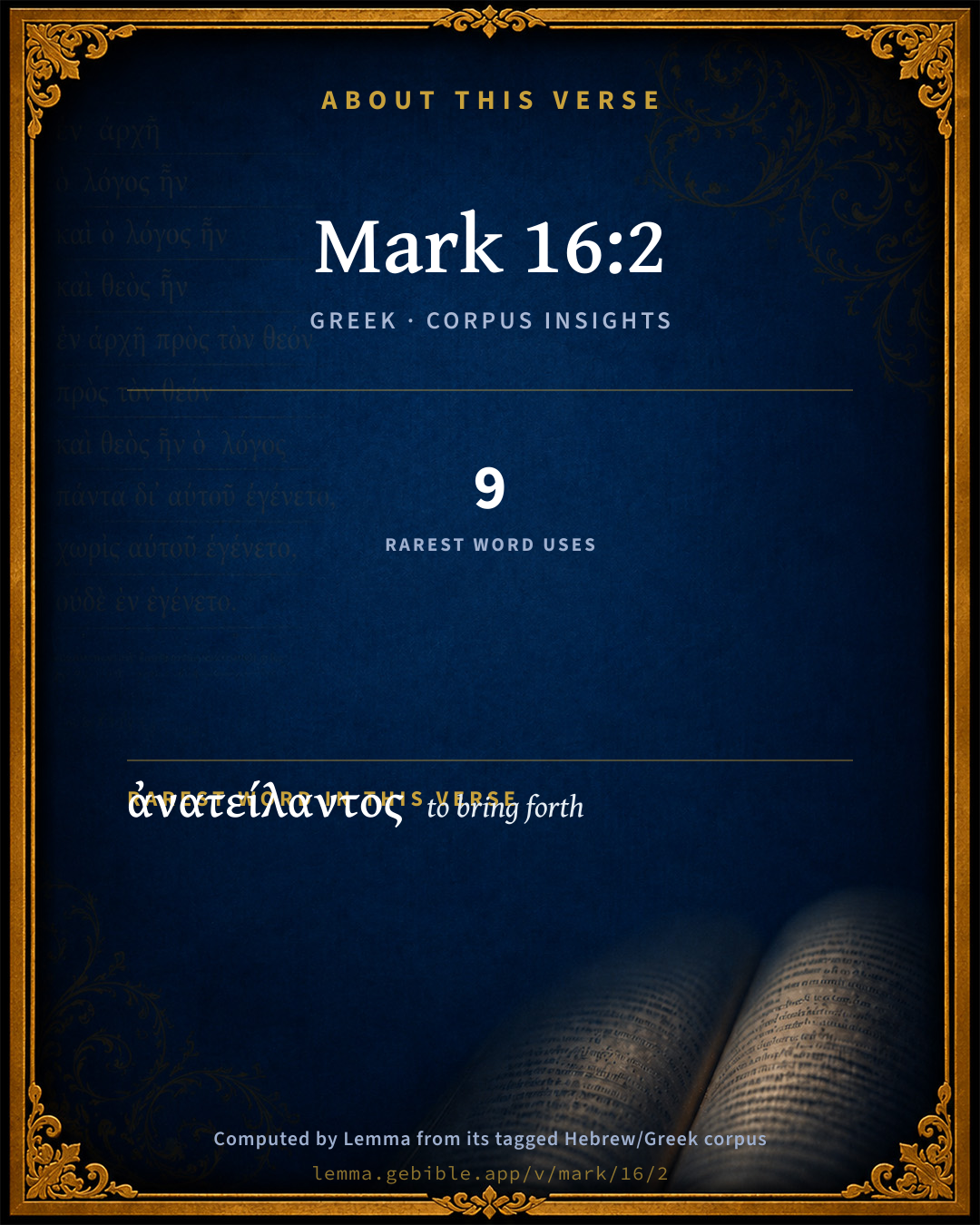
Mark 16:2

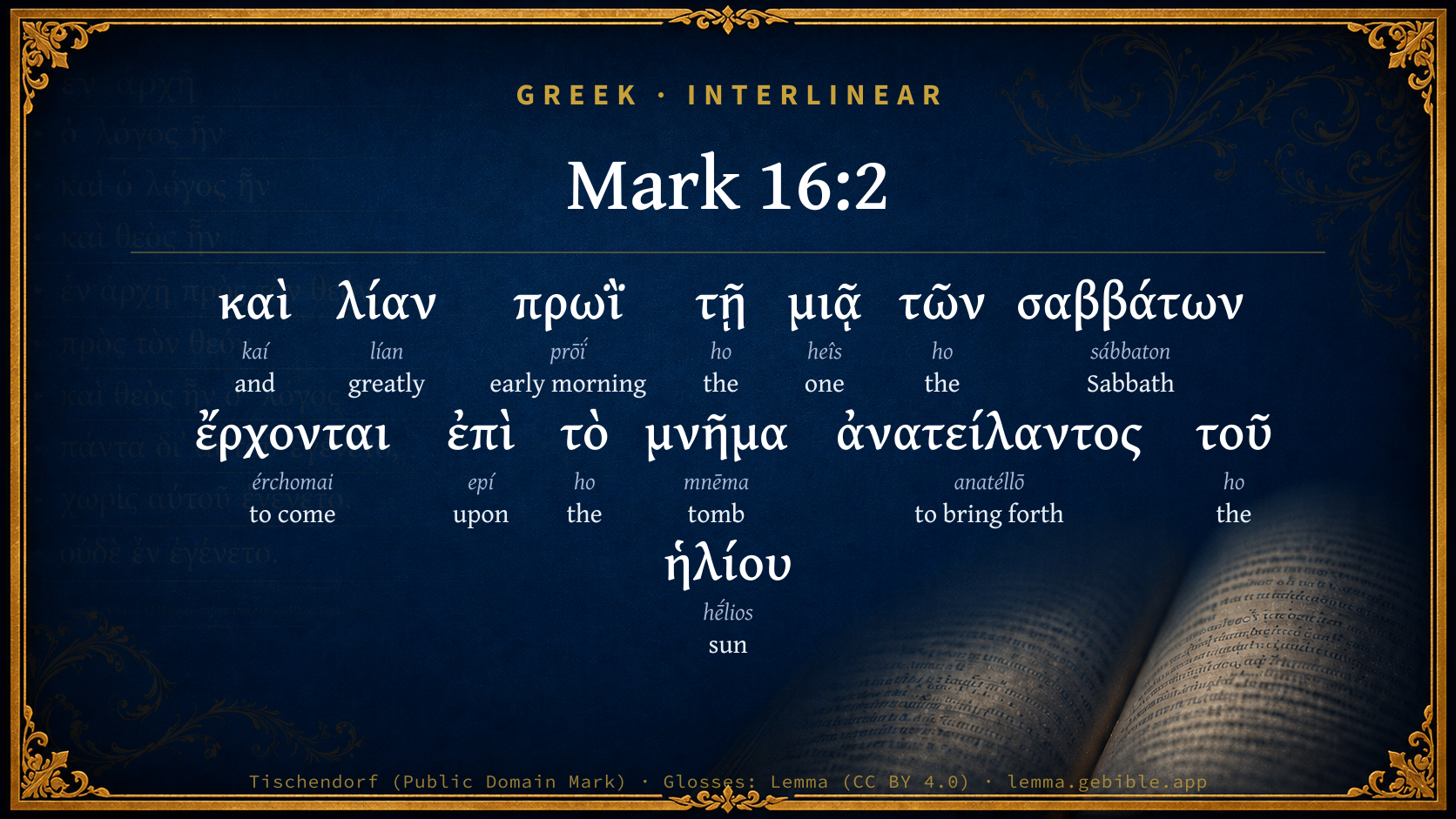
Greek (Tischendorf 8th ed.) Mark 16:2 appears in the Greek New Testament. The text above is from the Tischendorf 8th edition. Each word links to its Strong’s number and a concise gloss. Click any word for its full Thayer’s Greek Lexicon entry.
Download image
Cite this verse

Mark 16:2 (World English Bible). Public Domain. Lemma interlinear Bible study tool, https://lemma.gebible.app/v/mark/16/2.

Show BibTeX & RIS
BibTeX
RIS
English Translation
Very early on the first day of the week, they came to the tomb when the sun had risen.
World English Bible · Public Domain
Download a study sheet

One document with this verse’s original text, its word-by-word gloss line, the meaning frame, cross-references with their text, attributed commentary, and full source and license credits — printable, and it pastes into notes with its structure intact.

This verse Autodidact and up

Study sheet (.html) Plain text (.txt)

A passage Seminary Student

Up to 50 verses in one chapter. A passage sheet keeps up to 6 commentary sources and 12 cross-references per verse, in the order this page ranks them, and says so on the sheet whenever that leaves anything out. Ask for a single verse and you get the Autodidact verse sheet above.

Everything on this page stays free to read, with no account — the sheet is a download of what is already on screen, not access to it.

Want to remove ads? Support Godless Engineer
Compare translations 3

The same verse in 3 English versions, stacked beneath the original-language interlinear above. Click any original word for its lexicon entry.

Each is an independent rendering of the whole verse — the interlinear is not word-aligned to these translations.

Highlighted words mark where these versions differ — a whole-verse word diff, not a word-by-word alignment.

  • World English Bible Public Domain
    Very early on the first day of the week, they came to the tomb when the sun had risen.
  • King James Version Public Domain
    And very early in the morning the first day of the week, they came unto the sepulchre at the rising of the sun.
  • unfoldingWord Literal Text CC BY-SA 4.0
    And very early on the first of the week, they arrive at the tomb, the sun having come up.

unfoldingWord Literal Text — © unfoldingWord, licensed CC BY-SA 4.0. Word-aligned USFM3 via Door43 (git.door43.org/unfoldingWord/en_ult).

Versions to compare (up to 4)

3 of 4 selected

Show all 19 translations

Every available English version of this verse, each an independent rendering of the whole verse.

  • World English Bible Public Domain
    Very early on the first day of the week, they came to the tomb when the sun had risen.
  • Berean Standard Bible Public Domain
    Very early on the first day of the week, just after sunrise, they went to the tomb.
  • Majority Standard Bible Public Domain
    Very early on the first day of the week, just after sunrise, they went to the tomb.
  • King James Version Public Domain
    And very early in the morning the first day of the week, they came unto the sepulchre at the rising of the sun.
  • American Standard Version (1901) Public Domain
    And very early on the first day of the week, they come to the tomb when the sun was risen.
  • Revised Version (1885) Public Domain
    And very early on the first day of the week, they come to the tomb when the sun was risen.
  • Geneva Bible (1599) Public Domain
    Therefore early in the morning, the first day of the weeke, they came vnto the sepulchre, when the Sunne was nowe risen.
  • Douay-Rheims (1899) Public Domain
    And very early in the morning, the first day of the week, they come to the sepulchre, the sun being now risen.
  • Young's Literal Translation Public Domain
    and early in the morning of the first of the sabbaths, they come unto the sepulchre, at the rising of the sun,
  • Literal Standard Version CC BY-SA 4.0
    and early in the morning of the first [day] of the weeks, they come to the tomb, at the rising of the sun,
  • Unlocked Literal Bible CC BY-SA 4.0
    Very early on the first day of the week, they went to the tomb when the sun came up.
  • unfoldingWord Literal Text CC BY-SA 4.0
    And very early on the first of the week, they arrive at the tomb, the sun having come up.
  • Darby Bible Public Domain
    And very early on the first [day] of the week they come to the sepulchre, the sun having risen.
  • World Messianic Bible Public Domain
    Very early on the first day of the week, they came to the tomb when the sun had risen.
  • Webster's Bible Public Domain
    And very early in the morning, the first day of the week, they came to the sepulcher at the rising of the sun:
  • Free Bible Version CC BY-SA 4.0
    Very early on the first day of the week, just at sunrise, they went to the tomb.
  • Bible in Basic English Public Domain
    And very early after dawn on the first day of the week, they came at the time of the coming up of the sun to the place where the body had been put.
  • Text-Critical English NT CC BY 4.0
    Very early in the morning of the first day of the week, when the sun had risen, they went to the tomb.
  • Tyndale New Testament (1534) Public Domain
    And erly in the morninge the nexte daye after the saboth day they came vnto the sepulcre when the sunne was rysen.

Literal Standard Version (2020), Covenant Press — licensed CC BY-SA 4.0. Text via the HelloAO Bible API (eBible.org). Unlocked Literal Bible (unfoldingWord) — licensed CC BY-SA 4.0. Text via the HelloAO Bible API (eBible.org). unfoldingWord Literal Text — © unfoldingWord, licensed CC BY-SA 4.0. Word-aligned USFM3 via Door43 (git.door43.org/unfoldingWord/en_ult). Free Bible Version, Dr. Jonathan Gallagher — licensed CC BY-SA 4.0. Text via the HelloAO Bible API (eBible.org).

Word by word

More ways to search: Search by grammar → Find every occurrence → Compare this word →

Practice this passage: Drill this verse → Learn its vocabulary →

ἀνατείλαντος
anatéllō
G393
“to bring forth”
Verb, Aorist, Active, Participle, Genitive, Singular, Masculine
Part of Speech
Verb
Tense
Aorist
Voice
Active
Mood
Participle
Case
Genitive
Number
Singular
Gender
Masculine
Full Thayer's Definition

Origin: from G303 and the base of G5056

TDNT: 06:51,6

1. rise a. to cause to rise 1. of the earth bring forth plants b. to rise, arise, to rise from, be descended from 1. of sun moon and stars)
  1. καὶ kaí G2532 “and” Conjunction
  2. λίαν lían G3029 “greatly” Adverb
  3. πρωῒ prōḯ G4404 “early morning” Adverb
  4. τῇ ho G3588 “the” Article, Dative, Singular, Feminine
  5. μιᾷ heîs G1520 “one” Adjective, Dative, Singular, Feminine
  6. τῶν ho G3588 “the” Article, Genitive, Plural, Neuter
  7. σαββάτων sábbaton G4521 “Sabbath” Noun, Genitive, Plural, Neuter
  8. ἔρχονται érchomai G2064 “to come” Verb, Present, Middle or Passive deponent, Indicative, 3rd person, Plural
  9. ἐπὶ epí G1909 “upon” Preposition
  10. τὸ ho G3588 “the” Article, Accusative, Singular, Neuter
  11. μνῆμα mnēma G3418 “tomb” Noun, Accusative, Singular, Neuter
  12. τοῦ ho G3588 “the” Article, Genitive, Singular, Masculine
  13. ἡλίου hḗlios G2246 “sun” Noun, Genitive, Singular, Masculine

About this verse

These counts appear in no published source. They are computed here, from the morphology-tagged text and Lemma’s own curated glosses. What Lemma adds →

14
words
11
distinct lemmas
Gospels
section

Notable vocabulary

The rarest word here is ἀνατείλαντος to bring forth G393 — appearing just 9 times in the whole Greek New Testament.

Shared distinctive vocabulary

ἀνατείλαντος to bring forth G393 occurs in 9 verses of the Greek New Testament. Also found in:

Repetition

A word recurs within this verse:

Cross-references

3

Topical passages linked to Mark 16:2 in the Treasury of Scripture Knowledge — connected by theme and wording, ordered by reader-vote popularity; previews shown in the World English Bible.

  • John 20:1 Now on the first day of the week, Mary Magdalene went early, while it was still dark, to the tomb, and saw the stone taken away from the tomb.
  • Matthew 28:1 Now after the Sabbath, as it began to dawn on the first day of the week, Mary Magdalene and the other Mary came to see the tomb.
  • Luke 24:1 But on the first day of the week, at early dawn, they and some others came to the tomb, bringing the spices which they had prepared.

Cross-references courtesy of OpenBible.info (CC BY 4.0).

Commentary

Notes on Mark 16:2 from classic Christian and Jewish commentators (each source and its license shown beneath its notes). The classic Christian expositions comment on the surrounding passage and are grouped to its opening verse, so a note may address several verses; the Jewish commentaries on the Tanakh (Rashi and others) are per-verse, so they appear only where the commentator wrote on this verse.

Lemma curates 59 commentaries, every one of them public domain or Creative Commons licensed, each selected and text-cleaned for this edition rather than reprinted as found. About our sources →

The Biblical Illustrator

Joseph S. Exell

Mar_16:2

They came unto the sepulchre at the rising of the sun.

The sedulity of the devout women

Consider their sedulity-sedulity that admits no intermission, no interruption, no discontinuance, no indifference in religious offices. Consider we therefore their sedulity, if we can. I say, if we can; because if a man should sit down at a beehive or an ant hill, and determine to watch such an ant or such a bee in its work, he would find that bee or that ant so sedulous, so serious, so various, so concurrent with others, so contributory to others, as that he would quickly lose his marks and his sight of that ant or that bee. So, if we fix our consideration upon these devout women, and the sedulity of their devotion, as the several evangelists present it to us, we may easily lose our sight, and hardly know which was which, or at what time she or she came to the sepulchre. They came, in the end of the Sabbath, as it began to dawn toward the first day of the week, says St. Matthew; they came very early in the morning, the first day of the week, at the rising of the sun, says St. Mark; they prepared their spices, and rested the Sabbath, and came early the next day, says St. Luke; they came the first day when it was yet dark, says St. John. From Friday evening till Sunday morning they were sedulous, busy upon this service; so sedulous, that Athanasius thinks these women came four several times to the sepulchre, and that the four evangelists have relation to their four comings, and Jerome argues that this variety is no sign of untruthfulness in the evangelists, but testifies the sedulity of the women they speak of, going and coming, and unwilling to be far distant or long absent from their devout exercise. Beloved, true devotion is a serious, a sedulous, an impatient thing. He who said, I fast twice in the week, was but a Pharisee; he who can reckon his devout actions is no better; he who can tell how often he has thought upon God today, has not thought upon Him often enough. It is St. Augustines holy circle, to pray that we may hear sermons profitably, and to hear sermons that we may learn to pray acceptably. Devotion is no marginal note, no interlineary gloss, no parenthesis that may be left out; it is no occasional thing, no conditional thing: I will go if I like the preacher, the place, the company, the weather; but it is of the body of the text, and lays upon us an obligation of fervour and continuance. (John Donne, D. D.)

The Biblical Illustrator, edited by Joseph S. Exell (c. 1880s–1900s) — public domain. Text from a community e-Sword module.

Bengel's Gnomon

Johann Albrecht Bengel

Mar 16:2. Λίαν πρωῒ, very early in the morning.—ἀνατείλαντος τοῦ ἡλίου, the sun having arisen) The one [the first] clause applies to Mary Magdalene, Joh 20:1; the other clause to the rest of the women.

Bengel's Gnomon of the New Testament — English translation (T&T Clark, Edinburgh, 1860) — public domain. Text from a community e-Sword module.

Expositor's Greek Testament

ed. W. Robertson Nicoll

Mar 16:2 . λίαν πρωῒ , very early in the morning, suggesting a time hardly consistent with the qualifying clause: ἀνατείλαντος τοῦ ἡλίου = when the sun was risen, which again does not harmonise with the “deep dawn” of Lk. and the “yet dark” of John. Mk.’s aim apparently is to emphasise the fact that what he is going to relate happened in broad daylight; Lk.’s to point out that the pious women were at their loving work as early on the Sunday morning as possible.

The Expositor's Greek Testament, edited by W. Robertson Nicoll (1897–1910) — public domain. Text from a community e-Sword module.

Adam Clarke's Commentary

Verse 2. Very early in the morning,] This was the time they left their own houses, and by the rising of the sun they got to the tomb. As the preceding day was the Sabbath, they could not, consistently with the observances of that day, approach the tomb. See the concluding notes at the end of John. "Joh 21:25"

The following observations from Lightfoot will serve to illustrate this subject.

"The distinction of the twilight among the rabbins was this: -

"I. איילחא השחרא The hinde of the morning - the first appearance. R. Chaiia Rab, and R. Simeon ben Chalaphta, travelling together on a certain morning in the valley of Arbel, saw the hinde of the morning, that its light spread the sky. R. Chaiia said, Such shall be the redemption of Israel. First, it goes forward by degrees, and by little and little; but by how much the more it shall go forward, by so much the more it shall increase. It was at that time that Christ arose, namely, in the first morning, as may be gathered from the words of St. Matthew. And to this the title of the 22d Psalm seems to have respect - על איילת השחר. See also Re 22:16, I am the bright and morning star. And now you may imagine the women went out of their houses towards the sepulchre.

"II. משיכיר בי הכלת ללב When one may distinguish between purple colour and white. From what time do they recite their phylacterical prayers in the morning? From that time that one may distinguish between purple colour and white. R. Eliezer saith, Between purple colour and green. Before this time was obscurum adhue caeptae lucis, the obscurity of the begun light, as Tacitus's expression is.

"III. משיארו המזרח When the east begins to lighten.

"IV. בנץ החמה Sunrise; from the hinde of the morning going forth, until the east begins to lighten; and from the time the east begins to lighten, until sunrise, c.

"According to these four parts of time, one might not improperly suit the four phrases of the evangelists. According to the first, Matthew's, Τῃ επιφωσκουσῃ, As it began to dawn. According to the second, John's, Πρωΐ σκοτιας ετι ουσης, Early in the morning when it was yet dark. To the third, Luke's, Ορθρου βαθεως, Very early in the morning. To the fourth, Mark's, Λιαν πρωΐ, Very early in the morning. And yet, Ανατειλαντος του ἡλιου At the rising of the sun. For the women came twice to the sepulchre, as St. John teaches, by whom the other evangelists are to be explained which being well considered, the reconciling them together is very easy."

Adam Clarke's Commentary on the Bible (1810–1826) — public domain. Text from a community e-Sword/MySword module.

Ellicott's Commentary for English Readers

(2)At the rising of the sun.—Literally, when the sun had risen. There seems at first a slight discrepancy between this and St. Matthew’s “while it was yet dark.” A morning haze, however, or the partial continuance of the gloom which had shrouded the city on the previous day, may well be thought of as harmonizing the two accounts.

A Bible Commentary for English Readers, edited by Charles John Ellicott (1878–1897) — public domain. Text from a community e-Sword module.

The Cambridge Bible for Schools and Colleges

gen. ed. J. J. S. Perowne

2. And very early in the morning] while “it was yet dark” (Joh_20:1), before the dawn streaked the eastern sky on

the first day of the week] the world’s first Easter-Day, our Lord’s Day (Rev_1:10),

they came] or rather, come (observe again the graphic present of the Evangelist), draw near, to the sepulchre.

The Cambridge Bible for Schools and Colleges (gen. ed. J. J. S. Perowne; Cambridge University Press, 1878–1918) — public domain. Text from a community e-Sword module.

John Gill's Exposition

And very early in the morning, the first day of the week,.... See Gill on Mat 28:1.

They came to the sepulchre at the rising of the sun; of the sun of righteousness, as Mr. Mede observes; or rather, of the natural sun: for though it was dark when they set out, and when it dawned towards the first day, yet by that time that they all got to the sepulchre, the sun was rising; the Jews say (g), that

"from the ascending of the morning, or break of day, until the sun rises, is an hour and a half.''

And so much time may very well be allowed the women, from their setting out, to their coming to the sepulchre. Moreover, they say (h), that

"from the hind of the morning, to the time the east is enlightened, a man may walk four miles, and from the time that the east is enlightened, , "until the sun rises", four miles.''

But women must not be thought to walk so fast: let it be observed, that Christ, who is called the hind of the morning, Psa 22:1 (title, "Aijeleth Shahar"), and the morning star, Rev 22:16, rose at this time.

(g) Piske Tosaphot in Pesach. art. 44. (h) T. Hieros. Beracot, fol. 2. 3. Bereshit Rabba, sect. 50. fol. 45. 2.

John Gill's Exposition of the Whole Bible (1746–1763) — public domain (CC PDM 1.0). Text via the HelloAO Bible API.

Trapp's Complete Commentary

John Trapp

2 And very early in the morning the first day of the week, they came unto the sepulchre at the rising of the sun.

Ver. 2. The first day of the week] της μιας σαββατων, one of the sabbaths. So the first day of the world is called, Jom echad, one day; that is, the first day, Gen 1:5. For as that day was initial to the world, so the day of our Lord’s resurrection is the beginning of our glorification; as in that day light was produced, so Christ rising, the light of righteousness and joy is risen to us. (Gerb. in Harm. Evang.)

John Trapp, A Commentary or Exposition upon All the Books of the Old and New Testament (1647–1656) — public domain. Text from a community e-Sword module.

Haydock's Catholic Bible Commentary

St. Marks says very early, the sun being now risen, whereas St. John tells us that it was yet dark. But when St. Mark says the sun was risen, he means that it began, by its approach to the horizon, to enlighten the heavens, at which time there is still darkness remaining, (according to St. John) which decreases as light approaches the earth. (St. Augustine)

George Leo Haydock (1774–1849), Haydock's Catholic Family Bible and Commentary, 1859 edition — public domain. Excludes Psalms (Douay-Rheims chapter numbering differs from Protestant) and Deuterocanonical books (Catholic canon only).

Whedon's Commentary on the Bible

Daniel D. Whedon

2. First day of the week — Sunday. Hence this day of the week was called the Lord’s day by St. John in Rev_1:9. It is therefore recognized by inspiration as the sacred day in the Christian week. The day of the Saviour’s sepulchral repose was the last of Jewish Sabbaths. The first day of the week has from that time to this succeeded to the honours of the fourth commandment. Six days still shalt thou labour, but the seventh is the Sabbath of the Lord thy God. The first day of the old week is the decalogue’s seventh of the new. At the rising of the sun — See note on Mat_28:1.

Daniel D. Whedon (gen. ed.), Commentary on the Old and New Testaments (1874–1909) — public domain. Text from a community e-Sword module.

The Pulpit Commentary

And very early on the first day of the week (lian prwi th mia twn sabbatwn), they come (ercontai not "they came," St. Mark is fond of the graphic presentto the tomb when the sun was risen . They bought the spices that they needed on the Saturday evening, after the sabbath was past; and then set out early the next morning, reaching the tomb when the sun was risen.

The Pulpit Commentary (1880–1919), ed. H.D.M. Spence-Jones & Joseph S. Exell — public domain. Text from a community e-Sword module.

John Wesley's Explanatory Notes

At the rising of the sun - They set out while it was yet dark, and came within sight of the sepulchre, for the first time, just as it grew light enough to discern that the stone was rolled away, Matt. xxviii, 1; Luke xxiv, 1; John xx, 1. But by the time Mary had called Peter and John, and they had viewed the sepulchre, the sun was rising.

John Wesley, Explanatory Notes Upon the Whole Bible (1754–1765) — public domain. Text via the GEBible commentary corpus.

Scofield Reference Notes

C. I. Scofield

And very early

For the order of events on the day of the resurrection, and for the order of our Lord’s appearances after His resurrection, see,

(See Scofield "Mat 28:1") See Scofield "Mat 28:9"

The Scofield Reference Bible (1917 edition), notes by C. I. Scofield — public domain. Text from a community e-Sword module.

Cambridge Greek Testament for Schools and Colleges

2. τῇ μιᾷ τῶν σαββάτων ([3548][3549][3550][3551] 33) rather than τῆς μιᾶς σαββάτων ([3552][3553][3554][3555]). [3556] omits τῇ. [3557] has μιᾶς σαββάτου.

[3548] Codex Sinaiticus. 4th cent. Discovered by Tischendorf in 1859 at the Monastery of St Katharine on Mount Sinai. Now at St Petersburg. The whole Gospel, ending at Mar 16:8. Photographic facsimile, 1911.

[3549] Codex Vaticanus. 4th cent., but perhaps a little later than א. In the Vatican Library almost since its foundation by Pope Nicolas V., and one of its greatest treasures. The whole Gospel, ending at Mar 16:8. Photographic facsimile, 1889.

[3550] Codex Regius. 8th cent. An important witness. At Paris. Contains Mar 1:1 to Mar 10:15; Mar 10:30 to Mar 15:1; Mar 15:20 to Mar 16:20, but the shorter ending is inserted between Mar 16:8 and Mar 16:9, showing that the scribe preferred it to the longer one.

[3551] Codex Sangallensis. 9th or 10th cent. Contains the Gospels nearly complete, with an interlinear Latin translation. The text of Mark is specially good, agreeing often with CL. At St Gall.

[3552] Codex Alexandrinus. 5th cent. Brought by Cyril Lucar, Patriarch of Constantinople, from Alexandria, and afterwards presented by him to King Charles I. in 1628. In the British Museum. The whole Gospel. Photographic facsimile, 1879.

[3553] Codex Ephraemi. 5th cent. A palimpsest: the original writing has been partially rubbed out, and the works of Ephraem the Syrian have been written over it; but a great deal of the original writing has been recovered; of Mark we have Mar 1:17 to Mar 6:31, Mar 8:5 to Mar 12:29, Mar 13:19 to Mar 16:20. In the National Library at Paris.

[3554] Codex Regius. 8th cent. An important witness. At Paris. Contains Mar 1:1 to Mar 10:15; Mar 10:30 to Mar 15:1; Mar 15:20 to Mar 16:20, but the shorter ending is inserted between Mar 16:8 and Mar 16:9, showing that the scribe preferred it to the longer one.

[3555] Codex Petropolitanus. 9th cent. Gospels almost complete. Mar 16:18-20 is in a later hand.

[3556] Codex Vaticanus. 4th cent., but perhaps a little later than א. In the Vatican Library almost since its foundation by Pope Nicolas V., and one of its greatest treasures. The whole Gospel, ending at Mar 16:8. Photographic facsimile, 1889.

[3557] Codex Bezae. 6th cent. Has a Latin translation (d) side by side with the Greek text, and the two do not quite always agree. Presented by Beza to the University Library of Cambridge in 1581. Remarkable for its frequent divergences from other texts. Contains Mark, except Mar 16:15-20, which has been added by a later hand. Photographic facsimile, 1899.

2. ἀνατείλαντος τοῦ ἡλίου. When the sun was risen. Mk’s fondness for fulness of expression (Mar 14:58; Mar 14:61; Mar 14:68) here leads him into inconsistency. If the sun had already risen, it would not be λίαν πρωί. Mt. becomes still more confused about the time of day. Elsewhere (Mar 1:32, Mar 2:20, Mar 6:35, Mar 14:30), when Mk gives two notes of time, Mt. omits one (Mat 8:16, Mat 9:15, Mat 14:15, Mat 26:34). Here he gives two which are even less harmonious than Mk’s two. Mk confuses the time of the women’s leaving home with the time when they reached the tomb. Mt. confuses the time when they bought the unguents with the time of their setting out to use them. At the latter hour it was still dark (Jn), which agrees with λίαν πρωί here. Even if λίαν πρωί means only “as early as they possibly could,” it does not harmonize with “at sunrise.”

τῇ μιᾷ τῶν σαββάτων. So also Lk. and Jn. Lit. “On day one of the week,” not (as Coverdale in Lk.) “upon one of the Sabbathes.” Here and in Jn, Vulg. has una sabbatorum, in Lk. and Act 20:7 una sabbati. This is a more important point than the hour of starting or of reaching the sepulchre. All the Evangelists agree that the tomb was found empty on the morning of Sunday.

Cambridge Greek Testament for Schools and Colleges (Cambridge University Press, 1896; 21 vols, various authors incl. Carr, Maclear, Plummer, Farrar, Lumby, Moule, M. R. James, Simcox) — public domain. Text from a community e-Sword module.

Alford’s Greek Testament

Henry Alford

2. ἀνατείλαντος τ. ἡλ.] This does not agree with Matt., τῇ ἐπιφωσκ. εἰς μίαν σαβ.;—Luke, ὄρθρου βαθέος: or John, σκοτίας ἔτι οὔσης:—nor indeed with λίαν πρωΐ of our narrative itself. If the sun was up, it would be between 6 and 7 o’clock; which in the East especially, where even public business was transacted very early, could not be so called. The reading of , ἀνατέλλοντος, would not help us much, as it was evidently some time before sunrise. Even Greswell virtually acknowledges a difficulty here.

3,

Henry Alford, The Greek Testament (1849–1861) — public domain. Text from a community e-Sword module.

International Critical Commentary

2. Καὶ λίαν πρωι* (τῇ) μιᾷ τῶν σαββάτων1 ἔρχονται ἐπὶ τὸ μνημεῖον, ἀνατείλαντος τοῦ ἡλίου—And very early, the first day of the week, they come to the tomb, the sun having risen. Not at the rising of the sun. AV.

τῇ μιᾷ, instead of τῆς μιᾶς, Tisch. RV. (Treg. marg. WH.) א L Δ 33, Memph. μιᾷ, without τῇ, Treg. WH. B 1. Insert τῶν before σαββάτων, Tisch. Treg. WH. RV. א BKL Δ 33, 69.

International Critical Commentary — older volumes (1896–1929), various authors — public domain. Text from a community e-Sword module.

Vincent's Word Studies in the New Testament

Marvin R. Vincent

At the rising of the sun [ανατειλαντος του ηλιου] . More correctly, as Rev., when the sun was risen.

Marvin R. Vincent, Word Studies in the New Testament (1887–1900) — public domain. Text from a community e-Sword/MySword module.

Lesson kit

Teaching starters — assembled from the data on this page, not authored interpretation. Every prompt links to the verse data it draws on. Edit before teaching.

Mark, in the Gospels, opens this verse with 14 words (11 distinct Greek lemmas). Its most distinctive word is anatéllō (“to bring forth”). A historical commentator’s framing appears above. Read the whole chapter for the surrounding context.

Discussion questions

  1. What does “to bring forth” (anatéllō) contribute to the verse as a whole?
  2. Matthew 4:16 shares the word «to bring forth» with this verse. How do the two illuminate each other?
  3. “the” occurs 4× in this one verse. What is the effect of the repetition?
  4. These translations render this verse differently. What is at stake in choosing one wording over another?
  5. Reading how The Biblical Illustrator and Bengel's Gnomon read this verse, where do the two commentators agree and where do they part?

Things to notice

Reading settings

Reading text

Shown beneath each verse's original-language words.

Old Testament
Old Testament edition

Read the OT as the Masoretic Hebrew (MT) or the Greek Septuagint (LXX).

English shown for the Greek Septuagint (in the Hebrew ↔ Greek comparison).

Comparing translations? Open the Compare panel on any verse page to stack up to four side by side.