
Luke 4:5

Greek (Tischendorf 8th ed.) Luke 4:5 appears in the Greek New Testament. The text above is from the Tischendorf 8th edition. Each word links to its Strong’s number and a concise gloss. Click any word for its full Thayer’s Greek Lexicon entry.
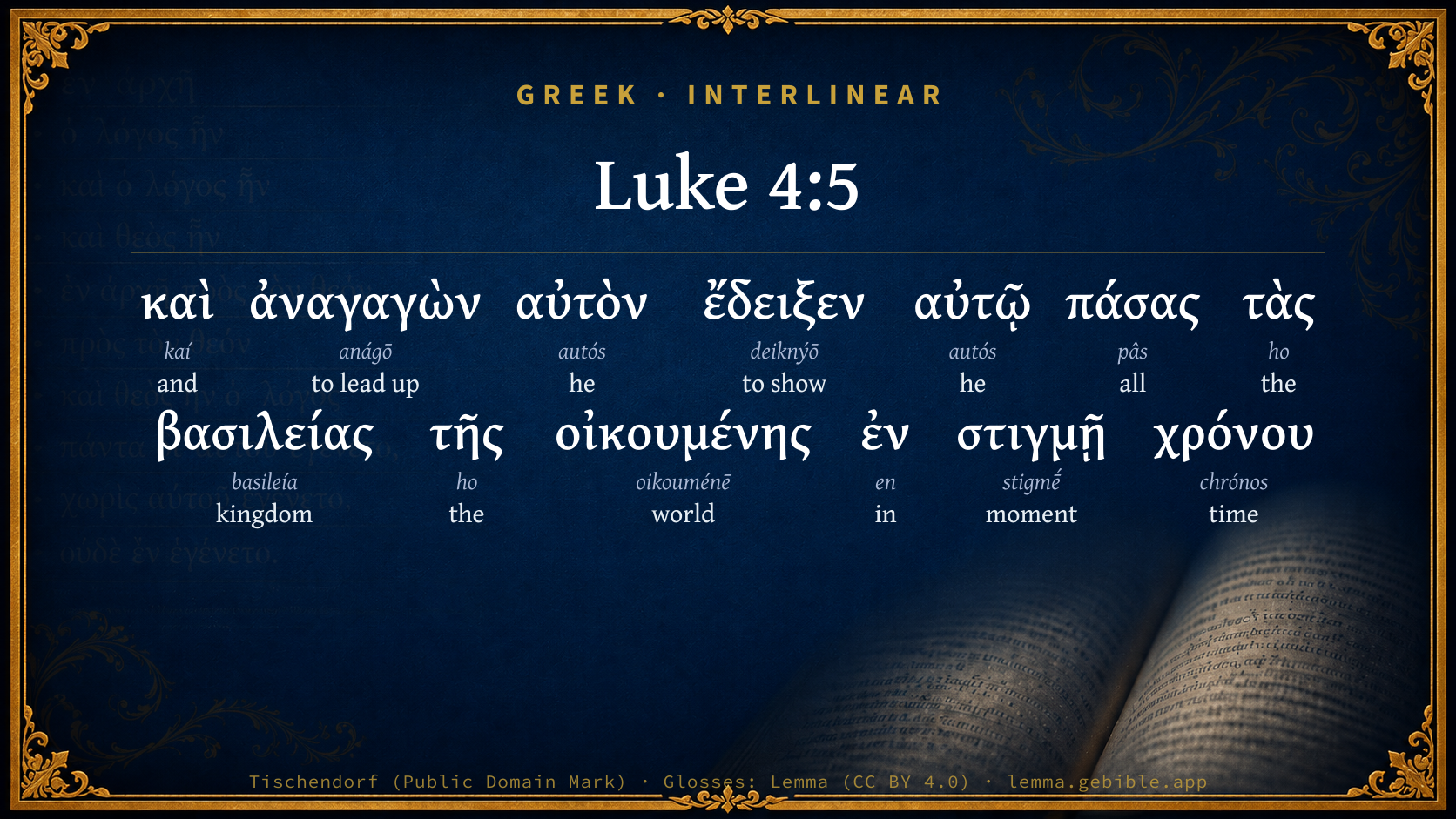
Download image
Cite this verse

Luke 4:5 (World English Bible). Public Domain. Lemma interlinear Bible study tool, https://lemma.gebible.app/v/luke/4/5.

Show BibTeX & RIS
BibTeX
RIS
English Translation
The devil, leading him up on a high mountain, showed him all the kingdoms of the world in a moment of time.
World English Bible · Public Domain
Highlights
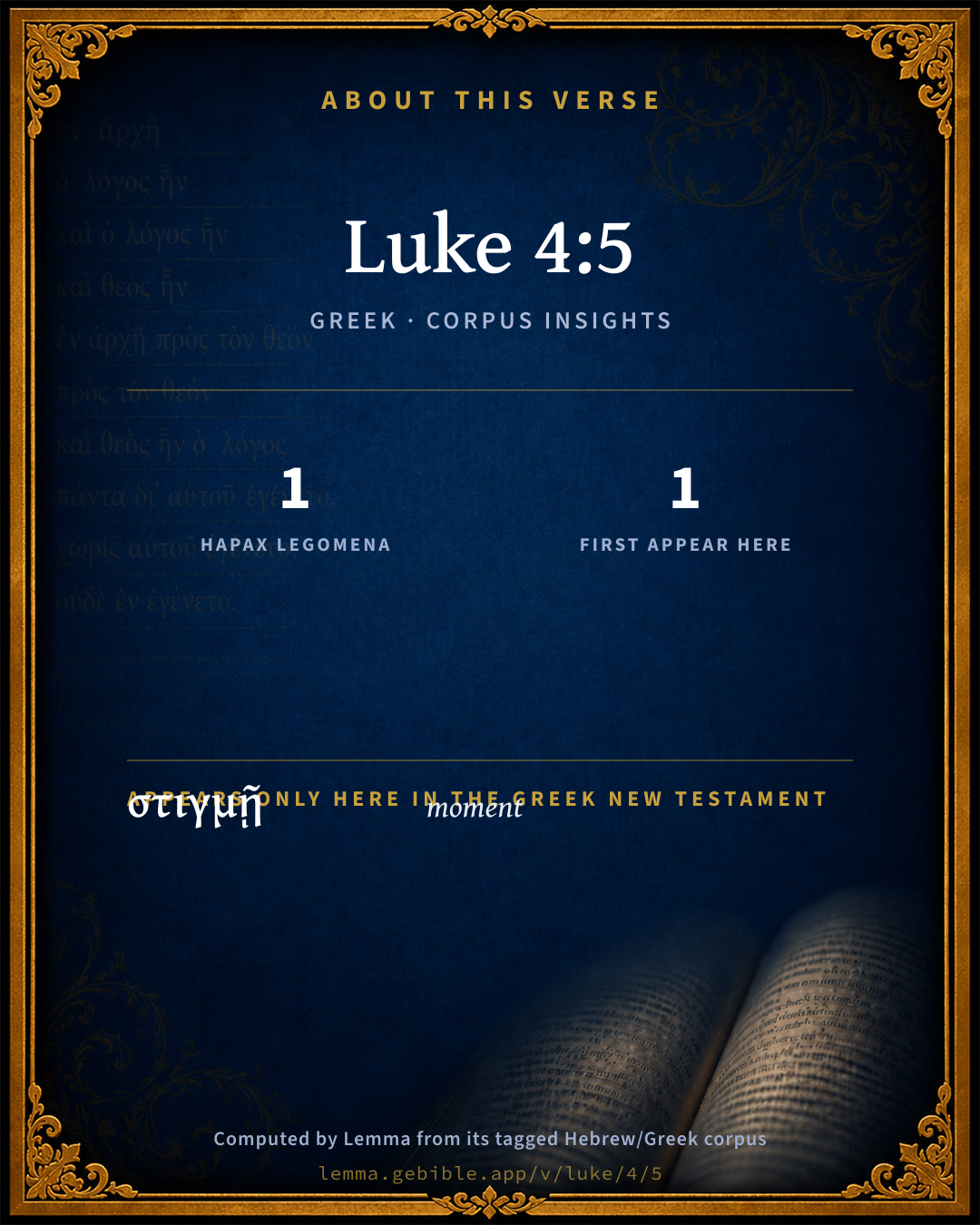
  • 1 hapax legomenon — only here in the Greek New Testament
  • 1 first appearance in the Greek New Testament
Full analysis ↓
Download a study sheet

One document with this verse’s original text, its word-by-word gloss line, the meaning frame, cross-references with their text, attributed commentary, and full source and license credits — printable, and it pastes into notes with its structure intact.

This verse Autodidact and up

Study sheet (.html) Plain text (.txt)

A passage Seminary Student

Up to 50 verses in one chapter. A passage sheet keeps up to 6 commentary sources and 12 cross-references per verse, in the order this page ranks them, and says so on the sheet whenever that leaves anything out. Ask for a single verse and you get the Autodidact verse sheet above.

Everything on this page stays free to read, with no account — the sheet is a download of what is already on screen, not access to it.

Want to remove ads? Support Godless Engineer
Compare translations 3

The same verse in 3 English versions, stacked beneath the original-language interlinear above. Click any original word for its lexicon entry.

Each is an independent rendering of the whole verse — the interlinear is not word-aligned to these translations.

Highlighted words mark where these versions differ — a whole-verse word diff, not a word-by-word alignment.

  • World English Bible Public Domain
    The devil, leading him up on a high mountain, showed him all the kingdoms of the world in a moment of time.
  • King James Version Public Domain
    And the devil, taking him up into an high mountain, shewed unto him all the kingdoms of the world in a moment of time.
  • unfoldingWord Literal Text CC BY-SA 4.0
    Then he led him up showed him all the kingdoms of the world in an instant of time.

unfoldingWord Literal Text — © unfoldingWord, licensed CC BY-SA 4.0. Word-aligned USFM3 via Door43 (git.door43.org/unfoldingWord/en_ult).

Versions to compare (up to 4)

3 of 4 selected

Show all 19 translations

Every available English version of this verse, each an independent rendering of the whole verse.

  • World English Bible Public Domain
    The devil, leading him up on a high mountain, showed him all the kingdoms of the world in a moment of time.
  • Berean Standard Bible Public Domain
    Then the devil led Him up to a high place and showed Him in an instant all the kingdoms of the world.
  • Majority Standard Bible Public Domain
    Then the devil led Him up to a high mountain and showed Him in an instant all the kingdoms of the world.
  • King James Version Public Domain
    And the devil, taking him up into an high mountain, shewed unto him all the kingdoms of the world in a moment of time.
  • American Standard Version (1901) Public Domain
    And he led him up, and showed him all the kingdoms of the world in a moment of time.
  • Revised Version (1885) Public Domain
    And he led him up, and shewed him all the kingdoms of the world in a moment of time.
  • Geneva Bible (1599) Public Domain
    Then the deuill tooke him vp into an high mountaine, and shewed him all the kingdomes of the world, in the twinkeling of an eye.
  • Douay-Rheims (1899) Public Domain
    And the devil led him into a high mountain, and shewed him all the kingdoms of the world in a moment of time;
  • Young's Literal Translation Public Domain
    And the Devil having brought him up to an high mountain, shewed to him all the kingdoms of the world in a moment of time,
  • Literal Standard Version CC BY-SA 4.0
    And the Devil having brought Him up to a high mountain, showed to Him all the kingdoms of the world in a moment of time,
  • Unlocked Literal Bible CC BY-SA 4.0
    Then the devil led Jesus up and showed him all the kingdoms of the world in an instant of time.
  • unfoldingWord Literal Text CC BY-SA 4.0
    Then he led him up showed him all the kingdoms of the world in an instant of time.
  • Darby Bible Public Domain
    And [the devil], leading him up into a high mountain, shewed him all the kingdoms of the habitable world in a moment of time.
  • World Messianic Bible Public Domain
    The devil, leading him up on a high mountain, showed him all the kingdoms of the world in a moment of time.
  • Webster's Bible Public Domain
    And the devil taking him up upon a high mountain, showed to him all the kingdoms of the world in a moment of time.
  • Free Bible Version CC BY-SA 4.0
    The devil led him up to a high place, and in a rapid view showed him all the kingdoms of the world.
  • Bible in Basic English Public Domain
    And he took him up and let him see all the kingdoms of the earth in a minute of time.
  • Text-Critical English NT CC BY 4.0
    So the devil brought him up to a high mountain and showed him all the kingdoms of the world in a moment of time.
  • Tyndale New Testament (1534) Public Domain
    And the devyll toke him vp into an hye moutayne and shewed him all the kyngdoms of the worlde even in the twincklinge of an eye.

Literal Standard Version (2020), Covenant Press — licensed CC BY-SA 4.0. Text via the HelloAO Bible API (eBible.org). Unlocked Literal Bible (unfoldingWord) — licensed CC BY-SA 4.0. Text via the HelloAO Bible API (eBible.org). unfoldingWord Literal Text — © unfoldingWord, licensed CC BY-SA 4.0. Word-aligned USFM3 via Door43 (git.door43.org/unfoldingWord/en_ult). Free Bible Version, Dr. Jonathan Gallagher — licensed CC BY-SA 4.0. Text via the HelloAO Bible API (eBible.org).

Word by word

More ways to search: Search by grammar → Find every occurrence → Compare this word →

Practice this passage: Drill this verse → Learn its vocabulary →

About this verse

These counts appear in no published source. They are computed here, from the morphology-tagged text and Lemma’s own curated glosses. What Lemma adds →

13
words
11
distinct lemmas
Gospels
section

Notable vocabulary

1 hapax legomenon — a word that appears only here in the entire Greek New Testament:

  • στιγμῇ moment G4743

First appearance in Scripture

This word makes its first canonical appearance in the Greek New Testament here:

  • στιγμῇ moment G4743

Shared distinctive vocabulary

οἰκουμένης world G3625 occurs in 15 verses of the Greek New Testament. Also found in:
Repetition

Words recur within this verse:

  • αὐτὸν he G846 ×2
  • τὰς the G3588 ×2

Cross-references

11

Topical passages linked to Luke 4:5 in the Treasury of Scripture Knowledge — connected by theme and wording, ordered by reader-vote popularity; previews shown in the World English Bible.

  • 1 John 2:15–16 Don't love the world, neither the things that are in the world. If anyone loves the world, the Father's love isn't in him.
  • Job 20:5 That the triumphing of the wicked is short, The joy of the godless but for a moment?
  • Psalms 73:19 How they are suddenly destroyed! They are completely swept away with terrors.
  • Matthew 4:8 Again, the devil took him to an exceedingly high mountain, and showed him all the kingdoms of the world, and their glory.
  • 1 Corinthians 15:52 in a moment, in the twinkling of an eye, at the last trumpet. For the trumpet will sound, and the dead will be raised incorruptible, and we will be changed.
  • Matthew 24:14 This Gospel of the Kingdom will be preached in the whole world for a testimony to all the nations, and then the end will come.
  • Mark 4:8–9 Others fell into the good ground, and yielded fruit, growing up and increasing. Some brought forth thirty times, some sixty times, and some one hundred times as much."
  • 2 Corinthians 4:17 For our light affliction, which is for the moment, works for us more and more exceedingly an eternal weight of glory;
  • Ephesians 2:2 in which you once walked according to the course of this world, according to the prince of the powers of the air, the spirit who now works in the children of disobedience;
  • Ephesians 6:12 For our wrestling is not against flesh and blood, but against the principalities, against the powers, against the world's rulers of the darkness of this age, and against the spiritual hosts of wickedness in the heavenly places.
  • 1 Corinthians 7:31 and those who use the world, as not using it to the fullest. For the mode of this world passes away.

Cross-references courtesy of OpenBible.info (CC BY 4.0).

Where the printed editions differ

1 variant

Places in this verse where the major printed Greek editions disagree on the wording in a way that affects the translation — a comparison of editions, not a manuscript-by-manuscript collation. The editions are the modern critical texts (Nestlé-Aland 28/27, SBL, Westcott-Hort, Tregelles, Tyndale House) and the traditional texts behind the KJV (the Textus Receptus and the Byzantine/Majority text). It is not a claim about which reading is original.

  1. Extra text
    διάβολος εἰς ὄρος ὑψηλὸν

    “devil into mountain high”

    In TRByz Not in NA28NA27TynSBLWHTreg

    διάβολος εἰς ὄρος ὑψηλὸν (diabolos eis oros hupsēlon) 'devil into mountain high' is only in traditional manuscripts (TR+Byz)

Textual data: Translators Amalgamated Greek New Testament (STEPBible TAGNT) · CC BY 4.0.

Commentary

Notes on Luke 4:5 from classic Christian and Jewish commentators (each source and its license shown beneath its notes). The classic Christian expositions comment on the surrounding passage and are grouped to its opening verse, so a note may address several verses; the Jewish commentaries on the Tanakh (Rashi and others) are per-verse, so they appear only where the commentator wrote on this verse.

Lemma curates 59 commentaries, every one of them public domain or Creative Commons licensed, each selected and text-cleaned for this edition rather than reprinted as found. About our sources →

Ellicott's Commentary for English Readers

(5) The kingdoms of the world.—St. Luke uses the word (literally, the inhabited world) which was commonly used as co-extensive with the Roman empire. On the difference in the order of the temptations, see Note on Mat_4:5.

In a moment of time.—The concentration of what seems an almost endless succession of images into the consciousness of a moment is eminently characteristic of the activity of the human soul in the state of ecstasy or vision.

A Bible Commentary for English Readers, edited by Charles John Ellicott (1878–1897) — public domain. Text from a community e-Sword module.

The Biblical Illustrator

Joseph S. Exell

Luk_4:5; Luk_4:8

And the devil, taking Him up into an high mountain, showed unto Him all the kingdoms of the world in a moment of time

Satan a close solicitor

1.

The importunity of Satan: he is upon our Saviour again: Again the devil taketh Him up.

2. The variety of his shifts: from the pinacle of the Temple he taketh Him up to an exceeding high mountain.

3. Note by what gate or passage he would enter his temptation: by the eye; he shows a goodly object unto Him.

4. The dignity of the object: he shows Him kingdoms.

5. For the amplitude and generality: All the kingdoms of the world.

6. In their most amiable and desirable shape he showed them in their glory.

7. Satan showed himself to be an arch juggler, or prestidigitator, as artists call it, for St. Luke adds, that he showed all this in a moment of time. A close solicitor, and a diligence worthy to be commended, if it had been in a good cause; but they that are in a wrong way are most zealous in their course, and negotiate for hell more urgently than we do for heaven. (Bishop Hacker.)

Temptation recurrent

But that tyranny is uncessant, the hatred of the devil hath no stint; expect it, be ready for it, and let it not sting your conscience with horror if you find somewhat within you always warring against the Spirit; temptations are not like some diseases, which are not incident to a man above once in his life, escape once and secure for ever, but like hereditary infirmities which are ever recurring to torment the flesh. A quotidian is more like to be cured, if it be well looked to, than an ague whose paroxysms keep longer distance. (Bishop Hacker.)

Principle not place the safeguard

But it is not the shifting to this place or that place that breeds contrary affections in a good man. Where there is an inward principle of goodness, firm and sure under every cope of heaven the mind is unalterable. (Bishop Hacker.)

Reviewed temptation

His mouth was stopped, and he was set non plus in the former temptation, yet how soon doth he begin to open his mouth again? He was repulsed, yet he comes to fight again. He hath many strings to his bow, and many arrows in his quiver. When one way takes not he tries forth with another; yea, he will make proof of all ere he leaves. (Bishop Hacker.)

The eye the portal to the heart

There is nothing so soon enticed and led away as the eye; it is the broker between the heart and all wicked lusts that be in the world. And therefore it was great folly in Hezekiah to show his robes and treasure (Isa_39:2), as he was told by the prophet; itstirred up such coals of desire in them that saw them, as could not be quenched till they had fetched away all that he had, and all that his ancestors had laid up, even till that day. It is the wisdom that is used nowadays, when men would have one thing for another, to show the thing they would so exchange; as the buyer showeth his money, and the seller his wares in the best manner that he can, each to entice the ether (by the eye) to the desire of the heart. (Bishop Andrewes.)

Fancy enticed

His power and work upon the fancies of men is none of the least of his ways whereby he advanceth the pleasures of sin. That he hath such a power, hath been discoursed before, and that a fancy raised to a great expectation makes things appear otherwise than what they are, is evident from common experience. The value of most things depends rather upon fancy than the internal worth of them, and men are more engaged to a pursuit of things by the estimation which fancy hath begat in their minds, than by certain principles of knowledge. Children by fancy have a value of their toys, and are so powerfully swayed by it, that things of far greater price cannot stay their designs, nor divert their course. Satan knows that the best of men are sometimes childish, apt to be led about by their conceits, and apt in their conceits to apprehend things far otherwise than what they are in truth. (R. Gilpin.)

The after-claps of sin

We, knowing this craft, must labour in these temptations to see that which the devil hides, and to apprehend the fearful after-claps. Let us labour to see Jaels nail as well as her milk; Delilahs scissors as well as her bosom; the snakes poison as well as her embrace; and the bees sting as well as her honey. (D. Dyke.)

True sight after sin

The devil blinds us so that we see not till afterward, as Gen_3:1-24., Then were their eyes opened. (D. Dyke.)

Distance lends enchantment to the view

Put a bit of broken glass, or a shred of worthless mica, in a ploughed field, and let the sun shine upon it, and it sparkles as vividly as that gem which spills its drop of light on the finger of beauty. Afar off, it is a glory: near, just a bit of broken glass, or shred of mica. My dear friends, beware of the glory, the splendour that seems to show very substantially at a distance, but which needs only to be approached to prove unreal. I remember very well how, up in the Italian and Styrian Alps, many an apparent sky-kissing range of yet mightier Alps seemed to tower, white and lustrous, over what we had deemed the loftiest peaks. They were but vanishing clouds, climbing higher than the peaks, but with no base--showing fair, glitteringly, astonishingly, unutterably beautiful, but carrying within them the rain that drenches, and the lightning that smites and the blast that loosens the roaring avalanche. Take heed to this artifice of the worlds show at a distance and from the mountain top. There is delusion and peril in the splendour. (A. B. Grosart.)

And the devil taketh Him up into an high mountain

Here the temptation seems eminently gross. Yet devil-worship can assume many forms, and some of these may be most refined. Worship is homage, and homage to a person, real or supposed, representative of certain principles, modes of action, and aims. What it here means seems evident enough. Jesus is recognized as seeking a kingdom, as intending, indeed, to found one. His aims are confessed to be more than Jewish, not national, but universal; not an extension of Israel, but a comprehension of the world. It is known that His purpose is to be the Messiah, not of the Jews, but of man. The only question is as to the nature of His kinghood and kingdom. The kingdom here offered is one not of the Spirit, but of the world. And world here means not what it may be to the good, but what it is to the bad it and its kingdoms may be won at once, and will be, if Jesus worships the devil, i.e., makes evil His good, uses unholy means to accomplish His ends. It is as if the tempter had said, Survey the world, and mark what succeeds. Away there in Italy lives and rules the emperor of the world, a selfish, sensual man, whose right is might. Over there in Caesarea sits his red-handed, yet vacillating, procurator. In your own Galilee a treacherous and lustful Herod reigns, its deputy lord. Up in Jerusalem are priests and scribes, great in things external, the fierce fanatics of formalism. Everywhere unholy men rule, unholy means prevail. Worldliness holds the world in fee. By it alone can you conquer. Use the means and the men of Caesar, and your success will be swift and sure. Worship me, and the kingdoms of this world are thine. The temptation was subtly adapted to the mood and the moment, and was as evil as subtle. Bad means make bad ends. Good ends do not justify evil means; evil means deprave good ends. So a Messianic kingdom, instituted and established by worldliness, had been a worldly kingdom, no better than the coarse and sensuous empire of Rome. And Jesus, while He felt the force, saw the evil of the temptation, and vanquished it by the truth on which His own spiritual and eternal city was to be founded, Thou shalt worship the Lord thy God, &c. (A. M.Fairbairn, D. D.)

The force of this temptation

Could it be other than a temptation to think that He might, if He would, lay a righteous grasp upon the reins of government, leap into the chariot of power, and ride forth conquering and to conquer? Glad visions arose before Him of the prisoner breaking jubilant from the cell of injustice; of the widow lifting up the bowed head before the devouring Pharisee; of weeping children bursting into shouts at the sound of the wheels of the chariot before which oppression and wrong shrunk and withered, behind which sprung the fir-tree instead of the thorn, and the myrtle instead of the briar. Could He not mould the people at His will? Could He not, transfigured in snowy garments, call aloud in the streets of Jerusalem, Behold your King? And the fierce warriors of His nation would start at the sound; the ploughshare would be beaten into the sword, and the pruning-hook into the spear. Ah, but when were His garments white as snow? Not when He looked to such a conquest; but when, on a moment like this, He spake of the decease which He should accomplish at Jerusalem. But how would He, thus conquering, be a servant of Satan: I will not inquire whether such an enterprise could be accomplished without the worship of Satan. But I will ask whether to know better and do not so well, is not a serving of Satan? whether to lead men on in the name of God as towards the best, when the end is not the best, is not a serving of Satan? whether to flatter their pride by making them conquerors of the enemies of their nation instead of their own evils, is not a serving of Satan? Nothing but the obedience of the Son, the obedience unto death, the absolute doing of the will of God because it was the truth, could redeem the prisoner, the widow, the orphan. But it would redeem them by redeeming the conquest-ridden conqueror too, the strife-giving jailor, the unjust judge, the devouring Pharisee. He would not pluck the spreading branches of the tree; He would lay the axe to its root. It would take time; but the tree would be dead at last--dead, and cast into the lake of fire. It would take time; but His Father had time enough and to spare. It would take courage and strength and self-denial and endurance; but His Father could give Him all. The will of God should be done. Man should be free--not merely man as he thinks of himself, but man as God thinks of him. He shall grow into the likeness of the Divine thought, free not in his own fancy, but in absolute Divine fact of being, as in Gods idea.

The great and beautiful and perfect will of God must be done. (George Macdonald, LL. D.)

This was a temptation which every worker for God, weary with the slow progress of goodness, must often feel, and to which even good and earnest men have sometimes given way--to begin at the outside instead of within, to get first a great shell of external conformity to religion, and afterwards fill it with the reality. It was the temptation to which Mahomet yielded when he used the sword to subdue those whom he was afterwards to make religious, and to which the Jesuits yielded when they baptized the heathen first, and evangelized them afterwards. (J. Stalker, M. A.)

This was of all the temptations the most awful and searching. It was the only one of the three in which Satan suggests no doubt of the Divine Sonship and Divine glory of Christ. Could a Divine Son rightly refuse the houour and glory of a son? Could it be anything but a sin to turn His back on the only way that seemed to lead straight up to His throne? Was not this a tempting of God? How solemn and heart-searching are the lessons it may teach all those who profess to be servants of God among men; lessons which, perhaps, were never more needed than in the present day.

1. The conversion to Christ of the unconverted, and the evangelization of the masses, absorb the energies and the efforts of the Church. But the intensity of this passion for saving men may itself become a peril to the Church. In its zeal to save souls it may become indifferent to the means by which they are saved.

2. To resort to worldly and carnal methods for the extension of Christs kingdom; to lose faith in the power of the gospel of Christ to do its own work, and to win its own way in the world is treason to Christ and to God; it is the worship of the devil. (G. S. Barrett, B. A.)

What would the result have been if Christ had yielded!

There can be little doubt that in one sense Satan would have fulfilled his promise. No cross would have stood at the end of Christs earthly life. There would have been louder Hosannas than Jerusalem ever offered Him as its King; there would have been vaster throngs of people proclaiming Him their Messiah and Lord; a more splendid homage from the rich and great, from rulers and Pharisees, would have been laid at His feet; in a word, Christ would have received the crown of worldly dominion and glory. But at what a cost! The great burden of human guilt would have been left still resting on the world; the heart of man would have been still weary and heavyladen; the hope of immortal life would have been left a yearning and a longing, unsatisfied and unfulfilled; and the kingdom of God among men would have been unfounded and unknown. Christ would have lost the kingdom by appearing to gain it. The promise of the devil, like all his promises, would have turned out a black and terrible lie. He would have given the kingdoms of this world and the glory of them to our Lord, but only alter Christ had given Himself to the devil. Satan would have lost nothing of his kingdom, for he would have been king of the worlds King. Appearing to resign his sovereignty for a moment he would have secured it for ever. (G. S. Barrett, B. A. )

The temptation on the mountain

1. The vision was a splendid one, well fitted to appeal even to a mind that was actuated by no vulgar ambition.

2. The desire for power here appealed to is one of which the noblest natures are susceptible.

3. It was not a wrong thing, nor at variance with His mission, that Christ should contemplate the prospect of becoming universal King.

4. The prospect held out to Him was well-fitted to stir the loftiest and holiest ambition.

5. It may well, then, foster our reverence for His character, while it teaches us lessons of the greatest practical importance, that although His universal dominion would lead to such blessed results, He would not procure or hasten it by entering into compromise with, or doing the slightest homage to, wrong.

6. Paying homage to evil with a view to the easier and speedier accomplishment of good is a sin to which the Church has always been powerfully tempted.

7. Christs kingdom is not of this world. It is neither formed on worldly principles nor furthered by worldly measures. (W. Landels, D. D.)

An high mountain

The high mountain is most probably Abarim, with its three peaks of Pisgah, Peer, and Nebo. From the western point, Peer, Balaam overlooked the tents of Israel and blessed them, when brought there by Balak to curse the people. From the northernmost peak, Nebo, above Baal Maon, a complete panorama of the Dead Sea is obtained. Thence it was that She Lord God showed Moses all the land of Gilead unto Dan, and all Naphtali, and the land of Ephraim, and all the land of Judah … unto Zion (Deu_34:1-4). Now Satan takes Christ to the point where Moses stood to view the Promised Land which he was not to enter. And here again we notice a covert sneer. O Thou Prophet of the Most High, like unto Moses, who comest to lead the people of God out of bondage into liberty, to restore again the kingdom to Israel! Thou wilt, may be, do what Thou undertakest. But what will be the result to Thyself?. Wilt Thou profit in any way by it? God gave to Moses a hard forty years in the wilderness, and instead of rewarding him with rest at the end, let him see the Promised Land from afar, even from this spot, and let him die without allowing him to set foot on it. That is how God deals with His prophets, and that is how He will deal with Thee! And as he spake may be the eye of the Son of Man rested on far-off Calvary, which is visible from this spot. Then Satan went on with the contrast: But!--I reward my servants at once. Come, bend the knee to me, and I will give Thee glory, and power, and dominion in the present. And there rose a mirage of the desert, and in that mirage was a vision of palaces and palm trees, and glittering sheets of water, on which gay barges sailed, apparently very real, but it was only a phantom scene painted in the unwholesome vapours that rose from the Dead Sea, and from the hot bituminous desert sands and rocks. A phantom splendour over desolation and death. That was what Satan offered. And observe likewise the difference between his offers and those of God, offers which he makes quite unabashed, and emphasizes. God gives present pain and future glory; Satan gives present satisfaction and future wretchedness. Only note how he pitches on one half of each offer, and contrasts only the present, say ing nothing of the future. God gives present sadness, Satan present satisfaction; and he utters not a word about the future. The vision was but for a moment. Satan showed unto Him, in a moment of time, all the kingdoms of the world; the desert mirage does not last long, but while it lasts it is thoroughly deceptive. So it is with the gifts of Satan; they are but for a moment, and then they vanish away, and leave dust, and ashes, and barrenness, and death behind. (S. Baring.Gould, M. A.)

Satans short cut

The devil fits his temptation nicely to his purpose. Christ is about to begin His mission, and to found His kingdom, which is to be universal, to extend throughout the world. Satan shows Him how to make the kingdoms of earth His own instantaneously, by doing homage to himself. No need then for Calvary, no laborious preachings, no persecutions, no martyrdoms, no sowing in tears, no casting of the bread on the waters and patient expectance of the result after many days. The kingdoms of the world will become the kingdoms of Christ at once, if He will conform to the world, and acknowledge the Evil One as supreme--if He will allow the presence of evil, legislate for it, accept it, and not fight against it. But this offer of Satan is an usurpation of power--of Gods power. No compromise with evil. Get thee behind Me, Satan. (S. Baring.Gould, M. A. )

Satans methods

An illustration of Satans method of beguiling to destroy, was one day witnessed by the writer when rambling near Scawfell. His guide said he thought he could find a trout, and stooping down over the grassy bank of a small mountain-stream, remained for a few minutes perfectly quiet, excepting a slight motion of the arm. Presently he brought up a large fish. He knew where it was likely to be; he gently touched its back, drew his hand lightly backwards and for wards, soothed and charmed his victim, then grasped and captured it. So the devils policy is to tickle his victims to death, and damn them with delights (Newman Hall, LL.B.)

Elation no temptation to Christ

The temper had tried the Son of Man through the power of depression; he now tries him by me power of exaltation. He had sought to vanquish Him by the scourge of poverty; he now seeks to overcome Him by the vision of plenty. He had brought Him down into the valley, and had tempted Him by the dangers of humiliation; he now carries Him up to the mountain and tempts Him by the dangers of elevation. Why was the Son of Man superior to all circumstances? Only because He was superior to all sin. The sinless heart will be free from temptation everywhere. It will neither be reduced by the exigencies of the valley of humiliation, nor by the allurements of the mountain of elevation; it will not turn the stones into bread to avoid the famine; it will not bow the knee to Baal to purchase a crown. (G. Matheson, M. A. , D. D.)

The Biblical Illustrator, edited by Joseph S. Exell (c. 1880s–1900s) — public domain. Text from a community e-Sword module.

Bengel's Gnomon

Johann Albrecht Bengel

Luk 4:5. Εἰς ὄρος ὑψηλὸν, into a high mountain) See App. Crit. Ed. ii. on this passage.[40] The sentence would sound defective (‘hiulca’ having a hiatus) if read thus [as the Vulg. reads it], “Et duxit illum diabolus, et ostendit illi,” etc. [Some interpreters suppose a double conflict (between Jesus and Satan) on the mountain, inasmuch as it is put by Luke before that upon the pinnacle of the temple, whereas it is put after the latter by Matthew. But ‘all’ of the temptation had (consisted of) three assaults in all, Luk 4:13; and therefore Luke must clearly be employing a transposition in this passage. Nor is it the best way of consulting for the honour of the Lord, to double the temptation on the mountain; for, in fact, He seems to have once repelled it, and, at the same time, by that once to have repelled it universally and for ever. Moreover, Luke, by putting the ascent to (the pinnacle at) Jerusalem in the last place, was enabled to use more appropriately the verb ὑπέστρεψεν, in ch. Luk 4:14, just as that verb is used, ch. Luk 2:39, of the return from the same city to Galilee. Harm, p. 151].—ἐν στιγμῇ χρόνου, in a moment of time) A sudden showing of them: a sharp temptation [a violent and acute one, as opposed to a more gradual and stealthy one].

[40] BL Vulg. omit εἰς ὄρος ὑψηλόν, which probably came through the Harmonies from Mat 4:8. But ADc Hil. and Rec. Text support the words: so Lachm.; but Tischend. is for the omission.—ED. and TRANSL.

Bengel's Gnomon of the New Testament — English translation (T&T Clark, Edinburgh, 1860) — public domain. Text from a community e-Sword module.

Expositor's Greek Testament

ed. W. Robertson Nicoll

Luk 4:5-8 . Second temptation . Mt.’s third. καὶ ἀναγαγὼν , without the added εἰς ὄρος ὑψ . of T.R., is an expression Lk. might very well use to obviate the objection: where is the mountain so high that from its summit you could see the whole earth? He might prefer to leave the matter vague = taking Him up who knows how high! τῆς οἰκουμένης : for Mt.’s τοῦ κόσμου , as in Luk 2:1 . ἐν στιγμῇ χ ., in a point or moment of time ( στιγμὴ from στίζω , to prick, whence στίγματα , Gal 6:17 , here only in N. T.).

The Expositor's Greek Testament, edited by W. Robertson Nicoll (1897–1910) — public domain. Text from a community e-Sword module.

Godet's Commentaries

Frédéric Louis Godet

3 d. Luk 4:5-8.

Second Temptation.

The occasion of this fresh trial is not a physical sensation; it is an aspiration of the soul. Man, created in the image of God, aspires to reign. This instinct, the direction of which is perverted by selfishness, is none the less legitimate in its origin. It received in Israel, through the divine promises, a definite aim—the supremacy of the elect people over all others; and a very precise form — the Messianic hope. The patriotism of Jesus was kindled at this fire (Luk 13:34, Luk 19:41); and He must have known, from what He had heard from the mouth of God at His baptism, that it was He who was destined to realize this magnificent expectation. It is this prospect, open before the gaze of Jesus, of which Satan avails himself in trying to fascinate and seduce Him into a false way.

The words the devil, and into an high mountain, Luk 4:5, are omitted by the Alex. It might be supposed that this omission arises from the confusion of the two syllables ον which terminate the words αὐτόν and ὑψηλόν. But is it not easier to believe there has been an interpolation from Matthew? In this case, the complement understood to taking Him up, in Luke, might doubtless be, as in Matthew, a mountain. Still, where no complement is expressed, it is more natural to explain it as “taking Him into the air.” It is not impossible that this difference between the two evangelists is connected with the different order in which they arrange the two last temptations. In Luke, Satan, after having taken Jesus up into the air, set Him down on a pinnacle of the temple. This order is natural.

We are asked how Jesus could be given over in this way to the disposal of Satan. Our reply is: Since the Spirit led Him into the wilderness in order that He might be tempted, it is not surprising that He should be given up for a time, body and soul, to the power of the tempter.

It is not said that Jesus really saw all the kingdoms of the earth, which would be absurd; but that Satan showed them to Him. This term may very well signify that he made them appear before the view of Jesus, in instantancous succession, by a diabolical phantasmagoria. He had seen so many great men succumb to a similar mirage, that he might well hope to prevail again by this means.

The Jewish idea of Satan’s rule over this visible world, expressed in the words which two of the evangelists put into his mouth, may not be so destitute of foundation as many think. Has not Jesus endorsed it, by calling this mysterious being the prince of this world? Might not Satan, as an archangel, have had assigned to him originally as his domain the earth and the system to which it belongs? In this case, he uttered no falsehood when he said, All this power has been delivered unto me (Luk 4:6). The truth of this assertion appears further from this very expression, in which he does homage to the sovereignty of God, and acknowledges himself His vassal. Neither is it necessary to see imposture in the words: And to whomsoever I will, I give it. God certainly leaves to Satan a certain use of His sovereignty and powers; he reigns over the whole extradivine sphere of human life, and has power to raise to the pinnacle of glory the man whom he favours. The majesty of such language was doubtless sustained by splendour of appearance on the part of him who used it; and if ever Satan put on his form of an angel of light (2Co 11:14), it was at this moment which decided his empire.

The condition which he attaches to the surrender of his power into the hands of Jesus, Luk 4:7, has often been presented as a snare far too coarse for it ever to have been laid by such a crafty spirit. Would not, indeed, the lowest of the Israelites have rejected such a proposal with horror? But there is a little word in the text to be taken into consideration—οὖν, therefore—which puts this condition in logical connection with the preceding words. It is not as an individual, it is as the representative of divine authority on this earth, that Satan here claims the homage of Jesus. The act of prostration, in the East, is practised towards every lawful superior, not in virtue of his personal character, but out of regard to the portion of divine power of which he is the depositary. For behind every power is ever seen the power of God, from whom it emanates. As man, Jesus formed part of the domain entrusted to Satan. As called to succeed him, it seemed He could only do it, in so far as Satan himself should transfer to Him the investiture of his office. The words, if thou wilt worship me, are not therefore an appeal to the ambition of Jesus; they express the condition sine quâ non laid down by the ancient Master of the world to the installation of Jesus in the Messianic sovereignty. In speaking thus, Satan deceived himself only in one point; this was, that the kingdom which was about to commence was in any respect a continuation of his own, or depended on a transmission of power from him. It would have been very different, doubtless, had Jesus proposed to realize such a conception of the Messianic kingdom as found expression in the popular prejudice of His age. The Israelitish monarchy, thus understood, would really have been only a new and transient form of the kingdom of Satan on this earth,—a kingdom of external force, a kingdom of this world. But what Jesus afterwards expressed in these words, “I am a King; to this end was I born, but my kingdom is not of this world” (Joh 18:37; Joh 18:36), was already in His heart. His kingdom was the beginning of a rule of an entirely new nature; or, if this kingdom had an antecedent, it was that established by God in Zion (Psalms 2). Jesus had just at this very time been invested with this at the hands of the divine delegate, John the Baptist. Therefore He had nothing to ask from Satan, and consequently no homage to pay him. This refusal was a serious matter. Jesus thereby renounced all power founded upon material means and social institutions. He broke with the Messianic Jewish ideal under the received form. He confined Himself, in accomplishing the conquest of the world, to spiritual action exerted upon souls; He condemned Himself to gain them one by one, by the labour of conversion and sanctification,—a gentle, unostentations progress, contemptible in the eyes of the flesh, of which the end, the visible reign, was only to appear after the lapse of centuries. Further, such an answer was a declaration of war against Satan, and on the most unfavourable conditions. Jesus condemned Himself to struggle, unaided by human power, with an adversary having at his disposal all human powers; to march with ten thousand men against a king who was coming against Him with twenty thousand (Luk 14:31). Death inevitably awaited Him in this path. But He unhesitatingly accepted all this that He might remain faithful to God, from whom alone He determined to receive everything. To render homage to a being who had broken with God, would be to honour him in his guilty usurpation, to associate Himself with his rebellion.

This time again Jesus conveys His refusal in a passage of holy writ, Deu 6:13; He thereby removes every appearance of answering him on mere human authority. The Hebrew text and the LXX. merely say: “Thou shalt fear the Lord, and thou shalt serve Him.” But it is obvious that this word serve includes adoration, and therefore the act of προσκυνεῖν, falling down in worship, by which it is expressed. The words, Get thee behind me, Satan, in Luke, are taken from Matthew; so is the for in the next sentence.

But in thus determining to establish His kingdom without any aid from material force, was not Jesus relying so much the more on a free use of the supernatural powers with which He had just been endowed, in order to overcome, by great miraculous efforts, the obstacles and dangers to be encountered in the path He had chosen? This is the point on which Satan puts Jesus to a last proof. The third temptation then refers to the use which He intends to make of divine power in the course of His Messianic career.

Frédéric Louis Godet — Commentaries on Luke, John, Romans, and 1 Corinthians — English translation (T&T Clark, Edinburgh, 1870s–1890s) — public domain. Text from a community e-Sword module.

The Cambridge Bible for Schools and Colleges

gen. ed. J. J. S. Perowne

5. And the devil, taking him up into a high mountain] Probably “the devil” and “into a high mountain” are added from St Matthew. How the devil took Him up we are not told. Scripture, to turn away our thoughts from the secondary to the essential, knows nothing of those journeys through the air which we find in Apocrypha and in the ‘Gospel of the Hebrews.’

It is remarkable that St Luke (whom Milton follows in the Par. Regained) here adopts a different order of the temptations from St Matthew, perhaps because he thought that the temptation to spiritual pride (which he places third) was keener and subtler than that to temporal ambition; perhaps, too, because he believed that the ministering angels only appeared to save Christ from the pinnacle of the Temple. That the actual order is that of St Matthew is probable, because (1) he alone uses notes of sequence, “then,” “again;” (2) Christ closes the temptation by “Get thee behind me, Satan” (see on Luk_4:8); (3) as an actual Apostle he is more likely to have heard the narrative from the lips of Christ Himself. But in the chronology of spiritual crises there is little room for the accurate sequence of ‘before’ and ‘after.’ They crowd eternity into an hour, and stretch an hour into eternity.

of the world] See above on Luk_2:1.

in a moment] Rather, in a second; comp. 1Co_15:52, “in the twinkling of an eye”—in the sudden flash of an instantaneous vision. The splendour of the temptation, and the fact that it appealed to

“the spur which the clear spirit doth raise,

The last infirmity of noble minds,”

might seem to Satan to make up for its impudent, undisguised character. He was offering to One who had lived as the Village Carpenter the throne of the world.

The Cambridge Bible for Schools and Colleges (gen. ed. J. J. S. Perowne; Cambridge University Press, 1878–1918) — public domain. Text from a community e-Sword module.

John Gill's Exposition

And the devil taking him up into an high mountain,.... Somewhere near Jerusalem, but what mountain is not certain. The Evangelist Luke makes this to be the second temptation, which, with Matthew, is the third and last; and whose order seems to be more proper and natural than this, and to be the true and genuine one, which Luke neglects, though he does not contradict it: he relates matters of fact, without attending to the strict order of them; whereas Matthew strictly regards it, observing, that after the first temptation, "then the devil taketh him, &c." and that being finished, says, "again the devil taketh him, &c." and upon those words, "get thee hence", with what follows, remarks, that then the devil leaveth him: all which show, that his order is the most accurate, and to be followed. But to go on with the account; the devil having taken him from the pinnacle of the temple, and carried him to some high mountain, as Lebanon, or Pisgah, or some other near Jerusalem, showed unto him all the kingdoms of the world; not of the Roman empire only, though that consisted of many kingdoms, and is called the whole world, Luk 2:1 where the same word is used, as here; but of the whole universe, every kingdom that was under the heavens; which he represented to Christ, not in a map, since the glory of them could not be described in that way: for

he showed him all the glory of them, as Matthew adds; and for this a mountain was no more a proper place, than any other; nor was, it any real object he presented to his bodily sight, or any real prospect he gave him of the kingdoms of the world, which are not to be seen from any one place, no not one of them, not even from the highest mountain in the world, and still less to be seen together at once in a moment: but this was a mere phantasm, a deception of the sight, with which he endeavoured to impose on Christ, but could not; nor did Christ; who is the maker of the world, and the governor among the nations, need any representation of the kingdoms of the world from him; see Gill on Mat 4:8 and this he did in a moment of time; in the twinkling of an eye, not by succession, and in process of time, as one kingdom after another, but all at once, and in an instant: what a moment of time is; see Gill on Mat 4:8.

John Gill's Exposition of the Whole Bible (1746–1763) — public domain (CC PDM 1.0). Text via the HelloAO Bible API.

Trapp's Complete Commentary

John Trapp

5 And the devil, taking him up into an high mountain, shewed unto him all the kingdoms of the world in a moment of time.

Ver. 5. Showed unto him all the kingdoms] In a visible landscape of his own making, presented to the eye.

John Trapp, A Commentary or Exposition upon All the Books of the Old and New Testament (1647–1656) — public domain. Text from a community e-Sword module.

Matthew Poole's English Annotations

See Poole on "Mat 4:8-10". Those words, Luk 4:6,

for that is delivered unto me; and to whomsoever I will I give it, are only mentioned by Luke; where we may observe, that the devil was a liar from the beginning. The dominion over the things of the world was not given to the angels, but to man. Neither hath he any such power as he pretends to, being not able to do any thing against Job till he had obtained leave from God, nor to enter into the swine without licence first obtained from Christ.

Matthew Poole's English Annotations on the Holy Bible (1683–1685) — public domain. Text from a community e-Sword/MySword module.

Whedon's Commentary on the Bible

Daniel D. Whedon

5. Up into a high mountain—Matthew, no doubt, follows the true historical order of the three temptations—Luke, a doctrinal order. Hence, while Matthew’s connective phrases then, again, claim to affirm the true order, Luke cautiously has only and. Luke’s order Isaiah , 1. The appeal to the appetite; 2. The appeal to the desire for an earthly monarchy; 3. The appeal to the desire for a dashing supernatural exploitation, a showy triumph over the laws of nature. In Matthew there is a climax of faculties, namely, the appetites, the tastes, and the ambition. In Luke the climax is, power over personal gratification, power over men, power over the laws of nature.

Daniel D. Whedon (gen. ed.), Commentary on the Old and New Testaments (1874–1909) — public domain. Text from a community e-Sword module.

The Pulpit Commentary

And the devil, taking him up into a high mountain, showed unto him all the kingdoms of the world in a moment of time. This temptation was something more than "offering to One who had lived as a village carpenter the throne of the world." It appealed to his ambition certainly, but in Jesus" case it was a high, pure, sinless ambition. This much he certainly knew already, that he was destined to rule over men from pole to pole. It was for him a righteous longing, this desire to have the heathen for his inheritance, and the uttermost parts of the earth as his possession. No false ambition was this in Jesus, this desire to realize the glorious Messianic hope. Again, how typical a temptation! All ranks and orders are often soon tempted here. A noble end as they think, and in the beauty of the goal they forget that the road leading to it is paved with evil and wrong.

Vers. 5-8. Temptation: outward and inward grandeur.

Of course, literal exactness is necessarily excluded here; we must look for, and shall have no difficulty in finding, the sense and spirit of the words. We will look at

I THE APPEAL THAT WAS MADE TO OUR LORD, and the corresponding attack that is made on ourselves. Christ was tempted to seize "power and glory" for himself by an act of unholy submission. These were the prize which the worldly minded Jews of his age imagined to be within reach of their Messiah. To one of his humble circumstances but limitless capacity, and also of rightful and honorable ambition, there might very easily be presented a most powerful temptation to aim at a great and glorious supremacy a throne like that of the Caesar himself, on which imperial power might be exercised and human glory at its topmost height be enjoyed. And the force of this temptation would be very greatly intensified by the fact that such a throne as this would be gained by very different measures from those Jesus had been contemplating in his solitude. The collecting of multitudes by appealing to their national passions, the leading of armies and gaining of victories, the command of great bodies of men, the excitements of political strife, all this is full of enjoyment to the ambitious soul. A vastly different experience this (and to all that was human in the mind of Jesus Christ immensely more attractive) from that of speaking unappreciated truth, living a life too noble to be understood, suffering from keen and malignant persecution, dying in the pangs and shame of martyrdom! The price to be paid for surrendering the higher for the lower aim, and the distressing for the delightful means, was "worshipping" Satan; in other words, declining the course which he most disliked, and adopting the course which he most desired. The attack which is now made on us, corresponding to this, is the suggestion that we should turn aside from the higher aspiration (whatever it may be) to the lower ambition. It may come to the Christian minister in his study, to the statesman in his cabinet, to the doctor in his consulting-room, to the author or editor at his table: it is a suggestion to leave the straight line of duty, of faithfulness, of service, of truth, of loyalty to conviction, of moral and spiritual integrity, and take the lower path of popularity, of honor, of temporal success. To do this is to take a course which we may dignify by some fair name, but which, in Scripture language, is worshipping the devil.

II THE SPIRIT IN WHICH IT WAS REPELLED BY HIM, and in which it should be defeated by us. This was one of holy indignation: "Get thee behind me," etc. Our Lord indignantly refused to entertain a suggestion so utterly opposed to his spirit of consecration, so subversive of all his high purposes and lofty hopes. He met it by the quotation of a word which demanded entire obedience to the will of God and full devotedness to his service. In this spirit of holy indignation let us repel the first advances of a temptation to leave the higher and the heavenly road of truth and service for the lower and the earthly one of mere temporal success. To take that lower course would be to play into the hands of the evil one; to lose the commendation of our conscience and to live under the shadow of its rebuke; to lower ourselves and to degrade our life in the estimate of all the true and wise on earth and in heaven; to lose our true and high reward; to break the word and depart from the will of the Lord our God. C.

The Pulpit Commentary (1880–1919), ed. H.D.M. Spence-Jones & Joseph S. Exell — public domain. Text from a community e-Sword module.

Scofield Reference Notes

C. I. Scofield

world

"oikoumene" = "inhabited earth." (See Scofield "Luk 2:1").

The Scofield Reference Bible (1917 edition), notes by C. I. Scofield — public domain. Text from a community e-Sword module.

Kretzmann's Popular Commentary

Paul E. Kretzmann

The second temptation:

v. 5. And the devil, taking Him up into an high mountain, showed unto Him all the kingdoms of the world in a moment of time.

v. 6. And the devil said unto Him, All this power will I give Thee, and the glory of them; for that is delivered unto me; and to whomsoever I will I give it.

v. 7. If Thou therefore wilt worship me, all shall be Thine.

v. 8. And Jesus answered and said unto him, Get thee behind Me, Satan; for it is written, Thou shalt worship the Lord, thy God, and Him only shalt thou serve.

This temptation, in the chronological sequence, is really the third. Luke narrates the three’ in a different order, because he has a different climax in mind, that of the incident on the Temple’s roof. The attempt to incite care and worry about the body and its needs in the heart of Jesus had failed. But the devil believed that temporal riches and power would exert an irresistible appeal, if offered at the right moment and with the proper effect. So he took Jesus up very high, to the very summit of a high mountain and, by means of the power which he possesses, he was able to give Jesus a picture of all the kingdoms of the world in a moment of time, in a flash, in the twinkling of an eye. The suddenness of the view, coming without preparation or announcement, must have been a wonderful, overwhelming sight: All the riches of the world, the mined and the un-mined precious metals, the gems and precious stones with and without their setting of the appropriate foils; all the power of the many rulers, kings, emperors, princes wherever governments had been established, among all races, peoples, and nations. And then came the devil’s offer: To Thee will I give all this power (Thee emphatic). He asserts that all of the riches and all of the power have been given over to him, and that he can dispense his favors as he sees fit. But the condition was that Christ should bow down before him, should worship him, should acknowledge Satan as His Lord. To accede to this impudent demand would have put the Son of God into the power of the archenemy of mankind. But the Savior was fully equal to the occasion, and once more routed the enemy with a powerful quotation from Scripture, Deu 6:13. God is the only object of worship and service. To substitute any creature in heaven or on earth or under the earth for the one God is to commit idolatry. And in the case of Christ it would have been the end of His redemptive ministry.

Paul E. Kretzmann, Popular Commentary of the Bible (1921–1924) — public domain. Text from a community e-Sword module.

Burkitt's Expository Notes on the New Testament

William Burkitt

Observe, 1. The next sin which Satan tempts our Saviour to is the sin of idolatry, even to worship the devil himself. Oh thou impudent and foul spirit, to desire thy Creator to worship thee, an apostate creature! Doubtless there is no sin so black and foul, so horrid and monstrous, but the Christian may be tempted to it, when Christ himself was tempted to worship the tempter, even the devil himself.

St. Matthew reads it, If thou wilt worship me: St. Luke, If thou wilt worship before me.

From whence we may gather, that if to worship before the devil, be to worship the devil, then to worship before an image, is to worship the image. Dr. Lightfoot.

Observe, 2. The bait which Satan makes use of to allure our Saviour to the sin of idolatry, representing to his eye and view all the glories of the world in a most inviting manner, and that in a moment of time, that so he might affect him the more, and prevail the sooner.

Learn thence, that the pomp and grandeur of the world is made use of by Satan as a dangerous snare to draw men into a compliance with him, in his temptations unto sin: He showed him all the kingdoms of the world, and the glory of them.

Observe, 3. What an impudent liar and proud boaster the devil is; he was a liar from the beginning: All this will I give thee, for it is delivered unto me. An impudent untruth, for the dominion over the things of the world was never given to the angels, neither has the devil any power over the creatures, but by permission from God. The devil is a most impudent liar; he told the first lie, and by long practice has become a perfect master in the art of lying.

Observe also, the devil’s boasting as well as lying; All this will I give thee, when he had not one foot of ground to dispose of. Great boasters are for the most part great liars, and such boasters and liars are like the devil.

Observe, 4. How our Saviour declares the true and only object of religious worship; namely, God himself: Thou shalt worship the Lord thy God, and him only shalt thou serve. Religious worship is to be given to none of the creatures, neither to angels nor men, how excellent soever, but to God alone. We read but of two creatures that ever desired in scripture to be worshipped with divine worship; namely, the devil and antichrist; but the command is peremptory. Thou shalt worship the Lord, and him only.

William Burkitt's Expository Notes on the New Testament (1700–1703) — public domain. Text from a community e-Sword module.

unfoldingWord translationNotes

Door43 World Missions Community

led Jesus up

He led Jesus up a mountain. (See: Assumed Knowledge and Implicit Information)

in an instant of time

"in an instant" or "instantly"

they have been given to me

This can be stated in active form. Possible meanings are that "them" refers to 1) the authority and splendor of the kingdoms or 2) the kingdoms. AT: "God has given them to me" (See: Assumed Knowledge and Implicit Information and Active or Passive)

if you will bow down ... worship me

These two phrases are very similar. They can be combined. AT: "if you will bow down in worship to me" (See: Doublet)

it will be yours

"I will give you all these kingdoms, with their splendor"

translationWords

Satan

kingdom

authority

rule

splendor

bow

worship

unfoldingWord translationNotes — © Distant Shores Media and the Door43 World Missions Community, licensed CC BY-SA 4.0. Source: git.door43.org/Door43/en_tn.

Cambridge Greek Testament for Schools and Colleges

5. καὶ ἀναγαγὼν αὐτόν. Probably “the devil” and “into a high mountain” are added from St Matthew. How the devil took Him up we are not told. Scripture, to turn away our thoughts from the secondary to the essential, knows nothing of those journeys through the air which we find in Apocrypha and in the ‘Gospel of the Hebrews.’

It is remarkable that St Luke (whom Milton follows in his Par. Regained) here adopts a different order of the temptations from St Matthew, perhaps because he thought that the temptation to spiritual pride (which he places third) was keener and subtler than that to temporal ambition; perhaps, too, because he believed that the ministering angels (whom however he does not mention) only appeared to save Christ from the pinnacle of the Temple. That the actual order is that of St Matthew is probable, because (1) he alone uses notes of sequence, “then,” “again;” (2) Christ closes the temptation by “Get thee behind me, Satan” (see on Luk 4:8); (3) as an actual Apostle he is more likely to have heard the narrative from the lips of Christ Himself. But in the chronology of spiritual crises there is little room for the accurate sequence of ‘before’ and ‘after.’ They crowd eternity into an hour, and stretch an hour into eternity. And psychologically St Luke’s order is the more correct, for the purely spiritual temptation to a proud exclusive challenge of God’s care was of a keener kind than the temptation to earthly ambition.

τῆς οἰκουμένης. See above on Luk 2:1.

ἐν στιγμῇ χρόνου. ‘In a second’; comp. 1Co 15:52, “in the twinkling of an eye”—in the sudden flash of an instantaneous vision. It was as Bengel says ‘acuta tentatio,’ concentrated as it were into one intense spasm. The first temptation had been through a natural appetite; the second was through a patriotic aspiration; the third was purely religious. The splendour of the temptation, and the fact that it appealed to

“the spur which the clear spirit doth raise,

The last infirmity of noble minds,”

might seem to Satan to make up for its impudent, undisguised character. He was offering to One who had lived as the Village Carpenter the throne of the world. The intensity of the temptation lay however yet more in the fact that it seemed to open a swift way to the fulfilment of the Messianic promises, and the deliverance of the land for which the Lord felt so deep a love (Luk 13:34, Luk 19:41).

Cambridge Greek Testament for Schools and Colleges (Cambridge University Press, 1896; 21 vols, various authors incl. Carr, Maclear, Plummer, Farrar, Lumby, Moule, M. R. James, Simcox) — public domain. Text from a community e-Sword module.

Alford’s Greek Testament

Henry Alford

5.] There can be little doubt that the order in Matt., in which this temptation is placed last, is to be adhered to in our expositions of the Temptation. No definite notes of succession are given in our text, but they are by Matt.: see notes there. Schleiermacher and Bleek suppose that the inversion has been made as suiting better the requirements of probability: it seeming more natural that our Lord should be first taken to the mountain and then to Jerusalem, than the converse.

Henry Alford, The Greek Testament (1849–1861) — public domain. Text from a community e-Sword module.

International Critical Commentary

5. Lk. places second the temptation which Mt. places last The reasons given for preferring one order to the other are subjective and unconvincing. Perhaps neither Evangelist professes to give any chronological order. Temptations may be intermingled. It is very doubtful whether the τότε with which Mt. introduces the temptation which he places second, and the πάλιν with which he introduces his third, are intended to specify sequence in time. Many Lat. MSS. (Gbcflqr) here place vv. 5-8 after vv. 9-11. Lk.omits the command to Satan to depart;2 and we have no means of knowing which temptation it immediately followed. Mt. naturally connects it with the one which he places last.

ἀναγαγών. See on 2:22. The word does not require us to believe that Satan had control of Christ’s person and transferred Him bodily from the desert to a mountain-top. From no mountain could “ll the kingdoms of the world” be visible, least of all “in a moment of time.” If Satan on the mountain could present to Christ’s mind kingdoms which were not visible to the eye, he could do so in the desert. We may suppose that he transferred Jesus in thought to a mountain-top, whence He could in thought see all. For “all the kingdoms of the world” comp. Ezr 1:2, where we have τῆς γῆς for “of the world” in Mt. τοῦ κόσμου, which D substitutes here.

τῆς οἰκουμένης. A favourite expression with Lk. (2:1, 21:26; Act 11:28, Act 11:17:6, 31, Act 11:14:27, Act 11:24:5): elsewhere only six times, of which one is a quotation (Rom 10:18 from Psa 14:5). It describes the world as a place of settled government, “the civilized world.” To a Greek it might mean the Greek world as distinct from barbarian regions (Hdt. 4:110, 4; comp. Dem. De Cor. p. 242). Later it meant “the Roman Empire,” orbis terrarum, as in 2:1 (Philo, Leg. ad Cai. 25). In inscriptions the Roman Emperor is ὁ κύριος τῆς οἰκουμέης Finally, it meant “the whole inhabited earth,” as here and 21:26 (Rev 16:14; Heb 1:6; Jos. Ant. viii. 13, 4: B. J. vii. 3, 3). In Heb 2:5 it is used of the world to come as an ordered system: see Wsctt. Lk. omits καὶ τὴν δόξαν αὐτῶν here, but adds it in Satan’s offer.

ἐν στιγμῇ χρόνου. Puncto temporis: comp. ἐν ῥιπῇ ὀφθαλμοῦ (1Co 15:52). Not in Mt. Comp. Isa 24:5; Isa_2 Mac. 9:11. It intimates that the kingdoms were represented, not in a series of giants, but simultaneously: acuta fentatio (Beng.). To take ἐνστιγμῇ χρ. with ἀναγαγών is not a probable arrangement. With στιγμή (στίζειν=“to prick”) comp. stimulus, “stick,” and “Sting.”

International Critical Commentary — older volumes (1896–1929), various authors — public domain. Text from a community e-Sword module.

Vincent's Word Studies in the New Testament

Marvin R. Vincent

The world. See on chapter Luk 2:1.

In a moment of time [εν στιγμη χρονου] . Peculiar to Luke. Stigmh is literally a mark made by a pointed instrument, a dot : hence a point of time. Only here in New Testament. Comapre stigmata, brand - marks, Gal 6:17. Tynd., in the twinkling of an eye.

Marvin R. Vincent, Word Studies in the New Testament (1887–1900) — public domain. Text from a community e-Sword/MySword module.

Lesson kit

Teaching starters — assembled from the data on this page, not authored interpretation. Every prompt links to the verse data it draws on. Edit before teaching.

Luke, in the Gospels, opens this verse with 13 words (11 distinct Greek lemmas). Its most distinctive word is stigmḗ (“moment”). A historical commentator’s framing appears above. Read the whole chapter for the surrounding context.

Discussion questions

  1. How does “moment” (stigmḗ) shape what this verse is saying?
  2. This verse holds 1 word here found nowhere else in the Greek New Testament. What might the rare word draw attention to?
  3. The word “moment” first appears here in Scripture. What is being introduced at this debut?
  4. Matthew 24:14 shares the word «world» with this verse. How do the two illuminate each other?
  5. “he” occurs 2× in this one verse. What is the effect of the repetition?
  6. These translations render this verse differently. What is at stake in choosing one wording over another?
  7. Reading how Ellicott's Commentary for English Readers and The Biblical Illustrator read this verse, where do the two commentators agree and where do they part?

Things to notice

  • 1 word in this verse appears nowhere else in the Greek New Testament.
  • 1 word makes its first canonical appearance in Scripture here.
  • These translations choose different wording for 11 words in this verse.
  • “he” occurs 2× in this single verse.
  • 11 distinct Greek lemmas span 13 words in this verse.

Reading settings

Reading text

Shown beneath each verse's original-language words.

Old Testament
Old Testament edition

Read the OT as the Masoretic Hebrew (MT) or the Greek Septuagint (LXX).

English shown for the Greek Septuagint (in the Hebrew ↔ Greek comparison).

Comparing translations? Open the Compare panel on any verse page to stack up to four side by side.