Mark 15:27

Greek (Tischendorf 8th ed.) Mark 15:27 appears in the Greek New Testament. The text above is from the Tischendorf 8th edition. Each word links to its Strong’s number and a concise gloss. Click any word for its full Thayer’s Greek Lexicon entry.
Download image
Cite this verse

Mark 15:27 (World English Bible). Public Domain. Lemma interlinear Bible study tool, https://lemma.gebible.app/v/mark/15/27.

Show BibTeX & RIS
BibTeX
RIS
English Translation
With him they crucified two robbers; one on his right hand, and one on his left.
World English Bible · Public Domain
Download a study sheet

One document with this verse’s original text, its word-by-word gloss line, the meaning frame, cross-references with their text, attributed commentary, and full source and license credits — printable, and it pastes into notes with its structure intact.

This verse Autodidact and up

Study sheet (.html) Plain text (.txt)

A passage Seminary Student

Up to 50 verses in one chapter. A passage sheet keeps up to 6 commentary sources and 12 cross-references per verse, in the order this page ranks them, and says so on the sheet whenever that leaves anything out. Ask for a single verse and you get the Autodidact verse sheet above.

Everything on this page stays free to read, with no account — the sheet is a download of what is already on screen, not access to it.

Want to remove ads? Support Godless Engineer
Compare translations 3

The same verse in 3 English versions, stacked beneath the original-language interlinear above. Click any original word for its lexicon entry.

Each is an independent rendering of the whole verse — the interlinear is not word-aligned to these translations.

Highlighted words mark where these versions differ — a whole-verse word diff, not a word-by-word alignment.

  • World English Bible Public Domain
    With him they crucified two robbers; one on his right hand, and one on his left.
  • King James Version Public Domain
    And with him they crucify two thieves; the one on his right hand, and the other on his left.
  • unfoldingWord Literal Text CC BY-SA 4.0
    And they crucify two robbers with him, one at his right and one at his left.

unfoldingWord Literal Text — © unfoldingWord, licensed CC BY-SA 4.0. Word-aligned USFM3 via Door43 (git.door43.org/unfoldingWord/en_ult).

Versions to compare (up to 4)

3 of 4 selected

Show all 19 translations

Every available English version of this verse, each an independent rendering of the whole verse.

  • World English Bible Public Domain
    With him they crucified two robbers; one on his right hand, and one on his left.
  • Berean Standard Bible Public Domain
    Along with Jesus, they crucified two robbers, one on His right and one on His left.
  • Majority Standard Bible Public Domain
    Along with Jesus, they crucified two robbers, one on His right and one on His left.
  • King James Version Public Domain
    And with him they crucify two thieves; the one on his right hand, and the other on his left.
  • American Standard Version (1901) Public Domain
    And with him they crucify two robbers; one on his right hand, and one on his left.
  • Revised Version (1885) Public Domain
    And with him they crucify two robbers; one on his right hand, and one on his left.
  • Geneva Bible (1599) Public Domain
    They crucified also with him two theeues, the one on ye right hand, and the other on his left.
  • Douay-Rheims (1899) Public Domain
    And with him they crucify two thieves; the one on his right hand, and the other on his left.
  • Young's Literal Translation Public Domain
    And with him they crucify two robbers, one on the right hand, and one on his left,
  • Literal Standard Version CC BY-SA 4.0
    And they crucify two robbers with Him, one on the right hand and one on His left,
  • Unlocked Literal Bible CC BY-SA 4.0
    With him they crucified two robbers, one on the right of him and one on his left.
  • unfoldingWord Literal Text CC BY-SA 4.0
    And they crucify two robbers with him, one at his right and one at his left.
  • Darby Bible Public Domain
    And with him they crucify two robbers, one on his right hand, and one on his left.
  • World Messianic Bible Public Domain
    With him they crucified two robbers, one on his right hand, and one on his left.
  • Webster's Bible Public Domain
    And with him they crucify two thieves, the one on his right hand, and the other on his left.
  • Free Bible Version CC BY-SA 4.0
    They crucified two rebels with him, one on his left and one on his right.
  • Bible in Basic English Public Domain
    And they put two thieves on crosses with him, one on his right side, and one on his left.
  • Text-Critical English NT CC BY 4.0
    With him they crucified two robbers, one on his right and one on his left.
  • Tyndale New Testament (1534) Public Domain
    And they crucified with him two theves: the one on the ryght honde and the other on his lyfte.

Literal Standard Version (2020), Covenant Press — licensed CC BY-SA 4.0. Text via the HelloAO Bible API (eBible.org). Unlocked Literal Bible (unfoldingWord) — licensed CC BY-SA 4.0. Text via the HelloAO Bible API (eBible.org). unfoldingWord Literal Text — © unfoldingWord, licensed CC BY-SA 4.0. Word-aligned USFM3 via Door43 (git.door43.org/unfoldingWord/en_ult). Free Bible Version, Dr. Jonathan Gallagher — licensed CC BY-SA 4.0. Text via the HelloAO Bible API (eBible.org).

Word by word

More ways to search: Search by grammar → Find every occurrence → Compare this word →

Practice this passage: Drill this verse → Learn its vocabulary →

εὐωνύμων
euṓnymos
G2176
“left”
Adjective, Genitive, Plural, Masculine
Part of Speech
Adjective
Case
Genitive
Number
Plural
Gender
Masculine
Full Thayer's Definition

Origin: from G2095 and G3686

TDNT: None

1. of good name and of good omen a. in the latter sense used in taking auguries; but those omens were euphemistically called "euonumos" which in fact were regarded as unlucky, i.e. which came from the left, sinister omens, (for which a good name was desired) 2. left, on the left hand
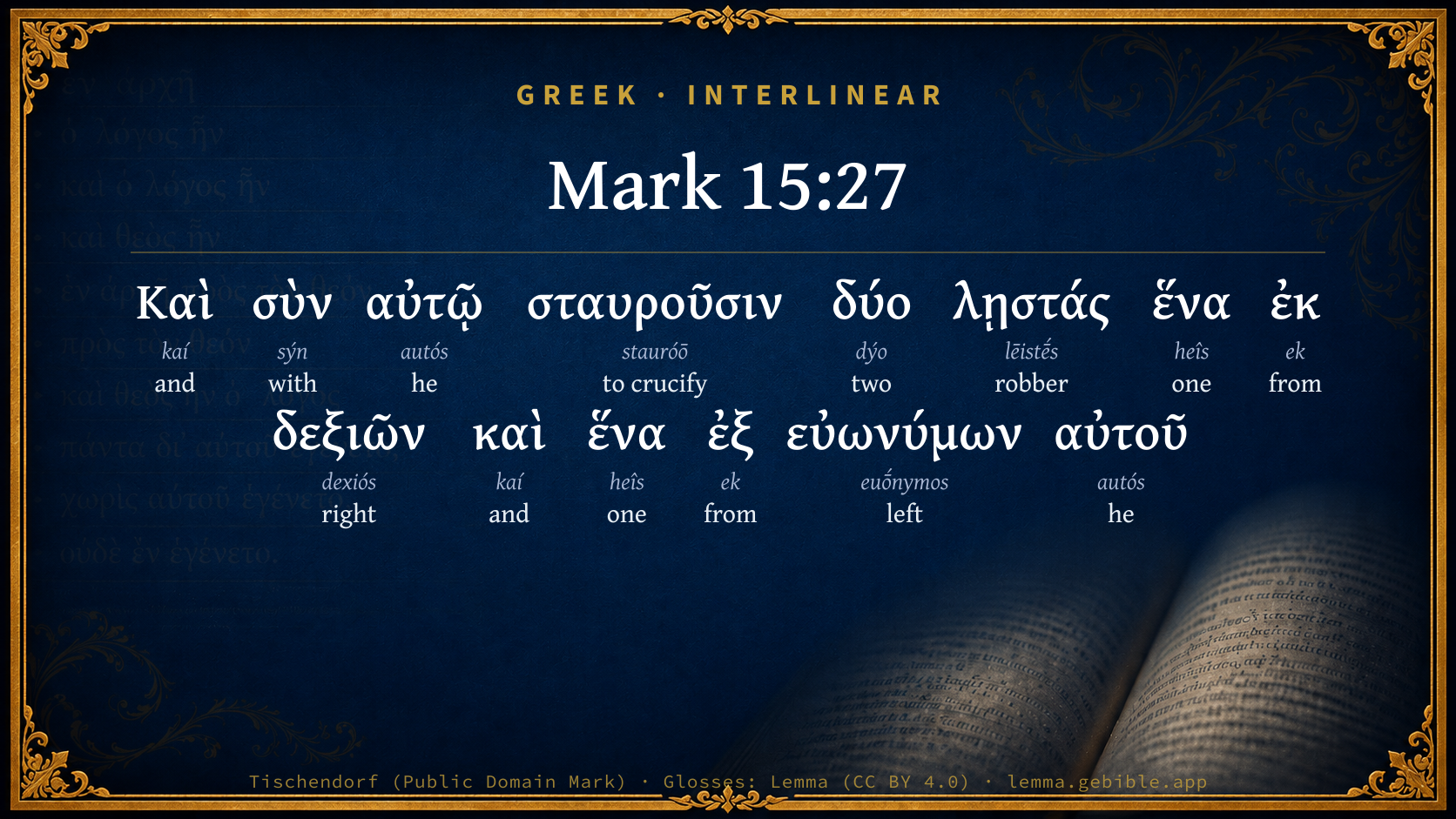
  1. Καὶ kaí G2532 “and” Conjunction
  2. σὺν sýn G4862 “with” Preposition
  3. αὐτῷ autós G846 “he” Personal pronoun, Dative, Singular, Masculine
  4. σταυροῦσιν stauróō G4717 “to crucify” Verb, Present, Active, Indicative, 3rd person, Plural
  5. δύο dýo G1417 “two” Adjective, Numeral (indeclinable)
  6. λῃστάς lēistḗs G3027 “robber” Noun, Accusative, Plural, Masculine
  7. ἕνα heîs G1520 “one” Adjective, Accusative, Singular, Masculine
  8. ἐκ ek G1537 “from” Preposition
  9. δεξιῶν dexiós G1188 “right” Adjective, Genitive, Plural, Masculine
  10. καὶ kaí G2532 “and” Conjunction
  11. ἕνα heîs G1520 “one” Adjective, Accusative, Singular, Masculine
  12. ἐξ ek G1537 “from” Preposition
  13. αὐτοῦ autós G846 “he” Personal pronoun, Genitive, Singular, Masculine

About this verse

These counts appear in no published source. They are computed here, from the morphology-tagged text and Lemma’s own curated glosses. What Lemma adds →

14
words
10
distinct lemmas
Gospels
section

Notable vocabulary

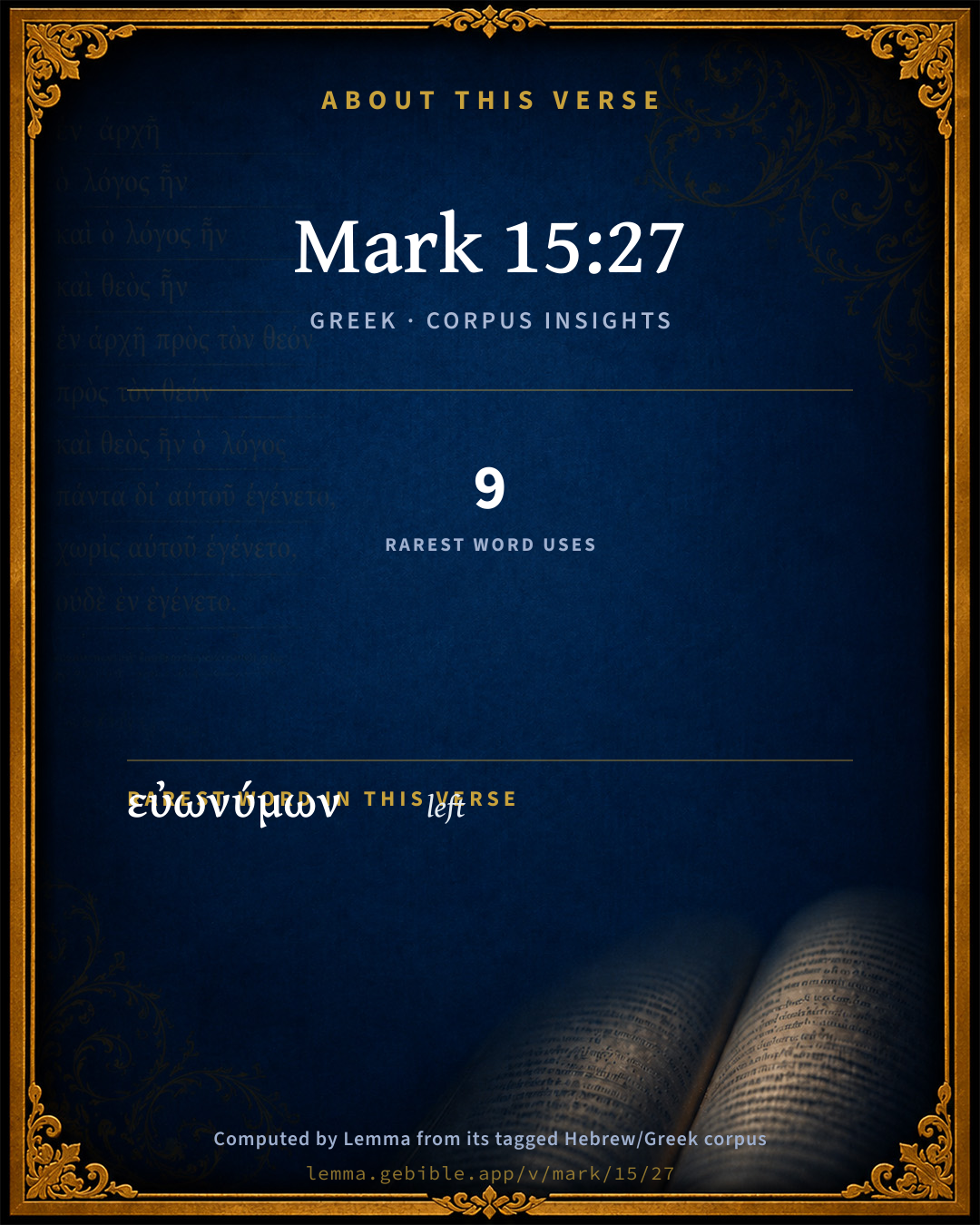
The rarest word here is εὐωνύμων left G2176 — appearing just 9 times in the whole Greek New Testament.

Shared distinctive vocabulary

εὐωνύμων left G2176 occurs in 9 verses of the Greek New Testament. Also found in:

Repetition

Words recur within this verse:

Cross-references

3

Topical passages linked to Mark 15:27 in the Treasury of Scripture Knowledge — connected by theme and wording, ordered by reader-vote popularity; previews shown in the World English Bible.

  • Matthew 27:38 Then there were two robbers crucified with him, one on his right hand and one on the left.
  • Luke 23:32–33 There were also others, two criminals, led with him to be put to death.
  • John 19:18 where they crucified him, and with him two others, on either side one, and Jesus in the middle.

Cross-references courtesy of OpenBible.info (CC BY 4.0).

Commentary

Notes on Mark 15:27 from classic Christian and Jewish commentators (each source and its license shown beneath its notes). The classic Christian expositions comment on the surrounding passage and are grouped to its opening verse, so a note may address several verses; the Jewish commentaries on the Tanakh (Rashi and others) are per-verse, so they appear only where the commentator wrote on this verse.

Lemma curates 59 commentaries, every one of them public domain or Creative Commons licensed, each selected and text-cleaned for this edition rather than reprinted as found. About our sources →

The Biblical Illustrator

Joseph S. Exell

Mar_15:27

And with him they crucify two thieves.

The malefactors

We propose to advert to the fact that Jesus endured his last agonies between two malefactors; and then to notice the respective characters of his companions in suffering.

I. Let us behold this strange sight: Jesus suffering, dying between two malefactors! What an amazing spectacle! And it may have been without any specific design on the part of his oppressors that He was crucified in the midst, rather than on either side of His companions in suffering. But whether it was designed by His enemies or not, there can be no doubt that this circumstance constituted a part of our Lords humiliation. A preeminence was thus assigned Him in ignominy and shame. This circumstance affords a striking fulfilment of prophecy; then was accomplished the declaration of the prophet, He was numbered with the transgressors: and not only so, but it is also illustrative of the prophetic Scriptures, as it shows how, without any design whatever, and sometimes with the very opposite design, men may be fulfilling Gods purposes, and accomplishing the predictions of His Word. That strange spectacle suggests the remark, how closely men may be allied by circumstances-how completely identified as to their lot on earth-between whom there is no resemblance in real character. Here are three persons suffering at the same time, and in the same place, the same cruel and ignominious death, and yet how perfectly dissimilar in point of character! Outwardly their lot is the same; but inwardly there is not the slightest resemblance between them. Heaven, earth, and hell, are brought into closest contact in the persons of those three sufferers. In the elevated character of Jesus we have all that is highest, purest, best in heaven; in the obduracy, the profaneness, and the impiety of one of the malefactors, we have the most striking characteristic of the lost, who are hardened in sin beyond the possibility of repentance; while in the contrition and prayerfulness of the other, we have what is peculiar to the good on earth. Often may the best and the worst be found in close connection here, sitting at the same able, or suffering on the same scaffold. How clearly does this indicate another state of being! Under the government of one infinitely wise and just, as well as almighty, such disorders cannot be final; there surely must come a time of separation, of adjustment!

II. We now proceed to consider the character of the malefactors who suffered with our Lord. We have already intimated, that they differed essentially from each other; we must, therefore, consider them separately. And, first, of the impenitent malefactor. The treatment which our Lord received at his hands is remarkable, and deserves our attention. He reviled the Redeemer, even on the cross. The conduct of this wretched man, in reviling the Redeemer on the cross, not only illustrates the power of example, but it is further instructive, as showing how near death a man may be, and yet how far from thinking seriously of any of the consequences of dying; how far from any reflections suited to his solemn position and prospects! How strikingly does this illustrate the folly of deferring to a dying hour, the all-important work of preparation for an eternal world! Men often speak of the penitent thief, and expect, like him, in their last moments, to find repentance unto life; but they rarely think of his companion who died unchanged; and yet it is to be feared he is the representative of a far larger class than the other. Let us turn to a more pleasing theme-the spirit and conduct of the penitent thief; in which there is much that is extraordinary, and deserving of our best attention. We may notice his deep sense of the solemnity of his situation. He feared God, into whose immediate presence he was so soon to enter. Nothing can operate so powerfully, so constantly, in deterring from evil, and in imparting to the character the highest elevation and purity; and those who do not realize this are exposed to every breath of temptation, and are guilty of neglecting their noblest and best interests. We notice, also, the free and spontaneous acknowledgment of his guilt. He felt and confessed that he and his companion deserved to die, and that they were justly exposed to the displeasure of God-We, indeed, justly; for we receive the due reward of our deeds. How deep seemed to be his conviction of sin and demerit; and how free and full his acknowledgment of it! What a touching illustration we have here of the distinguishing grace of God! The two malefactors who suffered with our Lord were probably condemned for the same offence. They had been associates in sin, and now they were companions in shame, and suffering, and death; and yet, how the one is made to differ from the other! And this leads me to notice his knowledge of the character of Christ. This man has done nothing amiss. Whence he derived his knowledge of the character of the Redeemer, it were in vain to inquire. It is not impossible that, in former days, he may have heard Jesus preach, and may have witnessed some of His stupendous miracles of power and of mercy. It is not improbable that, while on his way to the cross, and while hanging on it, he heard much of Jesus; for while the multitude reviled and reproached Him, there were some amongst them who bewailed and lamented Him; and these, doubtless, spoke of His worth; and it is certain that he that day saw much of the spirit and conduct of the Redeemer, as well as of His enemies; and no man could observe the conduct of Jesus with an impartial mind, without being convinced that He was a righteous person. Still more remarkable is the persuasion which he entertained and expressed of the dominion and spiritual power of the Redeemer: Lord, remember me when Thou comest into Thy kingdom. Strange that he could recognize a king in one whose environment was so humiliating. I cannot but remark, finally, his deep humility, which appears in his throwing himself so unreservedly on the compassion and grace of the Saviour. Lord, remember me when Thou comest into Thy kingdom. There is no presumption, no dictation, here. There is nothing of the Spirit of the two disciples who prayed that they might sit, the one on His right hand and the other on His left, in His kingdom; but there is the deep humility which is always characteristic of genuine repentance. (J. J. Davies.)

The Biblical Illustrator, edited by Joseph S. Exell (c. 1880s–1900s) — public domain. Text from a community e-Sword module.

Tyndale Open Study Notes

Tyndale Open Resources

15:27 Two revolutionaries: Jesus, the most important victim, was placed in the center.

Tyndale Open Study Notes — © Tyndale Open Resources, licensed CC BY-SA 4.0. Text via the HelloAO Bible API.

Adam Clarke's Commentary

Verse 27. Two thieves] A copy of the Itala tells their names: One on the right hand - named Zoathon; and one on the left hand - named Chammatha.

Adam Clarke's Commentary on the Bible (1810–1826) — public domain. Text from a community e-Sword/MySword module.

Ellicott's Commentary for English Readers

(27) Two thieves.—Better, as in Mat_27:38, two robbers.

A Bible Commentary for English Readers, edited by Charles John Ellicott (1878–1897) — public domain. Text from a community e-Sword module.

The Cambridge Bible for Schools and Colleges

gen. ed. J. J. S. Perowne

27. two thieves] Rather, two robbers, or malefactors as St Luke calls them (Luk_23:33). See note above, Mar_11:17. It is more than probable that they belonged to the band of Barabbas and “had been engaged in one of those fierce and fanatical outbreaks against the Roman domination which on a large scale or a small so fast succeeded one another in the latter days of the Jewish commonwealth.” This explains the fact that we read of no mockery of them, of no gibes levelled against them. They were the popular heroes. They realized the popular idea of the Messiah. See Trench’s Studies, p. 294.

The Cambridge Bible for Schools and Colleges (gen. ed. J. J. S. Perowne; Cambridge University Press, 1878–1918) — public domain. Text from a community e-Sword module.

John Gill's Exposition

And they that passed by,.... In the road, and went by the cross. The Arabic version adds, "before him", Christ, as he hung on the cross:

railed on him, wagging their heads; gave him opprobrious language, and used indecent gestures;

and saying, ah! thou that destroyest the temple; the Vulgate Latin version adds, "of God":

and buildest it in three days; thou poor vain miserable creature, that boasted of thy power, where art thou now? and what dost thou think of thyself?

John Gill's Exposition of the Whole Bible (1746–1763) — public domain (CC PDM 1.0). Text via the HelloAO Bible API.

The Pulpit Commentary

And with him they crucify two robbers (lhstai) not "thieves" (kleptai); St. Luke (Luk_23:32) shows that these two robbers formed a part of the procession to Calvary; but they were crucified after our Lord one on his right hand, and one on his left. We know from St. Luke (Luk_23:40) that one of these malefactors was saved; while it would appear that the other died in his sins. And thus Christ upon his cross, between these two men, and with the title of King over his head, presented a striking and awful picture of the final judgment. Such is the view of St. Ambrose on St. Luke 22, and of St. Augustine, who says," This cross, if you mark it well, was a judgment-seat. For the Judge being placed in the midst, the one who believed was set free; the other who reviled him was condemned; and thus he signified what he will do with the quick and the dead. Some he will place on his right hand, and some on his left" (Augustine, Tract. 31 in S. Johan.).

The Pulpit Commentary (1880–1919), ed. H.D.M. Spence-Jones & Joseph S. Exell — public domain. Text from a community e-Sword module.

Cambridge Greek Testament for Schools and Colleges

27. δύο λῃστάς. Two robbers (R.V.); see on Mar 11:17, Mar 14:48. They may have taken part in the insurrection in which Barabbas had shed blood; but no hint is given of any such connexion. More probably they were bandits, and may have been some of those who caused the road from Jerusalem to Jericho to be notorious for danger (Luk 10:30). They had probably been condemned at the same time as Jesus, for they know how His case differs from theirs (Luk 23:40-42). The names of the two robbers are given with extraordinary variety in the Apocryphal Gospels and other legendary sources; but, on the whole, Dismas or a similar name is given to the penitent robber, and Gestas or a similar name to the impenitent. Titus and Dumachus (θεομάχος), Joathas and Maggatras, Zoatham and Chammatha, Matha and Joca, are other variants.

ἕνα ἐκ δεξιῶν. Such are the right and left hand places for which James and John had asked (Mar 10:37).

Cambridge Greek Testament for Schools and Colleges (Cambridge University Press, 1896; 21 vols, various authors incl. Carr, Maclear, Plummer, Farrar, Lumby, Moule, M. R. James, Simcox) — public domain. Text from a community e-Sword module.

International Critical Commentary

27. λῃστάς—robbers, not thieves, AV. Men who plundered by violence, not by stealth.

International Critical Commentary — older volumes (1896–1929), various authors — public domain. Text from a community e-Sword module.

Vincent's Word Studies in the New Testament

Marvin R. Vincent

Thieves. Rev., robbers. See on Mt 27:38.

Marvin R. Vincent, Word Studies in the New Testament (1887–1900) — public domain. Text from a community e-Sword/MySword module.

Lesson kit

Teaching starters — assembled from the data on this page, not authored interpretation. Every prompt links to the verse data it draws on. Edit before teaching.

Mark, in the Gospels, opens this verse with 14 words (10 distinct Greek lemmas). Its most distinctive word is euṓnymos (“left”). A historical commentator’s framing appears above. Read the whole chapter for the surrounding context.

Discussion questions

  1. What does “left” (euṓnymos) contribute to the verse as a whole?
  2. Matthew 20:21 shares the word «left» with this verse. How do the two illuminate each other?
  3. “one” occurs 2× in this one verse. What is the effect of the repetition?
  4. The translations on this page render this verse differently — a whole-verse word diff, not a word-by-word alignment. What might account for the different wordings?
  5. Reading how The Biblical Illustrator and Tyndale Open Study Notes read this verse, where do the two commentators agree and where do they part?

Things to notice

Reading settings

Reading text

Shown beneath each verse's original-language words.

Old Testament
Old Testament edition

Read the OT as the Masoretic Hebrew (MT) or the Greek Septuagint (LXX).

English shown for the Greek Septuagint (in the Hebrew ↔ Greek comparison).

Comparing translations? Open the Compare panel on any verse page to stack up to four side by side.