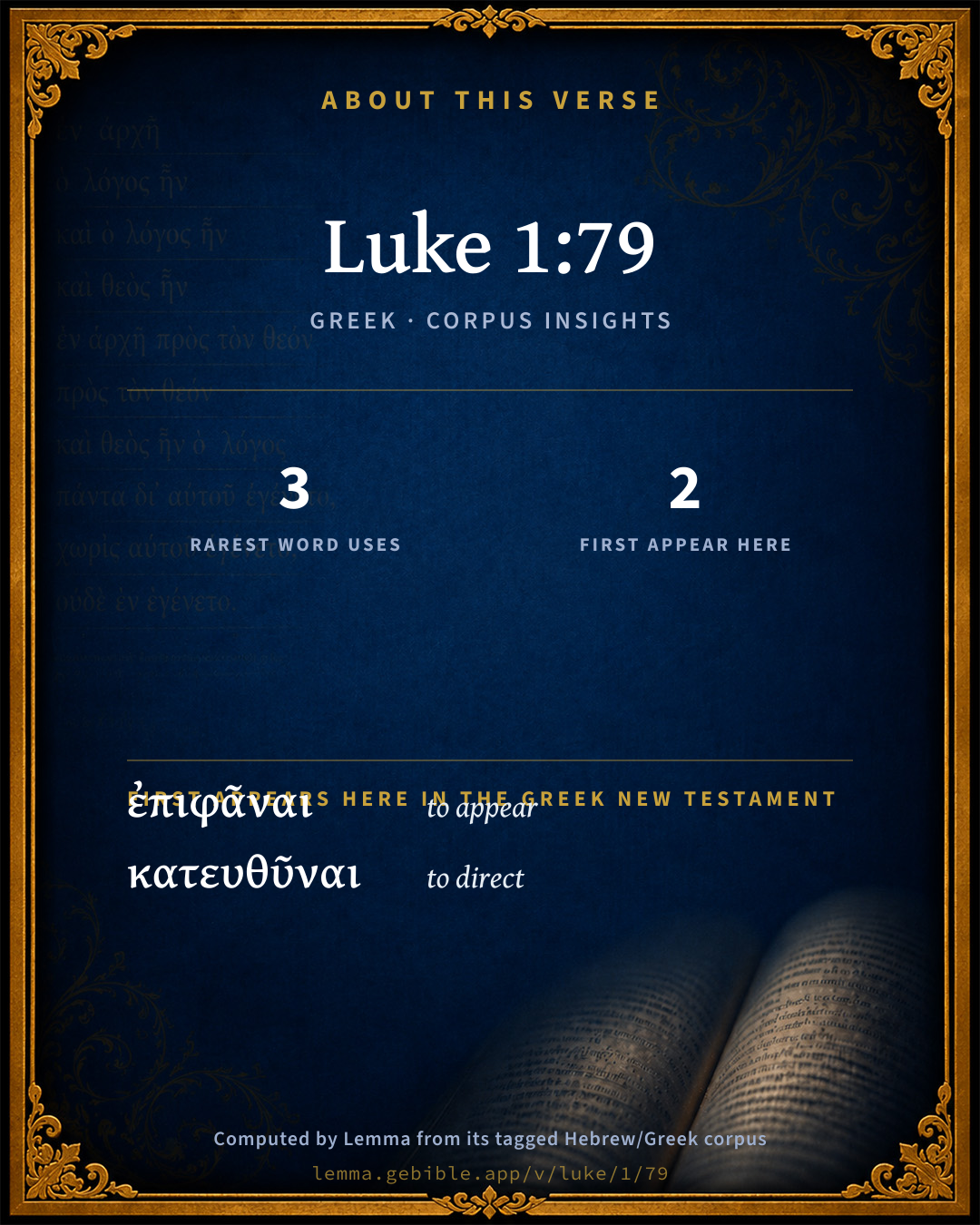
Luke 1:79

Greek (Tischendorf 8th ed.) Luke 1:79 appears in the Greek New Testament. The text above is from the Tischendorf 8th edition. Each word links to its Strong’s number and a concise gloss. Click any word for its full Thayer’s Greek Lexicon entry.
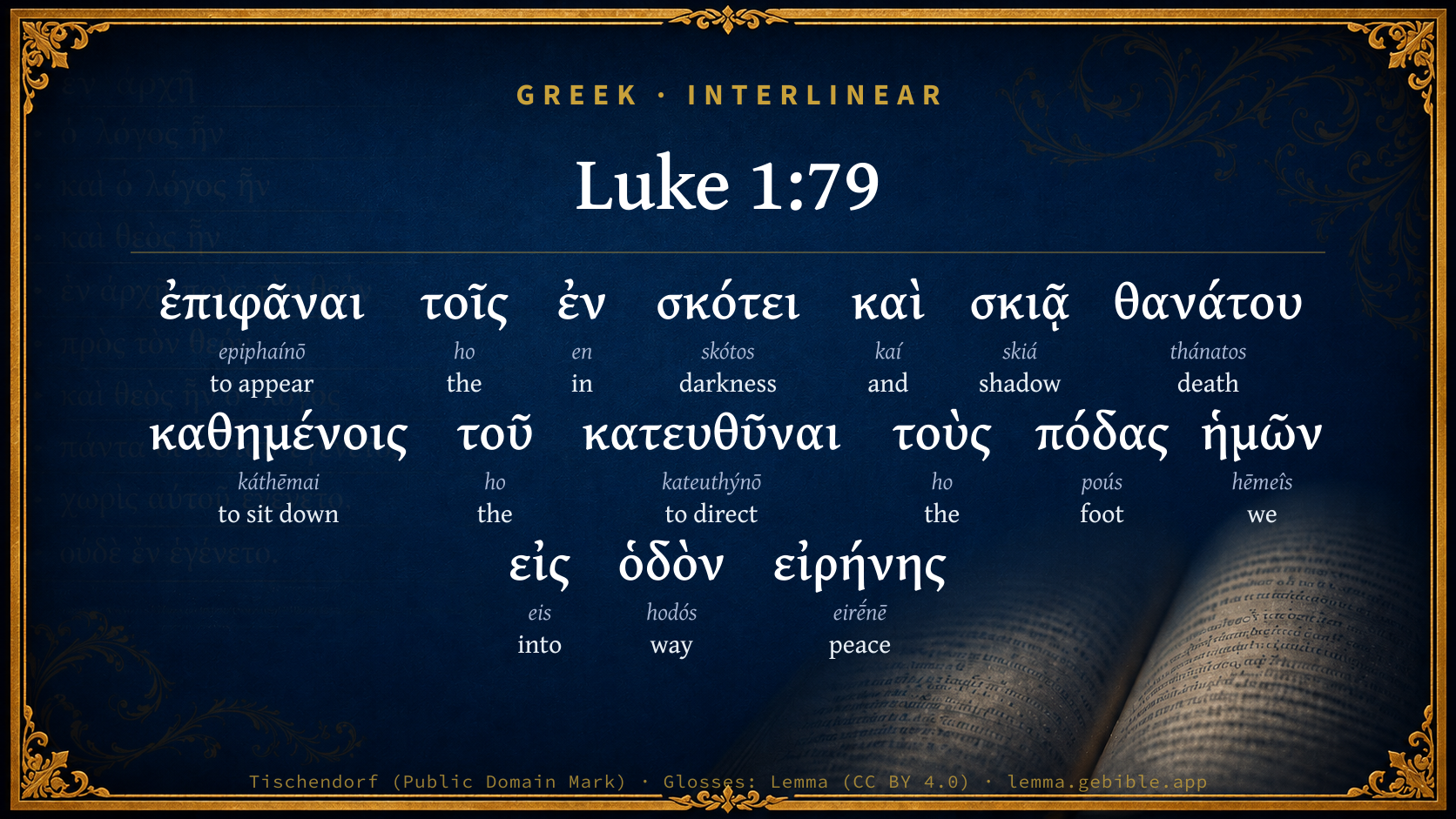
Download image
Cite this verse

Luke 1:79 (World English Bible). Public Domain. Lemma interlinear Bible study tool, https://lemma.gebible.app/v/luke/1/79.

Show BibTeX & RIS
BibTeX
RIS
English Translation
To shine on those who sit in darkness and the shadow of death; To guide our feet into the way of peace."
World English Bible · Public Domain
Highlights
  • 2 first appearances in the Greek New Testament
Full analysis ↓
Download a study sheet

One document with this verse’s original text, its word-by-word gloss line, the meaning frame, cross-references with their text, attributed commentary, and full source and license credits — printable, and it pastes into notes with its structure intact.

This verse Autodidact and up

Study sheet (.html) Plain text (.txt)

A passage Seminary Student

Up to 50 verses in one chapter. A passage sheet keeps up to 6 commentary sources and 12 cross-references per verse, in the order this page ranks them, and says so on the sheet whenever that leaves anything out. Ask for a single verse and you get the Autodidact verse sheet above.

Everything on this page stays free to read, with no account — the sheet is a download of what is already on screen, not access to it.

Want to remove ads? Support Godless Engineer
Compare translations 3

The same verse in 3 English versions, stacked beneath the original-language interlinear above. Click any original word for its lexicon entry.

Each is an independent rendering of the whole verse — the interlinear is not word-aligned to these translations.

Highlighted words mark where these versions differ — a whole-verse word diff, not a word-by-word alignment.

  • World English Bible Public Domain
    To shine on those who sit in darkness and the shadow of death; To guide our feet into the way of peace."
  • King James Version Public Domain
    To give light to them that sit in darkness and in the shadow of death, to guide our feet into the way of peace.
  • unfoldingWord Literal Text CC BY-SA 4.0
    to shine on the ones sitting in darkness and a shadow of death; to guide our feet into a path of peace.”

unfoldingWord Literal Text — © unfoldingWord, licensed CC BY-SA 4.0. Word-aligned USFM3 via Door43 (git.door43.org/unfoldingWord/en_ult).

Versions to compare (up to 4)

3 of 4 selected

Show all 19 translations

Every available English version of this verse, each an independent rendering of the whole verse.

  • World English Bible Public Domain
    To shine on those who sit in darkness and the shadow of death; To guide our feet into the way of peace."
  • Berean Standard Bible Public Domain
    to shine on those who live in darkness and in the shadow of death, to guide our feet into the path of peace.”
  • Majority Standard Bible Public Domain
    to shine on those who live in darkness and in the shadow of death, to guide our feet into the path of peace.”
  • King James Version Public Domain
    To give light to them that sit in darkness and in the shadow of death, to guide our feet into the way of peace.
  • American Standard Version (1901) Public Domain
    To shine upon them that sit in darkness and the shadow of death; To guide our feet into the way of peace.
  • Revised Version (1885) Public Domain
    To shine upon them that sit in darkness and the shadow of death; To guide our feet into the way of peace.
  • Geneva Bible (1599) Public Domain
    To giue light to them that sit in darknes, and in the shadow of death, and to guide our feete into the way of peace.
  • Douay-Rheims (1899) Public Domain
    To enlighten them that sit in darkness, and in the shadow of death: to direct our feet into the way of peace.
  • Young's Literal Translation Public Domain
    To give light to those sitting in darkness and death-shade, To guide our feet to a way of peace.'
  • Literal Standard Version CC BY-SA 4.0
    To give light to those sitting in darkness and death-shade, || To guide our feet to a way of peace.”
  • Unlocked Literal Bible CC BY-SA 4.0
    to shine on those who sit in darkness and in the shadow of death. He will do this to guide our feet into the path of peace.”
  • unfoldingWord Literal Text CC BY-SA 4.0
    to shine on the ones sitting in darkness and a shadow of death; to guide our feet into a path of peace.”
  • Darby Bible Public Domain
    to shine upon them who were sitting in darkness and in [the] shadow of death, to guide our feet into [the] way of peace.
  • World Messianic Bible Public Domain
    to shine on those who sit in darkness and the shadow of death; to guide our feet into the way of peace.”
  • Webster's Bible Public Domain
    To give light to them that sit in darkness and in the shades of death, to guide our feet into the way of peace.
  • Free Bible Version CC BY-SA 4.0
    to shine on those who live in darkness and under the shadow of death, and to guide us along the path of peace.”
  • Bible in Basic English Public Domain
    To give light to those in dark places, and in the shade of death, so that our feet may be guided into the way of peace.
  • Text-Critical English NT CC BY 4.0
    to give light to those who sit in darkness and in the shadow of death, to guide our feet into the way of peace.”
  • Tyndale New Testament (1534) Public Domain
    To geve light to the that sate in darcknes and in shadowe of deth and to gyde oure fete into the waye of peace.

Literal Standard Version (2020), Covenant Press — licensed CC BY-SA 4.0. Text via the HelloAO Bible API (eBible.org). Unlocked Literal Bible (unfoldingWord) — licensed CC BY-SA 4.0. Text via the HelloAO Bible API (eBible.org). unfoldingWord Literal Text — © unfoldingWord, licensed CC BY-SA 4.0. Word-aligned USFM3 via Door43 (git.door43.org/unfoldingWord/en_ult). Free Bible Version, Dr. Jonathan Gallagher — licensed CC BY-SA 4.0. Text via the HelloAO Bible API (eBible.org).

Word by word

More ways to search: Search by grammar → Find every occurrence → Compare this word →

Practice this passage: Drill this verse → Learn its vocabulary →

κατευθῦναι
kateuthýnō
G2720
“to direct”
Verb, Aorist, Active, Infinitive
Part of Speech
Verb
Tense
Aorist
Voice
Active
Mood
Infinitive
Full Thayer's Definition

Origin: from G2596 and G2116

TDNT: None

1. to make straight, guide, direct a. of the removal of the hindrances to coming to one
  1. ἐπιφᾶναι epiphaínō G2014 “to appear” Verb, Aorist, Active, Infinitive
  2. τοῖς ho G3588 “the” Article, Dative, Plural, Masculine
  3. ἐν en G1722 “in” Preposition
  4. σκότει skótos G4655 “darkness” Noun, Dative, Singular, Neuter
  5. καὶ kaí G2532 “and” Conjunction
  6. σκιᾷ skiá G4639 “shadow” Noun, Dative, Singular, Feminine
  7. θανάτου thánatos G2288 “death” Noun, Genitive, Singular, Masculine
  8. καθημένοις káthēmai G2521 “to sit down” Verb, Present, Middle or Passive deponent, Participle, Dative, Plural, Masculine
  9. τοῦ ho G3588 “the” Article, Genitive, Singular, Neuter
  10. τοὺς ho G3588 “the” Article, Accusative, Plural, Masculine
  11. πόδας poús G4228 “foot” Noun, Accusative, Plural, Masculine
  12. ἡμῶν hēmeîs G2249 “we” Personal pronoun, 1st person, Genitive, Plural
  13. εἰς eis G1519 “into” Preposition
  14. ὁδὸν hodós G3598 “way” Noun, Accusative, Singular, Feminine
  15. εἰρήνης eirḗnē G1515 “peace” Noun, Genitive, Singular, Feminine

About this verse

These counts appear in no published source. They are computed here, from the morphology-tagged text and Lemma’s own curated glosses. What Lemma adds →

16
words
14
distinct lemmas
Gospels
section

Notable vocabulary

The rarest word here is κατευθῦναι to direct G2720 — appearing just 3 times in the whole Greek New Testament.

First appearance in Scripture

These words make their first canonical appearance in the Greek New Testament here:

  • ἐπιφᾶναι to appear G2014
  • κατευθῦναι to direct G2720

Shared distinctive vocabulary

κατευθῦναι to direct G2720 occurs in 3 verses of the Greek New Testament. Also found in:

Repetition

A word recurs within this verse:

  • τοῖς the G3588 ×3

Cross-references

34

Topical passages linked to Luke 1:79 in the Treasury of Scripture Knowledge — connected by theme and wording, ordered by reader-vote popularity; previews shown in the World English Bible.

  • Isaiah 9:2 The people who walked in darkness have seen a great light: those who lived in the land of the shadow of death, on them has the light shined.
  • Matthew 4:16 The people who sat in darkness saw a great light, To those who sat in the region and shadow of death, To them light has dawned."
  • Acts 26:18 to open their eyes, that they may turn from darkness to light and from the power of Satan to God, that they may receive remission of sins and an inheritance among those who are sanctified by faith in me.'
  • Isaiah 42:7 to open the blind eyes, to bring out the prisoners from the dungeon, and those who sit in darkness out of the prison-house.
  • Ephesians 5:8 For you were once darkness, but are now light in the Lord. Walk as children of light,
  • John 12:46 I have come as a light into the world, that whoever believes in me may not remain in the darkness.
  • Psalms 107:14 He brought them out of darkness and the shadow of death, And broke their bonds in sunder.
  • John 8:12 Again, therefore, Jesus spoke to them, saying, "I am the light of the world. He who follows me will not walk in the darkness, but will have the light of life."
  • Psalms 107:10 Some sat in darkness and in the shadow of death, Being bound in affliction and iron,
  • John 9:5 While I am in the world, I am the light of the world."
  • Psalms 23:4 Even though I walk through the valley of the shadow of death, I will fear no evil, for you are with me. Your rod and your staff, they comfort me.
  • Isaiah 49:9 saying to those who are bound, Go forth; to those who are in darkness, Show yourselves. They shall feed in the ways, and on all bare heights shall be their pasture.
  • Isaiah 57:19–21 I create the fruit of the lips: Peace, peace, to him who is far off and to him who is near, says Yahweh; and I will heal him.
  • John 1:9 The true light that enlightens everyone was coming into the world.
  • Jeremiah 2:6 Neither said they, Where is Yahweh who brought us up out of the land of Egypt, who led us through the wilderness, through a land of deserts and of pits, through a land of drought and of the shadow of death, through a land that none passed through, and where no man lived?
  • Matthew 11:28–29 "Come to me, all you who labor and are heavily burdened, and I will give you rest.
  • Luke 2:32 A light for revelation to the Gentiles, And the glory of your people Israel."
  • 1 John 1:5–7 This is the message which we have heard from him and announce to you, that God is light, and in him is no darkness at all.
  • Psalms 25:8–10 Good and upright is Yahweh, Therefore he will instruct sinners in the way.
  • Isaiah 42:16 I will bring the blind by a way that they don't know; in paths that they don't know will I lead them; I will make darkness light before them, and crooked places straight. These things will I do, and I will not forsake them.
  • Isaiah 49:6 yes, he says, It is too light a thing that you should be my servant to raise up the tribes of Jacob, and to restore the preserved of Israel: I will also give you for a light to the Gentiles, that you may be my salvation to the end of the earth.
  • Psalms 25:12 What man is he who fears Yahweh? He shall instruct him in the way that he shall choose.
  • Psalms 44:19 Though you have crushed us in the haunt of jackals, And covered us with the shadow of death.
  • Isaiah 48:22 There is no peace, says Yahweh, to the wicked.
  • Isaiah 60:1–3 Arise, shine; for your light is come, and the glory of Yahweh is risen on you.
  • Jeremiah 6:16 Thus says Yahweh, Stand you in the ways and see, and ask for the old paths, where is the good way; and walk therein, and you shall find rest for your souls: but they said, We will not walk [therein].
  • Romans 3:17 The way of peace, they haven't known."
  • 1 Thessalonians 5:4–5 But you, brothers, aren't in darkness, that the day should overtake you like a thief.
  • Job 10:22 The land dark as midnight, Of the shadow of death, without any order, Where the light is as midnight.'"
  • Proverbs 3:17 Her ways are ways of pleasantness. All her paths are peace.
  • Isaiah 48:17 Thus says Yahweh, your Redeemer, the Holy One of Israel: I am Yahweh your God, who teaches you to profit, who leads you by the way that you should go.
  • Isaiah 59:8 The way of peace they don't know; and there is no justice in their goings: they have made them crooked paths; whoever goes therein does not know peace.
  • Job 3:5 Let darkness and the shadow of death claim it for their own. Let a cloud dwell on it. Let all that makes black the day terrify it.
  • Proverbs 8:20 I walk in the way of righteousness, In the midst of the paths of justice;

Cross-references courtesy of OpenBible.info (CC BY 4.0).

Commentary

Notes on Luke 1:79 from classic Christian and Jewish commentators (each source and its license shown beneath its notes). The classic Christian expositions comment on the surrounding passage and are grouped to its opening verse, so a note may address several verses; the Jewish commentaries on the Tanakh (Rashi and others) are per-verse, so they appear only where the commentator wrote on this verse.

Lemma curates 59 commentaries, every one of them public domain or Creative Commons licensed, each selected and text-cleaned for this edition rather than reprinted as found. About our sources →

Joseph Benson's Commentary

Luk 1:79. To give light to them that sit in darkness — The Messiah at his coming would enlighten with the knowledge of salvation the Gentile nations, who had long lived in ignorance and wickedness, the cause of death. To guide our feet into the way of peace — And he would guide the feet, even of the Jews, into the way of finding peace with God, peace of mind, and true happiness, by making them more perfectly acquainted with the method of salvation, and the will of God concerning them. Such phrases as darkness and the shadow of death, describe with peculiar propriety the ignorant and miserable state of the Gentile world: and, probably, the former clause might be intended principally of them. But as Christ’s preaching to the Jews in Galilee is said, Mat 4:14-16, to be an accomplishment of Isa 9:1-2, to which Zacharias here seems to refer, we must not confine the sense of it merely to the Gentiles; for indeed the sad character and circumstances of the Jews at this time too well suited the representation here made. Such are the elevated strains in which this pious man, under the extraordinary influence of the Holy Ghost, described the great blessings which mankind were to enjoy by the coming of the seed promised to Adam, to Abraham, and to David.

Joseph Benson's Commentary on the Old and New Testaments (1811–1818) — public domain. Text from a community e-Sword module.

Bengel's Gnomon

Johann Albrecht Bengel

Luk 1:79. Ἐπιφᾶναι, so as to give light to [to shine in full manifestation on]) Again comp. Psa 132:17 [I have ordained a lamp for mine anointed].—τοῖς—καθημένοις, them that sit) Comp. Mat 4:15, note on the passage of Isaiah quoted there.—σκότει καὶ σκιᾷ θανάτου, in darkness and the shadow of death) These are conjoined as their opposites, light and life.

Bengel's Gnomon of the New Testament — English translation (T&T Clark, Edinburgh, 1860) — public domain. Text from a community e-Sword module.

Geneva Bible (1599)

Geneva Bible translators

Into the way which leadeth us to true happiness.

Geneva Bible (1599) marginal notes — public domain. Text via Bolls.life.

Jamieson, Fausset & Brown

Robert Jamieson, A. R. Fausset & David Brown

(Compare Isa 9:2; Mat 4:13-17). "That St. Luke, of all the Evangelists, should have obtained and recorded these inspired utterances of Zacharias and Mary--is in accordance with his character and habits, as indicated in Luk 1:1-4" [WEBSTER and WILKINSON].

Jamieson, Fausset & Brown — Commentary Critical and Explanatory on the Whole Bible (1871) — public domain (CC PDM 1.0). Text via the HelloAO Bible API.

Ellicott's Commentary for English Readers

(79) To give light to them that sit in darkness.—The words are an echo of those of Isa_9:2, which we have already met with in Mat_4:16, where see Note. Here they carry on the thought of the sunrise lighting up the path of those who had sat all night long in the dark ravine, and whose feet were now guided into “the way of peace,” that word including, as it always did, with the Hebrew, every form of blessedness.

A Bible Commentary for English Readers, edited by Charles John Ellicott (1878–1897) — public domain. Text from a community e-Sword module.

The Cambridge Bible for Schools and Colleges

gen. ed. J. J. S. Perowne

79. in the shadow of death] The Hebrew Tsalmaveth. Job_10:21; Job_38:17; Psa_23:4; Psa_107:10; Isa_9:2; Mat_4:16, &c.

The Cambridge Bible for Schools and Colleges (gen. ed. J. J. S. Perowne; Cambridge University Press, 1878–1918) — public domain. Text from a community e-Sword module.

John Gill's Exposition

To give light to them that sit in darkness,.... God's elect among the Jews, who were not only in a state of unregeneracy, which is a state of darkness, ignorance, and unbelief; but in the darkness of the legal dispensation, and at this time under more than ordinary darkness and ignorance; having lost the knowledge of the righteousness of God, and of the spirituality of his law, the true sense of the Scriptures, and right notions of the Messiah; being led by blind guides, the Scribes and Pharisees,

and, were as it were also,

in the shadow of death; in a state seemingly irrecoverable, when Christ, the great light arose, and shone upon them; and communicated spiritual light, life, and heat unto them; see Isa 9:2 compared with Mat 4:13 though Christ is also a light, to lighten his chosen ones among the Gentiles, Luk 2:32 but the Jews seem chiefly to be intended here:

to guide our feet into the way of peace; which we knew not: not that he came to teach us how to make our peace with God, but to make peace for us, by the blood of his cross; and so by his Spirit and word, lead us into the true way of enjoying spiritual peace here, and eternal peace hereafter.

John Gill's Exposition of the Whole Bible (1746–1763) — public domain (CC PDM 1.0). Text via the HelloAO Bible API.

Trapp's Complete Commentary

John Trapp

79 To give light to them that sit in darkness and in the shadow of death, to guide our feet into the way of peace.

Ver. 79. That sit in darkness] This imports, 1. continuance; 2. content.

To guide our feet] The superstitious pagans thought that their goddess Vibilia kept them in their right way when they travelled: but we have a better guide to God. Arnob. advers. Gent. lib, 4.

John Trapp, A Commentary or Exposition upon All the Books of the Old and New Testament (1647–1656) — public domain. Text from a community e-Sword module.

Albert Barnes' Notes on the Bible

To give light ... - See the notes at Mat 4:16.

To guide our feet ... - The figure in these verses is taken from travelers, who, being overtaken by night, know not what to do, and who wait patiently for the morning light, that they may know which way to go. So man wandered. So he became benighted. So he sat in the shadow of death. So he knew not which way to go until the Sun of righteousness arose, and then the light shone brightly on his way, and the road was open to the promised land of rest - to heaven.

This song of Zechariah is exceedingly beautiful. It expresses with elegance the great points of the plan of redemption, and the mercy of God in providing that plan. That mercy is “great.” It is worthy of praise - of our highest, loftiest songs of thanksgiving; for we were in the shadow of death - sinful, wretched, wandering - and the light arose, the gospel came, and people may rejoice in hope of eternal life.

Albert Barnes' Notes on the Bible (1834–1885) — public domain. Text from a community e-Sword/MySword module.

Haydock's Catholic Bible Commentary

The Gentiles were in darkness, and given to the adoration of idols, till the light arose and dispelled the darkness, spreading on all sides the splendour of truth. (St. Basil on Isai.) --- With reason it is said in this place, who sit in darkness; for we did not walk in darkness, but sat down, as if destitute of all hopes of being delivered. (St. John Chrysostom, hom. xiv. on S. Matt.) --- Then our steps are directed in the paths of peace, when in our every action we act conformably to the grace of the Almighty. (St. Gregory, hom. xxxii.)

George Leo Haydock (1774–1849), Haydock's Catholic Family Bible and Commentary, 1859 edition — public domain. Excludes Psalms (Douay-Rheims chapter numbering differs from Protestant) and Deuterocanonical books (Catholic canon only).

Matthew Poole's English Annotations

Here Zacharias showeth us the end why God visited us with his Son, the Branch, the Light, the Dayspring, the Sun of righteousness. Men were in the darkness of sin and ignorance, dead in trespasses and sins, at war and enmity with God; Christ came to give them the light of gospel revelations, the light of spiritual comfort and salvation, to purchase peace, and to direct them how to walk that they might have peace with God, and at last enter into peace. This he did to the Jews first, then to the Gentiles: see Isa 9:1,2; 60:1,19.

Matthew Poole's English Annotations on the Holy Bible (1683–1685) — public domain. Text from a community e-Sword/MySword module.

Whedon's Commentary on the Bible

Daniel D. Whedon

79. To them that sit in darkness—The image is here completed. The people are sitting in sullen darkness, the darkness even of death, and the dayspring pours down its splendour from the eastern sky upon them.

Guide our feet into the way of peace—The sitters in darkness have wandered far from the paths of peace, and the dayspring from on high reveals to them the true way.

‘So breaks on the traveller, faint and astray,

The bright and the balmy effulgence of morn.”

On this song of Zacharias, and on this chapter generally, we may remark:

1. On the very eve of the Messiah’s appearing the speakers are still in the dimness of the Jewish dispensation as to the exact character of the Messiah and his reign. Had these prophetic passages been, as sceptics represent, composed after the crucifixion, or even after the destruction of Jerusalem, the writer would have suited the details to the then existing facts.

2. All the elements which are here ascribed to the Messiah’s kingdom are really in its very nature and substance, and are to be developed in its history from the beginning and in future ages. Mercy, holiness, truth, light, and peace are its inmost principles, and to those are given, in the present and future, power to triumph in the world.

3. The Messiah now truly lives and reigns in this kingdom. He lives and reigns personally and in the body. He lives and reigns as personally and corporeally as if he reigned visibly, and as if he now sat upon a golden throne in the city of Jerusalem. He sways the sceptre of the world though the world be in rebellion. Without visible manifestation or show of physical or mechanical power, and allowing the principles of probation and free-agency to work out their problem, he is ever ruling and overruling the affairs of men in order to the development and ultimate prevalence of the reign of truth and righteousness in the earth, in order that millions on millions may be redeemed; to the end that he shall finally “see the travail of his soul and be satisfied.”

4. Christian scholars have always been aware that, in the narratives of the births both of John and of Jesus, there is an abundance both of events and phrases that are framed after the model of Old Testament examples. Zacharias is visited in the same manner by an angel, and with the same message, as was Abraham. Mary’s hymn is paralleled by Hannah’s upon a similar occasion. John is, like Samson, heralded by an angel before his birth, and is bound to be a Nazarite. The mythical scheme of the skeptical Strauss uses these well known facts to show that the whole story is a fabrication manufactured by the imagination of the early Christians out of these Old Testament histories, blended mythically together. His system represents the main share of gospel history to be thus constructed out of Old Testament materials. Every New Testament fact that has anything like it in the Old Testament is a plagiary and an imitation; and every event fulfilling an Old Testament prophecy is held to be invented to fit the prophecy, or to be made out of the prophecy itself. The real truth is, that the Old Testament does contain the kernel and shadows of the New. The Jewish people were a living type of a better dispensation. The prediction is verified in the fulfillment, the type in the antitype, the sacrifice in the atonement, the shadow in the substance.

Daniel D. Whedon (gen. ed.), Commentary on the Old and New Testaments (1874–1909) — public domain. Text from a community e-Sword module.

The Pulpit Commentary

To give light to them that sit in darkness and in the shadow of death. It would seem that for a moment the Hebrew priest saw beyond the narrow horizon of Israel, and that here, in the close of his glorious song, he caught sight of the distant far-reaching isles of the Gentiles, over which so deep a darkness brooded for ages.

Christ our Light.

To whom and to what extent the Messiah should "give light" probably Zacharias did not know. He may have limited the blessing, in his mind, to the people of Israel; or, inspired and illumined of God, he may have had a larger and truer outlook. We, at any rate, are unable to confine our thoughts to Jewry; we see in the Sun of Righteousness, in the Dayspring from on high, a celestial luminary "whose going forth is from the end of the heaven, and his circuit unto the ends of it, and there is nothing hid from the heat thereof." To us it is "the Light which, coming into the world, enlighteneth every one.

I THE DEGREES OF DARKNESS in which the world was shrouded when the Dayspring rose. It was a dark hour when Jesus Christ was born. "Darkness covered the earth." But the shadows were deeper in some lands than in others; some minds were more lost and buried in the thick darkness than others were.

1. The dim twilight of Judaism a twilight, not of the morning, but of the evening. For Judaism had passed out of its manhood into its dotage, out of its strength and spirituality into a dreary and lifeless formalism. It had, indeed, escaped from idolatry, and it was free from the worst excesses of the pagan world; but of a pure piety, a spiritual and acceptable service, it knew but little. Compared, however, with surrounding peoples, the Jews may be said to have stood in the twilight of truth.

2. The darkness of philosophy. For philosophy was groping in the darkness; it had felt or was feeling its way out of the absurdities of polytheism and idolatry; it touched but only here and there the grand truth of monotheism; but it was peering in the direction of pantheism and atheism. "The world by wisdom knew not God." And even where it did reach the idea of one living God, it could not tell how he was to be worshipped, how his favor was to be won, what were the relations he desired to sustain to mankind.

3. The thick darkness of paganism. If the philosophers "sat in darkness," the idolaters of uncivilized communities were "in the shadow of death." What a death in life is the existence of those who are buried in the most blighting superstitions and the most debasing habits! There indeed "the light is as darkness;" it moves us to a profound pity as we think of it. We are not surprised to read in the text of

II THE COMPASSION OF THE FATHER OF MEN IN VIEW OF IT. "The tender mercy of our God" was called forth by the sad spectacle of a world in deep shadow, a race without the Light of life. At their best, men were far enough from truth, from righteousness, from the love of God; at their worst, they had utterly gone astray, "stumbling on the dark mountains" of error and of iniquity. Well might the God of all pity compassionate such a lost race as this.

III THE VISIT OF THE HEAVENLY DAYSPRING. "The Dayspring from on high hath visited us, to give light." Jesus Christ came to be the "Light of the world;" and such he is. He has illumined all the way from the blackness of darkness of sin to the light and glory of heaven. What precious rays of light has the Divine Teacher shed on

(1) the nature and the disposition of God, our Father; on

(2) the character and the consequences of sin; on

(3) the way back to God and righteousness; on

(4) the transcendent value of the human soul; on

(5) the beauty and blessedness of the life of consecration; on

(6) the certainty of future glory to the good and faithful!

Let us draw near to him who is the Light of the human world, let us walk in the light of his reviving truth, "that we may be the children of light," and dwell in immortal glory. C.

Christ our Peace.

"To guide our feet into the way of peace." And how far has the mission of the Dayspring succeeded? How far has he guided the feet of men into the way of peace? Judged by the outward appearance, the answer would be quite unsatisfactory. Today, after eighteen centuries of Christianity, there are four millions of men under arms in Europe only; and if another great war does not break out, it is not from humane or Christian considerations that it is suppressed. How do we explain the fact?

1. Christianity has had no fair chance of showing what it is in it to do. It has been so wretchedly misrepresented through whole centuries of time.

2. It has done much to moderate and mitigate the severities of war; amongst other things, it has carried the "red cross" of succor right into the heart of the battle-field.

3. It is impregnating the minds of statesmen with the truth that an unnecessary war is a heinous crime against God and man.

4. It has been leading the souls of men into a profounder peace. For there is a spiritual sphere in which there is strife and unrest worse by far than any physical contests can be. It is there that peace has been most missed, and that its absence has wrought the saddest evil. This worst restlessness has resulted from two things

I FROM MAN SEEKING HIS SATISFACTION WHERE HE CANNOT FIND IT.

1. What a vain thing is it to seek satisfaction in a life of pleasure, in living to be amused, in hunting happiness over the field of enjoyment!

2. What an unsatisfying thing is he lived on any lower plane, whatever it may be! Alas for those millions to whom it is a dreary and monotonous round of toil! And to those who move in the higher social circles, is it so very much better? When the veil is lifted, as it is occasionally by some honest memoirs or frank autobiography, how often do we find it full of disappointment, of disillusion, of wretched rivalry, of hunger and heartache! There is no peace or rest there that is worthy of the name. Where, then, shall rest be found? We shall gain it from him and find it in him who "knew what was in man," and who alone knew what would satisfy the hunger of his soul; it was he who came to guide our feet into the way of peace. We shall find it in his friendship, in his service, in his cause. When we have come to ourselves, and have returned unto the Lord our God; when we have lost sight of ourselves, and have entered his holy and happy service; then have we left disquietude and unrest behind us, then have we entered into a true, deep, and enduring peace.

II FROM OUR SENSE OF SIN AGAINST GOD. There is no peace for man without reconciliation to God. He has left the home of his Father, has become estranged from him, has come under his righteous condemnation, and he can find no peace until he has been forgiven and restored. Apathy, indifference, the unconcern of a stolid ignorance, there may be; but that is not peace. Peace is a well-grounded assurance that all is well with us. This we can only obtain by knowing the truth concerning ourselves, and by taking the path which leads us home to God. It is just this we have in Jesus Christ. He

(1) makes plain to the understanding and makes grievous to the soul our own great unworthiness and guilt; and then he

(2) offers himself to us as our all-sufficient Savior. Then "being justified by faith in him we have peace with God through our Lord Jesus Christ." And abiding in him, we continue in the path of peace a path which leads on to holy joy and up to heavenly glory. C.

The Pulpit Commentary (1880–1919), ed. H.D.M. Spence-Jones & Joseph S. Exell — public domain. Text from a community e-Sword module.

Cambridge Greek Testament for Schools and Colleges

79. ἐπιφᾶναι. 1st aor. inf., a late (and Doric) form for ἐπιφῆναι.

σκιᾷ θανάτου. The Hebrew Tsalmaveth. Job 10:21; Job 38:17; Psa 23:4; Psa 107:10; Isa 9:2; Mat 4:16, &c.

Cambridge Greek Testament for Schools and Colleges (Cambridge University Press, 1896; 21 vols, various authors incl. Carr, Maclear, Plummer, Farrar, Lumby, Moule, M. R. James, Simcox) — public domain. Text from a community e-Sword module.

Alford’s Greek Testament

Henry Alford

79.] See reff. Care must be taken on the one hand not to degrade the expressions of this song of praise into mere anticipations of temporal prosperity, nor, on the other, to find in it (except in so far as they are involved in the inner and deeper sense of the words, unknown save to the Spirit who prompted them) the minute doctrinal distinctions of the writings of St. Paul. It is the expression of the aspirations and hopes of a pious Jew, waiting for the salvation of the Lord, finding that salvation brought near, and uttering his thankfulness in Old Testament language, with which he was familiar, and at the same time under prophetic influence of the Holy Spirit. That such a song should be inconsistent with dogmatic truth, is impossible: that it should unfold it minutely, is in the highest degree improbable.

Henry Alford, The Greek Testament (1849–1861) — public domain. Text from a community e-Sword module.

International Critical Commentary

79. ἐπιφᾶναι τοῖς ἐν σκότει καὶ σκιᾷ θανάτου καθημένοις . For ἐπιφᾶναι comp. Act 27:20, and for the form Ps. 30:17, 117:27. In 3 Mac. 6:4 we have Σὺ Φαραὼ … ἀπώλεσας, Φέγγος ἐπιφάνας ἐλέους Ἰσραὴλ γένει. Note that the καθημένους ἐν σκότει of Isa 42:7 and the σκίᾳ θανάτου of Isa 9:1 are combined here as in Psa 107:10 (see table). Those who hold that these hymns are written in the interests of Ebionism have to explain why πεπεδημένουος ἐν πτωχείᾳ (Psa 107:10) is omitted.

τοῦ κατευθῦναι τοὺς πόδας ἡμῶν εἰς ὁδὸν εἰρήνης . For the constr. comp. vv. 74, 77. Those who sat in darkness did not use their feet: the light enables them to do so, and to use them profitably. The ἡμῶν shows that Jews as well as Gentiles are regarded as being in darkness until the Messianic dawn. “The way of peace” is the way that leads to peace, especially peace between God and His people (Psa 29:11, 85:9, 119:165; Jer 14:13). It was one of the many blessings which the Messiah was to bring (2:14, 10:5, 24:36). See on. Rom 1:7 and comp. ὁδὸν σωτηρίας (Act 16:17).

International Critical Commentary — older volumes (1896–1929), various authors — public domain. Text from a community e-Sword module.

Vincent's Word Studies in the New Testament

Marvin R. Vincent

To guide [κατευθυναι] . From eujquv, straight. Wyc. has dress, which is formed through the old French dresser, to arrange, from the Latin dirigere, to set in a straight line, draw up. Hence the military term dress for arranging a line.

Marvin R. Vincent, Word Studies in the New Testament (1887–1900) — public domain. Text from a community e-Sword/MySword module.

Lesson kit

Teaching starters — assembled from the data on this page, not authored interpretation. Every prompt links to the verse data it draws on. Edit before teaching.

Luke, in the Gospels, opens this verse with 16 words (14 distinct Greek lemmas). Its most distinctive word is kateuthýnō (“to direct”). A historical commentator’s framing appears above. Read the whole chapter for the surrounding context.

Discussion questions

  1. What does “to direct” (kateuthýnō) contribute to the verse as a whole?
  2. 2 words here appear for the first time in Scripture. What is being introduced at this debut?
  3. 1 Thessalonians 3:11 shares the word «to direct» with this verse. How do the two illuminate each other?
  4. “the” occurs 3× in this one verse. What is the effect of the repetition?
  5. These translations render this verse differently. What is at stake in choosing one wording over another?
  6. Reading how Joseph Benson's Commentary and Bengel's Gnomon read this verse, where do the two commentators agree and where do they part?

Things to notice

  • 2 words make their first canonical appearance in Scripture here.
  • These translations choose different wording for 9 words in this verse.
  • “the” occurs 3× in this single verse.
  • 14 distinct Greek lemmas span 16 words in this verse.

Reading settings

Reading text

Shown beneath each verse's original-language words.

Old Testament
Old Testament edition

Read the OT as the Masoretic Hebrew (MT) or the Greek Septuagint (LXX).

English shown for the Greek Septuagint (in the Hebrew ↔ Greek comparison).

Comparing translations? Open the Compare panel on any verse page to stack up to four side by side.