Luke 2:20

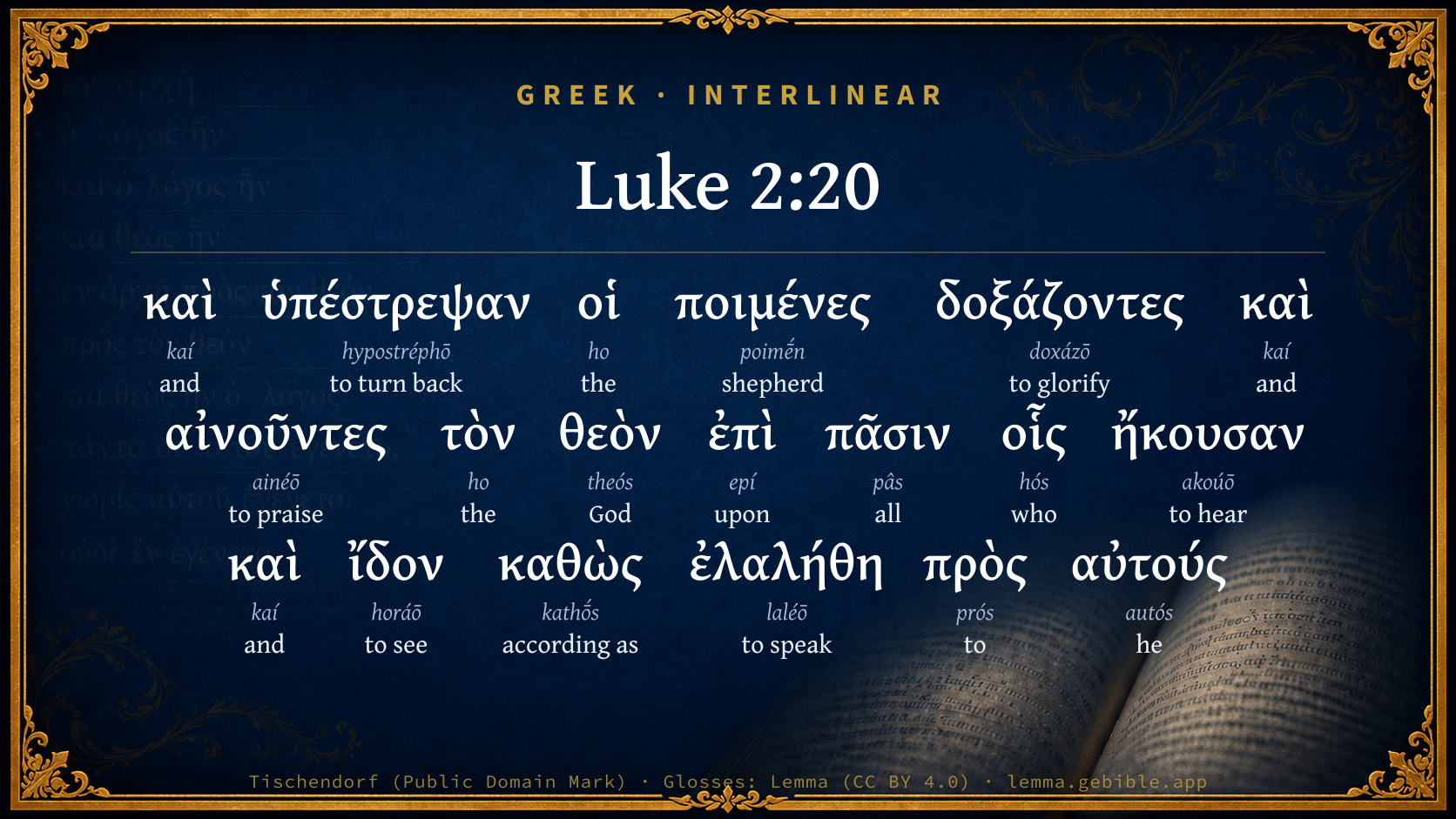
Greek (Tischendorf 8th ed.) Luke 2:20 appears in the Greek New Testament. The text above is from the Tischendorf 8th edition. Each word links to its Strong’s number and a concise gloss. Click any word for its full Thayer’s Greek Lexicon entry.
Download image
Cite this verse

Luke 2:20 (World English Bible). Public Domain. Lemma interlinear Bible study tool, https://lemma.gebible.app/v/luke/2/20.

Show BibTeX & RIS
BibTeX
RIS
English Translation
The shepherds returned, glorifying and praising God for all the things that they had heard and seen, just as it was told them.
World English Bible · Public Domain
Download a study sheet

One document with this verse’s original text, its word-by-word gloss line, the meaning frame, cross-references with their text, attributed commentary, and full source and license credits — printable, and it pastes into notes with its structure intact.

This verse Autodidact and up

Study sheet (.html) Plain text (.txt)

A passage Seminary Student

Up to 50 verses in one chapter. A passage sheet keeps up to 6 commentary sources and 12 cross-references per verse, in the order this page ranks them, and says so on the sheet whenever that leaves anything out. Ask for a single verse and you get the Autodidact verse sheet above.

Everything on this page stays free to read, with no account — the sheet is a download of what is already on screen, not access to it.

Want to remove ads? Support Godless Engineer
Compare translations 3

The same verse in 3 English versions, stacked beneath the original-language interlinear above. Click any original word for its lexicon entry.

Each is an independent rendering of the whole verse — the interlinear is not word-aligned to these translations.

Highlighted words mark where these versions differ — a whole-verse word diff, not a word-by-word alignment.

  • World English Bible Public Domain
    The shepherds returned, glorifying and praising God for all the things that they had heard and seen, just as it was told them.
  • King James Version Public Domain
    And the shepherds returned, glorifying and praising God for all the things that they had heard and seen, as it was told unto them.
  • unfoldingWord Literal Text CC BY-SA 4.0
    And the shepherds returned, glorifying and praising God for everything that they had heard and seen, just as it had been spoken to them.

unfoldingWord Literal Text — © unfoldingWord, licensed CC BY-SA 4.0. Word-aligned USFM3 via Door43 (git.door43.org/unfoldingWord/en_ult).

Versions to compare (up to 4)

3 of 4 selected

Show all 19 translations

Every available English version of this verse, each an independent rendering of the whole verse.

  • World English Bible Public Domain
    The shepherds returned, glorifying and praising God for all the things that they had heard and seen, just as it was told them.
  • Berean Standard Bible Public Domain
    The shepherds returned, glorifying and praising God for all they had heard and seen, which was just as the angel had told them.
  • Majority Standard Bible Public Domain
    The shepherds returned, glorifying and praising God for all they had heard and seen, which was just as the angel had told them.
  • King James Version Public Domain
    And the shepherds returned, glorifying and praising God for all the things that they had heard and seen, as it was told unto them.
  • American Standard Version (1901) Public Domain
    And the shepherds returned, glorifying and praising God for all the things that they had heard and seen, even as it was spoken unto them.
  • Revised Version (1885) Public Domain
    And the shepherds returned, glorifying and praising God for all the things that they had heard and seen, even as it was spoken unto them.
  • Geneva Bible (1599) Public Domain
    And the shepheardes returned glorifiyng and praising God, for all that they had heard and seene as it was spoken vnto them.
  • Douay-Rheims (1899) Public Domain
    And the shepherds returned, glorifying and praising God, for all the things they had heard and seen, as it was told unto them.
  • Young's Literal Translation Public Domain
    and the shepherds turned back, glorifying and praising God, for all those things they heard and saw, as it was spoken unto them.
  • Literal Standard Version CC BY-SA 4.0
    and the shepherds turned back, glorifying and praising God for all those things they heard and saw, as it was spoken to them.
  • Unlocked Literal Bible CC BY-SA 4.0
    The shepherds returned, glorifying and praising God for everything that they had heard and seen, just as it had been spoken to them.
  • unfoldingWord Literal Text CC BY-SA 4.0
    And the shepherds returned, glorifying and praising God for everything that they had heard and seen, just as it had been spoken to them.
  • Darby Bible Public Domain
    And the shepherds returned, glorifying and praising God for all things which they had heard and seen, as it had been said to them.
  • World Messianic Bible Public Domain
    The shepherds returned, glorifying and praising God for all the things that they had heard and seen, just as it was told them.
  • Webster's Bible Public Domain
    And the shepherds returned, glorifying and praising God for all the things that they had heard and seen, as it was told to them.
  • Free Bible Version CC BY-SA 4.0
    The shepherds went back to watching their flocks, glorifying and thanking God for all that they'd heard and seen, for it was just as they'd been told.
  • Bible in Basic English Public Domain
    Then the keepers of the sheep went back, giving glory and praise to God for all the things which had come to their ears and which they had seen, as it had been said to them.
  • Text-Critical English NT CC BY 4.0
    Then the shepherds returned, glorifying and praising God for all the things they had heard and seen, which were just as they had been told.
  • Tyndale New Testament (1534) Public Domain
    And the shepherdes retourned praysinge and laudinge God for all that they had herde and sene evyn as it was told vnto them.

Literal Standard Version (2020), Covenant Press — licensed CC BY-SA 4.0. Text via the HelloAO Bible API (eBible.org). Unlocked Literal Bible (unfoldingWord) — licensed CC BY-SA 4.0. Text via the HelloAO Bible API (eBible.org). unfoldingWord Literal Text — © unfoldingWord, licensed CC BY-SA 4.0. Word-aligned USFM3 via Door43 (git.door43.org/unfoldingWord/en_ult). Free Bible Version, Dr. Jonathan Gallagher — licensed CC BY-SA 4.0. Text via the HelloAO Bible API (eBible.org).

Word by word

More ways to search: Search by grammar → Find every occurrence → Compare this word →

Practice this passage: Drill this verse → Learn its vocabulary →

αἰνοῦντες
ainéō
G134
“to praise”
Verb, Present, Active, Participle, Nominative, Plural, Masculine
Part of Speech
Verb
Tense
Present
Voice
Active
Mood
Participle
Case
Nominative
Number
Plural
Gender
Masculine
Full Thayer's Definition

Origin: from G136

TDNT: 03:57,3

1. to praise, extol, to sing praises in honour to God 2. to allow, recommend 3. to promise or vow
  1. καὶ kaí G2532 “and” Conjunction
  2. ὑπέστρεψαν hypostréphō G5290 “to turn back” Verb, Aorist, Active, Indicative, 3rd person, Plural
  3. οἱ ho G3588 “the” Article, Nominative, Plural, Masculine
  4. ποιμένες poimḗn G4166 “shepherd” Noun, Nominative, Plural, Masculine
  5. δοξάζοντες doxázō G1392 “to glorify” Verb, Present, Active, Participle, Nominative, Plural, Masculine
  6. καὶ kaí G2532 “and” Conjunction
  7. τὸν ho G3588 “the” Article, Accusative, Singular, Masculine
  8. θεὸν theós G2316 “God” Noun, Accusative, Singular, Masculine
  9. ἐπὶ epí G1909 “upon” Preposition
  10. πᾶσιν pâs G3956 “all” Adjective, Dative, Plural, Neuter
  11. οἷς hós G3739 “who” Relative pronoun, Dative, Plural, Neuter
  12. ἤκουσαν akoúō G191 “to hear” Verb, Aorist, Active, Indicative, 3rd person, Plural
  13. καὶ kaí G2532 “and” Conjunction
  14. ἴδον horáō G3708 “to see” Verb, Aorist, Active, Indicative, 3rd person, Plural
  15. καθὼς kathṓs G2531 “according as” Adverb
  16. ἐλαλήθη laléō G2980 “to speak” Verb, Aorist, Passive, Indicative, 3rd person, Singular
  17. πρὸς prós G4314 “to” Preposition
  18. αὐτούς autós G846 “he” Personal pronoun, Accusative, Plural, Masculine

About this verse

These counts appear in no published source. They are computed here, from the morphology-tagged text and Lemma’s own curated glosses. What Lemma adds →

19
words
16
distinct lemmas
Gospels
section

Notable vocabulary

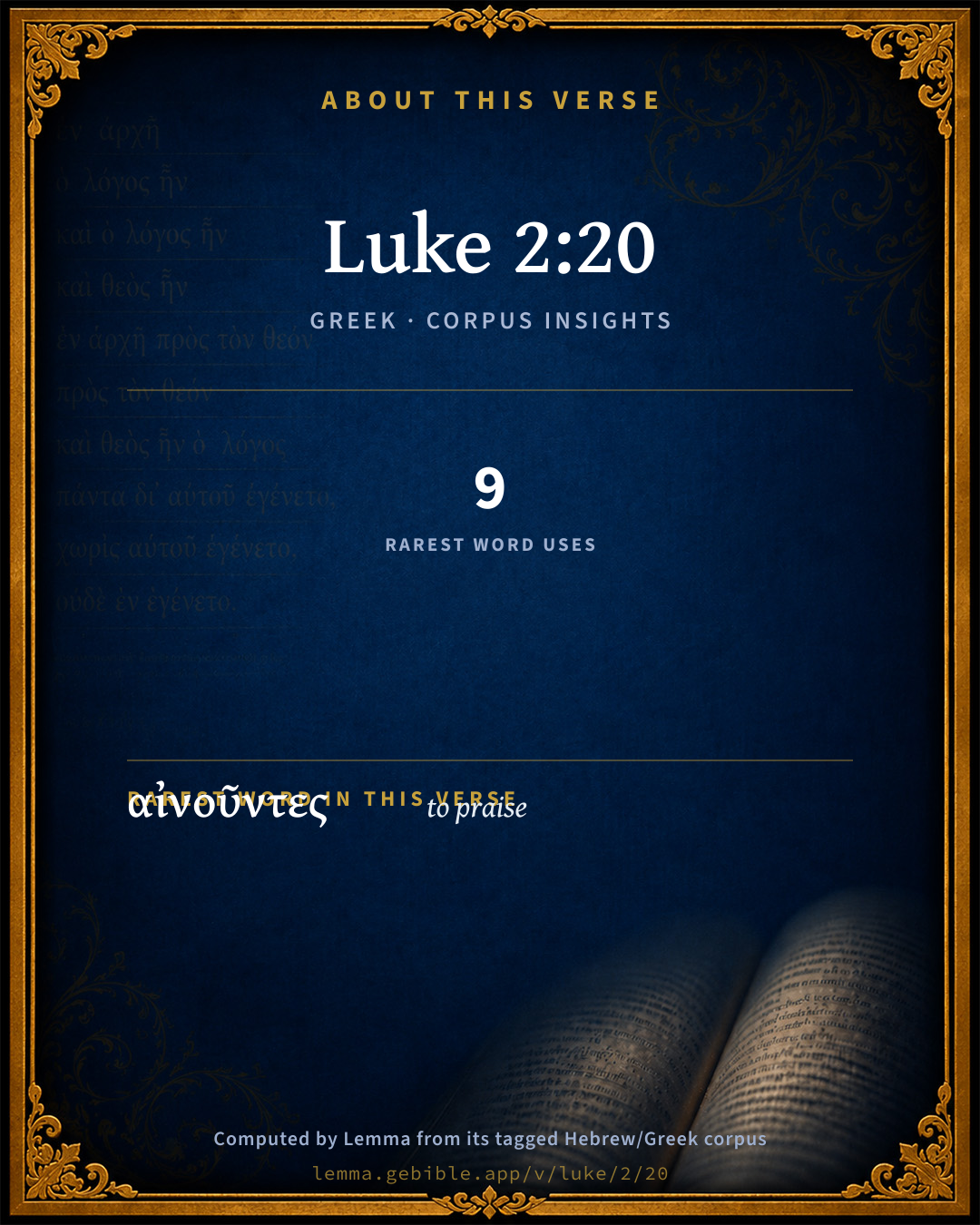
The rarest word here is αἰνοῦντες to praise G134 — appearing just 9 times in the whole Greek New Testament.

Shared distinctive vocabulary

αἰνοῦντες to praise G134 occurs in 9 verses of the Greek New Testament. Also found in:

Repetition

Words recur within this verse:

Cross-references

12

Topical passages linked to Luke 2:20 in the Treasury of Scripture Knowledge — connected by theme and wording, ordered by reader-vote popularity; previews shown in the World English Bible.

  • Psalms 106:48 Blessed be Yahweh, the God of Israel, From everlasting even to everlasting! Let all the people say, "Amen." Praise Yah!
  • 1 Chronicles 29:10–12 Therefore David blessed Yahweh before all the assembly; and David said, You are blessed, Yahweh, the God of Israel our father, forever and ever.
  • Psalms 72:17–19 His name endures forever. His name continues as long as the sun. Men shall be blessed by him. All nations will call him blessed.
  • Isaiah 29:19 The humble also shall increase their joy in Yahweh, and the poor among men shall rejoice in the Holy One of Israel.
  • Acts 11:18 When they heard these things, they held their peace, and glorified God, saying, "Then God has also granted to the Gentiles repentance to life!"
  • Psalms 107:8 Let them praise Yahweh for his loving kindness, For his wonderful works to the children of men!
  • Psalms 107:15 Let them praise Yahweh for his loving kindness, For his wonderful works to the children of men!
  • Psalms 107:21 Let them praise Yahweh for his loving kindness, For his wonderful works to the children of men!
  • Matthew 9:8 But when the multitudes saw it, they marveled and glorified God, who had given such authority to men.
  • Luke 18:43 Immediately he received his sight, and followed him, glorifying God. All the people, when they saw it, praised God.
  • Luke 19:37–38 As he was now getting near, at the descent of the Mount of Olives, the whole multitude of the disciples began to rejoice and praise God with a loud voice for all the mighty works which they had seen,
  • Acts 2:46–47 Day by day, continuing steadfastly with one accord in the temple, and breaking bread at home, they took their food with gladness and singleness of heart,

Cross-references courtesy of OpenBible.info (CC BY 4.0).

Commentary

Notes on Luke 2:20 from classic Christian and Jewish commentators (each source and its license shown beneath its notes). The classic Christian expositions comment on the surrounding passage and are grouped to its opening verse, so a note may address several verses; the Jewish commentaries on the Tanakh (Rashi and others) are per-verse, so they appear only where the commentator wrote on this verse.

Lemma curates 59 commentaries, every one of them public domain or Creative Commons licensed, each selected and text-cleaned for this edition rather than reprinted as found. About our sources →

The Biblical Illustrator

Joseph S. Exell

Luk_2:20

And the shepherds returned

Dignifying common life

And then they returned to their fields, to their flocks, to their ordinary life; giving thus a beautiful example of pious diligence and fidelity in their vocation.

An extraordinary privilege has been granted to them. They are not lifted up by it into pride and pretension and self-sufficiency and idleness. They are cheered by it in their common toil. This is all the gospel that some of them would hear on earth. They would die, probably, as they lived, tending their sheep, before the Good Shepherd openly appeared. In their example, they sanctify, they glorify, what we call common life. They dignify the duty, it may be the drudgery of the day. But what, after all, is common life? It is a relative phrase. Common life to these shepherds is the keeping of the sheep on those very fields where David was shepherd-boy before them, where Ruth gleaned after the reapers. Common life to the angels lies in the heavenly spheres, serving at the bidding of the King. This visit to the earth, on such an errand, is a remarkable exception to their ordinary experience. It is, if we may use the phrase, a point of high romance in their history. (Dr. Raleigh.)

This is how all true-minded, simple-hearted inquirers have returned from their Christian investigations. It is questionable whether any man has ever closed the Bible in a mood of dissatisfaction who opened it with reverent determination to know how far it was a testimony from heaven. Christian investigation is not finished until it has brought into the heart a joy altogether unprecedented. The mere letter never brings gladness. Critics and disputants have found little in the Bible but a great waste of words; but penitent and earnest inquirers have returned from its examination with hearts overflowing with a new and imperishable joy. (J. Parker, D. D.)

Shepherds glorifying God for the birth of a Saviour

We will contemplate the things for which, and the manner in which, they glorified God, and will inter mingle some practical reflections.

I. WE WILL CONSIDER THE MATTERS FOR WHICH THEY GLORIFIED AND PRAISED GOD. These were the things, which they had heard and seen.

1. They glorified God that the promised Saviour was now born. They seem to have been some of those pious people who looked for redemption in Israel.

2. They rejoiced that this Saviour was born for them. The angel says, Unto you is born this day a Saviour. Conscious of their impotence and unworthiness, they felt their need of a Saviour, and esteemed it a matter of great joy that He was come to bring salvation to them. They doubtless admired the distinguishing grace of God in visiting them first of all with the glorious tidings.

3. The shepherds rejoiced that the Saviour was horn for others, as well as themselves. I bring you good tidings, says the angel, which shall be to all people.

4. The shepherds glorified God for what they had seen, as well as what they had heard.

II. CONSIDER THE MANNER IN WHICH THEY GLORIFIED HIM.

1. They glorified God by faith in the Saviour, whom He had sent. They believed the heavenly message. By faith in the Redeemer we give glory to God.

2. They glorified God by a ready obedience. Being informed by a heavenly messenger where the Saviour lay, they came to Him with haste. They made no delay, but immediately obeyed the Divine intimation. Faith operates in a way of cheerful obedience.

3. They glorified God by confessing and spreading the Saviours name. When they had seen Him, they made known abroad what had been told them concerning the Child. They were not ashamed to own Him as the Messiah, even in His infant state. You see that true faith will prompt you to honour Christ before men.

4. They glorified God by an attendance on the means of faith. The angel who announced the Saviours birth gave them a token by which they might know Him. This shall be a sign to you. Ye shall find the babe wrapt in swaddling clothes, lying in a manger. And they came with haste, and found as he had told them. God gave them a particular sign for the confirmation of their faith; and He has appointed standing means to strengthen and enliven ours. Jesus Christ is exhibited to us in His Word, in His sanctuary, and at His table. Here we are to seek Him, and converse with Him, that we may increase our faith and warm our love.

5. They glorified God with the voice of praise. (J. Lathrop, D. D.)

The changed world

The day after Christs birth was a new day in the worlds history. The old era had passed, the new had begun; and only the angels knew what a revolution had been wrought by the quiet power of God. The wonder has grown with the years. Christianity has been an increasing miracle of the Lords presence on earth. That song, which a few shepherds heard, has sung itself into the thought of the world, and is the keynote and harmony of all peace and goodwill on earth.

I. THE CHRISTIAN CHANGE OF THE WORLDS HISTORY IS A FACT. The influx through Christ of a new power into the life of humanity is a known fact of experience, as certain as the battle of Gettysburg, or the dawn of day. This fact of the new power in the world, through the birth of Christ, belongs to a series of facts. The religion of the Bible presents a continued succession, and reveals an exalted order of facts. Christianity is a positive religion of historical facts from Moses to Christ, from Christ to the last Church organized and the last communion table spread.

II. THE NATURE AND REAL SIGNIFICANCE OF THIS FACT.

1. In Christianity we breathe a different air. Midway down the Simplon Pass the traveller pauses to read upon a stone the single word Italia. At this point he passes a boundary live, and every step makes plainer how great has been the change from Switzerland to Italy. The air becomes warm and fragrant, and vines line the wayside, and below, embosomed in verdure, Lake Maggiore expands before him. As that traveller rests at evening-time, he recognizes that the entrance into a new world was marked by the word Italia upon the stone on the pass. Humanity has crossed a boundary line: up to Bethlehem, bleak and cold--down from Bethlehem, another and a happier time.

2. This new transforming power was, to the disciples, Jesus Himself. He made all things new to them.

3. Jesus has been to the world a new revelation of God. God is essentially and eternally Christlike.

4. Jesus is also a new revelation of man. Man is in Christ another man. You pass a man in the streets, and you used to feel that you did not want to know or help such a poor creature--he lived below your world, and his name was not found in your book of life. Now it is different, for you have been baptized into the name of Christ, in whom our whole common humanity exists, redeemed and capable of a great salvation. CONCLUSION: We close by asking ourselves, Am I living, by faith in the Son of God, in this changed world? Is it, in the history of my soul, the day before, or the better day after, Christmas. (Newman Smyth, D. D.)

The Biblical Illustrator, edited by Joseph S. Exell (c. 1880s–1900s) — public domain. Text from a community e-Sword module.

Tyndale Open Study Notes

Tyndale Open Resources

2:20 Glorifying and praising God are major themes throughout Luke’s Gospel (e.g., 1:64; 2:13, 28; 5:25-26; 7:16; 13:13; 17:15, 18; 18:43; 19:37; 23:47; 24:53).

Tyndale Open Study Notes — © Tyndale Open Resources, licensed CC BY-SA 4.0. Text via the HelloAO Bible API.

Bengel's Gnomon

Johann Albrecht Bengel

Luk 2:20. Ἤκουσαν, they heard) from Mary.—καθὼς, even as) What had been said and what they saw and heard tallied together.—ἐλαλήθη, it was told) by the angels.

Bengel's Gnomon of the New Testament — English translation (T&T Clark, Edinburgh, 1860) — public domain. Text from a community e-Sword module.

Jamieson, Fausset & Brown

Robert Jamieson, A. R. Fausset & David Brown

glorifying and praising God, &c.--The latter word, used of the song of the angels (Luk 2:13), and in Luk 19:37, and Luk 24:53, leads us to suppose that theirs was a song too, probably some canticle from the Psalter--meet vehicle for the swelling emotions of their simple hearts at what "they had heard and seen."

Jamieson, Fausset & Brown — Commentary Critical and Explanatory on the Whole Bible (1871) — public domain (CC PDM 1.0). Text via the HelloAO Bible API.

Adam Clarke's Commentary

Verse 20. The shepherds returned, glorifying and praising] These simple men, having satisfactory evidence of the truth of the good tidings, and feeling a Divine influence upon their own minds, returned to the care of their flocks, glorifying God for what he had shown them, and for the blessedness which they felt. "Jesus Christ, born of a woman, laid in a stable, proclaimed and ministered to by the heavenly host, should be a subject of frequent contemplation to the pastors of his Church. After having compared the predictions of the prophets with the facts stated in the evangelic history, their own souls being hereby confirmed in these sacred truths, they will return to their flocks, glorifying and praising God for what they had seen and heard in the Gospel history, just as it had been told them in the writings of the prophets; and, preaching these mysteries with the fullest conviction of their truth, they become instruments in the hands of God of begetting the same faith in their hearers; and thus the glory of God and the happiness of his people are both promoted." What subjects for contemplation! - what matter for praise!

Adam Clarke's Commentary on the Bible (1810–1826) — public domain. Text from a community e-Sword/MySword module.

John Gill's Exposition

And the shepherds returned,.... From Bethlehem, to the fields, and to their flock there,

glorifying and praising God for all the things that they had heard; from Joseph and Mary:

and seen; as the babe lying in the manger:

as it was told unto them; by the angel: they glorified God on account of the birth of the Messiah; and praised him, wondering at his grace, and the high honour put upon them, that they should be acquainted with it; and that there was such an exact agreement between the things they had seen, and the angel's account of them.

John Gill's Exposition of the Whole Bible (1746–1763) — public domain (CC PDM 1.0). Text via the HelloAO Bible API.

Trapp's Complete Commentary

John Trapp

20 And the shepherds returned, glorifying and praising God for all the things that they had heard and seen, as it was told unto them.

Ver. 20. As it was told unto them] God, to show that he respected not persons, revealed this grand mystery to shepherds and wise men; the one poor, the other rich; the one learned, the other unlearned; the one Jews, the other Gentiles; the one near, the other far off.

John Trapp, A Commentary or Exposition upon All the Books of the Old and New Testament (1647–1656) — public domain. Text from a community e-Sword module.

Albert Barnes' Notes on the Bible

The shepherds returned - To their flocks.

Glorifying ... - Giving honor to God, and celebrating his praises.

Albert Barnes' Notes on the Bible (1834–1885) — public domain. Text from a community e-Sword/MySword module.

Whedon's Commentary on the Bible

Daniel D. Whedon

20. Glorifying and praising God—This conduct on the part of the returning shepherds indicates that the supposition is true that they piously waited for the hope of Israel, the Messiah.

CHRISTMAS, the NATIVITY, the anniversary of our Saviour’s birth, has been for ages celebrated by all Christendom upon the 25th of December. The accuracy of this date is a matter of interesting inquiry.

1. Upon grounds of tradition the authority for it is very slight. The Eastern Church, within whose bosom the locality of that sacred birth is centrally included, knew nothing of the date for centuries, and really celebrated the Lord’s birth on the 6th of January, the day of the Epiphany. (See note on Luk_3:22.) The fixing of the day of Christmas was really done at Rome, and was transmitted from thence over the Eastern Church. The authority for the selection of that day was the government record of the taxing, or census of Cyrenius, said to be in the imperial archives at Rome. But the authenticity of these records is too untenable to allow any weight to the argument.

2. Probably a main argument with the ancient Church for the nativity in December was based upon the assumption that Zacharias was high priest, and that the annunciation was made to him on the great day of atonement, which was in September. For, reckoning from September, nine months would bring us to the birth of John in June; and Jesus, being six months younger than John, (in all fifteen months,) must have been born in December. But the supposition that Zacharias was high priest is now by all admitted to be baseless.

3. But, after all that has been said, the negative argument drawn from the climate is unanswered. Mr. Andrews does indeed show from Barclay and others that there are often periods about Christmas which are the loveliest in the whole year. But Mr. Barclay’s meteorological tables show the average in inches of rain-fall through seven years to be as follows: November, 2 inches; December, 14; January, 13; February, 16; March, 8; April, 1; and May, 1. Average range of the thermometer through five years, November, 67; December, 53.3; January, 49.6; February, 52.1. So that December is within a trifle of being the severest month of the year.

4. But it must be specially noted that the strongest negative argument is not drawn from the flocks in the field. The gravelling question is this: Would the government select midwinter for a registration of all Palestine, including northern Galilee as well as southern Judea, which would compel a general journeying of the inhabitants often from nearly one end to the other? Let any one read Dr. Thomson’s account of a winter travel in Palestine, vol. i, pp. 329-332, and he will perhaps shudder to send the virgin from Nazareth to Bethlehem in December. Our own conclusion is, that the fixing the birth of Christ in December is unsustained by tradition and invalidated from Scripture.

Daniel D. Whedon (gen. ed.), Commentary on the Old and New Testaments (1874–1909) — public domain. Text from a community e-Sword module.

John Wesley's Explanatory Notes

For all the things that they had heard - From Mary; as it was told them - By the angels.

John Wesley, Explanatory Notes Upon the Whole Bible (1754–1765) — public domain. Text via the GEBible commentary corpus.

Cambridge Greek Testament for Schools and Colleges

20. δοξάζοντες καὶ αἰνοῦντες. Glorifying God for the greatness of the event, and praising Him for its mercy (Godet).

Cambridge Greek Testament for Schools and Colleges (Cambridge University Press, 1896; 21 vols, various authors incl. Carr, Maclear, Plummer, Farrar, Lumby, Moule, M. R. James, Simcox) — public domain. Text from a community e-Sword module.

International Critical Commentary

20. δοξάζοντες καὶ αἰνοῦντες. The latter is the more definite word. The former is one of the many words which have acquired a deeper meaning in bibl. Grk. Just as δόξα in bibl. Grk. never (except 4Ma. 5:18) has the class. meaning of “opinion,” but rather “praise” or “glory,” so δοξάζω in bibl. Grk. never means “form an opinion about,” but “praise” or “glorify.” It is used of the honour done by man to man (1Sa 15:30), by man to God (Exo 15:2), and by God to man (Psa 91:15). It is also used of God glorifying Christ (Act 3:13), a use specially common in Jn. (8:54, 11:4, etc.), and of Christ gloryfying God (17:4). See on Rom 1:21. For the combination comp. αἰνετὸν καὶ δεδοξασμένον (Dan 3:26, 55). For αἰνεῖν see on ver. 13.

πᾶσιν οἷς. For the attraction see on 3:19. If ἤκουσαν refers to the angelic announcement, then καθώς refers to εἶδον only. But ἤκουσαν καὶ εἶδον may sum up their experiences at Bethlehem, which were a full confirmation (καθώς = “even as, just as”) of what the Angel had said. Syr-Sin. Omits καὶ αἰνοῦντες and πᾶσιν.

Schleiermacher points out that, if this narrative had been a mere poetical composition, we should have had the hymn of the shepherds recorded and more extensive hymns assigned to the Angels (S. Luke, Eng. tr. p. 31). He regards the shepherds as the probable source of the narrative; “for that which to them was most material and obvious the nocturnal vision in the fields, is the only circumstance treated in detail” (p. 33). But any narrator would give the vision, and could hardly give it more briefly without material loss. The brevity of it, especially when contrasted with the apocryphal gospels, is strong guarantee for its truth. How tempting to describe the search for the Babe and the conversation between the parents and the shepherds! Of the myth-hypothesis Weiss rightly says that “it labours in vain to explain the part played here by the shepherds by means of the pastoral tales of the ancients, and is driven to drag in, awkwardly enough, the legends of Cyrus and Romulus” (Leben Jesu, i. 2, 4, note, Eng. tr. p. 255). As for the old rationalism, which explained the angelic vision by ignis fatuus or other phosphoric phenomena, which travellers have said to be common in those parts; “the more frequent such phenomena, the more familiar must shepherds above all men, accustomed to pass their nights the whole summer long in the open air, have been with them, and the less likely to consider them as a sign from heaven pointing at a particular event” (Schleierm. p. 36)

International Critical Commentary — older volumes (1896–1929), various authors — public domain. Text from a community e-Sword module.

Lesson kit

Teaching starters — assembled from the data on this page, not authored interpretation. Every prompt links to the verse data it draws on. Edit before teaching.

Luke, in the Gospels, opens this verse with 19 words (16 distinct Greek lemmas). Its most distinctive word is ainéō (“to praise”). A historical commentator’s framing appears above. Read the whole chapter for the surrounding context.

Discussion questions

  1. The word ainéō carries the sense “to praise.” How does it shape the verse?
  2. How does Luke 2:13, which shares the word «to praise», read alongside this verse?
  3. What does the repetition of “and” (3× in this one verse) do in this verse?
  4. The translations on this page render this verse differently — a whole-verse word diff, not a word-by-word alignment. What might account for the different wordings?
  5. Compare how The Biblical Illustrator and Tyndale Open Study Notes read this verse. Where do they agree or differ?

Things to notice

Reading settings

Reading text

Shown beneath each verse's original-language words.

Old Testament
Old Testament edition

Read the OT as the Masoretic Hebrew (MT) or the Greek Septuagint (LXX).

English shown for the Greek Septuagint (in the Hebrew ↔ Greek comparison).

Comparing translations? Open the Compare panel on any verse page to stack up to four side by side.