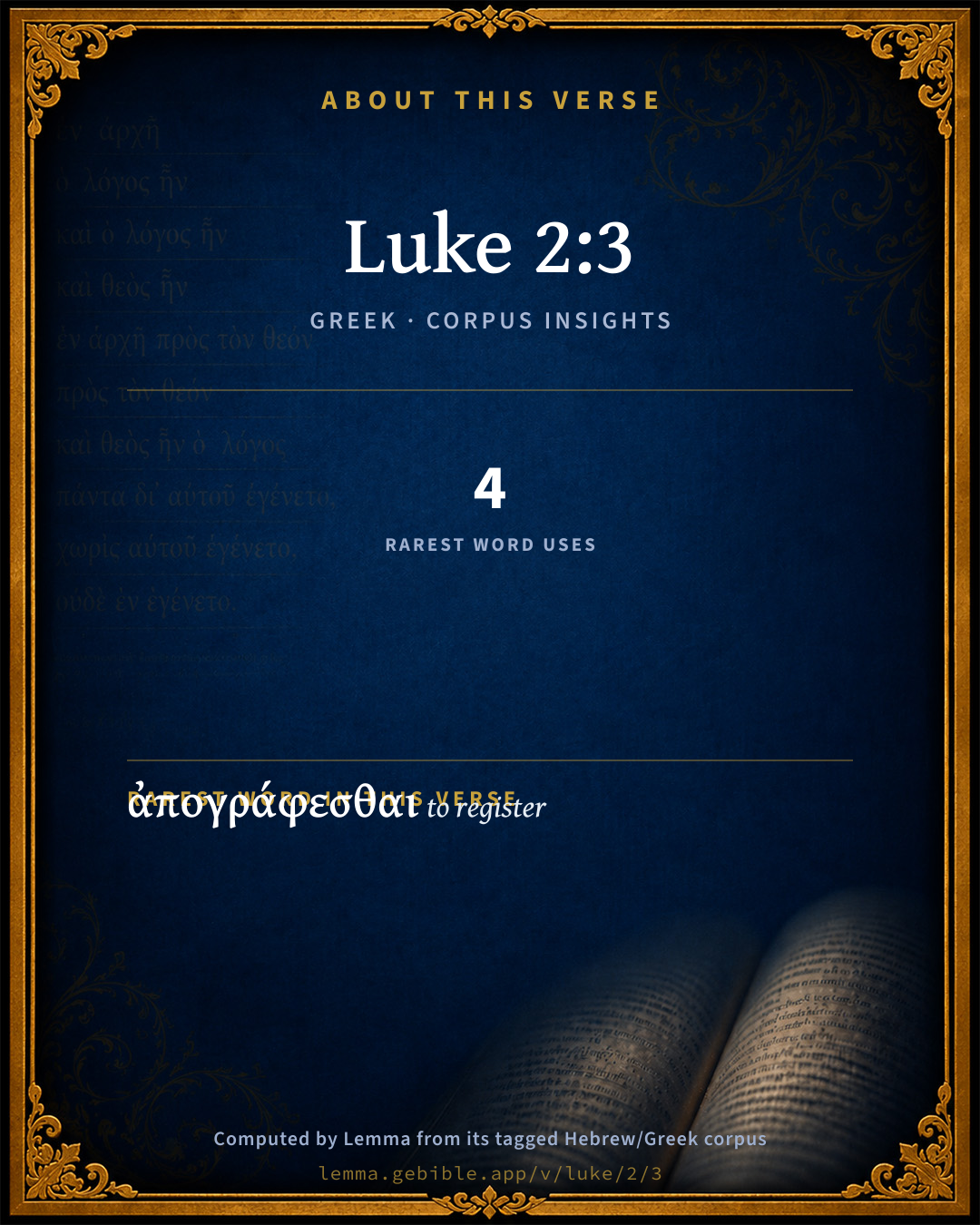
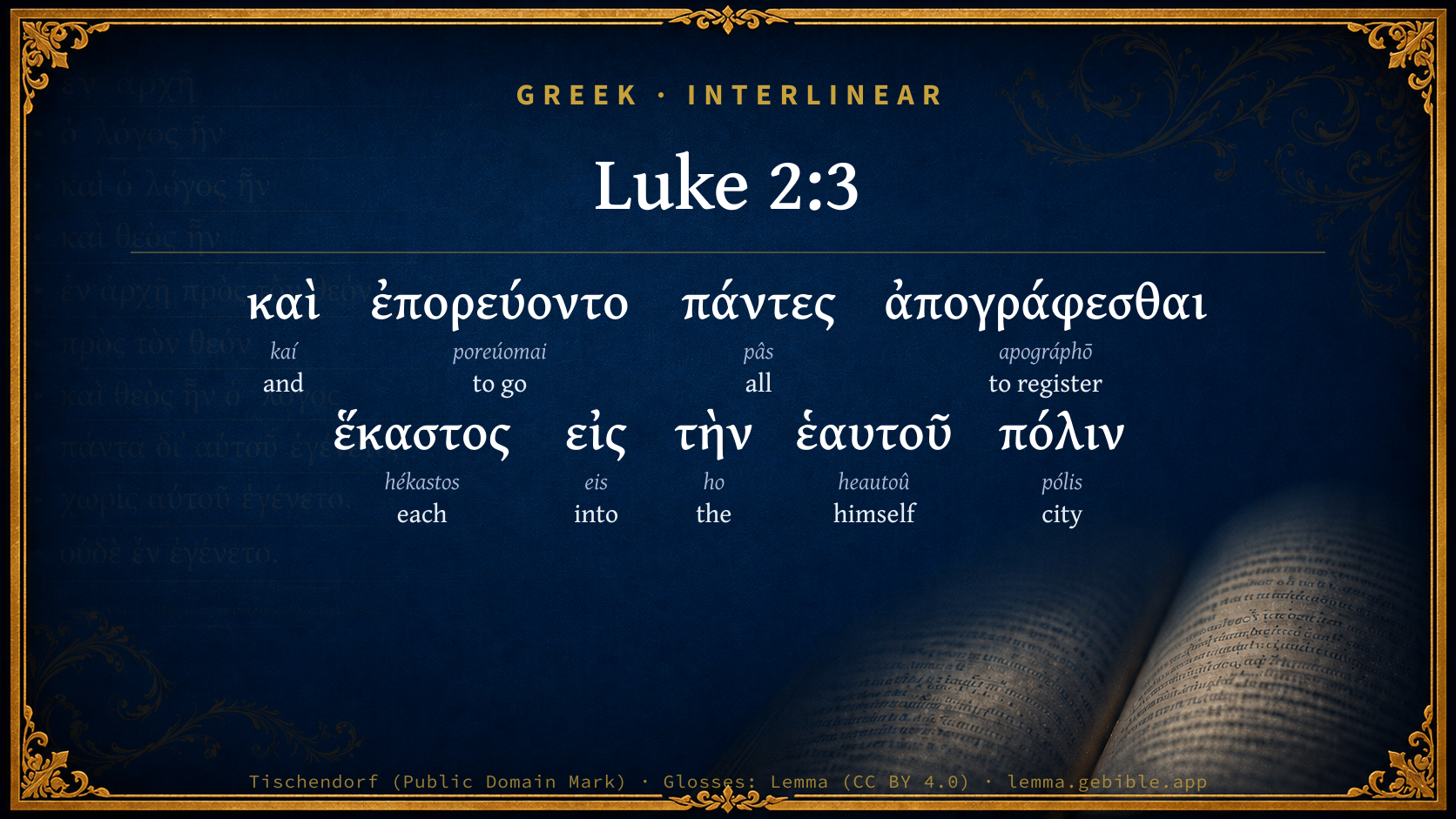
Luke 2:3

Greek (Tischendorf 8th ed.) Luke 2:3 appears in the Greek New Testament. The text above is from the Tischendorf 8th edition. Each word links to its Strong’s number and a concise gloss. Click any word for its full Thayer’s Greek Lexicon entry.
Download image
Cite this verse

Luke 2:3 (World English Bible). Public Domain. Lemma interlinear Bible study tool, https://lemma.gebible.app/v/luke/2/3.

Show BibTeX & RIS
BibTeX
RIS
English Translation
All went to enroll themselves, everyone to his own city.
World English Bible · Public Domain
Download a study sheet

One document with this verse’s original text, its word-by-word gloss line, the meaning frame, cross-references with their text, attributed commentary, and full source and license credits — printable, and it pastes into notes with its structure intact.

This verse Autodidact and up

Study sheet (.html) Plain text (.txt)

A passage Seminary Student

Up to 50 verses in one chapter. A passage sheet keeps up to 6 commentary sources and 12 cross-references per verse, in the order this page ranks them, and says so on the sheet whenever that leaves anything out. Ask for a single verse and you get the Autodidact verse sheet above.

Everything on this page stays free to read, with no account — the sheet is a download of what is already on screen, not access to it.

Want to remove ads? Support Godless Engineer
Compare translations 3

The same verse in 3 English versions, stacked beneath the original-language interlinear above. Click any original word for its lexicon entry.

Each is an independent rendering of the whole verse — the interlinear is not word-aligned to these translations.

Highlighted words mark where these versions differ — a whole-verse word diff, not a word-by-word alignment.

  • World English Bible Public Domain
    All went to enroll themselves, everyone to his own city.
  • King James Version Public Domain
    And all went to be taxed, every one into his own city.
  • unfoldingWord Literal Text CC BY-SA 4.0
    And everyone was traveling to register himself, each one to his own city.

unfoldingWord Literal Text — © unfoldingWord, licensed CC BY-SA 4.0. Word-aligned USFM3 via Door43 (git.door43.org/unfoldingWord/en_ult).

Versions to compare (up to 4)

3 of 4 selected

Show all 19 translations

Every available English version of this verse, each an independent rendering of the whole verse.

  • World English Bible Public Domain
    All went to enroll themselves, everyone to his own city.
  • Berean Standard Bible Public Domain
    And everyone went to his own town to register.
  • Majority Standard Bible Public Domain
    And everyone went to his own town to register.
  • King James Version Public Domain
    And all went to be taxed, every one into his own city.
  • American Standard Version (1901) Public Domain
    And all went to enrol themselves, every one to his own city.
  • Revised Version (1885) Public Domain
    And all went to enroll themselves, every one to his own city.
  • Geneva Bible (1599) Public Domain
    Therefore went all to be taxed, euery man to his owne Citie.
  • Douay-Rheims (1899) Public Domain
    And all went to be enrolled, every one into his own city.
  • Young's Literal Translation Public Domain
    and all were going to be enrolled, each to his proper city,
  • Literal Standard Version CC BY-SA 4.0
    and all were going to be registered, each to his proper city,
  • Unlocked Literal Bible CC BY-SA 4.0
    So everyone went to his own city to be registered for the census.
  • unfoldingWord Literal Text CC BY-SA 4.0
    And everyone was traveling to register himself, each one to his own city.
  • Darby Bible Public Domain
    And all went to be inscribed in the census roll, each to his own city:
  • World Messianic Bible Public Domain
    All went to enroll themselves, everyone to his own city.
  • Webster's Bible Public Domain
    And all went to be taxed, every one into his own city.
  • Free Bible Version CC BY-SA 4.0
    So everybody went to their own city to be registered.
  • Bible in Basic English Public Domain
    And all men went to be numbered, everyone to his town.
  • Text-Critical English NT CC BY 4.0
    So everyone went to be registered, each to his own town.
  • Tyndale New Testament (1534) Public Domain
    And every man went vnto his awne citie to be taxed.

Literal Standard Version (2020), Covenant Press — licensed CC BY-SA 4.0. Text via the HelloAO Bible API (eBible.org). Unlocked Literal Bible (unfoldingWord) — licensed CC BY-SA 4.0. Text via the HelloAO Bible API (eBible.org). unfoldingWord Literal Text — © unfoldingWord, licensed CC BY-SA 4.0. Word-aligned USFM3 via Door43 (git.door43.org/unfoldingWord/en_ult). Free Bible Version, Dr. Jonathan Gallagher — licensed CC BY-SA 4.0. Text via the HelloAO Bible API (eBible.org).

Word by word

More ways to search: Search by grammar → Find every occurrence → Compare this word →

Practice this passage: Drill this verse → Learn its vocabulary →

About this verse

These counts appear in no published source. They are computed here, from the morphology-tagged text and Lemma’s own curated glosses. What Lemma adds →

9
words
9
distinct lemmas
Gospels
section

Notable vocabulary

The rarest word here is ἀπογράφεσθαι to register G583 — appearing just 4 times in the whole Greek New Testament.

Shared distinctive vocabulary

ἀπογράφεσθαι to register G583 occurs in 4 verses of the Greek New Testament. Also found in:

Commentary

Notes on Luke 2:3 from classic Christian and Jewish commentators (each source and its license shown beneath its notes). The classic Christian expositions comment on the surrounding passage and are grouped to its opening verse, so a note may address several verses; the Jewish commentaries on the Tanakh (Rashi and others) are per-verse, so they appear only where the commentator wrote on this verse.

Lemma curates 59 commentaries, every one of them public domain or Creative Commons licensed, each selected and text-cleaned for this edition rather than reprinted as found. About our sources →

Joseph Benson's Commentary

Luk 2:3. And all went to be taxed, (enrolled,) every one to his city — “When the census was made in any country, the inhabitants were obliged to attend in the cities to which they belonged, Livy, 50. 42. c. 10. The reason was, without a precaution of this kind, the census would have been excessively tedious, and people who were abroad might have been omitted, or registered among the inhabitants of other cities, where they would not have been found afterward, or they might have been enrolled twice, which would have produced confusion in the registers.” In the dominions of Herod, however, probably by his order, a small alteration seems to have been made in the method of executing the census. For instead of the people being directed to appear, as usual, in the cities where they resided, or to whose jurisdiction the places of their abode belonged, they were ordered to appeal according to their families; every one in his native city, or the place where his paternal inheritance lay, to be there enrolled; a circumstance wisely ordered by Providence to verify the truth of ancient prophecies; for thus the parents of Christ were providentiatly brought to Bethlehem, the place where the Messiah was to be born, without leaving any room to suspect them of artifice and design. And thus, also, by their coming to be registered among the subjects of the Roman empire, the subjection of the Jews to the Romans was very remarkably manifested.

Joseph Benson's Commentary on the Old and New Testaments (1811–1818) — public domain. Text from a community e-Sword module.

Tyndale Open Study Notes

Tyndale Open Resources

2:3-4 Since Joseph was a descendant of King David, he returned to David’s hometown of Bethlehem (1 Sam 17:12, 58; 20:6), a tiny village in Judea five miles south of Jerusalem, where Mic 5:2 predicted that the Messiah would be born.

Tyndale Open Study Notes — © Tyndale Open Resources, licensed CC BY-SA 4.0. Text via the HelloAO Bible API.

Bengel's Gnomon

Johann Albrecht Bengel

Luk 2:3. Εἰς τὴν ἰδίαν πόλιν, into his own city) Joseph seems to have left Bethlehem only a short while before.

Bengel's Gnomon of the New Testament — English translation (T&T Clark, Edinburgh, 1860) — public domain. Text from a community e-Sword module.

Meyer's Critical & Exegetical Commentary

Heinrich August Wilhelm Meyer

Luk_2:3 ff. Πάντες] in the Jewish land, for which Luk_2:2 has prepared, and see Luk_2:4. Obviously only all those are meant, who did not dwell in their ἰδία πόλις; ἕκαστος is a distributive apposition (Ameis on Homer, Od. x. 397).

εἰς τ. ἰδίαν πόλιν] the more precise definition is furnished by Luk_2:4. This statement, too, does not suit a census proper; for to this every one was required to subject himself at his dwelling place, or at the place where he had his forum originis (see Huschke, p. 116 ff.), whereas in our passage the Jewish principle of tribe is the basis. And if the matter were not a census, but a mere registration (see above), there was no reason for departing from the time-hallowed division of the people, or for not having the matter carried out in Jewish form. The actual historical state of the case shines here through the traditional dress of a census.

πόλιν Δαυ.] The city where David was born, 1Sa_17:11.

Βεθλεέμ] see on Mat_2:1.

ἐξ οἴκου κ. πατριᾶς Δαυ.] The tribes proceeding from the sons of Jacob were called φυλαί (מַטּו̇ת); the branches proceeding from the sons of these patriarchs, πατριαί (מִשְׁפְּהו̇ת); the single families of such a tribal branch, οἶκοι (בֵּיח אָבו̇ח). See Kypke, I. p. 213; Winer, Realwörterb. s.v. Stämme; Gesenius, Thes. I. p. 193, III. p. 1463. Joseph was thus of the family descending from David, and belonged to the same branch of the tribe to which David bad belonged. A circumstantial designation of this important relationship. As to πατριά, moreover, see on Eph_3:15.

σὺν Μαριάμ] does not belong to ἀνέβη (Paulus, Hofmann, Ebrard), but to ἀπογράψ. beside which it stands: in order to have himself enrolled with Mary, etc. But that Mary had of necessity to share the journey with him (which was not requisite in the case of a census, when only the names of the women and children had to be specified, Dion. Hal. iv. 14; see Strauss, I. p. 235, and Huschke, p. 121, in opposition to Tholuck, p. 191) is the less to be supposed, as in the main the form of the execution of the ἀπογραφή was the Jewish one, Luk_2:3. Nevertheless, wives (in this case Mary as one betrothed, who according to Jewish law was placed on the same footing as the wife) had to be likewise entered in the register, which must have been a matter of Roman enactment, but for which it was not necessary that they should come personally with their husbands to the spot. We have consequently to abide by the view that Mary undertook the journey with her husband voluntarily, according to her own and Josephs wish, in order to remain under the protection of her betrothed (not exactly on account of the troublous times,an idea which Ebrard imports). There are various arbitrary hypotheses, such as: that she travelled with him on account of the poll-tax (Huschke); that she wished still as a maiden to represent her fathers house, and longed after Bethlehem in the theocratic feeling of maternity (Lange); that the command for the taxing extended also to the children and contained a definite point of time, just about which Mary expected her delivery (von Gumpach). And the hypothesis that Mary was an heiress, who had an estate in Bethlehem (Michaelis, Kuinoel, Olshausen; with hesitation Bleek and Köhler), is utterly unfounded as regards Luke in particular, since he has not the smallest trace of any earlier connection with Bethlehem and makes Mary in her travail not find even friendly lodging there.

τῇ ἐμνηστ. αὐτῷ] Thus, according to Luke, she was still only his betrothed (Luk_1:27; Mat_1:18), and the marriage was not yet completed. At variance with Mat_1:24. A different form assumed by the tradition of the virgin birth. Evasive suggestions are resorted to by Beza, Grotius, and others, including Schegg and Bisping (that Luke expresses himself thus, because Joseph had only conducted himself as one betrothed towards Mary).

οὔσῃ ἐγκύῳ] not: because she was pregnant (von Gumpach), but: who was pregnant (Act_24:24; Rom_1:16, and frequently). The observation forms the transition to what follows.

REMARK.

From Marys sharing in the journey we are not to conclude that she likewise was of the family of David (Grotius, Kuinoel, and others). She journeyed voluntarily with Joseph as his future wife, and Joseph journeyed as a member of the house of David. If Luke had had in his mind the thought that Mary shared the journey as a descendant of David, he must have written, and that at the end of Luk_2:5, διὰ τὸ εἶναι αὐτους κ.τ.λ. But comp. on Luk_1:36, and on Mat_1:17, Remark 2.

Meyer — Critical and Exegetical Commentary on the New Testament — English translation by Peter Christie, edited by Frederick Crombie (T&T Clark, 1880) — public domain. Text from a community e-Sword module.

Expositor's Greek Testament

ed. W. Robertson Nicoll

Luk 2:3 . πάντες : not all throughout the world, but all in Palestine the execution of the decree there being what the evangelist is interested in. εἰς τὴν ἰδίαν πόλιν (or ἑαυτοῦ π ., W.H [22] ). Does this mean to the city of his people, or to the city of his abode? If the former, what a stir in Palestine, or in the world if πάντες be taken widely! A regular “Völkerwanderung” (Holtzmann in H. C.). Sensible of this, some (Hahn, e.g. ) take the reference to be to the place of residence (Wohnort not Stammort), implying that Bethlehem was for Lk. as for Mt. Joseph’s home, and that they merely happened to have been living in Nazareth just before. But Luk 2:7 implies that Joseph and Mary had no house in Bethlehem. Feine quotes, with a certain amount of approval, the view of Schneller ( Kennst du das Land ) that Joseph was not a carpenter but a mason, and that Bethlehem was therefore his natural home, being the headquarters of that craft then as now. On this view, Joseph had simply been in Nazareth building a house, not at home, but away from home for a time as an artisan.

[22] Westcott and Hort.

The Expositor's Greek Testament, edited by W. Robertson Nicoll (1897–1910) — public domain. Text from a community e-Sword module.

Jamieson, Fausset & Brown

Robert Jamieson, A. R. Fausset & David Brown

went . . . to his own city--the city of his extraction, according to the Jewish custom, not of his abode, which was the usual Roman method.

Jamieson, Fausset & Brown — Commentary Critical and Explanatory on the Whole Bible (1871) — public domain (CC PDM 1.0). Text via the HelloAO Bible API.

Adam Clarke's Commentary

Verse 3. And all went to be taxed, every one into his own city.] The Roman census was an institution of Servius Tullius, sixth king of Rome. From the account which Dionysius of Halicarnassus gives of it; we may at once see its nature.

"He ordered all the citizens of Rome to register their estates according to their value in money, taking an oath, in a form he prescribed, to deliver a faithful account according to the best of their knowledge, specifying the names of their parents, their own age, the names of their wives and children, adding also what quarter of the city, or what town in the country, they lived in." Ant. Rom. l. iv. c. 15. p. 212. Edit. Huds.

A Roman census appears to have consisted of these two parts:

1. The account which the people were obliged to give in of their names, quality, employments, wives, children, servants, and estates; and

2. The value set upon the estates by the censors, and the proportion in which they adjudged them to contribute to the defence and support of the state, either in men or money, or both: and this seems to have been the design of the census or enrolment in the text. This census was probably similar to that made in England in the reign of William the Conqueror, which is contained in what is termed Domesday Book, now in the Chapter House, Westminster, and dated 1086.

Adam Clarke's Commentary on the Bible (1810–1826) — public domain. Text from a community e-Sword/MySword module.

Ellicott's Commentary for English Readers

(3) All went to be taxed.—As a rule the practice in a Roman census was to register people in their place of residence; but this was probably modified in Palestine, in deference to the feelings of the people. After the death of Herod and the division of his kingdom, such a method as that implied hero could hardly have been feasible, as the subjects of one tetrarchy would not have been registered as belonging to another, so that here again we have not an error, but a special note of accuracy.

A Bible Commentary for English Readers, edited by Charles John Ellicott (1878–1897) — public domain. Text from a community e-Sword module.

The Cambridge Bible for Schools and Colleges

gen. ed. J. J. S. Perowne

3. every one into his own city] This method of enrolment was a concession to Jewish prejudices. The Roman method was to enrol each person at his own place of residence. Incidentally this unexplained notice proves that St Luke is dealing with an historical enrolment.

The Cambridge Bible for Schools and Colleges (gen. ed. J. J. S. Perowne; Cambridge University Press, 1878–1918) — public domain. Text from a community e-Sword module.

John Gill's Exposition

And all went to be taxed,.... Throughout Judea, Galilee, and Syria; men, women, and children,

every one into his own city; where he was born, and had any estate, and to which he belonged.

John Gill's Exposition of the Whole Bible (1746–1763) — public domain (CC PDM 1.0). Text via the HelloAO Bible API.

Trapp's Complete Commentary

John Trapp

3 And all went to be taxed, every one into his own city.

Ver. 3. And all went to be taxed] To pay a certain small sum of money in token of fidelity. I was once at a court sermon (saith Melancthon) on the Nativity day, and this was the text: but the preacher, instead of discoursing on Christ’s incarnation, spent the whole hour, on a very cold day, in persuading the people to obey magistrates, and to give them as much money as they call for. This is the guise of court parasites, princes, trencher flies.

John Trapp, A Commentary or Exposition upon All the Books of the Old and New Testament (1647–1656) — public domain. Text from a community e-Sword module.

Haydock's Catholic Bible Commentary

Into his own city, i.e. the city of every one’s family. Now Joseph and Mary, being both of the family of David, were obliged to go to Bethlehem, the city of David, where by Providence, according to the predictions of the prophets, the Messias was to be born. (Witham) --- This decree took place by a special providence of the Almighty, that every one might be compelled to go to his own country; and that thereby the Saviour of Israel might more easily escape the snares of the treacherous Herod. (Ven. Bede) --- This circumstance, moreover, was a public testimony, to be kept in the archives of the country, of the birth and descent of the Messias. Augustus only meant to enumerate his subjects, but among them was numbered his God.

George Leo Haydock (1774–1849), Haydock's Catholic Family Bible and Commentary, 1859 edition — public domain. Excludes Psalms (Douay-Rheims chapter numbering differs from Protestant) and Deuterocanonical books (Catholic canon only).

Whedon's Commentary on the Bible

Daniel D. Whedon

3. Every one into his own city—The census in Judea was doubtless conducted in Jewish modes. The enrolment must be made at the place of the lineage of the head of the family. Mary goes probably under the protection of her husband in her present condition. The journey from Nazareth to Bethlehem is about sixty miles.

Daniel D. Whedon (gen. ed.), Commentary on the Old and New Testaments (1874–1909) — public domain. Text from a community e-Sword module.

Kretzmann's Popular Commentary

Paul E. Kretzmann

v. 3. And all went to "be taxed, every one into his own city.

v. 4. And Joseph also went up from Galilee, out of the city of Nazareth, into Judea, unto the city of David, which is called Bethlehem;

(because he was of the house and lineage of David:)

v. 5. to be taxed with Mary, his espoused wife, being great with child.

All the statements of the evangelist are made with such obvious care and accuracy that there is no reason to doubt his record, aside from the fact that the inspiration makes the text correct. It happened, came about, in those days, the days of Herod the Great, king of Judea. There went out an order from the Emperor Augustus, who reigned from 30 B. C. to 14 A. D. , that the entire world, the whole Roman Empire under his jurisdiction, which practically comprised the entire known world, should be entered into lists, all the people that belonged to the empire were to be registered, probably for the purpose of taxation, or for general statistical objects. Censuses of this kind were often taken in those days, in individual countries and provinces as often as once a year. The census here referred to was an unusual one, since it extended over the entire empire, over kingdoms as well as provinces. The time is fixed still more exactly by the statement that this enrollment was made, was actually executed, as a first one of its kind, when Cyrenius or Quirinius was governor of Syria, a Roman province, to which Judea belonged after the death of Archelaus. When the order was posted or proclaimed in Palestine that all people should be registered in the manner prescribed in the decree of Caesar, the inhabitants prepared to carry out the command. They went, everyone to his own city, to the city from which his forefathers hailed. Among those that made ready for the registration was also Joseph, of the city of Nazareth in Galilee.

Since he was of the house and family of David, the great king of Israel, he made the journey over the hills up to the city of David, which is called Bethlehem. And he did not go alone. Sometime before, he had celebrated his marriage with Mary, a virgin of the same city of Nazareth, to whom he had been betrothed. She is here, with great exactness, called his betrothed wife, for though the wedding has been celebrated, the consummation of marriage has not taken place, Mat 1:24-25. Mary was about to become a mother, but the order of the emperor had to be carried out, and therefore they risked the journey to Bethlehem. Note: According to the prophecy of Hag 2:6-7, all the nations were to be shaken when the Desire of the world was to be born. And the decree of Augustus had to be formulated so that both Joseph and Mary were present in Bethlehem at this time, since the Messiah was to be born in Bethlehem, Mic 5:2. A fitting name for the birthplace of the Redeemer, Bethlehem, the house of bread, since the Bread of Life came to earth in that little city, Joh 6:35.

Paul E. Kretzmann, Popular Commentary of the Bible (1921–1924) — public domain. Text from a community e-Sword module.

The People's New Testament

B. W. Johnson

3. Every one to his own city. It was the Jewish custom to enroll by tribes and families. Joseph was of the family of David, and would have to be enrolled where that family had its landed inheritance.

B. W. Johnson's The People's New Testament with Notes (1889–1891) — public domain. Electronic text from the Christian Classics Ethereal Library (CCEL) ThML edition.

Cambridge Greek Testament for Schools and Colleges

3. ἕκαστος εἰς τὴν ἑαυτοῦ πόλιν. This method of enrolment was a concession to Jewish prejudices. The Roman method was to enrol each person at his own place of residence. Incidentally this unexplained notice proves that St Luke is dealing with an historical enrolment.

Cambridge Greek Testament for Schools and Colleges (Cambridge University Press, 1896; 21 vols, various authors incl. Carr, Maclear, Plummer, Farrar, Lumby, Moule, M. R. James, Simcox) — public domain. Text from a community e-Sword module.

Alford’s Greek Testament

Henry Alford

3-5.] There is a mixture here of Roman and Jewish customs, which is not at all improbable, considering the circumstances. In the Roman census, men, women, and children were all obliged to go and be enrolled. Dion. Hal. iv. 15, ἃπαντας ἐκέλευσε (ὁ Τύλλιος) τοὺς ὁμοπάγους κατὰ κεφαλὴν ὡρισμένον νόμισμά τι συνεισφέρειν, ἕτερον μέν τι τοὺς ἄνδρας, ἕτερον δέ τι τὰς γυναῖκας, ἄλλο δέ τι τοὺς ἀνήβους. But then this census was made at their dwelling-place, not at that of their extraction. The latter practice springs from the Jewish genealogical habits, and its adoption in this case speaks strongly for the accuracy of the chronology. If this enrolment was by order of Augustus, and for the whole empire, it of course would be made so as to include all, after the Roman manner: but inasmuch as it was made under the Jewish king Herod, it was done after the Jewish manner, in taking this account of each at his own place of extraction.

Mary being apparently herself sprung from the lineage of David (see ch. 1:32), might on this account go to Bethlehem, being, as some suppose, an inheritress; but this does not seem to be the Evangelist’s meaning, but that, after the Roman manner, she accompanied her husband.

No stress must be laid on ἐμνηστ., as if she were only the betrothed wife of Joseph at this time;—she had been taken to his house before this: the history in our text happening during the time indicated by Mat 1:25.

Henry Alford, The Greek Testament (1849–1861) — public domain. Text from a community e-Sword module.

International Critical Commentary

3. καὶ ἐπορεύοντο πάντες ἀπογράφεσθαι, ἕκαστος εἰς τὴν ἑαυτοῦ πόλιν . The καί looks back to ver. 1, ver. 2 being a parenthesis. The πάντες means all those in Palestine who did not reside at the seat of their family. A purely Roman census would have required nothing of the kind. If Herod conducted the census for the Romans, Jewish customs would be followed. So long as Augustus obtained the necessary information, the manner of obtaining it was immaterial. Where does Lk. place the death of Herod?

International Critical Commentary — older volumes (1896–1929), various authors — public domain. Text from a community e-Sword module.

Vincent's Word Studies in the New Testament

Marvin R. Vincent

Went [επορευοντο] . The A. V. and Rev., alike miss the graphic force of the imperfect tense, were going. The preparation and bustle and travel were in progress. To his own city. The town to which the village or place of their birth belonged, and where the house and lineage of each were registered.

Marvin R. Vincent, Word Studies in the New Testament (1887–1900) — public domain. Text from a community e-Sword/MySword module.

Lesson kit

Teaching starters — assembled from the data on this page, not authored interpretation. Every prompt links to the verse data it draws on. Edit before teaching.

Luke, in the Gospels, opens this verse with 9 words (9 distinct Greek lemmas). Its most distinctive word is apográphō (“to register”). A historical commentator’s framing appears above. Read the whole chapter for the surrounding context.

Discussion questions

  1. The word apográphō carries the sense “to register.” How does it shape the verse?
  2. Luke 2:1 shares the word «to register» with this verse. How do the two illuminate each other?
  3. These translations render this verse differently. What is at stake in choosing one wording over another?
  4. Reading how Joseph Benson's Commentary and Tyndale Open Study Notes read this verse, where do the two commentators agree and where do they part?

Things to notice

Reading settings

Reading text

Shown beneath each verse's original-language words.

Old Testament
Old Testament edition

Read the OT as the Masoretic Hebrew (MT) or the Greek Septuagint (LXX).

English shown for the Greek Septuagint (in the Hebrew ↔ Greek comparison).

Comparing translations? Open the Compare panel on any verse page to stack up to four side by side.