
Luke 1:7

Greek (Tischendorf 8th ed.) Luke 1:7 appears in the Greek New Testament. The text above is from the Tischendorf 8th edition. Each word links to its Strong’s number and a concise gloss. Click any word for its full Thayer’s Greek Lexicon entry.
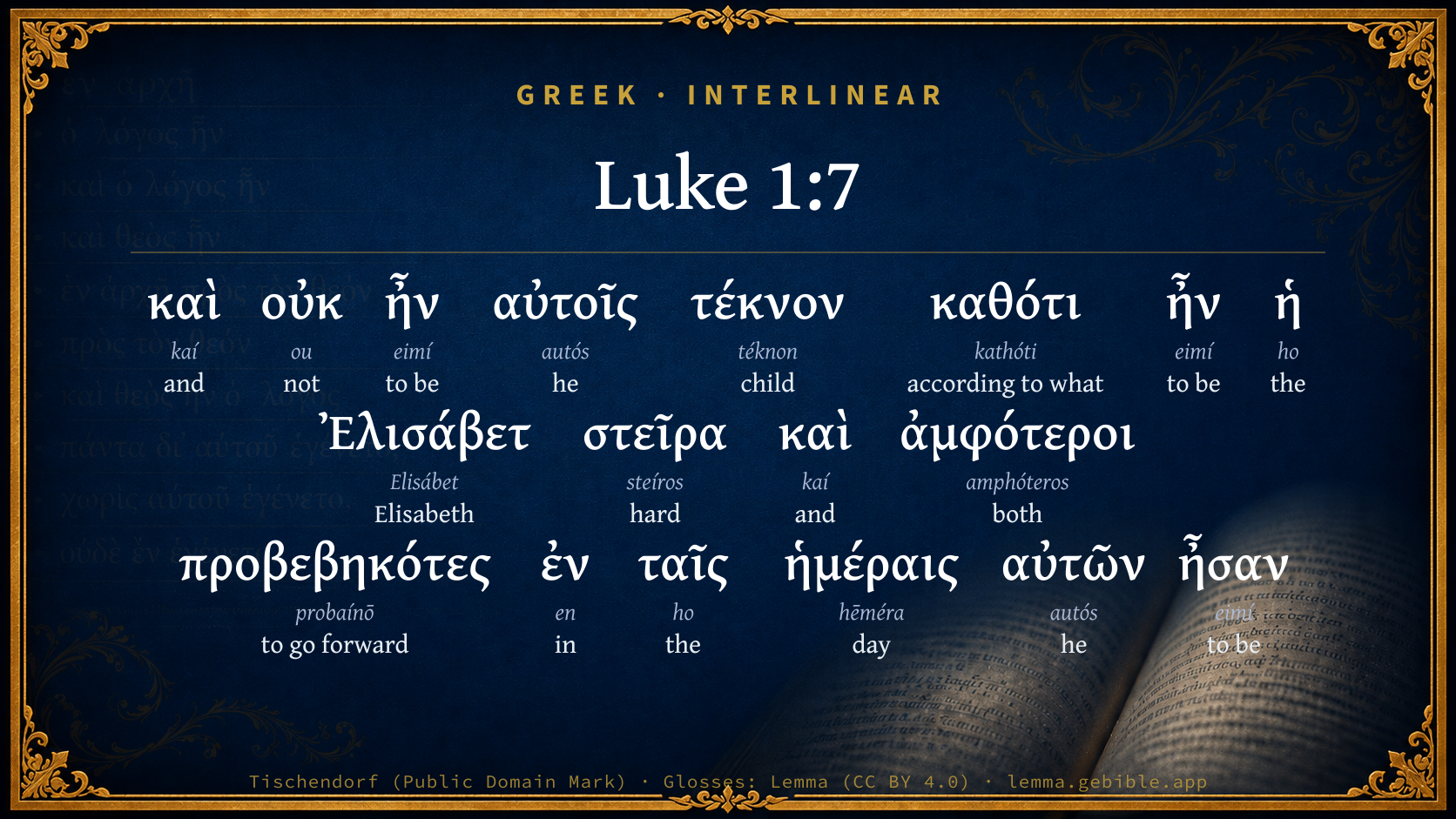
Download image
Cite this verse

Luke 1:7 (World English Bible). Public Domain. Lemma interlinear Bible study tool, https://lemma.gebible.app/v/luke/1/7.

Show BibTeX & RIS
BibTeX
RIS
English Translation
But they had no child, because Elizabeth was barren, and they both were well advanced in years.
World English Bible · Public Domain
Highlights
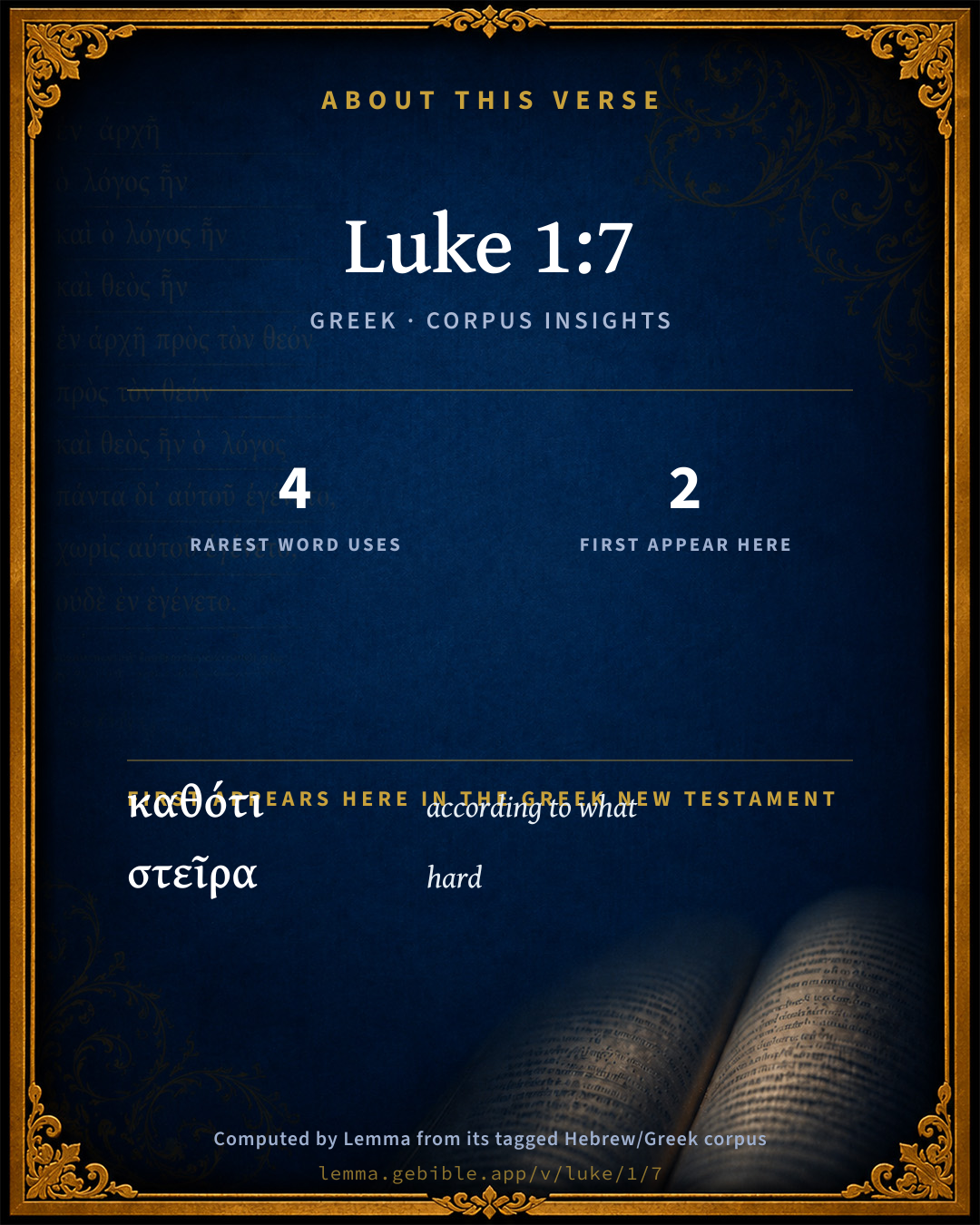
  • 2 first appearances in the Greek New Testament
Full analysis ↓
Download a study sheet

One document with this verse’s original text, its word-by-word gloss line, the meaning frame, cross-references with their text, attributed commentary, and full source and license credits — printable, and it pastes into notes with its structure intact.

This verse Autodidact and up

Study sheet (.html) Plain text (.txt)

A passage Seminary Student

Up to 50 verses in one chapter. A passage sheet keeps up to 6 commentary sources and 12 cross-references per verse, in the order this page ranks them, and says so on the sheet whenever that leaves anything out. Ask for a single verse and you get the Autodidact verse sheet above.

Everything on this page stays free to read, with no account — the sheet is a download of what is already on screen, not access to it.

Want to remove ads? Support Godless Engineer
Compare translations 3

The same verse in 3 English versions, stacked beneath the original-language interlinear above. Click any original word for its lexicon entry.

Each is an independent rendering of the whole verse — the interlinear is not word-aligned to these translations.

Highlighted words mark where these versions differ — a whole-verse word diff, not a word-by-word alignment.

  • World English Bible Public Domain
    But they had no child, because Elizabeth was barren, and they both were well advanced in years.
  • King James Version Public Domain
    And they had no child, because that Elisabeth was barren, and they both were now well stricken in years.
  • unfoldingWord Literal Text CC BY-SA 4.0
    But they did not have a child, because Elizabeth was barren, and they were both advanced in their days.

unfoldingWord Literal Text — © unfoldingWord, licensed CC BY-SA 4.0. Word-aligned USFM3 via Door43 (git.door43.org/unfoldingWord/en_ult).

Versions to compare (up to 4)

3 of 4 selected

Show all 19 translations

Every available English version of this verse, each an independent rendering of the whole verse.

  • World English Bible Public Domain
    But they had no child, because Elizabeth was barren, and they both were well advanced in years.
  • Berean Standard Bible Public Domain
    But they had no children, because Elizabeth was barren, and they were both well along in years.
  • Majority Standard Bible Public Domain
    But they had no children, because Elizabeth was barren, and they were both well along in years.
  • King James Version Public Domain
    And they had no child, because that Elisabeth was barren, and they both were now well stricken in years.
  • American Standard Version (1901) Public Domain
    And they had no child, because that Elisabeth was barren, and they both were `now' well stricken in years.
  • Revised Version (1885) Public Domain
    And they had no child, because that Elisabeth was barren, and they both were now well stricken in years.
  • Geneva Bible (1599) Public Domain
    And they had no childe, because that Elisabet was barren: and both were well stricken in age.
  • Douay-Rheims (1899) Public Domain
    And they had no son, for that Elizabeth was barren, and they both were well advanced in years.
  • Young's Literal Translation Public Domain
    and they had no child, because that Elisabeth was barren, and both were advanced in their days.
  • Literal Standard Version CC BY-SA 4.0
    and they had no child, because that Elizabeth was barren, and both were advanced in their days.
  • Unlocked Literal Bible CC BY-SA 4.0
    But they had no child, because Elizabeth was barren, and they were both very old by this time.
  • unfoldingWord Literal Text CC BY-SA 4.0
    But they did not have a child, because Elizabeth was barren, and they were both advanced in their days.
  • Darby Bible Public Domain
    And they had no child, because Elizabeth was barren, and they were both advanced in years.
  • World Messianic Bible Public Domain
    But they had no child, because Elisheva was barren, and they both were well advanced in years.
  • Webster's Bible Public Domain
    And they had no child, because Elisabeth was barren, and they both were far advanced in years.
  • Free Bible Version CC BY-SA 4.0
    They had no children because Elizabeth wasn't able to have any, and they were both growing old.
  • Bible in Basic English Public Domain
    And they were without children, because Elisabeth had never given birth, and they were at that time very old.
  • Text-Critical English NT CC BY 4.0
    But they had no children because Elizabeth was barren, and they were both advanced in their days.
  • Tyndale New Testament (1534) Public Domain
    And they had no chylde because that Elizabeth was barre and booth were well stricken in age.

Literal Standard Version (2020), Covenant Press — licensed CC BY-SA 4.0. Text via the HelloAO Bible API (eBible.org). Unlocked Literal Bible (unfoldingWord) — licensed CC BY-SA 4.0. Text via the HelloAO Bible API (eBible.org). unfoldingWord Literal Text — © unfoldingWord, licensed CC BY-SA 4.0. Word-aligned USFM3 via Door43 (git.door43.org/unfoldingWord/en_ult). Free Bible Version, Dr. Jonathan Gallagher — licensed CC BY-SA 4.0. Text via the HelloAO Bible API (eBible.org).

Word by word

More ways to search: Search by grammar → Find every occurrence → Compare this word →

Practice this passage: Drill this verse → Learn its vocabulary →

στεῖρα
steíros
G4723
“hard”
Noun, Nominative, Singular, Feminine
Part of Speech
Noun
Case
Nominative
Number
Singular
Gender
Feminine
Full Thayer's Definition

Origin: a contraction from G4731 (as stiff and unnatural)

TDNT: None

1. hard, stiff a. of men and animals 2. barren a. of woman who does not conceive
  1. καὶ kaí G2532 “and” Conjunction
  2. οὐκ ou G3756 “not” Particle, Negative
  3. ἦν eimí G1510 “to be” Verb, Imperfect, Active, Indicative, 3rd person, Singular
  4. αὐτοῖς autós G846 “he” Personal pronoun, Dative, Plural, Masculine
  5. τέκνον téknon G5043 “child” Noun, Nominative, Singular, Neuter
  6. καθότι kathóti G2530 “according to what” Adverb
  7. ἦν eimí G1510 “to be” Verb, Imperfect, Active, Indicative, 3rd person, Singular
  8. ἡ ho G3588 “the” Article, Nominative, Singular, Feminine
  9. Ἐλισάβετ Elisábet G1665 “Elisabeth” Noun, Proper, indeclinable
  10. καὶ kaí G2532 “and” Conjunction
  11. ἀμφότεροι amphóteros G297 “both” Adjective, Nominative, Plural, Masculine
  12. προβεβηκότες probaínō G4260 “to go forward” Verb, Perfect, Active, Participle, Nominative, Plural, Masculine
  13. ἐν en G1722 “in” Preposition
  14. ταῖς ho G3588 “the” Article, Dative, Plural, Feminine
  15. ἡμέραις hēméra G2250 “day” Noun, Dative, Plural, Feminine
  16. αὐτῶν autós G846 “he” Personal pronoun, Genitive, Plural, Masculine
  17. ἦσαν eimí G1510 “to be” Verb, Imperfect, Active, Indicative, 3rd person, Plural

About this verse

These counts appear in no published source. They are computed here, from the morphology-tagged text and Lemma’s own curated glosses. What Lemma adds →

18
words
13
distinct lemmas
Gospels
section

Notable vocabulary

The rarest word here is στεῖρα hard G4723 — appearing just 4 times in the whole Greek New Testament.

First appearance in Scripture

These words make their first canonical appearance in the Greek New Testament here:

  • καθότι according to what G2530
  • στεῖρα hard G4723

Shared distinctive vocabulary

στεῖρα hard G4723 occurs in 4 verses of the Greek New Testament. Also found in:
Repetition

Words recur within this verse:

Cross-references

13

Topical passages linked to Luke 1:7 in the Treasury of Scripture Knowledge — connected by theme and wording, ordered by reader-vote popularity; previews shown in the World English Bible.

  • Hebrews 11:11 By faith, even Sarah herself received power to conceive, and she bore a child when she was past age, since she counted him faithful who had promised.
  • Genesis 18:11 Now Abraham and Sarah were old, well advanced in age. It had ceased to be with Sarah after the manner of women.
  • Genesis 25:21 Isaac entreated Yahweh for his wife, because she was barren. Yahweh was entreated by him, and Rebekah his wife conceived.
  • 1 Samuel 1:2 and he had two wives; the name of the one was Hannah, and the name of other Peninnah: and Peninnah had children, but Hannah had no children.
  • Genesis 17:17 Then Abraham fell on his face, and laughed, and said in his heart, "Will a child be born to him who is one hundred years old? Will Sarah, who is ninety years old, give birth?"
  • Judges 13:2–3 There was a certain man of Zorah, of the family of the Danites, whose name was Manoah; and his wife was barren, and didn't bear.
  • 2 Kings 4:14 He said, What then is to be done for her? Gehazi answered, Most assuredly she has no son, and her husband is old.
  • Genesis 16:1–2 Now Sarai, Abram's wife, bore him no children. She had a handmaid, an Egyptian, whose name was Hagar.
  • Genesis 30:1 When Rachel saw that she bore Jacob no children, Rachel envied her sister. She said to Jacob, "Give me children, or else I will die."
  • Romans 4:19 Without being weakened in faith, he didn't consider his own body, already having been worn out, (he being about a hundred years old), and the deadness of Sarah's womb.
  • Genesis 15:2–3 Abram said, "Lord Yahweh, what will you give me, seeing I go childless, and he who will inherit my estate is Eliezer of Damascus?"
  • 1 Samuel 1:5–8 but to Hannah he gave a double portion; for he loved Hannah, but Yahweh had shut up her womb.
  • 1 Kings 1:1 Now king David was old and stricken in years; and they covered him with clothes, but he got no heat.

Cross-references courtesy of OpenBible.info (CC BY 4.0).

Commentary

Notes on Luke 1:7 from classic Christian and Jewish commentators (each source and its license shown beneath its notes). The classic Christian expositions comment on the surrounding passage and are grouped to its opening verse, so a note may address several verses; the Jewish commentaries on the Tanakh (Rashi and others) are per-verse, so they appear only where the commentator wrote on this verse.

Lemma curates 59 commentaries, every one of them public domain or Creative Commons licensed, each selected and text-cleaned for this edition rather than reprinted as found. About our sources →

The Biblical Illustrator

Joseph S. Exell

Luk_1:7

And they had no child

Virtue rewarded after long trial

Observe here--

I.

This holy pair, Zacharias and Elisabeth, were fruitful in holy obedience, but barren in children; a fruitful soul and a barren womb are consistent, and often meet together. This religious couple made no less progress in virtue than in age, and yet their virtue did not make their age fruitful.

II. Elisabeth was barren in the flower of her age, but much more so in old age. Here was a double obstacle, and consequently a double instance of Divine power in the birth of John the Baptist, showing him to be a prophet very extraordinary, and miraculously sent by God.

III. When Almighty God in old time did long delay to give the blessing of children to holy women, He rewarded their expectation with the birth of some eminent and extraordinary person. Thus Sarah, after long barrenness, brought forth an Isaac; Rebecca, a Jacob; Rachel, a Joseph; Hannah, a Samuel; and Elisabeth, St. John Baptist. When God makes His people wait long for a particular mercy, if He sees it good for them, He gives it at last with a double reward for their expectation. (W. Burkitt, M. A.)

Opposite wonders in the conception of Christ and of John

A just soul and a barren womb may well agree together. Among the Jews barrenness was not a defect only, but a reproach; yet, while this good woman was fruitful of holy obedience, she was barren of children; as John, who was miraculously conceived by man, was a fit forerunner of Him that was conceived by the Holy Ghost, so a barren matron was meet to make way for a virgin. (Bishop Hall.)

Here was desolation without murmuring. Blessings long withheld are more intensely prized. (W. H. Van Doren, D. D.)

The society of children

We are all brought nearer to Christ through childhood. Dr. Arnold used to say that no one could continue long in a healthy religious state unless his heart was kept tender by mingling with children, or by frequent intercourse with the poor and the suffering.

The grief of being childless

But, notwithstanding all the satisfaction and inward peace of innocent and godly lives, in spite of the natural pride they, doubtless, felt in the consideration that must have been shown them, as born of a priestly ancestry, stretching back through fifteen hundred years, and though they must have had round them the comforts of a modest competency, there was a secret grief in the heart of both. Elisabeth had no child, and what this meant to a Hebrew wife it is hard for us to fancy. Rachels words, Give me children, or else I die, were the burden of every childless womans heart in Israel. The birth of a child was the removal of a reproach. Hannahs prayer for a son was that of all Jewish wives in the same position. To have no child was regarded as a heavy punishment from the hand of God. How bitter the thought that his name should perish was for a Jew to bear, was seen in the law which required that a childless widow should be, forthwith, married by a dead husbands brother, that children might be raised up to preserve the memory of the childless man, by being accounted his. Nor was it enough that one brother of a number acted thus: in the imaginary instance given by the Sadducees to our Lord, seven brothers, in succession, took a dead brothers wife, for this object. The birth of a child was therefore a special blessing, as a security that the name of his father should not be cut off from among his brethren, and from the gate of his place, and that it should not be put out of Israel. Ancient nations, generally, seem to have had this feeling, and it is still so strong among Orientals, that after the birth of a first-born son, a father and a mother are no longer known by their own names, but as the father and mother of the child. There was, besides, a higher thought of possible relations, however distant, to the great-expected Messiah, by the birth of children; but Zacharias and Elisabeth had reason enough to sorrow at their childless home, even on the humbler ground of natural sentiments. They had grieved over their misfortune, and had made it the burden of many prayers, but years passed, and they had both grown elderly, and yet no child had been vouchsafed them. (Dr. Geikie.)

The Biblical Illustrator, edited by Joseph S. Exell (c. 1880s–1900s) — public domain. Text from a community e-Sword module.

Joseph Benson's Commentary

Luk 1:7. And they had no child — The providence of God so ordering it, that the birth of John the Baptist might be the more remarkable, and might excite the greater attention; because that Elisabeth was barren — Even when in the flower of her age. And they both were now well stricken in years — Here, then, was a double obstacle in the way of their having children, both the natural barrenness of Elisabeth, and the old age of them both; and, consequently, a double proof of the supernatural agency of God in the birth of John, evidently showing him to be a person miraculously sent by God. It is worthy of observation here, that many eminent persons under the patriarchal and Mosaic dispensations, were born of mothers that had been long barren, as Isaac, Jacob, Joseph, Samson, Samuel, and here John the Baptist, to render their birth the more extraordinary, and the blessing of it the more valuable in the eyes of their parents; and to show, that when God keeps his people waiting long for a particular mercy, he is sometimes pleased to recompense them for their patience, by doubling the worth of it when it is given.

Joseph Benson's Commentary on the Old and New Testaments (1811–1818) — public domain. Text from a community e-Sword module.

Tyndale Open Study Notes

Tyndale Open Resources

1:7 Elizabeth was unable to conceive: Childbearing was viewed as the highest calling for a woman, and infertility brought social stigma and shame. God miraculously intervened in the lives of various Old Testament women so they could bear children (Gen 18:10-12; 25:21; 30:22-23; Judg 13; 1 Sam 1:1-28).

Tyndale Open Study Notes — © Tyndale Open Resources, licensed CC BY-SA 4.0. Text via the HelloAO Bible API.

Bengel's Gnomon

Johann Albrecht Bengel

Luk 1:7. Καὶ, and) They no longer now had any hope of offspring, owing to a twofold cause [their age and Elizabeth’s barrenness]: Luk 1:18; Luk 1:36 (comp. Rom 4:19); and perhaps they were now not even seeking for [desiring] offspring.—προβεβηκότες, far advanced) A sweet description of the old age of the godly, which looks to the blissful goal [προβεβ. implying progress towards it].

Bengel's Gnomon of the New Testament — English translation (T&T Clark, Edinburgh, 1860) — public domain. Text from a community e-Sword module.

Expositor's Greek Testament

ed. W. Robertson Nicoll

Luk 1:7 . καὶ οὐκ ἦν , etc.: childless, a calamity from the Jewish point of view, and also a fact hard to reconcile with the character of the pair, for the Lord loveth the righteous, and, according to O. T. views, He showed His love by granting prosperity, and, among other blessings, children (Psa 128 ). καθότι : a good Attic word: in Lk.’s writings only in N. T. = seeing, inasmuch as. προβεβηκότες ἐν τ . ἡμ .: “advanced in days,” Hebraistic for the classic “advanced in age” ( τὴν ἡλικίαν ) or years ( τοῖς ἔτεσιν ): childless, and now no hope of children.

The Expositor's Greek Testament, edited by W. Robertson Nicoll (1897–1910) — public domain. Text from a community e-Sword module.

Jamieson, Fausset & Brown

Robert Jamieson, A. R. Fausset & David Brown

So with Abraham and Sarah, Isaac and Rebekah, Elkanah and Hannah, Manoah and his wife.

Jamieson, Fausset & Brown — Commentary Critical and Explanatory on the Whole Bible (1871) — public domain (CC PDM 1.0). Text via the HelloAO Bible API.

Adam Clarke's Commentary

Verse 7. Both were now well stricken in years.] By the order of God, sterility and old age both met in the person of Elisabeth, to render the birth of a son (humanly speaking) impossible. This was an exact parallel to the case of Sarah and Abraham, Ge 11:30; Ge 17:17. Christ must (by the miraculous power of God) be born of a virgin: whatever was connected with, or referred to, his incarnation must be miraculous and impressive. Isaac was his grand type, and therefore must be born miraculously - contrary to the common course and rule of nature: Abraham was a hundred years of age, Sarah was ninety, Ge 17:17, and it had CEASED to be with Sarah AFTER THE MANNER OF WOMEN, Ge 18:11, and therefore, from her age and state, the birth of a child must, according to nature, have been impossible; and it was thus; that it might be miraculous. John the Baptist was to be the forerunner of Christ; his birth, like that of Isaac, must be miraculous, because, like the other, it was to be a representation of the birth of Christ; therefore his parents were both far advanced in years, and besides, Elisabeth was naturally barren. The birth of these three extraordinary persons was announced nearly in the same way. God himself foretells the birth of Isaac, Ge 17:16. The angel of the Lord announces the birth of John the Baptist, Lu 1:13; and six months after, the angel Gabriel, the same angel, proclaims to Mary the birth of Christ! Man is naturally an inconsiderate and incredulous creature: he must have extraordinary things to arrest and fix his attention; and he requires well-attested miracles from God, to bespeak and confirm his faith. Every person who has properly considered the nature of man must see that the whole of natural religion, so termed, is little else than a disbelief of all religion.

Adam Clarke's Commentary on the Bible (1810–1826) — public domain. Text from a community e-Sword/MySword module.

Ellicott's Commentary for English Readers

(7) Well stricken in years.—Literally, far advanced in their days.

A Bible Commentary for English Readers, edited by Charles John Ellicott (1878–1897) — public domain. Text from a community e-Sword module.

The Cambridge Bible for Schools and Colleges

gen. ed. J. J. S. Perowne

7. And they had no child] This was regarded as a heavy misfortune because it cut off all hope of the birth of the Messiah in that family. It was also regarded as often involving a moral reproach, and as being a punishment for sin. See Gen_11:30; Gen_18:11; Gen_30:1-23; Exo_23:26; Deu_7:14; Jdg_13:2-3; 1Sa_1:6; 1Sa_1:27; Isa_47:9.

well stricken in years] A priest apparently might minister until any age, but Levites were partially superannuated at 50 (Num_3:1-39; Num_3:4; Num_8:25).

The Cambridge Bible for Schools and Colleges (gen. ed. J. J. S. Perowne; Cambridge University Press, 1878–1918) — public domain. Text from a community e-Sword module.

John Gill's Exposition

And they had no child,.... Son or daughter: and which was accounted a great infelicity: but this was not owing to the judgment of God upon them for any sins they had been guilty of, as the above character of them shows: and it had been the case of some righteous pairs before them for a great while, as Abraham and Sarah, Manoah, and his wile, Elkanah and Hannah:

because that Elizabeth was barren; so that it was peculiarly her case, and not Zacharias's: and though God had promised the people of Israel that there should be no male nor female barren among them, Deu 7:14 yet there were instances and exceptions to this general rule, as before mentioned, when it was the pleasure of God to make himself known, and magnify his power in the extraordinary conception and birth of any person; and therefore, though barrenness was reckoned a reproach to a person, there was, in this case, a particular hand of God, to answer a special purpose: the signs of sterility are, according to the Jews (b), when a woman had not breasts as other women have, her voice gross, so that it could not be discerned, whether it was a man's or a woman's, &c,

and they both were now well stricken in years; which made the conception and birth of John the more extraordinary, and even miraculous, and so the belief of it the more difficult; see Gen 17:17 It may be literally rendered, "they had proceeded", or had far advanced "in their days": it is an "Hebraism", and answers to, in Gen 18:11 where the Septuagint render it by the same phrase as here. The Mahometan writers Beidavi and Jallallo'din say (c) that Zacharias was "ninety nine" years of age, and his wife "eighty nine",

(b) T. Bab. Yebamot, fol. 80. 2. Maimon. & Bartenora. in Misn. Yebamot, c. 1. sect. 1. & Maimon. Hilch. Ishot, c. 2. sect. 6. (c) In Koran, c. 3.

John Gill's Exposition of the Whole Bible (1746–1763) — public domain (CC PDM 1.0). Text via the HelloAO Bible API.

Trapp's Complete Commentary

John Trapp

7 And they had no child, because that Elisabeth was barren, and they both were now well stricken in years.

Ver. 7. And they had no child] Which was then held a heavy judgment, as that which rendered them suspected of impiety, since godliness had the promise of increase both within doors and without.

John Trapp, A Commentary or Exposition upon All the Books of the Old and New Testament (1647–1656) — public domain. Text from a community e-Sword module.

Albert Barnes' Notes on the Bible

Well stricken in years - Old or advanced in life, so as to render the prospect of having children hopeless.

Albert Barnes' Notes on the Bible (1834–1885) — public domain. Text from a community e-Sword/MySword module.

Matthew Poole's English Annotations

Amongst all earthly blessings, there is nothing we more desire than children, in whom we have a kind of perpetuity, living in our species and in our posterity when we are dead in nature. But as God, for our trial, doth often deny us other good things which are the great objects of our desires, so he doth often deny his own people this great blessing. Sometimes he withholdeth it a long time from those to whom he at length giveth it. Barrenness in Israel was a reproach: see Luk 1:25, and 1Sa 1:6. There was a promise to Abraham of a plentiful seed; hence, amongst the Jews, she that was barren hardly thought herself, or was judged by others, a genuine daughter of Abraham. Both Zacharias and Elisabeth

were now well stricken in years. God chooseth this woman, naturally barren, and now aged also, to be the mother of John the Baptist, therein working a double miracle; and it is observable in holy writ, that when God denied to any women children for some long time, and then opened their wombs, they were the mothers of some eminent persons, whom God made great use of. Thus it was with Sarah, Rachel, the wife of Manoah, Hannah, 1Sa 1:1-28, and this Elisabeth.

Matthew Poole's English Annotations on the Holy Bible (1683–1685) — public domain. Text from a community e-Sword/MySword module.

The Pulpit Commentary

And they had no child. This, as is well known, was a heavy calamity in a Hebrew home. In the childless house there was no hope of the long looked-for Messiah being born in it. It was not unfrequently looked on as a mark of the Divine displeasure, possibly as the punishment of some grave sin.

The Pulpit Commentary (1880–1919), ed. H.D.M. Spence-Jones & Joseph S. Exell — public domain. Text from a community e-Sword module.

Burkitt's Expository Notes on the New Testament

William Burkitt

Observe here, 1. This holy pair, Zacharias and Elizabeth, were fruitful in holy obedience, but barren in children; a fruitful soul and a barren womb are consistent, and do oft-times meet together. This religious couple made no less progress in virtue than in age, and yet their virtue could not make their age fruitful.

Observe, 2. Elizabeth was barren in the flower of her age, but much more so in old age. Here was a double obstacle, and consequently a double instance of the divine power in the birth of John the Baptist, shewing him to be a prophet very extraordinary, and miraculously sent by God.

Observe, 3. That when Almighty God in old times did long delay to give the blessing of children to holy women, he rewarded their expectaiton with the birth of some eminent and extraordinary person; thus Sarah after long barrenness, brought forth an Isaac; Rebecca, a Jacob; Rachel, a Joseph; Hannah, a Samuel; and Elizabeth, St. John the Baptist. When God makes his people wait long for a particular mercy, he gives it in at last with a double reward of their expectation.

William Burkitt's Expository Notes on the New Testament (1700–1703) — public domain. Text from a community e-Sword module.

Cambridge Greek Testament for Schools and Colleges

7. καὶ οὐκ ἦν αὐτοῖς τέκνον. This was regarded as a heavy misfortune, because it cut off all hope of the birth of the Messiah in that family. It was also regarded as often involving a moral reproach, and as being a punishment for sin. See Gen 11:30; Gen 18:11; Gen 30:1-23; Exo 23:26; Deu 7:14; Jdg 13:2-3; 1Sa 1:6; 1Sa 1:27; Isa 47:9.

καθότι. This word in the N. T. is used only by St Luk 19:9; Act 2:24. Classically it is better written καθ’ ὅ τι.

προβεβηκότες ἐν ταῖς ἡμέραις. A Hebraism for baîm bayamîm Gen 18:11, &c. The classical phrase would be τῇ ἡλικίᾳ or τὴν ἡλικίαν or τοῖς ἔτεσιν. A priest apparently might minister until any age, but Levites were partially superannuated at 50 (Num 3:1-39; Num 3:4; Num 8:25).

Cambridge Greek Testament for Schools and Colleges (Cambridge University Press, 1896; 21 vols, various authors incl. Carr, Maclear, Plummer, Farrar, Lumby, Moule, M. R. James, Simcox) — public domain. Text from a community e-Sword module.

Alford’s Greek Testament

Henry Alford

7.] προβαίνειν is only found in the classics in this sense with τήν or κατὰ τὴν ἡλικίαν, or τῇ ἡλικίᾳ.

9,

Henry Alford, The Greek Testament (1849–1861) — public domain. Text from a community e-Sword module.

International Critical Commentary

7. καὶ οὐκ ἦν αὐτοῖς τέκνον. This calamity is grievous to all Orientals, and specially grievous to Jews, each of whom is ambitious of being among the progenitors of the Messiah. It was commonly believed to be a punishment for sin (Lev 20:20, Lev 20:21; Jer 22:30). The story of Glaucus, who tempted the oracle at Delphi, and “at the present time has not a single descendant” (Hdt. vi.86, 16), indicates a similar belief among the Greeks. Zacharias and Elisabeth had the sorrow of being childless, as Anna of being husbandless, and all three had their consolation. Comp. the births of Samson and Samuel, both of whom were Nazirites, and of Isaac.

καθότι. Peculiar to Lk. “Because that” (19:9; Act 2:24, Act 17:31), or “according as” (Act 2:45, Act 4:35). In class. Grk. editors commonly write καθʼ ὅ τι. The clause καὶ ἀμφότεροι … ἦσαν does not depend upon καθότι, which would be illogical, but is a separate statement. Their age would not explain why they had had no children, but why they were not likely to have any. “They had no child, because that Elisabeth was barren; and they were both advanced in years,” so that they had no hope of children.

προβεβηκότες ἐν ταῖς ἡμέραις αὐτῶν. Hebraistic: in class. Grk we should rather have had τῇ ἡλικίᾳ. In LXX we have προβεβ. ἡμέραις, or ἡμερῶν, or τῶν ἡμερῶν (1Ki 1:1; Gen 24:1; Jos 13:1). Levites were superannuated at about sixty, but a priest served as long as he was able.

International Critical Commentary — older volumes (1896–1929), various authors — public domain. Text from a community e-Sword module.

Vincent's Word Studies in the New Testament

Marvin R. Vincent

Well stricken [προβεβηκοτες] . Lit., advanced. Wyc., had gone far in their days.

Marvin R. Vincent, Word Studies in the New Testament (1887–1900) — public domain. Text from a community e-Sword/MySword module.

Lesson kit

Teaching starters — assembled from the data on this page, not authored interpretation. Every prompt links to the verse data it draws on. Edit before teaching.

Luke, in the Gospels, opens this verse with 18 words (13 distinct Greek lemmas). Its most distinctive word is steíros (“hard”). A historical commentator’s framing appears above. Read the whole chapter for the surrounding context.

Discussion questions

  1. How does “hard” (steíros) shape what this verse is saying?
  2. 2 words make their first appearance in Scripture here. What does this debut establish?
  3. How does Luke 1:36, which shares the word «hard», read alongside this verse?
  4. What does the repetition of “to be” (3× in this one verse) do in this verse?
  5. These translations render this verse differently. What is at stake in choosing one wording over another?
  6. Compare how The Biblical Illustrator and Joseph Benson's Commentary read this verse. Where do they agree or differ?

Things to notice

  • 2 words make their first canonical appearance in Scripture here.
  • These translations choose different wording for 11 words in this verse.
  • “to be” occurs 3× in this single verse.
  • 13 distinct Greek lemmas span 18 words in this verse.

Reading settings

Reading text

Shown beneath each verse's original-language words.

Old Testament
Old Testament edition

Read the OT as the Masoretic Hebrew (MT) or the Greek Septuagint (LXX).

English shown for the Greek Septuagint (in the Hebrew ↔ Greek comparison).

Comparing translations? Open the Compare panel on any verse page to stack up to four side by side.