1 Corinthians 14:31

Greek (Tischendorf 8th ed.) 1 Corinthians 14:31 appears in the Greek New Testament. The text above is from the Tischendorf 8th edition. Each word links to its Strong’s number and a concise gloss. Click any word for its full Thayer’s Greek Lexicon entry.
Download image
Cite this verse

1 Corinthians 14:31 (World English Bible). Public Domain. Lemma interlinear Bible study tool, https://lemma.gebible.app/v/1-corinthians/14/31.

Show BibTeX & RIS
BibTeX
RIS
English Translation
For you all can prophesy one by one, that all may learn, and all may be exhorted.
World English Bible · Public Domain
Download a study sheet

One document with this verse’s original text, its word-by-word gloss line, the meaning frame, cross-references with their text, attributed commentary, and full source and license credits — printable, and it pastes into notes with its structure intact.

This verse Autodidact and up

Study sheet (.html) Plain text (.txt)

A passage Seminary Student

Up to 50 verses in one chapter. A passage sheet keeps up to 6 commentary sources and 12 cross-references per verse, in the order this page ranks them, and says so on the sheet whenever that leaves anything out. Ask for a single verse and you get the Autodidact verse sheet above.

Everything on this page stays free to read, with no account — the sheet is a download of what is already on screen, not access to it.

Want to remove ads? Support Godless Engineer
Compare translations 3

The same verse in 3 English versions, stacked beneath the original-language interlinear above. Click any original word for its lexicon entry.

Each is an independent rendering of the whole verse — the interlinear is not word-aligned to these translations.

Highlighted words mark where these versions differ — a whole-verse word diff, not a word-by-word alignment.

  • World English Bible Public Domain
    For you all can prophesy one by one, that all may learn, and all may be exhorted.
  • King James Version Public Domain
    For ye may all prophesy one by one, that all may learn, and all may be comforted.
  • unfoldingWord Literal Text CC BY-SA 4.0
    For all are able to prophesy one by one so that all may learn, and all may be encouraged.

unfoldingWord Literal Text — © unfoldingWord, licensed CC BY-SA 4.0. Word-aligned USFM3 via Door43 (git.door43.org/unfoldingWord/en_ult).

Versions to compare (up to 4)

3 of 4 selected

Show all 19 translations

Every available English version of this verse, each an independent rendering of the whole verse.

  • World English Bible Public Domain
    For you all can prophesy one by one, that all may learn, and all may be exhorted.
  • Berean Standard Bible Public Domain
    For you can all prophesy in turn so that everyone may be instructed and encouraged.
  • Majority Standard Bible Public Domain
    For you can all prophesy in turn so that everyone may be instructed and encouraged.
  • King James Version Public Domain
    For ye may all prophesy one by one, that all may learn, and all may be comforted.
  • American Standard Version (1901) Public Domain
    For ye all can prophesy one by one, that all may learn, and all may be exhorted;
  • Revised Version (1885) Public Domain
    For ye all can prophesy one by one, that all may learn, and all may be comforted;
  • Geneva Bible (1599) Public Domain
    For ye may all prophecie one by one, that all may learne, and all may haue comfort.
  • Douay-Rheims (1899) Public Domain
    For you may all prophesy one by one; that all may learn, and all may be exhorted:
  • Young's Literal Translation Public Domain
    for ye are able, one by one, all to prophesy, that all may learn, and all may be exhorted,
  • Literal Standard Version CC BY-SA 4.0
    for you are able, one by one, all to prophesy, that all may learn, and all may be exhorted,
  • Unlocked Literal Bible CC BY-SA 4.0
    For each of you can prophesy one by one so that each one may learn and all may be encouraged.
  • unfoldingWord Literal Text CC BY-SA 4.0
    For all are able to prophesy one by one so that all may learn, and all may be encouraged.
  • Darby Bible Public Domain
    For ye can all prophesy one by one, that all may learn and all be encouraged.
  • World Messianic Bible Public Domain
    For you all can prophesy one by one, that all may learn and all may be exhorted.
  • Webster's Bible Public Domain
    For ye may all prophesy one by one, that all may learn, and all may be comforted.
  • Free Bible Version CC BY-SA 4.0
    You can all speak for God, one at a time, so that everyone can learn and be encouraged.
  • Bible in Basic English Public Domain
    For you may all be prophets in turn so that all may get knowledge and comfort;
  • Text-Critical English NT CC BY 4.0
    For you can all prophesy one by one, so that all may learn and all may be encouraged.
  • Tyndale New Testament (1534) Public Domain
    For ye maye all prophesy one by one that all maye learne and all maye have comforte.

Literal Standard Version (2020), Covenant Press — licensed CC BY-SA 4.0. Text via the HelloAO Bible API (eBible.org). Unlocked Literal Bible (unfoldingWord) — licensed CC BY-SA 4.0. Text via the HelloAO Bible API (eBible.org). unfoldingWord Literal Text — © unfoldingWord, licensed CC BY-SA 4.0. Word-aligned USFM3 via Door43 (git.door43.org/unfoldingWord/en_ult). Free Bible Version, Dr. Jonathan Gallagher — licensed CC BY-SA 4.0. Text via the HelloAO Bible API (eBible.org).

Word by word

More ways to search: Search by grammar → Find every occurrence → Compare this word →

Practice this passage: Drill this verse → Learn its vocabulary →

μανθάνωσιν
manthánō
G3129
“to learn”
Verb, Present, Active, Subjunctive, 3rd person, Plural
Part of Speech
Verb
Tense
Present
Voice
Active
Mood
Subjunctive
Person
3rd person
Number
Plural
Full Thayer's Definition

Origin: prolongation from a primary verb, another form of which, matheo, is used as an alternate in certain tenses

TDNT: 10:30,6

1. to learn, be appraised a. to increase one's knowledge, to be increased in knowledge b. to hear, be informed c. to learn by use and practice 1. to be in the habit of, accustomed to
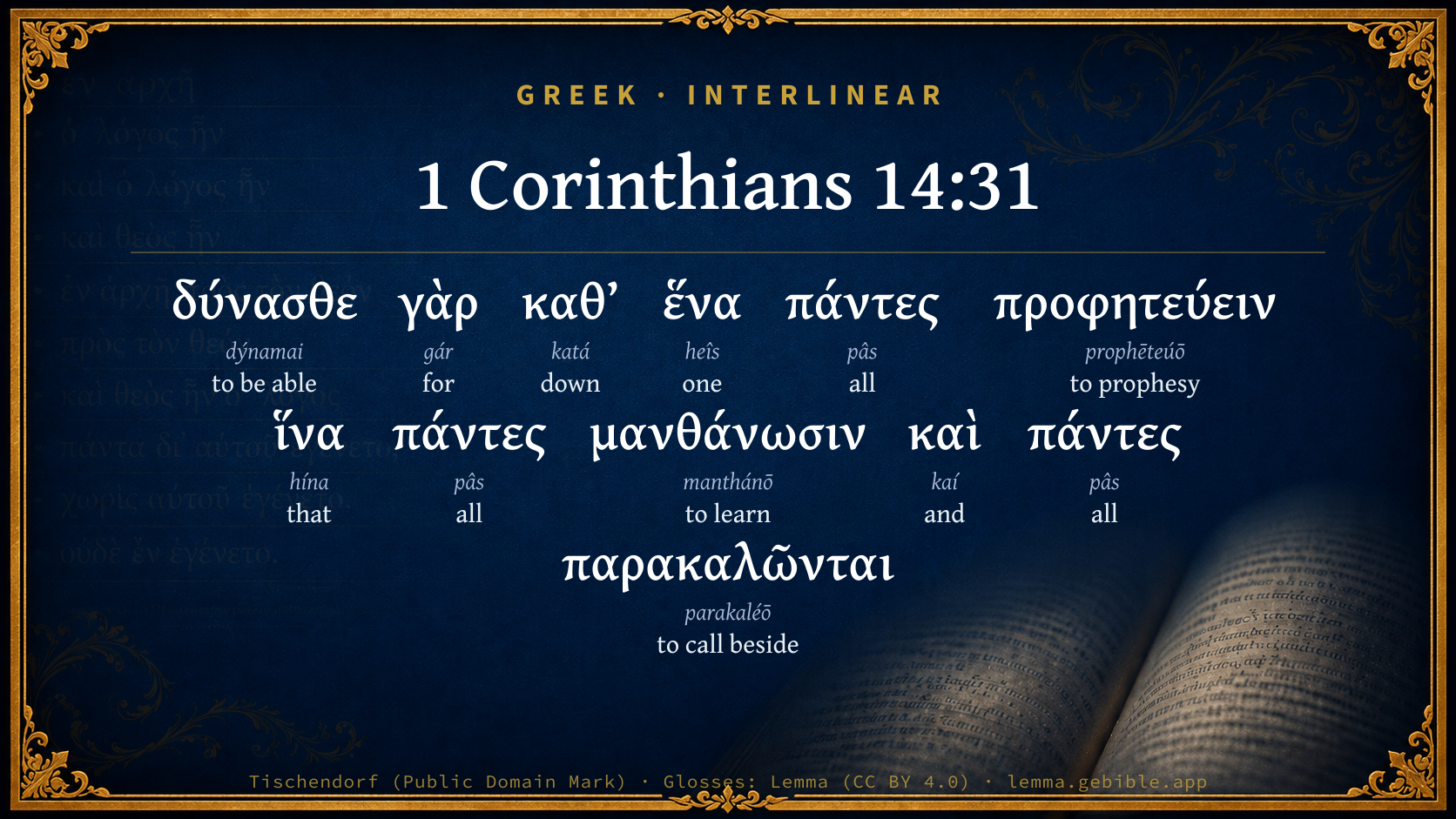
  1. δύνασθε dýnamai G1410 “to be able” Verb, Present, Middle or Passive deponent, Indicative, 2nd person, Plural
  2. γὰρ gár G1063 “for” Conjunction
  3. καθ’ katá G2596 “down” Preposition
  4. ἕνα heîs G1520 “one” Adjective, Accusative, Singular, Masculine
  5. πάντες pâs G3956 “all” Adjective, Nominative, Plural, Masculine
  6. προφητεύειν prophēteúō G4395 “to prophesy” Verb, Present, Active, Infinitive
  7. ἵνα hína G2443 “that” Conjunction
  8. πάντες pâs G3956 “all” Adjective, Nominative, Plural, Masculine
  9. καὶ kaí G2532 “and” Conjunction
  10. πάντες pâs G3956 “all” Adjective, Nominative, Plural, Masculine
  11. παρακαλῶνται parakaléō G3870 “to call beside” Verb, Present, Passive, Subjunctive, 3rd person, Plural

About this verse

These counts appear in no published source. They are computed here, from the morphology-tagged text and Lemma’s own curated glosses. What Lemma adds →

12
words
10
distinct lemmas
Pauline Epistles
section

Notable vocabulary

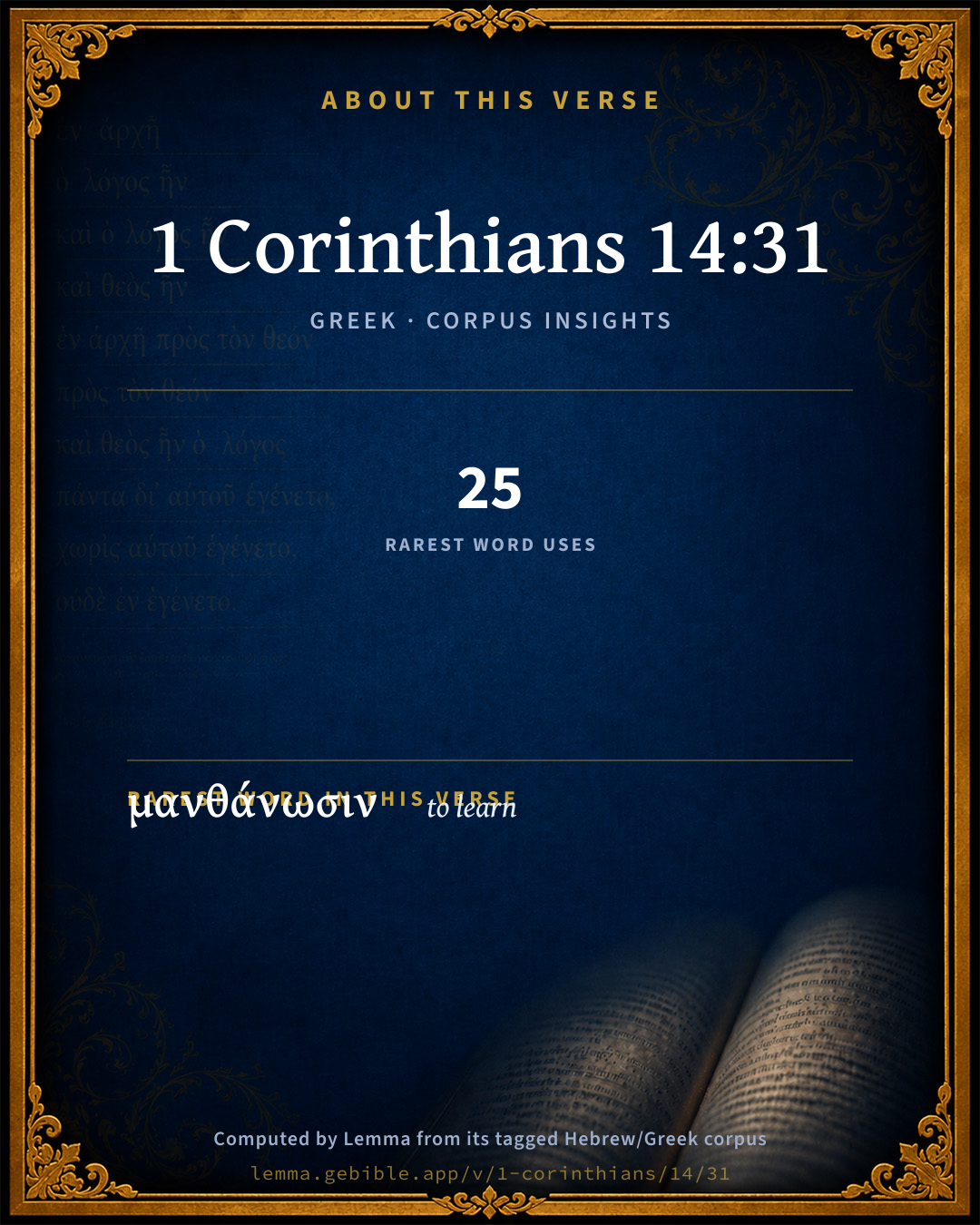
The rarest word here is μανθάνωσιν to learn G3129 — appearing just 25 times in the whole Greek New Testament.

Shared distinctive vocabulary

μανθάνωσιν to learn G3129 occurs in 24 verses of the Greek New Testament. Also found in:

Repetition

A word recurs within this verse:

  • πάντες all G3956 ×3

Cross-references

13

Topical passages linked to 1 Corinthians 14:31 in the Treasury of Scripture Knowledge — connected by theme and wording, ordered by reader-vote popularity; previews shown in the World English Bible.

  • 1 Corinthians 14:3 But he who prophesies speaks to men for their edification, exhortation, and consolation.
  • 1 Thessalonians 5:11 Therefore exhort one another, and build each other up, even as you also do.
  • 1 Thessalonians 5:14 We exhort you, brothers, admonish the disorderly, encourage the fainthearted, support the weak, be patient toward all.
  • Proverbs 1:5 That the wise man may hear, and increase in learning; That the man of understanding may attain to sound counsel:
  • Proverbs 9:9 Instruct a wise man, and he will be still wiser. Teach a righteous man, and he will increase in learning.
  • Romans 1:12 that is, that I with you may be encouraged in you, each of us by the other's faith, both yours and mine.
  • 1 Corinthians 14:19 However in the assembly I would rather speak five words with my understanding, that I might instruct others also, than ten thousand words in another language.
  • 1 Corinthians 14:35 If they desire to learn anything, let them ask their own husbands at home, for it is shameful for a woman to chatter in the assembly.
  • 2 Corinthians 1:4 who comforts us in all our affliction, that we may be able to comfort those who are in any affliction, through the comfort with which we ourselves are comforted by God.
  • 2 Corinthians 7:6–7 Nevertheless, he who comforts the lowly, God, comforted us by the coming of Titus;
  • Ephesians 6:22 whom I have sent to you for this very purpose, that you may know our state, and that he may comfort your hearts.
  • 1 Thessalonians 4:18 Therefore comfort one another with these words.
  • Ephesians 4:11–12 He gave some to be apostles; and some, prophets; and some, evangelists; and some, shepherds and teachers;

Cross-references courtesy of OpenBible.info (CC BY 4.0).

Commentary

Notes on 1 Corinthians 14:31 from classic Christian and Jewish commentators (each source and its license shown beneath its notes). The classic Christian expositions comment on the surrounding passage and are grouped to its opening verse, so a note may address several verses; the Jewish commentaries on the Tanakh (Rashi and others) are per-verse, so they appear only where the commentator wrote on this verse.

Lemma curates 59 commentaries, every one of them public domain or Creative Commons licensed, each selected and text-cleaned for this edition rather than reprinted as found. About our sources →

Bengel's Gnomon

Johann Albrecht Bengel

1Co 14:31. Καθʼ ἕνα, one by one) so that one person may always give way to another.—πάντες μανθάνωσι, all may learn) by conversing, inquiring, speaking, listening: all, being prophets. A man learns by teaching: he learns by speaking, and asking questions, 1Co 14:34-35. [Many continue to be foolish and languid in spiritual things, because they almost never speak about such things.—V. g.]—παρακαλῶνται, may be comforted) Sometimes the speaking of another produces in us more awakening effect, sometimes our own.

Bengel's Gnomon of the New Testament — English translation (T&T Clark, Edinburgh, 1860) — public domain. Text from a community e-Sword module.

Meyer's Critical & Exegetical Commentary

Heinrich August Wilhelm Meyer

1Co_14:31 f. Establishment of this precept by setting forth the possibility of its observance. The principal emphasis is laid upon δύνασθε, which is for this reason placed first (not upon πάντες, as Rückert holds), for in it lies the pith of the proof. Next to it πάντες has the emphasis. The sense is: For in my ὁ πρῶτος σιγ. I am enjoining nothing which is impossible for you; on the contrary, it stands in your power that, one after another, you may all come to give a prophetic address, et.

καθʼ ἕνα] always one at once, singulatim. Act_21:19; see Ast, Lex. Plat. I. p. 639 f.; Bernhardy, p. 240. The subject addressed in δύνασθε is the prophets in the church, not the members of the church generally (Hofmann), seeing that prophecy was a special χάρισμα[19] which did not belong to all (see 1Co_12:29; Act_13:1; Eph_4:11). The inspiration of the prophets does not compel them to speak on without a break, so as not to allow another to take speech at all or to speak alone, but it is in their power to cease when another begins, so that by degrees all may come to speaknot, of course, in the same assembly (1Co_14:29), but in successive meetings.

And this circumstance, that καθʼ ἕνα πάντες προφητεύουσι, has for its design (ἵνα), that all the members of the church (which includes also other prophets along with the rest) may learn, etc., that none may remain without instruction and encouragement. For modes of prophetic inspiration, very different from each other in substance and form, will then find expression, whereby satisfaction will be given to the most different want.

μανθάνωσι] what God has revealed to those speaking propheticall.

παρακλ.] be encouraged, aroused. Comp. παράκλησιν, 1Co_14:3. Paul describes here the effects of prophecy from the theoretical (μανθ.) and practical (παρακαλ.) sides. The latter he had already stated more specially in 1Co_14:3.

[19] It is not correct to say, on the contrary, whoever receives a revelation becomes a prophet (Hofmann); for the prophetic endowment is habitual, belonging to one and not to another. Whoever has it receives revelations to be communicated for the edification of others; he is the vessel divinely prepared for this reception and communication.

Meyer — Critical and Exegetical Commentary on the New Testament — English translation by Peter Christie, edited by Frederick Crombie (T&T Clark, 1880) — public domain. Text from a community e-Sword module.

Expositor's Greek Testament

ed. W. Robertson Nicoll

1Co 14:31 . By economy of time, every one who has the prophetic gift may exercise it in turn; so the Church will enjoy, in variety of exhortation, the full benefit of the powers of the Spirit conferred on all its members: “For you can (in this way) all prophesy one by one ( καθʼ ἕνα : singulatim , Cv [2163] ), in order that all may learn and all may be encouraged”. Stress lies on the repeated πάντες ( cf. 1Co 12:12 f.): let every prophet get his turn, and every hearer will receive benefit ( cf. 1Co 14:26 b ); even if the Church members were all prophets, as Paul imagined in 1Co 14:24 , and thinks desirable (1Co 14:1-5 ), by due arrangement, and self-suppression on the part of the eloquent, all might be heard.

[2163] Calvin’s In Nov. Testamentum Commentarii .

The Expositor's Greek Testament, edited by W. Robertson Nicoll (1897–1910) — public domain. Text from a community e-Sword module.

Hodge's Commentary on Romans, Ephesians & First Corinthians

Charles Hodge

1Co_14:31

For ye may all prophesy one by one, that all may learn, and all may be comforted.

This verse assigns the reason why two prophets should not speak at the same time. They could all have the opportunity of speaking one by one. Not indeed at the same meeting, for he had before limited the number of speakers to two or three for any one occasion. That all may learn, and all may be comforted. This is the end to be attained by their all speaking. The discourse of one might suit the wants of some hearers; and that of another might be adapted to the case of others. Thus all hearers would receive instruction and consolation. The latter word (consolation), however, is not so comprehensive as the original, which means not only to comfort, but also to exhort and to admonish.

Charles Hodge — Commentary on Romans (1835), First Corinthians (1857), and Ephesians (1856) — public domain. Text from a community e-Sword module.

Jamieson, Fausset & Brown

Robert Jamieson, A. R. Fausset & David Brown

For ye may--rather, "For ye can [if ye will] all prophesy one by one," giving way to one another. The "for" justifies the precept (Co1 14:30), "let the first hold his peace."

Jamieson, Fausset & Brown — Commentary Critical and Explanatory on the Whole Bible (1871) — public domain (CC PDM 1.0). Text via the HelloAO Bible API.

Adam Clarke's Commentary

Verse 31. For ye may all prophesy one by one] The gifts which God grants are given for the purpose of edification; but there can be no edification where there is confusion; therefore let them speak one by one.

Adam Clarke's Commentary on the Bible (1810–1826) — public domain. Text from a community e-Sword/MySword module.

John Calvin's Commentaries

31. You can all, one by one. In the first place, when he says all, he does not include believers universally, but only those that were endowed with this gift. Farther, he does not mean that all ought to have equally their turn, but that, according as it might be for the advantage of the people, each one should come forward to speak either more frequently or more seldom. “No one will remain always unemployed; but an opportunity of speaking will present itself, sometimes to one and at other times to another.”

He adds, that all may learn. This is applicable, it is true, to the whole of the people, but it is particularly suited to the Prophets, and Paul more especially refers to them. For no one will ever be a good teacher, who does not show himself to be teachable, as no one will ever be found who has, in himself alone, such an overflowing in respect of perfection of doctrine, as not to derive benefit from listening to others. Let all, therefore, undertake the office of teaching on this principle, that they do not refuse or grudge, to be scholars to each other in their turn, whenever there shall be afforded to others the means of edifying the Church.

He says, in the second place, that all may receive consolation. Hence we may infer, that the ministers of Christ, so far from envying, should rather rejoice with all their heart, that they are not the only persons that excel, but have fellow-partakers of the same gift — a disposition which Moses discovered, as is related in sacred history. (Numbers 11:28.) For when his servant, inflamed with a foolish jealousy, was greatly displeased, because the gift of prophecy was conferred upon others also, he reproves him: “Nay,” says he, “would that all the people of God were sharers with me in this superior gift!” And, undoubtedly, it is a special consolation for pious ministers, to see the Spirit of God, whose instruments they are, working in others also, and they derive also from this no small confirmation. It is a consolation, too, that it contributes to the spread of the word of God, the more it has of ministers and witnesses.

As, however, the word παρακαλεῖσθαι, which Paul here employs, is of doubtful signification, it might also be rendered may receive exhortation. Nor would this be unsuitable, for it is sometimes of advantage to listen to others, that we may be more powerfully stirred up to duty.

John Calvin's Commentaries (1540-1563) — public domain. Text from the Calvin Translation Society English edition (1840s-50s) via the Christian Classics Ethereal Library (ccel.org). Calvin's coverage is partial (roughly two-thirds of the Bible); uncommented books and verses are honest gaps, never fabricated. The 19th-century editor's footnotes and remarks are omitted so the notes are faithfully Calvin's own voice.

Ellicott's Commentary for English Readers

(31) For ye may all prophesy one by one.—Better, For it is in your power all to prophesy one by one. How it is in their power is explained by the following verse. This orderly prophesying will accomplish the instruction and comforting of all; words of instruction will be interspersed with words of comfort, and so the teaching be suited to every condition of mind and soul of those present.

A Bible Commentary for English Readers, edited by Charles John Ellicott (1878–1897) — public domain. Text from a community e-Sword module.

The Cambridge Bible for Schools and Colleges

gen. ed. J. J. S. Perowne

31. For ye may all prophesy one by one] Not necessarily at the same meeting of the Church, which would be in contradiction to what has just been said (1Co_14:29), nor that the permission was extended to the whole Christian body. All were not prophets, the Apostle tells us (ch. 1Co_12:29), and it is clear that none but prophets could prophesy, since prophecy (ch. 1Co_12:28, 1Co_13:2, 1Co_14:1; 1Co_14:5; 1Co_14:22) was a special gift of the Spirit.

comforted] The word has the sense of comfort and exhortation combined, and is most nearly equivalent to our encourage or cheer. See 2 Corinthians 1 where the word and the verb from which it is derived are translated indifferently comfort and consolation. In ch. 1Co_4:16 of this Epistle it is rendered beseech. In a great many passages, as for instance in Act_2:40, it is rendered exhort. From this word is derived the title Paraclete, rendered Comforter in St John 14, 15, , 16 and Advocate in 1Jn_2:1. The derivative is rendered exhortation in 3, and another word is employed for comfort,

The Cambridge Bible for Schools and Colleges (gen. ed. J. J. S. Perowne; Cambridge University Press, 1878–1918) — public domain. Text from a community e-Sword module.

John Gill's Exposition

And the spirits of the prophets are subject to the prophets. Meaning either that the doctrines which the prophets deliver, the explanations they give of passages of Scriptures, the revelations they declare, are subject to the examination, judgment, and censure of other prophets; who have a right to try and judge them, either according to a more clear revelation they may have, or rather according to the sure word of prophecy, the Scriptures of truth; and indeed they are subject to the trial and judgment of the whole church, and therefore ought not to be stiff in their own sentiments, and obstinately persist in them, but cheerfully and readily submit them to be examined, and approved or disapproved by others; and particularly when one that sits by signifies he has something revealed to him, which will better explain, or give further light into what the speaker is upon, he ought to submit and give way to him; and thereby truth may be made manifest and established, instruction, edification, and comfort promoted, and peace and order preserved: or else the sense is, that the spiritual gifts of the prophets, and the inspirations and instincts by which they are acted, and the affections which are excited in them, are subject to themselves, so that they can use, or not use those gifts; though they have the word of the Lord they can forbear speaking, as Jeremy did, for a while, and as the case of Jonah shows; or they can refrain themselves and be silent, and wait till they have proper opportunity of speaking, being not like the prophets of false gods, who are acted by an evil spirit, and observe no order or decorum, but with a sort of fury and madness deliver involuntarily what is suggested to them: but such is not the case of true prophets that are influenced and directed by the Spirit of God, who will give way to one another; one will be silent while the other speaks, and by turns prophesy one after another; and where there is not such a subjection, it is a sign that the Spirit of God is not in them, for the reason that follows.

And the spirits of the prophets are subject to the prophets. Meaning either that the doctrines which the prophets deliver, the explanations they give of passages of Scriptures, the revelations they declare, are subject to the examination, judgment, and censure of other prophets; who have a right to try and judge them, either according to a more clear revelation they may have, or rather according to the sure word of prophecy, the Scriptures of truth; and indeed they are subject to the trial and judgment of the whole church, and therefore ought not to be stiff in their own sentiments, and obstinately persist in them, but cheerfully and readily submit them to be examined, and approved or disapproved by others; and particularly when one that sits by signifies he has something revealed to him, which will better explain, or give further light into what the speaker is upon, he ought to submit and give way to him; and thereby truth may be made manifest and established, instruction, edification, and comfort promoted, and peace and order preserved: or else the sense is, that the spiritual gifts of the prophets, and the inspirations and instincts by which they are acted, and the affections which are excited in them, are subject to themselves, so that they can use, or not use those gifts; though they have the word of the Lord they can forbear speaking, as Jeremy did, for a while, and as the case of Jonah shows; or they can refrain themselves and be silent, and wait till they have proper opportunity of speaking, being not like the prophets of false gods, who are acted by an evil spirit, and observe no order or decorum, but with a sort of fury and madness deliver involuntarily what is suggested to them: but such is not the case of true prophets that are influenced and directed by the Spirit of God, who will give way to one another; one will be silent while the other speaks, and by turns prophesy one after another; and where there is not such a subjection, it is a sign that the Spirit of God is not in them, for the reason that follows.

1 Corinthians 14:33

co1 14:33

co1 14:33

co1 14:33For God is not the author of confusion,.... Or disorder, or "tumult", as the Syriac renders it; wherefore he does not inspire and excite his prophets to deliver themselves in a disorderly and tumultuous manner, so as to break in one upon another; but when one speaks, the other is silent, or when one has anything revealed to him, and he signifies it in a proper manner, the other stops and gives way to him, and when he has done another succeeds, and so the rest in order, till the whole opportunity is filled up in an orderly and edifying manner; and whatever is contrary to, or breaks in upon such a method, God is not the author of: for he is the author

of peace, harmony, unity, and concord among his prophets and teachers, and so of order, for the former cannot be without the latter; where there is no order in the ministry, there can be no peace among the ministers, nor comfort in the churches; but God is the God of peace, he calls for, requires, disposes, and approves of peace and order among all his people:

as in all churches of the saints. The Vulgate Latin reads, "as I teach in all", &c. and so read some copies, and may refer to all that is said before; and the sense be, that all the rules he had prescribed concerning speaking with tongues, and prophesying, were not new ones, but such as he had directed to be observed in all churches he was concerned with, and which consisted of holy and good men; or God is the author, not of confusion, but of peace in all the churches; he orders and disposes peace among them, and they attend to it: peace and order, and not confusion and tumult, prevail in all churches that deserve to be called churches of the saints, and therefore were in this to be imitated by the church at Corinth.

John Gill's Exposition of the Whole Bible (1746–1763) — public domain (CC PDM 1.0). Text via the HelloAO Bible API.

Trapp's Complete Commentary

John Trapp

31 For ye may all prophesy one by one, that all may learn, and all may be comforted.

Ver. 31. That all may learn] The most learned may learn something by the discourses of others less learned than themselves. Apollos, a learned teacher, may yet be taught by a tentmaker. The Jewish rabbins acknowledge that they came to understand Isa 14:23, by hearing an Arabian woman mention a besom in her language to her maid, טאטא (R. David in Radic.)

John Trapp, A Commentary or Exposition upon All the Books of the Old and New Testament (1647–1656) — public domain. Text from a community e-Sword module.

Albert Barnes' Notes on the Bible

For ye may all prophecy ... - There is time enough for all; there is no need of speaking in confusion and disorder. Every person may have an opportunity of expressing his sentiments at the proper time.

That all may learn - In such a manner that there may be edification. This might be done if they would speak one at a time in their proper order.

Albert Barnes' Notes on the Bible (1834–1885) — public domain. Text from a community e-Sword/MySword module.

Matthew Poole's English Annotations

Ye may not all prophesy in the same day, or hour, or moment of time, but orderly and successively

ye may all prophesy, the end of it being for the instruction and consolation of all; which may mind you so to govern yourselves in the exercise of that gift, as not to lose your end,

but that all may learn, and all may be comforted. Which lets us know, that though their receiving the gift of prophecy obliged them to an exercise of it, yet it did not oblige them to an exercise of it in or at this or that particular time. judged by the law of God, or the light of nature, or the common custom of other churches, to be done indecently or confusedly, without order. It is very observable, that though the apostle, in these things, hath given rules, yet he hath determined nothing shameful or uncomely, but what he hath made to appear so, either from the Divine law, (as in the case of the women’s prophesying, 1Co 14:34), or from nature and reason, (as in the case of many speaking at the same time), it being useless to the end, which was teaching and instructing those to whom they spake, and what unbelievers would count the effect of madness, 1Co 14:23.

Matthew Poole's English Annotations on the Holy Bible (1683–1685) — public domain. Text from a community e-Sword/MySword module.

Whedon's Commentary on the Bible

Daniel D. Whedon

31. Ye may—Rather, ye are able. St. Paul has given the above directions for preserving order, for they thereby were able, if they took proper care, all to prophesy, who had the gift, not simultaneously, but one by one, and so all the congregation may, by hearing a variety of discourse, learn and be comforted, or instructed.

Daniel D. Whedon (gen. ed.), Commentary on the Old and New Testaments (1874–1909) — public domain. Text from a community e-Sword module.

The Pulpit Commentary

Ye may all prophesy; rather, ye all can; that is, "if you have the gift of prophesying." St. Paul has already implied that at every assembly there would be idiotai, unendowed worshippers, who only came to profit by the gifts of others, and that "all" are not prophets. (1Co_12:29) May be comforted; rather, may be exhorted or cheered.

The Pulpit Commentary (1880–1919), ed. H.D.M. Spence-Jones & Joseph S. Exell — public domain. Text from a community e-Sword module.

John Wesley's Explanatory Notes

All - Who have that gift. That all may learn - Both by speaking and by hearing.

John Wesley, Explanatory Notes Upon the Whole Bible (1754–1765) — public domain. Text via the GEBible commentary corpus.

Godbey's Commentary on the New Testament

William B. Godbey

31. “For all are able to prophesy, one at a time, in order that all may learn and all may be comforted.” Amid the wonderful enthusiasm of those people to receive, enjoy and utilize those momentous spiritual gifts and graces, they had somewhat run away with the wagon; in their incorrigible zeal lest they should have to carry home with them a burning message undelivered, they had fallen into the mistake of breaking out and delivering their messages while another was speaking, thus producing confusion and seriously conflicting with the edification of the people, which is the great end in view in all gospel meetings. Hence you see Paul corrects these irregularities and orders them to speak one at a time.

William B. Godbey, Commentary on the New Testament (1896–1900) — public domain. Text from a community e-Sword module.

McGarvey & Pendleton's Commentaries

J. W. McGarvey

For ye all can prophesy one by one, that all may learn, and all may be exhorted;

J. W. McGarvey (with Philip Y. Pendleton), Commentaries on the New Testament (The Fourfold Gospel, 1914; Acts; and the epistles) — public domain. Text from a community e-Sword/MySword module.

The People's New Testament

B. W. Johnson

31. For ye all may prophesy. All who have the prophetic gift, but it must be one by one, not more than one speaking at a time.

B. W. Johnson's The People's New Testament with Notes (1889–1891) — public domain. Electronic text from the Christian Classics Ethereal Library (CCEL) ThML edition.

unfoldingWord translationNotes

Door43 World Missions Community

prophesy one by one

Only one person should prophesy at a time.

all may be encouraged

This can be stated in active form. AT: "you may encourage all" (See: Active or Passive)

God is not a God of confusion

God does not create confusing situations by making people all speak at the same time.

translationWords

prophet

courage

spirit

God

peace

unfoldingWord translationNotes — © Distant Shores Media and the Door43 World Missions Community, licensed CC BY-SA 4.0. Source: git.door43.org/Door43/en_tn.

Cambridge Greek Testament for Schools and Colleges

31. καθ’ ἕνα. Not necessarily at the same meeting of the Church, which would be in contradiction to what has just been said (1Co 14:29), nor that the permission was extended to the whole Christian body. All were not prophets, the Apostle tells us (ch. 1Co 12:29), and it is clear that none but prophets could prophesy, since prophecy (ch. 1Co 12:28, 1Co 13:2, 1Co 14:1; 1Co 14:5; 1Co 14:22) was a special gift of the Spirit.

παρακαλῶνται. This word, which signifies literally to call to one’s side, has the sense of comfort and exhortation combined, and is most nearly equivalent to our encourage or cheer. See 2 Corinthians 1, where the word and the verb from which it is derived are translated indifferently comfort and consolation. In ch. 1Co 4:16 of this Epistle it is rendered beseech. In a great many passages, as for instance in Act 2:40, it is rendered exhort. From this word is derived the title Paraclete, rendered Comforter in John 14, 15, , 16, and Advocate in 1Jn 2:1. See note on 1Co 14:3.

Cambridge Greek Testament for Schools and Colleges (Cambridge University Press, 1896; 21 vols, various authors incl. Carr, Maclear, Plummer, Farrar, Lumby, Moule, M. R. James, Simcox) — public domain. Text from a community e-Sword module.

International Critical Commentary

31. δύνασθε γὰρ καθʼ ἕνα πάντες προφητεύειν. ‘For ye have the power, one by one, all of you, to prophesy.’ If each preacher stops when another receives a message, all the prophets, however many there may be, will be able to speak in successive assemblies, three at each meeting. They are capable of making room for one another, and (like the rest of the congregation) they are capable of receiving instruction and encouragement. The congregation would learn more through a change of preachers, and the preachers also would learn more through listening to one another.*

International Critical Commentary — older volumes (1896–1929), various authors — public domain. Text from a community e-Sword module.

Godet's Commentaries

Frédéric Louis Godet

Vers. 31-33a. “For ye may all prophesy one by one, that all may learn, and all may be comforted. 32. And the spirits of the prophets are subject to the prophets. 33a. For God is not a God of confusion, but of peace.”

Ver. 31 might be understood in this sense: “Thus it may happen that those who prophesy to-day will in their turn be taught and exhorted to-morrow.” Each member will alternately play an active and a passive part. But in that case Paul would have said: καὶ οὕτω, and so, rather than γάρ, for. The true meaning seems to me to be this: “For you must all have it in your power to fill the prophet’s function one after another” (of course: those who have the gift of prophecy); now this is what could not be done except by observing the rule given in 1Co 14:30. Supposing, indeed, that a prophet had spoken indefinitely, he would have prevented the others from declaring what God revealed to them for the instruction or comfort of the Church. And thus is explained the second part of the verse: many members of the Church would have been deprived of the light and strength God wished to communicate to them by means of those other prophets who had been prevented from uttering their message. But this arrangement, of course, rested on a supposition: to wit, that the prophet was able to exercise the control necessary to restrain, if it was needed, the outburst of the prophetic inspiration which animated him. And this supposition the apostle now lays down as a reality in 1Co 14:32.

Vv. 32. The καί here signifies: and indeed. The terms: of the prophets and to the prophets, have sometimes been referred to different persons, as if Paul meant that the prophets should be humble enough to subordinate themselves to the other prophets, either by accepting their judgment (1Co 14:29), or by consenting to give place to them (1Co 14:30). So Calvin, Bleek, Rückert, etc. But it would be impossible to explain on this view why Paul should say: “the spirits of the prophets,” rather than the prophets themselves. And instead of are subject or subject themselves, it would require to run: should subject themselves. Hofmann also justly remarks that Paul would have said in this sense simply ἀλλήλοις: “should subject themselves to one another.” It is not without purpose that he brings the term prophets in the Greek into immediate contact with itself, as if to describe the reaction which every prophet is capable of producing on himself. The fact here enunciated by the apostle is of a psychological nature. He declares that the prophetical breathings or inspirations do not carry the prophet away without his consent or against his will. In chap. 1Co 12:2, he began by reminding the Corinthians of the state of passivity to which they were formerly accustomed when, in the midst of heathenism, they were carried away blindly by diabolical inspirations. It is not so with the operation of the Divine Spirit; this does not deprive the prophet of his liberty. Consequently he has no right to make inspiration a pretext for refusing to submit to the rules laid down by the apostle. The plural πνεύματα, spirits, here denotes, as in 1Co 14:12, the particular impulses and revelations granted to the prophets. Heinrici and Holsten contrast the prophet with the glossolalete, who, according to them, did not enjoy the same liberty in regard to his inspirations. This surely is a mistake; for 1Co 14:27-28 would be unintelligible if he did not enjoy his full liberty in relation to the Spirit. Divine inspiration differs from diabolical, in the fact that the latter takes man from himself,—it is a possession,—whereas the former restores him to himself. The present ὑποτάσσεται signifies, not are subject, but subject themselves, and that at the very moment when the prophet wills it.

Vv. 33a. The general maxim stated in this verse is the foundation of all the preceding injunctions. The term ἀκαταστασία denotes the disorder of a whole whose parts are at strife with one another, and εἰρήνη, peace, harmony of a whole, all whose parts act in concert. God dwells only in a whole of this second kind. The axiom justifies the rules which Paul has been giving, for without them the Church could only present a spectacle of complete disorder, which would banish God out of it.

There remains a last injunction, also essential, in the apostle’s view, to the good order of the Church, that regarding the speaking of women in the assemblies. Paul has purposely reserved this point for the last. For it was not till after imposing silence conditionally on the prophets that he could think of imposing it on women.

Vers. 33b-35. “As in all the Churches of the saints, 34. let your women keep silence in the Churches: for it is not permitted unto them to speak; but to be under obedience, as also saith the law. 35. If they will learn anything, let them ask their own husbands at home: for it is a shame for women to speak in the Church.”

The last words of 1Co 14:33 are joined, by many commentators, to what precedes. But how could Paul say: “God is not a God of confusion, but of peace, as in all the Churches of the saints”? He would have required to say: “God is among you a God...,” or: “God is a God...as is seen in all the Churches...” As they stand, the words: as in all the Churches..., cannot evidently depend on the preceding clause, which is a general maxim regarding the character of God. Besides, this clause is in close logical relation to the argument of 1Co 14:36 : “Did the Word go forth from you, or did it come to you only?” And it is this very thing, probably, which has led several Latin copyists to transpose 1Co 14:34-35, putting them after 1Co 14:40, in order thus to connect more directly the last words of 1Co 14:33 with 1Co 14:36. The addition of the verb διατάσσομαι, I ordain, to the end of 1Co 14:33, in two of the Greco-Lat. MSS. which have made this transposition, is due to the same cause. From this point of view the clause was read as follows: “So I ordain in all the Churches of the saints;” then the text continued with 1Co 14:36 : “Or did the Word of God come out from you...?” In other terms: Do you think you have the right to put yourselves above the rules followed by all the other Churches? Thus the words of 1Co 14:33 b and of 1Co 14:36 were put as referring to all the rules given in this chapter regarding the use of glossolalia and prophecy; and as the injunction relative to women broke this connection, some Greco-Lat. documents were led to transpose 1Co 14:33-34 after 1Co 14:40. But it is to be remarked that no document rejects these verses, which guarantees their authenticity, wrongly suspected by Heinrici and positively attacked by Holsten. Moreover, the latter himself recognises the impossibility of connecting the last words of 1Co 14:33 with the preceding context. Only he does not find the connection with the sequel much more tenable: because, says he, the word Churches in 1Co 14:33 denotes the communities of believers, whereas in 1Co 14:34 it can only designate their assemblies for worship. But these two meanings are so closely connected with one another, that they may perfectly well be used here side by side. “All the assemblies (groups of believers) have their customs; and to these customs belong the silence of women in the assemblies (meetings for worship).” This meaning is perfectly suitable. Holsten again asks why, if these words are really Paul’s, we have here: “the Churches of the saints,” and not, as in 1Co 11:16 : “the Churches of God.” The answer is easy: The saints, distributed in Churches, locally speaking, yet form only one great spiritual whole; the Corinthians should not isolate themselves from this community of saints by adopting customs rejected by all the rest of the body, such as the speaking of women in the assemblies. The term ἅγιοι, saints, expresses the venerable character which belongs to such customs.

Vv. 34. Here we have the principal proposition, on which depends the ὡς..., as..., of 1Co 14:33 b. The pronoun ὑμῶν, of you (if it is authentic), must form an antithesis to τῶν ἁγίων, of the saints. It may be made dependent on the ταῖς ἐκκλησίαις, in the assemblies, which follows; in this sense: “Your assemblies should resemble those of the other saints.” But it is more natural, seeing the position of the pronoun, to connect it with αἱ γυναῖκες, women. “Let your women behave like those of the saints in all the Churches.” The authenticity of the word appears to me guaranteed by the combined authority of two of the three families of MSS., and by the support of the Peschito. Not being necessary to the clause, it was easily omitted.

There is a touch of irony in the following clause, if, with the T. R., we read the infinitive, ὑποτάσσεσθαι, to be subject: “It is not allowed to them to speak, but to be subject.” This irony is in keeping with the context. It disappears if, with the Alex., we read the imperative: ὑποτασσέσθωσαν, let them be subject!

The words. as saith the law, refer to Gen 3:16: “Thy husband shall rule over thee.” It is obvious that the apostle regards speaking in public as an act of authority exercised over the congregation which listens; comp. 1Ti 2:12. And as the attitude of authority over the man is contrary to that of obedience which was imposed on the woman during the present economy, he draws the conclusion that the speaking of the woman in public is in contradiction to the position assigned to her by the Divine will expressed in the law. It is easy to see why the apostle substitutes the general idea: to be subject, which relates to the whole life of women, for that of not speaking in the assemblies; it is because the silence of women in worship is only an application of the general condition of subordination which is imposed on them in relation to man. Of course the law contained nothing regarding the part of women in the assemblies; but, by determining the character of their life in general, it had, according to Paul’s view, indirectly settled the question. Comp. Col 3:18; Eph 5:22. The καί, also, puts on the same level the apostle’s precept (1Co 14:34 a) and God’s declaration in Genesis, so certain is Paul that he speaks as he does in virtue of the will of the Lord (1Co 14:37).

Here, as tacitly in 1Co 14:19, the ἐν ἐκκλησίᾳ, in Church, is opposed to ἐν οἰκῷ, at home, in private. The word αἰσχρόν, shameful, misbecoming, seems very strong. Paul sees in the public speaking of woman a mode of acting contrary to the attitude enjoined on her both by nature and the command of the Creator; comp. 1Co 11:1-16. He does not say criminal, immoral; it is a question of propriety or modesty.

Vv. 35. Several commentators, Heinrici for example, draw from this verse the conclusion that the speaking forbidden to women, 1Co 14:34, is neither teaching, nor prophecy, nor discoursing in tongues, but solely the mania of raising questions in the assembly, and so posing as teachers under pretence of asking explanations. If they have questions to put, they should reserve them for the house, and address them to their husbands. But, even in this sense, the right to teach in the Church would be none the less denied to them by the apostle. For if women cannot put questions without going out of their sphere and shocking decorum, much less can they teach without committing an impropriety. But more than this: the meaning thus sought to be given to 1Co 14:35, by restricting it by 1Co 14:36, is contrary to the true relation between the two verses. The particle εἰ δέ, and moreover if, which begins 1Co 14:35, introduces, not a simple explanation, but a gradation: “And even if they would learn something, they ought to abstain from asking in the congregation; they should reserve their questions to be submitted to their husbands in private.” The form εἰ δέ, and if, is therefore founded on the fact that questioning was the case of least gravity, the one which seemed most naturally to admit of exception. But this very exception Paul rejects; for he knows how easily, under pretext of putting questions, women could elude the prohibition which forbade their public speaking. Woman belongs to the domestic hearth, so that a simple public question on her part would alone be an impropriety; for by putting her on a public stage, as it were, such an act would go contrary to the modesty of her destined sphere. To be remarked is the adjective ἰδίους, their own husbands; they ought to do nothing to affect the bond of dependence which unites each of them to her husband. Holsten asks how this applies to those who have husbands insufficiently instructed, or to those who have husbands yet heathen (chap. 7), we may add: or to those who have no husband at all. But these last are regarded as living in the house of their parents, to whom they can naturally turn; and as to the others, they are special cases which will find their solution in practice, without Paul’s needing to point it out. It is enough for him to settle in a summary way woman’s moral position and duty.

Conclusion as to the preaching of women.

In chap. 11 we have already treated of the relation of this prohibition to the authorisation granted to women to prophesy or pray, implicitly contained in 1Co 14:5 of this chapter. Our study of chap. 14 confirms the idea that the word λαλεῖν, to speak, in this chapter, cannot apply merely to simple questions, or vain gossiping, in which women might indulge with one another during worship. The term speaking in the Church, especially in a chapter where it is applied throughout to the glossolaletes and prophets, can only designate a public speaking, which has for its end to teach and edify. Thus, then, while referring to the observations presented on the subject in chapter xi., we think we shall not be far from the apostle’s view if we thus state the result of the two passages taken together: “As to women, if, under the influence of a sudden inspiration or revelation, they wish to take the word in the assembly to give utterance to a prayer or prophecy, I do not object; only let them not do so without having the face veiled. But in general, let women keep silence. For it is improper on their part to speak in church.”

Frédéric Louis Godet — Commentaries on Luke, John, Romans, and 1 Corinthians — English translation (T&T Clark, Edinburgh, 1870s–1890s) — public domain. Text from a community e-Sword module.

Lesson kit

Teaching starters — assembled from the data on this page, not authored interpretation. Every prompt links to the verse data it draws on. Edit before teaching.

1 Corinthians, in the Pauline Epistles, opens this verse with 12 words (10 distinct Greek lemmas). Its most distinctive word is manthánō (“to learn”). A historical commentator’s framing appears above. Read the whole chapter for the surrounding context.

Discussion questions

  1. What does “to learn” (manthánō) contribute to the verse as a whole?
  2. Matthew 9:13 shares the word «to learn» with this verse. How do the two illuminate each other?
  3. “all” occurs 3× in this one verse. What is the effect of the repetition?
  4. These translations render this verse differently. What is at stake in choosing one wording over another?
  5. Reading how Bengel's Gnomon and Meyer's Critical & Exegetical Commentary read this verse, where do the two commentators agree and where do they part?

Things to notice

Reading settings

Reading text

Shown beneath each verse's original-language words.

Old Testament
Old Testament edition

Read the OT as the Masoretic Hebrew (MT) or the Greek Septuagint (LXX).

English shown for the Greek Septuagint (in the Hebrew ↔ Greek comparison).

Comparing translations? Open the Compare panel on any verse page to stack up to four side by side.